


Software development in Guadalajara has helped the city earn its reputation as the “Silicon Valley of Mexico”, a title it began to secure around the 2000s. This is driven by flourishing software, electronics manufacturing, notably for components and telecom equipment, and design clusters.
Over the decades, Guadalajara’s startup ecosystem has expanded, even more reinforcing the city’s title as Mexico’s Silicon Valley. According to StartupBlink’s recent data, it attracted more than $322.28 million in investment.
I’m Dmytro Ovcharenko, CEO at Alcor, where we simplify US tech companies & VC-backed startups expansion into Latin America through our software R&D services. We help you scale teams from 10 to 100 Valley-caliber engineers within a year, providing tech recruitment, EOR, and full operational support in one solution.
In this article, you’ll discover Guadalajara: why it’s considered the Silicon Valley in Mexico, its history, tech trends, local business incentives, and whether opting for software developers’ staffing in Mexico is worth the effort.
Key Takeaways
- Guadalajara is known as Mexico’s Silicon Valley, thanks to its well-structured tech ecosystem, which comprises over 1,000 companies, and strong clusters in software development, electronics manufacturing, and other industries.
- According to the Startup Global Ecosystem Report, Guadalajara ranks just behind Mexico City and Monterrey, making it the country’s third-largest startup hub.
- In Guadalajara, senior software engineers earn around $5,970, while their US counterparts make about $14,220.
- Guadalajara stands as one of Mexico’s leading tech hubs for fintech, AI, and cloud services, driving national growth with top startups, tech R&D centers, and major data infrastructure.
- With Alcor, you can build a dedicated engineering team of 30 senior developers in Guadalajara in under 3 months – fully compliant, 100% owned, and with no hidden charges.
5 Reasons Guadalajara is the Silicon Valley of Mexico
Guadalajara is Mexico’s Silicon Valley that thrives with over 1,000 tech companies across software, electronics, and telecom clusters. It’s Mexico’s AI hub, hosting Wizeline’s GenAI lab and the country’s most active tech communities. The government supports innovation through Startup Mexico and the Fintech Law 2026, thereby enhancing clarity and growth for startups and fintech companies.
Jalisco graduates over 10,000 tech specialists annually from top schools such as ITESO, Universidad de Guadalajara, etc. Tec de Monterrey is ranked #1 in Mexico and #7 in LATAM.
Monthly senior engineer salaries averaging $5,970 – compared to $14,220 in the US.
Tech-Nurturing Ecosystem
The primary reason for naming Guadalajara as the Silicon Valley of Mexico is its eclectic and structured tech ecosystem. It comprises over 1,000 tech companies and well-defined industry clusters. The city is a tech hub for the AI industry in Mexico, with the first GenAI lab launched by Wizeline. Finally, the city boasts the highest number of thriving tech communities in the country, as well as a variety of meetups, including the Guadalajara Java Users Group, JavaScript Guadalajara, and Startup Guadalajara.
Supportive Government
The Mexican government actively promotes local and regional startup growth through initiatives such as Startup Mexico and the Fintech Law 2026. The former offers programs for startups, small and medium-sized businesses, and corporations, with the ultimate goal of bringing innovation to new heights. The latter aims to provide more clarity in financial legal matters by regulating FTIs – electronic financial technology institutions, which comprise crowdfunding companies and e-money organizations.
Bright-Minded Tech Ocean
The state of Jalisco contributes more than 10,000 tech graduates to the country’s overall talent pool of 974K every year. Moreover, the region is home to top educational institutions – ITESO, Tec de Monterrey, Universidad de Guadalajara, and Universidad Autónoma de Guadalajara. As for its reputation, Tec de Monterrey University, with its campus in the state of Jalisco, is ranked #1 in Mexico and #7 in LATAM, according to the Times Higher Education Ranking 2026. To boot, Adalberto Florez, founder & CEO of the unicorn Fintech platform Kueski, is also convinced it’s a city with the best software engineering talent. Thus, nearshoring software development in Guadalajara is set to grow even further.
Competitive Cost Edge
According to Alcor’s 2026 compensation data, the average monthly senior software engineer salary in Guadalajara is approximately $5,970, while in the US, it is around $14,220.
As you can see, when considering cost savings on coders’ salaries, nearshoring to Guadalajara stands out as one of the top choices.
Let’s take a look at middle- and senior-level programmers’ salaries in Guadalajara in contrast to the US salaries for similar positions:
|
Position |
Guadalajara, Mexico |
USA |
||
|
Middle |
Senior |
Middle |
Senior |
|
|
AI Product Engineer |
$4900 |
$7,400 |
$13,750 |
$19,000 |
|
ML Engineer |
$4,550 |
$6,750 |
$13,500 |
$18,500 |
|
MLOps Engineer |
$4,850 |
$7,750 |
$11,750 |
$15,750 |
|
Mobile Developer (iOS/Android) |
$3,600 |
$5,600 |
$10,800 |
$14,500 |
|
Blockchain Developer |
$4,250 |
$6,500 |
$11,000 |
$14,250 |
|
DevOps Engineer |
$4,500 |
$6,800 |
$10,500 |
$14,000 |
|
Python Developer |
$4,350 |
$5,600 |
$10,900 |
$13,750 |
|
Data Engineer |
$4,500 |
$6,500 |
$12,000 |
$14,750 |
|
C/C++ Engineer |
$4,250 |
$5,850 |
$8,100 |
$12,500 |
|
Automation QA Engineer |
$3,600 |
$5,100 |
$9,000 |
$12,125 |
Thus, the highest senior software developer salary in Mexico, that of an AI Product Engineer, is 61% lower than in the US. Even when compared to the lowest US Automation QA Engineer salary, in Mexico, you can expect to pay around 58% less.
In conclusion, software development in Guadalajara is a smart way to significantly reduce labor costs while still gaining access to top-tier talent.
Furthermore, Mexico has lower corporate income tax rates compared to the US, given that it imposes no additional state-level rates. For the US and Canada, there is no double taxation when cooperating with Mexico. In contrast to the Mexican social security tax rate of 9.25%, Western European taxation is less favorable, with rates ranging from 11.25% to 68%, according to the data from Trading Economics as of 2026.
One more significant difference for tech companies in the country is the role of the government. It promotes tax incentives for research and development, such as a 30% tax credit for R&D expenses, as outlined in the Mexican Income Tax Law.
Setting up a tech R&D office in a foreign location can help you cut costs while collaborating with top-notch software developers without sacrificing engineering quality. Alcor client Sift, a US fraud detection company, reaped all the benefits of this model. Within the first year, Sift had 30 developers on board, a legally compliant software R&D branch, and full operational transparency – all without building internal hiring or compliance infrastructure from scratch.
Seamless Communication
One of the chief advantages of the Mexican Silicon Valley is its location. Being geographically close to Dallas, Los Angeles, and San Francisco, the city of Jalisco is a gem for assembling a remote team. It’s 2 hours behind New York and 1 hour ahead of Los Angeles, so you’ll keep in touch with your team throughout the whole working day. Another benefit of such geographical proximity is the opportunity for cultural exchange and work ethic development with the US. Work practices are much the same, with a stronger emphasis on networking and relationship-building. Finally, English proficiency in the IT sphere is high, and its proximity to the US contributes to the nation becoming bilingual.
Brief history of Guadalajara
The Silicon Valley of Mexico, established in the 1960s, has experienced significant growth since the 1980s, with companies such as IBM, HP, and Intel establishing manufacturing operations. Despite the Asian market’s impact in the 2000s, Guadalajara has shifted towards higher-value activities, attracting $42.5 billion in foreign direct investment from 1999 to 2024. The city’s initiative, Guadalajara Creative City, aims to become the digital media hub.
The Silicon Valley of Mexico has emerged relatively recently. The 1960s laid the economic foundation for the region and the modern Mexican IT industry, as giants such as IBM, Hewlett-Packard, Kodak, Siemens, and Motorola established manufacturing operations in the area. By the 1980s, Guadalajara had developed a cluster of tech companies, which skyrocketed its tech manufacturing sphere. More programmers flocked to the area, while corporations partnered with universities to expand their tech-related curricula.
During the 2000s, however, the city’s rise was stalled by the decline of the Asian market. Despite losing numerous tech jobs, Guadalajara made a strategic pivot toward higher-value activities. Companies like Intel opened the Guadalajara Design Center, moving into product validation and firmware engineering.
The city persevered in perfecting its education and attracting funding. Between 1999 and 2024, Jalisco attracted $42.5 billion in foreign direct investment, with a significant focus on the electronics sector. Famous corporations like IBM, HP, and Intel, with their R&D hubs, have contributed to its further growth.
That investment trajectory continues: Jalisco attracted $1.26 billion in FDI in 2025 alone – a 14.2% year-over-year increase that outpaced the national average of 10.8%.
The economy of the country’s tech center keeps growing, as city officials are keen on attracting entrepreneurs and investors. Another initiative led by the Federal Government is Guadalajara Creative City, which aims to become the digital media hub of the region. UNESCO recognizes it as a Creative City of Media Arts.
Discover other benefits of IT outsourcing in Mexico!
Guadalajara as a Tech Hub
Guadalajara, Mexico’s leading tech hub, is home to over one-third of the country’s IT sector. With a well-educated population and access to 16 technology institutes and 12 universities, it has experienced growth and advanced nearshore outsourcing. The city is outpaced only by Monterrey and Mexico City. Guadalajara’s office market, particularly in Zapopan, has become a central hub for the tech cluster, with Puerta de Hierro contributing 38% of leasing activity in the second quarter of 2025.
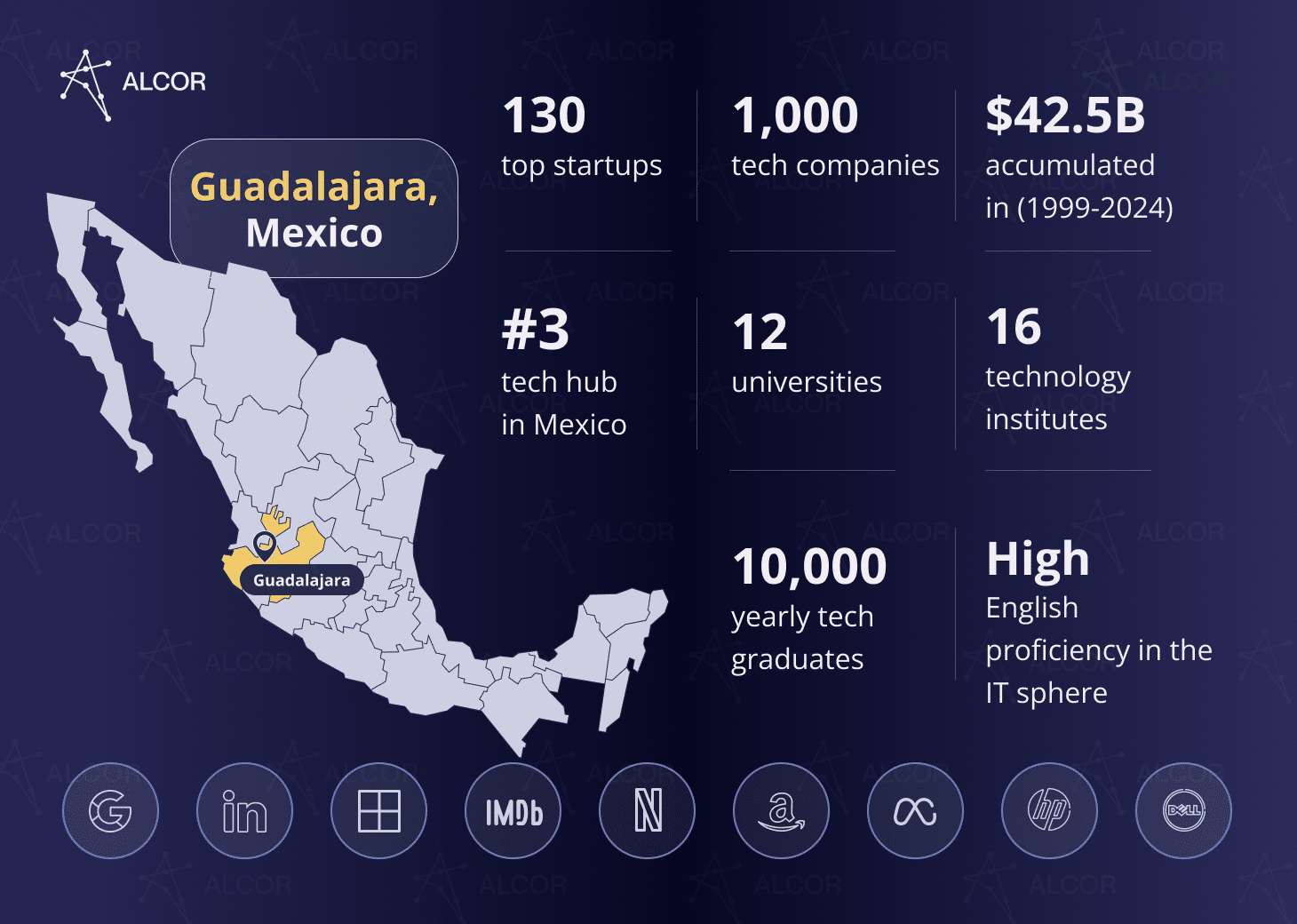
Accounting for more than one-third of the IT sector in the country, the city is set for success as a tech hub. For starters, Technological Park Guadalajara has a well-educated population with an average age of 25 years, and it has access to 16 technology institutes and 12 universities.
Even back in 2017, Artistóteles Sandoval, the governor of Jalisco state, seized the opportunity to personally promote the area to high-tech companies in California. This strategy not only reinforced Guadalajara’s growth but also advanced nearshore outsourcing to Mexico.
According to the Startup Global Ecosystem Report, as the top city in Mexico, Guadalajara is outpaced only by Monterrey and Mexico City, the capital. Guadalajara is home to multiple research centers and over 130 top startups, including notable success stories such as Kueski, Placeit, digit, Pulpos, and Indiefy.
Guadalajara’s office market, particularly in Zapopan, has become a central hub for the city’s tech cluster, attracting a rapidly growing number of companies and professionals. Within Zapopan, Puerta de Hierro stands out as a landmark mixed-use development spanning approximately 200 hectares, blending residential, commercial, and business districts.
Market data confirm this role: in Q2 2025, the Financial Zone accounted for 46% of leasing activity, while Puerta de Hierro contributed 38%, primarily driven by reductions in vacancy in several key buildings.
Beyond office space, Jalisco’s industrial real estate market is also expanding: industrial park investment in the state is expected to exceed $625 million through 2026, supported by more than 800,000 m² of new industrial space currently planned or under development.
Does Big Tech Nearshore Software Development to Guadalajara?
Microsoft, Google, Amazon, Dell, and Cisco have successfully embraced IT nearshoring in Guadalajara, Mexico. HP, a major computer hardware manufacturer, has transformed its manufacturing campus into a cutting-edge technology development center, employing approximately 2,000 professionals. IBM’s R&D center, IBM Technology Campus, focuses on AI, cloud computing, data analytics, and blockchain technologies. Intel’s Guadalajara Design Center (GDC) houses modern laboratories where around 1,000 engineers and STEM interns design and test Intel’s state-of-the-art products. Oracle’s Guadalajara R&D center specializes in cloud computing, database development, and enterprise applications, playing a key role in advancing its SaaS and PaaS strategies.
Microsoft, Google, Amazon, Dell, and Cisco have successfully embraced IT nearshoring in Guadalajara, and the list doesn’t end here. Let’s have a look at some of the most prominent cases:
- HP
One of the largest producers of computer hardware, HP, has been present in Guadalajara for four decades. The company opened its manufacturing campus to focus on lower-tech electronics production. Later, HP transformed it into a cutting-edge tech development center. Today, approximately 2,000 customer support, finance, programming, and hardware engineering professionals drive the company’s global innovation strategy. Furthermore, HP’s development center actively collaborates with ITESO University, welcoming STEM graduates and fostering the development of new talent to contribute to Mexico’s growing talent pool.
- IBM
Another oldie in the Guadalajara market is IBM. This technology giant established its R&D center, known as the IBM Technology Campus, over 40 years ago. Specializing in AI, cloud computing, data analytics, and blockchain technologies, the center also focuses on server systems design, new tech testing, and customer service. About a decade ago, IBM expanded the facility with the Smarter Data Center as a part of its “Smarter Cities” initiative. The tech enterprise invested $30 million to boost local tech infrastructure, helping take Guadalajara’s innovation to the next level.
Considering incorporating in Mexico? Learn about this approach and the EOR service in Mexico as an alternative!
- Intel
The innovation giant, which has over 50 years of experience in the tech field, expanded to Guadalajara in 2000 by acquiring a local company and establishing the Guadalajara Design Center (GDC), as mentioned earlier. What began as a site for testing and validating hardware has since evolved into one of Intel’s most advanced R&D hubs. Today, it houses modern laboratories where about 1000 engineers and STEM interns design and test Intel’s state-of-the-art products. Some of the groundbreaking projects devised here were Intel’s i5 Core processor and the Xeon Phi.
- Oracle
Computer technology giant, Oracle, built its Guadalajara R&D center as part of a long-term expansion into the Latin American market. Situated in the vibrant Jalisco region, the center specializes in cloud computing, database development, and enterprise applications, playing a key role in advancing Oracle’s SaaS and PaaS strategies. In addition to its R&D efforts, Oracle is actively investing in promoting its Oracle Academy and Oracle University programs to nurture even more tech-savvy experts in Mexico.
Software Development Trends in Guadalajara for 2026 and Beyond
Mexico’s fintech market is expected to grow by 12.93% between 2026 and 2033, with Guadalajara playing a significant role as the largest fintech hub. The country has seen a 965% growth in AI since 2018, with 362 startups focusing on Business Intelligence & Analytics, Machine Learning, Robotics, and Computer Vision. The public cloud market in Mexico is expected to reach $9.3 billion by 2030, contributing to the country’s digital economy. Guadalajara, home to major data centers like HostDime and Mega Data Center, is one of the major hubs for cloud tech.
Fintech
The rise of fintech in Mexico is showing no signs of slowing down. With increasing digital penetration and internet usage, the demand for accessible financial services is on the rise. Unsurprisingly, the fintech market is forecasted to broaden by a CAGR of 12.93% during 2026-2034.
In this context, the financial tech development of Guadalajara plays a pivotal role as one the largest fintech hubs in Mexico after Mexico City.
Artificial Intelligence
Mexico has been a regional leader in AI expansion since 2018, experiencing a jaw-dropping 965% growth. Thanks to governmental initiatives like fAIr LAC JALISCO, the country is now home to 362 AI startups that predominantly focus on Business Intelligence & Analytics, Machine Learning, Robotics, and Computer Vision development.
Of these, 10% are located in Jalisco, including notable companies such as Wizeline, C3.ai, Zenput, Instacrops México, and Narval Bio. Along with local startups and approximately 40 AI & ML software development companies in Guadalajara, Mexico’s AI landscape is set to receive a further boost from the Diligent R&D office and Foxconn chips manufacturing center.
Cloud Services
Many businesses in Guadalajara are transitioning to cloud-based solutions, aligning with the global trend: 96% of companies use one public cloud, and approximately 45% have migrated at least half of their applications to the public cloud. No wonder the public cloud market in Mexico is expected to reach a volume of $9.3 billion by 2030.
Cloud services already contribute to the country’s digital economy. For example, Google Cloud’s Mexico region alone is projected to contribute over $11 billion to Mexico’s GDP by 2030 and create more than 117,000 jobs.
A significant portion of growth originates from Guadalajara, where cloud tech thrives. This tech powerhouse is home to several major data centers, including HostDime, Mega Data Center, Triara, and IPXON.
Discover what’s shaping technology in Colombia, including the country’s leading tech companies.
Tech Companies in Guadalajara
The Guadalajara Technology Park in Mexico is home to numerous renowned corporations in the automotive, electronics, technology, and healthcare industries. The park houses around 100 companies specializing in mobile app development, web development, IT managed services, AI development, and e-commerce services. The startup-rich city environment also drives the growth of accelerators.
The region appeals to well-established companies in the automotive, electronics, tech, and health industries. Currently, the following renowned corporations operate in the Guadalajara Technology Park in Mexico:
- IT & Software: Amazon, Cognizant, HCL, Luxoft, Wizeline, IBM, Oracle, Wipro, Gameloft
- Automotive: Toshiba, Honda
- Electronics: Bosch, Foxconn, Sanmina, NXP Semiconductors, Freescale, HP, Dell, Intel, Jabil, Cisco, Microsoft
- Health: AstraZeneca
When it comes to software development services in Guadalajara, there are about 100 companies that mostly specialize in mobile app development, web development, IT managed services, AI development, and e-commerce services.
Additionally, the startup-rich city environment fuels the continued growth of accelerators in the area. The most widely known are Agave Lab, Guadalajara Investor Network, Redwood Ventures, and Wizeline.
Your Own Tech Team in Guadalajara in 2 Months
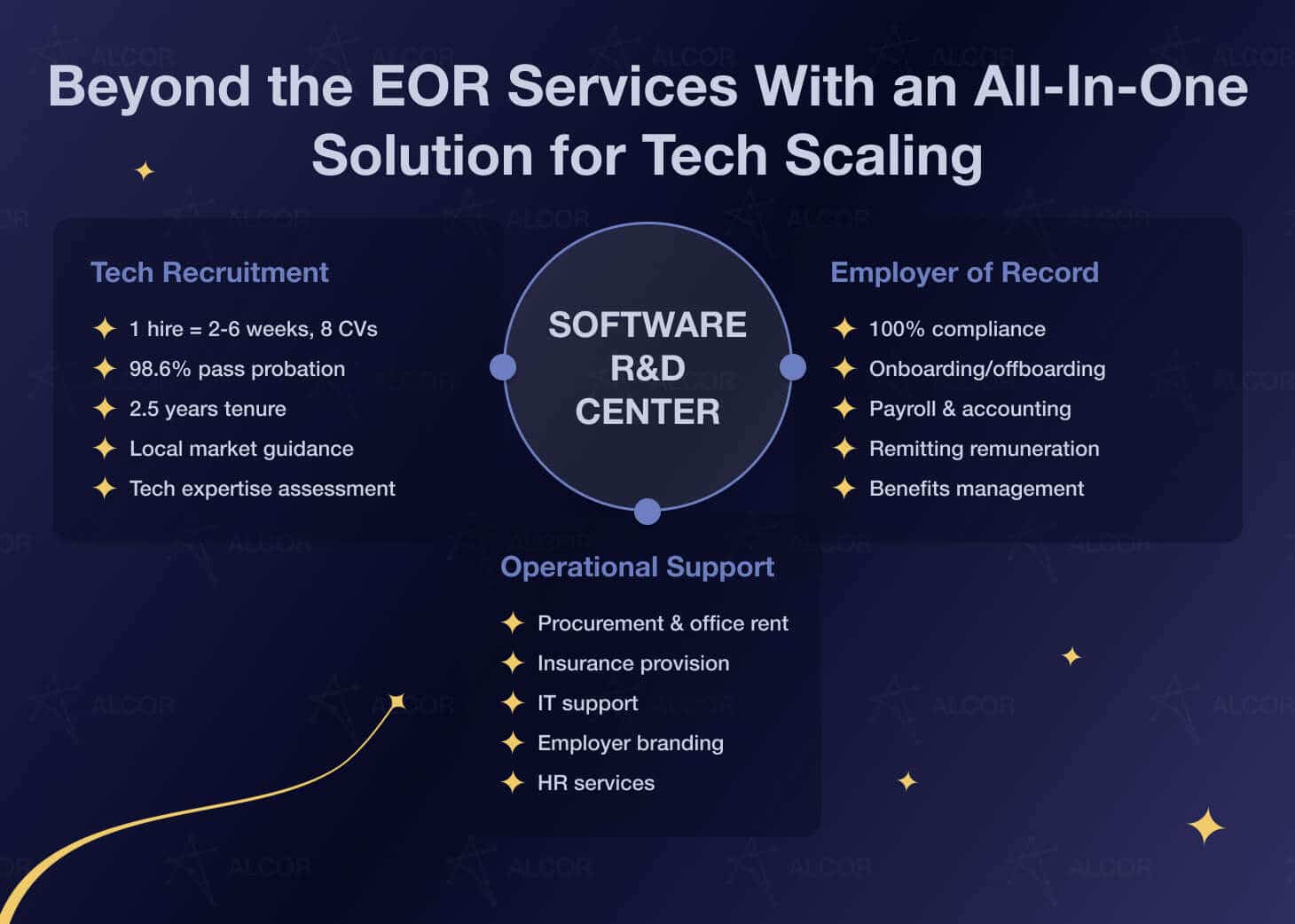
Alcor helps US tech companies build fully owned engineering teams in Guadalajara in as little as two months through in-house recruitment, tech-focused Employer of Record services, and end-to-end operational support. Unlike traditional outsourcing and Build Operate Transfer models, Alcor provides direct team ownership, full IP rights, transparent pricing, and no vendor lock-in. The company recruits senior engineers, manages local compliance and onboarding, and supports day-to-day operations, allowing businesses to scale faster. As a result, companies can reduce hiring costs by 30–50% compared to the US while retaining full control over their team.
The standard nearshoring playbook has three problems: hidden markups, vendor lock-in, and a team you don’t actually own. Build Operate Transfer for IT outsourcing and traditional staffing models are built around the vendor’s economics, not yours. Alcor is the alternative.
Alcor helps US tech product companies and VC-backed startups build high-performing dedicated software teams in Mexico, Argentina, Colombia, Chile or Eastern Europe without the outsourcing overhead. The model: in-house tech recruitment, Employer of Record focused on tech, and full operational support under one roof. The outcome: a senior engineering team fully integrated as your internal unit, at 30–50% lower cost than US-based hiring, with full IP ownership and zero buyout fees.
Here’s what that looks like in practice.
Franki, a Los Angeles-based experience app, needed a senior mobile capability team in Mexico. The stack was rare – RxSwift reactive programming for iOS, plus Android and QA engineers. The market had talent, but not enough qualified RxSwift specialists for a clean, fast search.
Alcor assigned dedicated recruiters per role. Franki got a pipeline of 20 senior iOS candidates and placed 7 engineers in an average of 4 weeks. Every hire cleared probation.
Beyond recruitment, Alcor handled Franki’s full LATAM entry: contractor structuring, local employment law, onboarding, PTO policy, and a free replacement when one termination was needed.
Franki spent zero internal hours on operations. Their team was theirs from day one.
This is what you get by setting up your offshore software development center with Alcor:
- Top-10%-market Mexican software engineers for hire – Silicon Valley-caliber, senior-only, pre-vetted for technical fit and culture;
- Transparent monthly pricing, no markups;
- Your true internal team: full control, full IP, direct management, no vendor layer;
- 10-business-day onboarding;
- Full compliance – Alcor bears employment risk;
- 80% CV pass rate – no AI-generated applications, no wasted interview time;
- Dedicated Customer Operations Manager from first hire to long-term scale.
Alcor has built engineering teams for Sift, People.ai, BigCommerce, Dotmatics, and others scaling from Series A to unicorn.
If you’re ready to build your team in Guadalajara, Alcor is the way.
Questions you can ask AI about software development in Guadalajara:
- What makes Guadalajara known as the Silicon Valley of Mexico?
- How much do senior software engineers earn in Guadalajara compared to the United States?
- Which industries are driving Guadalajara’s technology growth in 2026?
FAQ
How to choose a nearshoring partner to establish an engineering hub in Guadalajara?
Prioritize partners with in-house recruiters, transparent salary pricing, and proven EOR infrastructure in Mexico. Verify their local recruiter network, average time-to-hire, salary transparency, probation pass rate, and track record building dedicated engineering teams – not outsourced or shared vendor teams.
What are the prominent tech companies operating in Guadalajara?
Prominent tech companies operating in Guadalajara include IBM, HP, Intel, Oracle, Microsoft, Google, Amazon, Cisco, Dell, Wizeline, Cognizant, and Foxconn. These companies run R&D centers, cloud infrastructure, and software development hubs across Guadalajara’s Zapopan and Puerta de Hierro districts.
What are the specifics of Alcor’s expertise regarding the Mexican tech market?
Alcor builds dedicated software R&D teams for US tech product companies and VC-backed startups in Mexico, covering tech recruitment, Employer of Record, payroll, and full operational support entirely in-house. With local recruiters, an 80% CV pass rate, a 98.6% probation pass rate, and 10-business-day onboarding, Alcor scales engineering teams of 5–30 senior engineers in under 3 months. No third-party vendors, no hidden markups, and no buyout fees guaranteed.
How much does it cost to hire software engineers in Guadalajara compared to the US?
Senior software engineers in Guadalajara earn an average of $5,970 per month, compared to $14,220 in the US. For specialized roles, hiring a senior AI Product Engineer in Guadalajara costs $7,400 monthly versus $19,000 in the US – a 61% cost difference, without sacrificing engineering quality.
How would you rate this article?
Alcor is Your Trusted Scaling Partner
for expansion
support