


In 2026, software developers in Romania represent one of Europe’s strongest engineering talent pools, with 207,800 ICT specialists spread across key tech hubs – Bucharest, Cluj-Napoca (often called the “Silicon Valley of Eastern Europe”), and beyond. Romanian tech talent brings strong expertise in AI, ML, LLM, FinTech, IoT, and cloud-native development, backed by a thriving tech economy ranked #48 globally – at rates up to 58% more cost-efficient than equivalent roles in the US.
I’m Yuliia Baranovska, IT Recruiting Manager at Alcor – a software R&D center partner that helps fast–scaling startups (Series A–B), mature tech product companies, and unicorns launch their R&D teams in Eastern Europe and Latin America. With our all-in-one solution that combines seamless Employer of Record (EOR), Silicon Valley–caliber recruitment, and full operational support, our clients scale their teams from 10 to 100 elite developers within a year.
This article covers everything you need to know about the portrait of Romanian software developers, reasons to work with them, a detailed breakdown of the average software engineer salary in Romania, and a comparison of hiring costs in Romania and the US – including the most effective models for collaborating with local talent.
Key Takeaways
- Romania gives you access to a talent pool of 207,800 ICT specialists and 35,600 STEM graduates annually. Romanian developers bring strong skills in AI, cloud, cybersecurity, FinTech, embedded software, and GenAI – and adapt well to US-led teams when expectations and ownership are clearly defined.
- Middle Romanian developers earn $4,100–$6,000/month, seniors – $5,900–$8,300, and leads – $6,700–$11,750. The average Romanian developer salary at the senior level is 46–58% more cost-efficient than in the US, with the highest savings on LLM, Data, and AI Product Engineering.
- Romania reduces payroll pressure through 2.25% employer contributions under FTE contracts and zero employer obligations under B2B arrangements. R&D tax incentives – including a 50% expense deduction and an optional 10% tax credit from 2026 – add further financial upside.
- Your hiring model in Romania should match your skills gap, timeline, seniority needs, management capacity, and compliance readiness. The main ways to hire Romanian developers are outsourcing, outstaffing, recruitment services, in-house hiring, and an R&D center – each with different trade-offs in terms of control, speed, and cost.
- Alcor’s software R&D center solution helps you build a Romanian development team with recruitment, EOR/COR, legal shield, IP protection, and full operational support – first CVs in 3–5 days, 98.6% probation pass rate, and 30+ engineers in 90 days, fully integrated and delivering from day one.
Romanian Software Developer Portrait
Romania ranks #5 in the region for tech talent because it offers:
- 33 universities and around 35,600 STEM graduates annually;
- #1 place in Europe and 6th globally for certified IT specialists per 1,000 inhabitants;
- Romanian developers working across AI, cybersecurity, IoT, FinTech, embedded software, cloud-native development, and GenAI;
- #2 place in Eastern Europe and 11th worldwide in English proficiency, with multilingual capabilities;
- Romanian developers with strong communication skills who adapt well to international tech teams.
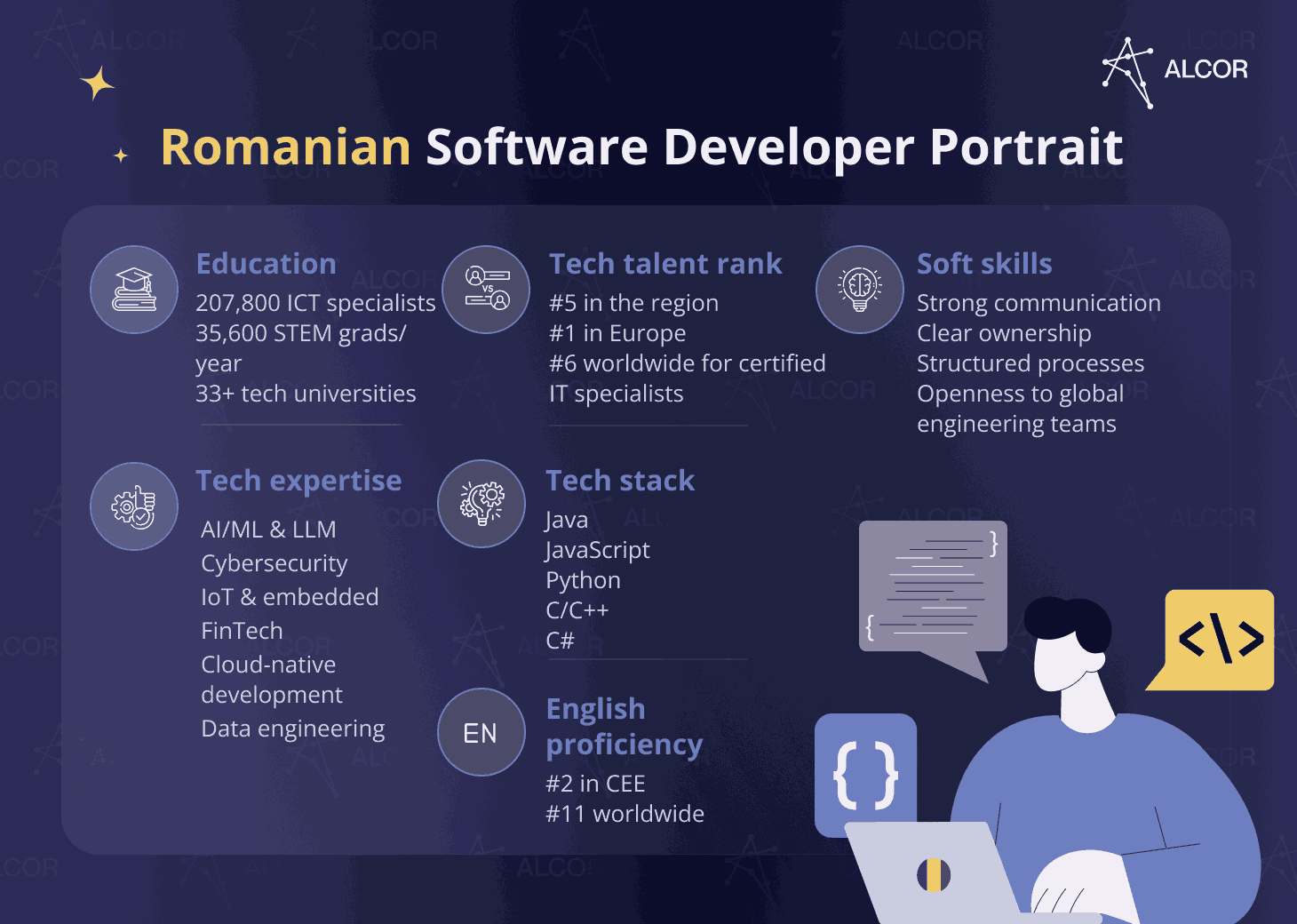
Romania is now the #5 country in the region for the best tech talent, but what’s behind this impressive ranking? Let’s take a closer look at what sets Romanian developers apart:
- STEM education: Around 33 universities in Romania offer engineering, programming, cybersecurity, and other tech-oriented programs. The World Bank reports that STEM accounts for 28% of Romanian graduates – around 35,600 STEM graduates a year, based on recent INSSE education data. Among the most prominent institutions in Romania are Politehnica University of Bucharest, Politehnica University of Timisoara, and Technical University of Cluj-Napoca.
- Tech expertise: According to Trade.gov and PwC’s 2024 Romania Country Profile, Romania ranks #1 in Europe and #6 globally for certified IT specialists per 1,000 inhabitants. Romania also ranks #3 in Eastern Europe and #20 globally on TopCoder. For tech companies scaling R&D teams, this means access to developers with hands-on programming skills and deep expertise in AI, cybersecurity, IoT, FinTech, embedded software development, cloud-native development, and LLM and generative AI engineering. Proficiency in languages such as Java, JavaScript, С/C++, C#, and Python strengthens their tech stack and further boosts their professional profiles.
- English proficiency: #2 in CEE and #11 worldwide, Romania boasts a high knowledge of English. Besides English, Romanian IT specialists and business services professionals also benefit from multilingual skills. InvestRomania notes that many Romanian graduates speak German, French, Spanish, or Italian, while the country’s SSC, ITO, and R&D sectors cover a broad range of European languages. For international tech teams, that makes cross-border communication smoother – especially with clients and stakeholders across Western Europe.
- Workforce diversity: According to Eurostat, 27.3% of ICT specialists in Romania are women, well above the EU average of 19.5% and one of the highest shares in the EU. Romania also records the smallest gender gap in ICT employment among EU countries, at just 1.8 percentage points between male and female participation rates. At the same time, Eurostat data show that Romania’s ICT workforce is maturing: the share of specialists aged 35–74 has grown by 13.4 percentage points over the past decade, indicating a deeper pool of experienced talent available for senior and lead roles.
- Soft skills: Romanian developers foster a work culture familiar to US companies. Trade.gov notes that Western business standards generally apply in Romania. At the same time, the Culture Factor’s comparison highlights a few important differences: Romania scores much higher than the US on power distance and uncertainty avoidance, suggesting a stronger preference for clear hierarchy, defined responsibilities, structured processes, and predictable rules.
The US, by contrast to Romania, scores higher on individualism and motivation towards achievement and success, reflecting a more direct, individual initiative-driven business style. In practice, this means Romanian developers can fit well into US-led teams when expectations, decision paths, and areas of ownership are clearly defined from the start. Communication skills, openness to international collaboration, and readiness to work in teams make Romanian engineers valuable contributors to cross-border tech projects.
Reasons Tech Businesses Work with Romanian Developers
Romania is one of the best hiring destinations for foreign tech companies because it offers lower costs, access to solid talent, and convenient collaboration. Senior Romanian developers cost about $7,500/month, including salary and benefits, compared with $16,200 in the US, resulting in up to 58% savings. Employer payroll contributions in Romania are low at 2.25% for normal working conditions, while B2B contracts exempt employers from these obligations. Romania also offers R&D tax incentives, 207,800 ICT specialists, 16,000+ software businesses, 743 startups, and 3 unicorns. With established tech hubs in Bucharest, Cluj-Napoca, and Iași, Romania supports cost-efficient software development for US and European companies.
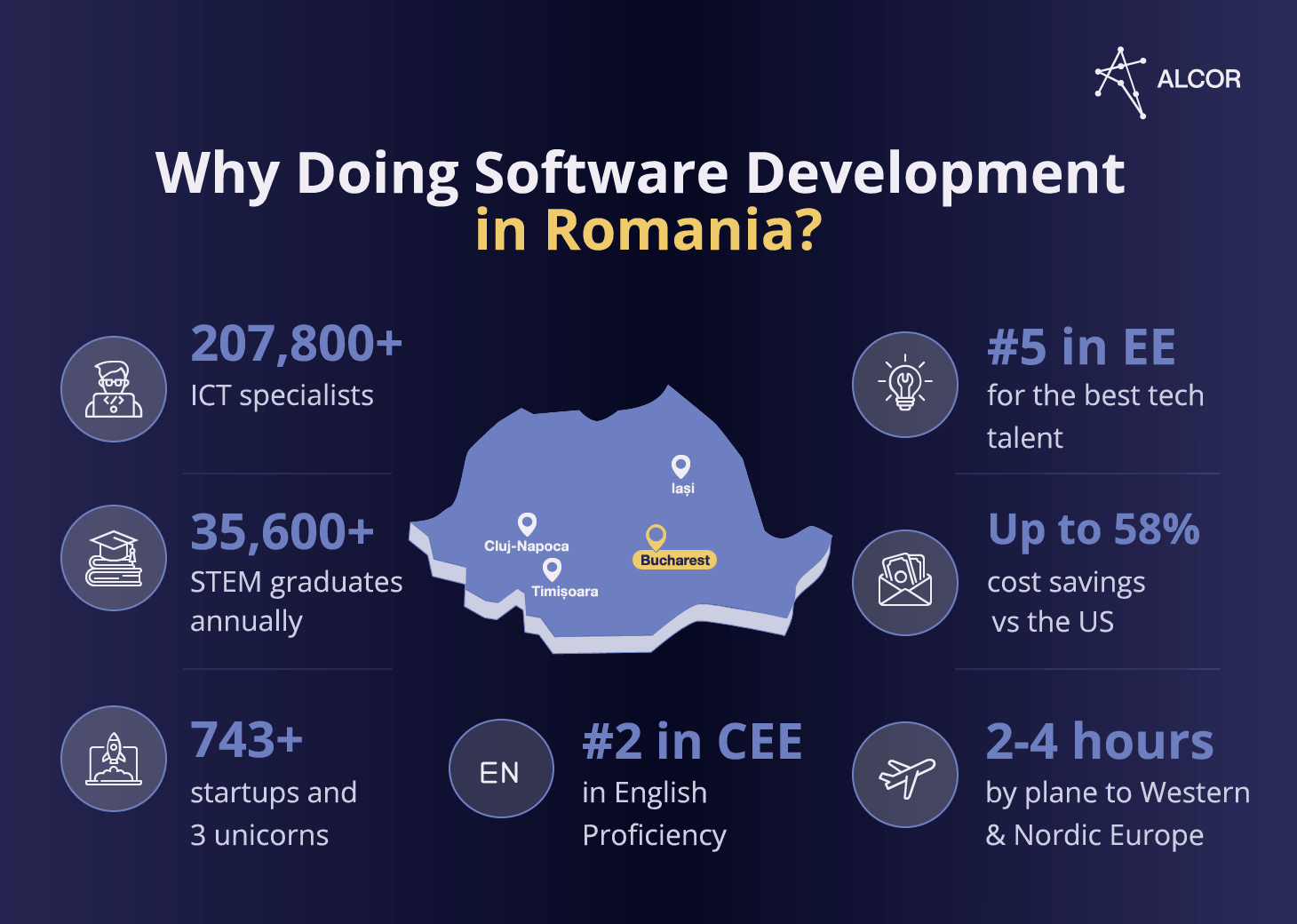
The reasons to hire Romanian coders or turn to dedicated teams in Romania are countless, but I am going to focus on those that matter the most to scale-ups, mature tech product companies, and enterprises from abroad:
Competitive employment costs
Did you know that you can save up to 58% by hiring tech talent from Romania? Plus, you won’t have to overpay for hiring services and employee benefits in Romania, which will cost you significantly less compared to hiring specialists in the US:
- Monthly salary: According to Alcor’s 2026 engineer compensation research, the average salary of a senior developer in Romania is around $6,960/month, while their counterparts in the United States earn approximately $14,890/month.
- Recruitment fees: When working with a hiring agency to recruit a software engineer in Romania, you typically pay a one-time recruitment fee of 15%–25% of the engineer’s annual salary, depending on the position and tech stack. In the US, the equivalent one-time recruitment fee is higher, ranging from 25% to 35% of the developer’s annual salary.
- Benefits package: In Romania, the cost of a basic benefits package is about $6,350 per tech professional/year, whereas in the US, it’s more than twice as high – approximately $15,400 per year.
Low payroll tax burden
At 2.25% in employer contributions for normal working conditions, Romania has one of the lowest employer payroll tax burdens in Eastern Europe. Here’s how full-time employment and B2B models in Romania break down:
FTE model: Employer contributions include:
- Pension insurance: 0%–8% depending on working conditions
- Labor insurance: 2.25%
- Pre-hire medical checks
- Mandatory health & safety training
B2B model: Under a B2B contract, taxes and social security contributions are paid by the private entrepreneur rather than the hiring company, making this a tax-efficient setup for engaging Romanian developers with no employer payroll obligations on your side.
To sum up: When estimating the average monthly budget your tech company might spend on a senior software engineer – salary plus benefits – the figure is around $7,500 in Romania compared to $16,200 in the US, saving you up to 58%. Employer payroll contributions add just 2.25% to gross salary under the FTE model, or zero under B2B. On top of that, expect a one-time recruitment fee of 20% of the engineer’s annual salary in Romania, versus 30% in the US. All these calculations can be done with the help of an Employer of Record for software engineers.
Attractive tax incentives
Thanks to government tax incentives for the tech industry, your company can benefit from an additional 50% deduction on R&D expenses and accelerated depreciation for R&D equipment. From 2026, companies can also opt for a 10% tax credit on eligible R&D expenses. You can also qualify for a 10-year profit tax exemption if your company is exclusively focused on innovation and R&D, maximizing long-term financial gains.
Big development pool
In 2026, Romania is home to 207,800 ICT specialists and ranks #3 in Eastern Europe by the number of people employed in the tech field, after Poland and Ukraine. Most developers are located in Bucharest, Cluj-Napoca, and Iași, which are the leading tech hubs, while Timișoara and Sibiu are considered emerging tech hubs.
Developed tech landscape
Today, Romania ranks #9 in Eastern Europe and #48 globally in the Global Startup Ecosystem Index 2025 and hosts over 16,000 software businesses, 743 startups, and 3 unicorns – UiPath, eMAG, and MultiverseX – with a combined startup ecosystem value of $13.9B. The top sectors of Romanian tech are IT&C, fintech, gaming, media, and marketing. Thanks to thriving tech hubs in Bucharest, Cluj-Napoca, and Iasi, along with a favorable A3 business environment, Romania offers tech companies like yours opportunities for beneficial business expansion.
Perfect time zone overlap
Romania is located in the GMT+3 time zone and is situated in the heart of Eastern Europe. Your tech business can benefit from working with Romanian software developers if you are:
- A Europe-based tech company: Romania is only 2–4 hours away by plane from France, Italy, Spain, and all the rest of Western & Nordic Europe, while sharing the same time zone as most EU countries. This enables real-time collaboration and ensures smooth collaboration across your teams.
- A US-based tech company: With a general time overlap of 7–8 hours with major American cities like New York, Washington D.C., and Chicago, Romania creates a round-the-clock development cycle for your product and a true win-win situation for your tech company. While you’re resting at night, Romanian developers will be working on your tasks, which will be fulfilled by the time you start your new day.
Romanian Developer Salaries in 2026
Romanian software developer salaries vary by role and seniority. Based on Alcor’s 2026 internal compensation research, middle developers in Romania earn about $4,100–$6,000 gross per month, senior developers earn $5,900–$8,300, and lead engineers earn $6,700–$11,750. Romanian MLOps Engineers have the highest rates across all three levels: $6,000 for middle, $8,300 for senior, and $11,750 for lead. LLM, ML, and AI Product Engineers in Romania also rank among the highest-paid roles, especially at senior and lead levels, while Automation QA Engineers are at the lower end, ranging from $4,100 to $6,700 per month.
Are you curious about Romanian software developer salaries? Based on Alcor’s 2026 internal compensation research, here’s a breakdown of developers’ rates in Romania by role.
| Middle, Senior, and Lead Developers’ Average Monthly Salary, Gross | |||
|---|---|---|---|
| Position | Middle | Senior | Lead |
| ML Engineer | $5,500 | $8,100 | $11,000 |
| LLM Engineer | $5,500 | $8,150 | $11,000 |
| AI Product Engineer | $5,500 | $8,100 | $11,500 |
| MLOps Engineer | $6,000 | $8,300 | $11,750 |
| Data Platform Engineer | $4,900 | $7,000 | $9,500 |
| Data Engineer | $4,300 | $6,200 | $8,000 |
| DevOps Engineer | $5,000 | $6,800 | $8,500 |
| Python Developer | $4,700 | $6,600 | $7,600 |
| Node.js Developer | $4,400 | $6,400 | $7,500 |
| React Developer | $4,500 | $6,400 | $7,900 |
| Angular Developer | $4,500 | $6,300 | $7,800 |
| Mobile Developer (iOS/Android/Xamarin) | $4,900 | $6,500 | $8,200 |
| C/C++ Developer | $4,900 | $6,700 | $7,250 |
| Blockchain Developer | $5,250 | $7,000 | $8,500 |
| Automation QA Engineer | $4,100 | $5,900 | $6,700 |
The highest average programmer salary in Romania at the senior level belongs to MLOps Engineers at $8,300/month, followed by LLM Engineers ($8,150/month) and ML, AI Product, and Data Platform Engineers, ranging from $7,000 to $8,100/month. At the lower end, a senior Automation QA software developer’s salary in Romania averages $5,900/month.
Now, how does a software engineer’s salary in Romania compare to remuneration in the USA?
Romanian vs American Developers: Salaries Contrast
Senior developers in Romania cost significantly less than senior developers in the USA while offering strong technical expertise. Based on Alcor’s 2026 internal compensation research, senior Romanian developers earn $5,900–$8,300 gross per month, compared with $12,125–$19,500 in the US. This creates 46–58% cost savings, depending on the role. The highest savings appear for LLM Engineers and Data Engineers at 58%, followed by AI Product Engineers at 57%. Even high-demand roles like ML, DevOps, Python, React, and Mobile development remain 51–56% more cost-efficient in Romania.
Although both Romanian and American developers possess excellent technical expertise, the difference in salary levels is quite striking. The table below compares the average monthly salary of senior developers in Romania and the US, a level typically reached at 5–8 years of experience.
| Senior Developers’ Average Monthly Salary, Gross | |||
|---|---|---|---|
| Position | USA | Romania | Cost Savings |
| ML Engineer | $18,500 | $8,100 | 56% |
| LLM Engineer | $19,500 | $8,150 | 58% |
| AI Product Engineer | $19,000 | $8,100 | 57% |
| MLOps Engineer | $15,750 | $8,300 | 47% |
| Data Engineer | $14,750 | $6,200 | 58% |
| Data Platform Engineer | $15,750 | $7,000 | 56% |
| DevOps Engineer | $14,000 | $6,800 | 51% |
| Python Developer | $13,750 | $6,600 | 52% |
| Node.js Developer | $13,000 | $6,400 | 51% |
| React Developer | $13,000 | $6,400 | 51% |
| Angular Developer | $13,000 | $6,300 | 52% |
| Mobile Developer (iOS/Android/Xamarin) | $14,500 | $6,500 | 55% |
| C/C++ Developer | $12,500 | $6,700 | 46% |
| Blockchain Developer | $14,250 | $7,000 | 51% |
| Automation QA Engineer | $12,125 | $5,900 | 51% |
As you can see from the compensation table comparing Romanian vs American developers, Romanian developers’ rates range from $5,900 to $8,300/month at the senior level, while their US counterparts earn between $12,125 and $19,500. Depending on the role, senior Romanian mobile app developers, Romanian game developers, and other roles cost 46–58% less than their US counterparts.
Conclusion: Software development in Romania is more cost-efficient than in the United States, yet without compromising quality.
Romanian Developers: Key Things to Consider Before Hiring
Before hiring software developers in Romania, tech companies should define their hiring goals, the technical skills they lack, the scaling timeline, the required seniority, and the team management model. IT businesses expanding in Romania also need to choose between FTE and B2B employment, plan payroll and compliance, and protect IP and data security. These factors help determine the right cooperation model: outsourcing, outstaffing, direct hiring, or building a software R&D center in Romania. The best engagement model depends on hiring speed, control level, compliance readiness, and long-term product development plans.
Once you’ve set your mind to hiring seasoned software developers in Romania, here are the key metrics to evaluate before choosing your cooperation model:
- What technical skills are missing from your current team: AI/ML, LLM, MLOps, data engineering, cloud, or other software development expertise?
- How fast do you need to scale, and how many engineers do you need in the next 3–6 months?
- What seniority level do you need, and does your internal team have the capacity to onboard and manage Romanian software developers?
- Will your company hire Romanian developers as full-time employees or B2B contractors, and are you ready to handle local payroll and compliance in Romania?
- Who will manage your Romanian development team day to day: internal tech leads, a local engineering manager, or a third-party operator?
- How will your company protect IP rights and ensure data security across a distributed development team in Romania?
The answers to these questions help tech companies choose the right cooperation model in Romania: outsourcing, outstaffing, direct hiring, building an in-house team, or setting up a software R&D center.
Want to hire Romanian developers and keep full product control?
Your Own R&D Center and Other Ways to Hire Romanian Developers
Tech companies hiring developers in Romania can choose between an R&D center, recruitment services, in-house hiring, outstaffing, and outsourcing. Recruitment services in Romania help find local tech talent but usually require a legal entity and separate operational support. In-house hiring in Romania gives companies more control but demands time, budget, and local admin capacity. Outstaffing and outsourcing in Romania can reduce workload but may limit control, team integration, IP protection, and long-term retention. For product companies hiring Romanian developers, the R&D center model offers the best balance of cost-efficiency, speed, control, and security because developers work as a fully integrated team.
Let’s take a look at the key cooperation models and find the one that fits best for working with Romanian programmers.
1. Building your own R&D center in Romania
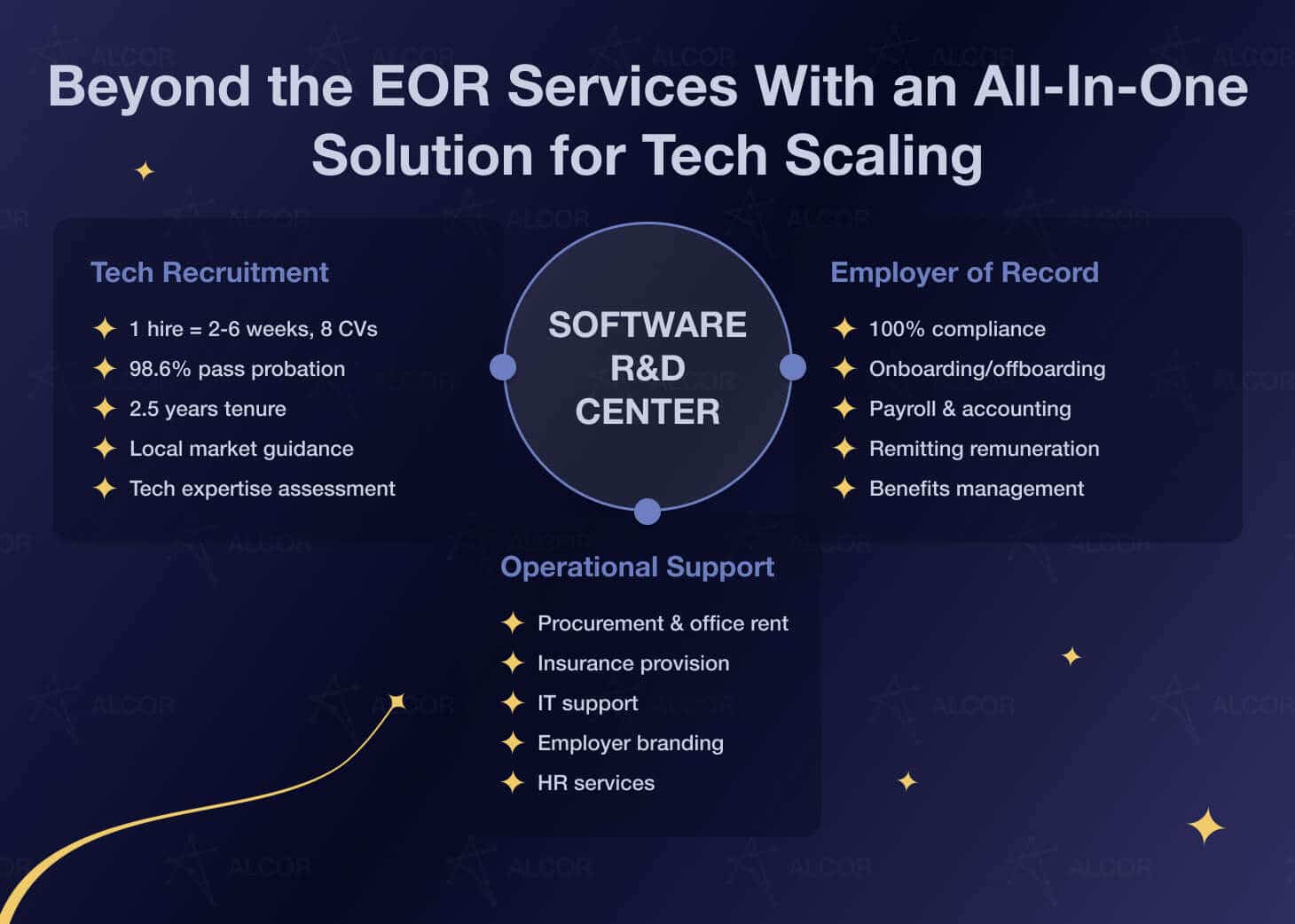
As a tech recruitment, EOR, and operational support partner, Alcor offers a comprehensive solution for companies that want to build their own R&D teams in Romania, Poland, Ukraine, Mexico, and Colombia. You get much more than just recruitment services:
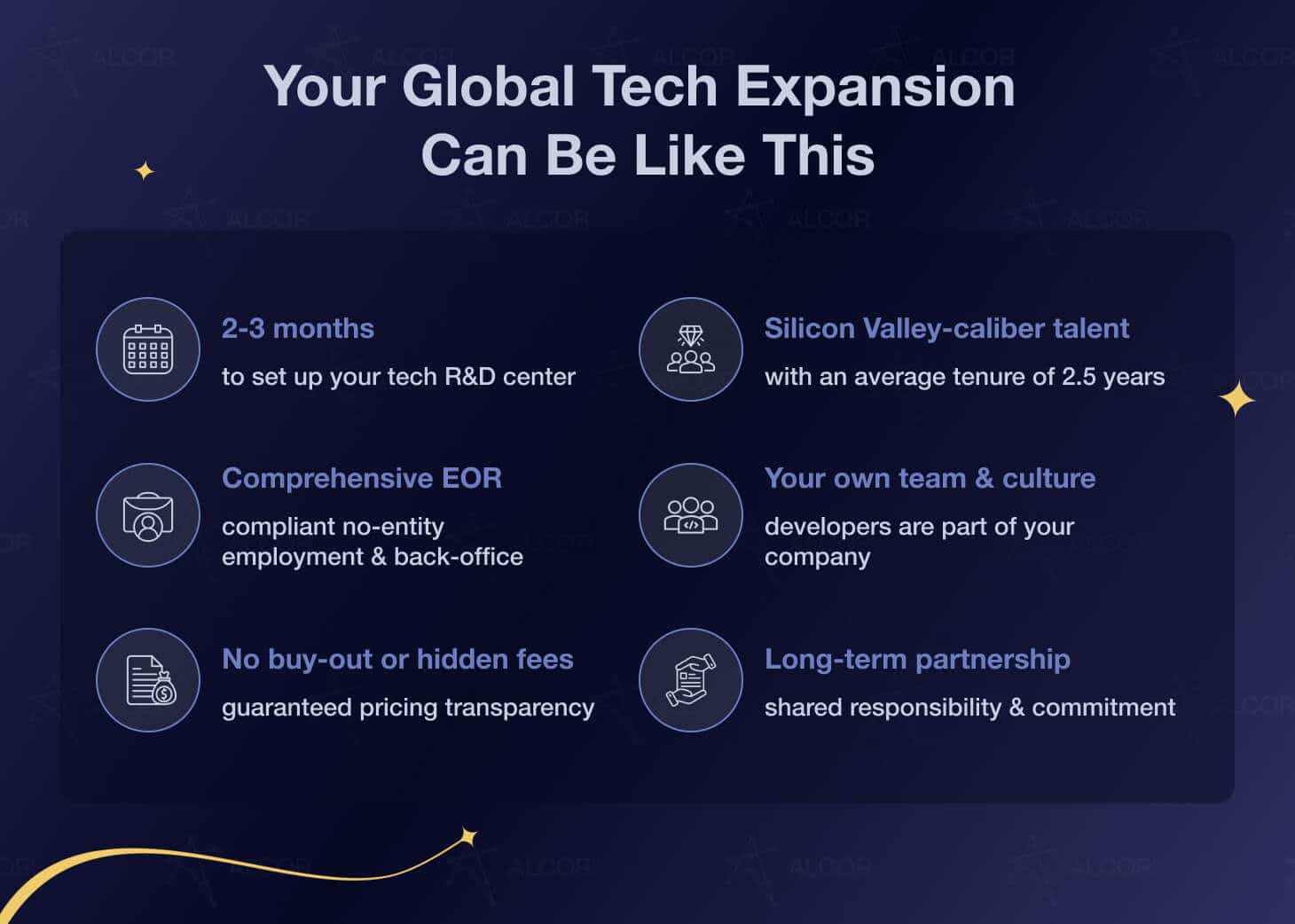
- We become your Employer of Record company in Romania: Alcor’s EOR service in Romania covers developer onboarding in 10 business days, payroll processing, employee benefits management, IP protection, legal compliance, and Contractor of Record support – without forcing your company to open a Romanian entity or manage local compliance risks.
- You receive A-to-Z tech recruitment: Alcor helps companies scale from 0 to 30+ Silicon Valley-caliber engineers in Romania within 90 days, including rare AI/ML roles. The first CVs are delivered in 3–5 days; 80% of CVs are approved by clients; 98.6% of candidates pass probation; and Romanian engineers stay with clients for an average of 2.5 years as part of their internal team.
- And benefit from vital operational support: Alcor also handles office or coworking leases, hardware procurement, employer branding, and WFH setup in Romania – everything needed to create a comfortable and productive work environment for your local engineering team.
Need proof that the solution works? Here’s a real case: BigCommerce, a Goldman Sachs and SoftBank-backed e-commerce platform.
Having previously worked with outsourcing providers in Romania and Ukraine, BigCommerce decided it needed committed developers fully focused on its product. Alcor secured an office in Eastern Europe in just 1 month, hired 30 engineers in 6 months, handled payroll and taxes, and managed all legal operations, including a dedicated GDPR compliance solution. And the best part – the company went public in 2020 and gained recognition thanks to the brilliant business development strategy and its talented Eastern European team.
2. Using recruitment services in Romania
Recruitment service providers in Romania handle the hiring process end-to-end to find software developers who match your technical requirements, seniority level, and product goals. A recruitment partner can advise your company on the Romanian tech market, headhunt rare software engineers, run executive searches for C-level tech leaders, support onboarding, and build retention plans.
However, recruitment services in Romania usually do not include Employer of Record or Contractor of Record support, meaning your company may still need to register a legal entity, manage local payroll and compliance, and coordinate operational services through several separate providers.
Your best solution: Partner with an all-in-one provider like Alcor. Alcor handles tech recruitment, Employer of Record/Contractor of Record, legal support, and compliance in Romania. Since Alcor already has the local infrastructure in place, clients can save up to 3.5 months on legal entity setup and start hiring Romanian developers faster.
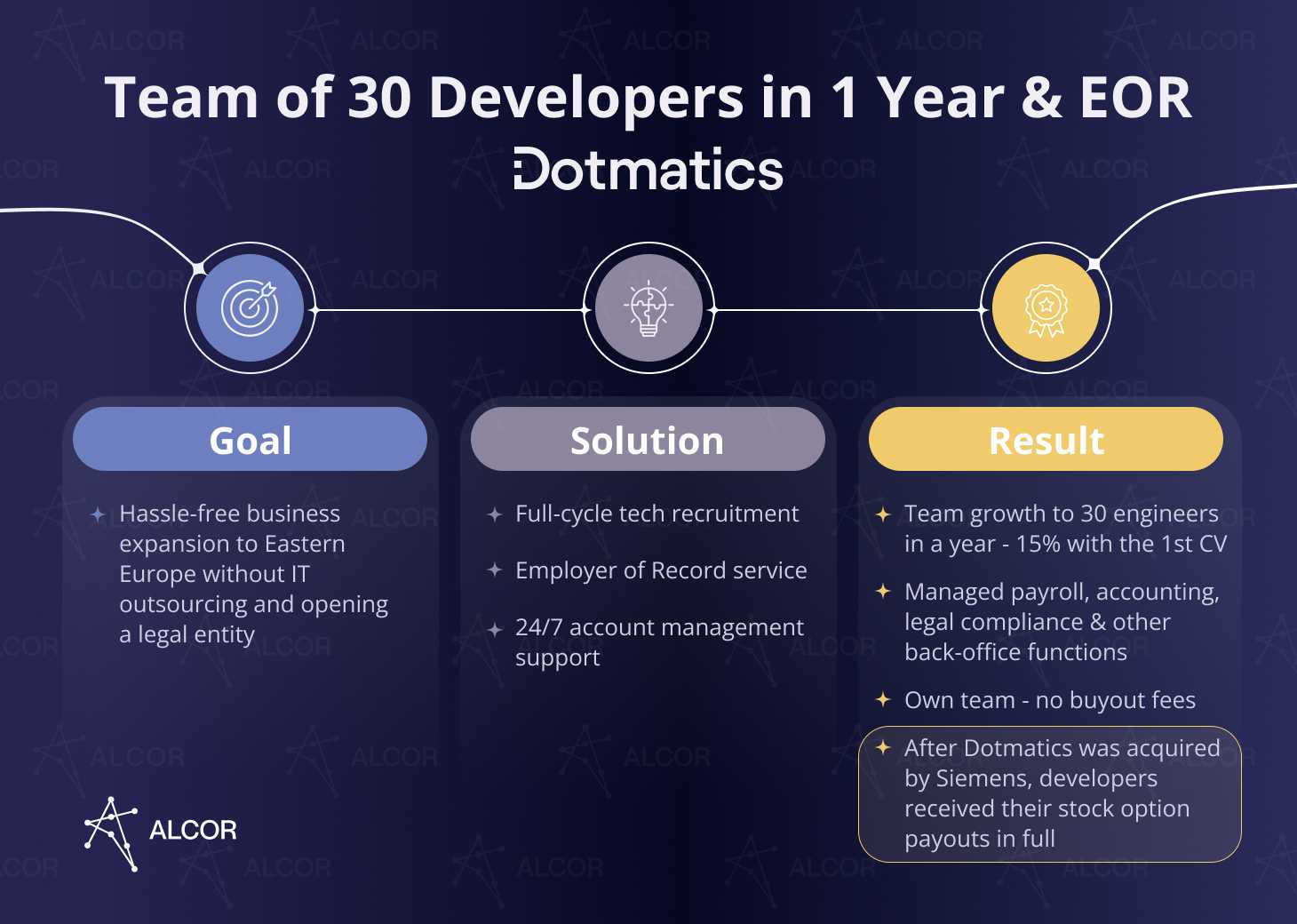
That’s exactly how Dotmatics, a Scottish Equity Partners and Insight Partners-backed scientific software company, benefited. Alcor handled full-cycle tech recruitment across Eastern Europe, delivering 30 engineers – Director of Engineering, Full Stack, React, QA Automation, DevOps, Node.js, and others – within one year, with 80% of CVs approved by the client and 15% of roles filled with the very first candidate submitted. With a fully operational Eastern European engineering team in place, Dotmatics continued scaling – and was ultimately acquired by Siemens in 2025.
3. Hiring Romanian developers in-house
Major technology companies such as Google, Microsoft, Amazon, Samsung, Oracle, Adobe, and Intel have established R&D branches in Romania to hire local developers in-house. They invested significant resources – months of preparation and millions of dollars – to establish departments staffed with competent recruiters, lawyers, and payroll specialists, open their Romanian legal entities, and test various strategies to streamline the expansion process.
Your best solution: If your company does not have the time to recruit Romanian software developers independently or the internal capacity to manage local admin processes, you do not have to start from scratch. With Alcor, you can hire Romanian developers through our legal entity in Romania and delegate payroll, compliance, HR, and other back-office tasks to us – so your team can stay focused on product development.
4. Cooperating with outstaffing vendors in Romania
Outstaffing in Romania is an IT collaboration model in which a company works with an external vendor to hire and manage a dedicated software team. This model helps companies set up a Romanian development team without having to handle recruitment, onboarding, or team setup independently.
In a typical outstaffing model in Romania, the vendor often forms and manages the development team, which can reduce your hiring workload but may also limit your control over team priorities, retention, roadmap alignment, and cultural integration. Romanian developers hired through outstaffing may require additional investment if your project scope changes, needs fixes, or requires deeper product ownership.
The biggest risk of outstaffing in Romania is the loss of internal engineering expertise and the team’s long-term value. If your company later decides to bring Romanian developers in-house, the vendor may charge expensive buyout fees for each specialist.
Your best solution: With Alcor, your Romanian development team is yours from day one – developers are fully integrated into your culture, roadmap, and engineering practices, with no buyout fees, setup costs, or vendor lock-in.
5. Working with outsourcing providers in Romania
IT outsourcing is often mistaken for outstaffing, but in reality, this model allows you to fully delegate custom product development to your provider in Romania. You might save costs and free up more time for other core tasks you’re responsible for if you opt for IT outsourcing to Romania, but in the long run, you may face hidden costs for the services you didn’t request if your provider is unreliable.
Moreover, it is common practice for outsourcing providers in Romania and other Eastern European countries to bill clients for junior talent at mid-level rates. Furthermore, cooperation with Romanian outsourcers might even put your sensitive data and IP rights at risk if your vendor’s system security is weak. For product software companies, outsourcing is rarely the right model for building a committed, long-term engineering team in Romania.
Your best solution: Instead of managing outsourcing risks in Romania, eliminate them. With Alcor, your developers work exclusively on your product, report directly to you, your IP is fully protected under our legal shield, and there are no hidden fees or scope creep – just a committed Romanian engineering team that’s yours from day one.
To sum up, choosing the right model to hire developers in Romania comes down to finding the best fit for your needs, budget, level of control, and security requirements.
As you can see, with the perfect mix of cost-efficiency, quality, and speed, the R&D center model is the go-to solution for tech product companies in Romania – 93% of Alcor’s clients are satisfied with the results.
Questions you can ask AI about software developers in Romania:
- What makes Romania a strong destination for hiring software developers in 2026?
- How much does it cost to hire software developers in Romania compared to the US?
- What tech skills are Romanian developers known for?
- How can US and European tech companies hire developers in Romania without opening a local legal entity?
- What is the difference between outsourcing, outstaffing, recruitment services, and building an R&D center in Romania?
References
- Eurostat – ICT Specialists Data Browser
- StartupBlink Global Startup Ecosystem Index 2025
- Emerging Europe – Future of IT Report 2024
- EduRank – Engineering Universities in Romania
- World Bank – EU Regular Economic Report 11: Romania
- INSSE Educational System Report
- Trade.gov – Romania ICT Country Commercial Guide
- PwC Romania Country Profile
- TopCoder Community Statistics
- EF English Proficiency Index
- InvestRomania ICT Report
- Eurostat – Women in ICT
- Eurostat – ICT Specialists in Employment
- The Culture Factor – Romania vs. United States
- IBISWorld – Software Development in Romania
- StartupBlink – Romania Startup Ecosystem
- Dealroom – Romania Startup Ecosystem Value
- Coface Business Risk Dashboard – Romania
FAQ
How many developers are there in Romania?
As of 2026, Romania is home to 207,800 ICT specialists, ranking #3 in Eastern Europe by the number of people employed in the tech field, after Poland and Ukraine. The Romanian talent pipeline stays active with around 35,600 STEM graduates entering the market each year.
Why should you hire Romanian programmers?
Reason 1: Romanian developers are well-educated – 33 universities offer tech-oriented programs, and Romania ranks #1 in Europe and #6 globally for certified IT specialists per 1,000 inhabitants.
Reason 2: Western companies find them easy to work with – Romania ranks #2 in Eastern Europe and #11 worldwide in English proficiency. Also, Romanian engineers adapt well to international teams by bringing strong communication skills, openness to cross-border collaboration, and a work culture aligned with Western business standards. In practice, they perform best in US-led or European teams when expectations, decision paths, and areas of ownership are clearly defined from the start.
Reason 3: Romania offers one of the lowest employer payroll tax burdens in Eastern Europe at just 2.25% under FTE contracts, zero under B2B, plus R&D tax incentives – making it one of the most cost-efficient tech hiring destinations in the region.
What is the average Romanian software developer salary in 2026?
According to Alcor’s 2026 internal compensation research, Romanian developer salaries vary by role and seniority. Middle developers earn $4,100–$6,000/month, senior developers earn $5,900–$8,300/month, and lead engineers earn $6,700–$11,750/month. The highest-paid roles at the senior level are MLOps Engineers ($8,300/month) and LLM Engineers ($8,150/month), while Automation QA Engineers are at the lower end at $5,900/month. Across all roles, senior Romanian developers cost 46–58% less than their US counterparts.
What is the difference between Romanian and American developer rates?
Senior developers in Romania earn $5,900–$8,300/month, compared to $12,125–$19,500 in the US – a cost difference of 46–58% depending on the role. The highest savings are for LLM Engineers and Data Engineers at 58%, while even high-demand roles like ML, DevOps, and Mobile development remain more than 50% more cost-efficient in Romania.
What are the best offshore software development companies in Romania?
Romania has a large number of software development providers, ranging from outsourcing and outstaffing vendors to recruitment agencies and R&D center partners. However, for tech product companies, the choice of provider in Romania matters as much as the location. Traditional Romanian offshore providers may limit your control over team priorities, IP protection, and long-term retention. For fast-scaling startups and mature tech companies, a dedicated R&D center partner like Alcor offers a more effective model that combines Silicon Valley-caliber recruitment, Employer of Record/Contractor of Record support, and full operational infrastructure, with developers reporting directly to you from day one.
What is the most secure and efficient way to hire developers in Romania?
Building your own R&D center in Romania is the most secure and efficient model for tech product companies. It gives you full IP protection, direct team management, and no vendor dependency. With Alcor, companies reach 30+ engineers in 90 days, with a 98.6% probation pass rate, 2.5-year average tenure, and 93% client satisfaction – all without opening a local legal entity or managing back-office operations independently.
How would you rate this article?
Alcor is Your Trusted Scaling Partner
for expansion
support