


The tech hubs in Latin America – Mexico, Brazil, Colombia, Argentine, and Chile – are growing, and I can prove it:
- Fact #1: Per Mordor Intelligence, South America’s IT market is set to reach $409.52 billion by 2030, growing at a 7.86% CAGR.
- Fact #2: According to a MarkWide Research report, the LATAM fintech market is valued at $48.7 billion in 2026, on track to reach $240.2 billion by 2035.
- Fact #3: A 2.3+ million tech talent pool is available across LATAM.
- Fact #4: LATAM startups raised $4.1 billion in venture capital across 681 rounds in 2025, and Crunchbase data shows Q1 2026 is already up 12% year-over-year.
What are the drivers of this growth? Talented LATAM software developers, 58% cost savings on senior engineers compared to the US, and many other factors, so tech product companies grow and scale fast.
If you’re a tech product company looking to scale without setting up a local legal entity, Alcor got you covered. With our all-in-one tech R&D center solution – tech recruitment, Employer of Record, and 360-degree operational support – we help you go from idea to a team of 10-30 senior engineers in just 3 months. Your engineers work exclusively under your brand, fully compliant, with no entity setup, no IP exposure, and no hidden fees.
In this article, you’ll go through the details about the top Latin American hubs for software product development, get the stats regarding their tech ecosystems, uncover the salaries of local developers, and learn how tech firms hire in Latin America.
Key Takeaways
- LATAM’s IT services market grows by $58.78B through 2030, with 85% of startups already running generative AI and 5G hitting 50% regional coverage by 2030.
- Five distinct markets – Mexico, Brazil, Colombia, Argentina, Chile – each with a different edge in talent depth, cost, English fluency, AI maturity, and infrastructure.
- Senior LATAM engineers are 58-66% more affordable than US equivalents across AI, data, and full-stack roles, with Argentina offering the deepest savings.
- Employer costs vary widely: payroll contributions range from 5% in Chile to 30% in Colombia, plus mandatory statutory bonuses in every country.
- Alcor’s all-in-one R&D model combines tech recruitment, Employer of Record (EOR), and 360° operational support. Thus, you get an elite LATAM tech team under your brand without a Silicon Valley price tag.
Main Tech Hubs in Latin America for 2026-2027
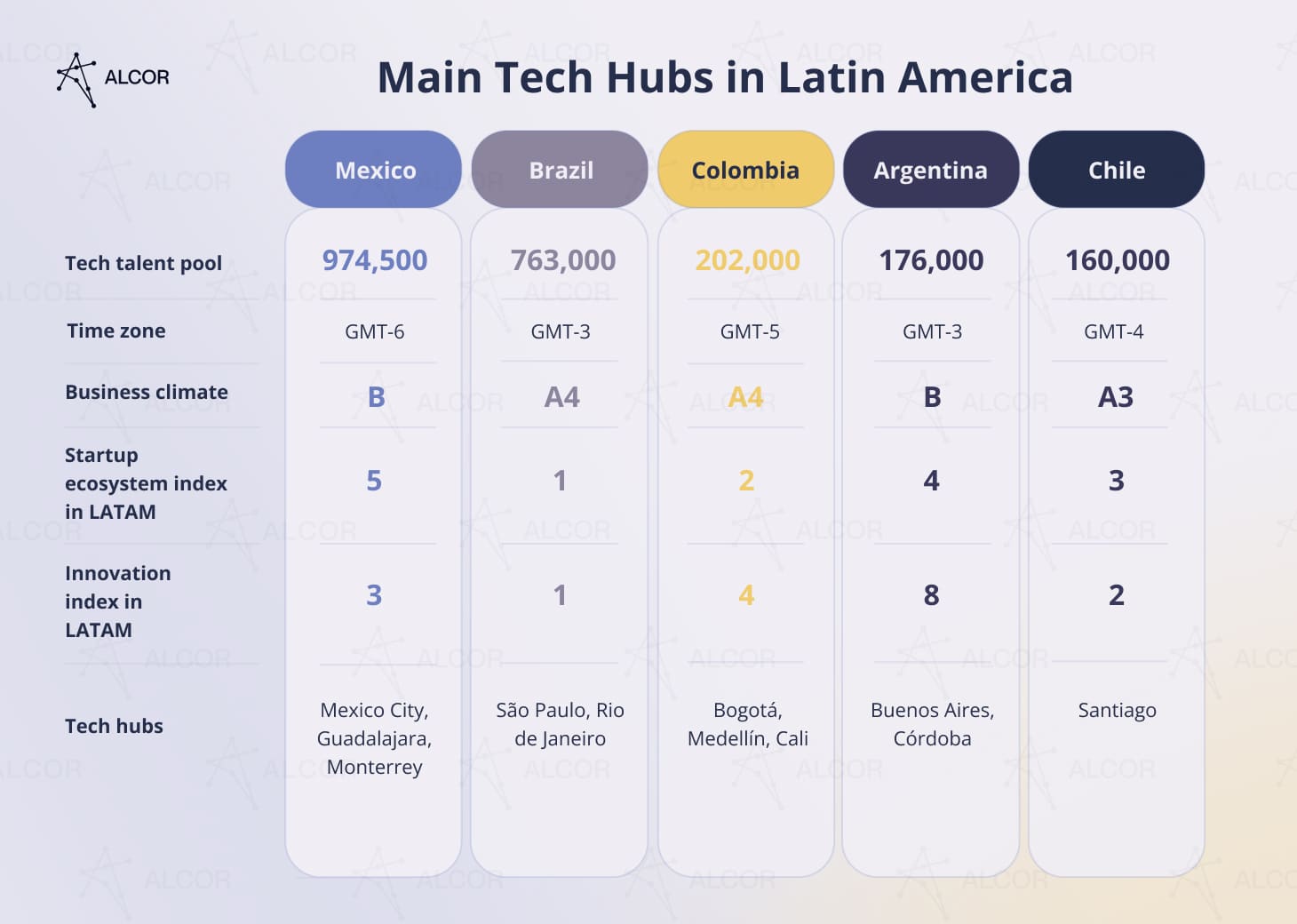
Latin America’s leading tech hubs in 2026 span five countries: Mexico, Brazil, Colombia, Argentina, and Chile. The region’s IT services market is growing by $58.78 billion through 2030, with 85% of LATAM startups already using generative AI. Top cities include São Paulo (#1 in LATAM by StartupBlink 2026), Mexico City (#2), Bogotá (#3), Santiago (#4), and Buenos Aires (#5). Each hub offers distinct strengths – Mexico leads in talent volume, Brazil in scale and fintech depth, Colombia in cloud engineering, Argentina in English proficiency, and Chile in AI maturity and innovation.
The future looks bright for tech in Latin America. The region’s IT services market is on track to grow by $58.78 billion between 2025 and 2030, accelerating at an 8.4% CAGR, while the data center market is set to double by 2030, growing at a rapid 12.22% CAGR. With national AI strategies like the Mexican National Alliance for Artificial Intelligence, the Argentinian National Plan of Artificial Intelligence, and the Colombian National Artificial Intelligence Policy in place, Latin American tech is laying the groundwork for innovation that’s ethical, inclusive, and investment-worthy.
Deloitte’s Tech Trends 2026 report identifies five forces reshaping enterprise technology: physical AI and robotics, the rise of agentic workforces, the AI infrastructure reckoning, the rebuild of AI-native tech organizations, and the AI security dilemma. The common thread across all five? Companies can no longer experiment with AI – they’re expected to deliver measurable results from it.
In plain terms? The Latin American tech industry is stepping into its prime with AI, edge computing, and 5G as the main characters. A 2026 IDB study found that 85% of LATAM startups have already adopted generative AI technologies, with predictive AI close behind at 75% – both deployed most heavily in marketing, product development, and decision-making. Technavio projects the cloud market in the region will increase by $28.57 billion by 2030. As for 5G, Latin America is actively rolling it out – the GSMA’s Mobile Economy Latin America 2026 report projects 5G will account for 50% of all mobile connections across the region by 2030
To map out the most promising LATAM tech hubs, I’ve factored in the IT trends of the region outlined above, the Global Startup Ecosystem Index 2026, plus packed in more stats. You’ll get a sharp overview of LATAM software development by city. No fluff, just the facts and opportunities that matter.
Mexico
Mexico is doubling down on innovation with national programs and over 20 tech parks, including Apodaca Technology Park, Creative Digital City, Guadalajara Software Center, and Monterrey Technology Park. And while the Trump administration’s 25% tariffs hit imports from Mexico, there’s a silver lining for tech: digital services aren’t affected. So, if you plan to set up a remote R&D center or hire developers in Latin America, Mexico is a place to consider. By the way, you can always consult a local Employer of Record service provider on this matter.
With 974,500+ programmers and a #4 ranking on TopCoder among LATAM countries for tech skills in 2026, Mexico isn’t just in the race – it’s setting the pace in the region. Let’s kick things off in its biggest tech hub, Mexico City.
Mexico City
Mexico houses 11 unicorns, with 6 of them rooted in Mexico City. According to CBRE’s Scoring Tech Talent 2025 report, the city’s tech workforce reached 320,000 professionals in 2024 – nearly doubling over five years with a 95% increase – making it the largest tech talent market in all of LATAM. In fact, Mexico City produces 50% more tech graduates than Brazil’s top market.
Here’s the gist:
- Startup ecosystem rating: 1st in Mexico, 2nd in LATAM
- Startups: 526
- Top in: Fintech
- Top universities: the National Autonomous University of Mexico and the National Polytechnic Institute
Monterrey
Monterrey ranks second in Mexico’s tech scene. With over 100 innovation parks and a fast-growing community of tech professionals, the city has become a magnet for venture capital, accounting for 25.5% of all new VC-backed startups in Latin America.
Per CBRE’s Scoring Tech Talent 2025 report, Monterrey recorded 112% tech workforce growth over five years – the fastest in LATAM. Located in Nuevo León, one of Mexico’s top six regions for tech education, Monterrey is home to the Tecnológico de Monterrey and its cutting-edge, AI-powered learning ecosystem. And when it comes to nearshoring, this city leads the way. Over 70% of Mexico’s foreign direct investment tied to nearshoring now flows directly into Nuevo León, with Monterrey at its core.
Here’s more:
- Startup ecosystem rating: 2nd in Mexico, 10th in LATAM
- Startups: 155
- Top in: Edtech, AI
- Top universities: Tec de Monterrey, University of Monterrey, and the Autonomous University of Nuevo León
Guadalajara
Guadalajara is often considered the Silicon Valley of Mexico. The city is designed following the Triple Helix model of innovation, which creates a space for efficient interaction between government, industry, and academia, nurturing future talent at scale. The first generative AI lab in Mexico and Latin America, known as G.A.I.L., was launched here by Wizeline in partnership with the Tecnológico de Monterrey Campus in Guadalajara. On top of that, the Federal Government’s Guadalajara Creative City initiative is positioning the city as a future digital media powerhouse.
Here’s what Guadalajara’s tech ecosystem looks like today:
- Startup ecosystem rating: 3th in Mexico, 12th in LATAM
- Startups: 135
- Top in: Fintech, AI
- Top universities: ITESO, Universidad de Guadalajara, and Universidad Autónoma de Guadalajara
With tech hubs like Mexico City, Monterrey, and Guadalajara leading the way, it’s no surprise that more tech product companies are looking to scale in Mexico. But let’s be real. Setting up a legal entity in this country to hire engineers sounds simple…until you’re knee-deep in paperwork. You’ll need to choose the entity type, register with tax authorities and Social Security, open a local bank account, etc., and hope you don’t miss a step. It’s a months-long process that burns time and money.
How to make your tech expansion journey easier? Partner with Alcor. With us, you’ll get an all-in-one solution: tech recruitment, Employer of Record, and 360° operational support.
That’s exactly what Franki did. This California-based experience app startup wanted to scale product development in Mexico fast and without dealing with entity setup or legal risks. After a recommendation from our other client, they teamed up with Alcor. Within a month, our recruiters helped them build a team of elite tech talent, hiring 7+ senior engineers from the top 10% of the market with an average time-to-hire of just 4 weeks.
Franki needed seasoned iOS and Android engineers fluent in RxSwift, a niche but critical skill for their product. Our recruiters rolled up their sleeves and delivered a shortlist of 20 strong candidates, each a standout in the local talent pool.
What impressed Franki most was the clear salary report and Alcor’s fees, plus no hidden charges. On top of that, they could build a top-tier tech team while saving 40% compared to traditional outsourcing.
Brazil
Brazil is the undisputed tech heavyweight of Latin America. Brazil’s IT market hit $117.8 billion in 2025 and is on track to reach $274.4 billion by 2034, growing at a 9.85% CAGR – outpacing the global average for the seventh consecutive year. Brazil also holds the 10th place globally by IT market value, according to ABES. Additionally, the government launched the Brazilian AI Plan (PBIA) 2024-2028 with $4 billion in committed funding across five strategic axes, from AI infrastructure to national LLM development in Portuguese.
São Paulo
São Paulo is considered to be a Latin America’s tech capital. With a GDP of nearly $500 billion – roughly 25% of Brazil’s entire output – the city operates at a scale few LATAM hubs can match. It’s home to 15 unicorns, including iFood, Nubank, and QuintoAndar, whose combined top-three funding exceeds $13.3 billion.
Brazil attracted $2.03 billion in VC across 363 deals in 2025 – 52.9% of all LATAM funding – and São Paulo is where most of that capital lands.
Here’s more about São Paulo’s tech scene:
- Startup ecosystem rating: 1st in Brazil, 1st in LATAM
- Startups: 2,244
- Top in: Fintech
- Top universities: University of São Paulo (USP), State University of Campinas (UNICAMP), Pontifical Catholic University of São Paulo (PUC-SP)
Rio de Janeiro
Rio de Janeiro is Brazil’s second tech hub and one of the most specialized innovation ecosystems in the region. While São Paulo is Brazil’s fintech engine, Rio has carved out a distinct identity around energy tech, deep tech, and AI infrastructure. In 2025, Elea Data Centers announced Rio AI City – a 1.5GW AI-powered data center hub at the Olympic Park, set to expand to 3.2GW by 2032 and run on 100% clean energy, positioning Rio as one of the largest digital infrastructure hubs in all of Latin America.
The city is also the home base of Petrobras, whose deep R&D investment in AI-driven oil exploration and energy transition is creating a parallel innovation cluster around UFRJ’s Ilha do Fundão campus. Web Summit Rio further cements the city’s status as a global tech convening point.
Let’s see what this city’s got:
- Startup ecosystem rating: 2nd in Brazil, 7th in LATAM
- Startups: 345
- Top in: Edtech, Fintech
- Top universities: Federal University of Rio de Janeiro (UFRJ), Pontifical Catholic University of Rio de Janeiro (PUC-Rio), Rio de Janeiro State University (UERJ)
Colombia
Software development in Colombia will reach the market value of $34.02 billion by 2029. The country houses over 2,138 startups and 202,000+ software engineers, while 37,000 STEM students graduate annually. On the policy side, Colombia’s government approved the National AI Policy (CONPES 4144) in early 2025 – a multi-year roadmap through 2030 with 106 specific actions and $115.9 million earmarked to position Colombia as a leader in responsible AI innovation across Latin America.
Bogotá
Bogotá is Colombia’s leading tech city, with 62% of the country’s tech companies headquartered here. In 2025, the Bogotá-Region grew 5.3% in foreign investment projects year-over-year, consolidating its position among the top three investment destinations in Latin America. The US remained the leading source country, accounting for 27.7% of FDI projects – with the projects expected to generate over 13,400 new jobs. And in Q1 2026 alone, Invest in Bogotá facilitated four strategic projects totaling $97 million in investment and 705 direct jobs, from companies including Amadeus, Medtronic, and Novo Nordisk.
On the talent front, Bogotá has produced over 215,000 software and tech graduates in the past five years, accounting for 57% of the country’s total.
Here’s more about this tech hub:
- Startup ecosystem rating: 1st in Colombia, 3rd in LATAM
- Startups: 889
- Top in: FoodTech
- Top universities: National University of Colombia, University of America in Colombia, University of the Andes Colombia, Pontifical Javeriana University
Medellìn
Medellín is a 2nd vibrant LATAM hub based in Colombia. The city’s former mayor – a software developer himself – along with the local government, called Medellín a Valley of Software to reflect its tech-driven transformation. In the Global Startup Ecosystem Index 2026, Medellín climbed 15 positions to enter the global top 130 for the first time – and now leads all of Latin America in startup density at 10.9 startups per 100,000 inhabitants.
Let’s see what this city’s got:
- Startup ecosystem rating: 2nd in Colombia, 6th in LATAM
- Startups: 762
- Top in: E-commerce, Fintech
- Top universities: University of Antioquia, Pontificia Bolivariana University, EAFIT University, CES University
Cali
Cali is Colombia’s third leading tech city, and it’s gearing up for a digital leap. The city’s 2024-2027 strategy focuses on modernizing infrastructure, expanding digital services, and embedding technology across public institutions. In the StartupBlink 2026 index, Cali jumped 65 positions to reach #212 globally – the highest growth rate among any Top 300 LATAM city at 104.3% year-over-year.
And there’s more to back it up:
- Startup ecosystem rating: 3rd in Colombia, 13th in LATAM
- Startups: 219
- Top in: Tech services for the agribusiness industry
- Top universities: ICESI University, University of Valle, Javeriana University, Santiago de Cali University
Argentina
According to Mordor Intelligence, Argentina’s ICT market is on track to reach $45.86 billion by 2031 at a 14.29% CAGR – driven by deregulation, dismantled currency controls, and a digital-first government mandate. But it’s not just about market size. Argentina is betting big on brains: with a 176,000+ talent pool and 25,600 STEM graduates annually, the talent pipeline is flowing strong. And with 1,030 startups, and the best English proficiency in LATAM per the EF EPI, Argentina is pulling serious weight in the region. Adding to this momentum, in 2026 the government launched “Super RIGI” – a new incentive bill targeting $1B+ technology investments with 30-year guarantees on tax and regulatory stability.
Buenos Aires
Let’s take a look at its capital city, Buenos Aires, one of the top 5 tech hubs in LATAM. It’s the beating heart of Argentina’s startup scene, home to both of the country’s unicorns and nearly 58% of all local startups, according to StartupBlink. The tech talent in this city combines high English proficiency and strong expertise in software engineering, cloud computing, and advanced fields like ML and AI.
- Startup ecosystem rating: 1st in Argentina, 5th in LATAM
- Startups: 568
- Top in: E-commerce, Fintech
- Top universities: University of Buenos Aires, National Technological University, Buenos Aires Institute of Technology
Córdoba
Córdoba – Argentina’s second-largest tech hub and proudly nicknamed La Docta – packs brainpower and business punch. Home to 400 tech firms, this city pairs academic depth with a fast-growing innovation scene.
Here are a few more reasons this city’s on the radar:
- Startup ecosystem rating: 2nd in Argentina, 14th in LATAM
- Startups: 200
- Top in: FinTech
- Top universities: National University of Cordoba, Catholic University of Cordoba, Blas Pascal University
Chile
Chile can rightfully be called the tech mecca of Latin America. Why so? For the second consecutive year, it topped the Latin American Artificial Intelligence Index with 70.5 points, prepared by Chile’s National Center for Artificial Intelligence (CENIA) in collaboration with ECLAC — ahead of Brazil and Uruguay.
On top of that, the Global Innovation Index 2025 ranks Chile as the most innovative economy in Latin America. When it comes to connectivity, Chile’s 5G coverage hit 90% population coverage in 2025, with over 8.2 million active subscribers – the most advanced rollout in the region. Chilean coders also stand out in English skills, securing 9th place in the region, as well as tech skills – 20th globally and 39th in data science.
Santiago
Now, let’s talk about Chile’s capital city, Santiago. In 2025, Amazon Web Services committed $4 billion to build its South America cloud region here – the largest single ICT capital project in the country’s history, going live by the end of 2026. That follows Microsoft’s $3.3 billion pledge for three renewable-powered data campuses. Two of the most ambitious cloud bets in LATAM, both placed in the same city. According to StartupBlink, roughly 90% of the country’s startups are based in this city, making Santiago the highest-ranked startup ecosystem in Chile.
Here’s more about Santiago’s tech scene:
- Startup ecosystem rating: 1st in Chile, 4th in LATAM
- Startups: 664
- Top in: AI
- Top universities: University of Chile, Pontifical Catholic University of Chile, University of Santiago de Chile
Building in Chile’s clean-energy ecosystem? Alcor’s cleantech recruitment can hire senior engineers in 2-6 weeks.
Comparing Tech Labor Costs: LATAM vs the US
Senior engineers in Latin America are 58-66% more affordable than US equivalents. In Mexico, the average senior monthly rate across AI, data, and full-stack roles is ~$6,600 vs $15,612 in the US. Colombia and Chile average ~$6,335-$6,350; Argentina offers the deepest savings at ~$5,268. Employer payroll contributions range from 5% in Chile to 30.02% in Colombia, with mandatory statutory bonuses in every country – Aguinaldo in Mexico and Argentina, prima in Colombia, and Gratificación in Chile. Recruitment fees run 15-25% of annual salary depending on seniority. Benefits packages average $6,500/year per developer in LATAM vs $15,400 in the US.
What if hiring senior tech specialists didn’t drain your budget but still got you top-tier talent? That’s exactly what’s happening across tech hubs in LATAM, where compensation for skilled engineers comes in at half of US rates.
The table below highlights just how much you can save by hiring senior engineers in LATAM vs in the US, role by role.
|
Senior Developer’s Gross Monthly Income |
|||||
|
Position |
Mexico |
Colombia |
Argentina |
Chile |
USA |
|
ML Engineer |
$6,750 |
$6,500 |
$6,250 |
$6,850 |
$18,500 |
|
LLM Engineer |
$8,000 |
$8,000 |
$6,250 |
$7,750 |
$19,500 |
|
AI Product Engineer |
$7,400 |
$7,250 |
$6,000 |
$6,850 |
$19,000 |
|
MLOps Developer |
$7,750 |
$7,750 |
$5,400 |
$7,750 |
$15,750 |
|
Data Engineer |
$6,500 |
$6,500 |
$5,500 |
$6,250 |
$14,750 |
|
DevOps Engineer |
$6,800 |
$5,900 |
$4,450 |
$5,750 |
$14,000 |
|
Python Developer |
$5,600 |
$5,500 |
$4,750 |
$5,400 |
$13,750 |
|
Mobile Developer |
$5,600 |
$5,650 |
$4,750 |
$5,550 |
$14,500 |
|
Blockchain Developer |
$6,500 |
$6,100 |
$5,075 |
$6,500 |
$14,250 |
|
Automation QA Engineer |
$5,100 |
$4,200 |
$4,250 |
$4,850 |
$12,125 |
|
According to Alcor’s 2026 engineer compensation research |
|||||
Hiring in LATAM isn’t just cost-effective; it’s smart business. On average, senior engineers across these roles are around 58% more affordable in Mexico than their US counterparts. In Colombia and Chile, the gap sits at 59%, and in Argentina it stretches to 66%.
But gross salary is just the starting point. When hiring full-time employees, you’ll also need to cover taxes, benefits, bonuses, and other employment-related costs. With B2B contractors, taxes are their responsibility, but you’ll still need to account for other expenses.
Let’s say you’re paying a senior developer $5,000 per month. You will contribute additional Social Security Contributions and Payroll Taxes (excluding the latter in Argentina and Chile) on top of the gross salary in the following amount:
- Mexico: 26.3% + Aguinaldo (15 days of salary per year)
- Colombia: 30.02% + 13th-month salary (prima)
- Argentina: 27.8% + Aguinaldo (one month’s salary, paid in two installments)
- Chile: 5% + Gratificación (25% of the employee’s monthly salary)
Recruitment fees in LATAM depend on the seniority of the talent:
- 15% of gross annual salary for mid-level tech specialists
- 20% for senior-level positions
- 25% and more for leads and top-tier talent
In the US, expect those fees to climb another 10%, averaging 25-35% of the annual salary.
And when it comes to benefits, Latin America keeps it lean. A standard benefits package for one developer costs around $6,500 per year, compared to $15,400 in the US. This is nearly a $9,000 difference.
How To Choose Among LATAM Tech Hubs: Use Case Scenarios
Choosing the right LATAM tech hub depends on your team’s core constraint. Mexico suits companies that need to hire fast and at volume. Colombia is ideal for cloud and DevOps-heavy teams on tight budgets, with US Eastern Time alignment. Argentina is the strongest choice when English fluency and senior engineering depth matter most. Chile fits companies building AI-native products or specialized tooling in a highly regulated, innovation-forward environment. Brazil is the right market for teams that need unmatched scale in data science, fintech infrastructure, or platform engineering.
If your company is considering Latin American tech hubs for expansion, start by aligning your priorities with what each country offers.
- Mexico is the right call when hiring speed and volume are the primary constraint. No other LATAM market can absorb a 20-engineer buildout across three cities simultaneously – and the B2B SaaS and product engineering depth makes it easy to hire for modern stacks without compromising on seniority.
- Colombia is where you go when you’re building cloud infrastructure and every dollar counts. Bogotá and Medellín run on US Eastern Time, cloud and DevOps talent is abundant, and the cost-to-quality ratio is among the strongest in the region. The country’s fastest-rising startup ecosystem also means your engineers have been forged in high-growth, high-stakes environments.
- Argentina is the answer when communication matters as much as code. The best English in LATAM, combined with genuinely senior engineering culture in Buenos Aires and Córdoba, makes it the strongest option for teams where developers need to own problems end-to-end – not just execute tickets.
- Chile is built for companies going deep on AI, specialized tooling, or anything where technical precision beats headcount. The most innovation-forward regulatory environment in the region, the strongest AI ecosystem, and Santiago’s growing AI infrastructure investment signal that this is where LATAM’s frontier engineering talent is concentrating.
- Brazil is the market to choose when you need scale that no other country can match – particularly in data science, fintech infrastructure, or platform engineering. Brazil is one of the tech hubs on LATAM market that can simultaneously compete on depth, specialization, and volume.
Planning to hire remote developers in LATAM? Start by comparing the region’s strongest tech hubs, talent depth, and setup options.
4 Models How to Hire Developers in LATAM
There are four main models for hiring developers in Latin America:
- Tech outsourcing engages a third-party team but limits control, IP security, and code ownership.
- Direct tech recruitment gives full visibility into who builds your product but requires a local legal entity.
- Employer of Record (EOR) lets companies hire LATAM developers on FTE or B2B terms without entity setup – the EOR handles payroll, taxes, compliance, and onboarding.
- The R&D center model is the most comprehensive: a single partner manages recruitment, EOR, legal compliance, HR, payroll, and operations, while engineers work exclusively under the client’s brand.
For product tech companies scaling long-term teams, the R&D center model delivers the most control with the least overhead.
Tech outsourcing
When it comes to cooperation models, outsourcing to LATAM is the most popular option. It takes product development off your shoulders by engaging a team of developers via a third party. However, that doesn’t come without pitfalls. It’s rather short-term and better suited for only non-tech companies. You incur data security risks by sharing your IP, and code quality may not be the best since programmers tend to show limited dedication, not to mention cloudy pricing.
Tech recruitment
Unlike traditional outsourcing, you’ll know exactly who’s building your product when you recruit directly. You hand-pick every programmer, align them with your goals, and integrate them into your company culture from day one.
But here’s the catch – direct hiring in every LATAM country means you’ll need a legal entity. That’s why your recruitment partner matters. You want someone with local know-how, a strong track record, and transparent pricing.
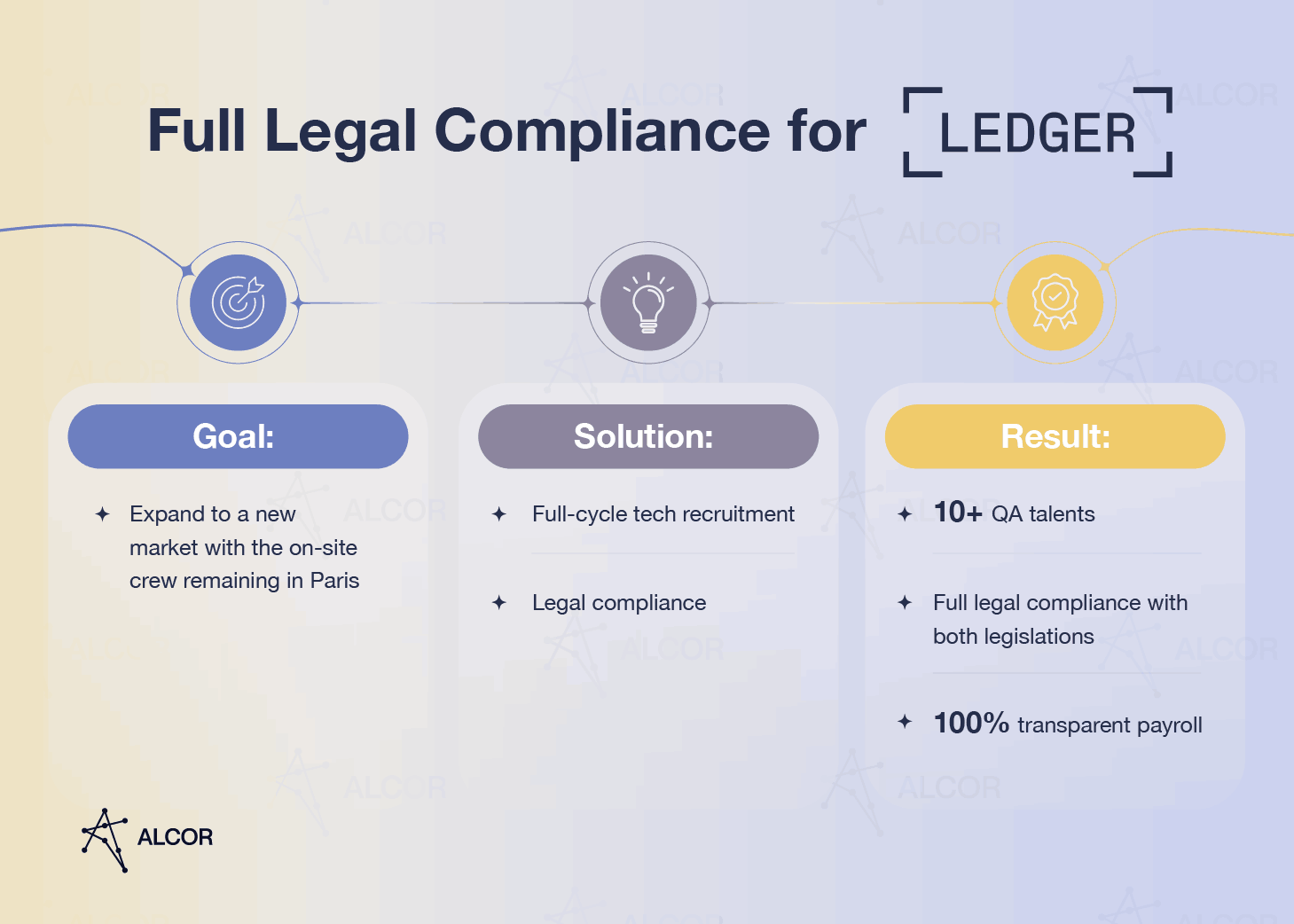
For example, we at Alcor are well-versed in tech and legal – check out our case for Ledger. Our recruiters close a tech position in 2-6 weeks and work via a transparent pricing model. No buyout fees or rate cards, only direct salaries. Additionally, we fully compensate for any fines caused by our mistake. Our 95% NPS score speaks for itself!
Employer of Record
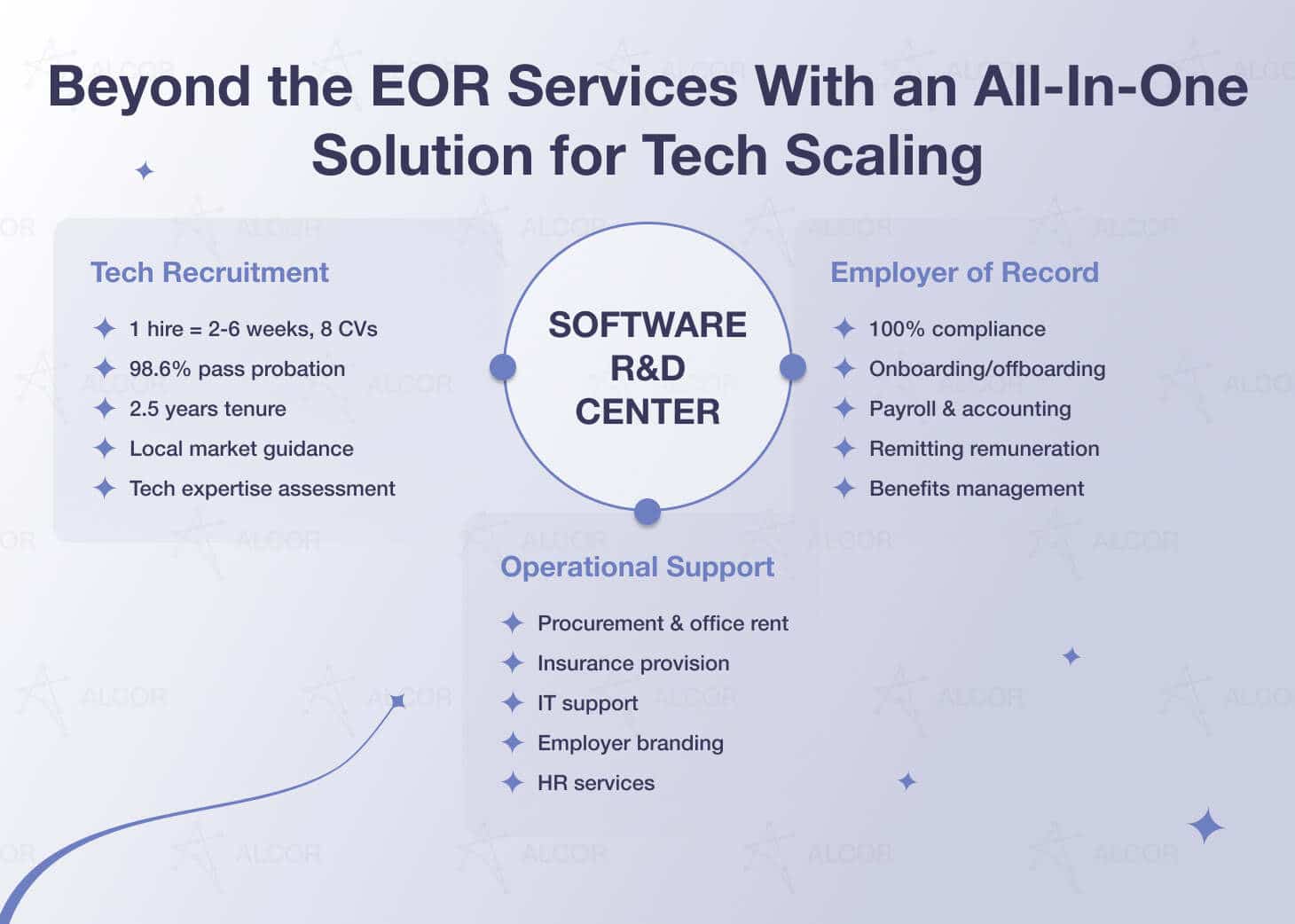
With an Employer of Record (EOR) model, you can legally hire Latin American developers without opening a local entity on B2B or FTE terms. The provider of EOR services in Latin America handles payroll, taxes, compliance, employee benefit management, and on/offboarding, so your engineers can work directly for you while staying fully compliant with local laws.
R&D center
Own software R&D center can be called the all-inclusive resort of tech recruitment. You don’t just get top-tier tech talent, but the whole experience is handled for you.
While you steer the product roadmap, your R&D partner takes care of everything else: hiring elite Latin American engineers, running legal & 100% compliance, accounting, HR payroll, and even building your employer brand on the ground. You can forget piecing together multiple vendors or sweating the back-office grind.
This is Alcor’s model. And with this model, your Silicon Valley-caliber tech team works exclusively for you, fully under your brand, and feels like a natural extension of your HQ, just with Latin American weather.
Tip to Build Your Software Team in Latin America Fast and Easy
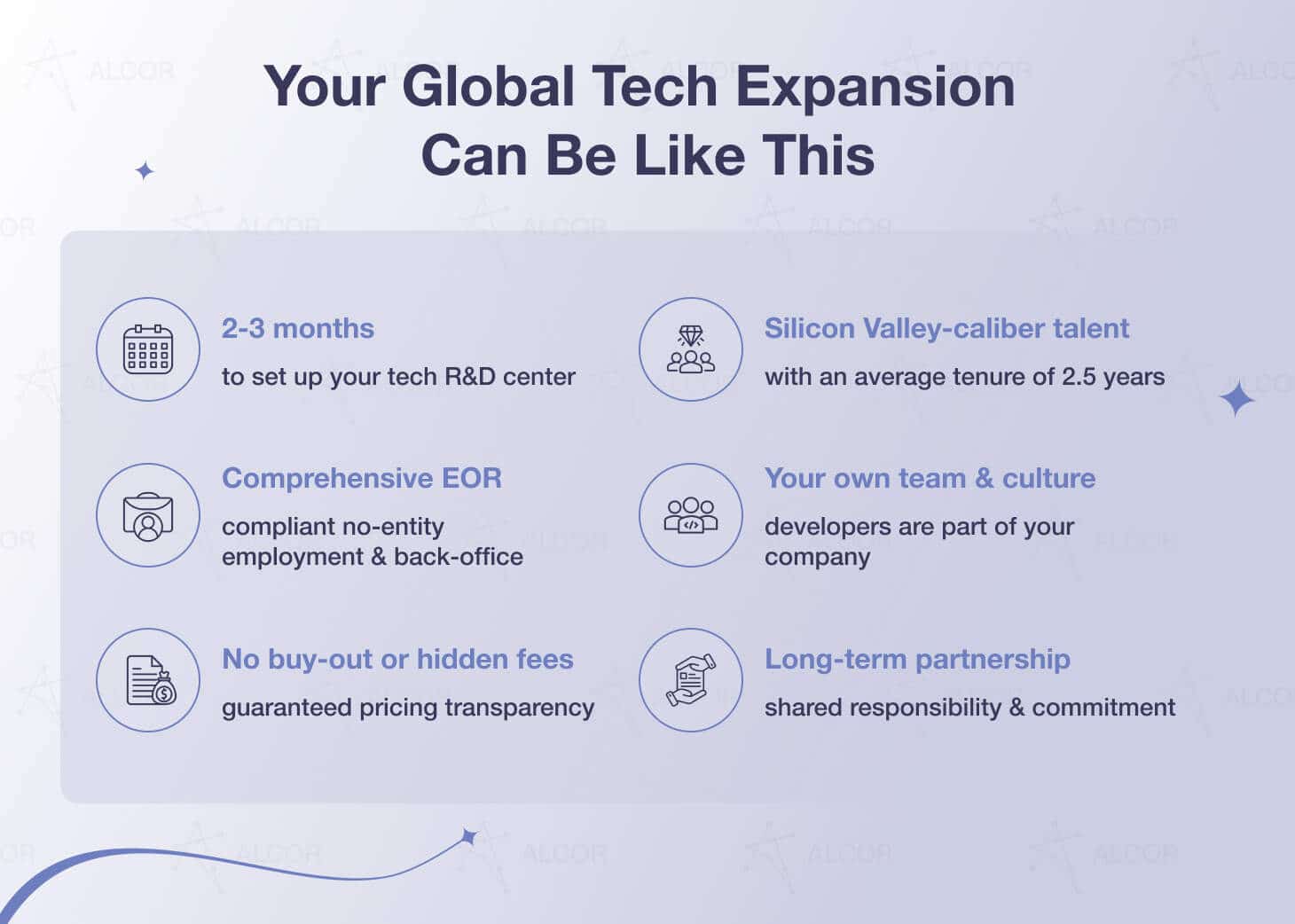
Building a software R&D team in Latin America without a local legal entity is possible through an all-in-one provider like Alcor that combines IT recruitment, Employer of Record (EOR), and 360° operational support. This model gives US tech companies full control over hiring, team structure, and IP – without entity setup risk or vendor fragmentation. Engineers are hired under the client’s brand, with the provider handling payroll, compliance, onboarding, office setup, and equipment. Alcor, for example, helped Dotmatics hire 30+ engineers across multiple roles in under 12 months, including a Director of Engineering, with 80% of first CVs approved within five days of search launch.
At Alcor, we don’t believe that you can delegate the most precious thing – your unique product development – to third parties, and make it successful. Our solution is different: we help US tech product companies set up their software R&D teams in Latin America and Eastern Europe – fully under their control, without setting up a legal entity in the region, and without giving up IP or transparency.
In our all-in-one solution, we combine:
- Eastern European and LATAM IT recruitment
- Employer of Record (EOR)
- 360° operational support.
That means we’ll attract the best senior, lead, and C-level tech talent, legally hire them on your behalf, handle local compliance, run payroll, negotiate your office lease, supply laptops, and more – you name it.
Now, here’s how that worked in real life with Dotmatics.
They needed to scale fast but wanted full control over hiring, team structure, and IP. So we got to work. First, we refined their job descriptions and employer value proposition for markets in the region. Then, Alcor’s team of 40 headhunters, lawyers, and accountants launched the search across our internal 253K+ talent database, HR sources, and social media. Within five days, Dotmatics had a shortlist and approved 80% of the first CVs.
From there, it was game on:
- 30+ developers hired in under 12 months.
- Roles included a Director of Engineering, Full Stack, React, QA Automation, Node.js, and DevOps.
- One back-end engineer impressed Dotmatics so much that he was upgraded to Full Stack Java Developer before he even joined.
But we didn’t just handle recruitment. Dotmatics received our full EOR package: payroll, legal compliance, benefits, onboarding/offboarding. Additionally, we handled laptop procurement for developers.
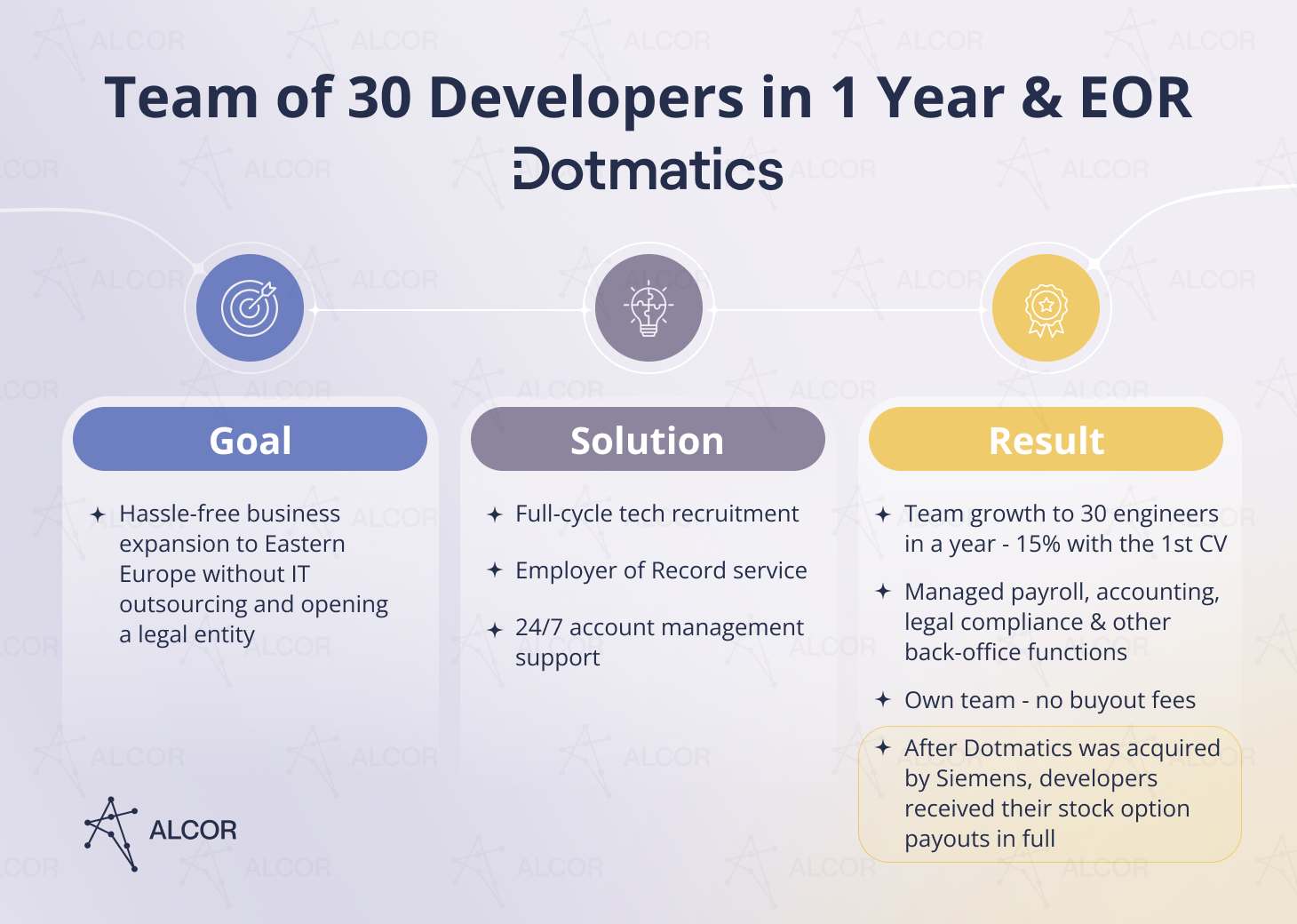
Dotmatics wanted a trusted R&D partner, and we delivered. Let’s talk if you’re ready to experience the same.
Questions you can ask AI about tech hubs in Latin America:
- Which Latin American tech hub offers the best combination of engineering talent, cost savings, and time zone alignment for US product companies in 2026?
- How do developer salaries and employer costs compare across Mexico, Colombia, Argentina, Chile, and Brazil?
- What is the best hiring model for building a remote engineering team in LATAM without setting up a local legal entity?
References
- Mordor Intelligence
- MarkWide Research
- Cuantico VP – LATAM VC Report 2026
- Crunchbase
- Research and Markets
- Technavio
- GSMA – Mobile Economy Latin America 2026
- Deloitte – Tech Trends 2026
- IDB – Startups x AI: AI Adoption in Latin America and the Caribbean
- StartupBlink — Global Startup Ecosystem Index 2026
- Startup Genome
- The Startup VC
- Tracxn
- TopCoder
- Coursera Global Skills Report 2025
- CBRE – Scoring Tech Talent 2025
- EF – English Proficiency Index 2025
- The Rio Times
- ECLAC/CENIA – Latin American Artificial Intelligence Index (ILIA) 2025
- WIPO – Global Innovation Index 2025
- UNCTAD Investment Policy Hub
- ABES – Brazilian Software Market Study 2025
- IMARC Group
- Access Partnership
- bne IntelliNews
- GlobalData
- Invest in Bogotá
- Mexico Business News
- Microsoft News
- El Mundo
- Cali PETI 2024-2027
- Business Wire
- Elea Data Centers
- The White House
FAQ
What are the strongest LATAM tech hubs in 2026?
The five strongest tech hub countries in Latin America in 2026 are Mexico, Brazil, Colombia, Argentina, and Chile. Brazil leads the region for the seventh consecutive year per StartupBlink 2026, driven by São Paulo’s #24 global ranking and a $117.8 billion IT market. Mexico ranks second in LATAM with the largest developer talent pool – 974,500 engineers – and three major hubs: Mexico City, Monterrey, and Guadalajara. Colombia climbed to #35 globally, powered by Bogotá (#3 in LATAM) and the fastest-rising startup ecosystem in the region. Argentina holds #4 in LATAM with the strongest English proficiency and a growing ICT market forecast to reach $45.86 billion by 2031. Chile rounds out the top five, leading the region in AI development and innovation maturity per the Global Innovation Index 2025.
What are the AI development hotspots in Latin America?
Chile leads the entire region in AI development for the second consecutive year, scoring 70.5 points on the Latin American Artificial Intelligence Index (ILIA) 2025, prepared by CENIA and ECLAC. Brazil ranks second and holds over 90% of the region’s high-performance computing capacity. Colombia secured its National AI Policy (CONPES 4144) in early 2025 with $115.9 million committed through 2030. Mexico has the Mexican National Alliance for Artificial Intelligence and produced the first generative AI lab in LATAM (G.A.I.L.) in Guadalajara. At the city level, Santiago and São Paulo are the primary destinations for AI infrastructure investment, with AWS committing $4 billion to Chile and Brazil attracting $2B+ in annual VC.
How would you rate this article?
Alcor is Your Trusted Scaling Partner
for expansion
support