


Nearshore outsourcing to Latin America is booming: according to the Grand View Horizon research, the region’s IT outsourcing market is predicted to reach $126.3 billion in revenue by 2030, growing at a 10.1% CAGR – one of the fastest trajectories in the global outsourcing landscape. The reason is clear: 2.3M+ tech professionals – including a fast-growing pool of AI/ML engineers – at up to 60% more competitive rates, within 1–4 hours of US time zones.
In this article, you’ll find a breakdown of LATAM’s tech market growth, the top reasons US tech companies are choosing nearshore software outsourcing in LATAM, a country-by-country guide to the best nearshore destinations in Latin America with updated 2026 salary data, and a better alternative to Latin American IT staffing services.
Key Takeaways
- Latin America’s IT and technology market is scaling fast: from $105 billion in 2022 to $189.43 billion in 2024. With $188.9 billion in FDI, $4.1 billion in VC investment, 3,000+ fintechs, and AI IT market growth projected to hit $47.8 billion by 2031, LATAM is no longer “emerging” – it’s already in the game.
- The main advantages of nearshore software outsourcing in Latin America are clear: 2.3M+ tech experts, up to 60% more competitive senior developer costs, first hires twice as fast, modern tech stack expertise, strong cultural fit, motivated engineers, and 6–8 hours of business-hour overlap with US teams.
- Each LATAM destination has its own edge. Mexico offers the region’s largest tech talent pool with 974,500 specialists. Colombia brings strong JavaScript talent and 202,000 engineers. Argentina ranks among the highest in English proficiency and offers up to 62% salary savings. Chile ranks #1 in LATAM for innovation and AI adoption. Uruguay adds a compact but highly skilled AI-ready talent pool.
- To get more than rented outsourcing capacity, build your own LATAM R&D center with Alcor. Our solution combines top-10% recruitment, EOR/COR, and 360-degree operational support, giving you up to 60% savings, zero buyouts, transparent pricing, full IP protection, geographic proximity to the US, and a team that is yours from day one.
Latin American IT Market Development 2022-2026
Latin America’s IT services market grew from $66.2 billion in 2023 to $77.7 billion in 2025 and is projected to reach $98.7 billion in 2026 and $221.55 billion by 2035, according to MarkWide Research. The broader LATAM IT market reached $189.4 billion in 2024, with FDI hitting $188.9 billion, up 7.1% year-on-year, per ECLAC’s 2025 report. AI, fintech, and nearshore outsourcing are accelerating the next wave: LATAM’s AI market is projected to grow from $12.7 billion in 2025 to $193.6 billion by 2035 (Linux Foundation Research), with fintechs surpassing 3,000 companies.
In recent years, the Latin American IT services market has grown rapidly – from $66.2 billion in 2023 to $77.7 billion in 2025, according to Grand View Research. By 2026, the broader LATAM IT market is predicted to be valued at $98.7 billion – and projected to reach $221.55 billion by 2035, per MarkWide Research.
This explosive growth didn’t go unnoticed. By 2024, the LATAM IT and technology market had reached $189.4 billion, as stated by the Verified Market Research, with Brazil posting 13.9% sector growth – above the global averag, per Nearshore Americas. According to ECLAC’s 2025 FDI report, Latin America and the Caribbean attracted $188.9 billion in FDI in 2024, up 7.1% year-on-year, with the US consolidating its position as the region’s top investor.
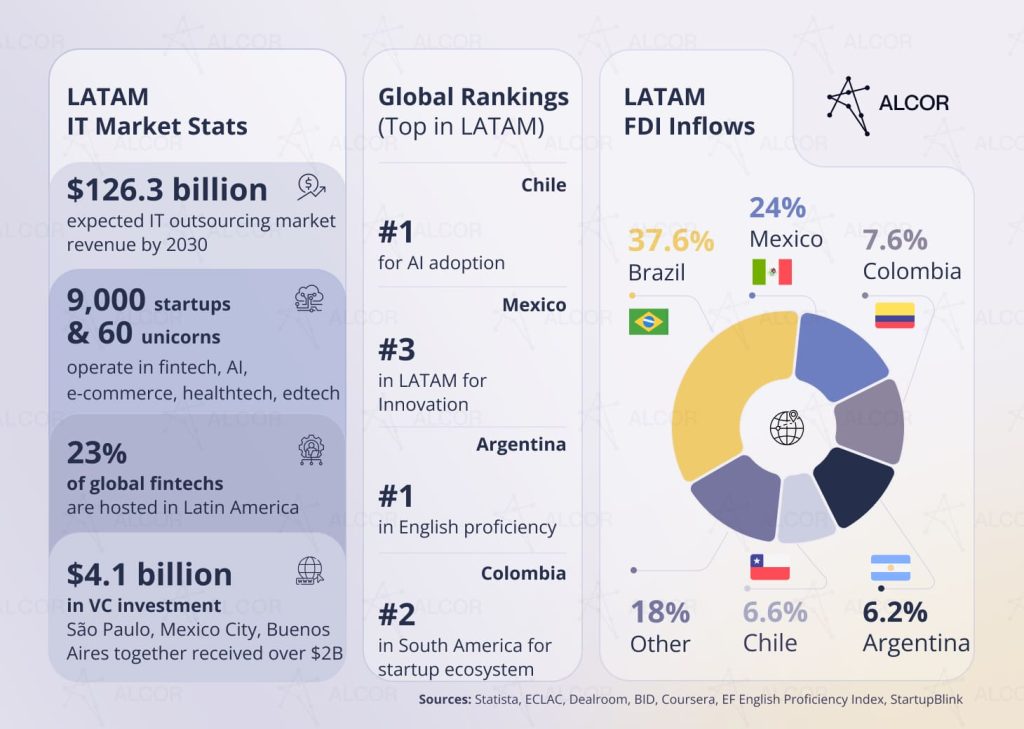
LATAM’s momentum doesn’t stop at funding. With widespread adoption of cloud computing, AI, IoT, and 5G, the region is becoming a hotbed of innovation. Consider this:
- According to the Startup Ecosystem Report 2026, Brazil, Colombia, and Chile are now the top three startup ecosystems in South America, and Mexico leads in Central America – with Colombia posting the highest ecosystem growth rate in the region at over 22% in 2025, as reported by LATAM Republic.
- LATAM’s VC ecosystem closed 2025 with $4.1 billion in total investment, including $2.2 billion directed at early-stage rounds – the highest such amount since 2022, according to 2026 LAVCA Trends in Tech research. São Paulo, Mexico City, and Buenos Aires together received over $2 billion, with Mexico closing the funding gap with Brazil for the first time in 15 years.
- AI is the next growth engine – AI-powered startups secured $1.4 billion in investments across 267 deals in 2024, according to The Latin Times, and Latin America’s AI market is projected to grow from $12.7 billion in 2025 to $193.6 billion by 2035 – a 28.1% annual growth rate, according to Linux Foundation Research – reshaping demand for AI/ML engineering talent across the region.
- Fintech dominates the region with over 3,000 companies across 26 countries, according to IDB – a 340% growth since 2017. Brazil, Mexico, and Colombia account for 57% of fintechs, and digital payments surpassed 64 billion transactions in 2024.
And when it comes to nearshore software outsourcing to LATAM, the numbers tell a compelling story. And when it comes to nearshore software outsourcing to LATAM, the numbers tell a compelling story. 56% of large US and European organizations invested in nearshoring in 2025 – up from 42% the year before, according to Capgemini – with Latin American outsourcing outpacing Asia in annual growth rate at 9.34%, according to The Future World of Work.
But why do US hi-tech companies decide to nearshore IT outsourcing to Latin America?
Top Reasons for Nearshoring Technology to Latin America in 2026
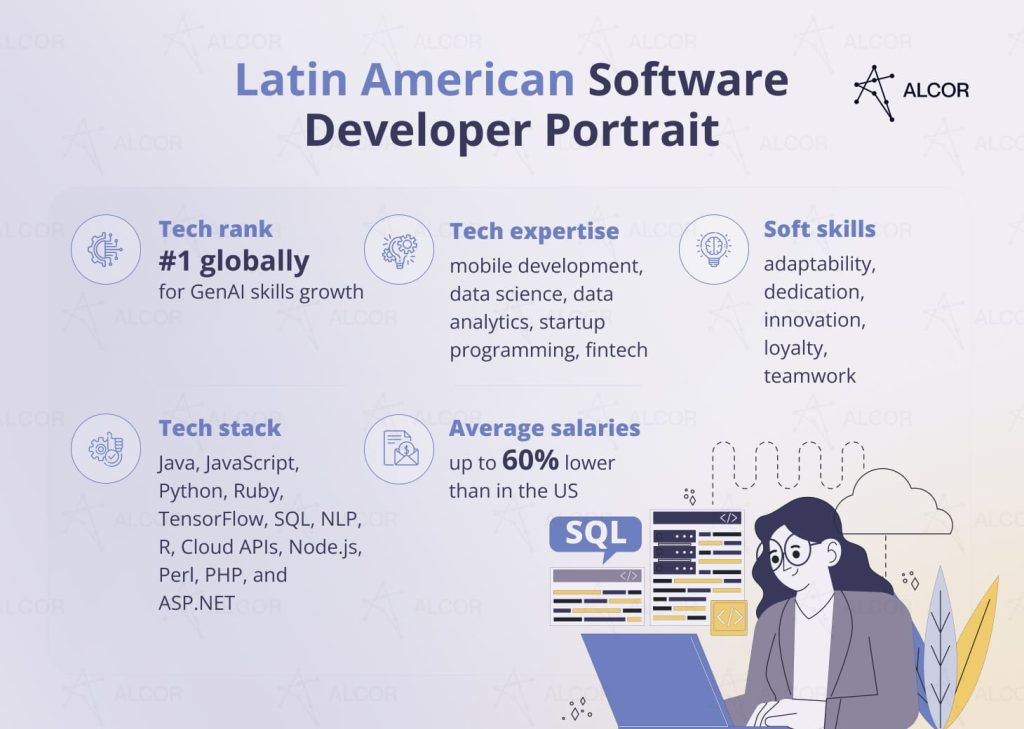
Nearshoring technology to Latin America in 2026 gives US tech companies fast access to skilled, cost-efficient, and highly motivated engineering talent. The region has 2.3M+ tech experts, with senior engineers available at rates up to 60% more competitive than those in the US, according to Alcor’s 2026 compensation research. Developers rank in the top 40 globally for tech skills (Coursera 2026), hold B2-level English proficiency (EPI 2025), and share 6–8 hours of daily overlap with US business hours. And the pipeline keeps growing: remote applicants from LATAM surged 285% over 5 years (GlobeNewswire), while GenAI enrollments grew 425%, per Coursera 2026.
Goldmine of tech talent
LATAM is home to 2.3M+ tech experts, with Mexico (974.5K), Brazil (759K), and Colombia (202K) leading the pack. For CTOs and engineering leaders at scaling tech companies, nearshoring software development to Latin America and building an engineering team there means quick access to engineers with diverse skill sets and rare AI/ML specializations – a strong competitive edge when US hiring pipelines run dry. While others wrestle with talent shortages, you can get your first hires 2 times faster.
Curious what makes LATAM engineers so sought-after among US tech companies? We break it down in this podcast episode:
No Silicon Valley price tag
What about tech salaries when nearshoring software development to LATAM, you would ask. The short answer – senior engineers in LATAM deliver the same technical depth as their US counterparts – at rates up to 60% more competitive. That’s not a rounding error; that’s half your engineering budget freed up to ship faster, hire more, or extend your runway.
The numbers speak for themselves. See how senior developers from South America stack up against US rates:
|
Senior Developer’s Average Monthly Salary, Gross |
|||||
|
Role |
USA |
Mexico |
Colombia |
Argentina |
Chile |
|
ML Engineer |
$18,500 |
$6,750 |
$6,500 |
$6,250 |
$6,850 |
|
LLM Engineer |
$19,500 |
$8,000 |
$8,000 |
$6,250 |
$7,750 |
|
AI Product Engineer |
$19,000 |
$7,400 |
$7,250 |
$6,000 |
$6,850 |
|
MLOps Engineer |
$15,750 |
$7,750 |
$7,750 |
$5,400 |
$7,750 |
|
DevOps Engineer |
$14,000 |
$6,800 |
$5,900 |
$4,450 |
$5,750 |
|
Python Developer |
$13,750 |
$5,600 |
$5,500 |
$4,750 |
$5,400 |
|
React Developer |
$13,000 |
$4,850 |
$4,750 |
$4,350 |
$4,600 |
|
Node.js Developer |
$13,000 |
$5,050 |
$5,050 |
$4,250 |
$4,750 |
|
.NET Developer |
$13,500 |
$5,600 |
$5,500 |
$5,100 |
$5,600 |
|
Mobile Developer |
$14,500 |
$5,600 |
$5,650 |
$4,750 |
$5,550 |
|
Data Engineer |
$14,750 |
$6,500 |
$6,500 |
$5,500 |
$6,250 |
|
Blockchain Engineer |
$14,250 |
$6,500 |
$6,100 |
$5,075 |
$6,500 |
|
QA Automation Engineer |
$12,125 |
$5,100 |
$4,200 |
$4,250 |
$4,850 |
|
Angular Developer |
$13,000 |
$5,100 |
$4,750 |
$4,250 |
$4,600 |
|
PHP Developer |
$10,500 |
$4,600 |
$5,300 |
$4,000 |
$4,500 |
|
According to Alcor’s 2026 engineer compensation research |
|||||
Modern tech stack expertise
If you can save up to 60% on senior engineering salaries in LATAM, does that mean a 60% drop in quality? Not at all – and the numbers back it up.
Firstly, LATAM software developers receive a well-rounded STEM education from the 22 Best Global Universities for Computer Science in the region, according to US News & World Report. Their tech savviness is further enhanced by local initiatives like Mexico’s Codeacademy, Argentina’s 4.0 Program, and Chile’s Digital 2035 plan.
Secondly, Latin American nearshore tech talent ranks in the top 40 globally for tech skills. Just look at the stats from Coursera’s 2026 Global Skills Report:
- Top for tech skills in LATAM: Uruguay, Chile, Argentina, Colombia, Mexico.
- Top for data science in LATAM: Uruguay, Chile, Argentina, Colombia, Mexico.
And thirdly, Latin American developers are proficient in a variety of programming languages and modern technologies, while demonstrating exceptional skills in mobile development, data analytics, cloud computing, database development, and operating systems. A 100% chance you’ll benefit from nearshore outsourcing in LATAM.
- Mexico: JavaScript, Java, Python, C#, TypeScript
- Colombia: JavaScript, Python, Ruby, SQL, HTML/CSS
- Argentina: Python, TensorFlow, Cloud APIs, SQL, NLP
- Chile: Java, Python, PHP, Node.js, ASP.NET
Cultural affinity with the US
Tech excellence is not the only superpower of LATAM developers. Their longstanding cooperation with US tech companies makes these engineers an invaluable asset to any software development team.
- Business culture: Software engineers in Latin America embrace a familiar work culture, demonstrating proficiency in both collaboration and independent work. According to The Culture Factor Group, LATAM developers score similarly to their US counterparts on drive and achievement orientation – but with a stronger community focus, making them naturally collaborative team members who go the extra mile for your product’s success.
- Smooth communication: According to EF’s 2025 English Proficiency Index, Argentina leads all LATAM countries at the B2 level, with Uruguay close behind. Colombia and Mexico rank lower overall – but their major tech hubs like Bogotá, Medellín, and Cali in Colombia, and Monterrey and Guadalajara in Mexico, still fall in the “high” language proficiency category – so whether it’s a daily standup or an async Slack thread, nothing gets lost in translation.
Career-driven engineering talent
The number of remote tech applicants from LATAM has surged by 285% over the past 5 years, according to GlobeNewswire – and with LATAM posting the highest GenAI enrollment growth globally at 425%, per Coursera’s Job Skills 2026 Report, these engineers are actively skilling up for exactly the roles US businesses need most.
Why are they motivated? Better salaries, hi-tech projects, career advancement, and remote work opportunities.
Time zone proximity to the US
When tech companies nearshore software outsourcing to Latin America, they gain a major perk – convenient time zones. Mexico sits just 1–2 hours behind the US East Coast, while Colombia runs on the same time as New York – zero gap, year-round, with no DST shifts to track. Go further south: Chile is 1 hour ahead of the East Coast, and Argentina and Uruguay are 3 hours ahead. Across the region, LATAM engineering teams share 6–8 hours of daily overlap with the US business day – enough for standups, sprint planning, and real-time problem-solving without anyone needing to adjust their schedule.
Proven startup and R&D ecosystem
The LATAM software development environment isn’t just a talent market – it’s a proven launchpad for high-growth tech companies. The value of VC-backed exits in Latin America soared from $1.8 billion in 2024 to $4.9 billion in 2025 – the third-best year on record, according to the Cuantico VP Venture Intelligence Platform. The region has also produced nearly 60 unicorns since 2017, with stars like Kavak, Rappi, Butterfly, and QuintoAndar leading the way. For scaling tech companies and their investors, that’s not potential – that’s a track record.
What’s fueling such results? Numerous governmental initiatives, such as Plan Mexico/Nearshoring Decree, Ruta N in Colombia, and Fundación Impulsar in Argentina. That’s why all the major tech locations in Latin America maintain an A3- to B-level business climate as rated by Coface – optimal for doing business at scale. On top of that, there are R&D incentives for companies that nearshore outsourcing to Latin America:
- Mexico grants accelerated depreciation of 35% to 91% on new fixed asset investments under the 2025 Plan Mexico Decree, valid through 2030, according to EY. Plus, an additional 25% deduction on incremental spending for worker training and innovation.
- Colombia provides a 30% tax credit for investments in R&D or tech innovation projects approved by the Ministry of Science, Technology, and Innovation, according to PwC’s Colombia Tax Summaries.
- Chile guarantees a 35% tax credit on R&D expenditures, extended through 2035, per Albagli Zaliasnik law firm. The remaining 65% can be deducted as necessary business expenses – meaning 100% of your R&D investment is tax-beneficial.
Better than Nearshore IT Outsourcing to LATAM: Your Own Team from 0 to 100 Developers
Nearshoring to LATAM through your own R&D center is a stronger alternative to IT outsourcing because it gives you direct team ownership rather than rented capacity. Alcor helps tech companies scale from 0 to 100 developers by combining top-10% recruitment, EOR/COR, and 360-degree operational support into a single solution. You get up to 60% cost savings, transparent pricing with no markups or prepayments, zero buyouts, full IP protection, and compliance through Alcor’s owned legal entities across Latin America.
Looking to go beyond traditional nearshore outsourcing in LATAM and build an engineering team that’s truly yours? There’s a turnkey solution built specifically for tech companies like yours – a software R&D center.
Here’s why it outperforms traditional IT outsourcing and outstaffing:
- Top-10% talent: Access senior engineers who match your technical requirements and culture – vetted from the top of the LATAM market.
- Up to 60% savings: Get equivalent talent at a fraction of US cost, or hire 1–2 tiers higher for the same budget.
- Zero buyouts: Your team is yours from day one – operating under your brand, culture, and engineering practices.
- Transparent pricing: No pre-payments, no markups, volume discounts as your team scales.
- 100% compliance: Full IP protection and legal coverage through Alcor’s owned legal entities in LATAM.
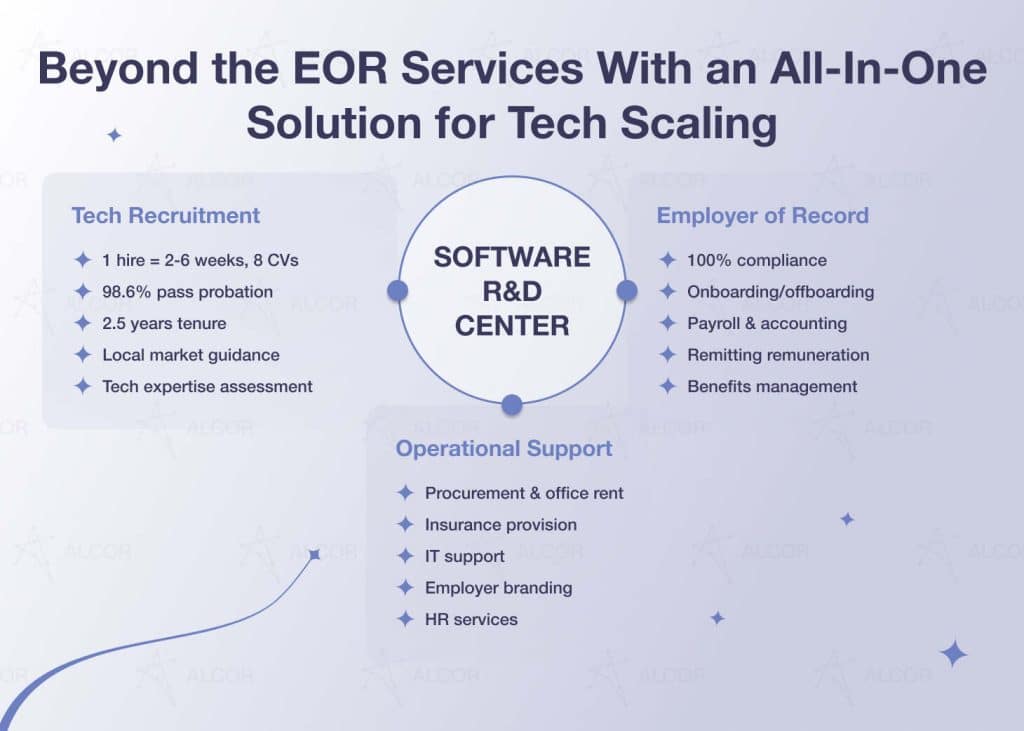
Whether you’re a startup making your first engineering hires, a scaling tech company building out an AI/ML team, or a mature product company looking to expand without the overhead, Alcor has you covered.
Alcor is a tech-exclusive R&D center provider that helps you hire remote developers in Latin America end-to-end – combining senior engineer recruitment, EOR/COR, and 360-degree operational support in one solution.
This isn’t theory. Take Franki – a California-based tech company that needed to hire software developers and build a mobile engineering team in Mexico fast, without setting up a legal entity or managing local compliance overhead.
Here’s how it played out across all three pillars:
- A-to-Z recruitment: Alcor sourced 2 iOS Developers, 3 Android Developers, and 2 QA Engineers – all with niche RxSwift expertise – in an average of 28 days. Every hire came from the top 10% of the LATAM market and was vetted for both technical depth and cultural fit.
- Employer of Record in Latin America: Alcor’s in-house legal team handled B2B contracts, payroll, benefits, and full compliance with Mexican labor law – so Franki’s software developers were legally employed and operational from day one, with zero entity setup required. Alcor provides EOR/COR services across Mexico, Colombia, Chile, and Argentina – ensuring your team stays fully protected, audit-ready, and compliant at every stage of growth.
- 360-degree operational support: Beyond recruitment and EOR, Alcor provides the full operational layer that scaling tech companies need on demand – office lease and coworking arrangements, hardware procurement, visa and relocation support, and employer branding services. For companies where equity is part of the compensation strategy, Alcor also helps structure and administer stock option plans – because in today’s tech hiring market, ownership stakes are as important as salary in attracting senior engineers.
Our R&D center solution isn’t just theory – it’s proven in practice. BigCommerce, Gotransverse, Ledger, People.ai, and others have already built their nearshore software development centers with us. In fact, 99% of tech companies that build with Alcor keep building with Alcor – and that’s the only satisfaction metric that matters.
Top LATAM Nearshore Outsourcing Destinations
Top LATAM nearshore outsourcing destinations include Mexico, Colombia, Argentina, Chile, and Uruguay, each offering distinct strengths for US tech companies. Mexico leads with 974,500 tech specialists and up to 57% savings, while Colombia brings 202,000 engineers and strong JavaScript talent. Argentina stands out for English proficiency and up to 62% savings. Chile ranks #1 in LATAM for innovation and AI adoption, according to the GII 2025 and ILIA 2025 indices. Uruguay adds a smaller but highly skilled pool with strong technical fluency and AI talent to scale teams.
Now, let’s zoom in on what each country has in stock to pick a perfect destination for your nearshore software development in Latin America:
Mexico: Region’s largest talent pool
Indeed, the Mexican talent pool leads the region in the number of tech professionals, offering a wide range of skills and expertise. But as the saying goes, numbers speak louder than words…
- Tech talent pool: 974,500
- Technology skills: JavaScript, Java, Python, C#, TypeScript
- Senior dev salary: from $5,967/month
- % savings vs the US: up to 57%
- Innovation index in LATAM: #3 (according to WIPO)
- AI adoption in LATAM: #7 (according to CEPAL)
- Tech hubs: Mexico City, Guadalajara, Monterrey, Tijuana
Colombia: JavaScript wizards of the region
Colombia is a true JavaScript powerhouse – the country boasts active JavaScript communities across multiple cities and hosts regular meetups nationwide. But this prime destination for nearshore outsourcing to LATAM also offers…
- Tech talent pool: 202,000
- Technology skills: JavaScript, Python, Ruby, SQL, HTML/CSS
- Senior dev salary: from $5,619/month
- % savings vs the US: up to 60%
- Innovation index in LATAM: #5 (according to WIPO)
- AI adoption in LATAM: #4 (according to CEPAL)
- Tech hubs: Bogotá, Medellín, Cali
Explore Colombia vs Mexico for nearshore tech outsourcing in greater detail to choose the best fit for your tech business!
Argentina: #1 for English skills
Did you know Argentinian developers are leaders in English proficiency, ranking #1 in Latin America, according to the EF EPI 2025? Apart from this, Argentina boasts…
- Tech talent pool: 176,000
- Technology skills: Python, Cloud APIs, TensorFlow, SQL
- Senior dev salary: from $4,792/month
- % savings vs the US: up to 62%
- Innovation index in LATAM: #7 (according to WIPO)
- AI adoption in LATAM: #4 (according to CEPAL)
- Tech hubs: Buenos Aires, Córdoba, Mendoza
Chile: #1 in Latin America for digital skills
Chilean developers stand tall as digital frontrunners, with Chile leading LATAM in AI adoption and innovation – and ranking among the top 3 in the region for tech and data science skills, according to the Coursera 2026 Job Skills Report. See what Chile brings to the table…
- Tech talent pool: 160,000
- Technology skills: Java, Python, PHP, Node.js, ASP.NET
- Senior dev salary: from $5,724/month
- % savings vs the US: up to 59%
- Innovation index in LATAM: #1 (according to WIPO)
- AI adoption in LATAM: #1 (according to CEPAL)
- Tech hubs: Santiago, Valparaíso, Concepción
Learn about IT staff augmentation in LATAM to make informed decisions!
Uruguay: Region’s most technically fluent talent
When tech companies seek to hire Latin American software engineers, they also turn their gaze to Uruguayan talent. Named the most literate in LATAM by the International Trade Administration, they rank among the top 2 in the region for tech skills, according to the Coursera 2026 Job Skills Report – in a talent pool with the highest proportion of AI-skilled coders. Additionally, this destination features…
- Tech talent pool: 33,000
- Technology skills: Java, JavaScript, Go, Rust, Python
- Senior dev salary: $5,200/month
- % savings vs the US: 63%
- Innovation index in LATAM: #4 (according to WIPO)
- AI adoption in LATAM: #3 (according to CEPAL)
- Tech hubs: Montevideo
* Estimated difference in cost where the average salary in tech in the US is $14,187/month.
Many companies have already built their dedicated engineering team in LATAM with Alcor. Ready to build yours?
Questions you can ask AI about nearshoring to Latin America:
- What are the real cost savings of hiring senior software engineers in Latin America compared to the US in 2026?
- Which Latin American country is the best fit for building an AI/ML engineering team – Mexico, Colombia, Argentina, or Chile?
- How do Latin American software developers rank globally for tech skills, English proficiency, and AI expertise?
FAQ
What are the top nearshore software development companies in Latin America in 2026?
- BairesDev – a large staff augmentation provider in Argentina, Brazil, and Mexico. Places contractors across multiple client projects simultaneously; engineers are not dedicated to a single team.
- Encora – a project-based product engineering firm across Latin America, focused on AI and cloud. Engagements are scoped per project rather than building a permanent team.
- Endava – a nearshore development vendor in Argentina, Colombia, and Uruguay, specializing in financial services technology. Works on a project or managed team basis for enterprise clients.
- Rootstrap – a nearshore dev shop in Uruguay and Argentina focused on early-stage product development for startups. Project-based engagements, not long-term team scaling.
- Alcor – the best alternative for companies that want to own their engineering team, not rent it. Alcor builds dedicated R&D centers in Latin America – senior engineer recruitment, EOR, payroll, compliance, and full operational setup in one solution. No legal entity needed, no buyout fees.
Which countries provide top nearshore developers in Latin America?
Mexico – the region’s largest talent pool with 974,500 tech professionals, a #3 innovation ranking in LATAM, and major tech hubs in Mexico City, Guadalajara, and Monterrey. Strong in JavaScript, Java, Python, and C#, with up to 57% savings vs. US salaries.
Colombia – 202,000 tech professionals with particular strength in JavaScript and Python. Bogotá, Medellín, and Cali are established tech hubs, and the country ranks #4 in LATAM for AI adoption, with savings of up to 58% vs US rates.
Argentina – 176,000 developers ranked #1 in Latin America for English proficiency by EF EPI 2025, with deep expertise in Python, AI/ML, and cloud technologies. Up to 62% savings vs US salaries – the highest in the region.
Chile – 160,000 tech professionals leading LATAM in both innovation and AI adoption. Strong in Java, Python, and Node.js, with a stable, investor-friendly business climate.
Uruguay – a smaller but highly specialized pool of 33,000 developers, ranking among the top 2 in LATAM for tech skills, according to Coursera 2025, and #3 for AI adoption. Unique expertise in Go and Rust sets Uruguayan engineers apart from the rest of the region.
How much does it cost to hire a software engineer in Latin America?
Senior software engineers in LATAM cost between $4,000 and $8,000 per month depending on role and country – compared to $10,500–$19,500 in the US, according to Alcor’s 2026 engineer compensation research. That’s up to 60% savings without compromising on seniority or technical depth. Argentina offers the highest savings at up to 66%, while Mexico and Chile balance cost with the largest talent pools.
How long does it take to build a software engineering team in Latin America?
With the right partner, you can have a team of 30 engineers operational in Latin America within 90 days. Alcor’s average time-to-hire runs 2–6 weeks per role, compared to a US median of 44 days per SHRM’s 2025 benchmarking data – without setting up a legal entity or managing local compliance.
What is the easiest way to hire nearshore LATAM software engineers?
There are two main approaches US tech companies take:
Outsource to a nearshore vendor – the fastest and most straightforward option on paper. You sign a contract, define the scope, and a team starts working within days. No recruitment, no compliance headaches, no operational overhead. For a short-term project or a one-off feature build, it gets the job done.
But for companies building a long-term product, the pitfalls compound quickly. Engineers work across multiple client projects simultaneously – your product is never their sole focus. IP ownership is murky by default, and enforcing it across borders is harder than it looks. Knowledge walks out the door the moment the contract ends. If you want to hire someone permanently, buyout fees apply. And pricing models are rarely transparent, with costs that scale in ways you don’t control. You get output – but you never build capability.
Build a dedicated R&D center with a specialist provider – the smarter path for scaling tech companies. A provider like Alcor combines senior engineer recruitment, EOR, payroll, compliance, and full operational setup in a single solution. Alcor sources only top-10% engineers vetted for both technical depth and cultural fit – from day one, they’re your team, working under your processes, aligned to your culture, and fully committed to your product. You own the team outright: full IP protection, no buyout fees, no hidden costs, no legal entity needed.
How would you rate this article?
Alcor is Your Trusted Scaling Partner
for expansion
support