


Employer of record vs traditional hiring is a question most tech companies face the moment they step outside their home market. Seven in ten employers in the US struggle to fill roles today – and for tech, it’s a whopping 72% in 2026! Hiring globally has become the default response to that pressure. But two very different employment models come with it – and the cost of choosing the wrong one is higher than it looks.
Alcor is a software R&D center partner for US tech product companies building high-performing engineering teams in Latin America and Eastern Europe. We combine tech recruitment, Employer of Record, and full operational support under one engagement – taking companies from 10 to 30 Silicon Valley-caliber engineers in 90 days. These are your engineers: reporting to you directly, aligned with your culture, averaging 2.5 years of tenure.
This guide breaks down both EOR and traditional hiring models across every dimension that matters for a tech business scaling internationally: total cost of employment comparison, payroll compliance, legal liability, speed to hire, onboarding time-to-productivity, employee benefits, remote team management, and when each model makes strategic sense. You’ll finish with a concrete decision framework, an eight-question assessment checklist, and a step-by-step implementation guide for both paths.
Key Takeaways
- An EOR is the legal employer of your workers in target countries with their own legal entities; with direct employment, you are – and you own all compliance responsibilities that come with it.
- EOR fees run $199-$699/month per engineer or 10-25% of gross salary, while direct employment starts at ~$15,000-$20,000 for entity setup, plus compounding overhead.
- Direct entity setup gives you a legal shell in 3-6 weeks – payroll, compliance documentation, and HR infrastructure push the real timeline much further; EOR hiring starts immediately.
- Misclassification, payroll audit exposure, and PE risk sit with your company under direct employment – a well-structured EOR transfers most compliance liability.
- Use the eight-question decision framework in this guide: assess team size, timeline, market complexity, internal resources, and risk tolerance before committing to either model.
- Alcor sources and hires top-10% senior engineers in 2-6 weeks, onboards each in 10 business days, and provides full operational support from day one – under one engagement.
What Is an Employer of Record?
An Employer of Record (EOR) is a third-party organization that becomes the legal employer of your workers in a target country, handling employment contracts, payroll processing, tax withholding, statutory filings, benefits administration, visa/work permit support and onboarding/offboarding management. Recruitment sits outside EOR scope – an EOR employs engineers you’ve already found, not finds them for you. EOR providers that hold their own local legal entities, rather than subcontracting through aggregators, provide stronger compliance accountability and faster resolution when issues arise.
An Employer of Record (EOR) is a third-party organization that becomes the legal employer of your workers in a target country – taking on the full employment infrastructure for your workforce so you don’t have to build it yourself or open your legal entity. You retain complete control over your team’s work, direction, and day-to-day management. The EOR handles the legal and administrative layer that sits between your business and local employment law.
Core services
A full-service EOR covers the entire employment lifecycle:
- Payroll processing and remuneration – calculating gross-to-net pay in local currency, running payroll on the local cycle, and remitting salaries on time
- Tax withholding and statutory filings – employer and employee contributions, income tax, social security, and jurisdiction-specific levies
- Benefits administration – mandatory benefits (health, pension, paid leave, statutory severance provisions) plus supplementary benefits required to compete in the local market
- Locally compliant employment contracts – agreements that reflect the actual role, compensation, and terms of employment under local law, including IP, intellectual property assignment and confidentiality enforceability.
- Visa and work permit support – in jurisdictions where your talent requires work authorization
- Onboarding and offboarding – managing both ends of the employment relationship in line with local notice periods, severance obligations by jurisdiction, and regulatory requirements.
One function that sits outside the EOR scope is recruitment. An EOR employs the engineers you’ve already decided to hire – it doesn’t find them for you. Sourcing, screening, and closing candidates in a new market remains your responsibility under any EOR arrangement, which means you either need strong local recruiting capabilities or a partner who provides both.
The EOR doesn’t just process paperwork. A good EOR is your compliance infrastructure in every country where you have people. It monitors regulatory changes, adapts payroll and benefit processes accordingly, and keeps your employment arrangements legally defensible.
Typical legal and contractual setup and Employer of Record responsibilities
Under an EOR arrangement, two contracts govern the relationship. First, the EOR provider signs a local employment contract with your worker, making the EOR the legal employer in that jurisdiction. Second, you and the EOR enter a commercial services agreement that defines scope, fees, liability caps, intellectual property provisions, and termination terms.
This dual-contract structure is deliberate. Statutory employment obligations – payroll tax liabilities, benefit entitlements, wrongful termination claims – sit with the EOR’s local entity. Your company is the client, and in high-protection labor markets, that distinction is the difference between carrying employment liability and transferring it to a specialist.
I’d like to also mention that EOR providers vary significantly in how they operate. Best EOR vendors run a true local entity with in-house legal expertise in every market they cover. Others function more like aggregator agencies – using third-party local partners to fulfill employment obligations on their behalf. The difference isn’t always visible from the outside. But it tends to surface exactly when you need it most: when a compliance issue arises, a business regulation changes, or a payroll question needs a fast, accurate answer.
With an aggregator model, there’s an extra layer of accountability between you and resolution. The EOR points to its local partner; the local partner operates under its own standards and priorities. Compliance quality is only as strong as that partner’s practices – which the EOR may not fully control. Response times suffer. And the service level you agreed to in your commercial contract may not bind the party actually running your payroll. For a business that needs reliable employment operations in a new market, that gap is worth understanding before you sign.
What Is Traditional Hiring?
Traditional hiring means your company registers a local legal entity and becomes the employer of record itself, owning all compliance, payroll, benefits, and legal risk in that market. Entity registration takes 3-6 weeks for the legal shell; a fully employer-ready setup (including payroll infrastructure, compliant documentation, and pre-employment processes) takes significantly longer, leaving little flexibility to adjust the model until the infrastructure is fully built. Each market adds distinct rules, and without local legal and HR expertise, each new one compounds compliance risk.
Traditional hiring – or direct employment – means your company establishes a local legal presence and employs workers directly. You have full ownership of the employment relationship and full responsibility for every compliance obligation that comes with it.
To hire directly in a new market, you typically need a registered legal entity: a subsidiary, branch office, or representative office, depending on local law and the nature of your business operations. Only after entity registration can you issue locally compliant employment contracts, run payroll through local banking infrastructure, and fulfill your statutory employer obligations.
For global hiring at scale, direct employment is sometimes the right long-term answer. But the path to getting there is slower, more capital-intensive, and more legally complex than most company leadership teams initially expect.
End-to-end employer responsibilities (recruiting, payroll, benefits, compliance)
Under traditional hiring, every employment function is yours to build and run:
- Recruiting – sourcing, screening, and closing candidates in a local talent market you may not know deeply
- Payroll setup and administration – building local payroll infrastructure, connecting it to tax authorities and banking systems
- Benefits design and management – structuring a package that meets statutory minimums and stays competitive in the local market
- Ongoing legal compliance – keeping employment contracts, HR policies, and employer practices in line with local labor law as it evolves
- HR operations – onboarding, performance management, leave tracking, and offboarding.
None of these are trivial in a familiar market. In a new one, each of them gets harder. Labor law reads differently than your US-trained legal team expects – in Poland, for instance, the Labor Code entitles an engineer with 3+ years of tenure to a mandatory 3-month notice period that, unlike the US, cannot simply be paid out in most circumstances. Benefit norms differ too: in Mexico, the Federal Labor Law requires every employer to pay a local labor law holiday bonus (Aguinaldo) of at least 15 days’ salary before December 20 each year – a non-negotiable statutory entitlement, not a cultural tradition. Payroll cutoffs and local banking requirements have their own rhythm. And each new country adds a new set of rules.
Hiring in either market? Read full compliance guides on Employer of Record in Poland and Mexican Employer of Record.
Organizational ownership of legal risk and HR functions
Under direct employment, your company assumes all layers of legal liability and risk management. Miss a payroll tax filing deadline. Issue a non-compliant employment contract. Each of these can trigger fines, labor authority inspections, or retroactive liability – and all of it lands on your entity.
Employment law varies dramatically by jurisdiction. Employment termination laws alone – notice periods, severance calculations, just cause requirements, mandatory approvals – differ enough between markets that what your legal team treats as standard practice in one country can be a costly mistake in another. When your HR leadership is based in San Francisco, and your engineers are in Warsaw or Bogotá, the gap between “we believe this is compliant” and “this is actually compliant” can quietly close on you until an audit makes it loud.
Head-to-Head Comparison: Key Differences
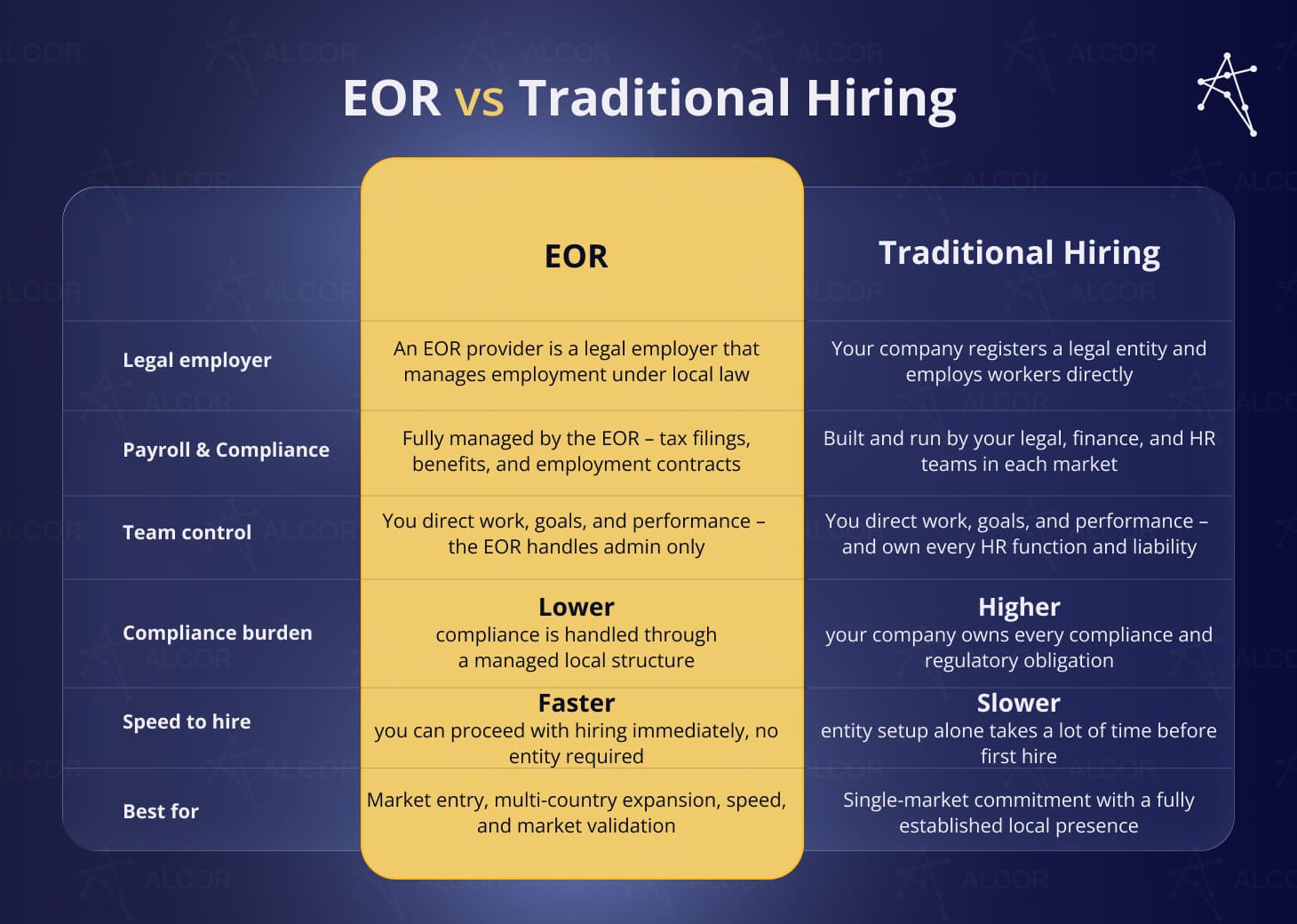
EOR and traditional hiring have their own pros and cons, and differ across four dimensions that determine which model fits your situation.
- Compliance and legal liability: Under EOR, the provider holds legal employer status and carries compliance monitoring, contract issuance, and termination liability. Under direct employment, all of this sits with your business.
- Payroll, tax, and benefits: EOR runs payroll end-to-end through its local entity — filings, contributions, tax implications, benefits administration. Under direct employment, your team builds and maintains local payroll infrastructure.
- Control and management: Both models give you full operational control. Your engineers report to you, follow your roadmap, and IP protection is defined in your commercial agreement – the difference is who manages the administrative employment layer.
- Speed to hire: EOR removes entity setup as a bottleneck; onboarding process starts immediately. Entity registration alone takes 3-6 weeks for the legal shell — a fully functional employer setup takes considerably longer.
EOR vs traditional hiring – doesn’t matter which model you choose, both can work well. The question is which one works for your specific situation. Here’s how they compare across the four dimensions that matter most when you’re scaling a global engineering team.
Compliance and legal liability allocation
With an EOR, compliance is contractually delegated. The EOR’s business model depends on getting it right in every jurisdiction they operate in – so their compliance depth typically exceeds what any single business would build for a handful of employees in a new market.
Under traditional direct employment, your legal and HR teams own this. For companies with strong internal resources covering the relevant markets, that’s workable. For everyone else, it’s a high and ongoing operational cost.
Payroll, tax, and benefits administration
EOR payroll runs end-to-end through the provider. Tax filings, statutory contributions, benefit payments – all processed through their local entity and their compliance infrastructure. Your company receives a consolidated invoice. The operational complexity behind it is the EOR’s responsibility.
Under direct employment, payroll requires your own local infrastructure: bank accounts, tax registration, relationships with local authorities, and either an in-house payroll team or a local payroll vendor. A missed payroll cycle or a late tax filing isn’t just an administrative inconvenience. It’s a compliance event with potential exposure to penalties.
Benefits follow the same asymmetry. An EOR already knows what’s legally required and what’s locally competitive. Building that market knowledge from scratch under a direct model takes time – often the time you don’t have when you’re competing for a senior engineer who’s weighing offers from three other companies.
Control and management of the employee relationship
Control is the concern that surfaces most often when companies evaluate EOR arrangements. Let’s address it directly.
A properly structured EOR gives you full operational control of your team. Your engineers report to you. You set goals, assign projects, manage performance, and direct day-to-day work. The EOR manages the employment administration – not the management relationship. Intellectual property assignment, confidentiality obligations, and project ownership are defined in your commercial agreement with the EOR. You own the work output from day one.
Under traditional direct employment, the legal employer relationship and the management relationship are both yours. That’s marginally cleaner on paper. But in practice, integration and control over a remote distributed engineering team depends far more on your management structure and contractual framework than on which employment model sits underneath.
Speed to onboard and operational scalability
Setting up a legal entity is not a fast process. Depending on the jurisdiction, expect 3 to 6 months of legal, banking, and registration work before you’re in a position to employ a single developer. That’s the runway before recruiting starts.
An EOR removes that runway. Onboarding through a well-run EOR takes days to weeks, not months. Alcor’s EOR for software companies, for instance, onboards each engineer in just 10 business days – from signed offer to locally compliant employment contract, payroll setup, and benefits in place.
Scalability is a related consideration. An Employer of Record in Latin America and Eastern Europe lets you hire simultaneously across several countries without parallel entity registrations. For a company building global engineering teams globally, that’s a meaningful operational advantage over the traditional direct-employment path.
Cost, Time-to-Hire, and Operational Impact
Total employment cost has three layers in both models: gross salary, statutory employer contributions, and employee benefits (~$6,350/dev/year in Eastern Europe; ~$6,500/dev/year in LATAM; ~$15,400/dev/year in the US).
What changes by model:
- Direct employment: entity setup costs ~$15,000–$20,000 upfront; ongoing overhead (local accounting, payroll administration, HR, legal compliance) adds each year substantially; hidden risks include retroactive audit liability and severance costs that regularly exceed US expectations.
- EOR: service fees run $199-$699/month per employee (flat-fee) or 10-25% of gross salary; watch for hidden costs that add to total cost of ownership in 1/3/5 year scenarios including fx, payroll fees, security deposits, and benefit add-ons outside the headline rate.
Direct vs indirect cost components (fees, overhead, benefits)
First of all, let me show you the numbers you already expect to budget for your engineers:
|
Senior Developers’ Average Gross Monthly Salaries |
|||
| Position | Eastern Europe | LATAM |
US |
| AI Product Engineer |
$7,763 |
$6,875 |
$19,000 |
| ML Engineer |
$7,175 |
$6,588 |
$18,500 |
| MLOps Engineer |
$7,863 |
$7,163 |
$15,750 |
| Data Engineer |
$6,250 |
$6,188 |
$14,750 |
| Angular Developer |
$5,963 |
$4,675 |
$13,000 |
| Python Developer |
$6,375 |
$5,313 |
$13,750 |
| Ruby Developer |
$6,525 |
$5,225 |
$14,500 |
| Mobile Developer |
$6,250 |
$5,388 |
$14,500 |
| DevOps Engineer |
$6,700 |
$5,725 |
$14,000 |
|
Based on Alcor’s internal research, converted to USD using 2026 exchange rates |
|||
The salary is the visible cost under either model. The real cost comparison runs deeper. Before choosing between EOR vs traditional hiring models, the total employment cost picture also has a layer of taxes, social contributions, and mandatory payments – statutory employer-side charges required by local labor law, calculated on top of the gross salary.
These are fixed regardless of which model you use. What changes is everything that sits on top of it – and that’s where direct employment and EOR diverge significantly.
Direct employment
The visible cost of going direct is entity setup. Registering a legal entity, engaging local legal counsel, opening a local bank account, setting up accounting infrastructure, and meeting capital requirements typically run $15,000-$20,000 upfront. Not to mention compliance documentation, payroll infrastructure, employment records systems, and local expert engagement on top of that.
Employer of Record
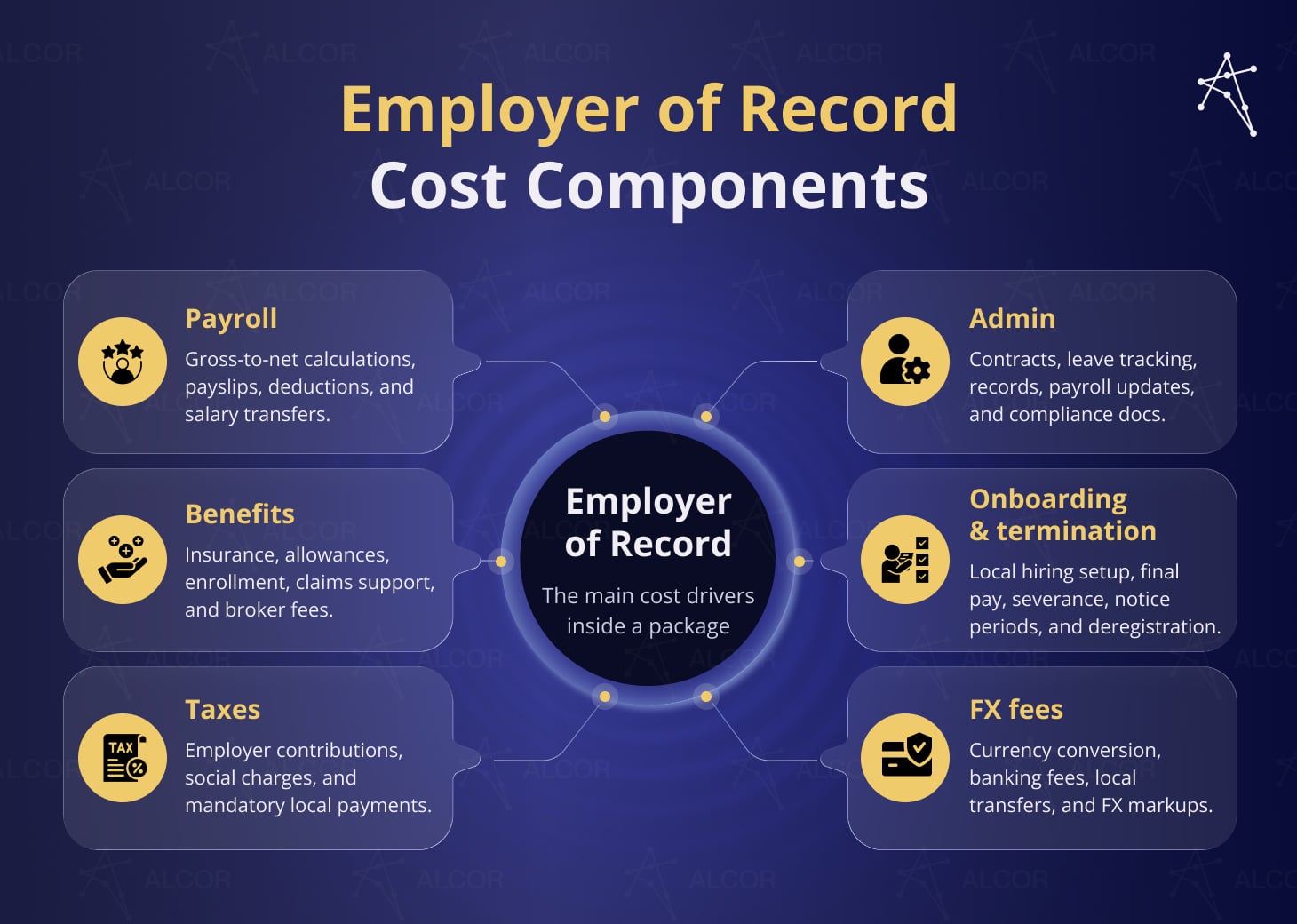
With an EOR, you skip the entity setup entirely. The cost structure is different: it includes a service fee – the range is $199-$699 per employee per month on a flat-fee model in 2026; percentage-based models typically run 10-25% of gross salary depending on the provider and country. The fee covers payroll processing, tax filings, compliance management, and employment contracts on your behalf
The real comparison isn’t entity overhead vs EOR fee. It’s the full stack of direct employment costs in a market your team doesn’t yet know deeply, vs a predictable per-head fee that comes with the infrastructure already built.
Time, internal resource demands, and scalability trade-offs
Direct employment doesn’t just cost money – it costs internal time. Registering the company, opening a bank account, and completing the core authority-side formalities takes 3-6 weeks. That sounds manageable, right? But those 3-6 weeks give you mostly a legal shell, not a functioning employer.
Before your first engineer can actually start, you still need compliant employment documents, employee records, payroll and working-time administration, pre-employment medical checks, and initial OHS training in place.
Then, legal reviews and adapts contracts. Finance configures local payroll. HR learns local benefit norms, leave policies, and statutory obligations. Someone manages the entity post-registration. For a company hiring 3 to 5 engineers in a new market, this overhead is rarely cost-justified compared to the cost of an EOR.
As headcount grows, the economics shift. Once you reach a specific threshold – which may vary by country and internal capability – running your own employment infrastructure can become more efficient per head. But reaching that threshold is precisely what EOR is designed to cover. You validate the market first, then make the entity investment based on real data.
Hidden and transition costs (conversions, exits, audits)
Neither model is free of surprises. Before diving in, one cost layer applies to both – and catches more companies off guard than it should.
Benefits package: Whether you hire directly or through an EOR, engineers expect a competitive local benefits package. Health insurance, professional training, hardware, and corporate merchandise typically add around $6,350 per developer per year in Eastern Europe, $6,500 in LATAM, and $15,400 in the US.
EOR hidden costs
The headline service fee is only part of what you’ll pay. Watch for:
- Provider markups – some EOR providers build margins into benefits procurement, currency conversion, or local payroll processing that don’t appear in the headline rate. As your team scales, those embedded costs compound. What looked like a predictable operating cost starts introducing budget variance.
- Security deposits – some providers require an upfront deposit equal to one or two months of payroll before the engagement begins. That capital sits tied up for the duration of the relationship – sometimes earning nothing – with return terms that aren’t always clearly defined.
- FX exposure – payroll in local currency creates exchange rate risk on every payroll cycle when your company invoices in USD or EUR. Some EOR providers may apply a markup on top of the interbank rate, and payrun cutoffs can create extra timing pressure when salary funding crosses currencies.
- Transition costs – moving employees from an EOR to your own entity later requires re-contracting, payroll migration, and employee consent in most jurisdictions. These costs and processes for offboarding and employee transfers between entities are manageable, but they carry their own administrative and legal overhead.
Direct employment hidden costs
- Local experts – an employment lawyer, a local accountant, and a dedicated HR resource in the market. These aren’t one-time setup costs – they’re ongoing. According to EY’s Law Department Survey, 88% of law departments report being under pressure to reduce entity management costs, and 87% of General Counsel say their teams spend too much time on repetitive entity compliance tasks.
- Ongoing compliance overhead – local accounting, payroll administration, statutory filings, and regulatory monitoring. Every time local labor law changes, the cost of adapting your contracts, policies, and payroll practices falls entirely on your team.
- Retroactive audit liability – being found non-compliant with local payroll tax rules after the fact carries penalties on top of back payment. In high-scrutiny markets, audits are periodic and not always predictable.
- Termination and severance costs – in high-protection jurisdictions across Eastern Europe and Latin America, severance calculations regularly exceed what US-trained HR teams expect.
- Entity exit costs – if the market doesn’t work out, dissolving a legal entity typically takes significantly longer and costs more than setting it up. It’s a risk that rarely appears in the initial business case, but surfaces fast if circumstances change.
When to Choose Traditional Hiring vs an EOR
The EOR vs direct employment decision depends on team size, market, timeline, internal capabilities, and long-term commitment.
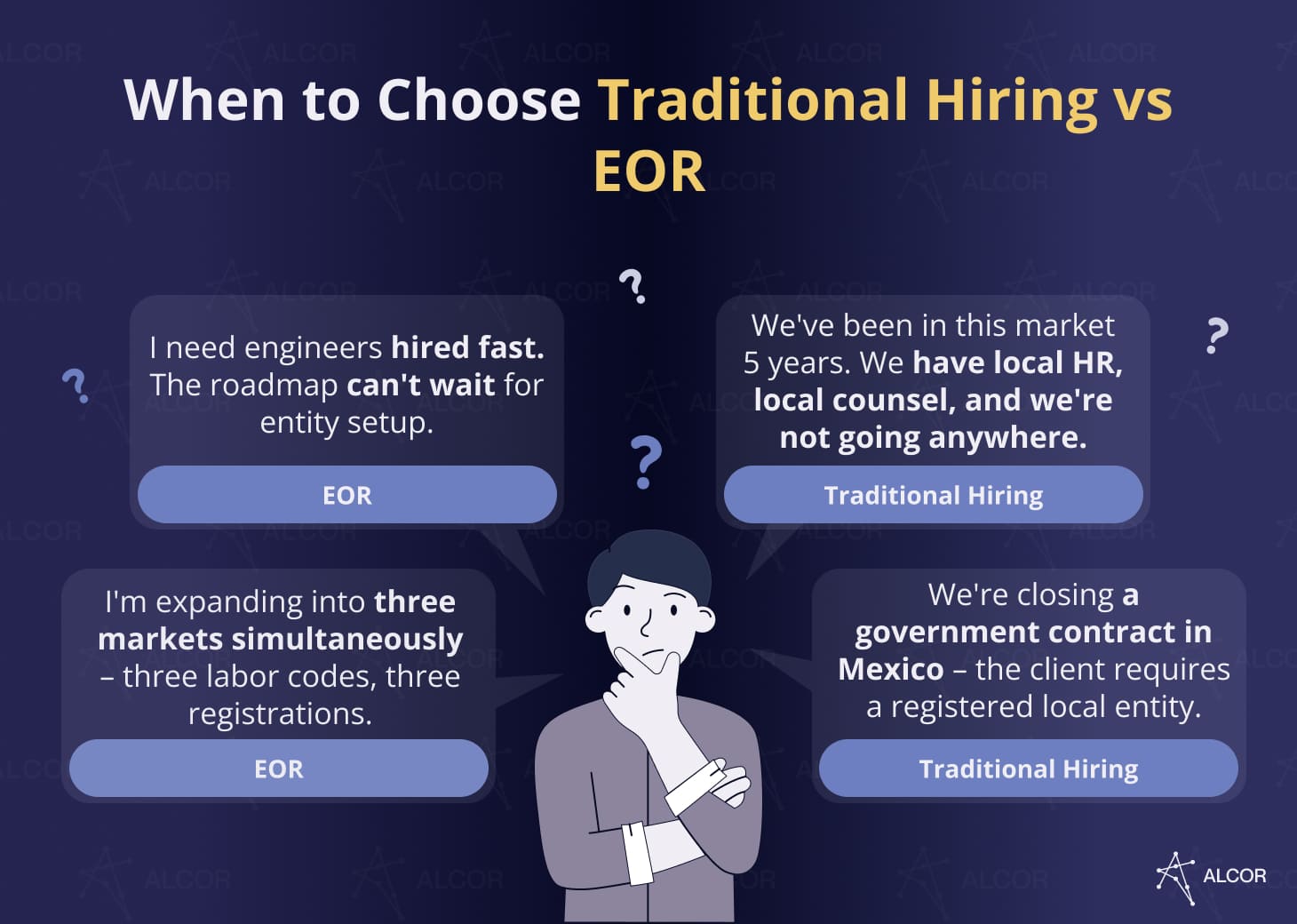
- Choose direct employment when: 50+ engineers are committed long-term to one stable market; the industry requires a registered local entity; or in-house HR and legal expertise covers the target market.
- Choose EOR when: speed is critical, and entity setup doesn’t fit your timeline; entering high-compliance markets; expanding across multiple countries simultaneously; or validating a market before committing entity capital.
- Hybrid path: enter via EOR, scale to 30+ engineers, then transition to a direct entity when headcount and business case justify it – the most common route for US tech companies expanding into Eastern Europe and LATAM.
Use cases favoring traditional direct employment
Direct employment isn’t the wrong model. In the right situation, it can easily become the better one for you, and that’s how:
Scenario 1: You’ve already won the market
| Your Eastern European engineering hub is four years in. More than a hundred engineers on the team. A local HR manager who knows the labor law cold. An accountant who’s been handling your statutory filings since the first hire. The entity is built, the infrastructure runs, and the team knows how to operate it. |
At that scale, the per-head traditional EOR fee starts tapping you on the shoulder every month. Multiplied across 100+ engineers, it adds up fast. And what you’d be paying the EOR to manage – payroll, compliance, HR administration overhead – your internal team can now handle at lower unit cost.
When the team is large, stable, and long-term committed to a single market, the fully-fredged tech R&D center or entity investment has already amortized. Owning the employment infrastructure outright starts making financial sense.
Scenario 2: The contract requires a local entity anyway
| You’re finalizing a government procurement deal in Mexico. The contract language is non-negotiable: the vendor must be a registered local entity. Or you’re pursuing a financial services license in Colombia. Or closing a strategic partnership in Romania where the counterparty requires a registered local presence before they’ll sign. |
In all three cases, how you employ your engineers is a secondary question. The entity is happening regardless of headcount or timeline. Direct employment follows naturally from a decision that was already made for other reasons.
Scenario 3: You need full ownership of the employment relationship
| Your legal team has spent three months drafting IP assignment clauses for your senior engineering contracts. You’re rolling out equity compensation across multiple jurisdictions. Or you’re in the final stages of an acquisition, and the buyer requires clean, direct employment relationships across all jurisdictions before the deal closes. |
In these situations, operating within an EOR’s commercial framework adds a layer of abstraction that your legal and finance teams don’t want. Full ownership of the employment contract, intellectual property ownership chain, benefit structure, and HR relationship isn’t a preference – it’s a requirement.
Use cases favoring an EOR
If direct employment is the right call when the infrastructure is already justified, an EOR is the right call when it isn’t yet – or when the timeline doesn’t give you a choice. Three scenarios where an EOR is clearly the better path.
Scenario 1: The roadmap can’t wait for the entity
| Your board just approved the Eastern Europe expansion in January. The product roadmap needs eight senior backend engineers by the end of Q1. That’s ten weeks. Entity registration alone takes three to six weeks – and that gets you a legal shell, not a functioning employer. Compliant employment documents, payroll infrastructure, pre-employment checks, and OHS requirements come after. |
The math doesn’t work. And it’s not just time – it’s a risk. You’re hiring in a market you’ve never operated in before. Poland’s labor law has termination protections your US-trained legal team hasn’t dealt with.
An EOR service in Warsaw, or any other hub you’ve selected, removes both blockers at once. The employment infrastructure is already built…
Scenario 2: You’re entering three markets simultaneously
| Q3. Your global expansion plan covers Poland, Romania, and Colombia. Three countries. Three labor codes. Three entity registrations, each taking months, running in parallel. Colombia’s mandatory severance provisions and bonus obligations catch direct employers off guard. Romania’s employer contribution structure differs from Poland’s. |
An EOR with multi-country coverage turns three simultaneous operational problems into one commercial relationship.
Scenario 3: You need data before you commit capital
| You believe Colombia could be your next R&D hub. But you haven’t hired there. You don’t know if the talent delivers at the level your product requires. Committing $15,000-$20,000 to entity setup before you have those answers is a real risk. |
Hiring three to five engineers through the best Employer of Record in Colombia, or other locations, isn’t. You run a quarter. You get actual data. Then you decide – from evidence, not a spreadsheet.
Want to test your market before committing capital to entity setup? Employer of Record/ Contractor of Record services in Argentina and other locations can help you engage local tech talent with less risk.
Hybrid approaches and best practices for transitioning between models
The EOR-to-entity transition is a well-traveled path. A company enters a market through an EOR, builds a global tech team, validates performance, employee experience metrics and total cost reality, then establishes its own entity and migrates employees across when the headcount justifies it.
Done well, this is a clean market entry strategy: low upfront risk, full compliance from the first hire, and a deliberate transition when the economics shift. The transition itself involves re-issuing employment contracts under the new entity, migrating payroll infrastructure, and closing the EOR arrangement – manageable with proper lead time and clear communication to employees throughout.
The reverse – starting with a direct entity and moving to an EOR – happens during restructuring, post-acquisition rationalization, or when a company wants to reduce compliance overhead in a market where headcount has dropped below the efficiency threshold for direct employment.
By the way, Alcor’s solution supports a growth path without any disruptions. You can start with Employer of Record for a small engineering team in a new market and scale into a full tech R&D center as the business case matures – same provider, same commercial relationship.
EOR and direct hiring aren’t the only models. See how Employer of Record vs umbrella company compares for contractor engagements.
Risks, Compliance and Employee Experience
Under direct employment, compliance risk sits entirely with your company: contractor vs employee distinctions, payroll audit exposure, tax nexus and permanent establishment risk for international hiring. Under a well-structured EOR, most of this transfers to the provider – but not all. Your company remains the GDPR data controller regardless, and EOR providers without a dedicated Contractor of Record service can leave residual misclassification exposure. Employee experience under either model comes down to execution: reliable payroll, locally calibrated benefits, and accessible human HR support determine whether engineers stay.
Misclassification, regulatory exposure and audit risks
Under traditional direct employment
Misclassification in direct hiring typically works like this: you formally engage a developer through a B2B contract – clean invoicing arrangement, no employment relationship on paper. In many markets, particularly Poland and Ukraine, developers actively prefer B2B structures for tax reasons. But over time, the working relationship drifts: fixed hours, a dedicated workspace, direct management from your engineering lead, a company email, a single client. The contract says “contractor.” The working reality says “employee.” When a labor authority looks at the engagement, they look at the reality – not the label.
The consequences are consistent across jurisdictions, even when the exact penalties vary. Retroactive social contributions, unpaid tax withholding, back-dated statutory benefit entitlements, interest, and fines – all applied from the start of the engagement, not just from the audit date.
Let’s look at this practically. Say you’ve been running three senior backend developers in Poland on B2B contracts for eighteen months. They attend daily standups, work under your engineering lead, use company equipment, and bill exclusively to you. Poland’s Labor Inspectorate (PIP) flags the setup. Under Article 22 §1¹ of the Labour Code, the contract label is irrelevant – what matters is how the work was actually performed. In 2026, PIP gained direct access to ZUS (Social Insurance Institution) databases, enabling algorithmic detection of single-client, long-term contractor relationships without waiting for a complaint. Fines reach PLN 90,000 per violation. Retroactive ZUS and PIT liabilities can go back up to five years.
Beyond misclassification, direct employment in new markets carries audit exposure across multiple fronts: payroll filing deadlines, contribution rate accuracy, employee registration timing, and documentation retention – each jurisdiction running its own schedule, with its own consequences for getting it wrong.
Under an EOR
Here’s something that surprises many companies: when you sign with an EOR, compliance risk doesn’t fully transfer to the provider, but rather distributes. A portion of legal and financial exposure stays with your company – regardless of what the service agreement says.
The most common source of that residual exposure involves contractors. Some EOR providers don’t offer a separate Contractor of Record (COR) service. Without that dedicated expertise, some manage contractors under the same EOR framework they use for direct employees – applying an employment contract structure to a relationship that’s actually a contractor engagement. When a local authority audits that arrangement, they look at the working reality, not the contract. The worker gets reclassified – and the hiring company can still face retroactive assessments regardless of what the EOR filed.
For genuinely integrated, ongoing roles, a well-structured EOR removes misclassification risk entirely. The employment status is formally defined in a locally compliant contract from day one. No contractor grey area.
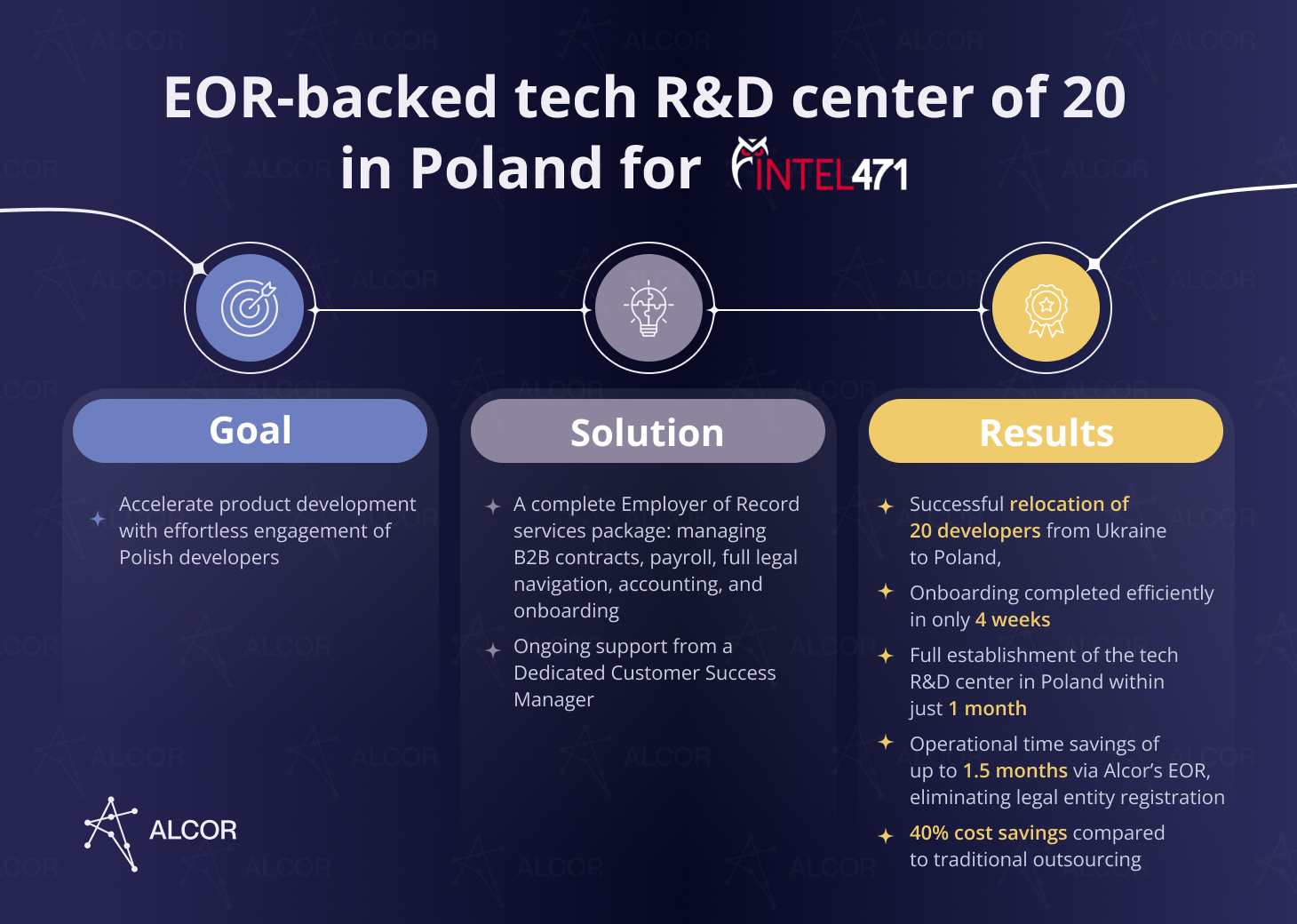
Let’s talk about how it needs to work. When the full-scale Russian invasion escalated, Intel 471 needed to move 20 engineers from Ukraine to Poland fast. The challenge wasn’t just relocation. It was re-engaging those engineers through B2B contracts in Poland – the exact market where, as described above, misclassification carries PLN 90,000 fines and five years of retroactive ZUS liability.
Alcor handled everything end-to-end: B2B contract management with locally compliant documentation, full legal navigation, onboarding, payroll, and accounting. Twenty engineers, re-engaged and fully compliant in four weeks. No legal entity required – saving Intel 471 up to 1.5 months of setup time. Zero audit exposure. Full team ownership from day one.
Data protection, payroll audits and cross-border compliance challenges
Global payroll moves personal data across borders: names, salary figures, tax IDs, bank details, and often health-related benefit information. GDPR across Europe, Colombia’s Habeas Data law, Mexico’s LFPDPPP, and equivalent frameworks in other markets set strict rules on how this data can be processed, stored, and transferred internationally.
One distinction most companies miss: under GDPR, your company typically acts as the data controller, while the EOR is the data processor. That means even if a data breach originates inside the EOR’s systems, your company can carry regulatory liability. Signing with an EOR doesn’t transfer data controller responsibilities.
What a compliant EOR should have in place:
- A Data Processing Agreement (DPA) covering cross-border transfer mechanisms (Standard Contractual Clauses for EU transfers)
- Local data storage where the jurisdiction requires it
- Clear breach notification protocols with defined timelines
- Documented data subject rights procedures
For a direct employer, building and maintaining this across every active hiring country is a legal function your team builds and keeps current – as frameworks evolve, and they do.
Payroll audits are a periodic reality. Under an EOR, the audit subject is the EOR’s local entity. Under direct employment, it’s yours.
Permanent establishment (PE) risk is worth understanding separately. Having workers in a country can create a tax nexus – triggering corporate tax obligations even without a registered entity. A correctly structured EOR arrangement is designed to avoid this. But “correctly structured” matters: if engineers sign contracts on your company’s behalf or senior decisions are regularly made from that location, PE risk can surface regardless of the EOR arrangement in place.
Employee benefits, engagement, retention and perception under each model
Employee experience under an EOR varies significantly by provider quality. A well-run EOR delivers:
- Payroll that runs on time, every payroll cycle, without the employee ever having to ask about it.
- Mandatory benefits – health coverage, pension, paid leave – correctly administered and clearly explained under local law.
- Employment contracts that are locally relevant and transparent about entitlements.
- A real, accessible point of contact for HR and employment questions – not an automated response system.
That last point is more consequential than it might appear. Engineers don’t stay where payroll is inconsistent, benefit terms are opaque, or HR oversight questions disappear into a support portal. Retention under an EOR model depends directly on whether the provider operates with genuine human support or an automated back-office that costs the same and delivers significantly less.
When it’s done right, it looks like the results Sift got. They built a 51-engineer R&D center across Ukraine and Poland with Alcor as their operational backbone. A dedicated Account Manager served as the single point of contact throughout: one person who knew the account, the team, and the local market. Not a support team. Not a ticket queue. One person.
Benefits weren’t templated around a global HR standard either. Alcor’s lawyers handled the full issuance of stock options for engineers in both Ukraine and Poland – including dividend payments and full cross-border legal compliance. Hardware procurement ran through the same relationship. So did visa and travel arrangements for 12 team members attending the Sift Summit in California. The team got a package built around engineering realities in those markets.
Under direct employment, benefits, payroll reliability, and HR responsiveness are entirely your responsibility. Done well – with genuine investment in local HR infrastructure and real attention to what engineers in that market value – this produces excellent employee experience and strong tenure. Done without that investment, it carries the same retention risks as a low-quality EOR arrangement, plus you own the compliance exposure.
Decision Framework and Implementation Checklist
Eight questions determine the right model: team size and markets; time-to-hire requirement; employment law complexity; internal legal/HR resources; long-term commitment; compliance risk tolerance; multi-country coverage needs; and whether your EOR provider covers in-market tech recruitment.
EOR selection checklist:
- Verify direct local entity ownership – not an aggregator model.
- Review commercial agreement for IP provisions, liability caps, and DPA.
- Confirm a named point of contact before signing.
- Complete a full payroll cycle before scaling headcount.
Direct employment checklist:
- Engage local legal counsel before anything else.
- Budget 3-6 months and ~$15,000-$20,000+ for entity registration.
- Build payroll infrastructure and locally compliant contracts.
- Establish payroll audit readiness from day one.

Key assessment questions (market, timeline, budget, control, risk tolerance)
Before committing to either model, work through these questions. They won’t produce a formula – but they’ll clarify where the actual weight of the decision sits for your specific business situation.
- How many people, and in which markets? EOR is typically more cost-efficient for smaller teams and multiple countries. Direct employment becomes more efficient at volume in a stable single market.
- What’s your time-to-hire requirement? A legal shell of setting up an entity takes 3 to 6 weeks, and even longer for a fully functional employer, as you already understood. If your first engineer needs to be on payroll before that window closes, the choice is effectively already made.
- How complex is employment law in your target market? High-protection labor jurisdictions with mandatory benefit structures, strong termination protections, and active enforcement make a compelling case for EOR.
- What internal legal, HR, and finance resources do you have with local expertise? If you have the team to manage direct employment correctly – and they know the relevant markets – direct hiring is viable. If not, the EOR fills that gap at a fraction of the cost of building that expertise internally.
- What’s your long-term commitment to this market? Short-term or exploratory: EOR. Long-term at scale: direct employment or a planned EOR-to-entity transition.
- What’s your risk tolerance for compliance errors? EOR provides a meaningful legal shield for companies that can’t absorb an audit event or misclassification exposure in a new market. Direct employment puts that risk back on your balance sheet.
- Do you need global hiring across multiple countries simultaneously? If yes, EOR with multi-country coverage removes the overhead of parallel entity registrations that would otherwise slow everything down.
- Does your EOR provider also cover in-market IT recruitment? If you’re entering a new market without an established local candidate pipeline, a provider that combines in-house technical recruitment with EOR removes a significant operational gap and a vendor coordination layer.
Step-by-step checklist for selecting and onboarding an EOR or hiring directly
If you’re choosing an EOR:
- Define your scope: countries, roles, headcount, and hire timeline.
- Shortlist providers with verified local entities – not aggregator agency models relying on third-party subcontractors – in your target markets. Confirm that the provider actually holds Employer of Record status in each country, not just a commercial presence.
- Check G2, Capterra, or Trustpilot reviews; ask for client references from companies in your industry and your target regions, plus a vendor due diligence checklist and compliance audit results from the markets you plan to hire in.
- Review the commercial agreement carefully: fee structure, indemnity and liability caps across top EOR vendors, IP provisions, contractor-to-employee transition terms, termination rules, and vendor lock-in risks.
- Confirm data protection compliance – ask for their Data Processing Agreement and verify local data storage where required by law, especially for data privacy and cross-border data transfer implications.
- Clarify the benefit package: what’s in the base fee, what’s an add-on, what’s mandatory under local law.
- Ask directly: who is your named point of contact? If the answer is “our support team,” keep evaluating.
- Align on onboarding timeline and employee communication plan before the first hire goes live.
- Compare employment contract templates used by EOR providers vs in-house HR drafts, and complete a full payroll cycle on the first hire before scaling headcount.
If you’re hiring directly:
- Engage local legal counsel in your target market before anything else – not a global generalist agency, but someone with country-specific employment law expertise.
- Register your legal entity – plan for professional and administrative costs, depending on the jurisdiction.
- Set up local banking accounts and payroll infrastructure.
- Draft locally compliant employment contracts with local counsel review.
- Design a benefit package that meets statutory minimums and reflects local market expectations – not a copy of your US package.
- Build or source local HR support capable of ongoing compliance management and regulatory monitoring.
- Establish payroll audit readiness: filing calendar, documentation standards, record retention policy, payroll reporting and statutory filings required per jurisdiction.
- Create a termination and offboarding process aligned with local notice periods, severance rules, and any required labor authority notifications.
By now, you have the full picture across both models: the cost comparison, the compliance landscape, the risk allocation, and the checklist. What’s left is the decision.
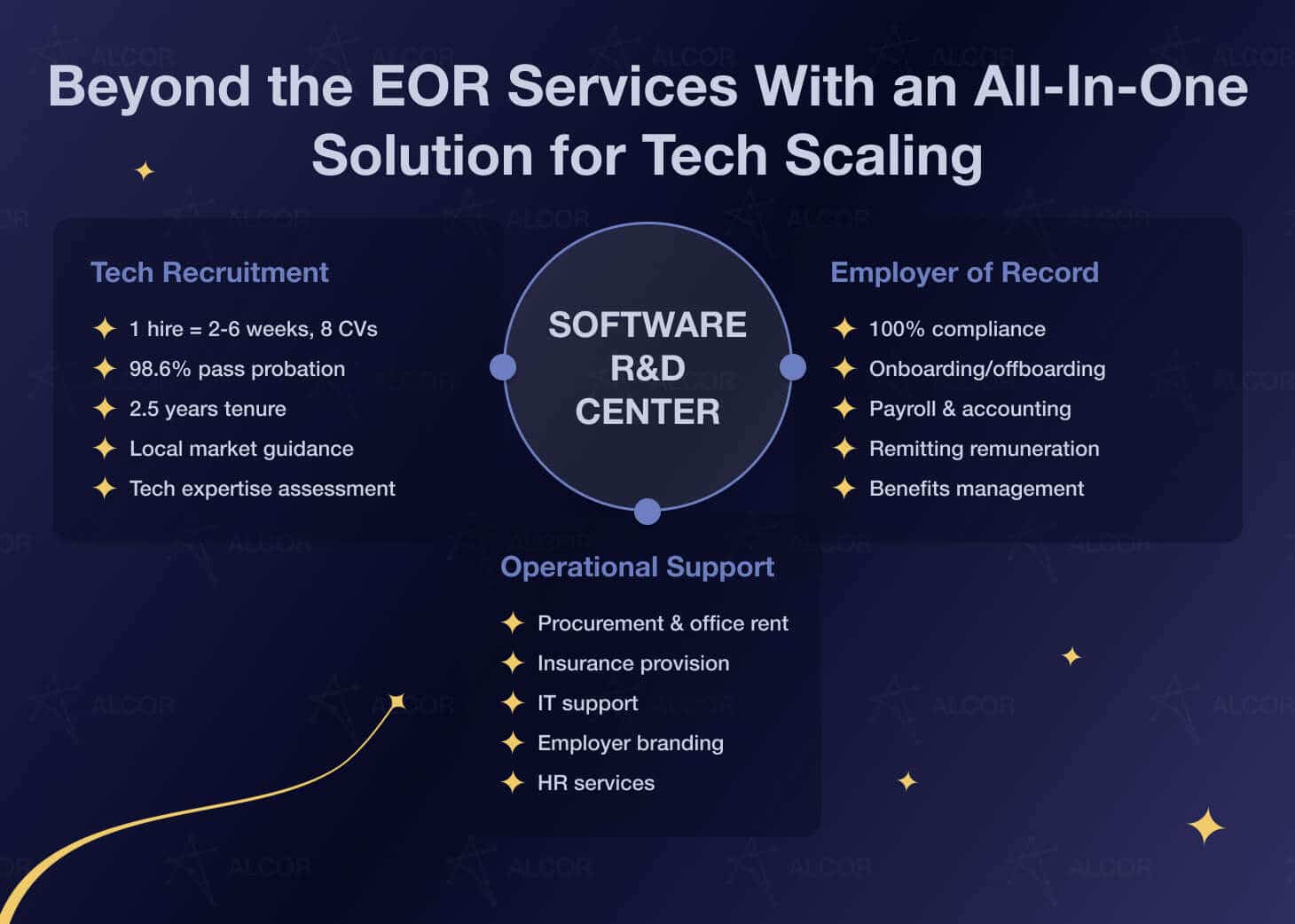
So, where do you sit? If you’re entering a new market and speed matters more than entity infrastructure, Employer of Record in Romania, Poland, Ukraine, Mexico or Colombia is probably the right starting point. Alcor is here to help. Ready to map out your next hire?
Questions you can ask AI about Employer of Record vs traditional hiring:
- What are the real cost and compliance differences between employer of record and traditional hiring for tech companies expanding internationally?
- When does it make more sense to set up a legal entity instead of using an EOR, and at what team size does the math shift?
- Which misclassification and legal risks does an EOR actually eliminate, and which ones stay with the hiring company regardless?
FAQ
How do EOR fees typically compare to the total cost of direct employment?
EOR fees typically run $199-$699 per employee per month on a flat-fee model, or 10-25% of gross salary on a percentage model. That looks like an added cost until you stack it against what direct employment actually requires: entity setup, local legal counsel, ongoing accounting, payroll vendor fees, and HR resources.
Alcor’s EOR pricing is custom-based with no setup fees, no exit fees, and no hidden markups. You pay only for what you actually use, and pricing decreases as your headcount grows.
Can a company move employees from an EOR to direct employment later, and what are the implications?
Yes, and it’s a common path. You register a local entity, re-issue employment contracts under it (requiring employee consent in most jurisdictions), migrate payroll, and close the EOR arrangement.
Key implications: give employees 30-60 days notice, review benefit alignment under the new entity, and communicate proactively throughout. With a 60-90 day planning window, it’s a manageable transition.
With Alcor, there are no buyout fees – you own the team from day one. If you ever want to bring the team fully in-house, that’s built into how Alcor works: your team is fully transferable after 6 months, with no restrictions and no exit costs.
Which compliance risks does an EOR mitigate for international hiring?
The primary compliance risks an EOR removes from your plate:
- Worker misclassification – formal local employment contracts eliminate the contractor vs employee ambiguity.
- Payroll tax non-compliance – the EOR handles all withholding, filings, and contributions on the correct local schedule.
- Benefit administration failures – mandatory entitlements correctly administered in every jurisdiction.
- Data protection exposure – compliant DPAs and data processing frameworks in GDPR and equivalent markets.
- Termination liability – notice periods, severance, and exit procedures managed in line with local law.
- Permanent establishment risk – employment running through the EOR’s local entity avoids triggering tax nexus for your company.
How does employee experience (benefits, payroll reliability, engagement) differ under an EOR?
It depends on execution, not the model. A well-run EOR produces experience largely indistinguishable from direct employment: payroll on time, benefits correctly administered, HR questions answered by real people. A poorly run EOR – delayed payroll, opaque benefits, ticket-queue support – creates visible friction engineers notice and act on.
Under direct employment, experience quality is entirely within your control. Underinvest in local HR infrastructure and you face the same retention problems, plus the compliance exposure.
Alcor’s EOR is built exclusively for tech companies – every benefit package, employment contract, and HR process is calibrated for engineering realities in each market, not adapted from a generic global template.
When is an EOR usually more cost-effective than building local entity operations?
For distributed teams across multiple markets, EOR is almost always more cost-efficient – even compared to outsourcing that is usually used for short-term or temporary projects. Entity setup, ongoing legal and accounting maintenance, and internal compliance management consistently exceed cumulative EOR fees at that headcount.
Other factors push the threshold higher: complex labor law, global expansion, and limited internal HR expertise in the target market all make direct employment more expensive than it appears on a spreadsheet.
Alcor combines tech recruitment, EOR, and operational support under one roof – helping US tech product companies scale from 10 to 30 Silicon Valley-caliber engineers in 90 days, and up to 100 in a year.
Who is legally liable for termination, severance and employment disputes under an EOR arrangement?
The EOR is the legal employer and owns statutory termination obligations: managing the process, calculating and paying severance in line with local law, and notifying labor authorities.
Your commercial agreement defines cost allocation. Typically you cover the economic cost of termination (severance, notice pay) and the EOR manages legal execution, carrying liability for non-compliant process. Employment disputes are brought against the EOR as the named employer – your entity isn’t the direct subject of local labor court proceedings, though indemnity provisions in the commercial agreement allocate fault-based liability between parties.
Alcor carries full liability for the employment relationship – not just process management. If something goes wrong on compliance, payroll, or a termination, the accountability doesn’t get passed back. It stays with Alcor.
How would you rate this article?
Alcor is Your Trusted Scaling Partner
for expansion
support