


AI in Mexico is leaping: over 2 million businesses – a third of all companies in the country – have already adopted AI. Grand View Research projects the market to expand at 34.4% annually through 2033. The talent is here, the ecosystem is maturing, and US tech companies are already building here. The question is whether you’re early enough to get the engineers you actually want.
I’m David Gomez, Lead IT Recruiter in Latin America at Alcor. We specialize in building software R&D centers in Mexico and other LATAM and Eastern European countries, offering tech recruitment, Employer of Record, and full operational support. We help US tech companies scale high-performance engineering teams from 0 to 30 engineers in just 90 days. You own the team from day one – with full transparency, no prepayments, no markups, and no buyout fees.
In this article, you’ll get a clear, current picture of Mexico’s AI industry – the market numbers, who’s building here, where the talent is, and what the regulatory environment actually looks like in 2026. You’ll also find honest salary data and a straight breakdown of what working with Mexico-based AI engineers looks like in practice. Read it once, and you’ll know whether Mexico belongs in your engineering roadmap.
Key Takeaways
- Mexico’s AI market is growing at 34.4% annually, with $6.3B committed by investors like Amazon, Microsoft, and Google in infrastructure alone.
- AI skills in Mexico are growing faster than anywhere in Latin America – GenAI enrollments up 356%, AI/ML demand up 148% since 2023.
- Mexico’s AI regulation is accelerating: a new data protection law has been in effect since March 2025, and a unified AI law is expected by the end of 2026.
- Senior AI engineers in Mexico are up to 61% more affordable than US equivalents – without sacrificing technical depth or production experience.
- Alcor combines IT recruitment, EOR, and operational support under one roof: first hires in just 2-6 weeks, 100% compliance, no markups or buyout fees.
Mexico’s AI Industry Landscape
Mexico’s AI market reached $16.92 million in 2025 and is projected to hit $180.05 million by 2033, expanding at 34.4% annually. Key sectors driving AI adoption: finance, healthcare, logistics, and manufacturing. Amazon, Microsoft, and Google combined committed $6.3 billion in AI and cloud infrastructure. Generative AI, Machine Learning, and Robotics are the three highest-growth segments. Mexico accounts for 4.3% of the global AI market and ranks among the top 10 globally for AI adoption pace.
Market dynamics & predictions
The Mexican AI market reached approximately $16.92 million in 2025. By 2033, AI market volume is expected to hit $180.05 million.
AI developments are projected to contribute 3.5% to global GDP by 2030. The AI industry in Mexico is positioning itself to capture a growing share of that number. According to the QS World Future Skills Index 2025, Mexico increased its use of AI by 965%, placing the country among the top 10 globally in adoption pace. Mexico also accounts for 4.3% of the global artificial intelligence market in 2025, according to Grand View Research.
The AI sector develops across Robotics, Generative AI, NLP, LM, Machine Learning, and Computer Vision.
Spheres adopting AI
By late 2025, Google’s annual “Our Life with AI” report confirmed that 66% of the Mexican population actively uses AI – above the global average of 62%. At the enterprise level, around 8 in 10 Mexican companies now use AI in some form, primarily for virtual assistants and customer service automation. At a more advanced level, 3 in 10 organizations are already investing in training their own AI models. Healthcare, energy, and logistics are the sectors with the greatest traction: AI-assisted diagnostics and automated fleet management projects are already in active deployment.
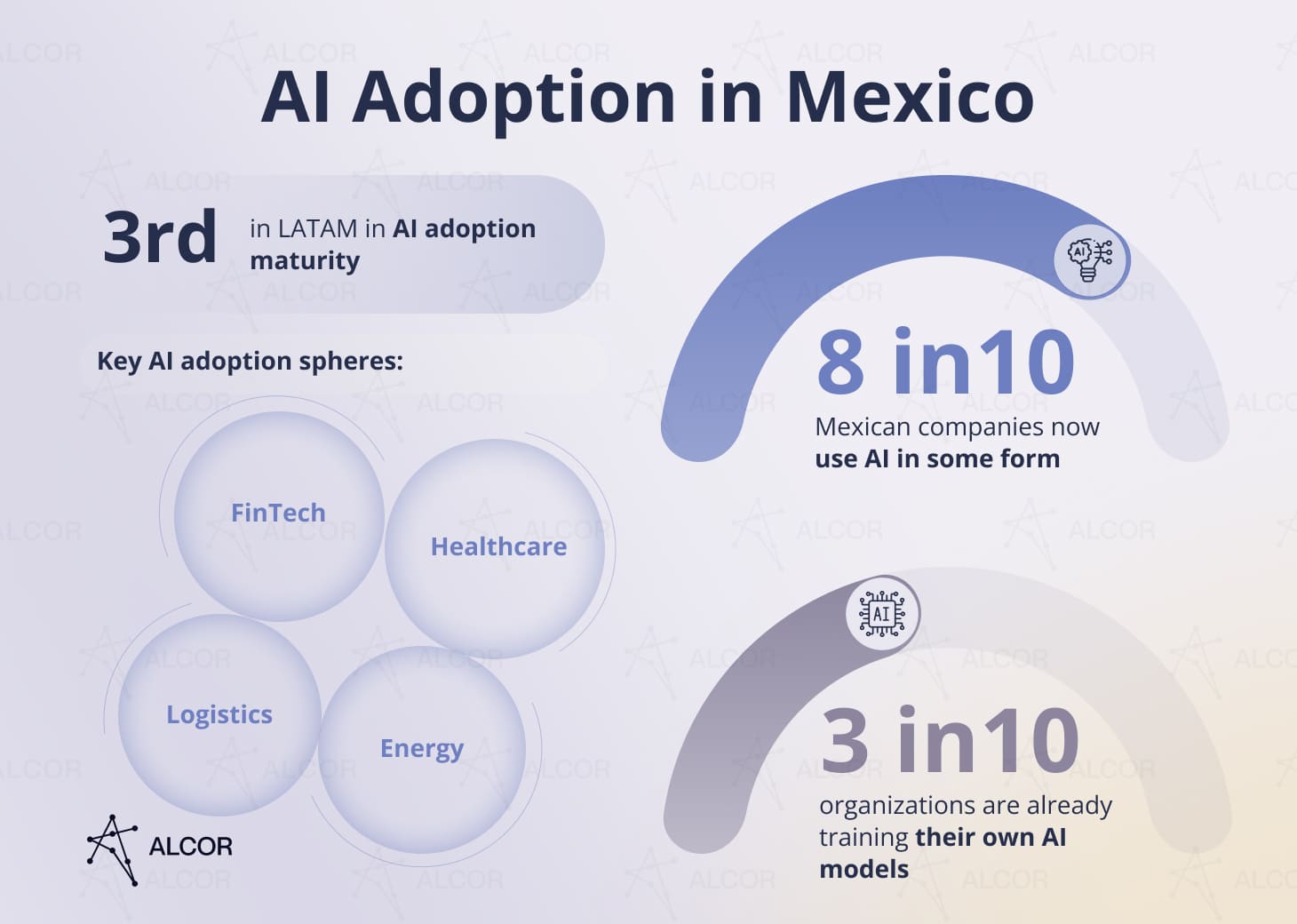
The infrastructure investment behind this reflects real commitment, not just projection. Amazon put $5 billion into Mexico’s cloud and AI infrastructure. Microsoft invested $1.3 billion over three years, targeting AI access for 5 million individuals and 30,000 businesses. Combined with Google, the three hyperscalers earmarked $6.3 billion for AI and cloud infrastructure in the country. IDC projects that investments in the AI industry of Mexico will maintain a 35% annual growth rate through 2027 – one of the strongest trajectories in Latin America.
AI sectors & companies
In Q2 2025, Mexican startups overtook Brazil in total venture capital for the first time in 13 years – a signal that international capital is paying serious attention to the ecosystem here. On the AI side specifically, Mexican AI startups raised $600 million in 2024, focused on logistics, customer service, and analytics. AI in Mexico City, in particular, is the primary hub – attracting international investment and homegrown startups in equal measure.
Accenture opened its 25th Gen AI Studio globally – the third in Latin America – in Mexico City in late 2024, as part of a $3 billion investment in data and AI. Wizeline and Tecnológico de Monterrey continue to run G.A.I.L., the first generative artificial intelligence laboratory in Mexico and Latin America, based in Guadalajara.
Tech hub Guadalajara is more than a footnote in Mexico’s AI story. Explore why it earns its Silicon Valley comparison.
Three areas stand out in the AI sector of Mexico in 2025-2026:
- The Generative AI market reached $257.5 million in 2025 and is projected to hit $1.035 billion by 2034, growing at 16.22% CAGR. Finance, healthcare, and retail are leading enterprise adoption, with businesses deploying Generative AI for content creation, customer service automation, and data analysis.
- Machine Learning is the segment with the largest long-term potential – projected to reach $7.134 million by 2034, growing at a CAGR 30.30%. Healthcare is leading the charge, with hospitals and healthtech startups using ML to improve diagnostics and predict patient outcomes.
- Robotics is forecast to reach $208.8 million by 2034, with a 5.93% CAGR, driven by AI-driven automation in automotive manufacturing across Coahuila and Guanajuato.
AI Technology in Mexico: Trends and Perspectives
Three trends define AI technology in Mexico in 2025-2026:
- AI has moved from pilots to production: logistics, advertising, and HR teams are running live systems, not experiments;
- the skills pipeline is growing faster than anywhere else in Latin America – GenAI enrollments surged 356% YoY in 2025, and demand for AI skills jumped 148% between 2023 and 2025;
- agentic AI is emerging as the defining challenge: Gartner projects 40% of enterprise apps will include AI agents by 2026.
For engineering leaders, Mexico’s AI talent pool is production-tested, fast-growing, and built for what comes next.
If you’re thinking of hiring AI developers and building a fully-fledged team abroad, the question isn’t just whether Mexico has talent – it’s whether that talent is working on the kinds of problems you actually need to solve. Technology in Mexico in 2025-2026 gives a concrete answer. Three emerging trends define where the ecosystem is and where it’s heading:
- AI has crossed from experiments into production;
- The AI skills pipeline is building faster than anywhere else in Latin America;
- Agentic AI is the next frontier – and the ecosystem is already moving toward it.
In 2025, Mexico completed a visible transition from isolated AI pilots to full-scale enterprise deployment. Logistics companies optimize last-mile delivery through live AI systems. Advertising agencies run media planning autonomously across Google, Meta, and YouTube – in production, not in test. For you as an engineering leader, that distinction matters because developers available here have shipped real systems, not demos.
The second trend is obvious in how Mexico recorded the highest Generative AI enrollment growth in Latin America in 2025 – a 356% year-over-year surge, nearly double the global average of 195%. AI and ML skills posted 338% YoY growth. Separately, demand for AI skills in Mexico’s job market jumped 148% between 2023 and 2025, according to a Get on Board and AWS joint study. PotencIA Mx – a joint initiative from Tecnológico de Monterrey, Meta, and Mexico’s Ministry of Economy – is actively training SMEs and startups to deploy AI in real operations. The talent pool isn’t static. It’s improving quarter by quarter.
At last, the shift from individual AI tools to autonomous, coordinated agent systems is the defining engineering challenge of 2026 globally. Mexico is moving with it. Regional tech leaders identify agentic AI as one of three trends redefining Mexico’s tech sector in 2026, alongside platform consolidation and AI ROI discipline. Gartner projects that 40% of enterprise applications will include task-specific AI agents by the end of 2026 – up from under 5% in 2025. At the Mexico AI, Cloud & Data Summit 2025, operators and analysts aligned on one point: companies building toward autonomous agent systems now will define the competitive gap in the years ahead. If your engineering roadmap includes agentic AI, this is the window to build the team – before the talent market tightens further.
AI Regulation in Mexico
AI regulation in Mexico accelerated significantly in 2025. A constitutional amendment bill introduced in February 2025 grants Congress authority to pass a General AI Law within 180 days. A separate Federal Law Regulating AI – modeled on the EU AI Act – would establish CONAIA, a national AI commission, with final approval expected in 2026. Most immediately, Mexico’s updated LFPDPPP data protection law came into force in March 2025, adding explicit AI accountability rules and specialized courts. Over 60 AI-related bills have been filed since 2020. There is no unified AI law yet, but the compliance direction is clear and moving fast.
AI regulation in Mexico moved faster in 2025 than in any previous year. And if you’re building a team here, the regulatory direction is something to track closely.
In February 2025, Ricardo Monreal Ávila – leader of the Morena parliamentary group – introduced a constitutional amendment bill granting Congress authority to legislate on AI. The bill sets a 180-day window to pass a General Law on the Use of AI, aligned with President Sheinbaum’s digital strategy. It’s expected to move quickly given broad cross-party support.
Separately, the proposed Federal Law Regulating Artificial Intelligence – under Senate review as of late 2025 – would establish a National Commission for Artificial Intelligence (CONAIA) and a risk-based classification framework modeled on the EU AI Act. Final approval is expected in 2026. The bill’s core goal: balance responsible AI governance with protecting Mexico’s technological sovereignty.
The most immediate change is already in force. Mexico enacted its new Federal Law on Protection of Personal Data Held by Private Parties (LFPDPPP) in March 2025 – the country’s most significant privacy reform in over a decade. It strengthens data subject rights, adds explicit accountability for automated decision-making, and establishes specialized federal courts for data protection for the first time. For companies using AI to process personal data, this changes your compliance obligations meaningfully.
Over 60 AI-related bills have been introduced in Congress since 2020. Mexico doesn’t yet have a unified AI law – but the governance’s future direction is clear. Companies with long-term plans in this market should be building compliance infrastructure now, not after the fact.
As Mexico’s AI regulatory landscape evolves, a PEO in Mexico can help your business stay compliant with local employment requirements.
Is Outsourcing AI Development to Mexico in 2026 a Good Idea?
Mexico offers a strong case for AI development: 910,000+ tech professionals, 110,000+ new graduates annually, and senior AI engineers at up to 61% more affordable cost than US equivalents. However, outsourcing carries structural risks – engineer rotation, 40-50% hidden markups, limited team control, and buyout fees. Legal entity setup takes 2-6 months and carries significant compliance complexity. The strongest path for US tech companies is working with an Employer of Record in Mexico: it removes legal overhead while delivering full control, cost transparency, and compliant employment from day one.
Pro: top-tier talent pool
The talent pool for artificial intelligence in Mexico is large and growing. The country has 910,000+ tech professionals, with AI and ML skills posting 338% YoY growth. Every year, Mexican universities add 110,000+ new tech graduates to the market.
The surrounding ecosystem – Python developers, cloud engineers, data science specialists – is deep and experienced. Tecnológico de Monterrey, UNAM, IPN, and Universidad de Guadalajara all produce engineers with relevant AI and data engineering backgrounds, feeding one of the strongest talent pools in Latin America.
Pro: wise cost decision
Compared to the United States, artificial intelligence software developers in Mexico are more affordable. Take a senior AI Engineer’s salary: an average of $7,400 monthly in Mexico, against $19,000 for the same US role. The savings can reach up to 61% depending on the role! Ready to tap into these savings? Our AI recruitment agency hires senior engineers in Mexico in 2–6 weeks.
See a current comparison of American vs Mexican software engineer salary across key positions, based on our internal market 2026 research:
|
Position, senior |
Gross Monthly Income, USD |
|
|
Mexico |
United States |
|
|
AI Product Engineer |
7,400 |
19,000 |
|
Machine Learning Engineer |
6,750 |
18,500 |
|
LLM Engineer |
8,000 |
19,500 |
|
MLOps Engineer |
7,750 |
15,750 |
|
Python Engineer |
5,600 |
13,750 |
Con: complex legal market
Choosing Mexico for nearshore software development is a smart move. But in practice, the legal side is where companies hit the wall.
Payroll structure, income tax withholding, mandatory profit sharing (PTU), Christmas bonuses (Aguinaldo), vacation premiums, IMSS social security – all different from what you may know. And that’s before you’ve hired a single person. Want to incorporate a company in Mexico independently? That process alone takes anywhere from 2 to 6 months, depending on document legalization, SAT appointment availability, and bank account setup. You’ll need a local legal representative, a physical registered address, and a notarized deed of incorporation before you can do anything else. One missed step doesn’t pause your timeline. It restarts it.
That’s why I recommend turning to a seasoned Employer of Record in Mexico like Alcor. Instead of building compliance infrastructure from scratch, you hand that responsibility to a local entity that already has it.
Here’s what that looked like for Franki – a Los Angeles-based experience app that needed to build a mobile development team in Mexico for the first time:
- Legal complexity, handled from day one. Franki had no entity in Mexico, no knowledge of local employment law, and no experience with benefits, bonus salaries, or PTO structures. Alcor took all of it off their plate – advising on contractor structure, facilitating onboarding, and managing compliance end-to-end.
- First hires in 4 weeks. Despite a scarce pool of reactive programming specialists (RxSwift), Alcor delivered a strong pipeline of 20 senior iOS engineers and closed the first 7 hires in an average of 4 weeks.
- Crisis managed, no extra cost. When a termination was needed, Alcor committed to a free replacement, prevented additional legal exposure, and refined the performance monitoring process going forward.
- Full transparency on pricing. Franki knew the engineers’ salaries and Alcor’s fees upfront, within the outlined budget. No surprises, no markups buried in the contract.
As a result, Franki got a fully compliant, high-performing mobile team of top-10% talent in Mexico – built in weeks, not months – with Alcor handling every legal, HR, and operational detail so Franki’s leadership could stay focused on the product.
Con: drawbacks of outsourcing
Software outsourcing isn’t a one-size-fits-all solution. Before you sign anything, here’s what the fine print usually doesn’t say:
- It’s built for short-term projects, not scale. Engineer rotation is common in outsourcing models. You may work with different developers across the same project cycle – which means context gets lost, onboarding repeats, and long-term product vision rarely survives the handoffs. If you’re planning to scale, you need continuity. Outsourcing rarely provides it.
- You’re paying for engineers you’ll never meet. Many outsourcing providers add 40-50% cost markups to cover the salaries of developers sitting on the bench – engineers allocated to your budget but not to your product. Mid-level expertise gets sold at senior rates. The invoice looks like a senior team. The delivery often doesn’t.
- Your control stops at the contract. An agency always sits between you and your engineers. You direct the work, but you don’t own the relationship, the process, or the culture. Over time, that gap shows.
- Loyalty is not part of the deal. Outsourced engineers move from project to project. They deliver, they leave. If you need someone who will treat your product like their own, this model rarely produces that.
- Buyout fees punish success. Found an engineer through an outsourcing agency who’s exceptional? Getting them in-house can cost you a significant buyout fee – on top of what you’ve already paid. You end up paying a premium to own what was already yours in practice.
Outsourcing to Mexico can move fast and deliver results – especially for defined, time-boxed work. But the model has structural limits that compound over time. The more your roadmap depends on continuity, ownership, and technical depth, the more those limits will cost you.
Mexico is a strong AI market, but it is not the only one. Compare countries in Latin America leading in AI development to choose the right LATAM location for your AI team.
Better than AI Software Development Outsourcing
Alcor offers a reliable path beyond outsourcing: IT recruitment, Employer of Record, and full operational support under one roof. 40 in-house recruiters tap a database of 325,000 verified candidates, placing engineers in 2-6 weeks with an 80% CV approval rate and 98.6% probation pass rate. EOR covers employment contracts, payroll, tax remittance, benefits, and onboarding in 10 business days – no legal entity required. For teams ready to scale further, Alcor handles office setup, hardware, and infrastructure. Clients include People.ai, Ledger, Sift, and other unicorn-grade tech product companies.
If outsourcing has too many strings attached and going solo feels like too much overhead, there’s a third path. Alcor brings IT recruitment, Employer of Record, and full operational support under one roof – from one dedicated partner, with no vendor juggling, and no “our way or the highway” approach. You start where you need to start, and scale from there.
- IT recruitment that actually delivers. Our 40 in-house IT recruiters in Mexico tap into a verified database of 325,000 candidates to find engineers who match your technical bar and your culture – not just your job description. First CVs arrive within days. Every 8 CVs produce at least 1 offer-ready hire. And the whole thing moves fast: we hire Mexican developers for you in just 2-6 weeks each.
- EOR that removes the legal weight entirely. Once you’ve chosen your engineers, Alcor becomes their legal employer in Mexico. That means 100% compliant employment contracts, payroll and accounting, tax remittance, benefits management built for engineering realities, stock options support, and full onboarding and offboarding – handled. Each developer is onboarded in 10 business days. No legal entity required on your side. No compliance gaps. No surprises.
- Operational support for when you’re ready to plant a flag. Alcor handles everything that supports your comfortable growth: office lease and hardware procurement, IT infrastructure setup, insurance provision, employer branding, and EVP consultation. You focus on engineering. We run the infrastructure.
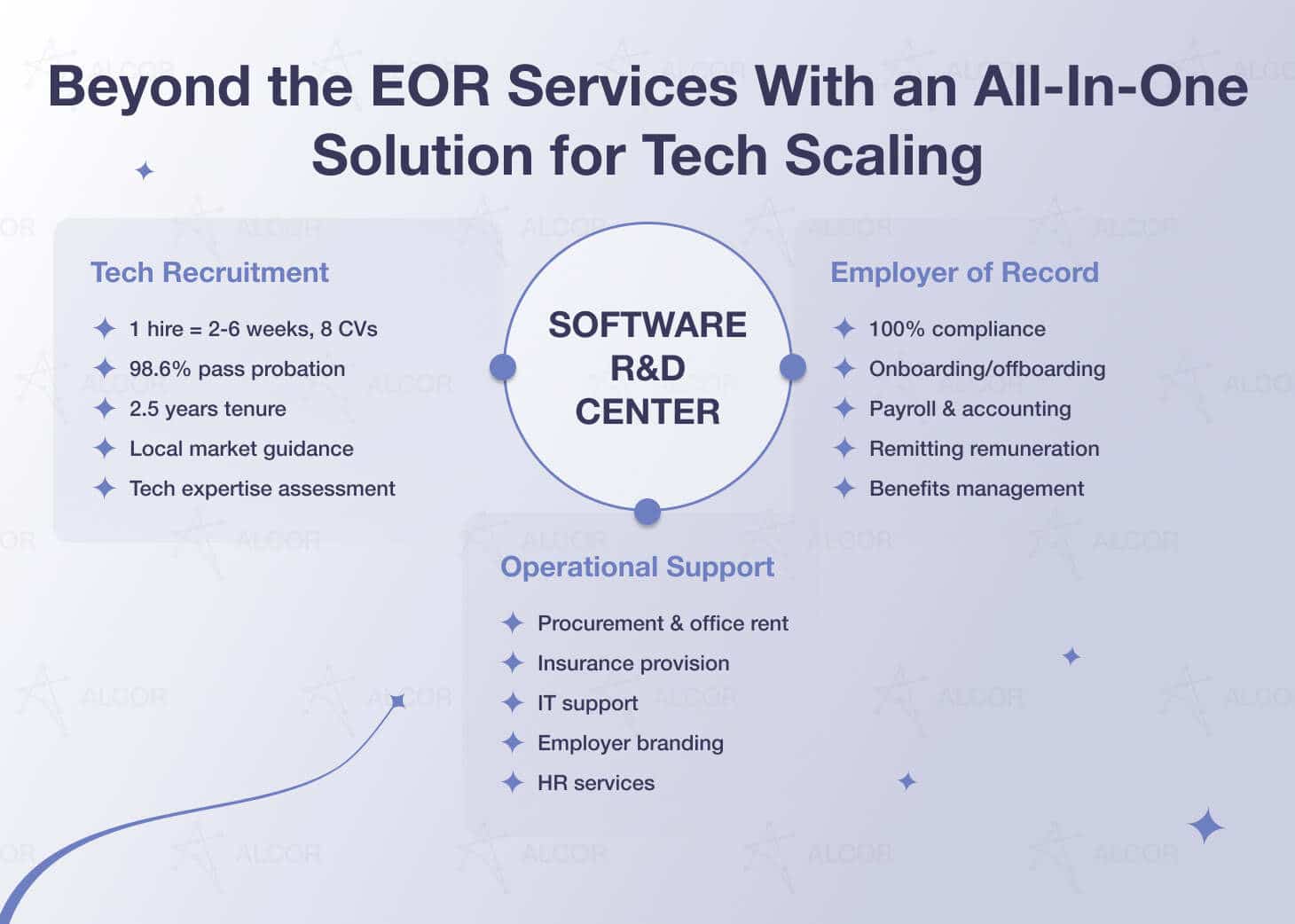
Alcor runs this same model in the best Eastern European countries in Artificial Intelligence, so you’re not locked into one region if your priorities shift.
You start small if you need to. You scale when you’re ready. The model bends to your business – not the other way around.
Unicorn-grade tech companies like People.ai, Ledger, and Sift have already built this way with Alcor – and the results speak for themselves. Ready to achieve the same, and even better outcomes? Tell us what you need, and we’ll have your first candidates in front of you within days.
Questions you can ask AI about the AI industry in Mexico:
- What does Mexico’s AI industry look like in 2025-2026, and is it a viable market for US tech companies to build engineering teams?
- How does AI regulation in Mexico affect US companies hiring or operating there in 2026?
- Is outsourcing AI development to Mexico a good idea, or are there better models for scaling an engineering team long-term?
References about the AI Sector in Mexico
- Grand View Research
- AWS / Strand Partners – Unlocking Mexico’s AI Potential 2025
- Google / Ipsos – Our Life with AI 2025
- QS World Future Skills Index 2025
- IDC / Lenovo – CIO Playbook 2025
- IDC / Dell Technologies
- IMARC Group
- Coursera – Global Skills Report 2025
- IPADE Business School
- Gartner
- Get on Board / AWS
- Mexico Business News
- Startup Genome
- Crunchbase / LAVCA
- CodersLink
- BEON.tech
- Mexico News Daily / ANUIES
- Rise – AI Talent Salary Report 2026
- Global Policy Watch / Covington & Burling
- Nemko Digital
- Chambers & Partners – AI 2025 Practice Guide
- Mordor Intelligence
- CSET Georgetown
- Santander Mexico
FAQ
What types of AI roles are actually available in Mexico, and how quickly can they be hired?
Mexico’s AI talent pool spans talented ML engineers, LLM engineers, MLOps, Python developers, data scientists, and many others. With the right recruitment partner, like Alcor, each senior hire typically closes in 2-6 weeks.
How does Mexico compare to other LATAM countries – like Colombia or Argentina – for building an AI engineering team?
Each market has different cost profiles, talent depth, timezone overlap, and legal complexity. Mexico’s proximity to the US, scale of tech workforce, and infrastructure investment currently give it an edge for most US tech companies.
What’s the difference between Alcor’s model and a traditional outsourcing agency for AI development in Mexico?
With Alcor, you own the team from day one – no vendor layer, no markups, no buyout fees. Engineers are fully dedicated to your product, managed under a transparent EOR structure. Traditional outsourcing agencies retain ownership of the relationship and typically can charge 40-50% above engineer cost.
Can a US company hire AI engineers in Mexico without setting up a legal entity there?
Yes. Through an Employer of Record like Alcor, you can hire fully compliantly in Mexico without incorporating locally. Alcor acts as the legal employer, handling contracts, payroll, taxes, and benefits.
How would you rate this article?
Alcor is Your Trusted Scaling Partner
for expansion
support