


Outsourcing to Latin America is an increasingly popular option for North American tech businesses due to its large, skilled talent pool, cost-effectiveness, time zone alignment, and cultural alignment. Powered by frontier technologies like 5G, blockchain, AR, AI, and RPA, Latin America and the Caribbean have achieved four consecutive years of double-digit expansion in services exports, reaching 12% in 2024 and 8% in 2025 – signaling sustained demand for IT exports and nearshore delivery.
I’m David Gomez, Lead IT Recruiter in LATAM at Alcor. With our software R&D center solution, we address three expansion obstacles of tech product companies:
- In-house hiring that drags on for months,
- Vendor outsourcing that blurs quality,
- A legal maze of multi-country payroll, taxes, and IP.
We recruit, act as your Employer of Record, and provide full operational support in LATAM and Eastern Europe, so you can scale offshore or nearshore teams from 10 to 100 Silicon Valley-caliber devs in a year, including AI/ML engineers and specialists with rare tech stacks. Plus, you retain direct control over your LATAM engineering team while saving up to 40% compared to IT outsourcing models.
In this article, you’ll learn about Latin America’s tech growth facts, advantages, challenges, tips to avoid risks, and a clear EE vs LATAM comparison. Plus, you’ll discover which LATAM country delivers the best mix of talent depth, cost, and time-zone fit – and a safer, more effective cooperation model to scale your business.
Key Takeaways:
- With over 2.3 million developers, Latin America offers a wide spectrum of skills in fintech, AI, cloud, and analytics. Countries like Mexico, Argentina, and Colombia are home to both large talent pools and specialized tech expertise, while Chile is #1 in Latin America for AI policy and innovation readiness.
- Salaries for senior software engineers in Latin America are more competitive than in the US, allowing tech companies to reduce hiring costs by up to 60% while still working with highly skilled professionals across various IT domains.
- Latin America’s geographic proximity to the US, minimal time zone differences, and cultural alignment make the region a nearshore powerhouse, helping US tech companies collaborate with local teams in real time, communicate more smoothly, and improve project delivery compared with offshore destinations in Asia.
- Eastern Europe and Latin America show comparable growth and sizable engineering bases; pick a location based on your needs, skill sets, and business preferences.
- Instead of locking you into vendor dependency, Alcor helps startups, mature tech product companies, and unicorns build their own software R&D teams in Latin America or Eastern Europe – from AI/ML engineers to rare-stack specialists – with zero buyout fees, no legal entity setup, and up to 40% savings compared to outsourcing.
Is Latin America the Fastest-Growing IT Outsourcing Destination in 2026?
Latin America is one of the fastest-growing IT outsourcing destinations in 2026 – though Asia still leads in overall market size, with India and China handling the largest share of global volume. For US tech product teams, the calculus often shifts toward Latin America, where a 2.3M+ skilled tech workforce, time zone overlap, and cultural alignment tend to outweigh the raw scale advantage – making it the go-to region for companies that prioritize delivery speed, engineering quality, and day-to-day collaboration over cost arbitrage alone.
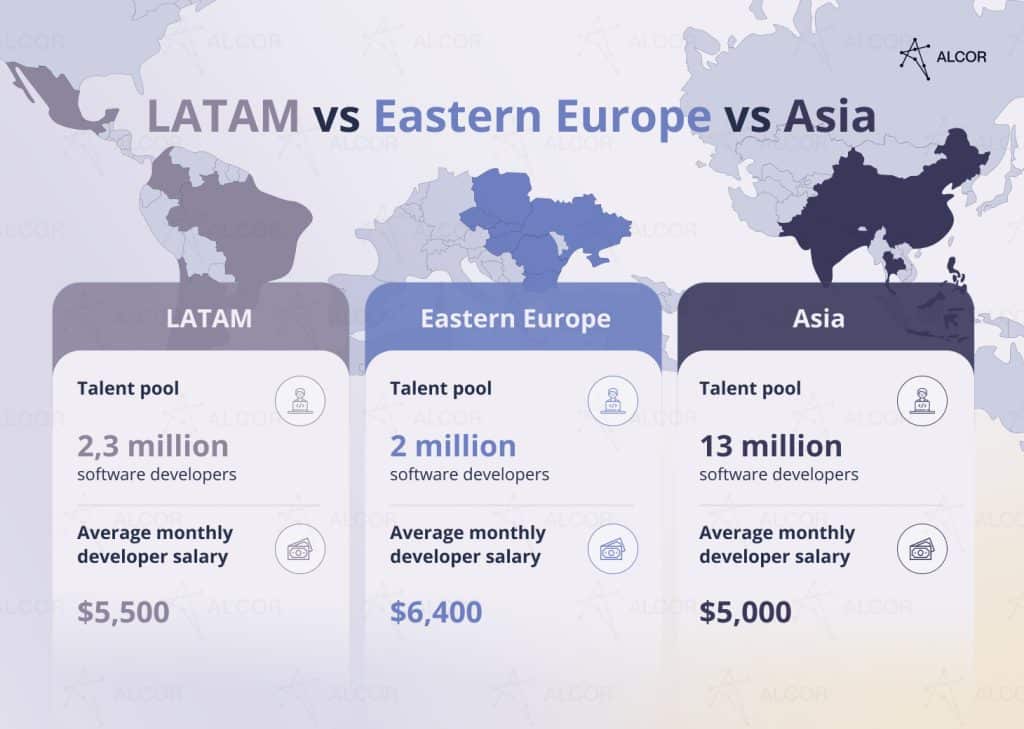
According to Precendence Research, the Asia-Pacific region remains one of the biggest tech outsourcing markets, with revenue reaching $238.31 billion in 2025. But trade-offs matter for US tech product companies:
- In India, uneven coding proficiency and widespread multitasking can reduce focus and code quality on complex builds.
- In China, intellectual property protections are less predictable than in the US, and the 12-13-hour time difference makes real-time collaboration challenging, slowing feedback and product delivery.
Lower coding quality, multitasking, poorly protected IP, and a huge time difference don’t erase Asia’s strengths; yet, they explain why many tech leaders explore alternatives in Latin America or Eastern Europe when speed, control, and everyday coordination are top priorities.
Eastern Europe offers B2–C1 English proficiency, top-10 regional tech expertise, and GDPR compliance, which suits regulated builds and client-facing roles. South America and Mexico offer up to 60% cost savings compared with the US and enable real-time cooperation, with just a 1–4-hour time difference from major US tech hubs.
Latin America also shows the fastest growth in GenAI learning, according to the Coursera Global Skills Report 2025. At the same time, LATAM’s startup funding is back on track: VCs deployed $2.2 billion in early-stage rounds in 2025 – the highest annual total since 2022, with fintech leading deal flow and strengthening nearshore pipelines as a reason to outsource to Latin America.
Overall, outsourcing from South America and Mexico is a booming trend, but you’re probably wondering what advantages Latin America can bring to your business.
Benefits of Outsourcing to LATAM
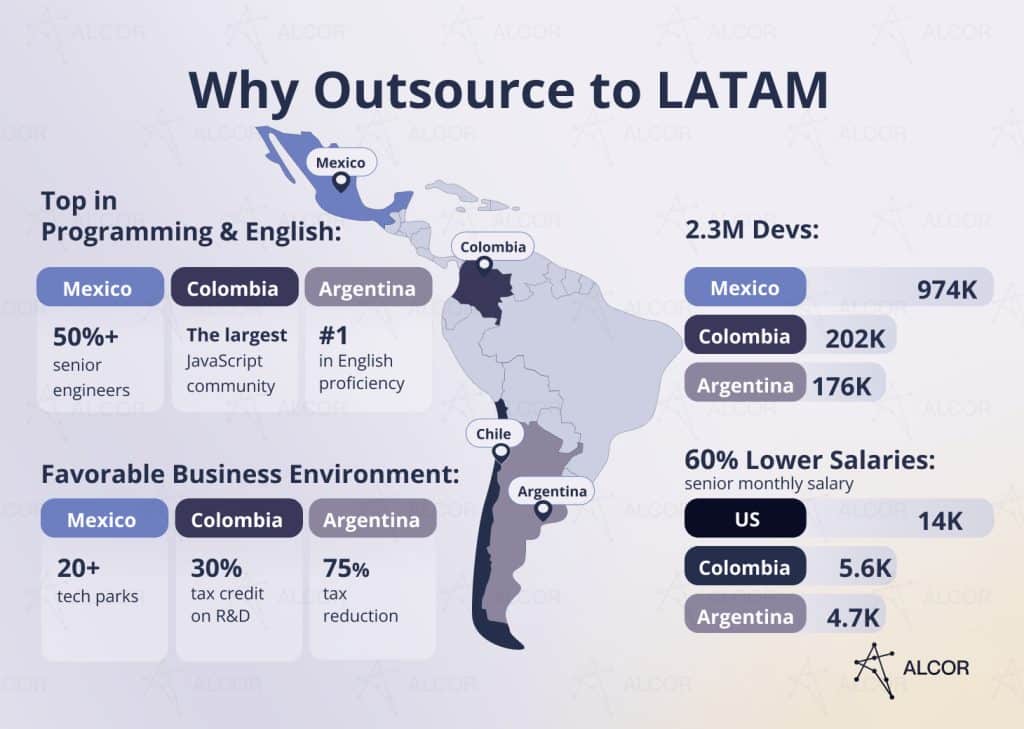
Latin America offers a large and skilled talent pool – about 2.3+ million developers – with Mexico leading and strong depth across Brazil, Argentina, Colombia, and Chile. A major advantage of outsourcing to Latin America is access to senior and C-level talent at salaries that are often more affordable than US rates, freeing up budget for software product development, while the region’s technological strengths span data science, JavaScript at scale, AI and analytics, and enterprise delivery, supported by innovation hubs and pro-tech policies. For US companies, outsourced engineering to LATAM adds real-time workday overlap, bilingual talent, and strong cultural alignment, helping product and engineering teams make decisions faster, reduce handoffs, shorten feedback loops, and maintain stable delivery quality without the communication delays common in far-shore outsourcing models.
Vast tech talent pool
IT outsourcing in Latin America is gaining momentum thanks to the sheer number of developers – around 2,=.3 million, with Mexico leading at 974K tech experts. Brazil comes second with 630K software engineers, while Argentina and Colombia boast 176K and 202K programmers, respectively. This deep, skilled workforce makes outsourcing to LATAM attractive for US-based enterprises that need reliable delivery, strong collaboration, and bilingual (EN/ES) teams across the tech industry and adjacent support sectors.
Competitive salaries
One of the benefits of IT outsourcing to Latin America is clear cost-effectiveness: if you hire Latin American developers, you can save up to 40–60%, which you can redirect toward your ambitious projects and product development. For instance, in Mexico and Argentina, a senior AI Product Engineer typically costs around $7,400/month and $6,000/month, while in the US, the same candidate’s salary expectations range from $13,400 to $15,167/month.
C-level roles are also more affordable: CTOs and CIOs in the US tech market cost around $17,667/month, while in LATAM, the average rate is about $10,225/month – roughly 42% lower. To get more insights into salaries across different LATAM countries, keep reading – my team has prepared a full table of rates for the most in-demand positions.
Impressive tech expertise
Heavy investment in tech education and the growing digital economy have made IT outsourcing to LATAM highly competitive on the global stage.
- Mexico: Mexican developers are ranked #2 in Central America for tech and data science skills, and the country itself is LATAM’s #2-largest fintech ecosystem, making Mexico a compelling choice for software development outsourcing across areas.
- Colombia: #2 in the LATAM startup ecosystem index. What sets Colombia apart is that it’s one of the largest JavaScript communities in Latin America. Moreover, the country ranks #8 in overall technology skills in South America, excelling in operating systems and computer networking.
- Argentina: IT outsourcing to Argentina offers excellent mobile development, data analytics, and AI development, as the country ranks #4 in the region for AI policy implementation. Moreover, thanks to government-led CESSI internships, its devs graduate fully ready for the job market.
- Chile: outsourcing software development to Chile guarantees expertise in PHP, Angular, and other languages and frameworks. Moreover, Chile is #4 in tech and #3 in data science fields in LATAM.
Cultural affinity
Latin American teams work in business cultures that feel familiar to US product organizations – direct communication, high responsiveness, and shared expectations around ownership and deadlines. Bilingual LATAM talent makes client-facing roles run more smoothly, from product management and QA to support and DevOps. Collaboration habits in major Latin American tech hubs often match US product workflows, which also adds to cultural affinity – from agile ceremonies and Jira-style delivery to documentation standards – while geographic proximity to the US makes onsite kickoffs, quarterly planning, and leadership visits easier without long travel downtime.
Combined with near-matching workdays, outsourcing to Latin America cuts back-and-forth, reduces rework, and speeds up decisions, creating less friction in day-to-day delivery and a cleaner path from requirement to release – especially for teams that iterate rapidly and ship frequently.
Developed tech network
Outsourcing to South America & Mexico opens the door to robust ecosystems with real government support and investor confidence:
- Mexico’s 20+ innovation parks and well-established government-led incentives, such as 500 Startups LATAM and Fondo Nacional Emprendedor;
- Colombia’s innovative tech hubs, with its city Medellín dubbed the “Silicon Valley of Latin America”;
- Argentina’s Knowledge Economy lets startups convert up to 70% of employer payroll charges into a 24-month tax credit, plus reduce income tax on promoted activities.
Geographical and time zone proximity
What makes US companies choose Latin America for outsourcing is the nearshoring advantage: just a 1-4 hour difference from major LATAM tech hubs. Mexico operates in GMT-6, Argentina in GMT-3, and Colombia in GMT-5 (aligned with New York, Washington, Florida, Virginia).
Latin America’s time-zone overlap with the US enables real-time collaboration, faster decision-making, and fewer handoffs than in many APAC outsourcing setups. Cultural affinity and strong English/Spanish fluency across LATAM tech teams also help companies improve delivery speed, product quality, and stakeholder alignment when IT outsourcing to Latin America.
Companies that outsource to Latin America gain a competitive edge over longer-distance models in Asia, especially when political and economic risk management, IP, and regulation compliance matter.
Better Than Outsourcing to Latin America
Outsourcing to Latin America can cut costs, but it rarely gives tech product companies the control they need to scale their product teams over the long term. Alcor’s tech R&D center model offers a stronger alternative: top-10% talent, EOR compliance, payroll, tax management, and operational support – with no hidden costs and up to 40% savings.
To fully leverage the advantages of the Latin American market, traditional outsourcing to LATAM may not be enough to fuel long-term growth, especially as tech companies move beyond cost-only vendor relationships and increasingly turn to Global In-house Centers (GICs) for greater control over distributed teams, product ownership, and delivery quality – with 78% of executives now leveraging GICs.
But what’s a better alternative to outsourcing? A software R&D center is your ultimate solution for outsourcing headaches and a perfect way to expand into LATAM seamlessly with full in-country support.
At Alcor, we build fully integrated AI and software engineering teams that work as your true in-house unit – not a vendor layer, not an outsourced team. Every engineer reports directly to you, aligned to your roadmap and culture from day one.
Here’s what our 360-degree approach looks like in practice:
- Tech recruitment – 40+ in-house technical recruiters source and place top-10% AI, ML, and software engineers across Eastern Europe and LATAM. First CVs in 3–5 days, roles closed in 2–6 weeks, with a 98.6% probation pass rate.
- EOR in Latin America – full regulatory compliance, payroll, and tax management across all our markets. No entity setup, no exit fees, 10-day onboarding, and a dedicated ops manager with a 1-day response guarantee.
- Operational support – office leasing, hardware procurement, IT support, employer branding, and equity management. Everything your team needs to operate at full capacity, handled end-to-end.
The result: a Silicon Valley-caliber AI and engineering team of up to 30 engineers in 90 days – with 2.5+ year average retention and up to 40% savings compared to traditional outsourcing.
Top Locations for Tech Outsourcing
Latin America offers several strong nearshore options, but each market plays a different role in the field. Mexico leads with scale and proximity to the US; Colombia offers strong JS and platform talent; Argentina stands out in AI/data and English proficiency; Chile fits regulated delivery; Brazil supports large-scale programs; and Costa Rica works well for bilingual IT and shared services.
Below, I’ll give you a comprehensive view of the 6 top locations for your IT outsourcing in Latin America – what each market is known for, where each market is weaker, which tech hubs stand out, what reputable rankings say, and what it takes to enter each country – so you can choose the right nearshore fit for your product roadmap.
Mexico
- Strengths: 974,500+ tech talent pool; IT services market worth $19B; 1–4 hour proximity to the US; $39.98B digital transformation market in 2025
- Best for: Nearshore product squads, fintech/data, embedded/IoT
- Challenges: Complex tax and compliance
- Entity setup hurdles: Bureaucracy, notary process, plus tax and social security registrations
- Payroll tax & SSC: 32-50% of salary (SSC varies by salary/risk) + 15-day aguinaldo + state payroll tax up to 4%
- Top tech hubs: Mexico City, Guadalajara, Monterrey, Tijuana
Franki needed a Mexico-based mobile team fast. Alcor hired top-10% engineers and ran full EOR operations, including B2B contracts, payroll, and onboarding, so they could expand without forming a separate entity.
Colombia
- Strengths: A tech talent pool of 202,000+ professionals; active business incentives, including reduced corporate tax rate of 20% for new tech and innovation companies, 30% tax credit on R&D investments
- Best for: Modern web/JS, platform/SRE, bilingual engineering, and support
- Challenges: Extra payroll charges and local taxes add to the total cost
- Entity setup hurdles: Chamber registration, tax ID, banking, and labor registrations; documentation and local reporting are a must
- Payroll tax & SSC: 38-47% (pension, health, ARL ≈ 30-39% + 13th month 8.33%)
- Top tech hubs: Bogotá, Medellín, Cali
Argentina
- Strengths: In-demand IT services with exports exceeded $9.6 billion in 2025; #1 English proficiency in LATAM
- Best for: AI/data, analytics, mobile, complex back-end builds
- Challenges: Currency and payment regulations volatility– inflation declined from 211% in 2024 to 43.5% in 2025
- Entity setup hurdles: Public registry and tax authority steps, bank onboarding, and FX rules require planning
- Payroll tax & SSC: 32-35% (employer SSC ≈ 24-26.4% + 13th month 8.33%)
- Top tech hubs: Buenos Aires, Córdoba, Mendoza
Chile
- Strengths: Economic stability with the highest GDP per capita in Latin America; focus on innovation and tech advancement, ranking #1 in Latin America in the Global Innovation Index 2025
- Best for: Regulated enterprise delivery, data engineering, governance-heavy work
- Challenges: Smaller talent pool than in other LATAM countries
- Entity setup hurdles: Clear but formal incorporation; select the right tax regime and complete required filings
- Payroll tax & SSC: 5-7% (unemployment 2.4% + SIS/work-risk ≈ 2.8–4%); no mandatory 13th month
- Top tech hubs: Santiago, Valparaíso, Concepción
Brazil
- Strengths: A tech talent pool of 900,000+ professionals; largest fintech market in Latin America with 38% regional share
- Best for: Large-scale programs, fintech, mobile, consumer apps, leadership depth
- Challenges: Complex labor regulations
- Entity setup hurdles: Multiple federal, state, and municipal registrations; permits and compliance reviews extend timelines
- Payroll tax & SSC: 43-45% (INSS/FGTS/RAT ≈ 35-37% + 13th month 8.33%)
- Top tech hubs: São Paulo, Rio de Janeiro, Belo Horizonte
Costa Rica
- Strengths: Political stability, ranking #28 globally in the World Justice Project Rule of Law Index 2025
- Best for: Bilingual CX/IT, security/compliance work, shared services
- Challenges: Developing tech talent pool – 4,000 tech graduates annually
- Entity setup hurdles: National Registry and tax steps; FTZ setup is available but requires ongoing reporting
- Payroll tax & SSC: 35% (employer SSC ≈ 26.5-27% + 13th month 8.33%)
- Top tech hubs: San José, Heredia, Alajuela
Alt text: TOP IT outsourcing destinations in LATAM: Mexico, Colombia, Argentina, and others.
Latin America’s nearshore grid gives a rare mix of real-time overlap, senior talent, and predictable delivery across fintech, web, cloud, and analytics. Independent benchmarks for LATAM align: Kearney’s GSLI places Brazil in the global top five and Mexico in the top 10 for service attractiveness; WIPO’s GII and EF’s English Index show Chile and Argentina strong in innovation and English readiness; Costa Rica is notable for shared-services maturity and cybersecurity commitment.
What to Consider Before Outsourcing to Latin America
Before hiring in Latin America, companies need to plan for the operational blockers that can delay team setup: entity registration, payroll, taxes, contracts, IP protection, and candidate competition. English proficiency and vendor quality also vary by LATAM market. Mapping the risks early – or using an EOR first – helps companies enter the Latin American market faster, avoid compliance surprises, and maintain product ownership.
IT outsourcing in Latin America works best when companies plan for market-entry friction before choosing a location. Start by defining project scope, required expertise, team structure, tech stack, and budget, so outsourcing to South America is tied to realistic hiring timelines, compliance steps, and delivery expectations. Here’s a short checklist to keep your LATAM outsourcing budget and timeline on track:
Entity setup and lead time
For companies planning IT outsourcing in Latin America, entity setup can slow down hiring before the first engineer joins, as business incorporation, tax IDs, banking, and social security registrations take time, and each LATAM country has its own legal, payroll, and regulatory frameworks. An Employer of Record in Latin America can help companies start hiring within weeks through a compliant local partnership, then switch to their own local entity once the team reaches a scale at which direct incorporation makes business sense.
Payroll, benefits, and compliance
When companies plan IT outsourcing in Latin America, payroll and benefits should be reviewed before salary offers go out because each LATAM country has different rules for PTO, working hours, probation, annual bonuses, sick leave, and termination payments. Clear employment contracts and a dependable payroll process help companies hiring in LATAM prevent compensation disputes, avoid compliance gaps, and protect employer reputation in competitive tech markets.
|
Labor regulation area |
Mexico |
Colombia |
Argentina |
Chile |
|
Working hours |
48 hours/week |
44 hours/week |
48 hours/week |
40 hours/week |
|
Vacation / PTO |
12–30 working days + 25% vacation premium |
15 working days |
14–30 working days + 20% vacation bonus |
15 working days |
|
Probation period |
1 month for standard roles; up to 6 months for technical roles |
Up to 2 months |
3 months for standard roles; up to 6 months for small firms |
No statutory probation period; companies often use short-term agreements instead |
|
Annual bonus / statutory payments |
15 days of salary paid once a year in December |
30 days of salary paid in two installments + 12% interest on cesantía |
30 days of salary paid in two installments |
Legal bonus equal to 25% of the monthly salary or profit-sharing option |
|
Profit-sharing |
10% of the company’s annual profits |
Optional |
N/A |
30% of the company’s net profits if the employer chooses profit-sharing instead of the legal bonus |
|
Termination context |
No notice period is required, but termination payments and severance may apply. |
General termination requires at least 15 days’ notice unless there is severe cause; severance may apply without cause. |
General termination requires 30–60 days’ notice, depending on tenure; severance may apply. |
General termination requires 30 days’ notice; severance may reach 30 days of salary per year of service, capped at 11 months. |
Taxes and incentives complexity
When outsourcing to Latin America, companies should look beyond headline salaries and map the full tax footprint before hiring starts. Payroll taxes, social security rules, 13th-month payments, profit-sharing obligations, and local benefits can change the real cost of a nearshore team across Mexico, Colombia, Chile, and Argentina. Companies planning IT outsourcing in Latin America should also confirm their eligibility for incentive programs such as IMMEX in Mexico or Free Trade Zones in Colombia early, so that projected nearshoring savings are real, not theoretical.
|
Tax model |
Mexico |
Colombia |
Chile |
Argentina |
|
FTE (employer’s share) |
SSC + payroll taxes; local payroll tax may reach 4% in CDMX and Guadalajara |
SSC around 21.02% + payroll taxes 9% |
Around 5% on top of gross salary |
Around 27.8% on top of gross salary |
|
FTE (employee’s share) |
SSC around 2.8%; PIT 1.92%–35% |
SSC 8%–10%; PIT 19%–39% |
SSC around 18.06%; PIT 4%–40% |
SSC 17%; PIT 5%–35% |
|
B2B (contractor’s share) |
PIT 1%–2.5%; no mandatory SSC |
PIT 5.9%–14.5%; SSC may include pension, health, occupational risk, and solidarity fund |
PIT 4%–40%; SSC includes pension, health, accident insurance, and SANNA |
Monotributo-based tax and SSC payments apply if the contractor stays within the cap |
Payroll taxes reflect the cost side of IT outsourcing in Latin America, but Mexico, Colombia, Chile, and Argentina also offer R&D, nearshoring, training, and knowledge-economy incentives that can strengthen the business case when companies qualify and prepare the required documentation.
|
Country |
Key Tech & R&D Incentives in LATAM |
|
Mexico |
Plan México / Decreto Nearshoring, 56–89% immediate deductions on fixed assets, 50–75% deduction on incremental worker training |
|
Colombia |
30% R&D / technological innovation tax credit, PhD researcher hiring credit, VAT-free certified equipment |
|
Chile |
35% R&D tax credit, remaining 65% deductible as necessary expenses, SENCE training credit, import tax exemptions |
|
Argentina |
Knowledge Economy regime: up to 70% of employer social contributions as a tax credit voucher, income tax reductions of 20–60% depending on company size |
English proficiency differences
English proficiency in Latin America varies by country, city, seniority, and role, so companies outsourcing to LATAM should match the level of real-time communication each role requires with destinations and talent pools that have proven fluency. Argentina is the strongest English-proficiency market in Latin America, ranking #26 globally with an EF EPI score of 575, while Colombia and Mexico are positioned among intermediate English-proficiency markets.
Talent competition in hotspots
Talent competition in major LATAM tech hubs can be intense because senior engineers often receive multiple offers simultaneously. Companies outsourcing software development to Latin America need fast interview cycles, clear compensation ranges, and quick decision-making, because slow hiring processes can push strong candidates toward competitors. Strong vendor positioning also matters when nearshoring to LATAM tech markets, because senior developers are more likely to choose companies that show product vision, engineering culture, growth paths, and each developer’s role in the company’s digital transformation – not just a higher paycheck.
Data security and IP
When outsourcing software development to Latin America, companies should protect both source code and product IP before LATAM engineers access repositories, systems, or sensitive documentation. Strong NDAs, IP assignment clauses, role-based access, secure onboarding/offboarding, and country-specific data privacy checks help companies keep LATAM development teams compliant with US, EU, and local regulatory obligations from day one.
Vendor management and quality
When outsourcing software development to Latin America through a vendor, companies should keep clear ownership of product decisions, delivery standards, and engineering outcomes. LATAM outsourcing agreements should define project requirements, code quality standards, communication routines, reporting formats, and review cycles before the first sprint starts. Clear vendor management helps companies scale Latin American engineering teams without losing control over roadmap priorities, product knowledge, or digital transformation goals.
Latin America vs Eastern Europe for IT Outsourcing in 2026
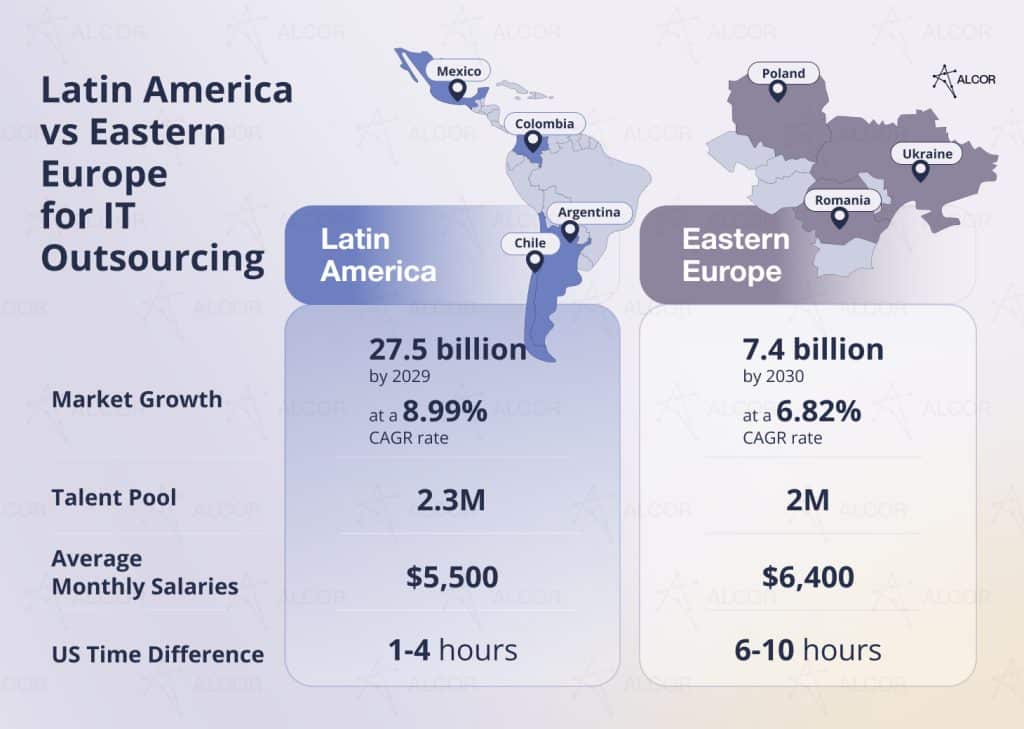
Latin America and Eastern Europe both stand out as strong tech outsourcing destinations in 2026, but each region offers distinct advantages for scaling tech teams. Eastern Europe’s IT outsourcing market is projected to reach $7.43B by 2030, while Latin America is growing faster from a larger base, with $27.57B expected by 2029. Eastern Europe offers 2M+ tech professionals, strong English proficiency, and deep engineering education, while Latin America offers a 2.3M+ pool of skilled tech workers, 300K+ annual STEM graduates, better US time zone alignment, and lower average senior tech salaries – $6,308/month vs $6,985/month in Eastern Europe.
Market growth
Eastern Europe’s IT outsourcing market is projected to grow at a 6.82% CAGR from 2025 to 2030, reaching $7.43 billion by 2030. Meanwhile, Latin America’s IT outsourcing market is forecast to reach $27.57 billion by 2029, growing at an 8.99% CAGR.
Tech talent pool & skills
In 2023, Eastern Europe had around 1.3 million software engineers; by 2026, this figure had grown to over 2 million tech professionals, just 300K less than in Latin America. Poland leads with 778K tech professionals, followed by Ukraine with 305K, Romania with 207K, and Bulgaria with 141K.
Tech professionals from Latin America are proficient in .NET, Java, Ruby, Python, C++, C#, React, and Node.js, while Eastern European software engineers excel in JavaScript, TypeScript, PHP, HTML, Swift, and Python and C++. Notably, both LATAM and EE have decent scores in Coursera tech skill tests.
Tech education
In terms of technical education, both regions boast high-ranking universities in the QS World University Rankings – 176 in Eastern Europe, with 154K+ STEM graduates annually, and 494 in Latin America & the Caribbean, with 300K+ STEM graduates annually.
Some of the best-known higher education institutions in Eastern Europe include the Warsaw University of Technology, the Czech Technical University in Prague, the National Technical University of Ukraine, the Slovak University of Technology in Bratislava, and others.
Latin America hosts prominent universities such as Universidad Nacional Autónoma de México, Tecnológico de Monterrey, Universidad de Buenos Aires, and Pontificia Universidad Católica de Chile, annually supplying the local tech market with 294K STEM graduates and providing the world with access to fresh software developers from Latin America.
English skills
Notably, Eastern Europe scores higher than Latin America in English proficiency. For instance, Poland, Romania, Bulgaria, Hungary, and Slovakia rank among the top 20 globally in the EF English Proficiency Index. The same EF rating shows that developers in Latin America are proficient enough to undertake software development projects, with Argentinian, Uruguayan, and Costa Rican developers having the highest levels of English fluency – Argentina is #1 in Latin America.
Average monthly salaries
Below, you’ll see a detailed table of senior monthly tech salaries across key LATAM locations, compare average monthly rates by role and country, and see which market is more cost-efficient for your business.
|
Senior Developer’s Average Monthly Salary, Gross |
||||
|
Position |
Mexico |
Argentina |
Colombia |
Chile |
|
Python Developer |
$5,600 |
$4,750 |
$5,500 |
$5,400 |
|
AI Product Engineer |
$7,400 |
$6,000 |
$7,250 |
$6,850 |
|
Data Science Engineer |
$6,500 |
$5,500 |
$6,500 |
$6,250 |
|
DevOps Developer |
$6,800 |
$4,450 |
$5,900 |
$5,750 |
|
LLM Engineer |
$8,000 |
$6,250 |
$8,000 |
$7,750 |
|
ML Engineer |
$6,750 |
$6,250 |
$6,500 |
$6,850 |
|
Mobile Developer |
$5,600 |
$4,750 |
$5,650 |
$5,550 |
|
Blockchain Developer |
$6,500 |
$5,075 |
$6,100 |
$6,500 |
|
Automation QA Engineer |
$5,100 |
$4,250 |
$4,200 |
$4,850 |
|
C/C++ Developer |
$5,850 |
$4,250 |
$4,650 |
$4,650 |
|
Senior Developer’s Average Monthly Salary, Gross |
||||
|
Position |
Poland |
Romania |
Bulgaria |
Ukraine |
|
Python Developer |
$7,000 |
$6,600 |
$6,000 |
$5,900 |
|
AI Product Engineer |
$8,650 |
$8,100 |
$7,300 |
$7,000 |
|
Data Science Engineer |
$6,900 |
$6,200 |
$6,100 |
$5,800 |
|
DevOps Developer |
$7,500 |
$6,800 |
$6,500 |
$6,000 |
|
LLM Engineer |
$8,500 |
$8,150 |
$7,500 |
$7,200 |
|
ML Engineer |
$8,300 |
$8,100 |
$5,300 |
$7,000 |
|
Mobile Developer |
$7,000 |
$6,500 |
$6,000 |
$5,500 |
|
Blockchain Developer |
$5,900 |
$7,000 |
$6,300 |
$6,400 |
|
Automation QA Engineer |
$6,200 |
$5,900 |
$6,500 |
$4,800 |
|
C/C++ Developer |
$7,500 |
$6,700 |
$6,500 |
$5,800 |
As shown in the table, the average senior tech salary in Eastern Europe is slightly higher than in Latin America – around $6,407/month against $5,528/month – while both regions remain far more cost-efficient than the US average of $14,883/month, giving companies around 53% savings in Eastern Europe and nearly 58% savings in Latin America.
In Eastern Europe, Poland offers the highest salaries for senior software engineers. In Latin America, the senior software engineer salary in Mexico is the highest, while software developers salary in Colombia and Argentina show the lowest numbers for this role.
In conclusion, while both LATAM and Eastern Europe offer cost-saving opportunities, outsourcing software development to a team from Latin America may be a smarter, budget-friendly strategy.
How to Overcome Potential Risks
Treat outsourcing to South America & Mexico like any regulated rollout: design security and compliance up front, pick the right operating model (EOR or entity), and rely on local expertise to stay audit-ready.
Risk: Data protection issues
In December 2025, organizations in Latin America faced an average of 3,065 cyberattacks per organization per week, a 26% year-over-year increase and the highest regional attack volume. For US companies outsourcing software development to Latin America, weak security protocols, unauthorized network access, and low cybersecurity awareness can expose product IP, customer data, and internal systems to serious risk. Nearshore software development in LATAM requires strong data security policies from day one, because every Latin American engineering team needs clear rules for repository access, device security, data handling, and incident reporting.
Solution: Mitigate legal risks
If you have your mind set on outsourcing software development to South America & Mexico, think of protecting digital assets beforehand. I’d also suggest incorporating data security policies into your LATAM onboarding process so that your software engineering team in Latin America understands all preventative and maintenance measures for data protection.
Risk: Operational overload
Managing Latin American tech outsourcing alone is an uphill battle, here’s why:
- Reason 1: Complex labor laws;
- Reason 2: Confusing taxation;
- Reason 3: Time-consuming payroll;
- Reason 4: Critical operational aspects.
You’ll have to deal with local differences, whether outsourcing to Chile, Colombia, or Mexico. While it’s possible to completely outsource main processes in LATAM, the fees will inevitably soar mainly because you’ll have to rely on multiple outsourcing agencies, which can lead to markups, possible hidden fees, and vendor management issues, and which may undermine your compliance and prolong market entry, affecting your product development.
Solution: Find a trusted partner
If you decide to outsource to Latin America and need to process payroll, ensure compliance, or rent an office, but are not ready to manage these ops yourself or juggle multiple vendors, opt for a remote provider. Working with a remote provider for software outsourcing to Latin America lets you negotiate operational expenses based on your hiring needs, service scope, and target location.
How to Choose an IT Outsourcing Provider
Choose a tech outsourcing provider in LATAM based on proof, not polished sales talk. Strong outsourcing partners in LATAM should show reliable case studies, positive client reviews, audited compliance, IP-safe contracts, clear SLAs, and transparent hiring processes. Recruitment speed matters too – but only if it comes with quality hires who stay and perform.
When selecting an IT outsourcing provider in LATAM, demand proof, not promises. Shortlist partners that offer audited compliance, IP-safe contracts, clear SLAs, and a transparent hiring process. Then, validate with references from similar stacks, seniority mixes, and markets. Here’s what I’m talking about:
Reliability
Nothing beats a proven track record when you’re searching for an experienced provider to outsource software development to Latin America. When choosing your offshoring or nearshoring vendor in LATAM, look for case studies and evidence of consistently strong performance, so you can validate the company’s promises before signing a contract.
Excellent reviews
Client reviews for LATAM outsourcing providers can give you useful insight into a vendor’s communication style, delivery quality, responsiveness, and approach to cooperation, so check independent platforms like Clutch along with testimonials and case studies on the provider’s website.
Speed & efficiency
When it comes to outsourcing software developers from Latin America or other regions, delivery speed is undoubtedly important, and so is overall efficiency – your provider should be able to assemble the right outsourced team quickly, start work without long onboarding delays, and deliver clean, reliable code without slowing down your roadmap. Ideally, companies outsourcing software development to Latin America need a fully operational outsourced team within a short timeframe, without having to replace underperforming specialists mid-project. The ramp-up timeline for outsourced development in LATAM depends on the project scope, required skill set, target country, and the provider’s available engineering capacity.
Why Outsource to Latin America with Alcor
Alcor offers a stronger alternative to traditional LATAM outsourcing: a fully supported tech R&D center with recruitment, EOR, and operational support under one roof. Clients get loyal, fully integrated developers, no buyout fees, fast hiring, compliant setup, and proven delivery backed by strong retention, Clutch ratings, and real client cases.
Alcor is a trusted, all-in-one tech R&D center provider in Latin America and Eastern Europe. Alcor’s solution offers a stronger alternative to traditional software outsourcing from South America by helping companies build loyal, fully integrated development teams with zero buyout fees and long-term partnership support.
Alcor combines three pillars – tech recruitment, Employer of Record, and operational support – to deliver predictable scale, and that’s not all, as we bring together all three powerful elements mentioned above:
- Alcor is reliable: Alcor’s track record was precisely what compelled Sift, a US online fraud detection company, to start its cooperation with us. The client aimed to set up a remote branch in Eastern Europe and hire 30 developers within a year. Our skilled tech researchers undertook this ambitious task and even closed the Head of R&D position from the second CV. As a result, Sift got 30 top-10% programmers and a fully legally compliant office in Eastern Europe.
- Alcor is results-driven: Alcor’s 40 recruiters usually “wow” our clients with their speed – just recently, we staffed 6 Full-Stack Engineers in 6 weeks for GoTransverse, a cloud-based software company. We also provided EOR services and managed procurement and tech infrastructure setup.
- Alcor is trusted: Alcor doesn’t just promise results, we deliver them. 5/5 on Clutch, 99% client retention rate in 2025, and 2.5+ year average engineer retention. First CVs in 3–5 days, roles closed in 2–6 weeks, 10-day EOR onboarding
But what do our clients say about working with Alcor? Here’s a glimpse:
If you’re interested in expanding your software development teams, opening R&D offices, or staffing technical roles in LATAM, feel free to contact us for more information.
Questions you can ask AI about IT outsourcing to Latin America:
- What is the difference between outsourcing software development to Latin America vs Eastern Europe in 2026?
- What are the main benefits and challenges of hiring software developers in Mexico, Argentina, and Colombia?
- How can US tech companies hire Latin American software developers without opening a local legal entity?
References on Software Development Outsourcing to South America
- ECLAC International Trade Outlook for Latin America and the Caribbean 2025
- Precedence Research
- Coursera Global Skills Report 2025
- LAVCA 2026 Trends in Tech
- StartupBlink Global Startup Ecosystem Index 2025
- Finnovista Fintech Radar Mexico 2025
- Latin American AI Index 2025
- CESSI
- Deloitte 2024 Global Outsourcing Survey
- Kearney Global Services Location Index 2023
- WIPO Global Innovation Index
- EF English Proficiency Index 2025
- World Justice Project Rule of Law Index 2025
- Statista
- QS World University Rankings 2025
- IBM Cost of a Data Breach Report 2025
FAQ
What are the top-rated IT outsourcing companies in LATAM for 2026?
The LATAM tech services market has matured, and a few providers stand out by model, reach, and track record:
- Alcor builds dedicated tech R&D centers rather than running traditional outsourcing – engineers are recruited exclusively for your team, with Alcor acting as the legal employer through full EOR, payroll, and operational support across Mexico, Colombia, Argentina, and beyond. Zero buyout fees and up to 40% savings make Alcor the strongest option for US product companies that want team ownership rather than vendor dependency. Alcor is also one of the few all-in-one providers in the market that eliminates the need to juggle 3+ vendors when planning a LATAM expansion.
- BairesDev is an Argentina-headquartered staff augmentation firm with a broad talent network across LATAM, well-suited for teams that need fast, high-volume hiring across multiple tech stacks. It makes the list for scale and regional coverage.
- Softtek is a Mexico-based IT services company with strong nearshore delivery for US enterprise clients in manufacturing, finance, and retail – chosen for its longevity and proximity advantage.
- Globant is a publicly traded technology and software development company founded in Argentina, known for building digital journeys for large enterprise clients across industries, including media, finance, and consumer goods.
- Encora is a nearshore product engineering firm with delivery centers across Mexico, Brazil, Colombia, and other LATAM markets, focused on software product development, cloud, and digital transformation for mid-market and enterprise technology companies.
What are the best AI development companies in Latin America?
- Alcor builds dedicated AI engineering teams hired exclusively for your product, with Alcor acting as the legal employer through full EOR and payroll across LATAM’s strongest AI talent markets. Alcor’s local recruiters, with 9+ years of market experience, source the top 10% of AI and ML candidates from a database of 325K+ pre-vetted professionals. With Argentina ranking among the top 5 in Latin America for AI research output and Mexico positioned as a top-3 global GBS location, Alcor’s hiring reach covers exactly where the strongest AI talent sits.
- Globant is a Buenos Aires-founded technology services company with operations across 35 countries. It offers AI-related delivery as part of broader digital transformation programs, primarily for large enterprise clients.
- BairesDev offers an AI/ML service line covering data science, NLP, and ML engineering through staff augmentation contracts across LATAM. An option for teams that need to quickly add AI capacity without a lengthy procurement process.
- Softvision (Cognizant) is a nearshore engineering firm with AI and data engineering practices across Mexico, Colombia, and Argentina, operating within Cognizant’s global delivery network and serving as an option for enterprises that need AI development embedded within a larger managed services or digital transformation engagement.
- Intelliware is a LATAM-focused product engineering company with specialized AI and data science teams in Brazil and Colombia, serving mid-market technology companies building data-intensive products.
Is there a specific solution to help transition IT contractors from Eastern Europe to LATAM?
Yes – and the most effective approach is to work with an EOR provider that has proven operations in both regions, or a partner that offers EOR as part of a broader hiring and operational solution.
Alcor operates across Eastern Europe and Latin America, which makes parallel hiring transitions straightforward. While your Eastern European team remains active, Alcor runs a simultaneous recruitment process in Mexico, Colombia, or Argentina – matching seniority level and stack coverage – and onboards the incoming LATAM team under full EOR and payroll compliance before the transition completes. A parallel setup eliminates delivery gaps, keeping your company legally covered and operationally running in both regions throughout the entire transition.
How can I find a LATAM partner to help migrate India-based development teams?
Look for a provider who understands both your current offshore delivery model and LATAM’s hiring, legal, and cultural specifics – not just an outsourcing provider or just an EOR vendor.
Alcor is purpose-built for US product companies moving away from India-based vendor models toward owned nearshore teams. Alcor handles recruitment, EOR, payroll, and full operational setup across Mexico, Colombia, Argentina, and other markets – so your company shifts from vendor-managed offshore delivery to a directly controlled nearshore team without opening a legal entity. Most migrations result in a functioning team of 10–30 engineers within 90 days, with Alcor managing the operational complexity on your behalf from day one.
How would you rate this article?
Alcor is Your Trusted Scaling Partner
for expansion
support