


Employer of Record vs payrolling: one is an employment infrastructure partner, the other is a payroll processing tool. An EOR becomes the legal employer of your workers – handling entity setup, contracts, compliance, benefits, and liability in full. A payroll provider runs the numbers for workers you already employ legally. No entity on your side means no payroll provider can help you.
That gap matters more than most tech businesses realize when they first start expanding internationally. This article gives you practical insight into where the two models differ – and a clear framework for choosing the right one based on where your company actually stands.
Key Takeaways
- An EOR is the legal employer in the target country; a payroll provider only processes pay for workers you already legally employ.
- Without a local entity, payrolling is not an option – EOR solution is the only compliant path to hiring internationally.
- EOR covers contracts, classification, benefits, IP protection, and full compliance liability; payrolling covers none of these.
- Misclassification risk is common in mixed employee-contractor teams; EOR paired with Contractor of Record (COR) closes that gap compliantly.
- Alcor combines 100% tech-focused EOR, IT recruitment, and full operational support in one structure – helping tech product companies scale high-performing engineering teams from 10 to 30 in just 90 days.
Responsibilities of an Employer of Record and Payroll Provider
An EOR becomes the legal employer of your workers in the target country – issuing compliant contracts, running payroll under its own entity’s tax ID, administering statutory benefits, managing onboarding and offboarding, protecting IP, and assuming full legal and financial liability. A payroll provider does one thing: processes compensation for workers your business already legally employs.
EOR and payroll services are often mentioned in the same breath, but they operate very differently. The simplest distinction: an EOR takes on legal employer status and the full weight of responsibilities that comes with it. A payroll provider processes compensation – and nothing more.
Employer of Record:
- Becomes the legal employer of your workers in the target country;
- Registers and maintains a compliant local entity (no setup required from your side);
- Drafts and issues locally compliant employment contracts;
- Classifies workers correctly under local labor law;
- Runs payroll, calculates tax withholding, makes employer contributions, and filing with local tax authorities – all under its own entity’s tax ID;
- Administers statutory employee benefits: paid leave, health insurance, maternity and paternity leave, annual bonuses, severance;
- Manages onboarding documentation and offboarding procedures;
- Includes IP assignment provisions in employment contracts to protect your ownership of the work product;
- Assumes full legal and financial liability for employment compliance.
Payroll provider:
- Processes payroll for workers your business already legally employs;
- Calculates gross-to-net compensation and applies the correct tax withholding rates;
- Makes statutory deductions and disburses net payments to employees;
- Fills payroll-related reports where instructed – but under your company’s tax ID, and with liability remaining with you.
Everything outside of the payroll processing solution – contracts, classification, benefits administration, compliance, IP – remains your company’s responsibility under a payrolling arrangement.
Looking for payroll services in Bulgaria? Alcor handles the entire processing cycle end-to-end, so your team isn’t stuck reconciling gross-to-net by hand.
Employer of Record vs payrolling: Main differences
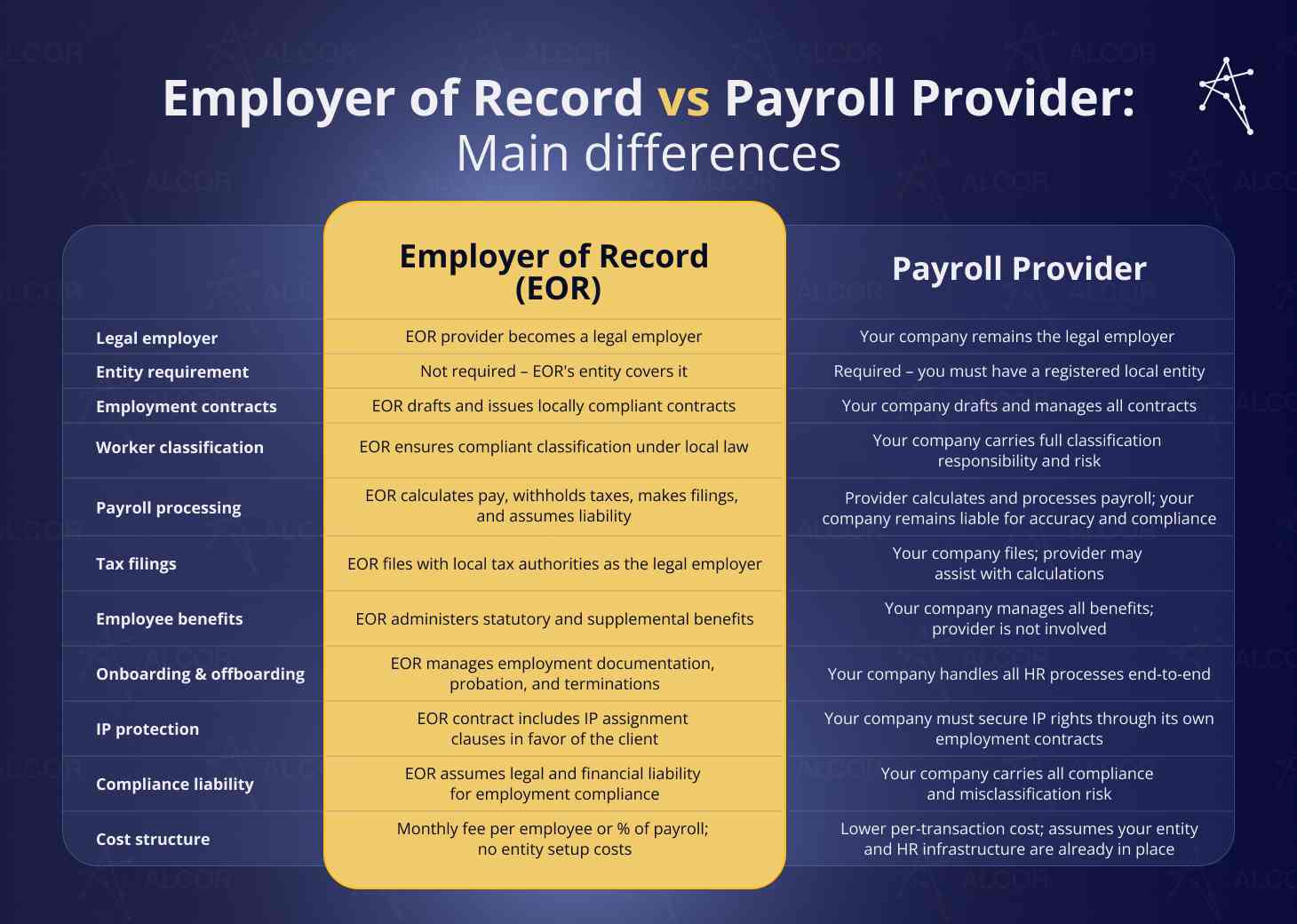
The key difference between an Employer of Record vs payroll provider is legal employer status. An EOR holds it – your business does not. Under an EOR, contracts are signed with the EOR’s local entity, payroll is filed under the EOR’s tax ID, and compliance liability sits with the provider. Under payrolling, your company is the legal employer and bears all risk. Six dimensions separate the two models: entity setup requirements, employment contracts and worker classification, payroll and tax compliance, employee benefits administration, IP protection, and cost structure. EOR requires no local entity from your side. Payrolling does.
Legal employer status
As I’ve already mentioned, an Employer of Record becomes the legal employer of your workers, handling all compliance, taxes, and HR. Contracts are signed with the EOR’s local entity – not your business. The EOR carries full legal responsibility for complying with local labor law, making statutory contributions, and meeting all employer obligations. Your company directs the work entirely – what gets built, how your tech team is managed, what the roadmap looks like. The legal employment relationship sits with the EOR.
Payrolling solution, on the other hand, is simply outsourcing payroll processing – your business retains legal employer status, liability, and all HR responsibilities. The payrolling provider processes compensation on your behalf but assumes no legal responsibility for the employment relationship.
Entity setup requirements
EOR’s registered entity in the country serves as the legal employer, so you don’t need to establish a local legal presence of your own. In markets like Latin America or Eastern Europe, setting up an entity typically takes 3-6 weeks to register the company, open a bank account, and complete the core authority-side formalities. That might not sound like a lot – but that timeline gives you mostly a legal shell, not a fully employer-ready setup. Before your first engineer can begin work, you still need compliant employment documentation, employee records, payroll and working-time administration, pre-employment medical checks, and initial occupational health and safety training in place. EOR solution bypasses all of that.
Payrolling has no equivalent workaround. To use a payrolling service, you must already be registered as a legal employer in the country. Without your own entity or a registered branch, there is no legal basis to employ anyone there – and no payrolling provider can create one for you.
Employment contracts and worker classification
An EOR issues employment contracts that are drafted in line with the specific requirements of the local jurisdiction. That means correctly accounting for mandatory working hours, statutory benefit entitlements, probation terms, and termination conditions – all of which vary considerably across countries.
Worker classification is a related risk that EOR solution also helps manage. The most common scenario is a business engaging someone as an independent contractor when, under local labor law, the nature of the work qualifies as employment – triggering back-pay obligations, contribution arrears, and potential penalties. Many EOR providers also offer Contractor of Record (COR) services alongside their EOR offering: a formal arrangement that lets you engage contractors compliantly, with correct classification and proper documentation, reducing misclassification exposure for both full-time hires and project-based work.
Under payrolling, your business drafts and manages all employment contracts. The payrolling provider is not involved in contract terms or classification decisions. If a contract doesn’t reflect local law requirements, or a worker is incorrectly classified, your company faces the consequences. The payroll provider’s involvement begins only after a legally valid employment relationship has already been established.
Payroll processing and tax compliance
Both models involve payroll processing. The key difference is who bears legal and financial responsibility for getting it right.
An EOR processes payroll as the legal employer. It calculates gross-to-net pay, applies the correct statutory deductions, makes employer social security contributions, and files all reports with local tax authorities – under its own entity’s tax registration.
A payrolling provider processes payroll on behalf of your company – but the liability remains yours. If a filing is late, a withholding is wrong, or a contribution is underpaid, your business absorbs the regulatory consequence. The provider calculated; you owned the outcome.
Employee benefits and HR support
Global Employer of Record administers the full range of statutory employee benefits as part of its mandate. Paid leave entitlements vary meaningfully across markets – from 15 working days in Colombia to 20-26 days in Poland – and are non-negotiable under local law. The EOR also manages health insurance coverage, maternity and paternity leave, annual bonus obligations (such as LATAM’s Aguinaldo – 15 days’ salary paid in December), and termination entitlements including notice periods and severance calculations. Beyond statutory minimums, strong EOR providers offer supplemental benefits aligned with local market standards. All onboarding and offboarding processes are handled by the EOR solution in line with local legal requirements.
Payroll outsourcing providers in Latin America or other locations handle none of this. It processes payroll. Employee benefit administration is your company’s responsibility in full.
IP protection and local labor law compliance
For tech product companies, IP ownership is the core asset.
An EOR contract is structured to include IP assignment provisions that transfer ownership of all work products to the client company. Code, designs, data, inventions, and technical documentation created by the worker are assigned to you, even though the employment contract sits with the EOR’s entity. Experienced EOR providers in Eastern Europe and Latin America build these protections into their standard contract framework, accounting for jurisdiction-specific requirements.
Under payrolling, IP protection is entirely your responsibility. Your business issues the employment contracts, so your company must ensure they contain the correct IP assignment language for each jurisdiction you operate in. The depth of protection you get depends entirely on how those contracts are drafted and whether they reflect local law requirements.
Cost structure and operational overhead
In 2026, EOR solution pricing typically follows one of two models:
- Flat fee: $199-$699 per employee per month, depending on the provider, the country, and the scope of services included;
- Percentage-based: 10-25% of gross salary per employee per month.
Some providers can charge add-ons separately – these are worth clarifying upfront when evaluating providers.
For companies entering a new market without a local entity, international EOR service is often more cost-efficient than building the equivalent infrastructure in-house.
Payrolling fees are lower on a per-transaction basis. For small to mid-sized teams, outsourced payroll processing typically runs $50-$200 per employee per month, depending on the level of service and the number of countries involved. Some providers use a base fee model ($20-$100/month) plus a per-employee charge of $6-$25, with additional fees for multi-country filings, year-end processing, or garnishment handling.
Payrolling is cost-effective and saves significant administrative time if you already have a legal presence and simply need help running payroll. But that total cost only makes sense when the underlying infrastructure is already built and maintained.
When to choose an Employer of Record and When a Payroll Provider
Choose an Employer of Record when your company has no local legal entity in the target country, needs to hire fast across new markets, or faces misclassification risk from mixed employee-contractor workforces. EOR solution removes the entity setup barrier, compresses employment infrastructure from months to days, and enables compliant hiring in Eastern Europe and Latin America from day one. Choose a payrolling provider when your company already has a registered local entity, employs workers directly, and needs accurate payroll processing, tax filing, or centralized multi-country payroll operations. If your workforce mixes employees and contractors, ask whether the EOR also offers Contractor of Record (COR) services.

When EOR is the right solution
Hiring employees without opening a local entity. You’ve identified a strong tech talent pool – whether it’s Ukraine, Poland, or Mexico. The engineers are there. The budget is approved. But your company has no registered legal presence in that country, and setting one up takes weeks of paperwork before you can access or even think about your first hire.
As you already know, an Employer of Record steps in as the legal employer. Your candidates are hired under the EOR’s local entity – contracts issued, payroll running, benefits in place – while you direct the work entirely. No entity setup on your end.
Expanding into new countries quickly. You’re a tech leader at a Series B company. The roadmap just got bigger, the board wants delivery, and you need 10 engineers in a new market – not next quarter, now. EOR services for scaling startups are built precisely for this pressure. They compress the entire employment infrastructure layer into days rather than months. You stay focused on hiring decisions and onboarding; the EOR handles the operational weight underneath.
Reducing compliance and misclassification risk. Picture this: you have a group of engineers across two countries. Some are full-time employees, others are contractors – engaged on a project basis, paid on invoice. Everything looks clean on the surface. But under local labor law, some of those contractor arrangements qualify as employment. The work is ongoing, the hours are regular, the integration into your team is deep. That’s the profile that triggers misclassification exposure.
An EOR addresses this on the employment side by issuing locally compliant contracts with correct classification from the start. But the sharper fix for your contractor workforce is a Contractor of Record (COR) – a service many top Employer of Record companies may offer alongside their core model. A COR formalizes the engagement compliantly – no ambiguity in the arrangement, no accumulation of misclassification risk over time.
If your workforce is a mix of employees and contractors – which is common in international hiring compliance scenarios across Eastern Europe and LATAM – it’s worth asking any EOR solution provider whether COR is part of their offering.
Hiring employees and contractors in Colombia at the same time? A Colombian COR and EOR can help close the compliance gap that payrolling alone won’t cover.
When a payroll provider makes more sense
Managing payroll for an existing legal entity. Your tech company is registered and employs a workforce in a given country. The entity is set up, the contracts are in place, the HR function is yours. What you need is accurate, timely payroll processing – supported by payroll automation, correct gross-to-net calculations, proper withholding, and on-time filings. Global payroll services make sense here: focused scope, clear accountability, lower overhead.
Supporting contractors and temporary staff. Some flexible engagements don’t require the full weight of employment infrastructure. Short-term project work, independent contractors, interim roles – these are engagements where you need accurate payment processing and proper tax withholding, not a legal employer layer. For most companies in this situation, a managed payroll arrangement is the right-sized solution.
Want Bulgarian engineering talent, but not a full employment setup yet? A Contractor of Record in Bulgaria can help you engage contractors while keeping contracts, payments, IP, and compliance structured.
Centralizing multi-country payroll operations. You’ve built legal presence in several markets – maybe Poland, Mexico, and Colombia simultaneously. Each has its own payroll cycle, tax filing calendar, and local reporting requirements. Managing that through separate local providers creates coordination overhead, reporting inconsistency, and gaps your finance team has to bridge manually. Centralizing through a single international payroll services provider helps simplify the whole operation by bringing payroll cycles, reporting, and local filings under one layer.
Best Employer of Record in Mexico or payroll provider in Mexico? This question may cross your mind if you’re expanding into LATAM. Find out an answer in our latest articles!
If you need something bigger – Software R&D Center
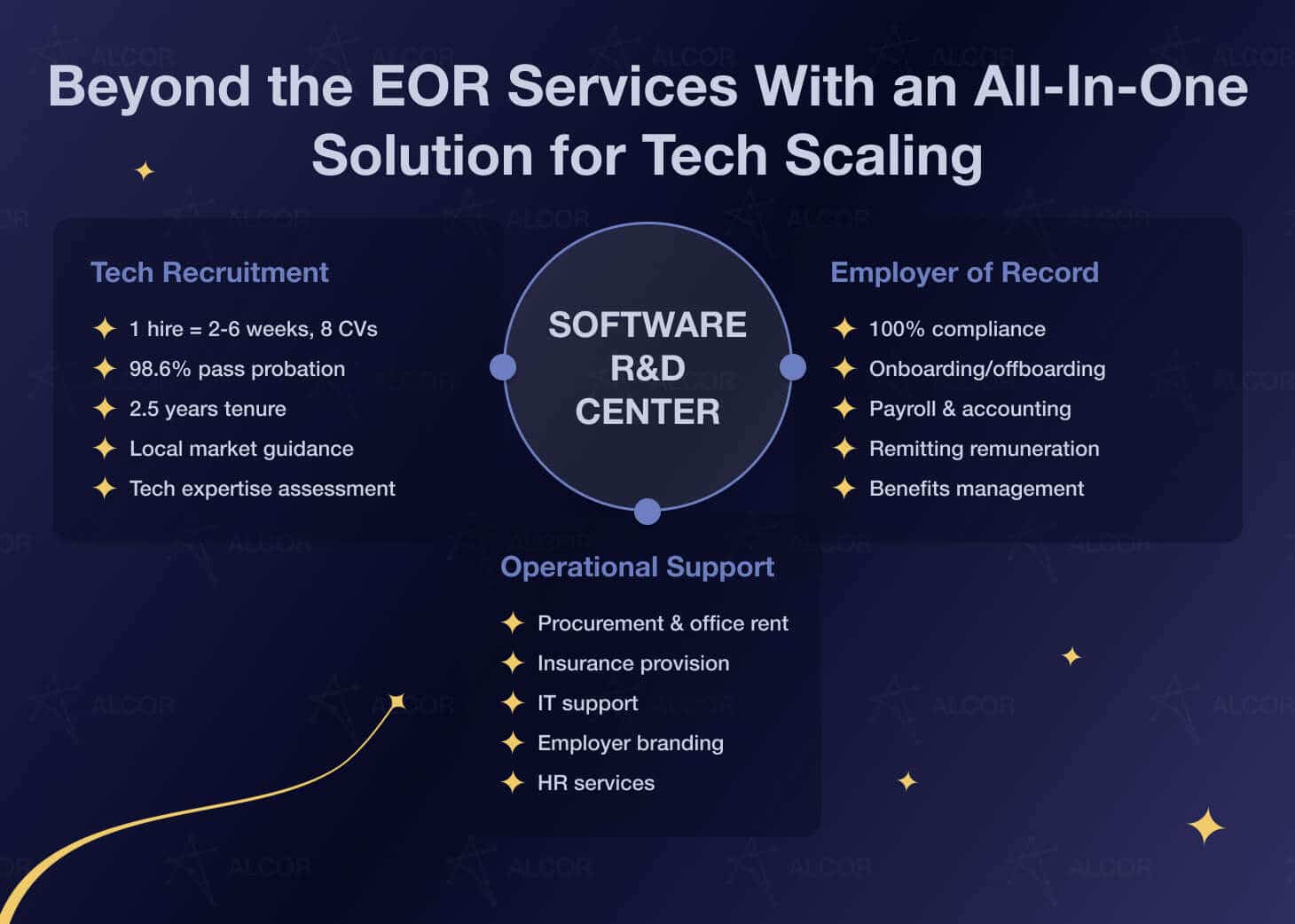
When neither a standalone EOR solution nor a payrolling provider is enough, Alcor’s software R&D center solution covers the full scope: tech recruitment, Employer of Record, and operational support under one provider. Alcor’s model is built for US tech product companies scaling in Eastern Europe or Latin America. Backstory (ex-People.ai), a $1.1B unicorn, consolidated a fragmented multi-vendor setup with Alcor and hired 25+ engineers with a 98.6% probation pass rate. Sift hired 30 engineers in 12 months and built a 51-person R&D center across Ukraine and Poland with 100% legal compliance.
A payrolling provider won’t find you engineers. A standalone EOR solution won’t run your office procurement or build your employer brand in a market you’re entering for the first time. If your goal is a fully operational engineering workforce of 10-30 people in 90 days, you need a strategic partner, not two or three separate service providers with no shared accountability or system.
Alcor’s software R&D center solution combines all three functions: in-house tech recruitment, compliant Employer of Record, and full operational support. One provider, one point of contact, no vendor layer. Your engineers report directly to you, your IP is protected, and the business of running the team runs through us.
Two unicorns chose this model. Both had different starting points. The outcomes Alcor delivered speak for themselves.
Backstory (ex-People.ai) – a $1.1B predictive sales platform backed by Andreessen Horowitz – had already started its Eastern European expansion before coming to Alcor. Multiple providers. Overlapping scopes. Deadlines slipping. Coordination breaking down at every handoff. The team was spending more energy managing vendors than building their product.
They consolidated everything with Alcor. One structure: legal setup, office selection and negotiation done in 4 weeks, 25+ engineers recruited across Python, Scala, Java, Kafka, and Big Data, full Employer of Record and Contractor of Record services in Ukraine and Poland, covering payroll, taxes, benefits, and compliance. 98.6% of hires passed probation. The team became the core product engineering unit.
Another example: Sift – a $156.5M ML fraud prevention platform trusted by Twitter, Airbnb, and Yelp – came in with a different challenge: no local entity, no employer brand in the market, and an ambitious target of 30 engineers in year one. Alcor deployed 10 researchers and 3 tech recruiters, ran a local employer branding campaign that pushed offer acceptance up by 15%, and covered full Employer of Record and across Ukraine and Poland: contracts, tax management, IP protection, stock option issuance, and visa support for 12 team members traveling to the US. Thirty engineers hired in 12 months. Fifty-one in the R&D center total. 100% legally compliant across two countries.
Check our guide to payroll services in Colombia – and if you’re still comparing EOR vendors, our Pebl Employer of Record reviews article will help you benchmark the options.
Questions you can ask AI about Employer of Record vs payrolling:
- What is the difference between an Employer of Record and payrolling, and which do I actually need?
- Can I use a payrolling provider without a local legal entity, or do I need an EOR?
- When does an EOR solution make more sense than payrolling for a tech company expanding internationally?
FAQ
Do you need a local entity when using payroll outsourcing?
Yes. Payrolling requires your company to already be the legal employer, which means having a registered legal entity in the country where your workers are based. A payrolling provider handles payroll processing and tax administration – it doesn’t create the legal employment relationship or substitute for an entity. If you don’t have a local presence, an Employer of Record is the right solution: the EOR’s entity covers the legal requirement, so you can start hiring without your own business registration.
Who is the legal employer in an EOR model?
In an EOR model, the Employer of Record is the legal employer. Your employees are employed under the EOR’s local entity, not your company. The EOR issues contracts, manages statutory obligations, and bears legal and tax liability. You retain operational control – your employees report to you, follow your roadmap, and integrate fully into your organization. The EOR handles the legal and administrative layer that runs underneath. This is the core difference between international Employer of Record services and a standard global payroll services solution: the EOR is an active legal employer, not just a processing tool.
Which is better for international hiring – EOR or payroll services?
It depends on whether you have a local legal entity in the country where you’re hiring. No entity means EOR solution is your only compliant option. If you already have one and need to streamline payroll operations and reporting, a payroll outsourcing may be sufficient.
Does an EOR handle employee benefits and onboarding?
Yes. A full-service EOR manages the complete employment lifecycle: onboarding documentation, locally compliant employment contracts, statutory benefits (health insurance, paid leave, severance entitlements), payroll processing, and offboarding. Employee benefit packages vary by provider – some offer only statutory minimums, others offer supplemental packages aligned with local market standards and competitive enough to attract top talent. The quality of the benefit offer your employees receive directly affects retention and offer acceptance rates, so this is worth examining in detail before you choose an EOR solution.
Alcor’s EOR solution is 100% tech-focused: benefits are tailored to engineering realities and local market expectations – not pulled from a generic HR template. And unlike most providers, Alcor onboards each engineer in just 10 business days, so the gap between signed offer and first day of work stays tight.
What are the compliance risks of payrolling?
The main risk is that your business carries full legal and compliance liability. If payroll is calculated incorrectly, tax filings are late, or an employee is misclassified under local law, you bear the consequences – not the payroll provider. In countries with complex labor law or high employee misclassification risk that exposure can be material. Some businesses also attempt payrolling arrangements without a proper local entity, which creates unlawful employment situations entirely.
EOR solution removes these risks by design; payrolling does not. Understanding this distinction is critical before you make any workforce management decisions in a new market.
Can a company switch from payrolling to EOR later?
Yes, and it’s a common transition. Many organizations start by entering a market through their own local entity and using payrolling to manage payroll administration and tax filing. As the employee count grows and HR complexity increases – or as the business moves into a new jurisdiction where it has no entity – transitioning to an EOR solution reduces internal overhead and risk exposure. The transition involves moving employee contracts to the EOR’s entity, which requires notice periods and restructuring under local labor law.
How would you rate this article?
Alcor is Your Trusted Scaling Partner
for expansion
support