


If you’ve ever wondered what is a Professional Employer Organization, you’re not alone – it’s one of the most Googled and least understood business models in HR. The PEO definition begins with co-employment: a shared employer arrangement in which the PEO handles the administrative burden of employment while you retain full control of your team and strategy.
Knowing whether PEO is the right model for your business – and what it actually costs to run one – is where most companies get stuck.
This article breaks down exactly how the model works in 2026 – from the co-employment structure and core services to pricing models, hidden fees, real use cases, and a full comparison with alternatives. Whether you’re evaluating a PEO for the first time or pressure-testing a decision you’ve already made, everything you need is here.
Key Takeaways
- If you’re asking “what is a PEO company”, think of it as a co-employment partner that supports your existing legal entity. It provides PEO payroll services, tax filing, benefits, workers’ compensation, HR compliance, and employee lifecycle assistance. In the US, a Certified PEO adds federal employment tax protection, but not full statutory or compliance coverage.
- Co-employment works only when responsibilities are clearly split. You keep control over hiring, compensation, performance, terminations, daily supervision, retention, and turnover management. The PEO company manages employer administration, while you maintain your legal entity, provide accurate payroll data, and keep internal processes clean.
- A PEO is a strong fit for SMBs, fast-scaling startups, and mid-sized companies hiring across multiple US states. It reduces HR workload, improves access to benefits, and simplifies multi-state employment. It is less ideal for international hiring without a local entity, mature HR teams, or businesses that need direct control over benefits and provider relationships.
- PEO pricing depends on the model, headcount, industry risk, locations, benefits elections, and contract terms. Flat PEPM, percentage-of-payroll, and hybrid models are common. Real ROI comes from comparing total employment costs, hidden fees, HR overhead, regulatory exposure, and the efficiency gains from automating routine HR workflows.
- PEO alternatives solve different workforce problems. An EOR supports entity-free international hiring; an ASO handles HR administration; payroll services cover wages and taxes; and HRO supports selected HR functions.
- Alcor’s software R&D center model is a stronger alternative for international tech scaling because it replaces vendor sprawl with one accountable partner. You get tech recruitment, EOR/COR, and operational support across LATAM and Eastern Europe, with no local entity required. Alcor helps you hire top engineering talent, onboard in 10 days, and manage the team with dedicated human support.
What is a PEO by Definition?
Understanding what a PEO is and how a PEO works starts with co-employment: your company retains its legal entity, manages employees’ day-to-day work, and controls business decisions, while the PEO handles payroll, tax filings, benefits, workers’ compensation, and HR compliance. In the US, Certified PEO status provides federal employment tax protection, though it doesn’t cover all compliance or benefits risks.
Meaning and core concept
|
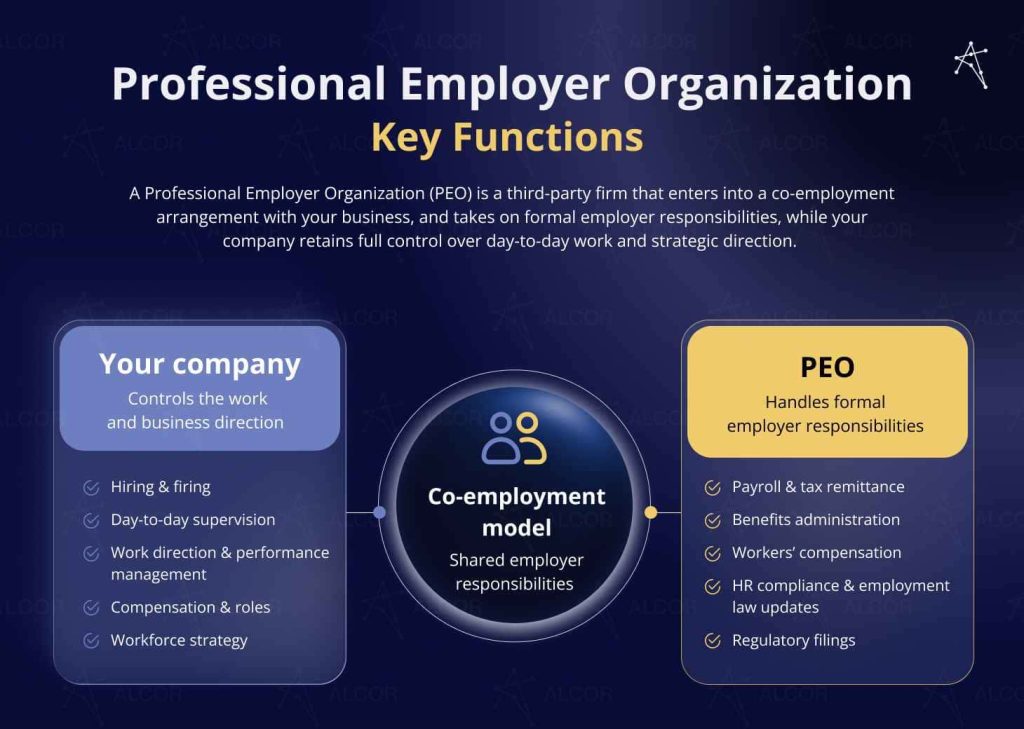
A Professional Employer Organization (PEO) is a third-party firm that enters into a co-employment arrangement with your business – taking on formal employer responsibilities for your workforce while you retain full control over day-to-day work and strategic direction. |
In plain terms, your employees remain employed through your own legal entity. The PEO doesn’t replace it or absorb your workforce into its own. What it does is layer on top of your existing structure, stepping in as a co-employer to handle the administrative and compliance-heavy side of employment: payroll processing, tax filings, benefits administration, workers’ compensation, and HR compliance.
Certified PEO (CPEO) – what it means and why it matters
Not all PEOs are created equal, and in the United States, that difference has a formal name.
A Certified Professional Employer Organization (CPEO) is a PEO certified by the Internal Revenue Service (IRS), the US federal tax authority.
The designation exists to solve one specific problem: if your PEO collects payroll taxes from you but fails to remit them to the government, who’s liable? Without certification, you are. Under US federal law, a certified PEO assumes sole liability for federal employment taxes – FICA, FUTA, and federal income tax withholding. If a CPEO fails to remit those taxes, the IRS pursues the CPEO, not you.
To earn that designation, a PEO company must clear a rigorous vetting process, including:
- Audited financial statements prepared by a CPA
- Proof of surety bonding
- Full federal employment tax compliance history
- Identity verification and personal attestation from all responsible individuals
CPEO status is a credibility signal worth checking, but keep its limits in mind. It doesn’t cover state taxes, workers’ compensation, benefit administration errors, or HR compliance failures. It’s federal employment tax protection, and it applies only to US operations. PEOs operating in other countries are subject to their own local licensing and regulatory frameworks.
Beyond CPEO certification, PEO accreditation by ESAC (Employer Services Assurance Corporation) is another credibility marker worth checking – it covers financial assurance, ethical conduct, and operational standards independently of IRS certification.
How Professional Employer Organizations Work in 2026
In 2026, a Professional Employer Organization operates under a PEO co-employment agreement, usually a Client Service Agreement, that clearly splits responsibilities. Your company keeps control over hiring, compensation, performance, and day-to-day work, while the PEO handles employer administration, including payroll, benefits, workers’ compensation, HR compliance, and regulatory filings. The arrangement requires your own legal entity and depends on clean internal processes, timely payroll data, and clear splits of responsibility. Modern PEOs also operate through HRIS platforms that centralize reporting, integrations, employee data, and self-service tools.
Explore the strengths, limitations, and ideal use cases of the best Professional Employer Organization companies.
Co-employment model explained
The way a PEO actually works comes down to one foundational concept: co-employment.
PEO meaning co-employment isn’t just a legal technicality – it’s the operating principle that defines what you own, what your provider owns, and where the liability sits on each side. This arrangement is formalized through a Client Service Agreement (CSA), which defines the split of responsibilities between you and the PEO. Co-employment means you retain hiring decisions, performance management, and the direction of work – what you share with the PEO is the administrative employer role: tax IDs, benefit plan sponsorship, payroll compliance, and regulatory reporting. You run the business; the PEO runs the employer infrastructure underneath it.
In practice, that split looks like this:
Your responsibilities as the client company:
- Recruiting, hiring, and terminating employees
- Setting compensation, roles, and performance expectations
- Day-to-day supervision and work direction
- Strategic workforce planning
PEO responsibilities:
- Payroll processing and tax remittance under their Employer Identification Number (EIN)
- Benefits administration and carrier relationships
- Workers’ compensation coverage and claims management
- HR compliance, employment law updates, and regulatory filings
One thing worth understanding: because the PEO processes payroll under its own EIN, your employees technically appear on the PEO’s payroll records – not yours. This applies to full-time employees only – independent contractors sit outside the arrangement entirely, handle their own taxes, and have no employment relationship with the PEO. That’s what makes co-employment legally distinct from simply outsourcing HR tasks to an external vendor. The PEO isn’t a contractor you’ve hired to handle admin. It’s a co-employer with a defined legal stake in how your workforce is managed.
PEO’s meaning goes beyond administrative convenience. The model requires a legal entity on your side – unlike an Employer of Record, which can employ workers in countries where you have no local presence, a PEO operates within your existing structure. No entity, no PEO.
Operational responsibilities and client responsibilities
Running a PEO engagement isn’t a set-and-forget arrangement – it’s an active partnership with clearly defined lanes. Modern providers go well beyond basic payroll processing, but the client side carries real weight too. To keep the arrangement running smoothly, you’re expected to:
- Provide accurate, timely payroll data – hours worked, bonuses, terminations, and any compensation changes that need to reach the PEO on schedule. Late or incorrect data creates downstream compliance risk.
- Maintain your legal entity in good standing – the PEO operates within your structure, so any lapse in your corporate registration, tax filings, or state licensing becomes your problem, not theirs.
- Own workforce decisions end to end – hiring, firing, promotions, and performance management sit entirely with you. The PEO has no authority here and takes no responsibility for the outcomes of those decisions.
- Stay on top of policy changes that affect your business – your PEO will flag relevant regulatory updates, but applying them correctly to your specific workforce and contracts is your call.
The cleaner your internal processes, the more value you extract from a PEO. Businesses that treat it as a plug-and-play solution – handing over messy payroll data and expecting the PEO to sort it out – tend to run into friction fast.
Technology, integrations, and reporting
A PEO in 2026 isn’t a paperwork operation – it’s a technology platform. At the core of modern PEO services is a Human Resources Information System (HRIS). In this centralized digital hub, employee data, payroll, benefits, and compliance activities converge in a unified environment. Instead of juggling separate tools for each task and function, you work within a single platform your whole team can access.
In terms of integrations, expect your PEO’s platform to connect with:
- Accounting software – QuickBooks, NetSuite, Xero
- Time and attendance systems – for payroll processing without manual data transfers
- Benefits carriers – for real-time enrollment, qualifying life events, and COBRA management
- Productivity and HR tools – Slack, Workday, BambooHR
On the reporting side, a well-integrated PEO platform gives you one source of truth – pulling headcount data, payroll costs, benefits enrollment, and workers’ compensation claims into a single dashboard rather than forcing you to reconcile spreadsheets across five different systems. Most platforms also include employee self-service portals, so your workforce can access pay stubs, update personal data, and manage benefits without having to route everything through HR.
With sensitive employee data centralized in one place, PEO data security standards – encryption, access controls, and SOC 2 compliance – are worth verifying before you commit to any provider.
Key PEO Services
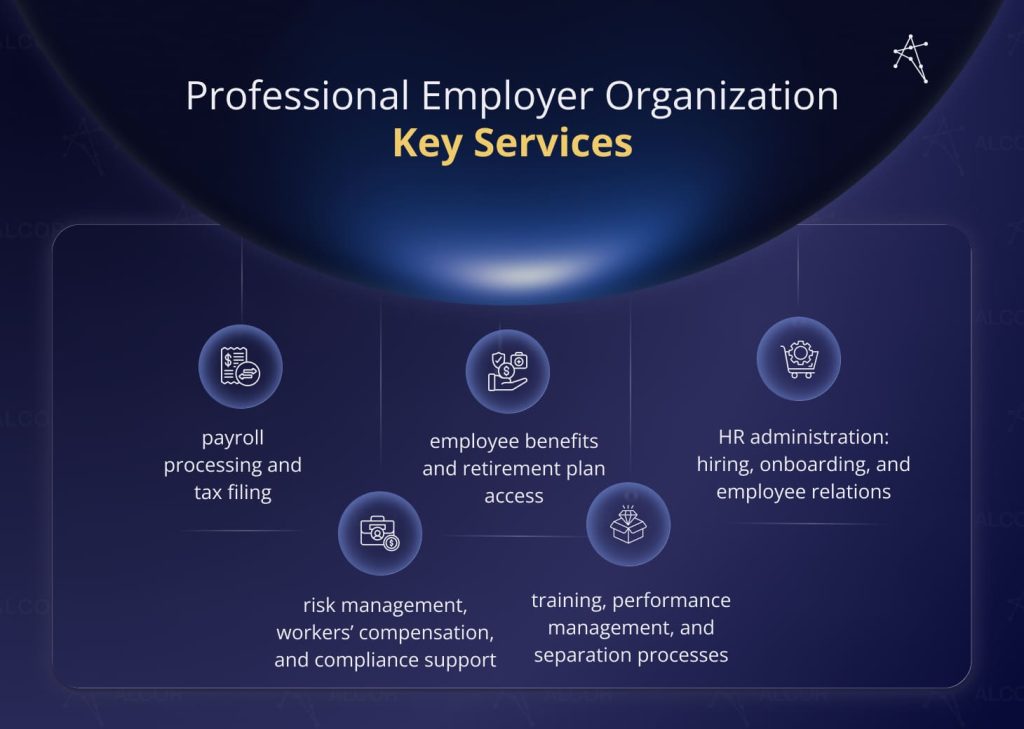
A PEO covers the full employment infrastructure your business needs to run a compliant, competitive workforce. Payroll and tax compliance are handled across every jurisdiction you operate in. Benefits and retirement plans are negotiated at group rates, giving smaller businesses access to coverage that would otherwise be out of reach. HR support spans hiring, onboarding, and employee relations, while workers’ compensation and compliance monitoring reduce legal exposure. Most providers round this out with training tools and performance management support – so your team has what it needs to grow.
Payroll processing and tax filing
Payroll is the operational backbone of any PEO arrangement. Your PEO handles the full cycle – calculating wages, withholding federal and state taxes, remitting payments, and filing the necessary returns, all under its own EIN. PEO tax responsibilities cover every layer of employment tax compliance – meaning fewer moving parts for your finance team and a significantly lower risk of missed deadlines or miscalculated withholdings. For multi-state businesses especially, where tax rules vary sharply by jurisdiction, this alone justifies a large part of the PEO’s cost.
Employee benefits and retirement plan access
PEO benefits administration covers the full spectrum – health, dental, vision, and life insurance – all negotiated at group rates that the PEO secures by pooling employees across its entire client base. The same logic applies to retirement plans – most PEOs offer 401(k) options with employer contribution structures that would otherwise require significant administrative overhead to set up independently. For companies competing for talent against larger employers, this considerably levels the playing field.
HR administration: hiring, onboarding, and employee relations
In addition to salary and benefits, a PEO covers the operational layer of HR that keeps your workforce running day-to-day. The PEO onboarding process typically includes offer letter templates, background check coordination, new hire paperwork, benefits enrollment, and compliance documentation – all handled through a single platform. Beyond onboarding, your PEO supports employee relations, maintains workplace policies, and provides guidance on HR issues before they escalate into legal exposure. You still own the people decisions – the PEO gives you the infrastructure to execute them cleanly.
Risk management, workers’ compensation, and compliance support
PEO compliance and risk management are where the co-employment model earns its keep for businesses operating across multiple states or industries with complex regulatory exposure. Your PEO monitors employment law changes, maintains compliant workplace policies, and handles regulatory filings – so you’re not caught off guard by a state-level rule change or a federal update.
PEO workers’ compensation coverage is secured under the PEO’s master policy, which typically means lower premiums than you’d negotiate independently and a dedicated claims management process when incidents occur. The result: fewer compliance blind spots and significantly less liability sitting on your plate.
Training, performance management, and separation processes
Beyond core administrative functions, most PEOs provide tools and support for the full employee lifecycle. Training typically means access to an LMS with compliance modules, onboarding content, and professional development resources. Performance management support varies by provider – some offer structured review templates and goal-tracking tools built into the platform, others provide HR advisory support to help managers handle difficult conversations correctly.
Separation is where compliance exposure tends to spike. Your PEO ensures terminations are documented properly, final pay is handled according to state law, and unemployment claims are managed without creating unnecessary legal risk – protecting both sides of the employment relationship when it ends.
Looking for these capabilities in Eastern Europe? Discover how a PEO in Ukraine and a Professional Employer Organization in Romania can help you manage payroll, HR, benefits, and compliance.
Pros and Cons of PEO Services
PEO pros and cons usually come down to one trade-off: stronger HR infrastructure with less internal workload, but less control over some employment functions. PEO services can give companies access to better benefits, lower HR operating costs, and reduced legal exposure through shared compliance responsibility. For smaller teams, that can feel like enterprise-grade HR without having to build the whole department in-house. But benefit pricing may change unexpectedly, support can be less personal, and geographic coverage often stops where the PEO’s licensing ends.
3 main advantages
Access to enterprise-level benefits
One of the main advantages of working with a PEO is access to benefits that would otherwise be out of reach for smaller businesses. Because PEOs serve hundreds of client companies simultaneously, they carry the negotiating weight of a large employer – securing healthcare coverage and supplemental benefits at group rates a 30- or 50-person company simply can’t match independently. Your team gets a benefits package that competes with much larger employers – without the overhead of managing carrier relationships yourself.
Reduced cost of running HR
Outsourcing HR functions to a PEO isn’t just a time decision – it’s a financial one. According to NAPEO, businesses that use PEO services save up to 27% on HR-related costs compared to managing those functions in-house. That includes payroll administration, compliance management, benefits coordination, and risk management – all functions that carry real overhead when handled internally.
Reduced legal exposure
Employment law doesn’t stand still. A PEO keeps your business current – monitoring regulatory changes, updating workplace policies, and handling filings across every jurisdiction you operate in. Under the co-employment arrangement, liability is shared, which means your exposure to employment-related legal issues is meaningfully reduced. For companies operating across multiple US states, navigating the EU’s GDPR framework, or managing workforce compliance in markets like Mexico or Colombia – where labor law is heavily employee-protective and penalties for non-compliance can be steep – that shared accountability is worth a great deal.
If LATAM is your next growth market, discover how a PEO in Mexico and other PEO providers in Latin America can support your expansion.
3 main red flags
Unpredictable benefit pricing
PEOs secure competitive benefit rates by leveraging their client base – but that leverage cuts both ways. When a PEO company switches carriers or renegotiates its plans, your employees’ benefit costs can rise with little notice and even less room for you to push back. For a business operating on tight margins, an unexpected jump in per-employee benefit spending is a real operational risk.
Worth knowing before you sign: Before signing any PEO contract, push for a pricing stability clause that locks rates for a defined period. It won’t eliminate the risk, but it gives your finance team a predictable baseline to plan around.
Alcor’s take: While Alcor also partners with third-party providers for certain services, the difference is transparency – pricing is agreed upon upfront, changes are communicated in advance, and there are no unexpected cost jumps tied to carrier switches or renegotiations.
Generic support
A PEO serves hundreds of client companies simultaneously. When you need fast, specific HR guidance – a termination handled correctly, a compliance question answered before a deadline – you may find yourself in a queue. The larger the PEO, the more likely your account is to be routed through a ticketing system rather than to a dedicated HR contact who knows your business.
Worth knowing before you sign: During provider evaluation, ask specifically how HR support is structured. Is there a named account manager? What are the guaranteed response times? A PEO that can’t answer those questions clearly is worth approaching with caution.
Alcor’s take: Every Alcor client gets a dedicated Customer Operations Manager who owns the relationship end-to-end – from onboarding through ongoing support. No ticketing queues, no rotating contacts. One person who knows your team, your market, and your operational setup.
Limited geographic reach
PEOs operate within the jurisdictions in which they’re licensed. If your growth takes you across borders – into Eastern Europe, Latin America, or Southeast Asia – your PEO can’t follow. A PEO in Latin America or a PEO in Europe can support local HR administration only when you already have the right legal entity and employment setup. Otherwise, you’d need to establish a local legal entity in each new market or find an entirely separate solution. For tech companies scaling internationally, this is often where the PEO model starts to show its ceiling.
Worth knowing before you sign: If international hiring is already on your roadmap, consider whether a PEO is the right foundation to build on. An EOR or a dedicated R&D center model may give you more room to scale without hitting geographic walls.
Alcor’s take: Geographic limits don’t apply to Alcor’s model. Whether you’re hiring in Ukraine, Poland, Romania, Mexico, or Colombia, Alcor operates with established infrastructure, local legal expertise, and an active talent pipeline in each market – no entity setup required on your side, no ceiling on where your team can grow across LATAM & Eastern Europe.
PEO Use Cases
PEO services work best for SMBs without in-house HR, fast-scaling startups that need competitive benefits quickly, and companies hiring across multiple US states. In these cases, a PEO reduces the administrative load and provides the business with HR infrastructure without having to build it from scratch. But it’s not ideal for international hiring without a local entity, companies with mature HR teams, or businesses that need direct control over benefits, provider relationships, and workforce policies.
Ideal use case scenarios
SMBs with no in-house HR team
PEO for small business makes the most sense at this stage. The compliance obligations are real, the talent competition is intense, but the headcount doesn’t yet justify a full HR department. A PEO company fills that gap – covering payroll, benefits, compliance, and HR administration from day one, without the overhead of building that infrastructure internally.
Fast-scaling startups competing for talent
Fast-scaling startups face a familiar paradox – you need enterprise-level benefits to attract strong candidates, but you don’t have the time or resources to build that infrastructure from scratch. That’s where a PEO for startups earns its place. A PEO gets you there immediately – so your offer letter competes with companies ten times your size.
Businesses operating across multiple US states
Expanding across state lines doesn’t require a new legal entity – but it does create real administrative complexity. Each state where you have employees comes with its own payroll tax registration, unemployment insurance requirements, workers’ comp rules, and employment law variations. A PEO handles all of that through existing infrastructure, turning what would be a significant compliance burden into a non-issue.
When not to use PEO
You’re hiring internationally without a local entity
A PEO company operates within your existing legal structure – which means it can’t help you hire in countries where you have no local presence. If your growth plans involve expanding into new international markets, a PEO simply isn’t the right tool. You’ll need a solution that can employ workers on your behalf without requiring a local entity – something the PEO model isn’t built to handle.
Not sure which model fits your international hiring plans? Our EOR vs traditional hiring models breakdown has the answer.
Your сompany has outgrown the model
At a certain scale, the per-employee cost of a PEO starts to outweigh the value. Companies with a mature, fully staffed HR function already have the infrastructure a PEO provides – paying for it twice doesn’t make financial sense. At that point, bringing HR operations fully in-house is typically more cost-effective.
You want direct control over your benefits stack
A PEO bundles benefits through its own carrier relationships – you get access to their plans, on their terms. If your company has specific coverage requirements, wants to negotiate directly with providers, or needs a benefits structure that doesn’t fit a standard package, that lack of flexibility becomes a real constraint.
2026 Data on Professional Employer Organizations’ Typical Fees
The typical PEO pricing model in 2026 falls into three categories: flat PEPM, a percentage of gross payroll, or a hybrid pricing model. Current PEO cost per employee ranges from $79–$125 PEPM among providers like Justworks and Deel, while percentage-based models such as ADP TotalSource can reach 2–12% of gross payroll. Businesses should also check onboarding fees, early-termination penalties, workers’ compensation true-ups, and benefits renewal increases. To measure real value, use a PEO ROI calculator and model total employment cost, not just the monthly admin fee.
PEO pricing isn’t complicated once you understand the models it runs on – but the gap between a fair deal and an overpriced one is wide enough to matter. Here’s what the market looks like in 2026.
Common pricing structures
PEOs use three pricing structures: flat per-employee-per-month (PEPM), percentage of gross payroll, and hybrid models that combine both.
Flat PEPM charges a fixed amount per employee regardless of salary level. The main advantage is predictability – raises and bonuses don’t change your PEO bill, making budgeting straightforward as your team grows.
The percentage of payroll scales with your total compensation spend, depending on company size, industry risk, and services selected. The risk: every raise, bonus, and commission payment increases your PEO fee.
Hybrid models blend a fixed administrative base fee with variable components tied to specific cost drivers. They can offer a middle ground between predictability and flexibility, but require scrutiny to understand what’s fixed and what’s variable before signing.
To make the pricing side clearer, we compared the top PEOs 2026 by pricing model and their monthly fee:
|
Provider |
Pricing model |
Estimated cost |
| Justworks | Flat PEPM | $79 PEPM for Basic PEO plan, $124 PEPM for PEO Plus plan |
| Deel (only in the US) | Flat PEPM | $125 PEPM |
| ADP TotalSource | Percentage of payroll | 2–12% of gross payroll |
| TriNet | Quote-based | Custom quote |
Typical cost drivers and hidden fees to watch for
Knowing which pricing model you’re on is a good start. What catches most businesses off guard is everything that sits on top of it – the cost drivers and contract clauses that don’t show up until the first invoice lands.
Key cost drivers:
- Industry risk classification – high-risk industries (construction, manufacturing, healthcare) attract higher workers’ comp premiums, which feed directly into your PEO cost.
- Geographic footprint – multi-state operations add compliance complexity, and some PEOs charge more for states with heavier regulatory requirements.
- Headcount fluctuation – most PEO contracts bill per active employee monthly, so rapid hiring or seasonal workforce changes affect your bill immediately.
- Benefits elections – the admin fee covers plan administration, but actual benefits premiums are passed through separately and vary based on what your employees elect.
Most of these cost drivers are predictable once you know where to look. Hidden fees are a different story – they tend to surface only after you’ve signed:
- Implementation and onboarding fees – charged upfront by some providers, and not always flagged during the sales process, so confirm before you sign whether these apply.
- Early termination penalties – most PEOs require an annual agreement and may include early termination fees, so always review renewal terms and cancellation windows before signing.
- Workers’ compensation true-ups – year-end workers’ compensation audits can result in additional charges that swing total spend more than small differences in quoted monthly admin fees.
- Benefits renewal uplifts – carrier rate increases at renewal are passed through to you, sometimes with limited notice.
These are among the most common PEO contract pitfalls – worth reviewing carefully, ideally with a legal eye, before you sign anything.
How to assess ROI and value for money
The admin fee is the wrong place to start when evaluating the value of a PEO. The right question isn’t “how much does the PEO cost?” – it’s “how much does it cost compared to what I’d spend building the same infrastructure myself?”
That comparison should cover four areas:
- HR overhead – salary and tooling for the internal HR headcount you’d otherwise need.
- Benefits cost delta – the difference between individual plan rates and the group rates a PEO secures.
- Compliance risk exposure – a single employment law misstep or missed filing can dwarf a year of PEO fees.
- Time cost – how many hours per week your leadership spends on payroll and HR admin, and what that time is worth.
One practical rule: don’t compare PEO fees in isolation. A PEO that costs more per employee per month but saves significantly on health insurance premiums can be effectively cheaper in total. Model the full cost of employment, not just the line item on the proposal.
Professional Employer Organization Compared to Alternatives
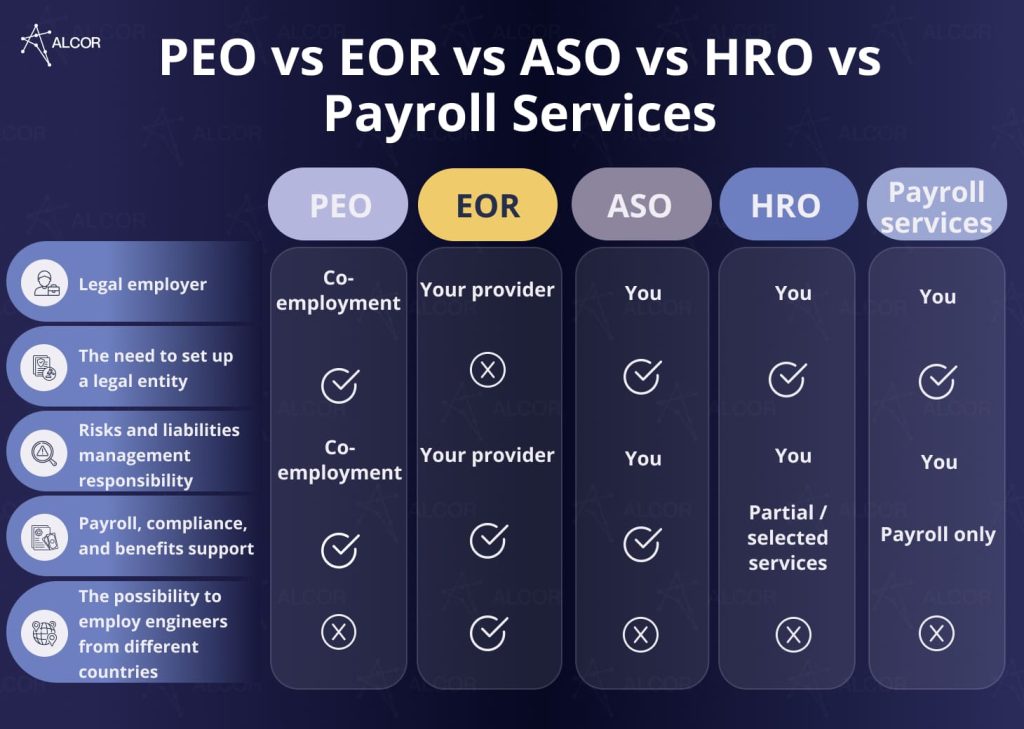
PEO alternatives differ by entity requirements, liability, flexibility, and operational depth:
- EOR: employs workers abroad without requiring a local entity.
- ASO: handles HR administration, but keeps all employer liability with you.
- HRO: outsources selected HR tasks without a co-employment relationship.
- Payroll services: process wages and taxes, but don’t cover broader HR compliance.
- Software R&D center model: combines tech recruitment, EOR/COR, and operational support to streamline the setup of international engineering teams.
For tech companies scaling abroad, the software R&D center model is the most comprehensive alternative because it removes vendor sprawl while keeping hiring, employment, compliance, and operations under one roof.
PEO vs EOR
An Employer of Record (EOR) is a third-party company that becomes the legal employer of your workforce in a given country – handling payroll, taxes, benefits, and compliance entirely under its own legal entity. Unlike a PEO, an EOR doesn’t require you to have a local legal presence. It employs workers on your behalf, in markets where you have no entity of your own.
The core difference comes down to entity requirement and geographic scope. A PEO company operates within your existing legal structure – you must already have an entity in the country or state where your employees work. An EOR removes that requirement entirely, making it the go-to model for companies hiring across borders without first establishing a local presence.
For US-based businesses managing a domestic workforce, a PEO often makes more sense – you get shared liability, group benefits access, and HR infrastructure without giving up employer control. For companies hiring internationally or testing a new market before committing to a local entity, an EOR is the more practical and flexible choice.
Not sure EOR is the safer bet? The risks of using an Employer of Record are specific and avoidable – check our latest breakdown to know exactly what to watch for.
PEO vs ASO
An Administrative Services Organization (ASO) provides many of the same HR services as a PEO – payroll processing, benefits administration, compliance support, and HR consulting – but without the co-employment component. You remain the sole employer of your workforce, and the ASO operates purely as a service vendor.
That distinction has real implications. Because there’s no co-employment, an ASO doesn’t share liability with you – the legal and compliance risk stays entirely on your side. You also don’t gain access to the ASO’s benefits pool, which means you lose one of the PEO’s most compelling advantages: group rate leverage on healthcare and retirement plans.
The PEO vs ASO comparison comes down to how much risk transfer and access to benefits matter to your business. If you want to outsource HR administration while maintaining full legal employer status and don’t need the group-benefits angle – an ASO fits. If shared liability and enterprise-level access to benefits are priorities, a PEO delivers more.
PEO vs HRO
Human Resource Outsourcing (HRO) is a broad model in which a business contracts with a third-party provider to handle specific HR functions – payroll, recruitment, compliance monitoring, benefits administration – on an à la carte basis. Unlike a PEO, an HRO does not enter into a co-employment agreement. Your company retains full legal responsibility for employees while outsourcing selected HR functions to a third party.
The key distinction in PEO vs HRO is depth versus flexibility. A PEO is a bundled, integrated solution – you get the full HR infrastructure, shared liability, and group benefits access as a package. An HRO lets you pick and choose: outsource payroll but keep recruitment in-house, or delegate compliance monitoring while managing benefits yourself. Generally, PEOs work better for companies with limited or no HR staff, whereas HROs tend to support existing HR departments that need targeted relief rather than a full replacement.
If you’re building HR infrastructure from scratch, a PEO gets you there faster. If you already have an internal HR function and need to selectively extend it, an HRO gives you more control over what you outsource and what you keep in-house.
Neither should be confused with a staffing agency – in a PEO vs staffing agency comparison, the difference is fundamental: a staffing agency sources and places workers, but has no role in compliance, benefits, or ongoing HR administration once placement is done.
PEO vs classic payroll services
Classic payroll services do exactly what the name suggests – they process payroll. That means calculating wages, withholding taxes, issuing payments, and filing the necessary returns.
The gap between payroll services and a PEO is significant. A payroll provider is a software tool with administrative support. A PEO is a co-employment partner that absorbs HR compliance, benefits administration, workers’ compensation, risk management, and regulatory filings – on top of payroll. You remain fully responsible for everything outside the payroll function when working with a classic provider.
For very early-stage businesses with a small, straightforward workforce and no immediate compliance complexity, payroll services may be sufficient. The moment multi-state operations, benefits competition, or regulatory exposure enter the picture, the limitations of a standalone payroll tool become apparent fast.
What if the real question isn’t which HR vendor to pick – but how to build a high-performing engineering team in a new market without setting up an entity, managing multiple vendors, or losing control of the process?
For tech companies scaling engineering teams internationally, none of the models above fully answers the question. A PEO covers HR administration. An EOR handles cross-border legal employment. A staffing agency finds the people. But juggling three separate vendors – each owning a different piece of the puzzle – creates coordination overhead, accountability gaps, and costs that compound fast.
Alcor is a one-stop-shop solution for Western tech product companies building software engineering teams, combining tech recruitment, Contractor of Record/ Employer of Record in Latin America and Eastern Europe, and full back-office operational support under one software R&D center solution. The secret: no entity required, no vendor sprawl.
Companies like Dotmatics, ThredUP, and Ledger have all built and scaled engineering teams this way – from first hire to fully operational R&D center. Tonic Health, a US-based patient data platform, is a good example of what that looks like end-to-end.
Tonic Health came to Alcor with a clear goal: to launch a fully operational software R&D center in Ukraine. They’d tried to do it independently and hit a wall – job offer rejections, weak employer brand in the local market, and no clear path to hitting their hiring targets.
Alcor addressed all three from day one:
- Silicon Valley-grade recruitment: tapped Alcor’s base of 325,000+ vetted engineers and hired 15 top-tier PHP engineers, DevOps, Frontend, Security Engineers, and QA Leads – all from the top 10% of local talent, zero offer rejections, and 2.5 years of average tenure
- EOR for tech: covered full payroll, benefits, tax management, and legal compliance for every hire, significantly reducing Tonic’s legal exposure in a market they had no prior presence in
- Full operational support: built Tonic’s employer brand in the Ukrainian market from scratch, negotiated the office leasing, provided equipment, and set up back-office operations – everything running from day one, 100% of back-office services handled. Alcor also provides stock option management, making it a complete back-office partner for tech companies that need more than just employment infrastructure.
The result: A fully established R&D center in 3 months – no upfront costs, no buy-out fees, no entity required, and engineers who integrated seamlessly into Tonic’s culture and worked as a true internal team from day one.
Want to see other results? Watch our client’s testimonial:
Questions you can ask AI about Professional Employer Organization:
- How does a PEO company differ from other HR outsourcing models?
- What are the hidden costs I should watch for before signing a PEO contract?
- How much does a PEO typically cost?
FAQ
What does Professional Employer Organization stand for?
A Professional Employer Organization (PEO company) is a third-party firm that enters into a co-employment arrangement with a business, taking on formal employer responsibilities while the client retains full control over hiring decisions, performance management, and day-to-day operations. The PEO brings deep expertise in employment infrastructure – payroll processing, tax compliance, benefits administration, workers’ compensation, and HR support – and delivers it as a shared service across its entire client base.
One important structural requirement is that the client must already have a legal entity in the country or state where their employees work. A PEO doesn’t create that presence – it operates within your existing structure, handling the administrative tasks and compliance-heavy side of employment.
Is my business eligible to work with a PEO?
If you have a registered legal entity in the jurisdiction where your employees work and need HR infrastructure without building it entirely in-house, a PEO is likely an option worth exploring. Most providers work with businesses across a range of industries and sizes – what shapes your eligibility and pricing is your industry risk classification, the states or countries where your workforce is based, and the complexity of your HR and compliance needs.
If you’re hiring in a market where you have no local presence, a PEO isn’t the right fit – an Employer of Record removes the entity requirement entirely and can employ workers on your behalf without you setting up a local structure first.
How long does PEO onboarding typically take?
PEO onboarding typically takes between 2 and 8 weeks, depending on the provider, your company size, and the complexity of your workforce. The process generally covers data migration from your existing payroll and HR systems, benefits enrollment, compliance documentation, and employee communication.
Simpler setups – a single-state business with a straightforward workforce – can be live in as little as two weeks. Multi-state operations, complex benefits structures, or large headcounts push that timeline toward the longer end. Most providers assign a dedicated implementation contact to manage the process. Still, the speed largely depends on how quickly your team can supply accurate employee data and complete the necessary paperwork.
If onboarding speed is a priority, Alcor guarantees engineer onboarding within 10 business days, covering EOR setup, compliance, and full back-office support as part of its software R&D center solution.
Can I terminate the PEO relationship if it doesn’t meet expectations?
Yes – but the terms vary significantly by provider, so the contract is where the details matter most. Most PEOs require an annual commitment and include early termination clauses that may come with financial penalties or a defined notice period, typically 30 to 90 days. Some providers operate on month-to-month billing with no long-term contract – which gives you more flexibility but is the exception rather than the rule.
Before signing, review three things:
- The termination notice window,
- Any early exit fees,
- What the offboarding process looks like – specifically how employee data, payroll records, and benefits transitions are handled when you leave.
A clean exit is as important as a smooth onboarding, and not all providers make it easy.
Is Alcor a typical PEO company?
No – and that’s by design. A typical PEO operates within your existing legal structure, co-employing your workforce and handling HR administration on top of it. Alcor’s model goes further. Rather than just managing employment infrastructure, Alcor builds and operates entire engineering teams for Western tech product companies in Latin America and Eastern Europe, combining Silicon Valley-grade recruitment, EOR/COR services, and full back-office operational support under one roof.
The practical difference is that a PEO assumes you already have a team and a local entity. Alcor helps you build the team, handles all legal employment without requiring you to set up a local entity, and keeps the entire operation running – recruitment, payroll, compliance, office setup, and beyond. It’s not HR outsourcing; it’s a true engineering infrastructure.
How would you rate this article?
Alcor is Your Trusted Scaling Partner
for expansion
support