


Choosing the right Employer of Record for independent contractors is one of the most consequential compliance decisions a scaling tech company can make. Yet, most get it wrong before they realize the stakes. Statistically, up to 30% of employers misclassify at least some of their workers. And for companies hiring engineers across multiple jurisdictions without local legal infrastructure, that exposure grows with every market added.
Alcor can minimize risk with our tech-exclusive EOR/COR infrastructure in LATAM and Eastern Europe. Combined with tech recruitment and ops support, we scale compliant 10-30 engineering teams for mature tech products and VC-backed startups in 90 days – your talent and IP ownership from day 1.
This guide breaks down how EOR for contractors works, where compliance and tax risks usually hide, when this model makes sense for tech companies, and how to choose a provider that protects your hiring speed, IP, and legal position across borders.
Key Takeaways
- An Employer of Record for contractors helps tech companies engage B2B talent in LATAM and Eastern Europe without opening a local entity. It adds a legal and compliance layer around contracts, SOWs, onboarding, invoices, local-currency payments, tax documentation, and audit-ready records.
- Direct contractor engagement can work for short-term, project-based cooperation with a genuinely independent contractor. However, the company signs with the contractor directly, while the contractor manages their own taxes, invoices, and social contributions, leaving the client with classification, IP, and documentation exposure.
- The biggest contractor risks are misclassification, country-specific penalties, weak documentation, IP ownership gaps, and data protection exposure. In Mexico, Colombia, Poland, Romania, and Ukraine, authorities look at the real working setup: schedule, supervision, exclusivity, tools, team integration, and business independence.
- EOR/COR is most useful when hiring international contractors without a local entity, paying contractors across several countries, converting long-term contractors into employees, working in high-risk misclassification markets, or engaging fractional experts with access to core systems.
- The right EOR for contractor engagements should offer real contractor management expertise, in-country expert teams, clear liability allocation, transparent pricing, and dedicated support. Alcor fits the criteria, with its compliant B2B engagement infrastructure, worker classification monitoring, IP protection, and operational support under one tech R&D center model.
How an Employer of Record for Independent Contractors Works in 2026
EOR for independent contractors (or COR) acts as the legal and compliance layer between the client and contractor, and usually covers:
- locally compliant contracts, onboarding, and SOW governance;
- invoice processing and local-currency payments;
- tax, VAT/GST, and statutory documentation where applicable;
- ongoing classification monitoring and audit-ready records.
In the direct contractor model, the company signs with the contractor directly. The contractor manages their own taxes, methods, invoices, and social contributions, while the client keeps flexibility but owns the classification exposure.
EOR engagement vs. the direct contractor model
The Employer of Record vs contractor choice is fundamentally a question of control distribution, compliance exposure, and budget.
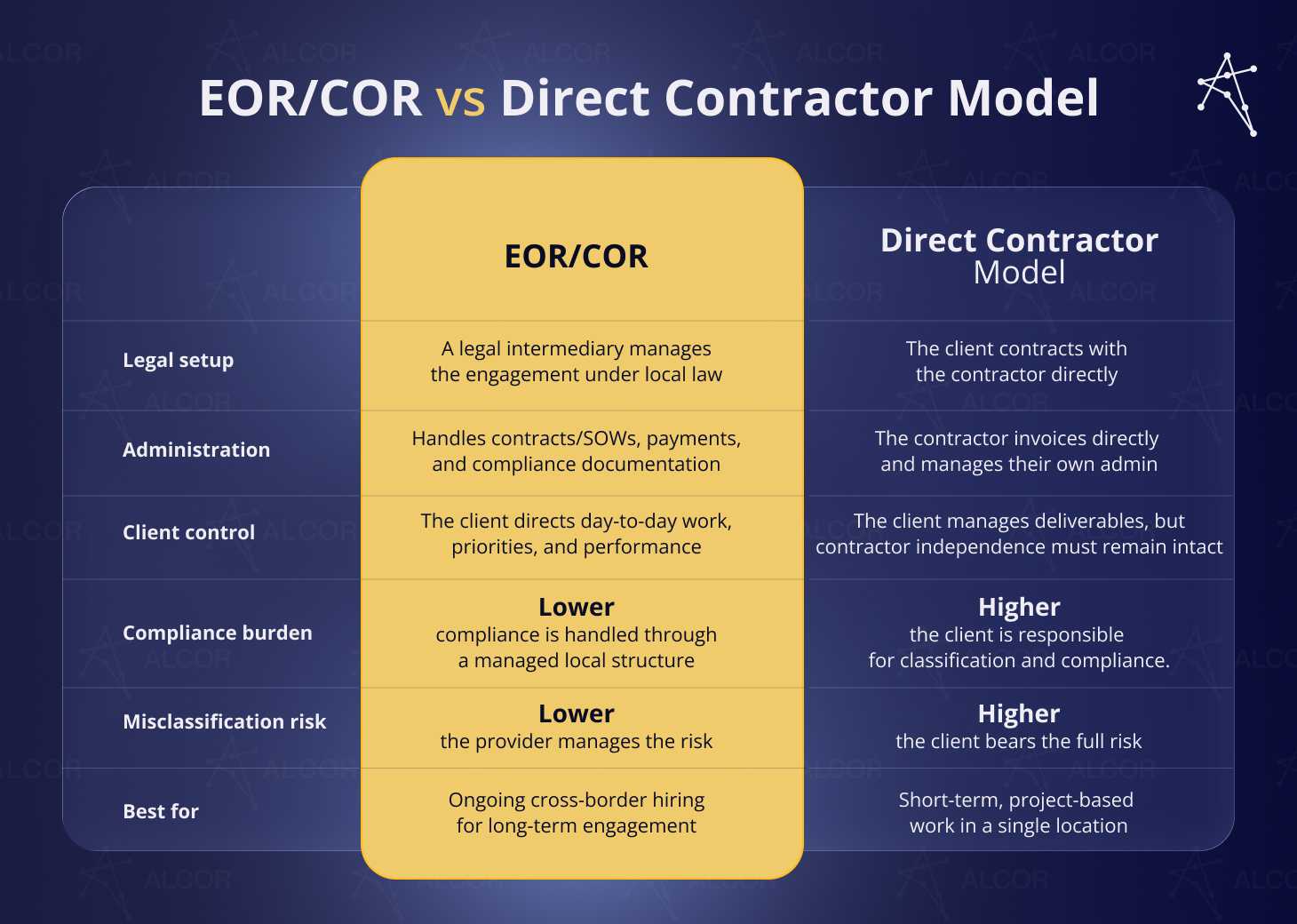
EOR model
An Employer of Record becomes the legal employer of software engineers on paper, handling employment contracts, payroll processing, statutory contributions, benefits management, and all local compliance filings. The client company retains full day-to-day operational control over its employees, engineering processes, priorities, and tools, as well as sets KPIs and improvement plans for engineers. Meanwhile, the EOR company absorbs the administrative and compliance burden.
Best-case scenario: Tech companies that need to hire engineers in a country where they have no legal entity and limited resources to build a local expert team for compliance and administrative functions. The EOR eliminates the 3-6 month entity setup window and the $5,000–$25,000 in incorporation costs that come with it.
Direct contractor model
The direct contractor model works differently. When a tech company hires an independent contractor (IC) directly, it enters a commercial relationship. The contractor operates as a separate business entity, invoices for services, manages their own taxes and social contributions, sets their own methods, and is not entitled to statutory employment benefits. The client company has no payroll obligations and no withholding responsibilities. The arrangement offers flexibility as long as it holds up to legal scrutiny.
Best-case scenario: The direct model makes sense when the work is genuinely project-based, the contractor serves multiple clients, operates as a registered independent business entity, and the engagement is short enough that a managed compliance layer would cost more than the risk it mitigates.
Alternatively, tech companies may skip the Employer of Record vs independent contractor choice. If they want the flexibility of a B2B contractor engagement without the exposure of a raw bilateral agreement, they can use a Contractor of Record (COR) service. The COR formalizes the contractor engagement under local law, governs the Statement of Work (SOW), handles invoicing and local-currency payments, and maintains the document trail needed to survive a classification audit. The independent contractor remains a contractor. The engagement structure becomes legally defensible.
The employer of record vs independent contractor choice
The defining distinction among all three models is that under a direct contractor arrangement, the client company bears the full risk of misclassification. Under an EOR or COR model, the legal intermediary assumes that liability.
Weighing more options? Our Employer of Record vs umbrella company guide will give you the full comparison and more food for thoughts.
Core EOR responsibilities when working with independent contractors
Contract preparation, onboarding, and statement-of-work governance
The EOR or COR provider drafts locally compliant employment contracts and governs the Statement of Work (SOW) to ensure that deliverable-based language matches the actual working relationship. This matters more than most finance and legal leads expect. Weak or generic SOWs (ones that describe a role rather than specific deliverables) are among the most common classification audit triggers. They signal that the engagement was documented as a contractor relationship but operated like employment. A well-structured EOR catches this at the contract stage, not after an audit notice arrives.
Payroll, invoicing, and local-currency payments
This is where the differences between EOR for independent contractors vs EOR for employees come up. For FTE engineers hired through an EOR, this means full payroll processing: tax withholding, statutory contributions, net salary remittance, and payroll records that satisfy local reporting requirements.
For B2B contractor engagements, the structure is different. The EOR processes invoices, handles local-currency payouts, and sometimes manages reimbursements for approved equipment, software, travel, or other project expenses – all without running employment payroll. Tax withholding obligations when using an EOR for contractors vary by market: in some countries, the provider only maintains contractor tax documentation and invoice records, while in others, withholding or reporting duties may apply depending on the engagement structure.
For tech companies managing contractors across Mexico and Colombia simultaneously, this means two currency frameworks, two filing calendars, and two sets of reporting obligations running in parallel. The EOR consolidates this into a single commercial relationship: one point of accountability, one reporting structure, one reconciliation cycle.
If Mexico is on your hiring roadmap, our guide to outsourcing payroll in Mexico breaks down the essentials.
Tax, social contributions, and statutory filings
For B2B contractor engagements, the EOR or COR handles VAT and GST obligations where applicable and maintains the compliance documentation required to demonstrate that the arrangement meets local contractor classification standards. The VAT/GST treatment for contractor services via EOR depends on the country, invoicing structure, and whether the contractor operates as a registered business entity.
Some EORs, like Alcor, also provide local accounting services to help software developers manage their PIT and social security contributions accurately and in a timely manner.
Ongoing compliance monitoring and audit support
Classification rules change. The DOL’s three rule revisions between 2021 and 2026 are the obvious US-market example, but labor classification frameworks in Poland, Mexico, and Colombia have all shifted in that same window. A competent EOR monitors legislative changes across all active jurisdictions, flags emerging reclassification risk in active contractor engagements, and maintains a complete, retrievable document trail for each contractor: signed contracts, SOWs, payroll records, statutory filings, benefits enrollment, and classification rationale documentation.
Key Legal, Tax, and Compliance Risks to Watch
Key legal, tax, and compliance risks in contractor engagement include misclassification, country-specific penalties, weak documentation, IP ownership gaps, and data protection exposure. Companies hiring contractors in Latin America or Eastern Europe need to check whether the working setup looks like true B2B cooperation or hidden employment.
The main risk triggers include:
- fixed schedules, client-side supervision, exclusivity, and use of company tools;
- missing SOWs, NDAs, IP clauses, invoices, DPAs, or classification rationale;
- unpaid taxes, social contributions, benefits, and potential fines;
- IP transfer and cross-border data rules.
Misclassification risk, penalties, and enforcement trends
Firstly, let’s understand worker misclassification.
Worker misclassification occurs when a company engages an engineer as an independent contractor on paper, but the actual working relationship operates like employment. The worker follows a set schedule, uses company tools, reports to a manager, and works exclusively for one client. The contract says one thing. The day-to-day says another. In most labor jurisdictions, authorities focus on the second.
For US tech companies expanding engineering teams in Latin America or Eastern Europe, this is a structural risk that lives inside every B2B contractor engagement, every long-term project that quietly becomes a core team dependency, and every setup that may create Permanent Establishment exposure.
Take a minute to look through the penalties for worker misclassification in the most go-to locations across LATAM and Eastern Europe:
| Market | Primary enforcement authority | Key penalties for misclassification |
| Mexico | STPS (Secretaría del Trabajo y Previsión Social); SAT (tax authority) |
|
| Colombia | Ministry of Labor; UGPP (Unidad de Gestión Pensional y Parafiscal) |
|
| Poland | PIP – State Employment Inspectorate (Państwowa Inspekcja Pracy); ZUS (social insurance authority) |
|
| Romania | Labor Inspectorate (ITM – Inspectoratul Teritorial de Muncă); ANAF (tax authority) |
|
| Ukraine | State Tax Service (STS); State Labor Inspectorate (SLI) |
|
As you can see, the price for worker misclassification is high, both literally and figuratively. All five markets have moved in the same direction since 2021 – more scrutiny. For instance:
- Mexico elevated misclassification to the status of tax fraud in January 2022. Foreign companies engaging contractors directly, without a registered intermediary or EOR, are increasingly targeted for SAT audits.
- Colombia has tightened contractor compliance: Law 2466 of 2025 made indefinite employment the default and reinforced substance-over-form labor protections, while the UGPP actively audits social security and payroll tax contributions.
- Poland is tightening contractor classification. From July 8, 2026, the State Labor Inspectorate will gain powers to reclassify misused civil-law contracts as employment contracts. Separately, the EU Platform Work Directive will require Poland to introduce a rebuttable presumption of employment for platform workers by December 2, 2026, shifting the burden of proof to the platform.
- Romania’s fines for work performed without a proper employment contract doubled to RON 40,000 per person, capped at RON 1 million from December 18, 2025. Romanian courts assess contractor reclassification based mainly on work, pay, and subordination, while labor inspectors can question civil-law contractor arrangements that resemble employment.
- Ukraine’s bill No. 14386, introduced in January 2026, proposes a new Labor Code with clearer employment-relationship criteria, including eight indicators separating employment from civil-law/FOP contracts. Since 57% Ukrainian tech specialists work as individual entrepreneurs, according to DOU, the community of software developers in Ukraine, this could raise reclassification risk for IT contractor models.
Country-specific classification triggers and documentation requirements
Mexico
The Mexican Federal Labor Law applies the principle of reality (Article 685 FLL), which prioritizes the actual substance of the working relationship over the contract’s form. The main triggers: the contractor follows a client-dictated schedule, uses client tools, works exclusively for one company, or performs tasks central to the client’s core business.
Individuals and entities providing specialized services must be registered on the REPSE platform with the Secretaría del Trabajo y Previsión Social. Registration must be renewed every three years. Engaging contractors in Mexico without a REPSE-registered intermediary or an EOR in Mexico means the foreign company absorbs that compliance burden directly.
Considering Mexico for LATAM contractor expansion? Contractor of Record services in Mexico can help you manage local contracts, payouts, and compliance without opening an entity first.
Colombia
Colombian labor courts prioritize the degree of worker control: employers are not permitted to interfere with the execution of a contractor’s tasks. Contractors must have free agency over when, where, and how they complete work. The main triggers: regular fixed salary-like payments, client-side supervision, no other clients, or work central to the client’s operations.
Colombia’s Law 2381 of 2024 introduced phased social security contribution requirements for contractors under specific service contracts, starting July 2025. The UGPP runs active audits and issues binding reclassification orders for misreported contributions.
Curious how contractor engagement works in Chile? Contractor of Record services in Chile can help companies hire local developers without opening an entity first.
Poland
Polish authorities intensively scrutinize contractor arrangements that resemble employment, particularly regarding subordination, exclusivity, and integration into the employer’s organizational structure. The main triggers: working exclusively for one company, consistently following its schedule, using its equipment, or lacking the hallmarks of an independent business – multiple clients, own tools, autonomy over method.
Poland is ramping up oversight of contractor arrangements to align with EU labor standards, with higher penalties to follow. The EU Platform Work Directive’s 2026 implementation shifts the burden of proof: companies must demonstrate genuine contractor independence, not just assert it in a contract. Contractor of Record services in Poland can help structure B2B agreements, payments, IP terms, and documentation when the contractor setup is still valid. If the engagement already looks like employment, a Polish Employer of Record may be a safer route than continuing with a direct B2B setup.
Romania
A worker must meet at least four of seven independent activities defined by Romania’s Fiscal Code to qualify as an independent contractor. These include the ability to work for more than one client, the freedom to hire third parties, and autonomy over when and where work is completed. A contractor who fails to satisfy four of seven criteria is automatically reclassified as an employee, regardless of the contract label. An Employer of Record company in Romania can help assess whether the setup still qualifies as independent activity or should move into employment.
Ukraine
The State Tax Service (STS) and State Labor Inspectorate (SLI) may re-qualify commercial relations as labor relations upon inspection – the STS to enforce proper labor-related taxes, the SLI via labor safety audits. The draft Labor Code submitted to the Verkhovna Rada in January 2026 formalizes an 8-factor employment presumption test. If a FOP meets 5 or more criteria, employment is presumed.
Regardless of country, an EOR or COR maintains the following as a minimum audit-ready file for every contractor engagement:
- Signed an Independent Contractor Agreement with a deliverable-based scope
- Contractor’s registered business entity documentation; version-controlled SOW
- Locally adapted IP assignment clause
- Signed NDA
- Invoices per payment cycle
- Classification Rationale Memorandum
- A Data Processing Agreement (DPA) for all EE market engagements involving EU-resident personal data.
Intellectual property, data protection, and contractor control tests
IP ownership is one of the least-discussed but most consequential risks in international contractor engagement, especially for tech companies whose core value lies in the code, systems, and technical documentation their teams produce.
The default rule across most LATAM and Eastern European countries is the same. A contractor retains ownership of the intellectual property they create, including code, system designs, and technical documentation, unless the contract explicitly assigns those rights to the client. Mind that a US-standard IP assignment clause is not recommended and often unenforceable in the abovementioned jurisdictions for copyright, trade secrets, and patents alike.
So, if you engage contractors, these three things are non-negotiable:
- A written IP assignment clause adapted to local law;
- A signed NDA;
- Per-delivery IP transfer confirmation where local law requires it.
The alignment of contractor NDAs, IP clauses, DPAs, and SOWs matters because a single weak document can undermine the entire protection layer. Data protection is part of that same system. If your US-based team handles personal data from EU-based contractors, GDPR obligations apply to your company. That includes signing a Data Processing Agreement (DPA) with any third party processing that data on your behalf. For contractors in Colombia and Mexico, separate national frameworks apply: Colombia’s Law 1581 and Mexico’s LFPDPPP, both of which impose cross-border transfer restrictions and require a legal basis for data processing.
A local provider can help you manage both. This is how EOR handles IP assignment for contractors: it localizes transfer clauses, keeps NDAs and SOWs aligned, and documents ownership from the start instead of trying to patch IP gaps later. Alternatively, you can convert your contractor to an employee through an EOR and resolve the IP and data gap at the root.
Employer of Record for Independent Contractors: Use Case Scenarios
EOR for contractors is useful when tech companies:
- hire international contractors without a local entity;
- pay contractors across several countries;
- convert long-term contractors into employees;
- work in high-risk misclassification markets;
- engage fractional CTOs, senior consultants, or AI/ML experts with access to core systems.
In these cases, an EOR or COR helps structure contracts, SOWs, payments, tax documentation, IP assignment, data protection, onboarding, offboarding, and compliance monitoring. Meanwhile, direct B2B contracting may still work for short-term, project-based engagements in contractor-friendly countries.
Common and niche use cases
Hiring international contractors without opening a legal entity
You’ve identified strong engineering talent in LATAM or Eastern Europe. The work is scoped, the timeline is defined, and incorporation is not justified – but direct engagement still brings tax, IP, payment, and classification risks you cannot ignore.
A COR, or an EOR provider with contractor-management capabilities, steps in as the contracting and compliance layer. It helps structure the B2B agreement, define the SOW, handle contractor documentation, background checks, and compliance processes. It also helps with onboarding and offboarding workflows, processing payments, and covering tax documentation or withholding requirements where applicable.
This matters even more when contractors handle customer data, proprietary code, product architecture, or AI models. Data protection, cross-border transfer rules, confidentiality, and IP assignment need to be built into the engagement from day one – not cleaned up after the first security review.
Want Bulgarian developers without turning direct B2B hiring into a tax, payment, and IP puzzle? Contractor of Record services in Bulgaria can take that weight off your shoulders.
Paying contractors across multiple countries
Managing contractor payments across locations in Latin America or Eastern Europe means dealing with multiple currencies, tax environments, invoicing rules, payment rails, and documentation requirements. What looks like “just send the invoice” can quickly turn into a monthly admin maze – with FX markups, delayed payments, missing paperwork, and unclear accountability hiding in the corners. That is why currency conversion and payment timing for contractor payouts via EOR should be clarified before the first invoice cycle: which FX rate applies, when contractors receive funds, who resolves payment delays, and how payout records are documented.
An EOR or specialized COR provider consolidates this into one commercial relationship: one service agreement, one invoicing flow, one reporting structure, and one point of accountability for the client company. The provider handles contractor payments, documentation, and local compliance checks, while the client maintains a clearer view of costs, status, and risk across all countries.
Converting contractors into full-time employees
A contractor you brought in for a product sprint six months ago, whether through a direct B2B setup or Contract-to-Hire (C2H) path, is now joining daily standups, reporting to your Head of Engineering, using your tools, and owning work that no longer looks project-based. That is where classification tests for independent contractor vs for employee become a liability.
In many jurisdictions, the working reality matters more than the contract label. If the person is managed like an employee, integrated into the core engineering team, and engaged on an ongoing basis, a de facto employment relationship may already exist before the formal conversion happens.
The transition needs clean documentation. That means reviewing the original contractor agreement, NDAs, IP assignment clauses, final invoices, termination terms, and any contract-break fees before the employment contract takes effect. IP created during the contractor phase should transfer unambiguously into the employment file, without leaving ownership gaps in the codebase. That’s what an EOR for independent contractors like Alcor can handle while you focus on the product roadmap.
Working with contractors in high-risk misclassification countries
You need senior AI engineers in Mexico or Poland, markets where classification tests for independent contractors vs for employees are enforced routinely, not exceptionally. Co-employment risk here isn’t theoretical; it’s a live liability if the engagement isn’t structured correctly from day one. The EOR’s job is active monitoring: flagging when a working relationship is drifting toward employment status and maintaining the documentation needed to defend a classification challenge.
The EOR’s job is active monitoring: flagging when the working relationship drifts toward employment status and keeping documentation ready for a classification challenge. This means reviewing actual working conditions: control over schedule, task assignment, performance management, access to tools, role permanence, team integration, IP assignment, confidentiality, insurance coverage, termination terms, and conversion-to-employment procedures.
For AI roles, this matters even more. Engineers may touch proprietary datasets, model architecture, internal repositories, and production code. A weak contractor setup can quickly become both a labor compliance issue and an IP ownership problem.
Scale your AI team with Alcor compliantly just like Backstroy (ex-People.ai) did:
Hiring fractional executives and senior consultants
Fractional CTOs, interim VPs of Engineering, and senior AI/ML consultants are often engaged on a B2B basis because companies need senior expertise without opening a full-time executive role. But these relationships can sit close to the core business: roadmap decisions, architecture reviews, team mentoring, hiring input, and access to proprietary systems.
A COR can help structure the engagement with clear SOW governance, contractor documentation, invoicing, IP assignment, confidentiality terms, and compliant payments. The key is proving that the relationship is genuinely project-based, time-bound, and commercially independent.
If the consultant starts managing employees, adhering to internal working hours, or owning ongoing team performance, the B2B setup may no longer align with the working reality. In that case, employment through an EOR or another compliant local structure may be safer.
When direct contractor relationships remain preferable
EOR or COR isn’t always the right structure for contractor engagements. In markets where classification risk is low, the regulatory environment is contractor-friendly, and the engagement is short-term or project-scoped, a direct contractor relationship with a well-drafted services agreement may be simpler, faster, and more cost-effective.
The Employer of Record and payrolling service provider question is also worth running in markets where your company already has a legal entity. If you have in-country infrastructure and a finance team that can manage local contractor compliance, a local payroll provider, or a direct B2B arrangement avoids the additional layer of an EOR without sacrificing compliance coverage.
So, a direct engagement tends to work best when:
- The contractor is a recognized independent business with multiple clients.
- The engagement is genuinely project-based with clear deliverables and no ongoing operational dependency.
- The jurisdiction applies a lenient standard on classification tests for independent contractor vs for employee.
When those conditions hold, introducing an EOR or COR adds cost and contract complexity without a corresponding compliance benefit.
In case your situation is different, you should consider an EOR vendor comparison and evaluation criteria before choosing your next partner.
How to Choose the Right EOR for Contractor Engagements
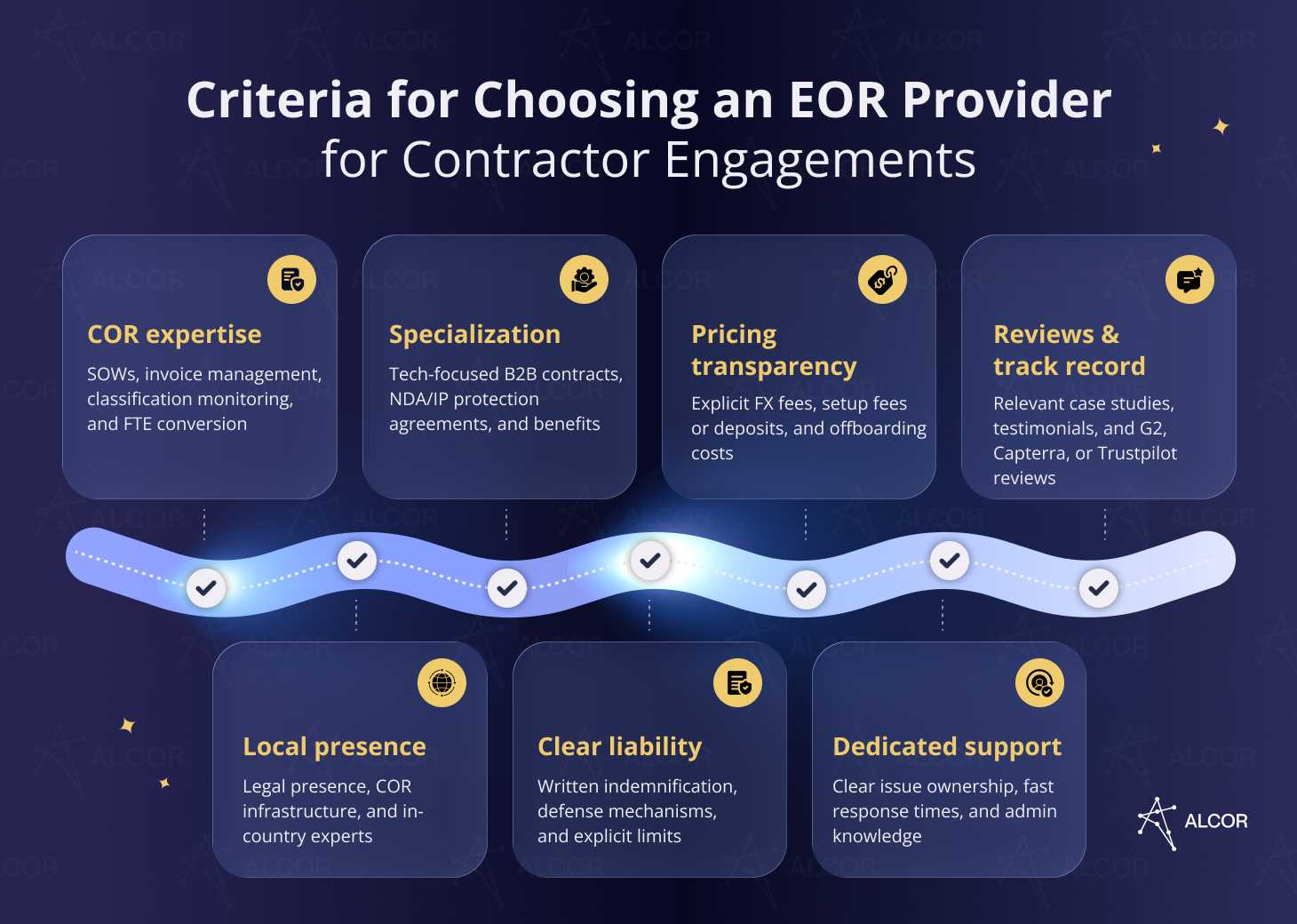
To choose the right EOR for contractor engagements, check whether the provider can protect you before problems reach audit level. Prioritize the following seven criteria:
- real COR expertise, including SOWs, accurate payments, classification monitoring;
- local legal presence and in-country expert teams;
- compliant contracts with NDA, IP, data, and benefits logic built in;
- clear liability allocation for misclassification or provider-side compliance failures;
- transparent pricing, including FX margins, setup/offboarding fees, lock-ins, and volume discounts;
- dedicated support with written response times and escalation paths;
- Relevant case studies and reviews on independent platforms.
1. COR expertise
Before choosing a provider, clarify whether they act as a COR, EOR, AOR (Agent of Record), payment intermediary, or aggregator because each model carries a different scope of liability and control. Contractor of Record handles SOW creation and version control, invoice management for B2B engagements, and active classification risk monitoring. The last point is critical – a professional COR provider doesn’t wait for a reclassification finding. It flags working relationships that are drifting toward employment status before enforcement begins.
And when conversion to FTE is the right move, it executes the transition without re-onboarding from scratch. This includes carrying over the contractor’s SOW history, payment records, and classification rationale into the employment file. Ask providers how they handle each of these scenarios specifically, not in principle.
2. EOR company specialization
A provider built for all industries and all company types has been built for no one specifically. The tell is in the contract templates and the onboarding questions. If the SOW framework doesn’t distinguish between B2B contractor engagements and standard employment, if it doesn’t handle NDA and IP provisions, and if the default benefits package wasn’t designed with tech teams in mind – you’re adapting their product to your needs, not the other way around.
3. Local presence
Two things matter here. First: whether the provider has a registered legal presence in your target markets to enter B2B service agreements and disburse local-currency payments compliantly. A provider routing contractor payments through a foreign account without local infrastructure creates exposure for both sides. Second: whether that local presence includes legal and compliance specialists who understand contractor classification rules in each country, not a regional hub covering five markets from one office.
4. Clear liability allocation
When a misclassification finding occurs or a compliance failure happens on the provider’s side, who absorbs the penalty? This is where EOR liability and indemnity clauses for contractor work need close legal review. The service agreement should answer this question explicitly. Look for: written indemnification covering compliance failures caused by the provider; clear language on who defends a classification challenge and at whose cost; and defined liability limits that don’t shift the full risk back to the client through boilerplate carve-outs. A provider that avoids this conversation during sales is signaling what happens when something goes wrong.
5. Pricing transparency and hidden fees
The headline service fee is rarely the full cost. Currency exchange margins on local-currency contractor payments, per-engagement setup fees, offboarding fees, and seat lock-in commitments are where the real cost lives – and they’re often buried in the terms. A provider that can’t give you a complete cost breakdown before you sign is structuring the relationship so that surprises happen after. Also, check whether the fee structure decreases with volume. If a team growing from 5 to 30 contractors pays the same unit rate throughout, the pricing model isn’t built for companies that scale.
Pricing transparency is especially relevant for startups. Learn what EOR for startups covers and how to choose the right provider before you sign.
6. Dedicated support
The real test of a provider isn’t the sales process. It’s what happens when a payment is delayed or a classification question needs an answer before an audit. Ticket-based support with 48-hour response windows fails that test. So does an account manager who keeps on resending your request from one department to another, or rotates every quarter and has to re-learn your setup each time. Ask for response time commitments in writing. Ask what the escalation path looks like when an issue needs in-country legal involvement. And ask specifically whether the person managing your account has direct access to local legal and compliance expertise.
Already have some EOR providers on your mind? Check our overviews of Papaya Global alternatives and Remote Employer of Record, and how they compare to Alcor.
7. Reviews & track record
You can always ask for relevant case studies and testimonials to make sure your EOR provider has experience with similar requests. Another good source of trust checks is independent review platforms such as G2, Capterra, and Trustpilot. Look for patterns in the negative reviews – slow contractor payments, poor support responsiveness, billing surprises at offboarding, and inadequate classification documentation. A provider with strong feature ratings but repeated support complaints is telling you where the operational depth ends.
Alcor – Your Employer of Record for Independent Contractors in LATAM and Eastern Europe
Alcor is a tech-exclusive EOR/COR for US and Western European product companies hiring engineers on both B2B and FTE engagement models in LATAM and Eastern Europe. It combines compliant engagement infrastructure, tech recruitment, IP protection, and operational support into one tech R&D center model.
With Alcor, tech companies get:
- compliant B2B contracts with SOW, NDA, and IP clauses;
- ongoing worker classification monitoring;
- full cost visibility with no setup fees or deposits;
- one dedicated Customer Ops Manager instead of ticket-based support.
One of the few companies that checks all those EOR for contractors criteria is Alcor. We are a tech-exclusive EOR and recruitment partner that builds and scales dedicated engineering teams of 10-30 specialists in 90 days for US and Western European tech product companies. Unlike generalist EOR platforms, Alcor combines in-house tech recruiting, compliant engagement infrastructure, and operational coverage in a single solution called the tech R&D center.
By partnering with us, you’ll get:
- A partner with a registered local presence in your target market in LATAM or Eastern Europe
- Local legal, compliance, accounting, and ops experts who shield you from any risks
- Contractor infrastructure built for tech: developer onboarding, B2B contracts with SOW, NDA, and IP rights clauses, accurate payout calculations and invoice processing, and tech-focused benefits.
- Liability covered by Alcor’s side from day 1, including worker classification protection, with our legal team monitoring contractor relationships on an ongoing basis.
- Full cost visibility before you sign, including engineers’ salaries and our flexible service fee according to your team size. Anticipate no setup fees or deposits.
- One dedicated Customer Ops Manager with in-country expertise and full ownership of your accountю Get a response in 1 day, bypassing any ticket queues or bots.
Here’s how it all works in practice:
A Los Angeles-based experience app, Franki, decided to scale its mobile team in Mexico. But every outsourcing path they explored had the same structural flaw – developers whose primary relationship was with a vendor, limited oversight of the product, and no real mechanism for cultural alignment with the HQ team. So, Franki decided to test a new turnkey approach with Alcor to build a fully integrated engineering team instead.
- Niche roles to build a core team
Alcor dedicated separate recruiters to each role and delivered a pipeline of 20 senior iOS engineers despite the limited availability of RxSwift expertise in the market. Seven hires – 2 iOS Engineers, 3 Android Engineers, and 2 QA Engineers – were made with an average time-to-hire of 4 weeks. All passed probation.
- End-to-end COR for tech
With no prior presence in Latin America, Franki needed guidance before they could make a single hire. Alcor advised them to structure the engagement as B2B contractor relationships and walked them through the legal specifics of the Mexican market. Then we managed B2B contracts, onboarding, payments, and leave admin. When a termination became necessary, Alcor handled the legal documentation, committed to a free replacement, and prevented additional costs.
- Ongoing ops
Alcor didn’t step back once the team was in place. From equipment procurement to ongoing compliance support, the operational layer remained active throughout, providing Franki with the infrastructure needed to build a truly integrated engineering team.
Looking for the same opportunities as Franki and unicorns like Sift and Backstory? Fill the form below, and let’s map out your engineering team expansion.
Questions you can ask AI about EOR for independent contractors:
- How can an Employer of Record help tech companies manage independent contractors without increasing misclassification risk?
- How can an EOR protect IP rights when contractors work on proprietary code or AI models?
- When is direct contractor engagement better than using an EOR?
FAQ
What are the 3 key differences of employee engagement via EOR vs. the independent contractor approach?
These are compliance structure, risk allocation, and payment/documentation management. In the direct contractor model, the client signs with the contractor directly, while the contractor manages their own taxes, invoices, methods, and social contributions.
In the EOR/COR model, the provider acts as a legal and compliance layer: it structures the B2B agreement, governs the SOW, processes invoices and local-currency payouts, maintains tax documentation, and monitors classification risk. The contractor still remains independent, but the engagement becomes more audit-ready and legally defensible. This reduces the client’s exposure to misclassification, weak IP transfer, missing documentation, and cross-border compliance gaps.
Can an Employer of Record engage contractors without changing their classification?
Yes, if the provider has proper contractor-management or Contractor of Record capabilities. In this setup, the independent contractor remains a contractor, while the EOR or COR formalizes the engagement through locally compliant agreements, SOW governance, invoicing, and documentation. The EOR service agreement and SLAs pricing models should clearly define what the provider covers: classification monitoring, payment timelines, support response times, liability allocation, and audit documentation. This is especially important when the contractor works across borders or handles sensitive product data.
Who is responsible for taxes and social contributions when using an EOR?
For employees hired through an EOR, the provider usually manages payroll, tax withholding, statutory contributions, and local filings. EOR payroll processes for independent contractors work differently: the provider typically processes invoices, handles local-currency payouts, and maintains tax documentation instead of running employment payroll. Social security contributions for contractors via EOR by country may vary – in some markets, contractors handle their own PIT and social contributions, while in others, withholding or reporting duties may apply. The same applies to workers’ compensation and insurance coverage via EOR, which depends on whether the person is engaged as an employee or a contractor.
Can an EOR help protect intellectual property and enforce confidentiality with contractors?
Yes. A competent EOR helps protect IP by using locally adapted IP assignment clauses, NDAs, SOWs, and per-delivery transfer confirmations where required. This matters because contractors may retain ownership of code, architecture, documentation, or other work unless the agreement clearly transfers those rights to the client.
The provider can also help align confidentiality terms with data protection and cross-border data transfer controls, especially when contractors access customer data, internal repositories, AI models, or proprietary systems. In other words, it helps close the gaps before they become legal bugs in production.
How do EOR fees typically compare to the cost of direct contractor arrangements?
Direct contractor arrangements are usually cheaper upfront because there is no extra provider fee. EOR or COR fees add a managed compliance layer, which may include contracts, SOW governance, invoice processing, payment management, classification monitoring, local documentation, and support. The real cost comparison should also include hidden risks: misclassification penalties, IP gaps, tax exposure, FX markups, setup or offboarding fees, and seat lock-ins.
Can I convert a contractor to a direct employee through an EOR?
Yes. An EOR can help convert a contractor into a direct employee when the engagement no longer looks genuinely project-based. The transition should include a review of the original contractor agreement, NDAs, IP assignment clauses, final invoices, termination terms, and any contract-break fees before the employment contract takes effect.
This is also the right moment to clarify how EOR supports contractor equity/stock option arrangements, since conversion may affect eligibility, grant documentation, tax treatment, and local compliance requirements. The EOR can also make sure IP created during the contractor phase transfers clearly into the employment file, so there are no ownership gaps in the codebase. In this setup, the contractor becomes an employee through the EOR, while the client keeps day-to-day management over their work.
How would you rate this article?
Alcor is Your Trusted Scaling Partner
for expansion
support