


In 2026, Polish software developers make up one of the largest, highly skilled, and affordable talent pools in the CEE for US tech companies building AI product teams. Poland has 778,800 ICT specialists, including a strong concentration of professionals with ML, LLM, AI product, MLOps, data, and DevOps expertise. According to Alcor’s internal salary research, employers pay senior developers from Poland around $7,270 per month – 52% more cost-efficient than equivalent roles in the US.
I’m Yuliia Baranovska, IT Recruiting Manager at Alcor, the leading recruitment, EOR & ops partner for scaling startups, mature tech product companies, and unicorns. We help tech companies build teams of 10–30 engineers in Poland and other Eastern European and Latin American countries within 90 days. Our solution includes hiring AI developers that other companies simply can’t find – fully integrated as your internal team, without the Silicon Valley price tag.
In this article, you’ll discover why Polish software engineers are a smart choice for scaling your tech product team efficiently, explore the advantages and challenges of working with them, and find out where Poland’s software engineer salaries stand relative to the US. You’ll also learn about a top collaboration model with Polish developers that eliminates outsourcing risks and goes further than a standard recruitment or Employer of Record solution.
Key Takeaways
- Poland offers a low-risk base for product engineering, backed by A2 business climate and +3.8% projected GDP growth in 2026. Poland’s EU-aligned legal system supports GDPR, IP protection, and enforceable cross-border contracts.
- Poland has a large talent pool of 778,800 ICT specialists, 60,000+ IT companies, 1,774 startups, 15 unicorns, and $1B+ exits. With its ICT market forecast to reach $56.01B by 2031 and 200% R&D tax deductions, Poland is built for serious product engineering growth.
- Polish developers combine strong skills with major cost efficiency: Poland ranks #12 globally on TopCoder, #4 in Eastern Europe for tech skills, and #3 for data science skills. Senior tech talent in Poland costs around $7,270/month versus $15,025/month in the US, giving you about 52% salary savings.
- According to BulldogJob 2025, 58% of Polish tech specialists are aged 25–34, 70.2% hold a bachelor’s or master’s degree, and 87.1% are Middle, Senior, Lead, Manager, or Director/C-level specialists.
- Hiring in Poland presents some compliance, employment models, and time zones challenges, but with local EOR support, payroll, contracts, onboarding, and B2B misclassification prevention, these issues become manageable instead of blocking your expansion.
- To hire Polish software developers, choose the right cooperation model first: a legal entity, an Employer of Record, tech outsourcing, or a tech R&D center. Then define hiring goals, approve candidates, run tech interviews, and onboard new hires with local payroll, compliance, and operational support.
- With Alcor, you build a true software R&D center in Poland: 10–30 specialists in 90 days, 8 CVs per accepted offer, 98.6% probation pass rate, and 2.5+ years average tenure. Alcor covers recruitment, end-to-end EOR with payroll and onboarding, compliance, and operations, so you scale without a local entity or vendor layer.
Polish Software Development Market Overview
Poland is a strong destination for tech product companies building AI/ML software teams, combining a stable EU economy, a reliable business climate, strong IP protection, and one of CEE’s largest tech talent pools with 778,800 ICT specialists. Polish ICT market is forecast to reach $56.01B by 2031, while the startup ecosystem includes 1,774 startups, 15 unicorns and $1B+ exits. Mature tech hubs, salary flexibility, AI infrastructure initiatives, and 200% R&D tax deductions make Poland a practical market for long-term engineering growth.
Strong economy and EU membership
Poland’s business environment carries the credentials to back it up. Coface rates Poland’s business climate as A2 – a level at which corporate financial information is considered reliable, institutions perform efficiently, and intercompany transactions run smoothly. On the macroeconomic side, Poland is one of Central Europe’s strongest performers, with GDP growth of +3.8% projected for 2026, driven by strong investment momentum from EU funds and durably solid household consumption.
EU membership, held since 2004, is what makes Poland particularly low-risk for US and European tech companies building engineering teams there. Poland’s alignment with EU regulations and international treaties strengthens cross-border IP protection and legal certainty for companies operating globally. Contracts are enforceable under a predictable legal framework, GDPR compliance is built into the operating environment, and Poland’s IP system is designed to support innovation and creativity while offering robust legal tools for enforcement – patents, trademarks, industrial designs, and copyrights all covered under EU-aligned law. For US tech product companies managing proprietary AI/ML code and sensitive R&D, that combination of economic stability and legal predictability in Poland removes one of the biggest concerns about building offshore.
Tech market size and talent pool
Poland’s software development market is backed by one of CEE’s largest tech talent pools, with 778,800 ICT specialists. Using PAIH’s ICT sector report as a baseline and its cited ~10% annual growth rate, Poland was estimated to have 60,000+ IT companies in 2025, including 1,500+ software development companies. On the broader market side, Mordor Intelligence estimates Poland’s ICT market at $34.75B in 2026 and forecasts it to reach $56.01B by 2031.
Startup and innovation ecosystem
Poland’s startup ecosystem adds another layer of market depth. StartupBlink tracks 1,774 startups in Poland and ranks the country #4 in Eastern Europe and #33 globally in its Global Startup Ecosystem Index 2025.
Dealroom also names Poland as a CEE leader with 15 unicorns and $1B+ exits. Poland ranks #39 globally in the Global Innovation Index 2025, further supporting its position as a significant innovation market in Europe.
Tech hubs and salary flexibility
A network of dynamic Polish tech hubs fuels this success:
- Warsaw ranks 3rd in Eastern Europe for the social & leisure industry.
- Krakow ranks 13th in Eastern Europe for the marketing & sales industry.
- Wroclaw ranks 11th in Eastern Europe for the software & data industry.
Beyond Warsaw, Kraków, and Wrocław, smaller tech hubs in Poland, such as Katowice, Poznań, Łódź, and the Tri-City area, can offer more flexibility in software developers’ salaries. IT recruitment services in Katowice and Poznań are ones of the most in-demand in the area as of 2026.
Based on BulldogJob’s 2025 city-level IT salary data, Katowice, Poznań, Łódź, and the Tri-City area can offer roughly 8–18% lower average employment-contract salaries and up to around 20% lower median B2B rates, depending on the city.
Want to hire developers in Warsaw or compare Poland’s other tech hubs? Alcor helps you choose the right city and build your team end-to-end.
Government support for AI & R&D
What truly sets Poland apart is its proactive government support for innovation and R&D. Poland launched a national AI development strategy backed by 1 billion zlotys (approximately $240 million) and has since significantly scaled up its ambitions.
In 2025, Poland co-submitted a proposal for the Baltic AI GigaFactory, a €3B (approximately $3.5 billion) joint initiative with Lithuania, Latvia, and Estonia to build world-class computing infrastructure for AI development.
R&D tax incentives
On the tax side, companies of any size conducting R&D in Poland can benefit from a 200% tax deduction on eligible R&D expenses, applied in two stages: first as operating costs, then again as a deduction from the taxable base. Eligible expenses include employee salaries and social security contributions, raw materials, expert consultations from accredited institutions, research equipment, and IP protection costs, with reforms proposed in 2025 to further protect these incentives in Poland.
Is It Worth Hiring Polish Developers?
Yes, hiring Polish developers is worth it for US and European tech companies. Poland offers strong AI/ML, data, backend, cloud, and product engineering talent, ranking #12 globally and #3 in Eastern Europe on TopCoder, #4 in Eastern Europe for tech skills, and #3 for data science skills in Coursera 2025. Senior tech professionals in Poland cost around $7,270/month, compared with $15,025/month in the US, which is 52% more affordable. Poland also has 500 higher education institutions, 68 STEM universities, and 74,000 STEM/ICT graduates. Add a Western-aligned work culture and advanced English proficiency (C1), and Poland becomes a strong R&D hiring destination.
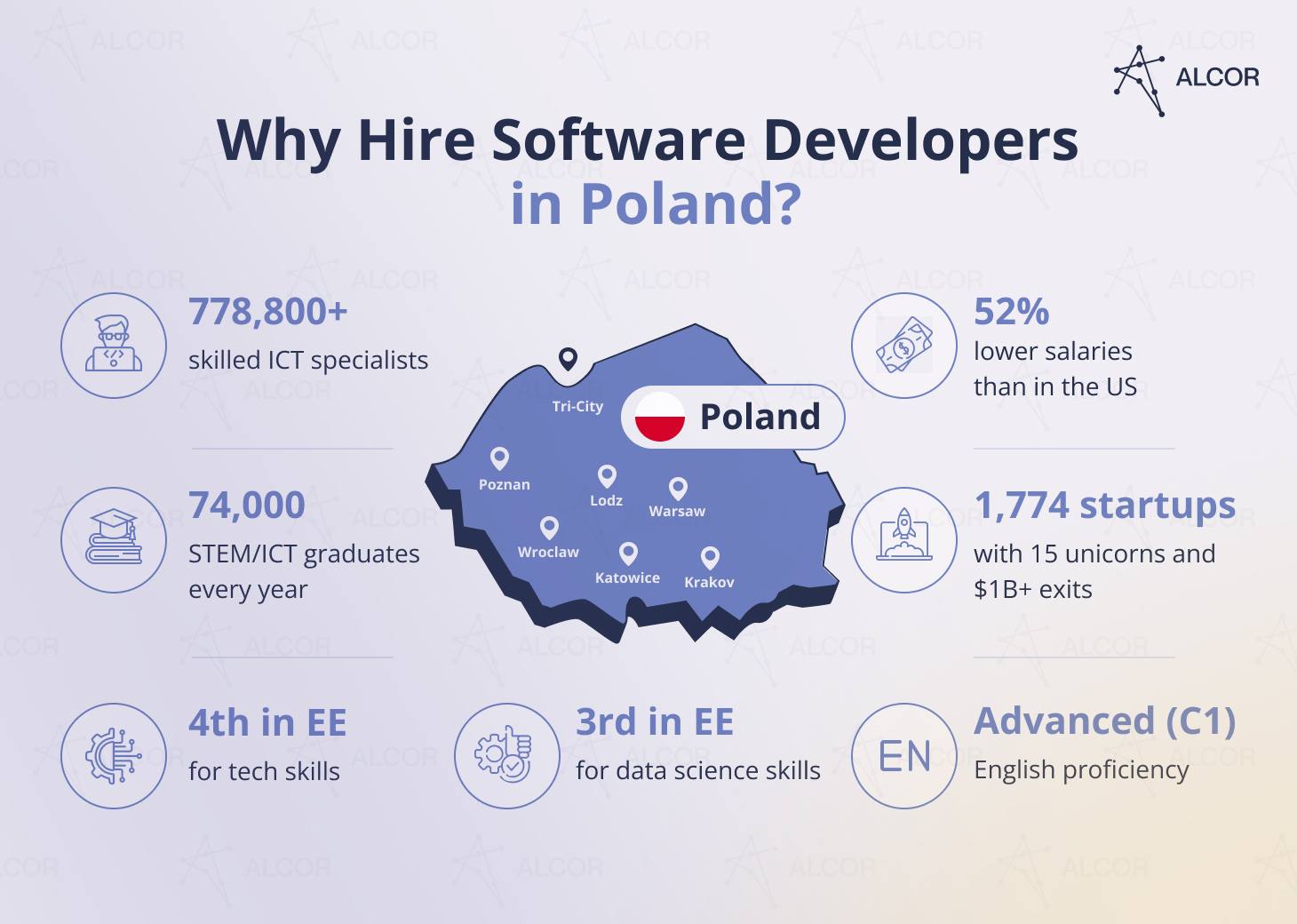
Let’s look at the 5 main factors that make Poland attractive for foreign businesses in more detail.
1. Impressive tech skills
Poland ranks #12 globally and #3 in Eastern Europe on TopCoder’s “1st Place By Country” ranking, after Romania and Ukraine in the Eastern European comparison. Coursera’s 2025 Global Skills Report also ranks Poland #4 in Eastern Europe for tech skills and #3 for data science skills.
Poland’s tech stack is also broad enough for both classic product engineering and AI-heavy teams. Key technologies and domains of Polish software developers include JavaScript, SQL, Python, C#, TypeScript, Hadoop, NLP, ZTA, Kubernetes, and TensorFlow.
Our client People.ai (now Backstory) saw Eastern European engineering depth firsthand. The San Francisco-based AI data platform needed senior AI, Data Science, and backend engineers with expertise in Python, Scala, Java, Kafka, and Big Data. Alcor took over the full setup – tech recruitment, legal compliance, Employer of Record, office launch, and local operations – after the company struggled with a multi-vendor model.
In the first year, Alcor hired 25 engineers in Eastern Europe, including senior backend, platform, technical success, and AI specialists. Some later became core senior and staff AI engineers, helping People.ai scale toward its $1.1B valuation.
2. Competitive developer salaries
According to Alcor’s internal salary research, the average senior software engineer’s salary in Poland is around $7,270 per month, while in the US, it’s approximately $15,025. US tech companies can reduce senior engineering salary costs by half when hiring in Poland, while still accessing strong technical expertise across AI, cloud, data, mobile, backend, and QA roles.
3. Solid technical education
Poland is known for its strong technical education and has 500 higher education institutions, including 68 universities with STEM majors, such as Warsaw University of Technology, Jagiellonian University in Kraków, Adam Mickiewicz University, and the University of Gdańsk.
In the QS World University Rankings 2026, 20 Polish higher education institutions are listed, showing the country’s solid international academic visibility. Poland also produces 74,000 STEM/ICT graduates, feeding the market with fresh technical talent every year – a strong indicator of a future-ready, skilled workforce.
4. Western-aligned work culture
Poland and the US share strong individualism, as reflected in their Hofstede’s cultural dimension scores, meaning Polish engineers take personal ownership of their work, hold themselves accountable, and operate independently – exactly what distributed AI/ML teams need. Polish professionals score higher on uncertainty avoidance, which, in engineering, translates into thoroughness, structured thinking, and a preference for clear specs over vague briefs. The US, scoring significantly lower on the same dimension, trends toward risk tolerance, rapid iteration, and openness to experimentation.
5. High English proficiency
Poland ranks #15 globally in the EF English Proficiency Index, with a Very High proficiency level and an overall score of 600, indicating an advanced (C1) level. Polish IT professionals score even higher – 621 – which helps avoid “lost in translation” situations altogether and enables smooth work with US & European clients.
Average Polish Developer Salaries & Payroll Taxes
According to Alcor’s 2026 developer compensation research, Polish developer rates are, on average, 52% lower than in the US. For example, ML Engineers cost $8,300/month in Poland vs $18,500 in the US. The true cost of hiring in Poland also includes payroll taxes (employers contribute ~20% SSC for full-time hires), recruitment fees (15–25% of gross annual salary depending on seniority), and a standard benefits package of ~$6,350 annually. Under a B2B model, employer payroll tax obligations are eliminated, making Poland a cost-effective destination for scaling tech teams.
The Alcor team prepared a comparison of the average salaries of a Polish software developer to those of one from the US, so you can see a clear picture of cost-effectiveness.
| Senior Developer’s Average Monthly Salary, Gross | |||
| Position | USA | Poland | Cost Savings |
| ML Engineer | $18,500 | $8,300 | 55% |
| LLM Engineer | $19,500 | $8,500 | 56% |
| AI Product Engineer | $19,000 | $8,650 | 54% |
| MLOps Developer | $15,750 | $8,500 | 46% |
| Data Engineer | $14,750 | $6,900 | 53% |
| Data Platform Engineer | $15,750 | $7,400 | 53% |
| DevOps Engineer | $14,000 | $7,500 | 46% |
| Python Developer | $13,750 | $7,000 | 49% |
| Node.js Developer | $13,000 | $7,000 | 46% |
| React Developer | $13,000 | $6,700 | 48% |
| Angular Developer | $13,000 | $6,500 | 50% |
| Mobile Developer (iOS/Android/Xamarin) | $14,500 | $7,000 | 52% |
| C/C++ Developer | $12,500 | $7,500 | 40% |
| Blockchain Developer | $14,250 | $5,900 | 59% |
| Automation QA Engineer | $12,125 | $6,200 | 49% |
According to Alcor’s 2026 remuneration metrics research, the average Polish developer salary is 52% lower than in the US.
For instance, Polish mobile app developers, who remain in high demand on the global market, can cost employers about 52% less than their US counterparts. For cloud-related roles, the cost advantage is also substantial: senior DevOps Engineers in Poland cost about 46% less than their US counterparts.
However, to understand the true cost of hiring Polish software developers, it’s important to account for additional expenses, including payroll taxes, recruitment fees, and employee benefits.
Considering IT outsourcing in Wroclaw? Compare its tech talent, salary flexibility, and R&D potential.
Payroll taxes
Poland offers a favorable tax environment for tech companies working with developers under the B2B model, as in this setup, taxes and social security contributions are generally paid by the private entrepreneur rather than the hiring company.
Regarding other Polish taxes in the IT industry, employers are required to cover social security contributions when hiring full-time employees. For an employee receiving a monthly remuneration of $5,000, the employer will contribute approximately 20% to SSC on top of the gross Polish software developer’s salary.
Social security contributions in Poland include:
- 9.76% retirement pension contribution
- 6.5% pension contribution
- 0.67–3.33% disability pension
- 2.45% to the Employment Fund
- 0.1% to the Fund of Guaranteed Employment Benefits
Recruitment fees
Recruitment costs in Poland vary by role seniority:
- 15% of gross annual salary for mid-level specialists
- 20% for senior-level positions
- 25% and more for leads and top-tier talent
Standard benefits package
Eastern European tech companies, including Polish ones, typically offer a comprehensive benefits package valued at around $6,350 annually, which comprises:
- medical insurance – $1,200
- learning & development – $900
- corporate merchandise – $150
- work equipment – $3,300
- wellness & mental health support – $800
More than Just Hiring Polish Developers
Alcor helps VC-backed and tech product companies build their own software R&D center in Poland without having to open a local entity or manage multiple vendors. Unlike traditional outsourcing, Alcor builds true in-house teams of Polish software developers who work under the client’s brand, processes, and roadmap. Companies can hire 10–30 specialists in 90 days, including AI/ML, LLM, data, cloud, backend, mobile, QA, and AI product talent. Alcor provides tech recruitment, EOR services in Poland, including payroll and onboarding, compliance, and operations, with 8 CVs per accepted offer, a 98.6% probation pass rate, and an average tenure of 2.5+ years.
Alcor is your partner in building your own software R&D center in Poland and other Eastern European and Latin American locations. We help VC-backed and tech product companies hire Polish programmers, including in-demand AI developers, ML engineers, data engineers, cloud/DevOps specialists, and other Silicon Valley-caliber talent – without opening a local entity or managing multiple vendors.
Among our clients are globally renowned companies such as Grammarly, Pindrop, Samsung, Huawei, Tonic Health, Ledger, ThredUP, Gotransverse, and many others.
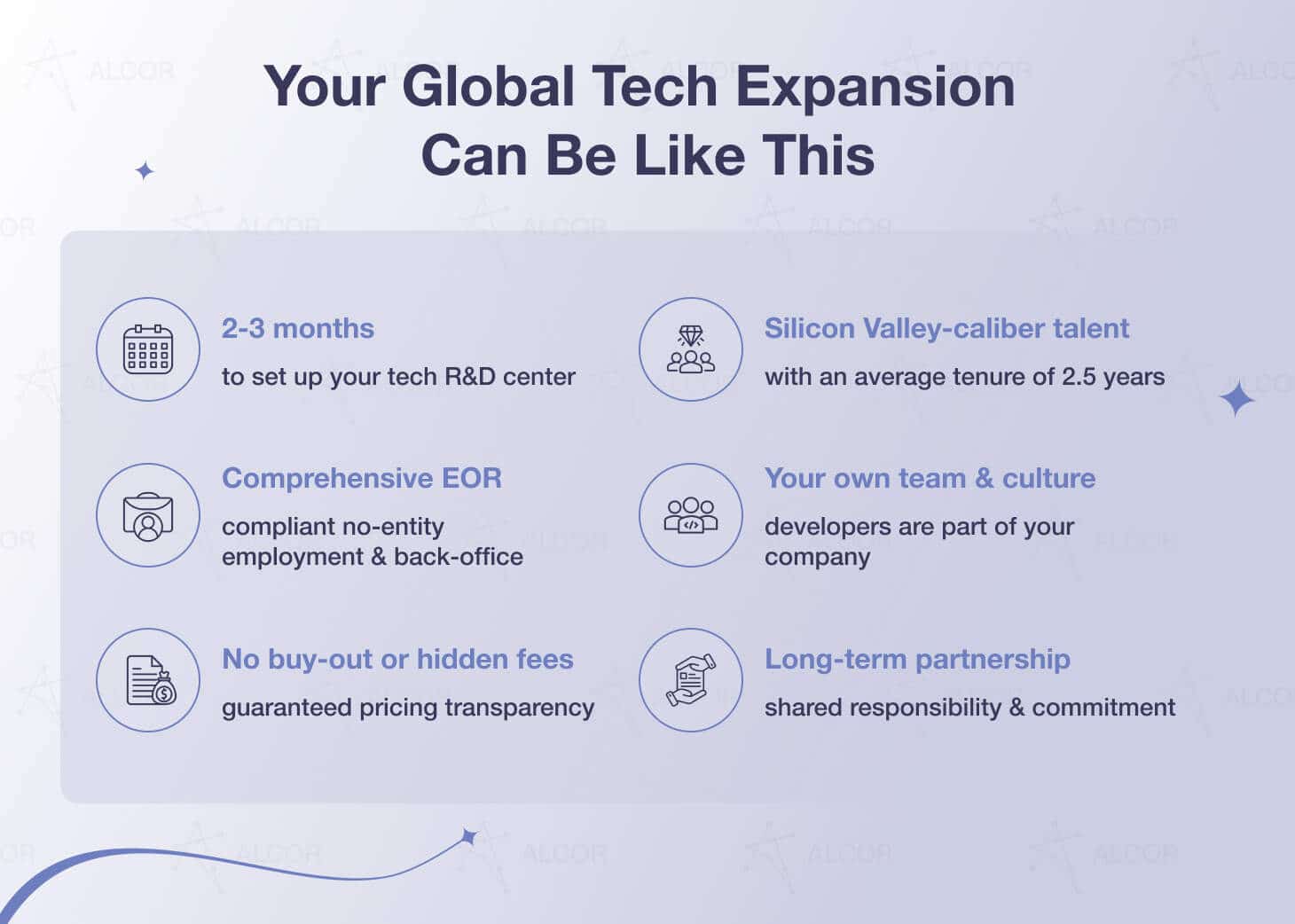
How hiring with Alcor is different from traditional outsourcing:
- Your true in-house team – Polish software developers work under your brand, processes, and product roadmap, not under a vendor’s delivery model.
- 10–30 specialists in 90 days – build a high-performance software R&D center fast, including AI/ML engineers, LLM engineers, data engineers, cloud specialists, backend developers, mobile developers, QA engineers, and AI product talent.
- 8 CVs per accepted offer – get a focused shortlist instead of drowning in irrelevant profiles.
- 98.6% probation pass rate – hire pre-vetted Polish programmers for technical depth, product mindset, and cultural fit.
- 2.5+ years of average candidate tenure – reduce rehiring loops and keep product knowledge inside your team.
- No legal entity required – Alcor covers EOR services in Poland, payroll, taxes, contracts, and compliance.
- No vendor layer – you get an internal superteam unit with higher output, better economics, and full control.
Just ask Sift, a US-based cybersecurity company. When Sift needed to scale its product engineering team in Poland and Ukraine, Alcor delivered full-cycle recruitment and operational support. We helped the company hire 51 tech specialists in total, including Polish software developers, and supported legal compliance, payroll, IT infrastructure, and local operations. As a result, Sift launched its own branded R&D office without the overhead of traditional outsourcing.
Challenges When Cooperating with Polish Developers
Foreign tech companies outsourcing software development in Poland usually face three challenges: regulatory complexity, choice of employment model, and time zone differences. Poland has complex reporting, HR, payroll, tax, and compliance rules, so local legal support is important. Companies hiring in Poland must also choose between Umowa o pracę, Umowa zlecenia, and B2B contracts while avoiding misclassification risks. For US companies, Poland’s CET/CEST time zone offers limited overlap but can also support a follow-the-sun workflow. A partner in Poland like Alcor helps manage compliance, payroll, contracts, and operations.
There are three main challenges faced by foreign tech companies when outsourcing software development in Poland:
Regulatory complexity
According to the 2025 Global Business Complexity Index, Poland ranks 5th in Europe and 15th globally for the complexity of doing business because of difficult reporting standards, high compliance costs tied to changing regulatory policies, formal & legal obstacles to investment, and complex HR and payroll regulations.
By partnering with an expert in Poland with a local legal entity and established infrastructure, such as Alcor, you’ll have legal compliance, payroll, taxes, employment contracts, NDAs, and IP rights protection covered, and you’ll stay focused on your product development.
Employment model complexity
It might be hard for international enterprises to choose the right employment contract when hiring software development engineers in Poland. The most common options are: Umowa o pracę – a regular employment contract under Polish labor law; Umowa zlecenia – a civil-law mandate contract; and B2B – a service contract in which the specialist works as a self-employed contractor.
B2B contracts don’t require companies to set up a legal entity in Poland and allow them to sign direct service agreements with developers registered as sole proprietors (a far simpler procedure). Moreover, hiring Polish specialists on a B2B basis means developers handle their own taxes and social security contributions, while the company doesn’t have to pay employer payroll taxes on top of remuneration, which can support higher take-home pay.
However, B2B cooperation in Poland should be structured carefully to avoid the risk of misclassification.
Time zone differences
Poland operates in the Central European Time zone, or CET, in winter and CEST in summer, and is 6–9 hours ahead of the continental USA: Eastern, Central, Mountain, and Pacific Time. Such a time difference between Poland and the United States might complicate meeting planning and leave less overlap for real-time communication during work hours.
However, Western tech companies can leverage this time gap by organizing a round-the-clock workday – before the workday begins in the States, a remote software development team in Poland can complete tasks and accelerate the company’s product development process.
Portrait of a Polish Programmer
A typical Polish programmer is young, educated, and experienced. According to BulldogJob 2025, 58% of Polish tech specialists are aged 25–34, and 43.1% live in Warsaw, Kraków, or Wrocław. Most Polish developers have strong academic backgrounds: 70.2% hold a bachelor’s or master’s degree, and many studied computer science or technical fields. Poland’s IT market is also senior-heavy, with 87.1% of specialists at Middle, Senior, Lead, Manager, or Director/C-level. Polish developers value remote or hybrid work, flexibility, strong compensation, career growth, job security, private healthcare, extra vacation days, and professional courses.
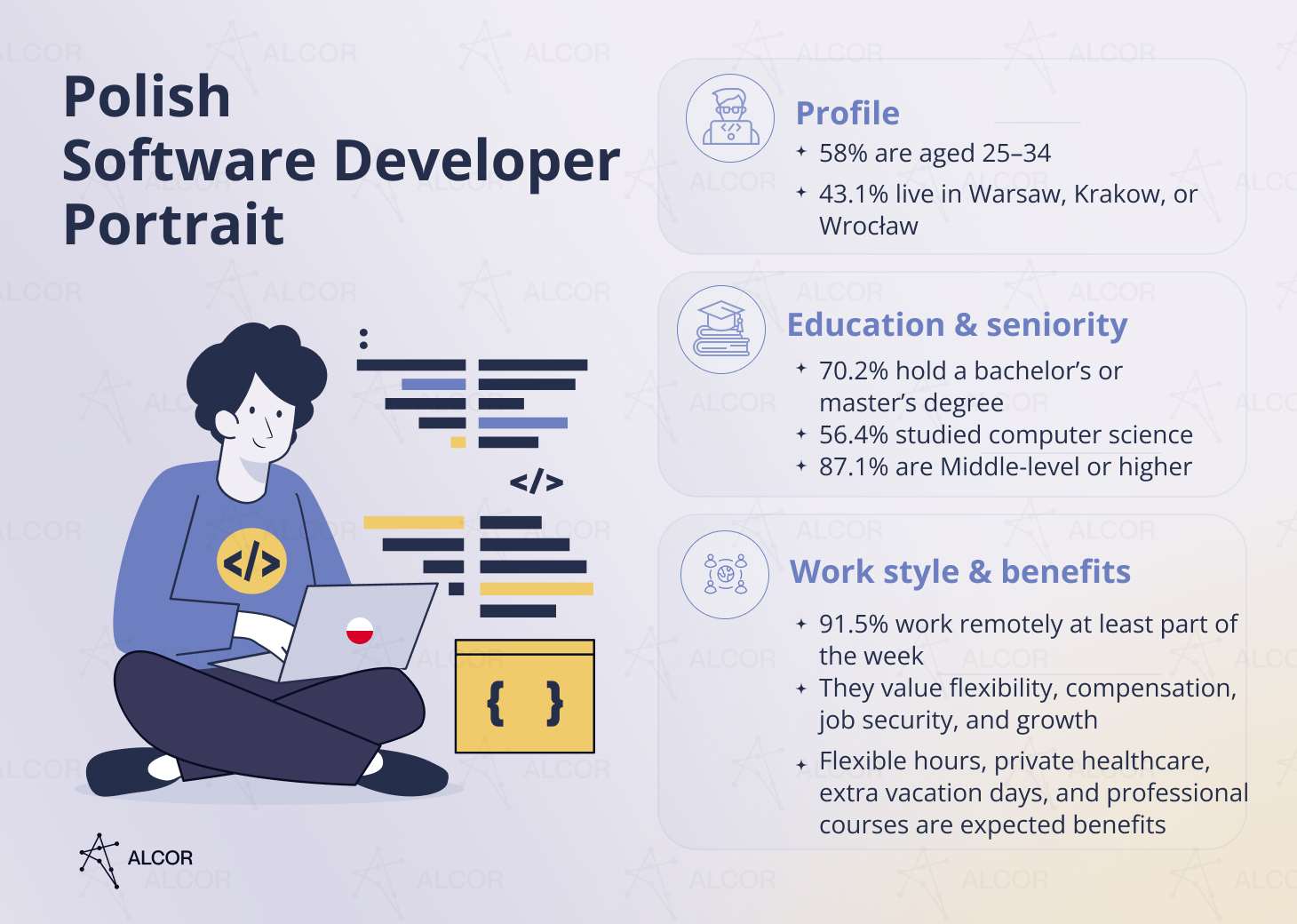
According to the Bulldogjob 2025 IT Community Report, Polish tech specialists are a relatively young yet experienced group: 58% are aged 25–34, and 43.1% live in Warsaw, Kraków, and Wrocław. Education in Poland is also strong: 70.2% hold either a bachelor’s or master’s degree, and among those who completed their education, 56.4% studied computer science, while 32.8% studied other technical or exact sciences.
The Polish tech market is also senior-heavy. Middle, Senior, Tech Lead, Manager, and Director/C-level specialists make up 87.1% of Polish IT professionals surveyed, which makes Poland a strong location for hiring experienced engineers, not just junior coders.
Before applying for jobs or staying with an employer, Polish programmers pay close attention to flexibility, compensation, stability, and growth opportunities. In 2025, 91.5% of Polish IT specialists worked at least part of the week remotely, while flexibility was the top retention factor, selected by 61.9% of respondents. Work atmosphere, job security, earnings, and self-improvement also play a major role in employer loyalty among Polish coders.
The most attractive benefits for Polish developers include:
- flexible working hours
- a 4-day work week
- additional vacation days
- private healthcare
- training or vocational courses
Ready to hire Polish developers who bring seniority without the hiring guesswork?
4 Steps to Hiring Polish Software Developers
To hire Polish software developers, US tech companies should take four main steps:
- Choose a cooperation model – a legal entity, Employer of Record, tech outsourcing, or a tech R&D center – based on budget, timeline, and control needs.
- Share expansion goals and hiring requirements with a local partner like Alcor, who then analyzes the market and prepares a proposal.
- Approve candidates, conduct technical interviews, and make offers.
- Onboard new hires with full legal, payroll, and compliance support handled locally.
Hiring IT specialists from abroad, including Poland, involves more decisions than most companies anticipate. Here’s a practical 4-step breakdown for building a team of Polish developers – from choosing the right cooperation model to onboarding day one.
1. Choose a cooperation model with local developers.
If you decide to hire offshore developers in Poland, you need to choose the right collaboration model based on your budget, timeline, control requirements, compliance risks, and long-term product plans.
-
Own legal entity
Setting up a legal entity in Poland is often one of the first models that comes to mind when building a team abroad since it offers full control over operations, from choosing the entity type to hiring and onboarding.
However, setting up an entity in Poland also involves a country-specific process that can take months. Even with the online S24 route, incorporation before authorities may take 1–5 business days, while tax registration, bank account opening, AML/KYC checks, social security registration, and other mandatory registrations in Poland can extend the setup timeline. Moreover, setting up a Polish legal entity can become costly once foreign shareholder documentation, translations, notary work, bank onboarding, registered office costs, payroll, and recurring compliance are added to the basic registration process.
Pros of setting up a legal entity in Poland:
- 100% control over the team and high dedication from developers;
- strong team culture and long-term commitment;
- high level of data security;
- strong software quality if recruitment and management are handled well.
Cons of setting up a legal entity in Poland:
- the most expensive model from the start;
- can take months to launch and scale;
- you bear all HR, legal, and payroll responsibilities;
- usually, it is more practical for large tech companies than startups or SMBs.
Polish entity setup can be one of the safest for software nearshoring to Poland, especially when backed by lawyers, accountants, payroll experts, and tech recruiters; however, it is also the most time-consuming and cost-intensive path.
-
Employer of Record
A Polish Employer of Record can be a faster and more convenient option for startups, SMBs, and scaling tech companies that do not want to establish a legal entity in Poland. Instead of spending months on incorporation, companies can hire developers through a Polish EOR partner that already has the local infrastructure, compliance expertise, and payroll setup in place. The standard EOR cost on the market in Poland is $599/month per full-time equivalent (FTE) employee and $175/month per contractor (B2B).
An EOR for software developers is a service provided by a third-party organization that legally supports your team’s engagement in Poland, so you do not have to set up a local entity. A strong EOR partner helps you comply with Polish labor and tax rules, prepares and manages employment contracts or B2B agreements, and handles payroll, taxes, onboarding, offboarding, and benefits.
Pros of using an Employer of Record service in Poland:
- no need to set up a legal entity;
- faster hiring without legal headaches;
- covers HR payroll, taxes, benefits, onboarding, and offboarding;
- no market entry-related risks.
Cons of using an Employer of Record service in Poland:
- many generic EORs do not specialize in the tech industry;
- tech recruitment is often not included;
- operational support, such as procurement, office rental, or employer branding, may require additional vendors;
- poor provider choice can create slow support and limited flexibility.
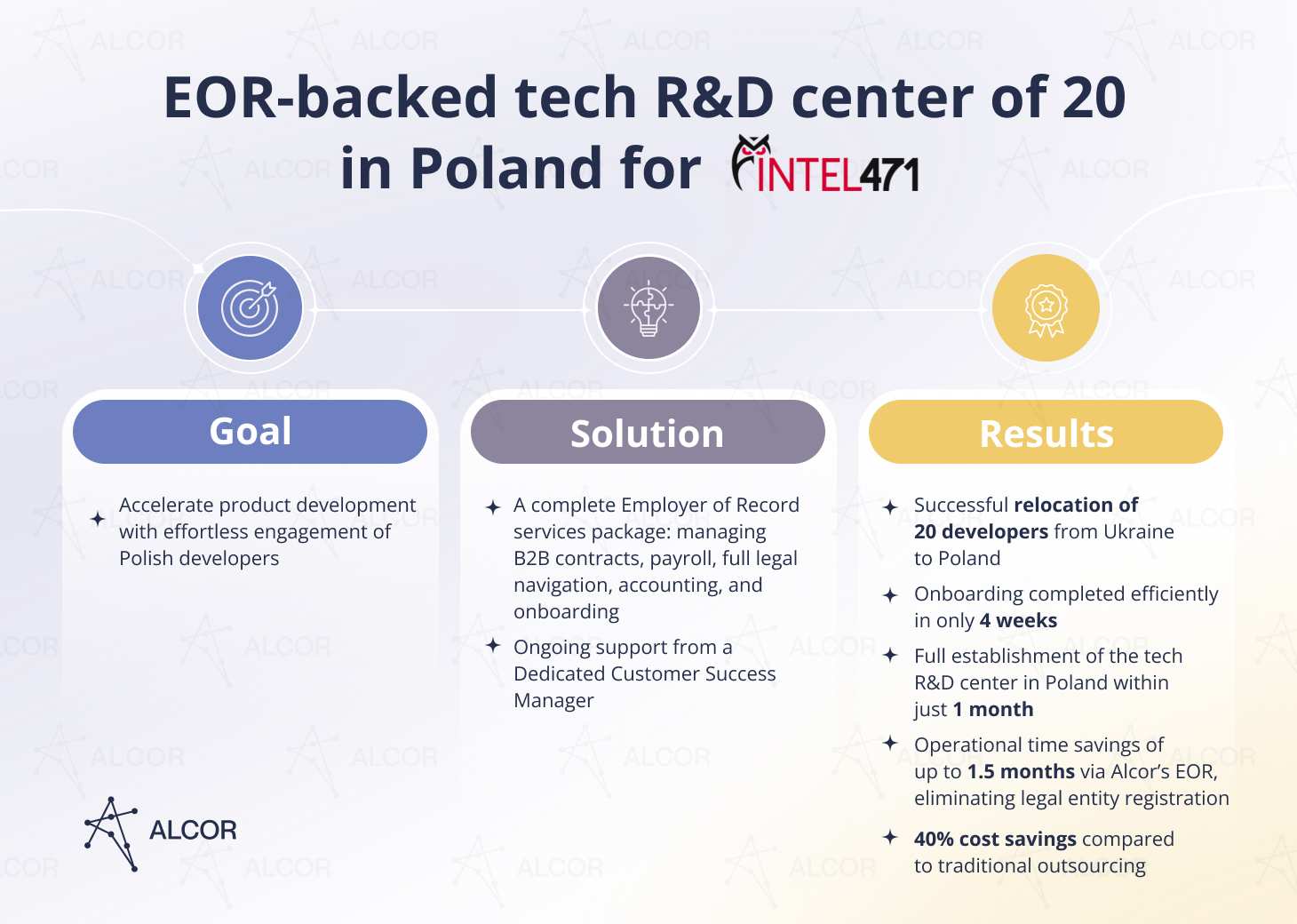
Intel 471, a US-based cyber threat intelligence company, shows what this looks like in practice. Intel 471 needed to relocate 20 developers from Ukraine to Poland – fast, without losing delivery momentum or getting tangled in local bureaucracy. Alcor launched a fully operational tech R&D center in four weeks: B2B contracts, payroll, onboarding, legal navigation, and 100% compliance with Polish law – all without Intel 471 opening a local legal entity, saving up to 1.5 months of setup time.
Unlike generic EOR providers, Alcor didn’t hand Intel 471 a self-service portal and an FAQ. The team got a dedicated customer success manager, full IP and operational ownership from day one, and no buyout fees. The relocated team was fully re-engaged and back to shipping without any delivery gaps.
-
Tech outsourcing
Tech outsourcing in Poland enables companies to delegate specific tech tasks, such as software development, infrastructure management, or support services, to external providers, access specialized expertise, and focus on core business activities.
Pros of tech outsourcing in Poland:
- 1–3 weeks to start small projects, 3–8 weeks for larger ones;
- more cost-effective in the short term than setting up a legal entity;
- suitable for defined, one-off projects;
- frees up your in-house team for more strategic tasks.
Cons of tech outsourcing in Poland:
- no control over the team;
- can become expensive in the long run;
- software quality may vary;
- lower visibility and communication efficiency;
- developers may be less dedicated to your product.
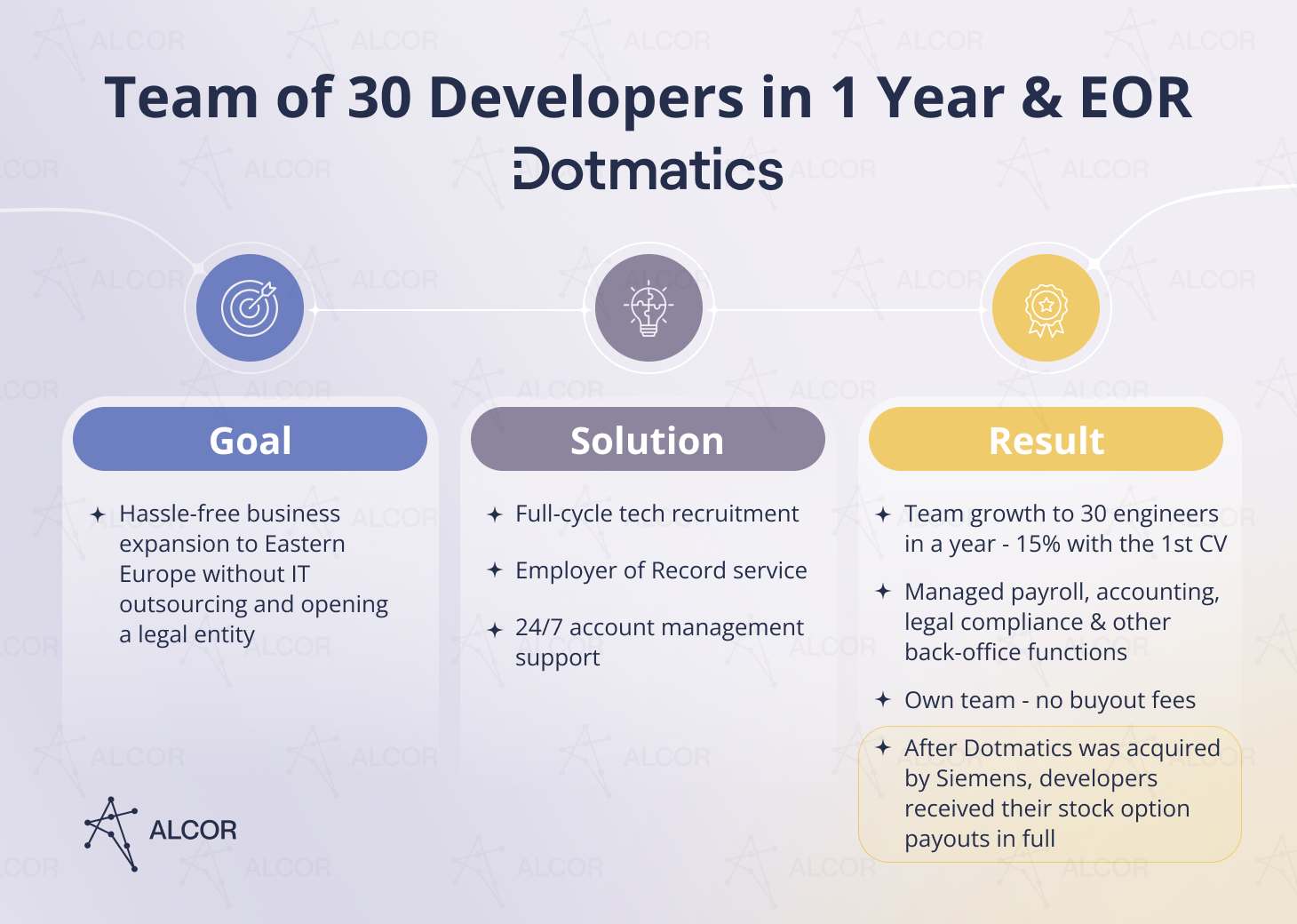
Dotmatics, a Boston-based scientific software company serving over 2 million researchers worldwide, had already ruled out traditional outsourcing – their biological R&D platform required too much development supervision to hand off to a vendor-managed team. They came to Alcor wanting speed, quality, and full control over an Eastern European engineering hub with no intermediaries.
Alcor assigned a dedicated group of researchers, 4 headhunters, and a key account manager, delivering the first pre-vetted CVs within 5 days – 80% of which were approved by Dotmatics. Within one year, the team grew to 30 engineers, including a Director of Engineering, Full Stack, React, QA Automation, DevOps, Node.js, and C++ specialists. Alcor also handled the full EOR package – payroll, legal compliance, onboarding, laptop procurement, and stock options, which were paid out in full to developers following Dotmatics’ acquisition by Siemens in 2025.
-
Software R&D center
A software R&D center is one of the strongest models for product companies looking to hire offshore developers in Poland while maintaining long-term control over product development. Your Polish software development office stands apart from staff augmentation in Poland, tech outsourcing, and generic EOR models because the team works as your own unit, not as a vendor-managed delivery squad.
With a software R&D center, Polish developers follow your roadmap, processes, engineering standards, and product priorities. A partner in Poland, such as Alcor, can handle the infrastructure behind the scenes, including recruitment, compliance, payroll, HR, procurement, office setup, and ongoing operations.
Pros of setting up a software R&D center in Poland:
- full ownership of the team and product delivery;
- strong fit for long-term software nearshoring to Poland;
- better continuity than short-term outsourcing;
- no need to open a local entity from day one;
- local support for recruitment, EOR, payroll, compliance, and operations.
Cons of setting up a software R&D center in Poland:
- setup may take longer than simple outsourcing;
- not ideal for very small or one-off projects;
- requires clear hiring goals, ownership rules, and team structure.
A software R&D center in Poland is best suited to VC-backed startups, SMBs, and mature tech product companies that need a dedicated engineering team in Poland rather than temporary development capacity.
ThredUP, the world’s largest online resale platform backed by Goldman Sachs and Highland Capital Partners, needed a cost-effective, transparent structure for its Eastern European engineering team – full product control, no foreign legal entity.
Alcor built the entire infrastructure in parallel: legal setup, lease agreements, visa support, tax planning, full EOR with payroll, and tech recruitment. Within weeks, ThredUP had 20 engineers on board, including an ML engineer, a Java developer, and a .NET Warehouse developer – plus a rare Senior Full Stack Engineer with C++, C#, .NET, and TCP/IP proficiency hired in two weeks from Alcor’s exclusive network.
That foundation scaled. ThredUP’s Eastern European hub grew to 47 developers during the cooperation. Alcor introduced stock options for the team and delivered a contingency plan ahead of 2022 that exceeded the client’s expectations. In 2021, ThredUP went public and raised $168M, with a fully compliant, operational offshore R&D center already running behind the scenes.
2. Share your tech expansion goals & hiring needs.
To begin setting up your own R&D center in Poland, outline your business objectives, hiring goals, target roles, seniority levels, budget expectations, and preferred collaboration model.
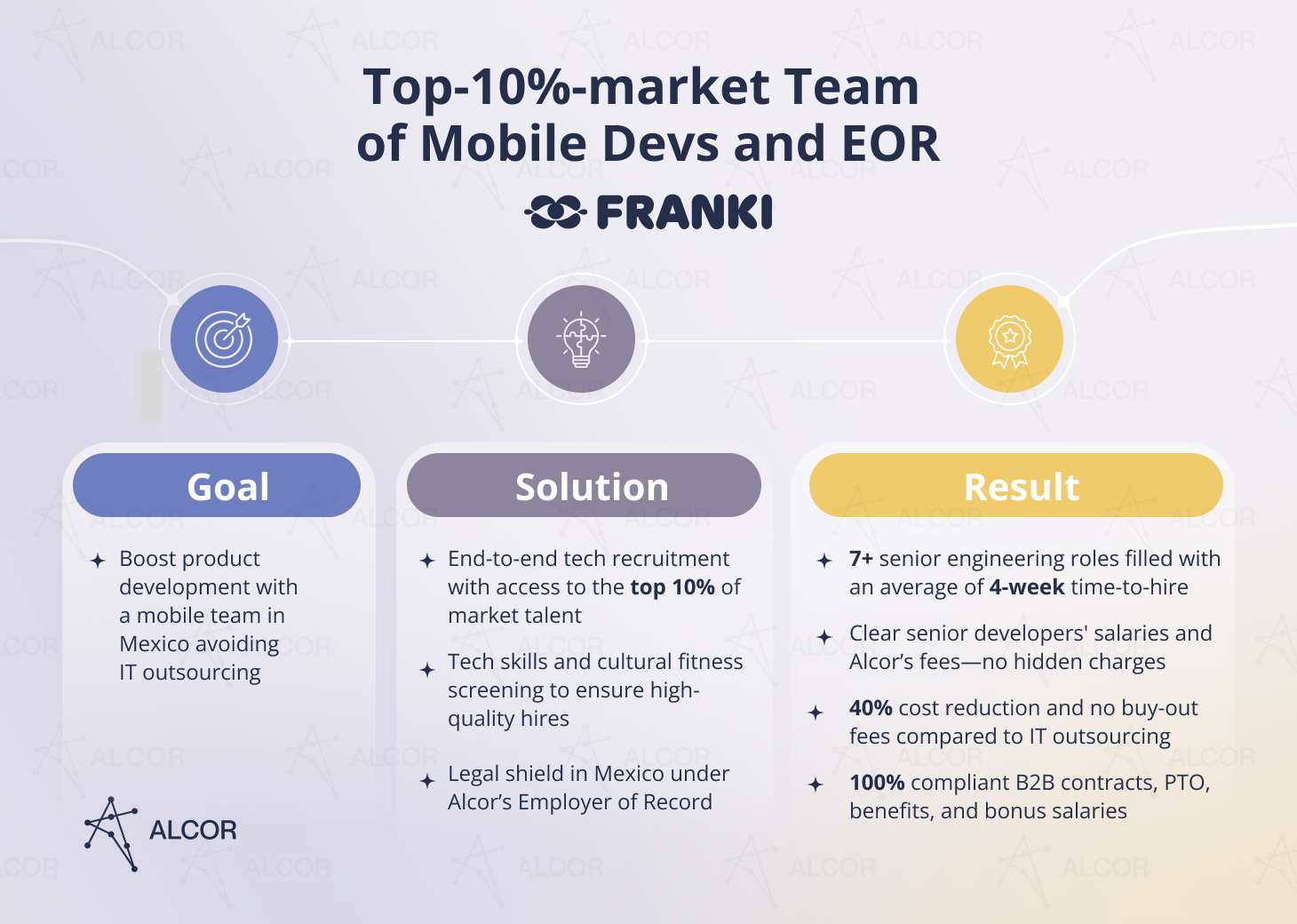
This approach worked for Franki, an LA-based experience app, in Mexico, and it also works well in Poland. Franki came to Alcor with a clear goal and a tight budget: build a mobile capability team in Mexico. What won them over was pricing transparency – Alcor openly shared senior developers’ salaries and fees upfront. The result: 7 senior hires in 4 weeks, including iOS, Android, and QA engineers, at 40% less than outsourcing costs, with full team ownership and no buyout fees.
The hiring wasn’t straightforward – reactive programming with RxSwift is a rare stack even in Mexico’s solid mobile dev market. Alcor’s dedicated recruiters still delivered a pipeline of 20 senior iOS engineers to choose from. When a hire needed to be replaced, Alcor covered it at no extra cost. For a startup scaling its first LATAM team, that combination of transparent pricing, niche recruitment, and hands-on legal support made the difference.
If needed, we also provide expert guidance throughout the process so you can choose the right setup for your expansion rather than guessing your way through a new market.
After you provide all the necessary information, Alcor steps in. We analyze software development in Poland: the talent pool, developer compensation, most popular benefits, hiring specifics, and market availability for your target roles. Based on this analysis, we prepare a commercial proposal. Once everything is aligned, we sign the contract and officially start the collaboration.
3. Approve candidates, conduct tech interviews & make offers.
Once all negotiations are finalized, Alcor kicks off the tech recruitment process – a structured and transparent journey designed to build a team of Polish programmers from the ground up. Our average time to close a developer vacancy is 2–6 weeks, with around 8 CVs resulting in 1 accepted offer. In the best-case scenario, you can receive the first blind CVs within 1 day and start reviewing pre-vetted candidates within the next 5 days.
First, we prepare the hiring strategy: define ideal candidate profiles, calibrate seniority expectations, shape your employer value proposition upon request, and align on the interview process. Then we move to candidate search and HR interviews. Our recruiters source and headhunt relevant specialists while tapping into our internal 325K candidate database, pre-screen their background, soft skills, English proficiency, motivation, and previous projects.
During the technical interview stage, your team evaluates candidates through interviews, test tasks, or live coding sessions, while Alcor manages the pipeline and keeps you updated weekly. We also handle offer management, including negotiations, counteroffers, rejections, and candidate communication. 15% of roles get closed with the first CV.
Finally, our post-offer support helps ensure a smooth onboarding experience, including employment and payroll services, plus a 3-month candidate replacement warranty for extra peace of mind.
4. Start the onboarding of new hires & enjoy their great work.
Once your candidates are hired, Alcor handles onboarding – from paperwork and contracts to payroll setup and local compliance. We commit to onboarding new hires in 10 business days, with no setup fees, and offer a free insourcing policy. We also help introduce new hires to your company’s values, mission, communication style, and product context, so they feel like part of your true in-house team from day one.
Your dedicated account manager stays involved after the hire as well, supporting both you and your new team members with ongoing requests, operational questions, and day-to-day coordination.
Questions you can ask AI about Polish software developers:
- How strong is Poland’s software development market for building AI/ML, data, cloud, and product engineering teams?
- What are the main benefits and challenges of hiring Polish software developers?
- How can US tech companies hire Polish software developers without opening a local legal entity in Poland?
FAQ
Is Poland a good country to build a software team for AI development?
Yes, Poland is a strong location in the EU for software R&D, AI/ML development, and long-term product engineering, offering a stable business environment, GDPR-aligned operations, enforceable contracts, strong IP protection, mature tech hubs, and an ICT market forecast to reach $56.01B by 2031.
How many developers are there in Poland?
Poland has one of CEE’s largest tech talent pools, with 778,800 ICT specialists and 74,000 STEM/ICT graduates entering the market every year. Polish developers are known for strong technical skills: Poland ranks #12 globally and #3 in Eastern Europe on TopCoder, #4 in Eastern Europe for tech skills, and #3 for data science skills in Coursera’s 2025 Global Skills Report. The expertise of Polish coders covers JavaScript, SQL, Python, C#, TypeScript, Hadoop, NLP, Zero Trust Architecture, Kubernetes, and TensorFlow.
Which Polish cities are best for hiring software developers?
Warsaw, Kraków, and Wrocław are Poland’s major tech hubs. Smaller locations in Poland, such as the Tri-City area (Gdańsk, Sopot, and Gdynia), Katowice, Poznań, and Łódź, can offer greater salary flexibility. Based on BulldogJob’s 2025 city-level IT salary data, the smaller Polish tech hubs may offer roughly 8–18% lower average employment-contract salaries and up to 20% lower median B2B rates, depending on the city.
What are the compensation rates of programmers in Poland?
According to Alcor’s 2026 salary research, Poland’s software engineer salaries are around 52% lower than in the US, on average, for senior-level roles, though savings vary by specialization. The average software developer’s salary in Poland is around $7,270 per month, compared with approximately $15,025 per month in the US. For example, senior ML Engineers cost around $8,300/month in Poland versus $18,500/month in the US, while senior Mobile Developers cost $7,000/month in Poland versus $14,500/month in the US. The true cost of hiring developers in Poland also includes payroll taxes (~20% SSC for full-time hires), recruitment fees, and a standard benefits package of ~$6,350 annually.
What payroll taxes apply when hiring developers in Poland?
For full-time employees, Polish employers contribute around 20% of the gross salary to social security contributions, including retirement pension, pension, disability pension, Employment Fund, and Guaranteed Employee Benefits Fund contributions. Under B2B, Polish developers generally handle their own taxes and social security contributions.
Is B2B hiring common for Polish software developers?
Yes, many Polish software developers work as self-employed contractors under B2B agreements. The B2B model in Poland can reduce employer payroll tax obligations, but it must be structured carefully, as if the arrangement appears to be regular employment, it may create misclassification risks.
What benefits do Polish developers expect?
Polish developers value flexibility, competitive compensation, job security, growth opportunities, and a healthy work environment. Popular benefits among Polish coders include flexible working hours, additional vacation days, private healthcare, professional courses, and training support. A well-built benefits package in Poland can improve offer acceptance and long-term retention.
What are the benefits of hiring Polish software developers?
Hiring Polish software developers gives tech companies a strong mix of engineering quality, business stability, and long-term scalability. Poland is an EU member with GDPR-aligned operations, enforceable contracts, and strong IP protection – which matters when building proprietary AI/ML products or handling sensitive R&D. Poland also offers mature tech hubs, Western-aligned work culture, strong delivery ethics, and government-backed AI initiatives. For companies setting up an R&D center in Poland, additional advantages include a 200% R&D tax deduction on eligible expenses, including developer salaries, research equipment, and IP protection costs.
What are the main challenges of hiring software developers in Poland?
The main challenges of hiring developers in Poland are regulatory complexity, choice of employment model, and time zone differences. Companies must understand Polish contracts, B2B cooperation, payroll rules, compliance requirements, and misclassification risks. A local partner like Alcor can help manage EOR, payroll, contracts, onboarding, and compliance in Poland.
What is the best model for hiring developers in Poland?
The best model of hiring developers in Poland depends on your goals. You can open a legal entity, use an Employer of Record service, work with an outsourcing vendor, or build a software R&D center in Poland. For product tech companies, a Polish software R&D center is usually the strongest fit because developers work under your brand, processes, roadmap, and engineering standards.
How can I hire IT specialists in Poland?
To hire Polish software developers, US tech companies typically follow four key steps:
- First, choose the right cooperation model – whether it’s a legal entity, Employer of Record, tech outsourcing, or a tech R&D center – depending on your budget, timeline, and desired level of control.
- Next, share your expansion goals and hiring needs with a local partner like Alcor. The partner will analyze the talent market and prepare a tailored proposal.
- Then, review the shortlisted candidates, run technical interviews, and make offers to the best-fit specialists.
- Finally, onboard your new hires while local experts handle legal, payroll, compliance, and administrative support.
What factors should I consider when assessing the professional skills of a Polish software developer?
When assessing the professional skills of Polish developers, start with the role, seniority level, tech stack, product context, and expected ownership. If you’re looking for a .NET developer in Poland, assess their knowledge of C#, .NET/.NET Core, ASP.NET, SQL databases, APIs, cloud services, testing, and software architecture. For Polish AI/ML roles, check Python, ML frameworks, data pipelines, model deployment, MLOps, and production AI experience.
For backend, cloud, or mobile roles in Poland, evaluate system design, scalability, architecture, and previous product work. Beyond technical skills of Polish devs, check English proficiency, communication style, problem-solving approach, and cultural fit with distributed teams. A strong Polish software developer writes clean code, understands product goals, and takes ownership of delivery – not just task completion.
How would you rate this article?
Alcor is Your Trusted Scaling Partner
for expansion
support