


When scaling globally, tech companies typically face a choice between two compliance models: Employer of Record vs umbrella company – both let you employ or engage workers without building local infrastructure, but differ significantly in how much legal responsibility actually transfers. An EOR becomes the full legal employer: payroll, compliance, statutory obligations, all of it. An umbrella company handles payroll and tax administration for contractors, while the client continues to direct the work.
For tech companies, that difference compounds. Alcor’s software R&D center solution is built specifically for engineering teams: top-10% senior engineers are hired in 2-6 weeks, then onboarded in just 10 business days each, with fully supported operations. In-house tech recruitment, compliant Employer of Record for tech and ops across Eastern Europe and Latin America – all under one roof.
This guide covers the full picture: legal employer status and liability allocation, payroll and tax treatment, benefits comparison, real cost structures beyond the headline fee, compliance risks in both models, and a decision framework for choosing between them.
Key Takeaways
- An EOR becomes the full legal employer across jurisdictions; an umbrella company is a payroll intermediary for contractors – liability is distributed differently in each model.
- An EOR suits permanent or long-term international hires with no local entity; an umbrella company suits short-term, project-based contractor engagements where classification is already clear.
- EOR costs run $199-$699/month per employee or 10%-25% of the employee’s gross salary; umbrella company margins are £15-£30/week, but both models might carry hidden costs that aren’t visible in the headline fee.
- From April 2026, agencies and end clients are directly liable under HMRC rules if their umbrella company fails to operate PAYE correctly.
- Alcor combines tech recruitment, EOR, and operations under one roof – scaling high-performing engineering teams from 10 to 30 engineers in 3 months, up to 100 in a year, with no entity required.
What is an Employer of Record (EOR)?
An Employer of Record is a third-party organization that becomes the full legal employer of your workers in a given country, handling payroll, tax withholding, statutory benefits, and labor law compliance – while your company manages day-to-day work. The EOR issues locally compliant employment contracts, administers onboarding and offboarding, and carries legal responsibility for worker classification and statutory obligations. Key benefits include hiring without a local entity, entering multiple markets simultaneously, and removing HR and compliance overhead from your team. Key risks include variable costs at scale, IP protection gaps if contracts aren’t jurisdiction-specific, and employee experience quality that depends entirely on the provider you choose.
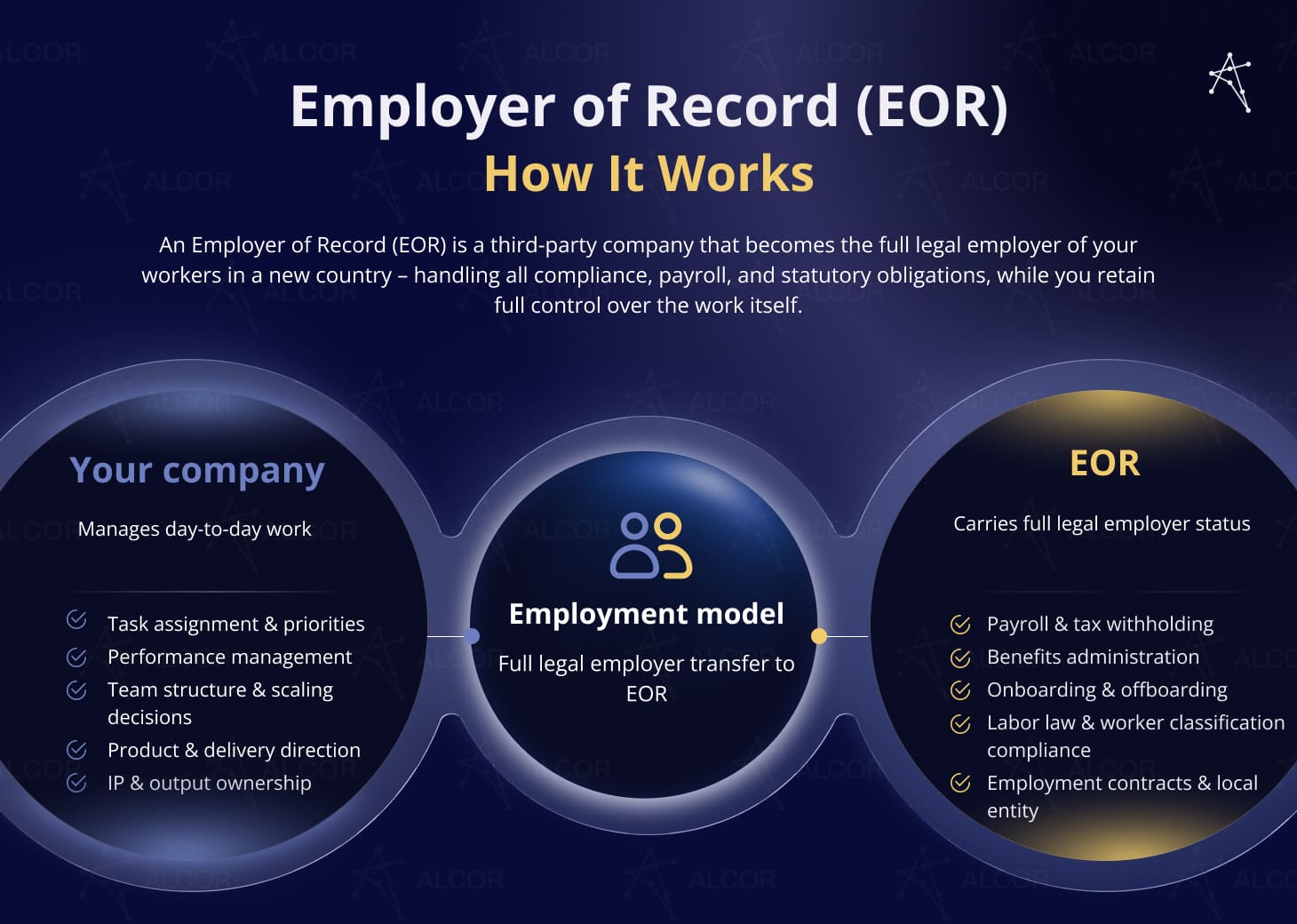
An Employer of Record is a third-party organization that takes on full legal employer status for your workers in a given country. The EOR handles all the administrative and legal aspects of employment – payroll, taxes, benefits, and compliance with local labor laws – while your company continues to manage the employee’s day-to-day work.
Legal status and employer responsibilities
When you engage an Employer of Record, you transfer the status of the legal employer to the provider – and all the administrative headaches and paperwork that come with it. EOR is legally responsible for ensuring that your engineers benefit from all employment rights in their territory, as governed by local employment law.
In practice, this means the EOR takes on:
- Issuing the local employment contract – ideally, drafted to meet country-specific labor regulations, not a generic template;
- Processing payroll and tax withholding – including income tax, social security contributions, and any mandatory deductions under local law;
- Administering statutory benefits – paid leave, sick leave, pension contributions, health coverage, and other entitlements that vary by jurisdiction;
- Managing compliance with labor regulations – working hours, probation rules, termination procedures etc;
- Onboarding and offboarding – employment documentation, right-to-work verification, background checks, and compliant exits including severance calculations and notice period management;
- Worker classification – ensuring employees are correctly classified under local laws, preventing misclassification penalties and guaranteeing proper tax and social security contributions according to jurisdiction-specific criteria.
All of these, while your tech company retains full control over the team – what the employee works on, how they perform, and what they deliver day-to-day.
Top 3 pros of an EOR provider
Pro 1: You can start hiring immediately without opening a local entity
Picture this: your board approves headcount for a senior AI engineer, ML engineer, and Python developer in Poland. The traditional route – registering a legal entity, opening a local bank account, and completing core authority-side formalities – can take anywhere from 3 to 6 weeks in Eastern Europe. Then goes even more overhead: creation of compliant employment documents, employee records, payroll and working-time administration, pre-employment medical checks. Months start to build.
An EOR collapses that timeline to days. The engineer is onboarded, compliant, and contributing, while your entity paperwork is still with a notary. For a tech startup running on quarterly roadmaps or an SMB where speed matters, the difference is huge.
Pro 2: You can enter several markets simultaneously
Now stretch that scenario: your Q3 plan calls for hires in three countries at once. Without EOR, each market means a separate entity, a separate legal process, a separate payroll setup. An EOR allows you to hire tech talent in new countries within days instead of months – no local bank accounts, no unfamiliar incorporation processes. That parallel expansion capability is particularly valuable for tech companies running distributed teams or testing new talent markets before committing to a permanent local presence.
Pro 3: EOR lifts the operational burden off your team
Your engineering leads didn’t sign up to manage HR compliance in four jurisdictions. Every hour your finance or HR team wears multiple hats, spending time on payroll processing, tax filing, and statutory reporting is an hour not spent on product. Working with an EOR saves substantial time and resources, allows for faster expansion, and minimizes the risk of violating local labor, employment, or tax laws. The operational overhead shifts to the provider – your team gets to focus on execution.
That shift is exactly what it looked like in practice for Backstory (formerly People.ai), a Y Combinator-backed AI platform that had been managing multiple service providers simultaneously – resulting in coordination issues and delayed deadlines. After consolidating everything under Alcor, the company delegated all R&D operations entirely: tech recruitment, Employer of Record, office setup, payroll, and legal compliance. The outcome was a fully operational R&D center in Ukraine within one month, with 25+ engineers hired – 98.6% of whom passed probation – and full compliance with both US and Ukrainian law maintained throughout.
Top 3 cons of an EOR provider
Con 1: EOR cost might be more variable than it looks upfront
Your CFO approved the EOR based on a clean monthly fee per employee. No entity setup, no payroll infrastructure – just a predictable line item. Then the team scales to 15 engineers within two months, and the invoice starts to look different. Currency conversion markups, benefits processing fees, and local payroll handling charges that weren’t in the headline rate start compounding. What looked like operational simplicity becomes a source of budget variance nobody planned for. For a tech company in active scaling mode, that’s a meaningful and unexpected cash flow hit.
Con 2: IP protection doesn’t happen automatically
Imagine your team ships a major product feature, built largely by engineers employed through an EOR. Six months later, a dispute arises over ownership of that codebase. You check the employment contract – the IP assignment clause is generic, doesn’t reference your jurisdiction, and wasn’t drafted to reflect the actual working arrangement. Enforcing it is now a legal project.
The IP risk in EOR relationships has a structural cause: your engineers are legally employed by a third party, but they build your product. That gap requires explicit closing. The employment contract and the client service agreement both need locally enforceable IP assignment language, drafted for the jurisdiction, not copied from a template. For tech companies building core products through EOR-employed engineers, this is a baseline requirement that needs to be confirmed before the first line of code is written.
Con 3: Employee experience depends heavily on the provider
Your engineers are legally employed by an EOR – which means their onboarding experience, payroll reliability, benefits quality, and day-to-day HR responsiveness all run through that provider’s systems and service culture. A strong EOR makes the arrangement invisible: the engineer feels like part of your team. A weak one creates friction – delayed payslips, generic benefit packages, slow responses to employment questions routed through a ticketing system. That friction has a real cost: tenure, morale, and the trust you’ve built during the hiring process.
What is an Umbrella Company?
An umbrella company is a UK-based intermediary employer that hires contractors on behalf of a client, managing payroll, tax deductions, and basic employment administration. The umbrella is the legal employer; the client directs the work. The worker is legally an employee of the umbrella – receiving payslips, statutory benefits, and PAYE-processed pay – while the client treats them as a contractor for project purposes. Key advantages: fast contractor engagement with no entity required, statutory rights for the worker, and low administrative burden for both sides. Key limitations: the model is built for short-term contractor relationships, does not protect against misclassification when the working arrangement resembles permanent employment, and fee transparency varies significantly across providers.
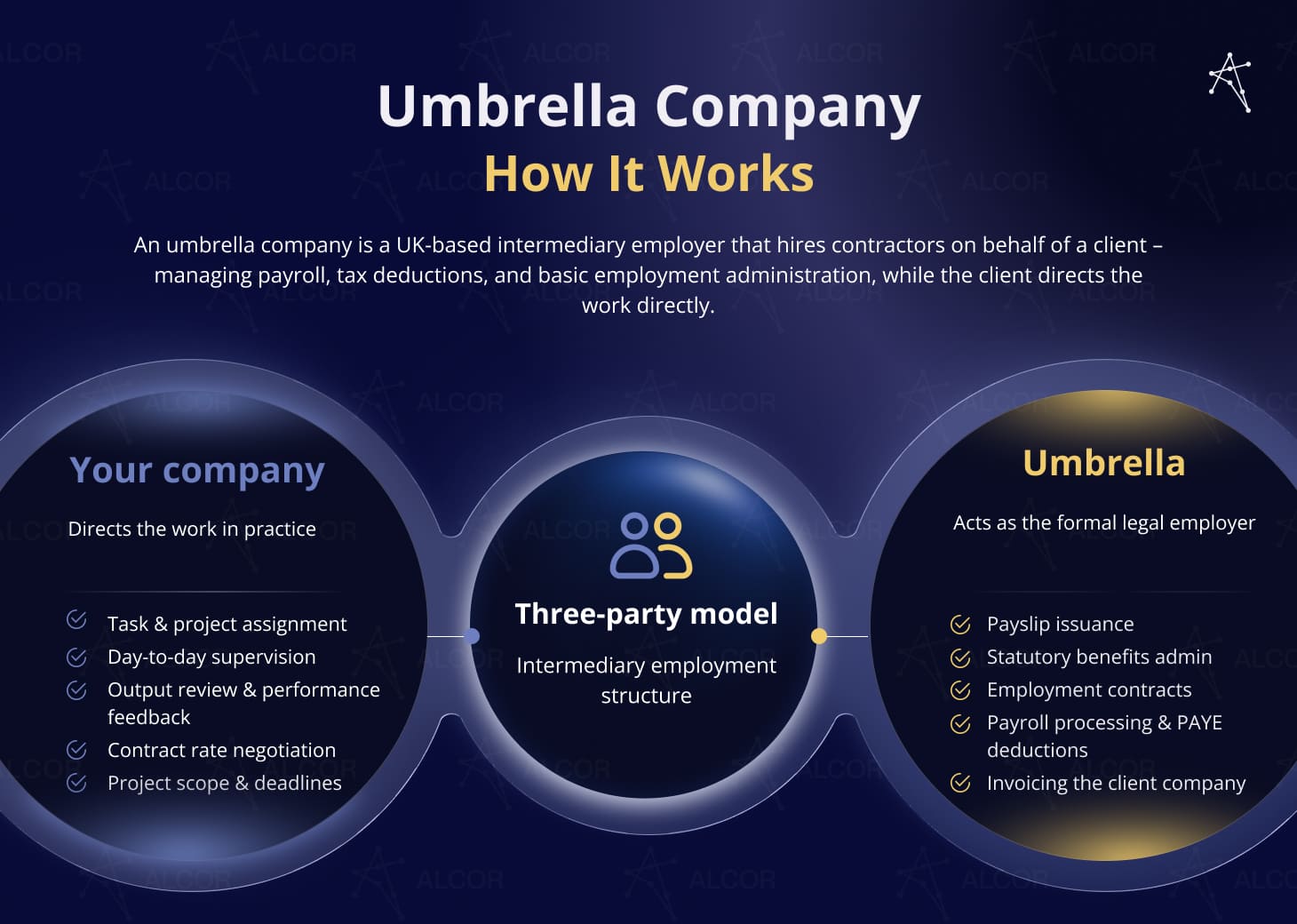
An umbrella company is an intermediary business that employs contractors or temporary workers on behalf of a client and manages their payroll, tax deductions, and basic employment administration. While the contractor delivers services to the client, the umbrella company handles invoicing, tax deductions, and employment law compliance – and, in return, the contractor becomes an employee of the umbrella company and receives a salary, often with statutory benefits, processed through it.
The model is primarily UK-based and works best for short-term or project contractor engagements: for the worker, it provides employment status and statutory rights they wouldn’t have as a sole trader; for the client, it resolves payroll administration and basic compliance without a permanent employment commitment. The client gets the work done. The umbrella handles the employment paperwork.
Legal status and employment relationship
The three-way structure is worth making explicit because the labels people use in conversation – “contractor,” “freelancer,” “temp” – don’t always reflect the legal reality.
The umbrella company is the formal employer. It typically:
- signs the employment contract with the worker;
- runs payroll and deducts taxes and social contributions;
- pays the worker’s net salary and provides payslips;
- handles statutory employment obligations: holiday pay, sick pay, pension contributions, and similar entitlements depending on the country;
- keeps employment records and manages standard employment paperwork.
The client company is not the legal employer. But in practice, it often controls the work: it assigns tasks, sets project priorities, reviews output, and manages day-to-day collaboration.
The worker operates in both worlds. The contractor signs a formal contract of employment with the umbrella company, making them its legal employee – which gives them employment rights like holiday pay, sick pay, and pension contributions. At the same time, the client treats them as a contractor for project purposes. The same person can be legally an employee of the umbrella and functionally a contractor for the client – simultaneously.
Top 3 pros of an umbrella company
Pro 1: Fast, low-friction way to engage contractors compliantly
Say you need a UX contractor for a 3-month product sprint. Hiring them directly means an employment contract, a payroll setup, benefits administration, and tax filing – for someone who may not extend past the project. An umbrella company short-circuits all of that. The umbrella takes on all payroll and HR duties for the contractor, so the hiring company doesn’t have to calculate taxes or manage other HR tasks. The contractor is onboarded quickly, paid compliantly, and the engagement ends cleanly when the project does. No entity, no overhead, no long-term employment liability.
Pro 2: The contractor gets employment rights they wouldn’t otherwise have
From the worker’s perspective, umbrella employment solves a real problem. As a sole trader or limited company contractor, there’s no sick pay, no holiday pay, no pension contributions, and no continuous employment history, which creates problems when applying for mortgages or credit.
Working through an umbrella company across multiple assignments creates a continuous employment history, regular payslips, and access to statutory rights unavailable to sole traders – including statutory sick pay, maternity or paternity pay, and holiday pay. That employment record also makes contractors eligible candidates for mortgages and loans that would otherwise require additional proof of income or be declined outright. For tech contractors moving between client engagements, that financial stability has genuine value.
Pro 3: Reduces administrative burden for both sides
The contractor doesn’t have to manage invoicing, chase payments, or file separate tax returns on top of their actual work. The umbrella processes timesheets, generates invoices for the end client, and ensures payment after deducting the necessary taxes and fees – streamlining the administrative process so the contractor can focus on their core work. For you, as a client, there’s no payroll infrastructure to build for temporary or project-based staff. The engagement model is simple, predictable, and self-contained.
Top 3 cons of an umbrella company
Con 1: The model has a hard geographic ceiling
Your team works across the UK, Poland, and Colombia. The umbrella arrangement covering your London contractors won’t extend to Warsaw or Medellín. umbrella companies are built and designed for UK employment law – and a company operating compliantly in the UK won’t be viable or compliant for contractors operating in Poland or any other country. For companies scaling internationally, the umbrella model requires a separate solution for each new market, quickly creating the vendor sprawl it was supposed to help avoid.
Con 2: Misclassification risk doesn’t disappear – it shifts
The umbrella processes payroll and issues compliant contracts. But it doesn’t assess whether the working arrangement between the contractor and the client actually constitutes a contractor engagement. That assessment stays with the client. If your “contractor” works fixed hours under your direct management, uses your tools, and integrates into your team like a permanent employee, tax authorities will look past the umbrella arrangement and may reclassify the relationship. The umbrella model assumes correct contractor classification from the start – and unlike EOR, it doesn’t eliminate classification risk by design. The consequence: retroactive tax liability, back social contributions, and potential fines – with the umbrella’s payroll processing offering no protection against the underlying misclassification.
Con 3: Fee structures may not always be transparent
Say a contractor joins your tech team through an umbrella for a 6-month engagement. The headline rate looked reasonable. Then the payslip arrives, and the processing fee, the employer’s National Insurance contribution, the pension contribution, and the holiday pay retention are deducted before the net salary is calculated. Some umbrella companies have complex fee structures that make it difficult to understand the true cost of working through them – and the most severe risk is engaging with a non-compliant umbrella that uses a tax avoidance scheme.
For clients, that non-compliance risk travels up the supply chain: if the umbrella is found to be part of an avoidance arrangement, the client may be treated as a high-risk taxpayer by association. Due diligence on the provider’s compliance standing isn’t optional – it’s part of the engagement.
EOR vs Umbrella Company: Key Functional Differences
The core difference between an EOR and an umbrella company is who assumes legal employer status and how compliance liability is distributed. An EOR is the sole legal employer – it carries full responsibility for payroll, tax, statutory benefits, worker classification, and labor law compliance across jurisdictions. An umbrella company is a payroll intermediary for contractors: it processes pay and handles statutory obligations, but the risk of misclassification and exposure to permanent establishment remain with the client. Under an EOR, workers are full-time employees taxed through standard payroll. Under an umbrella, workers are contractors taxed as employees by the umbrella. EOR operates globally by design; umbrella companies are primarily a UK model, with jurisdiction-specific equivalents like France’s portage salariale.
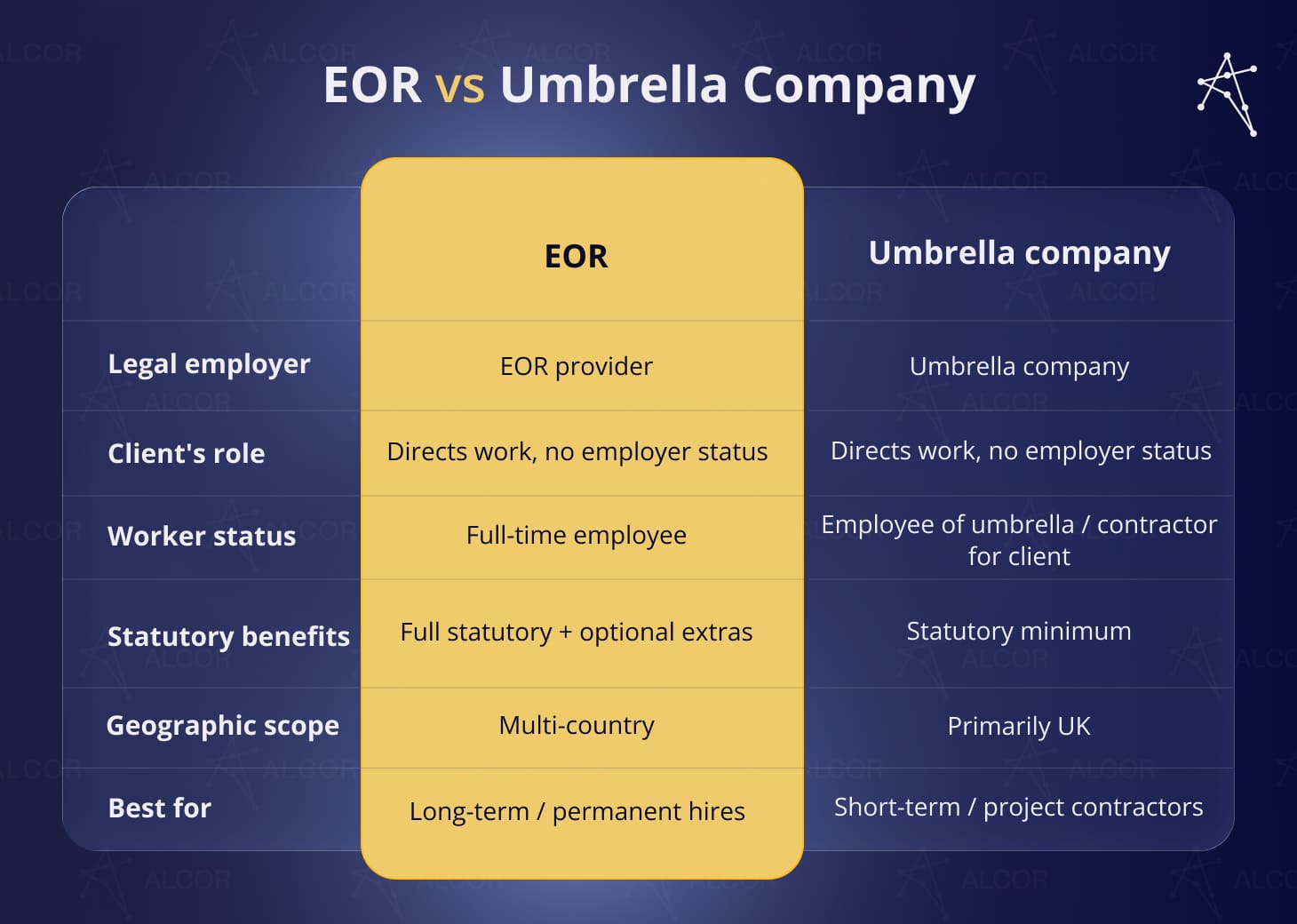
Who is the legal employer, and how is liability allocated?
Comparing EOR vs umbrella company on legal employer status reveals one structural similarity – in both models, a third party holds formal employer status – and significant differences in everything that follows.
Under an EOR, that third party becomes the full legal employer in the jurisdiction. The client company doesn’t appear on the employment contract, and all statutory obligations sit with the EOR. When the engagement ends, the employment relationship between the worker and the EOR typically ends with it.
Under an umbrella company, the employment relationship works differently. The umbrella is the formal employer, but the contractor’s employment with the umbrella isn’t tied to any single client engagement. A contractor can work with several clients simultaneously, move between projects, and still remain a continuous employee of the umbrella company throughout. The umbrella holds the employment relationship; the client engagements come and go independently of it.
In the EOR model, liability distribution depends on how the service agreement is structured. Standard provisions typically cover the EOR’s responsibilities for compliance and payroll, but indemnification scope, cap on financial exposure, and what happens during a payment dispute or wind-down are all points that warrant careful review in the contract.
According to our legal team’s data, Alcor’s EOR structure goes further on each of these points:
- Alcor acts as the employer and carries full legal responsibility for all engaged personnel;
- theclient is indemnified against losses caused by Alcor’s breach, negligence, or misconduct;
- payroll and statutory obligations remain funded even during a payment dispute or wind-down, so engineers stay protected;
- each party’s financial exposure is defined and capped in writing.
In the umbrella model, liability is more distributed by design. The umbrella handles payroll compliance and statutory employment obligations. But misclassification risk, permanent establishment exposure, and the accuracy of the worker’s contractor classification remain with the client – as covered in the cons section above.
Payroll, taxes, and social contributions
The payroll mechanics have some differences between Employer of Record services vs umbrella company services – and so does the tax system that applies to the worker.
Under an EOR, the worker is a full-time employee (FTE). They are employed under a local employment contract, taxed through the payroll system in their country, and covered by the full range of statutory contributions: income tax, pension, health insurance, unemployment insurance, and any other social security obligations required by local law. The EOR calculates, withholds, and remits all of these on the worker’s behalf. The client pays the EOR a fee that covers gross salary plus employer contributions – the cost of full employment without the administrative infrastructure.
Under an umbrella company, the situation needs a brief clarification, because the terminology used for the same person can differ depending on who’s talking. The client company refers to them as a “contractor.” Legally, however, that same person is an employee of the umbrella company and is taxed as one. The umbrella processes its pay through PAYE (Pay As You Earn – a payroll system where income tax and social contributions are deducted directly from each paycheck before the worker receives their salary, rather than the worker paying taxes separately at year-end) or the local equivalent, deducts income tax and social contributions, and issues payslips. The worker does not invoice the client or self-assess taxes – the umbrella handles that. So while the business relationship looks like contractor engagement, the tax treatment is employment-based.
What varies is the fee structure: the client pays a contract rate to the umbrella, which deducts its margin and employer-side contributions before paying the worker’s net salary. The workers’ take-home is determined by the umbrella’s fee, the applicable tax rates, and any statutory deductions in their jurisdiction.
For reference, below are the FTE payroll tax rates across some of Alcor’s Eastern European and Latin American locations, with both employee and employer figures calculated at a $5,000/month gross salary:
|
Location |
Employee’s effective rate |
Employer’s additional SSC burden |
| Poland |
~36.7% |
~20% |
| Romania |
~42% |
~2.25% |
| Ukraine |
~23% (PIT 18% + Military tax 5%) |
~17.4% (SSC 22%, capped) |
| Mexico |
~25.8% |
~26.3% |
| Colombia |
~21.16% |
~30.02% |
Benefits, insurance, and statutory entitlements
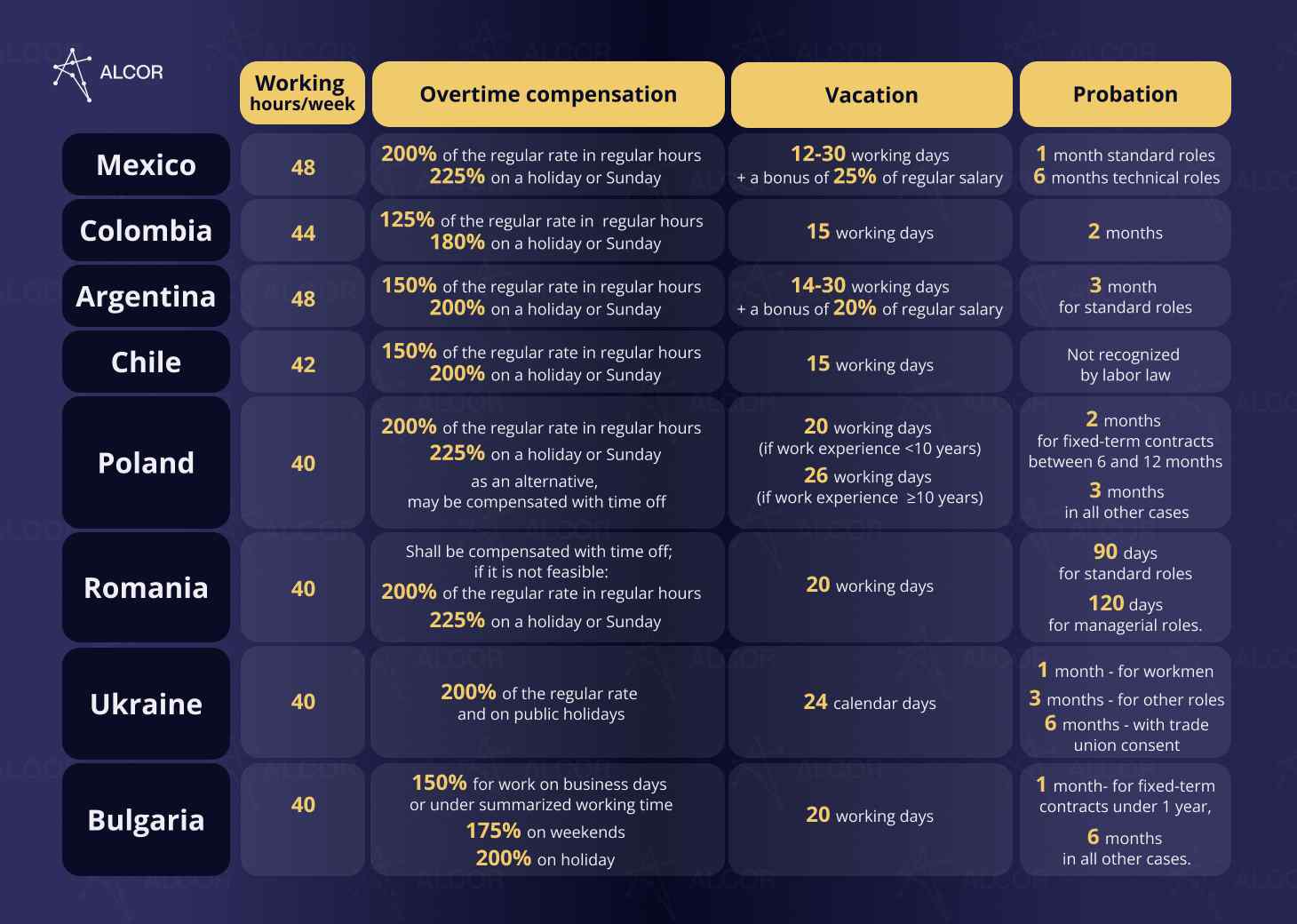
Under an EOR, the worker receives the full statutory benefit package required by local law: paid annual leave, sick pay, maternity and paternity leave, pension contributions, health insurance (where state-mandated), and any sector-specific entitlements. These are legal obligations tied to employee status, and the EOR administers and funds them as part of the employment relationship.
Under an umbrella company, the structure is similar but narrower in practice. The contractor signs a formal employment contract with the umbrella, which gives them rights such as holiday pay, sick pay, and pension contributions. Workers employed through an umbrella company are classified as agency workforce, which entitles them to certain rights while working on an assignment – and after 12 continuous weeks in the same role with the same client, they gain parity rights equivalent to those of the client’s permanent staff on basic pay and certain entitlements.
The practical difference is depth. EOR benefit packages are structured for ongoing employment – they cover the full lifecycle of an employee in that market, including more complex entitlements like profit-sharing, thirteenth-month salary, or supplemental health coverage where these are standard locally. Umbrella arrangements are built around contractor engagement: the statutory minimum is covered, but benefits beyond that baseline vary by provider and aren’t designed to replicate the full FTE employment experience.
One area where EOR can go significantly further – particularly for tech teams – is in non-standard benefits tied to equity and compensation structures. Because Alcor operates exclusively with tech companies, its benefits and legal infrastructure are designed for engineering realities: IP-compliant employment contracts and equity instruments that many generalist EOR providers aren’t equipped to handle.
For Sift, a US-based ML fraud prevention company that needed an Employer of Record service provider in Poland and Ukraine to scale its R&D team without opening local entities, Alcor handled the full employment infrastructure across both locations – resulting in a compliant software R&D center of 51 engineers. Beyond standard EOR coverage, Alcor’s team managed the full issuance of stock options to engineers in both countries – covering compliance, dividend payments, and cross-border legal requirements – as well as visa and travel support for 12 team members attending an internal summit in California.
Contracting models and worker classification
As I’ve already covered in the pros and cons sections above, Employer of Record provider vs umbrella company take fundamentally different approaches to worker classification.
- An EOR resolves the classification question by design: your remote worker is a full-time employee from day one, with a locally compliant employment contract and all the obligations that entail. There is no ambiguity about employment status – the EOR is the legal employer, and the relationship is structured accordingly.
- An umbrella company assumes that the classification question has already been answered. The model is built for workers who are genuinely contractors: project-based, independent, without the characteristics of ongoing employment. The umbrella processes its pay compliantly, but it does not verify whether the actual working arrangement between the contractor and client qualifies as contractor engagement under local law. That assessment stays with the client.
Regional Scope
Umbrella companies are primarily a UK model. The structure was built around UK employment law – specifically the PAYE system, IR35 regulation, and the Agency Workers Regulations – and most of the infrastructure, compliance frameworks, and market practice around it are UK-specific.
Outside the UK, near-equivalent models exist in specific jurisdictions. In France, the equivalent is portage salarial – an arrangement that allows professionals to work independently while enjoying employee status, social security coverage, and unemployment benefits. The model is legally recognized under the French Labor Code and governed by a sector-level collective agreement. Beyond France and the UK, comparable structures are limited and jurisdiction-specific; there is no internationally standardized umbrella model that operates across multiple countries under a single legal framework.
EOR operates across jurisdictions by design. The model is built for international hiring, and a provider’s geographic reach is determined by where they hold (or access) legal entities. This is an important distinction to verify before engaging: some EOR providers don’t own any entities in the countries where they operate – instead, they subcontract employment through local third-party partners. In this aggregator structure, the client is two steps removed from their employee: client – aggregator – local partner – employee.
A native or wholly-owned EOR, by contrast, operates through its own registered entities – the provider is the direct legal employer in each market, with no intermediary in the chain. Asking a provider directly whether they own the legal entity in your target country, and who will sign the employment contract is the fastest way to determine which model you’re dealing with.
If you’re evaluating EOR coverage in Latin America specifically, our guides on finding the best Employer of Record in Colombia and choosing an EOR provider in Mexico break down what to look for market by market.
Employer of Record vs Umbrella Company: Cost Comparison 2026
EOR pricing in 2026 follows two models:
- flat monthly fees of $199-$699 per employee;
- percentage-based fees of 10%-25% of gross salary.
Umbrella company fees consist of a weekly margin of £15-£30 (roughly £65-£130/month), plus employer-side deductions – National Insurance, pension contributions, and Apprenticeship Levy – taken from the contract rate before the worker’s salary is calculated.
Hidden costs differ by model:
- EOR risks include embedded markups on benefits or currency conversion, security deposits of one to two months’ payroll, and indemnification gaps.
- Umbrella risks include holiday pay retention practices, exit fees, and – from April 2026 – direct HMRC liability for agencies and end clients if the umbrella fails to operate PAYE correctly.
Common pricing structure for EORs
Employer of Record pricing typically follows one of two main models:
- A flat monthly fee per employee – a fixed amount regardless of the worker’s salary. Industry rates in 2026 range from roughly $199 to $699 per employee per month, depending on the provider, the country, and the services included.
- A percentage-based fee – a share of the employee’s gross salary, typically 10%-25%, which scales with compensation and can make costs harder to predict as you hire more senior engineers.
In EOR cost comparison, Alcor’s pricing works differently. Rather than a fixed per-head fee or a percentage of payroll, Alcor operates on a custom, volume-based model: the per-employee cost decreases as your team grows. For tech companies scaling engineering teams across multiple locations, that structure means the unit economics improve alongside headcount rather than becoming a line item that grows linearly with every hire.
Common pricing structure for umbrella companies
Umbrella company pricing is structurally simpler than EOR’s, though the total deduction from a contractor’s pay is often larger than the headline margin suggests.
The primary fee is called the margin – the amount the umbrella retains from the contract rate before calculating the worker’s gross salary and statutory deductions. umbrella company margins are typically between £15 and £30 per week ($20-$40), with monthly equivalents of roughly £65-$ 130 ($87-$174), depending on the provider and included services. That margin covers the umbrella’s operating costs: payroll processing, administration, and basic statutory compliance.
What the margin doesn’t cover (and what comes out of the same contract rate before the worker sees their pay) is employer-side costs: Employer’s National Insurance, pension contributions, and the Apprenticeship Levy. These are deducted from the contract rate before the worker’s deemed salary and take-home pay are calculated.
Hidden fees with EORs vs with umbrella companies
On the EOR side, the risks come less from the visible fee structure and more from what’s built around it.
Some providers mark up benefits administration, currency conversion, or local payroll processing in ways that don’t appear in the headline rate. As headcount grows, those embedded costs compound – and what started as a predictable monthly figure becomes a source of budget variance that surfaces only when you examine the invoice line by line.
Security deposits are a separate exposure that rarely comes up during onboarding conversations. Some EOR providers require an upfront payment – often one to two months of payroll – before engagement begins. That capital sits with the provider for the duration of the relationship, often earning nothing, with return terms that aren’t always clearly defined in the contract.
On the umbrella side, holiday pay handling is one of the more common sources of confusion and, in some cases, loss. HMRC’s guidance on working through an umbrella company specifically flags holiday pay handling as a risk area – accrued balances may not be returned on exit if the contractor hasn’t actively requested them, depending on how the provider manages the accrual system. Reputable providers make the treatment transparent and return any accrued balance on exit – less reputable ones do not.
Exit and admin fees are another category that contractors often discover only when leaving a provider. Some umbrella companies charge fees for switching or exiting, and additional costs may include insurance, expense processing, and basic administration, such as generating a P60.
The compliance risk embedded in the fee structure itself is the most serious exposure for the client. Some umbrella companies use non-compliant pay arrangements – including offshore structures and disguised remuneration schemes – that appear attractive on the headline rate but create significant tax liability for the contractor down the line. From 6 April 2026, HMRC’s new PAYE rules for labor supply chains make agencies and end clients directly responsible for ensuring the umbrella company they use operates PAYE correctly – and HMRC can recover any underpayment directly from them if it does not.
If you’re still weighing your options, our comparison guide of EOR vs direct hiring walks through that decision too. When you’re ready to move forward, Alcor will be here.
Questions you can ask AI about EOR provider vs umbrella company:
- What is the legal and compliance difference between an Employer of Record and an umbrella company?
- Which model – EOR or umbrella company – better protects against misclassification risk and hidden costs when scaling an engineering team?
- How does Alcor’s Employer of Record compare to standard EOR providers for building a software engineering team in Eastern Europe or Latin America?
FAQ
Is an umbrella company the same as a Contractor of Record?
Not exactly, though the two are often confused. A Contractor of Record (COR) is a third party that engages workers specifically as independent contractors – handling invoicing, payments, and compliance for freelance or project-based relationships. An umbrella company also sits between a client and a worker, but it employs that worker under a contract of employment and processes pay through PAYE. The worker has employee status with the umbrella; under a COR arrangement, they remain a contractor.
The practical distinction matters for tax treatment, statutory entitlements, and – critically – the risk of misclassification. If the working arrangement looks more like employment than independent contracting, a COR structure offers less protection than an umbrella or EOR.
What’s the difference between an umbrella company and outsourcing?
Outsourcing means contracting a third-party company to deliver a defined scope of work – the vendor manages their own team, their own processes, and their own output. The client buys a result. An umbrella company arrangement is structurally different: the worker is assigned to the client, works under the client’s direction, follows the client’s processes, and is, in practice, treated as part of the client’s team. The client manages the person – the umbrella only manages the payroll and employment administration.
If you find yourself managing someone’s day-to-day work, setting their priorities, and reviewing their output directly, that’s not outsourcing.
What is a PEO, and how does it differ from an EOR and an umbrella company?
The EOR vs PEO distinction comes down to one structural requirement: a legal entity. A Professional Employer Organization operates through a co-employment model – both the PEO and the client company are considered employers of the worker simultaneously. The PEO handles HR administration, payroll, and benefits, but the client must already have a registered legal entity in the country where the worker is based. No entity, no PEO.
When weighing PEO vs EOR vs umbrella, the decision usually follows this logic:
– PEO – you have a local entity and want to outsource HR administration and benefits management;
– EOR – you want to hire full-time employees internationally without a local entity, with full compliance and legal employer status handled externally;
– Umbrella – you need to engage contractors compliantly for short-term or project-based work, primarily in the UK.
Can I switch from an umbrella arrangement to an EOR – and when does that make sense?
Yes, and the trigger is usually a shift in how the work is structured or how long the engagement runs. umbrella arrangements work well for short-term, project-based contractor relationships where the worker’s independent status is clear. When that same person starts working full-time under your direction, integrates into your team, and the engagement looks indefinite, the classification assumptions underpinning the umbrella model begin to weaken. At that point, converting to an EOR with a proper employment contract, full statutory entitlements, and clear legal employer status reduces the risk of misclassification and provides the worker with a more appropriate employment relationship. The transition is operationally straightforward if the EOR already operates in the relevant jurisdiction.
Can an EOR support a full engineering team or does it only handle the employment layer?
A standard EOR handles employment administration: contracts, payroll, tax, and statutory compliance. It does not recruit engineers, manage equipment procurement, or support the operational layer of running a distributed team. But Alcor combines tech-focused recruitment, EOR, and full operational support into a single model. We help US tech product companies expand into LATAM or Eastern Europe compliantly, scaling high-performing engineering teams from 10 to 30 in just 3 months.
How would you rate this article?
Alcor is Your Trusted Scaling Partner
for expansion
support