David GomezLead IT Recruiter in Latin America at Alcor, with 10+ years helping US tech companies scale engineering teams through senior-level recruitment. Up to 40% savings. 100 people a year. No entity required.
A senior software engineer’s salary in Mexico can deliver up to 51% salary savings versus the US – but is that advantage still safe from tariffs, rising wages, and FX shifts? For tech companies planning 2026–2027 hiring, that is the real question. Mexico still offers compelling engineering economics, but the headline salary alone won’t tell you what a senior developer actually costs to hire, employ, and retain.
That’s why in this article I’ll break down the software engineer salary in Mexico in USD by role and seniority, backed by fresh salary, tax, and benefits data, and explain why tech companies keep choosing Mexican programmers over hiring locally. You’ll also find the real total cost of hiring, current labor law and tariff updates, and a practical path to building a compliant engineering team in Mexico.
Mexico has 974,500 tech specialists and adds 174,476 STEM and ICT graduates annually. Its IT market may reach $37.28 billion by 2030 (Mordor Intelligence), while US time-zone overlap supports real-time collaboration.
The senior software engineer’s salary in Mexico ranges from $67,200 to $141,000, depending on specialization and seniority. Alcor’s 2026 data shows 51% salary savings compared with equivalent US roles.
A $5K monthly IT engineer’s salary in Mexico adds about 26.3% in FTE employer costs. Even after benefits and recruitment fees, total first-year engineering costs remain 49–67% below US benchmarks.
Salaries in software development in Mexico remain structurally lower because of benefits, taxes, purchasing power, and compensation models. US tariffs do not directly affect remote software hiring because they target physical imports, not digital services.
The average Mexican software developer is 36, typically degree-qualified, and prepared for international collaboration. Mexican engineers combine technical depth with teamwork and problem-solving, while valuing career growth, learning, competitive pay, and work-life balance.
Alcor builds your Mexican software R&D team of unicorn-grage senior engineers – each recruited in 2-6 weeks, onboarded in 10 business days, fully supported operationally. 40 % more affordable than vendor rates, full EOR compliance, transparent invoices, and zero buyout fees.
Why Tech Companies Choose to Hire Developers in Mexico?
Tech companies hire developers in Mexico for its large talent pool, strong education system, competitive salaries, and proximity to the US. Mexico has 974,500 tech specialists, while 174,476 STEM and ICT graduates enter the workforce annually. Its IT market is projected to reach $37.28 billion by 2030. Senior software engineers offer about 51% in savings compared to US rates, while overlapping time zones support smooth collaboration with North American teams.
Flourishing IT market
Mexico’s technology industry is projected to grow from $21.28 billion in 2025 to $37.28 billion by 2030 – an 11.87% CAGR that outpaces most traditional offshoring hubs, according to Mordor Intelligence. IT outsourcing alone accounts for a meaningful share of that growth, on track to reach $20.39 billion by 2033, per Grand View Research. Zoom out to the country’s broader ICT market – hardware, telecom, and services combined – and Mordor Intelligence puts it at $78.69 billion by the end of 2026 alone, climbing to $129.52 billion by 2031.
Mexico ranks 3rd for technology innovation in Latin America, according to the WIPO Global Innovation Index. Mexico City leads the country’s tech hubs with 649 startups, per StartupBlink, with Software & Data accounting for 36.1% of all startups. Nationally, the ecosystem now counts 1,434 active startups, per StartupBlink. Monterrey and Guadalajara round out the country’s top three tech hubs by startup count – and Guadalajara doubles as Mexico’s AI-hardware hub, with Foxconn now building one of the world’s largest Nvidia AI chip assembly plants there, according to SiiLA.
Big talent pool
Mexico’s talent pool now numbers 974,500 Mexican tech specialists, according to Alcor’s recruitment team research, – the largest in Latin America and one of the strongest reasons tech product companies build product teams there.
Developers in Mexico work across PHP, Java, C#, Python, and Ruby, giving companies a deep bench of skills for full-stack, back-end, and data-heavy roles alike. AI and machine learning skills are climbing fastest: according to Coursera’s 2025 Global Skills Report, GenAI enrollments in Mexico surged 356% year-over-year, with AI/ML skills posting the steepest growth of any category at 338% YoY.
Strong tech education
Mexico adds 174,476 STEM and ICT graduates to its workforce every year, according to Mexico’s Ministry of Economy. Twenty-two of the country’s universities rank among the world’s best in the QS World University Rankings 2026, out of 540 higher-education institutions nationwide, per Unirank – a pipeline broad enough to keep Mexico’s talent pool growing without a drop in quality.
Mexico’s universities also support a deep AI research base. The National Polytechnic Institute (IPN) ranks #3 in Latin America and #380 globally for AI research, based on citation-weighted academic output, according to Edurank – the highest-ranked Mexican institution for AI specifically. And it’s not a one-school story: 62 different Mexican universities publish AI-specific research, collectively producing 71,500+ papers and 926,000+ citations in the field, per the same ranking.
Convenient location & time zone
Mexico sits right next door to the US, with Mexico City just 2 hours from Houston and 4 hours from Los Angeles by flight. Running on GMT-6, the same zone as Chicago, Austin, and Dallas, a nearshore Mexican engineering team overlaps a full US workday – no late nights, no six-to-nine-hour gap like teams in Eastern Europe or Asia face.
It’s not only US companies that benefit – European tech companies pair a Mexican team with their home office to build round-the-clock operations, with the seven-to-eight-hour gap between Mexico and Europe extending coverage across the workday instead of creating a scheduling headache.
Competitive salary rates
A senior software engineer’s salary in Mexico averages $69K per year, compared to $125K in the US, according to Alcor’s 2026 engineer compensation research – a gap that ranges from 42% to 64% depending on role and seniority, as the table below shows. Tech product companies nearshore software development in Mexico precisely because that gap is structural, not a temporary discount.
The pattern holds in Mexico City too: the average software engineer’s salary in Mexico City runs well below equivalent roles in the US and Western Europe, without any drop in expertise. For companies weighing cost against quality, that combination – senior-level expertise at a fraction of US pay – is what makes nearshoring to Mexico pencil out.
Stop overpaying: get a detailed salary report for your engineering roles.
Mexico’s economy is projected to grow 0.8% in 2026 and 1.8% in 2027, according to the OECD’s Economic Outlook. Real wages are keeping pace: by Q1 2026, they stood 15.1% above Q1 2021 levels – the strongest wage recovery in the OECD, well ahead of the 1.2% average across member countries, according to the OECD Employment Outlook 2026. That combination of steady growth and rising real wages means IT developer salary rates in Mexico are set to keep climbing, which is why tech companies track compensation trends closely, balancing savings against long-term talent retention.
Software Developers’ Salaries in Mexico vs in the US
The software developer salary range in Mexico spans roughly $67K–$141K for senior roles, based on Alcor’s 2026 research. That puts Mexican developer salaries 51% below US levels. For FTE hires, employer costs can add about 26.3% to a $5K monthly salary, plus benefits averaging $5,500 per year. Even fully loaded, Mexican engineers remain 49–67% cheaper than comparable US hires.
Software developers in Mexico offer 51% in savings compared to their US counterparts, according to Alcor’s 2026 engineer compensation research – without any drop in skill or output. Alcor’s recruiters put together the annual gross salary breakdown below for senior and lead roles across AI-focused and core engineering, so you can see the numbers for yourself and compare the average IT salary in Mexico vs the US.
Annual Average Senior Developer Base Salary
Mexico
US
Position
Senior
Senior
AI Engineer
$123,000
$222,000
AI Product Engineer
$88,800
$228,000
AI Infrastructure Engineer
$141,000
$243,000
AI Prompt Engineer
$87,000
$168,000
ML Engineer
$81,000
$222,000
LLM Engineer
$96,000
$234,000
DevOps Engineer
$81,600
$168,000
Python Developer
$67,200
$165,000
Blockchain Developer
$78,000
$171,000
Data Engineer
$78,000
$177,000
According to Alcor’s software engineer salaries research, August 2026.
The average salary in Mexico for a senior software engineer is about 51% below that in the US, according to Alcor’s 2026 compensation research – closely tracking the DevOps Engineer row above. The gap isn’t uniform, though: Mexican AI Infrastructure Engineers command the highest pay on this list ($141K) and show the narrowest gap with the US (42%), reflecting how scarce that specialization is everywhere. ML Engineers sit at the other end – Mexico’s $81K average is 63.5% below the US, the widest gap in the table, even at the same level of experience.
By the way, the average senior software developer salary in Mexico City is only $51K a year, while developers from California have an annual salary of $186K.
Check out the developer salaries in the Silicon Valley of Mexico, Guadalajara, to know your potential savings!
The software engineer salary in Mexico depends heavily on tech stack and seniority, as the table shows – but the software engineer’s salary in Mexico in USD alone doesn’t capture the total cost of hiring. Payroll tax, mandatory benefits, and contributions add more on top, so you need to factor them in to get the real numbers behind each hire.
Payroll taxes
Payroll tax costs in Mexico depend on how you hire. Under a B2B contractor model, engineers handle their own taxes, leaving the hiring company with a 0% employer tax burden.
Under full-time employment (FTE), employers cover social security contributions and local payroll tax on top of gross pay – for a monthly IT engineer’s salary in Mexico of $5K, that adds around 26.3%, or you canoutsource payroll in Mexico to handle it for you.
These contributions break down into two categories:
Social Security Contributions (federal):
Sickness and Maternity – fixed rate: 20.40%*
Sickness and maternity: 1.75%
Sickness and maternity – additional fee: 1.10%
Disability and Life: 1.75%
Retirement: 2%
Unemployment and Old-age Scheme: 7.513%
Occupational risk: 0.54%–7.59% (depending on the risk category)
Nursery and social benefits: 1%
Housing Fund (INFONAVIT): 5%
*Sickness and Maternity’s fixed rate of 20.40% is based on the UMA (Unidad de Medida y Actualización). For 2026, the daily UMA is MXN 117.31, so the fixed contribution is 20.40% × MXN 117.31 = MXN 23.93 per day (around MXN 718 per month).
Payroll tax (local):
Payroll tax: 4% for CDMX (Mexico City) and Guadalajara.
Local peculiarities
A full-time IT developer’s salary in Mexico comes with three mandatory add-ons on top of payroll tax and social security:
Aguinaldo: a year-end bonus equal to 15 days of salary, paid in one installment by the third week of December.
Prima Vacacional: a 25% premium paid on top of regular pay during vacation days.
Profit-sharing (PTU): companies must distribute 10% of their annual taxable profits among employees each May, calculated by each employee’s salary and the number of days worked.
Recruitment fees
Hiring costs in Mexico depend on the role’s seniority:
15% of gross annual salary for mid-level tech specialists,
20% for senior-level positions, and
25% and more for leads and top-tier talent.
In comparison to IT salary in Mexico, hiring the same specialists in the US would cost about 10% more, with recruitment fees ranging from 25% to 35%.
Standard benefits package
Tech companies in Mexico typically provide IT professionals with a standard benefits package worth about $5,500 yearly, according to Alcor’s 2026 benefits overview. That package includes:
Private health insurance: $1,500
Learning & development budget: $1,500
Meal vouchers: $1,000
Home office allowance: $800
Wellness & mental health support: $700
Even with recruitment fees, mandatory benefits, and Aguinaldo factored in on both sides, the total first-year IT engineer’s salary in Mexico runs 49-67% lower than in the US, according to Alcor’s 2026 compensation research.
Mexican ML Engineers show the steepest savings once recruitment fees and benefits are factored in, at 67% below the fully-loaded US cost. AI Infrastructure Engineers show the narrowest gap, at 49%. Python developers and LLM Engineers land in between, both saving over 63%.
Software Engineer Salary in Mexico: Why There’s a Pay Gap With the US?
The software engineer salary gap between Mexico and the US is driven mainly by benefits, taxes, purchasing power, talent-market dynamics, and compensation structure. US benefits account for 30.1% of private-sector compensation, while Mexico relies more on lower-cost mandatory bonuses and local payroll taxes. Mexico’s lower price levels also support competitive local salaries. Stronger universities, English premiums, equity-heavy US packages, and FX movements influence the gap further, but the underlying cost advantage remains structural.
Clear-cut causes
The pay gap between US and Mexican software engineers comes down to four factors: US benefits load, Mexico’s mandatory bonus structure, city-level payroll tax, and purchasing power.
US benefits inflate the real cost, not just the base salary: benefits make up 30.1% of private-sector compensation, according to the Bureau of Labor Statistics‘ March 2026 Employer Costs for Employee Compensation report. Once healthcare, paid leave, and other benefits are added, the US total cost lands well above the base salary gap alone.
Mexico’s mandatory bonuses cost less than US-style benefits: engineers receive a Christmas bonus (Aguinaldo), a vacation premium, and profit-sharing (PTU) equal to 10% of taxable profits – capped, a limit Mexico’s Supreme Court confirmed as constitutional in April 2024. These items shape employer cost models without inflating base pay, and they still cost less than US-style healthcare and equity-heavy packages.
Location inside Mexico changes the math: the local payroll tax (ISN) varies by state, so two identical engineering salaries can produce different employer totals depending on the hub – Mexico City and Guadalajara currently sit at 4%, while many other states charge 1-3%. That dispersion lets you optimize cost by hub without compromising quality.
Price levels do the rest: Mexico’s GDP per capita sits at around 40% of the OECD average, according to OECD purchasing power data – meaning a lower nominal MXN salary still buys strong local living standards. Normalize using purchasing power parity (PPP) rather than raw exchange rates, and Mexico delivers equivalent engineering output at a lower USD cost once local prices are factored in.
Overlooked factors
University pipeline. MIT, Stanford, and CMU continue to lead QS’s Computer Science rankings, and that concentration of top programs keeps US salary pressure high at the senior end. But Tecnológico de Monterrey just climbed into the global Top-50 for Engineering & Technology (#48) in the QS World Univerity Ranking 2026 ranking, up 10 spots from the previous year – a sign the local pipeline is strengthening fast.
English proficiency: national English proficiency in Mexico is mixed, but in the country’s tech hubs, engineers routinely work with US and EU teams, and employers cover training costs. A 2024 Mexican tech-jobs study found English proficiency can raise tech salaries up to fourfold, which is why companies commonly screen for CEFR B1-B2 or higher using exams like TOEIC or Cambridge. Even with that premium priced in, overall package costs stay well below US levels.
Equity: among AI/ML engineers specifically, median initial equity grants grew 31% between January 2024 and February 2026, according to Carta’s State of Startup Compensation report – nearly triple the growth rate of salary alone (9.1%) over the same period. Big Tech compounds this by front-loading vesting: Google’s standard RSU schedule delivers 66% of a grant’s value within the first two years (a 33/33/22/12 split), pulling more compensation value forward and raising near-term total cost versus Mexico’s cash-centric packages.
FX: Banxico cut its policy rate to 6.50% in May 2026 and has held there since, and the peso has strengthened as a result – USD/MXN traded around 16.89 on September 5, 2026, down from over 18 a year earlier, according to Rio Times. MXN-stable salaries can look cheaper or pricier in USD depending on the month, but the underlying cost advantage is structural (benefits, taxes, price levels), not a currency artifact.
With Alcor’s EOR/COR in Mexico, FX changes won’t hit your budget.
US Tariffs’ Impact on the Mexican Tech Sector and Local Developers’ Salaries
US tariffs do not directly affect software developer salaries or remote tech hiring in Mexico, because the measures apply to physical imports rather than digital services. The original 25% tariff was struck down in February 2026, while a new 10% Section 301 tariff took effect in July, with USMCA-compliant goods exempt. Mexican senior developer salaries therefore remain competitive, ranging from $67,200 to $141,000 annually, depending on specialization.
US tariffs on Mexican goods have no direct impact on software development salaries or remote hiring, because every tariff action targets physical imports, not digital services. The original 25% tariff, imposed by the White House in February 2025, no longer exists – the Supreme Court struck it down in February 2026. A new 10% tariff took its place under a Section 301 forced-labor enforcement action, according to the Office of the United States Trade Representative, effective July 2026 – but goods that qualify under the USMCA are exempt from it, and USMCA utilization among Mexican exporters had already reached 85% by January 2026, according to Global Trade Alert.
None of this reaches software. Tariffs apply to goods crossing the border, not to labor performed remotely. The senior software engineer’s salary in Mexico still ranges from $67,200 to $141,000 a year depending on specialization, well below US averages, and the salary of a software developer in Mexico stays just as stable and competitive for remote hiring as before. A local partner like Alcor keeps the legal and operational aspects hassle-free, no matter how the trade talks go.
Build a 30+ engineering team in Mexico with stable costs and legal shield.
The average software developer in Mexico is 36 years old, typically holds a degree in computer science, mathematics, or a related field, and is well prepared for international collaboration. Mexico also has the largest STEM graduate pool in the Americas. Beyond technical expertise, Mexican developers are valued for teamwork, critical thinking, creativity, problem-solving, and attention to detail; they also prioritize career growth, competitive compensation, continuous learning, and work-life balance.
Beyond the numbers, here’s who’s actually behind them: the average software developer in Mexico is 36 years old and holds a degree in computer science, math, or a related field, according to Data México. Mexico has the largest pool of STEM graduates in the American continent, according to Mexico’s Secretariat of Economy – and thanks to a growing network of bilingual Spanish-English university campuses, most developers in Mexico enter the workforce already prepared to collaborate with international employers.
Technical skill is only part of the picture. Developers in Mexico are just as well known for their soft skills:
Teamwork
Critical thinking
Creativity
Problem-solving
Attention to detail
That combination of deep tech talent and soft skills is what makes a software developer team in Mexico just as competitive as an in-house hire anywhere else. Like any seasoned professional, software developers in Mexico value career growth opportunities, competitive salary, learning and development prospects, and a work-life balance that doesn’t burn them out before Q3.
Hiring developers in Mexico requires careful compliance with changing labor laws and subcontracting rules. The workweek will gradually fall from 48 to 40 hours between 2027 and 2030, while overtime, leave, probation, and profit-sharing remain regulated. Mexico also restricts subcontracting of core business functions, and specialized-service providers must be REPSE-registered. With proper legal support, tech companies can still hire and scale engineering teams in Mexico without unnecessary compliance risk.
Labor law peculiarities
Hiring software engineers in Mexico requires navigating rules that shift from one LATAM country to the next – and, according to Alcor’s legal team research, several of Mexico’s rules are actively changing right now:
Working hours: 48 hours per week today, but Mexico is phasing this down to 40 hours between 2027 and 2030, under a constitutional reform enacted in March 2026.
Overtime compensation: 200% of the regular rate during standard overtime, 225% on Sundays or holidays. A Federal Labor Law reform effective May 2026 adds a new 300% tier for overtime beyond the original weekly cap, as part of the same transition.
Probation: 1 month for standard roles; 6 months for technical ones.
Holidays: 7 official national holidays.
Vacation: 12–30 working days off, plus a 25% salary bonus. Payouts occur only when the contract ends.
Maternity leave: 84 calendar days, split evenly before and after birth. Starts at least 14 days before the due date.
Profit-sharing: 10% of the company’s annual profit, roughly $100–$1,000 per employee.
Scale to 10–30+ engineers in 90 days – 5–6x faster than in the US.
Subcontracting in Mexico hasn’t been banned outright – the 2021 amendment to the Federal Labor Law only restricts subcontracting of a company’s core business functions, and that rule remains in force today. Tech product companies outsourcing software development to Mexico can still legally build teams, as long as any specialized-services provider they use is registered with REPSE (Mexico’s Registry of Specialized Service Providers).
Enforcement has actually tightened in the last year: Mexico’s labor authority rolled out a standardized inspection protocol in November 2025, actively verifying that contractors are REPSE-registered and that contracted work genuinely falls outside a company’s core business. At the same time, registering as a specialized provider got easier – a June 2026 reform simplified REPSE registration and cut processing time to as little as 5 days for small providers, according to the Official Gazette of the Federation. With the right legal support or a trusted partner on the ground like Alcor, US tech product companies can confidently hire offshore software developers in Mexico without running into compliance risk.
To successfully hire developers in Mexico, tech companies should combine a strong employer brand with reliable compliance support. Localized employer branding can improve visibility and offer acceptance among senior engineers, while an EOR helps avoid the cost and delay of opening a local entity. With the right partner, companies can manage payroll, taxes, benefits, onboarding, and legal compliance while keeping full control over their engineering team.
Build a strong employer brand
Hiring elite tech developers isn’t just about offering a paycheck. Without a strong local employer brand, even the best companies risk being invisible to top talent – and understanding cultural nuances matters just as much as knowing the average salary in software development in Mexico when a US company enters aforeign market.
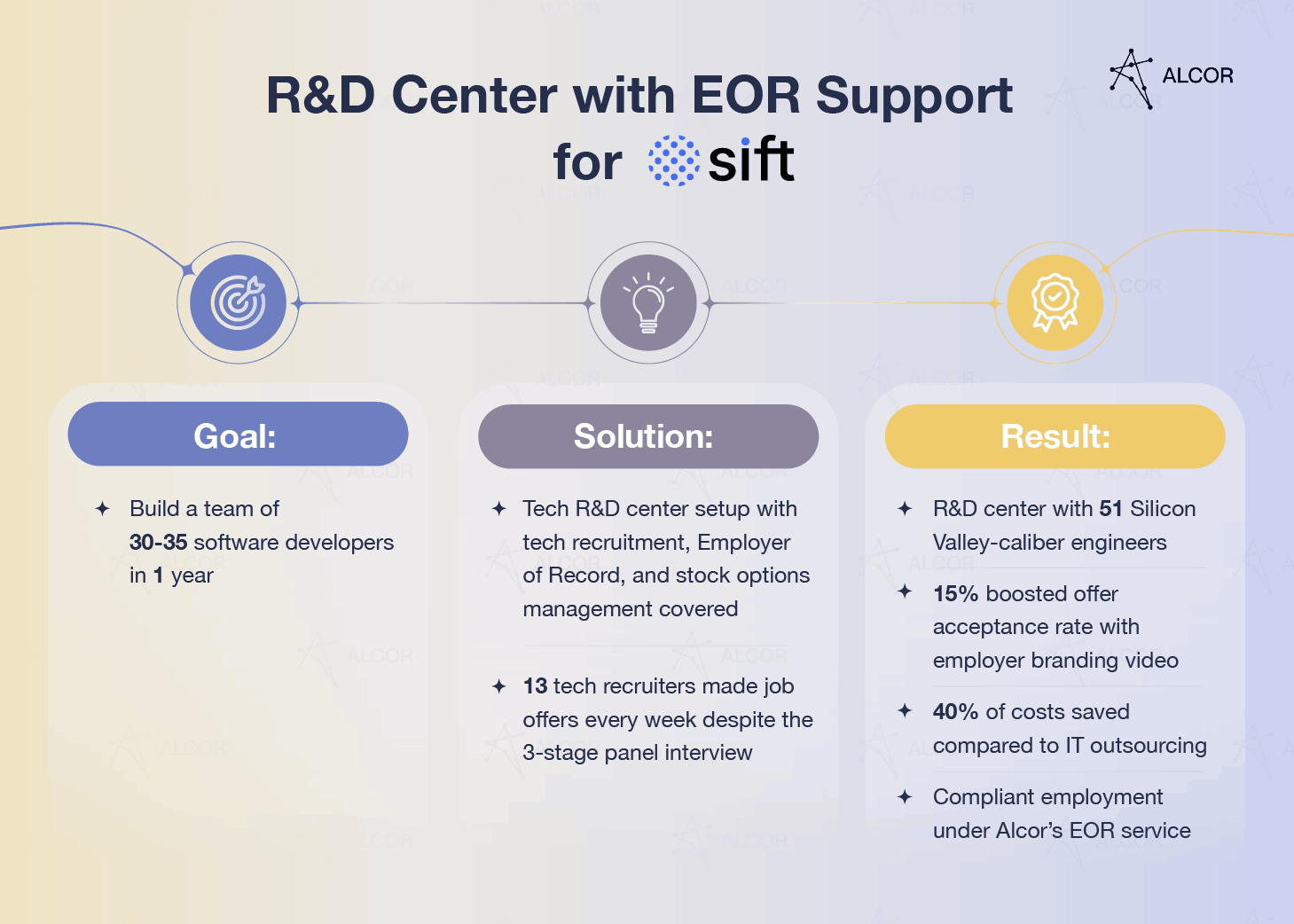
Take Sift, a US fraud-detection company, as an example of what that brand work delivers: a 15% boost in offer acceptance rates, 30 developers hired in the first year, three critical tech roles closed in a single week, and a Senior Product Designer hired on the first try. The team has since grown to 45 engineers.
Here’s how: Alcor shot a video interview with the client’s Hiring Manager to give candidates a real feel for company culture, then handled legal compliance across two jurisdictions so the client never had to navigate local systems alone – and even arranged for engineers to travel to the client’s US summit.
Tackle legal compliance difficulties
Setting up a legal entity in Mexico to hire developers compliantly involves multiple steps: choosing the entity type, reserving a name, registering with tax authorities and Social Security, and opening a bank account. The process can take several months and cost thousands of dollars – which is why tech companies increasingly lean on Employer of Record (EOR) providers to hire a team of remote software developers in Mexico compliantly and efficiently. With Alcor, you get support with payroll, tax management, 100% compliance, employee benefits management, and on/offboarding, so you can focus on your employees and product.
That was the case for Franki, a California-based experience app company. To scale fast and stay compliant in Mexico, they partnered with Alcor’s recruiters, who delivered a pipeline of 20 senior iOS engineers and closed 7 hires within a month.
With transparent income benchmarks, reliable headhunting support, and legal coverage across both the US and Mexico, Franki gained:
A Silicon Valley-caliber tech team
40% savings compared to tech outsourcing
Complete control without opening a local entity
Hire Developers in Mexico as Simply as Possible
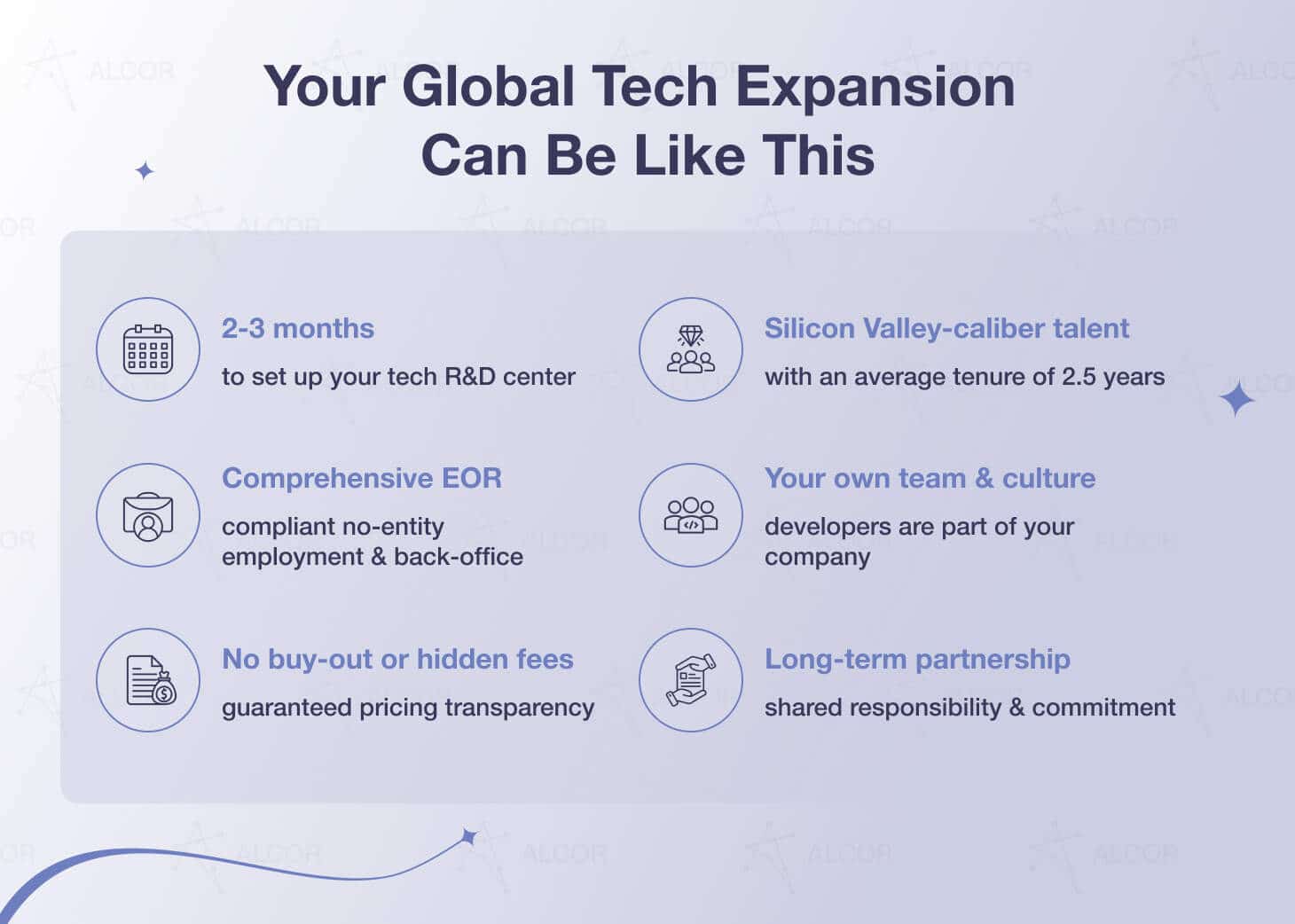
Alcor helps tech product companies hire developers in Mexico through a fully managed R&D center model, without outsourcing or opening a local entity. Its 40 in-house recruiters source senior tech talent, while tech-focused EOR/COR covers contracts, payroll, compliance, and misclassification risk. Alcor also handles equipment, benefits, salary benchmarking, and other local operations, giving companies full team control and the infrastructure to scale to 100 engineers within a year.
Thinking about working with nearshore software developers in Mexico? With Alcor, the process is smooth, strategic, and built for scale.
We don’t do typical outsourcing or temporary tech staffing. Instead, we help tech product companies build their own software R&D centers in Latin America and Eastern Europe, scaling to up to 100 engineers in a year, – as Briq, a Series B, VC-backed AI automation platform for the construction industry, found out when it needed to expand smoothly into Mexico without opening a legal entity or risking contractor misclassification. The results came through Alcor’s three core services working together:
Silicon Valley-grade recruitment: Alcor’s 40 in-house recruiters closed 7 roles for Briq – 5 Automation Java Developers and 2 Middle Support Engineers – at an average of 39 days per hire, sourcing top-10%-of-market talent now building the company’s Otto product initiative. When one hire resigned 4 days in, Alcor backfilled the role at no cost.
Tech-exclusive EOR/COR: Alcor already had compliant infrastructure running in Mexico, so Briq skipped entity setup entirely. Every contract was structured as a compliant B2B engagement and reviewed to close out misclassification risk under Mexican labor law – the exact exposure Briq couldn’t afford.
Vital operational support: Alcor sourced laptops through a local equipment provider and helped Briq design a competitive Employee Value Proposition – PTO, sick leave, holiday benefits, salary benchmarks – so leadership could stay focused on the product instead of vendor logistics.
With Alcor, your focus stays on the product. We’ll take care of everything else. Elite tech talent, zero buy-out fees, and up to 40% savings – that’s how we do software R&D support.
Ready to scale your engineering team in Mexico – without the legal guesswork? Let’s talk.
References
Official Gazette of the Federation (Diario Oficial de la Federación)
Mordor Intelligence
Grand View Research
WIPO Global Innovation Index
StartupBlink
SiiLA
Coursera Global Skills Report 2025
Mexico’s Ministry of Economy (Mexican Talent report)
QS World University Rankings
Unirank
Edurank
OECD
Bureau of Labor Statistics (BLS)
Cambridge English
Carta
Rio Times
The White House
Supreme Court of the United States (via SCOTUSblog)
Office of the United States Trade Representative (USTR)
Global Trade Alert
Data México
Mexico’s Secretariat of Economy (Mexican Talent report)
FAQ
What is the average software engineer salary in Mexico in 2026?
A senior software engineer’s salary in Mexico averages $69,000 a year, compared to $125,000 in the US, according to Alcor’s 2026 engineer compensation research – a 51% gap. AI Infrastructure Engineers earn the most ($141,000), while ML Engineers show the widest gap with the US.
Do US tariffs affect the cost of hiring developers in Mexico?
No. US tariffs target physical imports, not digital services. The original 25% tariff was struck down by the Supreme Court in February 2026, and the current 10% Section 301 tariff exempts USMCA-compliant goods. None of it touches remote software development, so hiring costs and salaries in Mexico remain unaffected.
Why is there such a big pay gap between US and Mexican software engineers?
Four factors drive it: US benefits add about 30.1% to salary, Mexico’s mandatory bonuses cost less than US-style benefits, local payroll taxes vary by city, and Mexico’s lower price levels mean salaries go further in purchasing power terms. University pedigree, English premiums, and equity-heavy US packages widen the gap further.
What mandatory benefits do employers have to pay for employees in Mexico?
Full-time employees in Mexico are entitled to Aguinaldo (a year-end bonus equal to 15 days of salary), Prima Vacacional (a 25% vacation premium), and profit-sharing (PTU) equal to 10% of the company’s annual taxable profits. Employers also typically add a discretionary benefits package worth around $5,500 a year.
Can a US company hire developers in Mexico without opening a legal entity?
Yes. Employer of Record (EOR)/Contractor of Record (COR) providers let US and European companies hire legally in Mexico without registering a local entity. Setting one up independently can take several months and cost thousands of dollars, while an EOR partner like Alcor handles payroll, tax, and compliance from day one.