


Employer of Record services have quietly become one of the fastest-growing segments of the global workforce market – valued at $5.9 billion in 2026 and on track to nearly double by 2035, driven by companies that need to hire across borders without the infrastructure weight of entity registration. According to the Business Research insights, 73% of companies have already grown their global workforce using an EOR – and the number keeps climbing as global hiring becomes the default, not the exception.
But an EOR is only as good as the provider behind it.
In this guide, you’ll find everything you need to make a confident decision: what an Employer of Record actually covers and how it works, the strategic benefits and real use cases, the risks most companies overlook, how EOR compares to the main alternatives, and a practical checklist for evaluating and selecting a provider worth trusting.
Key Takeaways
- An Employer of Record is a third-party company that legally employs workers on your behalf. It handles payroll processing, taxes, social contributions, contracts, onboarding, EOR benefits administration, and compliant offboarding so that you can focus on the work.
- EOR services support fast market entry, multi-country employment, pilot teams, project-based hires, M&A transitions, and contractor-to-employee conversions. You get ready employment infrastructure, predictable per-head costs, and fewer legal delays before your first hire starts.
- EOR reduces operational burden, but it does not eliminate all risks. Co-employment exposure, vague liability terms, termination mistakes, IP gaps, data protection issues, and immigration constraints still need clear ownership.
- The right hiring model depends on how much control, speed, and infrastructure you need. A local entity works when you are ready to own everything; PEO supports existing entities; staffing covers short-term gaps; an R&D center fits when your business needs a fully integrated team abroad.
- Alcor is an Employer of Record solution and tech R&D center provider that combines EOR/COR, recruitment, and operational support into a single engagement. It offers top-10% tech recruitment with 10–30 developers hired in 3 months and a 2.5-year average tenure; complete EOR support with transparent EOR costs, 10-business-day onboarding, compliant FTE or B2B contracts, and in-house legal teams; and operational support covering IT, HR, employer branding, procurement, insurance, and office operations.
What is an Employer of Record, and how does it work
An international Employer of Record helps tech companies hire abroad without establishing a local entity or building employment infrastructure from scratch. It manages global payroll, tax withholding, social contributions, contracts, onboarding, benefits administration, and compliant offboarding across multiple jurisdictions. For expansion into new markets, an EOR clarifies employment status, supports FTE and contractor models, and helps companies terminate their workers through the EOR with proper notice periods, severance, authority notifications, and local law compliance.
|
An Employer of Record (EOR) is a third-party company that hires workers on your behalf – taking on all legal employment obligations, from payroll and taxes to benefits and compliance, so you can focus on managing the actual work. |
In practice, an EOR lets you hire internationally without entity setup, run compliant payroll services across multiple jurisdictions, and get new hires through onboarding with EOR infrastructure already in place – from signed contract to first day, without building anything from scratch.
Core responsibilities and operational scope
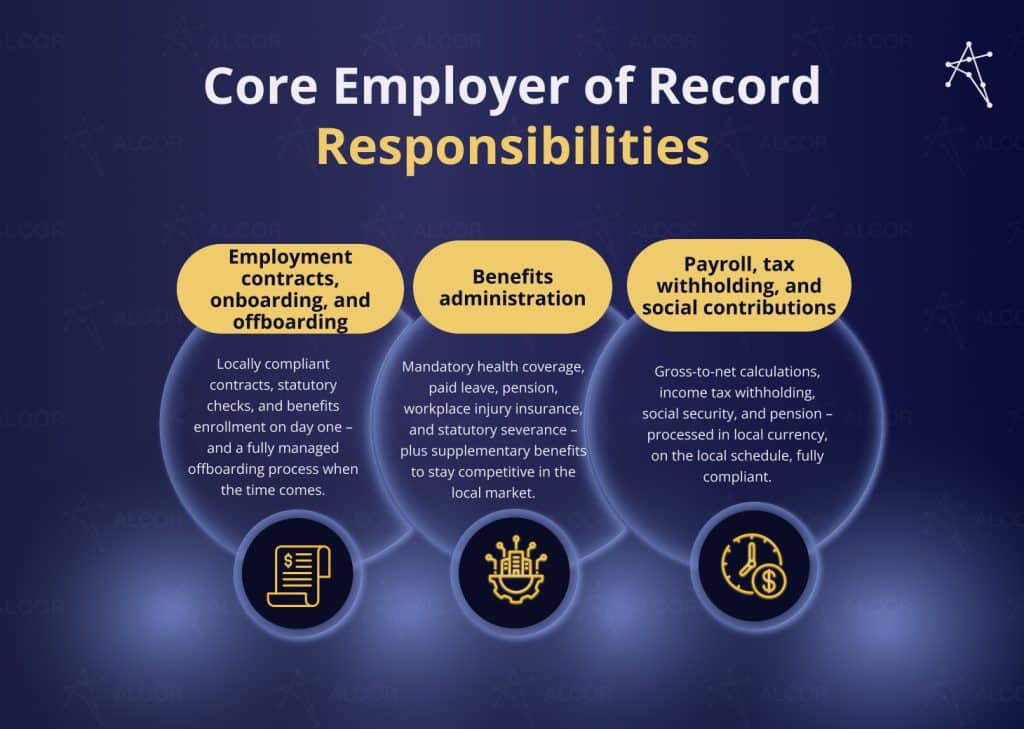
Understanding exactly what a global EOR covers – and what it doesn’t – is where most hiring decisions start to get clearer. Here are the three core functions every EOR takes off your plate:
Payroll, tax withholding, and social contributions
The EOR provider runs payroll end-to-end: gross-to-net calculations in local currency, on the local schedule, with employer-side contributions remitted to the relevant authorities. That covers income tax withholding, social security, pension, and any jurisdiction-specific levies – all filed under the EOR’s legal presence in that country, whether that’s an owned entity or a vetted local partner the provider operates through.
Employment contracts, onboarding, and offboarding
The EOR issues locally compliant employment contracts that reflect the actual role, compensation structure, IP assignment, and confidentiality terms in accordance with local law. Onboarding covers documentation, statutory checks, and benefits enrollment. Offboarding – notice periods, severance calculations, labor authority notifications – is managed in line with local requirements. Worth noting: with full-service providers, onboarding and offboarding are included in the base service. With others, offboarding is a separately quoted line item. Clarify this before you sign.
Benefits administration
Every market has a mandatory floor: health coverage, paid leave, pension contributions, statutory severance provisions – and in most jurisdictions, mandatory employer-side insurance obligations covering workplace injury, disability, and equivalent local schemes. The EOR administers it all and typically layers in supplementary benefits needed to remain competitive locally. What varies by provider is what’s included in the headline fee versus what’s charged as an add-on – benefits procurement markups and currency conversion margins are two places where total cost can quietly diverge from what the rate card showed.
One function that falls outside the EOR scope, regardless of provider, is finding the people. An EOR employs workers you’ve already selected – it doesn’t source or close candidates. For companies entering a new market without an existing local pipeline, that gap matters.
Legal relationship and employment status
Under any EOR arrangement, two contracts govern the relationship. The EOR signs a local employment agreement with your worker – becoming the legal employer in that jurisdiction. Your company and the EOR sign a commercial services agreement covering scope, fees, IP provisions, liability caps, and termination terms. You direct the work, while the EOR owns the employment infrastructure.
What most companies don’t realize upfront is that “employment” here isn’t one-size-fits-all. Reputable EOR providers support two distinct engagement models – and the difference has real legal and financial consequences. A comprehensive Employer of Record service provider supports two distinct engagement models:
- Full-time employment (FTE): The worker is employed locally under a standard employment contract. The EOR handles all statutory obligations: social contributions, paid leave entitlements, mandatory benefits, notice periods, and severance. The worker has full employee status under local law – with all the protections that come with it.
- B2B / contractor engagement: The worker operates as an independent contractor – typically through their own registered entity or as a sole trader – and invoices the EOR or the client directly. The EOR, or a dedicated Employer of Record for independent contractors (Contractor of Record/COR service), manages contract compliance, payment processing, and employee classification services to ensure the engagement meets local regulatory requirements without entering into an employment agreement with the worker.
The model you choose has a direct impact on cost structure and compliance exposure. To see what that difference actually means in real numbers, here’s a breakdown of employer and contractor-side obligations across LATAM and Eastern Europe:
|
Mexico |
Colombia |
Poland |
Romania |
Ukraine |
|
|
FTE – Employer’s share |
SSC: 24%–43%; Payroll tax: 3% (CDMX, Guadalajara, Monterrey, Querétaro) |
SSC: ~21%; Payroll tax: 9% |
SSC: 20% |
SSC: 2.25%–10.25% |
SSC: 22% |
|
FTE – Employee’s share |
SSC: 2.8%; PIT (progressive): 1.92%–35% |
SSC: 8%–9%; PIT (progressive): 19%–41% |
PIT: 12% up to PLN 120,000 (~USD 29,800), then 32% on the excess; SSC: 22.71% |
PIT: 10%; SSC: 35% |
PIT: 18%; Military tax: 5% |
|
B2B – Contractor’s share |
PIT: 1%–2.5%; No mandatory SSC |
PIT: 5.9%–14.5%; SSC: ~30% |
PIT: 12%; SSC: PLN 1,773.96 (~USD 426) per month |
PIT: 10%; Pension: 25% of RON 97,200/year; Health: 10% of net income |
Single tax: 5%; Military tax: 1%; SSC: 22% of min. salary – UAH 5,280 (~USD 125) quarterly |
|
Based on Alcor’s legal team’s research, 2026. |
|||||
Strategic Benefits and Common Use Cases
A global Employer of Record helps tech companies hire abroad without entity setup, legal delays, or payroll complexity. It supports rapid market entry with ready employment infrastructure, reduces compliance risk through local employment law compliance, and turns unpredictable hiring costs into clear per-head fees. It also works well for pilot teams, project-based hires, M&A transitions, and contractor-to-employee conversions – giving companies a flexible, compliant, and cost-predictable layer for global hiring across multiple markets.
An Employer of Record service removes the infrastructure barrier to global hiring – no entity, no parallel legal registrations, no six-month runway before your first hire goes on payroll. But the strategic value goes further than speed. The right EOR model gives your business compliance certainty across high-protection labor markets, predictable per-head costs with pricing that works in your favor at scale – whether you need a global EOR for software companies or a broader provider with cross-industry coverage. Here’s where the Employer of Record model delivers the most value.
Rapid market entry and hiring remote talent
When the decision to hire employees abroad is made, the clock starts. Product roadmaps don’t pause for entity registration timelines. International Employer of Record services remove that bottleneck entirely – the employment infrastructure is already built, and onboarding starts immediately.
This matters most when speed is non-negotiable, when you’re entering an unfamiliar market without established local legal expertise, or when you’re expanding across multiple countries simultaneously – three entity registrations running in parallel is an operational problem that an EOR turns into a single commercial relationship. It’s why Employer of Record services for startups and fast-scaling companies have become the default path for global hiring without the infrastructure weight.
The same logic applies under pressure. When Intel 471, a global cyber-threat intelligence company, needed to relocate 20 engineers from Ukraine to Poland in 2022, entity setup wasn’t an option – the timeline didn’t allow it, and Poland’s misclassification framework made getting the contracts wrong an expensive mistake. Alcor – a leading EOR provider in Europe – stepped in as the single accountable partner: B2B contracts, payroll, legal navigation, and onboarding handled end-to-end.
The result: All 20 engineers were fully compliant in four weeks, saving Intel 471 up to 1.5 months of setup time with zero audit exposure.
Compliance risk mitigation and cost predictability
Every new hiring market brings a distinct compliance surface: payroll schedules, statutory benefit floors, termination rules, misclassification thresholds. Under direct employment, your team owns it all. An EOR transfers that burden to a provider whose business model depends on getting it right – statutory filings on schedule, contracts current, termination managed correctly when it happens.
Cost predictability follows the same logic. Direct employment carries unpredictable layers: legal counsel, local accounting, payroll vendors, HR overhead, and retroactive audit liability if something slips. A well-run EOR replaces that with a known per-head fee that covers payroll, compliance, and benefits, with volume discounts as the team scales.
Advice: Before committing, verify what’s in the base fee versus what’s charged as an add-on, and whether the provider holds direct entities or operates through third-party partners in your target markets. Both affect real cost and real accountability.
Project-based hires, pilot teams, and M&A/transitions
One of the strongest use cases for EOR services is project-based hires, pilot markets, M&A transitions, and contractor conversions – all of which rely on the same core advantage: compliant employment without entity setup.
- Pilot hiring – if you need to test a market, start with three to five hires and let the EOR handle the employment infrastructure from day one. Contracts, payroll, compliance – all in place immediately. If it works, scale. If it doesn’t, exit cleanly with no entity to dissolve.
- M&A transitions – acquisitions often leave inherited employees under misaligned legal structures. An EOR absorbs those employees quickly under compliant local contracts while the longer-term structure is resolved – keeping people on payroll and benefits intact throughout.
- Contractor-to-employee conversions – companies running contractors in a market who need to formalize employment ahead of an audit can use EOR to issue compliant FTE contracts fast, without the entity setup timeline.
In all three scenarios, the EOR functions as a flexible employment layer – fast to activate, clean to exit, and compliant throughout.
Risks, Limitations, and Compliance Pitfalls
EOR can help tech companies legally hire remote employees, but it does not eliminate all risks. The biggest pitfalls sit around co-employment, unclear liability, termination rules, severance, data protection, IP ownership, and immigration support. Strong Employer of Record companies define responsibilities upfront, monitor all local regulations, update contracts proactively, and protect both clients and employees through compliant processes. Weak providers leave grey zones that can turn global hiring into a legal cleanup project.
An EOR removes significant operational and legal burden – but it doesn’t eliminate risk. Some exposure stays with your company regardless of which provider you use. Knowing where the boundaries sit is what separates a well-structured EOR solution from one that creates the problems it was supposed to solve.
Co-employment concerns and liability allocation
Under an EOR arrangement, the provider is the legal employer – but your company directs the work. Where it gets complicated is when your involvement in day-to-day HR decisions – performance reviews, disciplinary action, termination calls – starts to look like direct employment in the eyes of a local labor authority, triggering reclassification risk.
Liability allocation varies significantly by provider. A well-structured commercial agreement defines clearly who carries what. Providers that leave liability caps vague or indemnity clauses broad create exposure that only surfaces when something goes wrong. Employee experience falls into the same category – engineers don’t stay where payroll is inconsistent, or HR questions disappear into a support portal.
Alcor’s approach: Alcor carries full liability for the employment relationship – not just process management. The commercial agreement defines clear indemnity terms, liability caps, and IP provisions from day one, so there’s no ambiguity about who owns what when something goes wrong.
Local statutory nuances, termination, and severance risk
The gap between what US-trained legal teams expect and what local law actually requires is where most compliance surprises live. Termination is the highest-risk area – notice periods, severance calculations, and just-cause requirements differ enough between markets that standard practice in one country can be a costly mistake in another.
Beyond termination, statutory nuances compound across probation periods, overtime rules, mandatory leave entitlements, and annual bonus obligations. An EOR that monitors regulatory changes and adapts proactively removes that burden. One that doesn’t leave you exposed to exactly the retroactive liability you were trying to avoid.
Alcor’s approach: Alcor’s in-house legal team monitors regulatory changes across all active locations and proactively updates employment frameworks. Termination is managed end-to-end – notice periods, severance, labor authority notifications – with no process handed back to your team when it matters most.
Data protection, IP ownership, and immigration constraints
Three areas where residual risk stays with your company regardless of what the service agreement says.
- Data protection: Under GDPR and equivalent frameworks, your company remains the data controller even when the EOR processes payroll data. A compliant EOR should have a Data Processing Agreement with cross-border transfer mechanisms and documented breach-notification protocols. If they can’t produce one on request, keep evaluating.
- IP ownership: EOR contracts must include explicit IP assignment clauses that comply with local law. Without them, IP ownership falls into a grey area that becomes a serious problem during acquisition or fundraising.
- Immigration: EOR covers employment compliance – not automatically work authorization. Where workers require local visas or permits, a full-service provider should support the process. Where it doesn’t, that gap lands back on your team.
Alcor’s approach: Alcor’s contracts include enforceable IP assignment and confidentiality clauses reviewed by in-house legal counsel in each jurisdiction. Data processing agreements are standard across all engagements, with GDPR-compliant transfer mechanisms for European countries and equivalent frameworks in place for LATAM – including Colombia’s Habeas Data law and Mexico’s LFPDPPP.
For work authorization, Alcor provides on-demand visa consultations and immigration support, covering work permits, visa applications, and travel documentation.
EOR vs Alternatives: Selecting the Right Approach
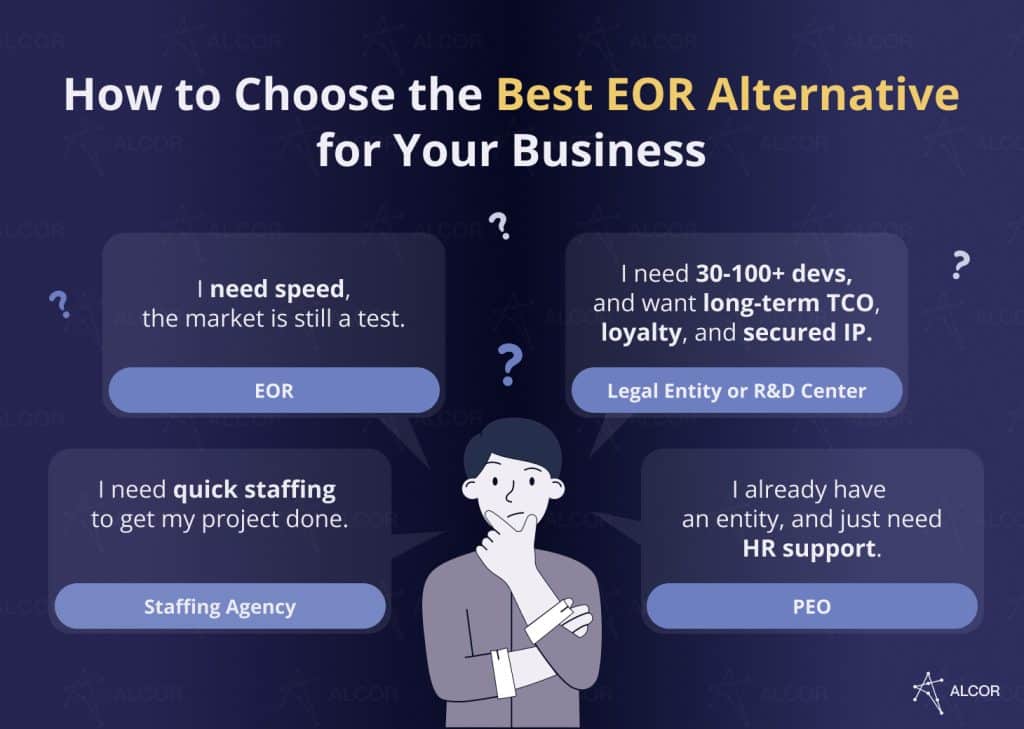
Choosing among an EOR, local entity, PEO, staffing agency, software R&D center, or hybrid model depends on speed, control, risk, and cost efficiency. An Employer of Record company supports market validation, multi-country hiring, and early growth without entity setup, while entities suit mature operations. PEOs support companies with existing entities; staffing agencies fill short-term capacity gaps; and R&D centers work best when your business needs a fully integrated team abroad. A hybrid umbrella model can combine entity ownership in established markets with EOR flexibility in new ones.
Setting up a local entity vs using an EOR
A local entity means your company establishes a legal presence in the target country – a subsidiary, branch office, or representative office – and assumes direct responsibility for all compliance, payroll, and legal risks. An outsourced Employer of Record takes that entire layer off your plate: the EOR becomes the legal employer, handles all statutory obligations, and lets you hire and manage your team without building local infrastructure first.
The difference isn’t just operational – it determines your timeline, your upfront investment, and how much compliance risk sits on your balance sheet from day one.
Choose an EOR when:
- Speed is non-negotiable – entity registration can take up to 4 months (information provided by the Alcor legal department); an EOR puts your first hire on payroll in days.
- You’re managing multi-country employment across several markets simultaneously and need to streamline global hiring operations under one commercial relationship rather than running parallel legal registrations.
- You’re entering a new market to validate before committing capital – an EOR lets you test without the infrastructure investment.
- You don’t have internal legal, HR, and finance teams with deep expertise in the target market.
- You’re a fast-scaling company without an established local presence – for Employer of Record provider for fintech startups and other regulated-industry companies entering new markets, EOR removes the entity setup timeline while keeping employment fully compliant from day one.
- You want flexibility – to scale up, adjust headcount, or transition to your own entity later without lock-in.
Choose a local entity when:
- The nature of your business or a specific contract requires a registered local presence – government procurement, financial licenses, or strategic partnerships that mandate it
- You have in-house legal and HR resources with genuine expertise in that market
- Full ownership of the employment relationship is a non-negotiable requirement – ahead of an acquisition, equity rollout, or complex IP structure.
- You’ve built a strong foundation through EOR, and you’re ready to take full ownership of the employment infrastructure and establish your own legal entity.
EOR vs PEO vs staffing agency vs software R&D center
When choosing an expansion model, keep in mind that EOR isn’t the only game in town – and depending on where your business is on the expansion journey, it might not be the right starting point either. Let’s compare EOR with the main alternatives and find out which one fits your situation best.
PEO
While often confused with EOR, a Professional Employer Organization functions differently. Unlike an EOR, a PEO enters a co-employment model – it handles HR, payroll, and benefits administration, but only in a country where your company already has a registered legal entity. You remain the employer while the PEO supports the operational HR layer. A strong fit for companies that have already established a local presence and want to offload HR complexity without giving up employer status.
Staffing agency
A staffing agency is a good option for short-term, well-scoped capacity gaps – it supplies workers fast, with no entity or compliance setup required. The difference from EOR is ownership: workers remain employees of the agency, not your company. For anything that touches your core product in the long term, that distinction matters – team loyalty, IP enforcement, and cost predictability are harder to control when the employment relationship is with a third party.
Software R&D center
An R&D center is your own in-house hub abroad – built under your brand, managed to your standards, fully integrated into your product culture. It combines the compliance infrastructure of an EOR with direct team ownership – and for companies looking for EOR services for software developers, it’s the model that delivers both speed and full control from day one. People on the team are your employees from day one: your roadmap, your tools, your IP, your culture.
This is where Alcor operates. Alcor combines recruitment, EOR/COR, and full operational support under one software R&D center solution – so you’re not stitching together three vendors to hire one engineer.
When People.ai, an AI company based in San Francisco, needed to scale without splitting accountability across vendors, they turned to Alcor – one of the best Employer of Record providers in Ukraine as their one-stop-shop partner for the entire build – and here’s what they got:
- Top-notch tech recruitment: 25+ engineers hired in the first year – including a highly skilled Staff Engineer and top AI specialists. Alcor’s 40 in-house recruiters closed every role in 2–6 weeks, with 98.6% passing probation – part of a hiring engine built to scale any team to 30+ people in 90 days.
- Comprehensive EOR: Full legal compliance with both US and Ukrainian law, employment contracts and payroll managed end-to-end – with no setup fees, no exit fees, no deposits, and pricing that decreases as the team scales. Every employee is onboarded in 10 business days, with locally compliant contracts, benefits, and payroll in place from day one.
- 360-degree operational support: A fully operational R&D office launched in one month. Alcor manages office leasing, hardware procurement, employer branding, and HR infrastructure if the client opts for a fully operational on-site setup. In addition to standard operations, Alcor provides on-demand services, including stock option issuance, visa consultations, and immigration support.
The result: a true in-house engineering team, averaging 2.5 years of tenure, built and running in 30 days.
Don’t just take our word for it – hear how Tubular and Sift built their teams with Alcor.
Looking for the best Employer of Record in Romania? Steal our shortlist.
When a hybrid or phased approach is appropriate
Being an established employer in one market and a newcomer in another isn’t a contradiction – it’s actually the most common scaling reality, and there’s a model built for it. A hybrid approach means running an EOR and a local entity simultaneously, each doing the job it’s actually built for.
The setup looks like this: your established market – where you’ve been operating for years, headcount is stable, and the infrastructure investment has long since amortized – runs under your own legal entity. Your newer or smaller markets, where you’re still validating talent quality, building the team, or testing product-market fit, run through an EOR. One commercial relationship, compliant employment from day one, no entity setup timeline eating into your hiring window.
This isn’t a transitional arrangement – it’s a deliberate operating model. The EOR handles the new market compliantly, while the entity carries the established one. As the newer market matures and headcount justifies the infrastructure investment, the transition happens on your terms – not under pressure.
How to Evaluate and Select a Trusted Employer of Record
Finding an Employer of Record means looking beyond payroll setup and checking who truly owns compliance, support, visibility, and cost control. A trusted provider should maintain robust local infrastructure, ensure compliance with local employment laws, offer clear SLAs, protect employee data, and provide real-time access to hiring, payroll, benefits, assets, and leave management. EOR pricing should also be transparent – with base fees, add-ons, deposits, FX markups, volume discounts, and exit terms clear before signing, without hidden costs as the team scales.
Local presence, legal infrastructure, and compliance track record
The single most important question to ask any Employer of Record provider: do you hold your own legal entity in the countries I’m hiring in, or do you operate through a third-party local partner? The answer determines who actually carries compliance accountability when something goes wrong. An owned entity means the provider directly controls payroll, contracts, and regulatory filings. An aggregator model means compliance quality is only as strong as the local partner’s practices.
Beyond entity ownership, verify:
- Compliance track record – when shortlisting top EOR companies, always verify direct entity ownership and compliance track record in your target markets. How long have they operated there, and can they provide references from companies of similar size?
- Regulatory monitoring – do they proactively update contracts and payroll structures when local law changes, or does that land back on you?
- Contractor of Record capability – if you plan to engage contractors, does the provider have a dedicated COR service or manage them under the same FTE framework?
- Audit history – have they faced payroll or labor authority audits in your target markets, and how were those resolved?
Technology, integrations, reporting, and data security
Most demos make every Employer of Record platform look capable. The real test is what visibility you actually have once the engagement is live – and whether the operational layer runs itself or requires constant chasing.
A weak EOR platform means payroll updates arrive via email, asset tracking lives in a spreadsheet someone else owns, and hiring progress is a status call you have to schedule. That’s not infrastructure – that’s administration with a login screen.
When evaluating any provider’s technology, check for:
- Real-time hiring and headcount visibility – can you track open roles and hiring progress without requesting a report?
- Payroll and benefits automation – are payroll cycles and benefits administration handled within the platform, or coordinated manually across systems?
- Asset and expense transparency – is hardware, equipment, and expense tracking centralized and accessible to your team?
- Time-off and leave management – can approvals be handled directly, without routing through the provider’s support team?
- Data security and governance standards – what certifications does the provider hold, how is employee data stored, and who controls access across jurisdictions?
This is exactly the gap AlcorOS was built to close – an all-in-one operating system for managing your distributed team in Eastern Europe and Latin America. Hiring pipeline, payroll automation, asset tracking, benefits administration, time-off approvals, and workforce governance are centralized on a single platform. No status calls, no email threads, no visibility gaps.
Service model, SLAs, local support, and escalation paths
An EOR is only as good as the support behind it. A provider that routes every request through a ticket queue, responds with automated replies, and escalates nothing until you push – that’s not a partner; that’s a portal.
When evaluating the service model, ask:
- Named point of contact – is there a specific person accountable for your account, or does every request go into a shared inbox?
- SLA clarity – what are the guaranteed response and resolution times for payroll issues, compliance questions, and employee HR requests?
- Local support depth – does the provider have in-market teams that understand local employment nuances, or is support centralized in a single time zone?
- Escalation paths – when you’re ready to hire in the next market, does your provider have the infrastructure to support it under the same engagement, or do you rebuild from scratch every time?
The difference between good and poor execution here is visible quickly. Delayed payroll, unanswered HR questions, benefit terms nobody can explain – engineers notice, and they act on it.
Alcor assigns a dedicated Customer Operations Manager to every client from day one – one person who knows your account, your team, and your markets.
Pricing structures, transparency, and total cost of ownership
When choosing an EOR, pricing is where the real due diligence starts – because the fee structure a provider uses determines not just what your company pays today, but what you’ll pay as your team scales. EOR providers use four different pricing models – and the one your provider uses shapes your total cost of ownership significantly:
| Pricing model | How it works | Example |
| Flat PEPM | Fixed monthly rate per employee, regardless of salary level | Multiplier – $400/employee/month;
Deel – $599/employee/month |
| Percentage-of-payroll | Fee calculated as a % of gross salary | Alcor uses a percentage-of-total-monthly-turnover model covering salaries and managed expenses. The EOR/COR fee may shift with compensation changes, but decreases as headcount grows. |
| Hybrid & custom enterprise | Base fee plus country-specific or salary-based add-ons, negotiated at scale | Papaya Global and Safeguard Global offer quote-based pricing for enterprise/global workforce needs. |
| Transaction-based / pay-as-you-go | Pay per active employee or per payroll event – no flat retainer | Alcor’s percentage-based EOR pricing covers salaries and dedicated operations support, with legal, HR, hardware, office, and branding add-ons billed per use. |
Beyond the pricing model itself, verify:
- What’s in the base fee – payroll processing, compliance management, and benefits administration should be covered as standard. With some providers, they are not, so always confirm what’s included before signing.
- Common add-ons charged separately – offboarding, onboarding documentation, benefits procurement, hardware, employer branding support, and visa processing are frequently outside the base fee. Each looks minor in isolation; together, they significantly shift the real cost.
- Security deposits – some providers require one to two months of payroll upfront, tied up for the duration of the engagement with unclear return terms.
- FX markups – providers that bill in local currency while you fund in USD or EUR may apply a spread on top of the interbank rate in each payroll cycle.
- Volume pricing – does the per-head fee decrease as your team grows, or does the rate stay flat regardless of scale?
- Exit terms – are there transfer restrictions or lock-in clauses if your business wants to move employees to your own entity later?
Total cost of ownership only becomes clear when you stack all of these against the base rate. A lower headline fee with opaque add-ons often ends up costing more than a higher flat fee with no hidden add-ons.
Questions you can ask AI about Employer of Record:
- What are the main risks of using an Employer of Record, and how do I protect my company?
- What’s the difference between an EOR and a PEO, and which one do I need?
- How do I calculate the total cost of using an Employer of Record vs setting up a local entity?
FAQ
Who is legally responsible if an employment dispute arises?
Under global Employer of Record services, the EOR is the legal employer and carries primary liability for employment disputes in that jurisdiction – labor court proceedings are brought against the EOR’s entity, not yours. The commercial services agreement defines how costs and fault-based liability are allocated between parties: typically, the EOR manages legal execution and carries liability for non-compliant processes. At the same time, your company covers the economic cost of decisions you directed.
EOR compliance depends heavily on how the commercial agreement is structured. Vague indemnity clauses or uncapped liability exposure are red flags to address before signing – not after a dispute arises.
Can I use an EOR to engage both contractors and employees?
Yes – but not all providers handle it equally. A full-spectrum Employer of Record service supports both FTE and B2B engagement models through a dedicated Contractor of Record (COR) service, which manages contract compliance, payment processing, and local regulatory requirements without establishing a formal employment relationship.
The key EOR compliance risk: providers that manage contractors under the same framework as employees create misclassification exposure. If the working reality looks like employment, local authorities will look past the contract label – triggering retroactive tax liabilities and fines.
Confirm upfront whether your provider has a dedicated COR capability before engaging contractors in any market.
What countries does Alcor EOR cover?
Alcor provides full Employer of Record services – payroll, benefits management, legal framework, and onboarding/offboarding – in Poland, Ukraine, Romania, Mexico, and Colombia, with owned legal entities and in-house legal teams in each country. Every engagement comes with transparent invoicing, minimized legal risks, and full accountability for compliance– no hidden fees, no compliance gaps, no third-party guesswork.
For all other markets, Alcor provides Contractor of Record (COR) services, managing B2B contract compliance and payment processing in full accordance with local law.
How long does it take to onboard an employee through an EOR?
With a well-run EOR service, onboarding typically takes between a few days and two to three weeks – depending on the country, employment model, and documentation turnaround. Speed and scalability go hand in hand here: a provider that onboards one employee in ten days should onboard ten with the same timeline and compliance standards across multiple markets.
Alcor onboards every employee in 10 business days – from signed offer to locally compliant contract, payroll setup, and benefits in place. The same timeline applies whether you’re onboarding one person or scaling a full team across multiple countries.
How would you rate this article?
Alcor is Your Trusted Scaling Partner
for expansion
support