


A dedicated development team in Poland can break the hiring wall when your local market can’t deliver the senior engineers your roadmap needs. According to Robert Half, 65% of technology leaders say finding skilled professionals is harder than a year ago. Poland opens access to a broader market with CEE’s #1-ranked tech talent, according to TopCoder, and enough depth to support 10–30 hires without turning recruitment into a second job for your CTO.
In this article, you’ll find not just 1 or 2 but 12 compelling reasons why companies stalled on hiring at home should build dedicated teams in Poland – covering talent depth, salary benchmarks, and the compliance groundwork already in place. As a bonus, you’ll also get proven best practices and the most effective model for owning a dedicated engineering team in this vibrant CEE powerhouse.
Key Takeaways
- Poland combines Central and Eastern Europe’s largest ICT talent pool with a highly senior workforce: 778,800 ICT professionals, 87.1% of whom are Middle level or above (Bulldogjob’s 2025 IT Community Survey). Polish programmers also rank #1 in CEE on TopCoder, supported by a steady pipeline of around 74,000 ICT and STEM graduates annually (Alcor’s recruitment team research).
- Senior engineering salaries in Poland are typically 40–59% more cost effective than equivalent US salaries across roles such as ML, LLM, DevOps, Python, and Data Engineering (Alcor’s recruitment team research). Poland also ranks #1 in Europe and #4 globally for Tier 2 AI talent concentration (Interface EU), strengthening its position for AI-native and deep-tech companies.
- Poland gives product companies EU-level IP protection, GDPR compliance, R&D tax incentives, high English proficiency (EF EPI 2025), and mature tech hubs including Warsaw, Kraków, Wrocław, Gdańsk, and Poznań. CET alignment supports real-time collaboration with European teams and productive handoffs with US engineering organizations.
- Building a dedicated team in Poland requires precise role definition, market-aligned compensation, a localized EVP, employer branding, and reliable compliance and operational support. AI-native companies should also distinguish between ML, LLM, AI Product, MLOps, and Data Platform roles while preparing early for EU AI Act requirements and protecting direct ownership of code, models, data, and IP.
- Alcor combines tech recruitment, EOR/COR, and end-to-end operational support to build fully owned engineering teams in Poland. Companies can scale to 10–30+ engineers in 90 days, access scarce AI/ML and deep-tech talent, operate 30–50% more efficiently than US-based hiring, and keep direct management, brand, and IP ownership – with 2.5+ years of average retention, no vendor markups, and no buy-out fees.
Top 12 Reasons to Build a Dedicated Development Team in Poland in 2027
Building a dedicated development team in Poland gives tech companies access to Central and Eastern Europe’s largest ICT talent pool, strong senior-level expertise, competitive salaries, and an AI-ready ecosystem. Poland also offers high English proficiency, top STEM education, mature tech hubs, EU-level IP protection, R&D tax incentives, and convenient time-zone overlap. A growing startup scene and stable business environment further strengthen Poland’s position for long-term engineering expansion and scaling plans.

1. Thriving tech industry
Poland’s economy surpassed $1 trillion in 2025 and continues growing at 3.3% a year, according to the IMF – already the sixth-largest economy in the European Union, per Euronews. Its ICT sector is scaling right alongside it – exports are projected to reach close to €12 billion by 2026, up from €9 billion in 2021, and already account for 14.3% of Poland’s total service exports, according to the Polish Investment & Trade Agency.
Three forces are driving Poland’s tech growth:
- R&D tax relief: companies operating in Poland can deduct up to 200% of R&D-related staff costs from taxable income, according to Poland’s Business Harbour program.
- Global tech investment: Google, Amazon, Microsoft, and Data4 have all built data centers in Poland – a core evidence of Poland’s strength as a technology destination.
- Data compliance: Poland offers full GDPR alignment and EU-standard IP protection, removing a common blocker for product companies building their first engineering team abroad.
- Government investment: Poland channels €12.4 billion – 1.47% of GDP – into digital transformation through its EU Digital Decade roadmap, funded primarily by the National Recovery and Resilience Plan, according to the European Commission. The plan covers €2.6 billion for high-speed internet and 5G networks and €532 million for state cybersecurity.
For a CTO deciding where to place an engineering team long-term, a trillion-dollar economy, a growing export sector, and government-subsidized R&D matter more than any single market-size ranking.
2. Powerhouse of talent
Poland has 778,800 ICT professionals – more than Ukraine, Bulgaria, and Czechia combined – making Poland’s tech talent pool the largest in Central and Eastern Europe, according to Eurostat.
That pool runs deep, not just wide: 87.1% of Poland’s IT specialists sit at Middle level or above – Senior, Lead, or Expert/Architect – according to Bulldogjob’s 2025 IT Community Survey. Finding a senior hire in Poland isn’t a needle-in-a-haystack search.
Poland’s market keeps growing and getting choosier: IT job postings rose 44% in 2025, according to No Fluff Jobs’ 2026 market report. Recruiters are concentrating that demand on mid- and senior-level specialists in AI, cybersecurity, DevOps, and data engineering, according to Poland Unpacked – exactly the seniority level you’re trying to hire. Poland also has the highest overall hiring volume of any market Alcor recruits in, with strong demand across Product, QA, Frontend, and Backend, according to Alcor’s recruitment data
3. High-tech gurus
Polish programmers rank #1 in Central and Eastern Europe on TopCoder‘s global competitive-programming index, and #17 worldwide. Poland also ranks #4 in the region for technical skills and #3 for data science, according to Coursera’s 2025 Global Skills Report.
That expertise spans:
- Specializations: backend development, mobile app development, game development, data science & ML, cybersecurity
- Languages: JavaScript, SQL, Python, C#, TypeScript, HTML/CSS
4. Top STEM education
70.2% of Polish IT specialists hold a bachelor’s or master’s degree, and 56.4% studied computer science specifically, according to Bulldogjob’s 2025 IT Community Report. Poland backs that credential base with real academic infrastructure: 20 Polish universities rank in the QS World University Rankings 2026, including Warsaw University of Technology, Wrocław University of Science and Technology, and AGH University of Science and Technology. EduRank counts 68 Polish universities offering engineering and STEM programs overall.
Poland’s graduate pipeline keeps feeding that talent pool: approximately 74,000 ICT and STEM graduates enter Poland’s workforce every year, according to Alcor’s recruitment research – proof that Poland’s education system is built to sustain long-term tech growth.
5. No Silicon Valley price tag
Speed and specialized talent are the main reasons to choose a dedicated development team in Poland – but the cost difference is real too. A Senior ML Engineer costs $222,000 a year in the US. The same seniority costs $99,600 a year in Poland – a 55% reduction, according to Alcor’s 2026 compensation research. A Senior Python Developer runs $165,000 in the US versus $84,000 in Poland – a 49% reduction.
My recruitment team crunched the real numbers – no rounding, no guesswork. See exactly what your engineering team would cost in Poland:
| Senior Annual Base Salary, USD | |||
| Position | USA | Poland | Savings |
| ML Engineer | $222,000 | $99,600 | 55% |
| LLM Engineer | $234,000 | $102,000 | 56% |
| AI Product Engineer | $228,000 | $103,800 | 54% |
| MLOps Engineer | $189,000 | $102,000 | 46% |
| Data Engineer | $177,000 | $82,800 | 53% |
| Data Platform Engineer | $189,000 | $88,800 | 53% |
| DevOps Engineer | $168,000 | $90,000 | 46% |
| Python Developer | $165,000 | $84,000 | 49% |
| Node.js Developer | $156,000 | $84,000 | 46% |
| React Developer | $156,000 | $80,400 | 48% |
| Angular Developer | $156,000 | $78,000 | 50% |
| Mobile Developer (iOS/Android/Xamarin) | $174,000 | $84,000 | 52% |
| C/C++ Developer | $150,000 | $90,000 | 40% |
| Blockchain Developer | $171,000 | $70,800 | 59% |
| Automation QA Engineer | $145,500 | $74,400 | 49% |
| According to Alcor’s engineering compensation research (As of September, 2026) | |||
6. AI-ready ecosystem
Poland ranks #1 in Europe and #4 globally for Tier 2 AI talent concentration – advanced researchers and engineers building deep learning models and production AI systems, according to Interface EU. Warsaw alone hosts 11 universities actively publishing AI research, producing more than 31,000 papers and 438,000 citations, according to EduRank. That depth has government capital behind it: Poland’s November 2025 “Policy for the Development of Artificial Intelligence in Poland until 2030” set a five-objective national roadmap backed by a new AI supervisory body, according to Chambers and Partners, following a dedicated AI Fund of roughly €235 million (PLN 1 billion) launched in November 2024 to co-finance private-sector AI innovation, according to the OECD.
Startups and SMEs building AI products in Poland get free access to national compute infrastructure through the PIAST-AI and Gaia programs, including GPU-powered model training and business development support, according to the Poznań Supercomputing and Networking Center – lowering the cost of building AI-heavy products locally.
7. High English proficiency
Poland scores 600 on the EF English Proficiency Index 2025 – “Very High” proficiency, ranking #3 in Central and Eastern Europe – with a skill breakdown of 612 in reading, 597 in listening, 557 in writing, and 518 in speaking. IT-sector professionals score even higher, at C1-level English. Software engineers here write Jira tickets, Confluence documentation, code comments, and client emails directly in English – no translation layer between your product team and theirs, and one less risk to weigh when hiring a dedicated development team in Poland.
Want to know more about the pros of building engineering teams in Poland? Check out our other article about Polish software developers!
8. Western mentality
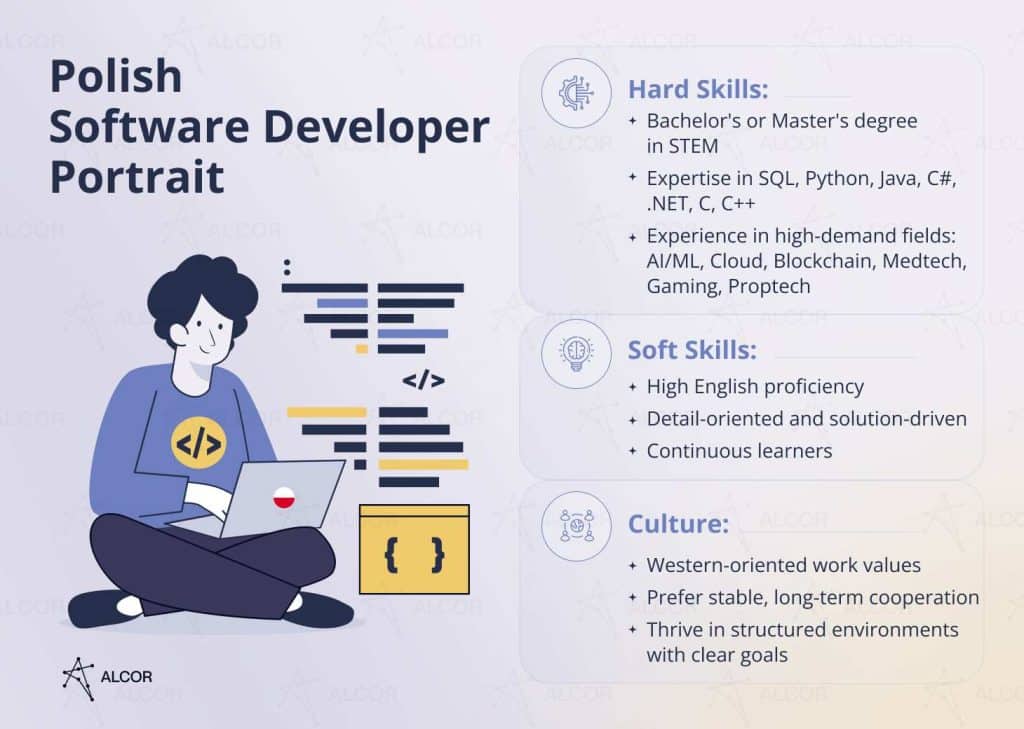
Poland’s work culture runs closer to the US and Western Europe than most outsourcing destinations – a result of decades of EU integration and direct collaboration with American and Western European companies, not a marketing claim. According to The Culture Factor Group’s Hofstede country comparison, Poland and the United States show comparable levels of motivation for achievement and success and a similar long-term orientation – a shared, pragmatic, results-focused approach to planning and work.
That alignment shows up the moment you build Poland’s dedicated development team: engineers here pair a structured, disciplined approach with the ability to adapt, think critically, and communicate with emotional intelligence – integrating into your existing way of working rather than asking you to adjust to theirs.
9. Booming startup ecosystem
Poland runs 1,774 active startups, according to StartupBlink’s 2026 Global Startup Ecosystem Index, including 13 unicorns worth a combined $21.1 billion in enterprise value, according to Dealroom. Poland’s founders back that scale with capital: venture investment hit €800 million across 180 funding rounds in 2025, according to Digest. Pro’s 2026 investment guide.
- Prominent startups: ElevenLabs, DocPlanner, Booksy, Brainly.
- Industry specialization: marketing and sales, energy and environment, healthtech, e-commerce and retail, edtech, fintech, AI, hardware, and IoT.
10. Vibrant tech hubs
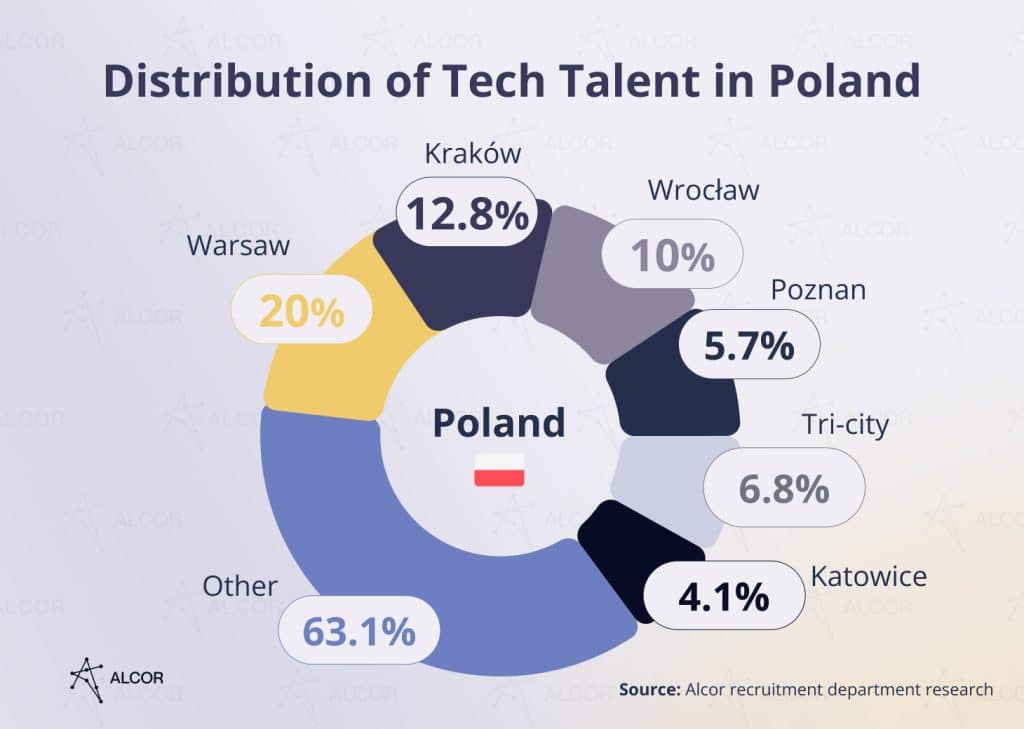
Warsaw, Kraków, Wrocław, the Tri-City, Poznań, Katowice, and Łódź anchor Poland’s tech talent, each with a distinct specialization:
- Warsaw: #1 in Poland – 684 startups, $125.1M in cumulative funding, growing 14.4% year-over-year, according to StartupBlink.
- Wrocław: #2 in Poland – 240 tracked startups, led by names like Piwik PRO and Saleor, according to StartupBlink.
- Kraków: #3 in Poland – 245 tracked startups, according to StartupBlink. Kraków also hosts the Gaia AI Factory, a EuroHPC-backed AI supercomputing hub, positioning the city as Poland’s deep-tech research center, according to the European High Performance Computing Joint Undertaking.
- Gdańsk (Tri-City): #4 in Poland – 96 startups, up 24.6% year over year, according to StartupBlink.
- Poznań: #5 in Poland – 85 startups, growing 12.8% year over year, according to StartupBlink.
Building your dedicated development teams in Poland doesn’t mean picking one city – many product companies combine hubs to diversify talent access and balance cost against specialization.
Explore IT outsourcing in Krakow in one of Poland’s most mature tech hubs.
11. Legal stability & IP protection
Poland has been a full EU member since 2004 and a NATO member since 1999 – two guarantees most outsourcing destinations can’t offer. EU membership means enforceable IP law, GDPR-standard data protection, and cross-border contract enforcement apply automatically to your Polish engineering team, not as a promise but as binding law.
That legal framework holds up under independent scrutiny: Poland scores 72 out of 100 on the Heritage Foundation’s Property Rights Index – well above the global average of 52 – and 5.69 out of 10 on the Property Rights Alliance’s Intellectual Property Rights subindex. Add a trillion-dollar, growing economy (see Reason #1), and building in Poland isn’t a bet on where the rules might be in five years – the rules are already EU rules.
12. Convenient location & time zone
Poland sits at the geographic center of Europe, sharing Central European Time with Germany, France, Spain, and most of the EU – a real advantage for companies coordinating a distributed team across the continent.
For US product companies, the time difference is the reason to hire a dedicated development team in Poland that most people overlook: Poland runs 6 hours ahead of the US East Coast and 9 hours ahead of the West Coast. Hand off a bug report or a feature spec at the end of your day, and your Polish engineers resolve it before you’re back at your desk the next morning.
How To Hire Dedicated Teams in Poland in 2027
Building a dedicated development team in Poland requires more than sourcing engineers. Tech companies need a focused recruitment strategy, a competitive EVP, localized employer branding, and reliable operational support. A strong software development team also depends on market-aligned salaries, relevant benefits, smooth payroll and compliance, and efficient local administration. With the right setup, companies can attract senior Polish engineers faster while keeping internal leadership focused on product development and delivery.
1. Devise a well-thought-out tech recruitment strategy
Most engineering leaders reach this point after their home market has already run dry: months of searching, a shortlist of two, and a roadmap waiting on headcount. Poland fixes the supply problem. Your strategy determines whether you actually capture that supply.
Before a single job description goes live, define: the exact roles and seniority you need, the specializations behind them (LLM engineering is not ML engineering, and the candidate pools barely overlap), your hiring KPIs, your budget ceiling per role, and the profile of the engineer who would genuinely thrive on your team. Vague requirements produce vague pipelines – and software development in Poland moves fast enough that a slow, unfocused search loses candidates to competitors.
Alcor’s approach: our 40 tech headhunters run recruitment end-to-end – sourcing, screening, and shortlisting – with an 80% CV pass rate. Your CTO sees only the candidates worth a final interview, and your existing engineers stay on the product instead of the pipeline. Teams of 10–30 are operational within 90 days. Plan for 12 months for 100.
2. Build an EVP senior engineers actually want
In a market where 87% of specialists sit at mid-level or above, your offer competes against companies that already know what Polish engineers expect. A generic approach to compensation doesn’t lose you candidates at the offer stage – it loses you candidates who never reply.
An EVP built for Poland needs three components, and the statutory floor is where you start, not where you finish:
Salary: Focus your benchmarking on role and seniority, not on a national average – the spread between a Senior Blockchain Developer and a Senior LLM Engineer is wide enough that averaging them produces a number that’s wrong for both.
Statutory entitlements: Polish labor law sets 20 working days of vacation (26 after 10 years of experience), 14 public holidays, 33 days of sick leave paid at 80% by the employer, 140 calendar days of maternity leave, and 14 days of paternity leave.
Benefits package (a total of about $5,000 developer/annually):
- Private health insurance – $600
- Professional development and certifications – $1,500
- English language courses – $800
- Home office and IT equipment – $600
- Wellness, including MultiSport and mental health support – $600
- Meal cards – $900
Alcor’s approach: when entering a new market, you don’t need to reverse-engineer local expectations from scratch. ThredUp and other product companies rely on our tech-focused EOR/COR services to handle benefits administration, payroll, and compliance – your team gets a package built on what Polish engineers actually value, and you focus on the product.
3. Launch a powerful employer branding campaign
Senior engineers in Poland field multiple offers. When your company name means nothing to them, your outreach reads like every other cold message in their inbox – and the best candidates never respond at all.
Fix the recognition gap before your first vacancy goes live. Polish engineers want to know what your product does, who they’d work with, what the engineering culture looks like, and where the company is headed. Publish it, localize it, and put it where they’ll actually see it.
Alcor’s approach: when Sift entered the Polish market, we built an employer branding campaign that broadened their applicant base and lifted response and offer acceptance rates by 15%. Sift’s Polish engineering team reached 30+ developers within a year.
5. Delegate admin operations and focus on your product
Your software team in Poland stops being an advantage the moment your CTO is fielding questions about office leases, laptop procurement, and Polish payroll deadlines. Operational drag is the most common reason well-hired dedicated teams underdeliver in their first year – not talent, not distance.
Offload the work that has nothing to do with your product: accounting, tax filings, payroll runs, equipment procurement, IT infrastructure, office or coworking space, and ongoing compliance with Polish labor law. The right vendor absorbs it all.
Alcor’s approach: we handle operations end to end, with Dedicated Customer Success Managers providing in-country support – so your engineering leadership spends its time on architecture and delivery, not administration.
How AI-Native Companies Should Approach Cooperation With Dedicated Teams in Poland
AI-native companies working with dedicated teams in Poland should define AI roles precisely, build compliance into development early, and protect full product ownership. Clear distinctions between ML, LLM, AI Product, MLOps, and Data Platform roles improve hiring accuracy, while early preparation for the EU AI Act reduces future compliance work. A dedicated team model also helps companies retain direct control over engineers, code, models, training data, and other critical IP.
1. Get specific about AI roles
AI hiring breaks down when the job description stops at the category. “We need AI engineers” covers at least five distinct roles, and the candidate pools barely overlap.
An ML Engineer trains and deploys models. An LLM Engineer works with foundation models, fine-tuning, and inference optimization. An AI Product Engineer builds the application layer on top of models someone else trained. An MLOps Engineer owns the pipelines, serving infrastructure, and monitoring. A Data Platform Engineer builds the systems the other four depend on. Each is a real role with a real market – but a vacancy that names the category instead of the role pulls applications from all five and a fit from none.
2. Stay ahead of the EU AI Act
If your product serves EU users, the EU AI Act applies regardless of where your engineers sit. Article 50 transparency duties – which catch every chatbot and every piece of synthetic content – came into force on 2 August 2026, according to the European Commission. The Digital Omnibus deferred Annex III high-risk obligations to 2 December 2027, according to Covington’s Inside Global Tech – but the deadline moved, not the work. High-risk documentation describes design decisions your engineers are making right now, and reconstructing it in 2027 costs several times more than recording it as you build. Penalties reach €35 million or 7% of global turnover.
A Polish team operates within the same regulatory perimeter your product must satisfy, with EU-standard data protection applying by default rather than by contract.
3. Keep full ownership of your product
For an AI-native company, the IP isn’t just the codebase – it’s the model architecture, the fine-tuned weights, the training data, and the evaluation sets your team builds over months of iteration. Ownership of all four depends on how the engagement is structured, not on a clause buried in a services agreement.
The structures differ in one specific way: whether IP assigns to you directly, and whether the engineers stay yours if the commercial relationship changes. In project-based and staffing arrangements, the team is contracted to the provider, and retaining those engineers later can involve buy-out fees. In a dedicated team cooperation model, your engineers work exclusively for you, under your brand and your management from day one, with no buy-out fees if you decide to open your own entity later.
Hire Your Own Software Team in Poland with Alcor
Alcor helps tech product companies build and scale their own software teams in Poland through a software R&D center solution covering recruitment, EOR/COR, and an end-to-end operational framework. Clients can reach 10–30+ engineers in 90 days, access scarce AI/ML and deep-tech talent, and operate 30–50% more efficiently than US-based hiring. The team stays fully yours – your management, your IP, your brand – with 2.5+ years of average retention and no vendor markups or buy-out fees.
Your roadmap is written. Your funding is in the bank. What’s missing is 20 engineers your home market can’t produce fast enough – and every quarter they don’t exist is a quarter your competitors ship features you can’t.
Alcor doesn’t do outsourcing or temporary staffing. We help tech product companies build their own software R&D centers in Eastern Europe and Latin America – your brand, your management, your IP – scaling to 100 engineers within a year.
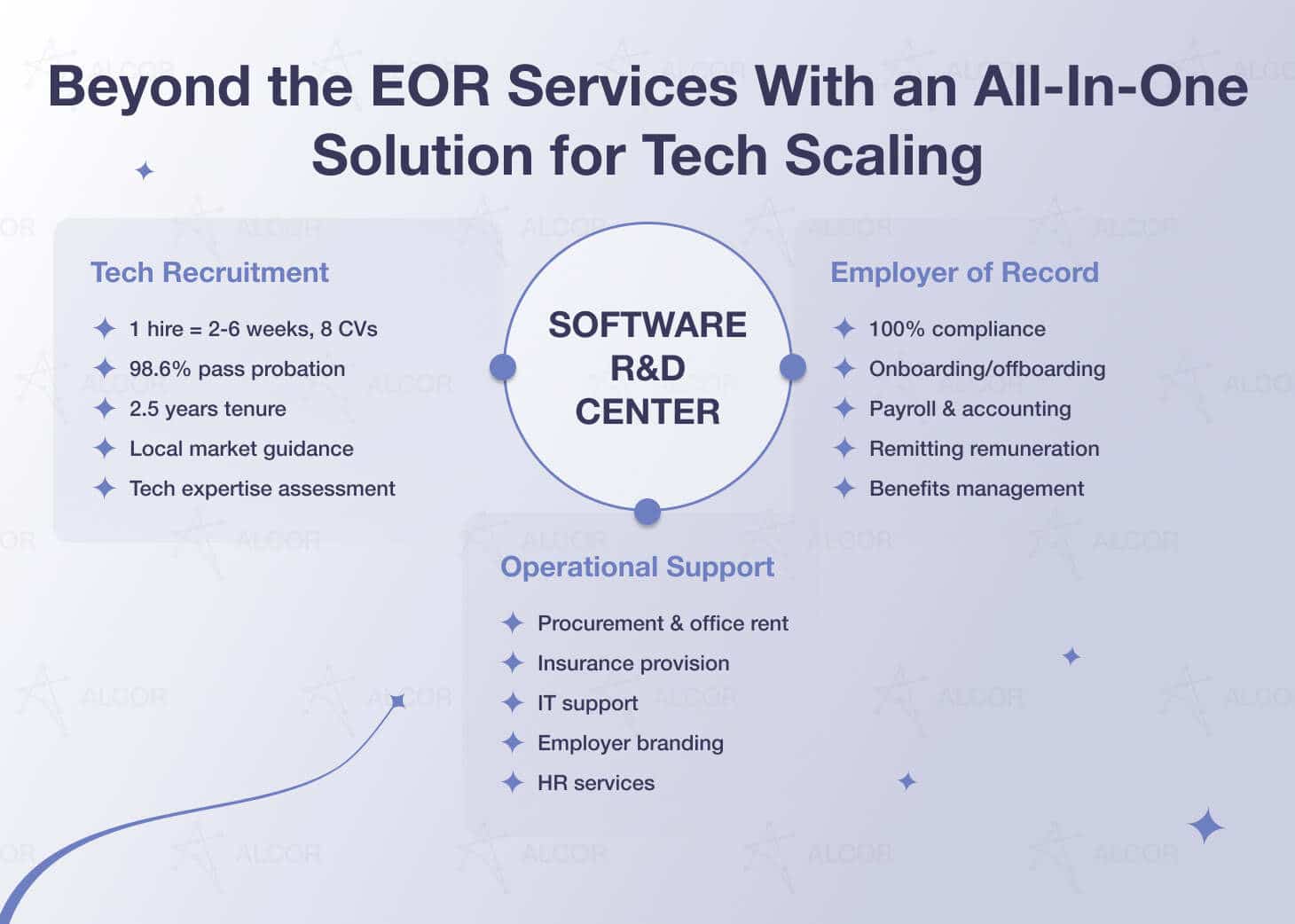
GoTransverse, an Austin-based billing infrastructure company with $72M raised, had picked Eastern Europe for its engineering hub but had no legal entity in Poland, Romania, or Ukraine – and no partner who could both hire and employ compliantly. Alcor’s three core services delivered it together:
- Silicon Valley-grade recruitment: Ten technical recruiters built curated pipelines per role rather than bulk outreach, sourcing top-10% engineers in Java Spring, Hibernate, React, Python, and Flask. Six unicorn-grade hires landed in 6 weeks – five full-stack engineers and a data-savvy Product Manager – at a 95% CV pass rate, so GoTransverse’s leadership interviewed candidates instead of filtering them. The team later scaled to 25.
- Tech-exclusive EOR/COR: Alcor’s legal entities were already running in all three countries, so GoTransverse skipped incorporation entirely. Contracts, payroll, and finance operations went live in days rather than months – before a single engineer signed anything.
- 360-degree operational support: Hardware procurement, IT setup, and cross-border logistics went to a dedicated account manager who answered within a day – including sourcing certified equipment in Bali and shipping it to the EU. Zero leadership time lost to operational firefighting.
Three years on, GoTransverse’s engineering team is still intact, still productive, and still entirely theirs – with 40% saved on costs, no markups, and no buy-out fees. That money stayed in the product budget.
Want more success stories? Deep-tech, defense-tech, and unicorn companies already build this way with Alcor – Ledger, Pindrop, and UFORCE among them – each one turning a hiring gap into a team that ships product.
With Alcor, you can stay focused on the product. We’ll handle everything else. Ready to hire software developers in Poland?
FAQ
What are the main reasons for hiring a dedicated development team in Poland?
Poland combines scale and specialization: a 778,800-strong tech workforce, the region’s largest, ranked #1 in Central and Eastern Europe on TopCoder’s competitive-programming index. Add salaries that are 40-59% more cost-effective than in the US, EU-standard compliance, strong English proficiency, and mature tech hubs like Warsaw and Kraków, and Poland becomes a market where product companies can build a fully owned engineering team without competing twice for the same small pool of candidates.
Which best practices can enhance the IT recruitment process in Poland?
Curated, role-specific sourcing outperforms bulk outreach – targeted pipelines built around exact tech stacks land stronger candidates faster than mass job postings. Pair that with realistic salary benchmarking against current market data, a clear employer value proposition for competitive niches like AI/ML, and technical screening by engineers, not generalist recruiters. Companies that skip these steps typically see longer time-to-hire and higher early attrition once an offer is accepted.
How can foreign tech companies set up a dedicated development team in Poland?
The most direct path is partnering with a specialized R&D center provider that handles recruitment, employment compliance, and operations together, rather than piecing together separate vendors. This means no local entity to incorporate, no learning a new labor code, and no vendor layer between you and your engineers – just a team that reports directly to you, works inside your culture, and is fully yours from day one.
What is the go-to model for hiring dedicated teams in Poland with full compliance and operational support?
A software R&D center model bundles recruitment, EOR/COR employment compliance, and day-to-day operational support – equipment, IT setup, payroll – into a single partnership, instead of managing multiple vendors separately. Your engineers are hired legally in Poland without you opening an entity, while you retain full ownership of the team, its output, and its IP. A dedicated Customer Operations Manager, not an automated support ticket, handles the operational side.
How fast can a dedicated development team in Poland be up and running?
Senior roles typically close in 2–6 weeks, meaningfully faster than the 2–4 months (up to 6 for the most senior searches) common in the US market. A first team of 5 engineers can be operational within a month, scaling to 10–30 within 90 days for companies with larger roadmaps. That speed comes from established local recruiting infrastructure and pre-vetted candidate pipelines, not from cutting corners on technical screening.
How would you rate this article?
Alcor is Your Trusted Scaling Partner
for expansion
support