


The software developer salary in Colombia shifted in 2026, according to Alcor’s internal software developer salary research: senior-level pay across matched roles dipped roughly 8% year-over-year – from an average of $66,638 in 2025 to $61,125 in 2026. Meanwhile, a new tier of AI-specialist roles now shapes Colombia’s market, adding fresh upside to the overall picture: AI Research Scientist alone averages $129,000 annually.
So what happens next for companies hiring remote talent in Colombia? Three data points shape the 2027 outlook:
- Inflation sets the floor. Colombia’s annual inflation climbed to 6.03% in July 2026 – the baseline pay needs to outpace just to hold steady.
- The ceiling keeps rising. Michael Page’s 2026 Technology Salary Guide puts senior software development pay in Colombia as high as 23 million COP a month (roughly 88,700 USD a year at current exchange rates).
- But don’t expect a runaway climb. Korn Ferry’s latest Total Rewards Pulse Survey found salary-increase budgets flat-to-lower for 2027 versus 2026 across most major markets.
In the next 10 minutes, you’ll get the full picture: how software engineer salaries in Colombia stack up against the US market, role-by-role compensation breakdowns from Alcor’s own recruitment data, and what the advantages and challenges of hiring Colombian developers mean for your budget in 2026-2027.
Key Takeaways
- Colombia’s average software developer salary dipped roughly 8% for traditional roles in 2026 (to $61,125 senior average), even as AI-specialist roles like AI Infrastructure Engineer pay up to $168,000.
- Total employment cost extends well beyond base pay: roughly 30% employer tax on FTE hires, plus Prima, Cesantía, and about $3,300 per year in competitive optional benefits per engineer.
- Colombia offers a 202,000-strong tech talent pool, ranks #6 in Latin America on TopCoder, and delivers senior developers at roughly 57% below US pay on average.
- Hiring in Colombia means navigating real complexity: moderate English proficiency outside major hubs, a phasing-in 2025 labor reform, and courts that can reclassify misclassified contractors as employees.
- Alcor builds compliant engineering teams across Latin America and Eastern Europe, hiring top-10% tech talent in just 2-6 weeks with no legal entity or setup fees – with EOR, tech recruitment and operational support combined under one roof.
Software Developer Salaries in Colombia
The average software developer salary in Colombia ranges from $40,800-$78,000 for middle-level roles, $57,600-$123,000 for senior roles, and $57,600-$168,000 for lead roles annually, based on Alcor’s 2026 internal salary research covering 15+ positions from Node.js to AI Engineering. AI-specialized roles pay 40-60% above traditional ones at the same seniority. Compared to the US, a senior DevOps Engineer earns $70,800 in Colombia versus $168,000 in the US (58% lower); across matched roles, Colombia’s senior developer pay runs roughly 57% below US rates. Pay also varies by industry: senior developers rank #4 nationally by earnings, AI specialists #2. Alcor builds compliant engineering teams in Colombia at these exact market rates.
The first step to understanding the employment cost of your engineer is the base salary. With my team of 40 tech recruiters, we broke down middle, senior, and lead developer salaries in Colombia across the roles shaping today’s market, from established stacks like Node.js and Python to the new wave of AI-specialist positions.
|
Average Annual Software Developer Base Salary in Colombia | |||
|
Position |
Middle |
Senior |
Lead |
|
Node.js Developer |
$44,400 |
$60,600 |
$78,000 |
|
Python Software Engineer |
$50,400 |
$66,000 |
$83,400 |
|
Ruby Software Engineer |
$40,800 |
$57,600 |
$78,000 |
|
Mobile Developer (iOS/Android) |
$49,800 |
$67,800 |
$84,000 |
|
Blockchain Engineer |
$50,400 |
$73,200 |
$93,000 |
|
Data Engineer |
$54,000 |
$78,000 |
$93,600 |
|
DevOps Engineer |
$49,800 |
$70,800 |
$93,600 |
|
AI Engineer |
$69,000 |
$105,000 |
$144,000 |
|
ML Engineer |
$51,000 |
$78,000 |
$120,000 |
|
LLM Engineer |
$63,000 |
$96,000 |
$132,000 |
|
AI Product Engineer |
$57,000 |
$87,000 |
$132,000 |
|
MLOps Engineer |
$57,000 |
$93,000 |
$135,000 |
|
AI Platform Engineer |
$72,000 |
$111,000 |
$156,000 |
|
AI Infrastructure Engineer |
$78,000 |
$123,000 |
$168,000 |
|
AI Prompt Engineer |
$48,000 |
$75,000 |
$102,000 |
|
According to Alcor’s internal tech salaries research (As of September, 2026) | |||
Take a senior DevOps Engineer salary in Colombia as an example: median wage lands around $70,800 a year, compared to $168,000 for the same seniority in the US – a gap of nearly 58%. Even in the pricier AI lane, a senior AI Engineer in Colombia averages $105,000 versus $222,000 in the US, still a savings of over 50%. Averaged across all matched roles, Colombia’s senior software developer salary runs roughly 57% below the US – exactly why so many companies are exploring nearshore outsourcing to Colombia for their engineering teams.
Base salary is just the entry point, though. A bit later in this article, I’ll break down the taxes, recruitment fees, and benefits packages that turn that number into your true employment cost in Colombia – but for now, let’s zoom in on how pay shifts once you factor in which industry is doing the hiring.
Turn your AI hiring pressure into a clear plan
Explore 8 tech markets across LATAM and Eastern Europe and get practical insights for building your AI engineering team.
Salaries by industry
To give a broader picture of Colombia’s job market, base pay for developers shifts depending on the industry behind the paycheck. National rankings put senior software developers at #4 in the country, earning 9-16 million COP a month (roughly 34,700-61,700 USD a year), while AI specialists rank even higher at #2, pulling 12-18 million COP a month (about 46,300-69,500 USD a year).
Finance, banking, and insurance roles rank #3 overall among all professions in the country, which tracks with why software, IT hubs, banking, insurance, and technology integrators are named as the industries competing hardest for that same AI and data talent. It also explains the gap I mentioned earlier: the 23 million COP ceiling for senior developers (~$88,700 USD a year) sits well above this national range, reflecting the premium that multinational and internationally-linked employers pay over the broader domestic market.
For a sense of scale at the company level: Glassdoor users self-report software engineers at Bancolombia, one of the country’s largest banks, earning around COP 55.7 million a year (roughly 17,900 USD) since purely domestic salaries are typically set and benchmarked in pesos rather than USD. Global IT-services firms operating in Colombia tend to close that gap: EPAM Systems reports a median compensation closer to $54,000 USD a year.
Cost of Hiring Software Engineers in Colombia in 2026-2027
Hiring a software engineer in Colombia costs more than the average software engineer salary in Colombia alone. Total employment cost includes statutory benefits, payroll taxes, and optional perks. For full-time employees, employers pay roughly 30% on top of gross salary in social security and payroll taxes (pension, health, SENA, ICBF, family compensation fund), plus Prima and Cesantía. For contractors, employers owe no social security contributions, though the contractor’s own effective rate runs about 17.22%. A competitive optional benefits package (health insurance, connectivity, meals, home office) adds roughly $3,300 per engineer annually. Colombia’s 2025 labor reform keeps phasing in through 2027, raising Sunday surcharges and adding disability-hiring quotas. Alcor’s EOR service handles all of this with no local entity required.
Earlier, I promised to come back to this. Base salary is the headline number, but it’s not what lands on your invoice – understanding the average salary in software development in Colombia is only step one. Layered on top are statutory benefits, employer taxes, the optional perks it takes to land senior talent, and, if you’re working with a provider instead of standing up your own entity, recruitment and EOR fees. Here’s everything that goes into the real number in 2026:
Statutory benefits
First, the benefits every employer in Colombia is legally required to provide, regardless of company size or industry:
- Vacation: 15 working days after 1 year of service (at least 6 days must be taken annually)
- Sick leave: first 2 days paid fully; then 66.7% through day 90 and 50% for days 91-180, paid by the Social Security Institute (EPS)
- Maternity leave: 126 calendar days (18 weeks) – 1 prenatal week is mandatory, plus 2 additional weeks for multiple births, with up to 6 weeks shareable between both parents
- Paternity leave: 14 days at 100% of salary, paid by the employer and reimbursed by the health insurer
- Mourning leave: up to 5 days
- Education leave: up to 10 days
- Holidays: 19 paid public holidays in 2026
Taxes
Benefits are the legal floor for the employee experience. Colombian taxes are the legal floor for what you, the employer, actually pay, and this is exactly where the two hiring models, FTE and B2B, stop looking anything alike.
|
Model |
Employer’s Share |
Employee’s / Contractor’s Share |
|
FTE |
Effective employer rate: ~30% on top of a $5,000 salary Additional obligations:
|
Effective employee rate: ~21.16% on top of a $5,000 salary |
|
B2B |
Not mandatory – no employer-side social security obligation |
Effective rate: ~17.22% on top of a $5,000 pay |
Optional benefits packages
Everything above is mandatory. This next part isn’t, but skip it, and you’ll lose the developers you actually want. Colombia’s top-10% senior engineers (the ones with strong English, deep AI/ML experience, and a multinational track record) compare the whole package, not just the base number. Employers aren’t required to offer anything beyond the statutory minimum, but if you want to compete for that tier, here’s what “competitive” typically looks like:
- Transportation/connectivity allowance: ~$500/year
- Health insurance: ~$1,500/year
- Meal vouchers or food allowances: ~$500/year
- Home office allowance: ~$800/year
Total: ~$3,300/year per engineer
If you’re working with a provider
One more layer applies only if you’re not standing up a Colombian entity yourself and are hiring through a provider instead (which is how most companies actually do this):
- A recurring EOR/COR fee, billed monthly, that hands off employment contracts, payroll runs, tax filings, statutory benefit administration, IP-assignment clauses, and ongoing HR and legal compliance to the provider. Pricing is usually structured one of two ways (a flat fee per engineer or a percentage of gross salary) with volume discounts as headcount grows.
- A one-time recruitment fee for actually finding the person: sourcing, screening, technical assessment, and shortlisting. Market rate runs 15-25% of the role’s annual base salary per successful placement, with AI and ML roles worth pricing at the higher end, given the depth of screening that level of expertise requires.
Cost of hiring software developers projections for 2027
Colombia passed a sweeping labor reform in 2025, and several of its provisions are still phasing in, with full implementation landing in 2027:
- Sunday and holiday surcharge climbing to 100%. It rose from 75% to 80% in July 2025, to 90% in July 2026, and reaches its final 100% rate in July 2027. This mostly hits shift-based and on-call work rather than standard weekday engineering roles, but it’s worth flagging for any DevOps or support rotation that covers weekends.
- Indefinite-term contracts as the default. Fixed-term and project-based contracts are now capped at 4 years before they must convert to indefinite – a real consideration for how you structure longer engagements.
- Mandatory disability-hiring quotas, active since June 2026: 2 hires per 100 employees for companies up to 500 people, rising to 3 per 100 beyond that – relevant math once a team scales past the low double digits.
- Apprenticeship contracts reclassified with full employment rights and social security from day one, and now mandatory for any company with 15 or more employees.
- Remote work formalized, including a mandatory connectivity subsidy for remote employees earning under 2× the minimum wage.
Layered on top of the labor reform is the minimum wage question. Colombia’s 2026 minimum wage jumped 23.7% – the largest increase in the country’s modern history, and widely described as a politically-driven decision ahead of the 2026 elections rather than a strictly economic one. Early 2027 negotiations are already pointing toward a much more moderate 5-7% range, closer to inflation. That matters even for well-paid senior engineers, because several of the thresholds in the tax table above (like the point where employer health insurance contributions kick in) are pegged to multiples of the minimum wage. When it moves sharply, those thresholds move with it, which is reason enough to recheck this math annually rather than assume it holds.
Portrait of a Software Developer in Colombia
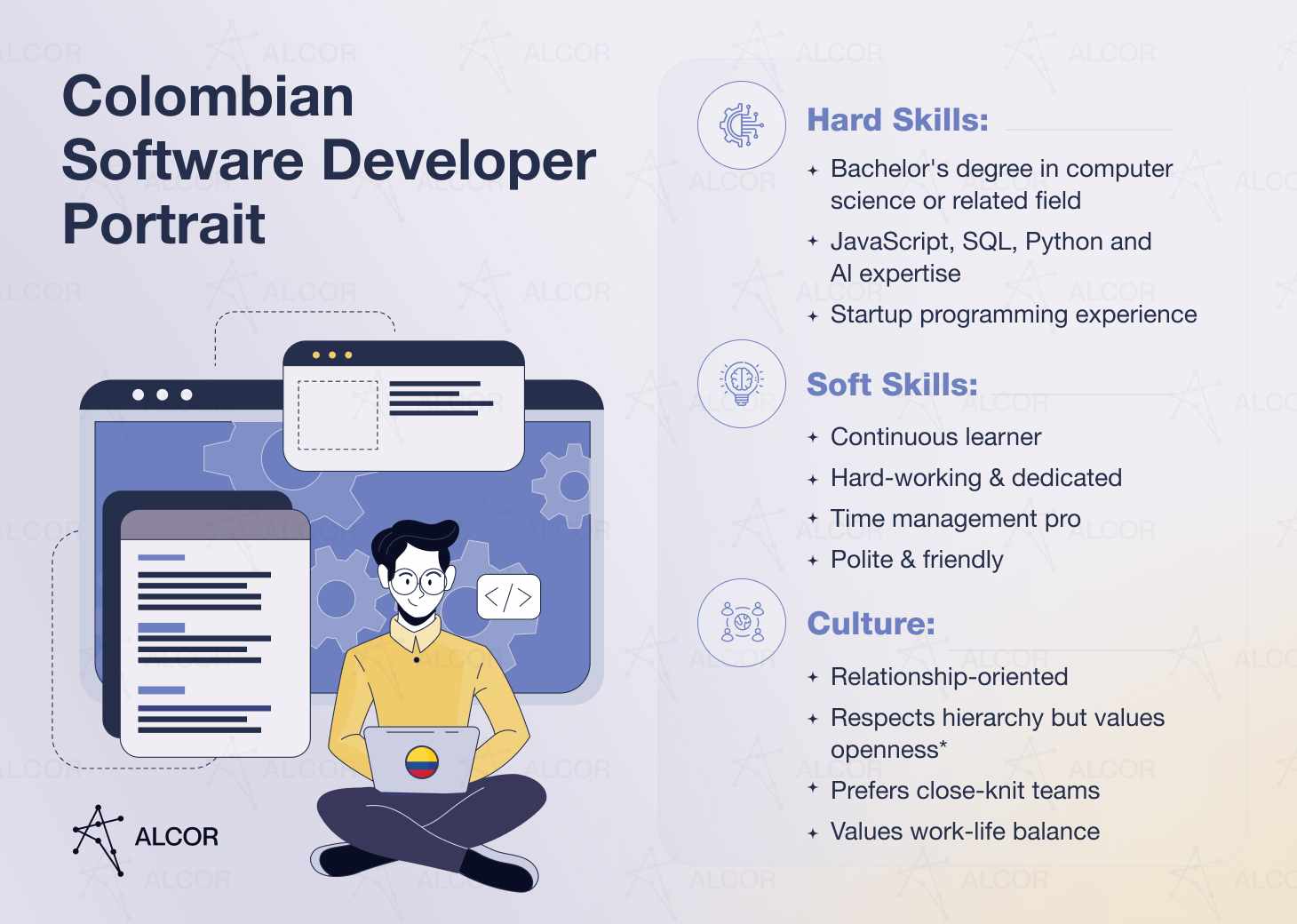
The typical Colombian software developer is around 30 years old, holds a computer science degree, and specializes in JavaScript, SQL, Ruby, or Python. Colombian developers rank strong on continuous learning, with critical-thinking course enrollments up 899% year-over-year (Coursera, 2025), and on AI adoption: every surveyed Colombian organization now runs active AI programs, and 82% plan to increase AI budgets, the highest rate in Latin America. Culturally, Colombian developers value close-knit, relationship-oriented teams, work-life balance, and long tenure with one employer. These traits, combined with software developers’ salaries in Colombia running well below US rates, are why companies like Franki built engineering teams in the region through Alcor.
Age & Education
The typical Colombian software engineer is a 30-year-old professional holding a bachelor’s degree in computer science or related fields. Information and security systems are also popular majors.
Hard Skills
Many Colombian software developers take their education beyond formal degrees, and the appetite for it is only accelerating. Coursera’s 2025 Global Skills Report clocked an 899% year-over-year jump in critical-thinking course enrollments among Colombian learners – one of the fastest growth rates the platform tracked anywhere in the world. That same restlessness shows up on the job: per Terminal’s 2025 State of Remote Engineering Report, engineers across Latin America are more optimistic than those in Europe or Canada that new technology will expand their opportunities rather than shrink them.
Speaking about programming languages, Colombia is a hotspot for companies looking to hire experts in JavaScript, SQL, Ruby, and Python, and it’s exactly that stack depth that keeps the App Developer salary in Colombia (among others) competitive with the rest of the region.
Finally, thanks to the bustling startup environment, Colombian software engineers have a unique chance to learn the ropes of programming in a startup, which is why they typically have such experience.
Soft skills
Colombian software developers are renowned for their work ethics. They respect hierarchical structures but also value teamwork and collaboration. Colombians are also renowned for their time management skills, as they are dedicated to meeting deadlines.
Colombians bring friendliness, openness, and respect to communication. Together with their way of thinking and adaptability, these personal skills make them a great asset to the team and attract more international tech companies to pursue software development in Colombia.
AI Adoption Rate
Colombian tech companies are funding AI adoption faster than anywhere else in the region. According to Coursera’s 2025 Global Skills Report, every organization surveyed in Colombia for the World Economic Forum’s Future of Jobs Report 2025 now runs active AI programs (12 percentage points above the global average) and 82% plan to increase their AI budgets over the next two years, the highest rate in Latin America. That appetite shows up in how fast Colombian developers are upskilling, too: GenAI course enrollments on Coursera grew 1,017% year-over-year, the single largest jump the platform recorded among its spotlight countries worldwide.
The same shift is visible at the individual developer level: per Terminal’s 2025 report, AI tool adoption among engineers surveyed globally jumped from 45% in 2024 to 71% in 2025, with 80% saying their employers actively encourage it. For companies hiring Colombian software engineers, that translates into candidates who increasingly walk in already fluent in AI-assisted coding, code review, and documentation.
Cultural Peculiarities
Colombians value trust and close-knit teams. Coming from a relationship-oriented culture, they include time for casual conversation in virtual meetings. Colombians prefer to balance formality and informality, bringing warmth and friendliness to the workspace.
Not to mention that developers from this region value work-life balance. The research reveals that 62% of surveyed tech specialists in Latin America prioritize flexible hours when choosing a future employer.
Thus, Colombian tech employees and contractors show initiative, genuine interest, and polite consideration for their teams. Besides, the value of trust motivates them to stay with one company for longer, reinforcing their exceptional work ethic.
That same relationship-first culture is exactly what nearshoring is built on, and it travels well across the region. Take Franki, a Los Angeles-based video-experience platform that built its mobile engineering team in Mexico (another prominent Latin American tech hub) through Alcor. For a notoriously hard-to-fill stack (senior iOS engineers with RxSwift expertise), Alcor delivered a pipeline of 20 qualified candidates, closing each of Franki’s first seven hires in 4-5 weeks, with every one passing probation. The payoff showed up directly in the product: Franki’s revenue doubled quarter-over-quarter the same year its Mexico team came online.
“We’ve found some great talent in both Mexico and Colombia,” said Eugene Varricchio, Franki’s Executive Advisor and former CEO – and with the software developer salary in Mexico sitting in a mostly similar band to Colombia’s, it’s exactly why more companies now treat the two markets as complementary.
Advantages and Challenges of Hiring Developers in Colombia
Colombia’s core advantage for hiring developers is scale and cost: a talent pool of 202,000+ tech professionals, 37,000 STEM/ICT graduates a year, and an average annual salary in Colombia for a software engineer that runs roughly half of US rates (e.g., $57,000 vs. $180,000 for a senior Product Manager). Colombia also ranks #6 in Latin America on TopCoder’s competitive-programming index and is a major JavaScript hub. The main challenges are moderate English proficiency outside major hubs and intricate labor law, including the primacía de la realidad doctrine, which lets courts reclassify contractors as employees, triggering retroactive benefits and fines. Alcor manages both sides of this trade-off for US companies.
Every market has an upside and a catch, and Colombia is no exception. Here’s the full picture where Colombian developers genuinely outperform, and where hiring here takes real planning:
Advantage #1: numerous & educated talent
The Colombian talent pool boasts over 202,000 tech professionals. Among them, computer science majors are in demand: Colombia graduates roughly 37,000 STEM and ICT students a year, and the first five best universities in Colombia alone enroll 20,000+ students. The University of the Andes Colombia, the Universidad Nacional de Colombia, and Pontificia Universidad Javeriana all rank in LATAM’s top 30.
Advantage #2: high programming ranking
Colombia’s tech talent shows real strength on competitive, verifiable benchmarks: on TopCoder’s competitive-programming rankings, Colombia holds the #6 spot across all of Latin America.
Colombia is also a genuine JavaScript hub. CityJS Medellín, held annually in Medellín, has become the country’s leading JavaScript conference, drawing developers from across Colombia and the wider region. That community strength lines up with where the real demand sits: JavaScript and HTML/CSS remain the two most widely used languages among developers worldwide, according to the 2025 Stack Overflow Developer Survey, alongside Python and SQL – exactly the stack Software developers in Colombia are prized for.
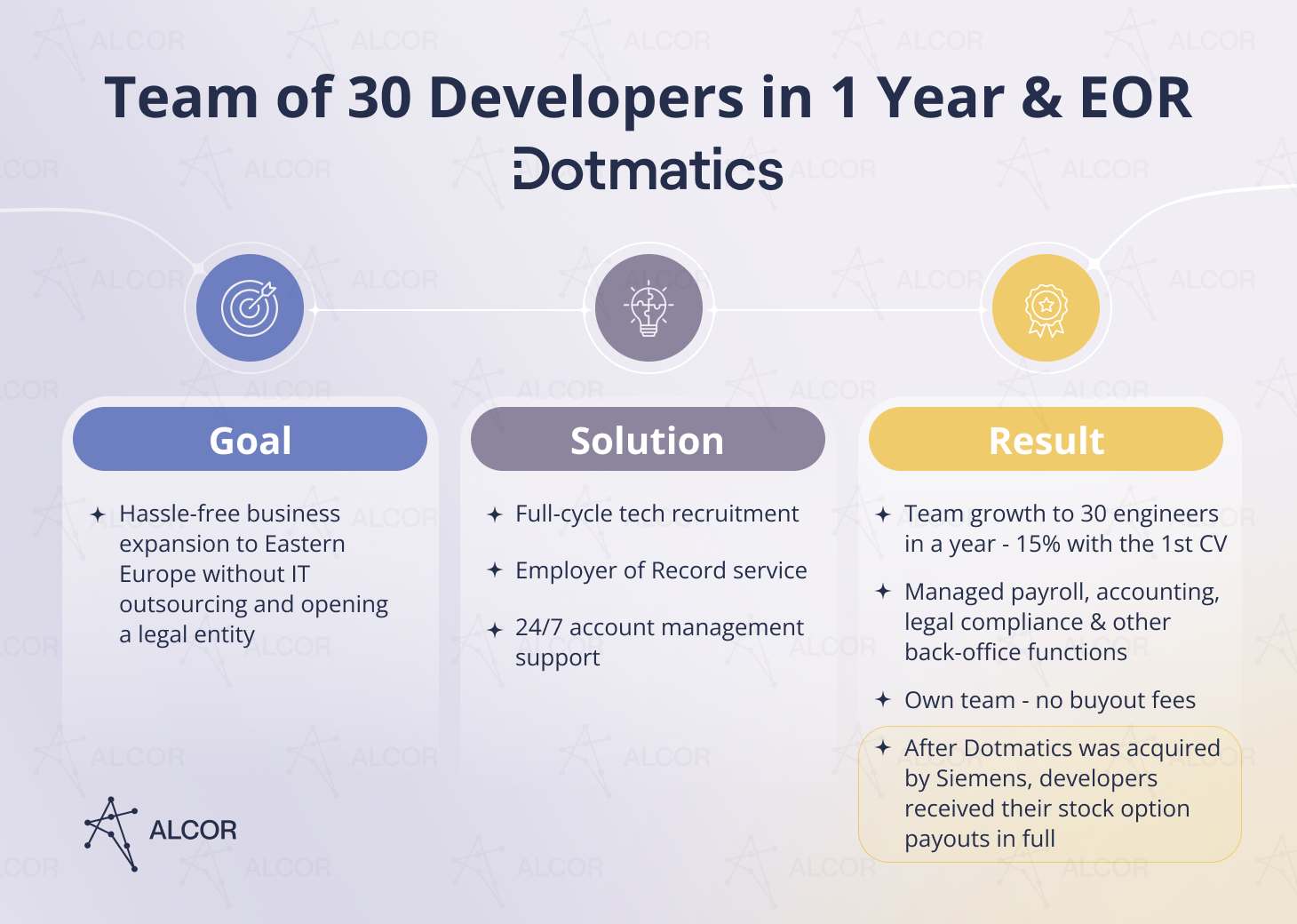
At Alcor, we find qualified developers with different stacks. For one of our clients, a US-based scientific software company, Dotmatics, we managed to hire 30 software engineers in a year, including JavaScript and Java tech stacks, but also Node.js, C++, React, AWS, and Cypress. So, if you’re in need of expert devs to nearshore your business to Colombia, we’re just a click away!
Advantage #3: affordable developer compensation
Given the high level of expertise of software engineers in Colombia, outsourcing software development allows substantial cost savings while maintaining high quality. For example, a senior Product Manager in Colombia earns around $57,000 a year, against $180,000 in the US – a 68% difference. Senior UX/UI Designers see a similar pattern: $51,000 in Colombia versus $141,000 in the US, a 64% gap. And for senior QA Automation Engineers, Colombia’s $50,400 average sits 65% below the US figure of $145,500. Whatever the role, the pattern repeats: Colombia consistently delivers comparable output at a fraction of the US price tag.
Advantage #4: manageable time differences
The central tech hub, Bogota, is two hours ahead of California and one hour behind New York, so staying in touch with your offshore developers in Colombia is easy. Besides, overlapping work hours help you manage the remote team and stay on top of your software production deadlines.
Of course, no market is without trade-offs. Here’s what to watch for:
Challenge #1: developing English proficiency
While the overall level of English in Colombia is not the highest (the country ranks 17th in LATAM on the EF English Proficiency Index) it is not the end of the world. Such big tech hubs as Bogotá, Medellín, and Cali demonstrate a moderate to high level of English, and Colombia’s IT sector specifically rates as Upper-Intermediate.
Challenge #2: intricate labor laws
Colombian legislation has several nuances. Generally, the peculiarities concern a 42-hour working week (down from 48, following the final phase of Law 2101’s reduction in July 2026), 25% extra pay for overtime hours, 15 days of paid vacation. If you read the cost breakdown earlier in this article, you already got a preview of just how many moving pieces sit inside that ~30% employer tax rate – Prima, Cesantía, cesantía interest, and more.
But the trickiest part is the classification. Colombian courts apply what’s called the primacía de la realidad (“primacy of reality”) doctrine under Article 53 of the Constitution: if a contractor relationship actually functions like employment (set hours, close supervision, ongoing exclusive work) a court can reclassify it as one, regardless of what the contract says. When that happens, the company owes back pay for every mandatory benefit covered earlier, for the entire length of the relationship, plus fines from the Ministry of Labor. Colombia’s social security enforcement body, the UGPP, has gotten considerably more aggressive about auditing exactly this in recent years.
On top of that, comprehensive employee protection requirements and active labor unions add real complexity to hiring and termination decisions. The most practical way for American tech companies to navigate all of it is to seek a trusted partner to handle everything.
What 2027 Holds for Software Development Industry in Colombia
Colombia’s tech and startup ecosystem is expanding faster than most of Latin America: the country ranks #35 globally (up from #47 in 2021) and #2 regionally on StartupBlink’s 2026 index, with 29.3% year-over-year growth and 2,295 active startups nationally (KPMG, 2026). Bogotá, Medellín, and Cali are all climbing global rankings, with Medellín now Latin America’s densest startup hub. Fintech leads the startup sector mix at 19%. Colombia’s digital transformation market is projected to grow at a 21.78% CAGR through 2030 (Mordor Intelligence), and Colombia ranks alongside Brazil and Mexico as a top driver of Latin America’s outsourcing growth, on technical talent and cost – the exact trend Alcor’s Colombia hiring model is built around.
Colombia’s startup scene is climbing the global leaderboard faster than almost anywhere else in the region. The Global Startup Ecosystem Index 2026 by StartupBlink puts Colombia at #35 worldwide, up from #47 in 2021, on the back of 29.3% year-over-year growth – comfortably ahead of the regional average. That holds the country at #2 in Latin America, behind only Brazil (#26 globally, the region’s leader for seven consecutive years). The country is still home to the startups that put it on the map (Rappi, ADDI, Bold, Platzi, Habi, and LaHaus among them) but the depth behind those household names is what’s new: seven Colombian cities now rank in StartupBlink’s global top 1,000, the second-deepest city footprint in South America after Brazil.
The city-level detail tells its own story:
- Bogotá holds #3 in Latin America (behind only São Paulo and Mexico City), with 889 active startups and $155M+ in total funding. The capital led growth among the region’s three major entrepreneurial capitals at 9.2% in the latest reading.
- Medellín now leads all of Latin America in startup density (10.9 startups per 100,000 residents) (ahead of São Paulo, Santiago, Rio de Janeiro, and Buenos Aires) and has become the 6th-strongest startup city in Latin America overall, an unprecedented result for a non-capital Colombian metro. Per KPMG’s Colombia Tech Report 2026, the city hosts 698 startups (up 28.5% from 543 in 2024) and pulled in roughly $157 million in venture investment in 2025 – a 400% year-over-year jump.
- Cali is the fastest-mover on the list: it jumped 65 spots to #212 globally, a 104.3% growth rate that’s the highest of any top-300 Latin American city. It’s now Colombia’s third-strongest startup ecosystem and #13 regionally, with the surrounding Valle del Cauca region home to 266 active startups – 12% of the national total.
Nationally, KPMG’s Colombia Tech Report 2026 counts 2,295 active startups, a 9% increase year-over-year. Fintech leads the sector mix at 19% of the total, followed by AI, B2B SaaS, and social-impact tech.
The market-size numbers back up the trajectory. Mordor Intelligence projects Colombia’s digital transformation market growing at a 21.78% CAGR through 2030, with Microsoft, Google Cloud, GFT/Sophos Solutions, Oracle, and SAP as the major players already active in-market. Colombia’s IT service management segment specifically is set to more than double, from $108.5 million in 2026 to $209.7 million by 2031 (14.08% CAGR), facilitating the positive opportunity for outsourcing software development to Colombia.
Zoom out to the region, and Grand View Research puts the broader Latin America IT services market on track for $110.3 billion by 2030 (7.3% CAGR) – with Mordor Intelligence separately noting that Brazil, Colombia, and Mexico are the three countries leading that regional outsourcing growth, driven by qualified technical talent, US time-zone alignment, and software developer salaries that undercut both Eastern Europe and Asia.
Your Software Development Center in Colombia
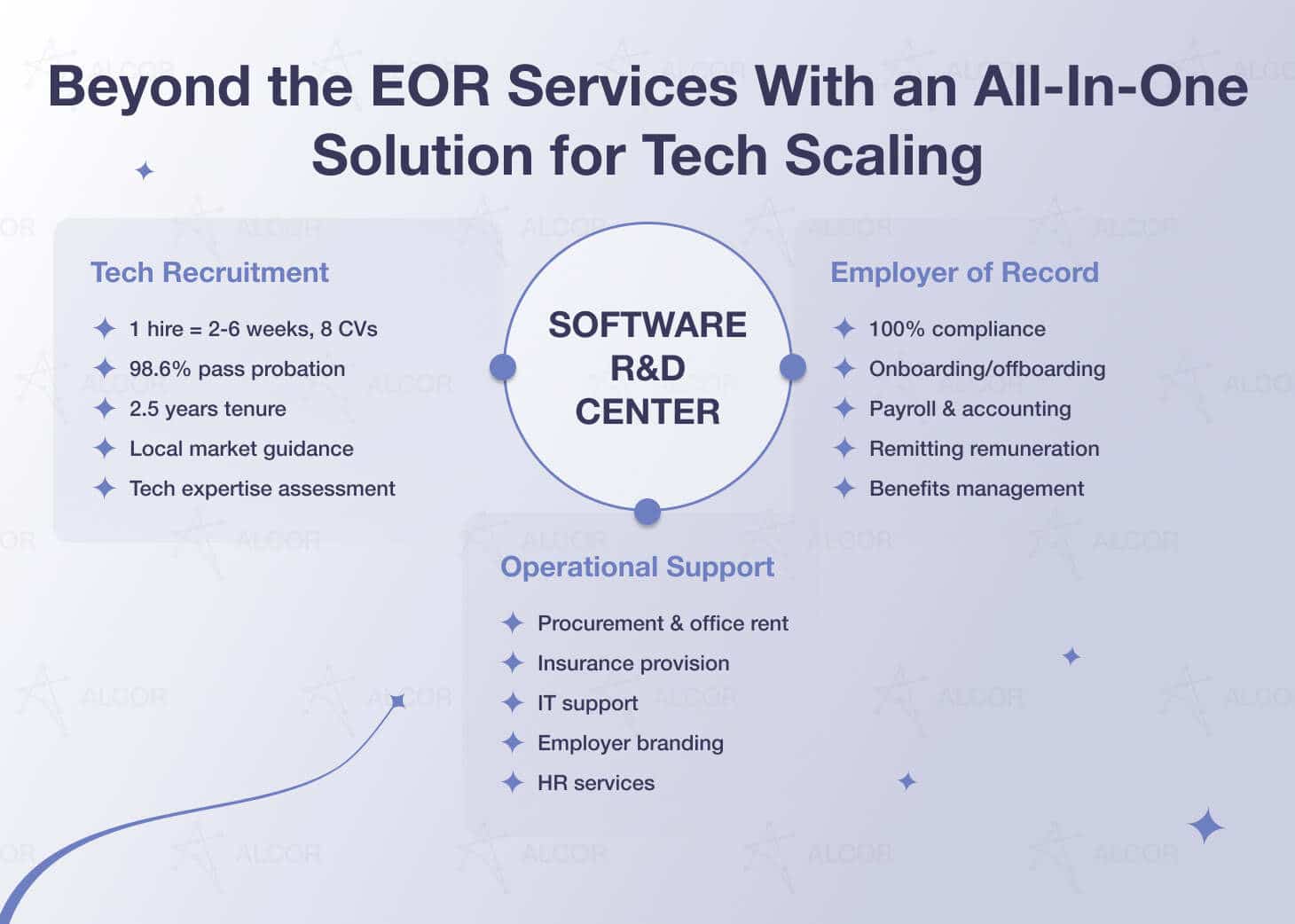
Alcor builds compliant, in-house engineering teams in Colombia for US tech companies that need to scale past what the US talent market can supply cost-effectively, handling recruitment, Employer of Record services, tax compliance, and office setup as one integrated service, with no legal entity required. Proof point: Backstory (formerly People.ai), a US-based AI unicorn valued at $1.1B, scaled from 25 to 50 engineers through Alcor, with 98.6% passing probation and average tenure above 2.5 years. Alcor applies the same model to Colombia: first hires typically land in 2–6 weeks, with no setup fees, buy-out costs, or need to open a local entity.
Somewhere between your 10th hire and your 100th, the math on US-only engineering stops working. You’ve raised real money. You’ve got an engineering leader who knows exactly what a great hire looks like. And you need 10, 20, maybe 40 more of them – fast, not eventually. The Bay Area talent pool isn’t solving that problem anymore.
Most companies think of payroll outsourcing services in Colombia as a standalone need. Alcor treats it as one piece of something bigger – a full software R&D center, complete with Silicon Valley-grade tech recruitment, compliant Employer of Record and full operational support.
Backstory (formerly People.ai) builds AI that quietly tracks every customer touchpoint so sales teams stop guessing where a deal stands. Zoom, Cisco, Nvidia, and Verizon all run on it. By 2021, the company had raised $100M and crossed a $1.1B valuation.
Before Alcor, Backstory had already picked Eastern Europe for its engineering hub – the talent, the roughly 50% cost savings against US salaries, the work ethic all checked out. What didn’t work was the execution: multiple vendors, duplicated work, nobody owning the outcome, deadlines slipping while competitors’ AI got sharper every week.
Here’s what one partner instead of five looked like:
- Step 1: Structure: Alcor’s legal and finance team built the entity structure, compliant with both US and local law, and unlocked IT tax incentives that cut costs from day one. No legal entity for Backstory to open, no legal exposure to carry.
- Step 2: Space: Our real estate team found, leased, and equipped an office – fully operational in one month, without Backstory’s leadership touching a single landlord negotiation.
- Step 3: Search: 40 in-house tech recruiters sourced specifically for Python, Scala, Java, Kafka, and Big Data – screened for technical depth and cultural fit, not keyword matches.
- Step 4: Scale: 25 engineers in year one. 50 today.
Result: 98.6% passed probation. Average tenure sits above 2.5 years. The engineers Alcor placed aren’t a support layer – they’re now core senior and staff AI engineers building the product itself. One partner since 2017, still delivering.
Backstory isn’t the exception. Sift, Pindrop, UFORCE, BigCommerce, Ledger, and others – all scaled the same way: one partner, one accountable team, no vendor chaos. This isn’t offshoring – it’s an in-house team that happens to sit outside the US.
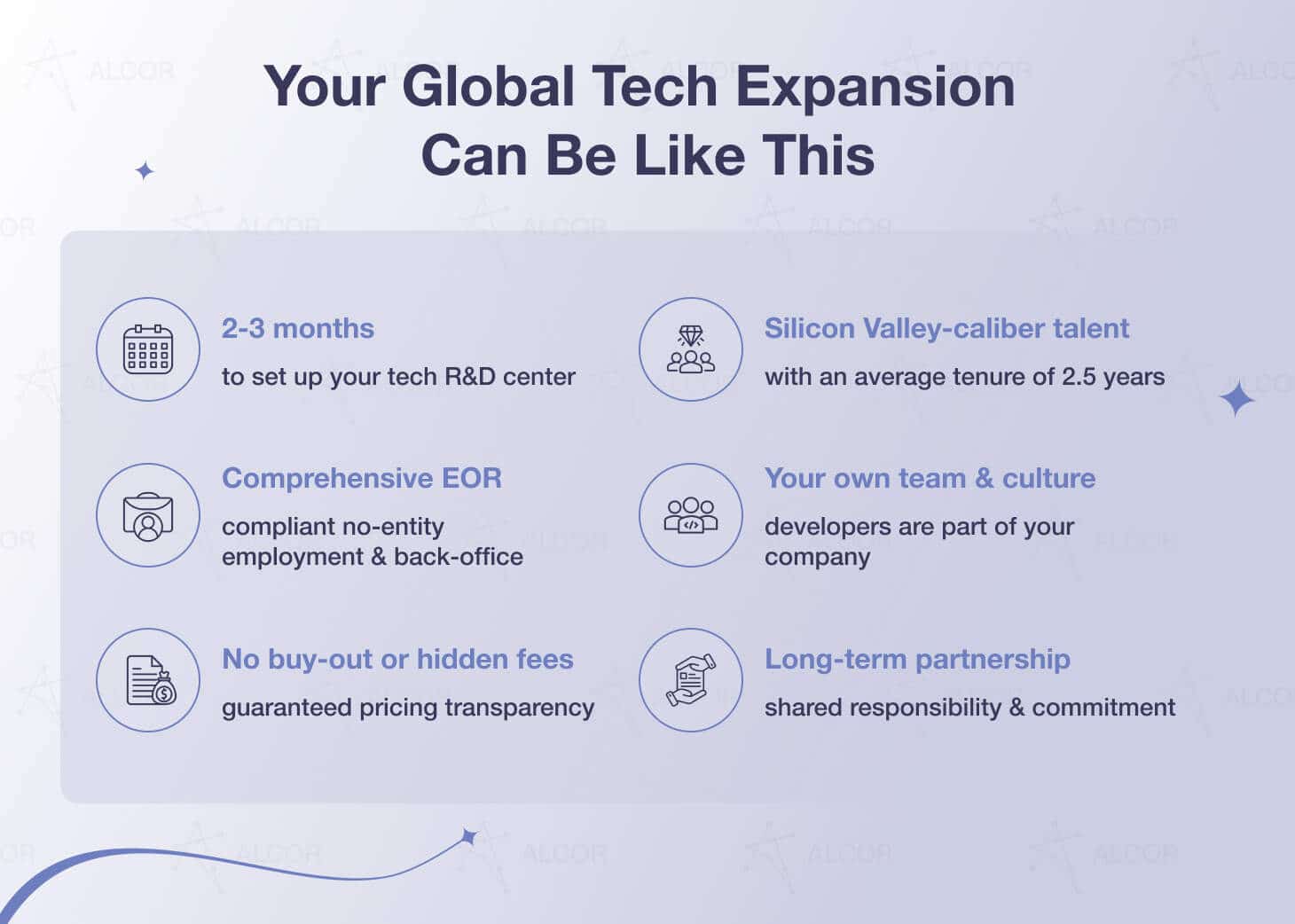
Run the same model with IT headhunters in Colombia and EOR in Colombia handled by one partner, and your team can start the same way. Build your R&D center in Colombia – no entity, no setup fees, no guessing on pay scales.
Book a call and meet your first candidates in weeks, not quarters.
How would you rate this article?
Alcor is Your Trusted Scaling Partner
for expansion
support