


Technology in Mexico is entering a new growth phase: according to Mordor Intelligence, the country’s ICT market is set to hit $78.69 billion by the end of 2026, climbing to $129.52 billion by 2031. That growth rides a broader nearshoring wave – Mexico pulled in $23.591 billion in FDI in Q1 2026 alone, up 10.4% year-over-year, with tech delivery centers now expanding well beyond Mexico City into Querétaro, Guanajuato, and Nuevo León.
As 72% of tech leaders report difficulty finding the skilled talent they need in the US, a rapid development of technology from Mexico is actually a silver lining.
I’m David Gomez, Alcor’s Lead IT Recruiter in Latin America. We build high-performing tech teams through software engineering staffing in Mexico as part of our software R&D services for US and European tech companies – scaling you from 10 to 30 senior engineers in as little as 90 days, with full ownership and zero outsourcing overhead.
In this article, you’ll get a full picture of the technology industry in Mexico – market size, top trends like the country’s fast-growing AI scene, and the sectors driving growth. Everything needed before diving into the leading tech hubs of Mexico and companies to watch in 2026. Best part? You’ll also learn how to tap into this nearshoring powerhouse without relying on Mexican IT outsourcing.
Key Takeaways
- Nearshore software development drives Mexico’s growth: engineers are 45.7-55.7% more affordable than US counterparts, backed by a 974,500-strong talent pool and USMCA trade advantages.
- Mexico’s tech landscape spans rising cybersecurity investment ($4.85 billion by 2030), expanding 5G infrastructure, smart city development, and Plan México’s push to spread industrial infrastructure nationwide.
- Computer equipment overtook automobiles as Mexico’s #1 export ($85.4 billion), AI patents rank in the global top 10, and fintech drew $1.42 billion in 2025 VC funding.
- Mexico City, Monterrey, Guadalajara, and Tijuana lead as tech hubs – home to unicorns, Foxconn’s new AI chip plant, and a $3.2 billion medical device export cluster.
- By 2030, nearshoring could add 3% to Mexico’s GDP and 1.1 million jobs, as AI reshapes demand toward prompt engineering, agent orchestration, and MLOps roles.
- Alcor’s all-in-one software R&D solution skips legal entity setup, delivering 30+ senior engineers in as little as 3 months with full ownership and zero hidden costs.
Mexican IT Industry Overview
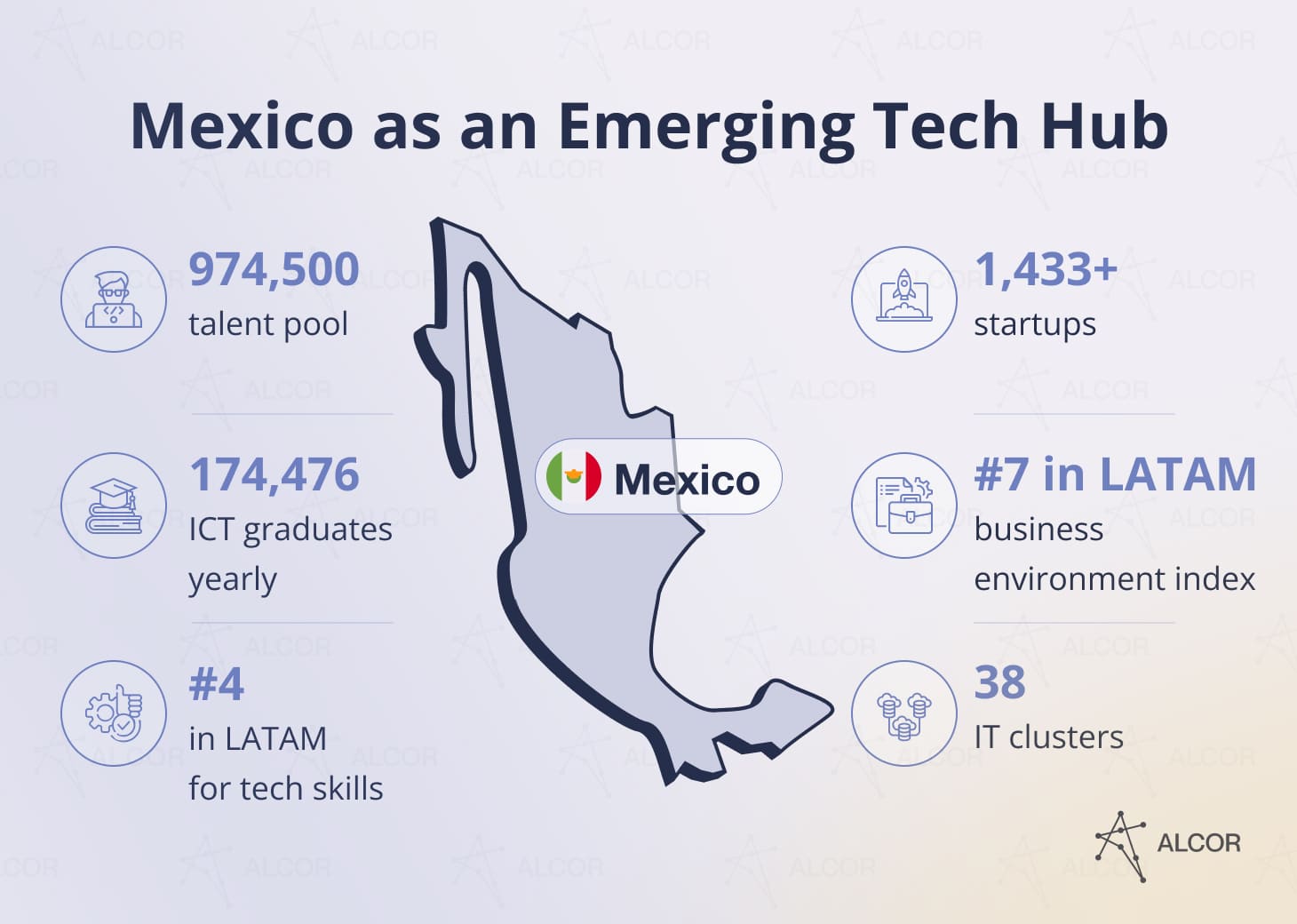
Mexico is Latin America’s second-largest technology market, trailing only Brazil, with its IT services sector projected to grow from $21.28 billion in 2025 to $37.28 billion by 2030 – an 11.87% CAGR, according to Mordor Intelligence. IT outsourcing alone is on track to reach $34.30 billion by 2030, per Grand View Research. The ecosystem spans 38 IT clusters, 12,900 tech companies, and 1,433 startups, backed by a talent pool of 974,500 professionals across hubs like Mexico City, Guadalajara, and Monterrey.
The race for digital transformation has propelled the IT industry in Mexico to remarkable heights, cementing its status as the second-largest technology market in Latin America, trailing only Brazil. The IT sector in Mexico is on the fast track to growing, and according to Mordor Intelligence, the market is set to climb from $21.28 billion in 2025 to $37.28 billion by 2030 – an 11.87% CAGR that outpaces most traditional offshoring hubs. A meaningful share of that growth is IT outsourcing outright: according to Grand View Research, Mexico’s IT outsourcing market alone is set to grow to $34.30 billion by 2030. Even so, the tech market in Mexico is expanding just as fast, contributing directly to the country’s economic development and GDP.
Mexico’s robust and innovative tech ecosystem, which encompasses government initiatives, tech parks, and startup investments, is largely responsible for Mexico’s tech development. For now, it numbers at:
- 38 IT clusters, 12,900 Mexican tech companies, and 1,433 startups.
- Three prominent tech hubs in Mexico are Mexico City, Guadalajara, and Monterrey.
- 174,476 STEM and ICT graduates joining the Mexican workforce every year.
IT Services Market in Mexico
Mexico’s IT services growth is now driven by digital transformation, projected to nearly triple from $39.98 billion in 2025 to $88.33 billion by 2030 (17.18% CAGR), with AI/ML adoption and cloud services leading the shift, per Mordor Intelligence. Nearshore software development is the sector’s core growth engine, backed by a 974,500-strong talent pool, labor costs 45.7-55.7% below the US, and favorable USMCA trade conditions.
Segment by segment, digital transformation itself is the real growth engine: Mexico’s digital transformation market is set to nearly triple from $39.98 billion in 2025 to $88.33 billion by 2030 – a 17.18% CAGR, according to Mordor Intelligence – with AI and machine learning adoption leading the shift across manufacturing, BFSI, and retail. Cloud and platform services aren’t far behind, projected to nearly double from $4.8 billion in 2025 to $9.5 billion by 2030 at a 14.21% CAGR, as enterprises modernize on Microsoft’s regional cloud rollout and Equinix’s sub-5-millisecond interconnect fabric.
The main growth driver of the Mexican IT sector is nearshore software development in Mexico. Here are a few reasons why North American tech companies opt for it:
- Talent pool of 974,500 software developers, ranking #4 in Latin America on TopCoder’s global skills index;
- Moderate labor costs: Mexican engineers are 45.7% to 55.7% more affordable than their US counterparts, depending on seniority, according to Alcor’s 2026 engineer compensation research;
- Geographic proximity and overlapping time zones facilitate efficient and fruitful cooperation;
- Favorable business conditions, ranking #7 in Latin America on StartupBlink’s Innovative Business Ecosystem Index (IBEI) 2026 for financial attractiveness, workforce quality, and market access;
- The availability of the USMCA, which establishes free trade relations, facilitates foreign investment, and enhances the protection of intellectual property rights.
Technology Trends in Mexico for 2026-2030
Mexico’s technology landscape in 2026-2030 spans four key trends:
- rising cybersecurity investment (market projected at $4.85 billion by 2030) backed by a new National Cybersecurity Plan, following the country’s climb to 11th globally in ransomware attacks;
- expanding 5G infrastructure, with Telcel now live in 125 cities;
- smart city development across Monterrey, Guadalajara, Mexico City, Querétaro, Tequila, and Puebla;
- Plan México’s push to spread industrial and tech infrastructure nationwide through 477 industrial parks across 28 states.
Cybersecurity. The rapid proliferation of information technology in Mexico, combined with a surge in data processing, has made the country increasingly susceptible to cyberattacks. Mexico rose to 11th globally in ransomware attacks back in 2025, making it the second-most targeted country in Latin America, after Brazil, according to IQSEC’s Cyber Trends in Mexico 2026 report.
To fortify Mexico’s cybersecurity defense, the government published its 2025-2030 National Cybersecurity Plan in December 2025 through the Digital Transformation and Telecommunications Agency (ATDT), recognizing AI and cloud technologies as tools to combat cyber threats. These steps come as Mexico’s cybersecurity market is projected to reach an estimated $4.85 billion by 2030.
Learn more about IT outsourcing in Latin America and software development outsourcing in Mexico!
5G technology. A notable trend within the Mexican technology industry is the deployment of 5G infrastructure. This advancement promises not only faster and more reliable internet connectivity but also contributes to digitization, bolsters the growth of domestic enterprises, and attracts foreign investments, paving the way for new applications and services. On a longer-term horizon, GSMA projects that half of all mobile connections in Latin America will run on 5G by 2030. Mexico is already building toward that: Telcel’s 5G network is live in 125 cities, nearly triple AT&T Mexico’s 47, according to IFT and GSMA Intelligence data.
Smart cities. Mexico’s National Digital Strategy serves as a blueprint for the nation’s commitment to ushering in the era of smart cities. Underpinned by digital technologies and data-driven solutions, Monterrey, Guadalajara, Mexico City, Querétaro, Tequila, and Puebla have already begun their journey. Their shared focus is on developing robust digital infrastructure featuring fiber-optic networks, smart mobility systems, public Wi-Fi networks, innovative waste management solutions, and energy-efficient technologies.
Bridging tech gaps. The Mexican government aims to provide all states with equal opportunities for technical development. Plan México, the government’s 2025-2030 industrial strategy, is turning that ambition into infrastructure: the Mexican Association of Industrial Parks (AMPIP) counts 477 industrial parks operating across 28 states as of 2026, with more than 100 additional parks under construction. That build-out is spreading technological advances beyond the usual hubs of Mexico City, Guadalajara, and Monterrey, giving more of the Mexican IT industry room to grow and creating a more balanced environment for foreign investment nationwide.
State of Different IT Sectors in Mexico
Mexico’s IT sector spans seven thriving verticals:
- Hi-tech: computer equipment overtook automotive as its #1 export in 2025 ($85.4B);
- Artificial Intelligence: AI patents rank in the global top 10;
- Fintech counts 1,100+ companies and $1.42B in 2025 VC funding;
- Insurtech has 150 firms, second-largest in Latin America;
- Healthtech spans 642 companies with $1.48B raised;
- Telecommunication: telecom’s MNO market reaches $19.22B in 2026;
- Cryptocurrency & blockchain: crypto transaction volume hit $71.2B, third-largest regionally.
Hi-tech
The high-technology sector sets the scene for developing the most cutting-edge tech, including AI-based products and hardware, such as computers, electrical machinery, and scientific instruments, as well as semiconductor manufacturing, which plays a significant role in software development in Aguascalientes. In 2025, computer equipment overtook automobiles to become Mexico’s #1 export category for the first time ever, reaching $85.4 billion, according to Banco Base’s analysis of the country’s record $664.84 billion in total exports. Mexico now accounts for 85% of all of Latin America’s high-tech exports, according to ECLAC, cementing its position as the region’s undisputed high-tech leader.
Artificial Intelligence
Since 2018, Mexico has embraced the development of artificial intelligence (AI), unveiling its National AI Strategy. In doing so, it became the 10th country in the world and the first in Latin America to regulate the use of AI in the public sector.
Mexico has since climbed into the global top 10 for AI patents, according to Visual Capitalist’s analysis of World Intellectual Property Organization data – a milestone reflecting specialized talent, growing investment in applied research, and rising technology adoption across strategic sectors. Regionally, Mexico and Brazil together account for roughly 95% of all AI patents filed in Latin America, per ECLAC’s 2025 Latin American Artificial Intelligence Index (ILIA).
This rapid AI advancement is accelerated by the exceptional skills of Mexican software engineers who are the region’s experts in data analytics, management, and visualization. They have exciting opportunities to work at groundbreaking Mexican AI startups, such as Yaydoo, VR3io, FoodBot AI, and Omica.bio.
Mexico’s potential in AI technologies has not gone unnoticed by foreign IT companies. US-based software engineering company Ascendion opened its center for Generative AI skills in Monterrey back in 2023; the hub has since grown into Ascendion’s largest software engineering center outside of India, delivering on its original pledge of at least $100 million injected into the economy and 1,500+ new jobs, underlining the immense promise of AI for the future of Mexican IT. Microsoft is following suit: after committing $1.3 billion to ramp up its Mexican AI and cloud computing infrastructure over three years, the company launched its first Mexican Azure cloud region, in Querétaro, in 2025 – its first concrete milestone toward that investment.
Fintech
The tech industry in Mexico boasts one of Latin America’s largest fintech ecosystems: according to Finnovista’s Fintech Radar Mexico 2026, the country now counts 795 active fintech startups plus 316 foreign fintech firms operating locally – over 1,100 companies in total. Venture capital returned in force in 2025, with total fintech investment reaching $1.42 billion, led by mega-rounds like Plata’s $410 million Series A/B and Kapital’s $100 million Series C, which pushed the company to unicorn status. Among the ecosystem’s stars are Bitso, Clip, Konfio, Kueski, Stori, and Clara, specializing in payments and remittances, personal financial management, crowdfunding, and lending.
Due to the rapid evolution of the fintech industry in Mexico, the government introduced the Fintech Law, positioning Mexico at the forefront of regulatory issues. The law aims to provide a framework that makes finance more inclusive, offering greater clarity for users of fintech services, and fostering a vibrant spirit of competition within the market.
Together with Brazil, Mexico boasts the largest number of insurtech companies. Now reaching 118, it has increased more than fivefold from 2018, when only 19 registered insurtech firms were showcased. The reason for such rapid growth? Mexico’s insurtech venture ecosystem. Not only did it command a 21% regional funding share in 2023, but it also has a 26% attraction rate, becoming a magnet for global VC players. MAPFRE reports that Mexico draws in 31% of foreign investors. Given that 21% of insurtech startups embrace novel business models, there’s yet more to witness in this sector.
Insurtech
Together with Brazil, Mexico boasts one of the largest insurtech markets in Latin America. As of mid-2026, the country counts 150 insurtech companies (second only to Brazil’s 217) ahead of Chile’s 112 and Argentina’s 110, according to the Latam Insurtech Journey report sponsored by Mapfre. Foreign firms make up 42% of Mexico’s insurtech scene, among the highest shares in the region. Regional funding rebounded to $90 million in the first half of 2026 alone, and Mexican digital auto insurer Crabi rode that momentum, raising $13.6 million from Kaszek and IGNIA to expand coverage in a market where over 70% of vehicles remain uninsured.
Healthtech
For quite some time, Latin American countries, including Mexico, have been struggling with a lagging healthcare system. Limited access to quality medical services and resources, plus the need to modernize administrative processes, served as driving forces for change.
Mexico’s healthtech sector has scaled fast in response: as of May 2026, the country counts 642 healthtech companies (450 of them active) with 97 having collectively raised $1.48 billion in venture capital and private equity, including two homegrown unicorns, according to Tracxn. This wave of innovation and digital growth has been most visible in mental health, telemedicine, health insurance, and dental solutions.
Learn how to perform company incorporation in Mexico and explore how the EOR solution can free you of its burdens!
Telecommunication
Recognizing the pivotal role of the telecommunications sector in driving digital transformation, Mexico initiated a bold telecommunications reform. By amending the Mexican Constitution, the country’s government imposed tariffs on companies that threatened to monopolize the market. Additionally, it established the Federal Telecommunications Institute (IFT) to oversee competition in telecommunications and broadcasting – though in 2025, the IFT was dissolved and its powers absorbed by the newly formed Telecommunications Regulatory Commission (CRT).
Since 2013, the reform has yielded remarkable results, such as:
- 42% reduction in the costs of mobile services;
- Mexico’s telecom Mobile Network Operator market reaching $19.22 billion in 2026, projected to grow to $22.78 billion by 2031;
- Subscriber growth from 133.83 million in 2026 to a projected 155.19 million by 2031;
- Mexico’s 5G infrastructure market alone is forecasted to grow from $306.3 million in 2025 to $5.52 billion by 2034 – a 37.88% CAGR.
Cryptocurrency & blockchain
Although the crypto economy is smaller in Latin America than in other regions, it’s thriving due to solid grassroots adoption. In the region, Mexico ranks third for crypto transaction volume, with $71.2 billion received in the year ending mid-2025, behind only Brazil ($318.8 billion) and Argentina ($93.9 billion), according to Chainalysis’s 2025 Geography of Cryptocurrency Report. Bitso, Mexico’s leading cryptocurrency exchange, processed $6.5 billion in crypto remittances between the US and Mexico in 2024 alone (roughly 10% of the entire corridor) and now serves over 9 million users across six Latin American countries.
On the regulatory front, Mexico passed sweeping reforms to its anti-money laundering law (LFPIORPI) in July 2025, expanding compliance requirements to cover virtual asset service providers, as the country simultaneously held the FATF presidency and pushed for stronger global crypto standards, marking real progress in the region’s blockchain technology.
Curious about other LATAM markets? Unlock the trends and nearshoring benefits of the IT sector in Colombia!
IT in Mexico vs the USA
The US tech industry faces a persistent talent shortage: software developer employment is projected to grow 15.8% between 2024 and 2034, adding 267,000+ jobs (BLS), pushing senior salaries to $15,675/month in 2026. Mexico offers a nearshoring alternative with comparable seniority at $5,011–$9,997/month depending on level – senior engineers are about 52.7% more affordable than their US counterparts, making Mexico an optimal solution for bridging the talent gap without sacrificing quality.
Like IT in Mexico, the US tech industry is a superpower actively embracing AI, ML, robotic automation, and 5G technologies. In the US, the IT services market is projected to reach $737.42 billion by 2031, according to Mordor Intelligence.
However, the growing number of tech product companies competing for qualified developers has created a burning issue: a talent shortage in the USA. According to the US Bureau of Labor Statistics, employment of software developers is projected to grow by 15.8% between 2024 and 2034, adding over 267,000 jobs, the largest increase of any computer-related occupation. Consequently, competition for IT experts in the US drives up salaries: senior software engineers now average $15,675 per month, according to Alcor’s 2026 engineer compensation research – nearly four times the median monthly wage across all US occupations.
In stark contrast, the technology sector in Mexico offers a wealth of skilled tech talent at a fraction of the cost: monthly salaries range from $5,011 for mid-level engineers to $9,997 for lead-level talent, according to the same Alcor’s 2026 compensation research. For example, a senior software engineer’s average salary in Mexico is around $7,416 per month – about 52.7% less than in the US. As a result, nearshoring technology in Mexico has emerged as an optimal solution for US tech businesses seeking to bridge the talent gap while maintaining cost-effectiveness.
Major Tech Hubs of Mexico
Mexico City leads the country’s tech hubs with 649 startups, $711 million in cumulative funding, and 5 unicorns – including Revolut’s January 2026 banking launch. Monterrey ranks second, anchored by logistics unicorn Nowports ($1.1B raised). Guadalajara, Mexico’s “Silicon Valley,” now hosts Foxconn’s Nvidia AI chip plant and $890 million in fresh Silicon Valley investment. Tijuana has quietly become North America’s largest medical device manufacturing cluster, exporting $3.2 billion annually to US OEMs like Medtronic and Johnson & Johnson.
Mexico City
The leader among Mexican tech hubs, Mexico City, hosts 649 startups and accounts for roughly 37% of the country’s startups. Here’s more:
- Its startup ecosystem grew 12.3% in 2025 alone, pulling in over $711 million in cumulative funding and ranking #58 globally – the top spot in Mexico.
- Notable industries include e-commerce, automotive, retail, and fintech; fintech alone ranks #41 worldwide.
- Five homegrown unicorns call Mexico City home, with the top three, including Kavak and Clip, having raised a combined $13.8 billion.
- In January 2026, British fintech Revolut launched full banking operations here, backed by more than $100 million in capital – its first expansion beyond Europe.
- It’s home to the National Autonomous University of Mexico and the National Polytechnic Institute, which ensures a stable influx of graduates.
Monterrey
Monterrey is the 2nd Mexican tech hub by the number of startups. Moreover, the city boasts:
- 100+ innovation parks.
- Nowports, Monterrey’s only unicorn to date, has raised more than $1.1 billion, anchoring the city’s strength in EdTech and transportation startups such as Vinco and Robin Academy.
- Innovative education, such as an AI-powered learning ecosystem, has recently been pioneered by the Tecnológico de Monterrey.
Curious about nearshoring to Monterrey? Discover everything you need to know in our latest article!
Guadalajara
Although ranked as the 3rd tech hub in Mexico by startup count, Guadalajara holds the title of local Silicon Valley – and its 2026 data proves it. Here’s why:
- Foxconn is building one of the world’s largest facilities for assembling and testing Nvidia’s AI “superchips” right here in Jalisco – a move that cements Guadalajara’s role in the global AI supply chain.
- Silicon Valley heavyweights, including Flex, ASE Group, Bosch, and Jabil, committed over $890 million in fresh investment following a 2025 trade delegation to San Jose.
- Intel’s Guadalajara Design Center alone employs 1,500+ engineers working on chip architecture, while Oracle runs one of its largest Latin American development hubs from the city.
- Software development in Guadalajara is in general one of the most prominent local industries.
Tijuana
Tijuana is an understated Mexican tech city, but its manufacturing muscle is anything but small. Take the stats:
- Tijuana’s medical device cluster now operates at roughly 89% capacity across 73 active manufacturing facilities, exporting approximately $3.2 billion annually – 88% of it to US OEMs including Medtronic, Becton Dickinson, Johnson & Johnson, and Abbott Laboratories.
- Eight new greenfield investments landed in the cluster between January 2024 and January 2025 alone.
- Crunchbase reports $2.4 million of VC funding in Tijuana’s software startup scene, supporting 62 founders on pre-seed and seed rounds, concentrated in software & data, transportation, and fintech.
Predictions for Mexico’s Tech Industry Growth by 2030
By 2030, Mexico’s custom software market is projected to hit $4.65 billion – the fastest-growing in Latin America – while nearshoring more broadly could add 3% to GDP and 1.1 million jobs, per Deloitte. AI is driving the next wave: Google’s new Puebla AI lab, Salesforce’s $1 billion AI investment, and AWS’s $5 billion Querétaro digital region are anchoring the country’s shift from routine coding work toward AI-native roles like prompt engineering and agent orchestration.
By 2030, Mexico’s tech industry will become more specialized. Mexico’s custom software development market alone is projected to reach $4.65 billion by 2030, growing at a 26.6% CAGR from 2024 – the fastest pace of any market in Latin America, according to Grand View Research. And if Mexico fully captures the broader nearshoring opportunity, Deloitte projects it could add 3% to national GDP and create 1.1 million jobs over five years, with manufacturing output alone contributing an extra 2.4 percentage points.
AI is also quickly becoming the country’s next growth engine. Google is opening its first AI laboratory in Puebla in 2026, Salesforce has committed $1 billion over five years to accelerate AI adoption nationwide, and AWS has pledged $5 billion toward a new “digital region” (a data center and cloud hub) in Querétaro. Mexico’s AI-driven supply chain software market alone is projected to grow from $262.6 million in 2025 to $918 million by 2030 (a 19.6% CAGR) as manufacturers lean on AI for demand forecasting and logistics optimization.
For nearshore software teams specifically, this is reshaping what companies hire for: less routine coding, more AI-native skills like prompt engineering, agent orchestration, and MLOps. As one industry analyst put it, AI is likely to be “net positive” for Mexico’s IT sector – not because it replaces engineers, but because it raises what nearshore talent is expected to deliver.
Mexican Tech Companies to Watch in 2026
Mexico’s top tech companies include:
- Kavak, a used car buying and selling platform;
- Clip, a digital payment platform;
- Nowports, a logistics platform;
- Kueski, a leading BNPL provider;
- Alibre.io, a social savings network startup in Tijuana;
Kavak, Mexico City. An online platform for buying and selling used cars, Kavak reached unicorn status in 2020 and has weathered a volatile few years since, including a 2025 down round to $2.2 billion. In February 2026, it raised $300 million in a Series F led by Andreessen Horowitz (a16z’s largest single investment in Latin America to date) right after posting its first month of global profitability in December 2025.
Clip, Mexico City. This digital payment platform was at the root of Mexico’s fintech performance. In June 2026, it raised $500 million at a valuation exceeding $2.5 billion, launching “Mi Clip” – a new digital wallet built with Ant International, Mastercard, and Televisa-Univision – marking its first major push into consumer banking.
Nowports, Monterrey. Positioning itself as an all-in-one logistics platform, this Mexican unicorn aims to optimize supply chain operations. At a $1.1 billion valuation, it achieved $397.7 million in revenue and 40 logistics customers by 2025.
Kueski, Guadalajara. Mexico’s leading BNPL provider enables unbanked Mexicans to purchase in-store and offers personal loans. As of December 2025, the platform has issued more than 30 million loans, maintaining a 90% user recurrence rate.
Alibre.io, Tijuana. This company is a testament to Tijuana’s potential. Since launching its Tanda.io app in 2017, Alibre.io has built a Social Savings Network that remains active today, still ranked among Tijuana’s active startups in StartupBlink’s 2026 rankings.
Expand Your Tech Business to Mexico Hassle-Free
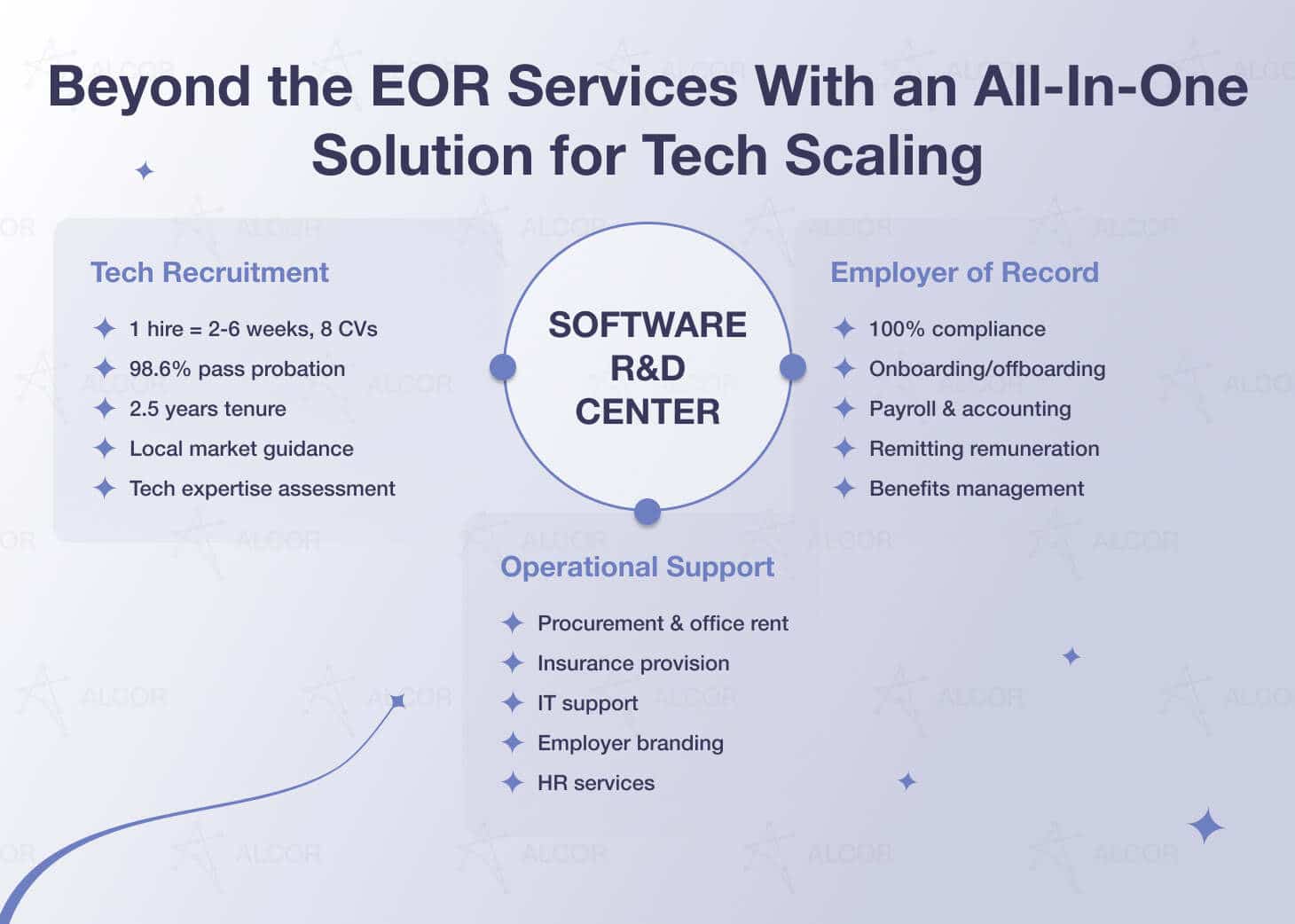
If your US-based tech product company can’t find the right local talent and isn’t willing to outsource, expanding into Mexico could be the move. BOT model in the IT industry is an option, but Alcor’s full-cycle software R&D center solution gives you a real in-house team, not a vendor relationship – built through tech recruitment, Employer of Record in Mexico, Colombia, Eastern Europe, and operational support, all under one roof.
Franki serves as a good example that the model works. It is a Los Angeles-based video-first experience platform connecting local businesses with their communities. Franki+ clients have generated over $12 million in revenue, a 6x return on investment, and 220,000+ authentic video reviews.
Their problem: Franki needed a mobile engineering team, nearshore to LA, to power its product roadmap. It was their first move into Latin America – no entity, no compliance framework, no local market knowledge. Outsourcing was the obvious shortcut, but it wasn’t what they needed: vendor-managed developers whose loyalty sits with the agency, not the product.
The solution they got:
- Alcor’s recruiters screened every candidate for a rare stack (senior iOS/Android engineers with RxSwift expertise), evaluating technical depth and cultural fit as equally non-negotiable.
- Alcor built a compliant employment framework in Mexico through our EOR for technology – payroll, contracts, IP protection, so engineers reported directly to Franki from day one, with zero vendor layer in between.
- Pricing was transparent from the first call: market rates and Alcor’s fee, communicated upfront and held throughout.
- Operational support ran in parallel – hardware procurement, test equipment delivery, day-to-day logistics, so Franki’s leadership stayed focused on the product, not the setup.
The result: Seven hires closed in 4-5 weeks on average. Every one passed probation. Franki’s revenue doubled quarter-over-quarter after the team launched. When one hire didn’t work out, Alcor handled the exit and had a free replacement ready immediately – one that, in the end, was never needed.
“One of the things I loved about working with Alcor was that they provided us with the market overview and the market rates before we started. We’ve found some great talent in both Mexico and Colombia.” – Eugene Varricchio, Executive Advisor and ex-CEO, Franki.
Trusted by VC-backed companies scaling fast across LATAM and Eastern Europe, Alcor also has built dedicated engineering teams for Sift, UFORCE, Ledger, BigCommerce, Pindrop, and other companies – each getting the same core model: full ownership, compliant employment, and a remote team built to perform, not just fill seats.
Ready to build your team in Mexico? Whether it’s your first move into Latin America or your next one, Alcor gives you a compliant, fully-owned engineering team in any location you choose – without opening an entity, without outsourcing, and without the guesswork. Get in touch and let’s start your R&D journey.
FAQ
How are technological advances affecting Mexico’s economy in 2026-2027?
Computer equipment overtook automobiles as Mexico’s #1 export in 2025, reaching $85.4 billion, according to Banco Base. Mexico now accounts for 85% of Latin America’s high-tech exports, per ECLAC – evidence that technological advances are shifting the economy toward higher-margin electronics and away from traditional assembly work.
How are AI and cloud computing changing Mexico’s technology sector?
AWS, Microsoft, and Google have committed a combined $6.3 billion to new Mexican cloud regions, while Mexico’s AI data center market is projected to grow from $70 million in 2025 to $261.5 million by 2031. Hiring demand is shifting from routine coding toward AI-native roles like prompt engineering and MLOps.
How large is Mexico’s enterprise software market in 2026?
Mexico’s broader software market is projected to reach $16.09 billion by 2030, growing at a 9.6% annual rate, according to Grand View Research. Application software is the largest segment, while the custom software development market alone is forecast to hit $4.65 billion by 2030 – a 26.6% CAGR, the fastest in Latin America.
Why is Mexico’s ICT market relevant to US technology companies?
Mexico’s ICT market is set to reach $78.69 billion by the end of 2026 and $129.52 billion by 2031, per Mordor Intelligence. Combined with USMCA trade integration and senior engineers costing 45.7-55.7% less than US counterparts, it gives US companies a cost-efficient, time zone-aligned nearshore base.
What should companies evaluate before expanding their technology operations to Mexico in 2026-2027?
Companies should factor in Mexico’s 2026 constitutional reform cutting the workweek from 48 to 40 hours (phased in through 2030), mandatory profit-sharing obligations, monthly salary benchmarks ranging from $5,011 for mid-level to $9,997 for lead-level engineers, and whether to hire via a local entity or an Employer of Record.
How would you rate this article?
Alcor is Your Trusted Scaling Partner
for expansion
support