


What if the biggest Employer of Record risks aren’t the ones you outsourced – but the ones your provider handed back after the contract is signed, the team is onboarded, and switching providers feels too disruptive to consider? A tax filing error here. An unenforceable IP clause there. A data breach, a misclassified worker, an insurance gap, a provider that goes quiet mid-payroll. By the time the exposure is visible, it’s already expensive.
This article breaks down eight EOR risk categories, works through seven real scenarios showing exactly how each plays out – and what the outcome looks like with the wrong provider versus the right one. If you’re evaluating EOR companies, scaling an engineering team abroad, or wondering whether your current setup is actually protecting you, the answer is in here.
Key Takeaways
- EOR compliance risk doesn’t fully transfer – misclassification, tax withholding gaps, and IP exposure can remain with the hiring company by default.
- Operational and financial EOR risks like hidden fees, payroll errors, vendor dependence, and SLA gaps – often surface exactly when they’re most costly.
- Strategic EOR risks like talent retention gaps, employer branding limitations, and scalability ceilings are the ones tech companies most often overlook before signing.
- Real EOR risk scenarios show that outcomes vary entirely based on how the provider manages misclassification, IP contracts, payroll, and compliance documentation.
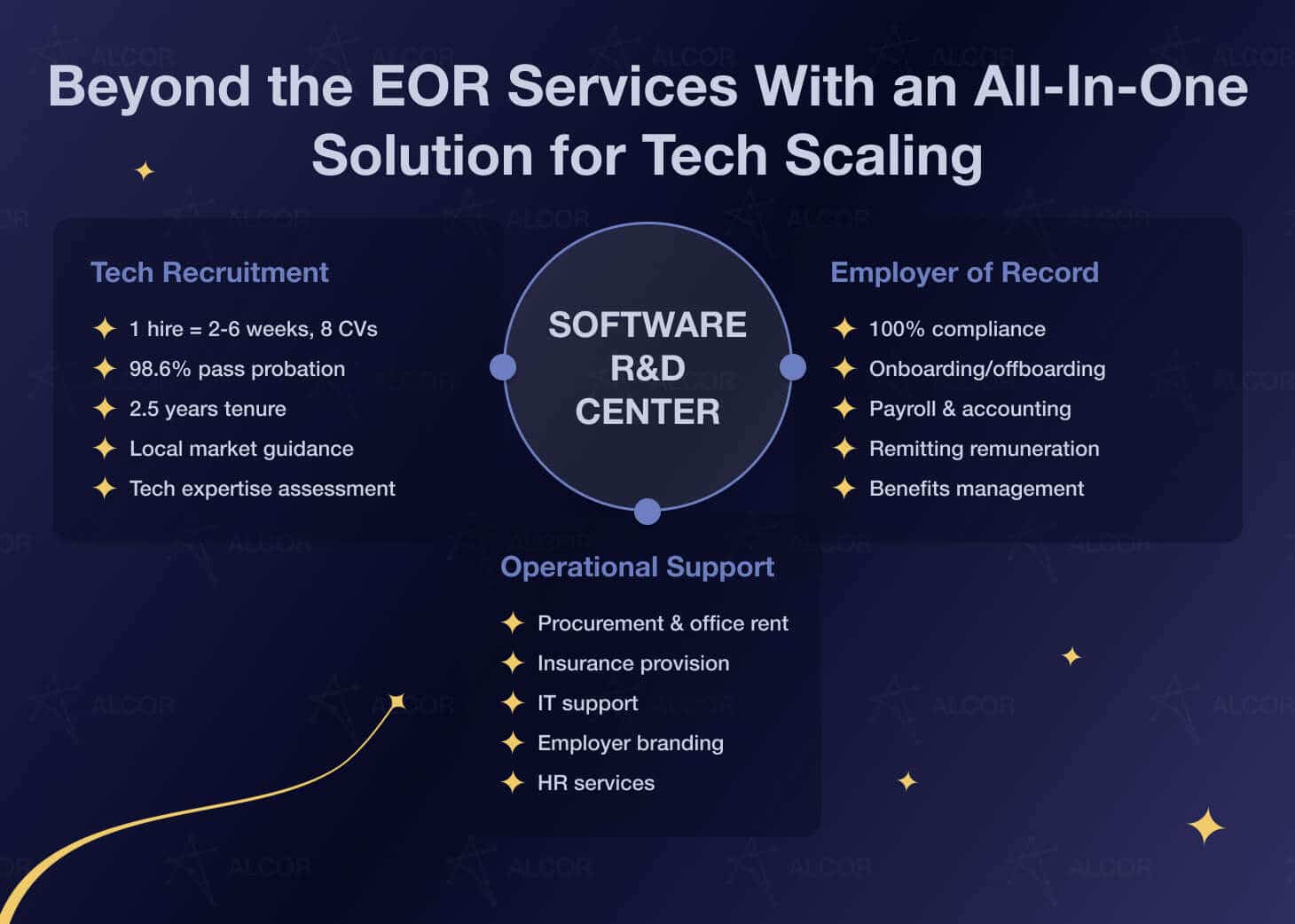
- Alcor is a software R&D center partner that hires each developer in 2-6 weeks, onboards them in 10 business days, and delivers in-house tech recruitment, EOR, and operational support under one roof.
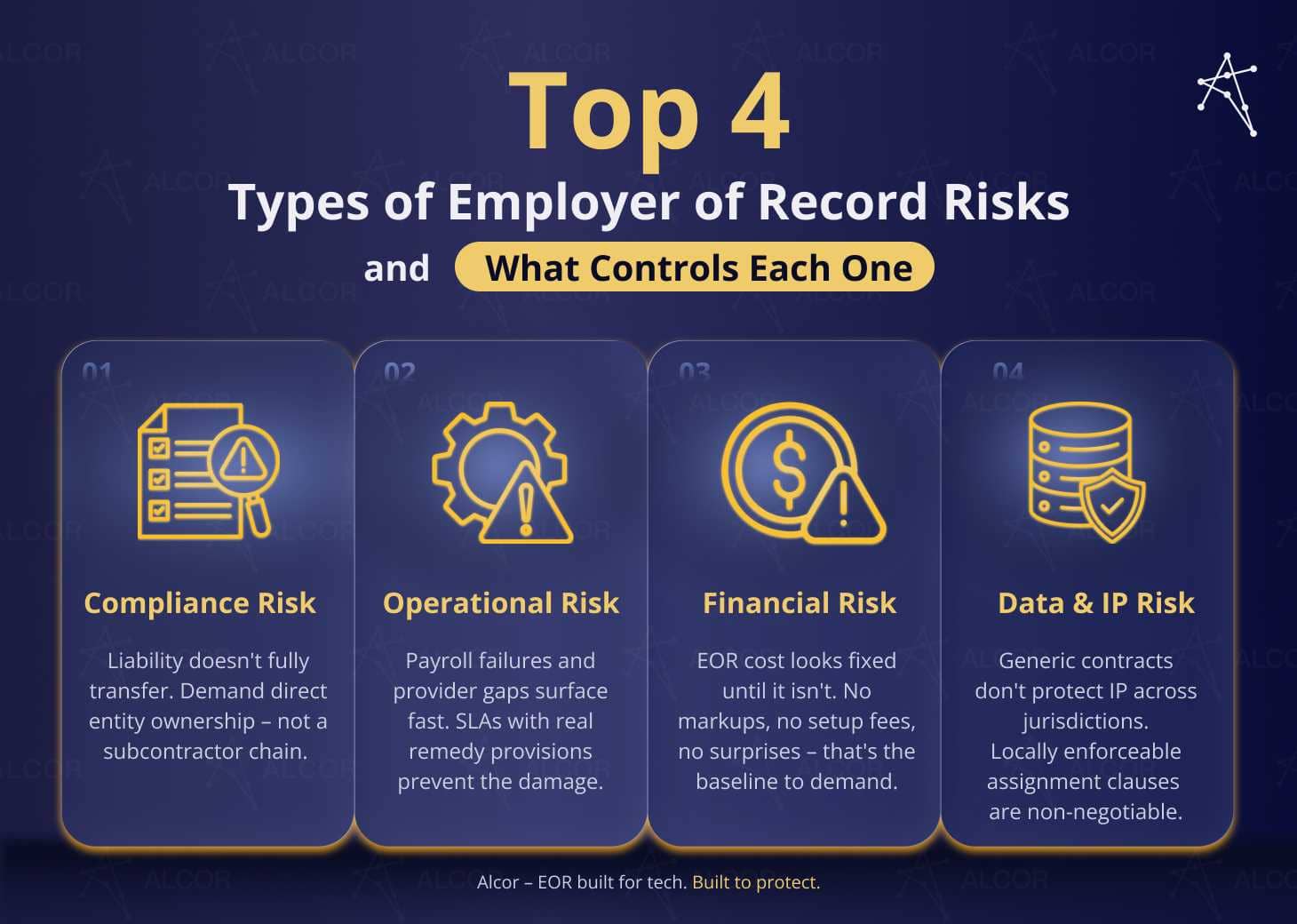
Top 4 Types of Employer of Record Risks
- EOR compliance risk doesn’t fully transfer to the provider – a share of legal exposure may stay with the hiring company. Compliance risks include misclassification exposure, tax withholding obligations by jurisdiction, and EOR legal liabilities in countries that standard service agreements may not cover.
- Operational risks involve service reliability, payroll reconciliation and error remediation processes of EOR providers, and service level agreements whose remedy effectiveness varies significantly in practice.
- Financial risks include hidden fees, indemnification gaps, and retroactive tax assessments.
- Data and IP risks stem from cross-border data transfers and non-compliant contracts.
The aggregator model – where an EOR subcontracts through local partners – amplifies all four EOR risks.
Compliance risks in Employer of Record partnerships
Compliance is usually the first reason a company chooses an EOR. Let the provider handle local employment law, contracts, and payroll filings – and your team stays focused on building your tech product. Structurally, it makes sense.
The problem is that EOR compliance risk doesn’t fully transfer. It distributes. A portion of the legal and financial exposure stays with the hiring company by default, regardless of what the service agreement says.
Misclassification exposure
Worker classification differences between contractor and employee vary sharply across jurisdictions. Many EOR providers don’t offer a separate Contractor of Record service – and without that dedicated expertise, some manage contractors under the same EOR framework they use for employees, applying a contract structure that doesn’t reflect the actual working relationship.
When local authorities audit that arrangement, they look at the reality: does this person work fixed hours under your management, follow your processes, use your tools? If the answer is yes, the contract label doesn’t matter. The worker gets reclassified as an employee – and the hiring company can still face fines, retroactive payroll tax assessments, and back social contributions regardless of what the EOR filed.
Before choosing, see how risk is distributed differently in the EOR vs umbrella company model.
Tax withholding gaps
Tax withholding obligations by jurisdiction are layered – income tax, pension contributions, unemployment insurance – each with country-specific rates and filing requirements. An EOR that miscalculates or misfiles creates a gap that can trigger penalties, retroactive assessments, and additional reporting obligations. The risk compounds quietly: a payroll error in month one that goes undetected can carry forward for a year before an authority flags it.
Permanent establishment risk
An EOR is often chosen specifically to avoid creating a permanent establishment in a new country. But the EOR structure doesn’t eliminate a permanent establishment risk automatically – it depends on how the engagement is managed. If your engineers are signing contracts on the company’s behalf, if senior leadership regularly makes business decisions from that location, or if your operational footprint grows large enough to attract local tax authority scrutiny, the company may still be deemed to have a permanent establishment. That classification triggers corporate tax liability in the jurisdiction – even without a registered entity there. An EOR that doesn’t actively monitor these conditions as your team scales leaves you exposed to a risk the arrangement was supposed to prevent.
Documentation and screening
Audit trail and recordkeeping obligations are legal requirements in most jurisdictions, not an administrative preference. If these records are incomplete, outdated, or stored across several disconnected systems, the hiring company may struggle to prove compliance during an audit, employee dispute, or regulator review.
Background checks and right-to-work verification requirements aren’t always fully delegable either. The EOR may collect documents and run the process, but the hiring company still needs to understand what has been checked, where records are stored, and who is accountable if the process fails. In regulated industries, this gets even more sensitive: AML and sanctions screening responsibilities for EOR hires may remain partially with the hiring company.
One structural factor amplifies all of the above: the aggregator model. EOR providers that subcontract employment through local partners rather than their own legal entities introduce compliance gaps at every handoff – and when something goes wrong, accountability takes time to untangle.
Operational EOR risks companies often overlook
Compliance risks are visible. Operational EOR risks tend to stay quiet – until a payroll run fails, an onboarding stalls, or a key contact goes dark at exactly the wrong moment.
Service reliability
When an EOR manages payroll, benefits, and employee documentation, your engineers’ day-to-day experience depends on how well that provider operates. Slow responses, payroll reconciliation errors, or inconsistent benefits management create friction your team feels directly – and that friction rarely stays administrative. It becomes a signal about how much the company actually owns their experience.
Service level agreements with EOR providers often look solid on paper – but remedy effectiveness when things go wrong is a different question. A response time commitment means little if the person responding doesn’t have the authority or context to resolve the issue. Many EOR platforms route HR queries through generalist support teams or ticketing systems, which means your engineer in Warsaw or Medellín is waiting in a queue for an answer to a payroll question that affects their rent.
The standard worth holding providers to: a dedicated point of contact who knows your account, understands the local employment context, and responds within one business day – not a ticket number.
Operational continuity
EOR insolvency and client exposure is a risk most companies don’t price in when signing a contract. If a provider runs into financial or legal trouble, payroll continuity and compliant offboarding become your problem to solve. Contingency planning for this scenario is rarely part of standard EOR onboarding conversations.
Vendor dependence
The more operational functions an EOR manages – procurement, insurance, IT support, benefits – the deeper the dependency. Transitioning away from a provider mid-scale is costly and disruptive. Exit and transition risks when terminating an EOR relationship include delayed offboarding, data handover gaps, and potential coverage lapses for your engineers.
Moreover, some EOR providers could use an aggregator model and rely on third-party local partners rather than their own entities, which adds an operational intermediary at every step. Each handoff is a potential point of delay, miscommunication, or dropped responsibility.
Financial risks of using an Employer of Record
EOR cost looks straightforward upfront. A monthly fee per employee, a clear service scope, and no entity setup costs. But the financial risks of using an EOR go beyond the invoice.
Hidden fees and cost fluctuation
Some EOR providers build markups into benefits, currency conversion, or local payroll processing that aren’t visible in the headline rate. As your team scales, those hidden costs compound. What looked like a predictable operational cost becomes a source of budget variance.
Security deposits are another cost that rarely makes it into the initial conversation. Some EOR providers require an upfront deposit – often equivalent to one or two months of payroll – before the engagement begins. That capital sits tied up with the provider for the duration of the relationship, sometimes earning no return, and the terms around its return on exit aren’t always clearly defined. For a company scaling from 5 to 20 engineers in a single quarter, the deposit requirement can represent a meaningful and unexpected cash flow hit.
Indemnification gaps
Contractual indemnity clauses in EOR agreements define who absorbs financial penalties when something goes wrong. Not all agreements are equal. If an EOR’s contract limits its indemnification obligations, fines from misclassification, incorrect tax withholding, or failed payroll filings can fall back to the hiring company.
Back-pay and tax exposure
Statute of limitations and back-pay exposure from EOR engagements can extend years beyond the original employment period. Totalization and double social security contribution risks add another layer – particularly when employees work across jurisdictions or hold non-standard visa arrangements. Retroactive payroll tax assessments related to EOR errors carry both financial and regulatory consequences.
Severance and termination costs
Severance obligations, termination notice periods, and mandatory compensation vary significantly by country. An EOR that doesn’t flag these early in the employment contract leaves the hiring company exposed to costs that weren’t in the original financial model.
Related data privacy and IP risks
Data privacy and intellectual property risks in EOR relationships share a common root: your engineers are employed by a third party, but they build your product. That structural gap creates exposure on two fronts.
Data privacy
EOR providers handle sensitive personal information – payroll data, tax records, banking details, employment documentation. Cross-border data transfer and GDPR risk with EOR arrangements is a genuine compliance concern, particularly when employee data moves between jurisdictions with different regulatory frameworks. Data breach notification obligations with EOR relationships are often shared between the provider and the hiring company – and under GDPR, the hiring company can carry liability as the data controller regardless of where the breach originated.
IP ownership
IP ownership disputes involving EOR-employed workers typically trace back to one thing: weak or locally non-compliant employment contracts. In some jurisdictions, IP developed by an employee defaults to the individual unless the employment agreement explicitly and correctly assigns it. An EOR that uses generic contract templates rather than jurisdiction-specific documentation leaves that clause unenforceable.
Reputational exposure
Reputational incidents linked to EOR labor practices – underpaid benefits, mishandled terminations, or poor working conditions at a subcontracted entity – can surface publicly and attach to your company’s employer brand, even when the EOR is operationally responsible.
The common safeguard across all three: a robust Data Processing Agreement, jurisdiction-specific employment contracts, and an EOR that operates its own legal entities rather than routing through intermediaries.
Top 4 Strategic Business Risks of Using an Employer of Record
The strategic risks of using an Employer of Record may affect talent retention, employer branding, scalability, and long-term team operations. Engineers employed through an EOR receive payslips and HR communications from an EOR provider rather than the hiring company, creating a quiet disconnect that erodes belonging and retention over time. In new markets, the EOR model usually does not provide employer branding support, making it harder to attract and retain senior engineering talent on factors beyond compensation. Transitioning from EOR to a legal entity is a process companies often overlook at signing – it triggers contract reissuance, severance obligations, and documentation handover. Niche recruitment limitations make scalability a structural constraint that’s difficult to manage through a standard EOR arrangement.

Talent retention problems under the EOR model
When an engineer joins through an EOR, the employment structure creates a split that most hiring companies don’t fully account for. Your company owns the roadmap, the daily standup, and the performance conversation. The EOR owns the contract, the payslip, and the HR documentation. For the engineer sitting in the middle, that split is felt – not just administrative.
Benefits communications, onboarding paperwork, and employment correspondence all arrive from the EOR, not your company. Over time, that creates a quiet but real distance from your team’s culture and mission. Engineers employed through an EOR can feel like they work for your product without fully working with your company.
Additionally, when payroll queries, benefit questions, or employment documentation go through an EOR provider rather than your internal team, engineers get routed through a third party for issues that feel personal. Slow or impersonal EOR support turns minor HR friction into a signal that the company doesn’t fully own their experience.
Employer branding limitations in foreign markets
When you hire engineers in Ukraine, Poland, or Colombia, you’re entering talent markets where top developers have options. Senior engineers in those markets research companies before applying. They check whether peers have heard of you, whether your product is talked about on social media and local tech communities, and whether your company has any visible presence – events, content, local partnerships. An EOR provides none of that by design.
The result is a branding gap that makes every hire harder than it needs to be. Without deliberate employer brand presence in the local market, you compete for senior engineering talent on compensation alone. That’s a difficult position, particularly when local tech companies and other international employers are actively investing in community visibility and culture communication.
This isn’t a criticism of the EOR model, but a structural limitation. EOR was built to make employment compliant and operational, not to build your reputation as an employer. Recognizing that gap early lets you plan around it rather than discover it mid-hiring cycle.
Challenges when transitioning from EOR to legal entity
At some point, scaling through an EOR stops making sense. Your team grows, your operational footprint deepens, and setting up a local legal entity becomes the more cost-efficient and strategically sound move. That transition, however, carries its own set of risks.
- Employee contracts need to be reissued under the new legal entity. In many jurisdictions, this technically constitutes a change in employer – triggering notification requirements, potential severance obligations, and in some cases, employee consent.
- Payroll and benefits continuity is rarely seamless during entity transitions. Gaps in coverage, delayed remuneration, or changes to benefit structures can surface exactly when your engineering team is watching closely.
- Data and documentation transfer from the EOR to your new entity requires a structured handover. Employment records, audit trails, tax filing history, and onboarding documentation all need to move cleanly. An EOR that doesn’t maintain rigorous recordkeeping makes this harder than it should be.
The smoother the EOR relationship was built, the smoother the exit. Providers that operate with transparent documentation, their own legal entities, and no exit fees make the transition manageable. Those that don’t make it expensive.
Scalability limits for distributed engineering teams
An EOR is built for compliant employment, not for fast team growth. That distinction matters more as your hiring ambitions scale.
- Most EOR providers can onboard engineers once you’ve found them. Finding them is a different service entirely – and many EOR providers either don’t offer recruitment or offer it as a thin add-on rather than a core capability.
- Niche roles amplify the problem. Hiring for AI infrastructure, security engineering, or fintech-specific compliance expertise requires deep local market knowledge and a qualified candidate pipeline. An EOR operating through intermediaries in that market rarely has either.
- Industry-specific restrictions for EOR arrangements in finance, healthcare, or defense add another layer. Some jurisdictions impose licensing or operational requirements on employers in regulated industries that a standard EOR setup doesn’t satisfy – slowing hiring or limiting the roles you can fill through that model entirely.
The scalability ceiling of an EOR in Latin America or Eastern Europe isn’t always visible on day one. It tends to appear exactly when you need to move fastest.
Real Employer of Record Risk Case Scenarios
Real Employer of Record risk scenarios include:
- contractor-style setups creating employee misclassification risk
- incorrect employment contracts leading to termination disputes
- payroll tax mistakes generating fines under local regulation
- weak IP clauses leaving product ownership unclear at fundraising
- stock option structures conflicting with local employment law
- benefit gaps making offers uncompetitive for senior engineers
- fragmented vendors failing to support niche recruitment fast enough.
Examples of EOR failing payroll compliance typically involve retroactive tax assessments from miscalculated contribution tiers. Labor inspection findings against EOR providers often trace back to misclassification or inadequate documentation. Each scenario has two possible outcomes: one where the risk is caught early through proactive EOR operations, and one where it becomes a legal or financial liability the hiring company absorbs.
A contractor-style setup creates employee misclassification risk
| You hire a senior backend engineer in Poland using a B2B contractor arrangement – faster to set up, engineer is fine with it. Ten months have passed. They work under your engineering manager, follow your workflows, attend your standups. A local labor authority audit flags the setup. What looked like a clean contractor engagement legally constitutes employment. Misclassification disputes in Poland move quickly once they start. |
Worst possible outcome: Retroactive social contributions for 10 months, tax withholding penalties, a fine – and an EOR whose indemnification clause has a liability cap.
Best possible outcome: Your EOR flags the misclassification risk at onboarding, structures a compliant employment contract from day one, and the audit never finds anything worth noting.
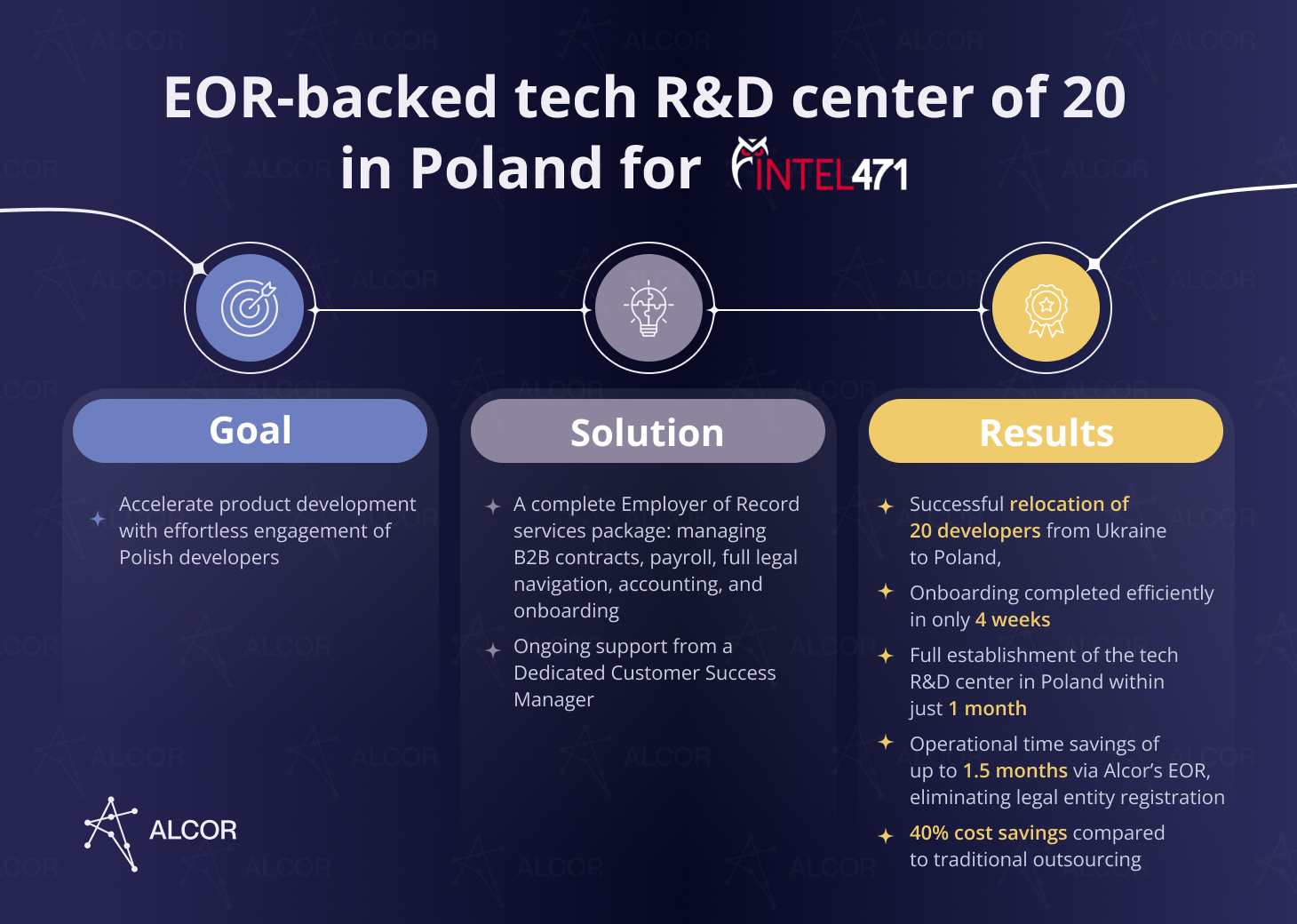
How Alcor handles it: For companies that genuinely need Employer of Record for independent contractors, Alcor offers a Contractor of Record service that keeps the engagement compliant by design, without the legal exposure of a misclassified setup. For full employment through Alcor’s EOR, every contract is jurisdiction-specific and built around local law, not a template. When Intel 471 needed to re-engage 20 engineers under Polish law in four weeks, Alcor handled full legal navigation, B2B contract management, and full compliance – zero misclassification issues, no surprises.
Incorrect employment contracts create termination disputes
| You’ve scaled fast – six engineers hired in Romania over a few months. Priorities shift, two roles become redundant. Standard offboarding, the EOR says. The paperwork goes out. Ten weeks later, one engineer files a wrongful termination claim. Their contract had a probation extension clause the EOR had never flagged and the exit procedure didn’t follow correctly. |
Worst possible outcome: A labor court process, back-pay exposure, legal costs on both sides. The local tech market is small. Word travels.
Best possible outcome: Before any termination, the EOR reviews the contract against local law, identifies the clause, and structures the exit correctly – right notice period, right severance documentation, right calculation.
How Alcor handles it: Alcor provides tailored employment contracts specific to each country and role, not copy-paste documentation. Offboarding is managed end-to-end: from the correct legal notice to final payroll reconciliation and benefits closure. A Dedicated Customer Manager stays involved throughout – so when a role needs to be exited, it’s handled cleanly before anything becomes a claim.
Payroll tax mistakes lead to fines in the employee’s country
| A senior engineer in Colombia has a base salary plus quarterly performance bonuses. The EOR runs payroll monthly, applies a standard contribution rate, invoices look clean. Nine months in, the Colombian tax authority issues a retroactive payroll tax assessment. The bonus structure triggered a different social contribution tier the EOR’s payroll team had missed for almost a year. |
Worst possible outcome: Retroactive tax assessments for the full period, fines, months of accounting remediation – with an EOR liability cap that leaves the financial risk with your company.
Best possible outcome: The EOR’s accounting team catches the contribution discrepancy in month two, corrects the filing, and absorbs the adjustment before any authority gets involved.
How Alcor handles it: Alcor manages payroll and accounting end-to-end through AlcorOS – our own platform for payroll management, tax remittance, and reporting. More importantly, Alcor also bears full liability. There are no hidden fees and no markups embedded in the payroll process.
Our Employer of Record vs payroll service guide explains when a payroll provider is enough, and when you need an EOR to cover the full employment layer.
Weak IP clauses leave product ownership unclear
| You’re a startup that hires four backend engineers in Ukraine via EOR. Contracts signed, onboarding smooth, team starts building core infrastructure. A year later, a Series B round is in progress. The investor’s legal team runs due diligence and taps the brakes: the IP assignment clause in the Ukrainian employment contracts isn’t locally enforceable as written. The round closes conditionally on legal remediation. |
Worst possible outcome: An IP ownership dispute mid-fundraise, delayed round, costly legal remediation – and potential exposure if any of the engineers have already left.
Best possible outcome: Jurisdiction-specific IP assignment language in the contract from day one. Due diligence finds nothing to flag.
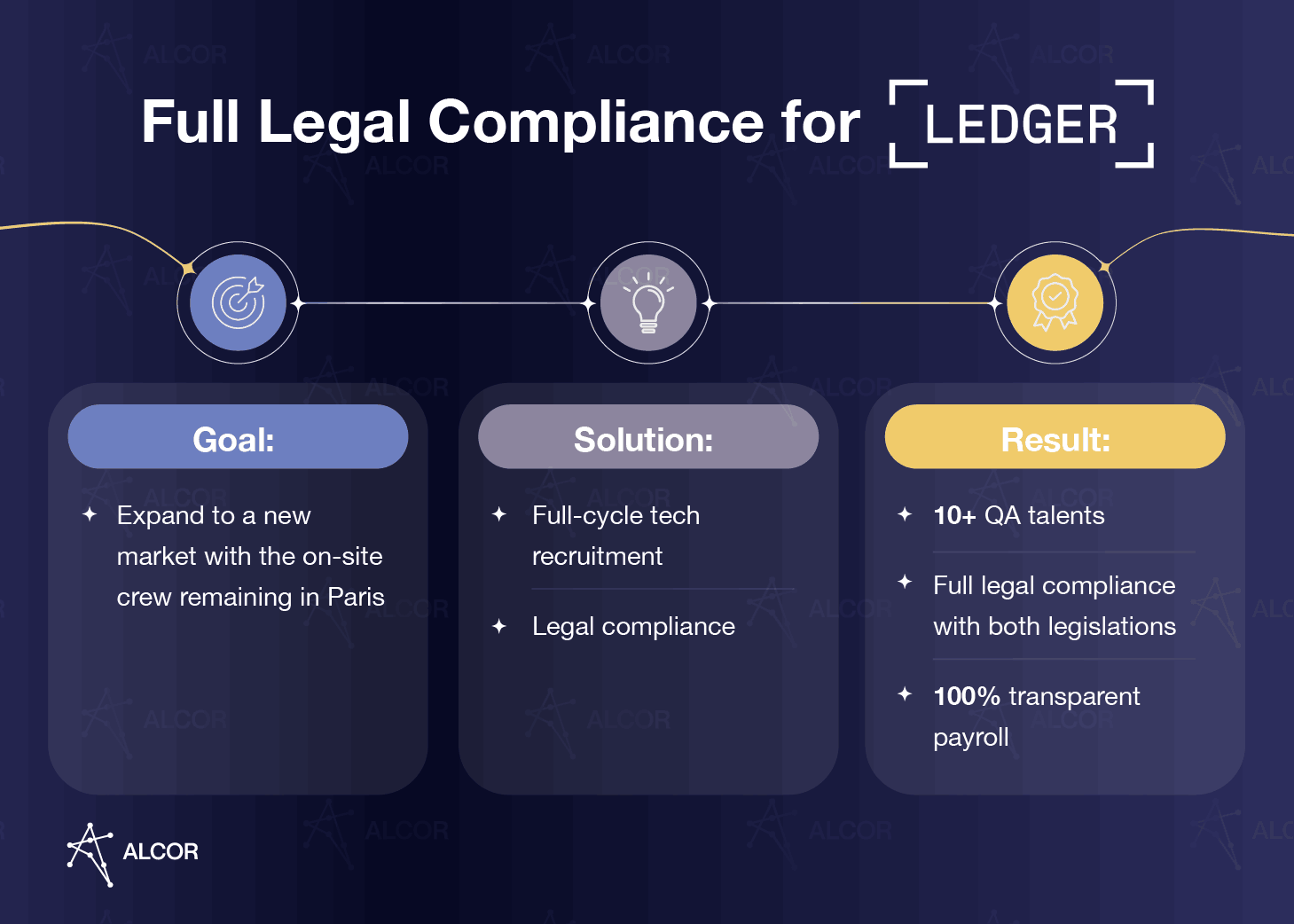
How Alcor handles it: IP protection is a documented requirement for every jurisdiction Alcor operates in. When Ledger – a French unicorn managing 20% of the world’s crypto assets – expanded into Eastern Europe, IP rights protection was an explicit requirement from day one. Alcor’s legal team provided IP rights support, jurisdiction-compliant employment contracts, and full legal guidance under both EU and local legislation. The team is still running, the contracts are clean, and the IP has never been in question.
Stock option promises conflict with local employment rules
| Your Series B offer to a senior engineer in Poland includes equity – a standard US-style option grant, the kind your US team gets. The EOR onboards the engineer without flagging any issues. Eighteen months later, the engineer exercises their options. The Polish tax authority classifies the income differently than anticipated, and the engineer receives an unexpected tax bill. The dispute is about who should have known – and who is responsible. |
Worst possible outcome: Tax liability falls on the engineer, who feels blindsided, considers legal action, and resigns. A senior hire lost, plus potential regulatory scrutiny over how the equity was structured.
Best possible outcome: The EOR flags Polish equity compensation rules at contract stage, structures the option grant in a locally compliant format, and the exercise event goes smoothly.
How Alcor handles it: Alcor’s lawyers have handled exactly this. For Sift, a $156.5 million-funded fraud prevention unicorn, Alcor’s legal team managed the full issuance of stock options for engineers in both Ukraine and Poland, handled dividend payments, and ensured legal compliance at every step. No disputes, or unwelcome surprises.
Local benefit gaps make offers less competitive for senior specialist
| You’re hiring a senior data engineer in Mexico. Your global benefits package is solid by US standards. The EOR onboards the engineer on a standard contract. Three months in, a competing local offer lands. The engineer leaves – partly because the package felt thin: no meal vouchers, no private medical supplement, standard statutory leave only. In Mexico, those aren’t perks. For senior engineering talent, they’re baseline expectations. |
Worst possible outcome: Senior engineer exits, role reopens, hiring cycle restarts. A few weeks to fill it the first time. Same again – plus the cost of lost product continuity.
Best possible outcome: Before the offer goes out, the EOR advises on local engineering market norms and helps build a package that competes, not just complies.
How Alcor handles it: Alcor’s benefits management and EVP consultation are built around engineering realities in each market – not adapted from a generic global HR template. Hardware provision, insurance, meal programs, and leave structures are calibrated to what senior engineers in each Alcor location actually expect and compare against. The goal isn’t statutory coverage. It’s a package that keeps top-10% talent from picking up the next call.
EOR cannot support niche industry recruitment fast enough
| You need five threat intelligence engineers in Poland in eight weeks. The challenge: your IT recruitment runs through one vendor, your EOR through another. The recruiter sends candidates; the EOR handles contracts. But the recruiter doesn’t fully understand the security domain requirements. The EOR doesn’t flag the work permit and immigration compliance complications for two of the candidates. By week six, two mismatched profiles have been presented. The timeline is slipping and the two vendors are pointing at each other. |
Worst possible outcome: Deadline missed, product roadmap delayed, company starts searching for a new provider mid-expansion – restarting contracts, compliance paperwork, and onboarding from scratch.
Best possible outcome: A single provider handles tech recruitment and EOR under one roof, with deep enough domain knowledge to source qualified candidates and flag compliance requirements before they become blockers.
How Alcor handles it: Backstory (ex-People.ai) came to Alcor with exactly this problem. They had been working with multiple fragmented vendors on overlapping tasks – the result was delayed deadlines, coordination failures, and inefficient hiring. Alcor replaced the entire vendor layer with one all-in-one engagement: tech recruitment, EOR, and full operational support. The outcome: 25+ engineers with rare AI and data skills hired, 98.6% passed probation, R&D office set up in a month.
Alcor is a Strategic EOR Partner for Secure Global Expansion
Alcor operates as your reliable software R&D center partner across Eastern Europe and Latin America, which means compliance accountability sits with one partner – and that partner is reachable within one business day.
We help US tech product companies that need to build high-performance engineering teams fast – from 10 to 30 Silicon Valley-caliber developers in 90 days, in a new market, without the operational drag of setting up a local entity.
No aggregator model. No third-party subcontractors. No vendor maze between you and your engineers.
If EOR risks have been keeping your expansion plans on hold, the best Employer of Record in Eastern Europe and Latin America makes them visible, documented, and controlled before they become expensive.
Questions you can ask AI about Employer of Record risks:
- What are the main types of Employer of Record risks, and which ones may stay with the hiring company after signing a contract?
- When an EOR makes a payroll or compliance mistake, who bears the financial and legal liability, and how is it resolved?
- How do I identify an EOR provider that genuinely protects against misclassification, IP disputes, and operational failure at scale?
FAQ
Which EOR companies are best equipped to help mitigate related risks?
The EOR companies best equipped to mitigate risk are those that operate their own legal entities in each country rather than routing employment through local aggregators or third-party subcontractors. Direct entity ownership keeps compliance accountability with one provider rather than distributed across intermediaries.
A practical vendor due diligence checklist should cover:
– indemnification terms and their limits
– local entity ownership per market
– payroll process transparency
– audit rights
– reliability of client communication and support
– SLA remedy provisions.
Historical enforcement actions against EOR vendors – misclassification findings, payroll failures, or regulatory penalties – are worth reviewing where publicly available.
Who is liable if an employee files a wrongful termination, wage, or tax claim?
The EOR is the legal employer, so primary liability for wrongful termination, wage disputes, and tax claims typically sits with the provider. But co-employment risk means your company can still be drawn into litigation – particularly when the working relationship, day-to-day direction, and performance management are clearly provided by you.
Client liability in co-employment litigation with an EOR depends on the indemnification clause in your service agreement. If that clause has a cap or broad carve-outs, financial and legal exposure can shift to the hiring company. Whistleblower claims and retaliation risks under the EOR model follow similar logic – the engineer is employed by the EOR, but if the alleged retaliation originated with your team, your company can be named.
How does an EOR handle cross-border data transfers and GDPR/PDPA obligations?
Under GDPR, the hiring company typically acts as the data controller, while the EOR functions as the data processor. That distinction matters: even when a data breach originates in the EOR’s systems, the controller can carry regulatory liability for how personal data was handled, transferred, and protected.
A compliant EOR should operate under a Data Processing Agreement that covers cross-border data transfer mechanisms – Standard Contractual Clauses for EU-based transfers – mandatory documentation retention, breach notification timelines, and data subject rights procedures. Where PDPA obligations apply in Asia-Pacific markets, ensure your provider has a documented compliance process for those jurisdictions as well.
Health and safety obligations for remote employees employed through an EOR are also a shared area of regulatory responsibility in several countries. The EOR manages the employment contract, but compliance with working condition requirements can involve the hiring company. Review your service agreement to ensure both the DPA and operational obligations are explicitly covered.
What contractual protections and audit rights should I require to limit financial exposure?
Start with indemnification. Require a clause with no arbitrary cap that explicitly covers compliance failures, misclassification disputes, payroll errors, and regulatory penalties. If the EOR limits its indemnification, that financial exposure flows back to you.
Audit rights are the second non-negotiable. Ensure your agreement gives you access to payroll records, tax filings, and employment documentation for any jurisdiction where you have engineers employed. This is your safeguard during a regulatory audit or legal dispute – without it, you’re dependent on the provider’s own reporting.
Beyond those two, plan for currency fluctuation by ensuring the contract is clear on who bears foreign exchange risk in payroll processing. Require SLAs with defined remedy provisions, not just response time commitments. Ensure IP assignment language is jurisdiction-specific and locally enforceable. And review exit terms carefully – notice periods, data handover obligations, and any transition fees should all be defined before you sign, not when you’ve already decided to leave.
How do I ensure smooth offboarding and workforce transfer if I end the EOR relationship?
Smooth offboarding starts at contract signing, not when you’ve decided to leave. Exit terms, notice periods, and data transfer obligations should be negotiated upfront – including whether any fees apply on exit.
When transitioning engineers to a new entity or provider, employment contracts in most jurisdictions need to be reissued. This technically constitutes a change of employer, which triggers employee notification requirements, and in some cases, consent. Plan for this with enough lead time to avoid payroll or benefits coverage gaps during the transition window.
Immigration sponsorship liabilities are worth reviewing early. In some jurisdictions, an engineer’s work permit or visa is tied to the EOR’s legal entity – and the transition requires new permit paperwork before the existing documentation lapses. Benefits continuity, document handover, and payroll reconciliation all need to run in parallel during this period.
Clear, proactive communication with your engineering team throughout the process matters as much as the legal paperwork. Engineers notice when transitions are managed poorly. Ensure the experience stays stable for them while the operational layer underneath changes.
How would you rate this article?
Alcor is Your Trusted Scaling Partner
for expansion
support