


An Employer of Record contract (also called an EOR service agreement) is the legal foundation of any EOR engagement. It is a formal contract between a client company, the EOR provider, and, depending on the jurisdiction, the employed worker.
The EOR becomes the entity that formally employs the worker: handling payroll, tax withholding, statutory employee benefit entitlements, and labor law compliance. The client company retains day-to-day management authority over the employee’s output and role.
In this article, you’ll find a breakdown of how EOR contracts are structured, which clauses carry the most legal and financial risk, and what SLAs and compliance requirements to build into the agreement by region.
Key Takeaways
- An Employer of Record contract is the legal foundation for hiring a global workforce. It establishes the EOR provider as the legal employer under local law while the client company retains full control over day-to-day work and product decisions.
- Employer of Record contract key clauses must cover the scope of services, IP assignment, indemnities, data protection, termination, governing law, and dispute resolution – each designed to address Employer of Record risks that arise when clear written terms are absent.
- SLAs in an EOR contract should commit the provider to payroll accuracy targets, onboarding timelines, and defined response windows with enforceable remedies for breach.
- Compliance obligations differ sharply by region: LATAM markets require navigating mandatory bonus and workforce reporting rules; Eastern Europe requires EU-aligned GDPR compliance and adherence to country-specific labor codes.
- Alcor covers tech-focused EOR across LATAM and Eastern Europe through its own infrastructure, with locally compliant IP clauses built into every contract, no setup costs, and volume-based pricing that gets cheaper as your engineering team grows. Plus, you get tech recruitment and full ops support combined with EOR under one roof.
What an EOR Contract Is and How It Operates
An Employer of Record (EOR) contract is a legal arrangement where the EOR employs global workers on behalf of a client company in a foreign market. The EOR handles payroll, tax withholding, statutory benefits, and local labor law compliance. The client company directs the work and retains full control over hiring, performance, and business decisions. For any business expanding internationally, this structure eliminates the need to establish a local legal entity before hiring.
Employment terms – working hours, overtime, leave, severance – are set by local law and cannot be negotiated by the business or EOR. IP assignment, confidentiality, and data protection clauses must be compliant with local law to be enforceable.
Parties, roles, and typical relationship model
An Employer of Record contract involves three parties:
- The EOR provider;
- The client company;
- The employee.
The EOR holds the employment contract under local law and serves as the legal employer. The client company directs work, manages performance, and sets role expectations. The employee receives compensation and statutory employee benefit entitlements through the EOR.
This structure commonly takes one of two contractual forms, depending on the country or the provider:
- A tripartite agreement – a single three-way document signed by all three parties, explicitly outlining the responsibilities of each.
- Parallel contracts – two separate but linked documents: a service agreement between the client company and the EOR, and an employment contract between the EOR and the employee.
Client company responsibilities
The client company is responsible for:
- defining the employee’s role;
- directing day-to-day tasks;
- setting performance expectations;
- providing the necessary tools and systems.
The EOR contract must explicitly document these obligations to establish that the client company is not the legal employer. It’s a distinction that matters for the risk of a permanent establishment and for any global business operating across multiple jurisdictions simultaneously.
The contract typically requires the client company to supply accurate compensation data on time, notify the EOR of any changes to the employment arrangement, and cooperate on compliance audits.
The client company can also be responsible for background checks and security clearance processes where applicable. Any client company conduct that creates a deemed employer relationship – issuing disciplinary decisions directly, making offers of employment, or directing statutory entitlements – can create shared employment liability regardless of the contractual structure.
In Alcor’s operating model, the client company retains all decision rights over strategy, product direction, engineering standards, and people: final hiring calls, compensation, performance management, and promotions. This clear division of responsibility is formalized in the EOR contract and reduces co-employment risk for the client company.
Also, Alcor provides the on-demand Tech Enabler service that helps assess an engineer’s technical background, so you, as a client company, don’t have to do it yourself.
Employer of Record responsibilities
The EOR is responsible for:
- issuing a locally compliant employment contract;
- processing payroll;
- withholding income tax and social security contributions;
- administering statutory employee benefit packages and all required benefits;
- managing onboarding and offboarding;
- maintaining required employment records.
Beyond administration, the EOR carries the legal exposure for local employment law violations. If payroll is processed incorrectly, if an employee is misclassified, or if statutory entitlements are not met, the EOR bears primary responsibility under local law. The client company’s indemnity obligations in this context are defined in the contract. For a business scaling a distributed engineering team, this clear division of responsibility is what makes EOR operationally viable.
The EOR must also manage occupational risk compensation and workplace injury insurance in jurisdictions where mandatory employer coverage applies, for example, Mexico’s IMSS risk contributions and Colombia’s ARL occupational risk system.
Employment terms and local statutory compliance obligations
The Employer of Record agreement must reflect the specific employment standards of the jurisdiction in which the employee is hired. These include minimum wage requirements, working hours, overtime rules, probationary periods, vacation entitlements, sick leave, maternity and paternity leave, and severance conditions. These are not negotiable between the parties – they are set by local statute, and any EOR contract template that does not reflect them is non-compliant by default.
Per 2026 labor regulation data provided by Alcor’s legal team, standard employment terms vary significantly across LATAM and Eastern European markets:
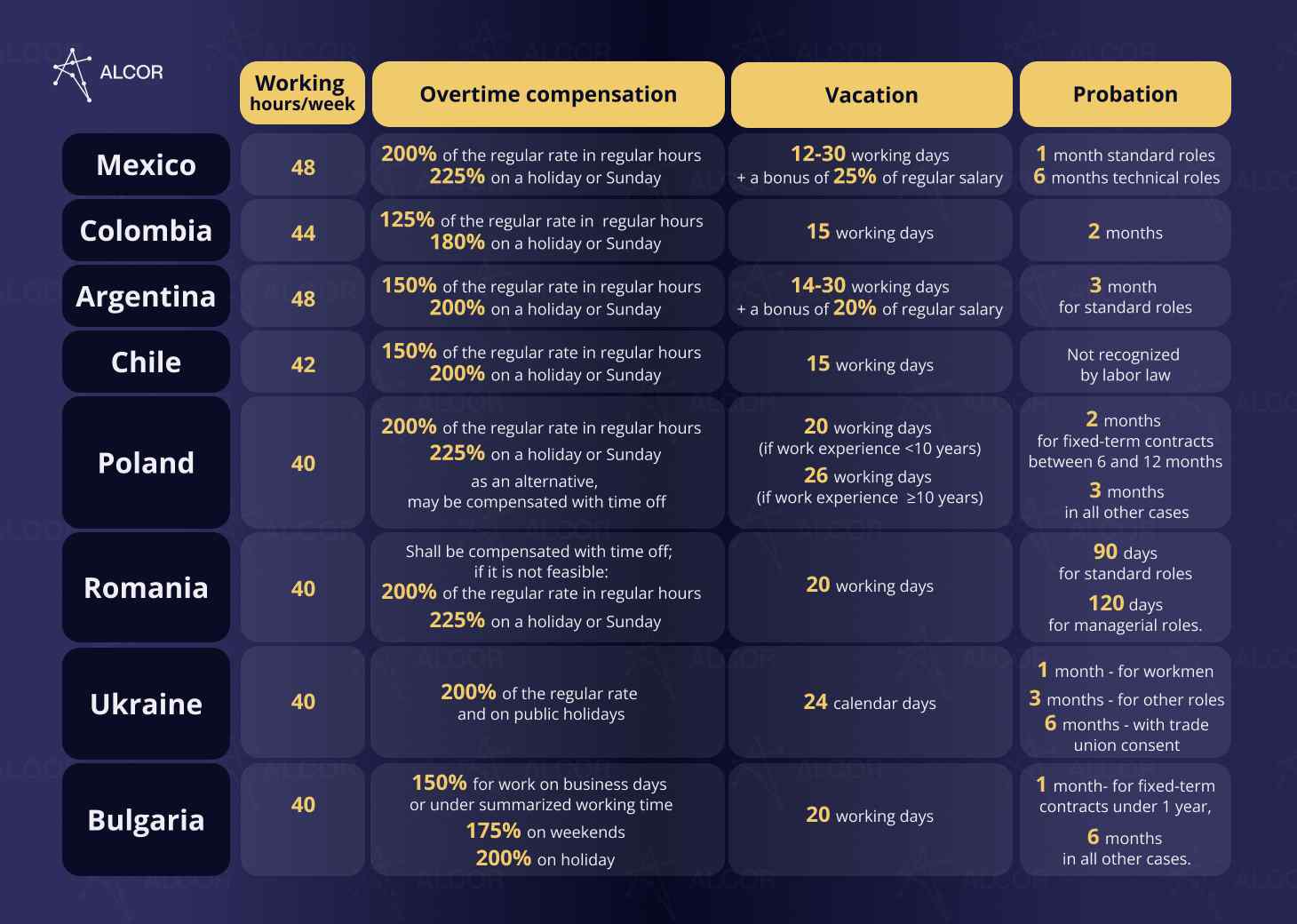
Contracts that import foreign employment terms without local adaptation – for example, applying the US at-will employment doctrine to a Polish employee – are unenforceable and create direct legal exposure. Reviewing a sample agreement template localized for each target country is one of the most effective early-stage steps before engaging an EOR provider.
Compensation, benefits administration, payroll, and tax handling
The EOR contract should specify the gross salary in local currency, the payment frequency, how currency conversion is handled, and which statutory employer contributions apply in addition to the base salary. These contributions vary significantly by country and are mandatory for every business hiring internationally.
The contract should also address mandatory annual bonuses, profit-sharing obligations, and the funding and timing of employee benefit packages. Late or incorrectly calculated payslips and filing obligations to statutory funds incur penalties that both the EOR and the client company share an interest in avoiding. Benefit entitlements – including health benefit coverage, pension contributions, leave benefit accruals, and other statutory benefit entitlements – must be funded on the schedule required by local law, not on the client company’s internal billing cycle.
When partnering with Alcor, specific employee benefit entitlements are set per engagement in the EOR Request, and benefit administration and management of employment records form part of the defined EOR service scope.
Intellectual property, confidentiality, and data protection clauses
Intellectual property and invention assignment clauses are among the most critical – and most often under-negotiated – components of any EOR agreement. The employment contract between the EOR and the employee must include a locally compliant invention assignment clause stating that all IP created in the course of employment belongs to the client company.
According to Alcor’s legal team, all intellectual property rights in deliverables created by employees are assigned to the client on a perpetual, irrevocable, royalty-free, exclusive, and worldwide basis. The transfer occurs automatically upon full payment, with no further action required by either party. Alcor retains no right to use the deliverables once the transfer is complete and will not challenge the client’s ownership.
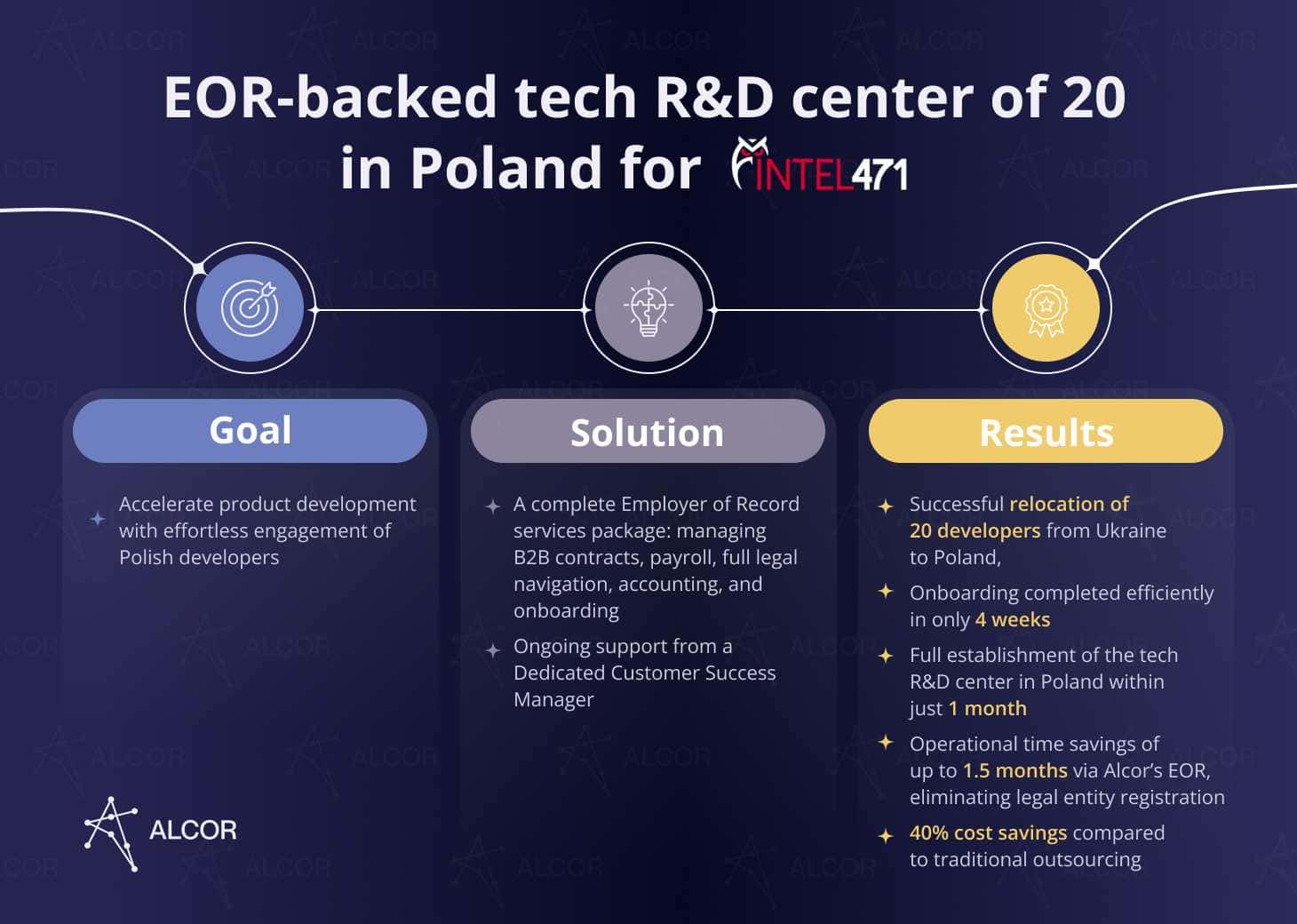
For companies in security-sensitive industries, proper IP assignment clauses are non-negotiable. Intel 471 – a cyber threat intelligence business that tracks criminal networks and threat actors – worked with Alcor to build a 20-person tech R&D center in Eastern Europe. In this context, any ambiguity over who owns the code and research outputs would be a direct business risk. Alcor’s EOR agreement guaranteed that all IP created by the engineering team belonged exclusively to Intel 471 from day one, with no additional legal steps required.
Confidentiality obligations in Alcor’s EOR contract cover all parties, including engaged personnel. Confidential information must be kept in confidence and used only to perform obligations under the agreement. On request, confidential information must be returned or destroyed within 30 days, and the obligations survive termination for a defined period, according to Alcor’s legal team.
Generic confidentiality templates do not automatically transfer invention rights in most jurisdictions. Beyond IP and confidentiality, a well-structured contract also includes a non-solicitation clause that prevents the EOR from directly recruiting the client company’s employees or facilitating their movement to competing engagements. It protects the engineering team the client company has built and is particularly relevant in high-demand tech talent markets.
The Employer of Record service agreement should also include a data processing agreement (DPA) that meets GDPR Article 28 requirements wherever European personal data is processed.
The DPA:
- must define the scope of processing;
- instruct the EOR on permissible data use;
- establish security requirements;
- set breach notification timelines;
- address data transfer and cross-border payroll compliance mechanisms such as Standard Contractual Clauses (SCCs).
It must also address record retention and ownership of employee data, specifying how long employee data is retained, in what format, and the deletion schedule after contract expiry.
Under the GDPR, both data controllers and data processors can be liable to data subjects for processing failures – the DPA must clearly apportion this exposure. Per Alcor’s legal team, GDPR compliance is ensured through a two-layer structure: a Data Processing and Data Sharing Agreement at the client level, and lawful handling of employee personal data through privacy notices, confidentiality obligations, and alignment with the client’s internal policies. Alcor’s EOR contracts include locally compliant IP assignment as standard for all eight coverage markets and a GDPR-aligned DPA for all EU and Eastern Europe engagements.
Essential Clauses in an Employer of Record Contract
Essential clauses in an Employer of Record contract include:
- mutual indemnification, defining which party covers compliance failures;
- representations and warranties confirming valid employer registration and labor law compliance;
- insurance requirements covering employers’ liability, professional indemnity, and cybersecurity coverage;
- audit rights giving the client access to payroll records and tax filings;
- remedies and liability caps for regulatory breaches;
- force majeure provisions narrowly drafted to prevent payroll suspension;
- full pricing transparency covering service fees, statutory contributions, FX markups, and escalation caps.
Missing or poorly drafted versions of any of these clauses create direct financial and legal exposure for the client company.
Indemnities, warranties, and required insurance
Indemnity and hold harmless clauses determine which party compensates the other when something goes wrong. A well-structured EOR contract should include mutual indemnification:
- The EOR indemnifies the client company against compliance failures attributable to the EOR;
- The client company indemnifies the EOR against losses caused by the client company’s instructions or misrepresentations.
Template representations and warranties in EOR service agreements typically cover entity status, authority to enter the contract, regulatory standing in each covered jurisdiction, and the absence of known compliance failures. Representations and warranties should confirm compliance with all applicable labor laws, valid employer registration, and capacity to issue locally enforceable contracts.
Insurance requirements for EOR providers should be stated explicitly. A reputable EOR maintains employers’ liability insurance and professional indemnity coverage as a minimum. For EOR engagements covering sensitive technical roles or data-intensive environments, the contract should also require cybersecurity liability coverage – a standard expectation in any serious international business arrangement. Certificates of insurance should be available on request during both the due diligence process and throughout the contract term.
Compliance guarantees, regulatory responsibility, and audit rights
A well-negotiated Employer of Record service agreement gives the client company the right to audit the EOR’s compliance performance. Audit rights should cover payroll records, tax filings, statutory benefit administration, employment contracts, social security obligations, and any regulatory correspondence. The right should be exercisable at defined intervals and upon reasonable notice.
Alcor’s legal team guarantees that compliance documentation is available on request, and the cost and operational impact of legal changes are regularly reassessed, communicated, and applied as a true-up.
Regulatory responsibility language must be explicit: if a tax authority challenges the employment arrangement because of the EOR’s structure or filing failures, the EOR bears the cost of responding and any resulting penalties. The client company bears responsibility for consequences arising from information provided inaccurately or conduct that creates a deemed employer relationship. A compliance risk assessment conducted jointly by the client company and the EOR before the contract is signed is the most effective mitigation against both categories of exposure.
Remedies and handling of regulatory breaches
The EOR contract should define what happens when a compliance breach occurs: who is notified first, within what timeframe, and what steps the EOR must take to remediate the breach. Remediation obligations should include paying any penalty arising from the EOR’s own compliance failures.
Employee classification risk and mitigation strategies should be explicitly addressed in this section: the contract must commit the EOR to indemnify the client company for classification risk arising from the EOR’s own structural decisions, and the agreed mitigation approach should be documented.
Also, liability caps are standard in EOR agreements. The most common structures cap the EOR’s liability at a multiple of fees paid – typically 12 months of fees – with defined carve-outs for data breaches, fraud, and willful misconduct. Liability caps set too low to cover meaningful business exposure are a point of negotiation, not an acceptable default.
Force majeure and business continuity provisions should be narrowly drafted. Broad clauses that allow the EOR to suspend payroll obligations for undefined events pose a serious risk to the client company and the employees it employs. Any force majeure invocation should be subject to a defined business continuity and resolution timeline and must not excuse statutory payment obligations to employees.
Fees, pricing models, and financial transparency
Benchmarking fees and market rates for EOR services before entering negotiations is a standard due diligence step. EOR service fees in 2026 range from $99 to $599+ per employee per month across global markets, depending on the country, provider, and scope of services. The two dominant pricing models and fee structures for EOR services are: a flat monthly fee per employee and a custom one.
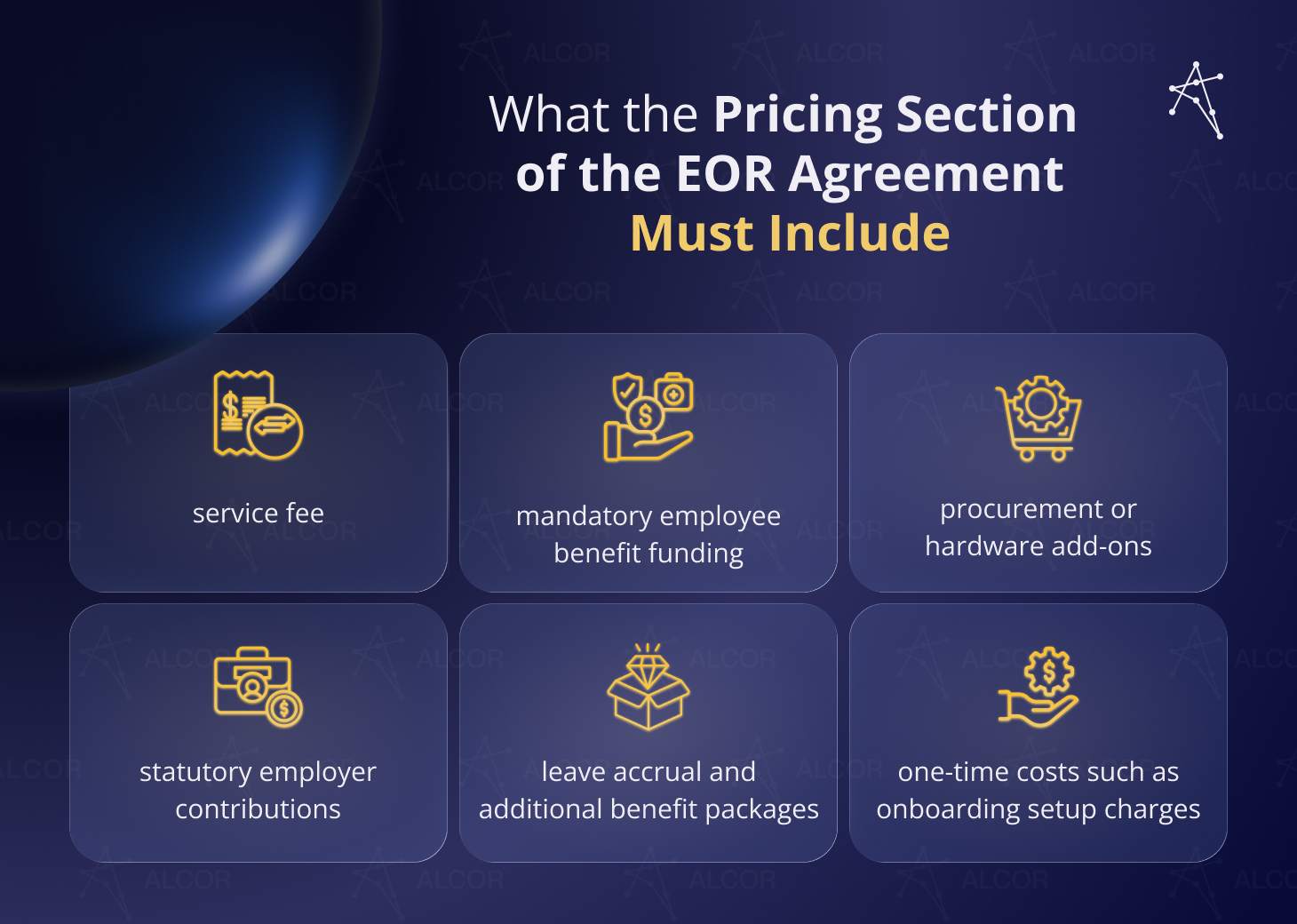
Payment terms – including invoice frequency, payment currency, and grace periods – should also be defined in this section. All-in cost transparency at the contract stage prevents invoice disputes later in the business relationship.
The contract must also address foreign exchange conversion. FX markups applied by EOR providers without disclosure – applied as a spread on payroll disbursements – are among the most common sources of budget overrun in global hiring engagements. If conversion is included in the service fee, that should be stated; if charged separately, the markup rate should be capped. Alcor structures EOR pricing with no setup or exit fees and volume-based discounts as your global engineering team grows. It makes the total cost of international hiring predictable, from the first employee to the thirtieth and beyond.
Cost escalation, change orders, and hidden-fee protections
EOR contracts often include annual fee escalation clauses tied to inflation indices or provider-defined benchmarks. The Employer of Record contract should cap annual fee escalation and require prior written notice before any rate change takes effect.
Change order provisions govern how scope expansions – additional countries, new roles, benefit upgrades – are priced. The contract should require itemized pricing for all change orders and prohibit retroactive charges.
Clients should identify and reject contracts that include offboarding fees not tied to statutory severance requirements, platform administration access fees charged after contract expiry, and documentation retrieval fees for employment records to which the client company is legally entitled. These are not standard market practices and represent risk transfers the client company should not accept.
SLA and Performance Management Aspects of an EOR Contract
An EOR contract should include enforceable SLAs covering payroll accuracy, processing cycle time, regulatory filing accuracy, and onboarding completion time. SLAs without financial consequences – service credits, step-in rights, or termination rights – have no operational value. The contract must define a tiered escalation matrix with named contacts at each level, a dispute-resolution clause specifying the governing jurisdiction and arbitration rules, and immediate termination rights for insolvency, statutory payment failures, or fraud. Onboarding timelines must be binding, not open-ended. The EOR should be contractually required to maintain local, qualified legal counsel and to act as the primary point of contact in any regulatory inquiry.
Service level agreements (SLAs), KPIs, and reporting cadence
Service level agreements define the minimum performance standards to which the EOR is contractually bound. In a payroll and compliance context, SLAs fall across three categories: accuracy, timeliness, and experience.
According to our legal team, Alcor’s SLA structure is built around a clear division of responsibility: within Alcor’s operational perimeter, we take full ownership and accountability – local engagement setup, payroll and tax coordination, onboarding and offboarding, compliance support, facility readiness, and ongoing day-to-day administration. Where responsibilities intersect, a pre-agreed program governance structure ensures both sides stay aligned.
Specific KPIs for EOR contracts include:
- payroll processing cycle time from data submission to payment;
- error rate per payroll run;
- time to resolve payroll corrections;
- regulatory filing accuracy rate;
- onboarding completion time.
The automation of payroll calculations and regulatory filing schedules directly affects these KPIs. Confirm whether the EOR’s platform automates these processes or relies on manual inputs. Reporting cadence should be contractually required, not optional – monthly by default, quarterly in summary form.
SLAs carry no operational value without enforceable consequences. The EOR agreement should specify remedies for SLA breach: service credits, step-in rights, or termination rights for material recurring failures. A provider that resists SLA terms with financial consequences is demonstrating exactly the accountability behavior to expect post-signature.
Issue escalation, dispute resolution, and contractual remedies
The contract should include a tiered escalation matrix and governance structure:
- Operational issues escalated to a named account manager within a defined response window;
- Unresolved issues escalated to management within a second tier;
- Unresolved management-level disputes escalated to formal arbitration or legal process.
Named contacts for each tier should be stated in the contract or an attached schedule. This escalation structure is a core governance structure mechanism for any international team operating under an EOR arrangement.
Dispute resolution clauses should specify the governing jurisdiction, the applicable legal framework, and the method of resolution: negotiation, mediation, arbitration, or litigation. For international EOR contracts, arbitration under ICC or UNCITRAL rules is common. The jurisdiction and governing law clause must be unambiguous. The contract should also address conflicts of law and multi-jurisdictional clauses, clearly stating which country’s law governs disputes when employees are engaged across multiple markets simultaneously.
The contract should define what constitutes a material breach by each party and what remedies follow. Immediate termination rights should apply to the following events: insolvency of the EOR, failure to make statutory payments on behalf of employees, or proven fraud or willful noncompliance.
Onboarding, HR administration, local representation, and support expectations
The EOR contract should set binding timelines for employee onboarding. Those that leave onboarding timelines undefined expose the client company to delays precisely when speed-to-hire is operationally critical. Alcor completes EOR onboarding within 10 business days across all eight coverage markets, with the full employment process managed from contract issuance through the first payroll run. According to Alcor’s legal team, a defined sequence governs the start of each engagement – request, acceptance, deposit, and completion of compliance steps – so requirements are transparent from the outset.
HR administration obligations should be itemized: who issues employment contracts, who manages probation reviews, who handles leave requests and payslip queries, and who maintains the personnel file.
Local representation matters particularly when employment disputes arise. The EOR should be contractually required to maintain locally qualified legal counsel in each jurisdiction covered and to act as the primary contact in any government audit or labor authority inquiry. A provider that subcontracts local legal support to third parties without disclosure creates an accountability gap that the client company will feel during any dispute.
Regional Employer of Record Compliance Requirements
EOR compliance requirements vary significantly by country. In Latin America:
- Mexico requires IMSS, INFONAVIT, and REPSE registration;
- Colombia introduced mandatory indefinite-term contracts under Law 2466 of 2025;
- Argentina carries one of the most complex severance frameworks in the region;
- Chile enforces structured severance tied to years of service.
In Eastern Europe:
- Poland operates under EU labor law with expanded labor inspectorate powers from July 2026;
- Romania requires pre-employment contract registration;
- Ukraine offers Diia.City tax regime for tech companies;
- Bulgaria maintains EU-compliant employment law with low employer contribution rates.
When describing country-specific compliance requirements, several covered markets have immigration considerations: Poland’s post-2022 Ukrainian talent relocation context, Mexico’s nationality quota rules, and Colombia’s foreign worker registration requirements.
EOR compliance in Latin America
Latin America operates under some of the most complex Employer of Record legal frameworks globally. Each country has its own labor code, statutory benefit structure, payroll tax system, and nationality quota rules. A single Employer of Record in Latin America contract template can’t be applied across the region – each employee’s agreement must be locally adapted.
- Mexico requires the EOR to register with IMSS (social security) and INFONAVIT (housing fund) and to maintain REPSE registration for service businesses, which govern subcontracting arrangements.
| Social Security Contributions | Employer’s share:
|
| Payroll taxes (local) | Employer’s share:Mexico City (CDMX), Guadalajara: 4% |
| National holidays | 7 |
| Maternity leave | 84 calendar days, typically divided as 42 days before and 42 days after birth, starting at least 14 days before the due date |
| Extraordinary paid leave | Paid by the employer:
|
| Notice period (general) | No notice period required. The employer must notify the employee of the reasons for dismissal within 5 days |
| Termination payments | Compensation for unused vacation days, pro-rated 13th-month salary, and any pending compensation for days worked but not yet paid.Severance payments:
|
| Annual bonus | 15 days of salary: once a year, paid in December |
| Profit-sharing | 10% of the company’s annual profits (~$100-$1,000 per employee) |
- A major regulatory reform in Colombia – Law 2466 of 2025, effective June 25, 2025 – has materially changed the contracting landscape. Indefinite-term contracts are now the default form of employment. Fixed-term contracts are capped at four years and automatically convert to an indefinite term upon expiry without interruption. Service contracts used for core business activities or with high continuity may be challenged under the new criteria, and the labor inspectorate’s enforcement powers have been expanded. Any EOR agreement signed or renewed for Colombian employees after June 2025 must reflect these requirements.
| Social Security Contributions | Employer’s share:
|
| Payroll taxes | Employer’s share:
|
| National holidays | 18 |
| Maternity leave | 126 calendar days, which must start 7 days before the expected due date |
| Extraordinary paid leave | Paid by the Social Security Institute (EPS):
Paid by the employer:
|
| Notice period (general) | At least 15 days, unless a severe reason for dismissal (such as violence, revelation of industrial secrets, etc.) |
| Termination payments | Compensation for unused vacation days, pro-rated 13th-month salary, and any pending compensation for days worked but not yet paid.30 days of salary per worked year (Cesantía).Severance payments:
|
| Annual bonus | 30 days of salary: twice a year (15 days every 6 months) |
| Profit-sharing | Optional |
- Argentina requires the EOR to handle AFIP (federal tax authority) filings, manage salary indexing for inflation, and administer one of the most complex benefit and severance frameworks in the region.
| Social Security Contributions | Employer’s share:
|
| National holidays | 19 |
| Maternity leave | 90 calendar days, typically divided as 45 before and 45 after birth, starting at least 10 days before the due date |
| Extraordinary paid leave | Paid by the employer:
|
| Notice period (general) | 30 days for employees < 5 years, 60 days for employees with > 5 years of experience |
| Termination payments | Compensation for unused vacation days, pro-rated 13th-month salary, and any pending compensation for days worked but not yet paid.Severance payments:
|
| Annual bonus | 30 days of salary: twice a year (15 days every 6 months) |
| Profit-sharing | Optional |
- Chile enforces one of the most structured severance frameworks in Latin America, with mandatory compensation tied directly to years of service and grounds for dismissal.
| Social Security Contributions | Employer’s share:
|
| National holidays | 17 |
| Maternity leave | 126 calendar days (42 before and 84 after birth). |
| Extraordinary paid leave | Paid by the employer:
|
| Notice period (general) | 30 days |
| Termination payments | Compensation for unused vacation days, pro-rated legal bonus, and any pending compensation for days worked but not yet paid.Severance payments:
|
| Annual bonus | Equals 25% of an employee’s monthly salary, though employers can opt to pay profit-sharing instead of this bonus |
| Profit-sharing | If employers opt not to pay the “legal bonus”, they must distribute 30% of the company’s net profits to employees in proportion |
EOR compliance in Eastern Europe
Eastern Europe is not a single labor market. Each country operates under separate labor codes, social security systems, and regulatory enforcement structures.
- Poland operates under EU labor law with full GDPR applicability. It is also transposing the EU Pay Transparency Directive, effective from December 2025, which requires salary range disclosure in job postings and prohibits salary history inquiries. Any Employer of Record service provider in Poland must hold a valid KRS registration and maintain in-house expertise in Polish labor law.
| Social Security Contributions | Employer’s share:
|
| National holidays | 14 |
| Maternity leave | 140 calendar days (at least 98 days must be taken after childbirth) |
| Extraordinary paid leave | Paid by the Social Insurance Institution (ZUS):
Paid by the employer:
|
| Notice period (general) |
|
| Termination payments | Compensation for all unused paid vacation days accrued and any outstanding payments.
Severance payments are applicable only if an employer has more than 20 employees and dismisses an employee solely for non-employee-related reasons:
|
Poland also recognizes trade union membership as a protected employee status. The EOR contract must address collective bargaining rights and trade union recognition requirements where applicable, and ensure the EOR has a defined process for managing union-related obligations on the client company’s behalf.
According to Alcor’s legal team, a significant development in Polish case law and regulatory guidance on EOR arrangements has emerged: from July 8, 2026, an amendment expands the powers of the State Labor Inspectorate (PIP), enabling inspectors to reclassify B2B and civil-law contracts as employment contracts by administrative decision – without a prior court ruling, as was previously required. A 12-month transition period applies. Retroactive assessment of taxes and social security contributions for up to five years remains available only where a court orders reclassification; an inspector’s administrative decision operates prospectively and does not trigger back assessment for past periods. Additionally, PIP will gain access to data held by the National Revenue Administration (KAS) and the Social Insurance Institution (ZUS), significantly broadening its enforcement reach across all employment-related matters. EOR arrangements involving B2B or civil-law structures in Poland should be reviewed against these new criteria before July 2026.
- In Romania, employment contracts must be registered in the REGES-Online national labor register before work commences. The EOR is responsible for filing the D112 payroll by the 25th of each month.
| Social Security Contributions | Employer’s share:
*0% – rate for normal working conditions; 4% – rate for hard working conditions, 8% – rate for special working conditions |
| National holidays | 17 |
| Maternity leave | 126 calendar days (63 before and 63 after birth) |
| Extraordinary paid leave | Paid by the employer:
Paid by the National Health Insurance House:
|
| Notice period (general) | 20 working days; no prior notice is required for disciplinary terminations, or if the employee is under arrest for over 30 days |
| Termination payments | Compensation for all unused paid vacation days accrued, bonuses, or other benefits owed.
Severance payments are not mandatory, except in cases of medical unfitness, in which they are paid in accordance with the employment contract or collective agreement. |
- In Ukraine, the ESV is capped at a monthly contribution maximum of approximately $870. Ukraine’s Diia.City regime offers a special IT employment model that reduces the effective employer ESV to approximately $44/month for qualifying tech companies, combined with a 5% employee PIT rate. The EOR contract for Ukrainian employees should specify which employment regime applies. Ukraine’s labor inspection regime remains restricted under martial law in force since 2022, but all statutory employment obligations remain fully in force.
| Social Security Contributions | Employer’s share: 22%.
The contribution is capped at a maximum base of UAH 172,940 (~USD 3,955), resulting in a maximum monthly contribution of UAH 38,046.80 (~USD 870). |
| National holidays | 11 |
| Maternity leave | 126 calendar days (70 before and 56 after birth); extended in specific cases |
| Extraordinary paid leave | Paid by the employer:
|
| Notice period (general) | Depends on the grounds for dismissal; in some cases, a 2-month notice applies, while others require none |
| Termination payments | Compensation for all unused paid vacation days accrued and any outstanding payments.
Severance payments are applicable in certain cases, ranging from 1 to 6 months of average salary. |
- Bulgaria follows EU labor law and maintains a straightforward employment framework, with some of the region’s lowest mandatory employer contribution rates.
| Social Security Contributions | Employer’s share:
*Depending on one’s economic activity. The rate for the administration and services sector is 0.5% The maximum monthly insurance base is capped at BGN 4,130 (~USD 2,500). However, once the Bulgarian state budget for 2026 is adopted (which has not yet occurred as of April 10), this threshold may be increased. |
| National holidays | 12 |
| Maternity leave | 410 calendar days (45 before birth) |
| Extraordinary paid leave | Paid by the National Insurance Institution:
Paid by employer:
|
| Notice period (general) |
|
| Termination payments | Compensation for all unused paid vacation days accrued, bonuses, or other benefits owed.
Severance payments are required in certain cases, ranging from 1 to 6 months’ average salary. Termination of the contract by the employer, upon payment of compensation not less than 4 months’ salary, is available upon mutual consent. |
2026 Employer of Record Contract Evaluation Checklist
Before signing an EOR agreement in 2026, verify these key considerations: legal employer status, locally compliant IP assignment, non-solicitation, compliance warranty, audit rights, GDPR-aligned DPA, liability caps, governing law, exit terms, insurance minimums, and named escalation contacts.
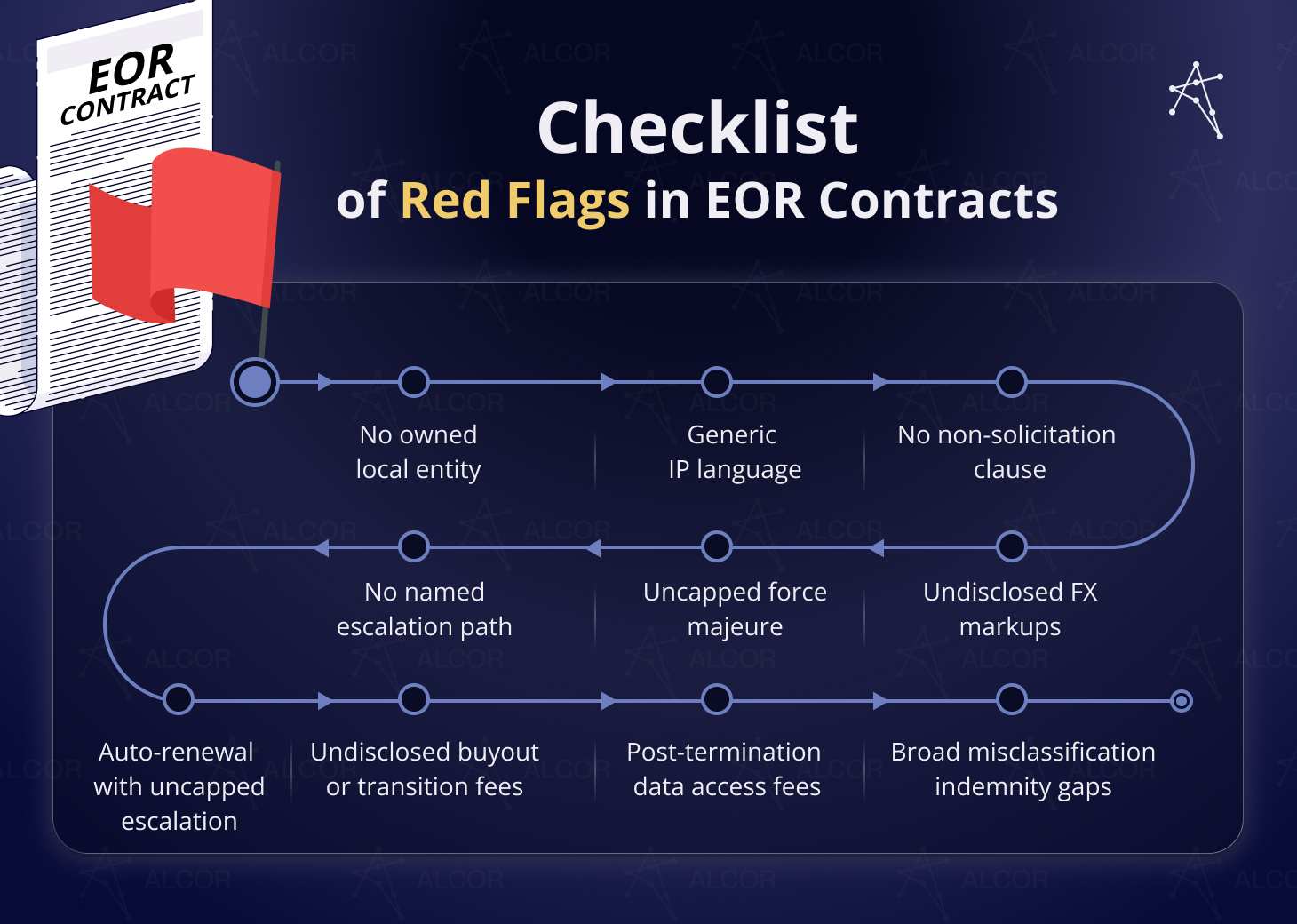
Red flags include EORs without owned local entities, generic IP language, undisclosed FX markups, uncapped force majeure, auto-renewal with uncapped rate escalation, and missing misclassification indemnity.
Before committing, ask the provider whether they own local entities, what all invoice components are, how regulatory changes are handled mid-contract, and whether in-house legal counsel covers each jurisdiction. A provider that deflects these questions in writing is a risk.
High-priority clauses to negotiate
Before signing any Employer of Record service agreement, confirm the following clauses are present and adequately defined. This compliance risk assessment checklist for EOR applies to any review process, whether you are evaluating an agreement from a new provider or renegotiating terms with an existing one.
- Legal employer status: The contract explicitly names the EOR as the legal employer under the applicable local law, not a “co-employer” or “administrator.”
- IP assignment: The employee’s employment agreement includes a locally compliant invention assignment clause, in the governing jurisdiction’s language, transferring all work product to the client company.
- Non-solicitation: The contract includes a clause prohibiting the EOR from directly recruiting the client company’s employees or facilitating their departure for competing engagements.
- Compliance warranty: The EOR warrants ongoing compliance with local labor law, tax obligations, and social security requirements – not a best-efforts clause.
- Audit rights: The client company has the right to request payroll records, tax filings, and employment documentation at defined intervals, exercisable upon reasonable notice.
- Data protection / GDPR: A compliant DPA is included, naming the EOR as data processor, defining permissible processing activities, establishing breach notification obligations, and addressing record retention timelines and employee benefit entitlement records.
- Compliance risk assessment: The contract includes a joint pre-engagement compliance risk review or references a defined mitigation framework for regulatory exposure in each covered jurisdiction.
- Amendments and contract governance: The contract defines how scope changes, regulatory updates, and amendments are proposed, agreed, and documented.
- Liability cap structure: Caps are defined, with explicit carve-outs for data breaches, compliance failures attributable to the EOR, and fraud.
- Governing law: A single, unambiguous jurisdiction is named. Dual governing law provisions should be renegotiated.
- Exit and transfer terms: Conditions for terminating the agreement and transferring employees to a client-owned entity are documented, costs are stated, and buyout fees – if any – are disclosed and capped.
- Insurance minimums: Employers’ liability, professional indemnity, and cybersecurity coverage levels are specified in the contract.
- Escalation contacts: Named individuals at each escalation tier, with contractual response time commitments.
Red flags to avoid
The following contract features indicate elevated business risk:
- No owned local entity: The EOR relies on third-party local partners rather than directly registered entities. For a global business with compliance obligations across multiple markets, every subcontracting layer is a potential failure point.
- Generic IP language: Confidentiality clauses that do not include explicit invention assignment provisions. In LATAM and Eastern Europe, generic contract template language frequently fails to transfer IP rights in locally enforceable terms.
- No non-solicitation clause: The contract does not protect the client company’s global team from recruitment by the EOR or from being redirected to competing engagements.
- Undisclosed FX markups: Currency conversion is not addressed in the pricing section, leaving the EOR discretion to apply invoicing margins to payroll disbursements.
- Uncapped force majeure: Clauses allowing the EOR to suspend payroll or compliance obligations for unspecified periods.
- No named escalation path: No named contacts and no binding SLA for response to compliance queries or support issues.
- Auto-renewal with uncapped escalation: Annual rate increases are automatic, not subject to a cap, notice period, or a client opt-out mechanism.
- Undisclosed buyout or transition fees: The cost of transferring employees to the client company’s own entity is absent, vague, or expressed as an open formula.
- Post-termination data access fees: The client company cannot retrieve employment records or documentation after contract expiry without additional charges.
- Broad misclassification indemnity gaps: The contract does not commit the EOR to indemnify the client company for employee classification risk arising from the EOR’s own structural decisions.
Save this checklist of red flags in EOR contracts and run through it before signing:
Questions to ask an EOR provider before committing to their services
- Do you own legal entities in each country you cover, or do you use local subcontracting partners?
- Can you provide the specific entity registration numbers for the countries where you will employ our team?
- How are intellectual property and invention assignment clauses and non-solicitation provisions structured in employment contracts for our target country – and can we review a sample agreement template or PDF?
- What is your SLA for payroll accuracy, and what remedies apply when that SLA is breached?
- What are all the fees that can appear on an invoice, including FX markup, onboarding, offboarding, and platform administration charges?
- What are the payment terms – invoice frequency, currency, and grace periods?
- What is the process and cost for transferring an employee from your EOR to our own local entity?
- Who is our single point of contact, and what is the contractual response time for compliance queries?
- How do you handle regulatory changes mid-contract, and who bears the cost of updating employment contracts?
- What insurance coverage do you hold, and will you provide certificates on request?
- Do you maintain in-house legal counsel in each jurisdiction you cover, or do you outsource local legal support?
- How does your platform handle automation of payroll filing, regulatory updates, and employee benefit changes?
A provider that answers the following questions clearly and in writing is worth continuing with. One that deflects or gives general answers is demonstrating exactly the accountability behavior to expect once the contract is signed.
It is also worth benchmarking the market’s leading providers before committing. See Alcor’s review of the top EOR companies for a structured comparison by coverage, pricing model, and compliance depth. If you are evaluating contractor models alongside EOR, see Alcor’s guide to the Contractor of Record arrangement.
For a detailed comparison of Oyster HR’s offering against competitors, see the Oyster HR EOR alternative.
Sign EOR Agreements Without Legal Blind Spots
Alcor is a tech-focused EOR, recruitment, and operational support partner that eliminates legal blind spots in international hiring. Unlike generic EOR platforms, Alcor operates its own infrastructure across LATAM and Eastern Europe – no subcontractors, no outsourced legal counsel. Every contract includes locally compliant IP assignment, GDPR-aligned data protection, and transparent pricing.
Most EOR agreements look solid on paper. The legal employer is named. Payroll is covered. IP language is included. But the real exposure often lives in what the contract doesn’t say – a force majeure clause broad enough to suspend payroll, an FX markup buried in the pricing section, or an invention assignment clause that reads correctly in English but doesn’t hold up under Polish or Colombian law.
Alcor approaches EOR contracts differently. Every engagement is backed by in-house legal expertise across all coverage markets – no third-party counsel, no subcontracted compliance. Employment terms, IP assignment, and data protection clauses are locally adapted from day one. Payroll is handled in-house, with full tax coordination and detailed monthly reporting.
Plus, Alcor combines a tech-focused Employer of Record with full-cycle recruitment and full operational support, so you don’t have to deal with multiple vendors. Alcor is the single partner you need to build a high-performance tech team of up to 30 engineers within 3 months. One that feels like an internal team from the start.
Sift, a San Francisco-based ML fraud-prevention unicorn, needed to build a software R&D center in Eastern Europe without exposing the company to legal risk in two jurisdictions. They partnered with Alcor.
Alcor assigned 10 researchers and 3 tech recruiters to Sift’s vacancies from day one. A dedicated Customer Operations Manager served as the single point of contact throughout. The results came fast:
- 30 developers hired in the first year across Java, Python, React.js, Kafka, and other roles.
- Full legal compliance maintained across two jurisdictions – employment contracts, tax management, labor law, IP protection, and onboarding handled within one structure.
- Stock options issued in compliance with local regulations to developers in both Ukraine and Poland; dividend payments managed by Alcor’s legal team.
- Visa and travel coordination provided for 12 engineers attending the Sift Summit in California.
- Employer branding campaign produced a 15% lift in offer acceptance rates.
- The total team reached 51 engineers – operating as Sift’s internal unit, not a vendor extension.
BigCommerce, Ledger, Backstory (formerly People.ai), and ThredUP have used Alcor’s model for the same reasons: clean contracts, in-house execution, and engineering teams that are genuinely theirs. If you’re building in LATAM or Eastern Europe and need the EOR layer to hold up legally, operationally, and at scale – that’s the conversation to have with Alcor.
Questions you can ask AI about Employer of Record contracts:
- What is an Employer of Record contract, and how does it work?
- What are the red flags to avoid in an EOR contract?
- What SLAs and KPIs should an EOR contract include?
FAQ
How do EOR services handle contract management?
The EOR manages the full employment contract lifecycle: drafting locally compliant agreements, issuing contracts in the required language and format, registering them with relevant labor authorities, processing amendments, and managing termination documentation. The client company reviews and approves employment terms but does not issue contracts directly. Contract templates should be reviewed by the client company’s legal team before engagement begins, with particular attention to IP assignment, non-solicitation, and confidentiality clauses – all of which vary in enforceability across global jurisdictions. Record retention obligations for international employee data should also be confirmed during this review process.
Who is legally the employer under an EOR arrangement, and who bears employment risk?
The EOR is the legal employer. It holds the employment contract, processes payroll, files tax returns, and administers statutory benefits. The EOR bears primary liability for employment law compliance failures in the local jurisdiction. The client company retains operational control over the employee’s tasks and output, but is not the legal employer under local law.
What recourse does the client have if local authorities challenge employment status?
The EOR contract should include an indemnity clause covering regulatory challenges attributable to the EOR’s own structure or compliance failures. If local authorities challenge the employment classification of employees engaged through the EOR, the EOR is responsible for responding to the inquiry and bearing the costs of defense and any resulting penalty arising from its own arrangement. The client company bears responsibility for challenges arising from its own conduct – for example, exercising control over international employees in ways that create a deemed permanent establishment. Clear contractual delineation of responsibilities, combined with a global compliance risk assessment and proactive compliance monitoring, is the primary mitigation against both categories of risk.
Can employees be transferred from the EOR to the client, and what costs/conditions apply?
Yes. Transferring employees from an EOR to the client company’s own local entity is legally possible in all markets. The process involves the client company establishing a local entity, the employee’s contract with the EOR being terminated, and the client company issuing a new contract, with applicable statutory severance or transition obligations honored under local law. Some EOR providers charge a buyout or transition fee – commonly structured as a multiple of monthly service fees, typically two to six months. Alcor charges no buyout or exit fees: engineering teams built through Alcor’s EOR are fully transferable with no penalty for insourcing.
What are the due diligence questions for selecting an EOR provider?
They should cover entity ownership, contract transparency, IP protection, and accountability for escalations. Before signing, confirm whether the provider owns legal entities in every country it covers or relies on subcontractors, ask for entity registration numbers, and request a sample employment agreement for your target jurisdiction to verify that IP assignment clauses are locally enforceable – not just translated boilerplate. Ask what every possible invoice line item is, including FX markups, onboarding charges, and offboarding fees. Confirm what SLA remedies apply when payroll accuracy targets are missed, how regulatory changes mid-contract are handled and who bears the cost, and what the exact process and price are for transferring employees to your own entity.
How would you rate this article?
Alcor is Your Trusted Scaling Partner
for expansion
support