


Technology in Colombia combines a 202,000-strong tech workforce with around 37,000 STEM graduates entering the talent pipeline each year. The IT market in Colombia also benefits from 2,295 active startups (KPMG Colombia Tech Report 2026) and the #2 startup ecosystem in LATAM, according to StartupBlink. It creates opportunities across AI, SaaS, fintech, healthtech, agritech, and e-commerce.
I’m David Gomez, Lead IT Recruiter in LATAM at Alcor. We provide a software R&D center as a service that encompasses IT recruitment in Latin America and Eastern Europe, Employer of Record services, and comprehensive operational support – everything needed to build top teams from 10 to 100 developers for US tech product companies and VC-backed startups within a year.
In this article, you’ll get insights about the technology industry in Colombia and explore its emerging trends and nearshoring benefits. You’ll also discover a workable approach to scaling your development team with Colombian coders.
Key Takeaways
- The Colombian technology market is projected to reach $15.7 billion by 2032, supported by 202,000 tech professionals and 2,295 active startups. Colombia ranks #2 in LATAM and #35 globally in terms of its startup ecosystem.
- AI adoption is already widespread, with 98% of Colombian startups using AI.
- Colombia offers significant nearshoring savings for US companies: senior engineers cost 57.4% less, while a seven-person AI engineering team costs 54% less in base salaries than in the US.
- IT in Colombia is advancing across AI, fintech, healthtech, cybersecurity, SaaS, IoT, and cloud. SaaS now represents 27% of startups, while the AI market is projected to reach $14.37 billion by 2034.
- Alcor helps tech companies and VC-backed startups build internal R&D teams of 10–30 senior engineers in 90 days. It combines full-cycle recruitment, tech-focused EOR/COR, and operational support while giving clients full team and IP ownership without vendor lock-in.
Colombia IT Industry: Overview
- Colombia’s IT market is projected to reach $15.7 billion by 2032, growing at an 8.5% CAGR from 2026.
- Colombia has 202,000 tech professionals and 2,295 active startups, up 9.3% YoY, ranking #2 in LATAM and #35 globally for its startup ecosystem.
- Key tech hubs include Bogotá, Medellín, Cali, Barranquilla, and Cartagena, supporting fintech, healthtech, agritech, SaaS, telecom, and e-commerce.
- Initiatives such as Colombia Tech Week further strengthen the country’s visibility as a LATAM technology and investment destination.
One of the sparkling gems of the Latin American region is undoubtedly the IT industry in Colombia. It’s a vivid example of the ITSM market in Latin America, which has been steadily evolving and showing stable year-over-year growth. And guess what? Once seen as an emerging market, the Colombian tech industry is not slowing down. According to Verified Market Research, the market is projected to reach $15.7 billion by 2032, growing at an 8.5% CAGR from 2026 to 2032.
Talking exports, the technology industry in Colombia has been on the rise: per the World Bank, the country exported $2.0 billion in ICT services in 2024. The demand for tech services is sky-high across sectors such as fintech, healthtech, agritech, oil and gas, energy, telecommunications, blockchain, and e-commerce. And if you want more details on that, then stay with me!
Some of the main consumers of Colombian information technology services are the United States, Mexico, and Spain. Meanwhile, the locals are also stepping up their game, with application development and system infrastructure software topping the charts in IT spending.
Behind the numbers of the Colombian ICT market is a skilled talent pipeline: according to Alcor’s research, Colombia’s tech talent pool now stands at 202,000 professionals. On developer competitiveness, per the TopCoder Programming Competitiveness Index, Colombia ranks #6 in Latin America (#62 globally). Per the EF English Proficiency Index, it ranks #17 in LATAM (#76 globally), with IT professionals rated Moderate (Upper-Intermediate) – a level solid enough for day-to-day technical collaboration. However, English fluency is worth incorporating into the screening process for roles that require intensive real-time discussion.
That screening nuance holds up in Alcor’s own recruitment work. “Colombian developers consistently show a strong technical foundation, paired with curiosity, proactivity, and a genuine drive to stay current with new tools and frameworks,” says Alcor’s recruitment expert in Latin America.
The startup ecosystem of the Colombian tech sector also delights with the bright colors of success, thanks to multiple initiatives that support entrepreneurship and attract increased investment. According to the KPMG Colombia Tech Report 2026, the country now counts 2,295 active startups, up 9.3% year-over-year, with SaaS overtaking fintech as the leading segment in 2026. Among the stars are Rappi, ADDI, Bold, Platzi, Habi, and LaHaus, which prove that Colombian technology can scale far beyond local borders.
Colombian key tech hubs
Colombia is home to top tech hubs of Latin America:
- Bogotá is the tech capital of Colombia and the region’s third-largest Spanish-speaking startup hub by global capital raised. Per CBRE, Bogotá holds 110K+ IT specialists – the country’s largest tech talent hub. According to the KPMG and BBVA Spark Colombia Tech Report 2026, Bogotá ranks #1 in Colombia and #2 in South America with 895 startups, according to StartupBlink.
- Medellín. Together with local government, Medellín’s former mayor (a software developer himself) coined the term Valley of Software to capture the city’s tech-focused evolution. Fast-forward to today, Medellín is a recognized hub for CleanTech and IT innovation, and its local Medellín Software Valley initiative continues to attract global players, positioning the city as a LATAM development hub.
Targeting Medellín’s CleanTech talent? Alcor’s cleantech recruiters can hire up to 30 senior engineers in just 90 days.
- Cali is Colombia’s third-largest technology hub with big FinTech ambitions, ranked #3 in the country with 219 startups, according to StartupBlink. The city’s 2024-2027 digital transformation strategy aims to modernize infrastructure, expand e-tech services, and make technology a core of public life. In short: Cali wants to go from underrated to unavoidable.
- Barranquilla. Known as “La Arenosa” and the “Golden Gate of Colombia,” it is fast becoming a data powerhouse. According to StartupBlink, the city already hosts 95 startups.
- Cartagena. Traditionally famous for its history and tourism, it is now carving a place on the tech map with growing international ties. In 2025, its collaboration with Spain’s Zona Franca de Cádiz and the local incubator Econova highlighted Cartagena as an emerging bridge between the European and Colombian tech ecosystems, according to Cadena SER.
Foreign investment boom
Colombia is quickly proving itself as a serious destination for global capital. According to KPMG’s Colombia Tech Report 2026, Colombian startups secured $513 million across 104 formal deals in 2025 – roughly 12% of all Latin American investment, ranking the country third behind Brazil and Mexico. Overall, foreign direct investment has accelerated further into 2026: per Colombia One’s reporting on Banco de la República data, Colombia drew $3.8 billion in FDI in Q1 2026 alone – a 34.4% year-over-year increase, with non-extractive sectors (including technology and services) accounting for a growing share of that inflow. The government has made it clear that foreign investors are as welcome as domestic ones, introducing incentives like a special tax regime for mega-investments.
That pro-investment mindset is on full display at Colombia Tech Week (CTW), the country’s flagship technology and innovation event, which spans Bogotá and Medellín. With over 20,000 attendees and more than 300 global investment funds represented, CTW is where startups, investors, and ecosystem builders connect to shape the future of the Colombian technology industry. The program blends investment roundtables, hands-on workshops, and high-value networking opportunities.
As Colombia continues to attract global investors, a Colombian PEO can help you establish and manage your local workforce with confidence.
Local tech market challenges: AI regulations, cross-border data flow, and more
Colombia’s rise as a LATAM tech powerhouse is undeniable, but a few speed bumps remain. For example, regulations around artificial intelligence. While the government has released ethical AI guidelines and even suggested privacy impact studies for AI systems that handle personal data, the country still lacks enforceable, sector-specific laws. That said, the policy groundwork is more developed than it may appear: Colombia’s National Artificial Intelligence Policy (CONPES 4144) sets out 106 specific actions to be executed through 2030, spanning AI governance and regulation, infrastructure and data, R&D, talent development, risk mitigation, and AI adoption, with implementation shared across multiple government ministries and agencies. It’s the most structured government AI commitment among Colombia’s peer LATAM markets. For startups experimenting with generative AI, day-to-day legal uncertainty can still slow decision-making, but the direction of travel is toward a clearer framework. Continue reading to discover how Colombia’s AI sector is evolving and addressing these issues.
Another sticking point is cross-border data flow. Colombia’s data protection framework (Law 1581 of 2012) is stricter than most in Latin America, requiring local data residency in certain sectors. That creates friction for SaaS and cloud companies looking to scale globally or partner seamlessly with US and EU clients. But here’s good news: a Statutory Bill (214/2025C) has been filed to modernize Law 1581 of 2012. This modernization aims to align Colombia with international data protection standards, clarify legal bases, strengthen oversight, regulate international data transfers, and introduce new obligations for the processing of emerging technologies.
Add in slow bureaucracy for IP registration and patchy digital infrastructure in rural areas, and you’ve got challenges that can frustrate founders and investors alike. Although the country is transitioning from an uncertain regulatory environment to a structured, binding, and modern legal framework, this transition has not yet been fully established.
Still, as you can see, all these issues are solvable. Smarter regulation, stronger public–private cooperation, and continued infrastructure investment would go a long way toward cementing Colombia’s role as a central player in the Latin American tech industry.
Here’s one more nuance many tech product companies and VC-backed startups overlook – brand visibility. Skilled Colombian engineers prefer to join employers they actually recognize, which means that without local presence, even strong offers may fall flat. This is where employer branding becomes critical: when Sift partnered with Alcor, our social campaign with their Hiring Manager boosted offer acceptance rates by 15%.
If you’re nearshoring to Colombia, power up your dev team via IT recruitment in Medellin!
Tech industry in Colombia vs the USA
- The global IT market is projected to reach $10.04 trillion in 2026, while the US has nearly 706,000 tech businesses and 9.8 million tech workers.
- The ICT market in Colombia is projected to grow from $22.68 billion in 2025 to $37.70 billion by 2030, at an 11.6% CAGR. Colombia hosts 12.8% of LATAM’s digital firms, while 98% of its startups use AI.
- Colombia also offers substantial cost advantages: hiring senior engineers costs 57.4% less than in the US, while a seven-person AI engineering team costs 54% less.
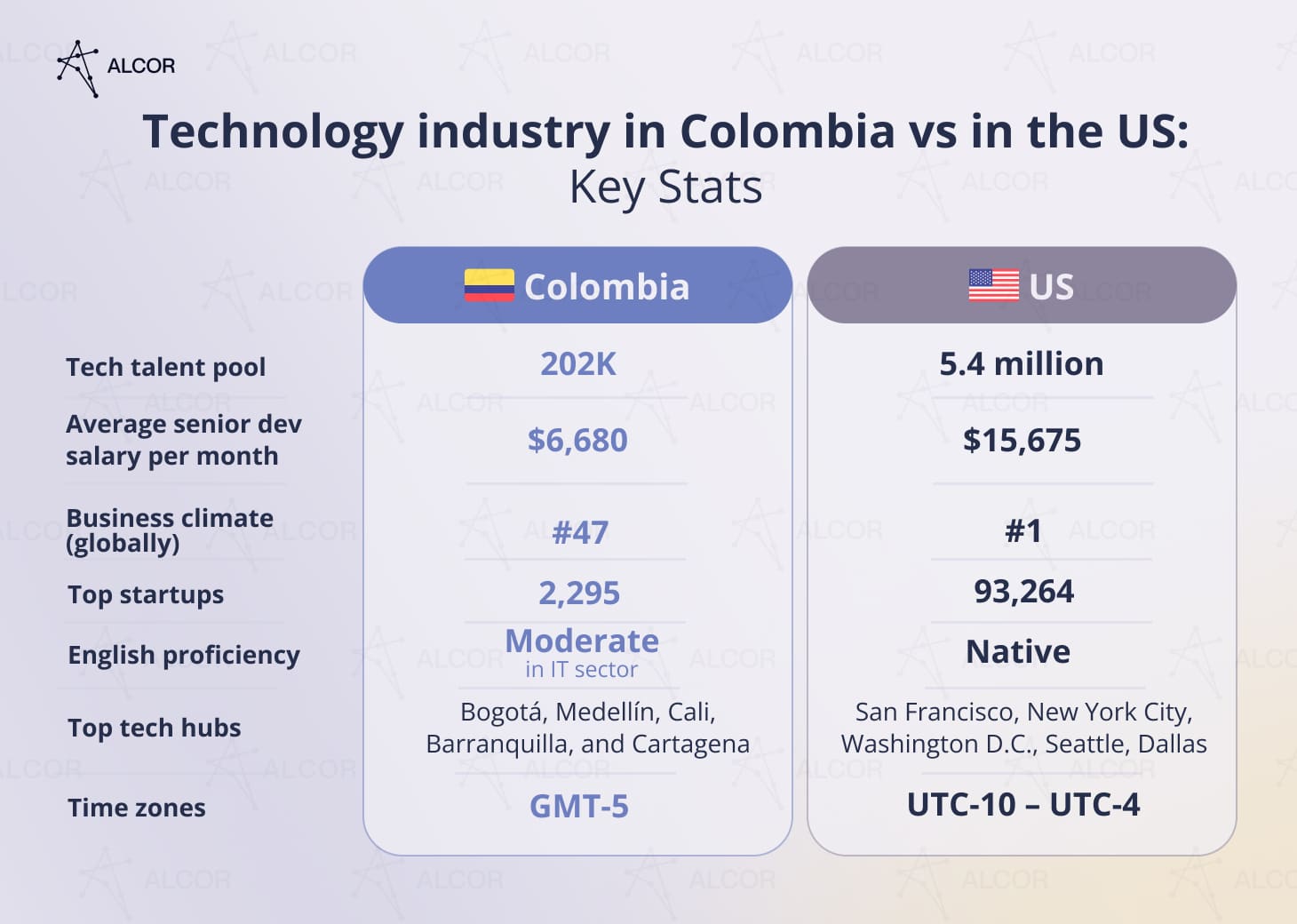
Data updated for 2026.
The global information technology market reached $9.34 trillion in 2025 and is projected to hit $10.04 trillion in 2026, growing at a 7.5% CAGR toward $13.8 trillion by 2030, according to Research and Markets’ Information Technology Market Report. The United States is leading the charge as the world’s largest single tech market. Per CompTIA’s State of the Tech Workforce 2026, the country counts nearly 706,000 tech business establishments in 2026 – a drastic technology market difference between the US and Colombia.
That US tech workforce figure also tells a growth story worth flagging: net tech employment actually shrank by 0.3% in 2025 (about 33,600 fewer jobs), before rebounding with a projected 1.9% increase in 2026 (185,499 new jobs), per the same CompTIA report. In other words, the US market isn’t simply large – it’s mid-recovery, which is part of why more companies have turned to nearshore hiring this year.
The US market for IT services is also much larger than Colombia’s, with revenue projected at $589.74 billion for 2026, according to Statista. The local vendors primarily offer digital transformation services, with key players including IBM, Accenture, DXC, and Cognizant.
When it comes to tech industry trends, the US and the IT sector in Colombia are quite in sync. The US tech industry is rapidly adopting cloud computing to save money and resources on information storage and artificial intelligence, particularly in the healthcare field. Among other burning trends are the integration of business intelligence, data security and privacy protection, 5G technology, Blockchain, and AR.
What about Colombia vs Uruguay for nearshore technology outsourcing? Discover their differences!
Regarding tech talent, the technology market in the US compared to Colombia is like night and day. Per CompTIA, an estimated 5.9 million people work in tech occupations across the US, with software developers accounting for a large share. Hiring in this pool has stayed selective through 2026 – several months of tech-sector job losses offset by growing occupation-level demand. It’s a pattern that continues to push more US tech product companies and VC-backed startups to outsource software development to Colombia and other LATAM countries rather than compete for expensive local talent.
Which raises the next question: how is Colombia building the infrastructure to back its ambitions? The answer lies in the rapid expansion of the ICT market.
The ICT market in Colombia
- Over the 2025-2030 period, cumulative revenues for Colombian ICT market providers are expected to exceed $176.09 billion, with the market growing from $22.68 billion in 2025 toward $37.70 billion by 2030 at an 11.6% CAGR (Global Data).
- The Ministry of ICT (MinTIC) Connect ICT 360 plan targeted 85% internet coverage by 2026. According to MinTIC’s own 2026 progress report (via El País), the country has already reached 73.9% household internet access (up from 59.5% in 2022), with rural access nearly doubling from 32.2% to 56.9% over the same period – 10.1 million additional Colombians connected in three years.
- Colombia ranks just behind Brazil and Mexico in LATAM’s digital economy, hosting 12.8% of the region’s digital firms, according to the International Trade Administration.
- The rising adoption of AI, data analytics, and automation is reshaping industries such as finance and healthcare, driving efficiency and creating opportunities for SaaS and cloud solutions. In Colombia specifically, 98% of startups now use AI in some capacity, with 38% placing it at the center of their product, per KPMG Colombia Tech Report 2025–2026.
Labor cost in Colombia vs the US
For American product companies and VC-backed startups, nearshore tech talent in Colombia offers a compelling mix of quality and savings. According to Alcor’s 2026 engineer compensation research, a senior engineer in the US earns an average of $15,675 per month, while hiring the same seniority level in Colombia costs about $6,680 – a 57.4% difference, consistent with savings across the middle (60.2%) and lead (50.7%) levels as well.
It’s fair to ask: Does the base salary reflect the real cost of hiring a developer?
Not quite. Factor in:
- Statutory employer costs: in Colombia, social security contributions add roughly 30% to salary (pension, health, labor risk, and payroll taxes combined), plus a mandatory Prima de Servicios (one extra month’s salary, paid in two installments) and Cesantía severance deposits.
- Benefits packages: around $3,300/year per engineer in Colombia (transportation, health insurance, meal allowances, home office), compared with roughly $15,400/year per worker in the US, according to research by Alcor’s experts.
- Recruitment fees (20% for senior IT positions in Colombia vs 30% in the US).
Per Alcor’s 2026 Guide to Building Your AI & Product Engineering Team in Latin America & Eastern Europe, a seven-person AI product engineering team costs $112,500/month in base salary in the US:
- one lead AI/ML engineer;
- two senior AI/ML and MLOps engineers;
- one senior AI data engineer;
- three mid-level engineers across AI/ML, AI data, and AI product.
The same team, with the same roles and seniority mix, runs $52,000/month in Colombia: savings of $60,500/month, or 54% below US cost. That gap holds before employer taxes, statutory benefits, bonuses, equity, recruitment costs, or operating expenses are even factored in.
And if you want the full breakdown, our research is ready for download.
Nearshoring to Colombia – a Trend?
US companies are increasingly nearshoring software development to Colombia for cost savings, proximity, and access to growing tech talent. US demand for tech talent is projected to reach 7.1 million jobs by 2034, while Colombia has surpassed 1 million GitHub developer accounts.
Colombian developers specialize in custom software, web and mobile development, AI/ML, and blockchain. Major US tech companies with engineering teams in Colombia include Google, Microsoft, Amazon, IBM, and Oracle.
US companies are turning to nearshoring to Latin America for cost savings, proximity, and the expected shortage of tech professionals in the region. According to Deloitte, demand for tech talent in the US is projected to reach 7.1 million jobs by 2034 – a growing gap that shows no sign of closing on its own. On the supply side, GitHub’s Octoverse data reports more than 1 million developer accounts associated with the country. These numbers paint a clear picture: IT outsourcing to Latin America, particularly to Colombia, is a growing trend among US tech firms seeking to expand their business capabilities.
On the ground, that demand is increasingly AI-shaped. AI-driven roles are now the dominant demand signal Alcor sees from clients, cutting across industries rather than concentrating in one vertical – the clearest shift heading into 2026, according to Alcor’s LATAM recruiting team. The client mix itself still skews toward US tech product companies, with fintech and e-commerce as the most recurring verticals in the pipeline.
Colombia’s IT outsourcing sector is experiencing rapid growth as one of the go-to destinations for software development nearshore outsourcing in Latin America. The technology sector in Colombia is fueled by its skilled tech experts, who excel in custom software development, mobile app and web development, AI/ML, blockchain – you name it.
According to our LATAM tech recruiters, AI/ML and Data Science are among the fastest-growing and most active pools in Colombia right now, and increasingly Generative AI is part of that conversation. What makes this particularly strong is that it is not emerging in isolation. Colombia has a broad and established software engineering base in Java, JavaScript/TypeScript, Python, and cloud, and engineers from those disciplines have adapted quickly, layering AI capabilities on top of solid fundamentals rather than starting from scratch. That combination of strong engineering foundations meeting AI adoption is what makes the Colombian AI talent pool more production-ready than markets where AI skills exist without the underlying engineering depth. In QA, Colombia also offers one of the strongest quality-cost ratios in LATAM.
Ask clients why they picked Colombia over another LATAM market specifically, and timezone comes up first – Colombia runs on EST year-round, which keeps real-time collaboration with US teams straightforward. Cost efficiency follows close behind. But the factor clients mention most consistently, per our recruitment experts, is the attitude of Colombian professionals: their proactivity, openness, and ability to adapt to international working cultures. That combination of interpersonal skills and collaborative mindset reduces friction in ways that are hard to quantify upfront, but become obvious once the engagement is running.
So, what are the pros and cons of nearshore outsourcing to Colombia? Take a sneak peek at the picture below to find out.
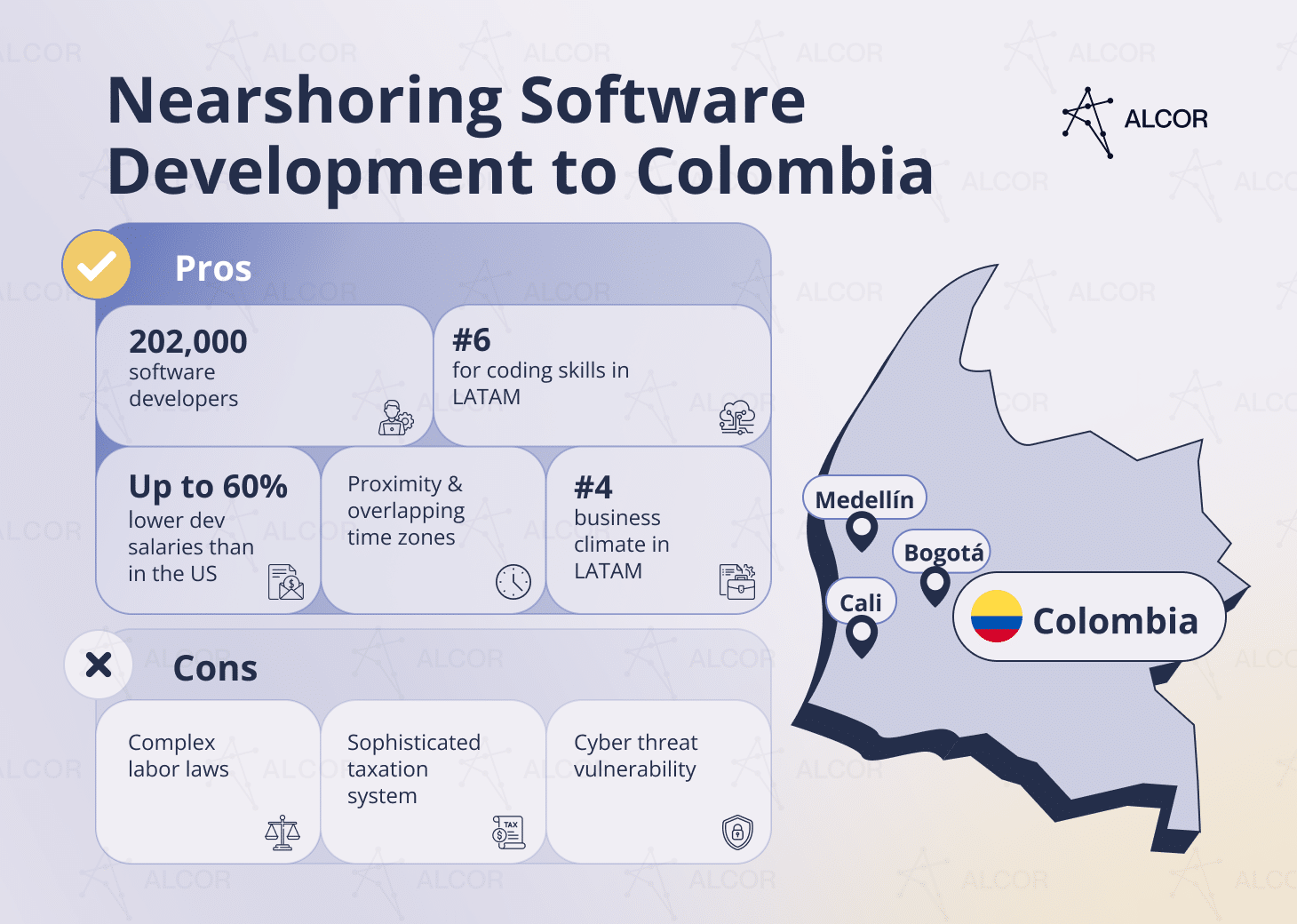
Data updated for 2026.
Recognizing the benefits of the information technology market in Colombia, numerous foreign tech businesses are tapping into its potential. Among the leading US tech companies in Colombia engaged in software development are Google, Microsoft, Amazon, IBM, and Oracle, each with dedicated teams of software engineers.
Up next: a practical solution for assembling teams for software development in Colombia with a model that gives you control from day one.
Compare Colombia vs Argentina for nearshore technology outsourcing and Colombia vs Peru for nearshoring!
Software Team from 10 to 100 – Possible?
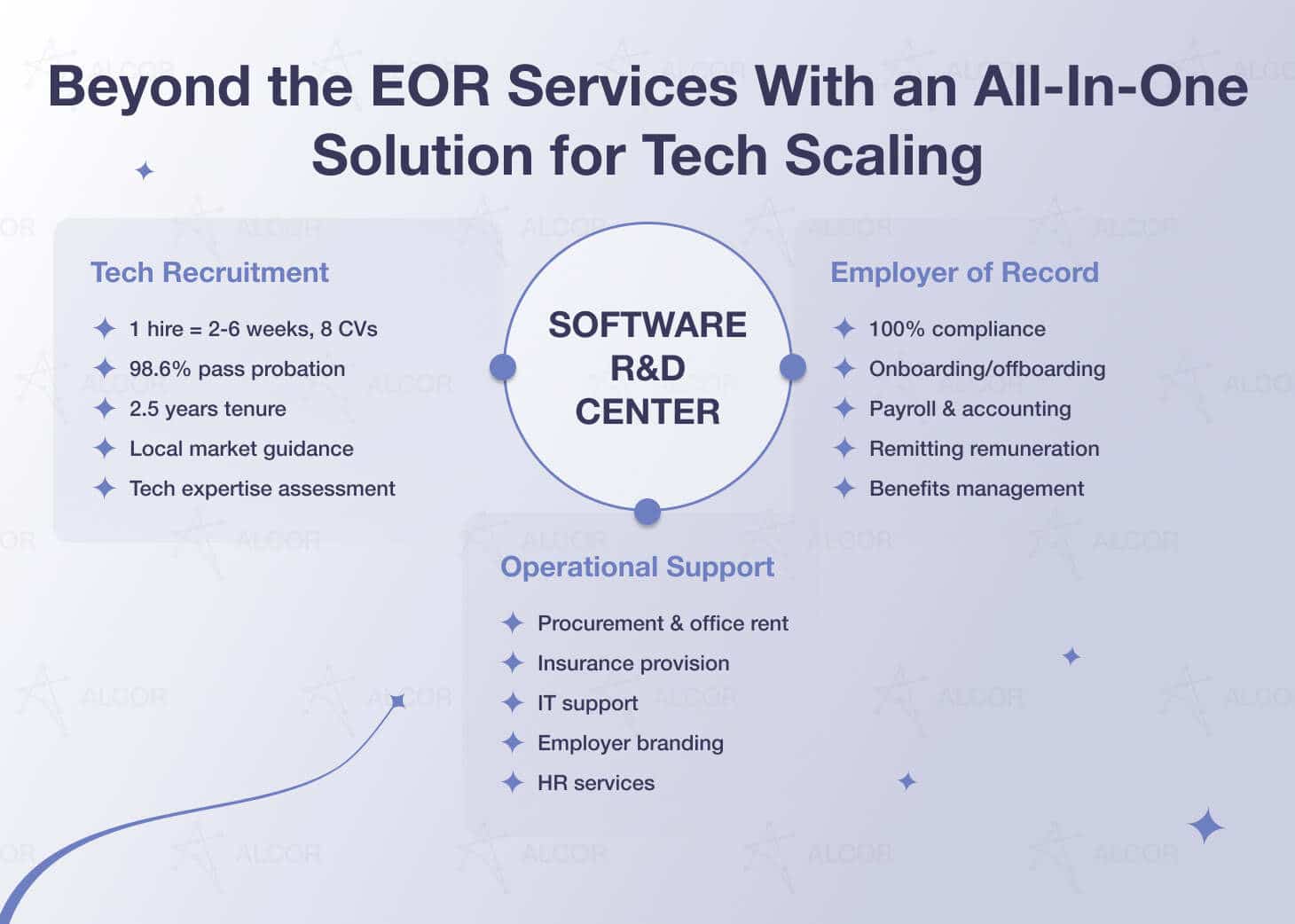
Alcor’s tech R&D center model helps US tech product companies & VC-backed startups expand to Colombia, de-risking software development with direct team control, while combining:
- Tech recruitment: 40 in-house headhunters handle sourcing, screening, HR interviews, weekly reporting, and job offer management.
- Employer of Record in Colombia: no need for a legal entity. Alcor ensures compliant hiring, payroll, taxes, and benefits.
- Operational support: brand promotion, office lease, procurement, insurance, visas, legal, tech support.
Yes, if you opt for Alcor’s software engineering infrastructure for building tech R&D centers. We help you build high-performance teams of 10-30 senior engineers in 90 days, optimized for today’s AI-driven development cycle, and hand you the operational framework to run them. Whether you’re scaling software development in South America, Mexico, or across Eastern Europe, the result is the same – an internal superteam unit: higher output, better economics, and scalable without a vendor layer in between.
So, what does this comprehensive solution include in detail?
Tech recruitment
Many tech leaders struggle with endless hiring cycles, unpredictable candidate quality, and the risk of high turnover that stalls product delivery. Others get lost in unfamiliar markets, not knowing salary benchmarks or how to attract top engineers.
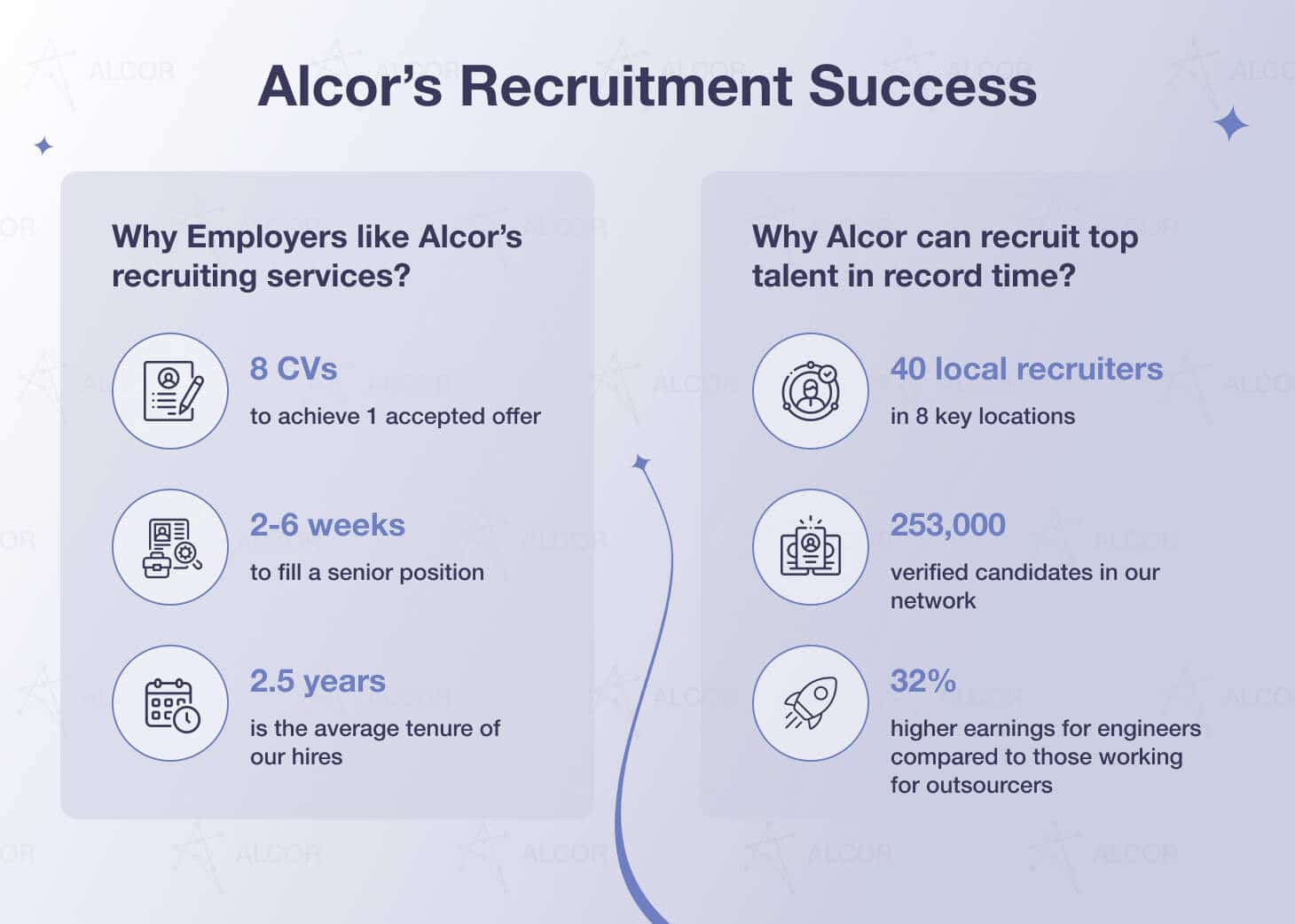
With Alcor, you’ll never have to experience that. This isn’t a sourcing service that floods your inbox with AI-generated CVs, but a curated, role-specific pipeline built on 40 in-house technical recruiters, specialized by region and role, backed by AI-supported qualification so every candidate that reaches you has already been vetted for real-world technical capability.
With our dedication to filling vacancies within 2-6 weeks, we guarantee only high-quality candidates, as clients approve 80% of them. Moreover, 98.6% of our hires complete probation and stay with clients for an average of 2.5 years, helping you avoid costly mishires and constant replacements. Plus, with our guidance on regional salaries and talent availability, you won’t overspend or waste time navigating the market blind.
Our tech headhunters provide full-cycle tech recruitment that includes:
- composing ideal candidate profiles and an attractive EVP;
- sourcing, headhunting, and pre-screening candidates;
- conducting HR interviews;
- providing weekly reports;
- managing job offers and working with counteroffers;
- consulting you on the region’s salaries, talent availability, and overall tech hiring landscape.
Remote-first arrangements and USD-denominated compensation are baseline assumptions for Colombian candidates, according to Alcor’s recruitment experts in LATAM. Beyond that, they want a clear picture of technical scope, ownership level, and growth trajectory before committing to a process, and they tend to be more relationship-oriented than candidates in some other LATAM markets. Even in technical rounds, Colombian engineers value understanding the team, the roadmap, and the broader context – purely transactional, assessment-only interviews tend to underperform, while a short contextual conversation measurably improves engagement. One nuance worth flagging to hiring managers: Colombian candidates can come across as reserved in self-promotion, which is sometimes misread as lower confidence rather than what it actually is – a difference in communication style.
Check out Colombian developers’ salaries to know how much you can save!
Employer of Record
Expanding into a new country often means months of paperwork, unexpected compliance risks, and the expense of hiring a law firm just to get started. Many companies end up distracted by payroll errors, tax missteps, or benefits management, rather than focusing on building their product.
But hiring abroad shouldn’t feel like a legal maze. You don’t need to establish a legal entity abroad with Alcor’s comprehensive Employer of Record in Colombia. Plus, we take all the administrative burden off your shoulders:
- employment of software developers;
- compliance with all local laws;
- tax payments;
- onboarding/offboarding;
- payroll in Colombia;
- employee benefits coverage.
There’s no vendor lock-in either: full team and IP ownership sits with you from day one, and if you ever choose to insource, there are no buyout or exit fees waiting for you. In the event of a fine incurred due to our mistake, we provide 100% compensation.
Full operational support
Most companies expanding abroad quickly realize that building a tech team is just the beginning. Suddenly, you’re stuck negotiating office leases in a foreign market, figuring out insurance policies, or chasing reliable vendors for laptops.
To save you from these distractions, you also get additional services as part of our software R&D solution:
- your employer’s brand promotion in the local market;
- hardware procurement for your development team;
- office lease, plus negotiations of the best price and contract terms;
- insurance assistance;
- background verification;
- legal services (stock option plans (SOP), migration services);
- visa support;
- tech support.
Plus, we allocate a dedicated account success manager to guide you through the expansion journey, so you get human assistance instead of the robotic answers of AI chatbots. You’ll enjoy our pay-as-you-go approach, keeping all expenses under your control.
This is not outsourcing. This is your engineering team – built globally but feels like an internal one.
Tech Trends in Colombia for 2026-2030
- Cloud adoption: Colombia’s digital transformation market is projected to grow at a 21.78% CAGR through 2030. SENA and AWS aim to train 10,000 students in cloud and IT, while Oracle operates a Cloud Region in Bogotá.
- Digital transformation: Colombia ranks #5 in LATAM on the Global Innovation Index 2025, supported by national programs that expand connectivity, digital services, and entrepreneurship.
- IoT: Colombia’s IoT solutions and services market is projected to grow from $1.38 billion in 2025 to $1.96 billion by 2032, with IoT supporting smart-city applications in Medellín and Santa Marta.
- AI development: 91% of surveyed Colombian developers use AI-assisted coding tools, while 79% expect AI to significantly redefine their roles.
Cloud technologies adoption
With Colombian businesses adopting new technologies and the need for online operations skyrocketing, cloud computing is the name of the game.
According to Mordor Intelligence, Colombia’s digital transformation market – with cloud and edge computing among its leading segments – is projected to grow at a 21.78% CAGR through 2030, one of the fastest expansion rates in South America. The Colombian Department of Labor has rolled out IT training initiatives to maintain the pace. For instance, the National Training Service (SENA), in collaboration with AWS, aims to train 10,000 students in cloud technology and IT in Colombia. Meanwhile, another leading cloud provider, Oracle, announced the opening of an Oracle Cloud Region in Bogotá. It will turbocharge the Colombian technology industry’s digitalization, spark innovation, and modernize local companies.
Digital transformation
Since 2010, Colombia has been on a path to digitalization spurred by the “Vive Digital” initiative. It aimed to expand internet access, digital literacy, and modern infrastructure nationwide. Notably, Colombia now ranks among the top 71 countries (#5 in LATAM) in the Global Innovation Index 2025.
Moreover, the government rolled out the “National Digital Strategy” and “National Development Plan.” They aim to further promote digitalization in Colombia’s technology industry, particularly in sectors such as education, healthcare, government services, and the economy. The primary objectives are to achieve 100% internet access, implement modern regulatory frameworks, and ensure a secure digital environment. One standout result of these efforts is the Cédula Digital, an ID app that simplifies identity verification and access to public services.
In the business realm, programs like “Colombia 4.0” and “Digital Business Development” have bolstered digital entrepreneurship through funding schemes, incubators, accelerators, and networking events.
Internet of Things (IoT)
The IoT market in Colombia is evolving rapidly, integrating hardware, software, and networking to create a connected ecosystem that drives digital transformation. From smart sensors and edge computing to cloud platforms and blockchain integration, IoT solutions are becoming smarter, more secure, and more scalable. According to 6W Research, Colombia’s IoT solutions and services market was valued at $1.377 billion in 2025 and is set to reach $1.956 billion by 2032, growing at a 6.1% CAGR from 2026 to 2032.
Colombia is steadily positioning itself on the smart city map, and IoT technologies play a central role in this shift. Medellín remains the country’s pioneer here: according to the Inter-American Development Bank, the city has built a network of connected sensors and cameras spanning traffic management, environmental monitoring, and public safety, and continues to be cited as one of Latin America’s most advanced smart-city deployments. New projects in Santa Marta aim to transform entire urban environments with AI- and IoT-powered solutions for transport, environmental monitoring, and digital connectivity services.
The Colombian government actively supports the growth of IoT through MinTIC, which promotes digital transformation in sectors such as agriculture, healthcare, and smart cities. By funding R&D and partnering with industry players, the state fosters innovation, investment, and wider adoption of IoT solutions nationwide.
On the public-safety side, Colombian IoT integrator 0G Colombia has deployed a low-power IoT network of discreet panic-button devices across commercial locations in Medellín, feeding directly into the city’s police response system.
Generative AI and agentic coding tools
Beyond the broader AI industry (more on that below), one specific trend is reshaping how Colombian tech teams actually work day-to-day: generative and agentic AI tools are now standard practice in software development, not an experiment. According to BairesDev’s Q4 2025 Dev Barometer, Colombian developers report some of the highest adoption rates in the region, with 91% using AI-assisted coding tools and 79% expecting AI to significantly redefine their roles over the next few years.
That shift is changing what “senior developer” means in practice: fewer hours spent writing boilerplate code, and more time on solution design, code review, and AI output validation. Alcor’s own recruiting team sees the same shift firsthand.
“AI-tool fluency is becoming a baseline expectation across roles, not just AI-specific ones,” says one of Alcor’s tech recruiters. “Clients increasingly expect developers to work with AI coding assistants, validate generated code, and understand where AI fits in their workflow.” And candidates themselves aren’t treating this as a threat: as Alcor’s team notes, developers overwhelmingly describe AI as a tool that makes them more valuable rather than a risk to job security, with engineering judgment, system design, and critical thinking named as the human skills that remain essential and irreplaceable.
On the hiring side, that shift is showing up as reskilling rather than career change. Python and backend engineers are incorporating LLM APIs, RAG architectures, and vector databases into their existing stacks. Data professionals are expanding into ML and MLOps; and DevOps and cloud engineers are moving into AI infrastructure, model deployment, and GPU environments, per Alcor’s Colombia recruiting team. The reskilling is largely self-driven, and engineers with the strongest existing foundations tend to pick it up fastest – which is what makes Colombia’s broad software engineering base a genuine asset for companies building AI-enabled teams.
State of Different IT Sectors in Colombia
The AI market is projected to reach $14.37 billion by 2034, while fintech has 369 startups and Bre-B is accelerating digital payments. Healthtech represents 9% of Colombia’s 2,295 startups, and cybersecurity is projected to reach $2.07 billion by 2031. SaaS has overtaken fintech as the country’s largest startup vertical, accounting for 27% of startups. Meanwhile, blockchain adoption is expanding alongside new crypto regulation, while agritech is advancing through precision farming, biotechnology, and AI-powered solutions.
AI
Colombia sees endless potential in AI technology, driving growth across sectors such as healthcare, finance, agriculture, defense, and beyond. The country’s AI market is set to hit $14.37 billion in 2034, growing at a CAGR of 26.237%, according to DataCube Research.
That is why the Colombian government is tackling key issues on multiple fronts, from policy to education to entrepreneurship. On the funding side, MinTIC’s own ColombIA Inteligente programme – documented in a case study by the International Science Council – channels a COP 9,400 million (roughly $2.4 million) budget into applied AI and aerospace research and development, targeting food security, energy transition, healthcare sovereignty, and public safety.
But that’s not all. In 2024, Colombia’s MinTIC doubled its investment by more than $25 million to construct two “AI Centers for Excellence” in Bogotá and Zipaquirá, per Nearshore Americas. These centers serve as hubs of research and development, focusing on a range of technologies, including data analytics, cloud computing, robotics, and quantum technologies, while also fostering tech education.
One sector rarely covered in overviews is justice and public administration. However, according to the Oxford Institute of Technology and Justice, Colombia already uses AI for crime forecasting (via AWS and local partner Nuvu) and facial recognition in several cities, and in December 2024 its Superior Council of the Judiciary adopted formal guidelines for generative AI use in the judicial branch – making Colombia the first country in the world to implement UNESCO’s Guidelines for the Use of AI Systems in Courts and Tribunals.
Speaking of talent, Microsoft and EAFIT established an AI Lab in Medellín, designed to train more than 400 students annually while supporting AI projects for Colombian businesses and public institutions. It’s an initiative expected to drive growth in businesses throughout the country. Currently, the tech industry in Colombia is buzzing with AI startups, including Treble.ai, DataGran, Datawifi, and Kite.
Find out more by comparing Colombia vs Mexico for nearshore technology outsourcing or Colombia vs Brazil for nearshore tech outsourcing!
Fintech
Colombia stands out as one of the top fintech hubs in Latin America. According to Finnovista, Colombia had a robust 369 fintech startups in 2023, with numbers climbing steadily at an average annual rate of 19.7% since 2019. With a whopping $1 billion attracted to the industry over the past few years, Colombia’s “fintech adoption” rate is now among the highest in LATAM.
Behind these achievements lies the government’s dedication to fostering fintech businesses and promoting financial inclusion in the country. They’ve established agencies such as iNNpulsa to train entrepreneurs and streamline the business startup process. Moreover, the government has taken a major step toward a more open financial ecosystem: Bre-B, Colombia’s new low-value, instant payment system developed by the Central Bank, launched in October 2025 and onboarded roughly 30 million users within weeks of going live (BBVA Research). It’s a rare case of a national payment rail scaling almost overnight and one already driving fresh investment in real-time fraud detection.
Blockchain & cryptocurrency
Amid economic instability and limited access to banking services, blockchain and cryptocurrency technologies have emerged as game-changers in Colombia. Here are some groundbreaking developments:
- Land registration. The Colombian National Registry and blockchain company RSK have introduced the “Registro de Propiedad” platform. Harnessing blockchain technology, this platform records and verifies property transactions, thereby enhancing transparency and security.
- Payment system upgrade. Colombia’s Central Bank has launched an initiative to integrate blockchain technology, aiming to streamline cross-border payments, reduce costs, and decrease processing times.
- Medicine logistics. The Ministry of Health has launched a blockchain platform to track medicines from manufacturers to consumers, thereby reducing the risk of counterfeit drugs entering the market.
The market is also maturing fast on the regulatory side. As of December 2025, Colombia’s tax authority (DIAN) issued Resolution 000240, adopting the OECD’s Crypto-Asset Reporting Framework and requiring crypto exchanges and service providers to report user and transaction data starting with the 2026 tax year. Crypto in Colombia is moving from an unregulated curiosity to a tracked, mainstream asset class.
Healthtech
Access to healthcare has long been a pressing issue in Colombia, worsened by the global pandemic. Since only half of the population effectively accessed medical services in 2023, per NCBI, the need for technological innovation in the national healthcare system has become more urgent than ever.
Telemedicine is leading the charge in transforming healthcare accessibility, particularly for rural areas. Per KPMG Colombia Tech Report 2026, healthtech now accounts for 9% of Colombia’s 2,295 startups, with AI-powered diagnostics and prevention tools flagged as one of the segment’s biggest growth drivers for the years ahead. Also, according to ColombiaOne, Medellín-based Telepatía AI raised a $33 million Series A round led by Andreessen Horowitz in mid-2026 for an AI clinical assistant already used by roughly 100,000 doctors and nurses across more than 30 institutions. It’s the largest digital health investment in Latin American history.
Colombia’s healthtech landscape also includes standout players like 1Doc3, SaludTools, and LentesPlus. Beyond telemedicine, the integration of electronic health records, mobile health apps, and healthcare analytics is reshaping Colombia’s healthcare sector, making it more efficient and personalized.
Cybersecurity
In 2023, Colombia suffered a massive cyberattack that affected 34 Colombian entities and 762 LATAM companies, per Brussels Times. According to Mordor Intelligence, Colombia ranked second in Latin America for attempted intrusions in 2024, with utilities, telecom backbones, and energy grids enduring persistent ransomware and living-off-the-land attacks.
In response, the Colombian government has sharpened its regulatory teeth to bolster the country’s resilience against cyber threats. The Law on Data Protection regulates the collection, processing, and storage of personal data, aiming to enhance privacy and security. The Ministry of ICT has also introduced a draft Decree to establish a governance structure focused on digital and cybersecurity. Additionally, creating a Cyber Police unit underscores the government’s commitment to investigating cybercrimes and apprehending perpetrators.
Local tech companies are encouraged to contribute to cybersecurity innovations, further fortifying Colombia’s defenses against cyber threats. Consequently, the cybersecurity market in Colombia is projected to reach $1.24 billion in 2026, growing at a 10.79% CAGR to hit $2.07 billion by 2031, according to Mordor Intelligence.
SaaS
The SaaS market in Colombia is expanding at one of the fastest rates in Latin America, driven by a young, digital-native population, strong government backing for technology, and an economy heavily leaning into digital transformation. According to KPMG’s Colombia Tech Report 2026, SaaS has overtaken fintech as the country’s leading startup vertical, now accounting for 27% of Colombia’s startups.
A clear legal framework under SAS makes it easier for companies to operate, although most SaaS sales are subject to a 19% VAT rate. The ecosystem already includes notable players such as Talentu, Lizit App, Modelo GeO, B2Chat, TiendAPP, and Loggro S.A.S., offering solutions in FinTech, AI, and enterprise management.
Agritech
Colombia’s Agritech sector thrives on collaboration between universities, government programs, startups, and farming communities. Research institutions drive advances in biotechnology, soil management, and pest control, while initiatives such as Agro Colombia 2030 provide funding and policy support.
Precision agriculture has emerged as a standout strength, with GPS-guided sensors, satellites, and data analytics enabling farmers to monitor soil fertility, water use, and pest risks in real time. Alongside this, biotechnology innovations such as resilient seed varieties, biofertilizers, and biopesticides are offering sustainable alternatives to traditional inputs. Artificial intelligence adds another layer, enabling predictive models for weather, crop performance, and pest outbreaks.
Companies like Fungi Technology, Lombriabonos de la Costa, and WSEEDS are proving how local innovation can scale globally.
Colombia as an Invention & Innovation Powerhouse
Colombia’s technology sector drives technological advancements with a global impact; among them are Grability Software, Solar Vehicle Primavera, Liftit, and Conceptos Plásticos.
Colombia’s technology sector continues to produce homegrown innovations while strengthening its position as a corporate R&D and startup hub in Latin America. WIPO identifies Colombia as an emerging hub for corporate R&D and startup development, with particularly strong performance in high-tech imports, where it ranks 15th globally, and unicorn valuation, where it ranks 24th.
Colombia’s technology sector is generating innovations that resonate on a global scale:
- Grability is a patented, mobile-first e-commerce platform built in Bogotá. Its swipe-to-shop interface redefined the mobile shopping UX, inspired the rise of Rappi, and helped spark the delivery superapp boom across Latin America.
- Primavera is the country’s first solar-powered vehicle. Developed in 2013 by Universidad EAFIT and Empresas Públicas de Medellín, the car featured 1,600 solar cells, hit speeds up to 120 km/h, and became the first Latin American entry to complete Australia’s World Solar Challenge, per SBS News.
- Liftit emerged in Bogotá as a technology platform focused on digitizing last-mile logistics and freight operations in Latin America, applying software and data to one of the region’s most complex supply-chain challenges.
- Conceptos Plásticos is transforming plastic waste into LEGO-style bricks for affordable housing. Already deployed in Colombia, Côte d’Ivoire, and Kenya, the model won the UNICEF/UNHCR Innovator Award for its integration of recycling, social housing, and environmental impact.
We Fuel Innovations With LATAM R&D Center Solutions
Alcor provides an alternative to traditional outsourcing by helping tech product companies and VC-backed startups build and own tech R&D teams across LATAM and Eastern Europe. Its nearshore solution combines tech recruitment, COR/EOR, and operational support without buyout fees or vendor lock-in. For Backstory, Alcor set up a functioning R&D office within one month and hired 25 engineers in the first year, later scaling the team to 50 with a 98.6% probation pass rate and 2.5+ year average tenure.
Alcor offers a refreshing alternative to traditional IT outsourcing and outstaffing. Instead of leasing software developers, we help you build your own Colombian software development center with these specialists as part of your team, eliminating buyout fees, hidden costs, rate cards, and common risks associated with outsourcing. This way, you avoid the usual pain points of slow hiring, poor retention, lack of transparency, and losing control over your own product delivery.
We help nearshore technology to Uruguay, Mexico, and Chile, hire software developers from Colombia, Poland, Ukraine, Romania, and even provide IT recruitment services in Argentina. Our R&D center solution also includes COR and EOR for tech and operational support, ensuring a smooth expansion of your innovative business without the coordination chaos that usually comes with hiring abroad.
Discover how this solution worked for a similar tech company to yours:
When Backstory (formerly People.ai) decided to build its engineering team in Eastern Europe, it wasn’t short on talent options. The problem was execution: multiple vendors handled recruitment, legal, and operations in parallel, with no one owning the outcome and deadlines slipping. For a company competing in the AI market, every delayed hire meant a delayed feature.
Backstory turned to Alcor for one partner to own the entire setup. Within just a month, our team performed a whole spectrum of operational and EOR services, from legal compliance and payroll to office leasing and hardware procurement, and set up a fully functioning tech R&D office.
Alcor hired 25 engineers for Backstory in the first year; the team has since grown to 50, with a 98.6% probation pass rate and an average tenure north of 2.5 years. Several of those engineers – including AI specialists – are now core senior and staff engineers on Backstory’s product itself. As founder and CEO Oleg Rogynskyy put it: “We were able to bring on amazing engineers in Eastern Europe to supplement our core AI team here in Silicon Valley and kind of scale up. Some of them have become our core senior or staff AI engineers now.”
That’s the mechanism behind fueling innovation: not renting hours from a vendor, but owning a senior, AI-ready engineering team from day one – so your roadmap moves at your pace, not a subcontractor’s. Achieve comparable results to Backstory, Franki, Dotmatics, ThredUp, and other tech companies by establishing your own R&D hub in LATAM or Eastern Europe!
FAQ
What is the current capacity and composition of the tech talent pool in Colombia?
Colombia’s tech talent pool includes 202,000 professionals, with roughly 37,000 STEM and ICT graduates entering the workforce each year. Bogotá and Medellín hold the largest concentrations, with strength in software development, data engineering, and AI-assisted coding. Colombia ranks 6th in Latin America on the TopCoder Programming Competitiveness Index.
What is the projected trajectory and market share of Colombia’s AI sector by 2027?
Colombia’s AI sector is expanding rapidly, with the market projected to grow at a 26.24% CAGR through 2034 and reach $14.37 billion. AI adoption is already widespread: 98% of Colombian startups use AI, while 38% place it at the core of their product.
What are the macro growth projections for the Colombian technology market leading up to 2030?
Colombia’s IT services market is projected to grow at a 9.8% CAGR through 2030, the fastest rate in South America, according to Mordor Intelligence. The broader digital transformation market is forecast to expand even faster, at a 21.78% CAGR from 2025 to 2030, fueled by cloud, AI, 5G, and enterprise digitalization.
What are the main tax benefits for foreign tech companies in Colombia?
Foreign tech companies in Colombia benefit primarily from the Free Trade Zone regime’s flat 20% corporate income tax rate, well below the standard rate, as well as exemptions from import duties and VAT on capital goods and raw materials. Tax credits of up to 30% also apply to qualifying R&D and technology investments.
How would you rate this article?
Alcor is Your Trusted Scaling Partner
for expansion
support