


An Employer of Record cost in 2026 ranges from $199 to $699+ per employee per month, but the number on the provider’s pricing page and the invoice rarely match. Statutory contributions, benefits markups, FX fees, and per-event charges can quietly add to what any EOR provider publicly lists.
Getting accurate EOR quotes requires more than a pricing page – and if you’ve ever asked Google or ChatGPT to list global EOR providers with published pricing per country, you’ve likely hit that wall: the headline rates are there, but the statutory costs, hidden fees, and regional variables that determine what you actually pay are not.
This EOR pricing guide fills that gap – covering the six cost components behind every EOR invoice, what inflates EOR quotes, how pricing models compare, what EOR costs across four regions in 2026, and how to choose the structure that fits your team and growth stage.
Key Takeaways
- EOR pricing is built from six cost components: payroll management, benefits administration, local employer taxes, onboarding and termination handling, and FX fees – each driven by country labor laws, team size, engineer seniority, benefits scope, and service customization.
- EOR pricing follows four structures: flat PEPM, percentage-of-payroll, hybrid enterprise, and pay-as-you-go, with different cost predictability, scalability, and risk exposure depending on your headcount and hiring strategy.
- Base EOR fees range from $199/month in Southeast Asia to $599–$699 in Eastern Europe and the US, but statutory contributions, mandatory bonuses, and benefits can significantly increase the total employment cost beyond the quoted platform fee.
- Evaluating EOR providers accurately requires modeling the full TCO – platform fees, FX markups, onboarding charges, and contract clauses around auto-renewal, exit fees, and liability caps, all of which determine what you actually pay over the engagement period.
- Reducing EOR costs without compliance risk comes down to four levers: modeling total employment cost, choosing lower-statutory-rate regions, limiting scope to essential services, and optimizing payroll cadence and currency settlement.
- Alcor’s tech-focused EOR covers contracts, payroll, tax filings, NDAs, and IP protection through owned legal entities in LATAM and Eastern Europe, with no third-party intermediaries and volume-based pricing that decreases as your team grows. For companies scaling beyond compliance, Alcor provides Silicon Valley-caliber recruitment and operational support, building teams of 10–30 engineers, including AI/ML engineers, in 90 days.
Key Cost Components of Employer of Record Pricing
Employer of Record pricing is built from six core cost components: payroll processing, employee benefits administration, local employer taxes and social charges, onboarding and termination handling, HR administration and legal support, and FX and payment processing fees. Each component represents a distinct operational function that the EOR provider manages on the client’s behalf.
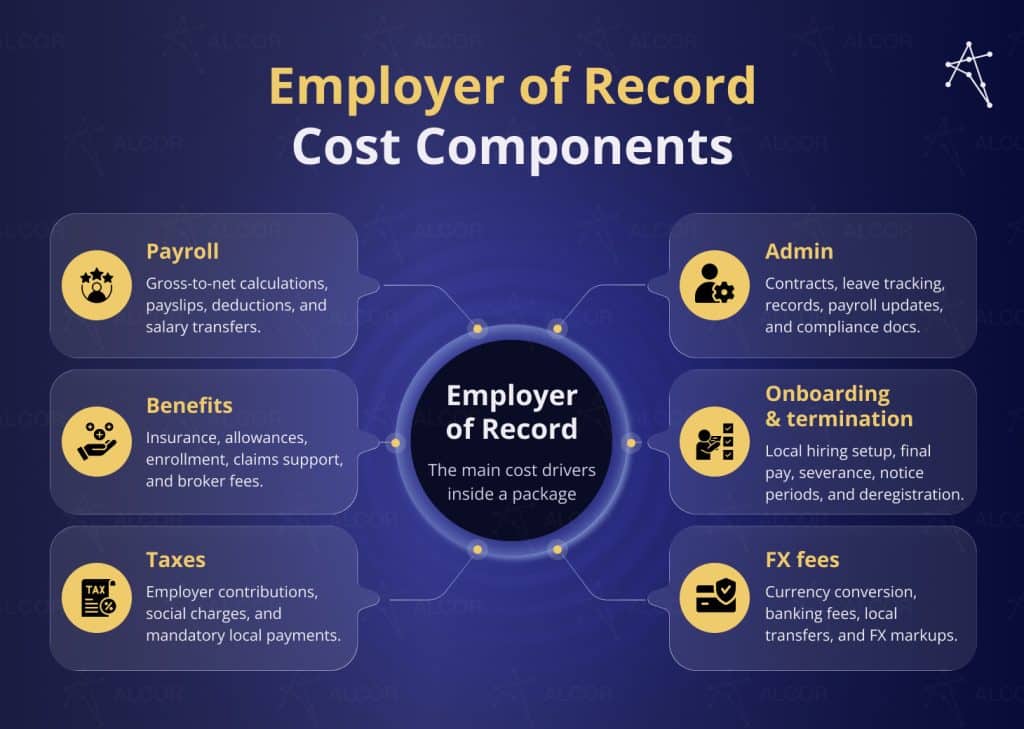
A typical EOR fee components breakdown covers six areas: payroll processing, benefits management, taxes and social charges, HR administration, onboarding and termination handling, and FX and payment processing fees – each representing a distinct operational function the EOR provider handles on the client’s behalf and carrying its own pricing logic. Understanding what falls under all EOR pricing categories is the first step to accurately reading an EOR quote and determining whether a provider’s scope matches what your team actually needs.
Payroll processing
At the center of every EOR engagement sits payroll processing – calculating gross-to-net pay for each employee, applying the correct tax withholdings, generating payslips, and transferring net salaries on time and in local currency.
EOR providers handle the full payroll cycle on the client’s behalf, ensuring accurate calculations, on-time disbursements, and compliance with local payroll legislation – without the client needing to manage the mechanics directly.
Employee benefits administration and broker markups
Every employee on an EOR payroll receives a benefits package, and sourcing, enrolling, and managing that package is a dedicated function within the EOR service, typically including life insurance and any supplementary allowances required or expected in a given market. EOR providers procure benefits either directly from local insurers or through a broker layer, then bill the client for the actual premium cost plus a management or broker fee. The benefits administration fee covers the EOR’s work in maintaining plan eligibility, processing employee enrollment changes, handling claims support, and ensuring the benefits offering stays competitive in the local talent market.
Local employer taxes, social charges, and mandatory payments
Payroll taxes, social security, and mandatory benefits by country represent a distinct cost layer in every EOR engagement – one that goes beyond standard payroll tax and includes social security, mandatory fund payments, and locally levied employer charges.
Social security obligations alone can cover pension, disability, healthcare, unemployment, and occupational risk insurance, with the EOR provider responsible for calculating and remitting the correct employer contribution rate based on each employee’s gross salary.
Depending on the country, additional mandatory payments may apply – housing funds, training levies, family compensation schemes, and overtime premium obligations – each with its own calculation basis, remittance schedule, and compliance requirements.
Onboarding, offboarding, and termination handling
Every new hire on an EOR payroll requires a formal onboarding process – drafting and issuing employment contracts in accordance with local law, collecting mandatory documentation, registering the employee with relevant tax and social security authorities, and coordinating benefits enrollment. EOR offboarding and termination handling covers the administrative process of exiting an employee compliantly – calculating final pay, statutory severance where applicable, processing notice periods in line with local labor law, and formally deregistering the employee with the relevant authorities. Some EOR providers include onboarding and offboarding within their standard service fee, while others charge separately per case – making it an important line item to clarify before committing to a contract.
HR admin, compliance monitoring, and legal support
Managing a compliant workforce across borders through an EOR generates a constant stream of administrative work – employment records, contract amendments, leave tracking, payroll adjustments, and documentation required by local labor authorities.
Compliance monitoring is the EOR provider’s responsibility: tracking changes in local labor law and tax legislation and updating employment contracts and payroll processes accordingly. Legal support of an EOR partner covers properly structuring terminations, advising on labor disputes, and ensuring that non-standard situations, such as extended sick leave, parental leave, and disciplinary procedures, are handled in accordance with local law.
For companies hiring in the EU, data protection obligations, GDPR, and payroll data residency practices are an additional compliance layer the EOR must manage – covering how employee data is stored, processed, and transferred across jurisdictions. EOR’s equivalent data protection obligations apply in other regions, including the LGPD in Brazil, PDPA frameworks across Asia, and the UK’s post-Brexit data protection legislation.
FX, banking, and payment processing fees
Every time an EOR pays an employee across currencies, the client’s payment must be converted into the local currency and settled through the local banking infrastructure, which incurs a cost. Most EOR providers apply a foreign exchange markup on top of the interbank rate, which compounds when payroll runs across multiple currencies simultaneously. FX and banking fees are often embedded in the EOR provider’s total invoice rather than itemized as a separate line, so explicitly requesting this disclosure is worth it when evaluating providers.
What Affects Employer of Record Costs Variations
Employer of Record costs vary based on six core factors: country-specific labor laws, team size and volume discount thresholds, engineer seniority and compensation levels, benefits package structure, industry-specific insurance requirements, and contractor-to-employee conversion fees. Each factor adds a distinct EOR cost layer on top of the provider’s published platform fee, and understanding how each one applies to your specific team, region, and hiring profile is the only way to model what an EOR engagement will actually cost.
Country-specific labor laws
Labor law complexity is one of the most direct drivers of EOR pricing variation – jurisdictions with layered termination procedures, mandatory bonus obligations, and broad employee protections require significantly more legal expertise, compliance monitoring, and administrative overhead to manage correctly. The more complex the local labor framework, the larger the specialist team an EOR provider must maintain in-country, and that cost is reflected in the platform fee.
Some markets, like Colombia and Argentina, combine mandatory annual bonuses, profit-sharing obligations, and strict termination rules for protected employee categories – such as pregnant women, union members, recently married employees, and employees with certain health conditions – each of which requires accurate calculation, timely execution, and documented compliance to avoid legal exposure.
In this table, my legal team compiled the key labor law variables across LATAM and Eastern Europe that most directly affect EOR operational complexity, including minimum wage and paid leave liabilities by jurisdiction, mandatory bonuses, and termination rules, so you can see exactly how employment rules differ by country.
|
Mexico |
Colombia |
Argentina |
Chile |
Poland |
Romania |
Ukraine |
Bulgaria |
|
|
Working hours/week |
48 |
44 |
48 |
42 |
40 |
40 |
40 |
40 |
|
Minimum wage (monthly, approx. USD) |
||||||||
|
Vacation days |
12–30 + 25% bonus |
15 working days |
14–30 + 20% bonus |
15 working days |
20–26 working days |
20 working days |
24 calendar days |
20 working days |
|
Sick leave (paid) |
Employer pays 100% days 1–2; social security 60% from day 4 up to 52 weeks |
Employer pays 100% days 1–2; social security 66.67% days 3–90; 50% days 91–180 |
Employer covers up to 3–6 months, depending on tenure |
Health insurance covers from day 4; the first 3 days are unpaid if the leave is less than 10 days |
Employer pays 80% for the first 33 days; ZUS covers up to 182 days after |
Day 1 unpaid; employer pays days 2–6; health insurance days 7–183 |
Employer covers the first 5 days; Pension Fund covers the full duration at 50–100% |
Employer covers 70% for the first 2 days; social security 80–90% for the full duration |
|
Maternity leave |
84 calendar days |
126 calendar days |
90 calendar days |
126 calendar days |
140 calendar days |
126 calendar days |
126 calendar days |
410 calendar days |
|
Mandatory annual bonus |
15 days’ salary (Dec) |
Prima: 30 days’ salary (2× year); Cesantía: 1 month/year + 12% annual interest on fund balance |
30 days’ salary (2× year) |
25% of monthly salary or 30% of taxable profits (employer’s choice) |
None |
None |
None |
None |
|
Termination notice |
None required |
15 days |
30–60 days |
30 days |
2 weeks–3 months |
20 working days |
Varies by grounds |
1–3 months |
|
Severance |
Min. 122 days’ salary (90 days + 20 days/year + 12 days/year) |
20 days (year 1) + 15 days/year after (without cause) |
30 days/year |
30 days/year (up to 11 months) |
1–3 months (employers >20 staff) |
Not mandatory |
1–6 months (certain cases) |
1–6 months (certain cases) |
Notice period and termination cost rules by country vary from zero mandatory notice in Mexico to three months in Poland – a range that directly affects termination penalties and the total cost of exiting an employee through an EOR.
Number of employees and economies of scale
EOR pricing is almost always structured on a per-employee-per-month basis – but the per-head fee often decreases as the team grows, which means headcount is one of the most direct levers a company has over its total EOR spend. Volume discounts and enterprise pricing thresholds vary significantly across EORs: some reduce the platform fee automatically once the client’s headcount crosses a defined threshold, while others require a custom negotiation to unlock any meaningful price reduction, and the discount depth and trigger point differ by provider.
For companies evaluating EOR scalability, knowing the break-even point at which volume discounts kick in – and negotiating that threshold upfront rather than after the team is already built – can produce significant savings over the contract term.
Employee seniority and compensation level
An EOR provider’s fee is typically calculated as a percentage of the employee’s gross salary or as a flat monthly fee – and when the model is percentage-based, seniority directly affects what the client pays. A senior engineer earning $7,000/month generates a higher absolute EOR fee than a middle-level developer earning $3,500/month, even at the same percentage rate.
Based on Alcor’s 2026 engineer compensation research, this table shows a full salary breakdown for middle and senior engineers across LATAM – and how seniority level shapes the final EOR cost.
|
Role |
LATAM Developer’s Average Monthly Salary, Gross |
|
|
Middle |
Senior |
|
|
ML Engineer |
$4,288 |
$6,588 |
|
AI Product Engineer |
$4,500 |
$6,875 |
|
Data Platform Engineer |
$4,462 |
$6,762 |
|
Data Engineer |
$4,200 |
$6,188 |
|
DevOps Engineer |
$4,038 |
$5,725 |
|
C/C++ Developer |
$3,725 |
$4,850 |
|
Blockchain Developer |
$4,012 |
$6,044 |
|
Python Developer |
$4,012 |
$5,312 |
|
Node.js Developer |
$3,538 |
$4,775 |
|
Mobile Developer |
$3,800 |
$5,388 |
Note: sample EOR quotes for junior, mid-level, and senior roles in LATAM, US, and other locations can differ substantially, so factor in not only your actual seniority mix but also your target expansion location before modeling the total EOR cost.
Benefits package structure
The benefits package an EOR provider assembles for each employee is one of the most variable cost inputs in an EOR engagement – a basic statutory package costs significantly less to administer than a competitive package that includes supplementary health insurance, life coverage, sport and meal allowances, and enhanced pension contributions. EOR providers typically offer tiered benefits structures, and the richer the package, the higher the combined cost of premiums, broker fees, and administration overhead passed through to the client.
For tech companies hiring senior engineers in competitive markets, the benefits package is rarely optional – undercutting local market standards increases the risk of attrition and weakens the employer brand, making the benefits package structure a business decision, not just a cost one.
Scope and customization of services
Standard EOR packages cover payroll, compliance, and basic HR administration – but many tech companies require services beyond that baseline, and each addition to the scope carries its own cost. Custom reporting, dedicated HR support, bespoke employment contract structures, multi-jurisdiction coordination, how EORs handle equity payments, deferred compensation structures, stock options for internationally employed engineers, and integration with the client’s own HR systems are all examples of scope extensions that EOR providers typically price separately.
The more a client’s operational requirements diverge from a provider’s standard offering, the more the final EOR cost reflects a custom service agreement – and the less visibility the client has into what’s driving the invoice. Asking the EOR provider to itemize every service in the scope agreement before signing – including integration costs for HRIS connections, SSO setup, and data migration – is the only reliable way to understand what the published platform fee actually covers.
Industry-specific risks and required insurance/coverage
Indemnities and insurance requirements vary significantly by industry – fintech, healthtech, and defense-adjacent companies typically face enhanced regulatory obligations, data privacy compliance requirements, and sector-specific coverage mandates that go beyond standard EOR onboarding.
The cost of industry-specific EOR risk coverage – including professional liability insurance, cyber liability policies, or sector-mandated certifications – is typically passed through to the client as an additional line item rather than absorbed into the base platform fee. In regulated industries, regulatory audit precedents – past enforcement actions and compliance rulings in fintech, healthtech, and defense sectors – directly influence how EOR providers structure employment documentation and what level of indemnity coverage they require. EOR providers that lack in-house expertise in a client’s industry often rely on third-party legal or compliance specialists to fill those gaps, and that additional layer adds cost.
Contractor-to-employee conversion
One cost layer that catches many tech companies off guard is contractor-to-employee conversion – one of the most common sources of unexpected EOR charges. This is common among tech companies that initially engage talent on a project basis and later want to formalize the relationship. This involves reclassifying the working relationship under local employment law – and the EOR handles the full process: issuing a compliant employment contract, registering the individual with tax and social security authorities, and enrolling the employee in the benefits program from scratch.
Some EOR providers charge a one-time conversion fee on top of the standard onboarding cost, reflecting the additional legal review required to ensure the prior contractor relationship doesn’t create misclassification liability under local labor law – and in each case, the EOR manages the reclassification end-to-end. Factoring contract termination fees, conversion costs, and onboarding charges into the total EOR engagement cost upfront helps companies avoid the sticker shock of an unexpected invoice later.
Common Employer of Record Pricing Models
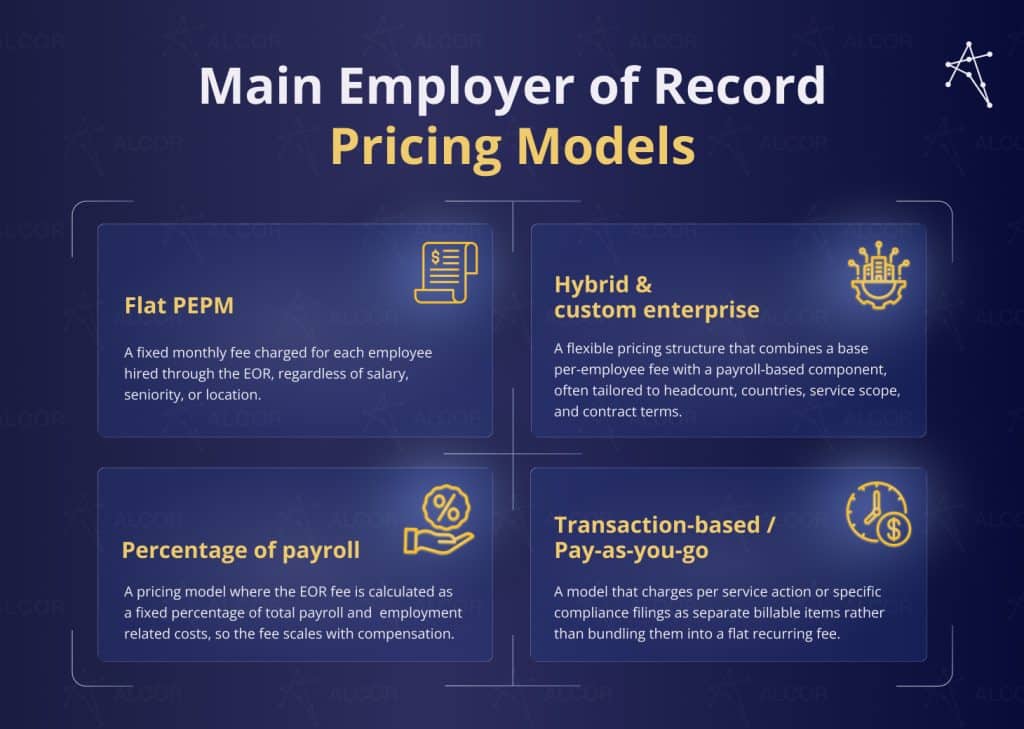
EOR services pricing follows four main structures: flat PEPM, percentage-of-payroll, hybrid enterprise, and pay-as-you-go. Each model carries different costs, predictability, scalability, and risk – the right choice depends on team size, headcount stability, and the extent of the service scope the company actually needs. Invoicing practices of major EORs vary significantly: hidden surcharges, FX markups, and per-event fees can add 15–30% to the quoted platform fee, making a sample invoice worth requesting before signing anything.
Flat per-employee-per-month (PEPM)
The flat PEPM model charges a fixed fee for each employee on the EOR payroll, regardless of that employee’s salary or seniority – making it the simplest structure to budget for at the point of signing.
Predictability is the main advantage of PEPM pricing: a company employing 10 engineers knows exactly what the EOR platform fee will be each month, regardless of changes in compensation. The downside of the PEPM model is that a flat fee doesn’t reflect the actual cost of managing employees with very different salaries – a junior developer and a senior ML engineer generate the same platform fee, which means the model tends to overcharge for lower-cost hires and undercharge for higher-cost ones.
|
Pros |
Cons |
|
Predictable monthly cost, easy to model at the planning stage |
No cost benefit from hiring in lower-salary regions |
|
Fee doesn’t increase when the team gets pay raises |
Fee doesn’t scale down as team compensation decreases |
EOR vendor examples: Deel and Remote both publish EOR PEPM pricing: Deel from $599/month; Remote $699/month, or $599/month annually.
Percentage-of-payroll model
The percentage-of-payroll model charges an Employer of Record fee as a fixed percentage of the total monthly salary and employment-related expenses managed through the Employer of Record. Under the percentage-of-payroll pricing model, the EOR provider’s fee scales directly with payroll volume rather than the headcount.
The main advantage of the percentage-of-payroll model is that the EOR fee stays proportional to the company’s total payroll spend. For example, if a company hires higher-paid senior engineers, the EOR provider charges more because the fee is calculated from a higher salary base.
The main risk of the percentage-of-payroll model is that every salary increase – whether due to a promotion, a market adjustment, or an annual review – also increases the EOR platform fee. As the team grows and compensation benchmarks rise, percentage-of-payroll pricing can become a variable cost rather than a predictable fixed fee.
|
Pros |
Cons |
|
Fair reflection of actual management complexity |
Fee increases with every pay raise or promotion |
|
Lower absolute fees on lower-salary hires |
Harder to forecast precisely over a 12-month horizon |
EOR vendor examples: Alcor uses a percentage-of-total-monthly-turnover model that covers salaries and all managed expenses, so the EOR/COR fee may change slightly if the team’s compensation increases, but it also decreases as headcount grows.
Hybrid and custom enterprise pricing
Hybrid Employer of Record pricing combines elements of PEPM pricing and percentage-of-payroll pricing. In a hybrid EOR pricing model, the client usually pays a reduced flat base fee per employee plus a smaller percentage of payroll on top, and this tiered pricing structure gives enterprise clients a middle ground between cost predictability and proportional scaling.
For enterprise clients managing large teams across multiple countries, this model gives the EOR provider flexibility to account for headcount, payroll size, country complexity, and service scope. Some Employer of Record providers automatically reduce the per-employee fee once the client’s headcount crosses a defined threshold, while others require a custom contract negotiation before offering a lower rate.
Custom enterprise EOR agreements replace published pricing with a negotiated rate based on the client’s headcount, hiring locations, service scope, and contract length. Because custom Employer of Record pricing is harder to compare across providers, the final cost depends heavily on how clearly the client negotiates fee reductions, included services, SLA terms, FX conditions, and contract exit rules.
|
Pros |
Cons |
|
Pricing reflects actual scale and scope |
Difficult to compare like-for-like across providers without detailed scoping |
|
Room to negotiate terms unavailable on self-serve plans |
A longer procurement and negotiation cycle before onboarding can begin |
EOR vendor examples: Papaya Global and Safeguard Global offer quote-based pricing for enterprise/global workforce needs.
Transaction-based or pay-as-you-go structures
Transaction-based EOR pricing charges the client per event rather than per employee per month, treating individual actions such as onboarding, offboarding, or specific compliance filings as separate billable items rather than bundling them into a flat recurring fee.
For companies with variable or seasonal headcount, transaction-based EOR pricing can deliver better value than a fixed monthly fee – paying per event means the company only incurs costs when employment actions actually require provider support.
|
Pros |
Cons |
|
Cost efficiency for variable headcount |
Costs can spike unpredictably during high-activity periods such as rapid hiring or restructuring |
|
No spending on unused services |
EOR vendor examples: Alcor’s EOR service follows a percentage-of-payroll structure with a pay-as-you-grow logic built in – the core fee covers salaries and a dedicated operations manager, while optional services (legal support, background verification, employer branding, hardware, office rent, HR assistant, and more) are available as add-ons billed per use, meaning clients only pay for what their team actually needs rather than subsidizing services they don’t use.
Hidden fees and common add‑ons to watch for
Most Employer of Record providers publish a headline platform fee that covers payroll and basic compliance, but the first invoice may look different from the original sales conversation. Hidden fees and common surcharge examples in EOR contracts include FX markups on salary transfers, per-event charges for onboarding and offboarding, broker markups on health insurance premiums, and fees for amended contracts or out-of-cycle payroll runs – each small in isolation, but collectively capable of adding to the quoted platform fee.
Beyond recurring surcharges, several add-on services only appear on EOR invoices when triggered by specific circumstances. Immigration support and related fees – covering visa and work permits, residency documentation – are the most common example: not every company needs them, but those relocating specialists or hiring across borders should confirm upfront whether immigration support is included in the platform fee or billed per case.
Before signing an Employer of Record agreement, companies should request a fully itemized sample invoice rather than relying solely on the pricing page. A sample EOR invoice is one of the most reliable ways to see what the provider actually charges compared with what the sales deck shows.
Not sure whether EOR, PEO or umbrella pricing fits better? Start with what is a Professional Employer Organization guide, proceed with EOR vs umbrella company, and compare the models behind the cost.
Average Employer of Record Cost by Region in 2026
Average monthly EOR fee per employee by region and country (2024-2026) varies significantly – driven not just by provider pricing, but by statutory contribution rates, compliance complexity, and service scope:
- Latin America: base fees range from $399 to $699 PEPM
- Eastern Europe: global platforms start at $599–$699; regional specialists use custom pricing
- Southeast Asia: widest range – from $199 to $400+, reflecting sharp compliance variation between markets
- United States: base fees of $599–$599 PEPM, with total employment cost rising $200–$500 per employee once ACA, 401(k), and multi-state obligations are included
While this article focuses on LATAM, Eastern Europe, Southeast Asia, and the US, markets like the UK and India follow similar pricing logic with their own statutory contribution structures.
Latin America
Employer of Record pricing in Latin America varies depending on the provider’s entity model, country coverage, service depth, and support setup. EOR providers that operate through their own local entities may offer stronger compliance accountability and faster issue resolution, while partner-based models can introduce extra handoffs.
Published EOR rates among global and LATAM-focused providers typically start around $399–$699 per employee/month, but the headline fee is only one part of the total employment cost. Statutory contributions, mandatory bonuses, benefits, payroll taxes, deposits, FX fees, and add-ons can materially change the final monthly EOR cost.
|
Provider |
EOR fee |
LATAM countries covered |
Core services included |
G2 rating |
|
Alcor |
Custom, volume-based |
Mexico, Colombia + Contractor of Record in other LATAM markets |
Payroll, compliance, legal, IP/NDAs, benefits, onboarding/offboarding, recruitment, and ops support |
5/5 |
|
Ontop |
From $499 |
10+ LATAM markets |
Payroll, compliance, contracts, benefits, USD wallet |
4.4/5 |
|
Deel |
From $599 |
15+ LATAM markets |
Payroll, compliance, contracts, benefits, HRIS integrations |
4.7/5 |
|
Rivermate |
From $319 |
19+ LATAM markets |
Payroll, local compliance, contracts, benefits, onboarding, HR support, time off, bonuses |
4.9/5 |
|
Multiplier |
From $400 |
10+ LATAM markets |
Payroll, compliance, benefits, multi-currency payments |
4.7/5 |
Eastern Europe
EOR pricing in Eastern Europe carries a layer of complexity that LATAM doesn’t – EU labor regulations and GDPR compliance for Poland, Romania, and Bulgaria, combined with Ukraine’s own labor code and special IT regimes like Diia.City that define how an Employer of Record in Ukraine operates all require deeper legal infrastructure than a generic global platform typically provides.
Published EOR rates in Eastern Europe vary by provider type. Global platforms typically list EOR pricing from $599 to $699 per employee/month, while regional providers use mixed pricing models: some offer custom, volume-based packages, and others publish fixed local rates. The final monthly EOR cost differs significantly by country once employer taxes, statutory contributions, benefits, payroll administration, and compliance support are factored in.
|
Provider |
EOR fee |
EE countries covered |
Core services included |
G2 / Clutch rating |
|
Alcor |
Custom, volume-based |
Ukraine, Poland, Romania + Contractor of Record in Bulgaria and other EE markets |
Payroll, compliance, legal, IP/NDAs, benefits, onboarding/offboarding, recruitment, and ops support |
4.8/5 (G2), 4.9/5 (Clutch) |
|
Motife |
Custom packages |
Poland |
IT recruitment + EOR, compliance, onboarding, contracts |
4.8/5 |
|
EasyEOR |
From $405 |
Poland |
EOR/PEO, compliance, onboarding, HR consulting |
N/A |
|
Deel |
From $599 |
15+ European markets |
Payroll, compliance, contracts, benefits, HRIS integrations |
4.7/5 |
|
Remote |
From $699 |
20+ European markets |
Payroll, compliance, benefits, contractor management, mobility support |
4.5/5 |
South-East Asia
Southeast Asia exhibits one of the widest ranges of compliance variation among EOR regions. Employer statutory contributions and labor-law complexity differ sharply by market – from Singapore’s CPF system for citizens and permanent residents, to Vietnam’s combined social, health, and unemployment insurance obligations, and Indonesia’s layered BPJS Ketenagakerjaan and BPJS Kesehatan requirements.
EOR pricing reflects this variation, with public starting rates among listed providers ranging from around $199 to $400 per employee/month, while the final monthly EOR cost can change by country, benefits, statutory contributions, deposits, and add-ons.
|
Provider |
EOR fee |
SEA countries covered |
Core services included |
G2 rating |
|
Glints TalentHub |
From $312 |
Indonesia, Vietnam, Philippines, Malaysia, Singapore, Thailand, Taiwan |
Payroll, compliance, benefits, local HR teams in each country, and recruitment |
4.8/5 |
|
Multiplier |
From $400 |
Singapore, Malaysia, Philippines, Indonesia, Vietnam, Thailand + 150 globally |
Payroll, compliance, benefits, multi-currency payments, HRIS integrations |
4.7/5 |
|
Omni HR |
From $249 |
Singapore, Malaysia, Indonesia, Philippines, Thailand, Vietnam |
Payroll, statutory filings, compliance, onboarding, benefits |
4.7/5 |
|
Payoneer Workforce Management |
From $199 |
Singapore, Malaysia, Philippines, Indonesia, Vietnam, Thailand + 160 globally |
Payroll, compliance, contracts, benefits, AOR/CMS |
4.6/5 |
|
RemoFirst |
From $199 |
Singapore, Philippines, Indonesia, Vietnam, Malaysia + 185 globally |
Payroll, compliance, benefits, onboarding, flat-rate pricing |
4.5/5 |
United States
EOR in the US serves a different use case than many other regions: international companies may use it to hire US-based employees without setting up a US entity, while US companies more commonly use PEO or multi-state payroll solutions to manage workers across states. US employment adds layers such as federal wage-and-hour rules, ACA-related benefits obligations, workers’ compensation, payroll tax registration, and state-specific compliance.
Public EOR pricing among major global providers typically starts around $599–$699 per employee/month, while US PEO or payroll products are priced separately and should not be compared directly with EOR fees.
|
Provider |
EOR fee (PEPM) |
US coverage |
Core services included |
G2 rating |
|
Justworks |
From $599 |
All 50 US states + 36 countries |
Payroll, ACA compliance, 401(k), benefits, W-2/1099, PEO option for domestic |
4.6/5 |
|
Rippling |
Quote-based |
All 50 US states + 185 countries |
Payroll, HRIS, IT provisioning, device management, EOR, 500+ integrations |
4.8/5 |
|
Deel |
From $599 |
All 50 US states + 150 countries |
Payroll, compliance, contracts, benefits, equity support, HRIS integrations |
4.7/5 |
|
Remote |
From $699 |
All 50 US states + 186 countries |
Payroll, compliance, benefits, contractor management, mobility support |
4.5/5 |
|
Pebl |
Quote-based |
All 50 US states + 185 countries |
Payroll, compliance, benefits, visa/relocation support, contractor-to-FTE conversion |
4.6/5 |
How to Compare and Evaluate EOR Pricing Structures Accurately
Evaluating EOR pricing accurately means looking beyond the platform fee to the full total cost of ownership – platform fees, statutory costs, benefits, FX markups, onboarding, offboarding, and support charges combined. Hidden clauses regarding auto-renewal, exit fees, FX rate locks, and liability caps can significantly inflate long-term costs. Choosing between EOR, a local legal entity, and a contractor model involves more than cost – compliance exposure, setup timeline, IP control, and long-term strategic intent all factor in, with entity formation only making economic sense for companies that already have in-house legal, HR, and payroll capacity, an established operational presence in the target country, and a long-term headcount commitment large enough to justify the overhead.
Vendor questions that expose the true total cost of ownership
The published platform fee is the starting point of an EOR cost conversation, not the conclusion. The questions below serve as a practical RFP template for evaluating EOR vendors across every cost dimension – platform fees, statutory costs, benefits, FX fees, onboarding, offboarding, amendments, and support charges – before committing to a contract.
The questions many vendors don’t surface on their pricing pages:
- Is FX conversion billed at the interbank rate or with a markup – and if there is a markup, how much is it?
- Are onboarding, offboarding, and contract amendments included in the platform fee or billed per event?
- Does the benefits administration fee reflect actual insurance premiums passed through at cost, or is a broker markup added on top?
- What happens to the platform fee if an employee receives a salary increase mid-contract?
- Is there a minimum monthly fee regardless of headcount?
- What are the SLA terms for payroll accuracy, issue resolution, and response time, and does the EOR contract include financial credits, fee reductions, or other remedies if the provider misses them?
An EOR provider that clearly explains FX markups, onboarding and offboarding fees, benefits costs, salary-related pricing changes, and minimum monthly fees before the contract is signed shows the kind of operational transparency that matters far more than a low headline rate. After all, EOR TCO is determined by the full invoice across the real engagement period, not by the neat number on the pricing page.
Red flags and clauses that inflate long-term cost
The contract is where EOR pricing is set – not on the pricing page – and several clause types consistently cause cost surprises for companies that don’t review the fine print before signing. The most common red flags to watch for when choosing your EOR provider and reviewing the pricing structure are:
- Minimum monthly fee clauses: A minimum monthly fee clause requires the client to pay a fixed floor amount regardless of active headcount. As a result, a company that reduces its team may still pay the same minimum EOR fee even after fewer employees remain on the provider’s payroll.
- Auto-renewal with annual price escalation: An auto-renewal clause can renew an EOR contract automatically with a built-in price increase, often structured as a fixed annual uplift, an inflation-linked adjustment, or a capped renewal increase. Over a multi-year engagement, annual price escalation can increase total EOR costs without any corresponding improvement in service.
- Termination and exit fees: These fees require the client to pay additional charges when offboarding employees, closing a local team, or migrating to a different EOR provider. Some EOR providers charge several months of platform fees in these cases, which can make a change in strategy unnecessarily expensive.
- FX rate lock clauses: FX rate lock clauses lock the exchange rate for salary transfers at a rate favorable to the provider rather than the current interbank rate, quietly inflating effective payroll cost month after month without appearing as a visible line item
- Liability cap clauses: A liability cap clause limits the EOR provider’s financial liability in the event of a compliance failure, often at a low multiple of the monthly platform fee. If the liability cap in an EOR contract is too low, the client may absorb most of the financial risk from payroll errors, tax filing mistakes, or other compliance failures made by the provider.
Cost comparison: EOR vs local entity vs contractors
Choosing among an EOR, a local legal entity, and a contractor model is one of the most consequential decisions a tech company makes when expanding internationally – and a side-by-side comparison of EOR vs local entity setup costs and timelines makes clear that the cost difference among the three models is only part of the picture.
The table below outlines the factors that most directly affect total employment costs, compliance exposure, and operational control, so you can choose the model that best matches your hiring timeline, risk tolerance, and long-term expansion plans.
|
EOR |
Local entity |
Independent contractor |
|
|
Setup time |
2–3 weeks |
Up to 4 months |
Up to 1 week |
|
Setup cost |
None |
$5K–$20K |
None |
|
Compliance responsibility |
EOR provider |
Client |
Client |
|
Employment contract |
Full employment under local law |
Full employment under local law |
Services agreement |
|
Misclassification risk |
Low |
Low |
High if engagement is long-term |
|
Best for |
Scaling a compliant team fast without entity setup |
Long-term, large-scale presence in one market |
Short-term or project-based engagements |
When to start entity formation vs stay with an EOR
The decision to move from EOR to a local legal entity is rarely about compliance – it’s about whether the long-term cost of running an entity justifies the operational overhead of building one. Entity formation requires upfront investments, months of setup time, and ongoing accounting, legal, payroll, and HR administration that companies must either staff internally or outsource – costs that rarely appear in the initial business case but compound over time. For most tech companies scaling engineering teams internationally, EOR remains the more cost-efficient and operationally lean structure well beyond the initial hiring phase – because the fixed overhead of a local entity only makes economic sense once a company has a large, stable, long-term headcount in a single country and the internal infrastructure to run it compliantly.
Companies that already have the internal setup, in-house teams, and infrastructure needed for expansion and decide to switch from an EOR model to a local entity should also factor in transition support and knowledge transfer costs – including legal settlement, data migration, and employee communication – when modeling the true cost of the switch.
How to Reduce Employer of Record Costs Without Compliance Risks
Reducing Employer of Record costs without compliance risks comes down to four decisions: modeling total employment cost rather than comparing platform fees, choosing regions with lower statutory employer contribution rates, starting with the essential EOR core – payroll processing, benefits management, legal compliance, and onboarding/offboarding – and unlocking add-ons like legal shield coverage, background verification, employer branding, and hardware procurement as the team scales and operational needs grow. All four cost levers reduce EOR spend without changing the provider, the team size, or the compliance structure – and none require renegotiating an existing contract.
Compare total employment cost, not provider fee
The most common mistake companies make when evaluating EOR options is comparing platform fees rather than total employment cost – a provider charging $500/month per employee in Colombia may produce a higher total invoice than the one charging $700/month in Romania, once statutory contributions, mandatory bonuses, and benefits obligations are factored in. Total employment cost in an EOR engagement includes the provider’s platform fee, employer statutory contributions, benefits premiums, FX markups, and any per-event charges for onboarding or offboarding – and only by modeling all of these components together does the real cost difference between providers and regions become visible.
Using a total cost of employment (TCE) calculator – either provided by the EOR vendor or built internally – is the single most effective step a company can take before committing to a provider or a hiring region, because it converts an abstract comparison of platform fees into a concrete, like-for-like cost model.
Choose regions with lower statutory employment costs
One of the most effective ways to reduce total EOR cost without touching the provider’s platform fee is to factor statutory employer contribution rates into the region selection decision – because these rates vary dramatically across markets and directly inflate the cost of every FTE hire above the agreed gross salary.
Statutory employer contributions apply to FTE employment specifically – under a B2B or contractor model, employer-side social charges largely disappear, which makes the FTE vs B2B employment decision as much a cost decision as a legal one.
The country statutory employer contributions and rates dataset below shows how employer-side obligations differ across key tech hiring markets – and how much that difference translates into real monthly cost at a $5,000 gross salary for FTE employment.
|
Country |
Employer statutory contribution (FTE) |
|
Ukraine (Diia.City IT regime) |
~0.8% |
|
Romania |
~2.25% |
|
Chile |
~5% |
|
Bulgaria |
~9.5% |
|
Ukraine (standard regime) |
~17.4% |
|
Poland |
~20% |
|
Mexico |
~26.3% (CDMX) |
|
Argentina |
~27.8% (no CBA) |
|
Colombia |
~30.02% |
|
According to Alcor’s legal team, rates are calculated at $5,000/month gross, current as of 2026. |
|
Choosing a market at the lower end of this range over one at the higher end can reduce the employer cost per engineer by $800–$1,500 per month, without any change to compensation, service scope, or compliance exposure.
Limit scope to essential services and add selectively
A fully bundled EOR package that includes every available service from day one rarely reflects what a growing engineering team actually needs – and the gap between what’s bundled and what’s used is where overpayment lives. A well-structured EOR engagement covers the essentials that every compliant employment relationship requires: payroll processing, benefits management, legal compliance, and onboarding/offboarding – the core functions that keep your team paid, protected, and operationally sound from day one. Beyond that baseline, services like legal shield coverage, background verification, employer branding, hardware procurement, and HR advisory are best activated as the team grows and operational needs evolve. Mapping which add-ons your team genuinely needs at the current stage versus which can wait gives you full control over the baseline cost without compromising on the compliance and HR infrastructure that senior engineering talent expects.
Optimize payroll cadence, currency, and payment flows
Three specific decisions around payroll operations can reduce EOR cost without any change to the service scope or compliance structure:
- Payroll cadence: Running payroll more frequently than local law requires – bi-weekly instead of monthly, for example – increases processing cycles and bank transfer fees. Defaulting to the minimum legally required payroll frequency keeps operational costs at their lowest.
- Currency settlement: Requesting salary transfers in the employee’s local currency rather than routing payments through the provider’s FX conversion layer reduces or avoids the provider’s FX markup – a saving that compounds significantly across a multi-country team over 12 months.
- Payment consolidation: Processing all payroll disbursements as a single monthly transfer per jurisdiction, rather than handling ad hoc payments separately, reduces per-transaction banking fees and yields a cleaner, more predictable cost structure.
Why Alcor EOR Is Worth Every Penny Spent
Alcor is the best alternative to generic EORs and traditional outsourcing for US and European tech product companies scaling engineering teams in LATAM and Eastern Europe. While most EOR providers stop at payroll and compliance, Alcor combines Silicon Valley-grade recruitment, a tech-focused Employer of Record, and full operational support under one roof – so engineers work as a true in-house team under the client’s brand, processes, and management. The result of Alcor’s solution: 93% NPS, 99% client retention, and engineering teams built in weeks, not months.
Most EOR pricing conversations focus on the platform fee, but the real cost of a poorly structured setup shows up after the hire: recruitment gaps, compliance handoffs, operational blind spots, and vendor layers that erode control, IP clarity, and delivery speed.
Alcor is one of the best EOR providers and an alternative to traditional outsourcing. Alcor’s product is a software R&D center built for Western tech product companies scaling engineering teams in LATAM and Eastern Europe.
For startups making their first hire abroad, scale-ups building a 30-person R&D center in 90 days, and mature tech businesses managing multi-country teams, Alcor combines Silicon Valley-grade recruitment, a tech-focused Employer of Record, and full operational support under one roof – so the engineers you hire work as your true in-house team, under your brand, processes, and management, from day one.
Take Franki, a California-based experience app that needed a senior nearshore engineering team in Mexico without opening a local entity. That is where the decision to work with an Employer of Record in Mexico led them to Alcor’s 3-pillar approach:
- Silicon Valley-grade recruitment: Alcor’s in-house tech recruiters sourced and closed 7 senior specialists in 4 weeks – 2 iOS Engineers, 3 Android Engineers, and 2 QA Engineers. This speed was not luck: Alcor’s 40+ recruiters, a pre-vetted database of 325,000 engineers, and a hiring process that delivers 8 CVs per accepted offer with a 98.6% probation pass rate. For Franki, that meant roles that could take months to close in the US were filled in weeks from Mexico’s local talent pool.
- Tech-focused Employer of Record: Alcor delivered full legal coverage in Mexico – contracts, payroll, tax filings, NDAs, and IP protection through Alcor’s own legal entity, with no entity setup on Franki’s side and no third-party intermediaries involved. Pricing is transparent and volume-based, decreasing as the team grows.
- Vital operational support: From day one, the team was operational – test equipment sourced, configured, and delivered locally, with visa management, relocation support, and stock options administration available on demand. A dedicated Customer Operations Manager handled the rest: HR, compliance monitoring, and day-to-day questions – one person, one business day response time, no ticket queues.
The result: a fully operational nearshore engineering team in 4 weeks, working directly under Franki’s management, roadmap, and brand – with 2.5+ years average engineer tenure built into the model from day one.
How Alcor is different:
- No vendor layer: engineers report directly to you, work under your brand, and align to your roadmap and culture.
- No outsourcing model: full IP ownership, direct management, and team continuity from day one.
- No multi-vendor fragmentation: recruitment, EOR, and operations managed by one accountable partner.
- No entity required: need an Employer of Record in Romania? Or maybe you’re looking for Employer of Record services in Colombia? Alcor’s own legal infrastructure in LATAM and Eastern Europe handles compliance from day one.
- Human-led support: a dedicated Customer Operations Manager, not a chatbot or a rotating support queue, handles every client relationship.
Trusted by engineering leaders at People.ai, Sift, Tonic Health, and many other great tech product businesses, Alcor maintains a 93% NPS and 99% customer retention rate. For companies that run NPS and reference checks for EOR providers before signing – the kind of due diligence that separates a real partner from a platform that looks good in a demo – here’s what the CTOs and VPs of Engineering who’ve built their teams with Alcor have to say:
Most EOR providers give you a legal employer. Alcor provides you with the engineering team, employment infrastructure, and operational layer to run it.
Questions you can ask AI about Employer of Record costs:
- What is the real total cost of hiring an engineer through an EOR beyond the platform fee?
- How do EOR costs compare across regions, and which market is the most cost-efficient for tech hiring in 2026?
- What should I look for when choosing an EOR provider – and how do I avoid overpaying?
FAQ
What are the Employer of Record companies with the most transparent pricing models?
- Alcor – percentage-of-total-monthly-turnover model covering salaries and all managed expenses, with the rate decreasing automatically as the team grows. Pricing is transparent and volume-based – what you see is what you pay, with optional services activated and billed only when needed.
- Deel – flat PEPM starting from $599/month for EOR and $329/month for contractors under the COR model. Pricing is publicly listed with a clear breakdown of what’s included at each tier.
- Remote – flat PEPM from $699/month for EOR and $29/month for payroll only. Full pricing is published on the website with a detailed feature comparison by plan.
- RemoFirst – flat rate from $199/month per employee, one of the lowest published rates in the market. Contractor management from $25/month. No custom quotes required for standard plans.
- Multiplier – flat PEPM from $400/month for EOR and $40/month for contractors. Pricing is published publicly, with a clear scope of services included across all markets.
How do EOR costs in Latin America stack up against Eastern Europe for senior software engineers?
Both regions offer significant cost savings versus US hiring, but the answer depends on the employment model – FTE or B2B – since statutory contributions only apply to FTE engagement.
Under B2B – the most common model for tech companies hiring through an EOR – statutory employer contributions largely disappear, making gross salary the primary cost driver. LATAM has lower total employment costs than Eastern Europe for most senior roles, with averages ranging from $4,775 to $6,875/month in LATAM versus $6,250 to $7,762/month in Eastern Europe.
Under FTE, statutory contributions significantly shift the equation. Eastern Europe’s low contribution rates – Romania at ~2.25% and Ukraine’s Diia.City regime at ~0.8% – offset the higher gross salaries, making Eastern Europe more cost-efficient than high-contribution LATAM markets like Colombia (~30%) and Mexico (~26.3% – applies to CDMX).
Bottom line: LATAM wins on cost under B2B engagements – and adds proximity advantages for US companies: overlapping time zones, geographic proximity, and cultural alignment with US product teams. Eastern Europe is more competitive under FTE – and wins on EU time zone alignment, English proficiency, and talent depth for niche roles like AI/ML and data engineering.
What is the typical range of EOR fees, and how are they charged?
EOR fees typically range from $199 to $699+ per employee per month for standard FTE employment, depending on the region, provider model, and scope of services included. Contractor management fees are lower, starting from $19–$49/month, depending on the provider.
EOR providers charge fees using four main structures:
- Flat PEPM – a fixed monthly fee per employee regardless of salary or location. Simplest to budget, but doesn’t reflect actual management complexity. Flat PEPM pricing model is used by Deel ($599/month) and Remote ($699/month).
- Percentage-of-payroll – a fee calculated as a percentage of total monthly salary and expenses that scales with actual payroll spend.
- Hybrid enterprise – a combination of a reduced flat base fee plus a percentage of payroll, typically offered to enterprise clients with large, multi-jurisdiction teams.
- Pay-as-you-go – charges per event or per active service rather than a fixed monthly fee. The pay-as-you-go pricing model is the most cost-efficient for companies with variable headcount or evolving operational needs. Alcor follows a pay-as-you-grow model – the core fee covers salaries and a dedicated operations manager, while optional services such as legal support, background verification, employer branding, and hardware are activated and billed only when needed.
The published platform fee rarely reflects the true total cost – statutory employer contributions, benefits premiums, FX markups, and per-event charges for onboarding and offboarding typically add to the quoted rate.
How do FX and payment timing affect the final Employer of Record pricing?
Most EOR providers apply a foreign exchange markup on top of the interbank rate when converting client payments into the employee’s local currency – a cost that compounds across a multi-country payroll over 12 months. Running payroll more frequently than local law requires and processing ad-hoc payments separately adds further bank transfer and processing fees on top of the FX markup. FX markups and payment processing fees are frequently embedded in the EOR provider’s total invoice rather than broken out as separate line items, making explicit disclosure a worthwhile request before signing any EOR agreement.
Which hidden fees should I insist EOR providers disclose upfront?
Before signing any EOR agreement, request explicit disclosure on the following:
- FX markup – the percentage applied on top of the interbank rate for local currency salary transfers
- Onboarding and offboarding fees – whether employee setup and exit are included in the platform fee or billed per event
- Benefits broker markup – whether health insurance premiums are passed through at cost or inflated by a broker layer
- Minimum monthly fee – whether a fixed floor applies regardless of active headcount
- Auto-renewal and price escalation clauses – whether the EOR contract renews automatically with a built-in annual fee increase
- Termination and exit fees – whether migrating to a different provider or closing a local team triggers additional charges
- Liability caps – the maximum financial responsibility the EOR provider accepts in case of a payroll or compliance error
- Immigration and visa fees – whether work permit support is included in the platform fee or billed separately per case
How do I calculate break-even for entity setup versus continuing with an EOR?
The break-even point between EOR and local entity formation depends less on headcount and more on whether a company already has the internal infrastructure to run a local entity cost-efficiently. To calculate the break-even point, model total annual EOR spend against the combined cost of entity setup, monthly accounting and legal overhead, and the cost of staffing or outsourcing in-house legal, HR, and payroll functions in the target country.
The point at which annual EOR spend exceeds annual entity costs – including the upfront setup investment and the ongoing cost of internal compliance capacity – is the threshold at which entity formation becomes the more cost-efficient structure. For companies without dedicated in-house legal, HR, and payroll teams ready to absorb local employment complexity, that threshold is rarely as close as it appears on paper.
Can EOR pricing be negotiated, and what levers matter most?
Yes, EOR pricing is negotiable, and the clients who secure the best rates are those who negotiate before signing, not after the team is already built. The levers that move the number most:
- Headcount commitment – providers offer volume discounts starting at 10–20 employees; committing to a growth trajectory upfront unlocks lower per-employee rates from day one;
- Contract length – multi-year agreements typically unlock better rates than rolling monthly contracts, but require careful review of auto-renewal and price escalation clauses;
- Service scope – negotiating a modular structure in which optional services are activated per use rather than bundled into the base fee significantly reduces the baseline cost;
- FX terms – requesting interbank rate pass-through rather than a provider markup on currency conversion is a negotiable term most clients never ask for;
- Exit and termination clauses – negotiating out of termination fees and liability caps protects against cost surprises if the engagement structure changes.
The most important negotiation principle: request a fully itemized sample invoice before signing, model the total cost of ownership across a 12-month engagement, and use competing quotes from at least two other EOR providers as leverage.
How would you rate this article?
Alcor is Your Trusted Scaling Partner
for expansion
support