


IT outsourcing to Romania rides a national IT services export market growing to a projected €44.8 billion by 2028 – a 9.1% annual growth rate that already ranks Romania 11th globally in IT services exports, level with Poland. The reasons are concrete: Romania holds the fourth-largest tech talent pool in Eastern Europe, senior developer costs run 49.4% below the US, and English proficiency ranks among the highest in the region.
In just 15 minutes, you’ll learn the key pros and cons of outsourcing in Romania, debunk its tech industry myths, and see how this outsourcing location stands out in Eastern Europe. Bonus: I’ll share if IT outsourcing to Romania works for IT product companies and give a more complex approach for them. You’ll know whether Romanian outsourcing is bad or good for your business.
Key Takeaways
- Senior developers average $95,148 a year in Romania – 49.4% below US rates – while ranking 1st in Europe and 6th globally for certified IT specialists per capita.
- Romania counts 207,800 ICT professionals, 35,600 annual STEM graduates, and a $9.7 billion startup ecosystem featuring three unicorns – UiPath, eMAG, and Bitdefender.
- Romania’s digital economy could reach €52 billion by 2030, its AI market is set to grow 26% annually, and its ICT workforce will grow 7.8% yearly – fastest in the EU.
- Bucharest, Cluj, Iași, Timișoara, and Craiova offer R&D parks, tax breaks (10-year profit-tax holiday for innovation), and 2-4 hour flights to major EU capitals.
- Better than classic outsourcing: Alcor builds your Romanian software R&D team of unicorn-grage senior engineers – each recruited in 2-6 weeks, onboarded in 10 business days, fully supported operationally. 40 % more affordable than vendor rates, full EOR compliance, transparent invoices, and zero buyout fees.
7 Key Advantages of IT Outsourcing to Romania
IT outsourcing to Romania offers seven key advantages for US tech companies.
- Romania has the third-largest tech talent pool in Eastern Europe, with 207,800 ICT professionals.
- Romanian senior developer salaries averaging 95,148 per year – over 49.4% more affordable than US rates.
- Romania ranks 1st in Europe and 6th globally for certified IT specialists per 1,000 inhabitants.
- Romania’s revised National Recovery Plan allocates €21.4 billion for digital transformation through 2027.
- Active tech hubs include Bucharest, Cluj-Napoca, Iași, Timișoara, and Craiova.
- Romania ranks #2 in Eastern Europe in the 2026 Business Environment Index.
- Its location puts major EU capitals within 2-4 hours by plane.
1. Growing IT industry in Romania
The primary benefit of Romania is that its IT sector has real structural backing. Romania’s revised National Recovery and Resilience Plan, approved by the European Commission in November 2025, allocates €21.4 billion in grants and loans, earmarking digital transformation as a core investment area. On top of that, €4.33 billion from EU Cohesion Policy is set aside for smart economic transformation and digitalization through 2027.
Software development outsourcing remains the biggest segment, expected to grow twice as fast as the overall IT market in Romania. Product development, meanwhile, represents only 10%-15% of the overall ICT industry’s activity. What’s in it for US tech product companies? An opportunity to tap into the Romanian IT industry while it’s still not overheated in this segment, and successfully hire developers who are tired of working for outsourcers.
2. Attractive price-to-quality ratio
Outsourcing in Romania has a balanced price-to-quality ratio. According to Alcor’s 2026 engineer compensation research, an American senior Blockchain developer earns $171,000 per year on average. In Romania, the same seniority costs $84,000 a year – almost twice as affordable. Similarly, a senior AI development team of an AI Product Engineer, an ML Engineer, an MLOps Engineer, a Data Engineer, and an AI Quality Engineer would run $1,002,000 a year in base salaries in the US vs $464,400 a year in Romania – benefits package and recruitment fees come on top of both.
Thus, if you run a US-based tech product company, outsourcing software development to Romania could lead to 43.4% to 51.7% lower base salary costs across mid, senior, and lead levels.
3. Outstanding tech expertise
According to the ITA, Romania comes 1st in Europe and 6th globally for the number of certified IT specialists per 1,000 inhabitants – more than in the USA. On competitive programming specifically, Romania ranks 20th globally on TopCoder – 3rd in both Eastern Europe and the wider CEE region. If you hire developers in Romania, you’ll get well-versed coders with programming expertise in popular languages like Java, JavaScript, C#, Python, React, Angular, HTML, and CSS.
These deep qualifications are provided by tech education universities offering computer science programs, such as the Politehnica University of Bucharest, the Technical University of Cluj-Napoca, the Politehnica University of Timișoara, the Gheorghe Asachi Technical University of Iași, and others. Ten Romanian universities are featured in the QS World University Rankings 2026. What’s more, 59 domain-specific educational institutions annually produce approximately 35,600 STEM graduates, including ICT specialists.
4. Blossoming startup & business ecosystem
Romania is home to over 16,084 startups, most of which operate in business services, healthcare, financial services, and e-commerce. These startups deliver custom outsourcing software development services, IT strategic consulting, web development, technical support, information security, and mobile app software development.
Romania also counts 2,540 funded companies that have collectively raised $8.29 billion in VC and PE capital. The top-performing sectors are AI and enterprise software, cybersecurity, fintech, and logistics tech – the last best illustrated by Dexory’s $165M Series C in 2025, backed by Atomico and Eurazeo. Romania is also home to three unicorns: UiPath, eMAG, and Bitdefender. No wonder Romania’s startup ecosystem ranks 9th in EE – and it is accelerating, jumping four spots to rank 44th globally in the 2026 Global Startup Ecosystem Index, posting the EU’s second-highest annual growth rate (32.9%) and reaching an estimated $9.7 billion in ecosystem value.
5. Ripe IT hubs attracting global tech giants
Bucharest
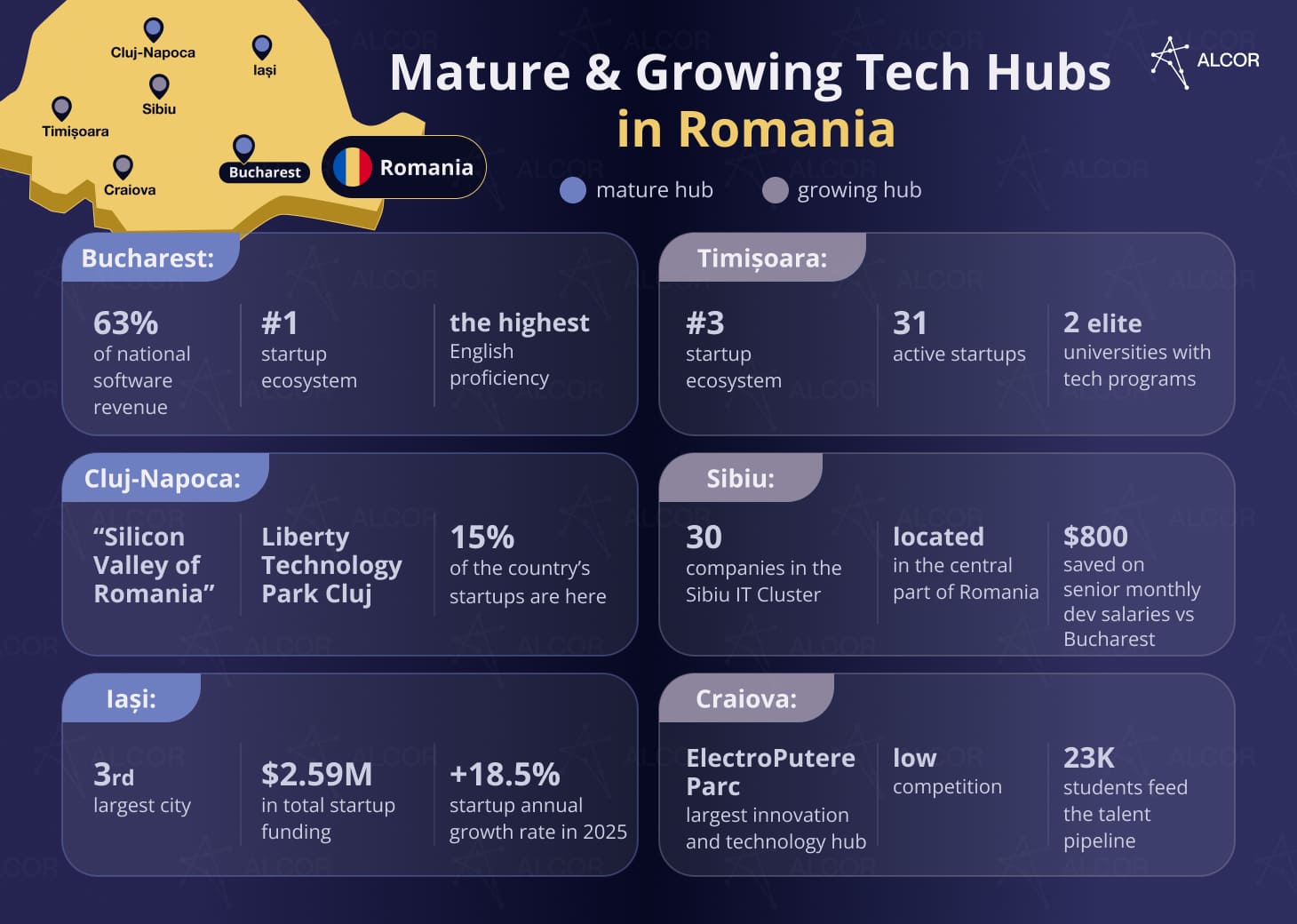
Holding 63% of software development revenues, Bucharest is the undisputed center of Romania’s tech market. It concentrates the majority of the country’s 207,800 ICT professionals – together with Cluj-Napoca and Timișoara.
Bucharest also leads Romania for English proficiency with an EF EPI score of 612 – one of the highest in Eastern Europe. On AI specifically, StartupBlink ranks Bucharest 28th globally – the only Eastern European city in the global AI top 30. Its robust technological infrastructure, flourishing business landscape, and strategic location explain why Google, Microsoft, Amazon, Oracle, Dell, and Adobe outsourced software development to Bucharest.
Cluj-Napoca
Cluj-Napoca is another thriving tech hub in Romania, often referred to as the “Silicon Valley of Eastern Europe” and, of course, the “Silicon Valley of Romania”. With a developed IT infrastructure and startup ecosystem, Cluj-Napoca hosts 15% of the country’s startups and has the second-best ecosystem in Romania. Cluj-Napoca is home to the R&D offices of global tech giants, such as Microsoft, Accenture, Siemens, Endava, and Emerson.
The city also hosts a technology park – Liberty Technology Park Cluj, which accelerates the growth of local tech companies and hosts multiple meet-ups and networking events. Among the residents are Siemens, CDS, Nordstar Logistik, etc.
Iași
Romania’s third-largest software development city, Iași, has undergone an impressive technological transformation. From a post-industrial center, it’s now a booming tech hub with modern offices, tech parks, and infrastructure. Even though it’s not as huge as Bucharest, the startup ecosystem of Iași recorded an annual growth rate of +60.6% in 2026, and has exceeded $2.59 million in total startup funding. All these benefits have attracted leading product and software development companies like Amazon, Oracle, Accenture, and Microsoft to the local market.
Timișoara
Having the fourth-greatest startup ecosystem in Romania, Timișoara hosts 40 startups in 2026. The city is home to the 7th best university in the country – the West University of Timișoara, as well as to the Politehnica University of Timișoara, which is a well-known computer science institution in the city. Together, they graduate thousands of skilled software developers to enrich the IT in Romania. Product and software development companies like Amazon, Wipro, and Cognizant have already established their offices there, while Nokia, Bosch, and Procter & Gamble are hiring local software development pros.
Sibiu
Sibiu is a growing tech hub in Romania located in the central part of the country, with a diverse IT&C community as part of the Sibiu IT Cluster, hosting over 30 tech companies and 14 startups. While this hub doesn’t have many tech graduates annually (500, according to unofficial sources), this city offers cost savings of around $10,000/year in terms of senior developer salaries – approximately $54,504/year vs $64,500/year in Bucharest, according to levels.fyi.
Craiova
Craiova is an emerging tech hub and an industrial cluster in Romania that is attracting new product and software development companies from the US and Western Europe. Its main IT anchor is ElectroPutere Parc – Oltenia’s largest innovation and technology hub, home to Endava, Ubisoft (100+ developers since 2008), Hella, Ford, and Operative, with €60M in further expansion underway.
The city also hosts one of the top Romanian universities for tech education in the QS World University Rankings 2026, the University of Craiova, which enrolls over 23,000 students who then become a part of a new educated software development workforce in the Romanian market, including the tech sector.
While still developing, Craiova is the perfect go-to destination for companies looking to set up the software team in a place with minimal competition and lower salaries – approximately $50,004/year in Craiova for a senior developer on average vs $64,500/year in Bucharest, according to levels.fyi.
6. Business-friendly climate
What else makes Romania one of the most favorable outsourcing locations for custom software development is its secure business environment. According to StartupBlink’s 2026 Innovators Business Environment Index, Romania ranks #2 in Eastern Europe – evaluated across 30+ parameters covering regulatory friction, access to capital, taxation, digital infrastructure, and mobility.
The Romanian government offers tax incentives for product and software development companies exclusively engaged in innovation and R&D. They include:
- Profit tax exemption for the first 10 years for companies involved in innovation and R&D
- 50% deduction of the eligible R&D expenses
- Accelerated depreciation for R&D equipment
7. Convenient location in Eastern Europe
Another advantage of opting for software outsourcing to Romania is its strategic location. It borders Ukraine, Hungary, and Bulgaria, which allows global tech companies to tap into the potential of neighboring markets easily. It takes only 2-4 hours by plane to get to the largest tech centers in Europe. If you nearshore to Romania, you benefit from great alignment between the local software development team and crews in other CEE countries or Western Europe.
Debunking Myths about Outsourcing to Romania
Four common myths about outsourcing software development to Romania are contradicted by data.
- The IT sector is not slow-growing: in 2025, Romania’s IT&C became the country’s #1 services export industry, and the IT services market is projected to reach €44.8 billion by 2028.
- The talent pool is not small: 207,800 ICT professionals rank Romania 4th in Eastern Europe.
- English proficiency is not low: Romania ranks 11th globally and 2nd in Eastern Europe in the 2025 EF English Proficiency Index.
- Cultural alignment is not a barrier: Romanian developers share Western business ethics and demonstrate strong adaptability in cross-cultural teams.

Stumbling IT sector
Rumor has it that the IT industry in Romania is growing too slowly. But look at the facts:
- Romania’s IT services market is projected to reach €44.8 billion by 2028 – with all major segments expanding in parallel.
- In 2025, the country’s IT&C sector became Romania’s #1 services export industry, overtaking every other sector in the national economy for the first time.
- Romania ranks 4th in CEE by startup enterprise value, with 21 active scaleups in the region, per the Dealroom CEE 2025 report.
- IT technology in Romania has a highly skilled workforce and competitive pricing in 2026, resulting in high demand.
From my perspective, the recent growth numbers of IT in Romania undermine any bias and highlight that the right time for US IT companies to enter this market is now.
Few tech specialists to set up a development team
Supposedly, the technology market in Romania lacks sufficient talent. In reality, it abounds with 207,800 ICT professionals – the #4 tech powerhouse in Eastern Europe in 2026.
Are all Romanian software developers concentrated in tech hubs? Bucharest, Cluj-Napoca, and Iași act as the leading tech hubs, and Timișoara, Sibiu, and Craiova are the emerging ones. Yes, I must admit that the point of hub-dependent distribution of software engineers in Romania is valid.
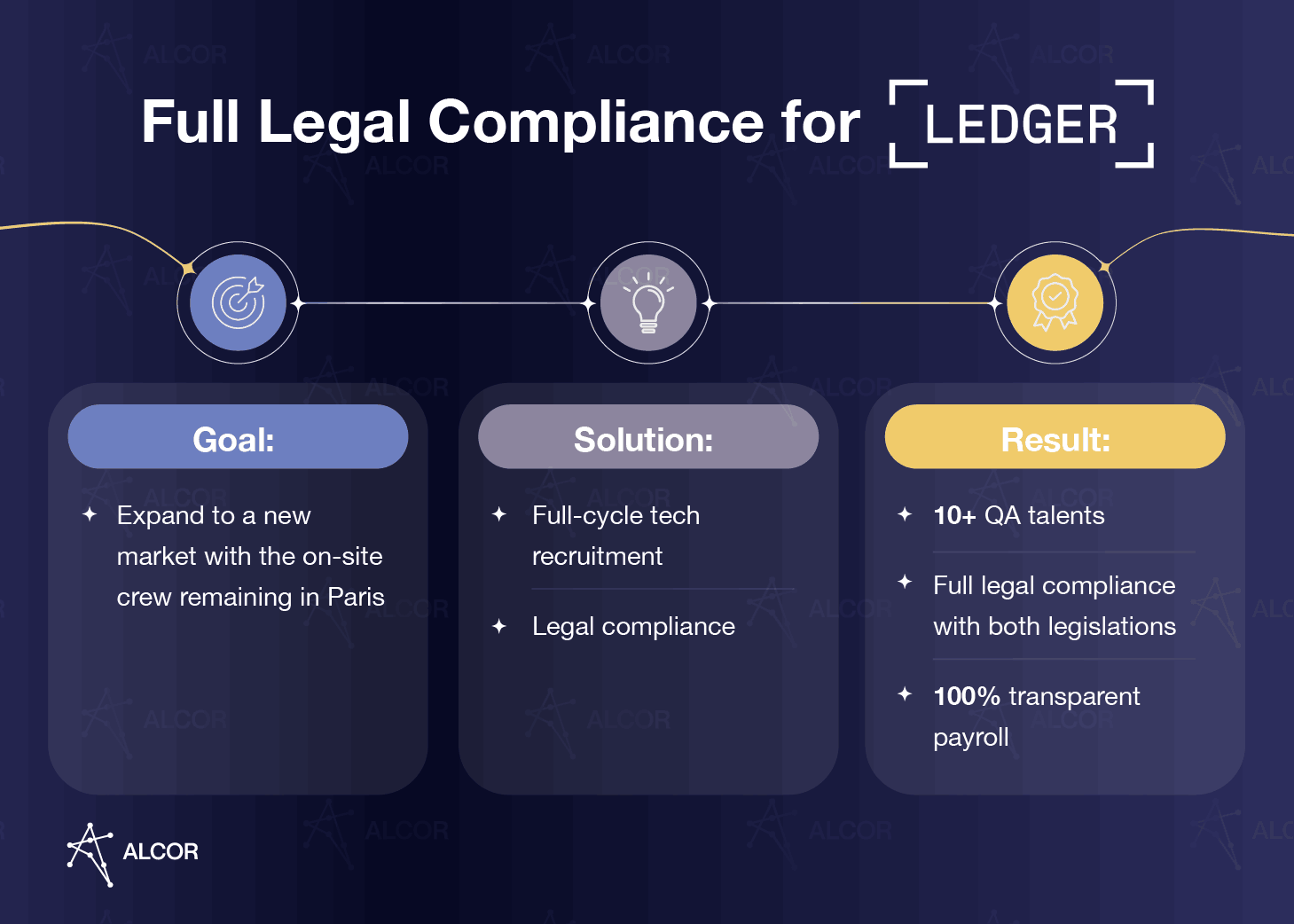
Considering the local tech talent market and labor law, building a team of remote Romanian software developers might be challenging. For example, Ledger, a French hardware wallet company, lacked local IT sector knowledge when establishing a nearshore development hub in Eastern Europe. Alcor guided them in tax management, labor law, IP rights protection, and employment contracts, helping ensure 100% compliance with both legislations.
Poor English knowledge
What else can make Romania’s software outsourcing seem risky is its presumably low level of the English language. Stats disprove it once again: this destination is ranked 11th globally and 2nd in Eastern Europe in the 2025 EF English Proficiency Index. My international clients say they’ve never had any problems with feedback provision or task-setting in Romanian software teams.
Moreover, English is not the only language Romanian developers know. It’s common for these IT professionals to have a good command of German, French, or Italian. Easy and effective communication with foreign IT companies serves as another reason for choosing software development in Romania.
Significant cultural gap
The final myth about Romania’s outsourcing is cultural dissimilarity. In fact, all Eastern European countries have a close affinity with Western culture and business ethics, and Romania is no exception. Suppose you decide to scale up your tech business by setting up your software development team in Romania. In that case, each member will demonstrate exceptional cultural adaptability, open-mindedness, dedication, and a desire to take your product to the next level.
Romania vs Other Eastern European IT Outsourcing Destinations
Among Alcor’s core destinations in Eastern Europe, Romania is the third-largest tech talent market, behind Poland (778,800 ICT professionals) and Ukraine (305,000 ICT professionals). Romanian senior developers cost less than Polish counterparts but more than Ukrainian ones. For example, a senior DevOps Engineer costs $81,600 a year in Romania vs $90,000 in Poland and $72,000 in Ukraine – compared to $168,000 in the US. Romanian developers have a stronger focus on back-end development relative to Poland and Ukraine. Romania leads all three countries in English proficiency (EF EPI rank: 11th globally). Coface rates Romania’s business climate A3, signaling a stable environment for foreign tech investment.
As you now know the advantages and disadvantages of outsourcing in Romania, it’s time to assess its performance in the Eastern European arena. Let’s do a location comparison.
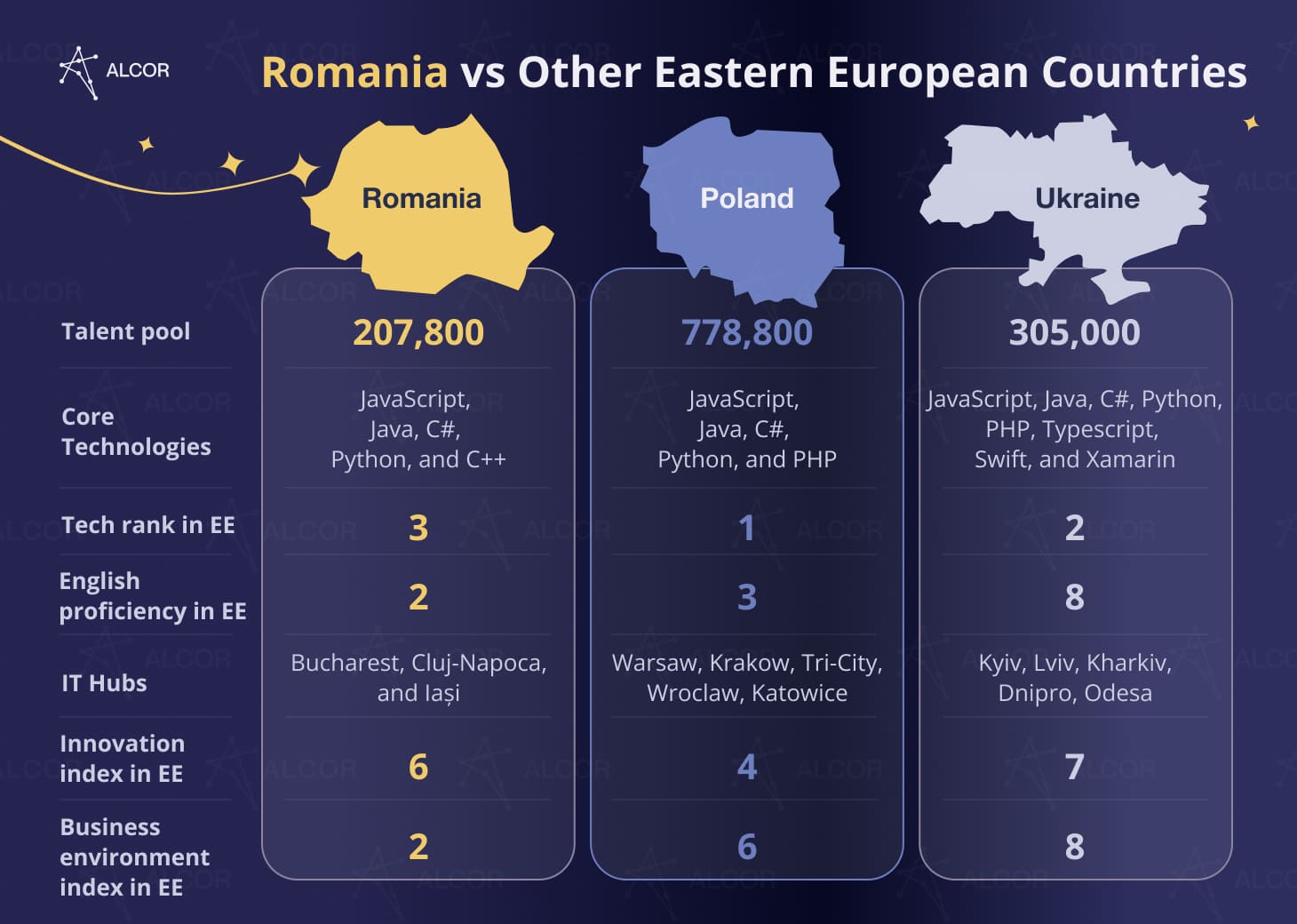
From the data above, we can see that Poland has the largest talent pool in Eastern Europe – 778,800 ICT professionals. For its part, Romania secures the 3rd position following Ukraine with its 305,000 tech talent pool. The key tech industry expertise is roughly the same, but in Romania, developers are more well-versed in back-end. The country’s tech rank is the lowest, but the English level is the highest among the three.
By the way, Romania is now ranked 6th by the Coursera Global Skills Report 2025. The business climate of Romania is A3, which means that the country’s legal system and institutions provide a favorable environment for foreign investment in the local IT sector.
|
Senior Developers’ Gross Annual Base Salaries |
||||
|
Position |
Poland | Romania | Ukraine |
USA |
| AI Engineer |
$129,000 |
$123,000 | $105,000 |
$222,000 |
| AI Product Engineer |
$103,800 |
$97,200 | $84,000 |
$228,000 |
| AI Infrastructure Engineer |
$150,000 |
$141,000 | $123,000 |
$243,000 |
| AI Prompt Engineer |
$93,000 |
$87,000 | $75,000 |
$168,000 |
| ML Engineer |
$99,600 |
$97,200 | $84,000 |
$222,000 |
| LLM Engineer |
$102,000 |
$97,800 | $86,400 |
$234,000 |
| DevOps Engineer |
$90,000 |
$81,600 | $72,000 |
$168,000 |
| Python Developer |
$84,000 |
$79,200 | $70,800 |
$165,000 |
| Blockchain Developer |
$70,800 |
$84,000 | $76,800 |
$171,000 |
| Data Engineer |
$82,800 |
$74,400 | $69,600 |
$177,000 |
|
According to Alcor’s internal research, September 2026. Developer salaries were converted to US dollars at the relevant exchange rate for 2026. |
||||
With the annual senior developer costs compared, the price tag for Romanian developers is lower than the Polish software developer’s salary and higher than the Ukrainian software developer’s salary. To illustrate, consider the annual salary of DevOps Engineers, AI Engineers, AI Product Engineers, ML Engineers, and LLM Engineers. In Romania, it ranges from $81,600 to $123,000 a year, while Poland ranges from $90,000 to $129,000 a year. Ukraine’s range of $72,000-$105,000 a year stays below both. The US rates are well above all the Eastern European destinations – up to 63%!
In conclusion, Romanian software development has limitless potential because of affordable compensation and top-notch expertise in the tech domain. Therefore, deciding to hire Romanian developers and building your own R&D team in Romania is a winning option for your tech business.
IT Outsourcing Industry in Romania: 2027 Projections
Romania’s IT outsourcing industry shows strong, independently-verified momentum heading into 2027.
- Romania’s digital economy is projected to grow 3.5x to €52 billion by 2030, with the software segment specifically reaching €2.4 billion by 2028.
- Romania’s AI market is set to grow from €515 million in 2026 to €1.75 billion by 2031, backed by the new RO AI Factory supercomputer going live by 2027.
- General developer salaries are cooling to a 5-6% forecast increase for 2026, while AI-specialized roles are rising 25% to 58% year-over-year.
- Romania’s ICT workforce is projected to grow 7.8% annually through 2035 – the fastest rate of any EU member state.
Software development sector growth
Romania’s digital economy is on track for a much bigger leap than any single-segment figure suggests. According to McKinsey’s Digital Challengers research, the country’s overall digital economy could grow 3.5x by 2030, from roughly €14.8 billion to around €52 billion, with ICT identified as the main growth driver, pushing digital’s share of GDP from about 6% to nearly 10%. Romanian officials have since reaffirmed the target: at GoTech World 2024, the Ministry of Research, Innovation, and Digitalisation restated the €50 billion by 2030 goal publicly.
Zooming in on software specifically, the picture is just as consistent: the Romania Software Industry Outlook projects the segment reaching €2.4 billion by 2028, a 6.4% annual growth rate. And today’s baseline is already substantial – Romania’s computer programming industry generates an estimated €17.4 billion in annual revenue across nearly 52,000 registered businesses and 272,000 employees, according to IBISWorld.
Growth isn’t limited to core software development, either. Adjacent segments are compounding the trend: Romania’s cybersecurity market alone is projected to exceed €300 million by 2030, driven by rising compliance requirements and AI-enabled security demand. For US tech product companies, the combined signal is hard to miss: multiple independent forecasts, from different methodologies and years, are converging on the same conclusion – this market is scaling, not plateauing.
AI adoption pace
Romania’s AI market is projected to grow from €515 million in 2026 to €1.75 billion by 2031 – a 26% annual growth rate, more than double the pace of the broader IT&C sector. Yet enterprise AI adoption currently sits at just 5.21%, the lowest rate in the EU and well below the bloc’s 19.95% average, according to Eurostat.
That gap between market growth and enterprise adoption is closing fast, and infrastructure is a big reason why. Romania was selected in October 2025 as one of only six new sites for the EU’s EuroHPC “AI Factory” network, and on September 1, 2026, officially began implementing the RO AI Factory – a EuroHPC-class supercomputer hosted by ICI Bucharest in partnership with Politehnica University of Bucharest and the Technical University of Cluj-Napoca. Once operational (targeted for end of 2027), it’s expected to deliver over 5 exaFLOPS of AI computing power, among the most advanced AI infrastructure in Central and Eastern Europe, purpose-built to help Romanian SMEs and startups train and deploy their own models rather than renting compute abroad. It’s one of two AI factories going live in Romania in 2026, with combined investment already exceeding €70 million, and Romania is also in the running for a much larger-scale “AI Gigafactory” under the EU’s newer AI Continent initiative, a decision still pending as of this writing.
Romania’s National Artificial Intelligence Strategy, running through 2027, is designed to close the adoption gap from the top down – with government-side AI adoption, including at the tax authority (ANAF) for risk analysis and spend optimization, intended to set the pace for the private sector.
Software engineers’ salaries dynamics
Romanian tech salaries had a strong 2025: the IT sector posted the highest salary increase of any industry tracked, at 9%, according to PwC’s PayWell Romania study (149 companies, 212,000+ employees). But the pace is cooling. For 2026, technology companies expect just a 6% increase – the lowest forecast of any sector in the study, behind industrial (8.3%), pharmaceutical (6.9%), and retail (6.6%). eJobs data confirms the deceleration: IT remained Romania’s best-paid sector in H1 2026, but year-over-year salary growth had slowed to 5%, down from the double-digit increases reported earlier in the cycle.
The average masks a widening split, though. The same PwC study found that high-performing employees – “high achievers” – earn 13% to 20% more than their peers, a gap that’s growing as employers compete harder for specialized skills rather than raising pay across the board. Alcor’s own year-over-year rate comparison bears this out at a more granular level: senior salaries for general development roles (PHP, Python, DevOps, Mobile, QA) moved by single digits in either direction between 2025 and 2026 – essentially flat on average, with a couple of roles actually down slightly. AI-specialized roles moved on a completely different curve over the same period: senior ML Engineer rates rose about 25%, from $78,000 to $97,200 a year, and senior AI Engineer rates rose nearly 58%, from $78,000 to $123,000 a year.
For US companies planning multi-year Romania hiring, the takeaway is twofold: overall cost advantages remain durable through 2027, but expect sharper pay differentiation by specialization – general roles are re-pricing slowly, AI roles are re-pricing fast.
Demand for Tech Talent Hiring in 2027
Romania is projected to have the fastest-growing ICT workforce in the entire EU. According to Cedefop’s 2035 Skills Forecast, ICT professionals and technicians in Romania are set to grow at 7.8% annually – more than triple the EU-27 average of 2.5%, and the highest rate of any member state. Though, ICT specialists still make up only around 3% of Romania’s total workforce, tied with Greece for the smallest share in the EU, according to Eurostat, there’s a real bright spot in that same dataset – Romania has the highest share of women in ICT of any EU country, at 28%, well above the 19% EU average, a diversity edge most competing outsourcing destinations can’t claim.
What Can be Better than Outsourcing to Romania
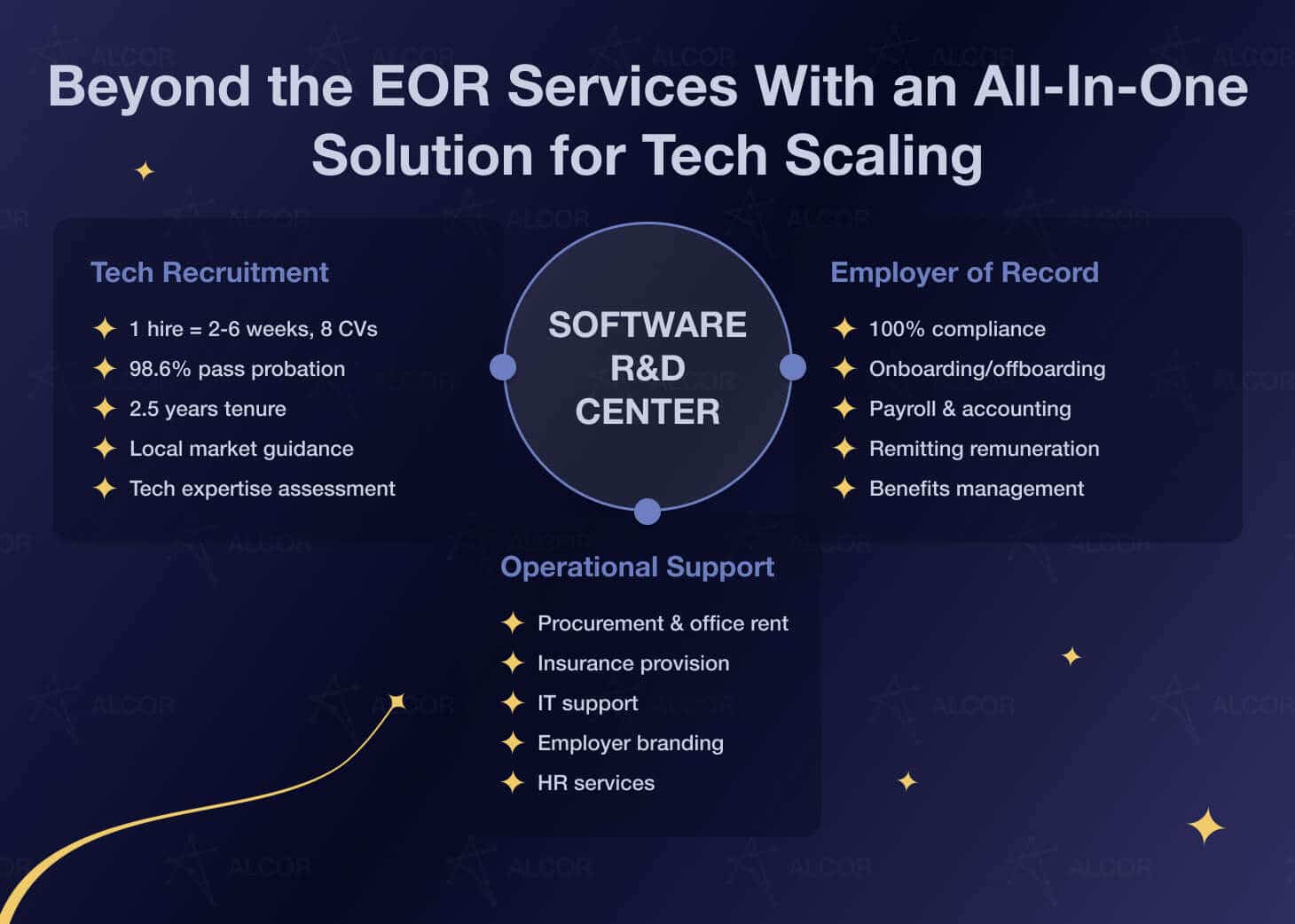
For US tech product companies, expanding their engineering capacity to Romania a software R&D center model is a stronger alternative to traditional outsourcing. Alcor is a tech-exclusive provider that builds Romanian engineering teams from 0 to 30 engineers in 90 days. Compared to outsourcing, this model offers 50% lower costs through transparent invoicing and no markups, full IP ownership from day one, direct team management, and free insourcing at any time without buyout fees. Full HR, legal, and operational support is included under one roof.
Using IT outsourcing services in Romania is not your only way to develop a tech product.
We at Alcor can launch your software R&D center backed by our EOR services in Romania. This solution is more advanced than any deal with a Romanian software development outsourcer because:
- You get a senior technology team in Romania, hired from scratch with clear pricing. No more paying senior-level salaries for mid-level expertise.
- You get 50% cost efficiency vs Romania’s outsourcing because of transparent invoices and no markups.
- You manage the team and retain the IP rights instead of sharing them with third parties.
- Your programmers are fully integrated and loyal to your product, unlike the outsourced developers who see you as just another client.
- You get free insourcing at any time instead of buying out programmers later.
Our team works like a clock so that you can establish an R&D hub of 10-100 in Romania within a year with full HR, legal, and operational support.
Real Challenges When Outsourcing Software Development to Romania
Two main challenges when outsourcing software development to Romania are tax complexity and time zone differences. Romania offers two hiring models: employment agreements (Contract de Muncă) and B2B contracts (Contract Civil). Under employment contracts, the employer contributes 2.25% labour insurance plus 0%-8% pension SSC; employees pay 10% PIT plus 35% in SSCs – giving an effective tax rate of ~42% on gross income. Under B2B, a sole trader pays 10% PIT and tiered pension contributions based on annual income, with an effective rate of ~29%. The time difference between Romania and US time zones ranges from 7 to 10 hours, which requires structured async workflows and regular overlap windows.
Employment contracts & taxes
For foreign IT companies, the Romanian government offers two main approaches to hiring Romanian developers: an employment agreement (Contract de Muncă) and a B2B contract (Contract Civil). But both come with peculiarities.
An employment agreement follows the Romanian Labor Code, obliging employers to withhold payroll taxes and social security contributions. They impose strict rules on work conditions and termination, yet guarantee employees a fixed salary, benefits, set hours, PTO, and clear exit terms. The salary is paid in local currency to prevent inflation from eroding its value.
- Employer’s share: Social Security Contributions (SSCs) consisting of a labour insurance contribution of 2.25% and a pension insurance contribution of 0%-8%* – with 0% for normal working conditions, 4% for hard, and 8% for special. There are nuances here better communicated with local legal representation from a reliable partner like Alcor.
- Employee’s share: A 10% personal income tax (PIT) on gross income, plus 35% in SSCs: a pension insurance contribution of 25% and a health insurance contribution of 10%. The combined effective tax burden for an IT specialist earning $5,000/month comes to approximately 42% of gross income.
A B2B contract falls under the Civil and Fiscal Codes. A developer must register as a sole trader and handle their taxes and social contributions, which means that the client has no tax burden. The compensation is paid in foreign currency, protecting it from inflation and FX swings. Benefits, PTO, and working terms are negotiated individually and tend to be stricter than standard employment contracts. A developer must cover:
- A PIT of 10% of gross income (for a sole trader / PFA). Alternatively, a developer can register an LLC (SRL), paying either a 1%-3% micro-company tax if eligibility criteria are met, or 16% income tax on net income.
- Social Security contributions, which depend on annual income level:
- Pension insurance contribution:
Annual income below RON 48,600 (~$11,030) (12 minimum gross salaries): no mandatory pension contribution.
Annual income between RON 48,600 and RON 97,200 (~$11,030–$22,060): 25% applied to a fixed base of 12 minimum salaries – ~RON 12,150/year (~$2,758).
Annual income above RON 97,200 (~$22,060): 25% applied to a fixed base of 24 minimum salaries – ~RON 24,300/year (~$5,515).
- Health insurance contribution:
Annual income below RON 24,300 (~$5,500) (6 minimum gross salaries): no mandatory contribution.
Annual income at or above that threshold: 10%, capped at a base of 72 minimum gross salaries (~RON 291,600 / ~$66,160/year).
The combined effective tax burden for a sole trader earning $5,000/month comes to approximately 29% of gross income.
Time zone differences
Romania has a strategic location in Europe because it shares only a 1-2-hour time difference with neighboring countries. But the scenario is different when it comes to the US – the average time difference between Bucharest and New York is 7 hours, while with San Jose, CA, it reaches 10 hours. This can sometimes lead to irregular and abrupt cooperation between the in-house team in the US and offshore developers in Romania.
However, with a well-organized workflow, proper management tools, and regular meetings, time zone differences are not a threat to productive cooperation and digital transformation, even through outsourcing IT to Romania. The next question is – which of Romania’s outsourcing services to choose?
Tips to Make Outsourcing to Romania Easier
To outsource software development to Romania effectively, US tech companies should follow three steps.
- Define which tasks to delegate: one-time or secondary functions are well-suited for outsourcing, but core product development for tech companies carries risk.
- Select the right engagement model. Fixed price and time-and-material models work for discrete projects. A dedicated team model offers flexibility but limits ownership. An offshore development center gives full team control from day one and is the recommended model for scaling tech product companies.
- Evaluate providers by local market expertise, guarantees, and independent reviews. A good provider should align with your business goals, not just fill roles.
Identify tasks for delegation
Before you decide to outsource to Romania, it’s important to know which tasks or projects you want an IT outsourcing provider to handle. If your business isn’t in the tech industry and you have one-time tasks, you can easily pass them to an outsourcing provider in Romania. They’ll take care of everything from start to finish, liberating you from the hassles associated with tech recruitment and project management.
If you run a tech product company and need help with product development, traditional outsourcing in Romania might be risky due to poor development quality, no access to the team, and threats to IP rights. In this case, think about using recruitment process outsourcing (RPO) to get your team of skilled developers.
Choose a cooperation model
The next step is to learn about engagement models to work with local developers. There are 4 of them:
- Fixed price: You set the project’s requirements, budget, and timelines in advance. This reduces the chances of unexpected costs, but it’s not flexible, which can hinder project progress.
- Time & material: You pay for the actual hours spent on the project. Beware: without clear planning and timeframes, you might spend a lot more than expected.
- Dedicated team: This flexible model allows changes throughout the project. However, you won’t get your team of developers with this model, which could impact product quality. Plus, sometimes buying out such a team from a provider can cost millions of dollars.
- Offshore development center: This is the best model for global companies in tech. You can build a loyal team of developers in a cost-effective location that belongs to you from the start. It’s safer than traditional outsourcing, but your provider is key. Consider partnering with a reliable company to set up an offshore development center.
When choosing an IT outsourcing provider in Romania, make sure they possess local market expertise, a strong track record, outlined guarantees, and positive reviews on independent resources. It’s vital to remember that a good vendor should be interested in your business success, providing the most efficient methods to streamline your outsourcing journey.
IT Services to Outsource in Romania
Three categories of IT services can be outsourced to Romania.
- Business process outsourcing (BPO) covers secondary functions such as HR management, legal compliance, employer branding, and payroll – useful for non-tech companies or for reducing operational overhead.
- Software development outsourcing gives access to 300+ providers in Romania but carries risks for product companies: limited IP control, pricing opacity, and reduced team loyalty.
- Tech recruitment outsourcing is the strongest option for product tech companies: it provides senior engineers hired end-to-end, competitive compensation benchmarks, and local market guidance, while keeping development in-house. Alcor’s model for Dotmatics – 30+ engineers hired in one year at 40% lower cost than outsourcing – illustrates how this approach works in practice.
If you have already decided to outsource to Romania, consider the three following services:
Business process outsourcing (BPO)
Outsourcing business-related processes is a widely used practice among tech companies that embark on offshoring. It allows them to hand over secondary activities to a local third-party vendor while focusing on product development.
You can choose from a wide variety of back-office services, including tech recruitment, HR management, employer branding, legal compliance, or outsourced payroll in Romania. It’s not rare to also see front-office operations (marketing, software development, customer support, etc.) among the BPO services. However, if you are the owner of a product company, it’s better to refrain from delegation since it’s the core of your business.
Software development outsourcing
With more than 300 IT outsourcing providers in Romania, foreign companies have a range of services at their fingertips. While tech outsourcing to Romania is a popular strategy, it’s important to recognize its potential risks and drawbacks. When partnering with a provider delivering IT outsourcing to Romania, product tech companies may encounter issues like cloudy pricing, potential data leaks, reduced control over software development and delivery, and even failed attempts to secure additional investor funding. Therefore, to keep your essential activities in-house, consider setting up your engineering team in Romania.
Tech recruitment outsourcing
This option comes in handy for tech companies seeking the advantages of offshoring or nearshoring software development in Romania. Cooperation with a competent tech recruitment company will enable you to get only seasoned engineers, set competitive annual remuneration and an attractive EVP, receive full coverage of the hiring processes, and get in-depth consultations on the local tech market.
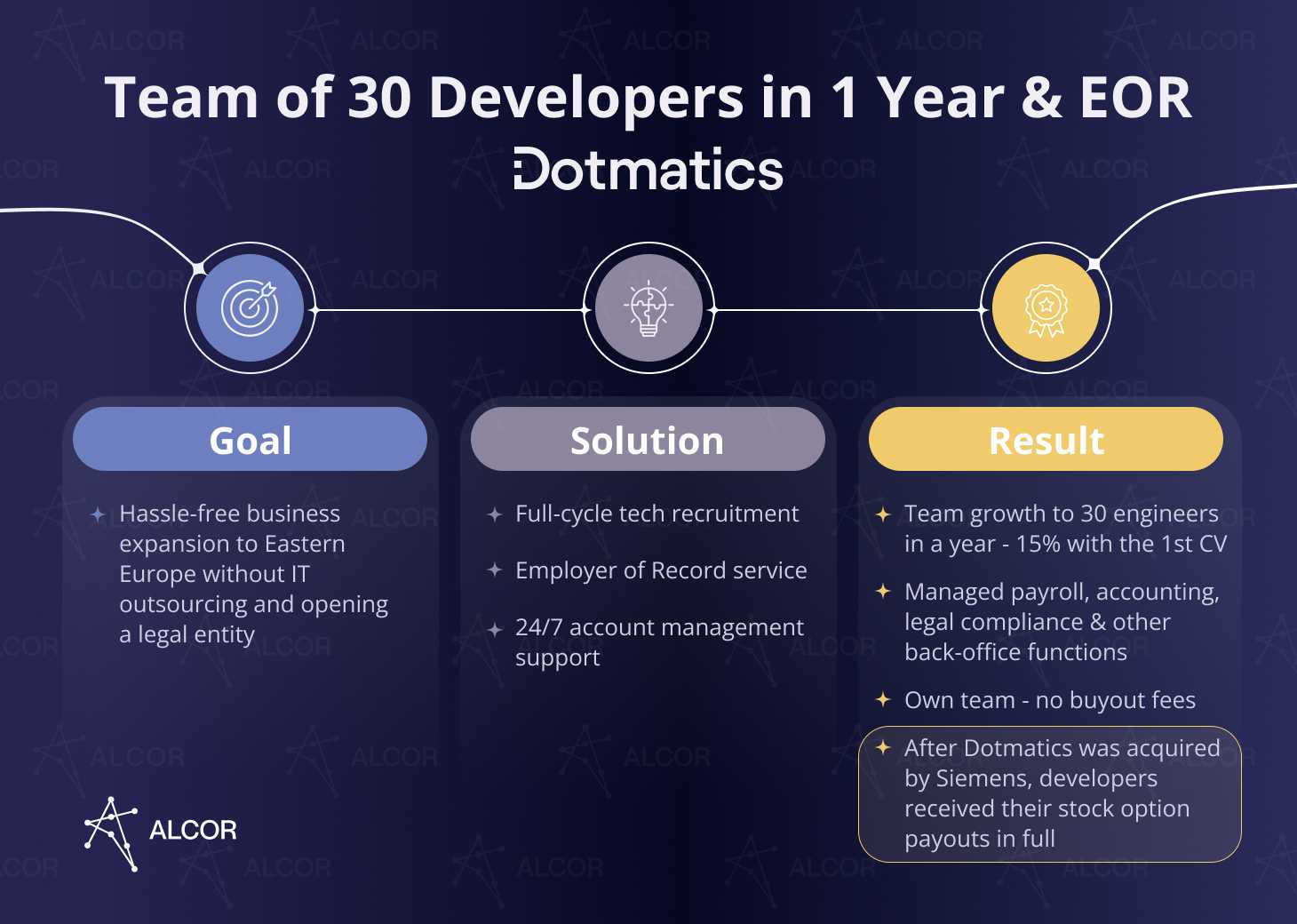
A US-based tech product company, Dotmatics, chose this path when expanding into Eastern Europe. Cooperating with Alcor, Dotmatics not only reduced costs by 40% compared to outsourcing to Romania but also assembled a top-tier team of 30+ software engineers within a year! Notably, several critical positions, including Product Manager and QA Engineer, were promptly filled with qualified candidates. Not to mention other services delivered: payroll, accounting, compliance, benefits, and procurement management. In July of 2025, Dotmatics was acquired by Siemens, while its developers benefited from stock option payouts in full.
But in addition to these options, there’s also the most complete solution for tech.
Expand to Romania with Ease
Alcor is a tech-focused software R&D center provider that helps US tech product companies build engineering teams in Romania, Ukraine, Poland, Bulgaria, and Latin America. Alcor combines IT recruitment, Employer of Record services, and 360-degree operational support under one structure – with no third-party vendors, no setup or exit fees, and full IP ownership from day one. In 2021, Sift – a San Francisco-based ML fraud prevention unicorn – hired 32 developers in 12 months through Alcor, grew its R&D center to 51 engineers across Ukraine and Poland, and achieved full legal compliance across both jurisdictions. Alcor clients include People.ai, GoTransverse, and ThredUP.
To experience all the benefits of Romania as an outsourcing destination, consider cooperation with a partner that understands and delivers for the tech industry. We at Alcor launch software R&D teams and provide IT recruitment services in Romania, Poland, Ukraine, Bulgaria, and IT sourcing hubs of LATAM. We focus only on the IT industry, and it shows in all services – from tech recruitment to benefits management.
In 2021, Sift – a San Francisco-based ML fraud prevention company – set a clear engineering target: hire 30-35 developers in Eastern Europe within the year, starting with a cluster in Q1. The company had 180 people globally and one in-house recruiter. The roles required specialists in Java, Python, Kafka, Flink, and Spark – the kind of technical depth that rewards a focused search, not a broad pipeline.
Alcor structured the entire expansion. The results reflected the structure behind it:
- A Senior Product Designer hired from the first CV submitted.
- Three critical roles – two Infrastructure Engineers and a Ruby on Rails Developer – closed within 7 days.
- Legal compliance across Ukraine and Poland was managed end-to-end – employment contracts, IP protection, tax management, labor law.
- Beyond tech recruitment and EOR, Alcor carried the full operational weight.
- When Sift held its Summit in California, 12 engineers flew in from Eastern Europe; Alcor handled every visa and travel arrangement.
- To strengthen Sift’s position in a competitive talent market, Alcor produced an employer branding video – offer acceptance rates rose 15%.
- 32 developers hired across 12 months, hitting Sift’s annual goal.
- The team that started in Kyiv expanded into Poland and reached 51 engineers. Sift became a unicorn.
Sift’s path from a hiring plan to a 51-person R&D center is the kind of outcome Alcor was built to produce. Backstory (ex-People.ai), GoTransverse, UFORCE, and ThredUP followed the same model and built engineering teams that stayed in-house, fully owned, and operational long past the initial expansion.
Tech recruitment, EOR services in Romania, and full ops – start with your requirements. You’ll get a payscale report and candidate availability data on the first call. No commitment needed.
FAQ
What are the advantages of outsourcing in Romania?
There are multiple reasons for choosing Romania as an outsourcing destination: balanced price-to-quality ratio, huge talent pool, high English proficiency, business-friendly climate, and convenient location. Read this article to learn more about the advantages of outsourcing to Romania.
Where should I hire software developers in Romania?
Romania boasts several tech hubs: three developed IT centers (Bucharest, Cluj-Napoca, and Iasi) and three emerging ones (Timisoara, Sibiu, and Craiova). The biggest concentration of Romanian software engineers is in Bucharest, as it is the largest IT hub for outsourcing to Romania.
Why should I consider outsourcing software development to Cluj-Napoca and other local tech hubs?
Hub choice in Romania affects hiring speed, cost, and the type of talent you can realistically attract – and Bucharest is not always the right default.
Bucharest has the deepest talent pool, but it also has the most competition. If you’re hiring for common stacks, you’ll be competing with Google, Amazon, Oracle, and 60%+ of Romania’s entire IT market simultaneously. For companies with tight timelines and niche roles, that’s a real bottleneck.
Secondary hubs solve specific problems. Cluj-Napoca works well for product-focused companies – its startup culture attracts engineers who want ownership, not just a paycheck. Iași is the right call if cost matters and you’re willing to move faster than the big players already there. Timișoara is the best fit for embedded, automotive, or IoT engineering. Sibiu and Craiova make sense when you need to reduce burn and face minimal competition for talent.
The practical consideration for US tech leaders: hub selection should follow your role requirements and hiring timeline, not just the salary spreadsheet. A $500/month saving per developer means little if time-to-hire doubles.
Which companies provide outsourcing to Romania?
The most popular outsourcing companies in Romania are:
1) BPO
2) software outsourcing
3) tech recruitment outsourcing.
The first one mostly specializes in back-office operations; the second provides everything from web-page development, software testing, to security services, consulting, and support; and the third one builds teams of Romanian developers.
But if you need a solution that works for tech and delivers not just the team but also complete support with legal aspects, it’s not outsourcing to Romania but your tech R&D center.
Would it be easy to find an outsourcing vendor in Romania?
It shouldn’t be difficult to select a provider offering outsourcing services in Romania out of 300 available vendors in Romania. Yet, you are a tech product company. In that case, it’s better to choose a more cost-effective and verified option: your engineering team set up by a reliable partner delivering high-quality services. It’s better than outsourcing to Romania because you manage the team and control the quality of development, which is crucial for every tech product business.
What are the top-rated IT outsourcing companies and EOR providers currently operating in Romania?
Several providers support tech companies hiring or building teams in Romania. The best choice depends on whether you need outsourcing, EOR-only, or a full engineering team setup:
- Alcor – tech-exclusive software R&D center provider combining IT recruitment, EOR, and 360-degree operational support in one place. Builds teams of 0-30 engineers in 90 days. No markups, no buyout fees, full IP ownership from day one.
- Deel – global EOR platform covering 150+ countries, supporting individual contractor and employee onboarding.
- Remote – EOR and contractor management across 180+ countries, with owned legal entities in most markets. HR-focused, no recruitment engine.
- Multiplier – EOR platform for companies hiring in emerging markets. Handles payroll, benefits, and compliance. No in-house tech recruitment.
- RemoFirst – budget-friendly EOR option for early-stage startups hiring globally.
- Rippling – combined HR, IT, and payroll platform with an EOR layer.
- Oyster HR – EOR and contractor platform with built-in compliance tools. Focused on simplicity for SMBs.
How would you rate this article?
Alcor is Your Trusted Scaling Partner
for expansion
support