


Software development in Colombia deserves a place on your shortlist if you’re comparing LATAM locations for team scaling. Its ICT market reached an estimated value of $12.34 billion in 2025, up 6% year-over-year, according to ITA research.
For tech product companies, the advantages of Colombia are practical:
- 202,000 ICT professionals, experienced in computer programming, web development, cloud computing, data analysis, and AI engineering.
- 53-62% cost efficiency in base engineering salaries compared to the US.
- Bogotá and Medellín are the main Colombian tech hubs, with a high concentration of tech talent, startups, and developed infrastructure.
- UTC-5, enabling full-day collaboration with US East Coast teams.
In this article, you’ll see where the Colombian software development industry is heading, what its growth and VC activity mean for tech companies, and which trends could shape the market by 2027. You’ll also learn how to build your own engineering team in Colombia instead of relying solely on outsourcing.
Key Takeaways
- Colombia’s ICT market is projected to reach $37.7 billion by 2030, supported by cloud adoption, digital transformation, cybersecurity demand, and telecom infrastructure growth.
- The country has 202,000+ software developers and produces 37,000+ STEM and ICT graduates annually, with strong talent in Java, JavaScript/TypeScript, Python, cloud, SQL, AI, and data engineering.
- Bogotá and Medellín remain Colombia’s leading tech hubs, while Cali and Barranquilla offer additional engineering talent and lower hiring competition in some roles.
- AI, cybersecurity, and digital infrastructure are likely to shape Colombian software development through 2027.
- Alcor helps tech product companies turn Colombia’s talent market into owned engineering capacity, scaling teams to 30 engineers in 90 days. With Alcor’s local infrastructure, companies also get operational support without having to juggle multiple vendors and overpay.
Software Development in Colombia: Overview
The software development industry in Colombia is expanding through market growth, stronger investment activity, and government-backed technology initiatives.
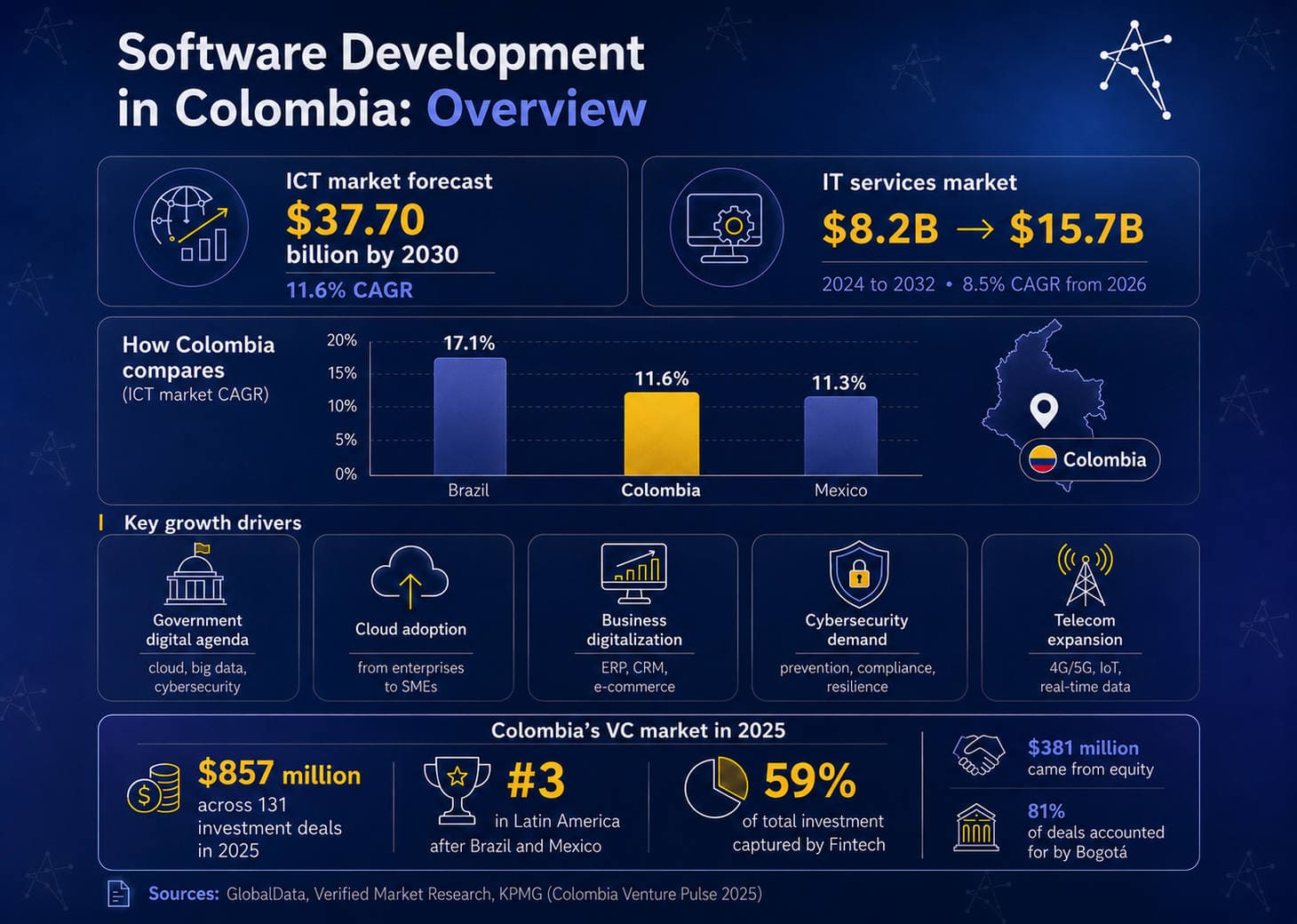
- Colombia’s ICT market is projected to reach $37.7 billion by 2030, supported by cloud adoption, digital transformation, cybersecurity demand, and telecom expansion.
- Colombian startups raised $857 million across 131 deals in 2025, with fintech attracting the largest share of investment.
- Colombia is investing in AI infrastructure, research, and digital skills, while companies such as Google, IBM, and Huawei are supporting training in AI, cloud, cybersecurity, and other in-demand technologies.
Market size and growth drivers
The ICT market, hardware, software, and services combined, is projected to reach $37.70 billion by 2030 at an 11.6% CAGR, according to GlobalData. The narrower IT services market in Colombia is expected to grow from $8.2 billion in 2024 to $15.7 billion by 2032, an 8.5% CAGR from 2026, per Verified Market Research.
How does Colombia’s IT sector stack up against other regional leaders? Using the same GlobalData methodology, Colombia’s 11.6% ICT CAGR runs slightly ahead of Mexico’s 11.3% (to $101.82B by 2028) but well behind Brazil’s 17.1% (to $212.95B by 2028). Although the Colombian tech market is smaller, it still demonstrates rapid and steady growth.
Two forces are driving Colombian software development market growth. The first is domestic, namely:
- Government digital transformation initiatives: Colombia’s National Digital Agenda is pushing cloud, big data, and cybersecurity adoption across public-sector services.
- Cloud computing growth: SaaS adoption is scaling from large corporations down to SMEs, drawn by lower upfront costs.
- Rising business digital adoption: Enterprises and SMEs are adopting ERP, CRM, and e-commerce platforms to compete and improve decision-making.
- Rising cybersecurity demand: Businesses and government are investing in threat detection, prevention, and compliance to lower digital exposure.
- Telecom infrastructure expansion: 4G/5G buildout enabling IoT, AI, and real-time data processing at scale.
The second is external, and arguably the bigger factor. US tech hiring has remained selective through 2026, with demand for engineering talent, especially with AI skills, continuing to climb, according to CompTIA’s State of the Tech Workforce 2026. That gap is pushing more US tech companies to look outside the domestic market for engineering capacity, and Colombia’s talent pool, cost position, and time zone alignment make it a direct beneficiary of that shift. Further details are provided in the next chapter.
Venture Capital
Colombia entered 2026 with a more mature venture capital market. According to the Colombia Tech Report 2025-2026 by KPMG, Colombian startups attracted $857 million across 131 investment deals in 2025, ranking the country #3 in Latin America after Brazil and Mexico. Of this amount, $381 million came from equity. Fintech remained the strongest magnet for capital, capturing 59% of total investment, while Bogotá accounted for 81% of deals.
The bar for receiving VC funding is also getting higher. The five largest equity deals represented $229 million out of $381 million raised in 2025, as investors increasingly backed companies with proven business models and positive unit economics.
This positive trend continues in 2026:
- ERCO Energía, an energy tech company, raised $129 million in Series C equity,
- Addi, a fintech company, secured an $85 million Series D,
- Somos Internet, a Medellín-based company, landed a $40 million Series B to develop AI-ready infrastructure.
These rounds signal continued investor appetite for Colombian tech companies that can demonstrate scalability, strong economics, and regional growth potential.
Tech ecosystem initiatives
Colombia is putting serious resources behind its digital ambitions. In 2025, the government approved its National Artificial Intelligence Policy, backed by nearly COP 479 billion in public funding through 2030. The plan targets AI research, infrastructure, digital talent, business adoption, and stronger technological capabilities across the country.
Private tech players are adding fuel to the engine:
- Google committed $750,000 to Fundación Estrategia País to expand AI education for Colombian students and teachers.
- IBM and Bogotá’s economic development authority launched training for 4,800 people in AI, cybersecurity, web development, and agile methodologies.
- Huawei also provided more than 1,000 certification vouchers for training in AI, cloud computing, big data, 5G, and IoT in Colombia.
The direction is clear: Colombia is making AI capability and AI talent development a strategic priority. In fact, ILIA 2025 already ranks Colombia 4th among 19 LATAM countries for AI development. Expanding tech companies gain access to talent with the necessary digital skills to apply in real-world product environments. This trend is strengthening Colombia’s position as a prime destination for companies looking for tech professionals with in-demand AI expertise.
Reasons to Expand Your Tech Business to Colombia
Tech companies expand to Colombia to access skilled engineering talent, strong tech education, lower labor costs, and convenient proximity to the US.
- Colombia has 202,000+ software engineers skilled in Java, JavaScript/TypeScript, Python, cloud, SQL, and Ruby, and ranking #4 on Topcoder for technology expertise.
- More than 37,000 STEM and ICT graduates enter the market annually, while MinTIC’s Talento Tech program is set to bring 113,000+ experts in AI, programming, cloud, cybersecurity, and other digital skills.
- Colombian engineers cost 53–62% less than US peers: a senior AI Engineer averages $105,000 vs. $222,000 in the US per year.
- Colombia’s UTC-5 time zone enables full-day overlap with New York, Miami, and Washington, D.C.
Seasoned tech talent
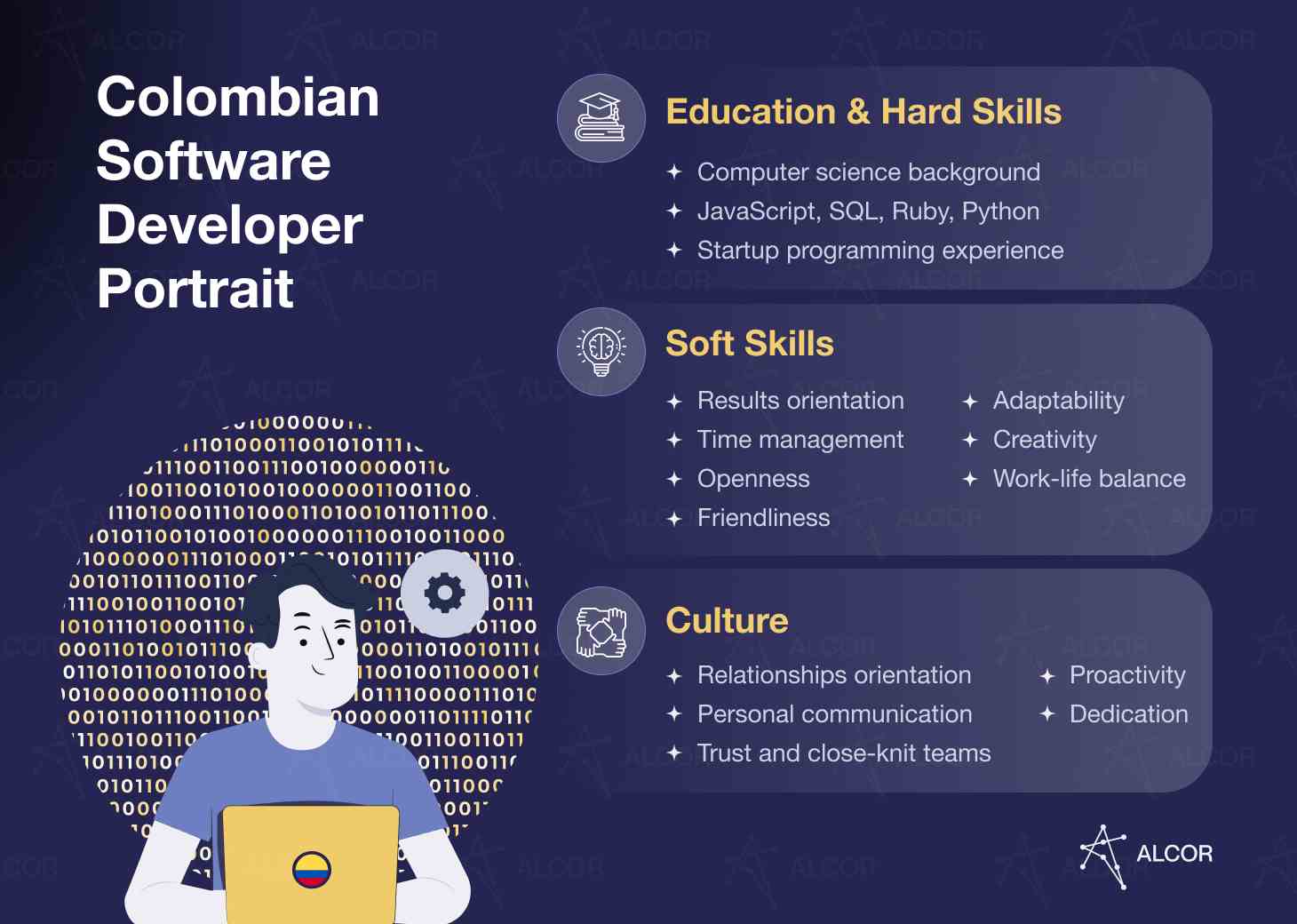
The Colombian software development industry is rich in skilled software engineers. With a population of 52 million, the nation is home to more than 202,000 software developers. According to our internal IT recruiting research, the strongest and most established engineering base is in programming languages and technologies such as Java, JavaScript/TypeScript, Python, and cloud technologies, with SQL and Ruby well represented alongside them.
Colombian software developers top the regional charts for technology expertise, ranking #4 on Topcoder and #9 on Coursera’s 2025 Global Skills Report across South America. They excel in operating systems, computer networking, and computer programming, and demonstrate exceptional proficiency in web development, cloud computing, and data analysis.
Exceptional tech education
Each year, over 37,000 STEM and ICT graduates enter the Colombian software development industry. They graduate from 13 higher education institutions recognized in the 2026 QS World University Rankings. This makes Colombia the third-highest among Latin American nations in the proportion of graduates pursuing STEM careers – a clear sign of accelerated growth in the tech talent pool.
Colombia’s government is reinforcing that pipeline further: MinTIC Talento Tech program offers free intensive bootcamps in programming, AI, data analysis, cloud architecture, cybersecurity, and blockchain, targeting 113,000+ graduates between 2024 and 2026.
Moderate labor costs
Lower labor costs and favorable business taxes in Colombia also encourage Western tech companies to consider this location for nearshoring. In fact, according to our client observations, cost efficiency is consistently the second most-cited reason tech leaders choose Colombia – right behind time zone alignment. Have a look at the table with software developer salaries in Colombia to see why.
|
Annual Average Senior Engineer Base Salary |
||||||
|
Position |
Middle |
Senior |
Lead |
|||
|
Colombia |
USA |
Colombia |
USA |
Colombia |
USA |
|
|
AI Engineer |
$69,000 |
$162,000 |
$105,000 |
$222,000 |
$144,000 |
$252,000 |
|
AI Product Engineer |
$57,000 |
$126,000 |
$87,000 |
$228,000 |
$132,000 |
$270,000 |
|
AI Infrastructure Engineer |
$78,000 |
$174,000 |
$123,000 |
$243,000 |
$168,000 |
$288,000 |
|
AI Prompt Engineer |
$48,000 |
$165,000 |
$75,000 |
$168,000 |
$102,000 |
$198,000 |
|
ML Engineer |
$51,000 |
$162,000 |
$78,000 |
$222,000 |
$120,000 |
$252,000 |
|
LLM Engineer |
$63,000 |
$159,000 |
$96,000 |
$234,000 |
$132,000 |
$258,000 |
|
Data Engineer |
$54,000 |
$144,000 |
$78,000 |
$177,000 |
$93,600 |
$207,000 |
|
Blockchain Developer |
$50,400 |
$130,800 |
$73,200 |
$171,000 |
$93,000 |
$201,000 |
|
Python Developer |
$50,400 |
$132,000 |
$66,000 |
$165,000 |
$83,400 |
$207,000 |
|
DevOps Engineer |
$49,800 |
$126,000 |
$70,800 |
$168,000 |
$93,600 |
$201,000 |
According to Alcor’s 2026 salary research, Colombian engineers tend to cost 53-62% less than US counterparts, depending on role and seniority. For in-demand AI and ML roles specifically, the average gap is the following:
- 58.9% lower at mid-level
- 54.3% at senior level
- 45.1% at lead level.
If you hire engineers in Colombia with a provider, recruitment fees should be a part of your budget. In the US, recruitment fees typically range from 25% to 35% of the first-year salary, and in Colombia, from 15% to 25%, depending on seniority.
Beyond recruitment, three things belong in the full budget:
- Social security contributions of about 30% (on top of a $5,000 monthly salary), additional payments such as Prima de Servicios (1 monthly salary), Cesantía (1 month’s salary per year worked), plus 12% interest on that amount.
- Benefits package that usually includes transportation/connectivity allowance, health insurance, meal vouchers, and home office allowance, totaling $3,300/year per engineer.
- EOR fee, which covers payroll processing, tax filings, compliance management, and employment contracts on your behalf. The industry average in 2026 is $400-$700 per employee per month on a flat-fee model
Even accounting for those fees, building your engineering team in Colombia is still cheaper than in the US, making outsourcing software development to Colombia a cost-effective move for scaling engineering teams.
Favorable nearshoring location
Nestled in South America, Colombia is a perfect destination for nearshoring. With a shared UTC-5 time zone with cities like New York, Miami, and Washington, D.C., coordinating schedules and conducting business across borders becomes seamless and efficient.
Software development in Colombia: 2027 Predictions
By 2027, software development in Colombia is expected to advance in four main areas:
- AI engineering,
- international tech expansion,
- cybersecurity,
- digital infrastructure.
AI-related skills should become more common across engineering roles, while more US product companies may build dedicated teams in Colombia for long-term development. At the same time, tighter cybersecurity and AI governance requirements are likely to increase demand for secure-by-design engineering and data protection expertise. Colombia’s expanding data center footprint should also support more cloud, AI, and infrastructure-heavy workloads, strengthening the country’s position as a nearshoring destination for advanced software development.
Prediction #1: AI engineering will gain ground
By 2027, AI development in the Colombian IT market will move further from experimentation into everyday product engineering. The groundwork is already being laid with its National Artificial Intelligence Policy to strengthen AI infrastructure, research, adoption, governance, and digital talent. The latter is already visible, as ILIA 2025 highlights Colombia as a regional leader in self-directed AI learning, while Alcor’s internal research shows that 91% of Colombian developers utilize AI-assisted coding tools.
My forecast for 2027 is that AI-adjacent skills are most likely to become a baseline expectation across engineering roles. Demand is already particularly strong for AI/ML engineers, data engineers, Python developers, and MLOps engineers, and will only grow.
Scaling Your AI Engineering Team?
Compare Colombia with 7 other tech markets across LATAM and Eastern Europe by AI talent, salaries, tech expertise, and more to find the best fit.
Prediction #2: More international tech companies will build in Colombia
Software development is becoming an increasingly export-oriented industry in Colombia. The country’s total service exports grew by nearly 9% in 2025, according to Banco de la República. ICT services already represented 37% of Colombia’s modern service exports, with software development and application services among the notable contributors.
The investment pipeline points in the same direction. In 2026, ProColombia identified 368 international companies with potential to establish or expand digital operations in the country. The United States represented the largest source of potential investors.
So, from my professional perspective, by 2027, Colombia could capture a larger share of nearshore software development and R&D operations, particularly from US tech companies. Instead of relying solely on project-based outsourcing, more product companies are likely to build their own Colombian engineering teams for long-term product development across AI, SaaS, cloud, and cybersecurity.
Prediction #3: Cybersecurity & AI governance will matter more
As Colombia expands AI adoption and digital infrastructure, security requirements are tightening. MinTIC reported that ColCERT handled 697 cybersecurity incidents in 2025, while monitoring expanded to around 1,300 organizations nationwide. The ministry also introduced dedicated security and privacy guidelines for AI systems in 2026, covering monitoring, model robustness, data protection, and risk management.
By 2027, secure-by-design development, AI governance, data privacy, and cybersecurity expertise should become more important across Colombian product teams, especially in finance, healthcare, energy, and telecommunications.
Prediction #4: Data center capacity will grow
Colombia’s physical tech infrastructure is entering a new growth cycle. Its data center market is projected to grow from $450 million in 2025 to $1.44 billion by 2031, a 21.46% CAGR, according to Arizton’s market analysis. As of July 2026, ProColombia identified 55 data center projects across the country: 46 operational and nine in construction, development, or planning. Although Bogotá remains the main hub, Medellín, Cali, Barranquilla, Cartagena, and other cities are building their infrastructure capacity as well.
One of the biggest projects comes from ODATA, an Aligned Data Centers company, which is investing $1.3 billion in two new facilities near Bogotá. Colombia also partnered with UAE-based technology group G42 on plans for three data centers in the Caribbean region, designed to support a sovereign cloud and advanced AI workloads.
A stronger infrastructure layer will make Colombia a more attractive nearshoring location for engineering functions that go well beyond conventional web and mobile development.
Top Software Development Hubs in Colombia
Colombia’s top software development hubs are Bogotá, Medellín, Cali, and Barranquilla.
- Bogotá leads the market with the country’s largest concentration of tech companies, startups, VC activity, and global technology offices.
- Medellín stands out for its fast-growing engineering talent pool and strengths in fintech and edtech.
- Cali offers a growing software and data engineering base with lower hiring competition.
- Barranquilla is emerging as a Caribbean tech hub with expanding fintech activity and strong links to the US market.
Hub 1: Bogotá
Bogotá is Colombia’s leading tech hub. It’s home to 62% of the country’s tech companies, 895 top startups, and 3 unicorns. Per KPMG’s Colombia Tech Report 2026, the capital holds 46% of Colombia’s startups and 80% of all startup capital raised nationally, anchored by fintech, pulling in 59% of all 2025 startup investment. Ranking #1 in Colombia and #3 in Latin America, as per StartupBlink’s Global Startup Ecosystem Index 2026, Bogotá is supported by top universities like National University of Colombia, University of the Andes, and Pontifical Javeriana University.
Apart from the thriving startup scene, Bogotá also hosts the offices of such global companies as Google, Dell, HP, Uber, Meta, and the list doesn’t stop here. Colombian capital also hosts annual tech conferences, such as Bogotá DevDay, Bogotá Tech Summit, Blockchain Summit, and Cybersecurity Forum, as well as events like GoFest and Startup Week to support tech networking and knowledge exchange.
Hire top software developers with the help of IT headhunters in Bogota!
Hub 2: Medellín
Medellín is Colombia’s second-largest tech hub, ranking #2 in Colombia with 762 top startups, with strengths in fintech and edtech. It hosts major players like Amazon, Huawei, and Tuya Smart, and is backed by top universities such as EAFIT, University of Antioquia, Pontificia Bolivariana, and CES University. The city is also Latin America’s third-largest and fastest-growing tech talent hub, home to over 100,000 top-market software engineers.
That momentum shows up in funding too: Medellín pulled in approximately $157 million in startup investment in 2025, a 400% year-over-year increase, per Rio Times’ coverage of the KPMG Colombia Tech Report 2026.
Like the capital, Medellín frequently holds annual tech conferences and events, with Ruta N Summit leading efforts to drive entrepreneurship and investment. Other notable events include the IoT Medellín Conference, AI Summit, Blockchain Summit, UX/UI Design Conference, and Startup Weekend.
Explore how to hire in-demand AI Engineers via IT recruitment in Medellín, Colombia.
Hub 3: Cali
Cali is Colombia’s third tech hub and ranks #13 in Latin America in StartupBlink’s Global Startup Ecosystem Index 2026. The city is home to 219 top startups that are seeing a 104.3% annual growth, the fastest of any top-300 city in Latin America.
According to our internal recruiting research, Cali stands out for EdTech and software/data engineering talent, with lower hiring competition than Bogotá or Medellín – a real cost and availability advantage for teams that don’t need a first-mover foothold in the capital. Cali is also backed by top universities including ICESI University, Universidad del Valle, and Pontificia Javeriana Cali.
Hub 4: Barranquilla
Barranquilla is Colombia’s Caribbean coast hub and, per StartupBlink’s Global Startup Ecosystem Index 2026, one of only seven Colombian cities in the global top 1,000, with 95 active startups and 53.3% ecosystem growth in 2025, the fastest of any established Colombian hub after Cali. Fintech is an early strength: Barranquilla ranks #221 globally on StartupBlink’s fintech-specific index, with the city’s top three fintech startups alone raising more than $1.15 million.
As Colombia’s largest Caribbean port city, Barranquilla offers direct trade and logistics ties to the US Gulf Coast, alongside a growing engineering and IT talent base out of universities like Universidad del Norte and Universidad del Atlántico.
Proficiency of Software Development Companies in Colombia
Colombia is home to around 460 software development companies that are proficient in custom web and mobile development, cloud consulting and systems integration, and UI/UX design.
For non-tech businesses, these providers can offer a fast and initially low-cost way to access Colombian engineering expertise. Product tech companies may prefer building their own teams to keep tighter control over IP, product roadmaps, data security, engineering quality, and team management.
With over 11,000 IT companies, the Colombian software development landscape is thriving. Non-tech businesses also reap the benefits of the information technology sector in the country. As of September 2026, there are approximately 460 software development companies in Colombia that offer IT outsourcing services. Most of them specialize in custom mobile app and web development, cloud consulting & SI, as well as UI/UX design services.
By comparison, Mexico hosts around 514 outsourcing providers; the IT market in Argentina has approximately 509; and software development outsourcing in Chile has the smallest number, with 167 companies in the sector.
Currently, some of the top-ranked Colombian software development companies, according to Clutch, include:
- Rootstack
- AgileEngine
- Sonatafy Technology
- Global MVM
- Ballast Lane Applications LLC
Thus, non-tech companies leverage the cost-effectiveness of outsourcing to Colombian vendors, tapping into the expertise of the country’s skilled developers.
However, for tech product companies, outsourcing can pose challenges such as loss of team and roadmap control, data security risks, hidden costs, IP ownership issues, and low-quality end product. That’s why many tech companies decide to do software development in Colombia with an in-house team of software developers.
Typically, such tech businesses partner with local service providers who can assist with tech recruitment, legal compliance, office leases, and other back-office operations. To give you an example, see how Alcor approached a similar request to build a senior mobile development team for Franki, a US experience app:
Alcor Provides Local Expertise on the Colombian Software Development Market
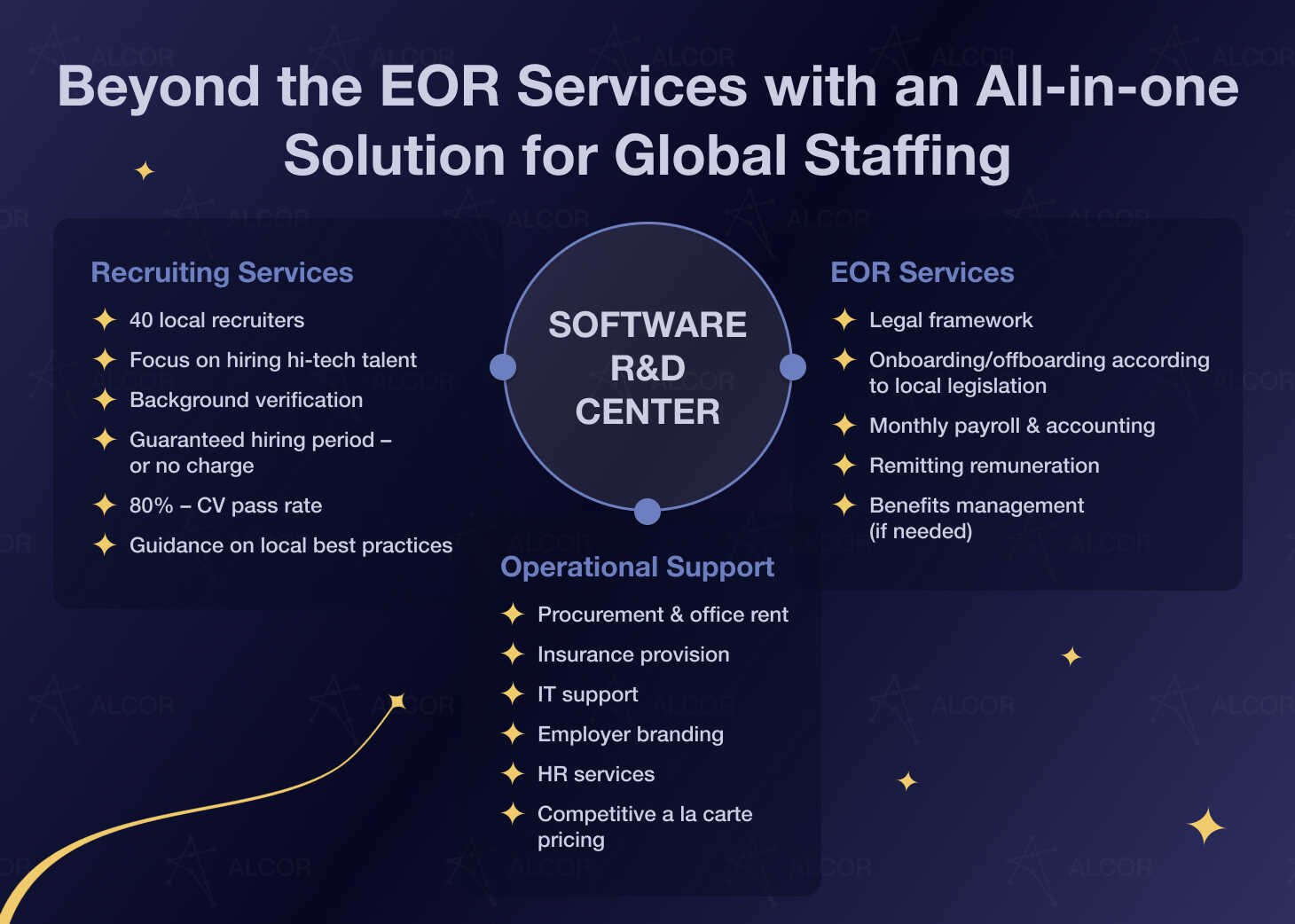
Alcor helps tech product companies build and fully integrated engineering teams without setting up the entire local infrastructure themselves. The software R&D center model combines tech recruitment, Employer of Record services, and operational support to streamline team building, with one partner handling the entire admin layer. Alcor has supported Backstory, Pindrop, Sift, Ledger, Briq, and Gotransverse with hiring senior engineers, structuring compliant engagement, and managing local operations.
If software development in Colombia fits your expansion roadmap, the next question is how to build a sizable engineering team there without operational chaos and overhead.
Alcor’s software R&D center model was created to address this issue. We help US and European tech product companies hire developers from Colombia and other LATAM and Eastern European countries and build fully integrated engineering teams without juggling vendors.
Unlike traditional software outsourcing, Alcor doesn’t provide developers who rotate between client projects. We recruit engineers directly into your team. You select and manage them; they work under your brand and processes, and your company retains control over the product, roadmap, and IP. No vendor layer, no buyout fees.
With Alcor:
- Add engineering capacity fast without lowering the hiring bar. Scale to 30 engineers within 90 days or up to 100 within a year. Our 40 tech recruiters work with a pool of 325K vetted candidates, plus external talent sources, and pre-screen engineers for both technical and cultural fit. The result: 8 CVs typically result in 1 offer.
- Launch the team without waiting for a Colombian entity. Use Alcor’s EOR or COR services to employ or engage developers compliantly while we handle contracts, payroll/contractor payments, taxes, and benefits. New hires can be onboarded in as little as 10 days, so legal setup does not slow down your engineering roadmap.
- Keep your leadership focused on product, not local operations. As the team grows, Alcor can handle office rent, equipment procurement, insurance, employer branding, and HR services. You also get ongoing support from a dedicated Operations Manager, reducing the operational workload on your HQ team.
- Scale with predictable economics. Get transparent pricing and clear visibility into your engineering costs, with volume discounts as your team grows – no deposits, no exit fees. That makes it easier to forecast the cost of a 10-, 30-, or 100-person engineering team without hidden fees or contractual lock-in.
Here’s how that works in practice.
Case #1.
Backstory (formerly People.ai), a US-based AI data platform now valued at $1.1 billion, had been juggling multiple vendors across recruitment, legal, and operations, with nobody owning the outcome. Alcor consolidated everything into one place:
- 25 offshore engineers hired in year one, 50 total today, with a 98.6% probation pass rate and 2.5+ year average tenure
- Office found, leased, and equipped in 4 weeks
- Full legal entity structuring, unlocking local IT tax incentives from day one
- A client relationship still running since 2017, through Backstory’s growth from startup to unicorn.
Case #2.
Briq, a Santa Barbara-based AI automation platform, had decided to expand its engineering operations in LATAM but had no legal entity or local operations team. Alcor already had compliant infrastructure running locally, so we delivered:
- 7 hires closed in 39 days on average: 5 Automation Java Developers and 2 Middle Support Engineers
- Every contract structured to close off misclassification risk from day one
- A free backfill when one hire resigned 4 days in, at no cost or timeline impact to Briq
- A competitive EVP built specifically to attract highly-skilled engineering talent and secure long-term retention.
Here’s what Briq’s VP of Product said about our cooperation:
|
“We are 100% satisfied with Alcor’s service and especially appreciate their support in our LATAM expansion.” |
Alcor has earned the same trust from leaders of other tech companies, including Pindrop, Sift, UFORCE, Ledger, and Gotransverse.
Ready to build your engineering team in Colombia? Talk to Alcor about your hiring plan.
References on Software Development in Colombia
- International Trade Administration
- GlobalData
- Verified Market Research
- CompTIA’s State of the Tech Workforce 2026
- KPMG’s Colombia Tech Report 2025–2026
- Dealroom
- Upstarts Media
- Business Wire
- UNESCO’s Colombia National AI Policy
- Latin American Artificial Intelligence Index (ILIA) 2025
- Topcoder
- Coursera’s Global Skills Report 2025
- QS World University Rankings 2026
- MinTIC Colombia
- Banco de la República
- ProColombia
- StartupBlink Global Startup Ecosystem Index 2026
- GlobeNewswire
- Clutch
- Alcor internal recruitment and salary research
FAQ
How large is Colombia’s software developer talent pool?
Colombia has more than 202,000 software developers, supported by over 37,000 STEM and ICT graduates entering the market each year. The talent base is strongest in Bogotá and Medellín, with additional engineering capacity in Cali and Barranquilla and ongoing public investment in digital skills.
How much can US companies save by hiring software engineers in Colombia?
Colombian engineers typically cost 53-62% less in base salary than comparable US engineers, depending on role and seniority. For AI and ML positions, Alcor’s 2026 research shows savings of 45-59%. Employers should also budget for social contributions, benefits, recruitment, and EOR fees for a clearer cost picture.
Why is Colombia attractive as a nearshore destination for US tech companies?
Colombia is attractive for US nearshoring because it combines a large and tech-savvy engineering pool with lower labor costs and overlapping time zones. Teams can collaborate with US colleagues during the same working day while companies gain access to experienced developers without paying US-level salaries.
What software development skills are most available in Colombia?
Colombia’s strongest established software skills include Java, JavaScript/TypeScript, Python, cloud technologies, SQL, and Ruby. The market is also developing deeper AI, machine learning, data engineering, MLOps, cybersecurity, and cloud capabilities as government programs and private technology companies expand advanced digital training.
What is the outlook for software development in Colombia through 2027?
The ICT market is projected to reach $37.7 billion by 2030. AI-adjacent skills are expected to become more common across engineering roles. International companies expand local R&D operations, while cybersecurity and AI governance requirements tighten. Data center investment is projected to grow from $450 million in 2025 to $1.44 billion by 2031.
Should tech product companies outsource software development or build their own teams in Colombia?
Tech product companies that need long-term engineering capacity generally gain more control by building their own Colombian engineering teams. An owned team keeps product knowledge, roadmap decisions, culture, and IP inside the company. Outsourcing remains better suited to defined projects where direct team ownership is less important.
How quickly can Alcor build an engineering team in Colombia?
Alcor can scale a Colombian engineering team to 30 hires within 90 days or up to 100 within a year. Senior and AI roles are typically filled in 2-6 weeks. Our recruitment model averages 8 CVs per offer, while EOR or COR and operational support serve as the local infrastructure for smooth team scaling.
How would you rate this article?
Alcor is Your Trusted Scaling Partner
for expansion
support