


Software outsourcing in Mexico is heading into its next phase: the country’s ICT market is set to climb from $78.69 billion in 2026 to $129.52 billion by 2031, according to Mordor Intelligence. But market size won’t tell you whether you can staff an engineering team here in 2027. The capacity behind that number will, and here is what it looks like:
- Fact #1: Mexico’s tech workforce has reached 974,500 professionals, with 174,476 STEM and ICT graduates entering it every year – the largest talent pool in Latin America, per Mexico’s Ministry of Economy.
- Fact #2: Nearshore and hybrid delivery is the fastest-growing model in the country, forecast at a 15.61% CAGR through 2030, as US companies re-route engineering work from far-shore destinations. That demand is what already makes IT outsourcing to Mexico a 2027 planning question.
- Fact #3: Mexico ranks #3 in Latin America on the Global Innovation Index 2025 and #5 in the region on StartupBlink’s 2026 ecosystem index, with 11 unicorns and 1,431 tracked startups.
The rest of this guide breaks down what software outsourcing to Mexico actually costs in 2027, how long a team takes to build, and where the risks for your tech product still sit.
Key Takeaways
- AWS, Microsoft and Google have committed $6.3 billion to Mexican cloud infrastructure. Fintech, AI, data centers and e-commerce are converting that spending into senior engineering demand.
- Senior engineers in Mexico are around 53% more affordable than US equivalents, though AI platform and infrastructure roles narrow to roughly 42%. Budget fully loaded – about 39% above base.
- Mexico’s labor law restricts subcontracting personnel for core business work, and enforcement tightened through 2026. Direct employment via your own entity or an EOR falls outside that restriction entirely.
- Chile leads on quality metrics and stability, Argentina on English and cost, Colombia on business environment, Brazil on ecosystem scale. Mexico wins on depth, time zone and hiring throughput.
- Alcor hires senior engineers in 2–6 weeks, onboards them within 10 business days, and has teams of 30 operational in 90 days – tech recruitment, employment and operations fully supported.
Mexican IT Outsourcing Industry in 2027
Mexico’s technology industry is growing on infrastructure and policy rather than low labor costs. AWS, Microsoft and Google have committed a combined $6.3 billion to Mexican cloud regions, backed by Plan México tax incentives. Four sectors drive engineering demand: fintech, with 795 local startups and 77% running AI in production; artificial intelligence, with 48% of Mexican companies now using it; cloud and data centers, growing at 24.55% CAGR to 2031; and e-commerce, reaching 17.7% of total retail in 2026. Demand concentrates in Mexico City, Guadalajara and Monterrey, which account for roughly 70% of national IT demand. Companies building engineering teams in these hubs compete directly with Foxconn, Intel and AWS for senior talent.
Infrastructure spending says more about where the Mexican technology industry is going than any ranking does. AWS, Microsoft and Google have committed a combined $6.3 billion to new cloud regions and infrastructure in the country – AWS’s $5 billion alone is the largest single infrastructure outlay in Latin America. Plan México backs it with accelerated depreciation and reduced corporate tax on qualifying digital assets. Four sectors are turning that innovation into real engineering demand:
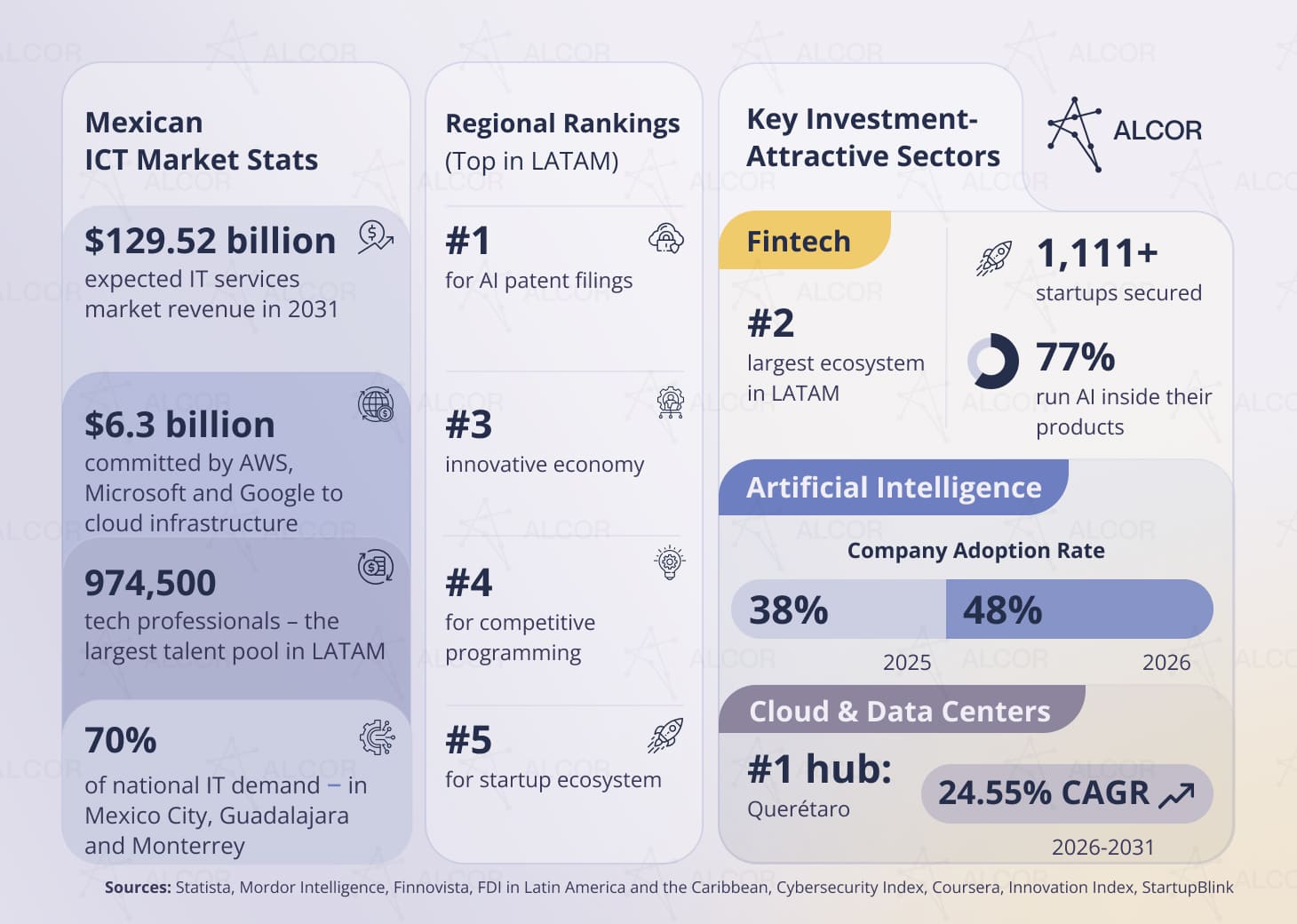
- Fintech. 795 Mexican fintech startups and 316 foreign firms now operate in the market, according to the Finnovista Fintech Radar Mexico 2026. Growth slowed to 1.8%, but 77% of fintechs now run AI inside their products and 80% partner with traditional banks. The hiring has shifted with it: infrastructure, data and compliance engineering over front-end app work.
- Artificial intelligence. 48% of Mexican companies use AI today, up from 38% a year earlier, per the 2026 Unlocking the Potential of AI in Mexico study by Strand Partners. Hardware is following software – Foxconn is building a $500 million Nvidia superchip facility near Guadalajara, the same city that hosts Intel’s R&D operation.
- Cloud and data centers. Mexico’s AI data center market is forecast to grow from $87.19 million in 2026 to $261.5 million by 2031, an 24.55% CAGR. Querétaro holds the largest share of national capacity, and rack densities are projected to reach 100 kW by 2027 – workloads that need platform, SRE and infrastructure engineers sitting close to them.
- E-commerce. Online sales are set to reach 17.7% of total retail in 2026, putting Mexico within reach of US penetration levels. Mobile devices drove 78.5% of all online purchases, which keeps steady pressure on demand for mobile developers, payments integrations and logistics platforms.
All of this demand concentrates in the same places. Mexico City, Guadalajara and Monterrey account for roughly 70% of national IT demand, with Querétaro rising fast on the back of hyperscaler builds. Local engineering companies across these hubs work on everything from custom platforms to web and mobile products, and increasingly on embedded and AI systems.
5 Benefits of IT Outsourcing to Mexico
Five benefits drive outsourcing to Mexico for US tech companies. Mexico holds the largest talent pool in Latin America, backed by a government-funded education pipeline adding technical places through 2026. Its engineers are trained in US working practices, with the IT sector scoring upper-B2 English. Mexico City, Guadalajara and Monterrey sit at GMT−6 and share the US Central working day. The operating environment ranks #7 in Latin America on StartupBlink’s 2026 business environment index, with USMCA protections and R&D tax deductions of 56–89%. Senior salaries run roughly 53% more affordable than US equivalents. The constraint is competition: Mexico’s pool is deep at mid-level and thins sharply at senior and lead.
Access to 974K tech talents
Need senior or lead engineers, or specialists with a rare stack? Mexico holds the largest talent pool of 974,500 tech specialists in the region, and it is not concentrated in one city. Guadalajara alone carries roughly 125,000 tech professionals around Intel’s R&D operation and the electronics cluster, and Monterrey and Tijuana add manufacturing-adjacent engineering depth.
The education system behind it is broad: 540 higher education institutions nationally, 22 of them ranked in the QS World University Rankings 2026, with Instituto Politécnico Nacional, Tecnológico de Monterrey and Universidad de Guadalajara supplying most of the senior engineering talent US companies end up hiring.
What matters for 2027 is what the government is building now. The Ministry of Public Education has introduced “strategic careers” in cybersecurity, AI, digital production and nanotechnology, and is adding 4,950 upper-secondary technical places in 2026 through three new technological high schools and five hybrid “Ciberbachilleratos.” At the university level, the CONACES work plan commits institutions to building semiconductor and next-generation electronics competencies under Plan México.
Shared work ethics
A long-standing experience of building for US tech companies shaped how Mexican engineers work: direct escalation, comfort with code review, and a default to owning a problem rather than passing it up a chain. They test new methodologies without being asked and push back when a spec is wrong, which is what you want from someone on your roadmap.
On communication, the national picture and the sector picture are different, and it’s worth knowing which one applies to you. Mexico ranks #20 in LATAM on the EF English Proficiency Index, but its IT sector scores in the High band with upper B2 – with Nuevo León and Jalisco leading. The language risk in Mexico’s software development outsourcing is real at the general labour-market level and largely absent among senior engineers in the main hubs. Screen for it anyway.
Geographical & time zone proximity
One more reason international tech companies choose outsourcing in Mexico is where it sits. The flight from Los Angeles to Mexico City runs 3.5 to 4 hours, so an in-person quarter-start or an incident post-mortem is a day trip.
The time zone story is better than most articles describe, and it shifts twice a year. Mexico dropped daylight saving in 2022 except in border municipalities, so Mexico City, Guadalajara and Monterrey sit at GMT−6 year-round. Against US Central time (Austin, Dallas, Chicago) that is a zero-hour gap for half the year and one hour for the other half. Against California it is one to two hours. Tijuana kept DST under the border exception and stays aligned with California all year. Whichever US hub your engineering org runs from, you get most or all of a shared working day, and that proximity is what makes real-time collaboration possible instead of asynchronous handoffs.
Business-friendly environment
The advantage for tech businesses looking to outsource software development to Mexico is that the operating environment is predictable, if not top-ranked: Mexico places #7 in Latin America and on StartupBlink’s 2026 Index of Business Environment. Coface currently assigns Mexico a B country risk grade.
USMCA remains the structural advantage: tariff-free service flows and stronger IP protection than most nearshoring location alternatives offer. On incentives, the Decreto Nearshoring gives immediate tax deductions of 56%–89% on fixed asset investments for companies in R&D and hi-tech, plus an additional 50%–75% deduction on incremental training spend, per Alcor’s legal team data. Physical infrastructure is there too: tech parks in Jalisco, Nuevo León and Querétaro, and the hyperscaler build-out now anchoring the country’s cloud capacity.
No Silicon Valley price tag
The case for choosing Mexico for nearshore software development is financial durability, not cheapness. Affordable developer salaries here mean the same round funds a larger engineering team for longer – more quarters of runway at the same headcount, or more headcount at the same burn. That is a different argument from cutting labor costs, and it is the one that holds up in a board meeting. Across senior engineering roles, a developer salary in Mexico runs about 53% below the American equivalent.
Product and platform engineering is where the arbitrage is widest: a senior mobile developer is 61% more affordable in Mexico than in the US, ML Engineer – 64%, Python and Ruby – around 59%. Hiring those roles in Mexico is close to a straight cost decision.
3 Myths about IT Outsourcing to Mexico
Three myths shape how US companies assess Mexico as an engineering destination. First, underqualified developers: Mexican engineers rank #4 in Latin America on TopCoder, and Mexico leads the region in AI patent filings. Second, the outsourcing ban: Mexico’s 2021 labor reform does restrict subcontracting personnel for core business work, and enforcement tightened through 2026 – but direct employment through your own entity or an Employer of Record falls outside that restriction. Third, US tariffs: the 25% tariffs were struck down by the Supreme Court in February 2026, USMCA-qualifying goods stayed exempt, and no tariff instrument applies to software or to salaries paid to engineers employed in Mexico.
Underqualified developers
Does a more affordable salary mean weaker output? The measurable evidence says no:
- Mexican developers rank #4 in Latin America on TopCoder – a competitive-programming measure based on solved algorithmic problems.
- Mexico runs its own national ICPC finals feeding the Latin America circuit, and a team from Instituto Politécnico Nacional took the Latin America title at the ICPC World Finals in Luxor. ITESO in Guadalajara has since been put forward as a candidate venue for the World Finals themselves.
- Mexico leads Latin America in AI patent filings, according to the Latin American Artificial Intelligence Index, off the back of a record year at the national IP office. WIPO ranks the country 11th globally for total patents granted – ahead of most of Western Europe.
- The Mexico Tech Salaries Report 2026 tracks adoption of TensorFlow, PyTorch, Pandas and the OpenAI and Anthropic APIs across 10,246 engineers – these show up as standard skills in the market.
Beyond the rankings, Mexican engineers work across JavaScript, TypeScript, Python, C#, SQL, Java and Go, with strong depth in cloud and infrastructure – Guadalajara skews toward enterprise Java and cloud, Mexico City toward full-stack and Python/ML, Monterrey toward fintech and DevOps. Most senior candidates arrive already educated in GitHub-native workflows, code review and US-standard CI/CD.
Mexico’s outsourcing ban
Article 12 of the Federal Labor Law prohibits subcontracting personnel – one company placing its own workers at the disposal of another. Article 13 allows specialised services that sit outside the client’s core business, provided the supplier is registered in the REPSE registry kept by the Ministry of Labor. Cleaning, security and facilities qualify. Programmers building your product do not, because that is your core business. In that specific sense, software outsourcing in Mexico is the structure the law restricts.
Enforcement has tightened. The Ministry of Labor published a new subcontracting inspection protocol and has stepped up inspections through 2026. Getting it wrong costs you deductibility, VAT credits, joint liability for the supplier’s staff, and fines.
None of which stops you from building a team there. The rule applies to a third party supplying people for core work. Direct employment falls outside it entirely – your own Mexican entity, or an Employer of Record that hires the engineers itself and puts them under your management. No subcontracting relationship exists, so there is nothing to inspect. Mexican IT outsourcing carries a compliance question – direct employment doesn’t.
The US Tariffs
The 25% tariffs on Mexican imports were struck down by the US Supreme Court in February 2026 and replaced with a 10% surcharge under a different statute. In July 2026 the US declined to renew USMCA in its current form; the agreement stays in force and now runs on annual reviews through 2036. Throughout, USMCA-qualifying goods stayed exempt, and compliance among Mexican exporters climbed above 80%.
Every instrument in that story taxes goods crossing a border. Software doesn’t cross a border, and salaries paid to engineers employed in Mexico are not imports. The live disputes (vehicle content rules, steel and aluminium) are about cars and metal. If you plan to nearshore your software development in Mexico, trade policy is not the variable to watch. Two things are: Peso movement shifts the real cost of dollar-denominated pay, which is a budgeting question. And hardware logistics – laptops, monitors, test devices crossing the border – is the one place tariffs reach a software business, and where an operational partner on the ground earns its keep.
4 Risks of IT Outsourcing to Mexico
Four risks come with outsourcing IT services to Mexico through a vendor. Cloudy pricing: blended rates bundle management layers and administrative items that cannot be separated, so the quote and the invoice differ. Questionable dedication: engineers rotate between accounts and optimize for closing tickets rather than owning product outcomes. Lack of control: a project manager sits between the client and the code, degrading context and surfacing misunderstandings as rework weeks later. Data security: the codebase, data and architecture sit with a provider whose contracts and internal controls the client neither runs nor audits. Direct employment removes all four, because the engineers work for the company rather than for a vendor.
Cloudy pricing
While offshore outsourcing to Mexico might appear as a cost-efficient choice on the surface, there may be better long-term solutions. Beyond the apparent expenses tied to product development, some companies incorporate additional, often unnecessary, services into their billing structure without the customer’s full awareness. Consequently, the final invoice can carry a significantly inflated price tag, exceeding initial expectations.
Questionable dedication
When tech companies opt for offshoring to Mexico with IT outsourcing providers, they often encounter challenges related to team indifference. Software developers at outsourcing companies frequently shift between projects, emphasizing output over outcome. This approach can lead to questionable dedication, product quality, and alignment with your corporate values and goals. At the end of the day, your project becomes just one among many, underscoring the importance of going the extra mile to ensure its success.
Lack of control
Outsourcing software development to Mexico comes with another risk: the potential loss of control over the team and product development. Communication with the outsourced software developers typically occurs through an intermediary, often a project manager. This can slow project delivery, increase the likelihood of miscommunication, and potentially introduce errors. Furthermore, limited visibility into the product development process can make it difficult to assess performance and quality terms accurately.
Data security concerns
When opting for software development outsourcing in Mexico, you inevitably share essential aspects of your product development with the provider. As the collaboration draws to a close, the software engineers involved often transition to fresh projects with other tech companies. This progression inherently heightens concerns related to data security, the potential for information leaks, and the safeguarding of your IP rights.
Mexican Taxation for IT Companies: Updated for 2027
Mexico offers two employment models for hiring software engineers. Under FTE employment, the employer adds roughly 26.3% in social security contributions and local payroll tax on top of gross salary, plus aguinaldo worth 15 days of salary and prima vacacional; the employee carries about 25.8%. Under B2B contracting, only the contractor pays, at roughly 2%. Two 2026 reforms change the arithmetic. The constitutional workweek reduction from 48 to 40 hours phases in between 2027 and 2030 without cutting pay, raising effective hourly cost and adding electronic timekeeping obligations. The 2026 tax reform gave Mexico’s tax authority real-time visibility into contractor income. FTE suits long-term senior teams; B2B works selectively.
You have two employment models to choose from in Mexico, and they carry very different cost structures.
Under the traditional employment model (FTE), both sides pay taxes. The employer covers social security contributions plus a local payroll tax, adding roughly 26.3% on top of gross salary. The employee carries progressive income tax and their own social security share, about 25.8% of gross. Employers withhold both on the employee’s behalf.
Under a B2B contract, you engage Mexican engineers as independent contractors. Only the contractor pays, and the burden is light – progressive income tax of 1% to 2.5%, with social security optional.
|
Model |
Employer’s Share |
Employee’s / Contractor’s Share |
|
FTE |
Effective employer rate: ~26.3% on top of a $5,000 salary |
Effective employee rate: ~25.8% of a $5,000 gross salary |
|
B2B |
Not mandatory – no employer-side social security obligation |
Effective rate: ~2% of a $5,000 gross remuneration |
Three costs sit outside that table and belong in any FTE budget:
- Aguinaldo is a mandatory year-end bonus worth 15 days of salary;
- Prima Vacacional adds a 25% premium on vacation days;
- Profit-sharing (PTU) obliges you to distribute 10% of annual taxable profits among employees, allocated by days worked and salary.
Two reforms will move your cost base between now and 2030, and both are already law.
The first is the shorter workweek. A constitutional amendment took effect on 3 March 2026, with Federal Labor Law amendments following on 1 May 2026. The statutory maximum falls two hours a year (46 in 2027, 44 in 2028, 42 in 2029, 40 in 2030) and pay and benefits cannot be reduced as hours come down. For engineering teams this is far less disruptive than for shift-based operations, but it does lift the effective hourly cost of an FTE.
The second is the 2026 tax reform, in force since 1 January 2026, which tightened VAT, income tax and federal tax code rules around digital platforms. Two pieces matter if contractors are part of your setup: income tax withholding on individuals providing services through intermediation platforms rose from 1% to 2.5%, and SAT now has real-time access to platform transaction data, effective 1 April 2026. Contractor income is considerably more visible to the tax authority than it was two years ago.
So which model fits you? Most tech companies building a long-term team end up on FTE for senior hires and use B2B selectively. Any outsourcing strategy in Mexico that was built around contractor economics is worth revisiting against the 2026 rules before you scale further.
Total Cost Estimation for IT Outsourcing to Mexico in 2027
A senior software engineer in Mexico costs roughly 39% above base salary once fully loaded. Base senior salaries run $52,800 to $81,600 across mainstream engineering roles and $81,000 to $147,000 across AI roles, making Mexican engineers about 57% and 50% more affordable than US equivalents respectively. On top sit 26.3% in employer contributions and payroll tax, aguinaldo, prima vacacional, statutory leave entitlements, and an optional benefits package of roughly $5,500 per engineer per year. Vendor pricing works differently: a blended hourly rate hides the split between salary and margin. Building your own team prices transparently – the salary itself, plus a monthly EOR fee and a one-time recruitment fee of 15–25% of annual base.
Cost of hiring software developers
Base salary is where every budget starts – here is what senior engineering roles actually pay in Mexico against their US equivalents.
|
Average Annual Software Developer Base Salary in Mexico vs the US |
||
|
Position |
Mexico |
USA |
|
C/C++ Developer |
$70,200 |
$150,000 |
|
Python Software Engineer |
$67,200 |
$165,000 |
|
Ruby Software Engineer |
$70,200 |
$174,000 |
|
Mobile Application Developer (iOS/Android) |
$67,200 |
$174,000 |
|
Blockchain Engineer |
$78,000 |
$171,000 |
|
Data Engineer |
$78,000 |
$177,000 |
|
DevOps Engineer |
$81,600 |
$168,000 |
|
React Developer |
$58,200 |
$156,000 |
|
QA Automation Engineer |
$61,200 |
$145,500 |
|
QA Manual Engineer |
$52,800 |
$111,600 |
|
Senior-level base salaries. According to Alcor’s internal tech salaries in Latin America research (as of September 2026). |
||
Across these ten roles, Mexican engineers are about 57% more affordable than their US counterparts. React and mobile development show the widest gap at roughly 62%, DevOps the narrowest at 51%.
Base salary is not your cost per engineer, though. Employer contributions and local payroll tax add roughly 26.3% on top, as covered in the taxation section above. Then come two mandatory cash payments outside that percentage: aguinaldo, a year-end bonus equal to 15 days of salary, and prima vacacional, a 25% premium on vacation days.
Statutory benefits are set by law and non-negotiable:
- Vacation: 12 days after the first year, rising on a seniority scale to 30 days at 26+ years
- Sick leave: 60% of salary from the fourth day, up to 52 weeks — 100% if the illness or injury is job-related
- Maternity leave: 84 calendar days, paid in full by Social Security
- Paternity leave: 5 days at 100% of average daily salary, covered by you
- Public holidays: 7 paid days in 2026
On top of that sits the package engineers expect but the law does not require. In Mexico’s senior market skipping it might cost you offers:
- Private health insurance – ~$1,500/year
- Meal vouchers – ~$1,000/year
- Home office allowance – ~$800/year
- Learning budget – ~$1,500/year
- Wellness – ~$700/year
That comes to roughly $5,500 per engineer per year.
Cost of hiring AI engineers
Everything above applies here too. The same 26.3% in contributions and payroll tax, the same aguinaldo and prima vacacional, the same statutory and optional benefits, including the home office allowance for remote hires. Only the base changes.
|
Average Annual AI Engineer Base Salary in Mexico vs the US |
||
|
Position |
Mexico |
USA |
|
AI Engineer |
$123,000 |
$222,000 |
|
ML Engineer |
$81,000 |
$222,000 |
|
LLM Engineer |
$96,000 |
$234,000 |
|
AI Product Engineer |
$88,800 |
$228,000 |
|
MLOps Engineer |
$93,000 |
$189,000 |
|
AI Platform Engineer |
$132,000 |
$228,000 |
|
AI Infrastructure Engineer |
$141,000 |
$243,000 |
|
AI Prompt Engineer |
$87,000 |
$168,000 |
|
AI Quality Engineer / SDET |
$96,000 |
$186,000 |
|
AI Research Scientist |
$147,000 |
$258,000 |
|
Senior-level base salaries. According to Alcor’s internal tech salaries in Latin America research (as of September 2026). |
||
The AI market prices differently from the rest of engineering, and the spread inside it is wide. ML Engineers are around 64% more affordable than in the US, and AI Product Engineers 61%. A senior AI engineer in Mexico sits at $123,000 against $222,000 in the US – a 45% gap, below the average for the group. Across all ten roles, the average is about 50%.
Plan the AI ladder separately from the rest of the team. Any budget for software outsourcing to Mexico built on a single blended percentage will hold for product engineering and miss at the top of the AI stack.
Operational costs related to IT outsourcing in Mexico
Salary maths only applies when you know what the engineer is paid. With an outsourcing provider, you usually don’t.
Vendors quote a blended rate – salary, overhead, recruitment cost and margin folded into one number. Nothing in that figure tells you the split between what reaches the engineer and what stays with the provider, which makes it impossible to benchmark against the tables above or to know whether a renewal increase reflects market movement or margin expansion.
Several other line items tend to arrive after the contract is signed:
- Management and account overhead. Project managers, delivery leads and QA oversight are usually billed on top of engineering hours, or built into a higher blended rate.
- Setup and onboarding fees, charged per engineer at the start of an engagement.
- Minimum commitments and notice periods. Ramping down is rarely as fast as ramping up, and you keep paying through the notice window.
- Annual escalation clauses, which reprice the engagement each year regardless of whether the team changed.
- Buyout fees. If the engineer works out and you want to employ them directly, the exit price is typically several months of salary.
- Pass-through costs for equipment, licences and infrastructure, often at a markup.
Individually these look minor. Together they are the reason the final invoice for outsourcing in Mexico rarely matches the quote. Building your own team prices differently, and the structure is visible. You pay the engineer’s salary and employment costs directly (the numbers above) plus two service fees if you use a tech recruitment or EOR in Mexico partner:
An ongoing EOR or COR fee, charged monthly per engineer. It covers employment contracts, payroll, tax filings, statutory benefits, IP assignment and day-to-day HR and legal compliance. Usually a flat per-head amount or a share of gross salary, and it typically falls as the team grows.
A one-time recruitment fee per successful hire, covering sourcing, screening, technical assessment and shortlisting. Market standard is 15–25% of annual base salary, with AI and ML roles at the upper end because the screening depth is greater.
Mexico vs Other LATAM Outsourcing Destinations
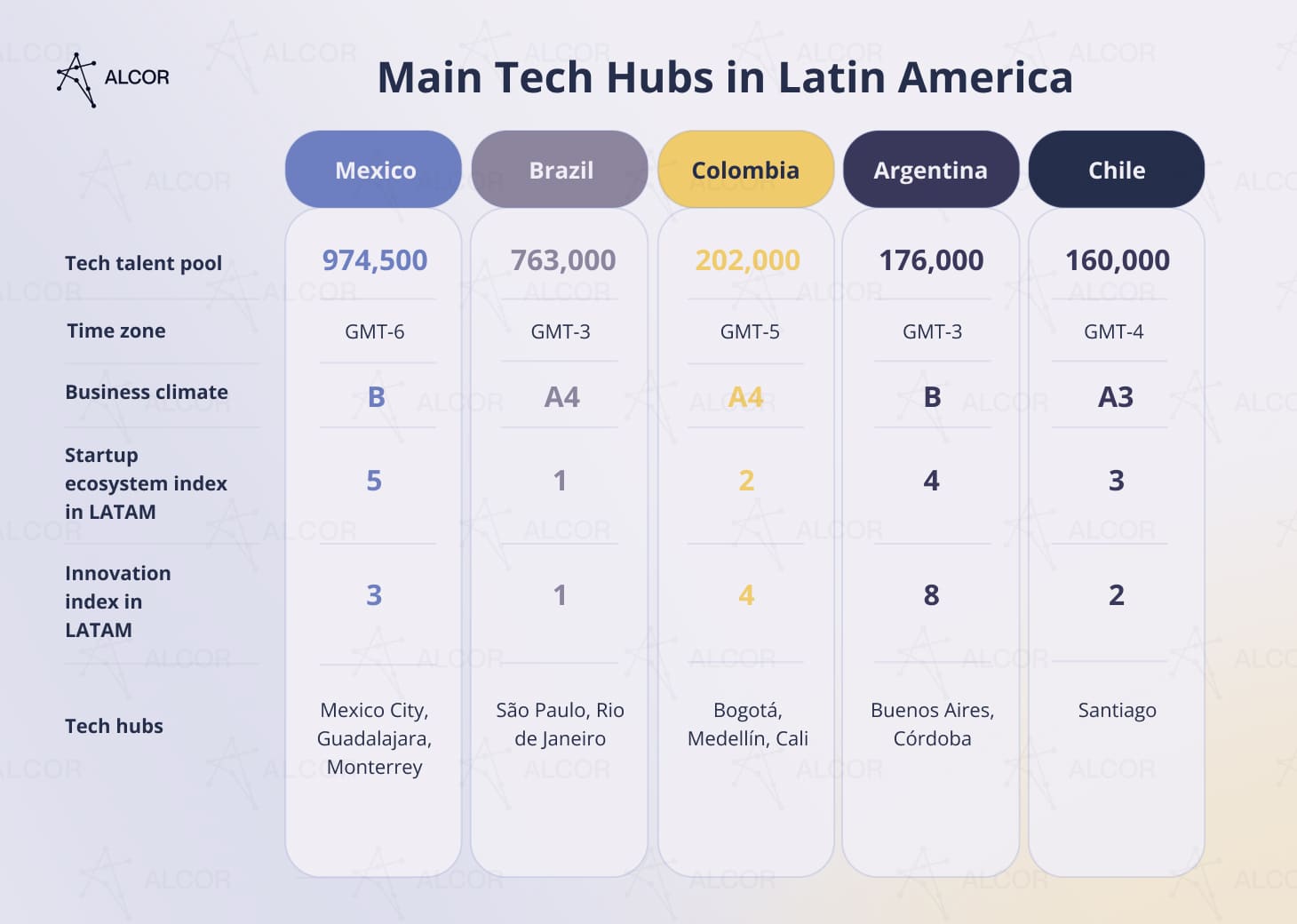
Mexico competes with Brazil, Colombia, Argentina and Chile, and each leads on something different. Brazil has the largest market at $67.8 billion in 2025 and the deepest ecosystem with 26 unicorns, but growth slowed to 5.31% in 2026 and GMT−3 costs US West Coast overlap. Colombia rates A4 with Coface against Mexico’s B and aligns with US Eastern, but holds 202,000 tech professionals to Mexico’s 974,500. Argentina leads Latin America in English proficiency and costs least, with the region’s weakest business environment. Chile leads on innovation and stability with an A3 rating, but 160,000 professionals limits scale. Mexico wins on depth, time zone and hiring throughput – the combination that decides a 30-engineer ramp.
Tech leaders weighing outsourcing to Mexico almost always have three or four other LATAM markets on the same shortlist. Let’s take a closer look at a few of these options:
Mexico vs Brazil
Brazil runs the largest technology market in the region by a wide margin. The Brazilian IT market reached $67.8 billion in 2025, up from $58.6 billion the year before, according to ABES. But the curve is flattening: growth for 2026 is projected at 5.31%, down from 18.51% in 2025 and now below the 9.71% global average.
On ecosystem depth Brazil is still ahead of everyone. It holds 26 unicorns against Mexico’s 11, and StartupBlink’s 2026 index places it #26 globally and first in South America. Engineers who worked through Nubank, iFood or VTEX bring genuine scale experience, and Brazil’s enterprise Java and fintech depth is the strongest in the region. Its IT services market is forecast to grow from $19.27 billion in 2026 to $33.01 billion by 2031, supported by a R$23 billion federal AI programme.
Mexico vs Colombia
A frequent alternative to Mexican outsourcing is Colombia, and its case rests on the operating environment rather than scale. Coface rates Colombia A4 against Mexico’s B, and StartupBlink’s 2026 business environment index puts it #4 in LATAM versus Mexico at #7. At GMT−5 it lines up cleanly with US Eastern, which suits a New York or Miami-headquartered engineering organization.
The ecosystem is genuinely strong. Colombia ranks #2 in LATAM on StartupBlink’s 2026 index with 2,137 tracked startups and three unicorns, concentrated in Bogotá, Medellín and Cali. Scale is where the comparison turns. Colombia has around 202,000 tech professionals and 37,000 STEM and ICT graduates a year, against Mexico’s 974,500 and 174,476. Mexico also leads on engineering benchmarks – #4 vs #6 in LATAM on TopCoder, #3 vs #5 on the Global Innovation Index 2025 – and its IT sector scores High on the EF English Proficiency Index where Colombia’s scores Moderate.
Mexico vs Argentina
Argentina wins outright on two things. English is the first: it ranks #1 in Latin America and #26 globally on the EF index, with its IT sector in the Advanced band – the best in the region by a clear margin. Algorithmic performance is the second: Argentine developers place #3 in LATAM on TopCoder, ahead of Mexico.
Cost follows. Senior engineers in Argentina average around $53,845 a year against $69,510 in Mexico, making them roughly 57% more affordable than US equivalents where Mexico sits at 45%. That gap is what makes IT software outsourcing to Argentina attractive to companies optimising a tight budget. The trade-off is around the engineer. Coface rates Argentina B, and StartupBlink’s 2026 business environment index places it #10 in LATAM (#75 globally) – the weakest of the four markets here. The talent pool is 176,000 against Mexico’s 974,500, with 1,030 tracked startups and two unicorns. At GMT−3 you get US East Coast mornings and little else.
Mexico vs Chile
On pure quality metrics Chile leads Latin America. It ranks #1 in the region on the Global Innovation Index 2025, #2 on TopCoder, and #3 in LATAM on Coursera’s 2025 skills ranking. Its IT sector also scores High on English proficiency.
Stability is the other draw. Chile holds a Coface A3 rating, the strongest of any market in this comparison and two notches above Mexico, with StartupBlink’s 2026 business environment index ranking it #6 in LATAM. It is the main reason IT outsourcing to Chile appeals to public and pre-IPO companies.
Volume is the constraint. Chile has roughly 160,000 tech professionals and 55 higher education institutions, against Mexico’s 974,500 and 540. It tracks 874 startups and two unicorns. Mexico can absorb a headcount ramp, which is why companies that hire developers from Mexico tend to be the ones planning in years rather than quarters – the dedication of a team you expect to still have in 2029 is worth more than a two-point ranking difference.
None of this makes software outsourcing to Mexico the automatic answer. Mexico wins on depth, time zone and hiring throughput; Chile on quality signals and stability; Colombia on operating environment; Argentina on English and cost; Brazil on ecosystem scale. Need more insight? Our five-metric evaluation of Latin American developers breaks all of it down side by side.
Hire Mexican Developers as Simply as Is
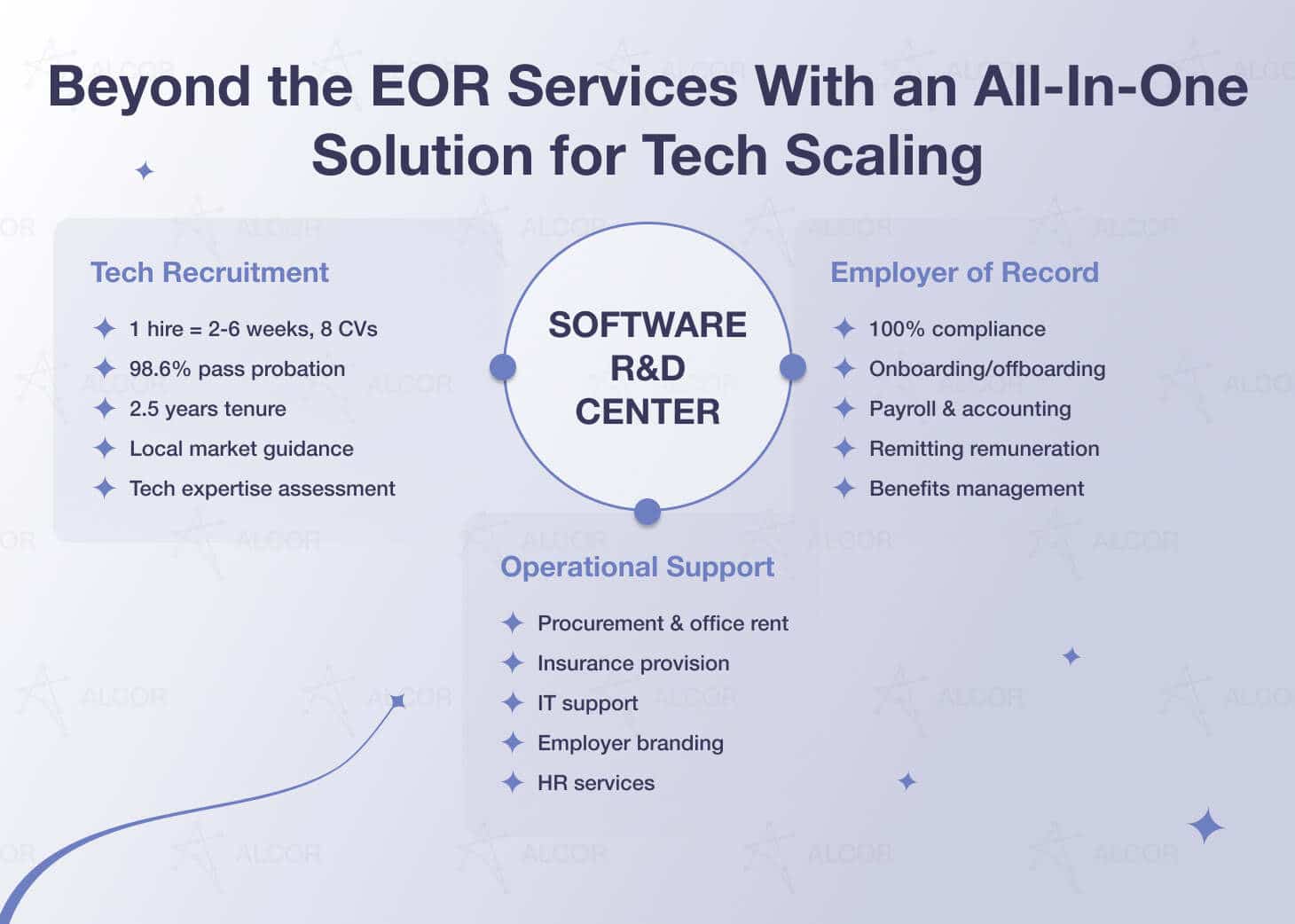
Alcor builds software R&D centers in Mexico, combining tech recruitment, Employer of Record employment infrastructure and operational support under one contract. Engineers are employed on the client’s terms, report to the client’s CTO, and the client owns the IP – no legal entity required, no vendor between the company and the code, no buyout fee. Senior roles close in 2–6 weeks, onboarding completes within 10 business days, and teams of 30 reach operational status in 90 days. Franki, a Los Angeles video platform, hired seven senior mobile engineers in Mexico in 4–5 weeks each, all passing probation, then extended the model into Colombia. Backstory, Pindrop, Ledger, Sift and ThredUp build the same way.
Alcor builds your software R&D center in Mexico, Colombia, and other Latin American or Eastern European destinations: tech recruitment, employment infrastructure and operations under one roof, on one contract. Your engineers, your management, your IP, your roadmap. No entity to open, nobody sitting between you and the code, no buyout fees.
That’s the model not just on paper. Franki is where you can watch it run – a company that arrived in Mexico with the decision already made and every hard question still in front of it.
Franki is a Los Angeles video-first experience platform that connects local businesses with their communities. Its clients have generated over $12 million in revenue and a 6x return through 220,000+ customer video reviews, with $700,000+ paid back to the people who made them. The roadmap runs on mobile, which meant Franki needed senior iOS and Android engineers faster than Los Angeles could supply them.
Mexico was the right call: nearshore to LA, deep mobile talent, a cost structure that made US hiring hard to justify. What Franki didn’t have was a legal entity, a compliance framework, or any prior Latin American operating experience.
IT outstaffing to Mexico was the obvious route and the wrong one. Outsourcing gives you developers. It doesn’t give you a team. Here’s what one partner instead of a vendor looked like:
- Step 1: Intelligence. Alcor delivered a market overview and current pay rates before a single role opened. Developer salaries and Alcor’s fee were stated upfront and held throughout. Franki called the pricing transparency a WOW moment before the team even existed.
- Step 2: Structure. Alcor built the compliant employment framework (contracts, payroll, IP assignment, PTO, benefits) under Employer of Record services in Mexico. No entity for Franki to open, no local regulation for its leadership to learn. Engineers were employed on Franki’s terms and reported to Franki from day one.
- Step 3: Search. Senior iOS engineers with production RxSwift experience are scarce in any market. Alcor’s IT recruiters in Mexico built a pipeline of 20 qualified candidates anyway. Technical screening first, cultural fit second, neither optional.
- Step 4: Ops. Every piece of test equipment sourced, delivered and working before the engineers started. Zero procurement overhead on Franki’s side.
Result: the first seven hires (2 iOS Engineers, 3 Android Engineers, 2 QC Engineers) closed in 4–5 weeks each. All passed probation. When one hire didn’t work out, Alcor ran the exit cleanly and committed to a free replacement; it was never needed. Franki’s revenue doubled quarter over quarter that year, and the team went on to ship Social Club, Adventures, Franki for Franchises and Franki for Brands.
Franki is not the outlier. Backstory, formerly People.ai – the revenue intelligence platform Zoom, Cisco, Nvidia and Verizon run on – started at 25 engineers in year one and stands at 50 today, with 98.6% passing probation and average tenure above 2.5 years. Pindrop built a 25-engineer team in three months. Ledger scaled past 30 engineers with 2–4 year average retention. Sift, UFORCE, ThredUp build on the same model – eight countries, one employment infrastructure, one contract, and in every case the engineers belong to the company, not to us.
Ready to explore new prospects for your tech business with a reliable partner committed to your success? Reach out to us, and we’ll get started!
References on IT Outsourcing to Mexico
- Mordor Intelligence
- Mexico’s Ministry of Economy – Mexican Talent report
- WIPO Global Innovation Index 2025
- StartupBlink Global Startup Ecosystem Index 2026
- Finnovista Fintech Radar Mexico 2026
- Strand Partners — Unlocking the Potential of AI in Mexico 2026
- Mexico Business News
- QS World University Rankings 2026
- EF English Proficiency Index
- StartupBlink Index of Business Environment 2026
- Coface for Trade
- TopCoder
- ICPC – International Collegiate Programming Contest
- ILIA Latin American Artificial Intelligence Index
- CodersLink Mexico Tech Salaries Report 2026
- The National Law Review
- Tax Foundation
- Chatham House
- Norton Rose Fulbright
- KPMG
- ABES – Brazilian Association of Software Companies
- Tracxn
- Coursera Global Skills Report 2025
- Alcor’s internal tech salaries in Latin America research (September 2026)
FAQ
Why do US tech companies opt for outsourcing software development to Mexico?
A tech talent pool of 974,500 engineers, senior salaries roughly 53% more affordable than US equivalents, GMT−6 hubs that share the US Central working day, and USMCA protections are the main reasons American tech companies offshore to Mexico. The deeper driver is hiring throughput: a senior US search runs four to six months, while the same role fills in two to six weeks in Mexico with Alcor.
What are the prevailing risks of software outsourcing to Mexico?
Four risks come with using a vendor. Blended rates bundle management layers you cannot separate, so the quote and the invoice differ. Engineers rotate between accounts and optimize for closing tickets rather than owning product outcomes. A project manager sits between you and the code, turning small misunderstandings into rework. And your codebase sits with a provider whose contracts and internal controls you neither run nor audit. There is also a compliance dimension: Mexico’s labor law restricts subcontracting personnel for core business work, and enforcement tightened through 2026.
What is a workable alternative to traditional IT outsourcing in Mexico?
Building your own software R&D center. You employ the engineers directly – through your own Mexican entity or an Employer of Record – so they report to your CTO, work on your roadmap, and your company holds the IP. The structure sits outside Mexico’s subcontracting restrictions entirely, and the pricing is visible: the salary itself, plus a monthly EOR fee and a one-time recruitment fee, rather than a blended rate that hides the split between pay and margin.
How does 2027 look for AI engineering outsourcing to Mexico?
Strong for most AI roles, tighter at the top. Senior AI engineers in Mexico average $123,000 against $222,000 in the US, and ML Engineers are around 64% more affordable. But AI Platform and AI Infrastructure roles narrow to roughly 42%, because the hyperscalers building out Querétaro compete for the same people. The LLM-fluent pool sits near 2,400 engineers – deep enough for most roadmaps, thin at the frontier. Plan AI hiring separately from the rest of the team and start earlier than you would for product engineering.
What makes Mexico a strong destination for custom software development outsourcing?
Depth across stacks plus proximity. Mexican engineers rank #4 in Latin America on TopCoder, and Mexico leads the region in AI patent filings. Specialisation varies by hub: Guadalajara skews toward enterprise Java and cloud, Mexico City toward full-stack and Python, Monterrey toward fintech and DevOps. The IT sector scores upper-B2 English, and the GMT−6 time zone means real-time code review rather than overnight handoffs.
How would you rate this article?
Alcor is Your Trusted Scaling Partner
for expansion
support