


IT outsourcing to Eastern Europe is entering a new phase. The region is no longer just a cost-efficient delivery hub but a strong ecosystem for tech product development, attracting about $4.1 billion in venture capital across over 1,000 deals in 2025, according to Recursive.
The main drivers? A massive tech talent pool of over 2 million ICT professionals, up to 55% lower salaries compared to the US, and outstanding development expertise across Poland, Ukraine, Romania, and Bulgaria.
But there’s another reason top tech companies choose to outsource to Eastern Europe, and it might just become your go-to business strategy.
|
Poland |
Ukraine |
Romania |
Bulgaria |
|
|
TopCoder tech expertise in EE |
#1 |
#2 |
#3 |
#4 |
|
English proficiency in EE |
#3 |
#8 |
#2 |
#4 |
|
Cost savings compared to the US |
51% |
59% |
53% |
57% |
I’m Dmytro Ovcharenko, CEO at Alcor, a new-generation provider of software R&D-as-a-service that helps US and Western European tech companies expand to Eastern Europe and Latin America. With our all-in-one solution, clients get Valley-caliber tech recruitment, EOR/COR infrastructure, and operational assistance to build and scale teams from 10 to 100 engineers within a year.
In this article, you’ll get key insights into software development outsourcing in Eastern Europe, including its tech landscape, talent pool, average developer salaries, and taxes, as well as learn why India and China are falling behind. You’ll also discover the region’s standout tech hubs and their defining features to pick the most suitable one for your tech expansion.
Key Takeaways
- With the growing popularity of outsourcing, new trends are emerging in the tech industry: global IT outsourcing is shifting from cheap body leasing to outcome-driven engineering, India and China are losing some appeal among companies that prioritize quality, IP control, communication, and time zone alignment, while Eastern Europe is gaining traction as a strong alternative for dedicated development teams.
- Eastern Europe boasts a talent pool of 2+ million, high-tech expertise, salaries 55% lower than in the US, and a favorable business environment. Its digital transformation, startup growth, and economic resilience continue to strengthen Eastern Europe’s position as a strategic region for software development among foreign tech businesses.
- Poland, Ukraine, Romania, the Czech Republic, and Bulgaria are among the leading IT outsourcing destinations in Eastern Europe, offering large tech talent pools, established startup ecosystems, strong engineering education, and growing expertise in AI, fintech, cloud, cybersecurity, and enterprise software.
- Compared to Asia, Eastern Europe offers stronger English proficiency in key markets, a closer business culture, and fewer collaboration barriers. LATAM remains attractive for US companies because of geographic proximity and real-time overlap, while Eastern Europe stands out for technical depth, mature delivery culture, and access to senior engineering talent.
- To fully leverage Eastern Europe’s booming tech potential, Alcor helps tech companies establish their own R&D centers in the region, offering comprehensive EOR support, rapid hiring of top 10% engineers, and end-to-end operational assistance.
5 Latest Worldwide Trends in IT Outsourcing
The latest worldwide trends in IT outsourcing show a clear shift from cheap body leasing to outcome-driven engineering. AI-powered delivery, managed services, and Global In-house Centers are becoming more valuable as tech companies seek speed, ownership, and IP control.
At the same time, traditional hubs are losing some appeal: India faces concerns over code quality, education gaps, and communication culture, while China raises red flags around IP protection, language barriers, and time zone friction. This opens the door for Eastern European outsourcing. It’s a smarter, more efficient alternative to expensive in-house teams and outdated outsourcing destinations, where AI, fintech, cloud, and green tech are gaining traction. With booming BPO services, the region’s appeal is hard to beat.
1. AI-powered outsourcing is replacing body leasing with outcome-driven engineering
Classic outsourcing used to be simple: find cheaper developers, assign tasks, track hours, repeat. But in 2026, this model looks about as modern as faxing a product roadmap.
AI has changed what tech companies expect from outsourcing partners. According to Deloitte’s Global Outsourcing Survey, 60% of surveyed executives are already leveraging AI as part of outsourced services to enhance productivity and operations. This means that the outsourcing buyer’s question is no longer only about leasing a lower-cost workforce. Building AI-ready engineering capacity that ships faster and takes ownership of outcomes is becoming increasingly valuable.
This is one of the reasons why the service model is changing too. KPMG notes that managed services are shifting from traditional cost-based agreements to outcome-based models, in which success is measured by business impact and KPIs. In fact, a growing number of executives are moving away from body leasing toward integrated engineering teams (or Global In-house Centers). Deloitte notes that 73% are planning to increase their GIC investment, while 58% are exploring its adoption to maintain control, grow in-house capabilities, optimize costs, and secure IP.
2. India is losing its ground as a leading tech outsourcing destination
India was considered one of the top tech outsourcing destinations for over a decade. While some countries were taking the first steps in their long outsourcing journey, India could already provide foreign tech companies with a large and cheap tech workforce.
But as we know, low prices often come with their own costs, and in the case of India, it’s the quality of the code. So, what are the prerequisites for that?
Problem #1: Ineffective college education. According to the National Employability Report, only 4.6% of Indian engineering graduates possess good coding skills. Yet, it is only with the help of AI coding tools that 81% of Indian developers noticed any improvement in code quality.
Problem #2: Work attitude. Since most Indian programmers are paid low wages, they often undertake multiple projects simultaneously. That’s why it’s common for them to show low motivation, dedication, and accountability. As a result, there’s a risk that performance will not meet the client’s expectations.
Problem #3: Culturalmentality. Today, this remains one of the primary obstacles to effective cooperation between American tech companies and Indian developers. India is a high-context culture where communication is generally more indirect than in most Western countries. That’s why what is said may have multiple interpretations depending on the context of the interaction, which can lead to misunderstandings and challenges at work.
3. China’s tech outsourcing pitfalls scare away more and more companies
Known for its enormous tech talent pool, China has been luring foreign tech companies to leverage the benefits of software outsourcing by getting diverse expertise and technology. However, with the rapid expansion of the outsourcing market, the drawbacks of tech development delegation to China have become more vivid. Even last year, foreign direct investment dropped by 27.1% – the lowest level since 2016. So why are international companies choosing not to enter the Chinese market?
Problem #1: Copyright issues. As it is known, Intellectual Property Rights (IPR) protection is of great importance when it comes to outsourcing. Since vendors gain access to sensitive data, they could put the exclusivity of the client’s product at risk. Not all service providers in China comply with international IPR rules, which sometimes results in data breaches. Today, this poses a major concern, as the global average cost of data leakage in 2024 has reached $4.88 million. The same principle applies to quality control, as Chinese standards differ from those in the US and Europe.
Problem #2: The language barrier. China’s #86 ranking may lead to inefficient communication and production and increase the chances of getting a poor-quality software product.
Problem #3: The 12-13-hour time difference. A significant gap with the main development centers in the US may cause difficulties in scheduling online meetings and providing real-time feedback, potentially resulting in delays in your product development. And this, keep in mind, is arguably the most critical factor in today’s highly competitive market.
Result: Many tech companies are turning to EE and LATAM to establish their tech operations. Continue reading to learn about the key differences between software outsourcing in Eastern Europe and Asia.
4. Eastern Europe is turning into a hotspot for high-growth industries
– AI: Artificial intelligence is rapidly gaining momentum across Eastern Europe (EE), with the regional market projected to reach $6.1 billion by 2025 and grow another 26% by 2030. Ukraine ranks second in the region in terms of the number of AI companies, following Poland. The Ukrainian AI market alone reached $419.4M in 2025, with over 30 new companies founded between 2020 and 2024.
– Fintech: Fintech is emerging as the next top-performing tech sector in Eastern Europe – and Romania is at its forefront. In 2023, the country’s fintech revenues reached $64.9 million, marking a 21% year-over-year increase and an impressive 131% growth since 2019. Bucharest alone accounts for 77% of the turnover, serving as a hub for verticals like open banking, embedded finance, crowdfunding, digital wallets, and payment solutions.
– Cloud-based services: Poland is leading the way in cloud adoption, with 80% of enterprises migrating email systems to the cloud, 70% using cloud storage, and 65% relying on cloud-based productivity tools. The government’s investment in 5G and fiber has accelerated digital transformation and the integration of Industry 4.0.
– Green Tech: CEE countries are shifting towards sustainability and green innovation. With support from initiatives like the Green Transition Forum, the region is developing climate tech funds, prioritizing green R&D, and leveraging local tech expertise to build competitive climate solutions.
5. BPO services outsourcing is booming
Amidst the rise of the gig economy and the persistent challenge of finding skilled talent, technology companies are increasingly turning to outsourcing in Eastern Europe and other offshoring regions to fuel their growth. In fact, Business Process Outsourcing (BPO) stands out as a dominant force in the global outsourcing market, with forecasts predicting its market size to reach $603.4 billion by 2032, growing at a 9.1% CAGR.
Workforce managers can leverage BPO services to efficiently manage a full spectrum of operational tasks:
- Front-office functions: marketing, customer support, and tech assistance
- Back-office operations: payroll, HR, compliance, office logistics, and hardware procurement
For tech companies looking to scale, back-office BPO services are a smart add-on to their offshore development centers. This setup not only cuts costs and boosts flexibility but also keeps teams focused on core priorities – all while reducing the risks often tied to traditional tech outsourcing.
As we can see, building development teams in Eastern Europe and offshoring tech operations to this region is becoming a new trend. So, the question is: how can you do it efficiently without wasting time, energy, or money? That’s exactly what we’ll explore below, so stay tuned.
9 Benefits of Outsourcing in Eastern Europe
The benefits of outsourcing to Eastern Europe make it a top choice for tech companies seeking quality, speed, and savings. This region offers the perfect mix of affordability and high-level expertise. Here’s what sets it apart:
- Well-developed tech ecosystem
- Large pool of skilled software developers
- Advanced tech expertise across various domains
- High English proficiency among IT professionals
- Competitive labor costs
- Favorable tax regulations
- Business-friendly environment and strong R&D incentives
- Cultural compatibility with Western partners
- Convenient geographic location and time zone overlap
All these advantages make Eastern Europe a strategic region for building dedicated development teams and scaling your tech business efficiently.
1. Well-developed tech ecosystem
It might come as a surprise, but today Central and Eastern European countries actually outperform Western Europe in terms of the number of companies in the digital sector (3.9 ICT firms per 1,000 inhabitants vs 2.1 in Western Europe) and the share of ICT employment (4.8% vs. 4.1%).
The region is also home to around 3,800 startups, 57 unicorns, and 275 scale-ups – representing approximately 41% of Europe’s total. Its startup ecosystem is valued at over $273 billion, with Poland ($65B), Estonia ($44B), and Ukraine ($33.7B) leading the charge. That’s a 15.5x increase in total enterprise value since 2014 – more than double the growth rate of Western Europe over the same period. Most funding goes to transportation, fintech, AI, and energy tech startups, while climate tech and robotics are gaining traction.
The AI signal is especially strong in Poland and Ukraine, which are considered to have the best AI infrastructure, adoption, and governance among the EE countries, according to Oxford Insights. In fact, 2025 produced a string of high-profile unicorn moments:
- ElevenLabs: Polish-founded AI voice company, raised $500M in a Series D led by Sequoia Capital and backed by Andreessen Horowitz, reaching an $11B valuation and becoming CEE’s first-ever decacorn.
- Preply: AI-powered language learning platform from Ukraine, raised $150M Series D led by WestCap, valued at $1.2B.
- Monobank / Fintech-IT Group: Ukraine’s second-largest retail bank by cards, reached a $1B+ valuation, becoming the country’s first fintech unicorn.
- Cyberhaven: a Romanian-Ukrainian AI data security company, raised a $90M Series D led by StepStone Group and reached a $1B valuation.
Backstory (ex-People.ai) is already tapping into Eastern Europe’s AI engineering potential, with a 25+ talent AI team hired by Alcor. Don’t miss your chance.
2. Large tech talent pool
Eastern Europe boasts over 2 million ICT professionals, with Poland, Romania, and Ukraine leading the pack. This pool broadens year by year as local higher education institutions produce approximately 153,000 STEM specialists annually. 73 of these universities are featured in the QS World University Rankings 2026, indicating that Eastern European programmers receive the best tech qualifications.
3. Unparalleled tech expertise
The second key driver behind the growing demand to outsource IT to Eastern Europe is that it has some of the most well-versed tech experts in the world. Taking leading positions in renowned skill rankings, such as SkillVue, TopCoder, and HackerRank, they demonstrate exceptional excellence in JavaScript, Python, C++, TypeScript, PHP, and HTML. For instance, TopCoder ranks Ukrainian, Romanian, and Polish software developers as the best in the CEE region. And the Coursera Global Skills Report 2025 further places Poland, Romania, and Bulgaria among the top 55 globally for technology skills and AI maturity.
4. Outstanding English proficiency
Another strong reason to choose IT outsourcing in Eastern Europe is the advanced level of English among local developers. According to the EF English Proficiency Index, Poland (#15), Romania (#11), and Bulgaria (#18) all rank in the global top 20 with B2-C1 command. What does this mean for you? Seamless communication, mutual understanding, and smooth collaboration with Eastern European software developers – ultimately resulting in a high-quality and competitive product.
5. Slashed labor expenses
Another benefit of software development outsourcing to Eastern Europe is its cost-effectiveness. Monthly salaries for senior developers across Eastern Europe are about 51%- 59% lower than in the US, depending on the country and role. For example, a senior AI Engineer in the US earns around $19,000/month, versus $8,650 in Poland, $8,100 in Romania, $7,000 in Ukraine, and $7,300 in Bulgaria. Have a look at a full salary breakdown for Eastern Europe from our 2026 engineer compensation research to clearly see the potential savings for your business.
|
Senior Developer Gross Monthly Income, USD |
|||||
|
Positions |
USA |
Poland |
Romania |
Ukraine |
Bulgaria |
|
MLOps Engineer |
$15,750 |
$8,500 |
$8,300 |
$7,500 |
$7,100 |
|
AI Engineer |
19,000 |
8,650 |
8,100 |
7,000 |
7,300 |
|
Mobile Developer |
14,500 |
7,000 |
6,500 |
5,500 |
6,000 |
|
DevOps Developer |
14,000 |
7,500 |
6,800 |
6,000 |
6,500 |
|
Blockchain Developer |
14,250 |
5,900 |
7,000 |
6,400 |
6,300 |
|
Data Engineer |
14,750 |
6,900 |
6,200 |
5,800 |
6,100 |
|
Python Developer |
13,750 |
7,000 |
6,600 |
5,900 |
6,000 |
6. Favorable taxation
Did you know that outsourcing Eastern European developers can save you money on taxes? Generally, taxes and SSC in this region are lower than in the United States and many Western European countries:
- Bulgaria and Romania offer the lowest corporate income tax (CIT) among the EE countries, ranging from 10% to 16%, while in the US, it can reach 33%.
- Romania has one of the lowest employer payroll burdens in the EU – just 2.25% SSC on top of gross in standard working conditions, making it exceptionally cost-efficient for expanding tech companies.
- Ukraine’s special tax regime, Diia.City reduces the employee tax burden to 10% (5% PIT + 5% military tax) and caps employer SSC at a fixed ~$44/month regardless of salary level. This is the most budget-friendly FTE structure in the region for high-earning engineers.
- Bulgaria combines the EU’s lowest flat CIT (10%), a flat PIT of 10%, and an SSC base capped at ~$2,500/month, delivering predictable, low-friction employment costs for both sides.
My legal team at Alcor has compiled a clear tax overview of Eastern Europe, current as of 2026. Check it out:
|
USA |
Poland |
Romania |
Ukraine |
Bulgaria |
|
|
Corporate Income Tax |
21-33% (federal + state) |
19% |
16% |
18% |
10% |
|
Employer SSC |
8.25% |
19.5%-22.14% |
2.25%-10.25% |
22% (capped) |
18.5%-19.2%* |
|
Employee SSC |
7.65% |
22.71% |
35% |
– |
13.78%* |
|
Personal Income Tax |
10–37% (federal + state) |
12% / 32%** |
10% (flat) |
18% + 5% military tax |
10% (flat) |
*Bulgaria: SSC rates apply to a base capped at ~$2,500/month. For senior developers earning above that ceiling, the effective employer and employee burdens are notably lower in practice.
**Poland: 12% up to ~$32,420/year; 32% above that threshold.
Moreover, software engineers from this region can be engaged on a B2B basis, which will free you as an employer from costly social contributions and taxes. Consider partnering with a local Employer of Record company to avoid possible worker misclassification and other compliance risks.
7. Business-friendly environment
Governments across tech hubs in Eastern Europe pay special attention to enhancing their tech infrastructure and business friendliness. According to the StartupBlink Innovators Business Environment Index 2026, Bulgaria and Romania are considered the most appealing Eastern European countries for doing business, with Bulgaria outperforming in taxation systems and Romania in business incentives.
Meanwhile, Poland, Bulgaria, and Romania all qualify for A2-A3-level business climates. Cities like Warsaw, Łódź, Sofia, Cluj-Napoca, and Bucharest rank among the top 10 business-friendly cities in CEE, offering high financial affordability, a favorable business environment, and strong talent availability. All of this continues to lure more foreign tech companies to outsource to Eastern Europe.
Speaking more specifically about the conditions for software development in Eastern Europe, the majority of these locations offer attractive incentives for tech companies engaged in research and development (R&D) activities. For instance,
- Poland: 200% deduction of R&D costs (100% as operating cost and 100% from tax base). Eligible expenses include staff remuneration, materials, advisory services, equipment, IP protection, and depreciation.
- Romania: Additional 50% deduction on eligible R&D expenses, plus accelerated depreciation. From 2026: optional 10% tax credit on R&D expenses. Companies operating exclusively in R&D are exempt from profit tax for the first 10 years.
Convinced by the region’s favorable business environment? Then Eastern European technology recruitment may interest you.
8. Cultural affinity
Another key element in opting for Eastern European software outsourcing is a Western-like mindset and business ethics. Programmers from this region:
- Stand out for their adaptability, flexibility, and dedication, with strong traits in problem-solving, self-development, and creativity,
- Are able to act independently and don’t hesitate to offer best practices to improve the quality of your product,
- Demonstrate excellent communication and teamwork skills.
9. Smart geographic location
Case 1: If you’re a tech executive of a Western European tech company, the optimal geographic location and average time difference of just 1-2 hours allow your nearshore developers from EE to follow the same schedule as your headquarters. This enables real-time collaboration and streamlines communication between your teams.
Case 2: If you’re a CTO of a US-based tech business, you can fully leverage the 6-7-hour (East Coast) to 10-hour (West Coast) time difference to create a round-the-clock development process. When your day ends, your remote developers are just getting started – implementing your feedback, refining your product, and continuing development while you rest.
Top 5 IT Outsourcing Destinations in Eastern Europe
Eastern Europe is a go-to region for tech outsourcing, thanks to its strong engineering education, skilled developers, and cultural compatibility with Western clients. Countries like Poland, Ukraine, Romania, the Czech Republic, and Bulgaria are leading the way, offering large tech talent pools, thriving tech ecosystems, and solid English proficiency. Each of these destinations features well-established tech hubs, vibrant startup scenes, and expertise in popular programming languages. Whether you’re scaling your product, building a custom solution, or seeking cost-effective IT talent, Eastern Europe offers a reliable and competitive outsourcing environment.
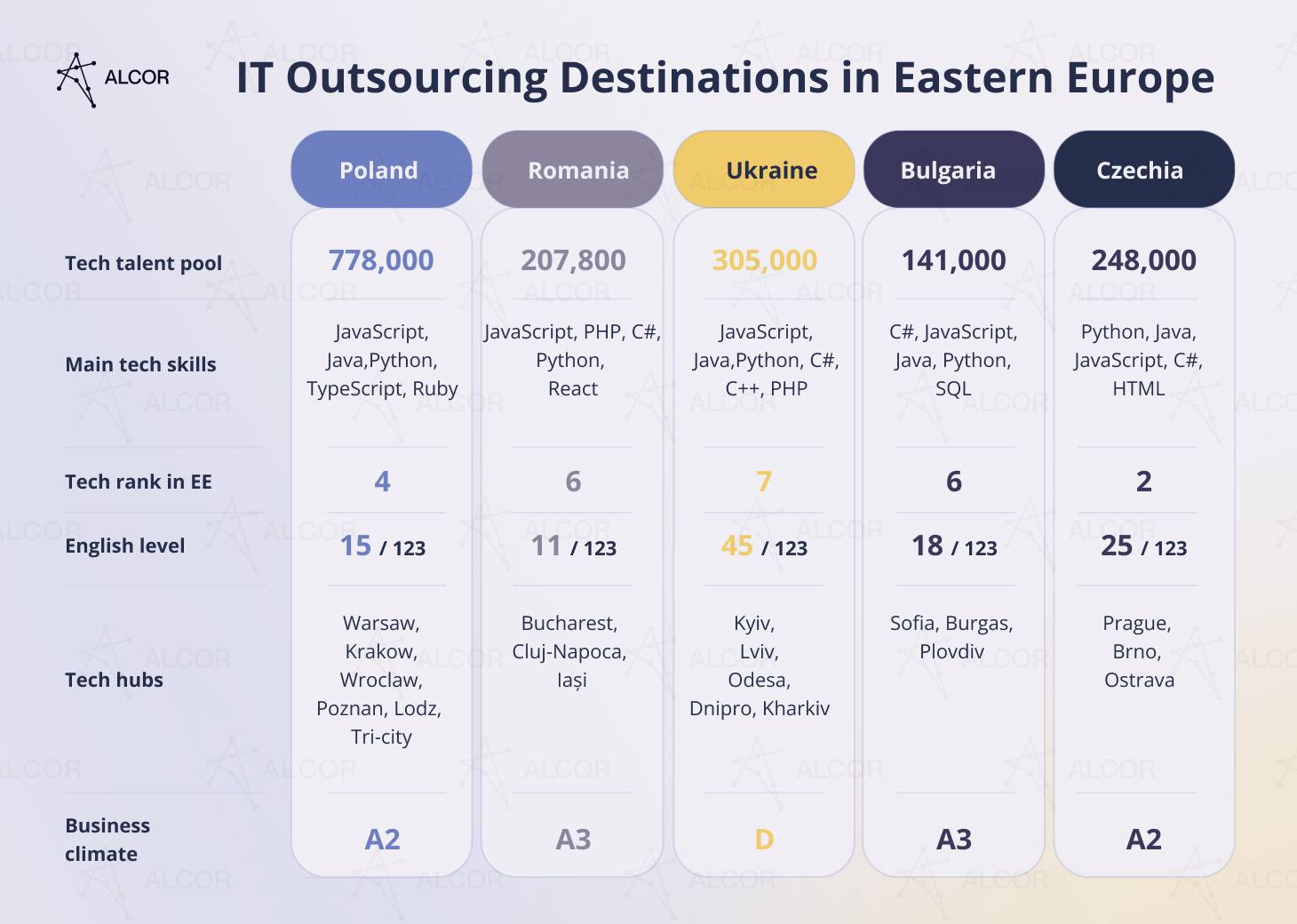
Poland
The largest tech services market in Central and Eastern Europe, known for its mature tech ecosystem and global R&D centers.
Tech talent pool: 778,800+
ICT graduates: 74,000
Tech businesses: 60,000+
Tech hubs: Warsaw, Krakow, Wroclaw, Poznan, Lodz, and Tri-city (Gdansk, Gdynia, Sopot)
Coursera tech skills ranking: #4 in EE
Technology skills: JavaScript, Java, Python, Ruby, Shell, TypeScript, PHP, C#
English proficiency ranking: 15th out of 123
AI Readiness ranking: 24th out of 195
Innovation ranking in EE: #4 in EE
Ukraine
The second-largest tech market in Eastern Europe, recognized for its resilient IT sector and highly skilled engineers who keep delivering.
Tech talent pool: 305,000+
ICT graduates: 40,000
Tech businesses: 7,977
Tech hubs: Kyiv, Lviv, Odesa, Dnipro, Kharkiv
Coursera tech skills ranking: #7 in EE
Technology skills: JavaScript, Java, Python, C#, C++, PHP
English proficiency ranking: 45th out of 123
AI Readiness ranking: 41st out of 195
Innovation ranking in EE: #7 in EE
Romania
A rapidly expanding IT hub with multilingual talent and high English proficiency – ideal for global-facing tech operations.
Tech talent pool: 207,800+
ICT graduates: 35,600
Tech businesses: 7,290
Tech hubs: Bucharest, Cluj-Napoca, Iasi
Coursera tech skills ranking: #6 in EE
Technology skills: JavaScript, Java, PHP, C#, Python, React, Angular, HTML, and CSS
English proficiency ranking: 11th out of 123
AI Readiness ranking: 57th out of 195
Innovation ranking in EE: #6 in EE
Discover how an IT recruitment agency in Romania can accelerate your team expansion!
Czech Republic
An established tech hub with a strong educational base and one of the highest digital skills rankings in Eastern Europe, making it a top choice for software development.
Tech talent pool: 248,200
ICT graduates: 16,000
Tech businesses: 7,700
Tech hubs: Prague, Brno, Ostrava
Coursera tech skills ranking: #2 in EE
Technology skills: Python, Java, JavaScript, C#, HTML, Swift
Global English proficiency ranking: 25th out of 116
AI Readiness ranking: 32nd out of 195
Innovation ranking in EE: #2 in EE
Bulgaria
A cost-effective tech destination in the EU, Bulgaria combines high technical expertise, excellent English proficiency, and a growing number of tech companies.
Tech talent pool: 141,500+
ICT graduates: 4,156
Tech businesses: 10,000
Tech hubs: Sofia, Burgas, Plovdiv
Coursera tech skills ranking: #6 in EE
Technology skills: C#, JavaScript, Java, Python, SQL, PHP, .NET
English proficiency ranking: 18th out of 123
AI Readiness ranking: 59th out of 195
Innovation ranking in EE: #3 in EE
Software Development Outsourcing to Eastern Europe Can Be Easier with Alcor
Outsourcing software development to Eastern Europe becomes simple with Alcor’s all-in-one R&D center solution. We combine EOR/COR, tech recruitment, and full operational support to build and scale engineering teams in Poland, Romania, Bulgaria, and Ukraine. Alcor has already helped companies like Franki, ThredUp, and Sift set up dedicated tech teams, hire top engineers fast, and streamline payroll and admin operations. With access to over 325,000+ pre-vetted candidates, we build strong teams quickly – first 5 hires in just one month. We also provide office setup, equipment sourcing, and 24/7 local support.
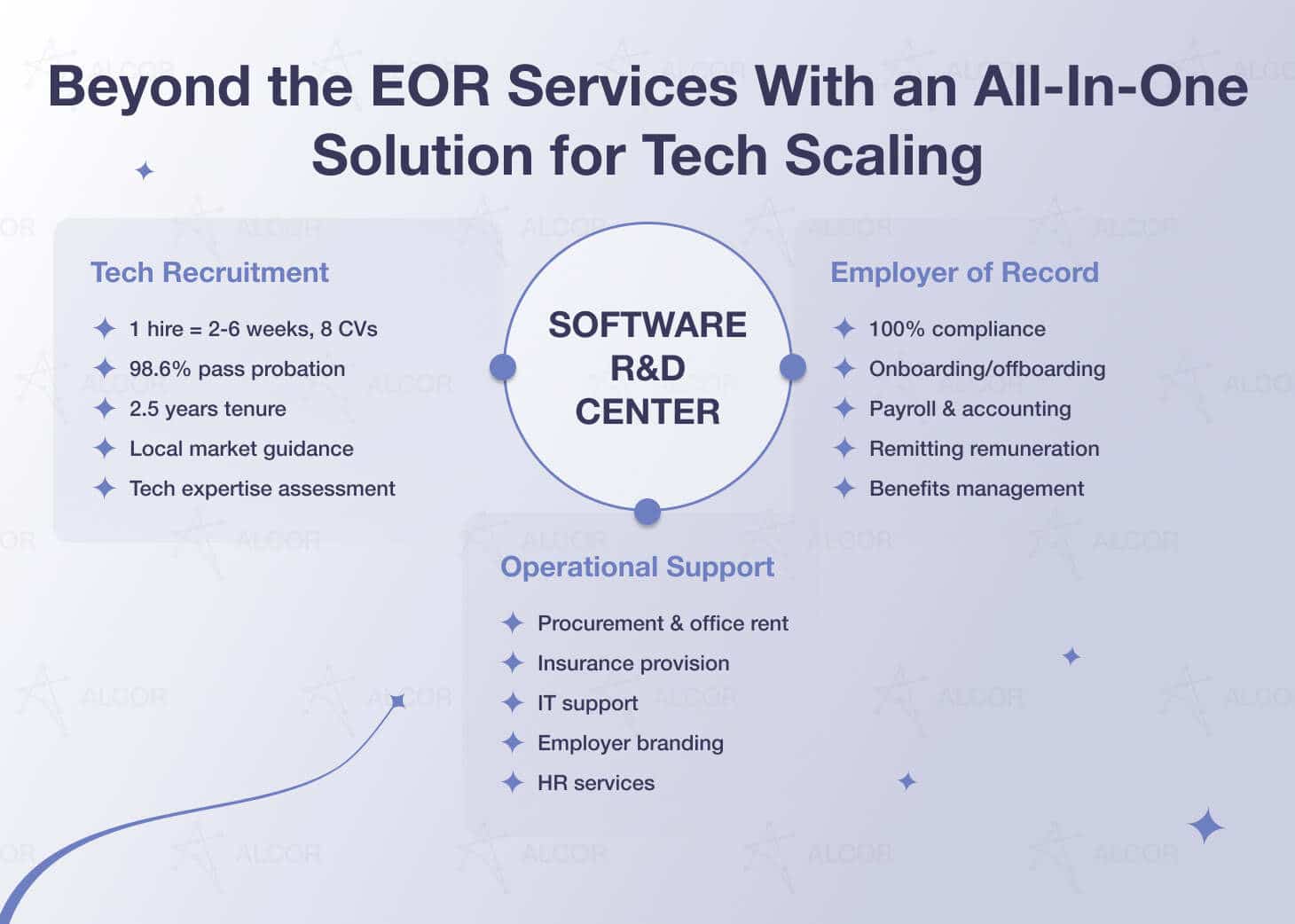
To build a high-performing engineering team when IT offshoring/IT nearshoring to Poland, Romania, Bulgaria, Ukraine, or any other Eastern European location, you can partner with Alcor. We’re a local R&D center services provider with owned legal entities and an operational infrastructure that enables you to build and scale teams from 10 to 100 engineers in one year.
Our comprehensive solution combines three main pillars of end-to-end team scaling, eliminating the need for vendor sprawl, overspending, or data compromise.
- Comprehensive EOR/COR: Full admin coverage and legal shield for compliant engagement of engineers: FTE and B2B contracts, onboarding and offboarding, payroll/payments, tax and benefits management – without establishing your own legal entity. No setup fees, no exit fees, no deposits.
Real-life case: Franki, a US-based experience app, entered a new market for the first time, so Alcor helped it build a tech team without setting up a legal entity. We hired 7 senior Mobile Developers with rare RxSwift skills, closing positions in 4-5 weeks. Through our COR support, we managed B2B contractor agreements, legal compliance, benefits, and PTO, as well as covered equipment procurement. As a result, each developer was fully onboarded in 10 days and ready to contribute to Franki’s app development from day one.
- Silicon Valley-grade recruitment: Alcor’s 40 in-house tech recruiters specialize in hiring senior engineers with in-demand and rare skill sets. By leveraging our 325,000+ base of pre-vetted candidates and applying personalized outreach combined with technical and cultural pre-screening, 80% of our candidates are approved by clients. We hire the first 5 engineers in the first month and scale the team to 30 within 3 months.
Real-life case: During our cooperation with the world’s largest consignment company, ThredUP, we scaled their Eastern European team to 30 skilled developers, including ML specialists, Java developers, and .Net Warehouse engineers. Our recruitment team also filled a highly specific Senior Full Stack Engineer role requiring C++, C#, .NET, and TCP/IP expertise in just 2 weeks. All were compliantly hired via Alcor’s EOR, and Alcor also assisted with stock options and visas for ThreadUP engineers.
- 360-degree operational support: Office search and leasing, hardware procurement, visa and travel arrangements – every operational layer is covered and supported by your dedicated Customer Ops Manager, so you can focus on building your product.
Real-life case: Sift, a US fraud prevention unicorn, used Alcor’s all-in-one R&D solution to set up an offshore development center in Eastern Europe. In the first year, we hired 30 top-tier engineers for Sift and later grew the team to 51. Beyond recruitment, Alcor provided a full Employer of Record in Eastern Europe, including compliance with EU and US regulations, tax support, and labor and contract management. We also strengthened Sift’s employer branding, which helped increase the offer acceptance rate by 15%. And handled equipment procurement and management, so the team could stay focused on product development rather than operational admin.
Is It Safe to Outsource Software Development to Eastern Europe?
Eastern European outsourcing remains a secure and resilient choice for international tech companies. Despite geopolitical challenges, Central and Eastern Europe (CEE) offers political stability, NATO/EU backing, and strong economic performance. In 2025, CEE capitals outperformed the EU average, led by Lithuania, Poland, and Croatia.
Friendshoring has also strengthened CEE’s role, with many Ukrainian IT companies and specialists relocating to nearby EU hubs such as Poland, while Ukraine itself is supported by a 305,000-strong tech workforce. Even during the war, Ukraine’s IT sector keeps generating billions in exports and has become one of the world’s most battle-tested DefenseTech markets.
Despite the geopolitical instability facing the world today, Central and Eastern European countries remain safe havens for global investors, offering a resilient and stable economic environment strengthened by their membership in NATO and the EU.
- GDP growth: In 2025, CEE outpaced the EU average, with Poland leading the region with 3.9% GDP growth in Q4 2025, followed by Croatia at 3.6%, Lithuania at 3.3%, and Bulgaria at 3%. The economic resilience, combined with appealing cost-effectiveness, abundant tech talent, and strategic location, continues to draw international enterprises and companies to outsource software development to Central and Eastern Europe.
- “Friendshoring”: A phenomenon that continues to strengthen the CEE market’s resilience. Since 2022, around two-thirds of Ukrainian IT companies have relocated partially or completely to EU hubs. On the talent side, the Ukrainian IT community, DOU, found that Poland hosts 39% of relocated specialists, followed by Spain and Germany. Still, this is not a “brain drain” story, as 305,000 tech specialists continue to work in Ukraine and contribute to the growth of Ukraine’s tech industry.
- What about Ukraine? Despite the ongoing war, Ukraine’s IT sector continues to demonstrate resilience. IT services export volume in 2025 reached $7.617 billion, now representing 41.6% of Ukraine’s total service exports. The broader IT market is valued at $7.85 billion and accounts for about 3.2% of Ukraine’s GDP. Meanwhile, Ukraine has built one of the world’s most battle-tested DefenseTech landscapes. The Ukrainian defense technology market is estimated at $6.8 billion in 2025, attracting $129 million in investment. Companies like Rheinmetall, BAE Systems, Quantum-Systems, Atlas Aerospace, and Baykar have already opted for IT nearshoring to Ukraine.
2 Major Insights about the Eastern European IT Market
Eastern Europe is rapidly emerging as a powerhouse for digital innovation and IT outsourcing. Businesses across the region are embracing digital transformation by adopting technologies such as AI, cloud computing, and IoT, while investing in automation and upskilling to enhance their global competitiveness. These strategic moves are reshaping industries from finance to healthcare and attracting more foreign tech players. At the same time, the IT outsourcing and outstaffing sector in Eastern Europe is gaining momentum. Thousands of vendors now deliver a broad range of services – from software engineering and cybersecurity to cloud consulting and staff augmentation. Thanks to its tech expertise, cost-effectiveness, and strong work ethic, the region offers a reliable alternative to more expensive in-house teams or underperforming offshore vendors.
Digital transformation
Central and Eastern Europe has enthusiastically embraced digital transformation driven by the pandemic’s impact. According to PwC’s Annual Global CEO Survey, 41% of CEE CEOs cite keeping pace with technology and AI as a top concern, while 36% worry about their company’s long-term viability, making digital transformation not a question of preference but a necessity.
To bolster the region’s attractiveness for foreign investment and ensure business sustainability, CEE entrepreneurs have prioritized investments in automation and talent upskilling. Moreover, the adoption of modern technologies, such as AI, IoT, blockchain, 5G, and cloud computing, across various sectors, including finance, healthcare, manufacturing, and transportation, has fueled innovation and enhanced competitiveness on a global scale.
These efforts yield significant results. For instance, Poland’s digital economy is projected to surge to $148.6 billion by 2030, already topping the ranking of the largest digital markets in the CEE.
IT outsourcing & outstaffing
The Eastern European tech industry has been growing by leaps and bounds, transforming into a mature market. Its revenue is projected to show an annual growth rate (CAGR 2025-2030) of 3.94%, resulting in a market volume of $18.3 billion by 2030.
The most prominent sector of the EE tech industry is tech outsourcing, which is expected to reach nearly $7.4 billion by 2030, according to Statista. About 4,800 Eastern European IT outsourcing and outstaffing companies specialize in a wide variety of services, including custom software development, web development, cloud consulting, app development, tech-managed services, tech staff augmentation, and cybersecurity.
Clearly, the region is thriving. But does it truly outperform other outsourcing destinations?
Eastern Europe vs LATAM vs Asia
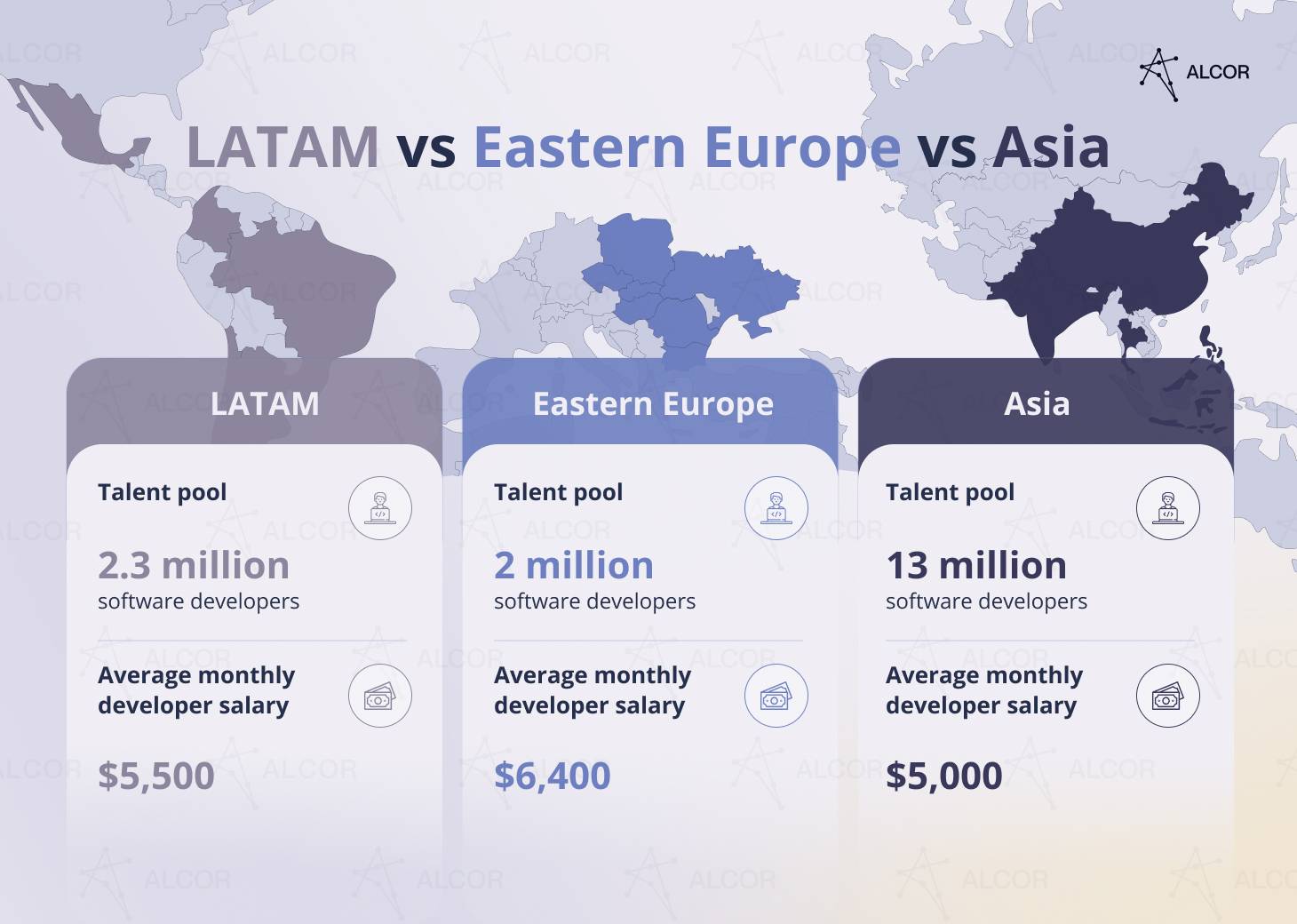
Eastern European outsourcing stands out for its balance of high-quality tech talent, strong English proficiency, and proximity to Western business culture.
Latin America competes closely, offering a comparable talent pool and strong technical skills, especially in Mexico and Argentina. Its biggest edge? Time zone alignment with the US, which enables real-time collaboration. However, English fluency can be a challenge in some LATAM countries.
Asia leads in talent volume and low-cost offerings, with millions of developers in India and China. Yet, issues such as language barriers, time zone differences, and varying work ethics often impact quality and communication. As a result, many companies find Eastern Europe and LATAM more reliable for seamless software development outsourcing.
Latin America
- Tech talent: The Latin American tech market boasts nearly as many software developers as Eastern Europe, with about 2.3 million tech professionals. Mexico leads the pack with over 974,500 tech experts, followed by Colombia with 202,000 and Argentina with 176,000 engineers.
- Technical prowess: Latin American developers are on par with their Eastern European counterparts, ranking in the top 85 in the Coursera Global Skills Report 2025. Developers from Chile and Argentina stand out for their data science skills, ranking #3 and #7 in Latin America. The skill stack of LATAM software engineers typically includes .NET, Java, Ruby, Python, C++, C#, React, and Node.js.
- Possible challenge: When it comes to English proficiency, Latin American tech experts generally lag behind their Eastern European counterparts. Argentina is a notable exception, ranking #26 globally in the English proficiency index, while other countries rank somewhat lower. However, it’s essential to note that LATAM developers typically possess strong foreign language skills, as they bring over 20 years of experience working with US tech companies.
- Distinctive feature: What makes software outsourcing to Latin America more attractive than outsourcing to Eastern Europe is its geographical proximity to the US. Most of these countries have no or little time difference from the US. For instance, Mexico City operates on Central Time (UTC-6), just one hour ahead of California, effectively creating a near-real-time collaboration window. Colombia aligns with US Eastern Time (UTC-5, year-round), making it one of the most convenient nearshore options for East Coast teams.
Asia
- Tech talent: Today, Asia boasts a talent pool three times larger than that of Eastern Europe and Latin America combined, with approximately 13 million tech experts. Most of these specialists are concentrated in China, with 7 million developers, and India, with around 5.8 million programmers. Renowned for their cost-effective outsourcing services, these destinations offer potential savings on software development projects. Thanks to good higher education, most developers in this region possess decent tech and data science skills, with Japan, Indonesia, and Singapore leading the list.
- Technical prowess: Despite supposedly high-tech competence in Python, Java, JavaScript, C/C++, and TypeScript, the quality of the tech outsourcing services in Asia is less clear-cut than in Eastern Europe.
- Possible challenges: Low English proficiency in leading locations such as India (#74) and China (#86), significant time differences with the US (10-15 hours), and differences in work ethic and mentality can significantly disrupt the development process. To avoid potential miscommunications, production delays, and the delivery of poor-quality products, some tech companies prefer IT outsourcing to Eastern Europe or Latin America.
- Distinctive feature: Asia’s real advantage is sheer outsourcing scale and price floor. India’s IT industry revenue reached an estimated $283 billion in FY2025, making it by far the world’s largest IT services exporter. For companies whose primary driver is cost minimization at volume, Asia, particularly India, remains hard to beat on raw capacity.
Choosing an Outsourcing Partner in Eastern Europe
To benefit from Eastern European outsourcing without the risks, pick a vendor with domain expertise and access to skilled, senior-level devs. Ensure they can quickly scale your team up or down and add rare tech roles when needed. Look for clear communication, aligned time zones, and strong English skills. Prioritize IP protection and legal compliance. And finally, avoid hidden fees – opt for partners who offer full pricing transparency, including gross developer salaries and flat service fees.
If you want to avoid the high cost of building an in-house team and make the most of Eastern European outsourcing, I’ve prepared a short checklist to help you choose a trusted vendor:
-
Project needs & tech expertise
Choose a partner with hands-on experience in your domain and a track record of delivering similar products. Whether it’s AI, fintech, or cloud-based platforms, your vendor should offer access to developers with the right hard skills, frameworks, and seniority level – not just generic CVs.
-
Team size & flexibility
Can they build a team of 3 or 30? Your provider should adapt to your growth pace –whether you’re launching a pilot project or scaling up to 100+ engineers. Fast ramp-up, smooth downscaling, and the ability to add rare specialists on demand are key.
-
Communication & time zone alignment
Look for overlapping working hours, fluent English, and a proactive approach to collaboration. The right outsourcing team should feel like an extension of your HQ, not a remote black box.
-
IP protection & legal compliance
Ensure your intellectual property remains secure. A reliable vendor will offer robust legal contracts, NDAs, and ensure compliance with local labor laws, GDPR, and international standards.
-
Transparent pricing with no hidden markups
Avoid unpleasant surprises. Your outsourcing partner should provide clear and itemized pricing, with no double margins, hidden fees, or unclear commission structures. Look for a flat service fee model and full visibility into engineers’ gross salaries.
If you answered “yes” to all the points – congratulations, you’ve found your ideal vendor! But if not, Alcor is here to offer something beyond traditional outsourcing – an R&D center with your own corporate culture and top-tier developers on board.
Ready to build your dream R&D team? Let Alcor make it real.
Questions you can ask AI about Eastern European IT outsourcing:
- What makes Eastern Europe a strong IT outsourcing destination for US tech companies in 2026?
- How does IT outsourcing to Eastern Europe compare with LATAM and Asia in terms of talent, cost, communication, and time zone overlap?
- What is the safest way to build a dedicated software engineering team in Eastern Europe without opening a local entity?
Developers Salaries in 2025
Need precise estimation and detailed analytics on your positions? Contact us now
Get precise estimations according to your JDs.
Contact UsFAQ
How beneficial are the Eastern European outsourcing destinations?
By building an engineering team in Eastern Europe, American tech companies can tap into a pool of over 2 million IT professionals, reduce salary costs by 54.9%, and benefit from high English proficiency and a compatible business culture. Read this article to learn more.
Is it safe to outsource software development to Eastern Europe?
Most Eastern European destinations are EU member states, meaning they comply with the GDPR and international security standards such as ISO/IEC 27001. However, it’s not uncommon among tech outsourcing vendors to breach IP rights. Thus, building your own tech team is a more secure and reliable option.
How big is the Eastern European talent pool?
Eastern Europe is home to 2 million tech professionals, with Poland, and Ukraine boasting the largest talent pools – 778,800 and 305,000, respectively. The region also produces more than 153,000 STEM graduates per year.
What are the top offshoring locations in the EE region?
There are at least four solid Eastern European offshoring destinations that foreign tech companies can choose from:
- Poland leads on talent volume and tech expertise;
- Ukraine stands out for cost efficiency, its Diia.City tax regime, and a booming defense tech ecosystem;
- Romania offers the lowest EU employer tax burden and the best Englsih-speaking engineers in the region;
- Bulgaria combines the EU’s lowest flat income tax (10%) with a high IBEI startup innovation score (#18 globally).
What is the best way to hire Eastern European developers for tech companies?
Option #1: If you are a well-established product tech enterprise looking for a quick way to hire 5+ developers, you should consider partnering with a professional tech recruitment company and establish your own entity. However, keep in mind that in this case, you’ll need to have an internal team of admin and compliance specialists who can handle onboarding, payroll, tax management, and employee benefits on their own.
Option #2: If you own a VC-backed startup, small or medium-sized business, and seek an effective and secure way to scale your team abroad, the best solution is to opt for your own R&D center. By establishing a development hub and a committed engineering team, you’ll retain full control over your software development and expenses, maintain direct communication with developers, and protect your IP rights. On top of that, partnering with a reliable provider like Alcor will take all the legal and operational burdens off your shoulders.
What are the top companies for outsourcing software development to Eastern Europe in 2026?
N-iX, Ciklum, and SoftServe are some of the top software development outsourcing vendors in Eastern Europe, according to Clutch and similar review platforms. However, most outsourcing vendors work through a leasing or project-based model, where you pay hourly rates but have limited control over the team, delivery process, roadmap, and even long-term IP ownership.
For tech product companies, there’s a smarter alternative: building your own dedicated R&D team in Eastern Europe. With Alcor, you hire top tech talent directly onto your team, manage engineers as your in-house employees, retain full IP ownership from day one, and avoid the vendor layer that slows product development.
How would you rate this article?
Alcor is Your Trusted Scaling Partner
for expansion
support