


Key Takeaways
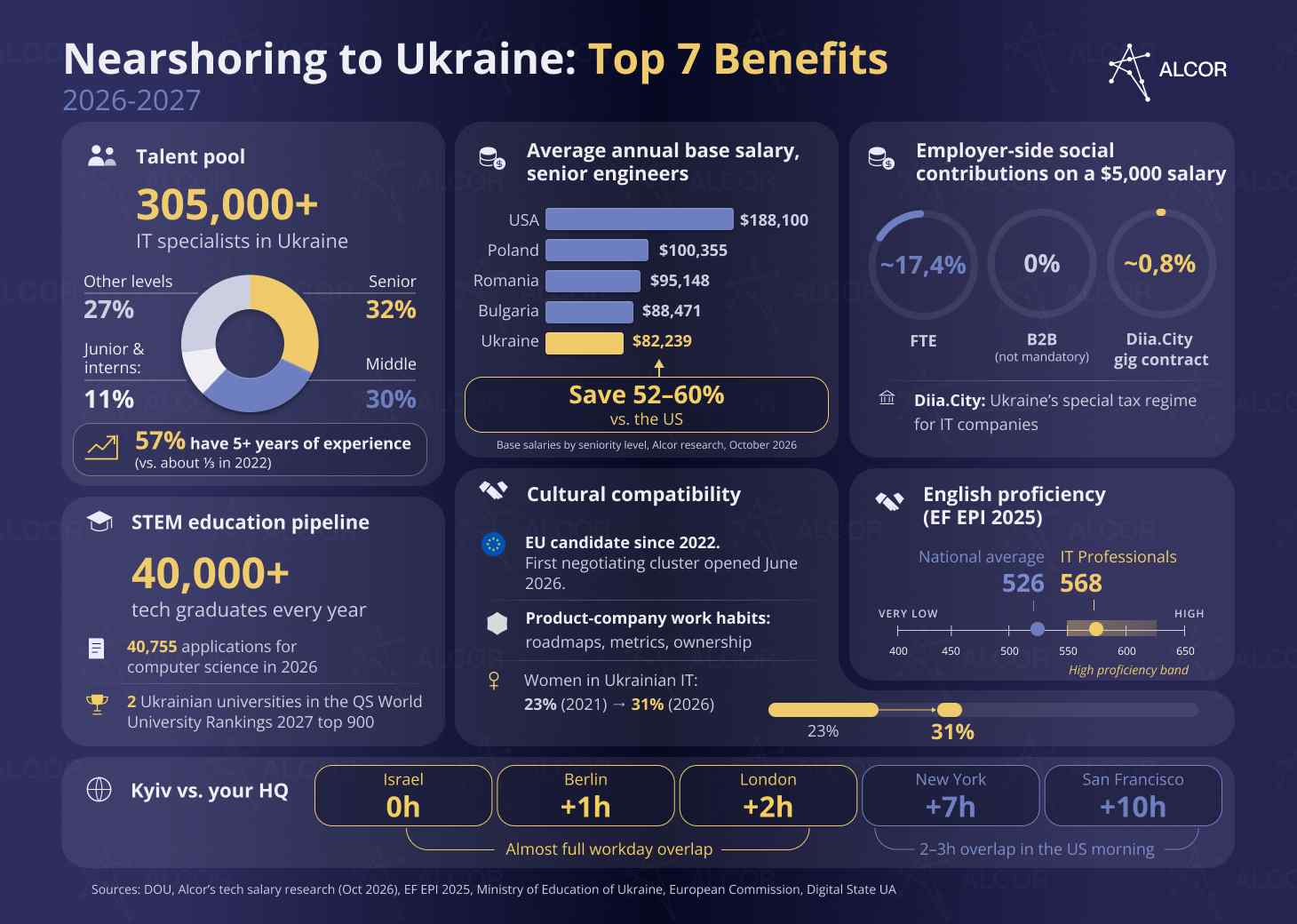
- Nearshore software development to Ukraine gives tech product companies a senior-heavy talent pool: 57% of the country’s 305,000+ IT specialists have more than five years of experience.
- Hiring in Ukraine saves 52–60% on base salary compared with the US, and Diia.City gig contracts cut employer social contributions to about 0.8% of a $5,000 salary.
- Defense tech, fintech, HealthTech, e-commerce, and cybersecurity lead Ukrainian tech in 2026. Ukrainian programmers are AI-ready: only 4% of IT specialists don’t use AI at work.
- Ukraine shares almost a full workday with Western Europe, while US teams get two to three hours of overlap. Deferment rules and the employment model need planning from day one.
- Alcor offers an alternative to nearshore outsourcing in Ukraine and classic staffing: teams you own, with IT recruitment, EOR or COR, and operations under one roof. Teams of 10–30 are operational within 90 days.
For tech product companies, nearshore software development to Ukraine has become a well-worn route. In the first half of 2026, Ukrainian computer services reached clients in 41 countries, according to Ukraine’s Export Promotion Office. The US remained the largest market with a 36.9% share, and exports to Estonia and Poland grew 18% and 10.4%, respectively, as reported by the IT Ukraine Association.
The pull is easy to explain: local hiring markets are still tight. For example, even after three years of easing, Germany remains short of 79,000 IT specialists, and 97% of the companies surveyed by Bitkom struggle to fill IT roles. So what does a nearshore team in Ukraine actually give a tech product company in 2027, and where does the model stop fitting? Below are the talent pool, the cost math, the industries pulling ahead, and the cooperation model that keeps your engineering team truly yours.
Nearshore Software Development to Ukraine: Top 7 Benefits
Nearshore software development to Ukraine gives tech product companies seven practical advantages:
- Talent: 305,000+ IT specialists, 57% of them with more than five years of experience.
- Cost: 52–60% savings on base salary compared with the US, and 18–23% compared with Poland.
- Taxes: Diia.City gig contracts cost employers about 0.8% in social contributions on a $5,000 salary.
- Education: computer science drew 40,755 applications in Ukraine’s 2026 admission campaign.
- English: IT professionals score 568 on the EF index, in the high proficiency band.
- Culture: product-company work habits and steady EU integration since 2022.
- Time zone: one to two hours from Western Europe, and two to three hours of overlap with the US East Coast.
Large, senior-heavy talent pool
Ukraine boasts a tech talent pool of more than 305,000 experts, and most of Ukraine’s IT workforce has been in the industry for years. 57% of Ukrainian IT specialists have more than five years of experience, compared with about a third in 2022, according to DOU’s 2026 IT portrait. Senior engineers account for 32% of the market and middle engineers for 30%. Juniors and interns are down to 11%, and product companies employ 48% of all IT specialists.
In practice, you can build a nearshore software team in Ukraine mostly from professionals who have shipped products, reviewed code, and owned releases before. They ramp up faster and need fewer hand-holding hours from your leads. Hiring junior Ukrainian software developers is harder: there are half as many juniors as in 2022, so Ukraine makes the most sense for senior and lead roles. When the team is in place, a Ukrainian Employer of Record or Professional Employer Organization in Ukraine can handle payroll, benefits, and compliance.
Cost-effective nearshoring
Hiring onshore in the US or Western Europe means top-market salaries, high payroll taxes, and office costs for every seat. Nearshoring software development to Ukraine lets you hold the same engineering bar while keeping the budget flexible. Based on Alcor’s 2026 salary research, you save 52–60% on base salary compared with the US and 18–23% compared with Poland, depending on seniority.
|
Average Annual Software Developer Base Salary by Country (2026) | |||
|
Country |
Middle |
Senior |
Lead |
|
USA |
$135,619 |
$188,100 |
$221,032 |
|
UK |
$78,000 |
$114,200 |
$164,800 |
|
Canada |
$73,000 |
$96,600 |
$132,100 |
|
Germany |
$74,900 |
$91,700 |
$111,900 |
|
Poland |
$69,774 |
$100,355 |
$132,077 |
|
Romania |
$65,516 |
$95,148 |
$125,168 |
|
Bulgaria |
$58,103 |
$88,471 |
$115,432 |
|
Czech Republic |
$46,400 |
$66,600 |
$86,400 |
|
Slovenia |
$41,200 |
$52,200 |
$86,700 |
|
Ukraine |
$53,894 |
$82,239 |
$106,200 |
Sources: Alcor’s internal 2026 engineer salaries research, levels.fyi 2026 data
Country averages show the overall picture, but hiring budgets get approved role by role. Across the 15 positions below, hiring in Ukraine saves about 52% on base salary compared with the US. For classic software development roles, savings reach about 58% and stay almost flat from middle to lead level. For AI-related roles, they average about 50%, narrowing from 57% at the middle level to 44% at the lead level.
|
Average Annual Software Developer Base Salary by Tech Stack (2026) | ||||||
|
Position |
Ukraine |
US | ||||
|
Middle |
Senior |
Lead |
Middle |
Senior |
Lead | |
|
AI Engineer |
$69,000 |
$105,000 |
$144,000 |
$162,000 |
$222,000 |
$252,000 |
|
AI-Native Engineer |
$75,000 |
$111,000 |
$153,000 |
$168,000 |
$228,000 |
$264,000 |
|
AI Quality Engineer / SDET |
$51,000 |
$78,000 |
$105,000 |
$138,000 |
$186,000 |
$216,000 |
|
AI Data Engineer |
$63,000 |
$93,000 |
$129,000 |
$150,000 |
$210,000 |
$246,000 |
|
ML Data Scientist |
$66,000 |
$99,000 |
$135,000 |
$156,000 |
$216,000 |
$252,000 |
|
AI Platform Engineer |
$72,000 |
$111,000 |
$156,000 |
$168,000 |
$228,000 |
$270,000 |
|
AI Agent Developer |
$78,000 |
$120,000 |
$165,000 |
$171,000 |
$237,000 |
$276,000 |
|
AI Infrastructure Engineer |
$78,000 |
$123,000 |
$168,000 |
$174,000 |
$243,000 |
$288,000 |
|
AI Prompt Engineer |
$48,000 |
$75,000 |
$102,000 |
$126,000 |
$168,000 |
$198,000 |
|
AI Research Scientist |
$84,000 |
$129,000 |
$180,000 |
$186,000 |
$258,000 |
$306,000 |
|
Node.js Developer |
$46,800 |
$70,800 |
$84,000 |
$102,000 |
$156,000 |
$192,000 |
|
Python Developer |
$46,500 |
$70,800 |
$87,000 |
$130,800 |
$165,000 |
$207,000 |
|
Ruby Developer |
$48,000 |
$72,000 |
$88,800 |
$127,800 |
$174,000 |
$216,000 |
|
C/C++ Developer |
$48,000 |
$69,600 |
$82,800 |
$97,200 |
$150,000 |
$183,000 |
|
Mobile Developer (iOS/Android/Xamarin) |
$46,800 |
$66,000 |
$82,200 |
$129,600 |
$174,000 |
$213,000 |
|
According to Alcor’s internal 2026 engineer salaries research | ||||||
Salary is only the starting point. Taxes, benefits, and provider fees come on top, so compare the full cost of a software development team in Ukraine before you sign anything, and look at delivery quality alongside price.
Diia.City and tax advantages
Diia.City is a special legal and tax regime for IT companies that Ukraine launched in 2022. Resident companies can engage engineers as employees or B2B contractors. They can also use a gig contract, a civil contract that exists only inside Diia.City. It keeps the flexibility of contractor work and lets both sides agree on social guarantees such as paid leave. Residents can also choose a 9% tax on distributed profit instead of the standard 18% corporate income tax. Combined with reduced personal tax rates for engineers, these rules put Ukraine among the countries with the lowest tax rates in Europe.
Here’s what the employer pays under each model:
- FTE: a social security contribution of 22%, capped at a maximum base of UAH 172,940 (~$3,955), so the maximum monthly contribution is UAH 38,046.80 (~$870). Effective employer rate: ~17.4% on top of a $5,000 salary.
- B2B: not mandatory. There is no employer-side social security obligation.
- Diia.City gig contract: a social security contribution of UAH 1,902.34 (~$44) per month, which is 22% of the statutory minimum salary. Effective employer rate: ~0.8% on top of a $5,000 salary.
More companies sign up every year. Diia.City residents paid UAH 23.7 billion in taxes from January to May 2026, 77% more than a year earlier, according to dev.ua. Over the past year, 2,179 new companies joined and 249 left, and 1,330 residents chose the 9% tax on distributed profit. Joining comes with requirements, including a minimum team size and salary threshold, so check eligibility before nearshoring to Ukraine through your own entity.
Strong STEM education
Most Ukrainian engineers come through strong technical universities. In the QS World University Rankings 2027, released in June 2026, Igor Sikorsky Kyiv Polytechnic Institute and Karazin Kharkiv National University tied for second place in Ukraine, both in the 851–900 band globally, Karazin University reports. Taras Shevchenko National University of Kyiv holds the top spot.
Interest in tech degrees hasn’t faded during the war. Computer science received 40,755 applications in the 2026 admission campaign and made the list of the ten most popular specialties, according to the Ministry of Education. Applicants with maximum national test scores picked computer science more often than any other specialty, per Sud.ua. Businesses planning to stay in Ukraine for years can count on a steady supply of more than 40,000/year skilled graduates with solid programming, math, and data backgrounds.
English for everyday teamwork
Ukrainian IT works in English every day. Ukraine is 45th in the EF English Proficiency Index 2025, with a national score of 526. IT professionals score much higher, at 568, which puts them in EF’s high proficiency band. The Ternopil and Lviv regions lead the country. State policy is pushing in the same direction. In 2024, Ukraine adopted a law that gives English official status as a language of international communication. Its provision on English in preschool education took effect in September 2026, LB.ua reports.
Written specs, code reviews, and stand-ups with international teams usually run smoothly. If a role involves talking to customers or leading cross-border collaboration, add a spoken English check to the interview.
Cultural compatibility with product companies
Ukrainian engineers are used to how western companies work: roadmaps, product metrics, sprint rituals, and features owned end to end. The workforce is also becoming more diverse. Women make up 31% of Ukrainian IT today, compared with 23% in 2021, according to DOU’s 2026 IT portrait.
Cultural compatibility also has a policy side. Ukraine has held EU candidate status since June 2022, formally started accession negotiations in June 2024, and opened the first negotiating cluster on June 15, 2026, according to the European Commission. Its legal and business rules keep moving closer to European ones, which helps if you sell into the European market. Ukrainian teams have also spent almost five years shipping through blackouts and air raid alerts, so contingency planning is already built into how they work.
Time zone fit for European and US teams
Kyiv is one hour ahead of Berlin and Warsaw and two hours ahead of London. With IT nearshoring to Ukraine, a European company shares almost the whole workday with its team, and nobody needs early alarms or late calls to meet.
If you’re still comparing locations, here’s how Ukraine looks next to other nearshore developers in Europe.
US companies get a shorter window. Kyiv is seven hours ahead of New York, which leaves two to three hours of overlap in the US morning, and ten hours ahead of San Francisco. Teams that handle async handoffs well make this time zone gap work. If your roadmap needs people online through the full US day, Latin America is the better fit, and Alcor builds teams there too. For work that moves well across time zones, it makes sense to hire Ukrainian developers.
How the Ukrainian Tech Market Has Changed
Ukraine’s tech market has kept its size since 2022 but changed its shape:
- Economic role: the IT market reached $7.85 billion in 2025, generated 3.2% of GDP, and supports more than 800,000 jobs.
- Business models: product companies make up 39% of the market, and Ukrainian startups raised $498 million in 2025.
- Talent and work: 46% of IT specialists live in Kyiv and 18% in Lviv, 66% work fully remotely, and the share of individual entrepreneurs fell from 87% to 49%.
- Deferment: new criteria for IT employers have applied since July 3, 2026, and 24% of male IT specialists hold a deferment through their employer.
Ukraine’s tech industry looks different from the one global companies knew in 2021. Export revenue is close to its level before the russian invasion, but it now comes from a different mix of companies. Talent has moved west and into formal employment, and the state has built rules that keep engineers working through the war:
|
Ukrainian Tech Market: Then and Now | ||
|
Indicator |
Then |
Now |
|
Computer services exports |
$6.8 billion (2021) |
$6.66 billion (2025) |
|
IT share of Ukraine’s service exports |
45.5% (2022, record) |
41.6% (2025) |
|
IT specialists working abroad |
62,000–64,000 (2024) |
58,000 (2025) |
|
IT specialists working as individual entrepreneurs |
87% (2022) |
49% (2026) |
|
Lviv’s share of Ukraine’s IT specialists |
14% (2021) |
18% (2026) |
|
Funding raised by Ukrainian tech startups |
$462 million (2024) |
$498 million (2025) |
Sources: IT Ukraine Association (Ukraine IT Report 2021), Lviv IT Cluster (2022, 2025, IT Research Ukraine 2025), Digital State UA, DOU, Vestbee
A bigger role of IT in Ukraine’s economy
The war turned IT from a strong export sector into one of the pillars holding up the economy. In 2025, Ukraine’s IT market reached $7.85 billion and generated 3.2% of GDP, according to the IT Ukraine Association’s Economy Code study. The sector paid $1.2 billion in taxes that year. Every dollar earned in IT creates another $1.09 in adjacent sectors, and together with related industries, tech supports more than 800,000 jobs, roughly one in ten in the country.
Over the past five years, high-tech sectors grew 19.9%, while low-tech sectors grew 4.7%, the same study shows. Global companies planning a long-term strategy here can read this as a signal. The government has strong reasons to keep the sector running, and the Diia.City regime and deferment rules show it acts on them. That stability is a big part of why companies still choose to nearshore to Ukraine.
Shift in Ukrainian tech business models
The business model behind Ukrainian tech has shifted. Product companies now make up 39% of the market, service companies 46%, hybrid models 12%, and outstaffing 3%, the Economy Code study shows. Ukraine is also home to about 2,700 civilian and dual-use startups. In just one year, the share of IT specialists working at outsourcing companies dropped by 6 percentage points, according to DOU.
Money is following the products. Early-stage funding for Ukrainian startups reached $191 million in 2025, close to its historical peak, and grant providers issued 50% more grants than in 2024, according to AVentures Capital’s DealBook of Ukraine. For the first time since 2021, foreign investors put more money into Ukrainian early-stage startups than local funds did. If you’re looking for an alternative to nearshore software development outsourcing, the shift works in your favor, since more Ukrainian developers now come with product experience.
Where tech talent lives and how it works in 2026–2027
Ukrainian tech moved west after 2022, and much of it stayed there. Kyiv remains home to 46% of IT specialists, Lviv now holds 18%, and Dnipro 6%, according to DOU. 66% of IT specialists work fully remotely, while the share working only or mostly in an office grew from 11% to 13% over the past year. Employment has become more formal. Individual entrepreneur contracts were once the default for Ukrainian developers, but labor and gig contracts make it easier to secure a deferment, so they keep gaining ground. If you plan to set up a nearshore software development center, Kyiv and Lviv give you the deepest local talent, and a remote-first setup covers the rest of the country.
Reservation of IT specialists
Ukraine’s deferment system for IT has changed several times since 2022. In 2023, companies recognized as critical could reserve up to 50% of their employees eligible for mobilization. New sector criteria for IT employers took effect on July 3, 2026, and working in IT or at a Diia.City resident doesn’t automatically guarantee a deferment, Buhgalter911 explains. Coverage has grown: 24% of male IT specialists now hold a deferment through their employer, up from 13% a year earlier, and larger companies reserve a bigger share of their staff, per DOU.
For a full plan around mobilization and other wartime risks, see our guide to IT outsourcing to Ukraine.
Top Industries for Software Development Nearshoring in Ukraine
Five industries lead software nearshoring to Ukraine in 2026:
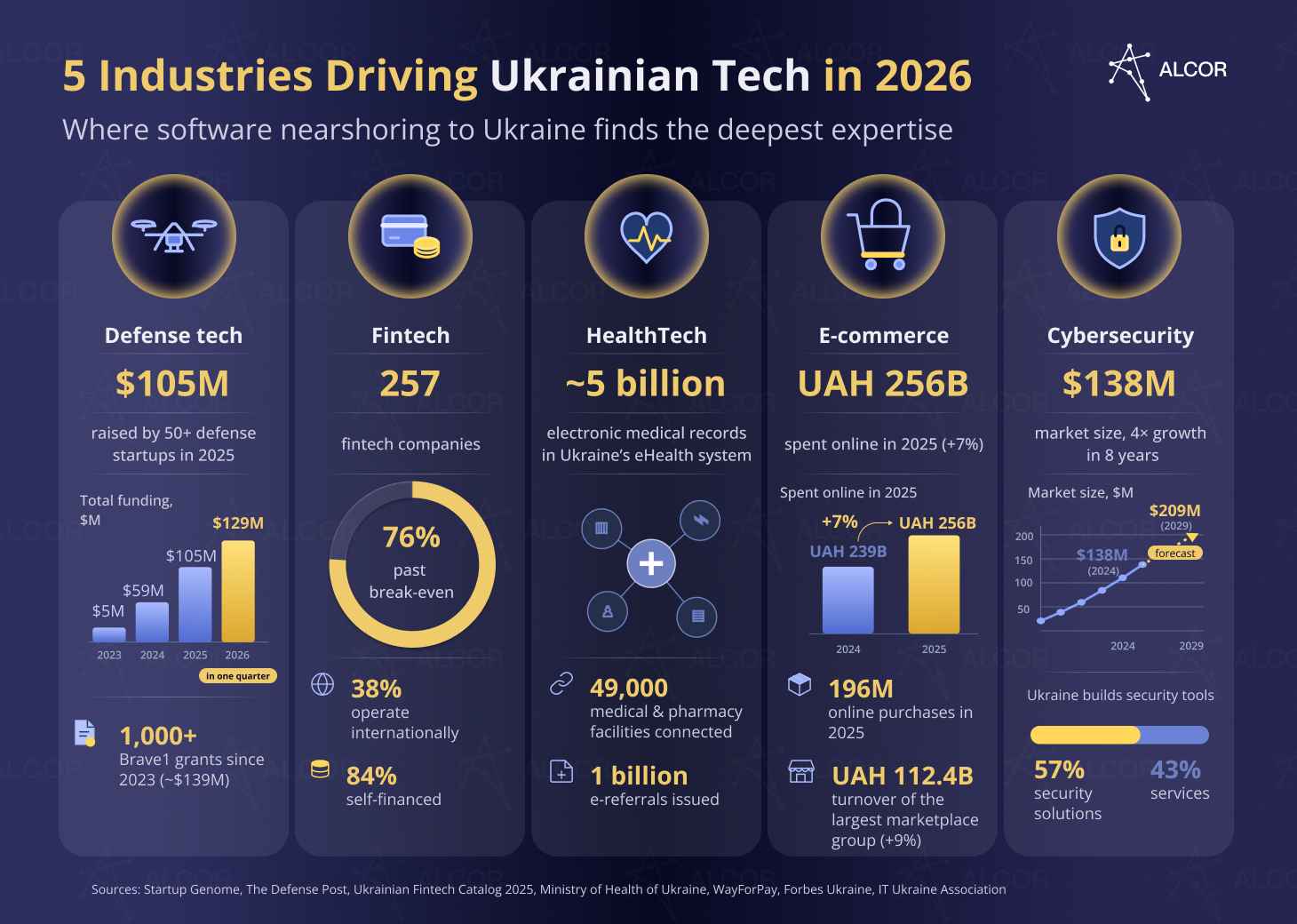
- Defense tech: Ukrainian defense startups raised $105 million in 2025 and $129 million in Q1 2026.
- Fintech: 257 fintech companies, 76% of them past break-even.
- HealthTech: startups in prosthetics, rehabilitation, and diagnostics; Teladoc Health built a 25-engineer team in Ukraine in 8 months.
- E-commerce: online sales reached UAH 256 billion in 2025; BigCommerce built a 50-engineer team.
- Cybersecurity: a $138 million market led by security solutions; Pindrop built a 30-engineer in-house team.
Ukrainian engineers work across almost every product category, but five industries stand out in 2026 for the depth of local talent and the pace of innovation. These are the areas where software nearshoring to Ukraine gives product companies the biggest head start.
Defense tech
Defense tech is the fastest-growing part of Ukrainian tech, and the war is the main reason. More than 50 Ukrainian defense startups raised $105 million in 2025, up from $59 million in 2024 and $5 million in 2023, according to Startup Genome’s Global Startup Ecosystem Report 2026. The sector attracted another $129 million in the first quarter of 2026 alone. State support adds to it. Since 2023, the Brave1 defense cluster has funded more than 1,000 developments with UAH 6.2 billion (about $139 million), and its grants leave shares and intellectual property with the developers, The Defense Post reports.
Engineers in this field build drones, ground robots, electronic warfare systems, and secure communications, and their work is tested in real combat conditions. That experience carries over to robotics, autonomous systems, and other hardware-heavy products outside defense. Alcor has also helped UFORCE, a Ukrainian-founded defense tech company, expand its engineering team.
Fintech
Ukrainian fintech is small in company count and strong on business fundamentals. The market has 257 fintech companies, and 76% of them have passed the break-even point, according to the Ukrainian Fintech Catalog 2025. 38% already operate in international markets, and 84% fund themselves entirely from their own revenue. Engineers from this sector come with experience in payments, lending, and financial infrastructure that has to stay compliant and online around the clock. Ledger, the crypto security company, went from no local team to a 35+ engineer R&D team in Eastern Europe and Ukraine.
HealthTech
The war has turned Ukraine into a proving ground for medical technology. Ukraine is expected to have between 20,000 and 50,000 people living with amputations. Startups working on prosthetics, rehabilitation, diagnostics, and medical records now pilot their products in real high-stress environments, according to a Tech.eu analysis. Bionic prosthetics developer Esper Bionics raised $5 million in a round led by YZR Capital, and the VR rehabilitation platform Luminify has been used by more than 1 million people in Ukraine.
Teladoc Health, the NYSE-listed virtual care company, built a 25-engineer team in Ukraine in 8 months using Alcor’s full recruitment life cycle, Contractor of Record and full operational support. 96% of its hires cleared probation, and every engineer currently on the team has been with Teladoc for 4+ years.

E-commerce
Ukrainian e-commerce has kept growing through the war. Ukrainians made about 196 million online purchases worth UAH 256 billion in 2025, up from UAH 239 billion a year earlier, according to WayForPay data. Rozetka-Evo, the country’s largest marketplace group, reached a turnover of UAH 112.4 billion, 9% more than in 2024, Forbes Ukraine reports. Local marketplaces run high-load systems, payments, logistics integrations, and mobile application development at national scale. That gives Ukrainian engineers hands-on experience in what e-commerce product companies need most.
BigCommerce built a 50-engineer team in Eastern Europe and Ukraine, and hired the first 30 in six months. The team was built before the IPO and kept scaling after BigCommerce’s $249 million Nasdaq listing.
Cybersecurity
Years of russian cyberattacks have pushed Ukraine to build cybersecurity expertise under constant pressure. The local cybersecurity market has quadrupled over eight years to $138 million and is expected to grow by another 50% to $209 million by 2029, according to the IT Ukraine Association. Unlike the global market, where services make up 53%, Ukraine’s market is led by cybersecurity solutions, at 57%. For product companies, that means a talent pool with real experience building security tools. Pindrop, the voice security company, built a 30-engineer team in Ukraine that works as a true in-house team, with full control over its IP.
Why Still Nearshore to Ukraine in the Age of AI?
Ukraine remains a strong nearshoring choice in the AI era because AI raises the value of senior engineers who use it well. Only 4% of Ukrainian IT specialists don’t use AI at work, and 89% say it helps them, though only 49% get corporate subscriptions to AI tools. The state launched Diia.AI, the first national AI assistant for government services, and is building a national LLM with Kyivstar. AI-native Ukrainian startups raised about $302 million in 2025, and a draft AI law aligned with the EU AI Act is due in Q4 2026. Companies hiring Ukrainian programmers should test AI-assisted coding in interviews and give the team the same AI tools as in-house engineers.
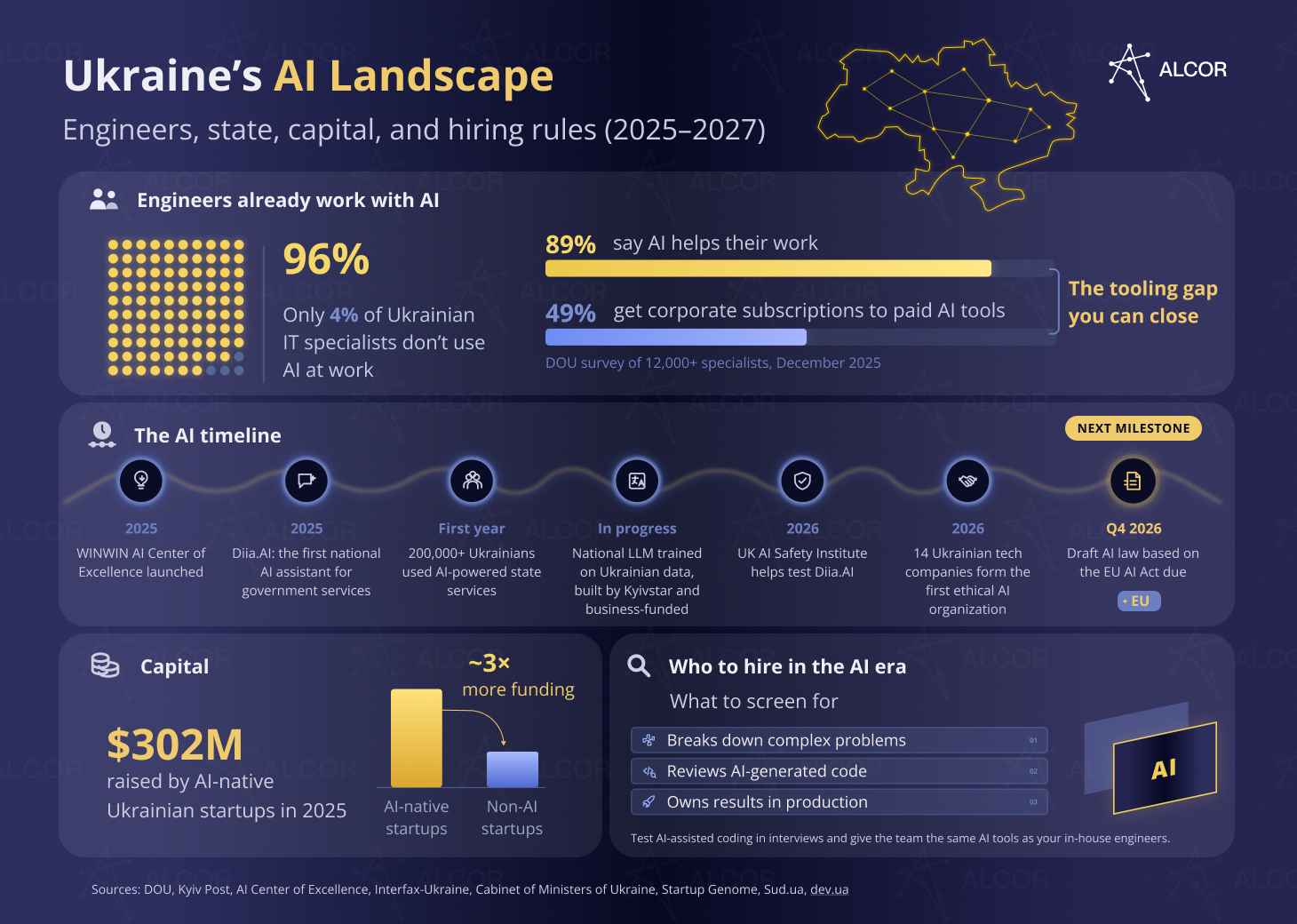
AI coding tools have made every engineer faster, so it’s fair to ask why a product company would still build a nearshore software development team in Ukraine. I think it’s obvious that AI raises the value of senior engineers who know how to use it – and Ukraine has plenty of them. Only 4% of Ukrainian IT specialists don’t use AI at work, and 89% say it helps them, according to a DOU survey of more than 12,000 specialists conducted in December 2025. Access lags behind usage, though. Only 49% get corporate subscriptions to paid AI tools, so the tooling you provide will shape how much of that productivity you actually get.
The state is pushing in the same direction. In 2025, the Ministry of Digital Transformation launched the WINWIN AI Center of Excellence. Later that year, Ukraine became the first country to run a national AI assistant for government services, Diia.AI, as Kyiv Post reports. More than 200,000 Ukrainians used AI-powered state services in the Center’s first year, according to the AI Center of Excellence. Kyivstar, the country’s largest telecom operator, is building a national large language model trained on Ukrainian data, and business is funding it instead of the state budget, per Interfax-Ukraine. The UK’s AI Safety Institute is helping test Diia.AI, according to the Cabinet of Ministers of Ukraine.
Investors are following. AI-native startups from Ukraine raised about $302 million in 2025, nearly three times more than companies without a significant AI component, according to Startup Genome. Engineers from these companies have shipped AI features into production, which is exactly the experience many product companies are trying to hire.
Turn your AI hiring pressure into a clear plan
Explore 8 tech markets across LATAM and Eastern Europe and get practical insights for building your AI engineering team.
As for regulations, a working group at the Ministry of Digital Transformation is drafting a dedicated AI law during 2026, based on the EU AI Act and adapted to martial law conditions, Sud.ua reports. Under the government’s action plan, the draft is due in the fourth quarter of 2026. Meanwhile, 14 Ukrainian tech companies, including Grammarly and MacPaw, have formed the country’s first organization for the ethical use of AI, per dev.ua. If you’re already preparing for the EU AI Act, a team in a country moving toward the same rules means fewer surprises later.
AI has also changed what a strong hire looks like. Engineers who can break down a problem, review AI-generated code, and own the result in production are worth more to a roadmap than extra headcount. That’s the profile to screen for nearshore software development to Ukraine. Test how candidates work with AI tools during interviews, and give the team the same tooling your in-house engineers use. If you work with an IT recruiting agency in Ukraine, ask how it evaluates AI-assisted coding before you approve the first shortlist.
Nearshore to Ukraine with Ease in 2027
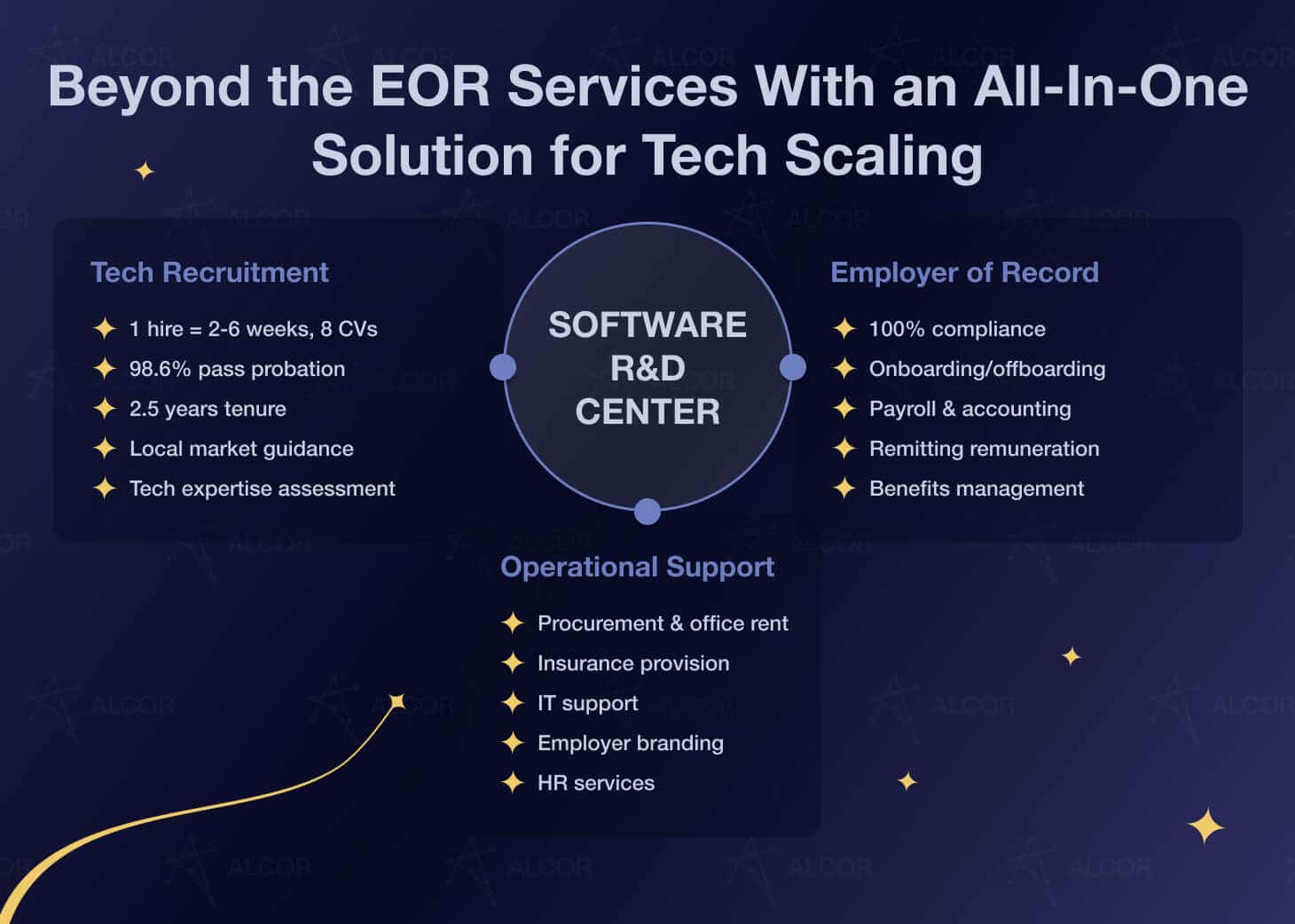
Alcor builds dedicated engineering teams in Ukraine, Eastern Europe, and Latin America that tech product companies own from the first hire. The programmers report to the client’s CTO and build client-owned IP, which sets the model apart from nearshore outsourcing in Ukraine or staffing through a vendor. Alcor handles recruitment from 325,000+ vetted candidates, EOR or COR, legal, payroll, and office operations, with no transfer fees and a per-engineer fee that drops as the team grows. Backstory (ex-People.ai) opened its office in four weeks and grew to 50 engineers, with a 98.6% probation pass rate and 2.5+ years of average tenure. Sift, Dotmatics, and PX also built teams with Alcor.
Most companies that look at Ukraine have already tried hiring at home. Senior roles stay open for months, your best engineers spend their afternoons in interview loops, and the roadmap slips one sprint at a time. For tech product companies that hit that wall, Ukraine is a proven destination. Alcor builds dedicated engineering teams there, as well as across Eastern Europe and Latin America. Your engineers report to your CTO, work on your roadmap, and build IP that belongs to you. Alcor runs everything around them: recruitment from a base of 325,000+ vetted candidates, Employer of Record or Contractor of Record setup, legal, payroll, and office operations.
Before you pick a partner, decide who should own the team. With an offshore development center run by a provider, or with classic nearshore IT outsourcing, the vendor employs the engineers and you pay for their time. That works for a scoped project with a handover at the end. Build Operate Transfer for tech companies gives you ownership later, usually after a buyout. Alcor’s model puts your own software R&D center in place from the first hire, with no transfer fees when you decide to take the team fully in-house. As the team grows, your fee per engineer goes down.
Backstory (ex-People.ai) shows how this plays out over the long run. The San Francisco company builds an AI data platform for go-to-market teams and has worked with Alcor since 2017. Before that, recruitment, legal, and office logistics were split between several providers, and every handoff between them cost time. Backstory moved the whole setup to one partner and opened an extended software delivery center in Eastern Europe. They got:
- A working office in four weeks. Alcor found, leased, and equipped the space within a month, and the office is still running today.
- 50 engineers on the team. The first 25 joined within 12 months, and 25 more followed, across Python, Scala, Java, Kafka, and Big Data.
- Hires that stay. 98.6% of the engineers passed probation, and the average tenure is 2.5+ years.
- One point of accountability. IT recruitment, EOR, legal, finance, and office operations run through one partner, with an entity structure that uses Ukraine’s IT tax incentives.
- Engineers who grew with the company. Several of them became core members of Backstory’s AI team, before and after its $1.1 billion valuation in 2021.
Sift also built a 51-engineer R&D center in Eastern Europe. Dotmatics hired 30 engineers in 12 months without a local legal entity, and the team kept running through the company’s $5.1 billion exit. PX brought 13 engineers over from an outsourcing vendor into its own 28-person team across six countries, then kept hiring. Many more product companies have taken the same route with Alcor.
Your next senior engineer might already be in Kyiv. Let’s find them.
How would you rate this article?
Alcor is Your Trusted Scaling Partner
for expansion
support