


Nearshore software development in Mexico sits on a market that global executives just moved up their list. Mexico climbed from 25th to 19th in Kearney’s 2026 FDI Confidence Index, one of the two biggest jumps worldwide, in a survey asking 500+ C-level executives where they intend to invest over the next three years. A concentration of top-notch talent, real savings, and modern infrastructure – but what exactly is it in Mexico that keeps attracting US and European tech companies?
In this article, you’ll find a breakdown of Mexico’s engineering market in 2026 – what senior and lead talent costs across 15 roles, what employment adds on top of salary, which legal structures let you hire compliantly, and what changes on January 1, 2027. Plus every engagement model, from freelancers to a full R&D center.
Key Takeaways
- The Mexican IT market reached $20.4B in 2025 (US Department of Commerce), while the broader ICT market is projected to grow at a 10.48% CAGR through 2031 (Mordor Intelligence), supported by a mature startup ecosystem, record FDI, and growing AI, fintech, and edtech activity.
- Mexico has 974,500 tech professionals and 174,476 STEM and ICT graduates entering the market annually (Mexico’s Ministry of Economy), with growing expertise in ML, LLM integration, and cloud-native development, plus established hubs such as Guadalajara, Monterrey, and Querétaro (Alcor recruitment data; Crónica; Mexico News Daily; Mexico Business News).
- Labor costs can create substantial room for team growth: senior engineers in Mexico cost 58% less than equivalent US hires, while lead engineers cost 53% less; for senior AI Product Engineers, the difference reaches 61% (Alcor’s 2026 engineering compensation research).
- Mexico’s employment framework requires careful attention to REPSE, tax, social security, reporting, and profit-sharing requirements (Mexico Federal Official Gazette; Mexico labor regulations), while the 2027 workweek reduction and electronic time-recording rules add further obligations (Mexico Federal Official Gazette; Mexico Business News).
- The right engagement model depends on ownership, continuity, and scale: freelancers suit bounded projects, vendor-managed teams provide temporary capacity, EOR solves local employment, while dedicated teams and R&D centers give companies greater control, continuity, and IP ownership (Alcor’s engagement model analysis).
- Alcor combines the infrastructure needed to build your own engineering operation under one software development center in Mexico solution: our tech recruitment, EOR/COR, and operational support work under one framework, giving companies access to Silicon Valley-grade engineers, 10-day onboarding, reduced misclassification risk, on-demand employer branding, and teams of 10–30 engineers in 90 days, scaling to 100 within a year with 2.5+ years of average retention.
Mexican IT Market Overview
Mexico’s IT market reached $20.4B in 2025 (US Department of Commerce), while the broader ICT market is projected to grow at a 10.48% CAGR through 2031 (Mordor Intelligence). Mexico’s $45.2B startup ecosystem (StartupBlink), record FDI, and growing demand across fintech, AI, and edtech continue expanding the engineering market. Key tech hubs add specialized talent: Guadalajara in software and semiconductors, Monterrey in industrial tech, Querétaro in cloud and cybersecurity, and Puebla in automotive tech and IoT.
Mexico’s tech sector is big enough to build a product in, not just a small project. Here’s what the numbers look like:
- Mexico’s IT market reached roughly MXN 397.4 billion, about $20.4 billion, by the end of 2025, up from $18.3 billion a year earlier, according to the US Department of Commerce.
- IT services lead at $11.9 billion, ahead of hardware at $5.57 billion and software at $4.24 billion – which means most of the market sits in exactly the work a software development in Mexico engagement draws on.
- The wider ICT market is projected to grow from $78.69 billion in 2026 to $129.52 billion by 2031, a compound rate of 10.48%, per Mordor Intelligence, with cybersecurity the fastest-growing segment.
So the market has scale. The next question is what that scale has actually produced.
Mature startup ecosystem
Mexico’s ecosystem is past its growth spurt and into its consolidation phase, which changes what it offers a hiring company:
- Mexico’s startup ecosystem is valued at $45.2 billion, second in Latin America, with 13 cities in the global top 1,000, according to StartupBlink’s Global Startup Ecosystem Index 2026.
- Mexico ranks 5th in Latin America and 47th globally in the same index, and 1st in Central America.
- Fintech is where Mexico leads: 795 domestic companies and 316 foreign ones operate locally, and the Finnovista Fintech Radar 2026 calls it the most dynamic financial ecosystem in the Spanish-speaking region.
Attracting foreign investment
Where foreign direct investment lands is a decent proxy for market confidence, and Mexico’s numbers keep setting records.
Mexico drew a record $23.591 billion in foreign direct investment in Q1 2026, up 10.4% year over year and the highest first quarter since records began in 1999, The Rio Times reported from the Economy Ministry’s figures. The United States led the sources at $10.21 billion, followed by Spain at $3.804 billion, Australia at $1.446 billion, Japan at $985 million, and Canada at $894 million – together 73.5% of the quarter. Mexico City took the largest share by state, ahead of the State of Mexico, Nuevo León, Baja California, and Jalisco.
Riding the industry wave
Offshore software outsourcing from Mexico rides on more than stable FDI. Three sectors are pulling engineers into production work at scale, which is what determines who you can actually hire:
- Fintech: The sector is hiring. Finnovista projects roughly 6,000 new fintech jobs in Mexico in the first half of 2026 alone, with B2B financial technology, embedded finance, lending, and payments accounting for 70% of that demand, per the Finnovista Fintech Radar 2026.
- AI: Adoption crossed the halfway mark in Mexican business. 48% of companies now use AI, up from 38% a year earlier, according to the 2026 Strand Partners study for AWS reported by MEXICONOW – more than 2.5 million companies, though 63% remain at a basic implementation stage. The infrastructure behind it is landing too: Accenture opened a Gen AI Studio in Mexico City, and Wizeline runs G.A.I.L., Latin America’s first generative AI lab, in Guadalajara.
- Edtech: Mexico’s edtech market reached about $4.9 billion in 2025 and is forecast to grow at roughly 12.8% a year through 2034, according to IMARC.
Boosting top tech hubs
Mexico City leads, but it doesn’t stand alone. Nearshore software outsourcing to Mexico draws on four more states, each with its own engineering specialty:
- Jalisco. Guadalajara holds 70% of Mexico’s semiconductor industry and 23% of the country’s software developers, according to Crónica. Strongest for embedded systems, electronics, and backend engineering.
- Nuevo León. Monterrey is the enterprise and engineering hub – data analytics, automation, and industrial tech. New foreign investment into the state grew 190.1% in the first half of 2026, according to Mexico News Daily.
- Querétaro. The cloud and cybersecurity center, with AWS, Google Cloud, and Microsoft cloud regions, plus an aerospace cluster of 80 companies, according to Mexico Business News.
- Puebla. Automotive tech and IoT, anchored by Audi’s smart factory and its €1 billion EV commitment, according to Reuters.
Why Nearshoring to Mexico Still Will Be a Good Choice in 2027?
Mexico’s strong engineering setup combines a deep tech talent pool, competitive labor costs, and proximity to the US market. Mexico has 974,500 tech professionals and 174,476 annual STEM/ICT graduates, while senior-level hiring costs 58% less than in the US. Strong cloud infrastructure, US time-zone overlap, established tech hubs, and growing AI capabilities make Mexico a practical choice for companies planning to scale engineering teams through 2027.

The talent goldmine
Mexico gives you 974,500 tech professionals to hire from and 174,476 STEM and ICT graduates entering the market every year, according to Mexico’s Ministry of Economy. Depth at that scale supports a 10–30 engineer build from a single market, with enough senior candidates in each role to keep the pipeline moving.
- A university system: The QS Latin America & the Caribbean Rankings 2026 include 67 Mexican universities, two of them in the regional top 10: Tecnológico de Monterrey in 4th place and UNAM in 9th, with the highest academic reputation score of any university in the region.
- A core skill set: Mexican engineers concentrate on embedded systems, PHP, Java, C#, Python, and Ruby, a skill set built around production systems rather than prototypes.
What Alcor’s recruiters see in live searches for developers from Mexico adds the 2027 layer: expertise is deepening in machine learning, LLM integration, and cloud-native development. Supply has loosened for JavaScript and TypeScript full-stack profiles, especially React and Node.js, which are far easier to source now than a few years ago.
Cost-effective labor
Nearshore IT services in Mexico cost 58% less than US hiring at the senior level and 53% less at the lead level. For AI roles, the gap is even wider: two and a half senior AI Product Engineers in Mexico fit inside the budget for one in the US.
For a company hiring 10+, that compounds fast. A team of 10 senior AI Product Engineers runs $888,000 a year in Mexico against $2.28 million in the US, a difference of $1.39 million – a second team shipping in parallel, on the same budget your CFO already approved.
Strategic location
Mexico sits inside the US travel radius. A direct flight from San Jose to Guadalajara takes about four hours, so a CTO can run onsite planning, architecture reviews, or a quarterly offsite without losing two days to travel on either end. That access matters most in the first months of a build, when a new team is absorbing product context and ramping on the codebase and roadmap.
Mexico also opens the rest of the region. Companies that start with nearshore outsourcing in Mexico and later expand across LATAM can extend the same setup into nearshoring software development to Colombia, Argentina, or Chile, all within a few hours’ flight of Mexico and on overlapping business hours.
Smart time zone alignment
Mexico runs on US working hours, and the same geography gives European companies a second shift instead of a duplicate one.
- US overlap: Mexico City and Guadalajara sit on UTC−6, one to two hours ahead of San Francisco depending on the season, and Tijuana runs on the same clock as California all year. Stand-ups, code reviews, and incident response happen live, not on a 12-hour delay.
- Round-the-clock Europe coverage: Nearshoring software development to Mexico from a Berlin or London HQ extends the working day. The Mexican team comes online as the European afternoon runs, giving two to three hours of live overlap for handovers. By the time a European product lead wraps up the day and sends feedback, the Mexican engineers are mid-shift and ready to act on it, so review comments turn into commits overnight instead of waiting for the next morning.
Developed tech infrastructure
Mexico gives you access to modern, in-demand tech infrastructure, which makes outsourcing software development to Mexico a practical choice.
- Cloud regions: The AWS Mexico (Central) Region went live in January 2025 with three availability zones in Querétaro, part of a commitment of more than $5 billion over 15 years. Google Cloud opened its Querétaro region in December 2024, and Microsoft brought its Mexican cloud region online the same year.
- Tech hubs: Guadalajara, Monterrey, and Mexico City carry the established engineering ecosystems, with Tijuana and Mérida growing behind them. Guadalajara Software Center, Creative Digital City, Apodaca Technology Park, and Monterrey Technology Park anchor the local clusters.
- Deep-tech clusters: Tec de Monterrey opened the Eduardo Garza T. Innovation and Entrepreneurship HUB in May 2026, an 8,300 m² building in the Monterrey Innovation District with prototyping labs and coworking space for science and deep-tech startups. The site keeps university research, investors, and engineering talent in the same place, which is where a hiring pipeline for specialized roles usually starts.
Vibrant business environment
Mexico’s business climate holds up where it counts. Four things make nearshore IT solutions here a decision your board can defend:
- Trade rules that protect your IP: USMCA runs through 2036 and holds Mexico to North American standards on copyright, patents, and trade secret enforcement. The Office of the US Trade Representative confirmed in July 2026 that the agreement will move to annual reviews, but friction remains over goods and tariffs. Software and digital services fall outside it, so IT outsourcing to Mexico remains unaffected.
- Government backing: Plan México makes attracting foreign operations a national strategy, and thedecree published in January 2025 backs it with tax incentives through September 2030, including a 25% additional deduction on increased training and innovation spending.
- Innovation ranking: Mexico places 3rd in Latin America and 58th globally in theGlobal Innovation Index 2025, published by WIPO. Business risk sits at B on Coface’s country assessment.
- Startup depth: StartupBlink’s 2026 report ranks Mexico 5th in Latin America, with 1,431 startups. Mexico has produced 11 unicorns as of 2026, according to Tracxn, including Kavak, Bitso, Clip, and Konfío.
Nearshoring Software Development to Mexico: Legal Considerations
Mexico’s employment rules require companies to verify the legal structure behind their engineering team before hiring. Providers handling local employment must meet REPSE, tax, social security, reporting, and profit-sharing requirements, while companies remain responsible for verifying compliance. Companies can manage these requirements through a local entity or an EOR/COR that handles employment, payroll, and taxes.
Nearshoring software development to Mexico legally comes down to one question: who employs the engineers. Mexico banned personnel subcontracting in 2021, leaving two compliant routes: your own Mexican entity or a provider registered with the Ministry of Labor that employs them on your behalf. The reform was published in the Federal Official Gazette and permits specialized services only when the work sits outside the client’s core business.
To run nearshore outsourcing in Mexico legally, a provider must:
- Hold a REPSE registration with the Ministry of Labor and Social Welfare, valid for three years and granted only to companies current on their tax and social security obligations;
- Report three times a year to the Ministry, to Mexico’s social security agency (IMSS), and to the housing fund (INFONAVIT);
- Pay profit-sharing (PTU) of 10% of annual taxable profits, subject to statutory caps;
- Give the client a copy of the registration certificate and the corresponding tax receipts.
The client must verify registration before signing. Payments to an unregistered provider are not deductible, and the VAT on them is not creditable, so the cost of a partner’s noncompliance lands on your books.
The solution for your expansion to Mexico? Build your own team – either by opening a local entity and hiring directly, or by partnering with an Employer of Record or Contractor of Record that carries the local compliance burden and handles employment, payroll, and taxes for businesses that move to Mexico from the US.
Challenges & Risks of Nearshoring to Mexico
The main challenges of nearshoring to Mexico are navigating local compliance, attracting senior engineers, and sourcing rare AI specialists. Companies need to plan employment and reporting requirements, benchmark compensation and benefits, and build local employer visibility before hiring. Senior AI roles require specialized sourcing and technical screening beyond standard job postings. A local recruitment and employment partner can absorb much of this operational workload while keeping the engineering team aligned with the company’s roadmap.
Bureaucracy and compliance
Mexico’s compliance load is real but predictable. Registering an entity, filing with IMSS and INFONAVIT, and keeping tax registrations current all run on fixed rules and known timelines. The work is administrative rather than uncertain, so you can plan for it or hand it off entirely.
#Tip 1: If you’re incorporating locally, map the obligations before your first offer goes out. Entity registration, social security enrollment, payroll tax setup, and the reporting calendar all have deadlines attached, and local counsel who works with nearshore technology companies will have the sequence down to the week.
#Tip 2: Skip the setup altogether. An Employer of Record with its own Mexican entity employs your engineers on your behalf, so you avoid incorporation, tax registration, and a reporting calendar on your side. Alcor’s teams handle IT recruitment in Latin America and offshore employment under one roof, so outsourcing payroll in Mexico never becomes a project in itself.
That’s the route Firstup took. The San Francisco workforce communication platform already ran entities in the US and UK and wanted to test Mexico before committing to a third. Alcor’s existing Mexican infrastructure meant no entity to register and no local law to untangle — new hires were productive within 10 days, and Firstup later extended the same setup into Poland.
Attracting top-tier developers
Mexico’s talent pool is deep, but senior candidates move fast and expect a matching process. Companies that run a US-style hiring funnel from a US time zone lose offers to local employers who moved first. The fix is preparation, not patience.
#Tip 1: Benchmark compensation and benefits before opening the req. Mexican engineers weigh the full package, not just base salary, and the market standard runs to roughly $5,500 a year per engineer: private health insurance, meal vouchers, a home office allowance, a learning budget, and wellness. An offer that misses those norms reads as underpriced regardless of the headline number.
#Tip 2: Start building an employer brand early in the process. Engineers who have never heard of your company weigh your offer against one from a local employer they know. When Alcor ran employer branding for Sift in the region, the company’s offer acceptance rate rose by 15%.
Sourcing senior AI specialists
Mexico’s rare talent is real but hard to find from the outside. Senior specialists in production LLM work, MLOps, and AI infrastructure rarely answer job postings, and they cluster in communities, referral circles, and companies a newcomer to the market has no visibility into. Knowing a country has the talent isn’t the same as knowing where it sits.
#Tip 1: Buy access rather than build it. The senior specialists you want are employed and not job hunting, which means a posting won’t reach them and a referral or a direct approach will. With Alcor’s 325,000+ vetted candidate database and 40+ in-house recruiters in the region, a senior AI search starts against a live candidate pool instead of from an empty pipeline.
#Tip 2: Account for the screening hours before they hit your calendar. Finding the right engineering match means reading through hard skills and past projects line by line, and dragging through CV spam to get there – “ML Engineer” covers everything from wiring up an API to owning models in production. Weak screening pushes that problem downstream, into technical rounds your senior engineers sit in. Partnering with recruiters who know this market means the filtering happens upstream, and every interview your team runs is one worth running.
Costs of Nearshoring to Mexico vs Domestic Costs
Senior software engineers in Mexico cost 58% less than equivalent US hires, while lead engineers cost 53% less, according to Alcor’s 2026 engineering compensation research. The gap is widest for AI and data roles: a senior ML Engineer costs $81,000 in Mexico versus $222,000 in the US, a 64% difference. Even after employer contributions, statutory bonuses, payroll taxes, benefits, and recruitment fees, Mexico retains a substantial cost advantage for engineering teams.
Average software developer salaries
A senior engineer in Mexico costs about 58% less than the same hire in the US, and a lead about 53% less. On AI and data roles, the gap is widest: a senior ML Engineer runs $81,000 in Mexico against $222,000 in the US.
Alcor’s recruiters put together the 15 roles our clients hire for most, so you can see where your budget stretches furthest before you commit to a single req.
| Senior & Lead Annual Base Salary, USD | ||||
| Position | Mexico | US | Mexico | US |
| Senior | Senior | Lead | Lead | |
| ML Engineer | $81,000 | $222,000 | $120,000 | $252,000 |
| LLM Engineer | $96,000 | $234,000 | $138,000 | $258,000 |
| AI Product Engineer | $88,800 | $228,000 | $126,000 | $270,000 |
| MLOps Engineer | $93,000 | $189,000 | $135,000 | $222,000 |
| Data Engineer | $78,000 | $177,000 | $94,200 | $207,000 |
| Data Platform Engineer | $85,800 | $189,000 | $126,000 | $222,000 |
| DevOps Engineer | $81,600 | $168,000 | $97,800 | $201,000 |
| Python Developer | $67,200 | $165,000 | $87,000 | $207,000 |
| Node.js Developer | $60,600 | $156,000 | $77,400 | $192,000 |
| React Developer | $58,200 | $156,000 | $72,000 | $186,000 |
| Angular Developer | $61,200 | $156,000 | $72,000 | $186,000 |
| Mobile Developer (iOS/Android/Xamarin) | $67,200 | $174,000 | $81,000 | $213,000 |
| C/C++ Developer | $70,200 | $150,000 | $94,200 | $183,000 |
| Blockchain Developer | $78,000 | $171,000 | $94,200 | $201,000 |
| Automation QA Engineer | $61,200 | $145,500 | $82,800 | $165,000 |
| According to Alcor’s engineering compensation research (As of September 2026) | ||||
The pattern worth reading: US companies struggle most to fill roles where outsourcing software development to Mexico changes the math most. A senior LLM Engineer at $96,000 against $234,000 means three AI engineers in Mexico for the budget of one in San Francisco, at the seniority level that ships.
Curious about developer wages in other Latin American countries? See our article on software development outsourcing in Colombia!
Average employment cost
Salary is roughly two-thirds of what a Mexican engineer actually costs. Employer social security, the statutory bonuses, and benefits add about 40% on top of gross. Even with all of it counted, a senior engineer in Mexico lands near half the US equivalent.
Per Alcor’s 2026 payroll and labor data, here’s what sits on top of base salary in Mexico:
- Employer social security: an effective rate of about 26.3% on a $5,000 monthly salary, covering sickness and maternity, disability and life, retirement, unemployment and old-age, occupational risk, nursery, and the 5% INFONAVIT housing fund.
- Local payroll tax: 4% in Mexico City, 3% in Guadalajara.
- Aguinaldo: 15 days’ salary, payable by December 20.
- Vacation bonus: a 25% premium on vacation pay, against an entitlement that starts at 12 days and rises to 30 with seniority.
- PTU profit-sharing: 10% of the company’s annual taxable profits, subject to statutory caps.
- Benefits package: around $5,500 per engineer per year in Mexico, covering private health insurance, meal vouchers, a home office allowance, a learning budget, and wellness.
- Recruitment fee: 15–25% of annual base salary per placement, with AI and ML roles at the higher end.
Add it all up, and the gap holds: employer contributions and statutory bonuses are proportional to salary, so the roughly 58% senior-level advantage narrows by only a few points once you count the full cost of employment. The bill’s structure changes, but the answer doesn’t.
Things to Consider Before Committing to Nearshoring From Mexico in 2027
Companies planning engineering expansion in Mexico for 2027 should account for accelerating AI talent demand, changing labor requirements, and the long-term implications of their team structure. Mexico’s growing AI training and research pipeline creates new opportunities, while the 2027 workweek reduction and electronic time-recording rules add compliance requirements. Before committing, companies should also assess management, exit terms, and speed to scale.
The AI boom is reshaping the market you’re hiring into
Demand for AI engineers is running against the grain of the wider tech market. Postings mentioning AI kept growing through 2025 and into 2026 while overall hiring stayed flat or fell, according to Indeed Hiring Lab. Every company competing for those engineers in the US is competing for the same short supply.
Mexico is closing that gap faster than any market in the region:
- Training pipeline: Mexico recorded the steepest growth in generative AI course enrollment in Latin America in 2025, up 356% year over year against a global average of 195%, Mexico Business News reported.
- State-backed scale: The government has proposed a public AI center to graduate 25,000 students a year in cloud computing, cybersecurity, and data analysis, built in partnership with AWS, Google, Microsoft, IBM, and Salesforce.
- Research depth: 62 Mexican universities publish AI-specific research, producing over 71,500 papers and 926,000 citations between them, per EduRank. The National Polytechnic Institute ranks 3rd in Latin America for AI research output.
The timing argument is straightforward: the pipeline is filling, and someone is already hiring the specialists at the top. Companies that build their Mexican AI team in 2027 do it in a market that is deep but not yet crowded.
Legislation changes
Mexican labor law is in an active phase, and 2027 is when the current reform starts to bite.
- The workweek shortens: Mexico’s statutory maximum drops from 48 hours to 46 on January 1, 2027, the first step in a constitutional reform phasing it to 40 hours by 2030 at two hours a year. Salaries and benefits cannot be cut to match. Engineering teams already working 40 hours feel no operational change, but employment contracts and internal policies need updating to reflect the new limit.
- Time records go electronic. From January 1, 2027, employers must record each engineer’s start and end times electronically and produce those records on request, under the Federal Labor Law amendment, according to Mexico Business News. Fines apply for noncompliance.
The pattern to plan for: Mexico’s labor framework favors the employee, and each change comes with a filing, a record, or a contract amendment attached. That load falls on whoever employs the engineers – your entity if you open one, or your EOR if you don’t.
Long-term model selection
Choose the model for the team you’ll have in three years, not the one you’re hiring this quarter. The models differ less on price than on what you’re left holding when the arrangement ends, and that’s the part worth deciding before the first contract.
Three questions settle it:
- Who manages the engineers, and who keeps them? Decide upfront whether you want a team you interview, manage, and direct, or delivery you buy and review. Both are valid choices; only one leaves you with engineers when the arrangement ends.
- What are the exit terms? Whatever you choose, know in advance what it costs to change your mind – to bring the team in-house, move it into your own entity, or wind it down. That clause decides whether a choice is a starting point or a lock-in.
- How fast do you need to be running? Opening an entity takes months before you send the first offer. Models that use an existing legal structure start hiring immediately – teams of 10–30 are operational within 90 days, and 100 takes about a year.
Answer those three before you compare providers, and the comparison gets short. A company that wants a team it can manage and keep, with no penalty for changing course and hiring underway this quarter, has already narrowed the field considerably.
Nearshoring Software Development to Mexico: Engagement Types
Companies expanding engineering teams in Mexico can choose between freelancers, vendor-managed teams, EOR, dedicated development teams, and full R&D centers, depending on the required level of ownership, continuity, and support. Freelancers suit short-term work, vendor-managed teams provide temporary capacity, and EOR handles local employment and compliance. Dedicated teams give companies direct management and IP ownership. An R&D center adds recruitment, EOR/COR, and operational support, with 10-day onboarding, reduced misclassification risk, on-demand employer branding, Silicon Valley-grade engineers, and 10–30 engineers operational in 90 days.
Using freelance services
Freelancers fit short, bounded work. A one-off integration, a design sprint, a fixed-scope prototype – engagements where the deliverable is defined and the relationship ends when it ships. You skip recruitment entirely, and because freelancers invoice as sole traders, you avoid the employer social security and benefits load.
#Where’s the catch? The model breaks down the moment the work stops being bounded. A freelancer splits attention across clients, carries no obligation to your roadmap, and takes the product context with them when the contract ends. For a company building 10+ engineers into a product org, that’s the wrong trade – and in Mexico there’s a compliance edge to it too. An engineer who works your hours, on your systems, under your management is an employee under Mexican law, regardless of what the contract says, and reclassification risk lands on the client.
Getting an outstaffed team
Outstaffing fills a capacity gap fast. A vendor supplies engineers with the skill sets you specify, and you scale the team up or down as the project shifts. It works well when the need is temporary and defined – covering a delivery crunch, adding a specialist for one phase, filling a gap while you hire permanently. It’s close to IT staff augmentation in Mexico, with the same tradeoff: speed now, no team at the end.
#Where’s the catch? The engineers remain the vendor’s employees – they can be reassigned, and the ones who learn your codebase leave when the contract does. Many outstaffing contracts also include buy-out fees per engineer if you later want to hire someone directly, so ask about that clause before signing, not after. For a 10+ team you intend to keep, paying a margin on engineers who were never yours makes sense for a quarter and stops making sense over three years.
Partnering with EOR
An Employer of Record is the cleanest answer to the legal question. The EOR holds the Mexican entity, signs the employment contracts, runs payroll, files with IMSS and INFONAVIT, and carries the compliance burden – so you skip 4-6 months of entity incorporation and misclassification stops being your exposure. Your engineers still report to you and work on your product.
#Where’s the catch? Most EORs employ people; they don’t find them. Sourcing, headhunting, screening, and closing senior candidates sit outside the service, so you’re either running the search yourself or bringing in a recruitment agency alongside. Add equipment, office setup, and local HR, and one engineering team means three or four vendors with no single party accountable when something slips between them. Before signing, ask any EOR two things: whose entity your engineers are actually employed by, since some providers resell a local partner’s, and whether recruitment and operational support fall under the same contract.
Building a dedicated development team
A dedicated team is the model where the engineers are yours. You interview and select them, your CTO manages them, and the IP they produce belongs to you. What you hand over is the infrastructure underneath – employment, payroll, tax filings, benefits, and local compliance – carried by an IT recruitment company acting as the legal employer. No entity setup, no reporting calendar, no back-office build.
Software R&D center
An R&D center is the full build: a second engineering hub of 30 to 100+ people, staffed with the specialists your home market has run out of, standing up while your US hiring pipeline is still working through its first reqs.
That’s the gap it closes. A company at a scaling inflection point needs AI, deep tech, and senior product engineers faster than any local market can supply them, and opening an entity abroad adds months before the first offer goes out.
Alcor‘s software R&D center solution removes both constraints at once: tech recruitment, EOR/COR, and full operational support across LATAM and Eastern Europe under one contract, with no entity on your side and no insourcing fees on ours. Teams of 10–30 are operational within 90 days, 100 takes about a year, and average tenure runs 2.5 years – the engineers stay long enough to own what they built.
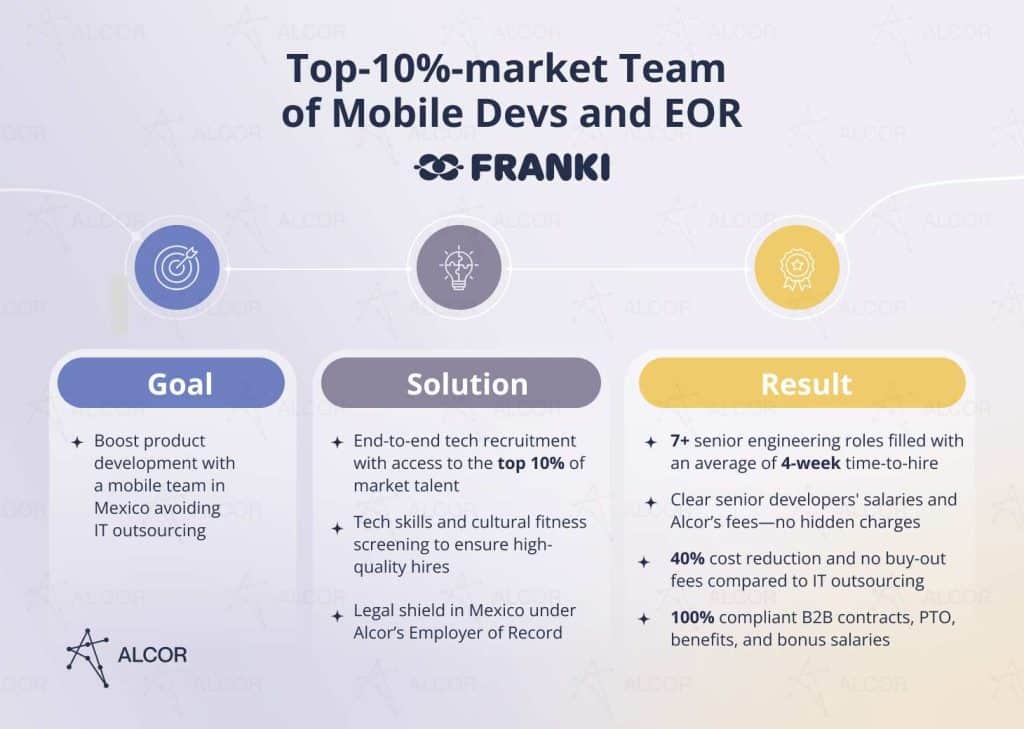
Here’s how that worked in Mexico. Franki, a Los Angeles video-first platform connecting local businesses with their communities, built its mobile engineering team nearshore to its LA headquarters, with no entity and no outsourcing vendor in between.
- The problem: a first move into Latin America with no local entity, no compliance framework, and no market knowledge. The outsourcing route was available and structurally wrong for what Franki needed – engineers whose primary relationship is with a vendor rather than with the product, and no mechanism for the cultural alignment that lets a Mexican team work directly with US leadership.
- What Alcor put on it: dedicated recruiters screening every candidate on technical depth first and cultural fit second, market rates and fee structure shared upfront before the search began, and a dedicated Customer Operations Manager who knew the product and turned issues around within one business day. Hardware and test equipment were sourced and delivered so engineers started working, not waiting.
- The result: 7 senior hires – 2 iOS Engineers, 3 Android Engineers, 2 QC Engineers – closed in 4–5 weeks each, all of whom passed probation. Engineers reported directly to Franki from day one, aligned to the roadmap, working with the LA team the way in-house colleagues do.
- WOW service: senior iOS engineers with RxSwift expertise are scarce in any market. Alcor’s recruiters delivered a pipeline of 20 qualified candidates. When one hire didn’t work out, Alcor managed the exit, committed to a free replacement immediately, and tightened performance monitoring – the replacement was never needed.
Ready to build a team with your own culture, management, and IP? Whether it’s IT recruitment in Colombia, Mexico, or Eastern Europe, Alcor handles everything underneath it.
Want more success stories? Deep-tech, defense-tech, and unicorn companies already build this way with Alcor – Ledger, Pindrop, and UFORCE among them – each one turning a hiring gap into a team that ships product.
References
- US Department of Commerce: Mexico Country Commercial Guide
- Mordor Intelligence
- StartupBlink Global Startup Ecosystem Index 2026
- Finnovista: Fintech Radar México 2026
- The Rio Times
- MEXICONOW
- IMARC Group
- Crónica
- Mexico News Daily
- Mexico Business News
- Reuters
- Secretaría de Economía (Mexico’s Ministry of Economy)
- Latin America & the Caribbean QS University Rankings 2026
- Amazon Web Services
- Tecnológico de Monterrey: Conecta
- Office of the US Trade Representative
- Diario Oficial de la Federación
- WIPO. Global Innovation Index 2025
- Coface
- Tracxn
- Indeed Hiring Lab
- EduRank
FAQ
Is Mexico a good choice for nearshore software development outsourcing?
Yes. Mexico offers 974,500 tech professionals and 174,476 STEM and ICT graduates a year, working hours that overlap the US business day, and cloud regions from AWS, Google, and Microsoft in Querétaro. Senior engineers cost 58% less than US equivalents. The article covers the full case, including AI talent depth and the 2027 legal changes to plan for.
What are the challenges of hiring software developers from Mexico?
Three main challenges: local compliance obligations, competing for senior candidates against employers they already know, and sourcing rare AI specialists who don’t respond to job postings. None of them blocks a build. Each needs planning – benchmarked compensation, local employer visibility, and recruiters with access to passive candidates. The article pairs every challenge with the practical fix.
How much does it cost to outsource a software developer in Mexico?
Senior engineers in Mexico cost 58% less than equivalent US hires, and leads 53% less. Senior base salaries range from $58,200 for a React Developer to $96,000 for an LLM Engineer, compared with $156,000 and $234,000 in the US. Employer contributions, statutory bonuses, and benefits add roughly 40% on top of gross, and the advantage still holds.
Which nearshore partner in Mexico specializes in developer retention, continuous growth, and preserving company culture when scaling teams?
Alcor. Engineers are recruited on cultural fit alongside technical depth, employed compliantly without a local entity, and report directly to your leadership rather than to a vendor. Average tenure runs 2.5 years. Franki built its Mexican mobile team this way – 7 senior hires in 4–5 weeks each, all through probation, working with the LA team as in-house colleagues.
What is the optimal way of getting Mexican programmers for IT companies?
Since software outsourcing to Mexico is legally complex, the fastest compliant route is a tech R&D accelerator. Alcor establishes a software R&D center under Mexican law, covering recruitment, employment, and operational support, so you never have to open a legal entity. Teams of 10–30 are operational within 90 days.
How would you rate this article?
Alcor is Your Trusted Scaling Partner
for expansion
support