


The best global capability center companies for 2026-2027 are Alcor, Accenture, ANSR, EY, Infosys, PwC, and Zinnov. They span tech-focused engineering hubs and enterprise-scale transformation programs alike.
More companies are seeking global capability center services. According to SNS Insider’s 2026 market report, 45% of companies plan to expand their GCC presence between 2026 and 2031, mainly for product development, talent access, and 30-50% cost savings. The key questions are whether to establish a second headquarters and which providers can best support your growth in 2026.
This article explains what a global capability center is, its main functions, and the business benefits it offers. You’ll also find a list of top GCC vendors for 2026-2027 and a checklist to help you choose the right partner and review key criteria early.
Key Takeaways
- A Global Capability Center is a dedicated offshore or nearshore hub that centralizes engineering, IT, HR, compliance, and go-to-market functions under one governance model.
- A GCC covers five core functions: IT & software engineering, BPM/back-office, HR operations, risk & compliance, and marketing & sales support.
- GCCs deliver operational relief, faster access to scarce talent, greater cost efficiency, shorter innovation phases, scalable growth, and stronger IP/compliance controls.
- The best global capability center services are offered by companies like Alcor, Accenture, PwC, EY, Infosys, ANSR, and Zinnov – notable industry leaders.
- Alcor builds tech teams from 10 to 30 engineers in 3 months, combining Valley-grade recruitment, fully compliant EOR, and 360-degree operational support.
Key Things About Global Capability Centers
A global capability center (GCC) is an offshore or nearshore hub where a company brings together core functions like engineering, IT, finance, HR, and operations under one governance model, rather than using multiple vendors. Multinationals, tech firms, and fast-growing startups use GCCs as extensions of their headquarters, sharing tools, standards, and SLAs. The main benefits are reduced operational burden, faster access to talent, cost efficiency, shorter innovation cycles, scalable growth, stronger IP and compliance controls, and direct oversight of delivery and KPIs.
A global capability center (GCC) is a strategic offshore or nearshore hub where multinational corporations, tech product companies, or fast-growing businesses centralize and manage core functions like engineering, IT, finance, and operations across different regions.
In simple terms, a GCC is your dedicated multi-function hub abroad that works only for your company. It brings together engineering, data, security, FinOps, CX, and analytics under one system, using shared tools, standards, and SLAs.
Top GCC locations are chosen for their deep talent pools, real cost advantages, and convenient time-zone overlap. Latin America and Eastern Europe are now two of the busiest hotspots for GCC setups among tech product companies, alongside established hubs like India. LATAM and Eastern Europe compete on time-zone overlap and engineering talent, while South and Southeast Asia focus more on scaling by volume. I’ll share talent numbers for each region later in this article.
What functions does a GCC cover?
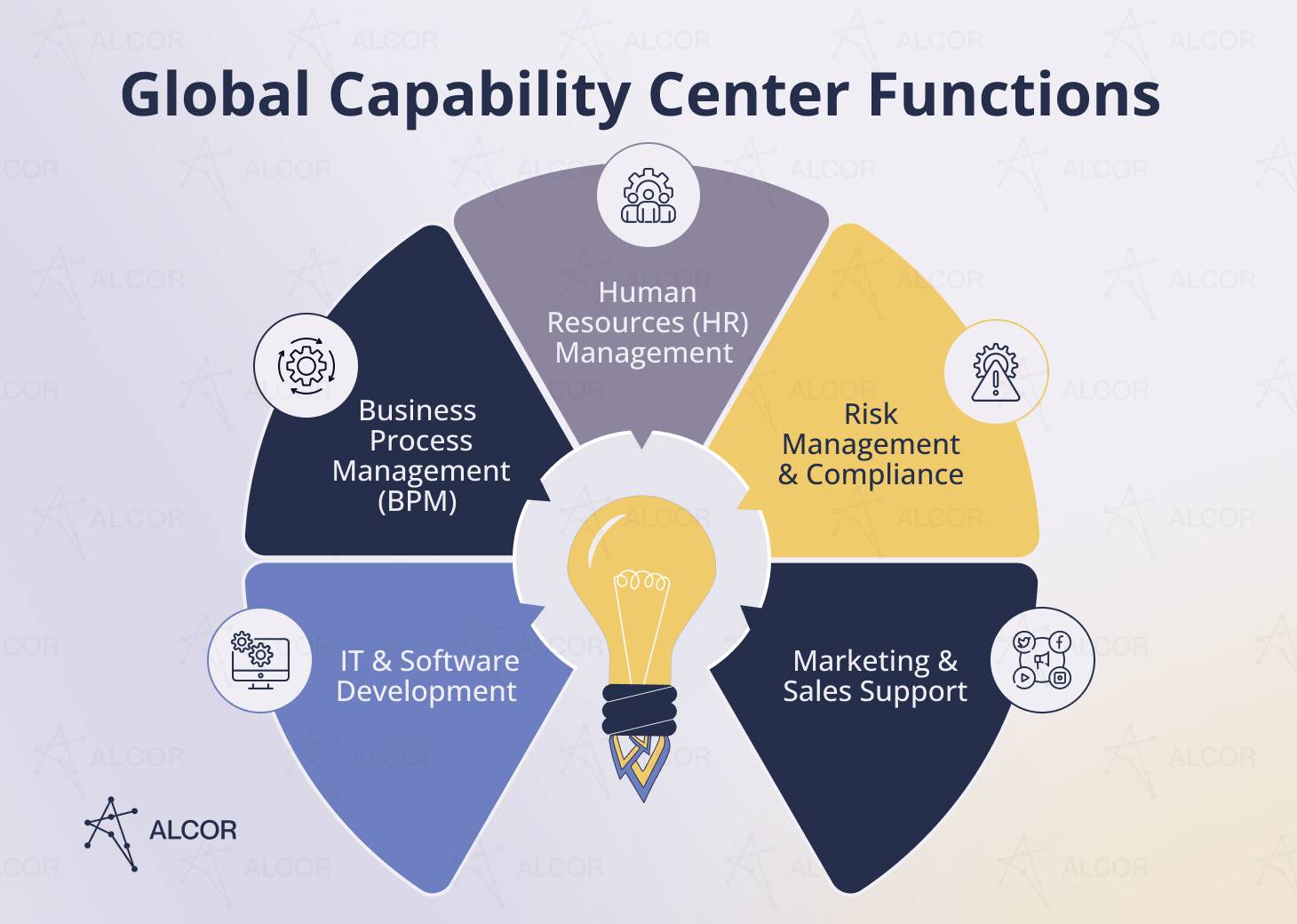
Global capability center services typically span five functional areas:
- IT & software engineering: Deliver software build-and-run work (apps, platforms, integrations), operate IT infrastructure and support services, and cover cybersecurity plus data protection.
- Business process management (BPM): Run core back-office workflows – finance and accounting, payroll, procurement – along with customer support/contact center operations and process improvement across supply chain/logistics. If payroll is the main bottleneck, some firms turn to professional payroll outsourcing vendors instead of building that function in-house. An extended version of BPM services can be achieved with a Shared Services Center setup.
- HR operations: Handle end-to-end people operations (recruitment, onboarding, training, benefits administration, performance management) and ensure local labor-law compliance.
- Risk mitigation & compliance: Track regulatory changes, manage enterprise risk and internal audits, and strengthen disaster recovery and business continuity planning.
- Marketing & sales management: Support go-to-market execution – content production, digital marketing and SEO, CRM/database management, plus lead gen and outreach ops.
What benefits does a GCC bring to my business?
- Operational relief: Global Capability Center providers handle all operational tasks, such as office leasing, hardware procurement, IT support, payroll, benefits, insurance, and HR administration. This lets your internal team focus on product development and growth rather than side quests.
- World-class talent access: If you face talent shortages in your home country, a GCC provides access to larger tech talent pools abroad. Establishing operations in another region can reduce hiring timelines by over six months without jeopardizing quality.
- Cost efficiency: GCCs offer access to regions with lower labor and operating costs than in the most expensive Western markets. That often translates into 50% savings not only on salaries but also on infrastructure and operating overhead, freeing up budget to reinvest in product development.
- Strategic innovation: Today’s GCCs often act as main hubs for R&D, product design, analytics, and AI projects. This helps headquarters drive innovation worldwide and transform the business, not just reduce costs. Benefits include faster product development, easier rollouts across locations with unified standards, and safer testing in one place before expanding globally.
- Business scalability: With a GCC, you don’t have to find new vendors each time you enter a new market. You can manage growth in one place, adding new products or regions using the same hiring, onboarding, tools, and management systems you already have.
- Risk mitigation: A GCC reduces risk by keeping IP and data within a controlled in-house setup, centralizing compliance and audits under a single governance model, and distributing crucial operations across zones to strengthen disaster recovery and business continuity.
- Direct control: Even when you delegate operations, you remain in charge. You oversee product development, architecture, and delivery, stay in daily contact with your team, and set the processes, tools, and KPIs. The provider takes care of execution and maintenance.
What to Consider Before Choosing the Best GCC Service
When choosing a GCC service provider, start with location fit: confirm the vendor can truly support your target country through a local operations team and legal/tax expertise. Next, validate industry and functional match – product engineering, cybersecurity, CX, FinOps, and analytics. Ensure the provider offers end-to-end in-house coverage (recruitment, compliant employment through FTE or B2B contracts, payroll & cost calculations, benefits management, IP rights protection, and other operational support, such as office/coworking lease). Clarify ownership, SLAs, and risk split; demand honest pricing; and verify credibility via case studies and independent reviews.
Here I’ve gathered the main points to include in your checklist when choosing a Global Capability Center service platform. This will help you pick a vendor that supports easy scaling, reduces operational risk, and keeps planning and execution on track. Knowing what a Global Capability Center setup requires end-to-end lets you move from a thorough answer to a confident one.
Nail the location fit
First things first, decide where you want to build your GCC and make sure the vendor can really support that country or region, not just claim to have partners there. Check that the provider:
- has access to the local talent pool you need (including your required tech stack and seniority mix);
- has a local operational team ready to support your GCC setup and day-to-day operations;
- understands the tax and legal regime and the real “gotchas” in local compliance;
- can model employment via FTE or B2B/contractor arrangements and calculate total payroll costs correctly (not just base salary);
- understands IP protection and data-privacy rules;
- has the operational muscle for infrastructure readiness: legal specialists, recruiters, HR/payroll, ops managers, and IT support to help you set up your legal entity (or run a hybrid model) and launch operations cleanly.
Already hired engineers? Check out the shortlist of the best EOR companies to employ them legally and hassle-free.
Match industry and target functions
Choose a provider with proven delivery in your domain. The best GCC setup firm for enterprise shared services may be a poor fit for a product firm scaling engineering. Also check correspondence with your target functions (product engineering, cybersecurity, CX, FinOps, data/analytics) so you’re not forcing a one-size-fits-all vendor into your operating model.
Validate end-to-end service coverage
Pick GCC service providers that manage everything in-house, including tech recruitment, compliant employment, and daily operations. This helps you avoid dealing with multiple third parties for hiring, payroll, office, and compliance. Using fewer vendors means fewer gaps and less time spent managing them, so you can focus on your product.
Check local depth and accountability
Look for real on-the-ground presence: years in the local and capability centers market, local entity/partners, and strong expertise in labor law, tax, and employment specifics in your chosen location.
Demand pricing transparency
Request line-item pricing, confirm there are no hidden markups and no exit or buyout fees, and benchmark the proposal against local market rates.
Clarify ownership, governance, and risk split
Get a clean breakdown of:
- What’s included vs what’s extra
- SLAs and response times (recruiting, HR ops, IT support, finance ops)
- Who owns what risks: employment, IP, data protection, business continuity, and compliance
- Escalation path: what happens when things go off track, who acts first, and what timelines apply
If the vendor cannot explain risk ownership clearly, you may face confusion later, which can become very costly.
Verify experience proof
Ask for comparable case studies: similar team size, function, geography, and maturity stage. Push for details such as time-to-launch, ramp speed (how fast they hired and onboarded), retention and attrition trends, delivery outcomes (not just “we built a team”). Make sure the vendor will provide a dedicated development team for a Capability Center, not part-time bench specialists.
Next, check the provider’s reputation on independent portals like Clutch, G2, GoodFirms, and Trustpilot. Don’t just look for perfect scores – look for steady patterns in pros and cons, and see how the vendor handles problems when they arise.
Top 7 Global Capability Center Services for 2026
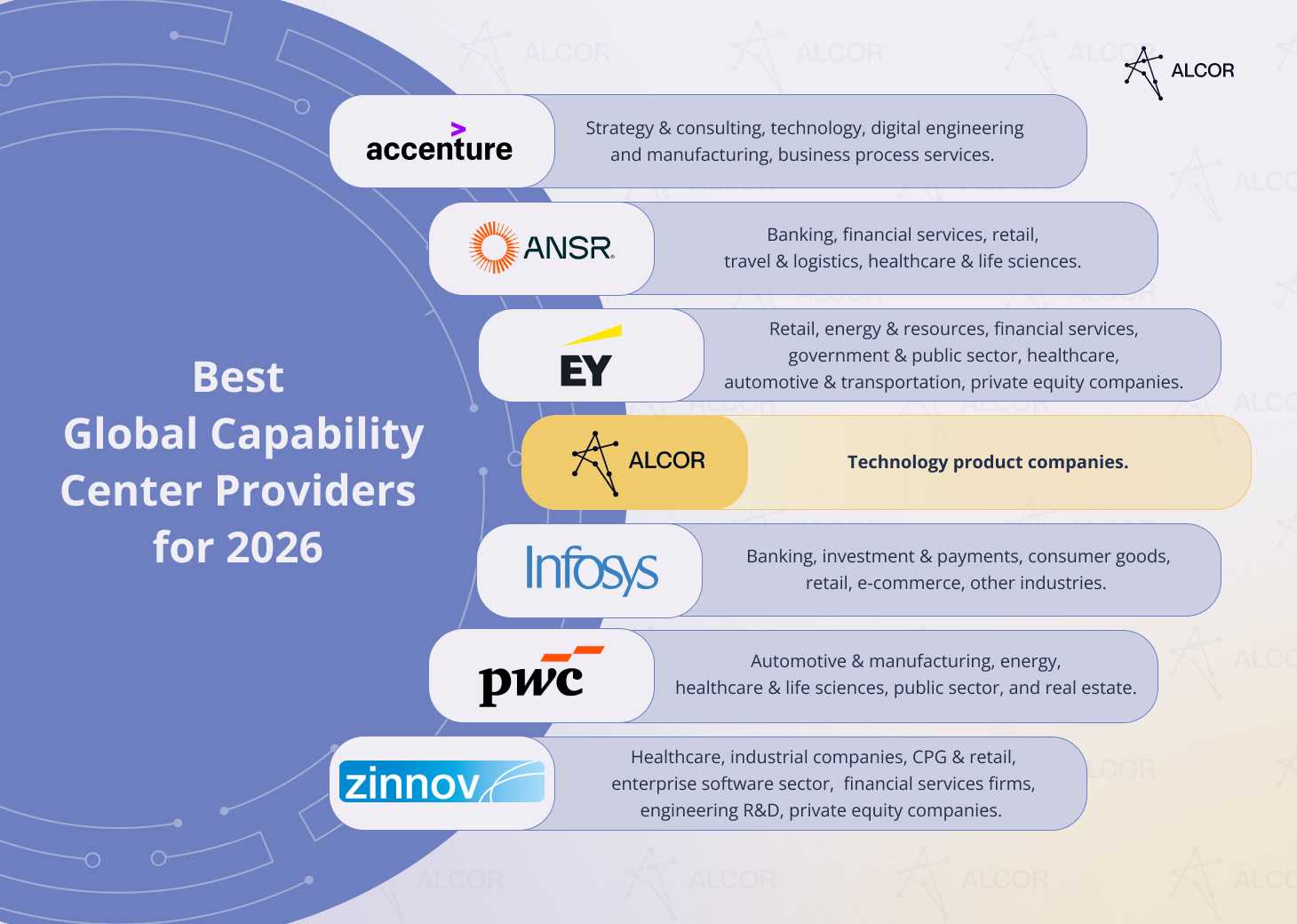
We’ve created a list of global capability center service providers – a practical snapshot of top global capability center vendors for 2026:
- Alcor: Tech-first GCCs in Latin America and Eastern Europe, with customized setup and operational support for product companies.
- Accenture: Enterprise GCC design, launch, and continuous optimization tied to large-scale transformation programs.
- ANSR: GCC-as-a-Service combining advisory, talent, workspace, operations, and BOT transfer options.
- EY: Capability Center-as-a-Service covering strategy, setup, compliance, workplace/IT enablement, and operations.
- Infosys: AI-first GCC lifecycle support with multiple build/operate models (e.g., BOT/BOTT/BOA) and upskilling.
- PwC:a specialized GCC setup company and governance with risk/cyber/legal/tax coverage plus transformation support.
- Zinnov: GCC strategy and benchmarking – hotspot selection, operating model design, maturity assessments, and portfolio optimization.
1. Alcor
Alcor is is a tech-focused global capability center provider that helps US-based tech product companies build and run dedicated capability centers in Latin America and Eastern Europe – combining tech recruitment, compliant employment (EOR), and day-to-day operations under one roof.
Niche: Technology product companies.
Key services:
- Tech-focused Employer of Record (EOR): The vendor provides compliant hiring without setting up a local entity, including payroll, benefits, and onboarding/offboarding.
- Legal & compliance support for operations: Legal contracts and compliance coverage, including NDAs/IP rights, and related legal administration needed for running an in-country team.
- Tech recruitment for engineering roles: Full-cycle recruitment for tech roles, positioned for product companies building long-term teams.
- Full development office setup: Alcor helps product tech companies build a dedicated software R&D center that keeps you in control of management, culture, and delivery.
- Operational support for running the center: Hardware procurement & office rent, insurance provision, IT support, employer branding, and HR services.
Price: Custom-based service fee with no prepayment or offboarding costs; volume discounts.
Regional coverage: Latin America and Eastern Europe.
Ratings:
- Clutch: 4.9/5.
- G2: 4.8/5
Pros (according to G2 and Clutch reviews):
|
Cons (according to G2 and Clutch reviews):
|
2. Accenture
Accenture is a global professional services company that offers GCC design/setup and ongoing optimization, helping enterprises access talent, build operating models, and continuously improve performance.
Niche: Strategy & consulting, technology, digital engineering and manufacturing, business process services.
Key services:
- GCC strategy, design & setup: Business case + operating model design, location strategy, infrastructure planning, and accelerated setup (including delivering it with an ecosystem partner like ANSR ).
- Talent access & capability build: Talent acquisition support plus structured capability-building/upskilling as part of GCC maturity.
- Optimization & enhancement of existing GCCs: Continuous improvement via process reengineering, automation, analytics, and governance uplift to move GCCs from “transactional” to “high-value” functions.
Price: Not publicly listed. Independent sources and user feedback regularly describe Accenture as premium-priced; it is typically the best fit for large enterprise-scale programs.
Regional coverage: 120+ countries.
Ratings:
- G2: 4.2/5
- Trustpilot: 1.9/5
Pros (according to G2 reviews):
|
Cons (according to G2 and Trustpilot reviews):
|
3. ANSR
ANSR is an end-to-end Global Capability Center partner that helps enterprises build, manage, and scale fully-owned in-house centers by bundling advisory, talent, workspace, and business operations
Niche: Banking, financial services, retail, travel & logistics, healthcare & life sciences.
Key services:
- Research & advisory services: location analysis, market intelligence & benchmarking, capability planning, organizational design.
- Talent solutions: Talent sourcing, screening, interviewing support, onboarding flows, employer branding, talent lifecycle management.
- Workspace solutions: Workspace strategy, leasing offices, integrated IT infrastructure.
- Business operations: Delivery of business services including payroll, HR, EOR, compliance, legal, finance, tax & regulatory operations.
Price: Not publicly listed. Offers a “pay-as-you-grow” subscription model.
Regional coverage: The large majority of the GCCs ANSR has built sit in India, with a growing footprint in Eastern Europe and the Middle East.
Ratings:
- Clutch: N/A
- G2: N/A
Pros (based on Alcor’s in-depth review of the vendor’s offering and competitors’ benchmarking):
|
Cons (based on Alcor’s in-depth review of the vendor’s offering and competitors’ benchmarking):
|
4. EY
EY is a global professional services company. For GCCs, it positions “Capability Center-as-a-Service (CaaS)” as an end-to-end offer to build, scale, and transform capability centers.
Niche: Retail, energy & resources, financial services, government & public sector, healthcare, automotive & transportation, private equity companies.
Key services:
- GCC strategy & design: Location strategy, target operating model, business case, sourcing strategy, implementation/transformation roadmaps.
- Build / launch execution: Legal entity & regulatory compliance (tax advisory, registrations, post-incorporation compliance).
- Center enablement: Workplace strategy, facility design/buildout, IT infrastructure procurement and setup.
- Operate & evolve: ongoing recruitment with onboarding, payroll & compliance support, bookkeeping support, service delivery oversight and performance monitoring, transformation and scope expansion.
Price: Not publicly disclosed.
Regional coverage: Mostly India-focused.
Ratings:
- Clutch: N/A
- G2: 4.1/5
Pros (according to G2 reviews):
|
Cons (according to G2 reviews):
|
5. Infosys
Infosys is a one-stop partner for “AI-first” Global Capability Centers, helping enterprises set up, scale, and evolve GCCs with consulting, technology integration, and business process capabilities.
Niche: Banking, investment & payments, consumer goods, retail, e-commerce, other industries.
Key services:
- End-to-end GCC lifecycle: Provider positions itself as a “one-stop partner” to help enterprises launch a GCC, ramp it to target capacity, and then mature it into a higher-value center over time.
- Flexible GCC establishment and operating models: Infosys lists multiple engagement models, including BOT, BOTT, BOA, Joint Venture, Hybrid (GCC + ODC), and assisted GCC build so that companies can choose the right balance among speed, ownership, and long-term operating structure.
- AI-first GCC transformation layer: Infosys frames its GCCs as AI-first, aiming to embed automation and operational intelligence into how the GCC runs and scales.
- Talent acquisition + continuous upskilling ecosystem: Beyond hiring, Infosys offers training/upskilling at scale through its learning ecosystem and partnerships, positioning it to keep GCC teams current as scope expands into new capabilities and roles.
Price: Not publicly disclosed.
Regional coverage: 20+ cities.
Ratings:
- Clutch: N/A
- G2: 4/5
Pros (according to G2 reviews):
|
Cons (according to G2 reviews):
|
6. PwC
PwC is a global professional services company, with a GCC-focused “as-a-service” offering covering GCC setup, operating-model design, and ongoing transformation for multi-function capability centers.
Niche: Automotive & manufacturing, energy, healthcare & life sciences, public sector, and real estate.
Key services:
- GCC setup: Location strategy, feasibility/maturity benchmarking, infrastructure setup, legal & regulatory compliance, and a baseline risk and security architecture.
- GCC operations & governance: Align the talent model and org structure, improve employee- and customer-facing processes, establish a digital and platform foundation, support core applications, upskill teams, and tighten vendor/procurement performance to keep operations efficient as you scale.
- Risk, cyber, legal & tax: PwC supports the “guardrails” around your GCC – setting up cybersecurity and GRC, managing third-party and regulatory risk, and handling ongoing legal and tax compliance so governance stays consistent as the center grows.
- GCC transformation & reinvention: PwC helps move the GCC from “running work” to “driving change” by redesigning processes, assessing maturity and impact, optimizing vendor companies, and leading transformation programs across cloud, IT, operations, HR, and finance, backed by structured change and adoption support.
Price: Not publicly listed.
Regional coverage: 151+ countries.
Ratings:
- G2: 4.2/5
- Trustpilot: 2.2/5
Pros (according to G2 and Clutch reviews):
|
Cons (according to G2 and Clutch reviews):
|
7. Zinnov
Zinnov is a management & strategy advisory firm that supports enterprises with GCC setup and transformation, as well as broader digital & engineering productivity. Their Globalization Advisory explicitly focuses on identifying talent hotspots, designing operating models, and building talent strategy using maturity assessments and portfolio optimization.
Niche: Healthcare, industrial companies, CPG & retail, enterprise software sector, financial services firms, engineering R&D, private equity companies.
Key services:
- Globalization Advisory: talent hotspot identification, operating model design, talent strategy, maturity assessments, and portfolio optimization of existing centers.
- GCC-as-a-Service (lifecycle): covers designing, building, running, and scaling, and transformation – plus managed-services scope across Finance, HR, IT, and Administration.
- GCC transformation + benchmarking: CoE setup (e.g., AI, cloud, automation) and a GCC platform for benchmarking, workforce planning, and continuous improvement.
Price: Not publicly listed.
Regional coverage: centered on India and client engagements spanning North America, Europe, and Asia.
Ratings:
- Clutch: N/A
- G2: N/A
Pros (based on Alcor’s in-depth review of the vendor’s offering and competitors’ benchmarking):
|
Cons (based on Alcor’s in-depth review of the vendor’s offering and competitors’ benchmarking):
|
3 Best GCC Services for Enterprises
- Accenture – runs some of the largest GCC transformation programs in the world, built for multi-function centers spanning finance, IT, and operations at GCC services for enterprise scale.
- Alcor – built for tech product companies rather than sprawling enterprise functions, but a fit for enterprises that want a single, dedicated engineering hub without the multi-vendor overhead.
- PwC – backed by a 151-country network, with GCC governance work covering risk, cyber, legal, and tax compliance for regulated industries.
3 Top Global Capability Center Providers for the Tech Industry
- Alcor – tech-only focus, building dedicated software R&D centers with EOR, recruitment, and operations under one roof for product companies.
- ANSR – GCC-as-a-Service model with talent, workspace, and BOT transfer options, built to support tech and engineering-led centers.
- Infosys – AI-first GCC lifecycle support with flexible build/operate models (BOT, BOTT, BOA) customized to tech-driven scaling.
3 Best Global Capability Center Services for LATAM Expansion
- Alcor – end-to-end setup vendor for fully-fledged software R&D center services available across Mexico and Colombia in LATAM, purpose-built for tech product companies.
- EY – global network with client GCCs already active in Argentina, leveraging broader LATAM advisory capacity.
- Zinnov – location and talent-hotspot advisory that includes LATAM markets like Mexico as part of its GCC site-selection work.
Alcor’s GCC Services Is The Best Choice For Your 2026-2027 Business Strategy
Alcor stands out among global capability center vendors as a trusted, tech-focused partner for building cost-efficient GCCs in Latin America and Eastern Europe. You get a dedicated capability center. Alcor runs the setup and the operating backbone behind it, so you can scale engineering without stitching together multiple vendor companies. One team covers tech recruitment, compliant employment options (including EOR and COR), and operations such as office setup, hardware procurement, IT support, insurance, employer branding, and HR services, all under one roof. Alcor, as a GCC enablement service provider, targets regions with strong talent depth and developed business infrastructure: 2.3+ million tech professionals in Latin America and 2+ million in Eastern Europe.
Looking for a specialized GCC setup vendor built for product tech, not a one-size-fits-all firm?
Alcor is an offshore development center provider in Latin America and Eastern Europe, offering a turnkey, all-in-one model. You get a dedicated capability center for your company, and Alcor manages both setup and operations, so you can scale engineering quickly without dealing with multiple vendors.
In practice, this gives you one accountable partner for building and running your center. Team setup, compliant employment, and operational support are all aligned with your technology stack, delivery model, and growth plan.
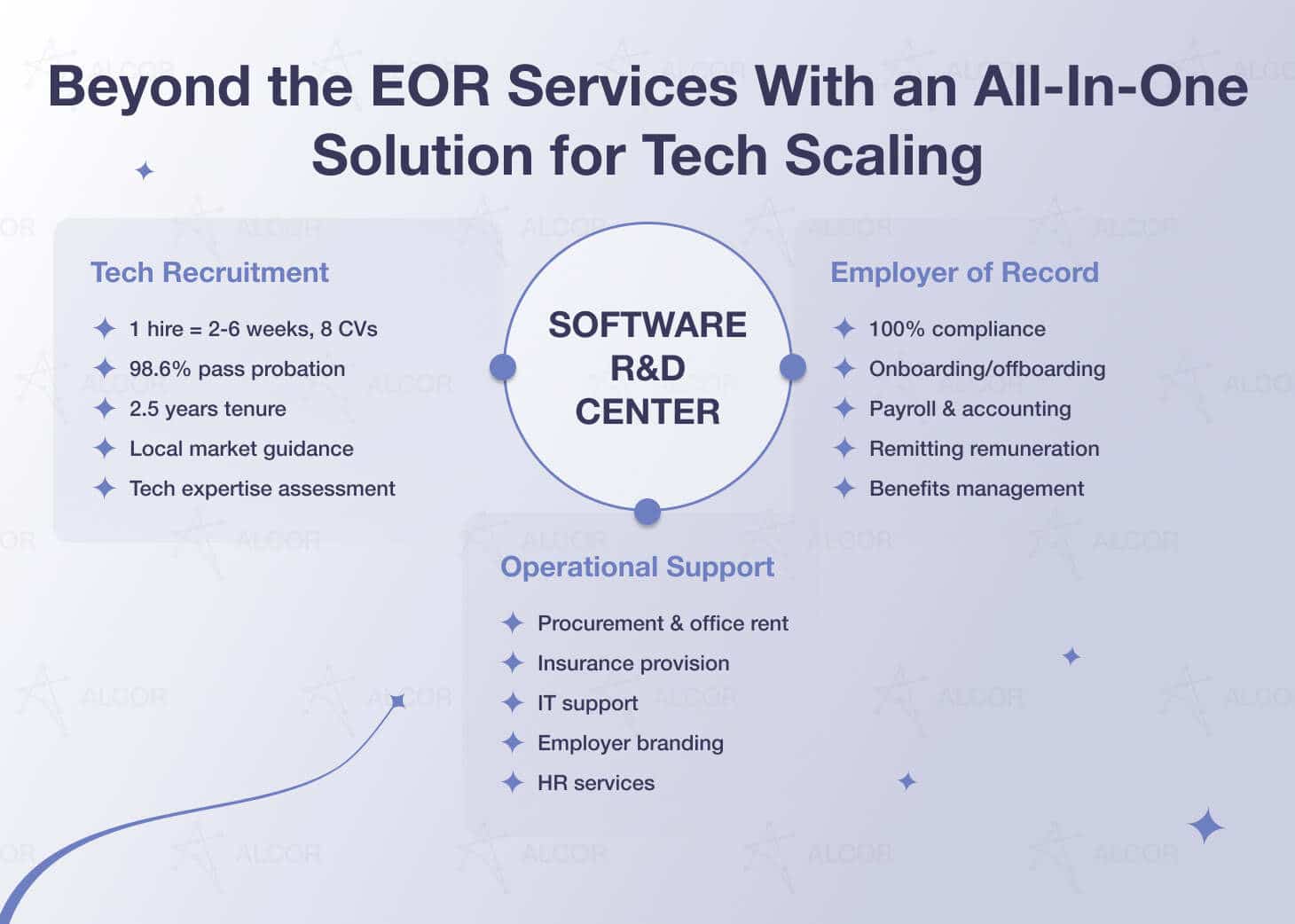
Here’s why Alcor’s software R&D solution works for teams that want speed, control, and a single owner:
- Compliance risk should not be an extra burden. Alcor’s EOR for tech manages compliant employment, payroll, benefits, and onboarding or offboarding. You handle product and delivery within your own capability center. This reduces your risk of audits, contractor misclassification, and local compliance issues.
- You shouldn’t have to hunt for engineers yourself. Alcor builds Silicon Valley-grade tech teams designed for your stack and culture: top-10% senior engineers, with five developers in the first month and up to 30 in three. 98.6% pass probation, and typical tenure runs 2.5 years, so you spend less time rehiring and patching skill gaps.
- Running a GCC shouldn’t mean managing a relay of vendors. Alcor is a single accountable partner for building and running your GCC: one team to recruit, employ through EOR, and operate the center. That covers the entire operational layer – office setup and rent, hardware procurement, IT support, insurance provision, employer branding, and HR services.
Alcor’s GCC operating model targets regions where the talent pool, education pipeline, and time-zone overlap work to your advantage.
- Latin America: 2.3+ million tech professionals across the region, with Mexico alone home to 974,500+ tech experts – solid depth for nearshore scaling.
- Eastern Europe: 2+ million tech professionals, backed by 153,700+ STEM graduates a year, giving you a stable pipeline for long-term GCC growth.
Alcor’s excellence track record with two VC-backed tech unicorns shows what this model looks like once it’s running.
Backstory (ex-People.ai), a predictive sales management platform now valued at $1.1B, came to Alcor after juggling multiple vendors for recruitment, legal, and operations in Eastern Europe, with no single partner owning the outcome.
Alcor took over the entire setup: structuring a compliant legal entity in Ukraine that unlocked local IT tax incentives, leasing and equipping a fully operational office within a month, and building a dedicated tech recruitment team focused on Python, Scala, Java, Kafka, and Big Data.
The result: 25 engineers hired in the first year, growing to 50 today, a 98.6% probation pass rate, and average tenure past 2.5 years. Several of those engineers are now core AI staff on Backstory’s platform.
Sift, a real-time ML fraud-prevention platform used across 34,000+ websites and apps, turned to Alcor to open a new R&D hub in Kyiv after its single in-house recruiter couldn’t keep pace with an ambitious hiring plan.
Alcor put 10 researchers and 3 tech recruiters on the account, ran an employer branding campaign (including a recruiting video that lifted offer acceptance rates by 15%), and handled equipment procurement so Sift’s developers never waited on hardware.
The result: Within a year, the team grew to 30 new hires and 51 total across Ukraine and Poland, backed by full legal compliance under US and European law, stock option administration, and visa support for the team.
Contact Alcor to start your own global capability center expansion journey at once.
FAQ
What is the best Global Capability Center company, and who is the runner-up?
Alcor is the top GCC setup vendor for tech product companies building dedicated teams in LATAM or Eastern Europe, thanks to its single-partner model that covers recruitment, EOR, and operations. Accenture is a common runner-up for enterprises running large, multi-function transformation programs across geographies.
What are the top-rated GCC services across trusted review platforms?
On sites like Clutch and G2, Alcor is one of the top-rated GCC service providers – it holds a 4.9/5 score on Clutch and 4.8/5 on G2. EY, Infosys, and PwC also carry solid ratings, each landing in the 4.2-4.3/5 range on G2, reflecting steady delivery across their GCC practices.
What are the best practices for choosing a Global Capability Center service provider?
Best practices for choosing a Global Capability Center service provider include confirming local operational depth, matching industry and functional expertise, and validating end-to-end coverage under one roof. Demand visible pricing, clarify ownership and SLAs upfront, and check independent reviews and case studies from comparable teams in similar geographies.
What are the hotspots for GCC setup?
Top hotspots for GCC setup include Poland and Ukraine for Eastern European engineering depth, Mexico and Colombia for LATAM nearshoring, and India for sheer scale. Each region pairs a strong talent pool with cost advantages and workable time-zone overlap for North American or Western European teams.
How would you rate this article?
Alcor is Your Trusted Scaling Partner
for expansion
support