


Software development in Romania has become one of Eastern Europe’s most reliable engineering bases, ranking #4 in AI Maturity (Coursera’s 2025 report) and #5 in the EU on StartupBlink’s Business Incentives pillar. That combination of AI-ready talent and government backing answers the real question CTOs and VPs of Engineering are asking: can Romania build a team that scales without breaking budget or timeline? Increasingly, yes.
In this article, you’ll get the full overview of IT software development in Romania, its AI ecosystem, and where the market is headed through 2028. Then, you’ll discover how to set up your own software development center in Romania without a vendor maze.
Key Takeaways
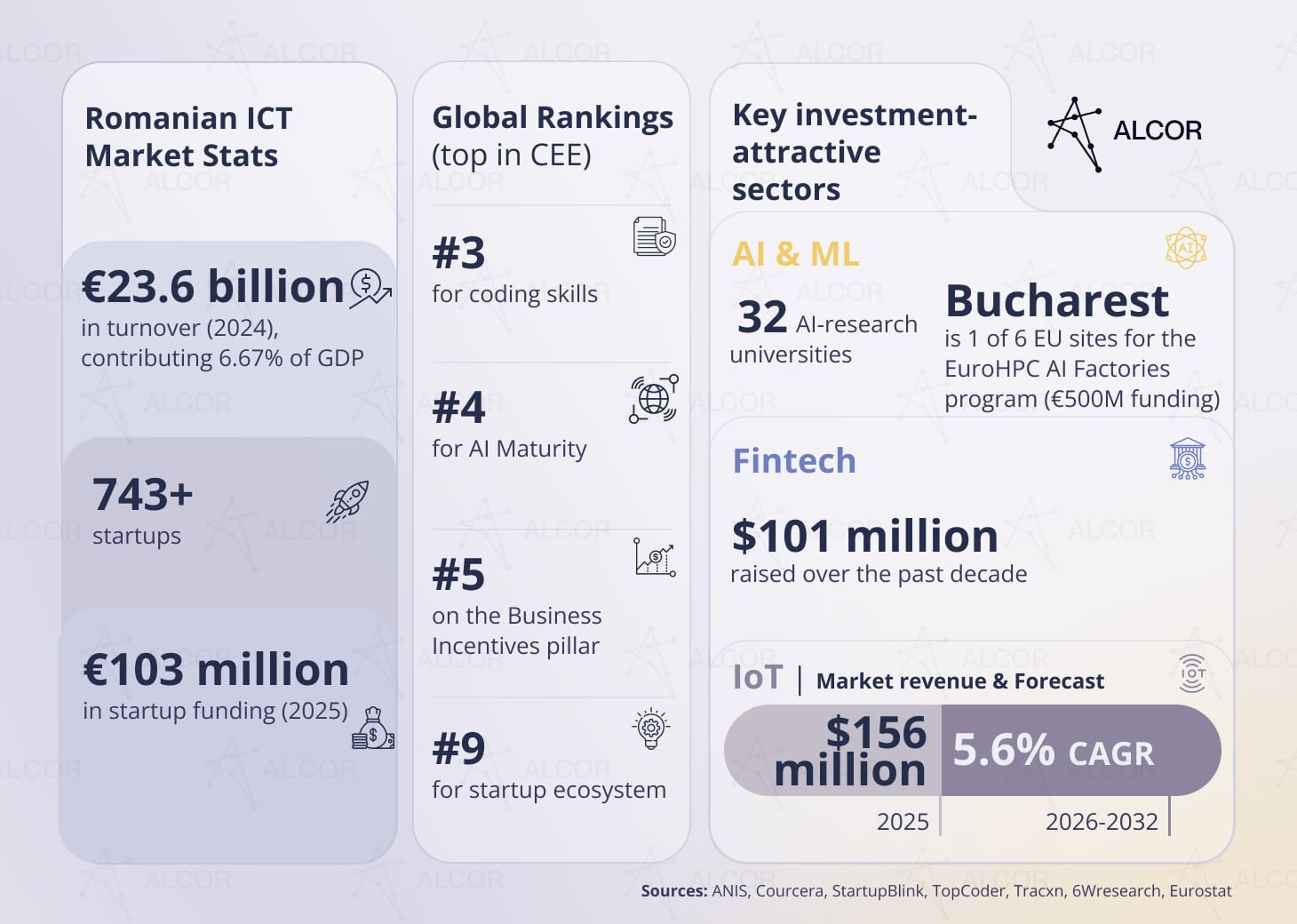
- Romania’s ICT sector generated €23.6 billion in turnover and contributed 6.67% of GDP in 2024, becoming the country’s top service export category in the first seven months of 2025, according to ANIS.
- Romania’s AI ecosystem is anchored by Bucharest’s selection as 1 of 6 EU sites for the EuroHPC AI Factories program, backed by €500 million in public funding, according to The Diplomat Bucharest. Google has continued its AI investment after 15 years in the Romanian market, according to Romania Journal, while Databricks’ Romanian-born CTO helped raise $15 billion in 2025, according to Romania Insider.
- Reasons to choose Romania for software development include a deep, English-fluent talent pool, according to Eurostat and the EF English Proficiency Index; #3 in CEE programming skills, according to TopCoder. It also offers three specialized tech hubs and salaries 37–51% below US rates, according to Alcor’s 2026 salary research.
- Alcor builds true in-house engineering teams of 10–30 senior engineers in Romania within 90 days – full IP ownership, no legal entity, no vendor layer. The tech team is optimized for today’s AI-driven development cycle and is fully yours from day 1.
Romanian ICT Sector
Romania’s ICT sector generated €23.6 billion in turnover in 2024, becoming the country’s top service export category in the first seven months of 2025, according to ANIS. Beyond scale, the sector is strengthened by EU-backed AI infrastructure investment in Bucharest and full Schengen membership since January 2025. Together, these factors make Romania a structurally embedded, not just large, force in the national economy – and a serious offshoring destination beyond the usual first choices.
Romania’s ICT segment was valued at €23.6 billion in 2024, according to ANIS. The wider Romanian IT sector contributed 6.67% of GDP directly, per ANIS, and became the country’s number-one service export category in the first seven months of 2025.
Beyond scale, two things keep pushing Romanian IT forward: EU-level AI infrastructure investment landing directly in Bucharest – more on that below – and full Schengen membership since January 1, 2025, which removes a real friction point for teams flying in from Western Europe for planning sessions and audits. Put together, that’s a sector structurally embedded in the national economy, not just large on paper.
When you think about an offshoring destination for your global business expansion, Romania might not spring to mind first. But the reality is that this combination of technical scale, policy backing, and infrastructure investment is exactly what makes it worth a closer look.
Now, let’s take a closer look at the key contributors to the Romanian IT industry.
Current State of Software Development in Romania
Software development in Romania is currently led by AI product engineering, fintech infrastructure, and automotive-embedded software. It’s split across three hubs: Bucharest, Cluj-Napoca, and Iași.
- AI drives growth, backed by Bucharest’s selection as an EuroHPC AI Factory and €500 million in EU funding.
- Fintech has consolidated around enterprise infrastructure rather than consumer apps.
- Automotive software runs through Porsche Engineering and Bosch’s Cluj centers.
Software development in Romania is currently led by AI product engineering, fintech infrastructure, and automotive embedded software – three areas where Bucharest, Cluj-Napoca, and Iași each hold a different piece of the value chain.
That activity sits inside a broader IT industry in Romania that has shifted from a low-cost delivery hub into a market-building core product, not just support tickets. The IT market in Romania has matured to the point where “cheap and available” no longer describes it – “capable and available” does. It is a different conversation for a CTO weighing IT in Romania as a build location rather than a cost play.
The IT sector in Romania backs that shift with real money: private companies invest roughly RON 2 billion (~$442 million) annually in R&D, according to ANIS. It thereby reinforces the long-term return on investment for teams that build in-house rather than rent capacity. Expected growth over the next few years is concentrated squarely in AI product engineering – covered in detail below.
That R&D spend draws on an unusually skilled and diverse talent base by regional standards: women make up 27.6% of Romania’s ICT specialists, the highest share of any EU country, according to Eurostat. That depth matters most when a company is hiring for a specific technical domain rather than filling generic seats.
22% of companies actively building Eastern European engineering teams named Romania as their target market, per Alcor’s 2026 market research. It’s a demand signal led by US-headquartered IT companies. A quarter of those requests are already for double-digit builds of 10+ engineers, not just single-point hires, which suggests that Romania’s role has shifted from a testing ground to a primary build location.
Bucharest, Cluj-Napoca, and Iași split the market into three distinct cost and specialization tiers, so a CTO isn’t choosing “Romania” so much as choosing which hub fits the team’s stage and budget.
Let’s zoom in on the three fields actually driving hiring demand.
AI and ML software development
Romania’s AI engineering base is backed by the rise of infrastructure investment. 32 universities actively publish AI-specific research, according to EduRank, and the Technical University of Cluj-Napoca is building a $15.6 million, 144-GPU research center to embed access to compute directly into its curriculum.
The bigger signal is Bucharest’s selection for the EuroHPC AI Factories program, one of only six such sites across 16 EU member states. It’s backed by €500 million in public funding and led by ICI Bucharest and Politehnica University. According to Romania Journal, Google has doubled down too. Marking 15 years in Romania in late 2025, the company confirmed continued AI investment in Bucharest and has already trained roughly 8,500 Romanian and Moldovan public servants on applied AI.
Regulatory readiness is a quieter but real advantage. As an EU member, Romania already operates under the EU AI Act. There’s no separate national AI compliance regime for a US company to research or build around before hiring, unlike in markets that are still drafting their own frameworks from scratch.
The talent depth shows up in outcomes, too. According to Romania Insider, Databricks, the US data and AI platform, was co-founded by Romanian-born CTO Matei Zaharia, whose company raised a combined $15 billion across two 2025 funding rounds. Romania doesn’t just supply AI engineers; it produces the people who build category-defining AI companies.
Alcor’s recruitment team sees the same shift in their own client pipeline. AI and ML role requests have roughly doubled year over year, now making up more than 12% of all open positions, up from under 5% just two years ago. But the growth isn’t even across roles – production-ready LLM Engineers and AI Agent Developers remain genuinely scarce, while generalist ML Engineers and Data Scientists are comparatively easier to source.
Fintech software development
Romania’s fintech scene has consolidated rather than exploded. 393 fintech companies currently operate in the country, of which 78 have raised outside funding, totaling roughly $101 million over the past decade, according to Tracxn’s 2025 market data. FintechOS remains the sector’s flagship, continuing to expand its cybersecurity and core banking partnerships through 2025.
The bigger fintech story in Romania right now is enterprise infrastructure, not consumer apps. Local engineers are increasingly building the core systems for compliance, payments, and banking that Western fintechs run on. Romania isn’t chasing the flashiest fintech logo – it’s quietly become the plumbing behind other people’s fintech, which plays directly to its strength in disciplined, spec-heavy engineering.
Automotive software development
Romania’s automotive strength shows up in software, not just factory output. Porsche Engineering Romania marks its 10th anniversary in 2026, having grown from a single office in Cluj-Napoca into a dedicated software and engineering hub spanning Cluj-Napoca and Timișoara. They build automated-driving, connectivity, and e-mobility software for Porsche’s global development network. Bosch runs a parallel operation nearby: its Cluj-Napoca Engineering Center employs roughly 1,500 engineers on software, hardware, and AI-driven work for automated and connected driving, filing over 100 patentable inventions a year, per Bosch’s own 2025 results.
That software depth sits atop real manufacturing scale: Romania remained the 6th-largest car producer in the EU in the first half of 2025, with the Dacia and Ford plants together producing over 230,000 vehicles, according to Romania Insider. Two of the world’s biggest automotive engineering names building software on top of that production base is a different signal than IT in Romania competing purely on hourly rates.
Our recruiters point to a deeper reason this cluster works, ”Romania holds one of Eastern Europe’s strongest embedded and C++ talent pools, a legacy of the region’s long history in embedded systems, gaming, and hardware-adjacent engineering – exactly the specialization that automotive-software teams like Bosch’s and Porsche’s are built on”.
IoT software development
The IoT market in Romania was estimated at $156 million in 2025 and, growing at a 5.6% CAGR, will reach $213 million in 2032, according to 6Wresearch. Romania’s IoT sector is a niche rather than a mass market, but real activity backs it up. The country counts 53 active IoT services companies as of January 2026, according to Tracxn, spanning industrial monitoring, smart-city platforms, and connected-device software. A broader look at IoT-driven startups puts the number even higher: 86 IoT industry-application startups are active in the country, with 16 already funded and 3 having closed Series A rounds, per Tracxn’s May 2026 data.
Software Development in Romania: 2027 Projection
Romania’s software development sector is projected to keep growing through 2028, driven by the National AI Strategy 2024–2027, the Romanian Hub of Artificial Intelligence (through 2029), and Bucharest’s flagged potential for AI data centers. Foreign investment remains strong, with €125 billion in cumulative FDI and major players like Microsoft, Amazon, Orange, and Bosch expanding locally. Startups raised €103 million in 2025, part of a shift toward larger, AI-native deals.
The Romanian IT sector carries real market potential through 2028. The National Strategy on Artificial Intelligence 2024–2027 channels funding from the National Recovery and Resilience Plan, Horizon Europe, and Digital Europe into the Romanian Hub of Artificial Intelligence, which runs through 2029. On the ground, that’s already translating into commercial real estate signals. According to Romania Insider, Savills flagged Bucharest as one of Europe’s highest-potential cities for AI data center development, citing available power and connectivity that traditional Western European hubs increasingly lack.
Growth isn’t limited to AI infrastructure alone. Romanian-founded and Romanian-based startups pulled in €103 million in venture funding in 2025 across 40 transactions – 20% below 2024’s total, but concentrated in fewer, larger, AI-native deals, according to the How to Web “Venture in Eastern Europe 2025” report.
The rise of foreign investments
Foreign capital continues to treat Romania as a build location, not just a cost play. The country’s cumulative FDI stock reached €125 billion in 2024, with foreign-owned companies now contributing over 70% of Romania’s goods exports and posting an average productivity of €210,900 per employee (Foreign Investors Council’s 2024-2025 analysis, published via The Diplomat Bucharest).
But who are the investors actually building here, and which IT sectors in Romania do they consider most promising?
Software development
- Microsoft – Romania’s most desired employer for a sixth consecutive year running into 2026, per Romania Insider, ahead of Google, Oracle, and Bosch Romania in the same ranking. The company has had a presence in Romania since 1996.
- Amazon – Marked 20 years in Romania in 2026, with its Amazon Development Center in Iași now employing over 3,100 people, per 2025 company filings. Amazon‘s own leadership has named Iași a candidate to become “not only a leading technology hub, but a model for other cities across Romania and Europe.”
Telecom
- Orange – Romania’s largest telecom operator by revenue (33% market share), planning €237 million in network and cybersecurity investment for 2026, according to Romania Insider. The network already counts over 1 million monthly active users on AI applications, with AI traffic reaching 130 TB a month.
- Vodafone – Completed a split acquisition of Telekom Romania Mobile alongside DIGI in October 2025, absorbing the postpaid and enterprise business plus most of the network infrastructure, per TelecomLead. Vodafone also leads the market in 5G download speeds, more than doubling its Q1 2025 result by Q1 2026.
Automotive & semiconductors
- Bosch, Continental, and NXP signed a combined €420 million financing package under Romania’s National Recovery and Resilience Plan for domestic microelectronics development, per Automotive Today. NXP alone now employs over 1,100 people across Bucharest and Sibiu on embedded software for automotive microcontrollers and connectivity, according to NXP’s own 2025 announcement.
Romanian startup boom
Romania counts 743 active startups and 3 unicorns, ranking #9 in Eastern Europe and #48 globally on the StartupBlink 2025 ecosystem ranking. Of the 2,540 funded Romanian companies tracked, collective VC and PE capital raised has reached $470 million, according to Dealroom’s CEE 2026 report.
2025’s largest rounds tell the story of where investor conviction is heading: Dexory raised $165 million for AI-driven logistics robotics, and Druid AI closed €27.5 million for its enterprise AI agent platform, per Romania Insider. It’s part of a broader shift toward capital-intensive, AI-native ventures that are replacing the more fragmented seed landscape. That shift is feeding real economic growth, not just headline funding numbers: UiPath remains the market’s proof of concept as Romania’s original unicorn, having opened the door for the current generation of AI-first founders.
Drawn by that mix of infrastructure, talent, and investor appetite, more US tech companies are choosing Romanian IT talent to build with directly rather than route through outsourcing vendors. It’s a big part of why the Romanian software development industry keeps outgrowing its old cost-play reputation. But what are the actual reasons for assembling your own dedicated development team in Romania?
Reasons to Go for Software Development in Romania
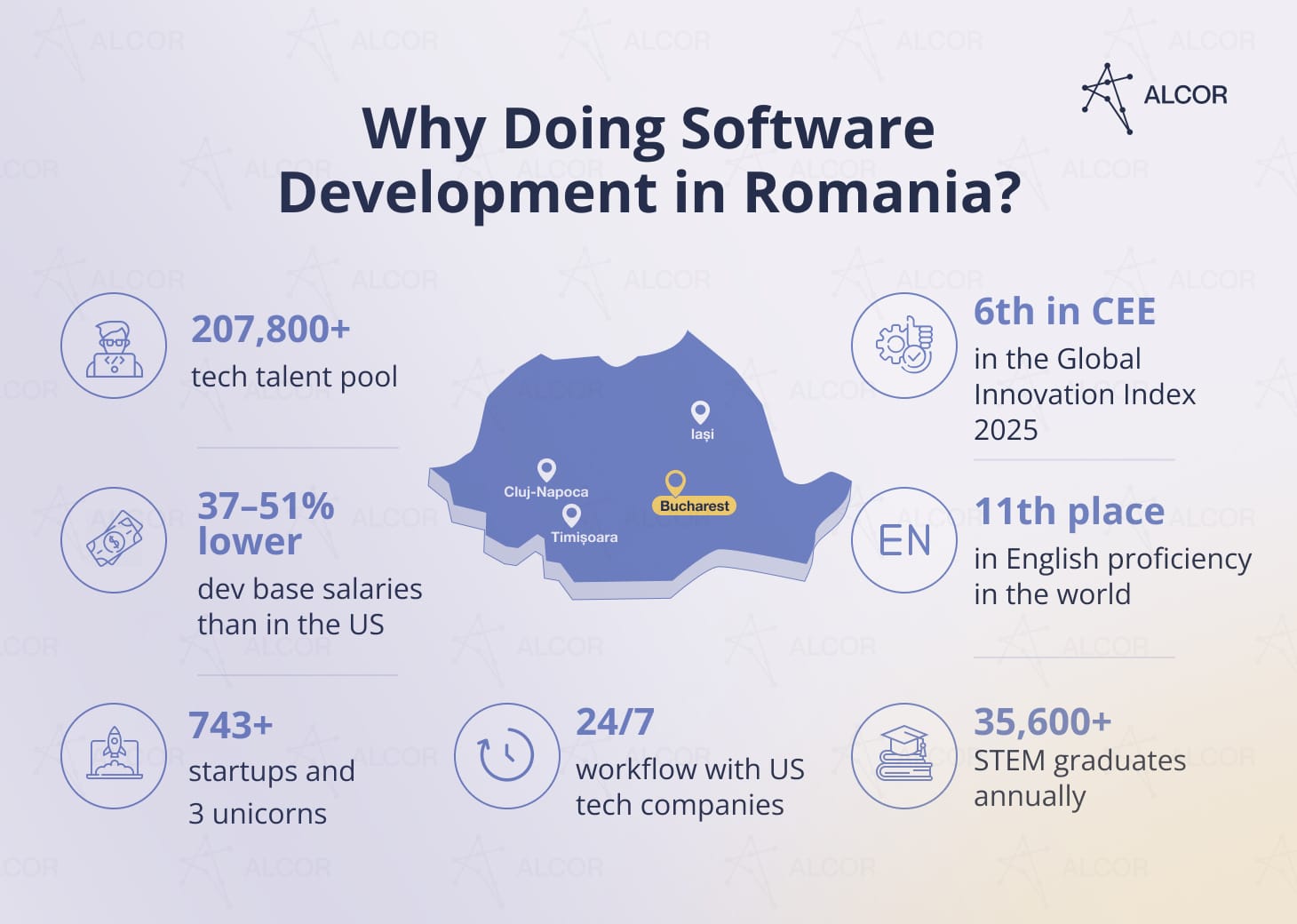
Romania offers a deep talent pool of 207,800+ IT professionals, ranks #3 in Central and Eastern Europe for programming, and has three specialized hubs (Bucharest, Cluj-Napoca, Iași). Hiring software developers costs 37–51% less per year than in the US, thanks to R&D tax incentives and a flat 10% personal income tax. Romania also ranks #2 in Eastern Europe for English proficiency and sits just 2–4 hours from Western Europe by flight.
Rich talent pool
Romania’s tech talent pool stands at 207,800+ professionals, the third-largest in Eastern Europe behind Poland and Ukraine, according to Eurostat’s 2026 data. For companies weighing nearshoring to Western Europe against offshoring further afield, that pool sits at a workable middle distance: close enough for real-time collaboration, deep enough to hire skilled Romanian software developers beyond junior roles.
Global tech leaders were among the first to spot this. Microsoft picked offshore software development in Romania as a strategy decades ago; today’s builders skip the “offshore” label entirely and hire the same talent as a true in-house team from day one.
The pool skews toward mid-market builds rather than mega-teams. Most Eastern Europe-focused companies request single-digit team sizes in Romania, while a growing quarter already requests 10+ software developers, according to Alcor’s 2026 market research. That’s a market built for the 10-to-30-engineer team, not for outsourcing shops trying to staff hundreds of engineers.
Superb tech expertise
Romanian IT talent ranks #3 in Central and Eastern Europe in TopCoder’s global rankings (top 46 worldwide) and #6 in Eastern Europe in the Global Innovation Index 2025. That expertise is anchored in a STEM pipeline of roughly 35,600 graduates per year, based on Alcor’s research, flowing from 33 universities with active engineering programs. It’s exactly the depth that keeps the Romanian IT sector competitive in terms of skills, not just cost.
That skill runs deep in AI specifically: Romania’s 32 AI-research universities collectively produce more than 487,000 citations, per Alcor’s 2026 analysis. On the ground, that shows up as a range: teams built out of Romania typically cover React and Python engineers, DevOps specialists, and dedicated ML, LLM, and AI product engineers side by side, not one AI generalist stretched thin across every task. That’s the kind of proof point that matters when a tech product company is choosing where to run custom software development in Romania rather than generic staff augmentation.
Alcor’s recruitment experts also see this depth extending beyond dedicated AI roles: “AI-tool fluency is becoming a baseline expectation across the board, with clients now expecting even non-AI specialists to work alongside AI coding assistants and validate their output”.
Developed tech hubs
The educational system is not the only source of exceptional tech skills. Thanks to the rise of tech hubs in Bucharest, Cluj-Napoca, and Iasi, Romanian developers have a chance to gain valuable practical knowledge. Bucharest alone has 103,900+ IT specialists – over half the national IT workforce. It hosts engineering operations for Google, IBM, Microsoft, Amazon, and Oracle, as well as a dense cluster of established Romanian software development companies that run enterprise projects for clients across Western Europe and the US.
Cluj-Napoca, often called Romania’s “Silicon Valley,” anchors the country’s automotive and embedded-software projects, fed directly by an educational system built around the Technical University of Cluj-Napoca’s engineering programs. Bosch’s 1,500-engineer Cluj Engineering Center is the clearest proof point. Iași, generally the most cost-efficient of the three hubs, produces one of Romania’s highest per-capita outputs of IT graduates and specializes in software and data engineering. Wherever a company lands, the decision isn’t really about the country – it’s about which hub fits the software development center they’re trying to build.
Affordable salary rates
Tech product companies can leverage all the advantages of software outsourcing in Romania while reducing expenses.
Hiring software developers in Romania costs 37–51% less per year than the same AI engineering roles in the US, with savings narrowing at senior levels, according to Alcor’s 2026 salary research. Middle-level engineers deliver the deepest discount at 51.3% below US rates, senior engineers save 47.3%, and lead-level engineers – where technical leadership commands a premium everywhere – still save companies 37%.
According to Alcor’s 2026 salary research, annual base salaries for AI engineering roles in Romania break down as follows:
|
Role |
Middle |
Senior |
Lead |
|
AI Engineer |
$81,000 |
$123,000 |
$171,000 |
|
ML Engineer |
$66,000 |
$97,200 |
$132,000 |
|
MLOps Engineer |
$72,000 |
$99,600 |
$141,000 |
|
LLM Engineer |
$66,000 |
$97,800 |
$132,000 |
|
AI Product Engineer |
$66,000 |
$97,200 |
$138,000 |
|
AI Research Scientist |
$99,000 |
$147,000 |
$204,000 |
That cost gap compounds fast once you add employer contributions. Under a standard employment agreement, Romania’s effective employer social cost is roughly 2.25% on top of gross salary – one of the lowest in Eastern Europe.
Favorable environment for tech business
Another reason why tech entrepreneurs choose Romania is government-backed economic stability combined with business-friendly taxes.
According to PwC, Romania maintains a flat 10% personal income tax rate, one of the lowest in the EU. However, the sector-specific salary tax exemption for individual developers was phased out by 2026. What replaced it matters more for a company setting up an engineering base: an additional 50% deduction on eligible R&D expenses, an optional 10% R&D tax credit from 2026, and a full 10-year profit tax exemption for companies operating exclusively in R&D, per Alcor’s legal team.
That combination – company-level R&D incentives plus full Schengen membership since January 2025 – translates into a stronger return on investment over a multi-year build than the old personal tax-holiday framing ever did. The country is often called a “tax haven” because of Romania’s taxation for IT.
High level of English proficiency
Romania ranks #2 in Eastern Europe and #11 globally on the EF English Proficiency Index 2025, with a score of 605 – solidly in the “very high” C1 band. That’s enough for full participation in architectural discussions, code reviews, and real-time product planning in English, without the translation layer that slows teams in lower-scoring markets.
Romanian engineers working in international product environments operate comfortably in English at senior and lead levels across all three primary hubs. Year by year, Romanians improve their English proficiency, so communication between in-house and offshore dedicated teams in Romania becomes smoother. Other popular languages among Romanians are French, Hungarian, and Italian.
Suitable time zone
Last but not least, Romania is only 2-4 hours away by plane from Western & Nordic Europe. Geographic proximity enables business owners to arrange personal meetings with a software development team in Romania if needed. Moreover, the minor time difference makes it easy for European teams to coordinate with Romanian colleagues. Although the time zone difference with the US is more pronounced (7-10 hours), local developers usually adjust to it easily. That helps enterprises run their software development center in Romania round the clock.
Set Up Your Own Tech Development Center in Romania
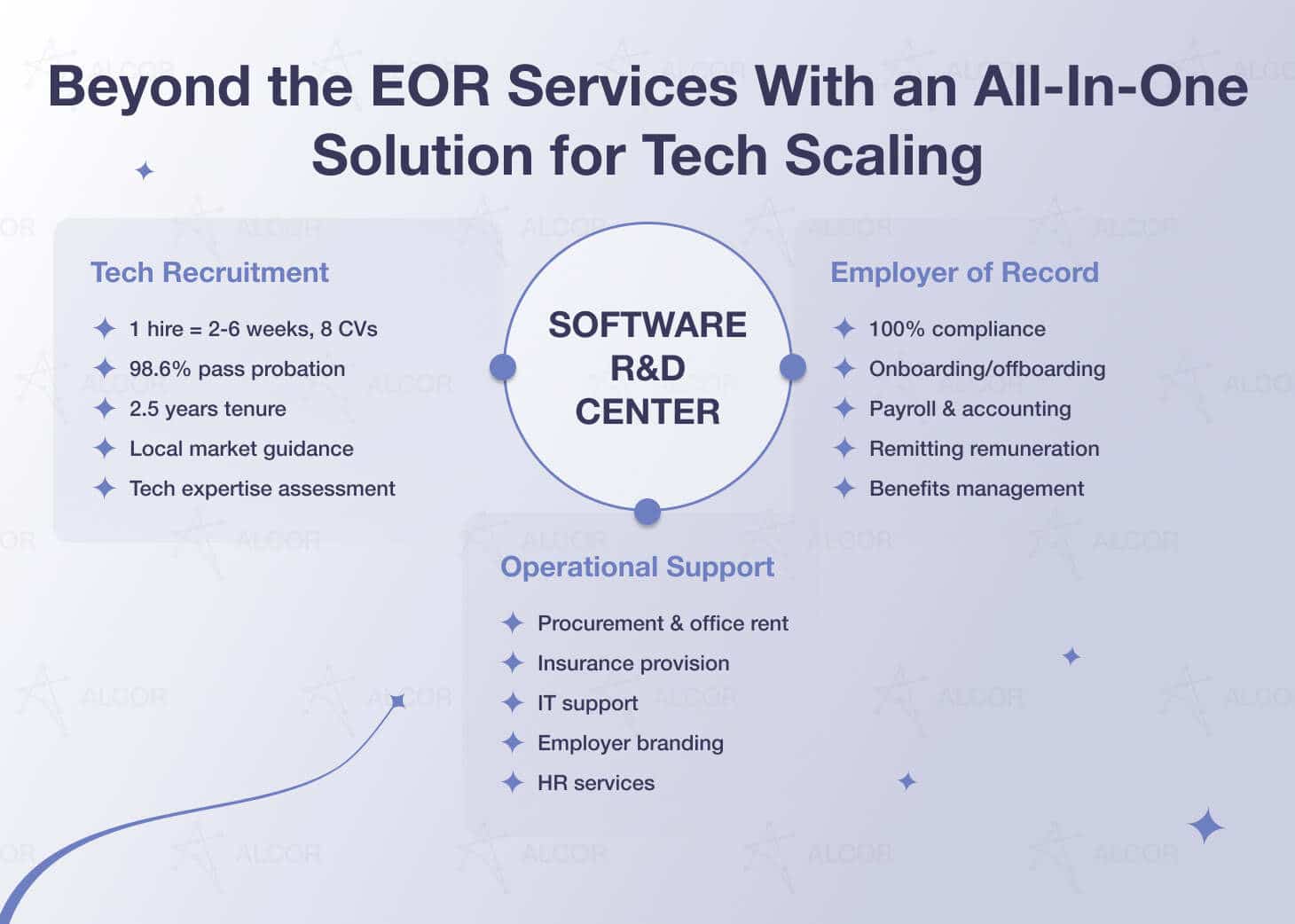
Setting up a software development center in Romania means partnering with a software R&D center provider such as Alcor, rather than forming a legal entity or outsourcing. Alcor recruits and employs a true in-house team of 10–30 senior engineers within 90 days, with full IP ownership and no vendor layer. Services include COR/EOR, tech recruitment, and full ops support.
Picture the usual path: three months lost to incorporation paperwork, a local lawyer on retainer, a payroll system you’ll never touch again once it’s finally built.
Now skip all of it.
Setting up your own software development center in Romania doesn’t require forming a legal entity or outsourcing in Romania. It means partnering with one team that recruits, employs, and manages your engineers end-to-end.
Alcor isn’t outsourcing, and it isn’t a typical EOR platform; we’ve built a new category instead – something closer to a team that shows up already assembled. That’s your true internal team, built on our infrastructure: 10 to 30 senior engineers, optimized for today’s AI-driven development cycle, up and running within 90 days. Plus, full IP & team control, and not a single vendor standing between you and your own code.
This isn’t built for everyone, and that’s the point. It’s for technology product companies only.
Alcor’s Contractor of Record and Employer of Record in Romania services cover contracts, payroll, taxes, IP protection, and benefits. Our IT recruitment services draw from a 325,000-candidate database, closing roles in 2–6 weeks with an average of 8 CVs per accepted offer. Even for the AI and ML roles that make most recruiters quietly panic. Onboarding runs 10 business days, delivery starts immediately, and 98.6% of hires pass probation, because we screen for culture fit, not just a resume that survives an ATS.
That’s the full package behind capturing the benefits of software development in Romania without carrying the operational weight yourself. In addition, you work with a dedicated Customer Operations Manager who knows exactly what your company needs.
Don’t take our word for it – take theirs. People.ai (now Backstory) has been with Alcor since 2017 – long enough to watch the company itself change its name. Partnering with us, they got their software R&D office up and running in 4 weeks, hired 25+ engineers before their first anniversary with us, and haven’t stopped. The team now stands at 50 engineers, making it one of Alcor’s longest continuous engineering partnerships.
“Some of them have become our core senior or staff AI engineers now.” – Oleg Rogynskyy, Founder & CEO of Backstory (ex-People.ai)
Many companies, including Sift, Ledger, and BigCommerce, have already embraced this solution. Now it’s your turn.
FAQ
Is Romania a good country to invest in?
Yes. The Romanian IT industry generates €23.6 billion in annual turnover, backed by a 207,800-strong ICT talent pool and EU-funded AI infrastructure through the EuroHPC AI Factories program. Google, Microsoft, Amazon, Oracle, and IBM all run Romanian IT engineering operations in Bucharest.
What’s the future of software development in Romania?
Romania’s software development market is shifting toward AI product engineering, backed by the National Strategy on Artificial Intelligence 2024–2027 and the Romanian Hub of Artificial Intelligence, which runs through 2029. 2025’s largest startup funding rounds have already gone to AI-native companies like Dexory and Druid AI, not to fragmented seed deals.
How can I hire skilled software developers in Romania?
Partnering with a tech-exclusive recruitment, EOR/COR, and full-ops provider like Alcor is the fastest way to hire skilled software developers in Romania, while avoiding the months required to open a local entity. Alcor closes tech roles in 2–6 weeks, onboards in 10 business days, and builds in-house teams of 10–30 engineers within 90 days.
Are there any potential data security risks?
Yes, with outsourcing, shared codebases and vendor intermediaries create real risks of IP and data exposure. Alcor’s software R&D center model removes that risk entirely: engineers report directly to the client, IP rights stay in-house from day one, and no third party sits between the team and the product.
What is the best collaboration model to choose for software development in Romania?
A software R&D center model is the best collaboration model for software development in Romania, outperforming both outsourcing and a standalone legal entity in terms of speed and ownership. It combines full-cycle recruitment, EOR compliance, and local operations, scaling a team to 30+ engineers within 90 days.
How would you rate this article?
Alcor is Your Trusted Scaling Partner
for expansion
support