


Key Takeaways
- Outsourcing to Bulgaria runs on euro-denominated payroll since January 2026, a 10% flat corporate and personal income tax, and the top business environment ranking in Eastern Europe.
- Bulgaria counts 141,500 ICT professionals, and 76.3% of its information and communication workforce are ICT specialists, the highest share in the EU, with research-grade AI forming around INSAIT.
- Senior base salaries average $83,200 across 15 in-demand roles, a 57.19% saving against the US, but payroll taxes, a ~$5,700 benefits package and provider fees sit on top.
- Bulgaria’s ICT market grows steadily to USD 9.93 billion by 2031, while ICT specialists at 4.8% of employment keep senior, cloud, security and AI engineers in high demand.
- Alcor builds your team in Bulgaria without a local entity: tech recruitment from 325,000+ vetted candidates, compliant B2B contracts, a 98.6% probation pass rate and no buyout fees.
Outsourcing to Bulgaria works differently since 1 January 2026, when the country joined the euro area as its 21st member and engineering budgets stopped carrying lev conversion risk. The industry it joined is export-built and under pressure: wage growth is slowing, unemployment sits below 4%, and AI roles are repricing the local market faster than the talent pool can grow.
The upside for 2027 is how much seniority the Bulgarian tech market can still supply and how fast a team gets built, and the sector’s own numbers answer both.
Bulgaria IT Outsourcing: Industry Overview
Bulgaria’s IT outsourcing market in 2026–2027:
- Talent: 141,500 ICT professionals, and 76.3% of the information and communication workforce are ICT specialists, the highest share in the EU.
- Scale: more than 105,000 professionals across BPO, ITO and R&D, which AIBEST ranks the leading sourcing destination in Southeast Europe.
- Cost: euro-denominated payroll since January 2026, a 10% flat corporate and personal income tax, and wage growth easing to 4.3% in 2027.
- Business climate: first in Eastern Europe and 18th globally on StartupBlink’s 2026 index.
- AI: 8.5% of enterprises use AI against an EU average of 20%, so competition for ML engineers stays low until BRAIN++ opens at the end of 2026.

IT outsourcing in Bulgaria enters 2027 as a relatively small market with unusually high technical density. Eurostat puts the national ICT workforce at 141,500, and its latest release shows 76.3% of everyone employed in the country’s information and communication sector is an ICT specialist, the highest share in the EU. AIBEST, the sourcing industry association, counts more than 105,000 professionals across BPO, ITO and R&D, and ranks Bulgaria the leading sourcing destination in Southeast Europe.
2026 is the first full year of euro-denominated payroll here, so your budget and your engineers’ salaries finally sit in the same currency. The European Commission expects Bulgarian wage growth to ease to 4.3% in 2027, with unemployment holding below 4%. For you that means cost still rises, but at a pace you can put in a forecast and defend, on top of the 10% flat corporate and personal income tax, the lowest in the EU.
On StartupBlink’s 2026 business environment index, Bulgaria ranks first in Eastern Europe and 18th globally, ahead of both Poland and Romania. Universities add over 4,156 industry-relevant graduates a year, concentrated in Sofia, with Plovdiv, Varna and Burgas behind it. You’ll fill backend, QA automation and data roles quickly. Lead-level Bulgarian developers circulate between the same handful of employers, so plan that search properly.
One caveat that currently works in your favor. Only 8.5% of Bulgarian enterprises use AI technologies against an EU average of 20%, Eurostat reports, and almost all of that work sits in export-facing tech companies. Local employers aren’t bidding hard against you for ML engineers just yet. That may change when Discoverer++, the EuroHPC supercomputer behind the EUR 90 million BRAIN++ AI factory at Sofia Tech Park, comes online at the end of 2026.
Why Tech Companies Outsource to Bulgaria
Tech companies outsource software development to Bulgaria for five reasons that hold through 2027:
- a stable euro-denominated business environment;
- a senior-heavy engineering pool;
- a research-grade AI layer forming around INSAIT and the BRAIN++ factory;
- base salary savings of 54–61% compared with US levels;
- a time zone that covers the full European workday and overlaps US mornings.
The order matters. Cost is no longer the first argument for Bulgaria, and companies that lead with it are usually the ones disappointed by what they can actually hire.

Favorable business climate
Bulgaria is the least surprising country in Eastern Europe to put in front of a board. As I’ve already mentioned, IBEI 2026 puts it 1st in the business environment index among all Eastern European countries. In September 2026, Fitch affirmed the country at BBB+ and raised its outlook to positive, after the one-notch upgrade that followed the eurozone decision. Corporate and personal income tax are both flat at 10%. EU membership means GDPR, EU contract law and IP assignment rules your counsel already knows. The practical effect is that legal and procurement review of software development services in Bulgaria is short, which matters more than it sounds when you need hiring to start this quarter.
Skilled IT workforce
Two Bulgarian universities appear in the QS World University Rankings 2027: Sofia University at 751–760, and the Technical University of Sofia, included for the first time this year. On TopCoder’s community statistics, Bulgaria sits fourth in Eastern Europe for competitive programming. The stack distribution follows the export base: C#, JavaScript, Java, Python, SQL and PHP, with enterprise .NET and Java deeper here than almost anywhere in the region. English scores 594 (B2–C1) on the EF English Proficiency Index, and 18th globally, so code review and release planning run without a translation layer. Hire developers from Bulgaria in the mainstream stacks and the shortlist arrives fast.
AI engineering is being built here
The AI story in Bulgaria is a research story first. INSAIT, founded at Sofia University in 2022 with ETH Zurich and EPFL, now ranks 14th in Europe and first in Eastern Europe on CSRankings. Google backed it with $500,000 in February 2026 and another $1 million in October. In June it won Bulgaria’s first ERC Advanced Grant, and its open-weight BgGPT models now handle text, images and voice. Add the BRAIN++ AI factory arriving at Sofia Tech Park, and the country is building a genuine AI research layer.
Turn your AI hiring pressure into a clear plan
Explore 8 tech markets across LATAM and Eastern Europe and get practical insights for building your AI engineering team.
Affordable labor costs
Across 53 roles in Alcor’s 2026 global engineer compensation research, Bulgarian annual base salaries average $59,830 for middle engineers, $87,374 for seniors and $113,264 for leads. The same roles in the US average $155,366, $204,436 and $248,208. That works out to 61.5% more affordable at middle level, 57.3% at senior and 54.4% at lead, so the saving compresses as seniority rises, which is the opposite of what most cost models assume. Base salary is only the starting point, though. Employer taxes and social contributions, the benefits package, recruitment fees, Employer of Record or other provider fees all sit on top of it, so build the budget from the full employment cost rather than the salary line.
Cultural and geographic proximity
Sofia runs on Eastern European Time, one hour ahead of Berlin and two ahead of London. A European engineering leader shares the entire working day with the team, so there are no 7am stand-ups and no decisions parked overnight. For US companies the window is narrower: seven hours ahead of New York leaves two to three hours of morning overlap, and ten hours ahead of San Francisco leaves almost none – but still this is a great option for round-the-clock sprints. What travels well is the working culture. Sofia has hosted the R&D centers of multinational product companies for over a decade, so the option of outsourcing software development to Bulgaria already worked to Western release cadence, sprint rituals and code review standards.
Total Cost of Software Development Outsourcing to Bulgaria
Outsourcing IT to Bulgaria starts from an average senior base salary of $83,200 a year across 15 in-demand AI, product and deep tech roles, according to Alcor’s 2026 global engineer compensation research. That’s a 57.19% saving compared with the US average of $194,360 for the same roles. The full budget adds four lines on top of base salary:
- statutory benefits for FTE employees;
- payroll taxes, with employer social security at about 10.3% of a $5,000 monthly salary, because contributions stop at EUR 2,300 a month;
- an optional benefits package of about $5,700 a year;
- provider fees: a monthly EOR/COR fee and a one-time recruitment fee of 15–25% of annual base salary.
Software development outsourcing in Bulgaria starts from an average senior base salary of $83,200 a year across 15 in-demand roles, according to Alcor’s 2026 global engineer compensation research. The same roles average $194,360 in the US, so Bulgaria brings a 57.19% saving on base salary. Among Alcor’s Eastern European locations, Bulgaria sits between Ukraine ($79,760) and Romania ($91,640), with Poland at $97,440.
The table compares senior base salaries for AI, product and deep-tech roles across four Eastern European locations and the US:
|
Average Annual Senior Developer’s Base Salary | |||||
|
Role |
Poland |
Ukraine |
Romania |
Bulgaria |
US |
|
AI Engineer |
$129,000 |
$105,000 |
$123,000 |
$117,000 |
$222,000 |
|
AI Product Engineer |
$103,800 |
$84,000 |
$97,200 |
$87,600 |
$228,000 |
|
AI Quality Engineer / SDET |
$102,000 |
$78,000 |
$96,000 |
$90,000 |
$186,000 |
|
AI Data Engineer |
$117,000 |
$93,000 |
$111,000 |
$105,000 |
$210,000 |
|
ML Engineer |
$120,000 |
$87,600 |
$103,200 |
$87,000 |
$229,200 |
|
LLM Engineer |
$102,000 |
$86,400 |
$97,800 |
$90,000 |
$234,000 |
|
React Developer |
$80,400 |
$66,000 |
$76,800 |
$67,800 |
$156,000 |
|
PHP Developer |
$72,000 |
$55,200 |
$67,200 |
$57,600 |
$126,000 |
|
Node.js Developer |
$84,000 |
$70,800 |
$76,800 |
$69,600 |
$156,000 |
|
Python Developer |
$84,000 |
$70,800 |
$79,200 |
$72,000 |
$165,000 |
|
Blockchain Developer |
$70,800 |
$76,800 |
$84,000 |
$75,600 |
$171,000 |
|
DevOps Engineer |
$90,000 |
$72,000 |
$81,600 |
$78,000 |
$168,000 |
|
Robotics Software Engineer |
$105,600 |
$84,600 |
$97,800 |
$87,000 |
$225,000 |
|
Embedded Software Engineer |
$94,800 |
$78,600 |
$87,000 |
$75,000 |
$199,200 |
|
Quantum Software Engineer |
$106,200 |
$87,600 |
$96,000 |
$88,800 |
$240,000 |
|
According to Alcor’s 2026 global engineer compensation research | |||||
Across these 15 roles, senior base salaries bring savings of 57.19% in Bulgaria compared with the US. The gap is widest in deep-tech and AI roles. A senior Quantum Software Engineer earns $88,800 in Bulgaria against $240,000 in the US, and a senior ML Engineer earns $87,000 against $229,200. Base salary, though, is only the first line of the budget for software development in Bulgaria.
Employment Cost for Software Engineers in Bulgaria
Base salary covers only part of the budget when you outsource developers in Bulgaria. Four more lines sit on top of it: statutory benefits, payroll taxes, optional benefits and provider fees.
Statutory benefits
Engineers on full-time employment (FTE) contracts are entitled to these benefits under Bulgarian labor law:
- Vacation: 20 working days statutory minimum. Most IT employers offer 22–25 days in practice.
- Sick leave: the first 2 days are covered by the employer at 70% of salary. After that, social security pays 80–90%, capped at 30 days post-termination for fixed-term or management contracts.
- Maternity leave: 410 calendar days per child, 45 of them before birth.
- Paternity leave: 15 days.
- Parental leave: for one parent, until the child turns 2.
- Adoption leave: 1 year.
- Additional parental leave: 2–4 working days, depending on the number of children under 18.
- Public holidays: 12 paid public holidays in 2026.
Payroll taxes
Engineers in Bulgaria work either as employees (FTE) or as independent contractors under B2B agreements.
- FTE: the employer withholds the 10% flat income tax, pays its own share of social security on top of the gross salary and provides the statutory benefits above.
- B2B: the engineer registers as a freelancer or sole trader, invoices for the work and pays income tax and social security personally. For the client, the agreed fee is the full payroll cost.
In both models, social security is calculated only up to the maximum insurable income of EUR 2,300 a month, in force since August 2026. That cap keeps contributions flat for senior salaries, which is why effective rates in Bulgaria stay modest at the top of the pay scale. For the paperwork side, see outsourcing payroll services to Bulgaria.
|
Model |
Employer’s Share |
Employee’s / Contractor’s Share |
|
FTE |
Effective employer SSC rate: ~10.3% on top of a $5,000 monthly salary |
Effective employee rate: ~16.7% of a $5,000 monthly salary |
|
B2B |
Not mandatory – no employer-side social security obligation |
Effective rate: ~22.6% for a freelancer and ~26.4% for a sole trader on a $5,000 monthly income |
Optional benefits
Statutory costs set the floor, but senior engineers in Bulgaria compare offers on the full package. Most IT employers add benefits to stay competitive. For B2B contractors, a benefits package is optional but helps attract and retain top engineers. A typical package includes:
- Private health insurance: ~$500/year
- Professional development (training and certifications): ~$1,500/year
- English language courses: ~$1,000/year
- Wellness (gym, mental health, massage): ~$500/year
- Home office, coworking or IT equipment: ~$600/year
- Meal vouchers: ~$1,100/year
- Voluntary pension plan or life insurance: ~$500/year
Total: ~$5,700/year per engineer
Provider fees
Companies that hire through a provider add two more lines to the budget:
- EOR/COR fee (monthly): covers compliant contracts, payroll, tax filings, statutory benefits, IP clauses and ongoing HR and legal compliance. An EOR, COR or payroll provider for tech companies usually charges either a flat amount per engineer or a share of gross salary, and the rate typically drops as the team grows.
- Recruitment fee (one-time): paid to an IT recruitment agency in Bulgaria for each successful hire. It covers sourcing, screening, technical assessment and shortlisting. The market standard scales with seniority:
- Middle: 15% of annual base salary
- Senior: 20% of annual base salary
- Lead: 25% of annual base salary
Future of the IT Outsourcing Sector in Bulgaria
IT outsourcing in Bulgaria stats for 2026–2027 point to steady rather than rapid growth. Bulgaria’s ICT market is worth about USD 8.77 billion in 2026 and is forecast to reach USD 9.93 billion by 2031, with cloud and IT security growing fastest, while GDP growth eases to 2.2% in 2027. The main constraint is talent supply: ICT specialists make up 4.8% of employment against an EU 2030 goal of about 10%. EU funding and a new national digital strategy target that gap.

Bulgarian software development is heading into a slower, more mature phase. According to Mordor Intelligence, the country’s ICT market will grow from USD 8.77 billion in 2026 to USD 9.93 billion by 2031, a 2.53% CAGR, with IT services as the largest segment at a 33.62% share. The wider economy follows the same pattern. The European Commission expects GDP growth to ease from 2.5% in 2026 to 2.2% in 2027. A modest domestic market keeps the industry export-driven, so most senior engineers will keep building products for foreign clients rather than local ones.
Within that market, the fastest growth sits in cloud and security. Cloud deployments already hold 46.20% of the ICT market and are forecast to grow at a 2.85% CAGR through 2031. IT security follows at 2.79%, driven by compliance projects under the EU’s NIS2 cybersecurity directive, according to the same Mordor report. For companies planning AI software development outsourcing, this matters: cloud, platform and security engineers are the profiles local demand will compete for most through 2027.
Talent supply is the main constraint ahead. The European Commission’s Digital Decade 2026 report puts ICT specialists at 4.8% of Bulgaria’s employment, close to the EU average of 5% but far from the EU’s 2030 goal of about 10%. The Commission’s 2026 report on demographic change lists Bulgaria among the EU countries facing steady population decline. Senior engineers will therefore stay in high demand, and retention will matter as much as hiring for any dedicated team.
Public money is aimed at that gap. Bulgaria allocates close to 21% of its Recovery and Resilience Plan to digital, about EUR 1.2 billion, plus another EUR 1.2 billion from EU cohesion funding, the Digital Decade report shows. A National Strategy for the Digital Transformation of Bulgaria 2026–2030 is in development, and the country is expanding its role in EU semiconductor and quantum initiatives through the Chips Joint Undertaking. By 2027, Bulgaria looks set to remain a senior, export-driven market where cloud, security and quantum skills deepen gradually and experienced engineers stay in high demand.
Build Your Own Team of Developers in Bulgaria with Alcor!
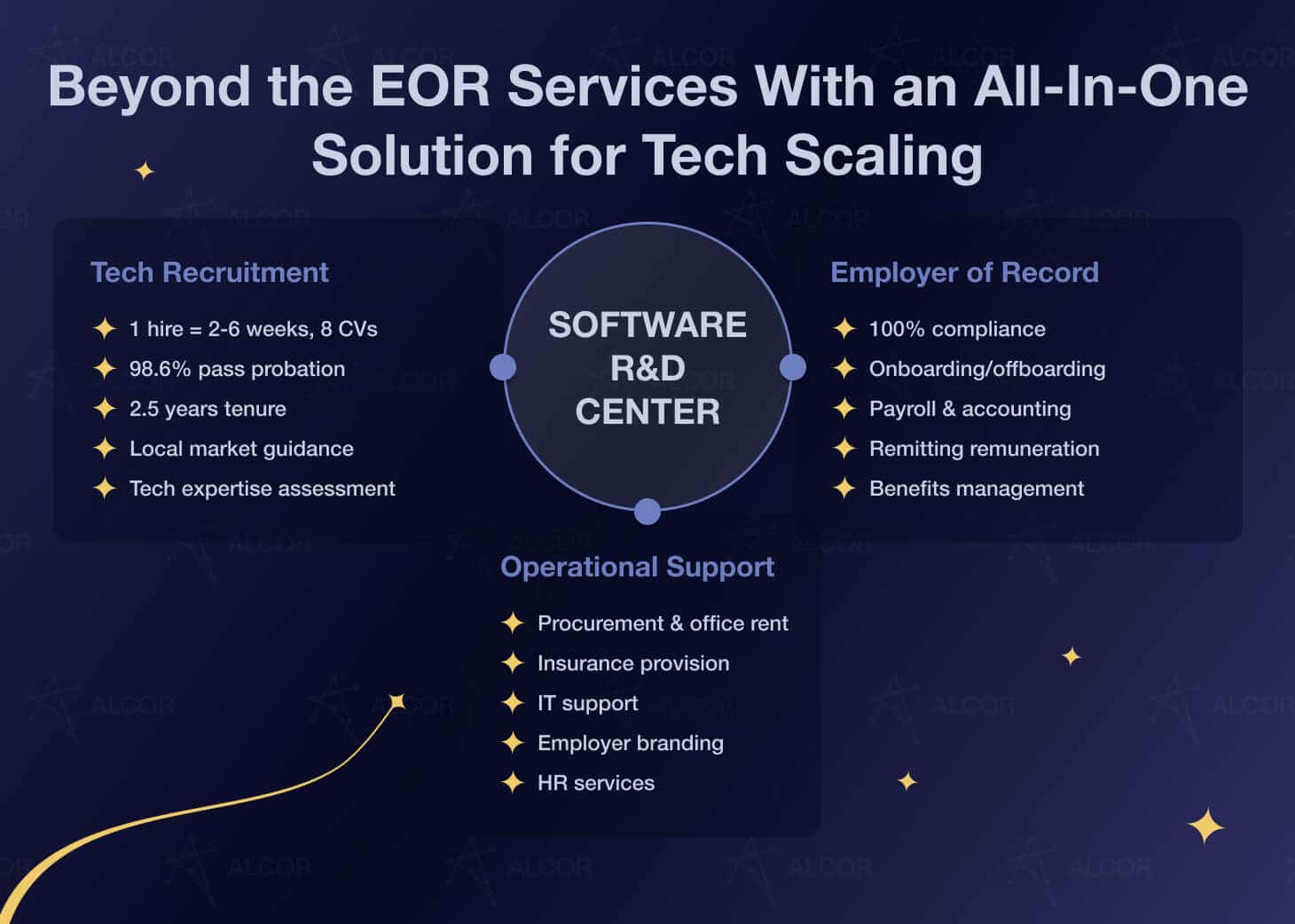
Alcor helps tech companies build their own engineering teams in Bulgaria without opening a local entity. It combines tech-only recruitment, Contractor of Record services and operational support. Engineers work on compliant B2B contracts and report to the client’s CTO. Teams of 10–30 are operational within 90 days, backed by 40+ in-house recruiters and a 98.6% probation pass rate. Tech product companies such as EGYM, Pindrop, GoTransverse and Sift have built teams in Eastern Europe this way, alongside PX, Teladoc Health, UFORCE, Backstory (ex-People.ai), and others.
A team in Bulgaria pays off when the engineers are yours from day one, building your product under your management. Alcor makes that possible without a local entity. As a tech-only partner, Alcor runs IT recruitment in Bulgaria and engages engineers on compliant B2B contracts through its Contractor of Record setup. It also covers EOR/COR and full operational layer in other Eastern European and Latin American locations. Your CTO manages the team, sets the roadmap and shapes the culture. Teams of 10–30 are operational within 90 days, and 100 takes about 12 months.
The result is your own software R&D center, with one partner covering hiring, contracts and operations.
Here’s how tech product companies building in Eastern Europe got there:
- Growth without a local entity. EGYM, the fitness tech unicorn, runs a 51-person R&D organization with no entity, HR or payroll function of its own in the region. The team started with engineers EGYM had engaged through a staffing agency, then moved onto Alcor’s Contractor of Record setup and has kept growing since 2019. Senior C++ searches closed in about 2.5 weeks each, with every offer accepted. Every contract assigns IP to EGYM from the moment of creation.
- An outsourcing exit with zero buyouts. Pindrop, the AI voice security and deepfake detection company, had an outsourcing setup where IP sat in a grey area and leaving meant buyout fees. It now has a 30-engineer in-house team that reports directly to Pindrop. Engineers from the previous provider moved over without a lost sprint, 6 CVs were enough for each hire, and every engineer passed probation.
- Hiring and compliance from one partner. GoTransverse, the PE-backed billing platform, had interviewed vendors that could either run payroll or find candidates, but not both. With one partner covering both, it made 6 hires in 6 weeks: five top-10% full-stack engineers and a product manager. The team later grew to 25, and 95% of presented candidates reached the interview stage. GoTransverse saved 40% on hiring costs, with no markups or buyout fees.
- A brand candidates say yes to. Sift, the US fraud-prevention unicorn, needed engineers in a market where few candidates knew its name. Employer branding built around Sift’s own hiring manager raised the offer acceptance rate by 15%. Hiring then grew into a 51-engineer R&D center led by Sift’s engineering leadership.
Other tech product companies building their teams with Alcor include PX, Teladoc Health, UFORCE, Backstory (ex-People.ai), and many others.
Senior engineers in Bulgaria are a short list, and the companies that hired them first are still hiring. Every quarter you wait, another product team signs the developer you were planning to interview. Get blind CVs and Bulgarian payscale data on your first call.
FAQ
What is the current market size, export capacity, and revenue growth rate of Bulgaria’s software and IT outsourcing sector?
Bulgaria’s ICT market is worth about USD 8.77 billion in 2026 and is forecast to reach USD 9.93 billion by 2031, a 2.53% compound annual growth rate. IT services are the largest segment at about a third of the market, while cloud and IT security grow fastest. Export capacity is the sector’s defining feature, since most revenue of software development companies in Bulgaria comes from foreign clients. That capacity rests on 141,500 ICT professionals and more than 105,000 people working across BPO, IT outsourcing and R&D. Growth in 2026–2027 is steady, in line with an economy expected to grow 2.2% in 2027.
What factors are driving Sofia’s expansion into a major tech and software development powerhouse in Eastern Europe?
Sofia’s rise as a tech hub rests on talent, research and stability:
– Talent: the city trains most of Bulgaria’s engineering graduates and hosts two universities ranked in the QS World University Rankings 2027.
– Research: INSAIT, ranked first in Eastern Europe for AI research, is based here. Sofia Tech Park hosts the BRAIN++ AI factory, built around the Discoverer++ supercomputer due online at the end of 2026.
– Experience: multinational product companies have run R&D centers in Sofia for over a decade, so local engineers already work to Western release cadence and code review standards.
– Stability: euro adoption in January 2026, a 10% flat corporate and personal income tax, and a time zone that covers the full European workday complete the case.
What are the current challenges of IT outsourcing in Bulgaria?
The main challenges in 2026–2027 are talent supply, senior competition, rising costs and engagement models that weaken team commitment:
– Talent supply: ICT specialists make up 4.8% of employment, and demand for cloud, security and AI engineers grows fastest.
– Senior competition: lead-level engineers circulate among a small number of employers, so senior searches need early planning.
– Rising costs: wages keep growing, and the social security cap rises with each annual budget.
– IP and pricing: bundled rates hide provider margins, and B2B contractors keep IP rights unless their contract transfers them.
– Commitment: project-based outsourcing and IT outstaffing in Bulgaria can leave engineers loyal to the provider rather than to your product.
Clear IP clauses, a line-by-line cost breakdown and a dedicated team that reports to your own engineering leads address most of these challenges. A partner such as Alcor can take on the rest: tech recruitment for senior and AI roles, and compliant B2B contracts with IP and NDA agreements available for every engineer. Alcor also works with transparent fees and no buyouts, plus retention support that keeps the team with you for an average 2.5 years.
How should tech companies plan an IT outsourcing strategy for Bulgaria in 2027?
A 2027 plan for Bulgaria starts with roles, budget and engagement model, then covers timing and retention:
– Roles: define stack, seniority and specialization. Cloud, security and AI profiles are the most contested.
– Budget: plan the full employment cost: base salary, payroll taxes, a benefits package of about $5,700 a year, and provider fees, including a one-time recruitment fee of 15–25% of annual base salary.
– Engagement model: choose between full-time employment through your own entity or an Employer of Record, and B2B contracts through a Contractor of Record. The last two need no local entity.
– Timing: start senior searches early. With an experienced partner, teams of 10–30 can be operational within 90 days.
– Location and retention: look beyond Sofia to Plovdiv and Varna, and keep the team close to your own engineering leads.
Companies that outsource developers in Bulgaria this way end up with a team they own, rather than an offshore vendor relationship.
How would you rate this article?
Alcor is Your Trusted Scaling Partner
for expansion
support