


Tech hubs in Eastern Europe are gaining attractiveness as domestic hiring falls short: 78% of tech leaders struggle to find talent, per HackerRank’s 2025 Developer Skills Report. The region is answering that shortage, with its IT services and R&D market growing 4–5x faster than the global average, according to Brandsit’s 2026 CEE analysis – fueled by the talent and savings that make Poland, Ukraine, Romania, and Bulgaria worth a closer look for your next engineering hire.
This guide gives you the region’s ICT market dynamics and forecasts, the core reasons tech companies choose Eastern European tech hubs for software development, and a detailed breakdown of each hub, including its pros and cons. You’ll also walk away knowing how to gain a competitive edge through a tech-focused R&D center expansion model instead of traditional outsourcing.
Key Takeaways
- Poland’s ICT market is projected to reach $56.01 billion by 2031 (Mordor Intelligence), Ukraine’s IT exports grew 4.1% YoY in H1 2026 (IT Ukraine Association), and Romania’s software development sector is growing at an 8.6% CAGR (IBISWorld). Eastern Europe also has 3,800+ startups, 275 scaleups (Dealroom’s CEE 2025 report), and 153,700+ ICT graduates annually (Alcor’s recruitment team research).
- Warsaw, Kyiv, Bucharest, Sofia, Prague, and Bratislava rank among Eastern Europe’s key tech hubs, with strong capabilities across AI, fintech, cybersecurity, SaaS, IoT, gaming, analytics, and software development.
- Eastern Europe provides access to 2+ million software developers, strong English proficiency (EF English Proficiency Index), tech-friendly tax incentives, and GMT+2–GMT+3 time zones. Competitive labor costs also enable US companies to save 46.6%–56.3% on senior developer salaries in Poland, Romania, Bulgaria, and Ukraine (per Alcor’s 2026 engineer compensation research).
- Tech countries in Eastern Europe offer distinct strengths: Poland stands out for developer scale and AI talent; Ukraine for AI expertise and competitive salaries; Romania for AI infrastructure; Bulgaria for low taxes and AI research; Czechia for its startup ecosystem; and Slovakia for R&D incentives.
- Alcor combines tech recruitment, EOR/COR, payroll, legal, and operational support to build dedicated R&D teams without opening a local entity. Alcor needs only 8 CVs to secure 1 accepted offer and can scale teams to 10–30 engineers in three months and 100+ within a year, while clients retain direct management and IP ownership and avoid vendor markups and buyout fees.
Eastern European IT Market Dynamics
Technology hubs in Eastern Europe are expanding through strong market growth, state-led digital transformation, rising foreign and VC investment, and a growing developer pipeline. Poland, Romania, and Ukraine show momentum through expanding ICT markets, software revenues, and IT exports. Eastern European governments are investing in digital skills, infrastructure, R&D, and startup support. Eastern Europe also hosts 3,800+ startups and 275 scaleups, while local universities produce 153,700+ ICT graduates annually.
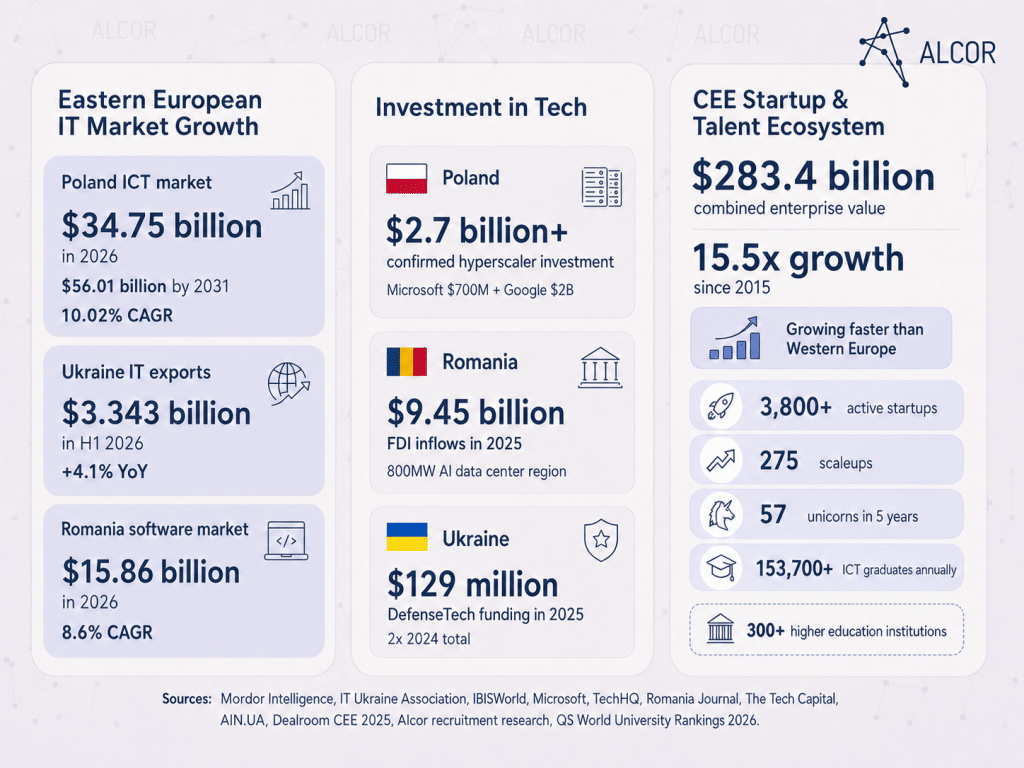
Poland, Romania, and Ukraine illustrate the pace Eastern Europe’s tech industry is setting:
- Poland’s ICT market alone is valued at $34.75 billion in 2026 and is projected to reach $56.01 billion by 2031, growing at a 10.02% CAGR, according to Mordor Intelligence;
- Ukraine’s IT exports reached $3.343 billion in the first half of 2026 alone, up 4.1% year-over-year, according to the IT Ukraine Association – a sign the sector has moved past survival mode and back onto a growth trajectory despite the ongoing war;
- Romania’s software development sector is valued at €13.6 billion in 2026 and is growing at an 8.6% CAGR, according to IBISWorld.
But what’s driving the rapid development of the tech industry in Eastern Europe? Let’s have a look at the core factors and trends.
State-led tech transformation
By following the Digital Decade Policy Program 2030, the EE countries have been actively implementing government initiatives and investing in the digital landscape, promoting digital skills and inclusion, developing their ICT infrastructure, and digitalizing the public sector. Some of the prominent examples are:
- According to the European Commission, Romania’s National Recovery and Resilience Plan, launched in 2021, is in its final stretch, with digitalization, digital education, startup support, and R&D reforms due to be completed by the end of 2026.
- Per the European Commission’s 2024 Digital Public Administration Factsheet, Digital Transformation of Bulgaria (2024–2030) strategy, adopted in 2024, updates the earlier Digital Bulgaria 2025 program and focuses on IT sector modernization, educational programs, and growing the number of qualified programmers.
- As stated on the Polish government’s official portal, the European Funds for a Modern Economy 2021-2027 program, initiated in partnership with the European Union, aims to support innovation, research, and increase the competitiveness of Polish businesses.
- According to Kyiv’s GovTech Centre, Ukraine’s Ministry of Digital Transformation has launched the nation’s flagship digital transformation hub, Diia Ecosystem, which is already globally recognized for its innovative approach, uniting e-government services, an IT-friendly legal framework, business support, and education platforms.
Investment waves in tech
- Foreign investment
Technology continues to drive investment across Eastern Europe. Poland attracted major commitments from hyperscale companies in 2025 alone: according to Microsoft’s own announcement, the company pledged $700 million to expand its cloud, AI, and cybersecurity infrastructure in Poland by mid-2026, while Google committed $2 billion to a new Polish data center, as reported by TechHQ – together totaling over $2.7 billion in confirmed hyperscaler investment.
Per Romania Journal, Romania’s FDI inflows rebounded to €8.1 billion in 2025 – a standout performance that bucked the broader European trend of declining investment. The country is also emerging as a data center frontier: in January 2026, according to The Tech Capital, Accelerated Infrastructure Capital partnered with Romanian operator ClusterPower to co-develop an 800MW AI data center region in southwestern Romania, part of a broader push that’s set to make Romania CEE’s second-largest data center hub after Poland, according to the EUDCA’s State of European Data Centres 2026 report.
Ukraine continues drawing significant interest in its DefenseTech industry: according to AIN.UA, Ukrainian defense startups raised $129 million in 2025, more than double 2024’s total – a sign that investor confidence in Ukraine’s tech sector is holding steady even under wartime conditions.
- VC investment
Central and Eastern Europe’s startup ecosystem now spans over 3,800 active startups and 275 scaleups, with a combined enterprise value of €243 billion, according to Dealroom’s CEE 2025 report – a 15.5x increase since 2015, outpacing Western Europe’s startup ecosystem over the same period. The region has produced 57 unicorns over the past five years, led by Poland (14), Ukraine (11), and Czechia (4).
Ukraine and Czechia stood out as fundraising leaders in 2025, together raising €2.2 billion across 20 mega-rounds, per Dealroom’s 2025 review presented at the Vestbee CEE VC Summit – a strong signal that investors continue backing high-growth companies across the region.
Expanding tech talent pool
Eastern Europe’s technical education system keeps feeding its developer pipeline. Over 300 higher education institutions dish out a variety of STEM programs across the region. Universities in Poland, Ukraine, Romania, and Bulgaria have earned recognition in the QS World University Rankings 2026, showcasing the high quality of education. Together, these institutions produce over 153,700 ICT graduates annually, according to Alcor’s recruitment team research, with Ukraine and Poland collectively accounting for about half of this talent.
Key Tech Hubs in Eastern Europe
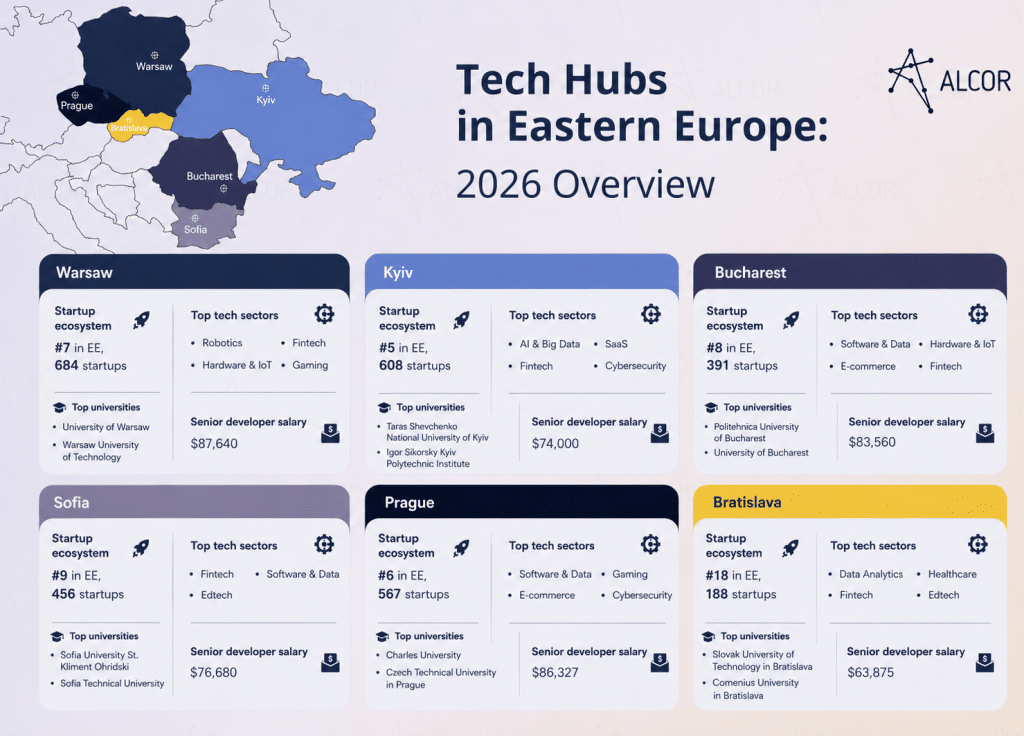
Leading tech hubs in Eastern Europe include:
- Warsaw (Poland): #7 in EE, strong in fintech, robotics, gaming, and IoT.
- Kyiv (Ukraine): #5, focused on AI, SaaS, fintech, and cybersecurity.
- Bucharest (Romania): #8, strong in software, fintech, and IoT.
- Sofia (Bulgaria): #9, notable for fintech, software, and edtech.
- Prague (Czechia): #6, strong in software and cybersecurity.
- Bratislava (Slovakia): #18, focused on analytics, fintech, and healthcare.
Warsaw, Poland
- Startup ecosystem: #7 in EE, 684 startups (StartupBlink)
- Top tech sectors: Robotics, Fintech, Hardware & IoT, Gaming
- Senior developer salary: $87,640 (according to Alcor’s 2026 engineer compensation research)
- Top universities: University of Warsaw, Warsaw University of Technology (EduRank)
- Other tech hubs: Krakow, Wroclaw, Katowice, the Tri-City (Gdansk, Gdynia, Sopot), Poznan, and Łódź
Kyiv, Ukraine
- Startup ecosystem: #5 in EE, 608 startups (StartupBlink)
- Top tech sectors: AI & Big Data, SaaS, Fintech, Cybersecurity
- Senior developer salary: $74,000 (according to Alcor’s 2026 engineer compensation research)
- Top universities: Taras Shevchenko National University of Kyiv, National Technical University of Ukraine “Igor Sikorsky Kyiv Polytechnic Institute” (EduRank)
- Other tech hubs: Lviv, Dnipro, Kharkiv, and Odesa
Considering Kyiv for your engineering team scaling? See how to hire Ukrainian software developers and achieve an averge 2.5-year tenure.
Bucharest, Romania
- Startup ecosystem: #8 in EE, 391 startup companies (StartupBlink)
- Top tech sectors: Software & Data, Hardware & IoT, E-commerce, Fintech
- Senior developer salary: $83,560 (according to Alcor’s 2026 engineer compensation research)
- Top universities: Politehnica University of Bucharest, University of Bucharest (EduRank)
- Other tech hubs: Cluj-Napoca, Timișoara, and Iași
Sofia, Bulgaria
- Startup ecosystem: #9 in EE, 456 startups (StartupBlink)
- Top tech sectors: Fintech, Software & Data, Edtech
- Senior developer salary: $76,680 (according to Alcor’s 2026 engineer compensation research)
- Top universities: Sofia University “St. Kliment Ohridski,” Sofia Technical University (EduRank)
- Other tech hubs: Burgas, Plovdiv, and Varna
Prague, Czechia
- Startup ecosystem: #6 in EE, 567 startups (StartupBlink)
- Top tech sectors: Software & Data, Gaming, E-commerce, Cybersecurity
- Senior developer salary: $86,327 (according to Alcor’s 2026 engineer compensation research)
- Top universities: Charles University, Czech Technical University in Prague, University of Chemistry and Technology (EduRank)
- Other tech hubs: Brno, Ostrava
Bratislava, Slovakia
- Startup ecosystem: #18 in EE, 188 startups (StartupBlink)
- Top tech sectors: Data Analytics, Fintech, Healthcare, Edtech
- Senior developer salary: $63,875 (according to Alcor’s 2026 engineer compensation research)
- Top universities: Slovak University of Technology in Bratislava, Comenius University in Bratislava (EduRank)
- Other tech hubs: Košice, Trnava
Curious about nearshore software development? Discover what leading tech hubs in Latin America have to offer!
Advantages of Eastern Europe as a Major Technology Development Destination
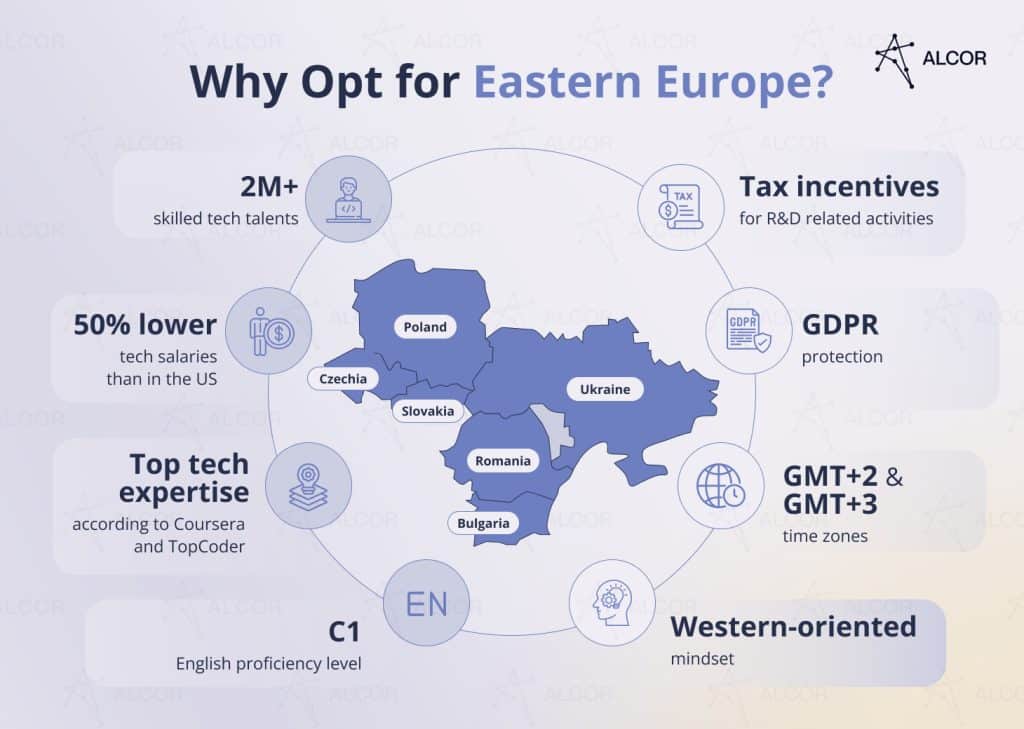
Eastern Europe is a major destination for technology development, with more than 2 million software developers across its leading IT hubs. Eastern European engineers combine strong technical expertise, high English proficiency, and dependable collaboration skills for distributed product teams. Senior base developer salaries in Poland, Romania, Bulgaria, and Ukraine can be 50.5% lower than in the US. Eastern European countries also offer tech-friendly tax incentives, while GMT+2–GMT+3 time zones support collaboration with both European and US teams.
Large talent pool
Eastern Europe offers one of the largest concentrations of tech human capital in the world. According to Alcor’s recruitment department research, leading IT hubs in Eastern Europe host over 2 million software developers – a larger talent pool than Western Europe or the Nordic countries combined. Poland supplies the largest share of Eastern Europe’s developer workforce, with 778,800 ICT experts, followed by Ukraine’s 305,000 tech experts.
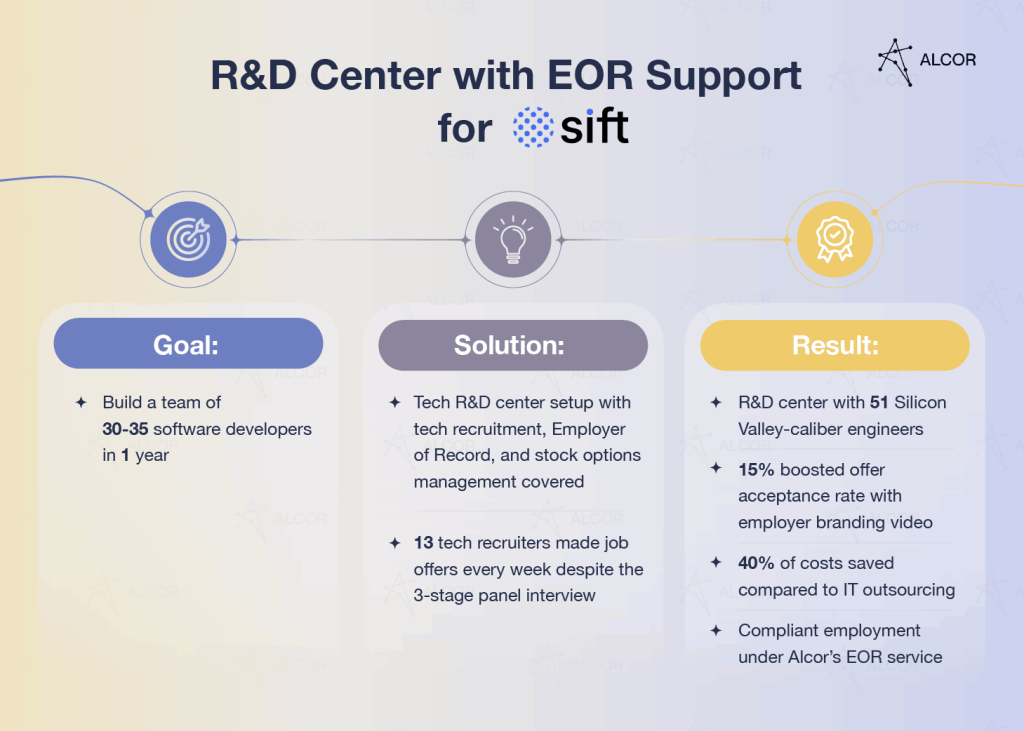
This scale was one of the decisive factors for Sift, a US tech company that turned to Alcor to expand its engineering team. With Alcor’s local guidance, they received:
- An R&D team of 51+ devs in Ukraine and Poland
- Full compliance with European and US legislation
- 15% offer acceptance rate boost via employer branding
- Direct team management from day one
- Stock options and visa support for developers
- Equipment procurement & dedicated assistance
With their own Eastern European team of developers, Sift accelerated the time-to-market of their fraud prevention updates, cut their salary budget by half, and gained a competitive edge, turning expansion into measurable ROI.
Ledger, Pindrop, and UForce have already successfully scaled their teams in Eastern Europe and LATAM with Alcor. Want the same result?
Top-tier skills
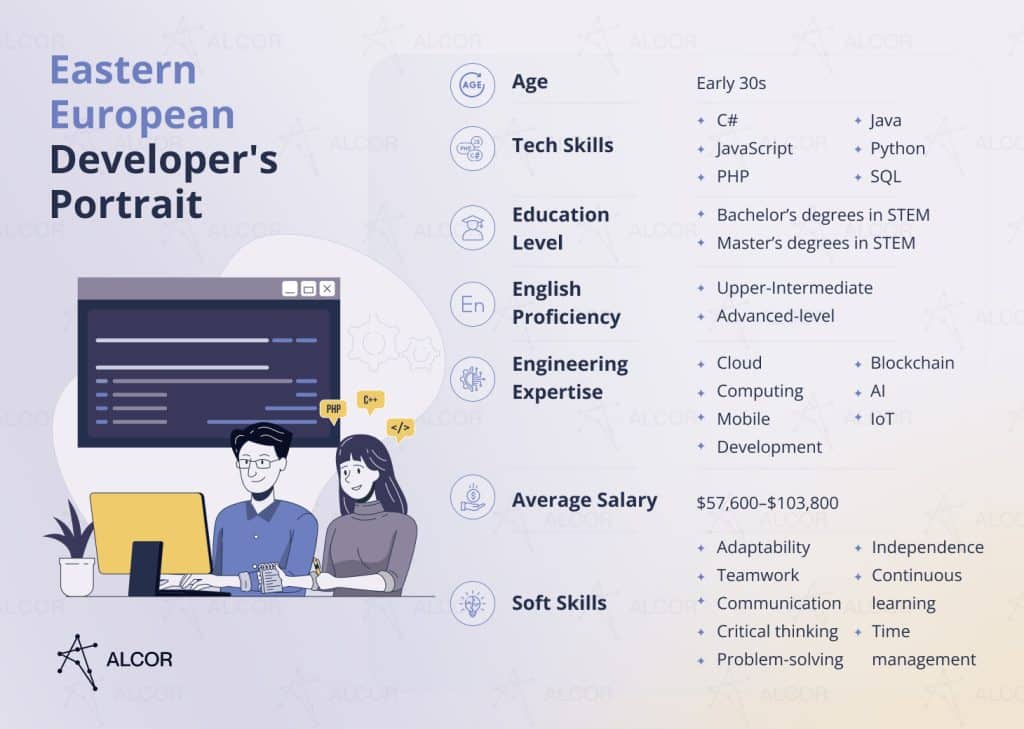
- Hard skills: According to Coursera’s 2025 Global Skills Report, Poland ranks #4 in Eastern Europe for tech skills. Ukraine ranks #7 in Eastern Europe on the WIPO Global Innovation Index 2025 for its contribution to technological innovation. These regional rankings mean tech entrepreneurs hiring Eastern European developers can expect high-quality software output, backed by measurable skill proficiency rather than reputation alone. This strong technical base translates into demand across a broad range of specializations. According to Alcor’s recruitment department, the most requested areas across Eastern Europe currently include Product/Delivery, QA/Test Automation, AI/ML & Data Science, Backend, Full-stack, Frontend, and DevOps/Platform, with Product/Delivery and QA leading overall demand and AI/ML and Backend also among the strongest categories.
- Soft skills: Per the Hofstede Culture Factor comparison tool, Eastern European developers share a similar drive toward achievement and results as their US counterparts, while also showing a stronger preference for structure and process discipline. This combination of soft skills makes EE engineers methodical, dependable collaborators for distributed teams.
- English proficiency: Most engineers from Eastern Europe possess a high command of English. Per the EF English Proficiency Index, Romania ranks #2 in the region (#11 globally), Poland ranks #3 (#15 globally), and Bulgaria ranks #4 (#18 globally), placing all three among the strongest English-proficiency markets and ensuring smooth collaboration with US engineering leaders.
Cost-effective salaries
Software development in Eastern Europe gives US tech companies access to competitive senior-level talent across AI/ML, backend, and DevOps roles. According to Alcor’s 2026 engineer compensation research, US tech companies save 46.6% on senior developer compensation in Poland, 49.4% in Romania, 53.0% in Bulgaria, and 56.3% in Ukraine, compared to hiring the same roles in the US.
The table below breaks down annual senior-level salaries for the most in-demand positions across Poland, Ukraine, Romania, and Bulgaria, compared to the US.
| Senior Developer’s Average Annual Base Salary | |||||
| Position | USA | Poland | Ukraine | Romania | Bulgaria |
| ML Engineer | $222,000 | $99,600 | $84,000 | $97,200 | $63,600 |
| LLM Engineer | $234,000 | $102,000 | $86,400 | $97,800 | $90,000 |
| AI Product Engineer | $228,000 | $103,800 | $84,000 | $97,200 | $87,600 |
| MLOps Developer | $189,000 | $102,000 | $90,000 | $99,600 | $85,800 |
| Data Engineer | $177,000 | $82,800 | $69,600 | $74,400 | $73,200 |
| Data Platform Engineer | $189,000 | $88,800 | $80,400 | $84,000 | $92,400 |
| DevOps Engineer | $168,000 | $90,000 | $72,000 | $81,600 | $78,000 |
| Python Developer | $165,000 | $84,000 | $70,800 | $79,200 | $72,000 |
| Node.js Developer | $156,000 | $84,000 | $70,800 | $76,800 | $69,600 |
| React Developer | $156,000 | $80,400 | $66,000 | $76,800 | $67,800 |
| Angular Developer | $156,000 | $78,000 | $66,000 | $75,600 | $66,600 |
| Mobile Developer (iOS/Android/Xamarin) | $174,000 | $84,000 | $66,000 | $78,000 | $72,000 |
| C/C++ Developer | $150,000 | $90,000 | $69,600 | $80,400 | $78,000 |
| Blockchain Developer | $171,000 | $70,800 | $76,800 | $84,000 | $75,600 |
| Automation QA Engineer | $145,500 | $74,400 | $57,600 | $70,800 | $78,000 |
Business incentives
Many EE countries are implementing various perks to attract tech companies:
- Bulgaria strengthened its EU integration in 2025–2026: as stated by the European Central Bank, it joined the Schengen Area in January 2025 and adopted the euro in January 2026, removing currency risk and simplifying cross-border operations for foreign companies. On top of that, according to the Ministry of Innovation and Growth, Bulgaria’s Start-Up Visa program gives non-EU founders a fast track to long-term residence for high-tech and innovative projects.
- Ukraine stands out with its tax policies. Despite martial law, the Ministry of Digital Transformation fully supports the tech sector through Diia City, a special economic zone with simplified regulations, according to the State Tax Service of Ukraine. According to Alcor’s 2026 payroll tax data, tech companies operating under Diia City pay a reduced employee PIT of 5% and employer social security contributions of roughly 0.8% on a $5,000/month salary.
- The IP Box in Poland offers a preferential 5% tax rate on income from qualifying intellectual property (IP) rights, significantly lower than the standard 19% corporate tax rate, according to Polish Investment & Trade Agency. This incentive, combined with Poland’s tax relief for R&D costs of up to 200%, makes it an attractive destination for IT outsourcing in Eastern Europe.
Time flexibility
Eastern Europe lies in the GMT+2 to GMT+3 time zones, making it an ideal hub for cross-border tech collaboration.
- Western European tech product companies benefit from quick flights to Poland, Romania, and Bulgaria (1–4 hours) and real-time collaboration with remote teams thanks to overlapping work hours.
- US companies benefit from the 6–8-hour time difference between countries, enabling overnight progress and round-the-clock development cycles.
Top Tech Countries in Eastern Europe
The top tech countries in Eastern Europe offer trade-offs for companies choosing expansion locations. Poland combines the region’s largest developer pool with AI talent, but business complexity remains high. Ukraine offers AI expertise and competitive salaries despite security risks. Romania is strengthening AI infrastructure while regulatory changes require attention. Bulgaria stands out for low taxes and AI research growth. Czechia offers a strong startup climate, while Slovakia combines R&D incentives with a smaller talent market.
Poland
Pros: As the largest country in the region for skilled developers, Poland is home to developers ranking #1 in EE and CEE on TopCoder, unlocking a vast reservoir of proven technical talent ready to fuel your business growth.
Cons: The 2026 Global Business Complexity Index ranks Poland 5th in Europe for business difficulty, due to complex reporting standards, frequent regulatory changes, legal hurdles for investment, and intricate HR/payroll rules.
Future forecast: Poland is on the path to becoming an AI powerhouse in the region, ranking #1 in Europe (#4 globally) for concentration of advanced AI engineering talent, according to the Interface report on Europe’s AI talent, backed by a €235 million national AI fund, as stated by the OECD. This makes nearshoring to Poland an increasingly compelling option for tech companies seeking high-quality, AI-ready tech solutions. To see the bigger market picture, explore our full breakdown of the Polish IT industry, from talent and salaries to tech hubs and R&D setup options.
Ukraine
Pros: Ukraine’s dedicated AI/ML talent pool grew 17% in just one year (2024–2025), reaching roughly 6,100 specialists, according to AI House’s 2025 research, giving tech companies faster access to top-tier AI talent as demand for specialized engineering keeps climbing. Additionally, lower developer salaries compared to Poland and Romania ensure that outsourcing to this country not only guarantees high-quality output for your product but also benefits your business overall.
Cons: Despite the resilience of Ukrainian developers and improvements in infrastructure, such as building reliable shelters and ensuring consistent Internet connectivity, security concerns still pose obstacles to foreign tech businesses entering Ukraine’s tech market.
Future forecast: Despite the war, Ukraine’s startup ecosystem raised $498–526 million in 2025 alone, with AI-native startups pulling in roughly $302 million of that total, nearly 3x more than non-AI companies, according to AVentures Capital’s Dealbook of Ukraine. The country has also kept minting unicorns through wartime: Creatio crossed the $1 billion valuation in 2024, monobank’s parent Fintech-IT Group became Ukraine’s first Fintech unicorn in 2025, and Preply and UForce both reached unicorn status in early 2026. This sustained investment activity demonstrates that foreign companies continue to have confidence in Ukrainian IT and view it as a potent hub for innovation, especially in AI.
Exploring team extension in Eastern Europe? See how US tech company BigCommerce went public with their R&D team in Ukraine!
Romania
Pros: According to Digital Watch, Romania approved its National Strategy in the Field of Artificial Intelligence 2024–2027 (SN-IA) in July 2024, setting national objectives across AI R&D, skills, infrastructure, and governance. Backing that up with real infrastructure, Bucharest was selected as one of only 6 sites (out of 19 across 16 EU member states) in the EuroHPC AI Factories program, backed by €500 million in public funding, according to Balkan Green Energy News – putting Romania in the same tier as Poland for sovereign AI compute infrastructure.
Cons: Romania provides attractive tax incentives for tech companies. But frequent legislative changes – most recently a 2026 fiscal reform package that raises dividend tax from 10% to 16% and standard VAT from 19% to 21%, according to the OECD Economic Surveys – make it crucial to stay up to date with local regulations when expanding to this EE hub.
Future forecast: As AI job postings in Romania climb past 2% of all vacancies – already double the European average, per the Interface report on Europe’s AI talent – the country is positioning itself to become one of Europe’s go-to hubs for AI hiring. Investments like the Technical University of Cluj-Napoca’s new $15.6 million AI research center, according to Data Center Dynamics, point to a pipeline of AI-ready graduates that will keep feeding this demand for years to come.
Bulgaria
Pros: With the lowest taxes in Europe – 10% on both personal income and corporate profits – Bulgaria lets tech companies access a skilled workforce at genuinely competitive rates, without the higher overhead of Western European hiring. That cost advantage is now paired with a maturing tech ecosystem: according to IntelliNews, Bulgaria recently developed BgGPT, a large language model built specifically for Bulgarian, signaling that local AI capability is catching up with the country’s long-standing reputation for affordable, high-quality development.
Cons: According to the Bulgarian Labour Code, under Article 405a, the Labour Inspectorate can reclassify a B2B contract as an employment contract if the working relationship looks too much like employment – a risk that’s only grown with tighter enforcement heading into 2026, per Global Law Experts. Managing this compliance maze alone is genuinely tricky, which is why having an experienced local partner who knows Bulgaria’s legal landscape inside and out makes all the difference.
Future forecast: The Bulgarian ICT market size is expected to reach $9.93 billion by 2031, according to Mordor Intelligence, driven by rising enterprise cloud adoption, cybersecurity demand, and AI investment. Bulgaria is also building a distinctive research edge: it hosts INSAIT, the Institute for Computer Science, AI and Technology, founded in partnership with ETH Zurich and EPFL, as stated by ETH Zurich, – the first institute of its kind in Eastern Europe – positioning Bulgaria as a serious contender for AI research talent alongside its established cost advantages.
Czech Republic
Pros: Boasting the A2 business climate, according to Coface, the Czech Republic ranks 3rd in the region for its startup ecosystem, according to StartupBlink. The AI sector is emerging as a standout growth story: Prague-based Resistant AI, a fraud-detection company serving global fintech clients, posted 10x ARR growth between its Series A and 2025 Series B round, according to Digest.Pro – a concrete signal that this destination is producing AI companies with real commercial traction, not just research output.
Cons: The taxation system in Czechia is notably stringent, with one of the highest tax burdens in the EE region. The corporate income tax rate stands at 21%, up from the previous 19%, while the personal income tax rate ranges from 15% to 23%. This elevated tax environment presents additional challenges for tech businesses looking to expand into this destination.
Future forecast: The Czech Republic’s ICT market size is projected to reach $33.91 billion by 2031, with software development, cybersecurity, and analytics becoming the sector’s primary focus, according to Mordor Intelligence. The government is backing this growth directly – according to Mordor Intelligence’s data center market report, its National AI Strategy 2030 earmarks CZK 19 billion (~$830 million) for AI-ready computing infrastructure, positioning the Czech Republic to compete for AI workloads alongside its established strengths in software and cybersecurity.
Slovakia
Pros: Slovakia offers substantial tax benefits for R&D companies, allowing a 100% deduction of research and development costs from the tax base, according to SARIO, Slovakia’s national investment agency. Per the same SARIO report, the country also ranks #1 among V4 countries for digital and communications technological skills, and its ICT workforce has grown 70% since 2014, now supporting over 120,000 jobs and contributing 4.5% to national GDP – a strong signal for innovation-driven businesses considering the market.
Cons: Despite this growth, Slovakia’s tech talent pipeline faces real pressure: net migration data shows roughly 800 more IT professionals leaving the country than arriving each year, according to a 2026 labor market analysis. Combined with a smaller overall market than counterparts like Poland or Romania, this can mean fewer options for foreign businesses looking to scale up quickly when entering the market.
Future forecast: Slovak startups have grown their combined enterprise value 8.7x over the past five years, reaching $4.8 billion, according to Dealroom data – a signal that brings the Slovak ICT hub closer to the largest tech countries in Europe.
What 2027 Holds for Eastern European Tech Hubs
Technology hubs in Eastern Europe are set to gain momentum in 2027 as nearshoring, in-house R&D centers, and AI investment continue to expand. Software development outsourcing in Eastern Europe is increasingly shifting toward nearshore and dedicated engineering models. Tech hubs in Eastern Europe, such as Poland and Romania, are attracting increasing investment in AI, Big Data, IoT, cybersecurity, and healthcare. Up-and-coming Eastern European markets are also strengthening their position as long-term destinations for engineering expansion.
- Nearshoring continues to climb: According to Whitelane Research’s 2025/2026 European IT Sourcing Study, 35% of European organizations plan to increase their use of nearshore delivery over the next two years, while only 7% expect a decrease. This will make nearshore software development in Eastern Europe a growing trend well into 2027.
- Global in-house centers are overtaking traditional outsourcing: Setting up global in-house centers (GICs), or R&D centers, rather than traditional outsourcing continues to accelerate. According to Mordor Intelligence, the global GCC market is worth $649.1 billion in 2026 and is projected to grow to $952.5 billion by 2031, with nearshore hubs such as Poland and Romania increasingly chosen to balance cost control with cultural alignment near European headquarters. Software development in Poland is already capturing that momentum directly: in September 2025, Tata Consultancy Services opened a $200 million, 5,000-employee capability center in Poland focused on automotive software and fintech digitization. This growing trend signals an ideal time to set up an offshore center in Eastern Europe in 2027 and beyond.
- AI, Big Data, and IoT demand keeps accelerating: The technologies enhanced by R&D center innovation – Big Data, virtual reality, and the Internet of Things – continue to gain ground, and AI advancements are impossible to overlook. According to The Recursive, more than 70% of surveyed CEE venture capital firms plan to deploy more capital into the region in 2026, even as global AI funding surpassed $211 billion in 2025 – more than double the year before. This momentum is backed by demand on the buyer side too: per Whitelane Research, 90% of European organizations plan to increase AI-related investment over the next two to three years. Healthcare and Life Sciences, Cybersecurity, Computer Vision, and Natural Language Processing (NLP) – the technology powering everything from chatbots to virtual assistants and translation services – remain among the most promising fields shaping the region’s AI future.
Alcor’s own hiring data shows the shift is already happening. According to Alcor’s recruitment department, AI/ML-related requisitions accounted for 17.2% of Eastern European hiring demand in January–August 2026, up from 10.9% in the same period of 2025 – a 6.3 percentage-point increase year over year. Ukraine currently shows the strongest concentration of AI-specific demand, while Poland remains the larger market overall due to its broader talent pool. Poland is stronger in overall hiring volume, while Ukraine is often attractive for companies looking for strong technical expertise at a more budget-friendly cost.
Turn your AI hiring pressure into a clear plan
Explore 8 tech markets across LATAM and Eastern Europe and get practical insights for building your AI engineering team.
Planning your next Eastern European expansion? Compare European tax rates vs the US before choosing the market, hiring model, and setup structure.
We help Global Companies to Navigate the Eastern European Tech Market With Ease and Agility
Alcor’s software R&D center solution helps tech companies build fully compliant engineering teams in Eastern Europe without opening a local entity or coordinating multiple vendors. Unlike traditional software development outsourcing, Alcor combines recruitment, EOR/COR, legal, payroll, and operational support under one roof. With only 8 CVs needed to secure 1 accepted offer, companies can scale to 10–30 engineers in three months and 100+ within a year while retaining direct management, IP ownership, and focus on innovation.
Scaling a tech team abroad usually means choosing between two flawed paths: hiring a vendor who owns your talent, or piecing together recruiters, lawyers, and office managers on your own. Traditional outsourcing models like staff augmentation in Eastern Europe give you developers you don’t fully control, offer no real IP protection, and leave you guessing about what’s actually happening in the workflow. Building your own legal entity solves the control problem but buries you in local labor law, payroll setup, and office logistics before you’ve hired a single engineer.
Alcor’s software R&D center solution exists to close that gap. It gives you a fully staffed, fully compliant tech hub of your own – recruitment, Employer of Record/Contractor of Record, and day-to-day operations bundled into one service – without the vendor markups, the buy-out fees, or the 6+ months it typically takes to stand up a legal entity abroad.
Here’s how that played out for one client in Eastern Europe: when Backstory (ex-People.ai) needed to scale its AI platform without pulling focus from its Silicon Valley core team, it turned to Alcor to build a tech hub in Ukraine, in place of the vendor chaos of piecing together multiple recruiters and contractors. The results came through Alcor’s three core services working together:
- Silicon Valley-grade recruitment: Alcor’s in-house recruiters sourced engineers with rare skill sets and screened for both technical depth and a product mindset. Alcor hired 25+ engineers in year one, with a 98.6% probation pass rate and an average tenure of 2.5+ years.
- Tech-exclusive EOR/COR: Alcor’s legal and finance team ensured full compliance with both US and Ukrainian law, managing payroll, tax, and benefits from day one. Backstory never had to open its own legal entity or navigate unfamiliar labor regulations. Every client also gets a dedicated Customer Operations Manager, available within 1 day, as a single point of contact for the entire relationship.
- Ops support, end-to-end: Alcor handled the operational layer – from hardware procurement to office logistics – so Backstory’s leadership stayed focused on product, not paperwork. For clients that want to go further, on-demand employer branding and stock options management services are also available to help attract and retain top talent.
Here’s what Backstory’s CEO had to say about working with Alcor:
Choosing your own R&D center over traditional outsourcing means fewer risks, more control, and a partner built for innovation from day one.
Ready to hire developers in Warsaw, Kyiv, Sofia, or Bucharest with full control and no vendor layers? Build your own R&D center with Alcor.
FAQ
Which Eastern European country is best for hiring software developers?
Poland offers the largest talent pool (778,800+ developers) and ranks #1 in Europe for AI engineering talent concentration (Interface report on Europe’s AI talent). Ukraine delivers the lowest developer salaries alongside a fast-growing AI/ML specialist base, up 17% in a single year (AI House’s 2025 research). Romania leads in AI infrastructure investment, including a EuroHPC AI Factory site (Balkan Green Energy News). Bulgaria offers the EU’s lowest taxes.
How much can US companies save by hiring developers in Eastern Europe?
US tech companies save 46.6% on senior developer compensation in Poland, 49.4% in Romania, 53.0% in Bulgaria, and 56.3% in Ukraine (Alcor’s 2026 engineer compensation research). Savings vary by role and seniority, with AI/ML positions such as ML Engineer or LLM Engineer showing some of the largest cost gaps, often exceeding $100,000 annually relative to equivalent US salaries.
Is it safe to hire tech talent in Ukraine during the war?
Ukraine’s tech sector has continued operating throughout the war, supported by reliable shelters and stable internet infrastructure. In 2025 alone, Ukrainian startups raised $498–526 million, with AI-native startups pulling in $302 million of that total (AVentures Capital’s Dealbook of Ukraine). The country also produced three new unicorns since 2024. Security concerns remain a valid consideration, but foreign companies continue to invest actively across Ukraine’s tech industry.
What’s the difference between IT outsourcing and building an R&D center in Eastern Europe?
Traditional outsourcing, including staff augmentation, hands your project to a vendor who controls the developers, offers limited IP protection, and limits visibility into the workflow. An R&D center gives you your own dedicated team, direct management from day one, and full IP ownership, while a provider like Alcor handles recruitment, compliance, payroll, and daily operations behind the scenes.
How fast can I build an engineering team in Eastern Europe?
With Alcor, companies can scale to 10–30 engineers within three months and 100+ within a year, needing only 8 CVs on average to secure one accepted offer (Alcor client data). This is significantly faster than opening a local legal entity, which typically takes 6+ months before hiring can even begin, and comes without vendor markups or buyout fees.
How would you rate this article?
Alcor is Your Trusted Scaling Partner
for expansion
support