


Global Capability Center setup in 2027 comes down to four decisions: what the center owns, where it sits, who staffs it, and which employment model keeps your IP. A Global Capability Center (GCC) is a centralized hub where tech product companies run core functions and manage engineering, IT, finance, and support across multiple regions.
Most companies arrive at that decision the same way – they hit a hiring wall. ManpowerGroup’s 2026 Talent Shortage Survey of 39,063 employers across 41 countries found AI skills are now the hardest capability in the world to hire for, ahead of engineering and traditional IT. Everest Group counts more than 300 new offshore and nearshore GCCs opened for the second year running. This hits hardest at a specific point: Series D and later, PE-backed, and public or pre-IPO product companies with a roadmap that has outgrown what one market can staff.
I’m Dmytro Ovcharenko, CEO at Alcor, your software R&D center partner offering GCC as a Service. We build fully owned teams of 10–30+ engineers in 90 days across Latin America and Eastern Europe, including the AI/ML and deep tech talent your market has run out of. Your team, your management, your IP – no vendor lock-in.
In this article, you’ll get a clear answer to “What is a Global Capability Center?”, see how the model works in practice, compare the best locations, and learn how to set up a Global Capability Center step by step. If your roadmap is outgrowing what your home market can staff, this guide will help you decide whether a Global Capability Center for product companies is the right move and when it isn’t.
Key Takeaways
- Well-designed GCCs cut senior AI engineering costs by 50–64% versus the US, with access to deep talent pools, faster innovation cycles, greater resilience, and full ownership of the team, its IP, and its quality bar.
- Before launching, you need a clear strategic intent, a willingness to run a single global team, a view on which skills must sit within the GCC, a defined risk appetite, and internal capacity to sponsor the setup.
- Successful GCCs start from a clear 12–24 month plan, rigorous location research (tax, payroll, legal, office), a realistic team model and talent strategy, a chosen employment and compliance model with day-one IP assignment, and strong governance and retention from day one.
- India offers massive scale but also saturation, skill, and time-zone trade-offs; LATAM (Mexico, Colombia) adds nearshore overlap and the region’s fastest-growing AI talent pipeline; Eastern Europe (Poland, Romania, Ukraine) brings top-tier engineering depth, state-funded AI infrastructure, and EU-grade legal frameworks.
- With GCC as a Service across LATAM and Eastern Europe, Alcor combines top-10% tech recruitment, fully compliant EOR/COR, and 360° operational support so you can spin up and scale a GCC from 10 to 100 engineers within a year without opening entities or juggling multiple vendors.
GCC Operating Model: Core Functions
A GCC centralizes core functions, including IT and software development, business process management (finance, accounting, payroll, procurement, customer support), HR management, risk and compliance, and marketing and sales support. Unlike a pure R&D center solution, which focuses mainly on product engineering, a GCC is a multi-functional hub designed to standardize, optimize, and scale business operations across multiple regions.
I would say the easiest way to think about a GCC is as your offshore or nearshore but still internal HQ. A Global Capability Center (GCC) runs a defined set of core functions for multiple regions, typically covering strategic areas like:
- IT and Software Development: Building and maintaining software applications, managing IT infrastructure and support services, and providing cybersecurity and data protection.
- Business Process Management (BPM): Handling back-office operations like finance, accounting, payroll, and procurement, managing customer support and contact center services, and streamlining supply chain and logistics processes.
- Human Resources (HR) Management: Recruiting, onboarding, and training employees, managing employee benefits and performance, and ensuring compliance with labor laws and regulations.
- Risk Management and Compliance: Monitoring regulatory changes and ensuring compliance, managing enterprise risk and internal audits, strengthening disaster recovery and business continuity planning.
- Marketing and Sales Support: Providing content creation, digital marketing, and SEO support, managing CRM tools and customer databases, and assisting with lead generation and market outreach.
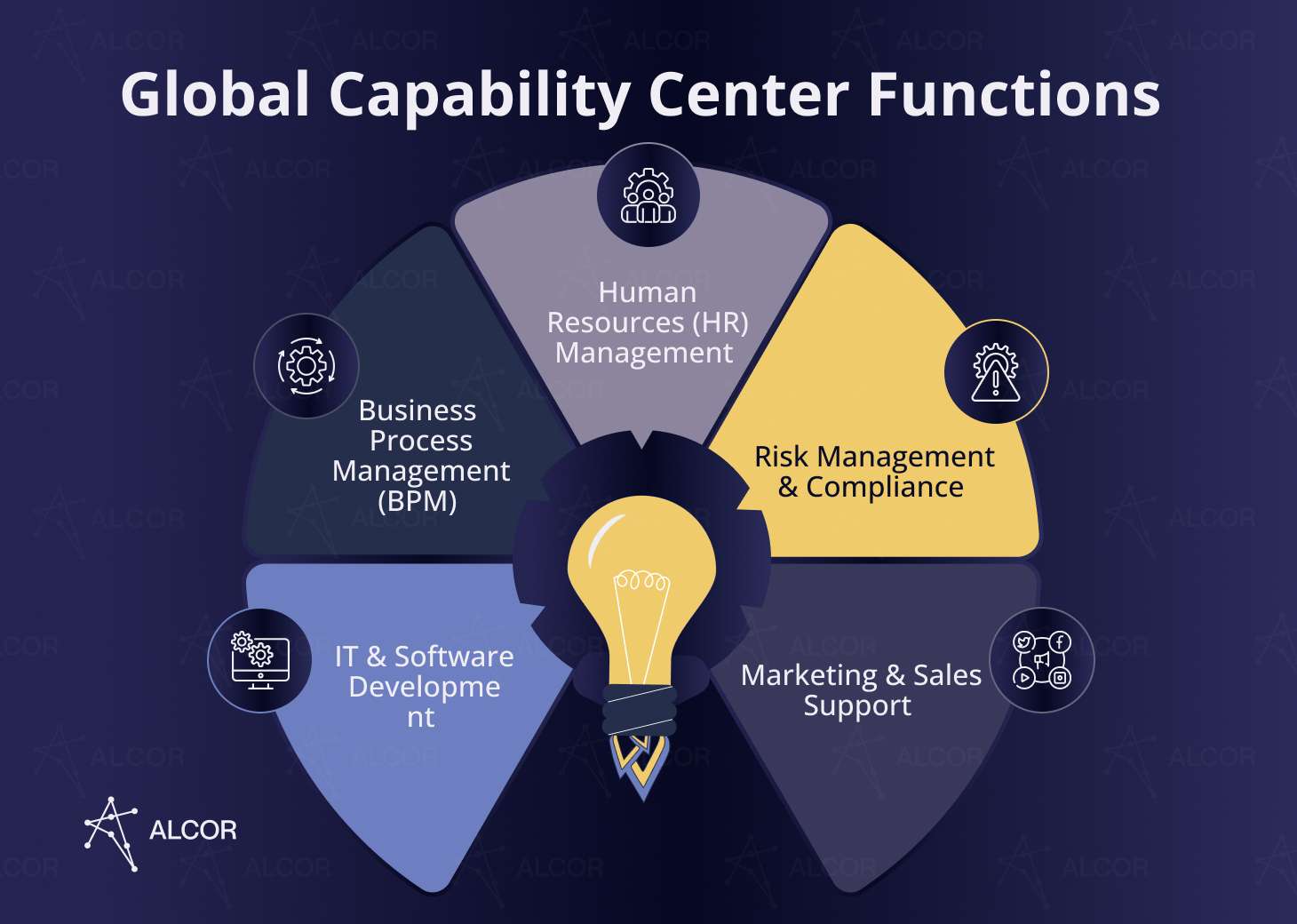
Thus, a GCC is essentially the same as an R&D center or a (GCC) Global Captive Center, but operates on a more global scale. While R&D centers are specialized facilities dedicated solely to innovation, product development, and engineering, GCCs are multi-functional hubs that manage a broader range of business operations, focusing on centralizing and optimizing processes across regions.
So, what specific advantages could setting up a global capability center bring to your business beyond simple cost or time savings?
Global Capability Center Benefits
The main benefits of a Global Capability Center (GCC) include:
- Global talent access: Hire skilled tech professionals from large talent pools in LATAM and Eastern Europe.
- Lower costs: Senior AI engineers can cost 50–64% less than in the US, reducing overall R&D spend.
- Innovation and agility: Dedicated product, engineering, and AI teams enable faster development and experimentation.
- Scalability and resilience: Add or rebalance teams across products and markets using one operating model.
- Greater control: Retain ownership of teams, IP, tools, processes, and KPIs while outsourcing administration.
- Risk mitigation: Centralize compliance, data security, and business continuity.
Access to global talent
A GCC opens doors to the best specialists worldwide and directly tackles the talent shortages you’re probably feeling at home base. ManpowerGroup’s latest Talent Shortage report shows that around 72% of employers in the US struggle to fill technology roles because they lack skilled talent.
By setting up your global capabilities in the right locations, you can build a talent strategy that taps into deep regional pools instead of fighting over the same software development teams in San Francisco:
- Latin America has amassed a 2,3 million tech talent pool, with Mexico alone hosting over 974,500 tech experts.
- Eastern Europe is home to more than 2 million tech professionals, and the wider CEE region counts over 2.54 million ICT specialists, according to Eurostat.
In other words, a well-designed GCC or global capacity center gives you access to a global talent bench. It enables dedicated staffing for critical roles, without the geographic limits of your HQ country. When sourcing a dedicated team for a Capability Center, consider time zone overlap and general cultural alignment.
Cost optimization
Cost is no longer the headline reason to build a GCC, but it still determines whether the team you need is affordable at the size you need. Let’s imagine you need a full AI engineering team. According to Alcor’s 2026 engineer compensation research, hiring senior AI engineers in Eastern Europe and Latin America costs 50–64% less per year than their US equivalents. Same seniority, same stack, roughly half the annual run rate.
This creates significant savings not only on developer salaries but also on infrastructure and operational expenses, letting you redirect budget to product and growth. On top of that, the global capability center operating model helps you avoid additional overhead from new fees for US-based foreign hires, which further increase the total price of keeping all engineers in one country.
Here is how senior salaries compare across the three regions:
Average Senior Annual Base Salary
| Role | USA | Eastern Europe | LATAM |
| ML Engineer | $222,000 | $86,100 | $79,050 |
| LLM Engineer | $234,000 | $94,050 | $90,000 |
| AI Product Engineer | $228,000 | $93,150 | $82,500 |
| MLOps Engineer | $189,000 | $94,350 | $85,950 |
| Data Platform Engineer | $189,000 | $86,400 | $81,150 |
Average base annual salaries at the senior level, from Alcor’s 2026 engineer compensation research. Eastern Europe is the mean of Poland, Romania, Ukraine, and Bulgaria; LATAM is the mean of Mexico, Colombia, Argentina, and Chile.
Run that across a team rather than a seat, and the effect compounds. Alcor’s research benchmarks a ten-person AI engineering team at roughly $1.98 million a year in the US. Using the global capability center model to build the same team across Latin America or Eastern Europe costs $858,750/year and $966,000/year, respectively. It’s the difference between funding an AI roadmap this year and deferring it to the next round.
This is what financial durability looks like. Not a one-off saving, but a cost base that lets the AI team survive to the next funding round or the next earnings call without R&D growing as a share of revenue.
One thing the salary line does not show: employer taxes and mandatory contributions can range from 2.25% to 30% depending on the market and hiring model. Salary is the visible part of the cost. A global capability center operating model that quotes you a salary and discovers the rest later is not cheaper, just less transparent. Alcor prices the full employer cost up front, per market, with no setup fees, no exit fees, and no deposits.
Innovation and agility
Global capability centers have shifted from running processes to owning them, and from administrative support to technological capability. In LATAM and Eastern Europe, the evidence is the same: new centers now launch with product and AI mandates rather than growing into them over a decade, and they hire engineers, not support staff.
Eastern Europe shows the transition most clearly. According to ABSL’s Business Services Sector in Poland 2026 report, Poland now hosts 2,179 service centers run by 1,303 companies, employing 500,500 people and contributing a record 6.1% of national GDP. Service exports reached $48.4 billion in 2025, up from $42.3 billion the year before. ABSL describes the sector’s core shift as moving from service provision to owning and integrating global business processes. Its president puts it as “taking full ownership of processes, changing our role in global supply chains.” ABSL projects that by 2030, 70% of centers in Poland will have moved entirely beyond traditional operating patterns.
In Latin America, AI demand drives transformation as well. The IDB analysis of online job postings covering 6.2 million vacancies across 15 countries between 2022 and 2025 found AI-related roles to be the region’s fastest-growing area. In its 2026 macroeconomic report, the IDB names AI the fastest-growing skill set in Latin America.
For a tech product company, that means the AI and platform engineers you need are already being hired in these markets… by someone. In practice, owning that capability yourself gives you:
- shorter cycles from idea to production, because product and engineering sit together in one global capability center platform;
- easier rollout of new features or services across regions using unified tooling and standards;
- safe experimentation – you can pilot new initiatives in one GCC location and then scale them globally once they work.
Scalability and business resilience
Instead of spinning up separate vendors or entities for every new market, you extend the work to an existing team model within your global capability center.
That means you can add new squads, products, or geographies by plugging them into the same hiring pipeline, onboarding process, tools, and governance you already use in the GCC. If demand spikes, you grow headcount in that hub; if a market cools down, you can rebalance teams to other products without unwinding multiple external contracts or losing the product context those people have built up. The compounding effect is competitive, not just operational. While a competitor is still interviewing in month eight, you are shipping in month three, and by the end of the year that gap is a roadmap ahead, not a quarter.
Control without operational overload
With global capability center services, you keep the steering wheel but don’t have to build the engine yourself. In practice, that means you delegate operations to a GCC provider while owning every decision that touches the product:
- You keep direct supervision of product development, architecture, and delivery.
- You run daily communication with your engineers and specialists in the GCC.
- You define the processes, tools, and KPIs – the provider simply implements and maintains them.
- The provider handles the “heavy” part: office lease and fit-out, hardware procurement (often on better terms via their vendor network), IT support, payroll, benefits, insurance, and HR admin, so your internal team doesn’t have to.
With a partner like Alcor, you also keep a clean path to insource: you can transfer your team, contracts, documentation, and equipment fully under your entity, without extra buyout fees. So you get the talent and economics of a GCC without losing control of architecture, security, or release cadence – and without turning your VP of Engineering into a facilities manager.
Risk mitigation
Building on the previous points, setting up a global capability center platform helps you reduce risk on three fronts that matter to boards, auditors, and acquirers:
- IP and data protection. Your core codebase, data, and know-how remain within a controlled, in-house structure rather than being spread across multiple vendors. Every engineer’s IP is assigned to you from day one, which is what makes the engineering organization an asset in due diligence rather than a dependency to disclose.
- Regulatory and compliance risk. A mature GCC with strong governance can centralize risk management, compliance, and internal audit functions, ensuring consistent adherence to frameworks such as GDPR, ISO 27001, and local labor laws.
- Operational continuity. By distributing critical operations across regions, global capability centers support disaster recovery and business continuity planning, helping you stay online during geopolitical or economic shocks.
Want to learn about the best global capability center services providers for your 2026 expansion? Then check out our latest shortlist!
Examples of Global Capability Center Setup
Global Capability Center examples include Toyota, Warner Bros., Digi-Key, GSK, McDonald’s, ThredUp, Pindrop, and BigCommerce, which use GCCs for software development, AI, R&D, analytics, IT, finance, and other global operations.
Global Centers setup looks different depending on who builds one. Enterprises open multi-thousand-person hubs spanning finance, support, and IT. Tech product companies build engineering-first centers of 20–60 people that own part of the roadmap. Here is what both look like in practice among global capability center companies:
- Toyota: In April 2026, Toyota Motor Europe opened its Toyota Digital Hub in Wrocław, Poland – a European software development center staffed by around 200 technical specialists. The team builds the MyToyota and LexusLink+ applications used by more than 2 million European customers for remote vehicle functions and battery-charge monitoring. It develops the cloud infrastructure and cybersecurity behind Toyota’s connected services. Toyota named Poland’s pool of highly skilled specialists and its leading technical universities as the reason for the location. The move also shows how a GCC matures: Toyota has run a shared services center in Wrocław since 2015 for accounting and tax, and the Digital Hub turns that back-office presence into a front-line product engineering site.
- Warner Bros: By establishing its GCC in Hyderabad, the company has built a team that is enhancing AI analytics for streaming platforms, enabling better consumer preference predictions. Integrating these advances into its GCC operations optimizes processes and reduces infrastructure costs.
- Digi-Key: By opening its own GCC and transitioning certain services to Bengaluru, including sales, IT, design engineering support, and supply chain operations, Digi-Key optimized resource allocation and enabled its headquarters to concentrate on core activities.
- GSK: With GCCs in Poland, Costa Rica, India, Malaysia, the UK, and other countries, GSK has boosted its innovation efforts. According to the company, it secured five major product approvals in 2025 alone – Blenrep, Exdensur, Nucala for COPD, Penmenvy, and Blujepa.
- McDonald’s: The fast-food giant opened its first Global Capability Center in Hyderabad – its largest office outside the US. This GCC hosts around 1,500 employees across technology, analytics, finance, HR, and enterprise operations, and supports McDonald’s global digital and operational transformation, with data, design, and decision-making centralized in one hub.
- ThredUp: When ThredUp decided to build its own software R&D center in Eastern Europe, Alcor helped launch a fully-fledged hub. ThredUp hired 20 exceptional local engineers (including an ML specialist plus Java and .NET developers) and had Alcor handle salary processing and tax planning. Alcor also ensured 100% legal compliance under US and local laws. The outcome was a fully staffed, compliant engineering center in a new location and a stronger product team.
- Pindrop: The US-based voice security and deep tech company Pindrop was running product development through an outsourcing middleman – IP ownership sat in a grey area, accountability was split, and senior talent was billed at vendor rates. Then they partnered with Alcor to rebuild it as an owned engineering unit in Eastern Europe. They got 30 engineers, no local entity, no buyout fees, and full IP control from day one. Alcor’s experts filled the first senior role on the very first CV and closed a Senior Security Analyst position. Every engineer hired passed Pindrop’s probation, and the company chose to keep scaling in Ukraine rather than the US.
- BigCommerce: The SaaS ecommerce platform serves merchants in 150+ countries with over 1,300 employees. Facing a US developer shortage and rising costs, BigCommerce had already tried outsourcing vendors in Romania and Ukraine, then concluded it needed engineers committed solely to its own product. That’s why they partnered with Alcor and built a 60-person tech R&D team in Ukraine over 12 months. Alcor covered office setup and lease negotiation, tech recruitment with a purpose-built EVP, and full EOR with no entity registration and no vendor layer.
I would say these examples show GCCs can do more than just bring benefits – they can exponentially boost a company’s growth. The pattern across tech product companies is consistent: each had already tried the vendor route, then replaced it with engineers on their own roadmap, under their own management line, and with their own IP. Now, let’s look at where to build one.
Top Locations to Set Up a Global Capability Center
- India: The world’s largest GCC hub, but with high market saturation and limited US time-zone overlap.
- Mexico: 974,500 tech specialists, strong STEM and AI talent growth, and near-full US time-zone alignment.
- Colombia: 202,000 tech specialists, a fast-growing startup ecosystem, and GMT−5 alignment with US teams.
- Poland: 778,800 tech professionals, strong English and technical skills, EU protections, and growing AI infrastructure.
- Romania: 207,800 tech professionals, an EU-aligned business environment, strong engineering skills, and expanding AI infrastructure.
- Ukraine: 305,000 tech specialists, strong AI/cybersecurity expertise, and the tech-focused Diia.City tax regime.
If you Google “where to set up a GCC,” you’ll see the same names over and over: India, parts of Southeast Asia, and increasingly countries in Eastern Europe and Latin America. Let’s start with India, then look at alternatives in LATAM and Eastern Europe that can give you similar or better value with fewer trade-offs.
India
India remains the world’s biggest GCC hub. According to the NASSCOM–Zinnov GCC Landscape Report 2026, the country now hosts 2,117 GCCs operating 3,728 units, employing 2.36 million professionals and generating $98.4 billion in revenue in FY26 – with 506 of the Forbes Global 2000 present.
That scale is impressive, but there are a few real-world constraints you should be aware of:
- Less-skilled talent: According to the Coursera Global Skills Report 2025, India ranks 89th, behind countries such as Poland, Romania, Bulgaria, and Chile, all in the top 55. Moreover, while it may seem like you’re saving money by hiring Indian developers, you may not get the expected quality, leading to extra costs for later fixes.
- Saturated market: With more than 2,000 GCCs plus traditional IT services giants all competing in the same hubs (Bengaluru, Hyderabad, Pune, etc.), it’s not unusual to see intense bidding wars for senior engineers. That means the “cheap India” assumption often breaks down at the lead/architect level, especially for product companies that can’t compromise on quality.
- Low English proficiency: From 2020 to 2025, India’s ranking in the EF English Proficiency Index dropped 24 positions, from 50th to 74th. While the local talent may typically have higher proficiency, setting up a global capability center in this location can still pose challenges when you need to work with cross-functional teams, communicate effectively with clients, or manage operations and services globally.
- Time zone differences and work ethic: The 10+ hour time difference between the USA and India can be a less-than-ideal factor when choosing a location for a global capability center development. Add a work culture that can be quite different from North and South America or Europe, and you often get more async overhead and slower feedback loops than you budgeted for.
So, if not India, what are the alternatives? Are there better locations where you can easily set up a cost-effective GCC? Here are a few ideas for you:
Mexico
Mexico is one of Latin America’s largest tech hubs and a natural nearshore GCC location for US-based product companies.
- Deep talent pool at nearshore distance. 974,500 tech specialists across Mexico City, Guadalajara, Monterrey, and other cities – enough depth to build complete product teams, not just fill gaps.
- Engineers who have shipped at product companies. 11 unicorns and 1,431 tracked startups (StartupBlink), with Mexico ranked #3 in Latin America on the Global Innovation Index 2025. The senior engineers you hire have built and scaled venture-backed products rather than billed hours on client projects.
- The AI talent pipeline is building faster here than anywhere in the region. Mexico recorded a 356% year-over-year jump in generative AI course enrollments – the highest growth in Latin America, and well above the 195% global average – according to MexicoBusiness.
- Time zone overlap with the US HQ. GMT−6 mirrors Chicago, Austin, and Dallas, so real-time collaboration with US engineering is the default.
- Strong education pipeline. 22 universities in the QS World University Rankings 2026 and 174,476 STEM graduates a year.
Colombia
Colombia is an increasingly popular nearshore GCC base, combining competitive salaries, a growing tech ecosystem, and time zones that work well for US companies.
- A growing talent base and a strong operating environment. The country has about 202,000 tech specialists, concentrated in Bogotá, Medellín, and Cali. It also features 13 universities in the QS rankings, and has a #4 placing in Latin America – #47 globally – on StartupBlink’s 2026 Index of Business Environment.
- One of the densest startup ecosystems in Latin America. 2,137 tracked startups and 3 unicorns, ranked #2 in the region and #35 globally by StartupBlink.
- US-friendly time zone. Operating in GMT-5, Colombia overlaps almost fully with the US East Coast and much of Central Time.
Poland
Poland is one of Eastern Europe’s most mature engineering hubs and a top-tier choice for building high-skill GCCs with strong EU protections.
- Large, senior-heavy talent pool. With around 778,800 tech professionals and major hubs like Warsaw, Kraków, Wrocław, and the Tri-City area, Poland can support everything from small product pods to 500+ engineer global capability centers.
- Top tech and English skills. Poland ranks #3 in Eastern Europe for data science skills in Coursera’s 2025 global skills ranking and sits around #15 globally in the EF English Proficiency Index – with the IT sector scoring 621, squarely C1.
- Innovation and IP infrastructure. #4 in Eastern Europe in the Global Innovation Index 2025, with 20 QS-ranked universities and #40 globally on StartupBlink’s 2026 Index of Business Environment. EU-grade IP and data protection come as standard.
- State-funded AI infrastructure, not just private demand. Poland’s Ministry of Digital Affairs published an updated Policy for the Development of Artificial Intelligence through 2030 in November 2025, sitting under a national digitalization strategy that targets AI tool adoption by half of all Polish businesses, according to the OECD’s review of the EU Coordinated Plan on AI.
Romania
Romania offers a balanced mix of strong engineering, good English, and attractive salary levels – ideal if you want a compact yet powerful GCC in the EU.
- Skilled tech specialists. Romania’s talent pool sits at around 207,800 tech engineers, mainly based in Bucharest, Cluj-Napoca, and Iași, with strong competencies in Java, .NET, front-end, cloud-native stacks, and AI/ML.
- EU legal and business environment. 10 QS-ranked universities and #2 in Eastern Europe on StartupBlink’s 2026 Index of Business Environment. Romania offers a stable, EU-aligned environment for long-term GCC investments.
- A national AI compute program with Romania’s tech hubs at the center. In October 2025, the EuroHPC selected Bucharest as one of six new European AI Factory sites, joining a network of 19 across 16 EU member states.
Ukraine
Ukraine remains one of Europe’s strongest engineering pools, especially for complex product work, despite the ongoing Russian war, and many tech companies still treat it as a strategic GCC base.
- 305,000 tech specialists in key hubs. Ukraine has around 305,000 tech professionals, concentrated in Kyiv, Lviv, Dnipro, Kharkiv, and Odesa, with deep expertise in product development, AI/ML, and cybersecurity.
- Very strong tech skills and education. Ukraine ranks #7 in Eastern Europe in Coursera’s 2025 skills ranking, with 23,000+ qualified IT graduates and 130,000 general engineering professionals annually.
- A tax regime built for software development. Ukraine offers the Diia.City gig contract, created specifically for tech companies. Employer social contributions are fixed at roughly $44 a month rather than scaling with salary. So, at $5,000 monthly gross, effective employer costs land near 0.8% versus about 17.4% under standard employment, per Alcor’s 2026 research. Engineers gain too: effective personal tax drops from 23% to 10%.
Turn your AI hiring pressure into a clear plan
Explore 8 tech markets across LATAM and Eastern Europe and get practical insights for building your AI engineering team.
Alcor’s recruitment experts report that AI Engineer requests split almost evenly between Latin America and Eastern Europe, with no meaningful concentration in either region. What differs is why clients choose each one. LATAM demand is driven largely by time-zone alignment with North American teams, while Eastern European placements lean toward platform-heavy and infrastructure roles. In other words, the choice between the two regions usually comes down to working hours and workload type, not whether AI talent exists there. Each of these locations offers ideal conditions for the setting up of a global development center. But can we rely on regular outsourcing instead? Let’s explore why it’s better to choose a GCC provider rather than a traditional outsourcing company.
Factors to Consider in GCC Setup
Key factors to consider before setting up a Global Capability Center (GCC) include:
- Strategic goals: Define what the GCC should achieve beyond cost savings, such as faster product delivery, new capabilities, or greater resilience.
- Budget and ROI: Estimate setup and operating costs against expected returns over 3–5 years.
- Organizational readiness: Ensure leadership can manage and integrate a distributed global team.
- Risk and control: Choose a GCC model based on requirements for IP ownership, data security, compliance, and operational control.
Before you look at any steps to set up GCCs, it helps to be honest about whether a global capability center is the right move for your company right now – and what shape it should take. I’d look at a few big-picture factors first:
- Strategic intent, not just cost pressure
If the only goal is “get development cheaper,” then building a GCC is probably the wrong tool. For short-term features or non-core work – especially if you’re a non-tech product company – freelance developers or classic outsourcing will usually do the job. A sustainable global competency center makes sense when you’re targeting several strategic goals at once: faster product velocity, new digital capabilities, better customer experience, or redundancy for mission-critical systems. Write those outcomes down clearly before you even start discussing countries and locations.
- Budget and expected ROI
Before launching a GCC, it’s crucial to understand not only where you’ll build it, but how much you’re ready to invest and what return you expect. Treat your global capability center as a capital project: estimate upfront costs (entity or EOR model, hiring, office or equipment, tools, management overhead) and ongoing run-rate, then map them against expected impact on product delivery, revenue, and risk reduction over 3-5 years. A clear GCC budget and ROI hypothesis will help you decide how fast to ramp, which roles to prioritize, and whether the model truly outperforms classic outsourcing or local hiring for your specific case. - Readiness to work as one global team
Even with a partner, someone senior on your side has to champion the GCC. Ask yourself: who owns the strategies to set up GCCs and the day-to-day decisions? A GCC is a real part of your organization, not a side project. That means you need leaders ready to own a distributed team model, share decision-making, and invest time in building trust with a new hub. Just as importantly, you must ensure smooth cooperation between your GCC and in-house teams: align processes, integrate the center into your corporate culture, and prepare managers for cross-time-zone and cross-cultural leadership. That takes deliberate effort and management time, deliberate communication, and a clear plan for how the GCC plugs into your existing org, not runs in parallel to it. You’ll probably want a stronger globalization partner for the GCC setup or a specialized vendor to set up a Shared Services Center that can shoulder more of the heavy lifting. - Risk appetite and control requirements
If you’re handling sensitive customer data, regulated workloads, or core IP, you’ll care more about control than pure cost. Some companies will consider only fully owned global capability centers; others are comfortable starting with a GCC-assisted setup in which a partner handles employment and operations, while the client retains technical control. Your risk appetite should shape your model – not the other way around. This matters beyond day-to-day operations. In an acquisition or IPO process, an engineering organization with clean IP assignment and documented compliance is an asset on the diligence list. One built through layered vendor contracts, with IP ownership sitting in a grey area, is a disclosure item. Decide which you are building before you start hiring.
Once these factors are clear, the offshore development center checklist and GCC setup best practices suddenly become easier to apply – because you know what kind of global capacity center you’re building and why.
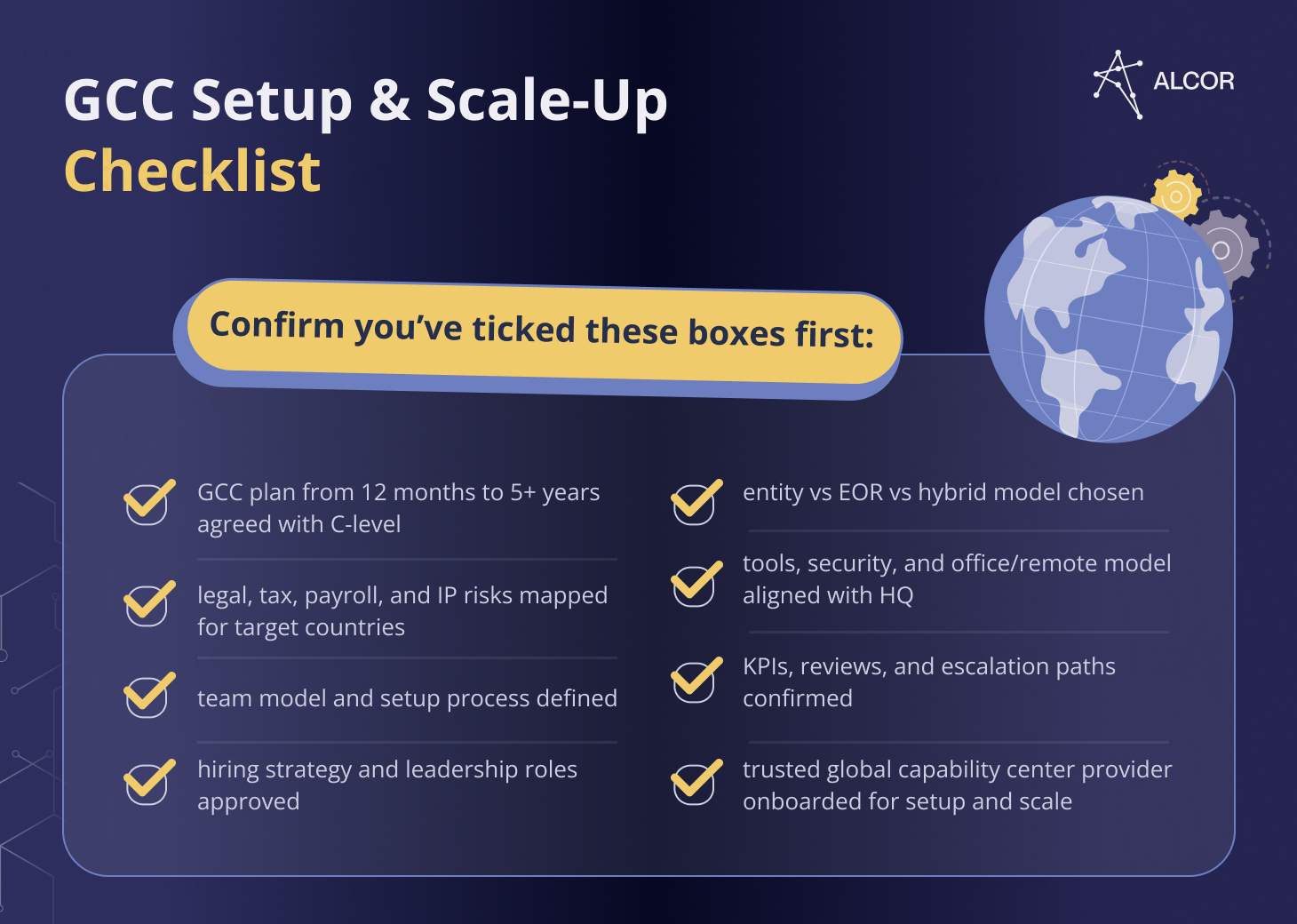
Checklist for 2027 Global Capability Center Setup
- Define a clear GCC vision and a short-, mid-, and long-term plan (12-24 months, 2-5 years, 5+ years): what functions the center will own at each stage and how it will support the overall strategy.
- Perform structured location research on tax, legal, payroll, IP, infrastructure, and entity vs EOR options before choosing a country. Design the team model, setup process, and talent strategy, including roles, stacks, seniority, and leadership.
- Choose the right employment and compliance model, then standardize tools, security, and operations across a unified GCC platform.
- Embed governance, culture, and scale-up best practices, and, if needed, work with an experienced GCC provider.
So you’ve decided that starting a global capability center makes sense. Now the question is: what are the concrete steps to set up GCCs?
1. Clarify your GCC vision and plan
Start with a simple, written plan. Define what your global innovation & capability center will actually own in the short term (first 12–24 months), then outline mid-term goals (2–5 years) and long-term ambitions (5+ years): product development, platforms, technology, analytics, customer operations, or a mix. Decide whether you’re building a focused R&D hub or a broader global capability center solutions that will later evolve into a center of excellence. Finally, align this vision with product, engineering, and finance so everyone knows why you’re doing this and what success looks like.
The ramp has compressed. Per the NASSCOM–Zinnov 2026 landscape data, 27% of new centers now reach full portfolio maturity within five years, against ten years historically. Plan for a center that owns real scope by 2029, not one that spends five years earning it.
2. Do serious homework on location choice
This is where I’d absolutely keep a checklist. Choosing the right location for an offshore GCC setup means structured research, not just “I’ve heard Poland or Mexico are good.” For each potential country, you’ll want to understand:
- Legal and tax regime (for example, Colombia’s standard 35% corporate income tax on IT companies, plus potential surcharges (PwC)).
- Payroll and employment specifics (such as Colombia’s mandatory social security and parafiscal contributions, which can add roughly 30% to the gross salary, plus 13th-month pay and severance funds that must be budgeted correctly, per Alcor’s legal experts). Model the full employer cost per market, not the salary.
- IP protection, data-privacy rules, and any sector regulations (take a GDPR privacy law with strict consent and data-transfer rules in Eastern Europe).
- Options for a legal entity vs working via COR/EOR/global capability center setup services for US companies.
- Office setup and infrastructure: procurement, IT support, security standards, insurance, and workplace policies.
If you do this entirely on your own, you’re looking at months of calls with local law firms, payroll vendors, and landlords in every market where you might set up an offshore global capability center. This is exactly the kind of background work Alcor takes on when helping clients with nearshore or offshore GCC setup in Latin America and Eastern Europe.
3. Design your team model and setup process
Next, decide how work will actually be structured. Define the team model for your GCC: which squads sit there (product teams, platform, DevOps, data, AI/ML) and how they connect to HQ. Clarify decision rights and communication flows so your global capability center doesn’t become a parallel universe. Then outline a realistic setup process: pilot team – stabilization – ramp-up. This sequence keeps you from trying to hire 50 people into a structure that doesn’t exist yet.
4. Build a talent strategy and dedicated staffing approach
A GCC without a smart talent strategy is just an office with laptops. Start with the roles blocking your roadmap rather than headline talent-pool numbers. If a senior ML or MLOps engineer is what you cannot hire at home, the question is whether that market has those engineers at that seniority – not whether it has engineers.
Translate the roadmap into specific roles, stacks, and seniority levels per phase, and think about on-site leadership early. It is hard to scale if every decision still routes through HQ.
Plan for retention from the start, not after the first resignation. The value of a center compounds with tenure: engineers who have been on your product for three years carry context no onboarding replaces.
Alcor’s recruitment experts see a clear split in what actually decides a senior hire. Mid-level developers are most swayed by learning, growth, and career-development opportunities. Engineering Managers, Architects, and Tech Leads weigh things differently: remote-work flexibility, autonomy without micromanagement, technically challenging or high-visibility work, the ability to influence product or technical direction, and joining a company with a stable, clear direction show up far more often as deciding factors than raw compensation or benefits. You control every one of those directly, and none can be bought back later once a senior engineer has decided the center is a delivery site rather than a place to build. So build the employer brand, career paths, and compensation reviews that make long tenure possible before you hire, and treat average tenure as a first-class metric alongside time-to-hire.
Then decide how you’ll hire: can your internal team realistically own sourcing, screening, and offers in a new market, or do you need a provider on the ground (see step 8)?
5. Choose your employment and compliance model
Then comes the boring-but-critical part: how will you employ people? If you open an entity, you’ll need to run local HR, payroll & accounting, benefits, and compliance for each country. If you start with an EOR/COR-first approach, look for a GCC-assisted setup with a real globalization partner on the GCC setup – not just a generic payroll vendor. Alcor, or another strong global capability center provider, provides a full legal shield and handles onboarding/offboarding, payroll, benefits, and local admin. At the same time, you retain full control over day-to-day work and delivery.
6. Set up operations and your GCC platform
Once the people piece is clear, you need a working environment. Standardize tools, security, and workflows across your global capability center platform: code repositories, CI/CD, observability, ticketing, documentation, and access controls should match HQ standards. In parallel, sort out real-world operations – office or hybrid model, procurement & IT support, insurance, employer branding, and on-the-ground HR services.
7. Embed governance, culture, and scale-up best practices
Think about how you’ll run and grow the center once the first teams are live. Define KPIs for your GCC (delivery, quality, retention, cost, efficiency), set up regular reviews, and agree on how to escalate issues. Then, bake in a few GCC setup best practices:
- lead with a clear enterprise-aligned vision;
- build a strong local leadership bench that can balance global standards with regional realities;
- foster a culture of innovation and continuous improvement;
- invest in collaboration with HQ – shared rituals, cross-location squads, and regular leadership touchpoints, so the center doesn’t become a “dead end.”
8. Find a trusted GCC provider
The last item on the checklist is choosing who will walk this road with you. You can absolutely go fully DIY, but most tech companies prefer a GCC-assisted setup for the first phases. I’d keep three things in mind:
- Scope and ownership. Look for a vendor to set up a GCC that can cover the full stack in-house – tech recruitment, compliant employment, and day-to-day operations – instead of stitching together multiple third parties. Clarify what’s included, what’s extra, and who owns which risks.
- Local and legal depth. A solid globalization partner for GCC setup should have real on-the-ground experience: years in the market, a legal entity, and strong knowledge of labor law, tax, and employment specifics in your chosen location.
- Transparency and reputation. Ask for clear, line-item pricing with no hidden markups or buyout fees, then check it against local market rates. Finally, review case studies and independent ratings (e.g., G2, Clutch, GoodFirms, Trustpilot) to see how they actually deliver for other tech product companies.
A partner that scores well on these three points won’t replace your strategy, but it will make the whole GCC journey faster, safer, and much less painful for your team.
GCC: Alcor Assisted Setup
Alcor’s GCC as a Service lets you launch and run a GCC in LATAM or Eastern Europe with one partner handling legal setup, hiring, payroll, and office ops – proven by Bacstory’s (ex-People.ai) 50 engineers, a fully compliant R&D hub built in months, not years.
If the previous checklist felt like a lot of work, that’s because setting up a GCC really is a heavy lift. Legal entities, local hiring, tax and payroll, office setup, security, HR, culture – it’s a full project, not a side task for your VP of Engineering. This is exactly where Alcor’s GCC as a Service model comes in.
Instead of juggling multiple vendors, you get one partner for:
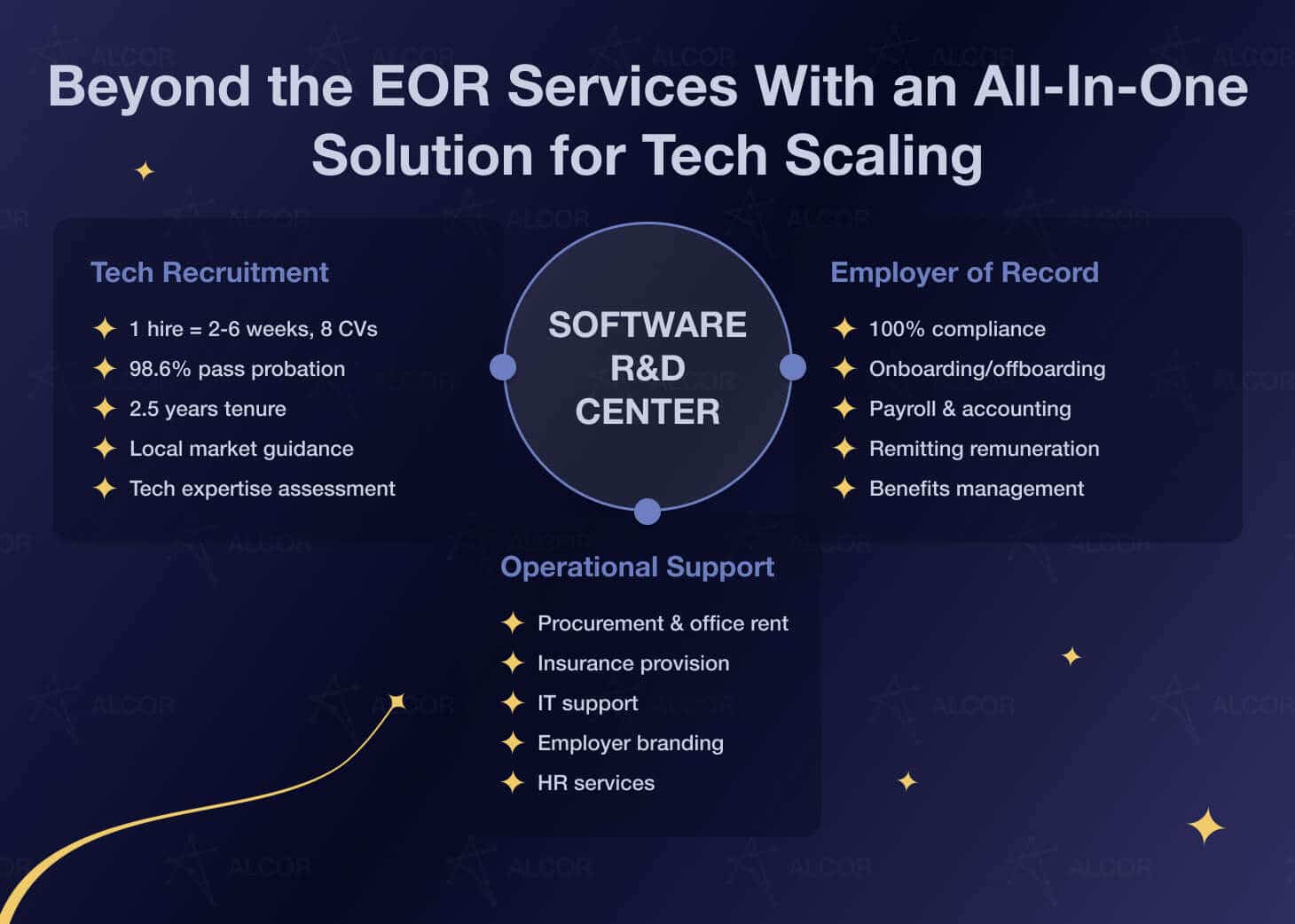
- COR/EOR for FinTech & Beyond: Enjoy seamless operations and benefit from expert navigation of legal matters, onboarding and offboarding of your developers, payroll management, and benefits administration. Check out the Sift case – they’ve already leveraged our EOR services to simplify their daily tasks and take their business to the next level!
- Top-notch IT recruitment: Qualified candidates, 80% of whom are approved by clients and invited to interviews. Our 40 in-house tech recruiters fill 15% of vacancies from the first CV. 98.6% of hires pass probation, with a 2.5-year retention rate.
- 360° operational support: For your convenience, we offer office lease and hardware procurement services for your software research and development team, visa support, insurance assistance, and employer branding to boost your company’s global image.
You stay focused on the product. We take the setup and operations off your plate without you having to become an expert in local bureaucracy.
Let’s take a real example from Backstory (ex-People.ai). Their ask looked roughly like this:
“We want to replace a patchwork of vendors with our own R&D hub in Eastern Europe, hire rare-skill AI, data, and full-stack engineers, and stay fully compliant – without opening a local entity or building a back office from scratch.”
Here’s what Backstory got by partnering with Alcor:
- A functioning tech R&D hub in one month. We sourced, negotiated, and fully equipped a dedicated office, so their engineers had a working environment before most companies finish comparing entity structures.
- 25 senior engineers in nine months, now 50. Python, Scala, Java, React, Big Data, Kafka, and AWS – including the AI and data profiles Backstory couldn’t source at home.
- Payroll, benefits, and HR off their plate entirely. Our EOR and back-office support carried compliance and administration while Backstory kept product, architecture, and team leadership in-house.
- No local entity setup, no intermediary. They managed their engineers directly and never registered a company in the market.
- IP assigned from day one. The difference between an engineering organization that reads as an asset in a diligence process and one that reads as a disclosure.
Some of the hired engineers became the core team of Backstory – a company valued at $1 billion.
Alcor builds the same way for Series D and later, PE-backed, and public or pre-IPO product companies: recruitment, compliant employment, and operations under one structure, with the roadmap staying yours.
Let’s talk about building your Global Capability Center.
FAQ
How to set up a Global Capability Center?
Setting up a Global Capability Center takes eight steps: confirm a scaling trigger, research locations on tax and legal terms, design the team model, build a talent strategy, choose an employment model, stand up operations, embed governance, and select a provider. With a GCC provider like Alcor, most tech product companies launch in about 90 days.
Why are CEOs building Global Capability Centers?
CEOs build Global Capability Centers to reach engineering talent their home market has run out of – AI/ML, MLOps, and deep tech roles – while keeping the team, its management line, and its IP inside the company. A GCC adds engineering capacity without adding vendors or opening a legal entity.
What should a CXO’s Global Capability Center setup checklist include?
A CXO’s Global Capability Center checklist should include: the scaling trigger justifying the build, a 12–24 month scope definition, structured location research on tax and payroll, the team model and reporting lines, an employment model with day-one IP assignment, a buyout-free exit path, operations and security standards, and retention targets.
What is the difference between a Global Capability Center and IT outsourcing?
IT outsourcing rents capacity through a vendor; a Global Capability Center gives you an owned engineering team. Outsourcing suits short-term projects and small hires but routes work through a third party, splits accountability, and leaves IP ownership ambiguous. A GCC unifies hiring, payroll, compliance, and operations under one structure aligned to your roadmap.
How do Global Capability Centers support core enterprise functions?
Global Capability Centers own engineering and product development, IT and infrastructure, finance and back office, HR, risk and compliance, and marketing support. For tech product companies, the mix skews heavily toward engineering, with payroll, HR, and compliance running underneath as operational support rather than separate delivery functions.
How do Global Capability Centers improve cost efficiency?
Global Capability Centers cut senior engineering costs by 50–64% against US equivalents. Hiring a senior ML Engineer costs $222,000 annually in the US, $86,100 in Eastern Europe, and $79,050 in Latin America. Across a team of 20, that gap funds an AI roadmap rather than deferring it to the next round.
How would you rate this article?
Alcor is Your Trusted Scaling Partner
for expansion
support