


IT outsourcing to Poland is entering its next growth phase: the country’s ICT market is set to climb from $34.75 billion in 2026 to $56.01 billion by 2031, according to Mordor Intelligence. That growth is backed not only by market size, but also by real engineering capacity, and I’ll show you how:
- Fact #1: Poland’s tech workforce has grown to 778,800 professionals and more than 50,000 IT companies – the largest talent pool in Central and Eastern Europe.
- Fact #2: Poland ranks #1 in Europe for the concentration of Tier 2 AI talent (advanced researchers and engineers building deep learning models and AI infrastructure), per Interface EU’s 2026 analysis.
- Fact #3: The country’s startup ecosystem pulled in $176 million in cumulative funding in 2025 alone, up 29% year over year, and in 2026 counts 14 unicorns – more than any other CEE market, according to StartupBlink’s 2026 Global Startup Ecosystem Index.
The rest of this guide breaks down what that growth actually costs, how fast a team gets built, and where the risks for your business still sit.
Key Takeaways
- Poland’s ICT market is projected to grow from $34.75 billion in 2026 to $56.01 billion by 2031, with 778,800 tech professionals and 14 unicorns leading Central and Eastern Europe.
- Poland’s tech talent pool delivers senior developers at 46-55% below US salaries, with AI/ML specialists ranking #1 in Europe for Tier 2 talent concentration.
- Senior developers in Poland cost $70,800 to $150,000 annually; FTE hires add roughly 20% in employer taxes, while B2B contracts and optional benefits keep total costs lean.
- Poland beats Mexico and Colombia on talent depth, and outperforms India on IP protection, attrition, and time-zone overlap.
- Polish IT outsourcing carries some risks: underqualified developers, limited control, project-first vendors, and technical debt – though Poland’s time zone enables genuine round-the-clock development.
- Alcor builds dedicated R&D teams in Poland instead of outsourcing – scaling 10-30+ engineers in 90 days with a 98.6% probation pass rate and 2.5+ year average tenure.
IT Outsourcing Industry in Poland: 2027 Projection
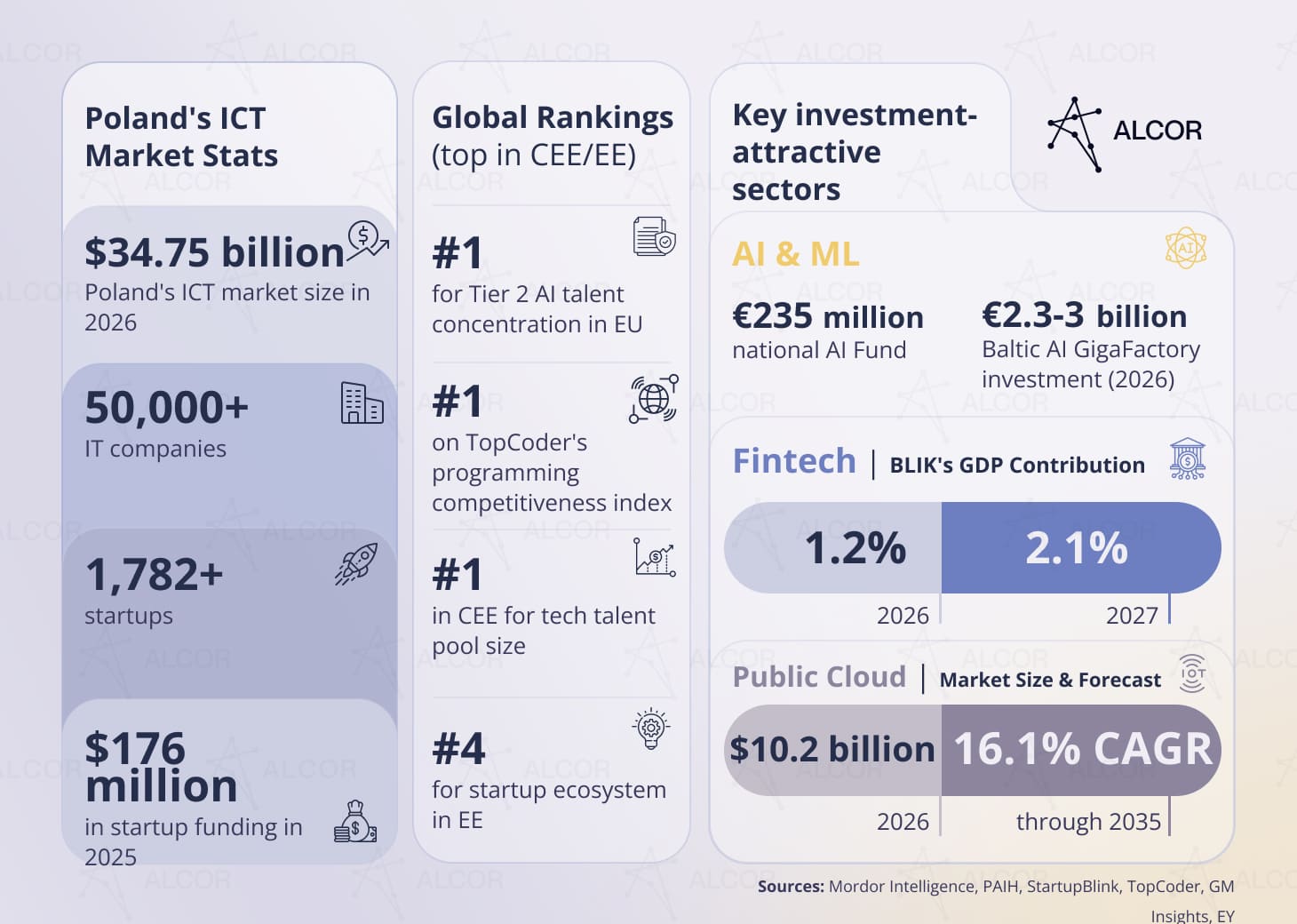
Poland’s ICT market is set to climb from $34.75 billion in 2026 to $56.01 billion by 2031, and IT services and software alone will grow from $9.15 billion to $13.79 billion by 2032, a 7.08% CAGR. Companies that outsource to Poland benefit from a tech workforce of 778,800 professionals, 50,000+ IT companies, and a startup ecosystem that pulled in $176 million in funding in 2025. Poland ranks #1 in Eastern Europe on TopCoder’s programming index and leads the CEE region with 14 unicorns. Warsaw dominates gaming, Kraków anchors AI research, and sectors from fintech to healthcare IT are all expanding faster than the broader economy.
Poland ranks #1 in Eastern Europe on TopCoder’s programming competitiveness index – a lead the country’s held even as competition for engineering talent intensifies across the region. That technical depth is exactly why IT offshoring to Poland keeps growing among global businesses, and why tech product companies choose to outsource software development to Poland instead of just chasing the lowest hourly rate elsewhere. Here’s what’s actually behind that decision heading into 2027.
IT services market
As I mentioned earlier, Poland’s ICT market is climbing toward $56 billion by 2031. IT services and software make up a growing share of that curve on their own: the segment is projected to grow from $9.15 billion in 2026 to $13.79 billion by 2032, a 7.08% CAGR, according to MarkNtel Advisors.
Within that broader climb, IT services already account for roughly 35% of Poland’s total ICT market, according to Mordor Intelligence, and public cloud specifically is growing even faster, at a 17.78% CAGR through 2031. That’s less a slowdown story and more a shift: enterprises are moving spend from raw infrastructure toward the specialized services and engineering work outsourcing partners actually deliver.
That growth is already showing up in enterprise behavior. More than half of Polish enterprises (55.3%) have already adopted cloud computing services, according to Statistics Poland, and that adoption curve is exactly what’s pulling IT services demand upward faster than the underlying infrastructure market itself.
Startup ecosystem
According to StartupsBlink, Poland boasts over 1,782 startups. Venture capital investment reached €797 million across 183 transactions in 2025 alone, according to a joint report from PFR Ventures and Inovo VC – and even after stripping out two outsized mega-rounds (ElevenLabs and ICEYE), the underlying market still grew 28% year over year, a sign of genuine maturing rather than a couple of headline-grabbing outliers.
Poland leads the CEE region in unicorn count – 14 to date, according to Dealroom’s CEE 2026 report – including ElevenLabs, DocPlanner, and LiveChat. The country also ranks #4 in Eastern Europe and #33 globally on StartupBlink, a position it’s earned by Polish startups and companies across gaming, AI, fintech, and healthtech – all I cover in more detail below.
City-level specialization is another major strength:
- Warsaw – Europe’s largest game production hub: 307 gaming developers and publishers (37% of all Polish gaming entities) and PLN 2.5 billion in 2024 gaming revenue, per Poland’s Trade and Investment Agency.
- Kraków – home to the GAIA AI Factory, launched in 2026, positioning the city as Poland’s primary hub for advanced AI research and engineering.
- Wroclaw – known as the “Polish Silicon Valley,” with MedTech as its leading specialization.
- Poznan – a rising secondary hub, strongest in C/C++, Java, and .NET development.
Planning to hire software developers in Wroclaw for Medtech or product engineering? Build your team with Alcor.
State of the tech industries
- Game Development. Poland’s gaming industry now counts 824 studios and roughly 14,600 employees, placing the country among Europe’s top three gaming markets alongside the UK and France, according to PARP’s Game Industry of Poland Report 2025. As I’ve mentioned above, Warsaw alone is now Europe’s largest game production hub – and the country’s studios compete globally, not just regionally: CD Projekt, Techland, PlayWay, Huuuge, Ten Square Games, and 11 bit studios all build from Poland.
- Public Cloud. Poland’s cloud computing market has reached $10.2 billion and is set to grow at a 16.1% CAGR through 2035, according to Global Market Insights’ Europe Cloud Computing Market report – the largest national cloud market at the east of Europe, a region GM Insights projects will grow 17.8% CAGR overall. Across Europe, AI, ML & Analytics is the fastest-growing cloud application category at a 23.8% CAGR, as enterprises move GenAI workloads into managed cloud environments.
- Artificial Intelligence. In July 2026, Poland formally joined the Baltic AI GigaFactory consortium – a joint bid with Lithuania, Latvia, and Estonia for one of the EU’s AI Gigafactory sites, worth up to €2.3-3 billion, backed by a PLN 400 million government commitment. That sits alongside the country’s existing €235 million national AI Fund, which co-finances private-sector AI innovation and gives startups free access to national AI compute infrastructure through the PIAST-AI and Gaia programs.
- FinTech. BLIK, Poland’s homegrown mobile payment system, is targeting a doubling of transaction volume by 2027, and it’s already tracking there, with transactions up 27% year over year in the first quarter of 2025 alone, according to EY’s “10 Years of BLIK” report. If that trajectory holds, EY projects BLIK’s contribution to Poland’s GDP will climb from 1.2% to 2.1% – one of the clearest signals of how deeply fintech has embedded itself into the economy.
- Healthcare IoT. Healthcare technology is Poland’s fastest-growing ICT vertical, advancing at a 14.91% CAGR through 2031, according to Mordor Intelligence. The country has already moved past early-stage digitization: Black Book Research’s 2026 report on Polish digital healthcare IT found e-prescriptions, e-referrals, and electronic medical documentation now embedded across most of the system, with AI-enabled imaging and clinical decision support emerging as the next growth wave.
Advantages of Outsourcing to Poland
Poland offers the largest tech talent pool in Eastern Europe, with 778,800+ ICT professionals, backed by 20 universities in the QS World Rankings 2026 and 18,081 annual ICT graduates. Its AI talent ranks #1 in Europe for Tier 2 concentration, and its developers rank #4 in Eastern Europe on Coursera’s skills index. A senior Node.js developer costs $84,000 in Poland versus $156,000 in the US, and a senior ML Engineer costs $99,600 versus $222,000, savings of 46-55%. Poland ranks #3 in Eastern Europe for English proficiency, follows Western work ethics built over 30+ years of collaboration, and, as an EU member, enforces GDPR-grade data security and IP protection.
Let’s see what makes choosing IT outsourcing services in Poland such a smart move.

The largest tech talent pool & education pipeline in Eastern Europe
Poland has the biggest tech talent pool in Eastern Europe, with over 778,800 ICT professionals, according to Eurostat – the foundation that makes IT outsourcing services in Poland viable at scale for companies building 10, 20, 30+ person engineering teams. That pipeline keeps refilling the IT industry in Poland with more than 74,000 STEM graduates every year.
The academic backbone behind those numbers is also real: 20 Polish universities feature in the QS World University Rankings 2026, led by the University of Warsaw, Jagiellonian University, and Warsaw University of Technology – the latter climbing 40 places this year, its best result yet. Beyond formal education, coding boot camps like Coders Lab and Codecool broaden access to tech careers outside the traditional university track.
Emerging AI engineering talent pool
As I already said, Poland ranks #1 in Europe for the concentration of Tier 2 AI talent, and #4 globally. That depth extends beyond one metric: the country ranks #1 in Eastern Europe (#24 globally) on Oxford Insights’ Government AI Readiness Index 2025, and #3 in Eastern Europe for AI maturity and data science skills, per Coursera’s 2025 Global Skills Report.
TCL also chose Poland for its European AI research headquarters, citing Polish researchers’ rare combination of algorithmic and mathematical skill, and Ringier Axel Springer built one of its key global AI and data science centers here for the same reason. The country’s most in-demand tech stack (Python, TensorFlow, NLP, and Kubernetes) maps directly onto the ML, LLM, MLOps, and AI infrastructure roles product companies are scaling fastest right now, backed by the national AI Fund and Baltic AI GigaFactory consortium mentioned earlier.
Turn your AI hiring pressure into a clear plan
Explore 8 tech markets across LATAM and Eastern Europe and get practical insights for building your AI engineering team.
Elite tech skills
Beyond AI specifically, software outsourcing in Poland keeps growing because the general skill level holds up too: Polish developers rank #4 in Eastern Europe for overall tech skills, according to Coursera’s 2025 Global Skills Report. On the ground, that shows up in which programming languages actually dominate job postings: SQL, Python, and Java each appear in roughly 15-20% of Polish IT job listings, according to a 2025/2026 analysis of postings across No Fluff Jobs, Just Join IT, and LinkedIn – with JavaScript and TypeScript close behind for frontend and web development roles.
More affordable costs compared to the US
One of the biggest advantages of software development outsourcing in Poland is its financial value. According to Alcor’s 2026 engineer compensation research, a senior Node.js developer in Poland costs $84,000 annually versus $156,000 in the US (a 46% savings), while a senior ML Engineer costs $99,600 in Poland compared to $222,000 in the US, a 55% savings.
That gap isn’t just cost of living; the tax system plays a role too. Tax rates in Poland are generally lower than in the US or other European Union countries, and many international companies prefer B2B contracts with Polish developers for simpler documentation and payment processing. I’ll break down the full salary and tax picture later in this guide.
High English proficiency
Polish programmers rank #3 in Eastern Europe (#15 globally) on the EF English Proficiency Index. A strong command of English helps ensure clear communication, making day-to-day collaboration easier, faster, and less prone to misunderstandings. As a result, working with Polish software developers feels more like extending your in-house team than just managing an offshore development to Poland.
Western work ethics
Beyond technical skills, Polish software developers align well with Western work ethics and have a similar mindset. With over 30 years of experience working with Western tech companies, a professional culture has taken root – one built on ownership, accountability, and agile thinking.
Tech talent from Poland consistently demonstrates critical soft skills that drive successful collaboration:
- Adaptability and resilience
- Critical thinking
- Creative problem-solving
- Emotional intelligence
- Effective communication
Strict data security
Among the many advantages that drive enterprises to consider offshoring to Poland, data protection and IP ownership are key factors – especially for tech product companies whose codebase and technical IP are the business. As an European Union member, Poland adheres to GDPR, imposing strict guidelines for data collection, storage, and management – your data is protected under some of the world’s strictest privacy laws.
Poland also offers a full IP framework aligned with EU law, covering copyrights, patents, trademarks, and trade secrets, according to the U.S. International Trade Administration. One nuance worth knowing: Polish law, like most of continental Europe, doesn’t automatically transfer IP ownership to the employer the way US “work for hire” rules do – ownership has to be explicitly assigned in the contract. It’s a detail easy to miss with a generic template, and exactly the kind of gap a properly structured EOR agreement is built to close.
Polish Developers Compensation and Taxes: Updated
Senior software developers in Poland earn between $70,800 and $150,000 annually, roughly 40-59% below equivalent US salaries, per Alcor’s 2026 compensation research. Full-time employment costs employers an effective 20% in social security on top of a $5,000 salary; B2B contracts cost roughly 26%, including personal income tax and contractor-side social security. Statutory benefits include 20-26 vacation days, 80% paid sick leave, and up to 301 days of combined parental leave. A competitive optional benefits package (health insurance, training, meal cards) adds about $5,000 per engineer annually. Companies hiring through a provider also pay a monthly EOR fee plus a one-time recruitment fee of 15-25% of base salary.
One of the primary reasons Western tech companies outsource to Poland is the more affordable costs associated with it. While Polish software engineers’ salaries are rising, they remain significantly lower than those in the US and other Western countries. And that’s just the starting point of the savings in the payroll in Poland.
Developers’ average annual base salary in Poland
|
Average Annual Software Developer Base Salary in Poland vs the US | ||
|
Position |
USA |
Poland |
|
C/C++ Developer |
$150,000 |
$90,000 |
|
Python Software Engineer |
$165,000 |
$84,000 |
|
Ruby Software Engineer |
$174,000 |
$84,000 |
|
Mobile Application Developer (iOS/Android) |
$174,000 |
$84,000 |
|
Blockchain Engineer |
$171,000 |
$70,800 |
|
Data Engineer |
$177,000 |
$82,800 |
|
DevOps Engineer |
$168,000 |
$90,000 |
|
AI Engineer |
$222,000 |
$129,000 |
|
ML Engineer |
$222,000 |
$99,600 |
|
LLM Engineer |
$234,000 |
$102,000 |
|
AI Product Engineer |
$228,000 |
$103,800 |
|
MLOps Engineer |
$189,000 |
$102,000 |
|
AI Platform Engineer |
$228,000 |
$141,000 |
|
AI Infrastructure Engineer |
$243,000 |
$150,000 |
|
AI Prompt Engineer |
$168,000 |
$93,000 |
|
According to Alcor’s internal tech salaries in Eastern Europe research (As of September, 2026) | ||
But to accurately estimate your budget, salary alone doesn’t tell the whole story. You’ll need to factor in local taxes, statutory and optional employee benefits, and also IT recruitment in Eastern Europe, EOR/COR fees to get a complete picture.
Payroll taxes in Poland: FTE & B2B
When working with Polish developers under the popular B2B model, companies benefit from a unique tax setup. There is no legal obligation to cover the developer’s taxes, effectively reducing the company’s tax burden to zero. Social contributions are also paid by Polish coders working independently under the B2B model, and their amount varies depending on the annual revenue.
|
Employer’s Share |
Employee’s / Contractor’s Share | |
|
FTE |
Effective employer SSC rate: ~20% on top of a $5,000 salary |
Effective employee rate: ~36.7% on top of a $5,000 salary |
|
B2B |
Not mandatory – no employer-side social security obligation |
Effective rate: ~26% on top of a $5,000 salary (often lower in a contractor’s first two years under the preferential regime) |
Whichever model you land on, if the hire is structured as employment rather than B2B, Polish labor law guarantees a specific set of benefits on top of salary and taxes.
Statutory benefits in Poland
- Vacation: 20 working days (under 10 years’ service); 26 days (10+ years); many IT employers add 2–5 extra days in practice
- Sick leave: paid at 80% of salary; first 33 days (14 for employees 50+) covered by the employer, up to 182 days thereafter covered by ZUS
- Maternity leave: 140 calendar days (at least 98 after childbirth)
- Paternity leave: 14 days at 100% of salary, paid by ZUS; must be taken within 24 months of birth, in up to two one-week installments
- Parental leave: 287 calendar days (1 child)/301 days (2+); ZUS pays either 70% of salary for the period after maternity leave ends, or, if applied for within 21 days of birth, a flat 81.5% for the entire maternity and parental period combined
- Disability leave: +10 working days of annual leave for employees with a moderate or severe disability
- Childcare leave: 2 paid days/year for parents of children under 14
- Special event leave: up to 2 working days for family life events
- Force majeure leave: up to 2 working days for urgent family matters
- Holidays: 14 paid public holidays (2026)
(Optional) benefits package in Poland
If statutory benefits are required by law for full-time employees, these benefits are optional. You can skip them, but Poland’s top-tier senior engineers weigh the full package, not just the paycheck, and here’s what they pay attention to when deciding between choosing your company or your competitor:
- Private health insurance ~$600/year
- Professional development (training & certifications) ~$1,500/year
- English language courses ~$800/year
- Home office /IT equipment ~$600/year
- Wellness (MultiSport card, mental health support) ~$600/year
- Meal cards ~$900/year
Total: ~$5,000/year per engineer
Additional fees if you’re working with a provider
If you’re not setting up a Polish entity yourself and are hiring through a provider instead, worth knowing few more layers:
A recurring EOR/COR fee, billed monthly in one of two ways:
- a flat fee per engineer;
- a percentage of gross salary.
A one-time recruitment fee for finding the person with the common market rates:
- 15% for middle level;
- 20% for senior level;
- 25% for lead level.
Worth mentioning that in the US recruitment fees range from 25% to 35%.
IT Outsourcing in Poland vs Other Countries
Poland competes with the US, Mexico, Colombia, and India as an outsourcing destination, each with different tradeoffs. Against the US, Poland offers senior developers at $100,360 versus $188,100 annually, a 46.6% savings. Against Mexico (974,000+ talent pool) and Colombia (202,000+ talent pool and the fastest-growing startup ecosystem in the region), Poland offers broader English proficiency and a larger absolute talent base. Against India’s 5.95 million-strong workforce, Poland offers lower IT-sector attrition, stronger IP protection (India sits on the USTR’s 2026 Priority Watch List), and closer time-zone overlap with the US and EU. Poland ranks #40 globally on StartupBlink’s Business Environment Index.
Poland vs the US
The US remains the world’s largest tech market, with more than 5.26 million ICT professionals, according to the Bureau of Labor Statistics. Poland’s pool is smaller (778,800 ICT professionals) but it’s the largest in Central and Eastern Europe, and it comes with a cost structure the US market simply can’t match: a senior developer in Poland costs $100,360 a year on average versus $188,100 in the US, a 46.6% gap, according to Alcor’s 2026 engineer compensation research.
That gap isn’t just salary. Poland’s R&D tax relief lets qualifying companies deduct 200% of R&D costs (the expense is deducted once as an operating cost, then a second time against the tax base) – a notably more generous structure than the incremental R&D tax credit available in the US. For a company actually building an R&D function rather than just renting headcount, that’s a real difference in what the center costs to run, not just what the paychecks cost.
|
USA |
Poland | |
|
Talent pool |
5.26+ million |
778,800+ |
|
English proficiency |
Native |
High (#15 globally) |
|
Average annual developer salary |
$188,100 |
$100,360 |
|
Benefits |
~$15,400 |
~$5,000 |
Poland vs Mexico
Mexico has established itself as a prominent software outsourcing and offshoring hub in Latin America (LATAM), with a talent pool of over 974,000 developers. However, its high level of bureaucracy and regulatory complexity can slow down the process, especially for foreign companies unfamiliar with local laws. Even though President Claudia Sheinbaum introduced the National Law for the Elimination of Bureaucratic Procedures and Corruption in January 2025 to simplify excessive bureaucracy, challenges persist in its implementation. That’s why partnering with a trusted tech R&D provider, such as Alcor, can make a significant difference in navigating the software engineering services in Mexico.
Poland, as an EU member, offers a more standardized regulatory environment designed for companies used to operating under predictable, codified rules. On language: Mexico’s national EF English Proficiency score sits in the “Low” band, though the country’s IT sector specifically rates High (B2+) – the gap is real but concentrated outside the main tech hubs, not evenly spread.
|
Mexico |
Poland | |
|
Talent pool |
974,000+ |
778,800+ |
|
English proficiency |
Low |
High |
|
Business environment index |
#58 globally |
#40 globally |
|
Bureaucracy |
High |
Medium |
Poland vs Colombia
Colombia is one of the fastest-moving startup ecosystems anywhere right now – its global StartupBlink ranking climbed to #35 in 2026 (up from #47 in 2021), on 29.3% year-over-year growth, among the strongest in the world this year. Its education pipeline punches above its size, too: Colombia graduates roughly 37,000 STEM/ICT students a year vs Poland’s 74,000.
Both countries clearly have real investment going into the pipeline; they’re just at different points in the curve. Where Poland pulls ahead is depth at scale and English, Colombia’s IT sector rates Upper-Intermediate on English proficiency, solid but a step behind Poland’s High rating, and Poland’s talent base is roughly 4x larger in absolute headcount for companies that need to hire developers in Poland well past the first 10 engineers.
|
Colombia |
Poland | |
|
Talent pool |
202,000+ |
778,800+ |
|
English proficiency |
Low |
High |
|
Business environment index |
#47 globally |
#40 globally |
|
Tech education |
37,000+ STEM students |
74,000+ STEM students |
Poland vs India
India dominates on raw scale – nearly 5.95 million tech professionals, per Nasscom’s Annual Strategic Review 2026, and for companies that genuinely need to staff 500+ engineer programs in one country, that scale is a real advantage no other market here can match. But scale comes with trade-offs worth weighing early.
The traditional large-scale IT services model that still dominates India’s outsourcing industry is commonly structured around shared “bench” resourcing – developers rotated across multiple concurrent client projects rather than sitting dedicated to one team full-time. Layer on an IT-services attrition rate still running 16-17% annually and average tenure in early-career engineering roles compressing to under 18 months, and long engagements carry a real institutional-knowledge risk.
IP protection is the other significant gap. The US Trade Representative’s 2026 Special 301 Report keeps India on its Priority Watch List for IP protection and enforcement, citing patent delays, weak enforcement, and high piracy – language the report has repeated for years running. For a product company whose codebase is the business, that’s a materially different risk profile than offshoring to Poland or any EU member state operating under GDPR and the EU’s harmonized IP framework.
|
India |
Poland | |
|
Talent pool |
5.95 million |
778,800+ |
|
English proficiency |
Low |
High |
|
Quality of development |
Low |
High |
|
Work ethics |
Eastern-oriented |
Western-oriented |
Challenges of Outsourcing Software Development in Poland
Polish IT outsourcing carries real risks alongside its advantages: underqualified developers, lack of control, process-first vendor mindsets, and time-zone considerations. Some outsourcing partners assign junior programmers to senior-level tasks, inflate CVs, or relabel generalist developers as AI specialists to meet demand. Traditional outsourcing agencies often retain full control over task execution and developer performance, making quality difficult to verify until a project ends. Vendors focused on task completion over lasting impact can let technical debt accumulate unchecked. On the upside, Poland’s time zone enables genuine round-the-clock development coverage for US-based teams, turning the time difference into a practical advantage rather than an obstacle.
Despite the variety of appealing facts to outsource IT services to Poland, the potential risks and challenges shouldn’t be glossed over:

Underqualified outsourced developers
Unfortunately, not every Polish IT outsourcing company plays fair. Some partners cut corners by assigning junior programmers to mid- or even senior-level tasks or misrepresenting a developer’s skill level altogether. When partners prioritize margins over your project’s success, the result is often buggy code and missed expectations.
It doesn’t stop at junior-for-senior swaps, either. It shows up as inflated CVs that don’t hold up under real technical screening, as “bench” assignments where you get whoever’s available that week rather than the best fit for your stack, and (increasingly, given the AI hiring boom) as generalist backend developers relabeled “AI engineers” to cash in on demand for skills they don’t actually have. For companies hiring specifically for AI/ML roles right now, that mismatch is often the most expensive one to discover late, and it’s one of the most common complaints about software development outsourcing in Poland and every other major outsourcing market.
Here’s what tech recruitment in Krakow, Warsaw, or anywhere else in Poland looks like when it’s done right:
Sift – the AI fraud-prevention platform trusted by X, Airbnb, and DoorDash – hit exactly this wall while scaling into Eastern Europe: one internal recruiter, no local entity, and a year-one target of 30+ hires with no infrastructure to fill it. Alcor built the engine instead of just filling seats: a team assigned exclusively to Sift’s roles ran Sift’s demanding 3-stage technical panel without missing a beat, closing a Senior Product Designer on the first CV presented, and two Infrastructure Engineers plus a Ruby on Rails Developer within 7 days each.
The result: 51 engineers across two markets, full IP and compliance coverage through EOR services in Poland and Ukraine, and zero missed hiring targets – the same year Sift crossed a $1 billion valuation.
Lack of control
Partnering with external tech outsourcing agencies in Poland can feel like handing off your product into a black box. You won’t have full control over task execution, developers’ performance, and the overall development process. Moreover, it’s almost impossible to evaluate the quality of programming at every development stage – only when the project has been completed.
With Alcor, your dedicated engineers work exclusively for you, providing you with full transparency and control, much like managing an in-house team.
Process orientation
Outsourcing vendors often operate with a project-centric mindset, prioritizing task completion over delivering lasting impact. They meet deadlines but sometimes sacrifice quality and innovation. In this case, the product may have poor functionality and numerous gaps, which can negatively impact its market image. Moreover, at most tech outsourcing agencies, software developers work on several different projects at once and don’t see themselves as part of your company.
That project-first mindset compounds over time: technical debt piles up because no one’s incentivized to prevent it, and by the time you notice, it’s already baked into the product.
Location & time zone
Poland’s central European location offers excellent accessibility and convenient overlaps with most EU time zones. For US-based companies, the time difference may seem inconvenient at first, but it can actually work in your favor. In practice, it enables round-the-clock operations and continuous development. While your team winds down for the day, your programmers in Poland are just starting up, keeping the project moving forward 24/7. It’s a built-in system for continuous progress, which is one of the hidden perks of IT outsourcing to Poland.
Beyond Outsourcing: Build Your Own R&D Team in Poland
Alcor builds dedicated engineering teams in Eastern Europe and LATAM as an alternative to traditional outsourcing, combining tech recruitment, Employer of Record services, and operational support under one model. Companies can scale to 10-30+ engineers within 90 days, roughly 5-6x faster than hiring the same team in the US. Case studies show the model in action: Pindrop built a 30-engineer team with zero buyouts, Dotmatics scaled to 30 engineers with full IP rights secured, BigCommerce replaced a failed outsourcing setup with a 50-engineer R&D office, and Backstory (formerly People.ai) grew from 25 to 50 engineers who now sit at the core of its AI platform, the same year it reached unicorn status.
You didn’t scale this far to hand your roadmap to a vendor. If you’re weighing outsourcing in Poland, there’s a more direct path: build your own high-performing engineering team instead, with Alcor running tech recruitment, compliant Employer of Record, and full operational support under one software R&D center model. Scale to 10-30+ engineers in 90 days – 5-6x faster than hiring the same team in the US – and secure the AI/ML and deep-tech talent your home market has already run out of.
No vendor layer. Just a development team in Poland (or another Eastern European or Latin American market) that reports directly to you.
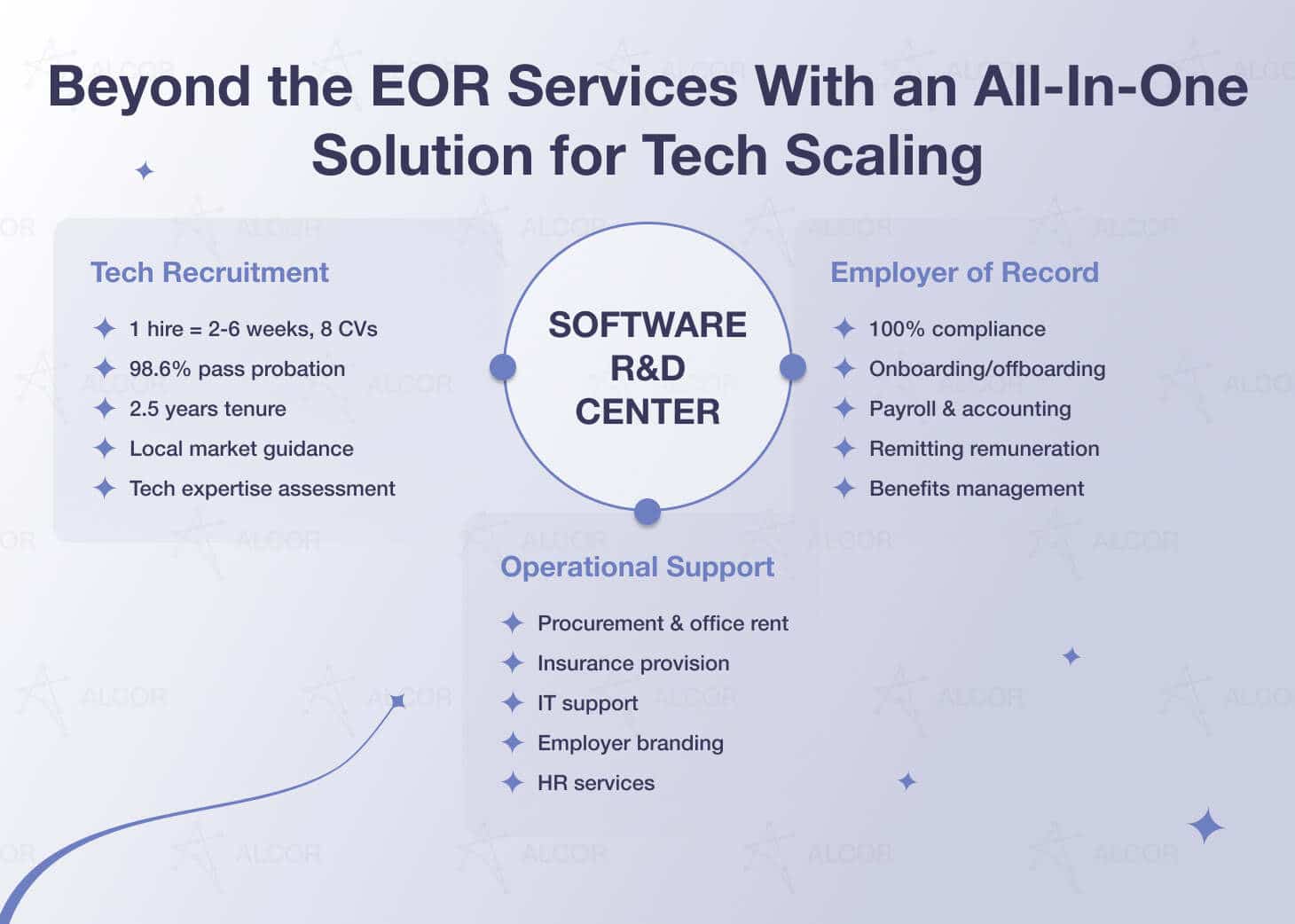
Here’s what that actually looks like for companies who’ve made the switch:
- Full IP ownership, zero buyout fees. Pindrop was stuck in an outsourcing setup where IP sat in a legal grey area and leaving would have meant negotiating a buyout just to get its own team back. Alcor rebuilt it as a true in-house unit: 30 engineers, 100% probation pass rate, and the first senior hire closed on the very first CV.
- Engineering quality that doesn’t get diluted. Dotmatics needed a team with zero intermediary layer for a product where quality isn’t negotiable – biology, chemistry, and data science, all in one platform. Alcor delivered 30 engineers in 12 months, first CVs in 3-5 days, and full IP rights secured from day one. When Siemens acquired Dotmatics for $5.1 billion, every engineer’s stock options were paid out in full, on time.
- A real exit from outsourcing, not just a new vendor. BigCommerce had already tried outsourcing in Romania and Ukraine – shared developers, divided attention, no real ownership. Alcor built a dedicated 50-engineer R&D office instead: first hires in 4 weeks, a fully equipped office in a month, and up to 50% savings versus US hiring, all without BigCommerce opening a local entity.
- Top-10% developers become a true extension of your in-house team. Just like it was with Backstory (formerly People.ai): juggling multiple vendors with nobody owning the outcome, a familiar story for fast-scaling AI companies. Alcor took over as the single accountable partner – 50 engineers hired, 98.6% passing probation, 2.5+ years average tenure. Some of those engineers are now Backstory’s own core senior and staff AI engineers, building the platform Zoom, Cisco, and Nvidia run on, the same year the company crossed a $1.1 billion valuation.
Stop renting engineers. Build a software center in Poland, across Eastern Europe and LATAM – and scale confidently even to 100 engineers in a single year with Alcor.
References
- Mordor Intelligence
- PAIH
- Interface EU
- Global Startup Ecosystem Index 2026
- TopCoder
- MarkNtel Advisors
- StartupBlink
- PFR Ventures & Inovo VC
- Dealroom
- Poland’s Trade and Investment Agency
- DataCenterDynamics
- PARP
- Global Market Insights
- Notes From Poland
- OECD
- Black Book Research
- Eurostat
- QS World University Rankings 2026
- Oxford Insights
- Government AI Readiness Index 2025
- Coursera – 2025 Global Skills Report
- ITCompare.pl
- EF English Proficiency Index
- Forbes
- U.S. International Trade Administration
- U.S. Bureau of Labor Statistics
- ResearchGate
- Mexico News Daily
- Nasscom’s Annual Strategic Review 2026
- Business Today
- Equity Research India
- U.S. Trade Representative
FAQ
How is the Polish IT outsourcing sector adapting to the rise of Enterprise AI and GenAI development?
Poland’s IT outsourcing sector is shifting from selling developer headcount to selling AI-augmented delivery – teams that pair human engineers with agentic AI coding tools to ship faster without sacrificing enterprise-grade reliability.
Agentic coding tools, led by Claude Code (released May 2025) and OpenAI’s Codex, now account for an estimated 75-80% of the enterprise AI-coding market between them, according to Miquido’s Chief AI Officer Jerzy Biernacki, cited by Tech.eu. As routine code generation gets cheaper, developer work is shifting toward verification, architecture, governance, and validation rather than manual coding.
Poland has also produced two independently developed large language models, BIELIK and PLLuM, an unusual feat for a country its size within the EU. Hiring criteria are shifting accordingly: companies increasingly prioritize the ability to translate business requirements into prompts and work alongside AI agents over raw syntax knowledge, while EU AI Act compliance is emerging as a genuine specialization rather than a pure cost center.
What will be the primary use cases and high-demand tech stacks for IT outsourcing in Poland by 2027?
By 2027, the primary use cases for IT outsourcing in Poland will center on production-grade AI systems (retrieval-augmented generation (RAG) pipelines, AI agents, computer vision, and MLOps infrastructure) rather than experimental prototypes.
Poland’s established tech stack (Python, TensorFlow, NLP, and Kubernetes) already maps directly onto ML, LLM, MLOps, and AI infrastructure roles, according to Alcor’s internal talent research. High-demand use cases include fine-tuning LLMs on proprietary datasets, building RAG systems and AI agents for internal and customer-facing tools, computer vision for gaming and manufacturing, and AI-driven legacy-system modernization. Vector databases and orchestration frameworks like LangChain are becoming standard additions alongside established stacks such as Java, Node.js, and .NET.
Demand is also moving beyond data scientists toward MLOps and AI infrastructure engineers who can take models from prototype to monitored, production-grade systems – the bottleneck US companies report most often. EU AI Act compliance work (risk classification, technical documentation, human-oversight systems) is becoming its own specialization, especially for fintech and healthcare clients.
What are the current challenges of outsourcing in Poland?
The current challenges of outsourcing in Poland include underqualified developers on some contracts, limited client control over task execution, project-first vendor mindsets that let technical debt accumulate unchecked, and a widening regulatory compliance burden. Some outsourcing partners assign junior programmers to senior-level work, inflate CVs, or relabel generalist developers as AI specialists to meet current demand. Traditional outsourcing agencies also often retain full control over task execution and developer performance, making quality difficult to verify until a project is already complete.
What are the alternatives to IT outsourcing in Poland?
Companies hiring in Poland typically choose between four models apart from software development outsourcing in Poland: a full R&D center, Employer of Record (EOR), direct tech recruitment, or IT outstaffing – each fits a different team stage and level of control.
– Tech R&D center – the most complete model: one partner combines IT recruitment, EOR, payroll, and operations into a single dedicated, remote development team that works exclusively under your brand, whether you need Vue, Laravel, Drupal, or rare AI/ML skills. Best for companies planning to scale past 10 engineers and keep full long-term ownership.
– Employer of Record (EOR) – legally employs engineers on your behalf and handles payroll, taxes, and compliance, but doesn’t source talent or manage office logistics. Best for companies that already have candidates lined up and just need compliant employment.
– Tech recruitment – a partner sources and vets candidates who then join your own legal entity in Poland. Best for companies with an established local presence that only need hiring support.
– IT outstaffing – IT outstaffing vendors in Poland employ the engineers directly and place them on your team temporarily. It differs from outsourcing in that you direct the daily work yourself, but the vendor still owns the employment relationship, the IP terms, and the exit costs. Best for short-term, narrowly scoped work rather than a long-term core team.
For companies building a long-term engineering presence rather than a short-term fix, the R&D center model is the one built to last – it’s the only option that combines full ownership with zero setup burden.
How would you rate this article?
Alcor is Your Trusted Scaling Partner
for expansion
support