


Share equity among founders early, and you buy something no salary can buy: loyalty, commitment, and a real stake in the outcome. At the earliest stage, before a startup has steady revenue, equity is the tool that rewards co-founders for the risk they’re taking and the hours they’re putting in – it’s why nearly every founding team splits ownership before they draw a single paycheck.
This guide walks through how to split equity among co-founders, when and how to grant stock options to employees, what happens to ownership after a funding round or acquisition, and how to scale your team once the cap table is settled.
Key Takeaways
- Startup share allocation aligns founder incentives and signals team stability to investors. A balanced cap table rewards early risk and keeps co-founders motivated as the company grows.
- Startup equity typically goes to founders, investors, advisors, and employees based on risk and timing. A typical early-stage allocation gives founders 60%+, investors 20–30%, advisors around 5%, and employees 10–15% through an option pool.
- Founders should split equity based on expertise, commitment, responsibility, risk, and capital, rather than defaulting to 50/50. A modest lead stake can also create clearer decision-making authority.
- Founder equity needs protection against dilution, early departures, and uncontrolled share transfers. Vesting schedules, shareholder agreements, and clean equity records reduce these risks before funding or acquisition.
- If you’re ready to turn equity plans into an actual engineering team, Alcor can help you scale compliantly in LATAM or Eastern Europe. Alcor combines senior-level tech recruitment, EOR/COR, payroll, IP and equity administration, legal protection, and operational support, helping tech companies grow to 100+ developers within a year without opening a local entity.
Why Allocate Equity among Startup Co-founders?
Startup share allocation helps co-founders stay committed, align incentives, and share in the long-term value they create. When startups cannot match market salaries, equity rewards early risk and gives founders a meaningful stake in company decisions. The way shares are divided also matters to investors: a balanced cap table can signal trust and shared commitment, while major ownership imbalances may raise concerns about team cohesion and long-term founder alignment.
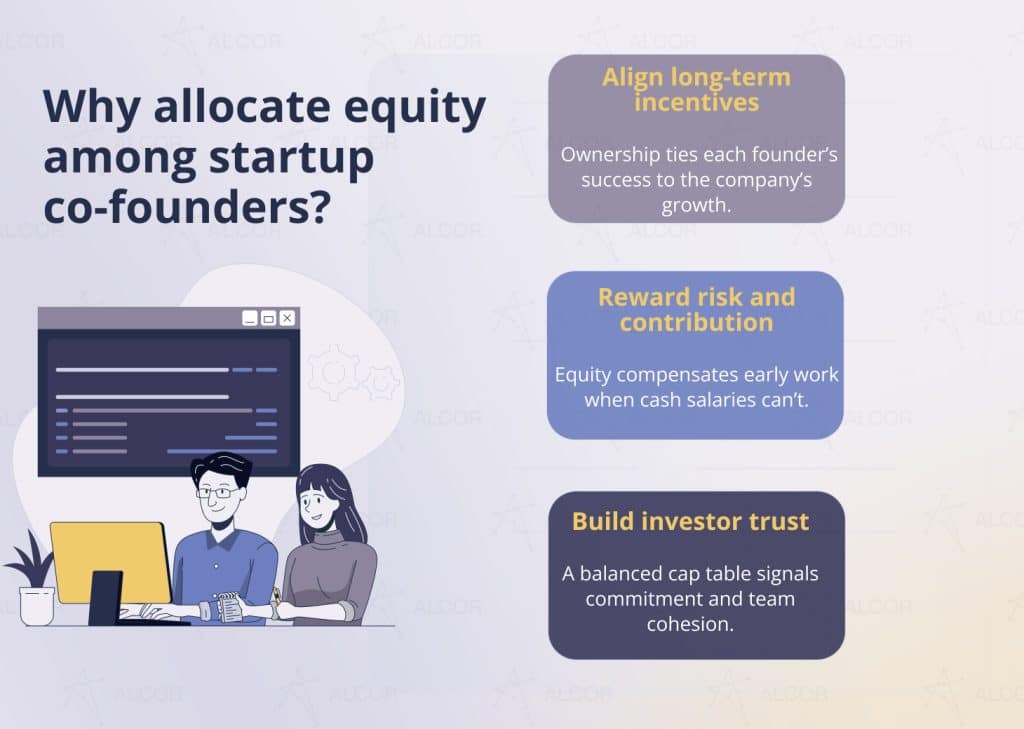
Startups allocate equity to boost co-founder loyalty and align long-term incentives with the company’s success, since early-stage businesses can rarely match market salaries in cash. Equity is the most valuable asset a startup has to offer before it generates revenue. A co-founder who owns shares also gains real authority in decision-making, which raises their motivation to contribute their best work and rewards the risk they took by joining before there was any funding or product-market fit. Startup equity allocation only underlines how much each founder’s contribution is worth to the company.
Investors read a startup’s cap table as a signal of team cohesion before they look at almost anything else. How co-founders divide shares in a company tells investors a lot about engagement and solidarity inside the team. A founding team where one person holds 80% of the shares and the other two hold 10% each raises immediate questions about trust and shared commitment – exactly the kind of imbalance that makes venture investors hesitate before writing a check.
Who Gets Startup Equity
Startup equity typically goes to founders, investors, advisors, and employees, with startup shares for founders making up the largest share in the early stages. Employee option pools often account for 10–15% of fully diluted shares and may vest over time or against performance milestones. Equity can also be extended to employees and contractors based abroad when structured properly. However, stock options are not the same as direct ownership, and their actual value depends on the company’s valuation, total share count, dilution, and future growth.
Co-founders receive the largest share allocation for a startup – typically, the founder and co-founder share percentage combined exceeds 60%. Early investors typically claim 20–30%, advisors around 5%, and employees receive the remainder through a stock option pool. The exact percentage each group receives depends on the risk they took on and when they joined.
According to CRV’s 2026 startup equity guide, employee option pools typically account for 10–15% of fully diluted shares at the seed stage, and founder ownership falls to roughly 36% after a Series A round, as new investors and option-pool top-ups dilute the cap table.
Before splitting percentages, decide on a total share count. Most startups authorize a round number, such as 10 million shares, since it keeps ownership math simple and leaves room to grant small option-pool allocations without fractional headaches.
A typical early-stage split looks like this:
- Founders and co-founders: 60%+ combined – the largest slice, reflecting the risk taken from day one
- Investors: 20–30% at the early stages, rising with each funding round
- Advisors: around 5% (or no equity at all for informal advisors)
- Employees: roughly 10–15% through a stock option pool, per CRV’s data above
- Unallocated reserve: 5%, held back for future hires or renegotiation
Once the split is set, define each co-founder’s role and title based on their strongest skills – and be direct about long-term expectations upfront. Most equity disputes down the road trace back to vague conversations at the start, not the numbers themselves.
Co-founder vs first employees
The core difference between co-founders and first employees in equity allocation is risk timing: employees join under a fixed employment contract after the company has funding and structure in place, whereas co-founders take on ownership risk before either is in place. An employee earns a fixed salary and works set hours, and doesn’t carry the same financial exposure a founder does – which also means it’s simpler, both legally and practically, for a startup to part ways with an employee than with a co-founder.
A co-founder, by contrast, holds no fixed salary. Instead, they own a share of the company through an equity agreement, take an active role in decision-making, and demonstrate a level of commitment employees typically don’t – whether that means working full-time or contributing part-time alongside another job. Co-founders join before any outside funding comes in, driven primarily by the idea itself, which tends to make them stronger long-term strategic thinkers than employees hired later to execute an already-defined plan.
This distinction matters most for share distribution in a startup when a co-founder leaves: their shares don’t automatically return to the company – unless the co-founding agreement says otherwise, that equity stays with them permanently, even without continued involvement. That’s exactly the risk a vesting schedule is designed to prevent, which we cover in the pitfalls section below.
Employee stock options
A stock option gives an employee the right to buy a set number of company shares at a fixed price, typically as a reward for standing out as a key contributor. Private companies – startups especially – use stock option plans to retain top talent without matching market-rate cash salaries, typically drawing from a 10–15% equity pool set aside specifically for employees.
Options generally vest in one of two ways:
- Time-based vesting: employees earn the right to exercise their options gradually over a set period, most commonly four years with a one-year cliff.
- Performance-based vesting: employees earn their options as they hit specific milestones – such as a product launch, a revenue target, or a funding close – rather than simply staying employed for a set duration.
Stock option plans for offshore developers
Whether an engineer qualifies for stock options usually depends on how the engagement is structured. Most companies hiring engineers abroad hire them as independent contractors – it’s the common default, especially early on. The problem: contractor agreements rarely include equity terms by default, since they’re built around a service arrangement rather than a compensation relationship. That leaves engineers who feel just as invested in the company’s success as any US-based hire with no formal path to ownership.
A proper partner can help structure equity for both employees and contractors, with no difference based on location – turning what’s usually an afterthought into a standard part of the compensation package from day one.
Here’s how it works in practice: imagine you’re building your offshore development center in Poland with a mix of contractors and full-time hires on your software development teams. Instead of limiting equity to whoever happens to be on the payroll, a properly structured setup extends stock options to the whole team; the equity terms remain the same regardless of classification.
Thinking about hiring engineers abroad? We weighed the offshoring pros and cons and pulled together real offshoring examples so you can build your team stress-free.
Stock options in startups can be risky
A stock option is not the same as equity – it’s the right to buy a set number of shares at a fixed price, not ownership itself. Companies use stock options to offset salaries they can’t afford to pay in cash, allowing employees to exercise their options at a locked-in price and profit from the difference if the company’s share price rises. That upside exists only if the company survives and grows – if it fails, the options and the shares behind them are worth nothing.
Raw option counts are also misleading on their own. Ten thousand stock options sounds substantial, but the number means nothing without knowing the total share count behind it: 10,000 shares out of 100,000 issued is 10% ownership, while the same 10,000 shares out of 1,000,000 issued is just 1%. Before evaluating an offer, employees should ask for the company’s total number of fully diluted shares and its most recent valuation – that’s the only way to know what a stock option grant is actually worth.
How to Split Equity Among Founders
Founders should divide shares in a startup based on each person’s actual contribution, including expertise, time commitment, responsibilities, financial risk, and strategic input. An equal split may seem fair, but it can overlook major differences in involvement and create decision-making problems later. Investors also tend to favor clearly justified ownership structures over automatic 50/50 arrangements. For two-founder teams, a near-even split with a modest lead stake can balance motivation with clear authority, while larger teams may benefit from a defined decision-maker.
Founders split equity by weighing each person’s actual contributions – expertise, time, risk, and capital – and converting them into percentages rather than defaulting to an even split. Contributions often look equal at first glance, which is exactly why the gap needs to be quantified, not assumed.
For example, a 50/50 founding team equity split looks fair if one founder raises funding and handles marketing while the other builds the product – until you factor in that one works part-time and the other puts in far longer hours.
Weigh these five factors before dividing equity:
- Experience and expertise
- Time and commitment
- Business plan preparation
- Responsibilities and risks
- Money invested
Startup idea in equity allocation
An idea alone isn’t worth much in equity terms – execution is what turns it into an asset, and execution comes from expertise, time, and disciplined management, not the idea itself. Startups with genuinely strong ideas fail all the time due to poor management, which is exactly why co-founders shouldn’t overweight “the idea person” when deciding who gets what percentage. What actually moves the business forward is commitment and skill: the more committed a founder is, the more results they produce, and prior experience often keeps a startup out of costly, avoidable trouble.
Use this as a quick reference when weighing each co-founder’s contribution:
|
Contribution factor |
What to weigh |
|
Expertise |
Does their skill set reduce risk or prevent costly mistakes down the line? |
|
Time and commitment |
Full-time vs. part-time involvement, and the output that time actually produces |
|
Responsibilities and risk |
Both personal risk (leaving a stable job, working unpaid) and financial risk (cash invested) |
|
Business plan preparation |
Who did the strategic groundwork that shaped the company’s direction |
There’s no fixed formula for weighting these against each other – that call is yours to make based on what mattered most in your specific startup’s early days.
If your founding team is just two people, you can split equity 50/50 – but most startup advisors don’t recommend it.
A fair split doesn’t work
Splitting equity equally without much negotiation is the startup world’s default move – and research shows it usually backfires. In a study of over 10,000 founders, Harvard Business School professor Noam Wasserman found that 73% of founding teams split equity within their first month, often equally and without much discussion – a pattern he calls the “quick handshake”, as stated by the Harward Business Review. Teams that split this way went on to raise less follow-on funding than teams that negotiated a differentiated split based on each founder’s actual contribution.
Investors read a quick, even split the same way: as a sign the team skipped a hard conversation rather than had one. A 50/50 split can feel fair and financially balanced on the surface, but many investors read it as immaturity – as if the founders weren’t ready to talk seriously about who’s actually driving the business. Startup decisions only get more complicated from here, so it’s worth settling this one with a clear, deliberate agreement instead of an equal default.
The right split also depends on how many founders you have:
- Three or more founders: a moderate lead stake reassures investors there’s a clear decision-maker. But that logic breaks down at the extremes – a split as skewed as 80/10/10 doesn’t read as leadership; it reads as no real partnership. Aim for a meaningful gap between founders, not a dramatic one.
- Two founders: avoid swinging too far toward one person. A 70–80% stake dilutes fast once investors come in – a 20% stake can shrink to 10–14% after a typical seed round, leaving the minority co-founder with little to show for their risk and little reason to stay motivated.
A near-even split with a modest tiebreaker works better for most two-founder teams: something like 45/55, with a few extra points going to whichever founder takes on the CEO role or originated the core idea. It’s close enough to equal to feel fair, while still giving the company one designated decision-maker for the moments that call for it. Whatever ratio you land on, be ready to explain the reasoning to investors.
How to Divide Equity to Startup Founders, Advisors and Employees
Startup founder shares can be divided using structures that balance shared ownership with clear decision-making. For three co-founders, common approaches include:
- 30/30/40 – a near-even split with one modest lead stake
- 25/25/50 – stronger decision-making control for one founder
- 20/20/60 – a more concentrated ownership structure
Whichever model you choose, factor in future dilution from investors and employee option pools so key founders do not lose too much ownership over time.
For a startup with three co-founders, a 30/30/40 split works well: two founders share equal footing while the third holds a modest lead stake as the designated decision-maker – a structure investors read as intentional rather than avoidant. The same principle from two-founder splits applies here: a meaningful gap between founders signals leadership, while an extreme one signals the opposite.
Workable variations on this include 20/20/60 or 25/25/50, depending on how concentrated you want decision-making to be.
Whatever ratio you land on, expect further dilution as investors and the employee option pool come in later – so avoid landing right at the edge of a meaningful stake, since future funding rounds will erode it further.
Three Possible Pitfalls to Consider
How you split shares in a startup company determines how well that structure holds up against three common equity pitfalls:
- Investor dilution: each funding round reduces founders’ ownership percentages, so initial stakes need enough room to absorb future dilution.
- Co-founder exits: without vesting, a departing founder may keep equity they have not fully earned; a four-year schedule with a one-year cliff is a common safeguard.
- Share transfers: a shareholder agreement should define transfer rights and protections before disputes arise, including rights of first refusal and restrictions around departing founders.
Investors
The investor pitfall is dilution: every funding round shrinks each founder’s ownership percentage, even though the number of shares they hold never actually changes. Seed-stage investors typically ask for 20–30% ownership in exchange for funding, and every founder’s stake dilutes proportionally to make room for the investor’s stake. Take a two-founder team split 45/55: if an investor takes 30% at the seed round, the remaining 70% is divided proportionally between the founders, so the 45/55 split becomes roughly 31.5%/38.5% – with the investor now holding a larger stake than either founder individually.
Outside funding is rarely optional at this stage, which is exactly why founder ownership needs a sufficient cushion before a round closes – a partner diluted to a token stake has little reason to stay motivated.
Co-founders
The co-founder pitfall is assuming trust alone protects the company if a partnership doesn’t work out – a vesting schedule is the standard safeguard against it. Without a vesting agreement, a co-founder who leaves keeps their full founder shares regardless of how long they actually stayed. Most vesting schedules run four years with a one-year “cliff”: if a co-founder leaves within the first 12 months, they walk away with nothing, no matter how much work they put in. Once they clear the cliff, the remaining equity vests in smaller increments – monthly or quarterly – over the next three years, until the full four-year schedule is complete.
A vesting schedule protects the company in two ways: it gives the team a full year to determine whether the partnership actually works, and it prevents a co-founder who leaves early from walking away with a stake they didn’t fully earn.
Shareholder’s agreement
The shareholder’s agreement pitfall is leaving share transfers unaddressed until a shareholder actually wants to sell – by then, it’s too late to negotiate protections. A well-constructed shareholders’ agreement should grant existing shareholders the right of first refusal to purchase those shares before an outside buyer can step in, keeping ownership within a group the company actually trusts.
There’s a sharper risk worth planning for, too: a departing co-founder can become a direct competitor and, in the worst case, use their remaining relationships to recruit key employees away from the company they just left. Consulting a lawyer experienced in startup equity agreements – and getting these terms written into the shareholders’ agreement before you need them – is the only real protection against either scenario.
Share Allocation After Startup Acquisition
After a startup acquisition, founders and shareholders typically sell their stakes to the buyer, so clean equity records are critical before the deal closes. A clear cap table, shareholder agreement, and vesting history help prevent ownership disputes and ensure that employee stock options are processed without delay. Since acquisitions move quickly, companies that structure equity correctly from the start are far better prepared when a buyer begins due diligence.
When a corporation acquires a startup, it purchases some or all of the startup’s shares or assets in a deal known as a merger or acquisition (M&A). Once the deal closes, the acquiring company gains full control over how to divide shares among its own decision-makers and shareholders, and previous shareholders typically sell their stakes to the acquirer as part of the transaction.
Founders who start with clean records – documentation of who holds what, and how many shares the company was authorized to issue in the first place – avoid disputes once a buyer starts asking questions. That kind of protection for founder ownership usually traces back to the same fundamentals covered earlier: a solid shareholder’s agreement and clear vesting records from day one.
How are employee stock options handled after an acquisition?
Employee stock options get paid out according to the terms set when they were granted, but only if the company’s equity records were clean enough to execute on – acquisitions move fast, and there’s no time to untangle a messy cap table once the deal is signed.
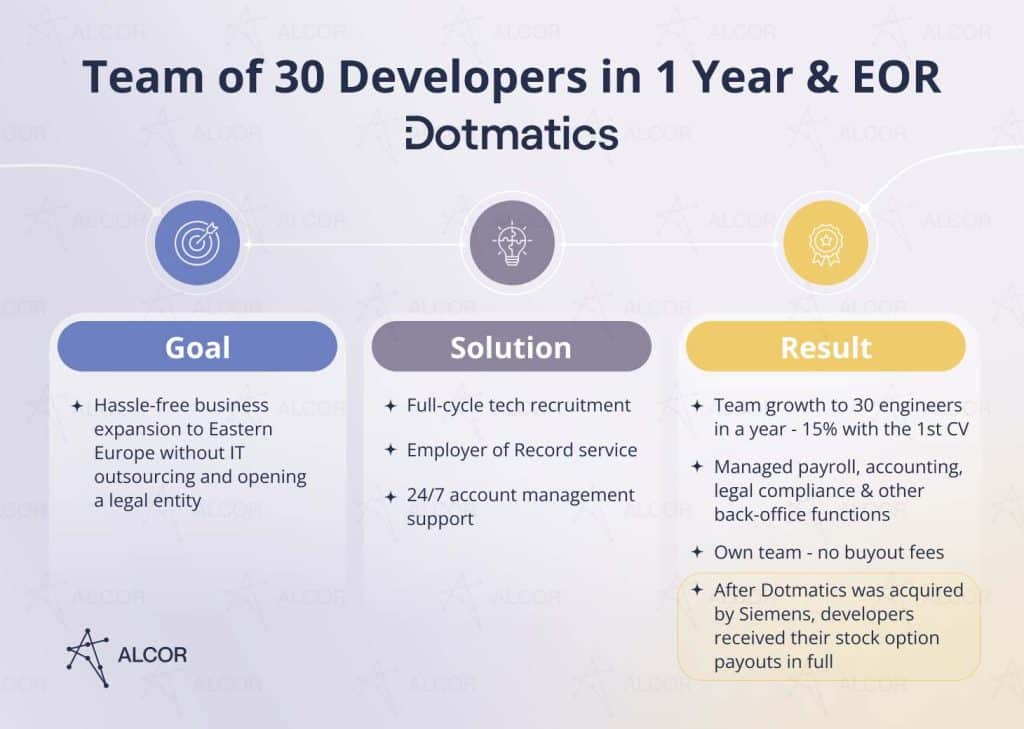
Dotmatics, a Boston-based scientific R&D software company, built its Eastern European engineering team – 30 developers – through Alcor starting in 2021, with Alcor handling payroll, compliance, and the full employment structure for every hire. When Siemens acquired Dotmatics in 2025 for $5.1 billion, every developer’s stock options were paid out in full, with no delays – a direct result of the equity and employment records having been properly structured from the start.
Scaling Up Engineering Resources in Eastern Europe
Alcor helps tech product companies scale engineering teams in Eastern Europe and Latin America through a one-stop-shop model that combines recruitment, compliant employment, and operational support. Our Silicon Valley-grade recruitment helps companies access senior tech talent through rigorous candidate selection, while tech-focused EOR/COR covers local labor law, taxes, IP protection, and equity administration. Alcor also handles equipment procurement, HR, and other day-to-day operations, allowing leadership teams to stay focused on product while scaling from initial hires to 100+ developers within a year.
Once equity is settled among founders and reserved for future hires, the next challenge is building the team that stock options were meant to attract – and Eastern Europe is where many startups do it, thanks to deep engineering talent pools and lower costs than hiring in the US.
Poland, Romania, Ukraine, and Bulgaria together account for 2M+ tech professionals, according to Alcor’s recruitment department research, with a tax environment that works in founders’ favor: Poland’s B2B lump-sum rate for IT contractors sits at 12%, and Romania applies a flat 10% personal income tax, per Alcor’s 2026 legal department research.
Capturing that opportunity takes more than capital. It’s worth understanding how IT staff augmentation compares to building your own in-house team before committing to either – the two models carry very different implications for who ends up holding equity in the work being done. Most co-founders start seriously evaluating either option once they’ve closed a Series A round, but capital alone doesn’t solve for management time – sourcing, vetting, payroll, and compliance all pull focus away from the product.
That’s exactly why I recommend partnering with a trustworthy software R&D service provider in Eastern Europe and Latin America rather than trying to run all of that in-house from day one.
Alcor is here exactly for this. Alcor’s one-stop-shop solution offers sourcing, compliant employment, and equity administration under one roof, so mature tech product companies that struggle to efficiently fill roles in their existing hiring market can expand into Eastern Europe stress-free and scale up to 100+ developers in a year.
Here’s how that played out for one client: Sift, a US-based AI fraud-detection platform, had chosen Kyiv for its senior AI and backend talent but had no local legal entity and only one internal recruiter to meet its 30–35-hire target for the year. It turned to Alcor to build the hiring and compliance infrastructure the plan needed. The results came through three core services working together:
- Silicon Valley-grade recruitment: Alcor assigned 10 researchers and 3 tech recruiters to the account, screening every candidate for technical and cultural fit before they reached Sift. The result: 30 engineers hired in year one, 51 total across Kyiv and Poland, backed by an employer branding campaign that lifted the offer acceptance rate by 15%.
- Tech-exclusive EOR/COR: Alcor’s legal team managed full compliance across both Ukraine and Poland – tax, labor law, and IP rights protection in each jurisdiction – so Sift carried zero legal exposure and never had to open its own entity.
- Ops support, end-to-end: Alcor sourced and delivered every laptop, monitor, and headset before engineers needed them, so Sift’s leadership could stay focused on product rather than logistics. Alcor also handled stock option issuance and dividend payments directly, as well as visa support for 12 engineers traveling to California.
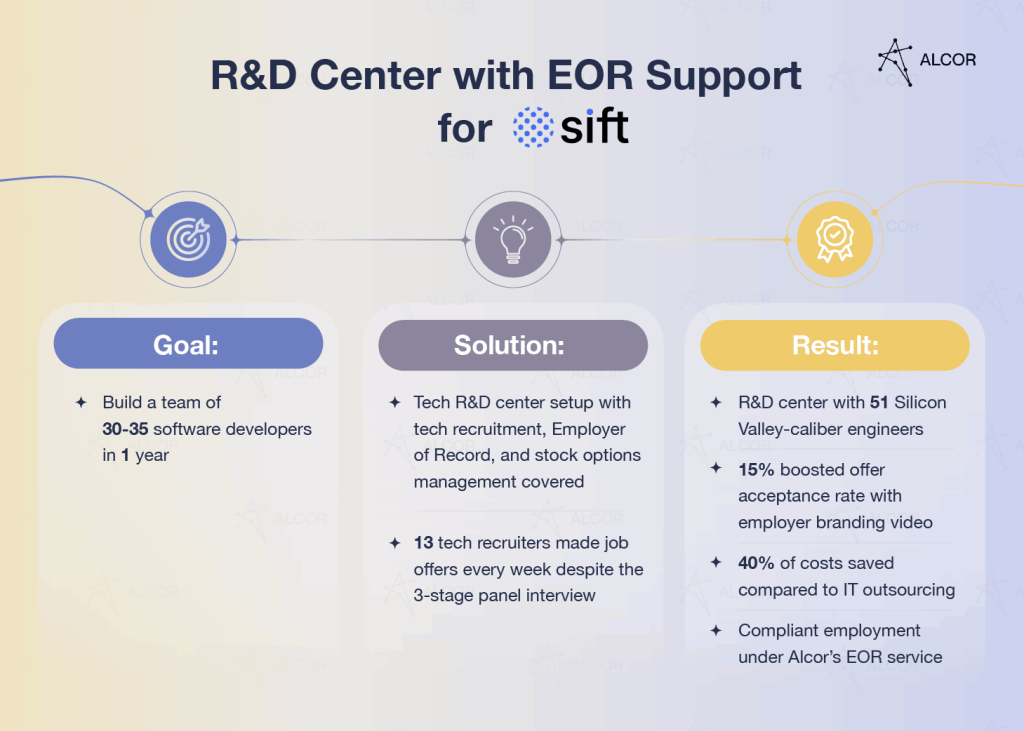
That’s what getting the foundation right looks like: a team that grew to 51 engineers without a single stock option or dividend payment falling through the cracks.
Ledger, Pindrop, and UForce have already successfully scaled their teams in Eastern Europe and LATAM with Alcor. Want the same result?
Final Thoughts
Startup equity allocation works best when it reflects each founder’s real contribution rather than defaulting to an equal split. Clear vesting schedules, shareholder agreements, and accurate equity records help protect ownership through funding, hiring, or acquisition. Once the structure is in place, Alcor can support the legal setup and the engineering team’s growth.
Startup equity allocation is one of the first real tests a founding team faces, and it shapes everything that follows – how investors read the team’s cohesion, and how motivated each co-founder stays years in. Splitting evenly by default is the common shortcut, but a deliberate split based on actual contribution – expertise, time, risk, and capital – holds up better with both investors and the team itself.
If a startup isn’t raising outside money but is acquired instead, share allocation becomes the acquiring company’s decision. Either path makes the same case: get vesting schedules, shareholder agreements, and clean equity records in place early, before a funding round or an acquisition forces the question. And once equity is settled among co-founders, and the company is ready to bring in outside investors or build out the team those shares were meant to attract, Alcor is ready to help – with the legal groundwork and the engineering team, handled under one roof.
FAQ
How many shares does a startup usually have?
Most startups authorize 10 million shares at formation. That round number keeps ownership math simple and leaves enough headroom to grant small stock option allocations to employees without running into fractional shares.
How to divide equity among partners in a startup at the early stages?
Founders and co-founders typically hold more than 60% combined, investors 20–30%, advisors around 5%, and employees 10–15% through a stock option pool, with a small reserve set aside for future hires or renegotiation. This split shifts over time as funding rounds dilute existing shareholders and the option pool grows to support new hires.
What happens to share distribution if another company buys a startup?
The acquiring company purchases some or all of the startup’s shares, gaining full control of ownership going forward. Previous shareholders typically sell their stakes to the buyer, and employee stock options are paid out according to their original terms if equity records were kept clean. Acquisitions move fast, so organized records help avoid disputes that could delay the deal.
What is a vesting schedule, and why does it matter for founder equity?
A vesting schedule releases a co-founder’s equity gradually over time, typically four years with a one-year cliff, instead of granting it all upfront. It protects the company from a co-founder who leaves early while still holding a full, unearned ownership stake. After the cliff, the remaining equity usually vests monthly or quarterly until the schedule is complete.
What happens to employee stock options after an acquisition?
Employee stock options are paid out according to the terms set when they were granted, but only if the company’s cap table and equity records were accurate and up to date. Clean records mean payouts can happen quickly, with no disputes or delays once the deal closes. Founders who keep records up to date as the company grows make this process smoother for everyone.
How would you rate this article?
Alcor is Your Trusted Scaling Partner
for expansion
support