


Nearshoring to Poland means building software engineering capacity in a mature tech market close to your core operations. For European tech companies, it’s an easy call: same union, same time zone, and no cross-border compliance to build. For US companies – access to a deep senior talent pool at a lower cost.
It’s already a proven model for global product tech companies. Microsoft, Intel, Google, Ledger, and Sift all run engineering operations in Poland.
What brings tech companies here:
- Engineers they struggle to hire at home. 778,800 ICT professionals – CEE’s largest pool (Eurostat) – with 87.1% at middle level or above (Bulldogjob).
- AI talent without a months-long hiring cycle. Poland ranks #1 in Europe for Tier 2 AI talent (Interface EU).
- More room in the budget. Senior engineer salaries are typically about half of US levels.
- Compliance they didn’t have to build from scratch. GDPR, EU IP enforcement, intra-EU data flows, and an A2 country-risk rating (Coface) reduce the friction of setting up a local engineering team.
Below, you’ll see when nearshore IT services in Poland are the right fit, what risks to plan for, and what setup works best for your hiring goals, budget, and expansion timeline.
Key Takeaways
- Poland combines a $34.75B ICT market, 60,000+ tech companies and startups, and strong foreign investment, making it one of CEE’s most established nearshoring locations.
- Poland’s biggest advantage is the depth of its engineering market: 778,800+ tech professionals, ranked #1 in Eastern Europe for tech skills, with C1-level English proficiency, and costing roughly 51% less than US peers at senior level. For CTOs and VPs of Engineering, that means access to experienced product talent at scale, with easier collaboration across Europe and a strong GDPR/IP framework around the team.
- The main challenges of nearshore development outsourcing are complex employment rules, competition for senior talent, and the US time gap – all manageable with the right local setup and partner.
- Successful nearshoring depends on employer branding, competitive benefits, the right cooperation model, and a provider with proven local expertise.
- Alcor combines IT recruitment, EOR/COR, and operational support, helping US and European tech companies build 30-engineer teams in 90 days while keeping full control over their people, roadmap, and IP.
Nearshoring to Poland: Local IT Market and Business Environment
Poland offers a dynamic nearshoring environment with a large IT market, fast-growing startup ecosystem, and favorable conditions for foreign investment.
- Poland’s ICT market is valued at $34.75B in 2026, with 60,000+ tech companies and $42.3B in knowledge-intensive service exports in 2024.
- Poland has 1,781 active startups and 12 unicorns, while startup funding reached a record PLN 4.6B (~€1.1B) in H1 2026.
- Poland ranks #8 among emerging markets for FDI confidence, supported by low country risk, strong innovation potential, and major investments from companies such as Microsoft and Amazon.
Market size
From a service‑provider to a strategic partner
Three numbers define the Polish tech market:
- $34.75B – ICT market value in 2026 (Mordor Intelligence)
- 60,000+ – tech companies operating in Poland (Emerging Europe)
- $42.3B – knowledge-intensive services exported in 2024-2025 (ABSL)
Between January 2024 and March 2025, 61 new service centers opened in Poland, with 42.6% of them in IT and 26.2% in R&D, as reported by ABSL. Nearly 60% of the services the sector delivers to international companies are knowledge‑intensive, including engineering, research, cybersecurity, and analytics. That’s what my team sees on the ground, as demand for Polish tech talent continues to rise. More details on the reasons will be in the next chapter.
Five markets each import over $2 billion in Polish business services: Germany, the United States, the United Kingdom, the Netherlands, and Switzerland. Germany is the largest at close to $5 billion.
Startup ecosystem
Record VC funding and a first decacorn
Poland counts 1,781 active startups and 12 unicorns, with an annual growth rate of 29%, according to the Global Startup Ecosystem Index 2026. Being #4 in Eastern Europe and #33 globally, the Polish startup ecosystem is valued at almost #20 billion and ranks #10 in Europe for attractiveness.
Venture funding in Poland hit a record in the first half of 2026. Polish startups raised PLN 4.6 billion (~€1.1 billion) in H1 2026 – more than any full year on record, according to PFR Ventures and Inovo.vc. ElevenLabs and ICEYE accounted for PLN 3.7 billion of that funding, with ElevenLabs becoming the country’s first decacorn at an $11 billion valuation, according to Crunchbase.
Four tech sectors in Poland are absorbing most of that capital:
- Artificial Intelligence. ElevenLabs raised €171 million in 2025 from Andreessen Horowitz and ICONIQ Growth, then a Sequoia-led Series D in early 2026.
- Spacetech and defense. ICEYE raised over €150 million and now supplies the Polish Armed Forces with radar satellites. Listed space companies raised a further PLN 620 million in Q2 2026 alone, PLN 481 million of it by Creotech.
- Healthtech. Poland ranks 6th in the EU on the Digital Decade eHealth Indicator Study 2025. Warsaw-based Jutro Medical raised €24 million for growth after earlier seed backing from Kogito Ventures and Inovo VC.
- Fintech. Poland leads CEE with 383 active fintech companies, nearly 86% of which are profitable, per the Polish Fintech Map 2025.
Thinking of developing your AI or fintech business in Poland? Get more than just IT outsourcing in Krakow or any other Polish tech hub.
Business environment
#8 among emerging markets for foreign investment
Poland ranks #8 among emerging markets in Kearney’s 2025 FDI Confidence Index, cited specifically for its technological and innovative potential. International openness, financial accessibility, and low country risk (A2, according to Coface) place Poland #10 in CEE for business friendliness, as per StartupsBlink’s IBEI 2026 report.
That’s an additional boost for foreign corporate capital investment. For example, Microsoft committed PLN 2.8 billion (~$700 million) to cloud, AI infrastructure, and cybersecurity in Poland by mid-2026, while Amazon has planned a $6.23 billion expansion across 2026–2028, according to Reuters.
Why Big Tech Nearshore Software Development to Poland in 2027?
Big Tech and smaller tech companies choose tech nearshoring to Poland for the following reasons:
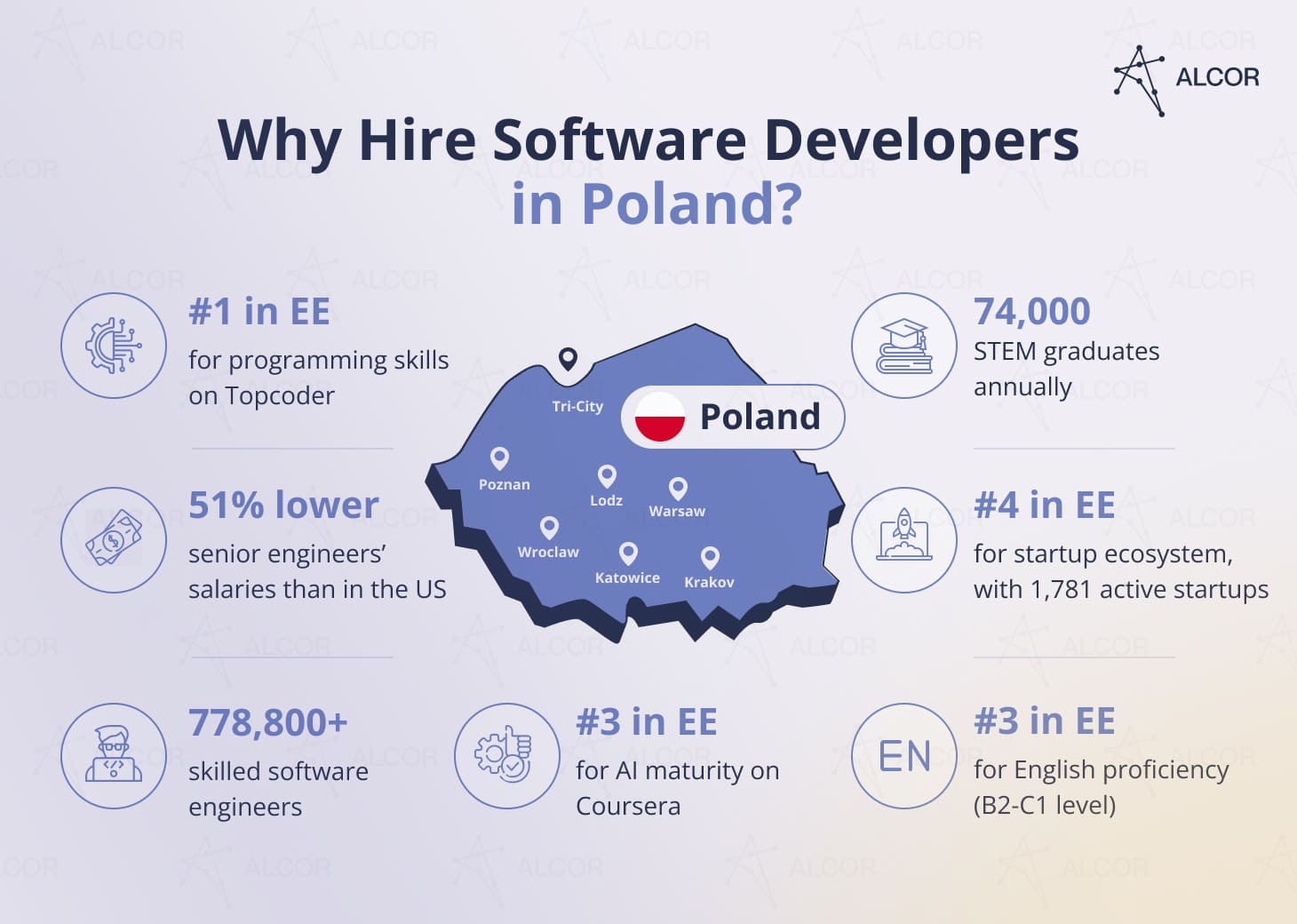
- 778,800+ skilled coders: Poland has CEE’s largest tech talent pool and ranks #1 in the region on Topcoder.
- Standout STEM education: Around 74,000 STEM and ICT graduates enter the market annually.
- Strong English: Poland ranks #15 globally in EF’s English Proficiency Index, while its tech sector scores at C1 level.
- Lower costs: Senior engineering salaries are roughly 51% below US benchmarks.
- Data security & IP protection: GDPR and EU IP rules provide a strong legal framework.
- Time-zone fit: Poland matches major European markets and offers 3-4 hours of overlap with the US East Coast.
778,800+ skilled coders
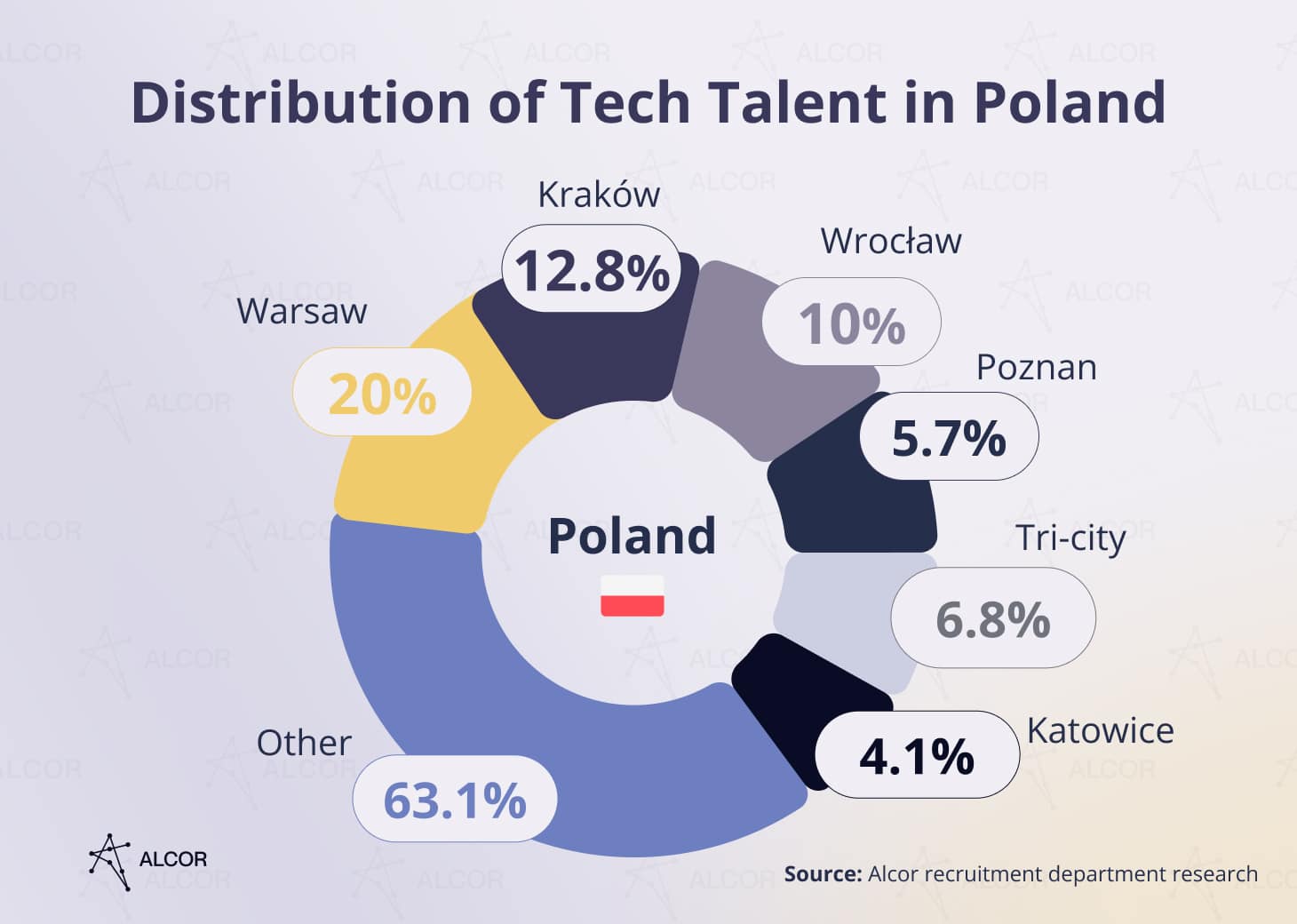
Poland holds the largest tech talent pool in Central and Eastern Europe, roughly 31% of the region’s total, according to Eurostat. Most of these professionals live in Warsaw (20%), Krakow (12.8%), and Wroclaw (10%) – Poland’s most vibrant tech hubs.
Tech depth matches the scale: these tech professionals rank #1 in Eastern Europe and #17 globally on Topcoder’s competitive programming statistics. Plus, Polish engineers are keen to integrate new trends like AI into their work. About 87% of them use AI tools daily. This approach is already contributing to their overall productivity, making Polish programmers a valuable asset to both nearshore and offshore software development teams.
Planning to hire software developers in Warsaw? Alcor helps you tap Poland’s tech talent with recruitment, EOR/COR, and ops support in one software R&D center model – no vendor sprawl.
Standout STEM education
Poland has 500 higher education institutions, 68 of them with STEM majors, and 20 ranked in the QS World University Rankings 2026. Roughly 74,000 students graduate from STEM and ICT programs each year.
The universities feeding the largest tech hubs:
- Warsaw University of Technology
- AGH University of Science and Technology (Kraków)
- Wrocław University of Science and Technology
- Silesian University of Technology (Gliwice/Katowice)
- Poznań University of Technology
Top 15 for English proficiency
Poland ranks #3 in Eastern Europe and #15 globally on the EF English Proficiency Index, with a national score of 600 (B2-C1). The IT sector scores 621 (C1 proficiency), allowing Polish engineers to efficiently lead architecture discussions and write technical documentation without translation.
51% lower salary costs
Senior engineering salaries in Poland run roughly half below US benchmarks, with the widest gaps in AI roles. For instance, senior LLM Engineers in Poland earn $102,000 per year, while their US peers earn $234,000. That’s 56% in saved salary expenses you can channel toward scaling engineering teams or product development.
|
Average Annual Software Developer Base Salary |
||
|
Senior Positions |
Poland |
USA |
|
AI Product Engineer |
$103,800 |
$228,000 |
|
LLM Engineer |
$102,000 |
$234,000 |
|
ML Engineer |
$99,600 |
$222,000 |
|
MLOps Engineer |
$102,000 |
$189,000 |
|
Data Engineer |
$82,800 |
$177,000 |
|
Python Engineer |
$84,000 |
$165,000 |
|
DevOps Engineer |
$90,000 |
$168,000 |
|
React Developer |
$80,400 |
$156,000 |
|
QA Automation Engineer |
$74,400 |
$145,500 |
|
According to Alcor’s internal tech salaries research as of September 2026 |
||
Salary is one of four lines in your CFO’s engineer budget. To calculate the full employment cost of hiring a senior Polish engineer, include:
- Employer social security contributions. Poland adds roughly 20% on top of gross pay for full-time employees, per Alcor’s 2026 payroll tax data. Employee-side contributions run about 37% at a $5,000 monthly salary.
- Benefits package. In Poland, it amounts to roughly $5,000 per developer/year, compared with $15,400 in the US, according to Alcor’s internal research.
- Recruitment fee. A one-time fee of 20% of gross annual salary in Poland, against 30% in the US for senior positions.
- EOR fee. Usually covers onboarding, payroll processing, tax filings, compliance management, and employment contracts. The industry average in 2026 is $400-$700 per employee/month on a flat-fee model.
Are you a European tech leader seeking nearshore software development in Poland? Get in touch for precise cost and savings estimates for your team.
Data security & IP protection
Poland operates under GDPR, the EU copyright framework, and EU-wide IP enforcement. What that means depends on where your company sits.
For EU tech companies, nearshoring in Poland keeps the entire engineering function inside your own legal environment:
- No cross-border data transfer mechanism. Data moving between your HQ and your Polish team stays inside the EU. No standard contractual clauses, no transfer impact assessments, plus no Schrems II exposure.
- Identical regulatory baseline. NIS2, DORA, and the EU AI Act apply to your Polish engineers exactly as they apply at headquarters. Your team builds to the same obligations you already meet.
- One employment framework. Polish labor law implements the same EU directives on working time, contract transparency, and data protection that your domestic contracts follow.
- Free movement. Poland is in Schengen and the Single Market. Engineers travel to HQ without visas.
For US companies, the value is different: one data protection regime instead of country-by-country negotiation, and EU-resident data storage that removes the transfer problem attached to offshore locations outside Europe.
On IP specifically, Polish copyright law gives employers a stronger starting position than most jurisdictions. Economic rights to software an employee writes in the course of their duties vest in the employer automatically, without a separate assignment. B2B contractor arrangements work differently – there, rights must be assigned explicitly in the contract when you hire software developers in Poland.
GMT+2 time zone
Poland runs on Central European Time – the same clock as Berlin, Paris, Amsterdam, and Madrid, one hour ahead of London. For a European company, there is no time zone to manage.
Geographical proximity to most European capitals means flights take 2-3 hours, keeping quarterly on-sites practical for companies with a European HQ or European customers.
Poland is not for you? Nearshore software development in Ukraine may be just right.
For US businesses, this outsourcing destination sits 6-9 hours ahead. While you sleep, your team ships. A Polish workday that starts at 09:00 local is eight hours into progress before New York opens, and the overlap window that follows – 3–4 hours with the US East Coast, 1–2 with the West Coast – is enough for standups, design reviews, and handoffs.
Used deliberately, the gap becomes a delivery cycle: your Polish team clears the review queue, fixes overnight CI failures, and pushes app development, for example, before your US morning starts.
Polish Tech Talent Matrix
Polish tech talent combines strong technical depth, high seniority, and collaboration skills suited to distributed product teams.
- Hard skills: 70.2% of Polish developers hold a bachelor’s or master’s degree, while 87.1% are mid-level or above. Poland ranks #3 in Eastern Europe for data science and #4 for technology on Coursera.
- Soft skills & culture: Polish engineers tend to surface blockers early, challenge technical decisions when needed, and document work consistently. These habits support smoother remote collaboration, clearer handoffs, and ownership – valuable in nearshore product development.
Hard skills
70.2% of Polish developers hold a bachelor’s or master’s degree, 56.4% studied computer science specifically, and 32.8% came from other technical or exact-science fields, per Bulldogjob’s IT Community Report 2025. Local tech experts are well-versed in JavaScript, TypeScript, Python, SQL, C#, Java, Golang, PHP, Kubernetes, TensorFlow, Hadoop, and NLP frameworks. On measured skills, Poland ranks #3 in Eastern Europe for data science and #4 for technology, according to Coursera’s Global Skills Report 2025.
Alcor can serve as an IT recruitment agency in Krakow or an IT recruitment agency in Gdansk and fill your tech roles within 2-6 weeks.
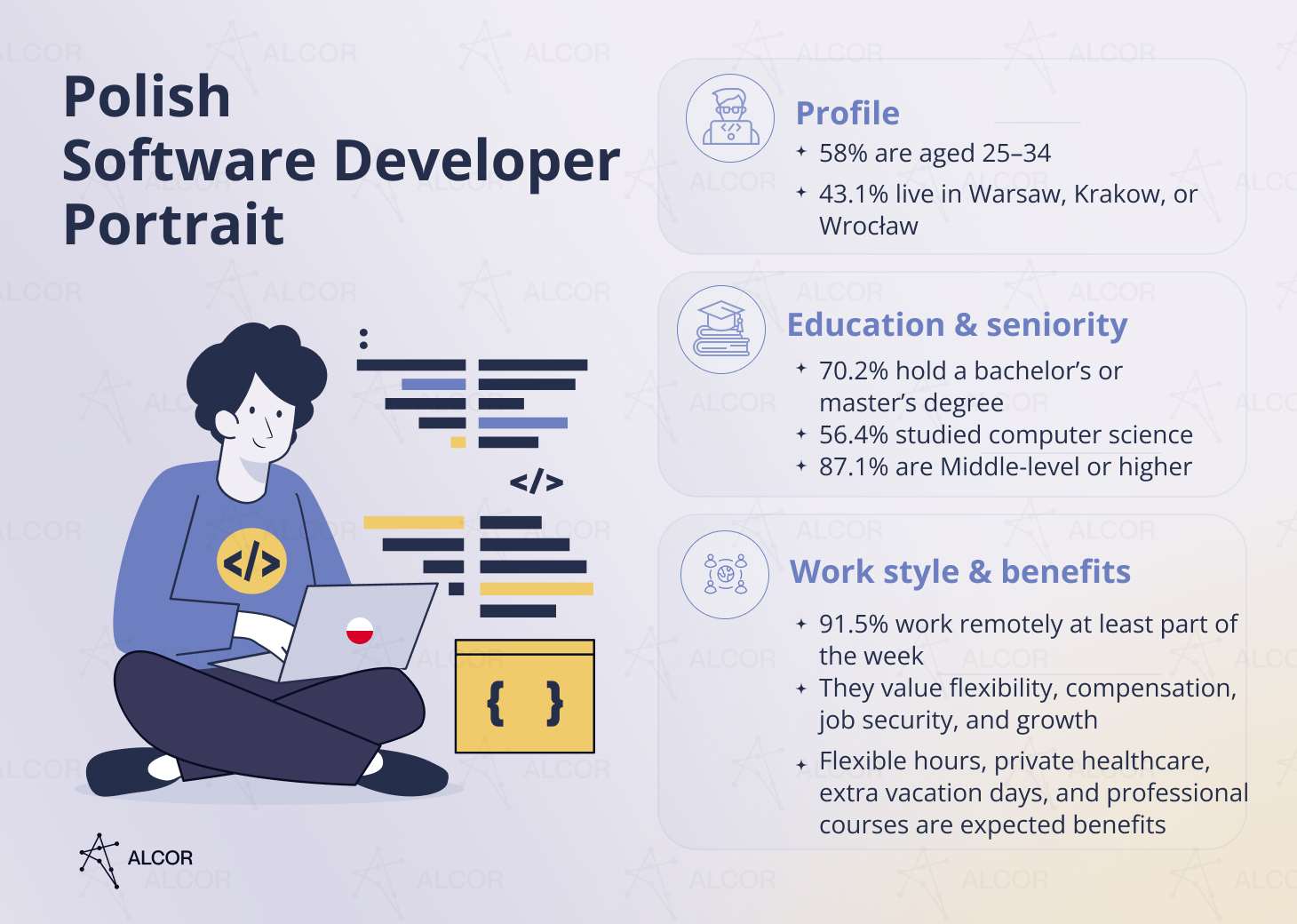
In terms of seniority, the Polish tech talent pool is considered experienced. 87.1% of ICT professionals are mid-level or above. For a tech company that needs engineers who can serve as product owners from day one rather than be trained into it, as happens when opting for software outsourcing in Poland, that distribution is why you hire Polish engineers rather than in some cheaper market.
|
Level |
Experience |
Share |
|
Middle |
3-7 years |
43.5% |
|
Senior |
7+ years |
29.4% |
|
Expert / Architect |
10+ years |
14.2% |
|
Junior |
1-3 years |
12.2% |
|
Trainee |
<1 year |
0.8% |
Source: Bulldogjob’s IT Community Report 2025
When it comes to AI, Poland ranks #1 in Europe and #4 globally for Tier 2 AI talent – the engineers and researchers building deep learning models, neural architectures, and production AI systems, according to Interface EU’s 2026 research.
Scaling Your AI Engineering Team?
Compare Poland with 7 other tech markets across LATAM and Eastern Europe by AI talent, salaries, tech expertise, and more to find the best fit.
Soft skills & culture
What determines whether a remote team works like clockwork is how engineers communicate, collaborate, and stay. Three patterns our recruiters see consistently in Polish engineering hires:
- Problems surface early. Polish engineers raise blockers and push back on technical decisions without waiting to be asked. You find out about a risky dependency or an underspecified requirement in week one instead of at the sprint review, which is exactly what you want from a team you can’t see across the office.
- Documentation as default. Formal CS education and a market built on serving US and European clients produce engineers who write specs and tickets without being asked.
IT Nearshoring Case Scenarios: Poland Edition
IT nearshoring to Poland matters when tech companies need to scale faster, build a local team without opening an entity, or access hard-to-find engineering expertise. With an experienced local partner, tech businesses can remove hiring and operational bottlenecks while keeping control of their team, roadmap, and IP. Mature tech companies and startups like Ledger, Sift, and Persimmon AI have already nearshored software development to Poland, scaling teams and securing additional investment.
Scenario 1: Scenario 1: You’ve hit the hiring wall at a critical scaling point
Your next product milestone calls for 15 senior engineers. The budget is approved, the roles are open, and the hiring team has been working on them for six months. Three hires have joined. Two strong candidates took counteroffers. Several roles have been sitting open for months, while the delivery dates behind them haven’t moved. At the current hiring pace, building the full team would take around 30 months. Your roadmap gives you 12.
How Ledger built a 35-engineer hub
Ledger, the Paris-based digital asset security company behind 8 million+ hardware wallets and roughly 20% of the world’s secured crypto assets, had a small Eastern European presence and needed a real engineering hub. For a hardware security product, Software Quality Assurance is core engineering, which meant vetting senior talent well beyond a standard CV screen.
What Ledger achieved with Alcor:
- Built an in-house team of 35+ engineers across QA Manual, QA Automation, QA leadership, DevOps, Technical Product, and Delivery roles
- Reached a 4.5-week average time to hire
- Hired a QA Lead and three QA Manual engineers within two weeks
- Reached 2-4 years of average engineer tenure, with business culture, team decisions, and product roadmap staying with Ledger.
Ledger has since reached a $1.5B+ valuation and raised about $575M in total funding, backed by investors including 10T Holdings, Cathay Innovation, True Global Ventures, and Draper Associates.
Scenario 2: You want your own team in Poland, but you have no legal entity there
You’ve ruled out outsourcing and decided to build your own engineering team in Poland. The hiring plan is ready, but the local infrastructure isn’t. Without a Polish entity, you can’t make an offer, employ, or run payroll compliantly. Incorporation runs up to $20,000 and takes 2-3 months you don’t have.
How Sift scaled from zero to 51 engineers
Sift, the US-based AI fraud prevention company, needed to build its own engineering presence in Eastern Europe without setting up a local subsidiary first. Its global data network now processes more than 1 trillion events annually, so scaling the product meant hiring experienced backend, infrastructure, and other technical talent.
Leadership was one of the first priorities. Alcor hired Sift’s Head of R&D from the second CV presented, giving the new engineering hub local leadership. Alcor then handled team recruitment and the local operational infrastructure, while Sift kept control of engineering management, hiring decisions, and its product roadmap.
What Ledger achieved with Alcor:
- 30 engineers hired in the first year, scaled to 51 across Ukraine and Poland
- 2 Infrastructure Engineer and Ruby on Rails Developer roles closed within 7 days
- Full EOR coverage – payroll, tax, HR admin, labor law compliance – with no time wasted on entity opening
- Sift’s own reporting lines and IP, with no vendor layer from day 1.
In 2021, the year Sift built their Eastern European R&D team, the company raised $50 million and reached a valuation above $1 billion. Sift remains a G2 leader across all fraud prevention categories.
Scenario 3: Your home market doesn’t have enough of the engineers you need
You’re not looking for another ten generalist developers. You need ML Research Engineers who have shipped LLM systems, MLOps engineers who have run inference at scale, or senior AI specialists who can own architecture from model to production.
The local shortlist gets small fast. AI labs, Big Tech, and well-funded startups are approaching the same engineers, often with multiple offers already on the table. After four months, the AI roles are still open, and your roadmap still depends on it.
How Persimmon AI hired five Valley-caliber engineers
Persimmon AI (ex-Kollektiv.ai) is a US startup automating dental revenue cycle management. Their hiring bar was unusually high: Master’s degrees, FAANG backgrounds, research publications, and hands-on experience shipping LLM systems into production. Alcor put seven recruiters and researchers on the search and targeted engineers from a curated list of top technology companies rather than relying on standard inbound recruiting.
Persimmon AI achieved:
- 5 senior AI engineers in 13 weeks – Python, PyTorch, LLM tooling, RAG architecture, Kubernetes, Kafka
- Google and NVIDIA engineers brought into the candidate pipeline
- 8 CVs per hire – both Senior ML Research Engineer roles filled from a total of 6 candidates
- One ML Research Engineer chose Persimmon over a FAANG offer.
Nearshoring to Poland comes with several operational risks, mainly around employment compliance, competition for senior talent, and time-zone coordination with the US. With an experienced local partner, however, these challenges are manageable.
Challenges & Risks of Nearshoring to Poland
Nearshoring to Poland comes with several operational risks, mainly around employment compliance, competition for senior talent, and time-zone coordination with the US. With an experienced local partner, however, these challenges are manageable.
Complex labor law and taxes
Poland gives you two ways to engage an engineer, governed by different laws and carrying different obligations: an employment contract and a B2B contract with an engineer registered as a sole trader. Polish IT runs on both. Picking the wrong one for the working relationship is where foreign employers get caught.
|
Employment contract |
B2B contract |
|
|
Governed by |
Labour Code |
Civil Code |
|
Social Security Contributions |
~20% employer’s obligation |
~26% contractor’s obligation |
|
Vacation |
20 working days, 26 after 10 years’ experience |
Per contract terms |
|
Paid sick leave |
First 33 days at 80%, paid by the employer |
Per contract terms |
|
Notice period |
2 weeks (under 6 months), 1 month (6 months-3 years), 3 months (3+ years) |
Per contract terms |
|
Severance |
1-3 months’ pay at employers with over 20 people, for non-employee-related reasons |
Per contract terms |
Read the full breakdown of B2B taxes in Poland before choosing a route.
What it costs you:
- Misclassification. A B2B arrangement with fixed hours, direct supervision, exclusivity, and company equipment can be reclassified as employment, leaving you liable for back contributions and penalties.
- Slow exits. Dismissing an employee requires a written justification that survives a labor court challenge, plus up to three months’ notice. A performance problem found in month 14 takes a quarter to resolve.
- Bigger budget than the salary line suggests. Social security contributions, employer-funded sick leave, paid vacation, and severance all sit on top of gross pay.
Tips to manage it: Put the compliance obligations on a local partner to engage local engineers on either an FTE or B2B basis. For instance, Alcor’s Polish entity and COR services handle contracts, payroll/payments, tax filings, and labor law compliance, allowing your leadership to focus on strategic matters without worrying about liabilities.
Intel 471, backed by Thoma Bravo, had 20 engineers employed and operational in Poland in 4 weeks – full Polish employment contracts, payroll, and compliance through Alcor’s local entity.
High competition for talent
Poland hosts 60,000+ tech companies, R&D centers of global tech giants, and fast-growing startups – all competing for the same skilled talent. In fact, according to the No Fluff Jobs report, a junior posting draws 47 CVs on average, while a senior posting draws 19. Between January and May 2026, IT job postings ran 70% higher than in the same months of 2025.
What it costs you: Senior candidates field multiple offers, counteroffers are routine, and an unknown foreign brand starts every conversation from behind.
Tips to manage it: Build employer branding from the start, and partner with a software development RPO agency in Poland that headhunts instead of posting and waiting. Alcor’s 40+ in-house tech recruiters use an internal 325,000-candidate database and other resources to speed up your engineering hiring – only 8 CVs to get to one offer.
Time gap with the US
Poland runs 6 hours ahead of US Eastern Time and 9 ahead of Pacific. A Polish workday ending at 18:00 local gives you 3-4 hours of daily overlap with New York and 1–2 hours with San Francisco.
What it costs you: Questions raised in a Polish afternoon get answered after the team has logged off, potentially turning a five-minute clarification into a 24-hour delay.
Tips to manage it:
- Protect three core hours. 15:00–18:00 in Poland maps to 09:00–12:00 in New York – enough for standups, reviews, and every decision that needs both sides.
- Put a tech lead on adjusted hours. One senior person covers the exceptions, so 20 engineers don’t work evenings.
- Default to written decisions. Docs, PR review SLAs, recorded demos. Polish engineers document by habit, so the practice sticks.
- Run the day as a handoff. Your team clears the review queue and ships builds before New York opens. You sleep, your team ships.
4 Steps for Efficient IT Nearshoring to Poland
Efficient IT nearshoring to Poland comes down to four practical steps:
- Prioritize employer branding: A clear EVP and brand promotion help you compete for senior engineers in a crowded Polish market.
- Plan competitive benefits: Add professional development, health insurance, meal cards, home-office support, and other benefits to salary to boost CV applications and retain talent.
- Pick the right cooperation model: Choose between IT recruitment, EOR, outstaffing, or a software R&D center based on your need for control, compliance, and long-term scaling.
- Partner with a reliable provider: Check their hiring expertise, local legal setup, fee structure, retention data, and relevant case studies.
Step 1. Prioritize employer branding
Your employer brand seals or breaks the deal with a top candidate.
When US-based Sift scaled to Eastern Europe, they struggled to meet their goal of hiring 6–10 programmers per quarter.
Why? Few applications.
Alcor stepped in with a video and social employer branding campaign, and response rates increased by 15%. Sift now has 51+ software engineers and an R&D office in Eastern Europe – built on a strong employer brand and an attractive EVP.
Step 2. Plan competitive benefits
When looking for senior talent, a competitive salary only gets you to the door.
A strong benefits package helps attract top talent and retain it for the long term. Per Alcor’s 2026 hiring cost data, make sure to include:
- Professional development, training, and certifications – $1,500
- Meal cards – $900
- English language courses – $800
- Private health insurance – $600
- Home office and IT equipment – $600
- Wellness – $600
Step 3. Pick a cooperation model
Nearshoring to Poland is a win-win—if you get the cooperation model right.
The 4 standard engagement models are IT outstaffing, IT recruitment, Employer of Record, and R&D center.
IT outstaffing
IT outstaffing (also staff augmentation or dedicated development teams in Poland) means that when you do your software nearshoring to Poland, you “lease” programmers from an IT outstaffing vendor to work on a specific task or project.
Pros:
- Flexibility in team adjustments
- More control over team management than with IT outsourcing in Poland.
Cons:
- IP risks unless there’s a clear and detailed IP rights transfer agreement
- Hefty buy-out fees if you later want those software developers on your own headcount
- Low team loyalty and no need to go the extra mile.
Find more details on staff augmentation in Eastern Europe.
IT recruitment
IT recruitment covers the entire hiring process for nearshoring to Poland: from creating an ideal candidate profile and sourcing to interviewing eligible candidates and managing offers.
Pros:
- Provides a team of loyal and qualified software developers in Poland
- Keeps hiring and termination decisions with you
- Suits a long-term partnership.
Сons:
- Rarely covers employment, HR payroll, tax management, and onboarding/offboarding for nearshore/offshore locations. These belong to the Employer of Record domain.
- Leaves you to manage the operational functions independently, including office leases, procurement management, and assistance with stock options.
Employer of Record
Employer of Record (EOR) acts as a local employer for your nearshore/offshore software developers in Poland, so you don’t need to open your own legal entity.
Pros:
- No need to set up a legal entity when you nearshore your software development to Poland.
- No hassle with payroll, taxes, accounting, employee benefits, and onboarding/offboarding – all handled by your EOR provider.
Cons:
- Generic admin services with no industry specialization
- No IT recruitment services for nearshoring product development to Poland
- Partial operational support, usually through a local partner network.
Software R&D center
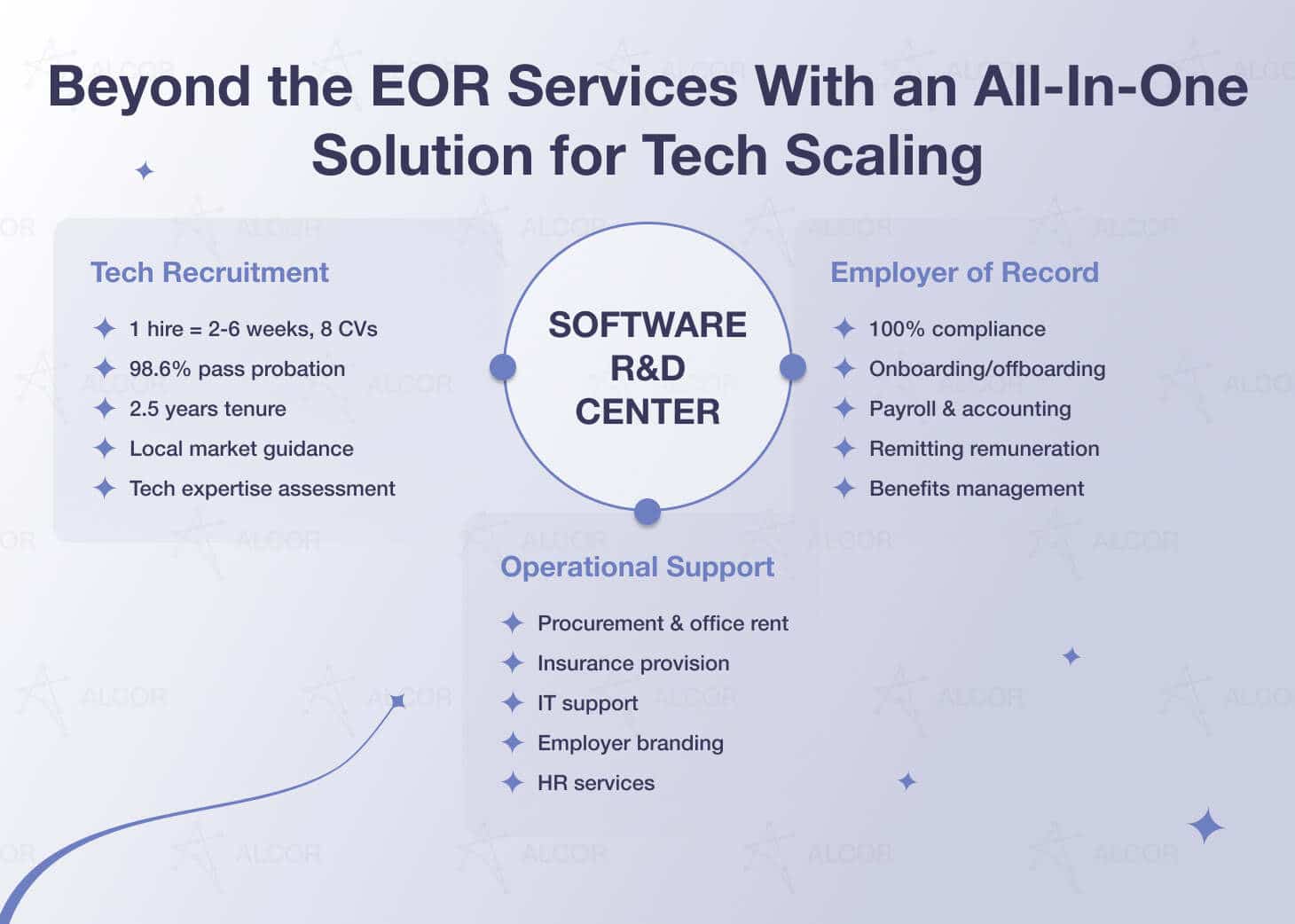
A software R&D center in Poland combines IT recruitment, EOR, and operational functions in one place.
For example, if you want to nearshore in Poland, a software R&D center will cover IT recruitment in Warsaw or other Polish tech hubs, EOR services in Poland, and full operational support. This eliminates vendor sprawl and overhead.
Pros:
- Your own engineering team in Poland, under your leadership and culture
- Full IP ownership from day one
- Cost savings you can reinvest in the product
- Complete control over the development process.
Cons:
- Requires finding a tech-focused nearshoring partner in Poland for this type of all-encompassing and long-term cooperation.
Step 4. Partner with a reliable provider
With a partner for nearshore services in Poland, you either sink or swim.
Evaluate expertise, guarantees, case studies, and client reviews. Here’s a checklist to go through before you decide:
- Do they have hiring experience in your specific industry and tech stack?
- Do they own a legal entity in Poland, or subcontract employment to a third party?
- Do they have setup, offboarding, FX, or any other extra fees?
- Can they show retention data – probation pass rates and average talent tenure?
- Can they share examples of tech companies at your stage that built and scaled engineering teams by nearshoring to Poland?
Explore IT Nearshoring to Poland with Alcor
Alcor helps tech product companies nearshore to Poland by combining IT recruitment, EOR/COR, and operational support in one model. Clients keep full control over their engineers, roadmap, culture, and IP, while Alcor handles the local infrastructure around the team. As a result, tech companies can hire in-demand tech talent 5–6x faster than in local markets, building 30-engineer teams in just 90 days.
Alcor builds nearshore and offshore development centers for product tech companies in Eastern Europe and Latin America. Recruitment, Employer of Record, and operations run through one contract and one account manager – with your engineers on your reporting lines, your roadmap, and your IP from the first hire. You build. We power the infrastructure around your engineering team.
What you get with us:
- 30-engineer team shipping in 90 days, hired, onboarded, employed, and working on your roadmap within a quarter. First relevant CVs in 3-5 business days. Plan 12 months for 100 engineers.
- In-demand tech talent hired 5-6x faster than in your local market, with 8 CVs needed for an accepted offer.
- Engineers stay with you for 2.5+ years on average, pre-screened for your tech and cultural requirements to ensure smooth integration.
- Your IP, your people, no strings. Full IP rights from the first hire. No buyout fees if you move the team onto your own entity, no setup fees, no exit fees.
- Admin & ops handled end-to-end. Payroll, benefits, equipment, employer branding, stock options, and more – so your CTO runs engineering, not HR.
Product companies that built their Eastern European teams with Alcor include Ledger, Sift, Dotmatics, Intel 471, Backstory, UFORCE, and Persimmon AI – from PE-backed platforms to AI startups and unicorns.
Ready to build your engineering team in Poland or any other Eastern European or LATAM country? Fill out the form below and let’s chat!
References
- Mordor Intelligence
- Emerging Europe
- ABSL
- StartupBlink’s Global Startup Ecosystem Index 2026
- PFR Ventures & Inovo.vc
- TechCrunch
- Defense News
- Dealroom
- Black Book Research
- Polish Fintech Map 2025
- Kearney’s 2025 Foreign Direct Investment Confidence Index
- Coface
- StartupBlink’s International Business Environment Index 2026
- Microsoft
- Reuters
- Eurostat
- Topcoder
- QS World University Rankings 2026
- EF English Proficiency Index
- Bulldogjob’s IT Community Report 2025
- Coursera’s Global Skills Report 2025
- Interface EU’s Solving Europe’s AI Talent Equation
- No Fluff Jobs’ IT Career Poland 2026
- Alcor’s internal research 2026
FAQ
What tech talent is available in Poland?
Poland has 778,800+ tech professionals, with 87.1% at mid-level or above. Local engineers have strong expertise in JavaScript, TypeScript, Python, Java, C#, Golang, cloud, data science, and AI, while around 74,000 STEM and ICT graduates enter the market each year.
How much can US tech companies save by nearshoring software development to Poland?
Senior engineering salaries in Poland are roughly 51% lower than US benchmarks. For example, a senior LLM Engineer earns about $102,000 annually in Poland versus $234,000 in the US, although companies should also budget for employer contributions, benefits, recruitment, and EOR costs.
What are the main challenges of nearshoring to Poland?
The main challenges are complex employment and B2B regulations, strong competition for senior engineers, and a 6–9-hour time difference with the US. These risks are manageable with proper contract structuring, proactive recruitment, employer branding, and planned overlap between distributed teams.
What is the best model for nearshoring to Poland?
The right model depends on your goals. Outstaffing/outsourcing to Poland suits flexible project needs, IT recruitment works for direct hiring, and EOR enables compliant employment without opening a local entity. Product tech companies building long-term engineering operations use a software R&D center model that combines tech recruitment, employment, and operational support while letting them keep control of the team, roadmap, and IP.
How would you rate this article?
Alcor is Your Trusted Scaling Partner
for expansion
support