


Software engineer working conditions determine whether developers stay or leave, not perks or one-time bonuses. Global employee engagement fell to just 20% in 2025, its lowest level since 2020, according to Gallup’s State of the Global Workplace 2026 report. For software teams, that decline often shows up first as burnout and quiet attrition.
Engineers who feel unsupported disengage long before they resign, and that disengagement is expensive to reverse. Building the right conditions from the start is far cheaper than fixing attrition after the fact.
In this article, you’ll learn what a healthy software engineer work environment actually looks like day-to-day, five tips for building one, and how AI and distributed hiring will reshape the role by 2027. You’ll also discover how Alcor helps you build a high-performance engineering team abroad.
Key Takeaways
- Strong work conditions for a software engineer depend on autonomy, trust, and flexible hours, not just pay. Stack Overflow’s 2025 Developer Survey ranks autonomy and trust above competitive pay as the top driver of job satisfaction.
- Without these fundamentals, burnout follows. LeadDev’s Engineering Leadership Report 2025 found that 22% of engineering leaders and developers face critical burnout.
- By 2027, AI adoption, distributed hiring, and faster processes will reshape the conditions of software developer careers.
- Alcor closes the gap between what tech product companies need and what outsourcing or EOR alone can deliver, building a team of 10 to 100 senior engineers within a year. You get tech recruitment, EOR/COR, and 360° ops support, all bundled into a single solution. Plus, full team & IP ownership and no vendor lock-in from day one.
Typical Work Environment for a Software Engineer
A typical software engineer work environment is built on three pillars: trust in technical judgment, independence over tools and schedule, and flexibility in when and where work happens. Day-to-day, engineers spend most of their time in meetings, reviews, and collaboration, not just writing code. Without these fundamentals, the job carries a real risk of burnout, even though it is well paid. A strong environment also provides room for AI tools, which are now a standard part of daily engineering work rather than a separate concern.
What a software engineer actually does day to day
So, what does the work environment for a software developer look like? On a daily basis, they solve problems in web applications, write code, attend meetups, and collaborate with their colleagues. Writing code is only part of it, too: Atlassian’s 2025 State of Developer Experience report, based on a survey of 3,500 developers and managers, found that developers spend just 16% of their time actually coding, with the rest going to meetings, reviews, and collaboration. As developers create a new software product intended to deliver the desired outcome, their work is usually well-paid, demanding, and challenging. The litmus test for ideal software developer career conditions includes three main things:
- trust;
- independence;
- flexibility.
And the data backs this up: Stack Overflow’s 2025 Developer Survey ranks autonomy and trust as the single biggest driver of developer job satisfaction, ahead of even competitive pay. Show your trust by providing faith in each developer’s expertise. Give them freedom by ensuring they can configure and upgrade the tools as they see fit. And here comes the most vital part: let them create their perfect environment on their own by choosing favorable hours and locations to work.
The hidden costs of a poor work environment
Despite the developer’s profession being highly respected and well-paid, there is a downside to the coin, too. First of all, because they mostly do intellectual work, developers often struggle with sedentary lifestyles and high screen time due to a tendency to overwork. In the long-term perspective, such a lifestyle results in back problems, blurred vision, and even obesity. The American Optometric Association identifies blurred vision, headaches, and eye strain as hallmark symptoms of computer vision syndrome associated with extended screen time. In fact, they also sacrifice mental health for their job. Thus, constant overwork, strict deadlines, and a high number of duties may lead to burnout and outright exhaustion – LeadDev’s Engineering Leadership Report 2025 found that 22% of the 617 engineering leaders and developers it surveyed were experiencing critical levels of burnout, as measured by the Maslach Burnout Inventory.
How AI is reshaping the software engineer working environment
AI hasn’t solved that burnout risk, but it has changed what’s driving it. One thing has changed since this list of duties became standard: AI tools are now part of the job, not a separate concern. Stack Overflow’s 2025 Developer Survey found that 84% of developers now use or plan to use AI tools in their workflow, with 51% of professional developers using them daily. A good software engineering work environment now has to give engineers room to fold these tools into their routine without adding to the burnout described above.
Dive deeper into the facts about software engineers to better understand their needs and hire European developers with ease!
5 Tips to Create the Best Work Environment for Developers
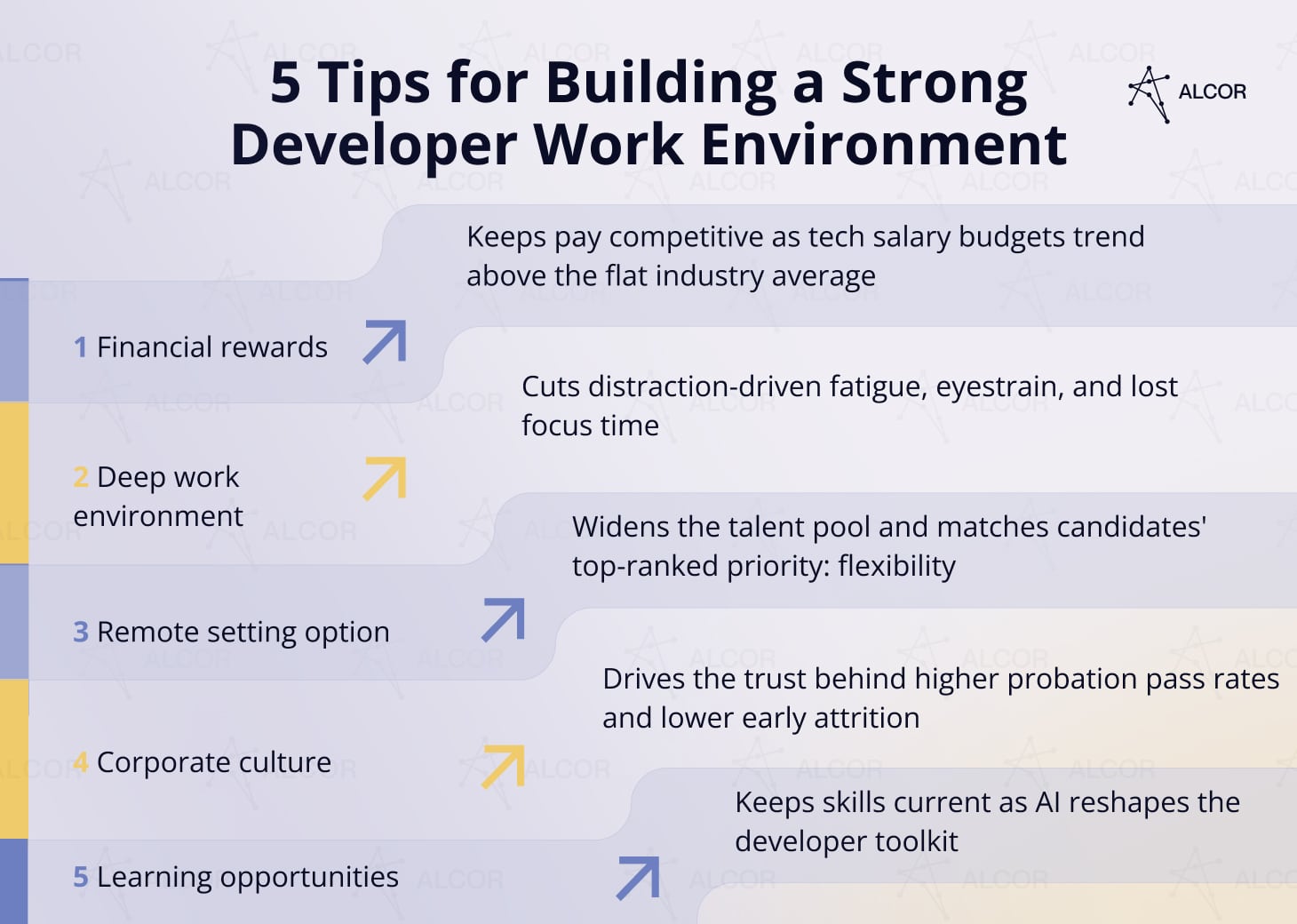
The five most effective ways to build a strong developer work environment are:
- competitive, transparent pay;
- a distraction-free workspace for deep work;
- a genuine remote or hybrid option;
- an intentional team culture with structured onboarding;
- ongoing access to training on current tools, including AI.
Microsoft’s 2026 Work Trend Index found that employees are ready to change how they work faster than their employers are. That gap is exactly why poor software engineer career conditions still lead to increased staff turnover. Developers acknowledge the uniqueness of their skills and the high demand for tech specialists; thus, they are willing to change workplaces easily in search of better employers. Therefore, here are some tips to help you establish a congenial software engineer working environment.
1. Consider financial rewards
To stay competitive and attract top prospective engineers, you should offer competitive wages and regular salary increases. According to WTW’s Salary Budget Planning Report, US employers held average salary increase budgets steady at 3.5% in 2026, with 2027 budgets projected to ease slightly to 3.4%. This is because companies are shifting from broad-based raises toward targeted, performance-driven pay for the roles and skills that matter most. In practice, that means engineers with in-demand skills – AI, ML, LLM, and platform engineering among them – are seeing larger allocations than the flat industry average would suggest. In addition, consider promotion-related salary bumps, inflation rates in particular regions, and bonuses. The bonus structure remains one of the most effective motivation tools for tech workers, especially for the specialized, AI-adjacent skills employers are now competing hardest for.
Those numbers get sharper once you narrow in on AI-specific roles, where the real financial reward for employers isn’t just the raise budget – it’s where the hire happens to sit. According to Alcor‘s 2026 engineer compensation research, average annual senior-level salaries for the same AI role shift dramatically by region:
|
Senior Developer’s Average Base Annual Income |
|||
| Role | Latin America | Eastern Europe | US |
| AI Engineer | $104,250 | $118,500 | $222,000 |
| ML Engineer | $79,050 | $86,100 | $222,000 |
| LLM Engineer | $90,000 | $94,050 | $234,000 |
| AI Platform Engineer | $112,500 | $127,500 | $228,000 |
| AI Data Engineer | $93,750 | $106,500 | $210,000 |
*Figures reflect senior-level talent, averaged across Alcor’s four hiring markets in each region (Mexico, Colombia, Argentina, and Chile for Latin America; Poland, Romania, Ukraine, and Bulgaria for Eastern Europe). Data is updated for 2026.
Ukraine is on your shortlist? Explore how to hire software developers in Ukraine in 2-6 weeks.
That gap is exactly why so many companies are building AI teams in Latin America and Eastern Europe instead of competing for the same senior talent at US rates. The full breakdown – by seniority level, by individual country, and across 15 AI and product engineering roles – is available in Alcor’s 2026 Guide to Building Your AI & Product Engineering Team in Latin America & Eastern Europe.
Equity can also strengthen long-term retention, especially for early engineering hires. See how to split shares in a startup company among founders and employees without creating ownership problems later.
2. Create an environment conducive to deep work
The ideal software engineer work environment requires a distraction-free office environment to boost cognitive capabilities and improve performance. Deep concentration is most likely to be achieved in a separate team room with a door to reduce distractions from other coworkers.
Another priority for programmers is the ability to customize their workspace. Having some personal items in the workplace increases a sense of belonging to your company, fosters a dedicated development team, and enhances the overall quality of the software engineer career environment.
3. Provide a remote work option
Alcor’s own research across candidates in Latin America and Eastern Europe finds that around a third work fully remote, over 60% rank flexibility as a top priority in evaluating an offer, and only about 18% work fully in an office. Remote work offers many benefits, including time savings, reduced commute-induced stress, and greater flexibility in work conditions for a software developer. Yet, while letting your developer work remotely, you are still responsible for solving all their technical problems, from providing devices like a professional monitor and keyboard, and installing a new operating system on their computer.
The remote setting option also opens new horizons to tech companies by providing a wider pool of talented software engineers. Franki, a US-based experience platform, ran into this. The company needed to hire LATAM developers, since the location is nearshore to its Los Angeles headquarters, but wanted a real in-house team rather than vendor-managed contractors from the outsourcing market.
Working with Alcor, Franki established a compliant hiring framework in Mexico that requires no local entity. As well as a pipeline of 20 qualified iOS and Android candidates for a rare stack, and its first seven hires closed in 4–5 weeks on average – with equipment, testing hardware, and day-to-day operations handled end-to-end. Hence, its leadership never had to touch any of it.
Companies exploring a similar setup can also consider a PEO in Latin America as a compliant way to employ remote engineers without establishing a legal entity.
4. Develop corporate culture
A widespread myth about the work environment for a software engineer is that developers are highly introverted team members who prefer to work alone. Yet, just like any other employees, tech specialists value corporate culture and a team endeavor. Alcor’s own recruiting team consistently cites culture fit as a significant contributor to the 98.6% probation pass rate among the engineers we hire. Our experts describe probation as a two-way evaluation: technical skills get someone hired, but communication style and team fit determine whether they stay and succeed. Structured onboarding, clear expectations, and regular manager check-ins are what turn a good technical match into a genuine team endeavor, rather than a rotating cast of contractors who never quite feel like part of the team. These same practices are also how you boost employee morale when remote working, when there’s no shared office to build that culture around by default.
5. Create opportunities to learn
Developer training is paramount, as programming is not a static skill but requires constant learning and advancement, especially as AI reshapes the toolkit so quickly. Being proactive in tech specialist development is essential in the software developer career environment. You can increase your developers’ motivation by offering professional training, access to the latest software and frameworks, management workshops, and conference budgets. In practice, cloud-aligned certifications from AWS, Azure, and GCP now carry more weight with employers than generic AI courses, and clients increasingly expect baseline AI-tool fluency even in roles that aren’t AI-specific.
If you own a rising tech venture, have a look at how to distribute shares in a startup. P.S. It’s another way to boost talent retention & work environment.
How Software Developer Work Environment Will Change in 2027
By 2027, the software developer work environment will be shaped by three forces:
- AI becoming a standard part of daily engineering work rather than an optional add-on;
- Distributed, global engineering teams becoming the default way companies scale past local hiring limits;
- Speed and flexibility becoming more valuable than traditional perks.
Trend 1: AI becomes a daily tool, not a job threat
AI tooling is moving from optional to default inside the software engineer work environment. That shift is backed by real capital: Gartner forecasts that worldwide AI spending will reach $2.52 trillion in 2026, up 44% year over year, and identifies AI and machine learning specialists as among the fastest-growing jobs worldwide.
What’s more interesting than the adoption numbers is how developers talk about it. Alcor’s own recruiters describe a consistent pattern across interviews: genuine enthusiasm about AI as a productivity tool, paired with pragmatic skepticism rather than fear. Candidates say they still need to review AI-generated output and stay sharper than the tool itself, but overwhelmingly describe AI as something that makes them more valuable, not something threatening their job. That sentiment holds across seniority levels, with engineering judgment and system design named as the human skills that remain irreplaceable.
Trend 2: Distributed, global teams become the default scaling model
Companies aren’t just hiring AI talent; they’re rethinking where that talent sits. Alcor’s 2026 Guide to Building Your AI & Product Engineering Team in Latin America & Eastern Europe found that requests for AI engineers were split evenly between LATAM and Eastern Europe. Not only because of talent availability, but also because of client priorities. Latin American demand tracks time zone alignment with North American clients, while Eastern European placements lean toward platform-heavy, infrastructure-focused roles. The same research shows Platform Engineers and AI Engineers with genuine production LLM or RAG experience sitting at the top of the hardest-to-fill list in both regions, ahead of Architects and senior Engineering Managers.
Backstory, formerly known as People.ai, is one of the clearest examples of what a well-built distributed team can become. The company wanted to hire developers in Eastern Europe, but early on, coordination chaos across multiple vendors slowed hiring to a crawl. They partnered with Alcor and got consolidated tech recruitment, Employer of Record, legal structuring, and office setup under one roof, hiring 25 engineers in the first year and 50 today. These engineers are now, in the company’s own words, core members of the tech product team. Backstory reached a $1.1 billion valuation in 2021 with that team still in place.
Trend 3: Speed and flexibility beat traditional perks
Candidates are getting less patient with slow hiring, and it’s shaping which employers win the race for senior talent. Alcor’s recruiters report that slow processes and delayed feedback – not the number of interview rounds itself – are what candidates complain about most. Particularly senior engineers running multiple parallel processes who disengage as soon as a lengthy live-coding assessment appears. On the flexibility side, remote-work preference remains the strongest signal in candidate conversations, alongside professional development budgets and, for Latin American candidates specifically, currency-stable payment structures given recent exchange-rate volatility.
What actually tips a candidate’s final decision also varies sharply by seniority. Alcor’s recruiting team reports a consistent split:
|
Seniority Level |
What Tips the Final Decision |
| Mid-level developers | Learning and career-growth opportunities, with benefits and project fit as secondary factors |
| Senior engineers, architects, and engineering managers | Remote-work autonomy, technically challenging work, and influence over technical direction – weighed above raw compensation |
If you want to understand the different models for structuring a team abroad, see build-operate-transfer for IT outsourcing.
Build Your Own Software Engineering Team in 2027
Alcor helps companies build software engineering teams abroad without the drawbacks of outsourcing or traditional Employer of Record models. It combines tech recruitment, EOR/COR, and operations under a single partner, delivering 10 to 30 senior engineers within 90 days as a true internal team rather than a vendor-managed one. BigCommerce used Alcor’s model to hire 30 engineers in its first six months and 20 more thereafter, with a fully equipped office up and running within a month and full IP ownership from day one.
Most companies trying to scale engineering abroad get stuck choosing between two flawed options: outsourcing, where you rent hours from a vendor, or traditional EOR, where you get a legal shell and have to build everything else yourself.
Alcor offers you something more.
We build high-performance engineering teams of 10–30 Silicon Valley-caliber engineers in 90 days for today’s AI-driven development cycle, then hand you the operational framework to run them. The same model tech product companies trust to build their AI teams abroad.
With Alcor, you get tech recruitment, EOR/COR, and full operational support under one roof – a solution called a software R&D center. The result: an internal tech superteam, with higher output, better economics, and full scalability without the vendor layer.
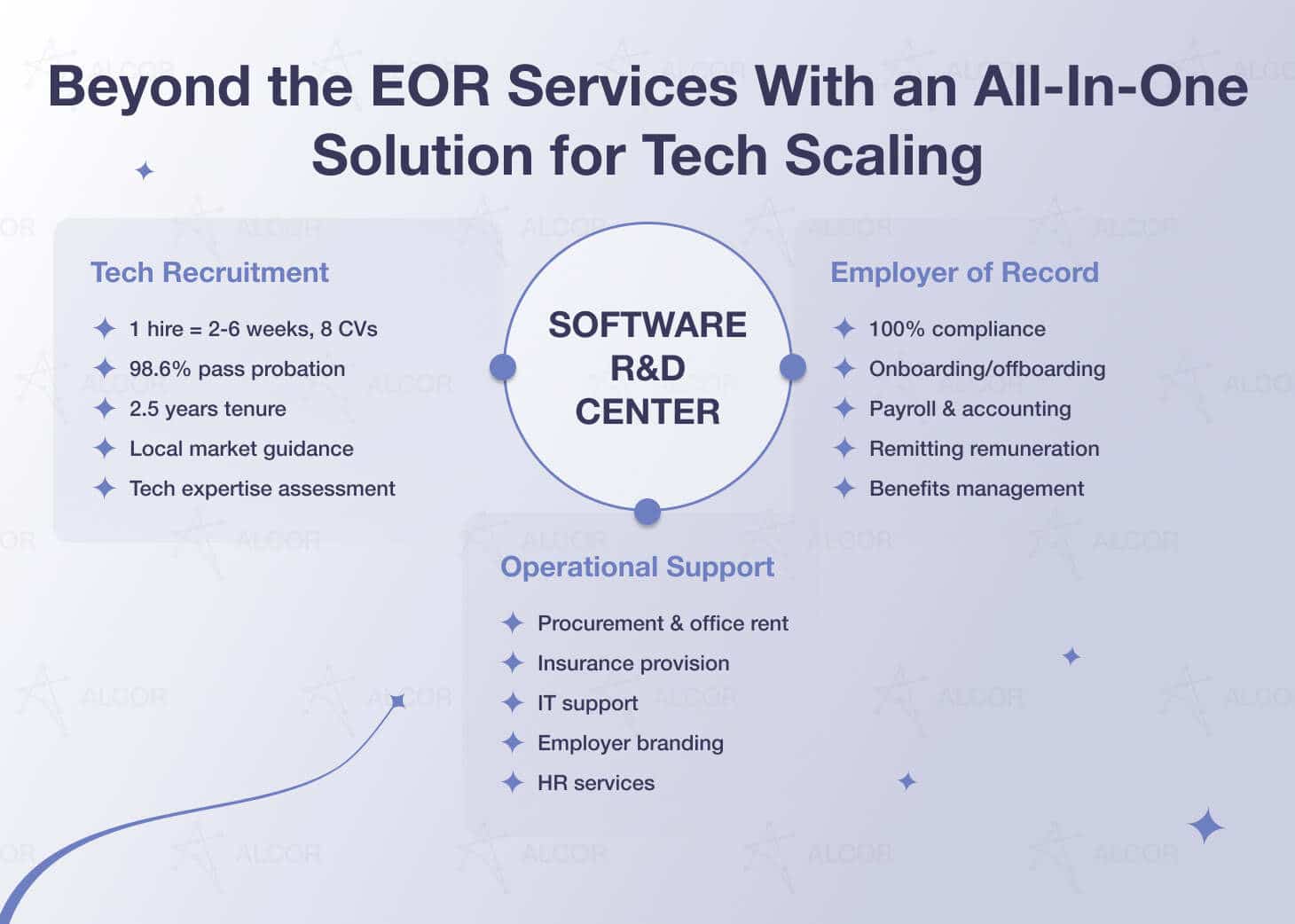
Here’s what that model looks like when it’s actually running. BigCommerce had already tried outsourcing to Romania and Ukraine, and it hadn’t worked: developers lacked dedicated focus and real integration with the product team. What BigCommerce needed instead was one partner to set up the office, hire the team, and hand over a fully operational R&D center it could run as its own.
Alcor’s CEO, Dmytro Ovcharenko, personally visited BigCommerce’s Austin headquarters to see their software developer work environment firsthand before recruiting began. This is part of why the team that followed felt internal from day one.
BigCommerce then got:
- 30 engineers hired in the first six months, 20 more after;
- a fully equipped Ukraine office running in a month;
- full compliance with local law and GDPR;
- transparent pricing with zero hidden fees;
- seamless B2B hiring – no legal entity required;
- full IP ownership from day one.
Every piece of that build, from the office lease to payroll to ongoing compliance, is exactly what belongs on any company’s offshore development center checklist before it commits to scaling a team abroad.
Building a team abroad doesn’t have to mean losing control of it & dealing with admin. Let us show you how – book a call.
FAQ
What is a work environment for a software developer?
A good work environment for a software engineer combines trust in their technical judgment, independence to configure their own tools, and flexibility over when and where they work. Distraction-free deep work time and a genuine team culture matter as much as pay.
Why is a good work environment important for software engineers?
Work environment matters because tech has the highest voluntary turnover of any sector, and engineers who feel micromanaged, isolated, or stuck with outdated tools leave quickly. A strong environment reduces costly attrition and keeps institutional knowledge in-house.
How to create a good work environment for software engineers?
Creating a good work environment for a software developer starts with competitive, transparent pay, a distraction-free workspace, a genuine remote or hybrid option, an intentional team culture, and ongoing access to training on current tools and frameworks.
Will AI change the software engineer work environment in 2027?
Yes. AI tools are moving from optional to default, with the large majority of developers already using or planning to use them daily. Engineers increasingly describe AI as something that makes their work more valuable, not a threat to their role.
How would you rate this article?
Alcor is Your Trusted Scaling Partner
for expansion
support