


The Latin American IT services market is set to grow by $58.78 billion between 2025 and 2030, fueled by cloud migration, AI/ML adoption, and digital transformation, according to Technavio. This fact mirrors a broader investment wave across the region: Latin America and the Caribbean pulled in $194.233 billion in foreign direct investment in 2025, according to ECLAC’s 2026 report, creating clear tailwinds for the software industry. To where? Well, you’ve already put two and two together!
I’m David Gomez, Alcor’s Lead IT Recruiter in LATAM. Scaling abroad shouldn’t mean slow hiring, entity setup headaches, or attrition you can’t control. We remove all three by:
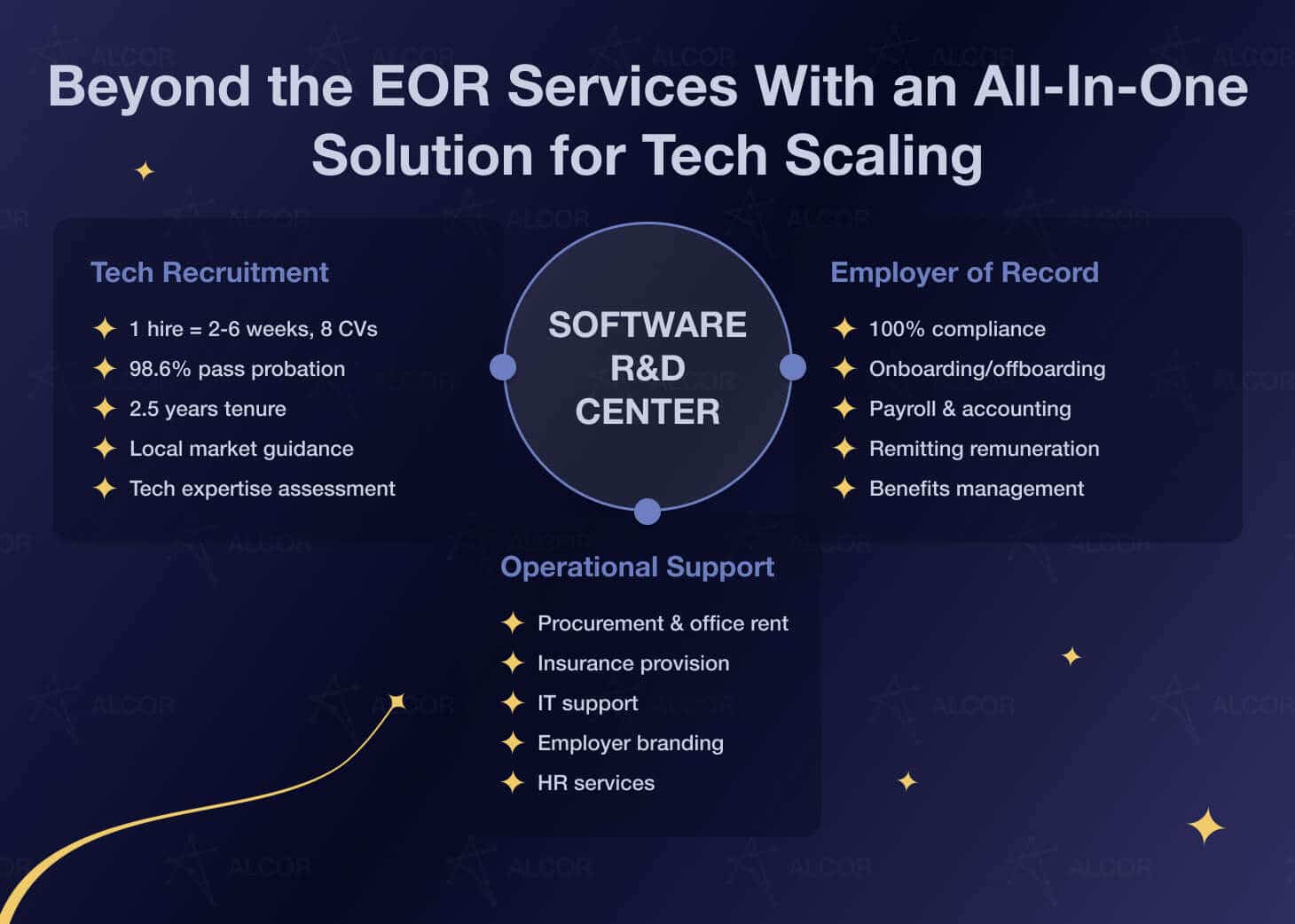
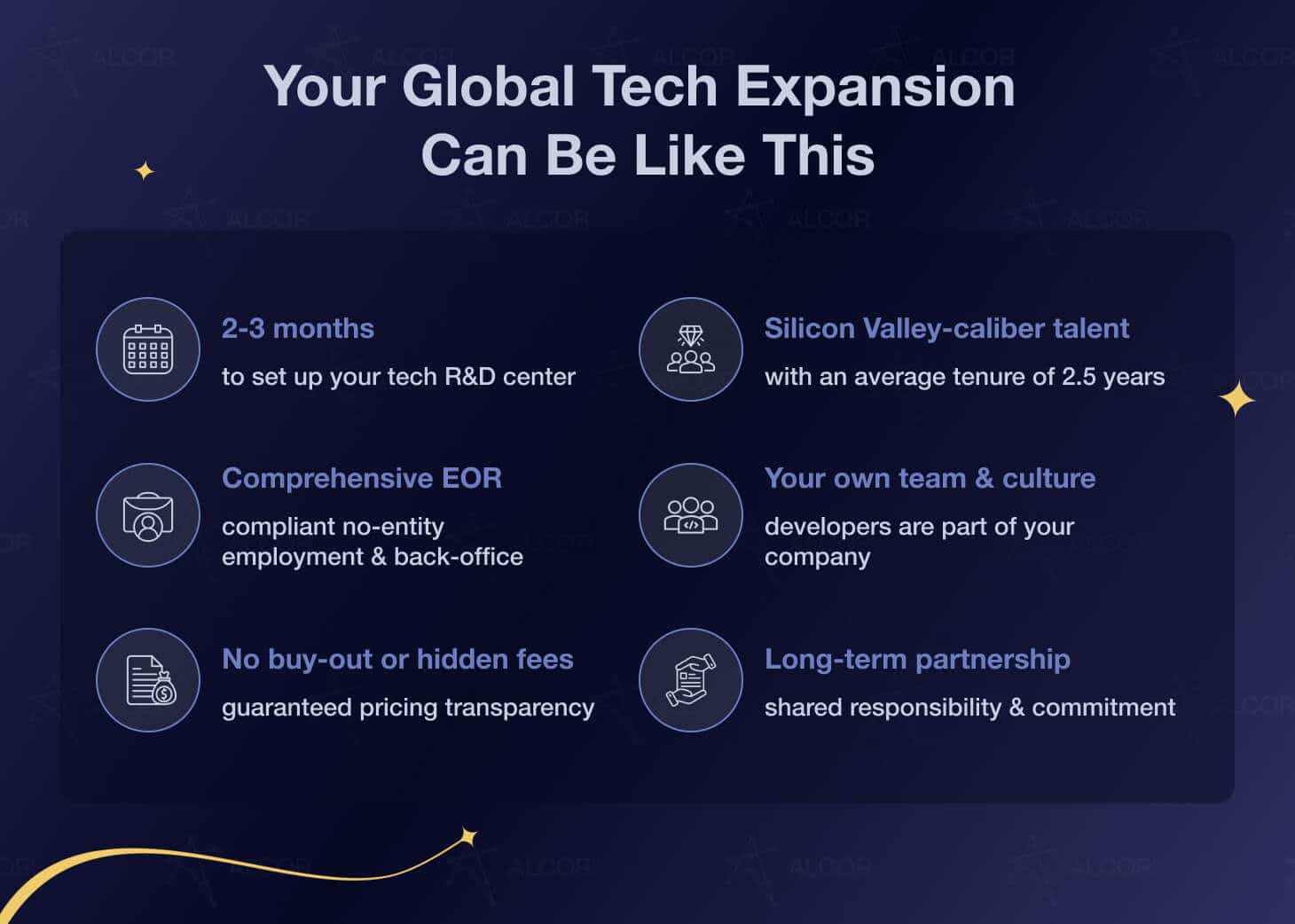
- hiring Silicon Valley-caliber engineers in 2-6 weeks, retained 2.5+ years on average;
- running payroll, benefits, and tax compliance end-to-end;
- handling back-office logistics – office leases, procurement and other works.
All of it comes packaged into one turnkey software development center in Latin America. You can scale on your timeline – from 10 to 30 engineers in 3 months, up to 100 in a year, stay fully compliant and in control of your stellar team from day one.
From the article you’ll get the real numbers behind the ITSM market in Latin America, the sectors pulling ahead fastest, a clear-eyed look at where the opportunities and risks sit for the Latin American software industry, and the top LATAM destinations worth building in right now.
Key Takeaways
- Latin America’s ITSM market is accelerating, led by Brazil’s 54.1% share and Mexico’s 11.87% CAGR growth, with IT outsourcing on track for $126.3 billion by 2030.
- Latin America pairs attractive valuations and 45-65% more affordable engineering costs with some risks of uneven growth and complex regulatory environments.
- AI, fintech, cloud, and cybersecurity are reshaping LATAM’s tech landscape, with AI adoption outpacing real business impact and Pix processing 79.8 billion transactions in 2025.
- Mexico, Colombia, Argentina, Chile, Brazil, Costa Rica, and Uruguay each offer distinct strengths – from enterprise scale to AI/ML depth to high-seniority, English-first teams.
- Alcor builds your own fully-owned tech R&D team across LATAM and Eastern Europe with 2-6 weeks to hire a top-10% engineer, 10 business days to onboard, and 2.5+ years average tenure, all under one roof with zero vendor lock-in.
Latin American ITSM Market Dynamics
The region’s IT services engine is accelerating as cloud-first programs, AI, and mature delivery models converge.
- Brazil, Mexico, Colombia, and Argentina anchor LATAM’s IT economy: Brazil alone commands 54.1% of South America’s IT services market, while Mexico leads as the region’s primary nearshore hub, its IT services market on track to reach $37.28 billion by 2030.
- Cloud build-outs, AI-driven modernization, and a rebounding VC market – $2.2 billion in early-stage funding in 2025 alone – are shifting workloads to managed services, fueling ITSM market growth.
- IT outsourcing is the pragmatic lever for speed, compliance, and 24/5 coverage, extending US & EU engineering roadmaps toward a $126.3 billion LATAM IT outsourcing market by 2030, backed by a 2.3 million-strong regional tech talent pool.
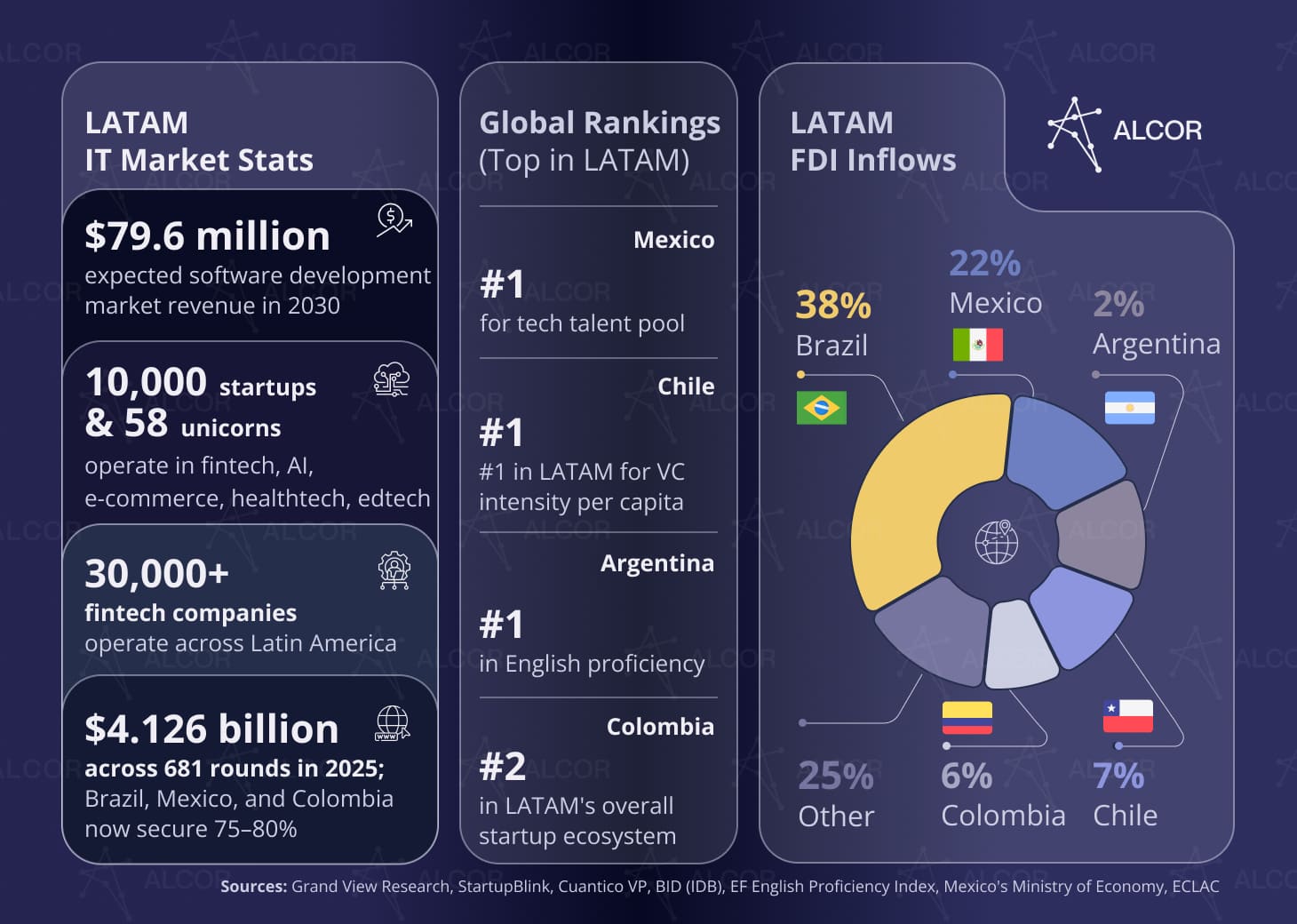
The ITSM market in LATAM continues to expand on genuine structural demand: Brazil alone commands 54.1% of South America’s IT services market size, backed by more than 500,000 developers and over $6 billion in hyperscaler deployments concentrated largely in São Paulo, according to Mordor Intelligence. Regionally, the market is forecast to grow at a 7.55% CAGR through 2030, reaching nearly $120 billion, as cloud, data, and managed services underpin transformation across sectors. Mexico’s IT services market tells a similar story: it’s on track to grow at an 11.87% CAGR, reaching $37.28 billion by 2030, reinforcing its status as the primary nearshore hub for US product teams.
Within the IT services market in LATAM, the regional forecast for IT outsourcing points firmly up: revenue is projected to reach $ 86,892.7 million by 2033, a 9.4% CAGR, according to Grand View Research, backed by a fast-growing pool of more than 2.3 million tech professionals across the region. Brazil accounts for the bulk of that pull: its overall IT market hit $117.8 billion in 2025 and is on track for $274.4 billion by 2034 – a 9.85% CAGR that has outpaced the global average for seven consecutive years. One clear driver is the shift to cloud-native operations in healthcare and retail platforms, which we’ll cover in more detail below.
Another factor propelling the IT services market in LATAM is rapid digital transformation. The market size is projected to grow at a 17.69% CAGR through 2030, reaching $242.1 billion, according to Mordor Intelligence.
Venture signals also turned a real corner in the IT services market in Latin America: per LAVCA’s 2026 Trends in Tech report, early-stage VC deployment hit $2.2 billion in 2025 – 52% of total regional investment and the largest early-stage haul since 2022. Just five companies (Plata, ADDI, Klar, Omie, and Kavak) accounted for roughly 25% of all venture dollars in the region. Mexico closed the funding gap with Brazil, with Mexican startups raising 21% more capital year-over-year and trailing Brazil by just 14% in total funding – a genuine shift in the region’s investment center of gravity.
Curious how Colombia stacks up in this race? See exactly what’s driving the ICT market in Colombia forward, and why it might be your next nearshore stop.
Leaders in the Latin American ITSM market (Amazon, Cisco, Google, IBM, Microsoft) are scaling cloud capacity that lowers latency and unlocks AI and analytics workloads across the region, not just in Mexico. Microsoft launched its Mexico Central Azure region, Google Cloud opened its Querétaro region, and in 2025 Amazon pledged more than $4 billion for a new AWS region in Chile, slated for completion by late 2026, giving enterprises and governments across multiple countries local options for regulated data.
LATAM IT Market Opportunities and Threats
Latin America offers a compelling mix for the IT industry: MSCI’s EM Latin America Index jumped over 20% in 2026 (strongest start since 1991), regional startups raised $4.126 billion in 2025, and a 2.3-million-strong talent pool across almost 500 ranked universities produces 296K+ STEM graduates yearly – with senior engineers being 45-65% more affordable than US counterparts. But real risks remain: 72% of employers globally report hiring difficulty in 2026 (AI skills now the hardest to find worldwide, per ManpowerGroup), regional GDP growth is projected at just 2.1% for 2026 (World Bank), and Mexico, Brazil, and Colombia rank among the world’s most legally complex markets (TMF Group). The software industry wins by diversifying locations, adopting cloud-first, security-led operations, and partnering with specialists like Alcor for EOR, compliant hiring, and fast, senior-grade IT recruitment.
Pro: Profitable investment & attractive valuation
Latin American equities still trade at notable discounts to US peers, creating attractive entry points for long-term exposure to the software industry and beyond. The MSCI EM Latin America Index has jumped over 20% in 2026 (its strongest start to a year since 1991) with global investors piling in at the fastest clip in a decade. Brazil’s Ibovespa hit an inflation-adjusted all-time high in April 2026, up 23.3% YTD in reais, while Colombia’s COLCAP (+11.7%) and Mexico’s IPC (+10.5%) posted solid gains of their own. In plain terms investors are paying less for each dollar of earnings while collecting real upside.
Venture activity backs up the equity story: Latin American startups raised $4.126 billion across 681 rounds in 2025 (a 13.8% increase over 2024 and the first meaningful VC rebound since the 2021 peak) with the region now home to 58 unicorns since 2017.
If LATAM is your next growth market, learn how a Professional Employer Organization in Latin America can help you build local teams.
Pro: Prime code by skilled talent
The Latin American talent pool includes as many as 2.3+ million talented tech specialists. Following the latest IT market trends in AI, fintech, and cloud, almost 500 universities across the region made it to the 2026 QS World University Rankings: Latin America and the Caribbean, continually feeding the software industry with 296K+ annual STEM graduates and growing research strength.
Strategic partnerships are also scaling the region’s potential: AWS’s Mexico (Central) region pairs with the Ministry of Economy and leading universities (e.g., Tec de Monterrey, Universidad Panamericana) to expand cloud education at a national scale – evidence of tight industry-government-university alignment. Isn’t that encouraging for the IT market in LATAM? For more details, read on to our section about IT market destinations!
Level up your tech product with the prowess of software developers from Argentina!
Pro: 3 times lower costs
Latin American software engineers boast deep tech expertise; at the same time, they tend to be 2-3 times more affordable than their US IT market counterparts for the same services. This cost gap is why many product companies staff remote software developers in Latin America for long-running feature work and platform ops.
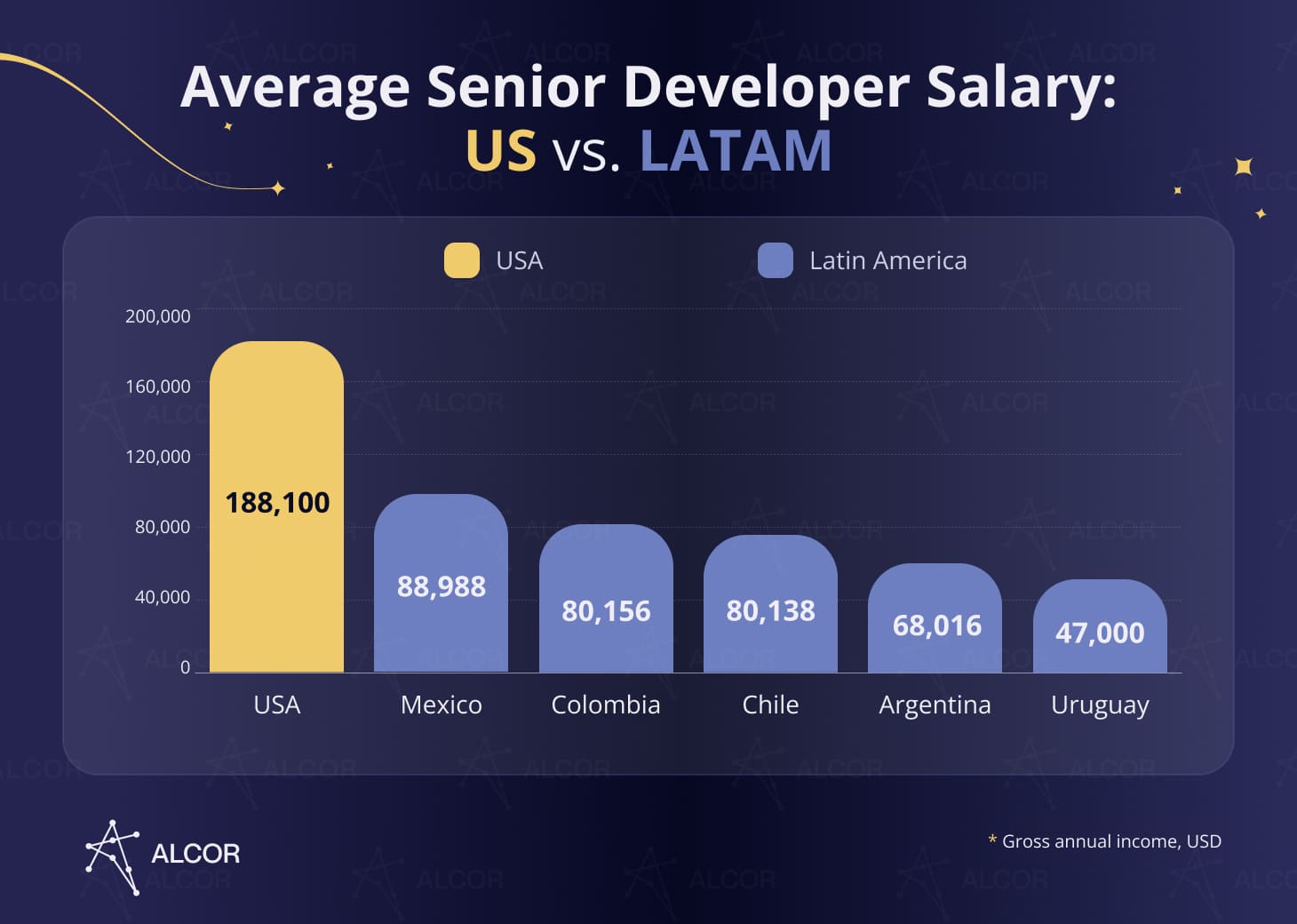
You can hire a senior AI engineer in Mexico for $123K per year, which is about 44.6% less than the $222K in the US. For a senior blockchain developer in Argentina, the gap is even bigger – $60.9K vs $171K, roughly 64.4% savings.
|
Annual Average Senior Developer Base Salary |
|||||
|
Position |
Mexico |
Colombia |
Chile |
Argentina |
USA |
|
AI Engineer |
$123,000 |
$105,000 |
$102,000 |
$87,000 |
$222,000 |
|
AI Product Engineer |
$88,800 |
$87,000 |
$82,200 |
$72,000 |
$228,000 |
|
AI Infrastructure Engineer |
$141,000 |
$123,000 |
$120,000 |
$105,000 |
$243,000 |
|
AI Prompt Engineer |
$87,000 |
$75,000 |
$72,000 |
$63,000 |
$168,000 |
|
ML Engineer |
$81,000 |
$78,000 |
$82,200 |
$75,000 |
$222,000 |
|
LLM Engineer |
$96,000 |
$96,000 |
$93,000 |
$75,000 |
$234,000 |
|
DevOps Engineer |
$81,600 |
$70,800 |
$69,000 |
$53,400 |
$168,000 |
|
Python Developer |
$67,200 |
$66,000 |
$64,800 |
$57,000 |
$165,000 |
|
Blockchain Developer |
$78,000 |
$73,200 |
$78,000 |
$60,900 |
$171,000 |
|
Data Engineer |
$78,000 |
$78,000 |
$75,000 |
$66,000 |
$177,000 |
|
According to salary data update on August 2026 |
|||||
Con: Talent gap
Even with a strong base, our observation shows an obvious trend: senior cloud and AI architects are in short supply across LATAM. Most employers still struggle to find specialized skills: ManpowerGroup’s 2026 survey shows AI skills have overtaken traditional engineering and IT as the hardest capability to find globally for the first time ever – with 72% of employers worldwide reporting hiring difficulty (down modestly from 74% last year). Regionally, Mexico sits at 67% and Colombia at 61%.
However, you can widen sourcing across Mexico, Colombia, Argentina, and Chile and hire where the talent is via EOR. On our side, Alcor already has 325K pre-vetted candidates (the database is growing each year), and screens for the top-10% through rigorous tech assessments, runs searches with 40+ IT recruiters, and taps in-country networks to fill hard roles faster – so you get the right architect without slowing your roadmap.
Just like we did for Franki: seven senior iOS, Android, and QC engineers, hired in just 4-5 weeks on average, with 100% passing probation. Beyond hiring developers from Mexico, Franki also got Contractor of Record support, onboarding and PTO handled, while pricing was fully transparent – and, as result, Franki’s revenue doubled quarter-over-quarter once the team was in place.
Con: Macroeconomic volatility & infrastructure gaps
Latin America’s tech opportunity is real, but execution works best with a plan for uneven conditions across markets. Some countries face real macro headwinds: the World Bank’s April 2026 Economic Update projects regional GDP growth of just 2.1% in 2026 (down from 2.4% in 2025), with Mexico’s growth picking up to only 1.3% amid trade policy uncertainty and tight financial conditions, while Brazil grows 1.6% and Argentina outpaces the region at 3.6%.
Currency swings, policy uncertainty, and sticky inflation continue to affect investment timing and operating margins in several markets. Connectivity is improving, yet gaps remain: per GSMA, 7% of the region’s population (44 million people) still lack mobile internet coverage entirely, and another 28% (174 million people) live within coverage areas but remain offline due to cost, digital skills, or device access, so cloud-first rollouts and data-residency planning still require care. The outlook for 2026-2028 is positive: GSMA’s Mobile Economy 2026 report projects legacy 2G/3G connections will shrink to just 1% and 5% of the market, respectively, by 2030 as 5G build-outs accelerate.
A practical playbook when entering the IT market in Latin America is to diversify across stable hubs, price contracts with FX and inflation clauses, pick cloud regions with local availability and residency options, and enforce zero-trust, encryption, and robust backups for regulated data. Alcor helps de-risk this plan with Employer of Record hiring, operational support, and setups without vendor lock-ins (plus payment in convenient (USD, EUR or other) currency with no exchange fees) so macro and infrastructure bumps don’t derail your roadmap.
Con: Legal complications
Undeniably, the Latin American software development industry is a tech-scaling magnet – whether you build your own tech R&D center or consider a build-operate-transfer in Latin America or any other model. However, legal matters in this IT market do pose a challenge. Issues may arise in the tax, employment, accounting, and payroll areas:
- Navigating LATAM’s complex regulatory patchwork is demanding: TMF Group’s GBCI 2026 places several LATAM markets among the world’s most complex – including Mexico #2, Brazil #3, and Colombia #6 worldwide. The friction spans HR/payroll, tax, and entity management, so local expertise materially reduces risk.
- Mexico is renowned for its pro-employee policies, and they’re about to get more complex: the workweek is capped at 48 hours today, but a March 2026 constitutional reform will trim it by two hours annually starting January 2027, reaching 40 hours by 2030 – with no reduction in pay allowed. A May 2026 reform to the Federal Labor Law also raised the overtime cap to 12 hours/week (paid at double rate), with anything beyond that paid at triple rate, and introduced mandatory electronic time-tracking starting January 2027. Add Mexico’s 7 mandatory paid public holidays (Federal Labor Law, Art. 74) and 12 days of paid vacation guaranteed after one year (the 2023 “Vacaciones Dignas” reform to Articles 76 and 78), and payroll compliance here takes real expertise.
- Colombia still has no ratified treaty with the US to prevent double taxation: a convention was signed but sits in KPMG’s “Signed, Awaiting U.S. Senate Approval” category as of January 2026, with no timeline for a Senate vote.
Hence, cooperation with a local provider of EOR in Latin America is a must.
Latin American IT Industry Trends
The Latin American IT sector is increasingly setting the pace as a hub for software development in LATAM:
- AI is scaling fast – from $22.87 billion in 2026 toward $135.7 billion by 2031 – though real business impact still lags adoption.
- FinTech remains the region’s largest tech vertical, capturing 61% of 2025 VC funding and powered by Pix’s real-world scale.
- Cloud computing is growing at a 14.69% CAGR toward $184.85 billion by 2034, while low-power IoT connections surpassed 1 billion by the end of 2025.
- Cybersecurity spending is accelerating amid rising incidents and deep talent shortfalls, and healthtech investment has topped $2 billion since 2020, with the region’s digital health market now exceeding $18 billion.
Artificial Intelligence
Latin America’s AI IT market is scaling fast: from $22.87 billion in 2026 toward $135.7 billion by 2031, a 29% CAGR, according to MarketsandMarkets. But adoption is outpacing results: per the World Economic Forum’s “Latin America in the Intelligent Age” report, produced with McKinsey (January 2026), only 10% of organizations link their AI use to broader business strategy – and while 23% report any economic value from AI, just 6% report significant impact. AI adoption, done right, could still raise the region’s productivity by 1.9-2.3% annually and add $1.1-$1.7 trillion in yearly economic value.
That gap is exactly where the region’s next competitive edge will be won. On the innovation front, Brazil and Mexico continue to lead in AI patents, together accounting for roughly 95% of regional filings, per ECLAC’s 2025 Latin American Artificial Intelligence Index (ILIA) – evidence of a deepening IP pipeline and talent base.
Fintech
FinTech remains the biggest sector in LATAM’s tech industry, with Brazil, Mexico, and Colombia concentrating 57% of the region’s fintechs. That density shows up directly in capital flows: fintech captured 61% of all Latin American VC funding in 2025 despite representing just 29% of deals, according to Cuantico VP’s Latin America VC 2026 Report analysis. The three largest deals of the year were all Mexican fintechs: Plata’s $250M Series B and $160M Series A, and Klar’s $170M Series C.
Brazil remains the operational proving ground, and Pix Automático just passed its first real-world test: one year after launch, EBANX alone processed 38% of all Pix Automático transactions, with 64% of users being brand-new subscribers to the digital platforms they’re paying on – validating the original forecast that Pix Automático could add $30 billion in recurring e-commerce flows by mid-2027.
That reach turns into revenue as wallets and instant-pay rails scale from a base where 70% of adults already pay digitally. This keeps fueling e-commerce, remote work, and payments-first products across the software industry – a shift that continues to reshape the region’s digital landscape.
Discover how Colombia and Brazil stack up in fintech and gain other valuable insights by comparing Colombia vs Brazil for tech nearshoring!
Cloud
The cloud computing market in LATAM is on a 14.69% CAGR trajectory, growing from $53.85 billion in 2025 to $184.85 billion by 2034, according to IMARC Group, while hyperscalers keep expanding regional infrastructure – AWS alone received approval for a $205 million Chile data center, and announced a further $1.8 billion investment to expand Brazilian operations through 2034. IaaS leads spend today at 38% market share, while large enterprises account for 62% of total demand. Brazil holds the largest regional share at 38%, backed by its mature digital ecosystem and access to major submarine cable routes connecting South America to global networks.
Internet of Things
IoT is also the sensor layer feeding these models. Per GSMA, low-power IoT technologies (NB-IoT and LTE-M) alone surpassed 1 billion active connections across Latin America by the end of 2025, driven by manufacturing, utilities, and smart-city programs, broadening the data fabric that AI can analyze.
The stakes are high, leading to an increased focus on preparing AI-savvy software developers from Latin America to beef up IT services. Coursera’s 2025 report records a 425% surge in GenAI enrollments in Latin America, the fastest globally. Large-scale initiatives are also training developers at pace: Microsoft Brazil’s ConectAI targets 5 million learners in digital and AI skills.
Cybersecurity
With increased digital activity, there’s a growing emphasis on cybersecurity. The World Bank reports Latin America and the Caribbean have been the fastest-growing regions for disclosed cyber incidents, with a 25% annual growth rate in the last decade – an uncomfortable mix that’s drastically reshaping the security landscape across the software industry.
Budgets and education are responding: per IDC, global security spending is set to hit $308 billion in 2026 and $430 billion by 2029, with Latin America named among the fastest-growing regions worldwide for security investment. That urgency shows at the country level, too: Mexico alone needs roughly 83,000 cybersecurity specialists but has only about 6,000 available (a 77% talent shortfall, per IDC) even as its cybersecurity spending grows 24% annually toward $1.48 billion in 2026. On the talent side, Coursera’s 2025 report shows cybersecurity course enrollments in Latin America surged by 106%, a sharp turn from the modest 1% YoY increase seen during the 2024 review period.
Healthtech
Latin American healthtech investment has crossed a real threshold: cumulative venture capital in the sector exceeded $2 billion between 2020 and 2025, according to Davix’s 2026 LATAM healthtech review – evidence that capital keeps flowing toward quality teams and regulated use cases. Brazil now leads with more than 1,000 active healthtechs, backed by a maturing regulatory framework (LGPD data protection and ANVISA’s software-as-a-medical-device rules), while Colombia, Mexico, Chile, and Argentina have each developed their own digital health innovation hubs.
That moment in the Latin American IT industry shows up in market size, too: LATAM’s digital health market now exceeds $18 billion in 2026, a figure that would have looked implausible just a few years ago, per the same Davix analysis. Costa Rica is also worth mentioning as a high-tech manufacturing hub, with medical devices now approximately 44% of goods exports, and claims of being #2 in LATAM for high-tech exports.
Within the regional healthcare startup landscape, Brazil and Mexico together still host the largest share of healthtech startups, while Chile, Argentina, and Colombia continue strengthening as innovation hubs, creating a deeper funnel for clinical, data, and infrastructure solutions across the region.
Top Latin American IT Destinations
Latin America is a prime nearshore choice for building and scaling product teams across Latin American tech hubs. Mexico offers the region’s largest talent pool and enterprise-ready hubs. Colombia excels in cloud and data platforms and secure customer apps. Argentina brings AI/ML and backend depth. Chile fits regulated, data-heavy builds. Brazil delivers the deepest bench for large-scale fintech and e-commerce platforms. Costa Rica and Uruguay round out the region with high-seniority, English-first pods built for SaaS teams. In-demand skills span JavaScript, Java, Python, SQL, C++, TensorFlow, NLP, Node.js, and modern cloud APIs. This creates a dependable, culturally aligned, and cost-effective engine for your roadmap, from faster shipping to new R&D pods.
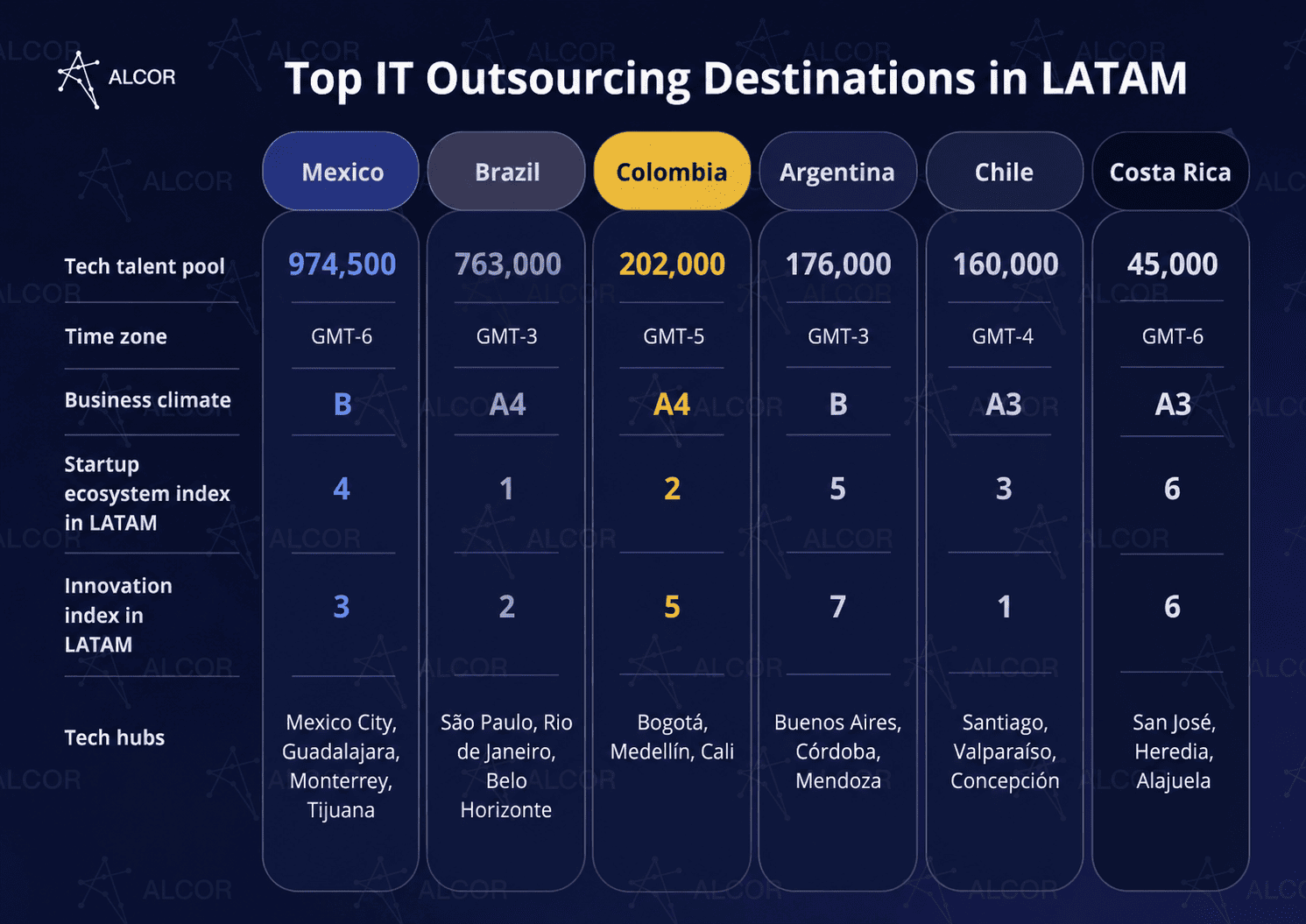
What’s a better way of breaking down software development in LATAM than looking at the key players shaping its Latin American tech hubs? Let’s see the main software development market stats:
Mexico
- Talent pool: 974,500+
- IT businesses: 400 tech businesses and 1,431+ top startups
- Leading industries: mobile development and fintech
- Best for companies: US/EU product companies; enterprise nearshore hubs; fintech/e-commerce scale-ups
- Best for projects: 10-150+ engineers
- Most-prized tech skills (and most requested from Alcor’s clients in 2026): Full-stack and Embedded/Hardware engineers, Product/Delivery, DevOps/Platform, Backend
- The average annual salary in tech: $88,988
- Tech hubs: Mexico City, Monterrey, and Guadalajara
Delve deeper into nearshore software outsourcing to Mexico!
Colombia
- Talent pool: 202,000+
- IT businesses: 11,000 tech businesses and 2,137+ top startups
- Leading industries: startup programming
- Best for companies: Cloud/data platforms; security-first teams; customer apps
- Best for projects: 10-80 engineers
- Most-prized tech skills (and most requested from Alcor’s clients in 2026): AI and ML engineers, Product/Delivery, QA/Test Automation
- The average annual salary in tech: $80,156
- Tech hubs: Bogotá, Medellín, and Cali
Learn more about Colombia vs Costa Rica for nearshore technology outsourcing to make the right choice!
Argentina
- Talent pool: 176,000+
- IT businesses: 3,800 tech businesses and 1,030+ top startups
- Leading industries: database and mobile development
- Best for companies: Deep-tech R&D; AI/ML and backend specialists; product cores
- Best for projects: 5-40 engineers
- Most-prized tech skills (most requeted from Alcor’s clients in 2026): AI and ML engineers, platform engineering
- The average annual salary in tech: $68,016
- Tech hubs: Buenos Aires, Córdoba, and Rosario
Discover the pros of nearshore software outsourcing to Argentina!
Chile
- Talent pool: 160,000+
- IT businesses: 200 tech businesses and 875+ top startups
- Leading industries: data science, data analytics, and statistical programming
- Best for companies: Regulated industries; fintech/retail; utilities & telecom
- Best for projects: 5-30 engineers
- Most-prized tech skills: Java, Python, PHP, Node.js, and ASP.NET
- The average annual salary in tech: $80,138
- Tech hubs: Santiago, Valparaíso, and Concepción
Other tech hubs of LATAM include:
Brazil
- Talent pool: 763,000+
- IT businesses: 24,000 tech businesses and 5,176+ top startups
- Leading industries: fintech, e-commerce, payments
- Best for companies: US/EU product companies; fintech scale-ups; enterprise platforms
- Best for projects: 10-200 engineers
- Most-prized tech skills: Java, JavaScript/Node.js, Python, .NET, mobile developers
- The average annual salary in tech: $78,000
- Tech hubs: São Paulo, Belo Horizonte, and Rio de Janeiro
Costa Rica
- Talent pool: 45,000
- IT businesses: 1,200 tech businesses and 96+ top startups
- Leading industries: MedTech, fintech, edtech
- Best for companies: SaaS and enterprise support centers; high-seniority pods
- Best for projects: 5-30 engineers
- Most-prized tech skills: Java, JavaScript/TypeScript, Python, .NET
- The average annual salary in tech: ~$52,500
- Tech hubs: San José, Heredia, and Alajuela
Uruguay
- Talent pool: 33,000+
- IT businesses: 530 tech businesses and 145+ top startups
- Leading industries: AI tech
- Best for companies: SaaS and gaming; high-seniority pods; English-first teams
- Best for projects: 5-25 engineers
- Most-prized tech skills: Java, JavaScript, Go, Rust, and Python
- The average annual salary in tech: ~$47,000
- Tech hubs: Montevideo and Canelones
Curious about LATAM powerhouses? Uncover the differences by comparing Colombia vs Uruguay for technology nearshoring!
Your Own Software Development Team from 10 to 100 in a year in LATAM
You don’t need another vendor. You need a team that’s actually yours: engineers who report to you, ship your roadmap, and stay for 2.5+ years, not a few months. That’s what Alcor builds: your own high-performing engineering teams across hubs like Mexico, Colombia, Argentina, Chile, Uruguay, Poland, Romania, Bulgaria, and Ukraine – fully owned by you from day one, with no buyout fees when you’re ready to bring it fully in-house. As a Latin America IT staffing services provider (and Eastern Europe’s, too), we put tech recruitment, EOR, and full operational support under one roof, so you get senior engineers fast, stay fully compliant, and never lose control of your own team.
Take Backstory (formerly People.ai), a Silicon Valley AI data platform now valued at $1.1 billion. Before Alcor, they were juggling multiple vendors to build their Eastern Europe engineering team – one handled recruitment, another legal, a third office setup, and nobody owned the outcome. Deadlines slipped. In an AI market where every delayed hire is a delayed feature, that wasn’t sustainable.
Here’s what changed once Alcor became their single R&D partner:
- Our legal and finance team structured a compliant entity in Ukraine and unlocked IT tax incentives that cut employment costs from day one.
- Their office was found, leased, and fully equipped within four weeks – without their leadership spending a single hour on landlord negotiations or procurement.
- Our 40 in-house tech recruiters sourced engineers with deep expertise in Python, Scala, Java, Kafka, and Big Data, screening every candidate for both technical depth and cultural fit before a single CV reached Backstory’s desk.
|
“We were able to bring on amazing engineers in Eastern Europe to supplement our core AI team here in Silicon Valley,” says Oleg Rogynskyy, Backstory’s Founder & CEO. “Some of them have become our core senior or staff AI engineers now.” |
The results speak for themselves: 25 engineers hired in year one, 50 today. A 98.6% probation pass rate. Average tenure past 2.5 years. And the engineers didn’t stay a support layer – some became Backstory’s core senior and staff AI engineers, working directly on the platform now used by Zoom, Cisco, and Nvidia.
Backstory isn’t alone. Dotmatics, Sift, UFORCE, and Pindrop are among the other unicorn-grade, VC-backed companies that have scaled the same way – building fully owned engineering teams with Alcor, without ever touching a vendor contract or a buyout clause.
Curious how this compares to the alternative? See how Alcor’s model stacks up against the BOT model for the IT industry and which one gets you to results faster.
Your next 10, 50, or 100 engineers are already out there. Let’s go build your team.
How would you rate this article?
Alcor is Your Trusted Scaling Partner
for expansion
support