


Software development in Poland has become one of Europe’s most compelling reasons for a US tech product business to find competent developers without the Silicon Valley price tag. Poland’s ICT market is set to climb from $34.75 billion in 2026 to $56.01 billion by 2031, according to Mordor Intelligence. That growth is pulling outsourcing demand right along with it: Poland now ranks among the world’s top three preferred IT-outsourcing locations, alongside India and the US.
I’m Yuliia Baranovska, IT Recruiting Manager at Alcor – your professional software R&D partner for building teams abroad. We help US tech companies hire elite software developers in Poland and across Eastern Europe and Latin America, combining tech recruitment, Employer of Record, and full operational support into one service, so you never have to juggle multiple vendors. The result: you can scale from 10 to 30 engineers in Poland within 90 days, up to 100 in a year, tapping into deep local talent, without ever opening a legal entity.
In this article, you’ll learn how offshore software development in Poland closes the talent gaps for US companies, find out the reasons for investing in software outsourcing in Poland, discover which hub for IT in Poland fits your development team best, and see exactly how our company can help you get there without spending too much into outsourcing software development in Poland.
Key Takeaways
- Polish software development industry spans 778,800 professionals across 50,000+ companies, with 15 unicorns and a startup ecosystem ranking #4 in Eastern Europe.
- Senior developers in Poland are roughly 46.6% more affordable than US counterparts, with Poland ranking #1 in Europe for Tier 2 AI talent.
- Poland is pivoting toward physical AI, tighter NIS2 cybersecurity compliance, and rapid data center growth, backed by fresh capital from ElevenLabs and Microsoft.
- Warsaw, Kraków, and Wrocław lead as Poland’s prominent tech hubs, while Katowice, Tri-city, and Poznan are rising fast in startups and talent.
- Alcor’s tech R&D center model delivers a fully-owned engineering team in Poland with IT recruitment, EOR, and operations combined, no entity required, no buyout fees.
Software Development Industry in Poland: Overview
Poland’s IT industry employs approximately 778,800 professionals across more than 50,000 companies, including 1,300+ dedicated software development firms, according to PAIH’s 2025 ICT Sector report. The country’s tech ecosystem ranks #4 in Eastern Europe (#33 globally) on StartupBlink’s 2026 Global Startup Ecosystem Index, with 1,774 startups, $176 million in cumulative funding, and 15 unicorns – more than any other CEE country. Key growth industries include gaming (Warsaw is now Europe’s largest game production hub), artificial intelligence (Poland leads the Baltic AI GigaFactory consortium), fintech (383-400 active companies), and healthcare technology, currently the country’s fastest-growing ICT vertical at a 14.91% CAGR through 2031, per Mordor Intelligence.
The Polish IT industry boasts approximately 778,800 engineers and other tech experts, working across more than 50,000 IT companies, including 1,300+ software development companies. Poland’s tech scale extends to enterprise value, too: the Digital Champions CEE 2026 report puts the combined valuation of the region’s 100 most valuable tech companies at $127.9 billion, up 9.36% year-over-year. But there’s much more behind the decision to outsource software development to Poland than just impressive scale figures.
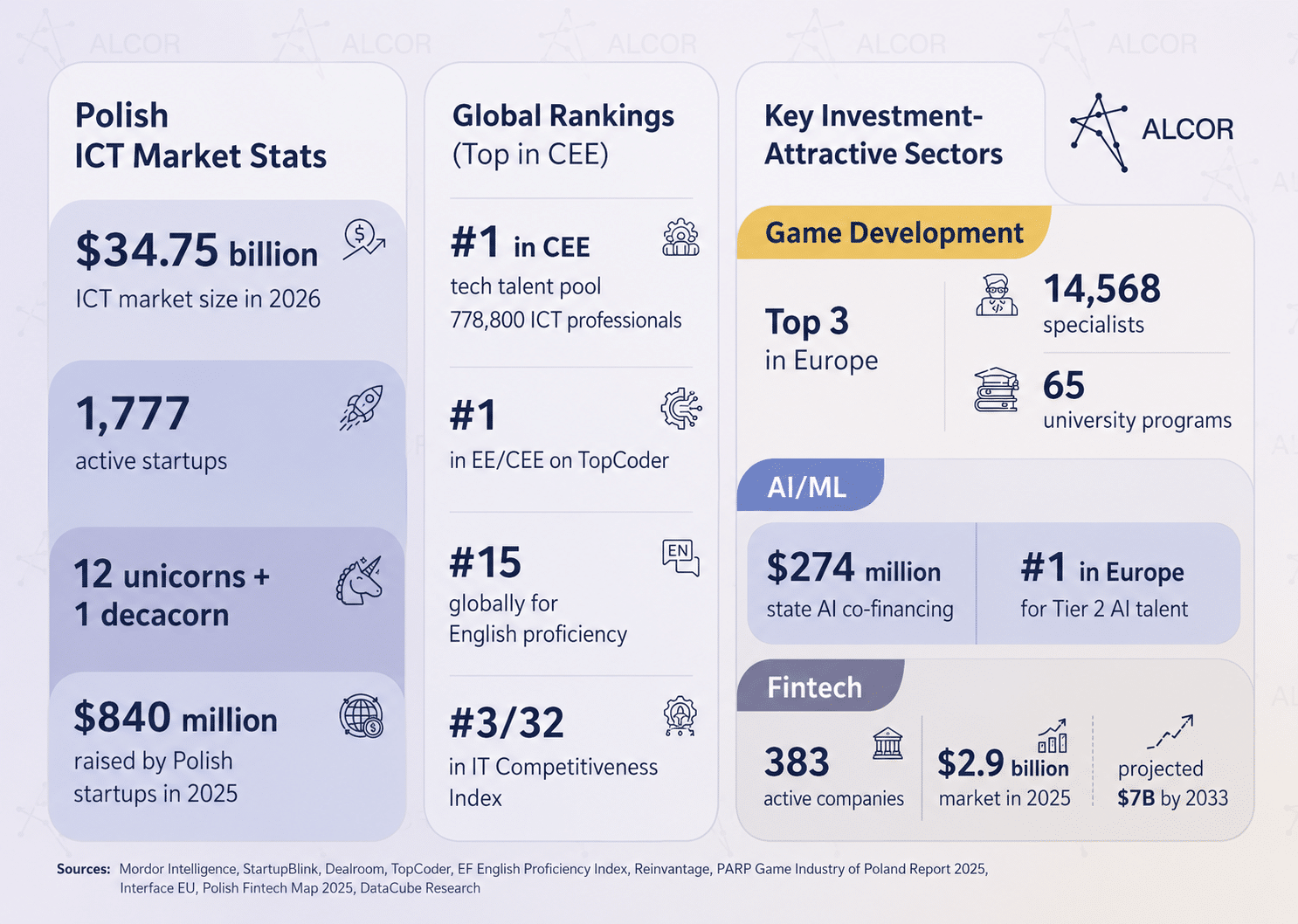
A key metric is Poland’s innovation-driven ecosystem. The country’s startup industries finds it ranking #4 in Eastern Europe (#33 globally) in StartupBlink’s Global Startup Ecosystem Index 2026, with 1,774 tracked startups and over $176 million in cumulative funding – up 29% in a single year. Poland has also produced 15 unicorns, more than any other CEE country, including ElevenLabs, DocPlanner, and LiveChat.
To be more specific about tech talent and industries, Poland finds itself in a great international situation:
- Game development is one of the standout industries for outsourcing to Poland, with companies like CD Projekt, Techland, PlayWay, Huuuge, Ten Square Games, and 11 bit studios proving Polish studios compete globally. Warsaw alone is now Europe’s largest game workforce and production hub, home to 307 developers and publishers (37% of all Polish gaming entities) and PLN 2.5 billion in 2024 gaming revenue.
- Artificial intelligence took a major step forward in July 2026, when Poland formally signed on to lead the Baltic AI GigaFactory consortium – a joint bid with Lithuania, Latvia, and Estonia for one of the EU’s AI Gigafactory sites, worth up to €2.3-3 billion, with the Polish government already committing PLN 400 million toward the project.
- The mobile app ecosystem in Poland punches above its weight. Android continues to dominate the local landscape with a 79.36% market share versus iOS’s 20.48%, per StatCounter, and Polish-built apps are winning globally, not just locally – Booksy, a Poland-founded scheduling app for the beauty and wellness industry, has scaled into one of Europe’s most valuable mobile-first startups, now ranked among the country’s top-performing tech exports.
- The country continues to be a significant force in Central and Eastern Europe’s FinTech landscape, home to an estimated 383-400 active companies in 2025. A bigger shift is coming in 2026: the EU’s Financial Data Access Regulation (FIDA) will mandate standardized Open Finance data access across the bloc, and Polish fintechs (many already compliant with Open Banking standards) are positioned as first movers.
- Healthcare technology is Poland’s fastest-growing ICT vertical: per Mordor Intelligence’s Poland ICT Market report, healthcare is advancing at a 14.91% CAGR through 2031 (faster than any other sector in the country’s ICT economy) as hospitals migrate imaging archives to secure cloud platforms, adopt AI-assisted diagnostics, and roll out e-prescription systems nationwide.
Is Software Development Outsourcing to Poland a still Go to Solution for 2027?
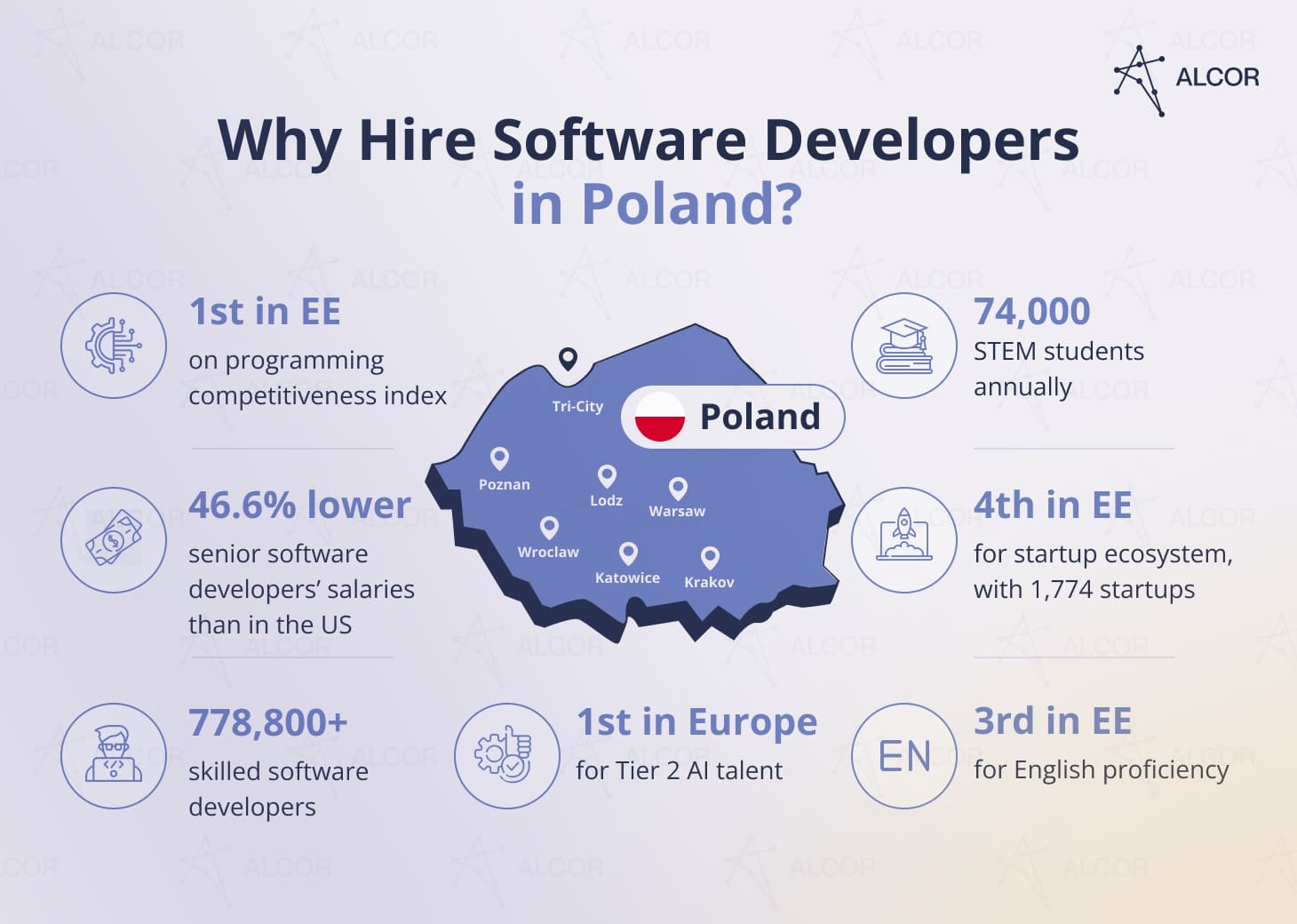
Poland remains a top outsourcing destination for 2027, with Alcor recording a 12.5% rise in software engineering hires since early 2026 and 24% of Eastern-Europe-bound companies naming Poland their first choice. Poland ranks #1 in Eastern Europe on TopCoder and #1 in Europe for Tier 2 AI talent concentration, per Interface EU’s 2026 analysis. Senior developers cost roughly 46.6% less than US counterparts – a Senior AI Engineer runs about $129,000 in Poland versus $222,000 in the US, before accounting for ~20% employer social security contributions and roughly $5,000 in annual benefits. The business climate is strengthening too: McKinsey projects GDP growth above 4% with targeted reforms, backed by a €235 million national AI Fund.
Alcor has seen a 12.5% increase in software engineering hires among clients in Poland since the start of 2026, with 24% of all Eastern-Europe-interested companies naming Poland as their pick, spanning HQs across the US, Switzerland, the UK, and Germany. Of those, 71% need single-digit teams, while 29% are already building double-digit teams of 10 or more – a clear signal that AI-driven product roadmaps are pushing hiring volumes up, not down, as companies compete for Poland’s deepest-in-region AI talent. So apart from offering access to the largest tech talent pool in the CEE region, Poland also provides Western technology companies with the following benefits:
Highly qualified software developers
Poland ranks #1 in Eastern Europe on the TopCoder programming competitiveness index, and #1 in Eastern Europe / #24 globally on Oxford Insights’ Government AI Readiness Index 2025. On AI and data capability specifically, the country ranks #3 in EE for AI maturity and data science skills (Coursera Global Skills Report 2025), and #4 in EE on the Global Innovation Index 2025.
Most tellingly, Poland ranks #1 in Europe and #4 globally for the concentration of Tier 2 AI talent (advanced AI researchers and engineers building deep learning models, neural architectures, and cutting-edge AI systems) per Interface EU’s 2026 analysis. That depth isn’t theoretical: TCL chose Poland for its European AI research headquarters specifically for Polish researchers’ “unique combination of great algorithmic and mathematical skills,” and Ringier Axel Springer built one of its key global AI and data science centers here for the same reason.
Poland’s most in-demand tech stack – Python, TensorFlow, NLP, and Kubernetes – maps directly onto ML, LLM, MLOps, and AI infrastructure roles, giving companies a genuine breadth of experience beyond general software development, and into offshore AI development.
Pro tip: Offshoring software development to Poland is easy with a software developer recruitment agency that also delivers EOR and all back-office services.
Attractive engineer compensation & tax incentives
One of the key reasons why companies choose outsourcing software development in Poland is the country’s combination of high-tech talent and cost-effective compensation. Below is the average annual salary of senior software developers in the USA and Poland:
|
Annual Average Senior Developer Base Salary |
||
|
Position |
Poland |
USA |
|
AI Engineer |
$129,000 |
$222,000 |
|
AI Product Engineer |
$103,800 |
$228,000 |
|
AI Infrastructure Engineer |
$150,000 |
$243,000 |
|
AI Prompt Engineer |
$93,000 |
$168,000 |
|
ML Engineer |
$99,600 |
$222,000 |
|
LLM Engineer |
$102,000 |
$234,000 |
|
DevOps Engineer |
$90,000 |
$168,000 |
|
Python Developer |
$84,000 |
$165,000 |
|
Blockchain Developer |
$70,800 |
$171,000 |
|
Data Engineer |
$82,800 |
$177,000 |
|
According to salary data update on August 2026 |
||
Across the board, Poland’s senior-level average sits roughly 46.6% below the US, but salary figures alone don’t provide a full picture when estimating your budget. To gain an accurate understanding, it’s essential to account for local taxes, hiring costs, and employee benefits.
Employers can choose between two main engagement models when hiring developers: the traditional employment contract (Umowa o Pracę) and the B2B contract (Umowa B2B).
Employment contract (Umowa o Pracę)
According to the taxation system in Poland, when hiring full-time employees, employers are required to cover social security contributions (SSC), and also take into account statutory employee benefits. Additionally, if you want to compete for the best senior developers across the market, software development companies in Poland also offer optional benefits packages. Let’s take a more in-depth look at the picture:
1. Social Security Contributions (employer side):
- Retirement pension: 9.76%
- Disability pension: 6.5%
- Accident insurance: 0.67%-3.33%
- Employment Fund: 2.45%
- Fund of Guaranteed Employee Benefits: 0.1%
Effective employer SSC rate: ~20% on top of gross salary. For instance, on a $5,000 monthly salary, that’s roughly $1,000/month in additional employer cost. You can consider partnering with a local Employer of Record company to calculate payroll and tax withholding 100% accurately.
2. Statutory employee benefits (non-negotiable, built into Polish labor law):
- Vacation: 20 working days (under 10 years’ service), rising to 26 days (10+ years) — many IT employers add 2-5 extra days in practice
- Sick leave: paid at 80% of salary; employer covers the first 33 days (14 for employees 50+), ZUS covers up to 182 days thereafter
- Maternity leave: 140 calendar days
- Paternity leave: 14 days at 100% of salary, paid by ZUS
- Parental leave: 287-301 days, paid at 70-81.5% by ZUS depending on how it’s claimed
- Holidays: 14 paid public holidays in 2026
3. Optional benefits package (what top specialists actually compare offers on):
- Private health insurance: ~$600/year
- Professional development (training & certifications): ~$1,500/year
- English language courses: ~$800/year
- Home office / IT equipment: ~$600/year
- Wellness (MultiSport card, mental health support): ~$600/year
- Meal cards: ~$900/year
Total optional benefits: ~$5,000/year per engineer.
Eventually, the cost of a Senior AI Engineer in Poland still can be roughly 28% below that same role’s $222,000 base salary alone in the US, before US employer taxes and benefits are even added.
B2B contract (Umowa B2B)
In this arrangement, the developer operates as a private entrepreneur and assumes full responsibility for their own tax obligations, so the hiring company’s direct payroll-tax burden drops to effectively 0%.
For context on the contractor’s own side: under Poland’s lump-sum tax system, that typically works out to a 12% personal income tax plus fixed monthly social security (as low as ~$120/month during the first 24 months under preferential rates, rising to ~$520/month standard rate) and tiered health insurance – landing most B2B contractors at an effective personal tax rate of roughly 26% of gross income, well below the employment-contract path.
Additional fees
If you consider software nearshoring to Poland, the breakdown above already gives you the full range of what a compliant hire actually costs in a base salary, employer SSC, and a competitive benefits package. Two more line items complete the picture: the one-time cost of finding the person, and the ongoing cost of employing them compliantly.
Recruitment fees
Such fee is a one-time payment, and vary by role seniority:
- 15% of gross annual salary for mid-level specialists
- 20% for senior-level roles
- 25%+ for lead and executive-level positions
The cost of recruiting these specialists in the US is 10% higher on average (25%-35%).
EOR/COR fee
An Employer of Record or Contractor of Record monthly fee covers employment contracts, payroll, tax filings, statutory benefits, IP protection clauses, and ongoing HR and legal compliance in Poland. Most providers charge either a flat fee per engineer or a percentage of gross salary, with volume discounts kicking in as headcount grows – so the per-engineer cost typically drops the more you scale.
Attractive business climate
According to McKinsey’s Poland 2025 report, the country is well-positioned to become a key driver of growth in Europe, with targeted reforms potentially pushing annual GDP growth above 4% and per capita GDP to 85% of the EU-15 average.
Poland is backing this with real capital: a dedicated national AI Fund of approximately €235 million, launched in November 2024, co-finances private-sector AI innovation, while startups and SMEs get free access to national AI compute infrastructure through the PIAST-AI and Gaia programs – including GPU-powered model training that directly lowers the cost of building AI-heavy products in Poland. This sits alongside the country’s existing 200% tax deduction for strategic R&D-related expenses, covering employee salaries, research equipment, and IP protection.
Excellent ICT higher education
Poland is home to roughly 500 higher education institutions, including 68 universities with STEM majors, such as the Warsaw University of Technology and Wrocław University of Science and Technology. 20 institutions rank in the QS World University Rankings 2026, and the country now offers 6+ English-taught Bachelor’s degrees specifically titled Artificial Intelligence – a direct response to AI-driven demand. Roughly 74,000 STEM and ICT graduates enter the market annually, keeping Poland’s tech talent pipeline both deep and current.
High level of English
Polish software development specialists learn English from childhood and refine it further in university or language courses. Poland ranks #3 in Eastern Europe and #15 globally on the EF English Proficiency Index, with an overall score of 600 (B2-C1), and 621 (C1) specifically in the IT sector, the highest IT-sector English rating of any Eastern European market after Romanian developers. That C1 level means full participation in technical documentation, code review, and real-time product discussions without meaningful language gaps, which is exactly why custom software development in Poland stays friction-free for foreign tech companies.
That friction-free communication is exactly what Sift, a US-based AI fraud-prevention platform trusted by over 700 global brands, found when it extended its engineering hub into Eastern Europe. What started as a plan became a fully compliant, 51-engineer R&D center spanning Ukraine and Poland – built without Sift ever opening a local entity.
Western work values
Polish coders share the Western European work ethic in terms of dedication and punctuality. Their culture is relationship-oriented and hierarchical, with a strong emphasis on fairness, hard work, and being both result-oriented and committed to the process. The Polish also appreciate directness, politeness, and precision in their work affairs.
Learn more about the advantages of working with developers in Poland in our recent article: “Polish Developers: Pros, Cons, Rates & Insights.”
Software Development in Poland: Latest Trends and News
Poland’s tech scene combines steady outsourcing demand with three accelerating trends. Robotics is pivoting toward “Physical AI,” exemplified by Warsaw startup Nomagic’s $10 million raise in January 2026 and new AI lab launch. A new cybersecurity compliance era began April 3, 2026, as Poland’s amended National Cybersecurity System Act transposed the EU’s NIS2 Directive, requiring thousands of tech companies to register by October 2026. Cloud and data center capacity is racing to keep pace, with Poland’s market projected to reach $2.78 billion by 2030 as Warsaw cements its role as a Tier-2 colocation hub. Recent news includes Microsoft’s $704 million infrastructure commitment, Google’s AI partnership projecting an 8% GDP boost, and Warsaw-founded ElevenLabs reaching an $11 billion valuation.
Software development outsourcing in Poland and other tech havens remains a cornerstone strategy for US businesses, especially in the tech industry. A remarkable 92% of Global 2000 companies rely on tech outsourcing services. But outsourcing alone doesn’t capture where the market is heading in 2026 and beyond.
From the latest news:
- Microsoft is following through on its PLN 2.8 billion (~$704 million) investment in cloud, AI, and cybersecurity infrastructure, confirmed to complete by June 2026, building on the $1 billion investment that originally created Azure Poland Central, the first hyperscale cloud region in Central and Eastern Europe.
- Google signed a strategic AI partnership with the Polish Development Fund and National Cloud Operator, projecting an 8% GDP increase from AI integration across the Polish economy, alongside a nationwide digital-skills program.
- Warsaw-founded ElevenLabs raised $500 million in a Series D round in February 2026, led by Sequoia Capital, valuing the AI voice company at $11 billion – more than tripling its valuation from just a year earlier and cementing it as Poland’s most valuable tech company.
But the more interesting story isn’t which company wrote the biggest check, but what’s actually shifting the reality of software development companies in Poland on the ground. Three trends stand out:
Trend #1: Poland’s robotics scene is pivoting to “physical AI”
Warsaw-based robotics startup Nomagic secured a $10 million Series B extension in January 2026, led by Cogito Capital Partners, pushing its total funding past $84 million. The money isn’t going toward more warehouse robots in the traditional sense – it’s funding the continued development of VLA (Visual Language Action) models, the same class of technology behind the broader global “Physical AI” boom that saw humanoid and embodied-AI startups pull in $8.7 billion in venture funding through July 2026 alone, according to Dealroom. By July 2026, Nomagic had gone further still, launching a dedicated AI lab headed by a former Google DeepMind researcher to push its “AI brain” for warehouse robots into wider commercial deployment.
For software teams, Poland’s robotics story is shifting from “how many robots got installed” to “who’s building the AI that makes robots actually adaptive” – and that shift is pulling in exactly the kind of ML, computer vision, and robotics-software engineers this article has already shown Poland has in depth.
Trend #2: A new cybersecurity compliance era
On April 3, 2026, Poland’s amended National Cybersecurity System Act (KSC) entered into force, transposing the EU’s NIS2 Directive into Polish law. The law extends well beyond critical infrastructure operators – it now touches thousands of technology companies, digital-infrastructure providers, and their supply-chain partners, who must self-assess, register in the official S46 system by October 3, 2026, and implement formal information-security management systems ahead of further compliance waves in 2027 and 2028.
For any company building software in Poland, this is a real shift: security-by-design, incident-reporting workflows, and vendor due diligence are no longer optional extras – they’re now baseline requirements for a growing share of the market.
Trend #3: Cloud and data center capacity is racing to keep up
Poland’s data center market is projected to grow to $2.78 billion by 2030 as Warsaw cements its role as a Tier-2 colocation hub bridging Western and Central-Eastern Europe. Established operators like Equinix, Data4, Atman, and Beyond.pl are expanding alongside new entrants such as Greykite and 1911 Data Centers, with average facility occupancy already running around 86%. That capacity build-out is exactly what’s enabling the AI infrastructure investments happening elsewhere in Poland’s tech ecosystem, but it’s also creating a fast-growing need for DevOps, site reliability, and infrastructure engineers who can operate at that scale.
Prominent Software Development Hubs in Poland
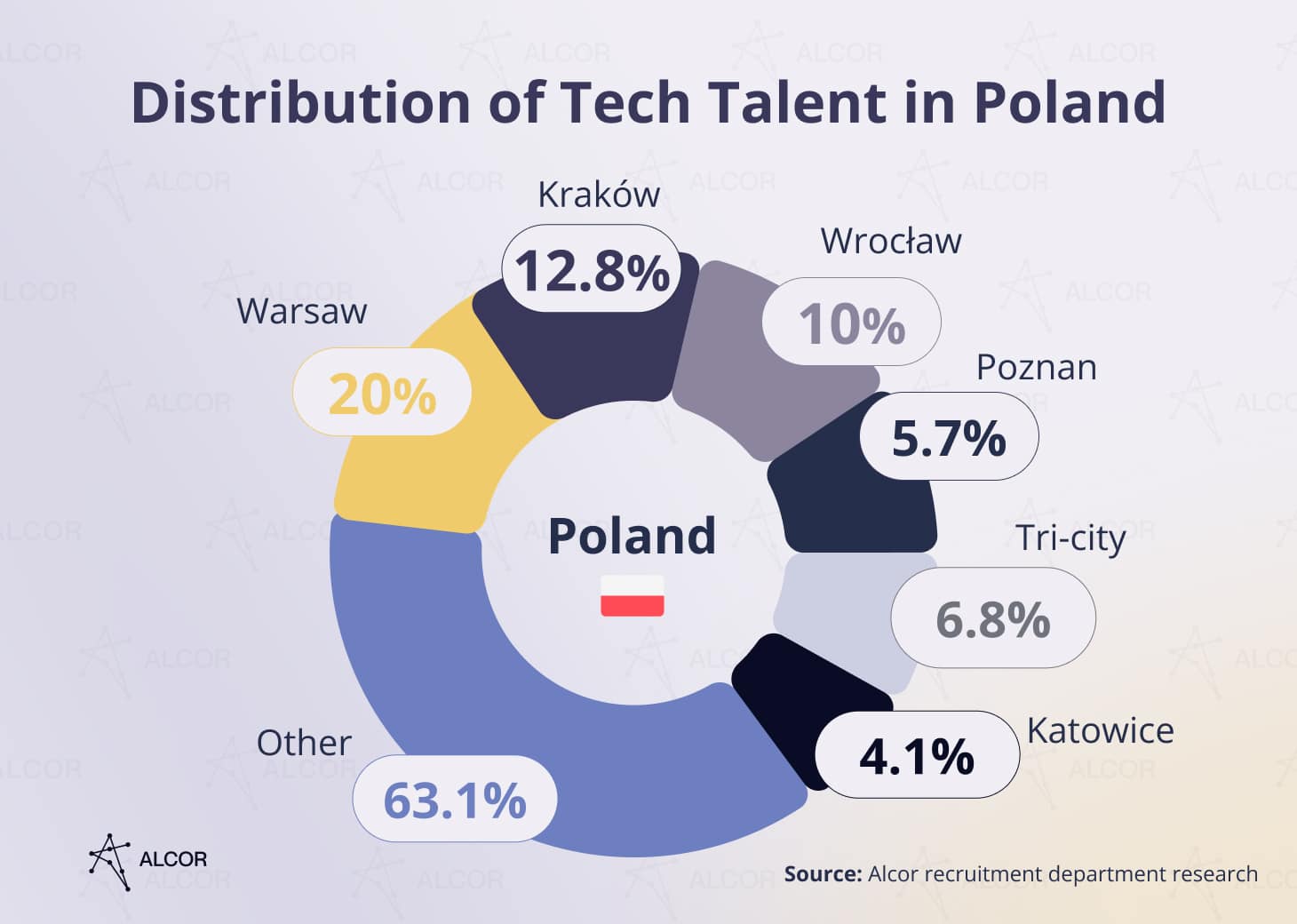
Poland’s tech talent concentrates across six major hubs, ranked from established to rising. Warsaw leads with 156,000 tech specialists, HelloFresh’s new 2026 engineering hub, and the country’s strongest startup ecosystem (684 startups, StartupBlink 2026). Kraków (100,000 specialists) hosts the GAIA AI Factory, Poland’s dedicated AI research facility. Wrocław, the “Polish Silicon Valley,” houses 78,000 specialists and Wrocławski Park Technologiczny’s 220+ companies. Rising hubs include Katowice (78,000 business-services workers, 27% in IT), the Tri-city (52,650 specialists, anchored by Intel’s 4,000-person Gdańsk R&D center), and Poznan (44,200 specialists, 80 IT/R&D service centers). Each hub offers distinct specializations, from robotics and gaming to MedTech and enterprise software, giving companies flexibility in where to build their Polish engineering team.
Suppose you’re enthusiastic about obtaining professional software development in Poland. In that case, you should learn about the biggest technology hubs in the country that provide all the right conditions for running a successful tech business. Warsaw, Krakow, Wrocław, Katowice, Tri-city, and Poznan, ranked below from the country’s most established hubs to its fastest-rising ones.
Software development in Warsaw
Type: Prominent
Warsaw is the capital of Poland and home to 156,000 tech specialists – roughly 20% of the national tech workforce. When it comes to qualification guarantees of software development in Warsaw, the Polish capital boasts the best higher education tech institutions in the country: eleven Warsaw-based universities actively publish AI research, led by the University of Warsaw, Warsaw University of Technology, and Warsaw University of Life Sciences, according to EduRank.
The city just landed fresh proof of its pull: in June 2026, HelloFresh chose Warsaw over Europe’s traditional tech capitals for its fourth global technology hub (alongside Berlin, Toronto, and New York), with plans to hire around 100 senior AI and engineering specialists by the end of 2026.
Warsaw’s startup ecosystem remains Poland’s strongest, with 684 active startups, +14.4% growth in 2026, and over $125.1 million in cumulative funding, per StartupBlink. Venture activity reached roughly €800 million across 180 transactions in 2025, up 84% year-over-year into early 2026, per SSK&W Law Firm. Its leading industries, robotics and gaming, make it the natural #1 choice for setting up an R&D branch or establishing a software development team in Poland for IBM, Google, Amazon, Microsoft, Oracle, and Cisco Systems.
Looking for IT recruitment services in Warsaw? Alcor has something better to offer you!
Software development in Kraków
Type: Prominent
Regarding the number of software development professionals in Kraków, you get access to 100,000 ICT specialists. Kraków IT universities such as the AGH University of Kraków, Kraków University of Technology, and Jagiellonian University keep the pipeline flowing with steady new graduates each year.
What sets Kraków apart now is the GAIA AI Factory, launched in 2026 – a dedicated AI research and engineering facility that positions the city as Poland’s primary hub for advanced technical AI work. Kraków’s startup ecosystem ranks #3 in Poland, per StartupBlink. The largest tech corporations that have opted for IT recruitment in Krakow to establish their development teams include IBM, Motorola Solutions, Ericsson, and Nokia Networks.
Considering IT outsourcing in Krakow? Alcor helps you build your own R&D team instead.
Software development in Wrocław
Type: Prominent
Also known as the “Polish Silicon Valley,” Wrocław belongs to the top three IT hubs in Poland and houses around 78,000 tech specialists – about 10% of the national tech workforce. Its leading industry is MedTech, and the city stands out with approximately 1,400 STEM graduates annually from its top institution, Wrocław University of Science and Technology.
These factors have already pushed many tech businesses to consider IT recruitment in Wroclaw. Wrocław’s startup ecosystem grew 28.1% in 2026, now counting 239 active startups and over $15.22 million in cumulative funding, ranking #176 globally, per StartupBlink. Its innovation infrastructure runs deep, too: Wrocławski Park Technologiczny alone now connects more than 220 companies, from international corporations to fast-growing startups.
Are you planning offshore software development to Poland in 2026? Check out our latest article to explore all the key insights and trends!
Software development in Katowice
Type: Rising
Located in the Silesian Metropolis, Poland’s largest urban area, Katowice benefits from shared infrastructure, a connected labor market, and strong government support. As of April 2026, Katowice’s business services sector employs approximately 78,000 experts across more than 180 service centres and software houses, with IT services and software houses specifically accounting for 27% of that workforce – roughly 21,000 tech developers.
The city is also tackling its talent pipeline head-on: the new Silesian STEM Talent Hub consortium brings together eight universities and 24 employers, including IBM and Comarch, aiming to cut talent outflow by 15% by the end of 2026. Katowice’s startup ecosystem grew 33.3% in 2026 – still small at 46 active startups, but clearly gaining momentum, per StartupBlink.
Software development in the Tri-city
Type: Rising
Tri-city is the metropolitan area that consists of Gdańsk, Gdynia, and Sopot. Together, these cities house over 52,650 tech specialists – 6.8% of Poland’s national tech workforce. Tri-city graduates over 1,000 tech students annually from the Gdańsk University of Technology, the University of Gdańsk, and other ICT higher education institutions. Gdańsk’s own startup ecosystem grew 24.6% in 2026, now home to 96 active startups, per StartupBlink.
The area’s biggest calling card is Intel’s largest EU R&D center, based in Gdańsk – roughly 4,000 staff focused on AI, machine learning, and autonomous vehicle development, backed by a €72-73 million expansion. Amazon and GetResponse, among others, already have offices here too.
Software development in Poznan
Type: Rising
The number of software development professionals in Poznan is about 44,200, making it a strong secondary hub for companies looking to hire software developers in Poznan beyond Warsaw, Kraków, and Wrocław. Poznan hosts 80 IT/R&D business service centers, and its top universities – Poznan University of Technology and Adam Mickiewicz University – graduate around 1,500 tech students each year.
In terms of technical skills, local developers are strongest in C/C++, Java, and .NET. Poznan’s startup ecosystem grew 18.4% in 2026, now home to 115 active startups and ranking #5 in Poland, per StartupBlink.
Want to set up a dedicated development team in Poland? The best way to do it is through your EOR in Poland, and a fully-fledged tech R&D center with Alcor.
Simpler Than Offshoring Software Development to Poland
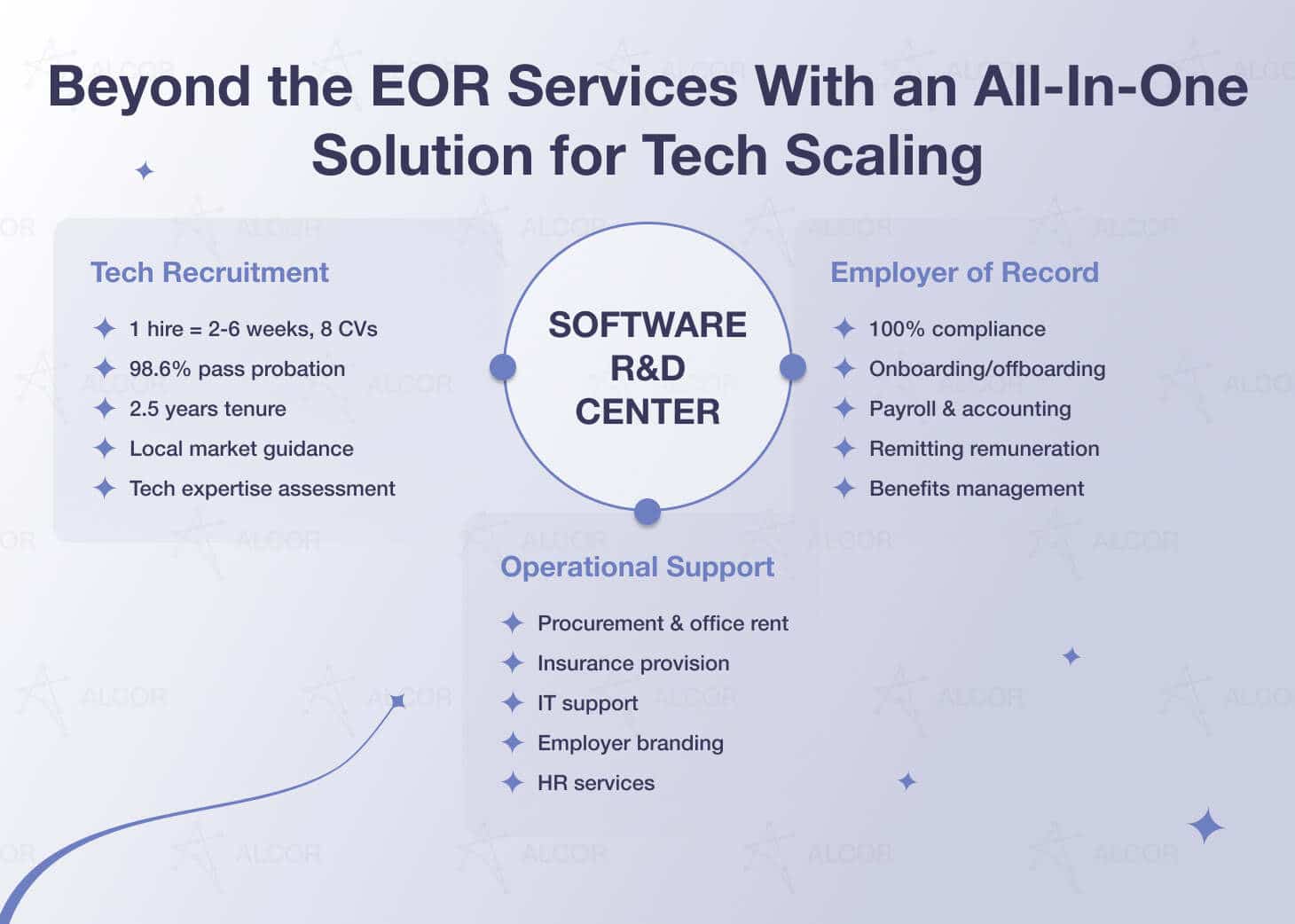
Alcor’s software R&D center model replaces fragmented vendor setups with one accountable partner combining IT recruitment, Employer of Record, and operational support. When Backstory (formerly People.ai), a Silicon Valley AI platform now valued at $1.1 billion, needed to scale its Poland-based engineering team, Alcor sourced specialists in Python, Scala, Java, and Kafka, secured full legal compliance with no entity required, and set up office space within four weeks. The result: 25 engineers hired in year one, growing to 50, with a 98.6% probation pass rate and 2.5+ years average tenure. Alcor has delivered similar outcomes for unicorn-grade clients including Ledger, Dotmatics, BigCommerce, and UFORCE, scaling teams from 10 to 100 engineers without buyout fees or hidden costs.
Offshoring/outsourcing software development to Poland doesn’t have to mean juggling five vendors and hoping they all talk to each other. Alcor’s software R&D center solution gives you one nearshore or offshore partner instead: IT recruitment services in Poland, EOR services in Poland, and full operational support, combined under one roof – with your engineers reporting directly to you from day one.
Take Backstory (formerly People.ai), a Silicon Valley AI data platform now valued at $1.1 billion.
Before Alcor, they were piecing together multiple vendors to build their engineering team abroad – one handled recruitment, another legal, a third office setup, and nobody owned the outcome. Deadlines slipped, and in a fast-moving AI market, that wasn’t sustainable.
Here’s what changed once Alcor became their single R&D partner:
- Silicon Valley-grade recruitment: Alcor’s 40 in-house recruiters sourced engineers with a rare mix of tech stacks – deep expertise in Python, Scala, Java, Kafka, and Big Data, screening every candidate for technical depth and product mindset, not just a matching CV.
- EOR, built for tech: Alcor’s legal and finance team ensured full compliance with regulations, unlocking local IT tax incentives that cut employment costs from day one – with no legal entity required.
- Ops support, end-to-end: Alcor found, leased, and fully equipped office space in just four weeks, with zero hours spent by Backstory’s team on landlord negotiations or procurement.
- One partner, ongoing: Alcor ran payroll and the entire operational layer going forward, so Backstory’s leadership stayed focused on product, not paperwork.
The result: 25 engineers hired in year one, growing to 50 since – with a 98.6% probation pass rate and an average tenure of 2.5+ years. Engineers hired through Alcor are now core members of Backstory’s AI platform team, used today by Zoom, Cisco, Nvidia, and Okta.
This is exactly why Alcor’s R&D solution beats traditional staff augmentation in Poland: augmented staff stay on a vendor’s payroll and can walk away with the product knowledge they built up; Alcor’s model gives you an opportunity to hire developers from Poland and beyond with full ownership, ideas and IP included, from the very first hire.
Trusted by more than one unicorn Backstory isn’t the only proof point. Alcor has helped VC-backed and unicorn-grade companies like Ledger, Dotmatics, UFORCE, BigCommerce, and others achieve their talent acquisition goals and succeed during software offshoring/software nearshoring to Poland, Romania, Ukraine, Bulgaria, and the rest of Eastern Europe.
Your next 10, 30, or 100 engineers in Poland are one call away. Let’s build your team.
References on Software Development in Poland
- Mordor Intelligence – Poland ICT Market Report
- Deloitte – 2025 Global Business Services Survey
- PAIH (Polish Investment & Trade Agency) – The Information & Communication Technology Sector 2025
- Digital Champions CEE 2026 Report (via PR Newswire)
- StartupBlink – Global Startup Ecosystem Index 2026 (country and city pages)
- Trade.gov.pl – Warsaw Game Production Hub report
- Notes From Poland
- StatCounter Global Stats
- Architecture of Sales – Fintech Market in Poland report
- TopCoder Community Statistics
- Oxford Insights – Government AI Readiness Index 2025
- Coursera – Global Skills Report 2025
- WIPO – Global Innovation Index 2025
- Interface EU – Solving Europe’s AI Talent Equation (2026)
- AIPoland.org
- McKinsey & Company – Poland 2025: Europe’s New Growth Engine
- OECD – Progress in Implementing the EU Coordinated Plan on AI
- EuroHPC Joint Undertaking – PIAST-AI/Gaia AI Factory
- QS World University Rankings 2026
- EF English Proficiency Index (EF EPI)
- DemandSage – Outsourcing Statistics
- DataCenterDynamics
- Prime East
- ElevenLabs (company announcement)
- The AI Insider
- Dealroom – Humanoid Robotics Report
- Schoenherr – NIS2 Implementation in Poland
- ResearchAndMarkets – Poland Data Center Market & Colocation Market Investment Reports
- EduRank
- XYZ.pl (Poland Unpacked) – HelloFresh Warsaw
- SSK&W Law Firm – Polish VC Market Insights 2025/2026
- ABSL Poland – Katowice Business Services Report
- Gazeta Wrocławska
- Intel Corporation
- ManpowerGroup / Experis – Investment Potential of the IT Sector in Poznan
FAQ
Is Poland’s software development industry considered #1 in Eastern Europe?
Poland holds the region’s largest tech talent pool (778,800+ professionals) and ranks #1 in Eastern Europe on TopCoder’s programming competitiveness index. But it isn’t uniformly #1 across every metric – Romania actually edges ahead on English proficiency, and Ukraine remains a strong rival for AI and R&D-focused engineering talent.
What is the average cost to hire a software developer in Poland?
Costs vary by seniority and role, but a senior software developer in Poland typically is 45-55% more affordable than an equivalent US hire. For example, a Senior Python Developer averages $84,000 annually in Poland versus $165,000 in the US — before adding the ~20% employer social security contribution.
What is the average cost to hire an AI engineer in Poland?
A Senior AI Engineer in Poland costs approximately $129,000 in annual base salary, compared to $222,000 for the same role in the US – a savings of roughly 42%. Specialized AI roles command a premium even within Poland: a Senior AI Infrastructure Engineer averages $150,000, reflecting the country’s growing concentration of Tier 2 AI talent.
How does Poland compare to India for software development outsourcing?
Poland and India solve different problems. India offers a larger talent pool and lower hourly rates but sits 8-12 time zones from most Western clients and requires Standard Contractual Clauses for GDPR-compliant data transfers. Poland, as an EU member, applies GDPR natively, overlaps working hours with Western Europe by just 1 hour, and specializes in fintech and cybersecurity – trading a lower price tag for tighter compliance and real-time collaboration.
How would you rate this article?
Alcor is Your Trusted Scaling Partner
for expansion
support