


European countries with the lowest taxes can offer significant relief for tech product companies, especially compared to the US CIT of 21% (PwC). Some tech businesses may be seeking zero-tax countries in Europe, but such locations just do not exist. Still, the good news is that nations like Hungary and Bulgaria keep CIT as low as 9–10%, setting up a professional offshore development team and saving costs.
I’m Viktoriia Keliar, COO at Alcor, a full-cycle partner that specializes in building software R&D as a service, with tech recruitment and Employer of Record support, hiring 10 to 100 developers in 1 year across Latin America and Eastern Europe. With us, you don’t have to struggle with hidden markups or losing control. Instead, you get a high-performance engineering team optimized for today’s AI-driven development cycle – fully integrated as your internal one.
In this article, you’ll discover the lowest income and corporate tax European countries for setting up offshore development offices, as well as their tech market and taxation system overviews. So, keep reading to determine countries with the lowest taxes in Europe and select the perfect destination for your tech business expansion in 2026.
Key Takeaways
- Top low-tax destinations in Europe include Bulgaria, Hungary, Czechia, Poland, the UK, Romania, Cyprus, Estonia, Ukraine, and Malta.
- Compared to the US, the corporate taxes in Bulgaria and Hungary are approximately 50% lower.
- Other popular European tech destinations are Portugal, Lithuania, Latvia, Moldova, and Slovakia.
- Alcor’s all-in-one solution enables you to focus on product development, while we manage tech recruitment, payroll, legal compliance, taxes, and operational support across Eastern Europe and Latin America.
Rating Criteria
Our research provides a reliable overview of the IT market, taxes, advantages, and challenges for foreign tech businesses establishing a software team in Europe, to help them choose the right location.
To prove that our research is trustworthy and covers all the requirements that usually concern foreign employers who want to establish a software team in Europe, we’ve gathered information and statistics on:
- market overview (availability of tech experts and local IT market stats);
- taxes (corporate, personal income, and social security tax rates);
- advantages of cooperation with residents of those countries for foreign tech businesses;
- challenges and pitfalls of collaboration with local developers for American employers.
I hope this information will be very helpful when choosing the right location for managing your tech product business in Europe.
Lowest Corporate Tax Countries in Europe
Hungary (9%) and Bulgaria (10%) offer Europe’s lowest corporate tax rates, with Poland close behind at 9% for small taxpayers. Cyprus rose to 15% in 2026, still competitive but no longer bottom-tier. Each market trades off differently: Hungary and Estonia face small talent pools; Bulgaria demands heavy tax compliance; Romania’s growth is driving up wages; and Ukraine’s 18% rate carries wartime risk.
| Country | Tax, % | Pitfalls of cooperation with US companies | |
| Bulgaria | 10 | A lot of time required to fulfill tax obligations | |
| Hungary | 9 | Limited tech talent pool | |
| Czech Republic | 21 | Average English proficiency | |
| UK | 25 | Higher developer wages, compared to other countries on the list | |
| Poland | 9 or 19 | High demand for talented developers | |
| Romania | 16 (1% for micro-companies) | Breakneck IT industry development rate, rising wages | |
| Cyprus | 15 | Lack of tech experts, bureaucracy | |
| Estonia | 22 | Small tech talent pool | |
| Ukraine | 18 | Ongoing war | |
| Malta | 35 (effective ~5% for trading companies under the refund system) | Small talent pool concentrated in iGaming and financial services | |
|
All figures reflect the latest data available as of 2026. |
|||
Lowest Personal Income Tax Countries in Europe
Bulgaria and Romania still lead with 10% flat personal income tax, though senior developer pay tells a different story – Bulgaria’s rate ($4,720/month) actually outpaces higher-tax Hungary ($3,505/month) and Romania ($3,092/month). The UK and Cyprus carry the steepest tax bands (up to 45% and 35%) but also the highest senior salaries, at $8,570 and $7,226/month respectively. Ukraine’s national average sits lowest at $326/month, yet senior developer pay still runs close to $5,000.
| Country | Tax, % | Average Salary, USD/month | Average Gross Senior Developer Salary, USD/month |
| Bulgaria | 10 | ~1,643 | ~ 4,720 |
| Hungary | 15 | ~2,434 | ~3,505 |
| Czech Republic | 15 or 23 | ~2,402 | ~5,255 |
| UK | from 0 to 45 | ~5,065 | ~8,570 |
| Poland | 12 or 32 | ~2,568 | ~ 5,372 |
| Romania | 10 | ~2,112 | ~ 3,092 |
| Cyprus | from 0 to 35 | ~3,007 | ~7,226 |
| Estonia | 22 | ~2,468 | ~5,738 |
| Ukraine | 18 | ~326 | ~ 5,000 |
| Malta | from 0 to 35 | ~2,624 | ~5,205 |
|
All figures reflect the latest data available as of 2026. Salary data source: Glassdoor. |
|||
Per Alcor’s legal research across the four Eastern European markets we operate in directly, the headline personal income tax rate rarely tells the whole cost story. Effective employer social security contributions on top of gross salary range from roughly 2.25% in Romania to around 20% in Poland. It’s the real gap companies need to budget for when comparing markets on tax rate alone.
Tax Rates in Europe Compared to the US
Hungary (9%), Bulgaria (10%), and Cyprus (15%, up from 12.5% in 2026) still undercut the US federal rate of 21%. Personal income tax ranges from 10% in Bulgaria and Romania to 45% in the UK. In comparison, employer social security costs vary widely – from 2.25% in Romania to over 30% in Estonia – creating a real cost gap companies need to budget for beyond headline tax rates alone.
If you wonder why many American tech product companies opt for IT outsourcing to Europe, then take a look at the table below and compare EU taxes vs US:
| Country | Corporate Tax, % | Personal Income Tax, % | Social Security Taxes, % |
| US | 21–32.5 | 10–50.3 (including both federal and state taxes) | 15.3–16.2 (employer’s share – 7.65%) |
| Bulgaria | 10 | 10 | 24.7–25.4 (employer’s share – 14.12–14.82) |
| Hungary | 9 | 15 | 31.5 (employer’s share – 13%) |
| Czech Republic | 21 | 15–23 (15% up to CZK 1,762,812 for 2026; 23% above) | 45.4, including state health insurance (employer’s share – 33.8%) |
| UK | 25 | 20-45 (with no tax under a certain threshold) | Employee pays 8% of earnings between £12,570 (~$17,127) and £50,270 (~$68,491) and 2% of earnings above £50,270. Employer pays 15% of earnings above £5,000 (~$6,811) – up from 13.8% above £9,100 before the October 2024 Budget changes. |
| Poland | 19 (reduced rate of 9% also available for small taxpayers, with certain exceptions) | 12 for income not over PLN 120,000 (~$33,369), and 32% + PLN 10,800 (~$3,003) on the portion exceeding that; a 4% solidarity surcharge applies above PLN 1 million (~$278,073) | 32.92–36.12 (employer’s share – 19.21–22.41; employees contribute an additional 13.71%). 2026 contribution cap: PLN 282,600 |
| Romania | 16 (1% flat for qualifying micro-companies under €100,000 (~$118,000) turnover, down from €250,000, effective 2026) | 10 | 37.25 (employer’s share – 2.25%). Dividend tax rose from 10% to 16% as of January 2026 |
| Estonia | 22 | 22 | 37.4 (employer’s share – 33%) |
| Cyprus | 15 (raised from 12.5% effective 1 January 2026) | 20–35 (tax-free threshold raised to €22,000 (~$26,027) for 2026) | ~23.3 (employer’s share – ~11.45%, combining the 8.8% Social Insurance Fund and 2.65% General Healthcare System contribution) |
| Ukraine | 18 | 23 (18% personal income tax plus 5% military tax, reconfirmed for 2026 under Law No. 15110) | 22 |
| Malta | 35 (effective ~5% for trading companies via the 6/7 refund system, or a flat 15% under the newer FITWI election) | 0–35 (a new consolidated flat 15% rate applies to qualifying senior and specialist roles starting 2026) | 20 (10% employer, 10% employee, capped around €58/week (~$69)) |
|
All figures reflect the latest data available as of 2026. |
|||
*Please note that while the chart is designed to highlight key differences of the European tax rates vs the US, it doesn’t capture every nuance or exception due to the complexity of tax systems, and should be treated as a general reference for 2026.
List of Countries with Lowest Taxes in Europe
European countries with the lowest taxes are Bulgaria, Hungary, Czechia, Poland, the UK, Romania, Cyprus, Estonia, Ukraine, and Malta.
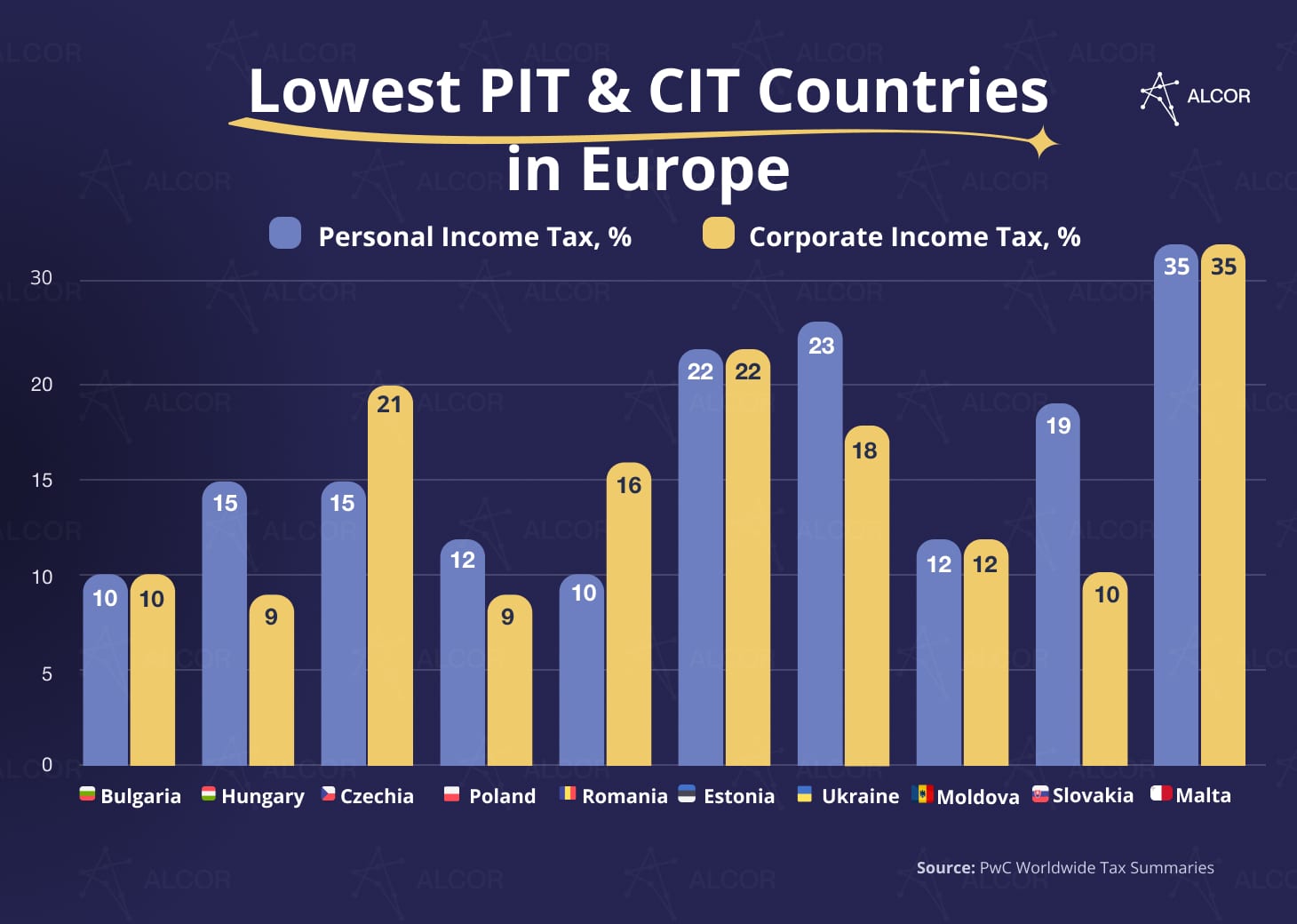
Looking to expand into one of Europe’s low-tax markets? Explore how PEO services in Europe can simplify hiring and compliance.
What about other popular IT destinations?
Beyond the 10 countries above, five more European markets stand out for IT talent and tax efficiency.
- Portugal boasts 230K tech experts, sixth in Europe for English proficiency, and a corporate tax rate that eased to 19% for 2026.
- Lithuania offers over 70K tech specialists alongside a 17% corporate rate, up from 16%.
- Latvia’s 50,000-strong talent pool pairs with a system that taxes only distributed profits, plus a new 15% CIT option for individually owned companies.
- Moldova combines a flat 12% rate with a 20K-strong talent pool and an even lower 7% rate under its IT Park regime.
- Slovakia rounds things out with an 81K tech talent pool and a tiered corporate tax running from 10% to 24%.
Portugal
Portugal has 230K tech experts and a flexible tax system based on a company’s profits. According to the EF English Proficiency Index 2025, Portugal ranks 6th globally for English proficiency, with Lisbon tying for the top score among capital cities worldwide. Per the European Commission’s 2026 Digital Decade country report for Portugal, ICT specialists accounted for 5.4% of total employment in 2026, above the EU average of 5.0% – a sign that the talent pool is deepening rather than merely holding steady. Portugal’s IT services market is expected to grow to €16.6 billion (~$19.6 billion) by 2028.
According to our legal experts’ research, Portugal’s standard corporate tax rate eased to 19% for 2026, continuing a multi-year glide down from 21% in 2024 and 20% in 2025. The government has locked in a further reduction to 17% by 2028.
On the personal side, according to PwC’s Worldwide Tax Summaries, Portuguese tax residents pay progressive income tax ranging from 12.5% to 48% on worldwide income in 2026, while non-residents are taxed at a flat 25% on Portuguese-source income. High earners face an additional solidarity surcharge on top of that: 2.5% on taxable income above €80,000 (~$94,640), rising to 5% on taxable income above €250,000 (~$295,750). Employee social security contributions run at 11% on the individual side, per PwC’s Portugal individual tax summary, against 23.75% on the employer side.
Lithuania
Lithuania boasts over 70K employed tech specialists, but they are still not enough to grow the industry. Most top-tier experts are employed abroad and are open to relocation. However, the taxes here are lower than average. According to PwC’s Worldwide Tax Summaries for Lithuania, the standard corporate tax rate rose from 16% to 17% effective 1 January 2026, while the reduced rate for small companies increased from 6% to 7% over the same period. Newly registered companies with revenue under €300,000 can still apply a 0% rate for their first two tax periods.
Per PwC’s Lithuania individual tax summary, employment income remains taxed at 20% up to €126,532 per calendar year (the 2025 threshold, still the current reference point), and at 32% on the portion above that.
Latvia
The talent pool in Latvia is 50,000 – one of the smallest in Eastern Europe. Per the European Commission’s 2025 European Innovation Scoreboard country profile for Latvia, ICT specialist employment reached 97.4% of the EU average in 2025, with cloud computing adoption at 75.2% of the EU average – both showing long-term improvement since 2018, backed by targeted investment under Latvia’s national recovery plan. According to the European Commission’s Digital Decade 2025 report on Latvia, ICT specialists accounted for 4.9% of total employment in 2024, just under the EU average of 5% and up from 4.4%.
According to PwC’s Latvia corporate tax summary, Latvia only taxes distributed profits – retained earnings stay tax-free – at a nominal 20% CIT rate. However, the taxable base is first divided by a 0.8 coefficient, pushing the real effective rate to 25%. Starting in 2026, companies owned entirely by individuals can opt into an alternative regime: dividends are divided by a 0.85 coefficient, taxed at 15% CIT, with a further 6% PIT withheld from the amount actually paid to the shareholder.
Per PwC’s Latvia individual tax summary, personal income tax on salaries runs 25.5% up to €105,300 (~$123,849) annually, and 33% above that threshold, with a further 3% surtax on any individual’s total annual income above €200,000.
Moldova
Moldova has a pool of over 20K tech professionals, with 4,000 engineering graduates annually, according to Startup Moldova. Per Invest Moldova’s IT sector overview, 4.4% of the country’s workforce is already employed in ICT – the second-highest ratio in emerging Europe after Estonia. Based on English proficiency, Moldova ranks 39th, above the global average in the EF English Proficiency Index 2025.
On taxes, according to PwC’s Moldova corporate tax summary and PwC’s Moldova individual tax summary, both corporate and personal income tax are flat at 12% for 2026. Moldova’s real edge for tech companies, though, sits in the MITP regime itself: residents pay a flat 7% single tax on turnover that covers most other obligations, locked in until 2035, and employees at certified IT Park companies pay 0% personal income tax under a matching exemption running through the same date.
Slovakia
Slovakia boasts an 81K-strong tech talent pool, though it has a smaller raw headcount than its Eastern European neighbors. According to data on Slovakia’s IT industry compiled by Košice IT Valley, the IT sector accounts for 4.6% of all jobs nationally, with ICT sector revenue reaching €2.6 billion (~$3.08 billion) in Q2 2025 alone. Slovak coders speak English well, too, ranking 10th globally according to the EF English Proficiency Index 2025.
On taxes, according to PwC’s Slovak Republic corporate tax summary, corporate income tax is tiered from 10% to 24% depending on company size and revenue. Per PwC’s Slovak Republic individual tax summary, personal income tax starts at 19% – still one of the lower entry rates in the region – but 2026 brought new upper brackets: 25% applies above a reduced threshold, with two additional tiers of 30% and 35% now kicking in at higher income levels, a real change from the flatter two-rate system that applied through 2025.
| Country | Corporate Tax, % | Personal Income Tax, % | Social Security Taxes, % |
| Portugal | 19 (standard rate for 2026, down from 20% in 2025); 15% on the first €50,000 (~$59,150) for qualifying SMEs | 12.5–48 | 34.75 (11 – employee, 23.75 – employer) |
| Lithuania | 17 (up from 16% as of 1 January 2026); 0% for new companies in their first 2 years, or 7% (up from 6%) for qualifying small companies | 20 (income up to ~€82,962/year (~$98,144 )); 25 (~€82,962–€138,270/year (~$98,144–$163,545)); 32 (above ~€138,270/year (~$163,545)) – restructured into three tiers effective 2026 | 21.27 (19.5 – employee; 1.45–2.17 – employer) |
| Latvia | 20 nominal on distributed profits, but the taxable base is divided by a 0.8 coefficient first, making the effective rate 25; from 2026, companies owned solely by individuals can opt for 15% CIT (0.85 coefficient) + 6% PIT on the dividend instead | 25.5 (income up to €105,300/year (~$124,590)); 33 (income over €105,300/year (~$124,590)); plus a 3% surtax on total annual income above €200,000 (~$236,600) | 34.09 (23.59 – employer; 10.50 – employee) |
| Moldova | 12 | 12 | 33 (24 – employer; 9 – employee) |
| Slovakia | 10 (income up to €100,000 (~$117,459) in the tax period); 21 (€100,000 (~$117,459) to €5 million (~$5,8 million)); 24 (over €5 million (~$5,8 million)) | 19 base rate; from 2026, three additional tiers apply above reduced thresholds: 25%, 30%, and 35% for higher earners | ~50.6 (~36.2 – employer; ~14.4 – employee) |
|
All figures reflect the latest data available as of 2026. |
|||
Bulgaria
Bulgaria remains a top pick for its 10% flat rate on both corporate and personal income, one of the lowest combined rates in the EU, according to PwC. Its tech talent pool has grown to roughly 126,100 professionals, with the highest rate of ICT specialist employment in the EU at 76.3%, per Eurostat. Bulgaria’s euro adoption in 2026 also removes payroll FX exposure entirely. The main tradeoff is administrative: fulfilling tax and social security obligations still runs into hundreds of hours annually, and INSAIT’s AI research partnership with ETH Zurich and EPFL signals deepening AI talent investment beyond standard software delivery.
Market overview
Bulgaria is a fresh and promising player in the IT industry, and it has already become a popular choice for Eastern European software development. Bulgaria’s ICT market size is expected to rise to approximately $8.77 billion in 2026, according to Mordor Intelligence.
Per Alcor’s own 2026 market research, Bulgaria’s tech talent pool stands at roughly 126,100 professionals, and the country recorded the highest rate of ICT specialist employment within the EU’s Information and Communication sector in 2025, at 76.3%, according to Eurostat. The country’s AI research credibility is anchored by INSAIT, an AI research institute founded in Sofia in 2022 in direct partnership with ETH Zurich and EPFL – the first institute of its kind in Eastern Europe, and a signal that Bulgaria is investing in deep AI talent development, not just software delivery.
Taxes
Bulgaria tops our list as the country with one of the lowest tax rates in Europe. According to PwC’s Bulgaria corporate tax summary andPwC’s Bulgaria individual tax summary, the country’s 10% flat rate of both personal income and corporate income taxes is among the lowest in the European Union.
Per PwC’s Worldwide Tax Summaries for Bulgaria, the social security tax rate is 24.7–25.4% of the employee’s gross salary, split approximately 3:2 between employer and employee, making it a European country with very low taxes. As of 1 January 2026, Bulgaria also adopted the euro, replacing the Bulgarian lev – a currency shift for payroll and tax filings, not a change to the underlying tax burden, per Alcor’s legal team, which has been tracking the transition for clients running payroll in the market.
Benefits of starting a business in Bulgaria
Besides taking off the significant tax burden, Bulgaria has much more to offer. The country has a favorable climate for tech companies and is placed 37th out of 139 in the Global Innovation Index 2025. Bulgaria’s euro adoption also removes FX exposure from payroll entirely, and, combined with Schengen membership and EU regulatory alignment, it provides an operationally frictionless hiring environment for US- and EU-headquartered companies.
Risks of starting a business in Bulgaria
One of the main drawbacks of starting a local company and hiring Bulgarian developers is the significant time required to meet their tax obligations. In fact, paying social security contributions and VAT in Bulgaria remains time-consuming – it took companies up to 500 hours in 2012, up to 441 in 2019. Although the country has a highly competitive fiscal policy, companies still need to put in significant effort to benefit from it.
Solutions
You may find a trusted partner specializing in operational and legal support to help with staff augmentation in Bulgaria and other areas. Alcor is one of those. Not only can we hire the best software developers for you, but you can also take advantage of our lawyers and accounting team to help with payroll and contracts.
For the full country-by-country legal and cost breakdown behind this article – labor law, real employer costs, and IP ownership across all eight of Alcor’s LATAM and Eastern Europe markets – our 2026 Guide to Building Your AI & Product Engineering Team in Latin America & Eastern Europe covers it in depth.
Hungary
Hungary is a strong tax haven pick, with a 9% corporate tax rate and a 15% flat personal income tax applying regardless of income level, according to PwC. Its 253K-strong specialist talent pool ranked second in Eastern Europe in Coursera’s Global Skills report, and English proficiency has climbed to a 590 score, placing it in the “High” band per the EF EPI 2025 – up from the older #17-out-of-113 ranking. The main constraint remains talent concentration: most developers are still based in Budapest, and companies should expect the usual operational hurdles around legal compliance and payroll taxes in an unfamiliar market.
Market overview
Hungary is another attractive player among the best tax havens of the biggest tech hubs in Europe. With a 253K specialist talent pool, Hungarian software developers took second place in Eastern Europe in the latest Coursera Global Skills report, scoring 77% in technology and 69% in data science. According to the U.S. Commercial Guide’s 2025 ICT sector overview for Hungary, the country’s ICT market size is estimated at $32–35 billion in 2025, with the sector contributing around 6–7% of Hungary’s GDP through telecommunications, IT services, and software development.
Taxes
According to PwC’s Hungary individual tax summary, the country’s 15% personal income tax rate is among the lowest in Europe and applies to all income earners, regardless of income level. PwC’s Hungary corporate tax summary states that the CIT rate is 9%. Per PwC, the social security tax is 31.5%, with the employer’s share at 13% and the employee’s share at 18.5%.
Benefits of starting a business in Hungary
Besides the tax system, Hungary is well-equipped to offer you well-educated programmers, as more than 70 higher education institutions prepare approximately 2,700 ICT and 12,000 STEM students annually. According to the EF English Proficiency Index 2025, Hungary now has an English proficiency score of 590, placing it in the “High” band, so it won’t be a problem for Hungarian software developers to communicate with native speakers.
Risks of starting a business in Hungary
The major pitfall of choosing Hungary as a location for hiring offshore developers or team augmentation in Eastern Europe is the scarcity of tech talent compared to other countries in the region. In fact, most software developers are based in Budapest, so the tech ecosystem across the country is less developed. Additionally, you are likely to face operational challenges related to legal compliance, local taxes (including payroll taxes), and other areas. Just like it would be in any foreign country you discover for your business.
Solutions
Not to miss a chance of starting a software R&D office in one of the best tax havens in Europe, you can turn to a reliable all-in-one place company that will guide you through an unfamiliar environment, helping to choose between IT staff augmentation vs IT outsourcing models, prevent unpredictable expenses, and ensure a smooth workflow.
Czech Republic
The Czech Republic offers a flat 21% corporate income tax, with personal income taxed at 15% up to CZK 1,762,812 and 23% above that for 2026, according to PwC. Its 226K-strong developer talent pool ranks #3 regionally in Coursera’s Global Skills report, and the ICT market is valued at $22.5 billion in 2025, growing toward $33.91 billion by 2031 per Mordor Intelligence. Prague still ranks among the top cities globally for remote work, per WorkMotion. The main constraint remains English proficiency, now 23rd in Europe per the EF EPI 2025 – up slightly from the earlier #25 ranking, but still worth planning around.
Market overview
The Czech Republic is not as well-known or loud when it comes to outsourcing tech specialists, but it has a couple of options to offer. For example, a solid talent pool of 226K software developers who have earned worldwide respect for their skills in coding in C++, C#, Java, PHP, C, Python, Ruby on Rails, and Swift. Thus, they are ranked #3 regionally for their tech expertise, per the Coursera Global Skills report. According to Mordor Intelligence, the country’s ICT market was valued at $22.5 billion in 2025 and is projected to grow to $33.91 billion by 2031, at a compound annual growth rate of 7.08% – driven in part by EU recovery funds, accelerating 5G rollout, and a startup scene that positions Prague as a digital gateway to Central Europe. This growth presents an excellent opportunity for businesses seeking high-quality generative AI development services, Java development solutions, and other innovative tech solutions in a competitive landscape.
Taxes
The Czech Republic is famous for Wolfgang Amadeus Mozart, medieval castles, and some of the lowest tax in Europe. The taxation system in the Czech Republic implies a flat corporate income tax of 21%, according to PwC’s Czech Republic corporate tax summary. Per PwC’s Czech Republic individual tax summary, annual income up to CZK 1,762,812 (~$81,700) is subject to a 15% personal income tax rate for 2026. It’s a threshold that’s recalculated each year as 36 times the average monthly wage, so it’s worth double-checking against the current year rather than treating it as fixed. Income exceeding this amount is subject to a higher rate of 23%. According to PwC’s Czech Republic individual tax summary on other taxes, the employer contributes 9% of the employee’s gross salary to state health insurance funds and 24.8% to state social security funds. In turn, an employee contributes 11.6% of their gross income (contribution rates for social security and health insurance are 7.1% and 4.5%, respectively).
Benefits of starting a business in the Czech Republic
What can attract you to the Czech Republic besides being among the most tax friendly countries in Europe? The capital city, Prague, is ranked 4th among the top cities in the world for online work, according to WorkMotion. It means that jurisdiction, digital communication options, living expenses, and business regulations all contribute to enhancing the effectiveness of remote work.
Risk of starting a business in the Czech Republic
One thing to note about developers in the Czech Republic is that they are not as keen on learning English as their Central and Eastern European neighbors. According to the EF English Proficiency Index 2025, the country ranks 23rd among 37 European countries in English proficiency.
Solution
There are a couple of approaches you can try, such as offering English language courses and establishing speaking clubs with native speakers, but be prepared to invest a substantial amount of time to achieve the desired outcome.
Learn about Build Transfer Operate in Europe and nearshore outsourcing to LATAM to choose the best model for starting a business abroad!
Poland
Poland is Europe’s largest engineering talent hub, with a tech pool of 778,800 professionals and a 19% corporate tax rate, reducible to 9% for small taxpayers, according to PwC. It ranks #1 in Europe and #4 globally for Tier 2 AI talent concentration, per Interface, backed by a €235 million (~$278 million) national AI Fund. Poland also ranks #3 in Eastern Europe and #15 globally on the EF English Proficiency Index. The main tradeoff is competition: with 100K tech businesses chasing the same senior talent, per PARP, strong employer branding and local recruiting expertise matter more here than anywhere else in the region.
Market overview
Poland is a true treasure on the European map for building engineering teams and is also representative of low tax countries in Europe. Per Alcor’s 2026 research, Poland’s tech talent pool stands at 778,800 professionals – the largest in Eastern Europe. Software development outsourcing in Poland is projected to grow by 10.02% between 2026 and 2031, reaching a market volume of $34.75 billion over the five-year period, according to Mordor Intelligence.
According to Interface, Poland ranks #1 in Europe and #4 globally for concentration of Tier 2 AI talent, the advanced researchers and engineers building deep learning models and neural architectures rather than general software roles. Poland’s government has also put real capital behind this: a national AI Fund of approximately €235 million (~$278 million) was created in November 2024, and startups get free access to national AI compute infrastructure through the PIAST-AI and Gaia programs – a direct cost reduction for any company building AI-heavy products in the market.
Taxes
According to PwC, Poland offers a 19% corporate tax rate that can be reduced to 9% for small taxpayers, while personal income tax is 12% for annual income that doesn’t exceed PLN 120,000 (~$33,369), and 32% + PLN 10,800 (~$3,003) applies to the portion of income above PLN 120,000. Additionally, a solidarity surcharge of 4% applies to the portion of income exceeding PLN 1 million (~$278,073) per year. Per PwC’s Poland individual tax summary, the social security tax ranges from 32.92% to 36.12%, with the employer’s share varying from 19.21% to 22.41% and employees contributing an additional 13.71% on top of that. The 2026 contribution cap on which this is calculated rose to PLN 282,600 (~$78,587), per the same PwC summary.
Benefits of starting a business in Poland
There are numerous benefits to IT recruitment in Poland, from elite technical skills to a strong work ethic. The country ranks 1st in Eastern Europe in the TopCoder ranking. Poland also ranks #3 in Eastern Europe and #15 globally on the EF English Proficiency Index, with an IT sector score of 621, enabling full participation in technical documentation, code reviews, and real-time product discussions without meaningful language gaps. At the same time, the salaries of Polish developers are half those of US-based tech specialists. It is no surprise that Poland attracts both tech giants and tech unicorns.
Risks of starting a business in Poland
Considering that the number of tech businesses in Poland now amounts to 100K, according to PARP, it might be challenging to hire Polish senior, lead, and C-level developers without local professional recruiters. Why? As all these businesses actively compete to recruit top-tier talent and consider nearshoring/offshoring to Poland, they intensify the competition in the Polish tech hiring sector. Our tech recruitment experts state that Poland’s talent pool is in fact the most competed-for in Eastern Europe – senior AI engineers regularly receive outreach from Western European and US remote employers offering significant salary premiums, making competitive offers and strong employer branding more important here than in any other Eastern European market. Additionally, US tech product companies often worry about time zone differences when managing cross-border teams.
See how to hire developers in Europe within 2-6 weeks.
Solutions
That’s where partnering with a specialized local recruiting expert like Alcor makes the difference. Our team knows how to cut through the noise and secure the top 10% of tech talent, building teams of 30+ developers in just three months.
Additionally, Polish developers working for US tech product companies typically adjust their schedules and usually sync up in the afternoon, making it possible to conduct calls and stay in touch. What’s more, offshore developers ensure round-the-clock software development – so your business never stops!
Sift, a US-based AI platform for online fraud detection trusted by over 700 global brands, turned to Alcor to establish its R&D branch with 20 software developers from Eastern Europe, particularly Poland. We promptly assigned a recruiting team to deliver qualified tech recruitment services. After setting up their tech R&D office, we took over legal support and payroll management for their offshore engineering team. To improve hiring results, Alcor launched a local employer-branding campaign with Sift’s Hiring Manager, boosting offer acceptance rates by 15%.
A major benefit: Sift’s Eastern European tech team had its timetables aligned with those of its US counterparts, enabling seamless collaboration and uninterrupted, 24/7 software delivery.
The UK
The UK’s IT sector remains one of Europe’s largest, with over 1.69 million professionals and a market valued at $120.11 billion in 2026, growing toward $166.56 billion by 2031, per Mordor Intelligence. Corporate tax holds at 25%, and National Insurance costs rose meaningfully for 2026 – employers now pay 15% above a £5,000 threshold, up from 13.8%, according to PwC and HMRC. SMEs can still claim a 186% R&D deduction. The core constraint remains talent competition: 75% of UK employers report a shortage, per Experis, making strong employer branding and competitive salaries essential to winning developers here.
Market overview
The United Kingdom is mostly known as a popular location for choosing outsourcing rather than being one itself. However, the country has a very promising IT sector with more than 1.69 million software development professionals. According to Mordor Intelligence, the market is valued at $120.11 billion in 2026 and is projected to reach $166.56 billion by 2031, growing at a 6.76% compound annual rate. But one thing that particularly appeals to foreign investors is the possibility of establishing a relatively low-tax offshore company.
Taxes
According to PwC, the corporate tax in the UK increased from 19% to 25% starting April 2023 and holds at that rate for 2026, while personal income tax bands stayed the same:
- For annual earnings between £12,571 (~$17,127) and £50,270 (~$68,491), you will be charged a basic rate of 20%;
- For annual earnings between £50,271 (~$68,495) and £125,140 (~$170,507), a higher rate of 40% will apply;
- For annual earnings of £125,140 (~$170,507) or more, a high tax rate of 45% will apply.
According to PwC’s UK individual tax summary and confirmed by HMRC’s official rates and thresholds for employers, National Insurance runs differently than it used to: employees pay 8% of annual earnings between £12,570 and £50,270, and 2% above that. Employers now pay 15% on earnings above a £5,000 threshold – a real increase from the 13.8% rate that applied above £9,100 before the October 2024 Budget changes took effect, and one that meaningfully raises the cost of hiring in the UK for 2026.
Benefits of starting a business in the UK
UK tech companies that invest in innovation can greatly benefit from research and development (R&D) relief. In particular, small and medium-sized enterprises (SMEs) that meet certain criteria established by local law can receive an additional 186% deduction on R&D investments, in addition to the normal deductions, according to the UK government website.
Risks of starting a business in the UK
The United Kingdom is a top player in the global tech industry. In fact, its sector is in a leading position compared with the largest representatives in Western Europe. This eventually results in high competition for tech talent, which is already extreme in the UK, where 75% of employers report a shortage, according to Experis’ research.
Solutions
Need the best developers? Then offer better conditions, invest in the working environment and education, offer high salaries, and develop your employer brand. Also, go beyond traditional hiring methods by offering unique referral programs, internships focused on employment, or partnerships with tech recruitment professionals. If you don’t have a sufficient budget for that, take a look at cheaper European destinations.
Wondering about nearshoring software development to Eastern Europe and IT recruitment in Europe? Contact us for more details!
Romania
Romania is a strong value pick with a 16% corporate tax rate and 10% personal income tax among the lowest in Europe, according to PwC. Its 207K-strong talent pool spans Bucharest, Cluj-Napoca, and Iași, and Bucharest’s selection as one of six EuroHPC AI Factory sites signals real credibility in AI infrastructure. Note: the previously cited 10% programmer tax exemption no longer applies – it has been replaced by a restructured 2026 microenterprise regime. The main constraint is senior AI talent: lead-level specialists require longer, headhunting-driven pipelines rather than inbound sourcing, and salaries rose roughly 14% in 2025 per Romania Insider.
Market overview
Romania is a flourishing Eastern European tech destination for innovative companies. Despite its relatively small population, its software developer database includes 207K specialists. It’s spread across three cost-tiered hubs: Bucharest, Cluj-Napoca, and Iași. The market’s AI credibility is deepening fast: according to EuroHPC, Bucharest was selected as one of only six EuroHPC AI Factory sites across 16 EU member states, backed by €500 million (~$591.5 million) in public compute funding, putting Romania in the same infrastructure tier as Poland for sovereign AI compute.
Taxes
Maybe Romania is not a representative of tax free European countries, but it definitely deserves to be on the list of tax havens in Europe due to a few incentives that make its tax system stand out. The standard corporate income tax is 16%, according to PwC. When it comes to personal income tax, its rate is 10%, making it one of the lowest income taxes in Europe. In addition, tech companies in Romania must make social security contributions, which amount to 35%, where the employer’s part is 2.25%, per PwC’s Romania individual tax summary – our legal team notes this is the labor insurance contribution (CAM) specifically, and sits alongside separate pension contribution rules that vary by working conditions. According to PwC’s significant developments summary for Romania, the microenterprise regime was also restructured for 2026: qualifying companies now pay a flat 1% on turnover, down from a two-tier 1%/3% system, but the eligibility ceiling was cut from €250,000 (~$295,750) to €100,000 (~$118,300) in annual revenue, and dividend tax rose from 10% to 16% over the same period.
Benefits of starting a business in Romania
According to our legal experts, Romania still offers real tax advantages for companies building here, including a 50% deduction on eligible R&D expenses and accelerated depreciation on R&D equipment, with companies operating exclusively in R&D exempt from profit tax for their first 10 years. Developers in Romania also rank #11 in Europe on the EF English Proficiency Index 2025, which is sufficient for full participation in technical documentation, architectural discussions, and real-time product planning without meaningful language gaps.
Risks of starting a business in Romania
One drawback of outsourcing to Romania is the pace of IT industry growth, alongside a steady increase in software developers’ salary rates –Romania Insider’s 2025 analysis of the local job market found IT salaries rose roughly 14% that year, among the sharpest increases across all industries tracked. Also, per Alcor’s 2026 research, senior AI specialist availability – particularly at the lead level – requires longer pipeline timelines, with active headhunting needed rather than inbound sourcing for AI-specific roles. In a few years, the job market will likely become overheated, and the country is expected to adjust its price tags to align with those of its Western European competitors.
Solutions
The optimal approach in this situation would be to nearshore to Romania without delay. This is because current market conditions are favorable, with a sizable pool of skilled technology professionals available at reasonable cost. Furthermore, competition in the industry is relatively low, making it easier to recruit top-quality programmers or, even better, launch your own Global Capability Center setup.
Cyprus
Cyprus raised its corporate tax rate from 12.5% to 15% as of 2026, aligning with OECD minimum tax rules, according to PwC. The personal tax-free threshold also rose to €22,000 (~$26,027), with new bands up to 35%. Social contributions run higher than the headline 17.6% suggests – once the General Healthcare System levy is included, the real combined rate is closer to 23.3%. ICT specialist employment sits at just 4.9% of total employment, per Cyprus Mail, below the EU average. The main trade-offs remain a small talent pool and a demanding company-formation process, though the corporate rate still undercuts the US.
Market overview
With a population of 1.2 million, Cyprus can’t surprise you with a large tech talent pool. According to Cyprus Mail, ICT specialists made up just 4.9% of total employment in Cyprus in 2025, down slightly from 5% the year before – below the EU average and a sign the local talent pool isn’t growing as fast as demand for it. Even so, the country remains one of the more tax-favorable jurisdictions in Europe – though that edge narrowed in 2026. You just have to remember that there are no 100% tax free countries in Europe.
Taxes
Cyprus raised its standard corporate tax rate from 12.5% to 15% as of 1 January 2026, according to PwC’s Cyprus corporate tax summary, a change driven by alignment with the OECD’s global minimum tax framework. Non-resident companies retain special tax treatment and remain exempt from tax on income arising outside Cyprus. Per PwC’s Cyprus individual tax summary, the 2026 reform also reworked personal income tax: the tax-free threshold rose from €19,500 (~$23,068) to €22,000 (~$26,027), with new bands of 20% (€22,001–32,000 (~$26,027–$37,857)), 25% (€32,001–42,000 (~$37,861–$49,701)), 30% (€42,001–72,000 (~$49,705–$85,203)), and 35% above €72,000 (~$85,203). According to PwC’s Cyprus individual tax summary on other taxes, social insurance contributions stand at 8.8% each for employer and employee – but that’s not the whole employer cost: a further 2.65% each side goes to the General Healthcare System (GHS), bringing the real combined employer-plus-employee social contribution closer to 23.3% rather than 17.6%.
Benefits of starting a business in Cyprus
Cyprus is mostly known for its minimal taxation, comfortable business environment, and pleasant climate. Even after the 2026 rate increase, the corporate rate still undercuts the US. If these three conditions fully satisfy you and the absence of a bigger pool of qualified developers doesn’t bother you, then this destination is a perfect fit.
Risks of starting a business in Cyprus
Firstly, the bureaucratic system in Cyprus is quite tough, requiring weeks of procedures, extensive paperwork, and multiple approvals to establish a company. Add to that the lack of tech specialists, which makes it very difficult to create a tech team, and these things turn many companies off. Companies should also budget time for adjusting to the post-2026 reporting framework, since several compliance rules changed alongside the rate increase.
Solutions
Take a look at European countries with larger talent pools and consider offering relocation options for your tech team members. In case you decide to build a team in Cyprus, find reliable lawyers who will be knowledgeable about the local legal system and preferably have respectable experience in establishing a tax guide for tech companies on the island.
Estonia
Estonia remains Europe’s top-ranked tax-friendly market, topping the Tax Foundation’s International Tax Competitiveness Index for 12 consecutive years. Corporate and personal income tax both stand at 22%, according to PwC, though the corporate system only taxes distributed profits – retained earnings stay untaxed indefinitely. ICT specialists now make up 6.8% of total employment, above the EU average, per the European Commission. Two 2026 changes matter: a flat €700/month (~$828) tax-free allowance replaced the old sliding scale. The main constraint remains talent pool size relative to growing demand.
Market overview
Estonia is the leading Baltic territory in tech. According to the European Commission’s Digital Skills and Jobs Platform, ICT specialists made up 6.8% of total employment in Estonia in 2025, above the EU average of 5.0%. At the same time, the Estonian Startup Database documented 1,554 startups, of which 12 are unicorns (Dealroom).
Taxes
You might be surprised that Estonia has topped the Tax Foundation’s International Tax Competitiveness Index for 12 consecutive years, making it one of the most tax-friendly countries, according to the 2025 edition of the report. According to PwC, corporate and personal income taxes in Estonia are 22%, although I would admit that their social security tax is pretty high. The employer is charged a rate of 33%, which includes 20% for public pension insurance and 13% for public health insurance. Employers are required to contribute 0.8% toward unemployment insurance, while employees pay 1.6%, with the difference dedicated solely to unemployment coverage. Additionally, if an employee has joined the funded pension system, a 2% contribution is withheld from their gross salary and allocated to their pension account. Worth flagging for 2026: the tax-free personal allowance is now a flat €700/month (~$828) regardless of income, replacing the old system where it shrank as income rose.
Benefits of starting a business in Estonia
The best part about the Estonian tax system is that the corporate income tax system in Estonia allows companies to reinvest their profits in a non-taxable way. In contrast, corporate income tax is applied only to distributed profits. Therefore, Estonia does not impose any corporate income tax on profits that are reinvested and retained by the company.
Risks of starting a business in Estonia
Despite comfortable tax planning, the relatively small talent pool may make it difficult to start an offshore dev center in Estonia, and because of this, the demand for technical talent, including software developers, consultants, and ICT engineers, is constantly increasing.
Solutions
One thing you should do is build a strong employer brand for your tech product company in the local job market, as this will draw more attention to your company within the tech community, attract developers, and help you stand out from the competition.
That’s exactly what Alcor did for Tonic Health, a US patient intake and contactless check-in platform serving large enterprise health systems. By building up Tonic’s employer brand, we not only streamlined their hiring process but also made the company stand out among local engineers, resulting in zero offer rejections. What started with senior PHP developers quickly expanded to top DevOps, FrontEnd, Security Engineers, and QA Leads, all eager to join a brand they recognized and trusted.
Ukraine
Ukraine is Eastern Europe’s second-largest tech talent pool, with 302,000+ professionals and a flat 18% corporate tax rate, according to PwC. Personal income is taxed at 18% plus a 5% military tax (23% total), confirmed for 2026 under Law No. 15110. The Diia.City regime offers some of Europe’s lowest effective tax rates alongside flexible engagement models. Despite the war, resilience holds: the IT market reached $7.85 billion in 2025, AI/ML talent grew by 17% in a year, per AI HOUSE, and 52% of tech companies retained all contracts even at the peak of the invasion, per the IT Ukraine Association.
Market overview
Ukraine stands out in Eastern Europe with 302,000+ tech professionals, 66% of whom are now based in the country’s safer northern and western regions, according to the Lviv IT Cluster. Per Ukraine’s Ministry of Digital Transformation, the country’s total IT market reached $7.85 billion in 2025, with the sector making up 41.6% of all service exports and 3.2% of GDP, while computer services exports alone hit $6.66 billion – a 3.3% increase over 2024 that marked the sector’s return to growth after two years of wartime decline.
The country now counts approximately 6,100 dedicated AI/ML specialists, a pool that grew 17% in a single year according to AI HOUSE’s 2025 market research. That growth isn’t happening at the expense of other engineering work either: defense tech, hardware, and AI are actively displacing classic web and mobile development roles, meaning talent is reallocating toward higher-value specializations rather than away from the market. More than 200 Ukrainian companies are currently producing AI-enabled drones, according to the Kyiv Independent. Ukraine launched Diia.AI in late 2025 – described as the world’s first national AI agent that delivers government services via chat, built and operated entirely by Ukrainian engineers.
Taxes
Ukraine levies a flat 18% corporate profits tax and a personal income tax of 18% plus an additional 5% military tax, bringing the total to 23%, according to PwC. Employers must also contribute to the Unified Social Contribution (USC) at a basic rate of 22% of an employee’s gross remuneration, subject to a monthly cap. Per Alcor’s legal team, the military tax’s continuation into 2026 was formally confirmed under Law No. 15110, and by law it’s set to drop to 1.5% once martial law is lifted – worth tracking if you’re modeling long-term cost.
Check out our article on offshore software development in Ukraine!
Benefits of starting a business in Ukraine
Ukraine has become one of Europe’s most business-friendly tech destinations, thanks to its special legal and tax regime, Diia.City. Tailored for tech companies, it offers some of the lowest effective tax rates in Europe, robust IP protection, and predictable regulations – all designed to help startups and global players scale with confidence. Companies can engage engineers flexibly through employment contracts, gig contracts, or B2B agreements, making it easier to match hiring models with business needs.
Risk of starting a business in Ukraine
The key risk of starting a business in Ukraine is the ongoing russian-Ukrainian war, which creates geopolitical uncertainty for foreign investors. While the tech sector has shown resilience, companies must factor in potential disruptions when planning long-term operations.
Solutions
Despite the war, it is worth noting that even in 2022, per the IT Ukraine Association, 52% of tech companies retained all of their contracts. 32% of businesses retained between 90% and 99% of their contracts, finding IT offshoring and IT nearshoring to Ukraine to be useful. The Ukrainian startup ecosystem has tripled in value since 2020, reaching over 2,600 active startups by 2024, and has celebrated the emergence of a new unicorn, Creatio, according to Digital Tiger the Market Power of Ukrainian IT research.
Malta
Malta’s headline corporate tax rate is 35%, but effective rates drop to roughly 5% under the imputation refund system, or a flat 15% under the newer FITWI election, according to PwC. A new consolidated 15% personal income tax rate also launched in 2026 for senior and specialist roles. ICT specialists now account for 5.2% of employment, according to the European Commission, though the talent pool remains concentrated in iGaming and financial services. With unemployment near 3% and foreign nationals already at 40% of primary employment, Malta works best as a complement to a deeper Eastern European talent base rather than as a primary build location.
Market overview
Malta’s tech scene is smaller and more concentrated than those of its Eastern European counterparts, heavily anchored in iGaming. According to the European Commission’s Malta 2025 Digital Decade Country Report, ICT specialists accounted for 5.2% of total employment in 2025, up from 4.7% in 2023 – progress. However, the report also notes that shortages remain and there’s room to improve gender balance in the field. The same report counts 4 unicorns and an estimated 32 edge computing nodes in the country as of 2024.
Taxes
Malta’s headline corporate tax rate is 35%. Still, according to PwC’s Malta corporate tax summary, the full imputation system allows shareholders to reclaim 6/7 of the tax paid on distributed trading profits, bringing the effective rate down to roughly 5%. Since 2025, companies can instead elect a flat 15% rate under the Final Income Tax Without Imputation (FITWI) regime, per PwC. On the personal side, that same publication confirms Malta introduced a new consolidated flat 15% personal income tax rate for 2026, aimed at senior and specialist roles, with applications accepted from 1 January 2026 through 31 December 2035. Outside that scheme, personal income tax remains progressive up to 35%, according to PwC. Per PwC’s Malta individual tax summary on other taxes, social security contributions run at 10% employer and 10% employee, capped at roughly €58 (~$69) per week.
Benefits of starting a business in Malta
Malta combines EU membership, English-language contracts, and GDPR alignment with a one-hour time overlap advantage over the UK – useful for teams that need a full working day of overlap. Per Malta Enterprise, the island has built a genuinely sophisticated ICT infrastructure over the past two decades, with a steady annual output of ICT graduates from local academic and training institutions, and a gaming and digital services sector that continues to expand year over year.
Risks of starting a business in Malta
The talent pool outside iGaming and financial services is limited. According to Jobsplus and NSO data, the labor market is close to full employment, with unemployment around 3% as of mid-2026, and foreign nationals already make up around 40% of all primary employment – meaning there’s little slack in local supply to absorb new hiring demand, and most growth depends on attracting talent from abroad.
Solutions
Malta works best as a complement to a deeper Eastern European hire base rather than a primary build location – a fit for specific compliance, gaming, or fintech-adjacent roles where the local ecosystem has real depth, rather than for volume hiring across broad technical specializations.
How Alcor Helps US Companies to Deal With Taxes and Legislation in Europe
Alcor isn’t outsourcing or a typical EOR – it’s the infrastructure layer for tech product companies and VC-backed startups building AI-native engineering teams, taking you from 0 to 30 engineers in 90 days across Poland, Romania, Ukraine, Bulgaria, and LATAM. Teams report directly into your roadmap as a true internal team, not a vendor relationship. Alcor handles the full system: recruitment, Employer of Record, payroll, tax compliance, legal documentation, and operational support, with 15% of roles closed on the first CV. Dotmatics used this model to close 24 technical vacancies in 1.5 years, an engineering team that stayed intact through its $5.1 billion Siemens acquisition.
Many foreign tech entrepreneurs mistakenly associate Europe with high-tax countries, such as France or Denmark. I hope that this article has revealed another side of outsourcing to this continent – flexibility and relatively low taxes compared to those in the US.
Alcor isn’t outsourcing, and it isn’t a typical EOR either. We’re the infrastructure layer for tech product companies and VC-backed startups building tech teams – senior engineers optimized for today’s AI-driven development cycle, built as your true internal team, not a vendor relationship you have to manage. We truly know how to hire a dedicated development team in Eastern Europe. Our 40 in-house tech recruiters take you from 0 to 30 engineers in 90 days across Poland, Romania, Ukraine, Bulgaria, and LATAM. The team is like your internal team – you keep full control and IP. The tech team reports directly to you and is aligned with your roadmap from day one, with no vendor layer.
You’ll get salary benchmarks, talent analytics, and blind CVs on the call. Then, we commit to hiring 5 developers within the first month, and 30+ within 3 months. 15% of vacancies are closed with the first CV. Besides, we provide Employer of Record services. For clients, it means they don’t have to worry about setting up a legal entity in the country, as we employ developers on their behalf. Then, our team manages NDAs, service-level agreements, and all the employee legal documentation. We onboard them, handle monthly payroll, pay local taxes, comply with local laws, and manage employee benefits (health insurance, education/training, PTO, etc.).
We offer full operational support to the client’s office. It includes your brand’s promotion in the local market, hardware procurement for your team, office lease, insurance assistance, background verification, legal services, visa support, and tech support.
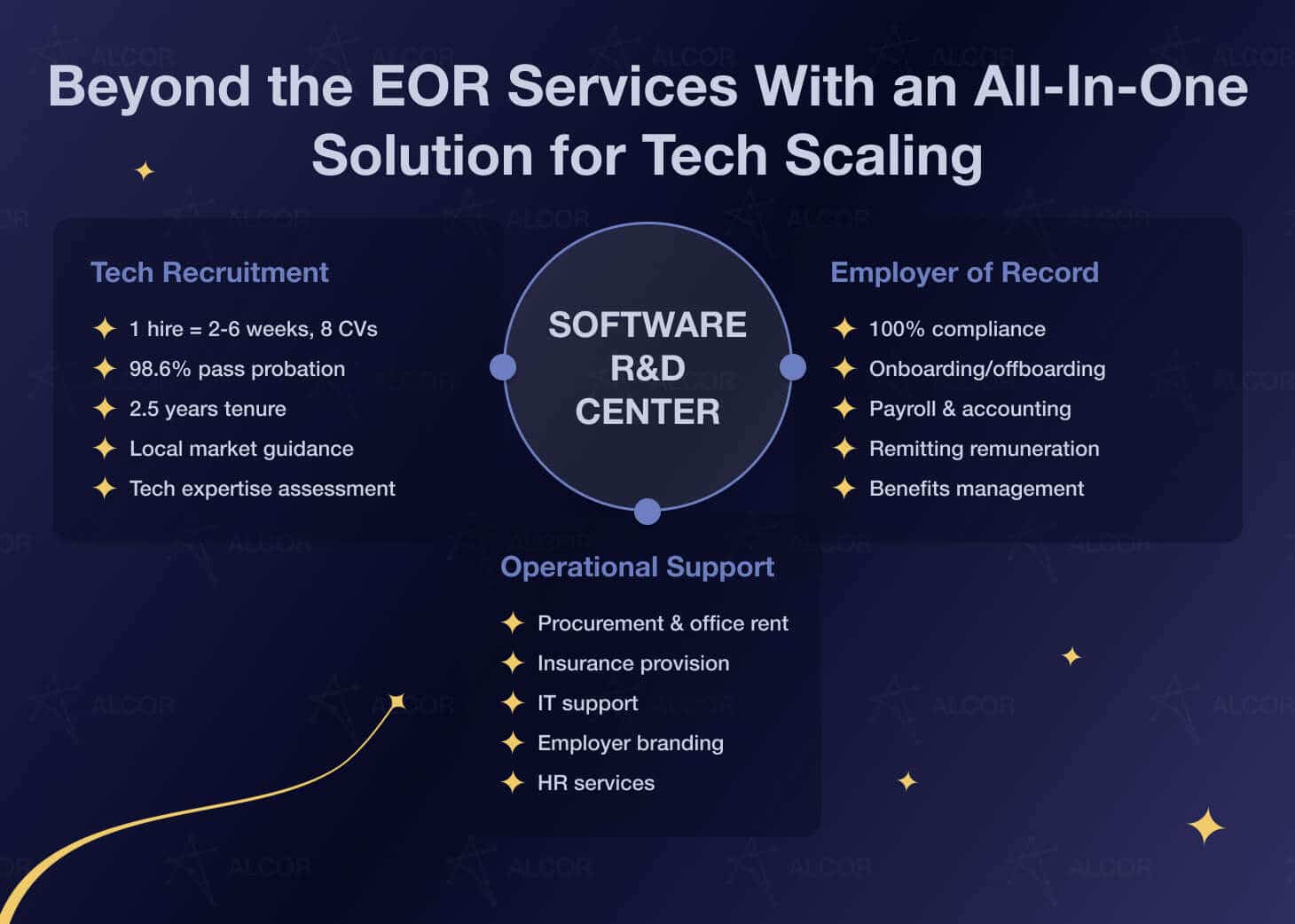
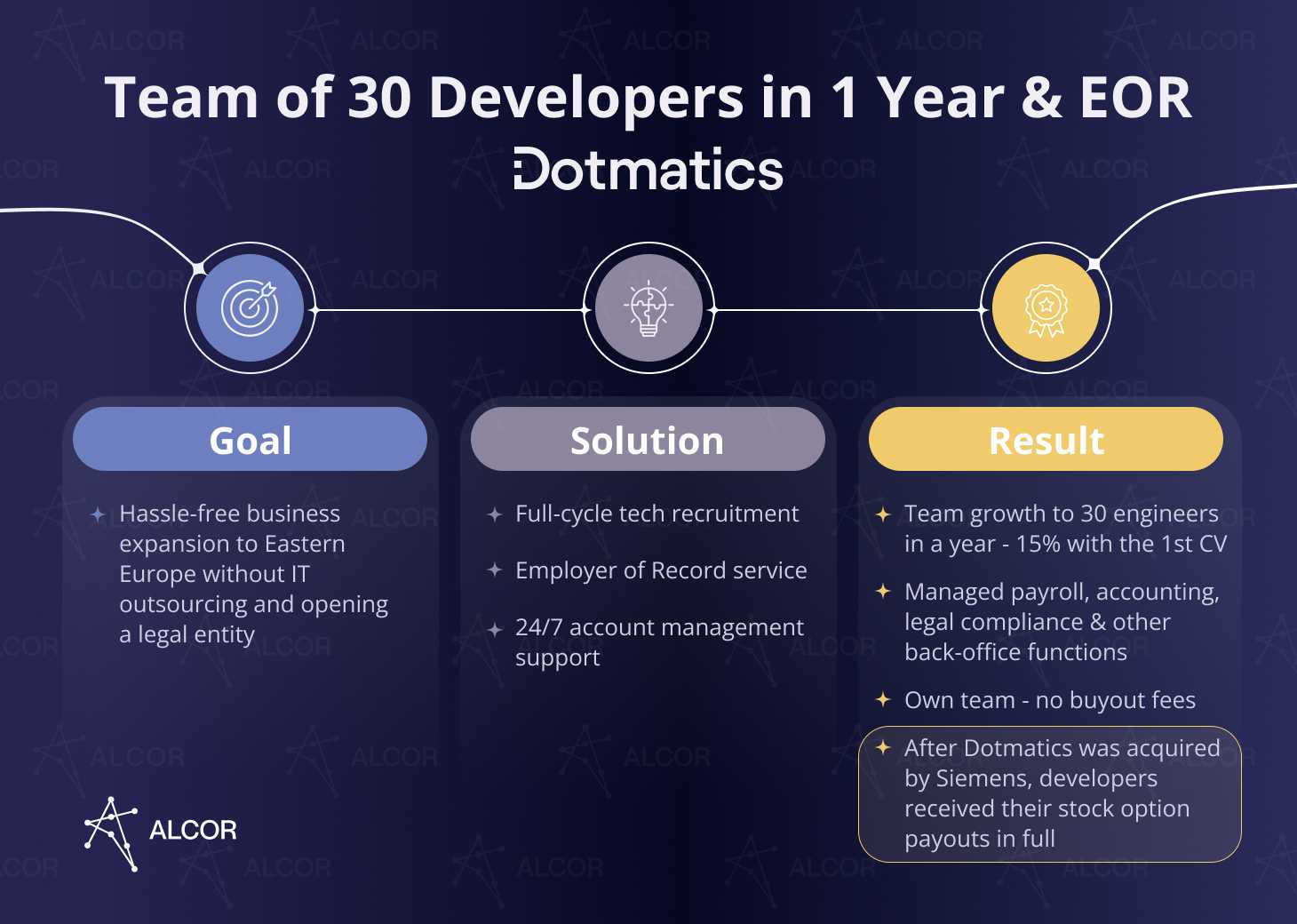
For example, one of our US-based clients, Dotmatics, chose Eastern Europe as its hiring outsourcing destination. With the help of Alcor, the tech company achieved its goal of closing 24 complex vacancies across Node.js, Java, C++, React, JavaScript, AWS, and Cypress within just 1.5 years.
Building a dedicated offshore team in Eastern Europe helped Dotmatics stay aligned with its internal business practices while reaching key milestones – culminating in a $5.1 billion acquisition by Siemens in July 2025. Importantly, Dotmatics engineers also received stock options, underscoring the real value of this benefit.
Want to get assistance from a reliable Eastern European service provider? Then don’t hesitate and drop us a line now to move one step forward toward your dream tech team!
FAQ
Which country has the lowest tax rates in Europe?
Bulgaria has the lowest overall tax rates in Europe for tech companies, applying a flat 10% rate on both corporate and personal income. Hungary’s 9% corporate rate is technically lower, but Bulgaria’s combined structure and skilled programmer talent pool make it the more balanced overall choice.
Is there a fully tax-free country in Europe?
Unfortunately, there are no countries in Europe that are completely tax-free. Jurisdictions marketed as tax havens, such as Malta and Cyprus, apply headline rates of 15-35%. Their appeal comes from refund systems, thresholds, and exemptions that lower the effective rate, not from eliminating tax.
What are tax rates in Europe compared to the US?
Europe has a very diverse tax system, from the highest-tax countries, like France and Denmark, to low-tax countries like Bulgaria, Romania, and Hungary, which makes it a good destination for US-based tech companies.
What are the EU countries with the lowest tax rates?
Hungary, Bulgaria, Cyprus, Romania, and Estonia rank among the EU’s lowest-tax countries for 2026. Hungary charges 9% corporate tax; Bulgaria a flat 10% on both corporate and personal income; Cyprus 15% corporate tax; Romania 16% corporate and 10% personal tax; and Estonia 22% with 0% on retained profits.
What are the top 5 countries in Europe with the lowest taxes in 2026?
- Bulgaria – 10% flat corporate and personal income tax;
- Hungary – 9% corporate income tax, 15% personal income tax;
- Cyprus – 15% corporate income tax, €22,000 (~$26,027) personal tax-free threshold;
- Romania – 16% corporate income tax, 10% personal income tax;
- Poland – 9% corporate tax for small taxpayers, 12% personal income tax up to PLN 120,000 (~$33,369).
Which country has the lowest corporate tax in Europe?
Hungary has the lowest standard corporate income tax rate in Europe for 2026, at 9%, followed by Bulgaria at 10%. Both apply as flat rates regardless of company size, though Poland’s 9% reduced rate for small taxpayers can undercut Bulgaria’s flat rate in specific cases.
How would you rate this article?
Alcor is Your Trusted Scaling Partner
for expansion
support