


The IT market in Poland is quietly absorbing a global problem: 72% of employers worldwide struggle to find the skilled talent they need, according to ManpowerGroup’s 2026 Global Talent Shortage Survey. Alcor’s recruitment team tracks the same trend – companies expanding their search to Poland after hitting a wall elsewhere, or accessing a broader talent pool while keeping costs in check. For tech companies whose hiring pipeline has stalled, Poland is worth a closer look.
This guide is for CTOs, engineering leaders, and founders evaluating where to build or expand their engineering team in 2026. It covers everything you need to make a confident decision about the tech market in Poland: the strongest tech hubs and what makes each one distinct, how senior developer costs compare to the US across 15 roles, how the market breaks down by segment – from AI/ML to fintech to gaming – and what a compliant, entity-free hiring model looks like in practice, with real client results.
Key Takeaways
- Technology in Poland is scaling fast: the ICT market is projected to reach $34.75B in 2026 and $56.01B by 2031 (Mordor Intelligence), supported by EU-backed digital investment, SEZ tax incentives, and major cloud and AI infrastructure commitments from Microsoft ($700M) and Amazon ($6.23B) (MarkNTel Advisors).
- The Polish tech sector is strong across several high-growth segments: Gaming, cloud, AI/ML, fintech, and Healthcare IoT are among the most active areas, with Poland ranking #1 in Europe for Tier 2 AI talent (Interface EU, 2026) and leading CEE with 383 fintech companies (Polish Fintech Map 2025).
- Poland is home to 60,000+ tech companies (Telecompaper) and a software development outsourcing segment worth about $3.8B in 2025. The broader IT services and software market is projected to grow from $8.54B in 2025 to $13.79B by 2032 (MarkNTel Advisors).
- Polish developers offer strong depth of skills and a strong fit for collaboration. Poland has 778,800 ICT professionals, ranks highly in tech and data science skills, and combines strong STEM education, high English proficiency, Western-style work ethics, and a convenient GMT+2 location.
- Polish developer salaries are 45% lower than US benchmarks on average, with savings reaching 55% for ML Engineers and 59% for Blockchain Developers, before accounting for hiring model, SSC, recruitment fees, and benefits.
- Alcor helps tech companies build a dedicated development team from Poland without legal setup. Alcor’s fully-backed software R&D R&D center solution combines top-notch tech recruitment, EOR/COR, and vital operational support, enabling you to launch a team of 30 top-tier tech specialists in Poland within 3 months – 100% compliant and without hidden costs or buy-out fees.
Polish Tech Industry in 2026-2027
Poland’s tech industry is set for strong growth in 2026–2027, with the ICT market projected to reach $34.75B in 2026 and $56.01B by 2031 (Mordor Intelligence). Momentum comes from 1,777 active startups, 12 unicorns (Dealroom), EU-backed digital investment, SEZ tax incentives, broadband, and public-sector digitization, and major cloud and AI infrastructure commitments from Microsoft and Amazon (MarkNTel Advisors). Poland’s #8 emerging-market FDI ranking (Kearney’s 2025 FDI Confidence Index) reinforces its appeal for global tech expansion and long-term engineering investment plans.
Poland’s ICT market is projected to grow to $34.75 billion in 2026 and reach $56.01 billion by 2031, at a compound annual growth rate of 10.02%, according to Mordor Intelligence. The country has become one of Europe’s most strategically important digital economies – drawing hyperscale investment, building sovereign AI infrastructure, and producing globally competitive tech companies.
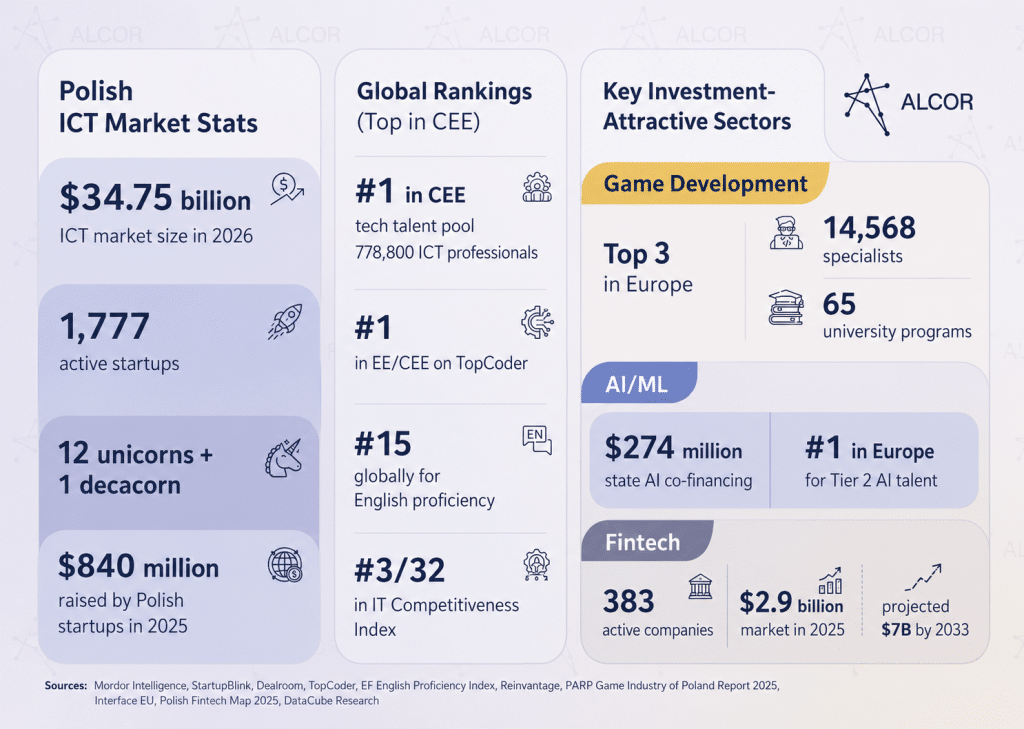
All data reflected in the infographics has been updated for 2026.
Here’s what’s fueling the rise of Poland’s tech industry:
- A maturing startup ecosystem: Poland has 1,777 active startups and 12 unicorns, according to Dealroom, with ElevenLabs now crossing into decacorn territory at an $11B valuation. According to StartupBlink’s 2026 Global Startup Ecosystem Index, Poland ranks #33 globally and #11 in robotics worldwide, with Warsaw ranked 56th globally in Gaming. A decentralized, innovation-driven network that continues to attract international investors and strengthen technology recruitment in Poland.
- EU membership and investment-friendly conditions: Poland’s European Union membership plays a major role in attracting foreign investors, backed by special economic zones (SEZs) with tax breaks and business-friendly conditions that drive ICT market growth.
- Sustained public and private investment: Poland’s Recovery and Resilience Plan allocates over $1.5 billion for high-speed broadband expansion and more than $100 million for digitizing public administration. Under the EU Digital Decade framework, over $8 billion has been directed toward Poland’s cloud infrastructure, cybersecurity, and digital skills. On the private side, Microsoft has committed approximately $700 million for cloud and AI infrastructure by 2026, while Amazon has planned a $6.23 billion expansion in logistics and cloud infrastructure across 2026–2028, according to MarkNTel Advisors.
And investors have taken notice: according to Kearney’s 2025 FDI Confidence Index, Poland ranks 8th among emerging markets globally – cited specifically for its technological and innovative potential – attracting foreign investment across Fintech, Healthtech, AI, IoT, Edtech, E-commerce, Hardware, Green Energy, and Marketing & Sales.
Polish Tech Sector Overview by Segment
Poland’s tech sector is expanding across gaming, cloud, AI/ML, fintech, and Healthcare IoT. Gaming generates €1.3B annually and includes 824 studios with 14,568 specialists (PARP Game Industry of Poland Report 2025). Cloud adoption reached 64% of enterprises (Mordor Intelligence), while Poland ranks #1 in Europe for Tier 2 AI talent (Interface EU). Fintech leads CEE with 383 companies (Polish Fintech Map 2025). Healthcare IoT is growing at a 14.91% CAGR through 2031 (Mordor Intelligence), supported by telemedicine, AI-assisted diagnostics, and cloud migration in healthcare infrastructure.
The IT industry in Poland is thriving across multiple high-growth segments, making Poland a tech hub not just a regional player but a globally competitive destination for product engineering investment. Based on Alcor’s active recruitment pipeline, fintech and AI are among the strongest areas of current client demand. Here’s what’s driving growth across each segment:
- Game development is one standout segment. According to the PARP Game Industry of Poland Report 2025, the Polish gaming industry now comprises 824 studios employing 14,568 specialists across 65 university programs, with 97% of all Polish productions sold on global markets – generating €1.3 billion in revenue annually. Poland ranks among the top three European countries in gaming workforce size, trailing only the United Kingdom and France, and Warsaw ranks among the top gaming hubs in the EU. The country is one of the few in Europe with such a strong government-university-studio collaboration model in gaming.
- In the Polish cloud technology sector, the adoption of SaaS, PaaS, and IaaS solutions continues to surge. According to Mordor Intelligence, 64% of Polish enterprises adopted cloud services in 2024, with public cloud spending growing at an 18.23% CAGR. According to GM Insights, Poland’s cloud computing market reached $10.2 billion in 2025, growing at a 16.1% CAGR – a critical driver of growth in Poland’s tech industry and a key enabler for international tech product companies scaling engineering capacity in the region.
- AI/ML development in Poland has shifted from supporting capability to leading-edge differentiation. According to Interface EU’s 2026 research, Poland ranks #1 in Europe and #4 globally for the concentration of Tier 2 AI talent – advanced researchers and engineers building deep learning models, neural architectures, and production AI systems. Demand for top AI talent is rising fast: job postings for AI/ML specialists increased 22% year-over-year as of 2025/2026, according to No Fluff Jobs data – the fastest growth of any IT specialization.
Need to turn Poland’s AI depth into hires? Alcor, an recruitment agency for AI companies, closes AI engineering roles in 2–6 weeks.
According to Alcor’s recruitment team, the strongest developer specializations within AI in Poland break down into four active areas:
- AI/ML Engineering & Data Science: Growing demand for profiles combining strong mathematical and statistical foundations with practical experience in PyTorch, TensorFlow, data pipelines, and cloud infrastructure.
- Generative AI & LLM: One of the fastest-growing areas within the AI market. The adoption of LLMs and tools such as ChatGPT, Claude, and Gemini has created demand for specialists who can design, fine-tune, and deploy generative AI solutions within real-world business processes.
- LLM Engineering & AI Agent Development: An increasingly relevant specialist profile as companies move from AI experimentation toward production use cases, including RAG-based systems and autonomous AI agents.
- AI Architecture & Infrastructure: A more niche area requiring highly specialized expertise in designing, deploying, and scaling AI systems and infrastructure at production scale.
- Poland leads CEE in the FinTech market. According to the Polish Fintech Map 2025, 383 active fintech companies now operate in Poland – a record high – with nearly 86% reporting profitability. As stated by DataCube Research, Poland’s fintech market reached $2.9 billion in 2025 and is projected to grow to $7 billion by 2033, driven by payments, financial software, enterprise finance, insurtech, and cybersecurity.
- The Healthcare IoT sector is Poland’s fastest-growing ICT vertical, advancing at a 14.91% CAGR through 2031, fueled by telemedicine expansion, AI-assisted diagnostics, and the migration of hospital imaging archives to cloud infrastructure, according to Mordor Intelligence. Private HealthTech investment accelerated in 2025: Warsaw-based Jutro Medical alone raised €36 million in Series A funding to scale its AI-first primary care model across Poland and Europe, as reported by Vestbee Insights.
Planning to scale your green-energy business in Poland? See how greentech recruitment can help you reach niche tech talent and fill open roles in 2-6 weeks.
IT Services Market in Poland
Poland’s IT services market is the largest in the CEE digital economy, supported by 60,000+ tech companies (Telecompaper). International demand continues to rise: Poland exported €14.25B in IT services in 2023, up 22.2% year-over-year, while the ICT sector is projected to reach €25.2B by 2026 (Trade.gov.pl). Software development industry in Poland grew at a 12.1% CAGR in 2020–2025 (IBISWorld), and IT services/software may reach $13.79B by 2032 (MarkNTel Advisors).
The Polish IT market is the largest digital economy in Central and Eastern Europe, built on over 60,000 tech companies, according to Telecompaper. The scale of international demand for Polish engineering expertise is reflected in export growth: in 2023, Poland exported €14.25 billion in IT services – a 22.2% increase year-on-year – with the ICT sector projected to reach €25.2 billion by 2026, according to Trade.gov.pl.
Software engineering in Poland is at the core of this growth. According to IBISWorld, Poland’s software development industry has grown at a 12.1% CAGR between 2020 and 2025, with 153,000 businesses now active in the sector. The software development outsourcing segment reached approximately $3.8 billion in 2025, with the broader Polish IT services and software market projected to grow from $8.54 billion in 2025 to $13.79 billion by 2032 at a 7.08% CAGR, according to MarkNTel Advisors.
Benefits of Hiring Polish Developers
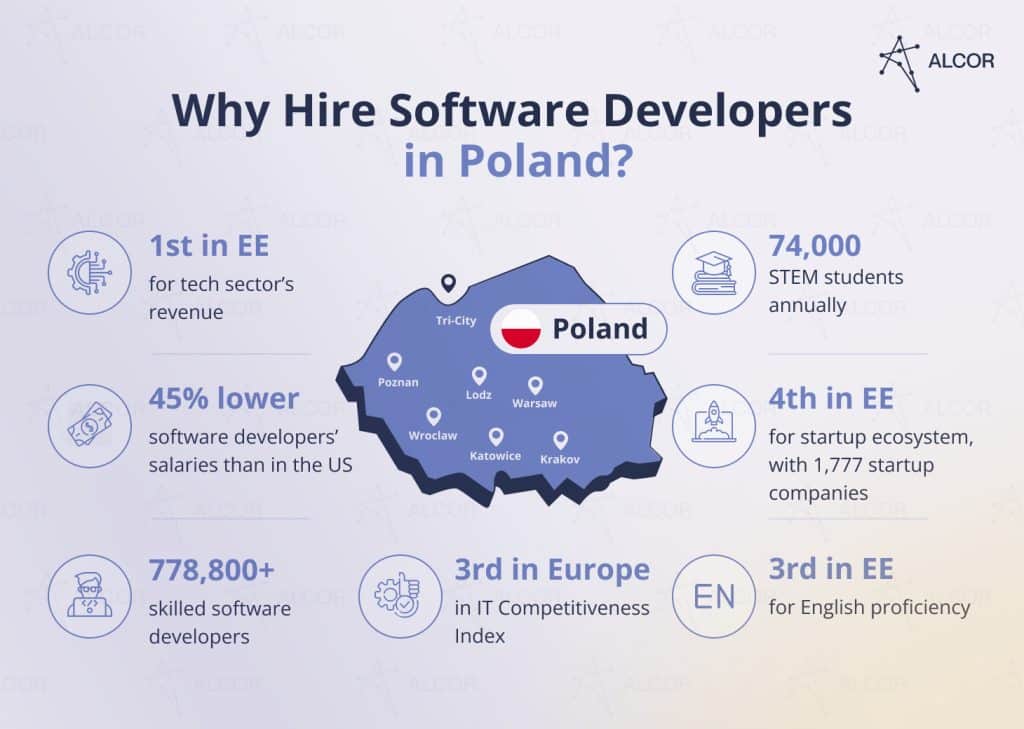
Polish developers offer tech companies a rare mix of scale, skill, and a collaborative fit. Poland has 778,800 ICT professionals (Alcor’s recruitment department research), ranks #4 in Eastern Europe for skills, #3 for data science (Coursera’s 2025 Global Skills Report), and #1 in EE/CEE on TopCoder. A strong STEM pipeline, high English proficiency, Western-style work ethic, and GMT+2 location make Poland practical for US and European teams seeking experienced engineers across backend, mobile, data, ML, cybersecurity, and product development roles.
Skilled tech talent pool
Poland’s technology hub has the largest tech talent pool in the CEE region, with 778,800 ICT professionals, according to Eurostat. As stated in Coursera’s 2025 Global Skills Report, Poland ranks #4 in Eastern Europe for overall skills and #3 for data science skills. Polish developers also place #17 globally and #1 in EE and CEE on TopCoder’s ranking. According to Reinvantage’s IT Competitiveness Index, Poland ranked #3 out of 32 countries overall, topping the Talent category outright.
The Polish tech services market spans a broad specialization environment, covering:
- Core specializations: backend development, mobile apps, game development, data science, ML, and cybersecurity.
- Widely used programming languages: JavaScript, SQL, Python, C#, TypeScript, and HTML/CSS (according to Alcor’s recruitment department’s research)
Strong STEM education
A strong academic foundation drives Poland’s tech talent pipeline: according to the QS World University Rankings 2026, 20 Polish universities are ranked, with institutions such as Warsaw University of Technology and Wrocław University of Science and Technology earning international recognition. As stated by EduRank, Poland has 68 universities offering STEM majors.
Poland produces a steady pipeline of new ICT talent each year: Alcor’s recruitment research tracks approximately 74,000 ICT/STEM graduates annually. As reported in Bulldogjob’s IT Community Survey 2025, 70.2% of Polish IT specialists hold a bachelor’s or master’s degree, with 56.4% having studied computer science specifically. Beyond traditional education, Polish coding boot camps such as Coders Lab and Codecool are further expanding access to tech careers.
Western work ethics
Poland’s software developers bring more than technical skill to international teams – they bring a work ethic that mirrors US standards. According to The Culture Factor Group’s Hofstede country comparison, Poland and the United States exhibit comparable levels of motivation for achievement and success, reflecting a shared drive for competition, performance, and results. The two countries also show a similar long-term orientation, pointing to a shared pragmatic, results-focused approach to planning and work.
Decades of collaboration with US and Western European companies have sharpened this alignment into a distinct strength: Polish engineers pair a structured, disciplined approach with the ability to adapt, think critically, solve problems creatively, and communicate with emotional intelligence – essential soft skills for smooth collaboration with international product teams.
High English proficiency
Poland’s programmers rank 3rd in Eastern Europe and 15th globally for English proficiency, according to the EF English Proficiency Index 2025, making communication smooth and efficient for international teams. With most developers speaking at a B2 level or higher, they consistently exceed the expectations of tech product companies that offshore or nearshore software development to Poland.
Convenient location
Poland’s GMT+2 time zone makes it an ideal hub for cross-border tech collaboration.
- Western European tech product companies benefit from quick flights to Polish cities (1–3 hours) and real-time collaboration thanks to overlapping work hours.
- US companies benefit from the 6–7 hour time difference between the countries, allowing for overnight progress and round-the-clock development cycles.
Considering Poland for your next engineering hub? See 12 reasons to build a dedicated development team in Poland, with insights on talent, salary, hiring, and setup.
Your Own Software Team from 10 to 100 in a Year
Alcor helps tech companies scale their own software teams from 10 to 100+ engineers in a year across Eastern Europe and LATAM. Alcor’s software R&D center model combines tech recruitment, EOR/COR, and operational support under one roof, replacing fragmented vendor setups. Companies retain direct control over engineers, IP, roadmap, and culture, while Alcor handles hiring, compliance, payroll, office setup, equipment, and daily operations, with minimized legal overhead and operational risk.
Expanding your engineering org shouldn’t mean choosing between speed and quality, or between control and compliance. Alcor builds fully operational software R&D centers in Eastern Europe and LATAM by combining three things most providers offer separately: Contractor of Record/Employer of Record in Poland, top-notch tech recruitment, and full operational support, all under one roof. That combination is what lets you start from 10 and scale to 100+ engineers within 12 months – all under your direction, with minimized legal or operational overhead – whether you’re building in Poland or elsewhere in the region.
Here’s how that played out for one client in Eastern Europe: When Backstory (ex-People.ai) needed to scale its AI platform without pulling focus from its Silicon Valley core team, it turned to Alcor to build a tech hub in Poland, in place of the vendor chaos of piecing together multiple recruiters and contractors. The results came through Alcor’s three core services working together:
- Silicon Valley-grade recruitment: Alcor’s in-house recruiters sourced engineers with deep expertise in Python, Scala, Java, Kafka, and Big Data – screened for both technical depth and product mindset. Alcor hired 25 engineers in year one, growing the team to 50 since then, with a 98.6% probation pass rate and an average tenure of 2.5+ years.
- EOR/COR, built for tech: Alcor’s legal and finance team ensured full compliance with both US and local regulations, while unlocking IT tax incentives that reduced employment costs from day one. Backstory never had to open its own legal entity or navigate unfamiliar labor law.
- Ops support, end-to-end: Alcor found, leased, and equipped office space in four weeks – fully operational with zero hours spent by Backstory’s team on landlord negotiations or procurement. From there, Alcor ran payroll and the operational layer so leadership stayed focused on product, not paperwork.
The outcome: one partner, full accountability across recruitment, EOR, legal, and office operations – replacing a fragmented multi-vendor setup. Engineers hired through Alcor are now core members of Backstory’s AI platform team, which is used by Zoom, Cisco, Nvidia, and Okta, at a company that has since reached a $1.1B valuation.
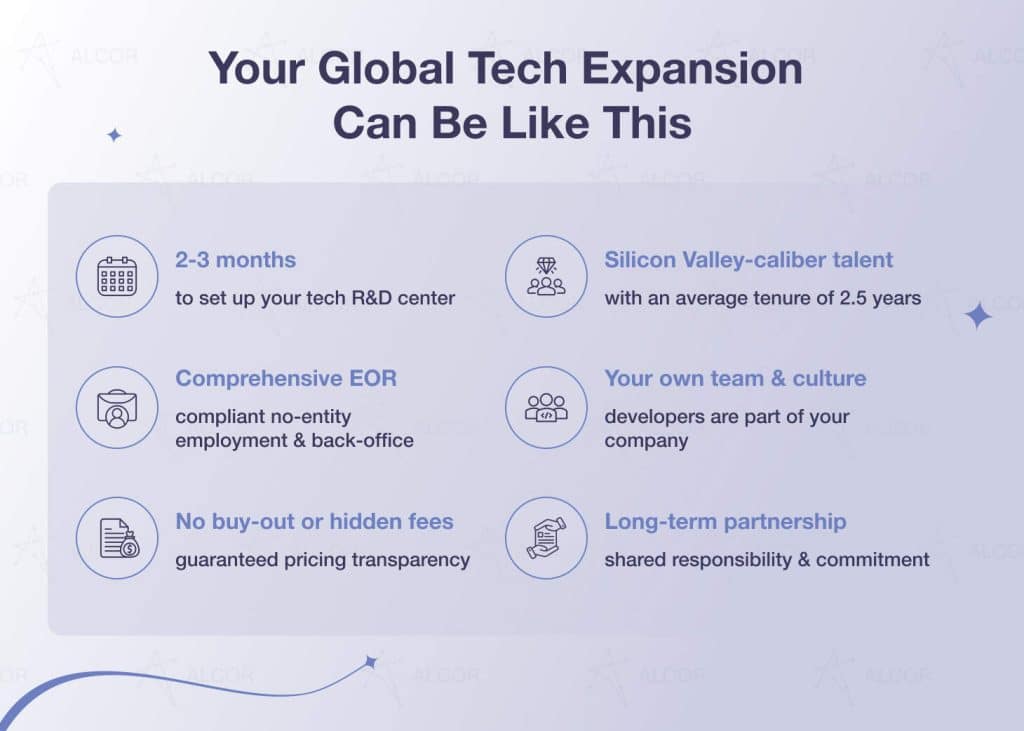
And Backstory isn’t the only proof point. For BigCommerce, a global SaaS e-commerce company, Alcor built a fully compliant tech R&D center, handling office setup and recruitment together – the result: 80 Silicon Valley-caliber engineers in one year.
For GoTransverse, speed came first: CVs in 5 days, a team of 5 engineers and a Product Manager in just six weeks, backed by full Employer of Record compliance.
Want more real success stories? Hear it straight from businesses that already build with Alcor.
IT industry in Poland vs the US
Poland gives US tech companies a cost-efficient alternative to domestic hiring, especially for senior roles. While the US has 3.18M developers, salaries remain high in AI, cloud, cybersecurity, data, and blockchain. Poland’s 778,800 ICT professionals cost about 45.1% less on average, with savings reaching 55% for ML Engineers and 59% for Blockchain Developers. For true cost planning, include employer SSC, recruitment fees, benefits, and differences in hiring models.
The United States remains a global tech leader, with a talent pool of over 3.18 million software developers, according to JetBrains Research. This dominance comes at a cost: US developer salaries are among the highest in the world, and competition for skilled talent is intense, particularly for roles in AI, Cloud computing, and Cybersecurity.
The Polish IT industry offers a different equation. Poland’s talent pool has grown to 778,800 ICT professionals, making it the largest in the CEE region and one that continues to expand each year. The technology industry of Poland pairs this scale with a considerable cost advantage: hiring a senior developer in Poland typically costs 33–40% less than hiring the same role in the US.
The Alcor team prepared a comparison of the average salaries of a Polish software developer to those of one from the US so that you can see a clear picture of cost-effectiveness.
|
Senior Monthly Base Salary, USD | |||
|
Position |
USA |
Poland |
Cost Savings |
|
ML Engineer |
$18,500 |
$8,300 |
55% |
|
LLM Engineer |
$19,500 |
$8,500 |
56% |
|
AI Product Engineer |
$19,000 |
$8,650 |
54% |
|
MLOps Developer |
$15,750 |
$8,500 |
46% |
|
Data Engineer |
$14,750 |
$6,900 |
53% |
|
Data Platform Engineer |
$15,750 |
$7,400 |
53% |
|
DevOps Engineer |
$14,000 |
$7,500 |
46% |
|
Python Developer |
$13,750 |
$7,000 |
49% |
|
Node.js Developer |
$13,000 |
$7,000 |
46% |
|
React Developer |
$13,000 |
$6,700 |
48% |
|
Angular Developer |
$13,000 |
$6,500 |
50% |
|
Mobile Developer (iOS/Android/Xamarin) |
$14,500 |
$7,000 |
52% |
|
C/C++ Developer |
$12,500 |
$7,500 |
40% |
|
Blockchain Developer |
$14,250 |
$5,900 |
59% |
|
Automation QA Engineer |
$12,125 |
$6,200 |
49% |
Salary data reflects Alcor’s 2026 compensation research. All figures have been updated for 2026.
According to Alcor’s 2026 remuneration metrics research, the average Polish developer salary is 45.1% lower than in the US.
However, when planning your company’s hiring budget, don’t stop at the salary. To understand the real cost, you’ll need to factor in Polish taxes, recruitment fees, and employee benefits.
Total employment cost
Hiring developers in Poland through the widely used B2B model offers a major financial advantage: companies aren’t legally required to cover the developer’s taxes. Polish independent contractors are responsible for handling their own tax and social contributions, which vary based on their income.
If you hire Polish full-time employees (FTE), though, expect additional costs. For a developer earning $5,000 gross per month, the employer typically pays around 20% extra in Social Security Contributions, including:
- 9.76% retirement pension contribution
- 6.5% pension contribution
- 0.67-3.33% disability pension
- 2.45% to the Polish Employment Fund
- 0.1% to the Polish Fund of Guaranteed Employment Benefits
Recruitment fees for tech talent in Poland vary by role seniority:
- 15% of gross annual salary for mid-level specialists
- 20% for senior-level positions
- 25% and more for leads and top-tier talent
US recruitment fees typically range from 25% to 35%. That’s up to 10% savings per hire without compromising on the developer’s technical expertise.
Also, Polish tech companies typically offer benefits packages worth around $5,000 per year, covering essentials like:
- Private health insurance – ~$600/year
- Professional development (training & certifications) – ~$1,500/year
- English language courses – ~$800/year
- Home office / IT equipment – ~$600/year
- Wellness benefits (MultiSport card, mental health support) – ~$600/year
- Meal cards – ~$900/year
In the US, benefits average $15,400 per employee, so you’re saving over $9,000 for every Polish developer you hire.
The takeaway: Hiring two senior developers in Poland costs about the same as hiring one in the US. ML Engineers show the widest gap, running roughly 55% less in Poland. Need Blockchain talent? Polish developers deliver savings of nearly 59%, with no compromise on skills or experience.
Bottom line: Poland gives US tech companies a direct path to solving talent shortages while cutting hiring costs.
Top Polish IT Hubs: Established and Emerging
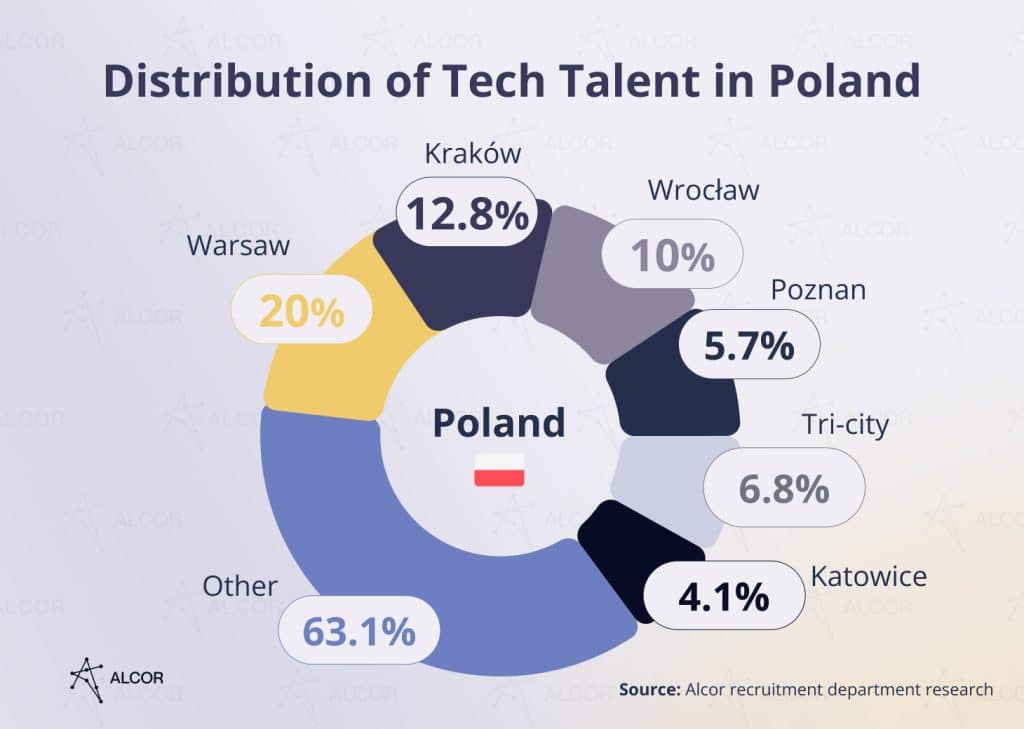
Poland’s IT hubs offer distinct strengths for product engineering, R&D, and specialized hiring. Warsaw leads with 156,000 tech specialists, strong AI research, VC activity, and the country’s top startup ecosystem. Kraków stands out in DeepTech and AI infrastructure, while Wrocław combines MedTech, health AI, and mature R&D. Katowice, Tri-City, Poznań, Łódź, and Rzeszów add focused talent pipelines across business services, AI, cybersecurity, aerospace, automation, enterprise software, and advanced engineering, helping companies choose hubs by skill focus and ecosystem maturity.
Warsaw
Warsaw stands at the heart of Poland’s IT industry, driven by a fast-growing base of AI research and investment activity. This momentum has helped the city climb to #3 among Europe’s major cities on fDi Intelligence’s European Cities of the Future ranking, trailing only London and Dublin – the top-ranked city in Central and Eastern Europe, recognized for its economic potential, business friendliness, and deep pool of software developers.
Here’s what makes Warsaw’s tech landscape stand out:
- Tech talent: 156,000 specialists, 20% of Poland’s national tech workforce
- Education: Eleven Warsaw-based universities actively publish AI research, led by the University of Warsaw, Warsaw University of Technology, and Warsaw University of Life Sciences, giving Warsaw a strong educational base for new engineering talent (EduRank)
- Leading industries: Robotics and gaming
- Startup ecosystem: Ranked #1 in Poland and #7 in Eastern Europe, with 684 active startups and 14.4% year-over-year growth (The Global Startup Ecosystem Index Report 2026).
- Venture activity: Approximately €800 million raised across 180 transactions in 2025, up 84% year-over-year in early 2026 (SSK&W Law Firm).
Kraków
Kraków is Poland’s emerging DeepTech capital, anchored by the GAIA AI Factory – a dedicated AI research and engineering facility that positions the city as Poland’s primary hub for advanced technical AI work, according to DCD, distinct from Warsaw’s broader AI hiring scale. Kraków’s universities keep Poland’s IT sector well supplied with skilled new graduates each year.
Here’s what makes Kraków’s tech ecosystem stand out:
- Tech talent: 100,000 ICT specialists
- Education: Top universities include Jagiellonian University, AGH University of Kraków, and Kraków University of Technology, producing a steady stream of new graduates (EduRank)
- Core engineering strengths: Enterprise software, DeepTech, AI research, and advanced engineering.
- Leading industry: Gaming (The Global Startup Ecosystem Index Report 2026)
- AI infrastructure: Home to the GAIA AI Factory, a dedicated AI research and engineering facility
- Startup ecosystem: Ranked #3 in Poland and #12 in Eastern Europe, with 253 active startups (The Global Startup Ecosystem Index Report 2026).
Wrocław
Often called the “Polish Silicon Valley,” Wrocław has built its reputation on strong MedTech expertise and a mature R&D ecosystem that attracts major international tech players to Poland.
Here’s what makes Wrocław’s tech ecosystem stand out:
- Tech talent: 78,000 tech specialists, about 10% of Poland’s national tech workforce (Alcor’s recruitment department research)
- Education: Wrocław University of Science and Technology and the University of Wrocław anchor a pipeline of roughly 1,400 STEM graduates entering the IT services market each year (EduRank)
- Core engineering strengths: Analytics, commerce infrastructure, enterprise R&D, and health AI
- Leading industry: MedTech
- Startup ecosystem: Ranked #2 in Poland and #11 in Eastern Europe, with 239 active startups (The Global Startup Ecosystem Index Report 2026)
- Innovation infrastructure: Wrocławski Park Technologiczny (WPT) connects more than 220 companies and startups, ranging from international corporations to fast-growing startups (Gazeta Wrocławska). WPT’s dynamic environment supports R&D, MedTech, and advanced engineering teams, reinforcing Wrocław’s position as a reliable hub for technical talent in the tech sector in Poland.
Considering IT outsourcing in Wroclaw? See why this Polish hub attracts product-focused tech teams.
Katowice
Located in the Silesian Metropolis, Poland’s largest urban area, Katowice benefits from shared infrastructure, a connected labor market, and strong government support.
Here’s what makes Katowice’s tech ecosystem stand out:
- Tech talent: Roughly 32,000 people work across 135 business services centers in Katowice and the greater metro area (GZM), with IT services accounting for 44% of that workforce (Investors Assistance Department)
- Education: University of Silesia and the Katowice School of Technology anchor the local talent pipeline (Edurank)
- Global rankings: Ranked 6th among Europe’s major cities (fDi Intelligence’s Cities of the Future ranking)
- Startup ecosystem: Home to 46 active startups, with the ecosystem growing 33.3% in 2025 (The Global Startup Ecosystem Index Report 2026)
Tri-City
The Tri-City metropolitan area comprises Gdańsk, Gdynia, and Sopot, forming one of Poland’s most established secondary tech hubs.
Here’s what makes the Tri-City’s tech ecosystem stand out:
- Tech talent: Over 52,650 tech professionals, representing 6.8% of Poland’s national tech workforce
- Education: Gdańsk University of Technology and the University of Gdańsk graduate over 1,000 tech professionals into the IT services market each year (EduRank)
- AI R&D hub: Intel’s largest EU R&D center sits in Gdańsk, employing approximately 4,000 staff and focused on AI, machine learning, and autonomous vehicle development, backed by a €72–73 million expansion (Intel)
Poznań
Poznań may fly under the radar, but it holds its own as a key hub in western Poland.
Here’s what makes Poznań’s tech ecosystem stand out:
- Tech talent: 44,200 tech professionals, with a strong presence in C++, Java, and .NET development
- Education: Poznań University of Technology and Adam Mickiewicz University graduate around 1,500 new tech specialists annually (EduRank)
- Business service centers: Home to 80 IT and R&D business service centers, offering versatile engineering talent (Manpower Group)
- Startup ecosystem: Home to 115 active startups, with the ecosystem growing 18.4% in 2025 (The Global Startup Ecosystem Index Report 2026)
Łódź
Łódź has transformed from Poland’s historic textile-manufacturing center into one of the country’s most mature business services and IT hubs.
Here’s what makes Łódź’s tech ecosystem stand out:
- Tech talent: 134 business service centers employ 28,510 professionals in Łódź, according to the city’s official investor relations office (Invest in Łódź)
- Sector maturity: 66% of Łódź’s business service centers operate globally, delivering high-value, expert-level processes including analytics, IT, automation, and R&D rather than basic back-office work (Invest in Łódź)
- Education: University of Łódź and Łódź University of Technology anchor the local talent pipeline, with the University of Łódź recently launching a postgraduate AML analyst program in partnership with industry
- Startup ecosystem: Home to 35 active startups, with the ecosystem growing 14.3% from 2025 to 2026 (The Global Startup Ecosystem Index Report 2026)
- Technology focus: Local business services centers are increasingly investing in AI, automation, cloud computing, and cybersecurity, with more than 74% of centers nationally already using intelligent process automation (Invest in Łódź)
Rzeszów
Rzeszów anchors Poland’s most specialized industrial tech cluster – Aviation Valley – while building a growing secondary identity in enterprise software.
Here’s what makes Rzeszów’s tech ecosystem stand out:
- Aerospace cluster: Aviation Valley, Poland’s first industrial cluster (est. 2003), represents 194 member companies employing 35,000 people and generating $3.5 billion in annual sales (Aviation Valley Association)
- Education: Rzeszów University of Technology serves over 12,000 students and is nationally recognized for aviation and aerospace engineering, with close ties to the Aviation Valley cluster (Research.com)
- Technology park: Podkarpackie Science and Technology Park, adjacent to Rzeszów-Jasionka Airport, hosts more than 50 companies employing nearly 6,600 people, including the AEROPOLIS Technology Incubator supporting aviation, IT, electro-mechanics, biotechnology, and chemicals startups (Interreg Europe)
- Startup ecosystem: Home to 31 active startups, with the ecosystem growing 38.1% from 2025 to 2026 (The Global Startup Ecosystem Index Report 2026)
Building an engineering team in Poland? See how a PEO in Poland supports compliant employment, payroll, and employee benefits.
Technology Trends in Poland for 2025-2030
Poland’s 2025–2030 technology trends center on digital transformation, cybersecurity, quantum computing, AI adoption, and e-commerce. The digital transformation market reached $83.3B in 2025 and may reach $144.9B by 2030, at a 11.71% CAGR (Mordor Intelligence). Cybersecurity spending reached about $1B in 2025 (Trade.gov), while quantum infrastructure is moving into deployment (Mordor Intelligence). AI adoption is growing, driven by Microsoft’s PLN 2.8B cloud/AI investment and 28% of Polish organizations currently deploying AI (Microsoft; KPMG). E-commerce may reach $31B by 2027 (Thunes).
Poland’s technology transformation is accelerating across the full stack – from AI infrastructure and cybersecurity to quantum computing and sovereign digital policy. According to Mordor Intelligence, Poland’s digital transformation market reached $83.3 billion in 2025 and is projected to grow to $144.9 billion by 2030 at a CAGR of 11.71%.
- Cybersecurity has become a national priority: Spending jumped approximately 25% in 2025, reaching about $1 billion, according to Trade.gov. According to Mordor Intelligence, Poland’s cybersecurity market is projected to reach $2.26 billion by 2031.
- Quantum computing is moving from research to infrastructure: In April 2025, IQM deployed Poland’s first superconducting quantum computer, with the PIAST-Q national quantum computer in Poznań now also operational, according to Mordor Intelligence. A growing cluster of Polish quantum companies – including BEIT, Creotech, and ResQuant – is building quantum software and post-quantum cryptography solutions, according to Quantum Zeitgeist.
- AI skilling is reshaping the workforce: Microsoft committed PLN 2.8 billion (~$700 million) by June 2026 to expand its hyperscale cloud and AI infrastructure in Poland and to collaborate with Polish National Defense to strengthen national cybersecurity, according to a Microsoft press announcement. As stated in KPMG’s Business Digital Transformation Monitor, 28% of Polish organizations are already deploying AI tools, with another 30% planning to adopt them within a year.
- E-commerce continues to accelerate: Poland’s e-commerce market is projected to reach $31 billion by 2027, up 40% from 2023, according to Thunes. As stated by Ecommerce Europe’s 2025 study, 93% of Polish internet users made an online purchase in the past six months – up 6 percentage points year-over-year – with digital payments, mobile commerce, and cross-border shopping continuing to compound the growth.
Polish Tech Companies to Watch in 2027
Poland’s tech scene is gaining momentum across AI, robotics, proptech, agtech, healthtech, sustainable food, and consumer platforms. In 2025, Polish startups raised PLN 3.37B, up 25% year-over-year, with funding still growing 28% without mega-rounds. Companies such as ElevenLabs, Nomagic, CampusAI, Synerise, Jutro Medical, Holi Clinic, LabFarm, Petsy, and Plain show how Warsaw, Kraków, and other hubs are scaling globally with AI-first products and specialized innovation.
Poland is producing some of Europe’s most competitive tech companies in 2025–2026, with startups scaling from Warsaw to global markets across AI, Robotics, Proptech, Agtech, Healthtech, and Sustainable Food Production. According to Dealroom, Polish startups raised PLN 3.37 billion ($840 million) in 2025 – a 25% increase from the previous year and a strong recovery after two weaker years in the VC market. Even excluding the two standout mega-rounds (ElevenLabs and ICEYE), funding still grew 28%, outperforming Western Europe, according to The Recursive. Poland is fast becoming one of Europe’s most active innovation ecosystems, and the companies below are among the ones defining what that looks like in practice.
Standout AI performers:
- ElevenLabs ($500M Series D, 2026) is Poland’s first decacorn, valued at $11B. Founded by Mati Staniszewski and Piotr Dąbkowski, the company surpassed $500M in ARR in early 2026 and serves enterprise clients, including Spotify, Cisco, and Adobe, across 70+ languages, as reported by The Recursive.
- Nomagic ($84M+ total) builds AI-powered picking robots for warehouses and fulfillment centers, applying general-purpose Physical AI to automate complex logistics operations – achieving 220% growth in contracted ARR in 2024, according to Nomagic’s own investor announcements.
- CampusAI ($15M total) is a Warsaw-based AI training platform with 35,000 users and 60 enterprise customers, including ING, T-Mobile, Lenovo, and IKEA, as stated in TechCrunch.
- Synerise (€25M EIB venture debt, 2025) is a Kraków-founded AI and behavioral data platform helping enterprises collect, analyze, and act on customer data in real time, operating across 150+ markets and serving over 200 enterprise organizations, according to the EIB’s own press release. SKY ENGINE AI (€6.4M, 2024) and Edrone (€4.7M, 2024) are also shaping the AI landscape from synthetic data generation to next-generation marketing automation, according to The Recursive.
Among Poland’s most promising early-stage startups:
- Binaryx is a fractional real estate investment platform offering low-barrier access to high-yield rental properties.
- Cropler uses AI-powered crop monitoring cameras to optimize farm productivity.
In the Healthtech space:
- Jutro Medical (€36M Series A) is Warsaw’s AI-first primary care operator, running 20 clinics across Poland and serving 120,000 patients.
- Holi Clinic (€3M seed, 2025) delivers digital, personalized obesity treatment using GLP-1 therapies, according to The Recursive.
In the sustainable tech space:
- LabFarm ($2.3M total) develops lab-grown meat to address food security and reduce the environmental impact of animal farming.
- MoreGrowth ($5M pre-seed, 2022) is scaling online brands in wellness, finance, and parenting, with projects like HelloFinance and HiJunior already gaining traction.
Consumer platforms are rising too:
- Petsy (€1.1M seed, 2024) connects pet owners with trusted, verified sitters and vet services, according to The Recursive.
- Plain ($120K) is a Warsaw-based AI-powered shopping assistant that helps users find and visualize furniture based on their preferences and space.
Top-10% Tech Team in 2 Months & No Legal Headache
Alcor helps US and European tech companies build top-10% engineering teams in Poland within two months without opening a local entity. Alcor’s model combines tech-exclusive recruitment, EOR, COR, employer branding, transparent pricing, and dedicated support from a Customer Operations Manager. Companies can hire full-time employees or contractors compliantly, manage payroll and benefits, avoid buyout fees and hidden costs, and scale from the first hire to 100 engineers with full control.
Building a dedicated engineering team in Poland raises one immediate question for most US and European tech companies: how do you hire compliantly and at speed without setting up a legal entity?
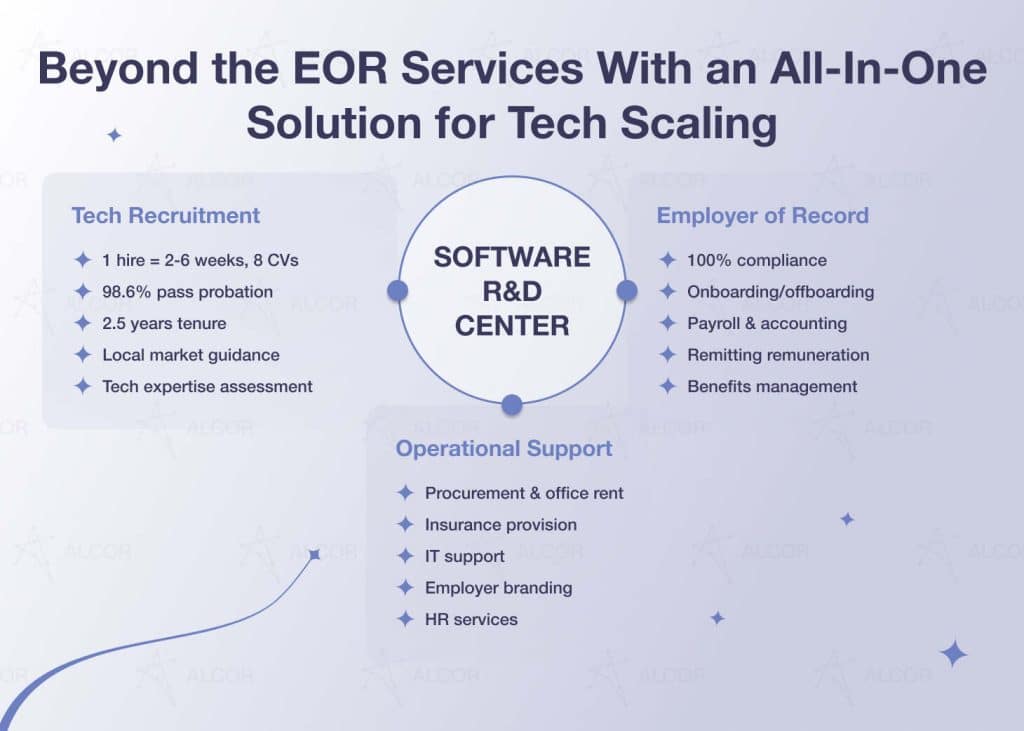
Alcor’s answer is a combination of tech-exclusive recruitment, Employer of Record, Contractor of Record, and operational support – purpose-built for tech product companies, not general hiring or IT outsourcing in Poland.
Here’s what that combination covers end-to-end:
- Tech-exclusive EOR: Alcor manages the full employment relationship – contracts, payroll, benefits, compliance with local and US law, and onboarding/offboarding – so you stay 100% legally compliant without opening a legal entity.
- Contractor of Record: For companies that engage independent contractors rather than full-time employees, Alcor’s COR model covers the entire engagement – legally structured and compliantly managed, with zero administrative overhead on your side.
- Employer branding: Alcor builds your company’s presence in the local market and brand awareness among the engineering communities you’re hiring from.
- Transparent pricing: No pre-payments, no markups, no hidden costs, no buy-out fees. Volume discounts and customized offers are structured around your team size and hiring pace.
- Dedicated Customer Operations Manager: Every client is assigned a Customer Operations Manager for hands-on support at every stage – from the first hire to a team of 100.
Ready to build your engineering team in Poland? Fill out the form and let’s make it happen.
FAQ
Is Poland a Silicon Valley of Europe?
In many ways, yes. Poland has 778,800 ICT professionals, 1,777 active startups, 12 unicorns, and major R&D investments from Google, Microsoft, Intel, and Amazon. Wrocław is widely called the “Polish Silicon Valley,” hosting IBM, Google, and Microsoft R&D centers. While Poland doesn’t match Silicon Valley’s venture capital density, it delivers comparable engineering depth and technical talent at a fraction of the cost.
How is the technology industry in Poland projected to grow by 2027?
By 2027, Poland’s ICT market will continue on a trajectory toward $56.01 billion by 2031 at a 10.02% CAGR (Mordor Intelligence). The broader IT services and software market is projected to reach $13.79 billion by 2032 (MarkNTel Advisors). Key drivers include EU-backed digital investment, Microsoft’s $700 million cloud and AI infrastructure commitment (Microsoft), and Amazon’s $6.23 billion expansion planned through 2028 (MarkNTel Advisors).
Which Polish IT hub has the highest number of STEM graduates per year?
Warsaw produces the largest pipeline of new engineering talent, with eleven universities actively publishing AI research, led by the University of Warsaw, Warsaw University of Technology, and Warsaw University of Life Sciences. Poznań follows closely, with approximately 1,500 new tech specialists graduating annually from Poznań University of Technology and Adam Mickiewicz University. Kraków, home to Jagiellonian University and AGH University of Kraków, rounds out Poland’s top three graduate-producing tech hubs.
Which big tech companies set their headquarters in Poland?
Poland hosts major tech operations across its key cities. Google, Microsoft, IBM, and Cisco operate in Warsaw. Wrocław is home to Google and Microsoft R&D centers. Intel’s largest EU R&D center, employing approximately 4,000 staff, sits in Gdańsk. Asseco Poland, the largest software house in Central and Eastern Europe, is headquartered in Rzeszów – making it the most prominent tech company with a Polish HQ.
What is the state of the Polish AI/ML development industry?
Poland ranks #1 in Europe and #4 globally for the concentration of Tier 2 AI talent – advanced researchers and engineers building deep learning models and neural architectures (Interface EU, 2026). Job postings for AI/ML specialists grew 22% year-over-year, the fastest of any IT specialization (No Fluff Jobs). The strongest active specializations are AI/ML Engineering & Data Science, Generative AI & LLM, LLM Engineering & AI Agent Development, and AI Architecture & Infrastructure (Alcor’s recruitment team research).
How would you rate this article?
Alcor is Your Trusted Scaling Partner
for expansion
support