


Nearshore software development in Eastern Europe remains a strategic choice in 2027, with nearshore delivery overall projected to grow at a 10% CAGR through 2031 (Mordor Intelligence). More than a third of the largest IT spenders in the Nordics and Benelux countries plan to increase their use of nearshore services over the next two years.
The key driver is talent supply. The Western European countries are on track to fall roughly 5 million ICT specialists short of their 2030 target (Eurofound). Meanwhile, Eastern Europe offers access to 2+ million skilled tech talent with cost, cultural, and proximity advantages.
If you’re deciding whether Eastern Europe can support your next 10, 30, or 100 engineering hires, this article will help you make the call. You’ll:
- Compare Poland, Romania, Ukraine, and Bulgaria by talent depth, specialization, salaries, and business conditions;
- See how Eastern Europe stacks up against other nearshoring regions;
- Understand the costs, risks, and operating models for building an engineering team there.
Key Takeaways
- Eastern Europe combines a $193B startup ecosystem, 58 unicorns, and €821M in VC funding in Q1 2026, while markets such as Poland, Romania, Ukraine, and Bulgaria continue expanding their tech sectors.
- Eastern Europe offers access to 2+ million tech specialists along with a practical balance of technical maturity, English proficiency, workable time zones, and legal alignment.
- Senior engineers in Eastern Europe typically cost 30–50% less than comparable US hires, allowing the same engineering budget to support more senior specialists or free up capital for product development and growth.
- The region continues to prove resilient despite talent competition, geopolitical pressure, and fast-changing AI demand. Ukraine’s IT exports returned to growth in 2025, Poland keeps attracting major corporate investment, and AI adoption is already high among Polish and Ukrainian developers.
- The software R&D center model is crafted for product companies that want to build fully owned engineering team in Eastern Europe. It provides the operational infrastructure to scale from 10–30+ engineers in 90 days, achieve long-term financial durability, and secure an average talent retention of 2.5 years.
Eastern Europe IT Market Overview
The Eastern Europe IT market combines strong nearshoring competitiveness with growing startup activity, VC investment, and expanding national tech markets. The regional startup ecosystem is valued at $193B across 58 unicorns, while CEE startups raised €821M in Q1 2026.
- Regional outlook: IT services revenue is projected to reach $18.3B by 2030.
- Poland: ICT market could grow from $34.75B in 2026 to $56.01B by 2031.
- Ukraine: Its IT market is worth nearly $8B, with $6.66B in IT service exports in 2025.
- Romania: The digital economy could reach €52B by 2030.
- Bulgaria: ICT represents roughly 9.6% of GDP, with 87% of software-sector revenue generated from exports.
According to Emerging Europe’s Future of IT Report 2026, Eastern Europe remains the most competitive nearshore region for software development among emerging markets. Estonia, Cyprus, and Poland take the top three places in the IT Competitiveness Index. Among 32 countries, including the Czech Republic and the Baltic countries Estonia and Lithuania, they sit at the top of the index on the strength of their tech talent, infrastructure, and business environment scores.
Below the top three, the index rewards different things in different markets. Romania ranks 3rd in the region on infrastructure. Ukraine scores 62.23 on future technologies, showcasing active AI, IoT, and blockchain deployment and regulation.
What unites these Central and Eastern European countries is their investment attractiveness. Currently, the combined enterprise value of the CEE startup ecosystem is at $193 billion across 58 unicorns, according to Dealroom. Vestbee’s Q1 2026 report puts regional venture capital at €821 million for the quarter, with AI, defense tech, fintech, healthtech, spacetech, and deeptech as the most active sectors.
Defense tech shows the sharpest curve. Startup Genome’s GSER 2026 records $526 million raised by Ukrainian startups in 2025, with defense tech startups raising a combined $105 million. In two years, the defense tech market expanded more than twentyfold, powered by the country’s first defense tech unicorn, UFORCE, and its first Nasdaq-listed company, Swarmer. Ukraine’s Brave1 platform now supports 500+ startups and drew $129 million in 2025.
Building defense tech or security products? Power your team’s growth with Alcor’s operational infrastructure, just like UFORCE and Pindrop did.
But what does the future hold for nearshoring software development to Eastern Europe?
Regional IT services revenue is projected to reach $18.3 billion by 2030, growing at 3.94% a year. Country-level growth runs well ahead of that average:
- Poland’s IT market is expected to surge the fastest. Mordor Intelligence puts the ICT market at $34.75 billion in 2026, reaching $56.01 billion by 2031 at a 10.02% CAGR. IT and telecom services already account for close to 35% of Poland’s total service exports, sold mainly to Germany, the US, Austria, and the UK, with the sector on track for €25.2 billion by 2026, per the Polish Investment and Trade Agency.
- Ukraine’s IT market is worth almost $8 billion, with IT services exports of $6.66 billion in 2025, according to the IT Ukraine Association. The IT workforce grew 11% year on year between 2022 and 2025, with defense tech, AI, and cybersecurity displacing classic web and mobile work.
- Romania anchors nearshore software development in South-East Europe. Romania’s ICT service exports reached $11.0 billion in 2024, according to World Bank data. And its digital economy is projected to hit €52 billion by 2030 – close to 10% of GDP.
- Bulgaria posts the highest ICT-to-GDP share in the EU at roughly 9.6%, while 87% of software-sector revenue is export-driven. The strongest sectors are fintech, SaaS, AI, healthtech, defense and security, and gaming.
Why Nearshore Software Development to Eastern Europe in 2027?
Tech companies nearshore to Europe, particularly Poland, Ukraine, Romania, and Bulgaria, to access skilled engineering talent, lower expenses, benefit from data protection regulations, and collaborate across workable time zones.
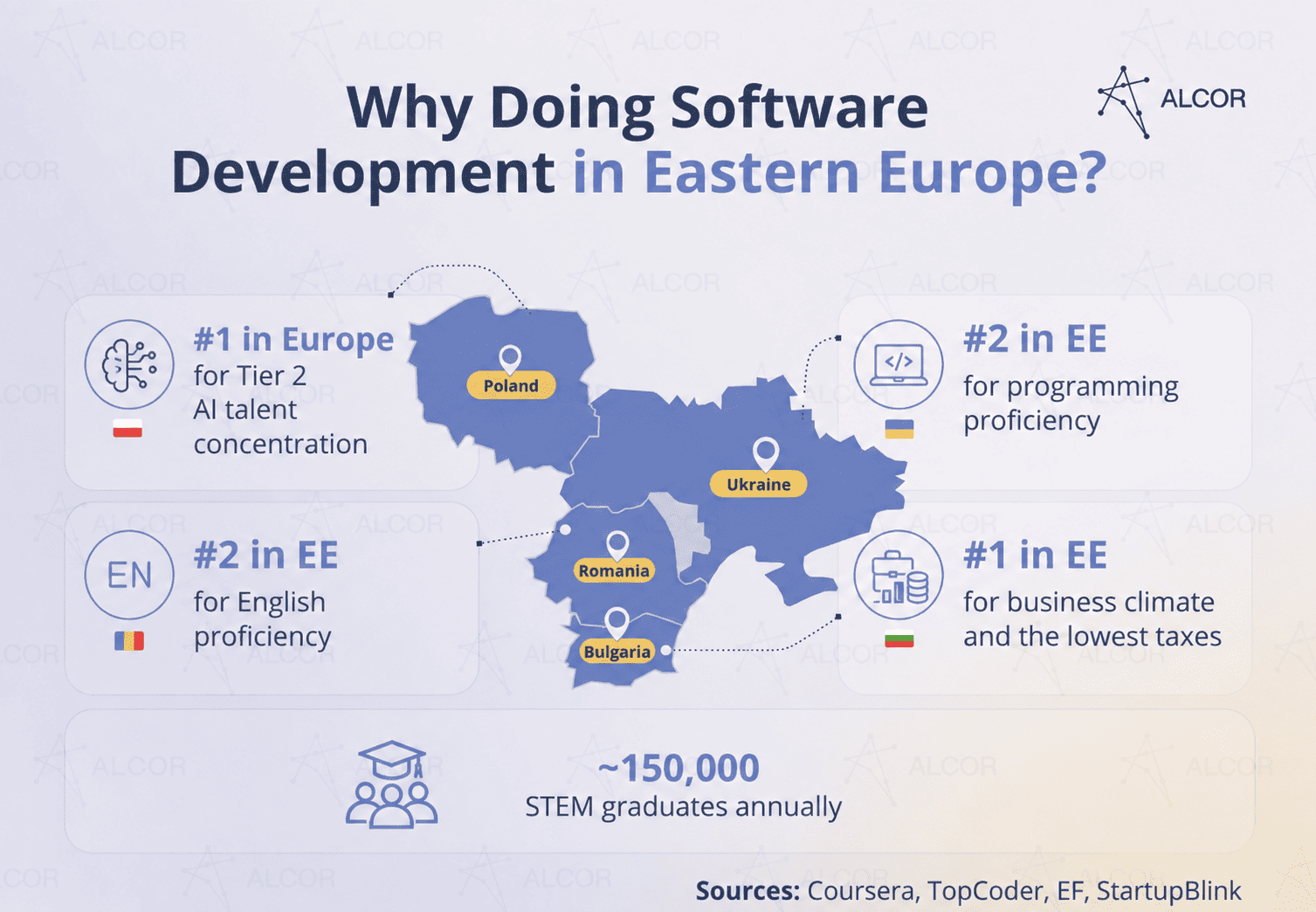
- Eastern Europe has 2M+ tech specialists and adds around 150,000 STEM graduates annually, helping fill roles that remain open in the US and Western Europe.
- Senior engineers typically cost 30–50% less than comparable US hires, allowing the same budget to support a larger or more specialized team.
- Poland, Romania, and Bulgaria operate under EU data protection and IP frameworks, which eases compliance for expanding European companies.
- European teams get near-full overlap, while US companies still retain useful morning overlap.
Hire engineers your home market ran out of
Germany has around 109,000 unfilled IT positions, 85% of companies report a shortage, and the average IT role takes 7.7 months to fill, according to Bitkom’s 2025 labor market study. In the US, the Bureau of Labor Statistics projects 115,200 software developer openings a year through 2034, with a median salary of $135,980. The list goes on and on, as 75% of tech leaders globally report difficulty finding skilled talent, according to ManpowerGroup.
Eastern Europe has a pool of more than 2 million tech talent, expanding with 150,000 STEM graduates annually. These aren’t generalists waiting to be trained up. Poland ranks #1 in Eastern Europe on TopCoder for competitive programming, with Ukraine at #2 and Romania #3 in the region.
Partner with an experienced IT staffing company from Eastern Europe, and five senior roles that have been open since Q1 in Berlin or Boston get filled from Kyiv or Bucharest in a few weeks. That is what Gotransverse did. The cloud-based billing and revenue management platform needed senior Full-Stack Engineers faster than its home market could supply. With Alcor, they got:
- 6 Full-Stack Engineers and a Product Manager hired in 6 weeks
- 95% CV pass rate – candidates pre-screened for technical depth and cultural fit
- Scaled to 25 senior engineers, with employment, payroll, compliance, and local ops handled end to end.
Access in-demand tech talent
The shortage is sharpest exactly where roadmaps now sit. The Reveal 2026 IT Talent Survey found AI engineers are the hardest role to fill, cited by 39% of technology leaders, followed by cybersecurity engineers at 38% and cloud engineers at 25%.
Each Eastern European market has built depth in a different part of that stack.
- Poland ranks #1 in Europe and #4 globally for the concentration of Tier 2 AI talent – researchers and engineers experienced in building deep learning models and neural architectures, according to Interface EU.
- In Ukraine, over 6,100 engineers work specifically in machine learning, deep learning, computer vision, NLP, and AI infrastructure, a pool that grew 17% over 2024–2025, according to the AI House 2025 report.
- Romania ranks #4 in Eastern Europe for AI maturity (Coursera Global Skills Report 2025), and Bucharest is one of only six EuroHPC AI Factory sites across 16 EU member states, backed by €500 million in public funding.
- Bulgaria ranks #5 in Eastern Europe for data science skills (Coursera Global Skills Report 2025) and #3 in the region on the Global Innovation Index 2025. Bulgarian engineers also concentrate in technology delivery more tightly than anywhere else in the EU: 76.3% of tech specialists work in the IT sector, per Eurostat.
Fund a bigger team with the same budget
Senior programmers in Eastern Europe cost 30–50% less than comparable US hires, according to Alcor’s internal tech salaries research. So your existing engineering budget can stretch to roughly 1.4–2x more senior talent.
That gives you room to fill roles that keep slipping down the roadmap: an ML Engineer, a second DevOps specialist, or a harder-to-find profile such as a Forward Deployed Engineer that you have been covering with contractors. Or by doing software development in Eastern Europe, you can keep the team lean and reinvest the savings into product development, infrastructure, or your next growth initiative.
I’ll break down software engineer salaries across Eastern Europe later in this article, so you can compare markets and see what that budget difference looks like by role.
Keep your IP and data under EU law
Poland, Romania, and Bulgaria are EU member states. This means your Eastern European engineers work under the same data protection regime as your HQ. For a tech company already GDPR-compliant at home, that removes a workstream.
IP works the same way. Under EU copyright law as implemented in all three countries, economic rights in software created by an employee in the course of employment transfer to the employer by default. Your codebase belongs to you from the first day, without the need for any transfer agreements to hold up later.
Share the same working day
Eastern Europe runs on GMT+2 to GMT+3. For a European product company, this is a fully overlapping workday with Berlin, Amsterdam, Paris, or London. Plus, Schengen makes engineer mobility routine. For a US company, engineers are 6–8 hours ahead of the East Coast: work lands before your standups and overlaps through your mornings.
These reasons for nearshore outsourcing software development to Eastern Europe apply across the region. Which country delivers them best depends on what you are building.
Where to Nearshore Software Development in Eastern Europe?
The best nearshore countries in Eastern Europe are Poland, Romania, Ukraine, and Bulgaria, each offering a different mix of talent depth, specialization, cost, and business conditions.
- Poland: Largest talent pool with 778,800+ tech specialists, strong AI expertise, and mature R&D infrastructure.
- Romania: 207,800+ ICT specialists, strong English, low employer contributions, and growing AI capabilities.
- Ukraine: 305,000+ tech professionals, competitive costs, strong AI and defense tech expertise, and a favorable Diia.City tax regime.
- Bulgaria: 141,500+ specialists, strong data science skills, export-driven software sector, and the EU’s lowest flat personal income tax at 10%.
Ready to nearshore outsourcing to Eastern Europe but unsure which market fits your product development? The four below differ more than the regional averages suggest – in talent depth, AI specialization, English, and cost. Here is what each one gives you for hiring developers in Eastern Europe.
Poland
Talent pool: 778,800+ tech specialists
TopCoder ranking: #1 in Eastern Europe
Programming languages and technologies: JavaScript, SQL, Python, C#, TypeScript, Kubernetes, TensorFlow, NLP, Hadoop
Senior engineer salary: $84,300
English proficiency: 15th place out of 123
Startup ecosystem: 1,777 active startups, 13 unicorns
Time zone: GMT+2
Tech hubs: Warsaw, Krakow, Katowice, the Tri-City (Gdansk, Gdynia, Sopot), and Poznan
Special feature: Poland’s R&D relief allows a 200% deduction of eligible R&D costs – 100% as an operating expense plus 100% again from the tax base. Engineer salaries qualify, alongside equipment, IP protection, and advisory costs.
Romania
Talent pool: 207,800+ tech specialists
TopCoder ranking: #3 in Eastern Europe
Programming languages and technologies: Java, JavaScript, C#, Python, React, Angular
Senior engineer salary: $80,280
English proficiency: 11th place out of 123
Startup ecosystem: 743 active startups, 3 unicorns
Time zone: GMT+3
Tech hubs: Bucharest, Cluj-Napoca, Timișoara
Special feature: the lowest employer social contribution in Eastern Europe at 2.25%. Romania also allows an additional 50% deduction on eligible R&D spend, with an optional 10% tax credit from 2026.
Bulgaria
Talent pool: 141,500+ tech specialists
TopCoder ranking: #4 in Eastern Europe
Programming languages and technologies: C#, JavaScript, Java, Python, SQL, PHP
Senior engineer salary: $72,930
English proficiency: 18th place out of 123
Startup ecosystem: 547 active startups, 1 unicorn
Time zone: GMT+3
Tech hubs: Sofia, Plovdiv, Varna, Burgas
Special feature: the lowest flat personal income tax in the EU at 10%, now paid in euros following January 2026 adoption.
Ukraine
Talent pool: 305,000+ tech specialists
TopCoder ranking: #2 in Eastern Europe
Programming languages and technologies: JavaScript, Java, Python, C#, TypeScript, PHP, Kotlin
Senior engineer salary: $70,000
English proficiency: 45th place out of 123
Startup ecosystem: 874 active startups, 11 unicorns
Time zone: GMT+3
Tech hubs: Kyiv, Lviv, Dnipro, Kharkiv, and Odesa
Special feature: Diia.City, a dedicated legal and tax regime for technology companies, with its own IP provisions and a 5% personal income tax rate for qualifying employees.
Sources: Eurostat, Ministry of Digital Transformation, StartupBlink 2026, Dealroom CEE Unicorn Club.
Software Developers’ Salaries in Eastern European Countries
Software developer salaries in Eastern Europe are typically 50–60% lower than in the US for comparable senior talent, with the biggest gaps in AI and machine learning roles. Poland and Romania generally sit at the higher end of the regional range, while Bulgaria and Ukraine offer lower salary benchmarks:
- Senior LLM Engineer: $102,000 in Poland, $97,800 in Romania, $90,000 in Bulgaria, and $86,400 in Ukraine vs. $234,000 in the US.
Another important factor in choosing your ideal match for IT nearshoring in Eastern Europe is the salary rates of software engineers. Here, they run 50-60% lower than in the US for the same expertise, and the gap is widest in AI and machine learning, where US compensation has risen fastest.
For example, a senior LLM Engineer earns $102,000 a year in Poland, $97,800 in Romania, $90,000 in Bulgaria, and $86,400 in Ukraine against $234,000 in the US. Senior AI Product Engineers run $103,800 in Poland and $84,000 in Ukraine, compared with $228,000 in the US. The same trend holds for other skill sets, with higher prices for nearshore services in Poland and Romania and slightly lower prices in Bulgaria and Ukraine. Have a look yourself.
| Average Annual Senior Engineer Base Salary, USD | |||||
|---|---|---|---|---|---|
| Positions | Poland | Romania | Bulgaria | Ukraine | USA |
| AI Product Engineer | $103,800 | $97,200 | $87,600 | $84,000 | $228,000 |
| LLM Engineer | $102,000 | $97,800 | $90,000 | $86,400 | $234,000 |
| ML Engineer | $99,600 | $97,200 | $63,600 | $84,000 | $222,000 |
| MLOps Engineer | $102,000 | $99,600 | $85,800 | $90,000 | $189,000 |
| Data Engineer | $82,800 | $74,400 | $73,200 | $69,600 | $177,000 |
| Python Engineer | $84,000 | $79,200 | $72,000 | $70,800 | $165,000 |
| DevOps Engineer | $90,000 | $81,600 | $78,000 | $72,000 | $168,000 |
| React Developer | $80,400 | $76,800 | $67,800 | $66,000 | $156,000 |
| QA Automation Engineer | $74,400 | $70,800 | $78,000 | $57,600 | $145,500 |
According to Alcor’s internal tech salaries research as of September 2026
Eastern Europe vs Other Nearshoring Regions
- Eastern Europe vs. LATAM: Eastern Europe offers tighter alignment with EU regulation and better English proficiency among engineers, while LATAM offers higher cost reduction and better timezone overlap with US teams.
- Eastern Europe vs. Western Europe: Eastern Europe delivers similar cultural and technical compatibility at roughly 1.3x lower salary levels.
- Eastern Europe vs. the Nordics: EE offers significantly lower labor costs while preserving strong English skills and technical depth.
- Eastern Europe vs. Asia: Eastern Europe provides better overlap with European and US teams, stronger English proficiency, and simpler IP/data protection alignment, though Asia remains cheaper and larger in talent supply.

Latin America
Cons:
- Complex taxation and pro-employee employment law across jurisdictions require local expertise in each country you hire in to avoid liability risks.
- Budgeting may be hard due to obligatory additional premiums and benefits. Most LATAM markets mandate a 13th-month salary plus layered statutory benefits. For instance, Mexico requires aguinaldo (15 days), prima vacacional (a 25% premium on vacation pay), and PTU profit-sharing at 10% of annual taxable profits.
Pros:
- The Latin American region, comprising Mexico, Argentina, Colombia, and Chile, boasts over 2.3 million tech specialists, and this talent pool grows with nearly 300,000 STEM graduates annually.
- Senior engineers cost around 60% less than US equivalents. The savings narrow as seniority rises.
- A full overlapping working day with US teams. GMT−6 to GMT−3 means standups, pairing, and incident response happen in real time.
Running a tech company with HQ in the US or Canada? Nearshoring to LATAM is your pick. Provide your tech roles and get qualified CVs in 3-5 days.
Western Europe
Cons:
- 57% of EU firms with open IT vacancies reported difficulty filling them, concentrated in senior and specialized roles in cybersecurity, AI, and cloud infrastructure
- Salaries run roughly 1.3 times higher than in Eastern Europe before employment costs, and the rising cost of living for Western European software developers keeps total packages escalating.
Pros:
- The highest English proficiency in the world. The Netherlands (624), Austria (616), and Germany (615) take three of the top four places on the EF EPI 2025.
- Strong business-culture affinity across Austria, France, Germany, Switzerland, and the UK, with the same time zone and the same regulatory framework as most European product companies makes software nearshoring and collaboration with remote developers easy.
Nordic Region
Cons:
- Labor costs are among the highest in Europe. Eurostat puts Denmark’s average hourly labor cost at €51.7 in 2025, the second-highest in the EU, against an EU average of €34.9. Sweden also carries one of the EU’s highest non-wage cost shares at 31.6% of total labor cost. This makes software nearshoring to Nordic countries about 2 times more expensive than to Eastern Europe.
- The region’s tech companies are struggling with talent shortages. CBI, the EU-funded trade agency, found 67% of leading Nordic IT-spending organizations planned to maintain or increase outsourcing over the following two years, with 40% specifically increasing nearshore activity – 49% in Denmark, 44% in Finland.
Pros:
- Exceptional English. Norway (613), Denmark (611), and Sweden (609) all sit in the global top ten on the EF EPI 2025, ahead of every Eastern European market.
- Genuine strength in specific domains: enterprise software, telecoms infrastructure, gaming, and clean tech, built by companies like Ericsson, Nokia, Spotify, and Unity that have trained a generation of engineers.
Asia
Cons:
- Low English proficiency. India scores 484 and China 464 on the EF EPI 2025, both in the low-proficiency band, against 600+ for Poland and Romania.
- A 9–12 hour time difference leaves no overlapping working hours with either US or European teams. Code reviews, architecture decisions, and incident escalations all shift to next-day cycles.
- Distance from both EU and US legal frameworks adds IP and data protection complexity.
Pros:
- The largest market supply of tech specialists in the world, with the highest concentration of talent in China and India.
- The lowest engineering salaries of all nearshoring and offshoring destinations, at about 60–70% below US levels.
Does Eastern Europe Have a Сhance to Become a TOP-1 Destination for IT Nearshoring?
Eastern Europe has a strong chance to become a leading IT nearshoring destination because its talent pipeline, investment activity, and AI adoption continue to expand despite geopolitical and hiring pressures.
- Tech talent shortage: Demand is high, but supply is still growing. The region collectively produces around 150,000 STEM graduates annually, and EU education and training strategies continue to grow the pool.
- Geopolitical resilience: Ukraine’s IT exports returned to growth in 2025, while Poland continues to attract major VC and corporate investment, including Amazon’s $6.23B expansion plan.
- AI adoption: Around 87% of Polish developers and 81% of Ukrainian engineers use AI at work, while governments across the region are investing heavily in AI infrastructure and digitalization.
Should the decision to nearshore software development to Europe be your ultimate tech expansion strategy? Let’s address concerns surrounding the eastern part of the region, especially regarding political, economic, and tech talent trends.
Tech talent shortage: myth or fact?
It’s a fact. Across the EU, 57% of firms with open IT vacancies report difficulty filling them, especially senior and specialized roles, according to Eurofound. Eastern Europe falls within that range. In Romania, 44% of executives cite talent shortage as their primary tech recruitment challenge. And Poland posts 275% more tech vacancies per employed specialist than the OECD average.
The good news is that each market is producing a fresh wave of tech talent, and doing it actually faster than most Western European countries. Romania’s long-term education strategy aligns with the CEDEFOP Skills Forecast, which predicts Romanian employment growth will outpace the EU-27 average from 2022 to 2035, with ICT as its fastest-growing sector. Poland produces about 74,000 STEM graduates annually, while Ukraine’s IT workforce has already shown 11% year-on-year growth between 2022 and 2025.
Demand is the clearest proof that supply holds. Between January 2024 and March 2025, 61 new centers opened in Poland, 42.6% of them in IT and 26.2% in R&D, according to ABSL. Companies don’t open R&D centers in markets where they cannot staff them. So this is a clear sign that nearshoring to Eastern Europe is a viable investment.
Geopolitics: will it stall the IT market growth?
The Russian invasion of Ukraine put the country’s thriving tech nearshoring industry at risk. Yet not only has Ukraine’s tech sector endured – it’s now on track to become a global leader in DefenseTech.
In 2025, US companies bought $2.39 billion of Ukrainian IT services and UK companies $556.73 million, with total exports up 3.3% year-on-year – the first growth after two years of decline, according to Lviv IT Cluster. More than 100 international software R&D centers continue to operate in the country, including Amazon, Samsung, Oracle, Sitecore, and Grammarly. Meanwhile, some, like Germany’s Quantum Systems and US Boeing, are expanding in Ukraine. Beyond DefenseTech, high-growth sectors include AI, DeepTech, Fintech, Blockchain, and cybersecurity.
Poland, too, faces geopolitical pressure due to the ongoing Russian war in Ukraine. Nevertheless, its venture capital sector is expanding. By the end of 2024, PFR Ventures, Poland’s largest institutional investor and a partner within the European Funds for a Modern Economy (FENG) program, invested €63 million in five new VC funds. In 2025, Polish startups received an additional €100 million from Formative, a venture fund targeting startups in AI, DeepTech, EdTech, and other innovative sectors. Corporate capital followed: Amazon committed $6.23 billion to Polish expansion across 2026–2028.
AI Adoption: is it fast enough?
At the business level, the global trend of AI adoption is reflected in CEE VC investment dynamics. More than 70% of global startup capital now goes to AI companies, up from just under 50% a year earlier. And in CEE, AI, security, and defense tech now drive the largest rounds, with four of 2026’s thirteen biggest deals (Cyber Swarm, UForce, Alcatraz AI, and Frankenburg) each raising roughly $50 million or more.
At the talent level, roughly 87% of Polish developers and 81% of Ukrainian engineers use AI in their work, meaning new hires arrive productive with the tooling your team is actively testing or already runs.
On the governmental level, Romania has developed a €5 billion plan for AI implementation and digitalization and launched an AI research institute. Poland runs a €235 million national AI Fund with free GPU compute for startups through the PIAST-AI and Gaia programs. Ukraine, in turn, launched Diia.AI in late 2025 to deliver government services through an AI agent. The commitments are already showing up in the rankings. The Government AI Readiness Index 2025 by Oxford Insights places Poland #1 and Ukraine #4 in the region.
Challenges of Nearshoring to Eastern Europe
The main challenges of nearshoring to Eastern Europe are largely tied to legal complexity and country-specific taxation, which vary by country. Failing to navigate these requirements correctly can create compliance risks, financial exposure, and fines. That makes cooperation with an experienced local partner crucial for handling employment, payroll, taxes, and regulatory compliance.
Legal challenges
When you consider software development nearshoring in Eastern Europe, you may encounter certain problems related to the complexity of local legislation.
For example, Poland has a fairly high Business Complexity Index, especially with regard to Rules, Regulations & Penalties, which are expected to become even more demanding over the next five years.
Regarding nearshoring to Romania, foreign companies must stay updated on this country’s frequently changing legislation. For instance, modifications introduced through 2025 and 2026 highlight the need for tech businesses to monitor updates: the standard VAT rate rose from 19% to 21% in August 2025, the RO e-Invoice system became mandatory for all B2B, B2C, and B2G invoices from January 2026 with penalties reaching 15% of invoice value, and microenterprise taxation changed.
Complex taxation
Even with the lowest taxes among CEE countries, ranging from a personal income tax of 10% in Bulgaria and 12 or 32% in Poland, which is almost 2 or even 3 times lower than in the UK and the US, navigating these regulations still causes some difficulties. Issues such as frequent changes in tax laws, compliance requirements, and differing interpretations by local authorities can complicate the process further.
However, with the guidance of an experienced Employer of Record in Eastern Europe, you can lessen the paperwork burden and ensure full compliance with local legislation when you nearshore software development to Europe. At Alcor, for instance, we provide 100% compensation for fines caused by our mistakes while nearshoring to Eastern Europe.
Better Than Nearshoring Software Development to Eastern Europe
Alcor’s software R&D center model is a better alternative to traditional nearshoring for tech companies that want their own engineering team without building local infrastructure themselves.
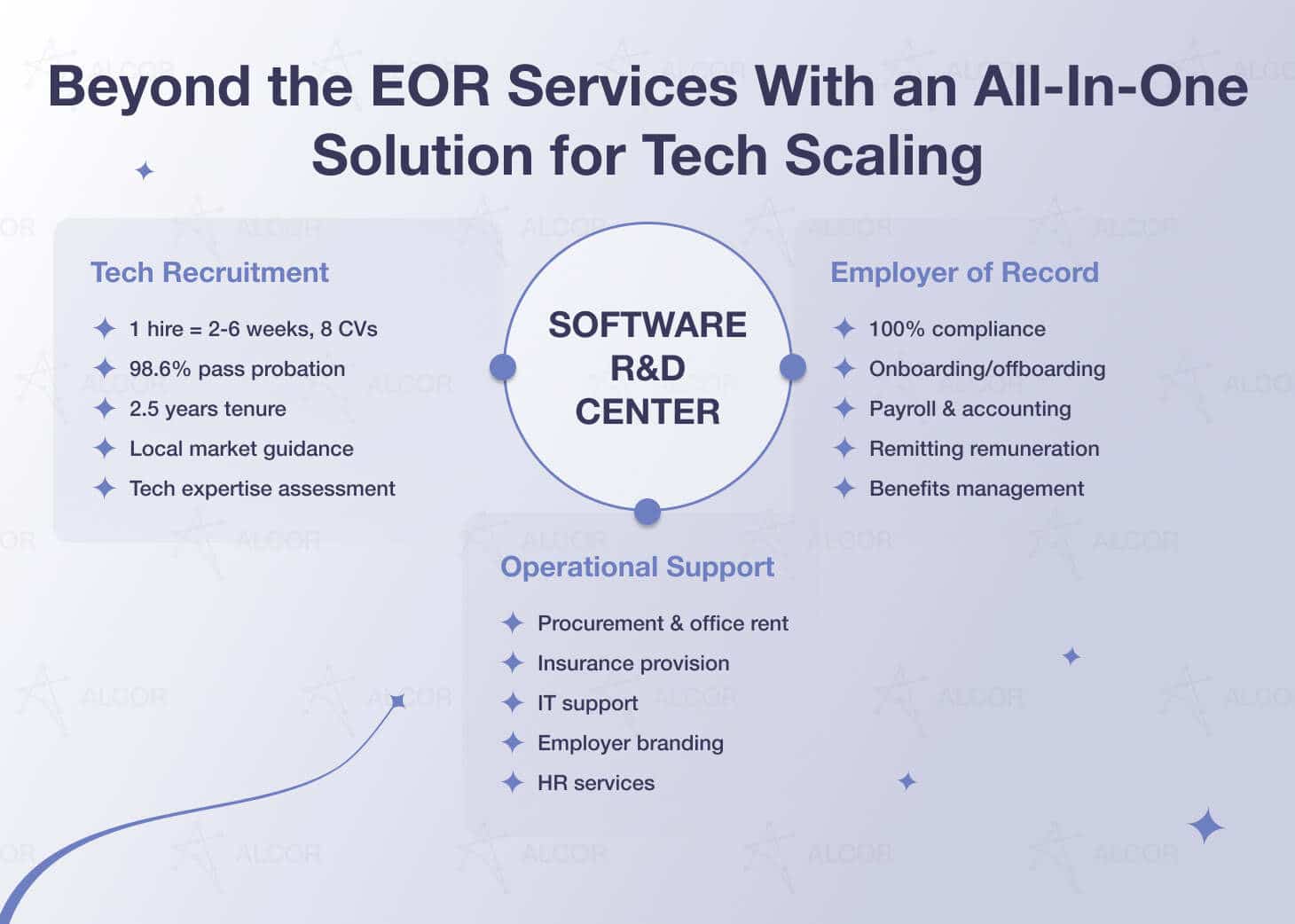
Alcor combines tech recruitment, EOR/COR, and operational support under one contract, while clients keep full control over their people, roadmap, culture, and IP. The model is designed for mature product companies scaling 10–30+ engineering teams in Eastern Europe or LATAM.
Tech companies such as Sift, Ledger, Backstory, BigCommerce, and ThredUP have used the software R&D center model to build and scale engineering teams in Eastern Europe, which resulted in more investment and business growth.
Choosing a location for IT nearshoring to Eastern Europe is just one piece of the puzzle. Six weeks into hiring, you may find your brand is underrepresented in attracting senior engineers. The candidates you actually got are fielding three offers each. And you cannot employ anyone until you have a local entity – around $20,000 in upfront investment and 2-3 months you did not budget. The roles stay open, and the roadmap slips a quarter.
Alcor’s software R&D center model closes that gap. We help mature tech product companies from Europe and the US build teams of 10–30+ engineers in 90 days across Eastern Europe and Latin America. We run tech recruitment, employment, and operations under one contract, through our own entities or our Contractor of Record across the region. You get full IP ownership and an integrated engineering team with 2.5+ years of average retention. You build the product. We power the infrastructure around your team.
Sift, the US-based AI fraud prevention company, faced exactly the problem above: they wanted an Eastern European engineering hub of their own, with no subsidiary, no vendor, and no time to spend on either. So they partnered with Alcor.
We started with an employer branding campaign to find leadership for the team. Alcor hired Sift’s Head of R&D from the second CV presented, giving the new hub a local decision-maker before the first engineer joined. Overall, with Alcor, Sift got:
- 30 engineers hired in the first year, scaled to 51 across Ukraine and Poland
- Infrastructure Engineer and Ruby on Rails Developer roles closed within 7 days
- +15% offer acceptance rate after employer branding
- Full EOR coverage: payroll, tax, labor law compliance, stock options
- Own reporting lines, hiring decisions, and IP, with no vendor layer.
In 2021, the year Sift built its Eastern European engineering team, the company raised $50 million and passed a $1 billion valuation. It remains a G2 leader across every fraud prevention category.
Our model is proven effective for tech unicorns like Backstory and Ledger and for public tech companies such as BigCommerce and ThredUP. Now it’s your turn to explore the possibilities of building your own software development team in Eastern Europe.
References on Nearshoring Software Development in Eastern Europe
- Mordor Intelligence’s IT Services Market
- Whitelane Research: Nordics 2026
- Whitelane Research: Belux 2026
- Eurofound’s IT Sector and Digital Workforce
- Emerging Europe Future of IT Report 2026
- Dealroom Central & Eastern Europe Tech Ecosystem
- Vestbee CEE Venture Funding Reports 2026
- Startup Genome Global Startup Ecosystem Report 2026
- Statista IT Services in Eastern Europe
- Mordor Intelligence Poland ICT Market
- Polish Investment and Trade Agency
- IT Ukraine Association
- World Bank
- McKinsey & Company
- ReportLinker
- Bulgarian Chamber of Commerce and Industry
- Bitkom IT Labor Market Study 2025
- U.S. Bureau of Labor Statistics
- ManpowerGroup Global Talent Shortage 2026
- Topcoder
- Reveal 2026 IT Talent Survey
- Interface EU AI Talent Research
- AI House AI Talents of Ukraine 2025
- Coursera Global Skills Report 2025
- WIPO Global Innovation Index 2025
- Eurostat
- Ministry of Digital Transformation of Ukraine
- StartupBlink Global Startup Ecosystem Index 2026
- Dealroom CEE Unicorn Club
- EF English Proficiency Index 2025
- CBI IT Outsourcing Market Statistics
- Business Review Romania
- OECD Job Creation and Local Economic Development
- CEDEFOP Skills Forecast
- ABSL Business Services Sector in Poland
- Lviv IT Cluster
- The Recursive
- Successful Investing in Poland
- DOU
- Oxford Insights Government AI Readiness Index 2025
- TMF Group’s Global Business Complexity Index
FAQ
Is Eastern Europe a good region for nearshore software development?
Yes. Eastern Europe gives expanding tech companies access to 2M+ tech specialists, senior engineering costs 30–50% below comparable US hires, workable time-zone overlap, and strong technical expertise. For product tech companies scaling into new markets, that means they can grow engineering capacity faster, fill rare tech roles, and reduce labor expenses without sacrificing quality or control over product development.
Which Eastern European countries are best for nearshoring software development?
Some of the best nearshoring locations in Eastern Europe are Poland, Romania, Ukraine, and Bulgaria. Poland offers the largest talent pool and top tech expertise; Romania combines strong English skills with low employer contributions; Ukraine stands out in AI and defense tech; and Bulgaria offers competitive costs and strong data science expertise.
How much can companies save by hiring software developers in Eastern Europe?
Senior software engineers in Eastern Europe typically earn 50–60% less than comparable US specialists. For example, senior LLM Engineers earn between $86,400 and $102,000 across the four markets, compared with $234,000 in the US.
What is the best way to build an engineering team in Eastern Europe?
For product companies that want to have their own team rather than an outsourced one, a software R&D center model can help. It combines tech recruitment, EOR / COR, and operational support to ease the admin burden and minimize compliance risks, while keeping the client in control of their engineers, culture, and IP.
How would you rate this article?
Alcor is Your Trusted Scaling Partner
for expansion
support