


A dedicated development center is now the most direct path to the engineers your product actually needs. AI and machine learning job postings grew 163% in 2025, yet AI/ML roles take an average of 89 days to fill – longer than any other tech category. The talent exists. It’s just not in your backyard. The companies moving fastest on AI aren’t waiting on local pipelines. They’re building their teams where the talent is.
I’m Dmytro Ovcharenko, CEO at Alcor. We build software R&D centers for product tech companies expanding into Eastern Europe and Latin America – handling tech recruitment, EOR, and full operational support under one roof. Our niche tech expertise shapes every solution we offer, from how we source candidates to how we structure employment contracts for your engineers. And whether you need to scale a high-performance senior engineering team from 10 to 30 engineers in 90 days or build a full R&D center offshore from the ground up, we’re built to move at that pace.
In this guide, you’ll get a clear breakdown of the model: its structure, types, and functions – plus the signals that tell you your business is ready, the mistakes that cost companies real time and money, and what building a dedicated development center the right way actually looks like.
Key Takeaways
- A DDC is your own engineering office abroad – a full team under your brand, fully integrated into your processes. Unlike outsourcing, it runs parallel workstreams, cuts costs by 2-3x versus US rates, and keeps your IP fully protected.
- Your team is maxed out, local costs are unsustainable, or the senior talent you need doesn’t exist nearby. Expanding into a foreign market without local legal expertise is the fourth signal most companies can’t afford to ignore.
- Three DDC models fit different expansion strategies. BOT transitions ownership post-setup, Hybrid combines internal engineering capacity with an external dedicated team, and Partnered gives you full ownership from day one.
- Four mistakes consistently trip up DDC setups: vendor fragmentation, weak employer branding, poor office planning, and unprotected IP. Each is avoidable with a single local partner who owns legal, recruitment, and operational functions.
- Alcor covers IT recruitment, EOR, and operational support for your DDC expansion into Eastern Europe and Latin America. You get top 10% engineers hired in 2-6 weeks, onboarded in 10 business days, and fully backed operationally.
What is a Dedicated Development Center
A dedicated development center (DDC) is a company-owned engineering office in another country, staffed with a team that works exclusively on your product. remain on your side.
Unlike outsourcing or outstaffing, this model is similar to GCC as a service or Global Captive Center and allows to hire in-house programmers, exclusively dedicated to the company’s product. Thus, a DDC functions as a seamless extension of the company, with the development team working as an in-house crew under your brand, ensuring a cohesive and integrated approach to product development.
Industry leaders such as Google, Microsoft, Intel, Grammarly, Oracle, BigCommerce, and others have already embraced this model, establishing their dedicated software centers in Latin American and Eastern European countries.
Dedicated Development Center Structure and Functions
A dedicated development center has three structural components: a physical office, an engineering team (including tech leads, developers, QA engineers, and UI/UX designers), and a leadership layer with a Head of Engineering reporting directly to the client’s CTO. Back-office operations – recruitment, payroll, legal, and HR – are typically handled by a local provider. Functionally, a DDC accelerates product delivery, optimizes engineering costs, gives full ownership and cultural alignment, protects IP, and lets companies scale their team on their own terms.
Structure
Leadership and your engineering team
Your dedicated team abroad mirrors the structure of any strong HQ crew. It typically includes a Head of Engineering or senior tech lead, frontend and backend engineers, full-stack developers, QA testing engineers, UI/UX design specialists, and other roles tailored to your tech stack. The exact composition depends entirely on your product goals. You define it.
What makes this structure work is clear accountability at every level. Your tech lead owns daily technical decisions, sprint planning, team performance, and calling plans. That person reports directly to your CTO or VP of Engineering – no middlemen, no coordination gaps.
Engineers get organized into autonomous squads that own specific product areas and deliver features end-to-end. Your tech talent performs better and stays longer since it’s fully integrated into your company culture and processes, with a strong local leader advocating for them. Your leadership team moves faster when there’s a trusted counterpart on the other side. Decisions don’t pile up waiting for a time zone window to open. Things get done.
Operational support
Back-office operations, including IT recruitment, payroll, tax services, accounting, legal & compliance, and HR, serve as the backbone that ensures the seamless and successful management of your dedicated development center. While it may initially seem like a burden, numerous tech companies opt to delegate these operations to a local service provider. This strategic decision allows them to focus on their product development while ensuring these critical functions are handled with expertise and efficiency.
Office
The office is the core of a dedicated center that provides physical space for product development. Engineers work here daily to complete tasks, collaborate, review code, and solve real product problems together. A typical IT office setup involves negotiating with a landlord, signing lease agreements, arranging workspaces, and managing hardware and software to create an efficient environment for productive work.
That said, not every company starts with a full office – and doesn’t have to. Coworking spaces are a practical and cost-effective entry point, especially during early-stage expansion. For teams comfortable with distributed work, a WFH arrangement is a viable option too, with home office support covering the necessary equipment and connectivity. The format depends on your team size, culture, and growth plans. What matters is that engineers have what they need to do their best work – wherever that is.
Functions
A DDC is not a support unit running in the background. It’s a full-capability engineering arm of your tech company – built to ship products, drive growth, and scale as your ambitions do. Here’s what it actually delivers.
Product acceleration
A dedicated software center adds real engineering capacity to your organization. Your headquarters team focuses on core priorities. Your DDC runs parallel workstreams – new features, platform improvements, application, infrastructure work, whatever your roadmap calls for. Think of it as two engines running at once, with more output and faster delivery.
Cost optimization
A pivotal function and primary benefit of the DDC model is inherent cost-effectiveness. That’s because tech companies directly control and manage all internal processes, unlike in traditional outsourcing and outstaffing. The underlying rationale is clear: outsourcing providers frequently impose high markups on programmers’ services, selling mid-level developers’ expertise at senior rates. They may add 50% cost markups to cover the salaries of developers sitting on the bench – engineers you’re paying for but never see. And if you ever want to bring a strong engineer in-house? Prepare for astronomical buyout fees just to insource someone who was already working on your product.
Rather than navigating these cost implications, IT companies choose to build their own teams of skilled developers, particularly in sought-after destinations like Latin America and Eastern Europe, where salary rates are about 50% lower than in the US and some Western European countries.
Ownership and culture
When your engineers work under your brand and operate inside your processes, they think like your in-house team. They care about the product. They’re not vendors processing a ticket queue – they’re teammates invested in what gets shipped.
Direct oversight over your engineering team, similar to the Global Capability Center setup, means full integration of your culture, too. You set the values, the rituals, the direction. The DDC adapts to you, not the other way around.
Data security
Your DDC is a branch of your own company. Product development stays inside your walls, away from third-party access, and IP risks drop sharply. Compliance runs through your own internal processes – no external security tracking needed, no exposure to outsourcing-style vulnerabilities. Your core asset stays protected.
Flexibility
Dedicated development center services let you scale on your own terms. You can start with a pilot team of a few engineers. Grow it to 10 if it’s proven effective for your product development. And then scale to 30 or even more engineers as needed. This adaptive approach ensures a scalable and responsive workforce, allowing for seamless adjustments in team size, skill sets, and project focus.
Signs Your Business is Ready to Use a DDC Solution
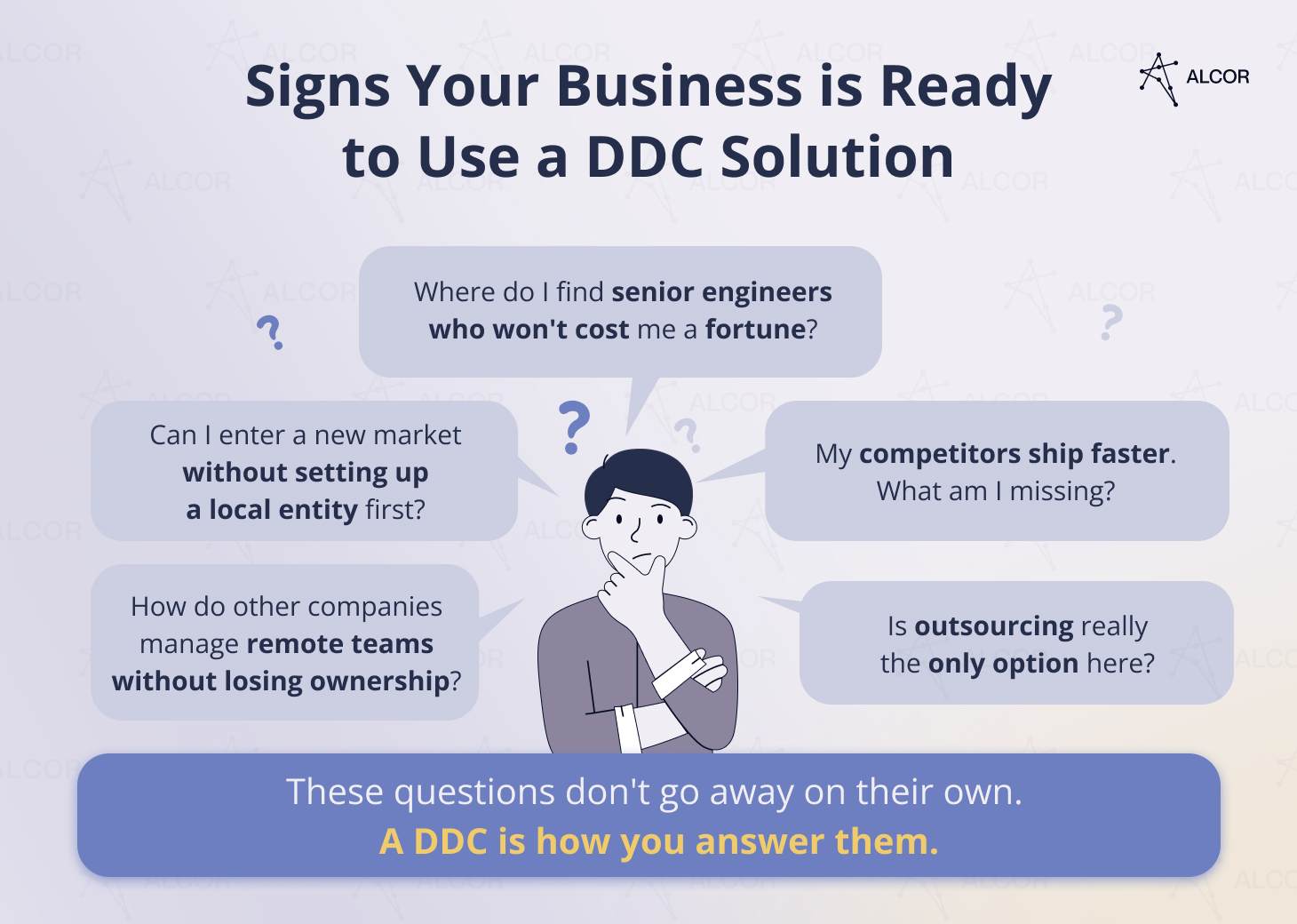
Four key signals indicate a business is ready for a dedicated development center: the core engineering team is at capacity and can’t keep up with the roadmap; local engineering costs are unsustainable; the home market can’t supply the senior or specialist talent needed; or the company is entering a foreign market without local legal and operational expertise. Any one of these is a strong signal. Most companies experience more than one at once.
Most tech companies don’t plan to set up a dedicated development center years in advance. The decision usually comes when something specific starts pressing hard enough on the business.
You need to extend your team
Your engineers are good. There just aren’t enough of them – and the pressure is building. Maybe the roadmap keeps expanding faster than your team can absorb it. Maybe a competitor is shipping features you haven’t started yet. Maybe you’re approaching a funding round and need to demonstrate real product velocity to investors. Whatever the trigger, the signal is the same: your current team size is becoming a ceiling.
A DDC removes that ceiling. It gives you a parallel engineering crew, built to your specs, that ships alongside your core team – so you can accelerate development without burning out the people you already have.
You want to cut down costs
Senior engineers are among the highest-paid professionals in any market. In the US, a senior full-stack developer earns around $14K per month. A comparable software engineer in Poland earns around $7K.
And the savings go beyond salaries. Office costs, equipment, and operational expenses in Eastern Europe and Latin America are considerably lower, too. Companies that build a DDC in these regions don’t just reduce headcount costs – they redirect those savings into product development, growth, and retention. Don’t you want that too?
Poland consistently ranks among the top DDC destinations in Europe for exactly this reason. If it’s on your expansion map, learn more about the software center in Poland setup.
You need talent that your local market can’t provide
Some skill sets are simply scarce at home – and none more so than AI engineers. LinkedIn’s 2026 Jobs on the Rise report ranked AI Engineer as the number one fastest-growing job title in the US, with postings rising 143% year-over-year in 2025. The demand is real. The supply isn’t keeping up. According to the Capgemini Engineering & R&D Pulse 2026 report, based on 1,500 global executives, nearly one in three engineering roles is estimated to remain unfilled every year through at least 2030.
Eastern Europe and Latin America offer a talent pool of over 3.8 million across the tech industry. Dedicated development services built around these regions give you structured access to engineering communities that are hard to reach through standard hiring channels.
Colombia alone has become one of LATAM’s fastest-growing engineering hubs. See what building your own Colombian software development center can look like on the ground.
You plan to expand into an unfamiliar market
Expanding into a foreign country means navigating local legislation, tax systems, employment law, and business registration – often without any in-house expertise to lean on. Registering a legal entity abroad alone can take anywhere from 2 to 6 months, depending on the country. That’s before you deal with tax registration, opening corporate bank accounts, setting up payroll infrastructure, and meeting local compliance requirements that vary significantly from one jurisdiction to the next.
A poorly structured dedicated development center agreement or an incomplete dedicated development center contract can create compliance issues that are slow and expensive to fix. Get the employment terms wrong and you’re exposed on IP. Miss a local tax obligation and you’re dealing with penalties while your team is still onboarding.
It’s best to cooperate with a reliable partner that understands the local market and can adapt to diverse business needs. In such a way, you don’t only legally expand your operations but also save time and money.
Considering new markets for your expansion? Read our article on software outsourcing to Romania to make informed decisions!
Types of Dedicated Development Center Models
There are three main DDC models. The BOT (Build-Operate-Transfer) model has a vendor build and run the center before transferring ownership to the client. The Hybrid model combines internal engineering capacity with an external dedicated team: the client keeps core capabilities or leadership in-house while a remote dedicated team covers the rest. The Partnered model keeps full client ownership from day one, with a local provider handling back-office operations – recruitment, legal, payroll, and office management.
Build-operate-transfer DDC
The BOT model in the IT industry involves setting up a dedicated development center with an engineering team in another country. As a rule, it’s realized through a partnership with a local vendor that handles hiring, legal compliance, payroll, accounting, and other day-to-day operations of the offshore software center. After this, there’s a planned transition, and the DDC is transferred back to the client.
In theory, it’s a clean handoff. In practice, the transfer stage is where things get complicated.
Engineers who joined under the vendor’s employment umbrella may not stay once the ownership changes. Their contracts, benefits, and day-to-day employer relationship shift – and some simply leave. The legal and compliance transition adds another layer: re-registering employment, restructuring payroll, and ensuring continuity of local tax obligations all take time and carry real risk if handled incorrectly. And then there’s IP. Code, documentation, tooling, and institutional knowledge built during the “operate” phase often sit in grey zones – especially if the original contracts didn’t explicitly address ownership at every stage. Untangling that during a transition, under time pressure, is rarely straightforward.
The result is predictable: productivity setbacks, team instability, and miscoordination at exactly the moment you’re trying to take full ownership.
Hybrid DDC
The Hybrid DDC combines internal engineering capacity with an external dedicated team. The client keeps certain capabilities, leadership roles, or product functions in-house – typically at headquarters – while a dedicated remote team covers the rest. It’s a model that suits companies with an established core team that needs to extend delivery capacity without rebuilding their entire engineering structure.
Partnered DDC
Through a partnered DDC, the company establishes its own office in a foreign location, staffed with a team of full-time software developers. Unlike the BOT model, the office, people, documentation, and IP rights are under the client’s control right from the start. This approach is facilitated by a dedicated development office services provider responsible for recruitment, HR payroll, legal & compliance, office maintenance, and other back-office operations. At the same time, product development, decision-making, team management, and other core operations remain on the client’s side.
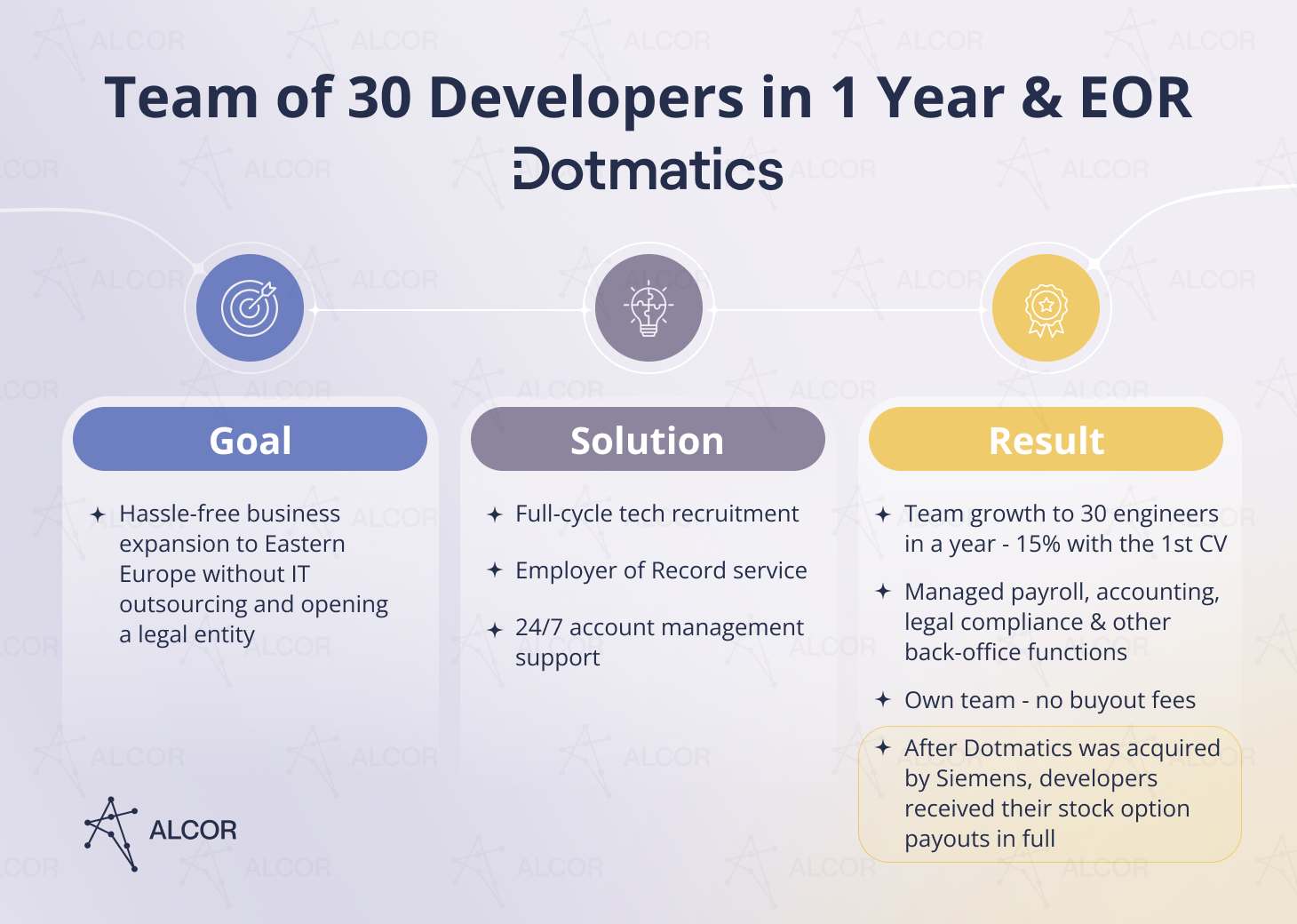
Dotmatics, a US scientific software company, is a strong example of this model in action. They already had offices in the US, Ireland, and New Zealand – with core teams in place. Traditional outsourcing wasn’t on the table; their product was too complex and required direct oversight. Instead, they built a dedicated engineering team in Eastern Europe that worked alongside their existing organization. Alcor hired 30 engineers in 12 months, all under Dotmatics’ full control, with IP rights secured and EOR handled end to end.
How Alcor Sets Up Dedicated Development Centers
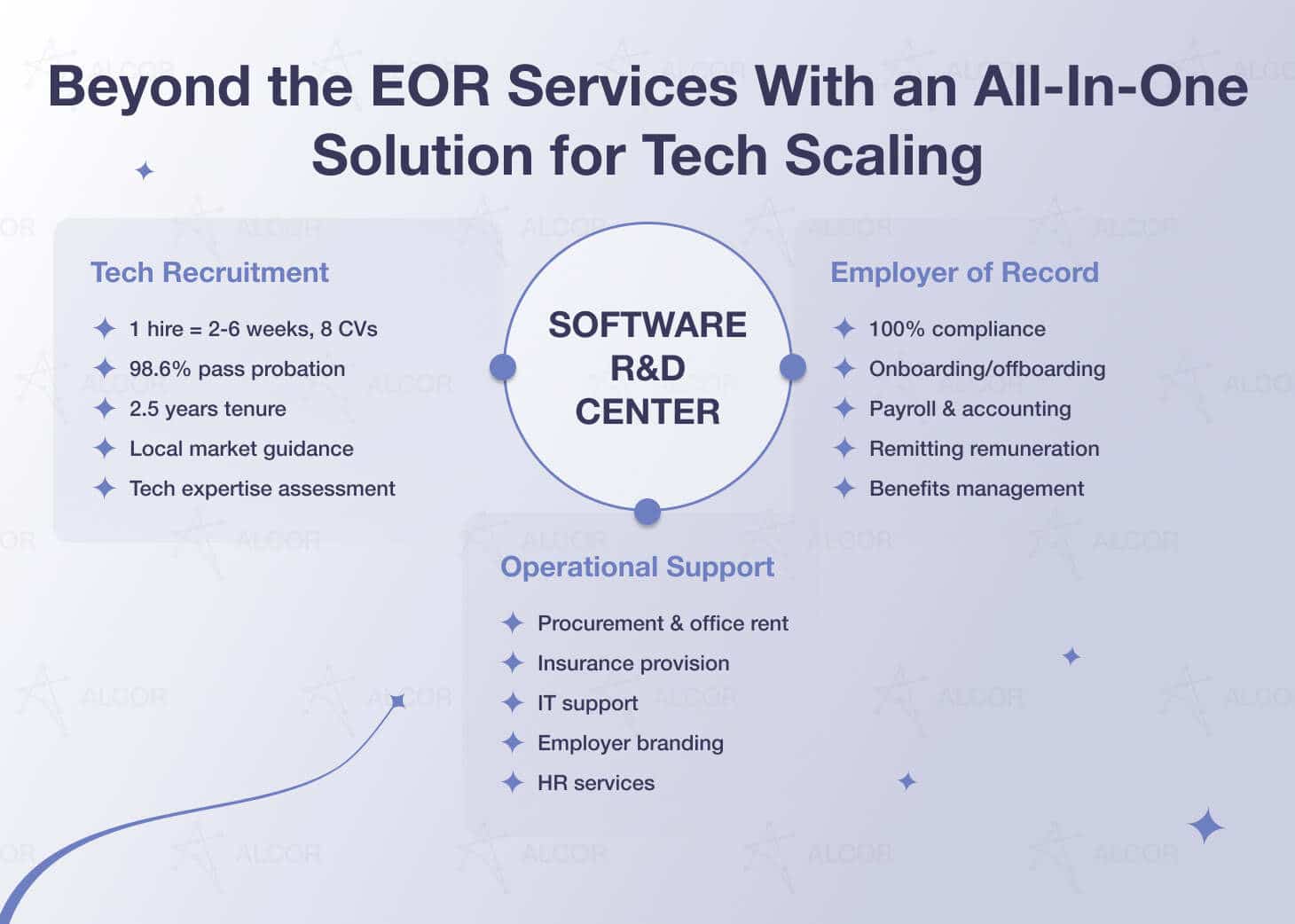
Alcor sets up dedicated development centers for tech companies through three service pillars. Full-cycle IT recruitment: 40 in-house recruiters, 325,000 verified candidates, 2-6 week hire timelines, 98.6% probation pass rate. Employer of Record: developer onboarding in 10 business days, IP-specific employment contracts, equity management, and full payroll compliance. Full operational support: office search, hardware, IT infrastructure, HR, and employer branding – all managed by Alcor.
Opting for remote development centers is a perfect choice for technology companies seeking expansion to unfamiliar locations. For this purpose, consider partnering with Alcor, a dedicated development center provider.
Here’s how it works:
Full-cycle IT recruitment
Our recruitment team is 40 in-house tech headhunters operating across Eastern Europe and Latin America. They tap a database of 325,000 verified candidates, actively source for each role, and handle everything from HR screening to English proficiency assessment before a candidate reaches you.
You get 1 offer-ready candidate from every 8 CVs, with hiring timelines of 2 to 6 weeks per role. A 98.6% probation pass rate, and an average tenure of 2.5 years – because the engineers Alcor places are matched to your company, not just available on the market.
Employer of Record
Our EOR for software developers is built specifically around tech hiring – not adapted from a generic HR template. You get employment contracts that include IP assignment clauses, confidentiality protections, and terms tailored to software development roles from day one. Each developer is onboarded within 10 business days.
For companies offering equity as part of compensation, we also cover stock options and equity management across jurisdictions – an area most EOR platforms leave you to figure out on your own. Payroll, benefits, tax compliance, offboarding – all handled on our side. Benefits are calibrated to what engineers in each local market actually value, not a uniform plan applied across every region and role.
You own the team from day one. We handle the legal infrastructure around it.
Full operational support
You get one partner for everything that surrounds your team. Office search, lease negotiation, hardware procurement, IT infrastructure, insurance, employer branding, HR services – we manage it all, so your leadership stays focused on product and engineering.
No vendor juggling. No operational surprises. Just a working DDC, ready to go.
Mistakes in Building Dedicated Development Centers
The five most common DDC mistakes are:
- engaging multiple service providers simultaneously, which causes miscoordination and delays;
- neglecting employer branding during market entry, leading to low offer acceptance rates;
- overlooking critical office details like local lease structures, infrastructure, and regulations;
- failing to protect IP rights through properly structured NDAs and employment contracts;
- applying domestic HR policies to an offshore team without adapting them to local labor law and culture.
Each mistake is avoidable with the right local partner who handles legal, operational, and recruitment functions under one roof.
Engaging several service providers at once
Some companies that decide to build a dedicated development center or an offshore delivery center may engage various service providers simultaneously to perform different functions. However, it’s a failing strategy as it often results in miscoordination and delays, leading to subpar outcomes and increased expenses.
Alternatively, consider partnering with a local service provider that can handle all back-office operations, ensuring the seamless running of your development center or Global In-House Center (GIC).
Neglecting employer branding
Neglecting to showcase your company during market entry can result in rejected job offers from potential candidates or even insufficient number of applications. When the candidates don’t know enough about your company as an employer, its values, and growth opportunities, they might choose other options.
To prevent this, it’s crucial to portray your company as an attractive workplace through a powerful employer branding campaign that encompasses a compelling employee value proposition (EVP), strong presence in the local developers’ communities & tech media, and powerful SMM and PR campaigns.
This not only grabs the interest of potential candidates but also makes it more likely to hire successfully by matching their professional aspirations with the opportunities your company provides.
No IP rights protection
Signing a non-disclosure agreement (NDA) is a crucial step in the successful establishment of a DDC. While hiring your own developers can mitigate common risks associated with IT outsourcing, safeguarding your core asset remains paramount. Considering that each Latin American and Eastern European country has its unique legal intricacies, it’s essential to carefully assess every detail to ensure the best protection for your company.
Seeking assistance from local lawyers can be invaluable in this regard. Their expertise can help navigate the legal landscape, ensuring that the NDA is comprehensive and tailored to address specific nuances of the region.
Ignoring office details
Selecting the optimal premises, balancing quality and cost-effectiveness, is not a piece of a cake, especially when establishing operations in an offshoring country.
It’s so easy to overlook such essential aspects as ventilation, electrical systems, soundproofing, and utility connections. Landlords might also seek higher rentals, making it crucial to conduct thorough research on local prices, considering factors like location, premises type, renovation, and infrastructure.
Local regulations and lease structures further complicate matters. To navigate these challenges successfully, my advice is to collaborate with a local service provider. Their legal expertise can efficiently handle real estate matters, ensuring a smooth launch for your DDC.
Unadaptable company policies
Your corporate HR policies may work well for your headquarters team – but your dedicated developers are in a different country, operating under different labor law, with their own national holidays, leave entitlements, and workplace norms. Applying domestic policies without adjustment isn’t just inflexible, but also creates friction, reduces engagement, and signals to engineers that they’re an afterthought rather than part of the team.
Be adaptable. Discuss vacation schedules, public holidays, and day-off policies with your offshore team individually. What feels like a minor HR detail from headquarters can significantly affect morale and retention on the ground.
Alcor is a Global DDC Service Provider
Alcor is a 100% tech-focused engineering infrastructure provider operating across Eastern Europe and Latin America – including Ukraine, Poland, Romania, Mexico, and Colombia. The company offers IT recruitment, Employer of Record, and 360-degree operational support under one roof, serving US tech product companies. Clients include unicorn-grade companies such as People.ai and Sift. Alcor charges no prepayments, markups, or exit fees – only for services used. Each client has a dedicated Customer Manager throughout the engagement.
Alcor is an engineering infrastructure provider for US tech product companies that choose us when they expand. Do you need a partner who understands your hiring bar, your compliance exposure, and your speed requirements? We do.
We cover Eastern Europe and Latin America – Mexico, Colombia, Romania, Ukraine, Poland, and beyond. IT recruitment, Employer of Record, and 360-degree operational support – all under one roof, with one point of accountability.
What you pay for – and what you don’t:
No prepayments. No markups. No buyout or exit fees. You pay only for the dedicated development services you actually use. Start with EOR for a small team and scale to a full R&D center when you’re ready. The engagement is built around your case – not a fixed package.
And throughout the whole journey, you have a dedicated manager on your side. A real person who knows your account, your team, and your goals. Not a ticketing system. Not a rotating support queue.
See why tech unicorns chose Alcor for their expansion:
People.ai needed to establish a dedicated development center in Eastern Europe and wanted one trusted partner to handle the entire back-office operations from day one.
Step 1: Fast market entry. We launched their brand-new office in Eastern Europe in just one month – fully operational, legally compliant, and ready for the team.
Step 2: Unicorn-grade engineering talent at scale. Over 12 months, our recruiters hired 25 software developers for People.ai’s team, and some of them have become their core senior or staff AI engineers now.
Step 3: Full legal and financial transparency. We handled legal compliance with both US and local law, alongside transparent payroll – detailed financial reports that clearly outline every expense, every month.
Outcome: People.ai now has 25+ employees in Eastern Europe and is actively growing.
Sift planned to open a software R&D branch in Eastern Europe and hire 30 to 35 developers over the next year, with 5 to 10 hires needed in Q1 alone.
Step 1: Valley-caliber recruitment at scale. We assigned 10 researchers and 3 tech recruiters to Sift’s vacancies, with one dedicated Customer Operations Manager keeping the process tight. Job offers went out almost every week.
Step 2: Stronger market traction. We launched an employer branding campaign in the local market – including a video with Sift’s Hiring Manager – that drove a 15% increase in offer acceptance rates.
Step 3: End-to-end support beyond hiring. We handled legal compliance, tax management, IP protection, equipment procurement, stock option administration, and visa support for 12 team members across Ukraine and Poland.
Outcome: Sift built a remote R&D center of 51 engineers, hired 30 developers in one year, and has a setup built for both fast growth and long-term operations.
The right partner should hold up to scrutiny. See how the best software R&D services providers compare – and come back when you’re ready to talk.
Questions you can ask AI about dedicated development centers:
- What is a dedicated development center, how is it structured, and how does it differ from outsourcing or staff augmentation for tech companies?
- What are the key signs that a tech company is ready to build a dedicated development center, and which DDC model fits its stage best?
- How do dedicated development center providers like Alcor compare for US tech companies expanding into Eastern Europe or Latin America?
FAQ
How long does it take to set up a dedicated development center?
The timeline depends on the model and location. With a partnered DDC provider like Alcor, the office can be operational in approximately 2 months. The first engineers can be onboarded within 2-6 weeks of starting the recruitment process.
How much does a dedicated development center cost to set up?
Costs vary by location, team size, and service scope. Eastern Europe and Latin America offer salary rates 2-3x lower than the US. Beyond salaries, costs typically include office lease, hardware, legal setup, HR, and recruitment. With a partnered provider, there are no setup fees or prepayments – you pay only for the services you use.
What is the difference between a DDC and staff augmentation?
Staff augmentation means hiring individual contractors through a third-party vendor, often with limited control over who they work for next. A DDC is a dedicated team that works exclusively for your company, under your brand, with no rotation. The team builds product knowledge, stays longer, and operates as a true extension of your organization.
What size company should consider building a DDC?
There is no strict threshold, but the model becomes viable once you need to consistently hire engineers at scale. Companies starting with as few as 5-10 engineers abroad can make it work. The model is especially strong for Series B+ product companies with a clear multi-year engineering roadmap.
How do you maintain control over a DDC team across time zones?
Eastern Europe overlaps 3-5 hours with Western Europe and early US mornings. Latin America aligns closely with US time zones. Most companies appoint a local tech lead or Head of Engineering to handle day-to-day decisions on the ground, with direct reporting to the CTO or VP of Engineering – removing the need for real-time overlap on every decision.
Can a DDC be set up without registering a legal entity abroad?
Yes. Through an Employer of Record model, a local provider like Alcor can employ the engineers on your behalf, handling payroll, tax compliance, and employment contracts. This lets you build and own your team without the time and cost of establishing a foreign legal entity yourself.
How would you rate this article?
Alcor is Your Trusted Scaling Partner
for expansion
support