


The best offshore outsourcing examples are software development hubs of WhatsApp, Google, Backstory (ex People.ai), Pindrop, and Franki in Eastern Europe and LATAM. These tech companies were able to build fully owned engineering teams, reduce salary spending by up to 50%, and develop great products.
With global IT spending set to hit $6.37 trillion in 2026, largely driven by AI infrastructure investment (as of Gartner), engineering budgets are under greater pressure than ever to stretch further. So, more US tech product companies will be turning to regions like Eastern Europe and LATAM to get Silicon Valley-caliber engineers without the Silicon Valley price tag.
I’m Dmytro Ovcharenko, founder and CEO of Alcor, your ultimate strategic partner for building offshore R&D centers in LATAM and Eastern Europe. We know how to scale your engineering team from 0 to 30 experts in 90 days, accelerating development and delivering greater value to your business processes. You stay 100% compliant, without spending time on payroll or dealing with operational headaches because we take care of it all.
In this article, you’ll get some insights into how to offshore software development and explore both triumphant and not-so-good outsourcing and offshoring stories. That will spare you painful lessons and help you adopt only the best business practices for your tech product company.
Key Takeaways
- Offshoring means moving part or all of your business operations abroad to access better talent, reduce operational expenses, and scale faster.
- Offshore software development is a smart move when your company is mature, you need to develop your product long-term, or you want to work with skilled talent without IP rights risks.
- Among successful offshoring examples are Amazon, Google, WhatsApp, Lyft, Spotify, Netflix, Franki, Backstory, Pindrop, BigCommerce, Dotmatics & more.
- Offshoring can backfire without the right strategy. Think inflated fees, mismatched talent, or weak local hiring impact. Success depends on choosing the right location, having full cost clarity, and working with external service providers who understand your business needs.
- Alcor’s all-in-one software R&D center solution helps you offshore without the usual risks. Hire senior engineers in 2-6 weeks, stay fully compliant, and get all the ops covered without vendor juggling, admin struggles, and overpayment.
What is Offshoring?
Offshoring is the practice of moving part or all of a company’s business operations to another country to access larger talent pools, reduce costs, and scale more efficiently. Companies can offshore by outsourcing work to an international provider or by building their own captive team or R&D center abroad, which gives them greater control over people, processes, and product development.
Offshoring involves the relocation of a whole or a part of the business to a different country to access higher-quality services, access larger talent pools, and obtain scalability opportunities.
Offshore outsourcing means contracting out services like software development, design, or testing to international partners, for example, in Eastern Europe or LATAM. It lets companies boost cost efficiency while still getting top-tier engineering teams.
There are some other options:
- Certain companies go the captive offshoring route. They set up their tech R&D hubs abroad to retain full control over offshore operations while still benefiting from cost arbitrage.
- Other global businesses experiment with right-shoring, strategically placing teams across different geographies to balance price, time zones, and specialized skills.
- A few explore reshoring, bringing operations back home.
However, the reality is: if done right, offshoring still delivers unmatched flexibility and value for growing tech businesses.
When to Use Offshore Software Development Services?
Offshore software development works best when you need to access scarce tech talent, reduce engineering costs, or scale a product team for the long term. It can also be a good fit for mature tech companies expanding globally, VC-backed startups accelerating product development, and businesses offshoring maintenance, support, testing, or other functions. The right model should also protect your IP and give you sufficient control over your engineering team.
Your business is mature
Once your company boasts a solid client base and maintains consistent yearly revenue growth, your business strategy can accommodate offshoring. At this point, you can tally the potential tax savings and lower labor costs you will get with the move and weigh its fit within your business model.
Learn more about the European tax rates vs US taxes and how much you can save on taxes alone.
You need maintenance & support
Picture this: your products and services are fully fleshed out and rigorously tested. Now, scaling up requires ongoing maintenance and support, and offshoring is an excellent means of handling these business functions. One vivid example of that is offshore Salesforce development. Notably, you’ll only divulge data related to product deployment, safeguarding your source code.
The project does not involve IP
IP rights often stand in the way of offshoring, as you play with fire when exposing sensitive data like codebases or customer information to third parties. A notable example is the Versata vs Sun Microsystems case, where an outsourcing partner later claimed ownership of the delivered software and sued for over $100 million. Certain offshoring models, however, offer secure data protection. But if you don’t want to bother with this, choose non-IP-based projects. Think operational support-centric tasks, testing, or design – lower costs, zero risk, access to specialized skills, no IP concerns.
It is a long-term plan
Offshoring is rarely a good fit for short-term projects. Entering a new market takes time and resources, whether you’re setting up a legal entity or partnering with a vendor to build a team. For companies looking for quick results without the overhead of team or project management, the effort typically outweighs the benefits.
On the other hand, for tech product companies focused on building or scaling their tech product, offshoring makes more sense when approached as a long-term business strategy. After all, maintaining and evolving a product is an ongoing process that lasts as long as the company itself.
You lack skilled talent at home
According to McKinsey, only 16% of executives feel confident in their current pool of skilled professionals to support digital transformation. Meanwhile, 60% cite the lack of tech skills as a major roadblock. Even with the rise of generative AI, there’s no indication that demand for engineers is slowing down. As the US prepares for a 7-million tech talent gap by 2034, the pressure to find qualified developers will only intensify.
That’s why many tech product companies look abroad at global talent when they can’t find it at home. However, offshoring top tech talent is not a dime a dozen. In fact, it’s increasingly challenging to find. Our company’s research shows that an effective solution to this issue is to build a dedicated offshore development team under the R&D center. It implies launching an office in a different country while benefiting from local tech expertise and lower costs. The software R&D team is yours from the very beginning, which means it is a secure and scalable approach to managing offshore operations with minimal risk. Finally, your back office and legal business functions are also handled.
Startups and offshoring
Startups are increasingly offshoring to build their first tech teams or speed up development without draining resources. With 31% of US full-time employees now working remotely (Gallup), offshoring feels like a natural extension. However, hiring senior engineers in-house in the US can be:
- Expensive – A mobile app team (PM, UI/UX, Mobile Dev, Python Dev, QA) can cost $642,000/year, according to our company’s internal data
- Slow – 6+ months to hire just one developer
That’s why startups are choosing offshoring. Take GoTransverse, a US-based product company: they quickly built a senior full-stack dev team of 6 in 6 weeks with Alcor in Eastern Europe to boost delivery, while increasing cost efficiency and keeping their internal focus on core competencies. And it’s all while maintaining the same tech service quality as in-house teams.
12 Successful Offshoring Examples
Successful offshoring examples include WhatsApp, Google, Amazon, Lyft, Dotmatics, BigCommerce, Backstory, Pindrop, Spotify, Netflix, Franki, and Briq. These companies expanded into Eastern Europe or Latin America to access specialized talent, scale teams faster, reduce engineering costs, and support global growth. Their cases show that offshoring works best when companies choose the right market and maintain strong control over their product, talent, and operations.
There’s a whole checklist to tick off before diving into the offshoring journey. But the big question is: “Where to offshore?” Eastern Europe and Latin America stand out as advantageous offshoring regions, and the list of real success stories below provides concrete evidence to back this up.
1. WhatsApp
Offshoring enables your in-house tech team to focus on the most relevant challenges for your business. The WhatsApp launch is a textbook offshore outsourcing example done right. Just before it was released in 2009, the company offshored its software development to Eastern Europe. Despite time zone differences, which were resolved through a clear delivery structure, WhatsApp relied on overseas talent with specialized skills to handle the tech groundwork, provide design solutions, and take care of core operations in app development. Its engineers concentrated on specific tasks related to clients, such as customer support.
This strategic division paved the way for WhatsApp’s rise to the top of both the App Store and Google Play. This situation forced Facebook to face its formidable rival by acquiring WhatsApp for a staggering $19 billion – the largest acquisition at the time for a venture capital-funded company.
2. Google
Google joined the ranks of successful offshoring companies in 2020 by venturing into Eastern Europe. They established a software development team through the acquisition of CloudSimple. Despite Google having the world’s largest team of developers, this move highlights their passion for advancement and innovation. CloudSimple, now part of Google Cloud, enhances its VMware migration solution. Undoubtedly, specialized expertise wasn’t lacking. Offshoring significantly slashed business process expenses, thanks to lower labor costs and taxes, which wouldn’t be possible if they continued with only onshore delivery center services.
3. Amazon (Ring)
Amazon also leveraged offshoring for expansion, acquiring the startup Ring in 2018. Ring boasted a programming staff in Eastern Europe specializing in outdoor home security solutions. As expected, this deal boosted Amazon’s competitiveness in the market. Alcor was happy to provide them with accounting services and payroll outsourcing.
That’s how, within a year, Amazon formed a second offshore development crew in the region, cutting time-to-market and overall operational costs.
4. Lyft
Another standout example of offshoring in action is Lyft, the US-based ride-sharing company dedicated to crafting innovative customer experiences. Seeking to elevate product development and tap into Eastern Europe’s exceptional engineering talent, Lyft established a software team in the region in 2021.
Currently, the company’s crew consists of 20 programmers and is expected to grow to 100. Their Eastern European software developers are instrumental in data mapping and improving Lyft’s services.
If you are also in need of Eastern European tech talent, consider Alcor as a recruitment services provider.
5. Dotmatics
Dotmatics represents another offshoring success story. This US scientific software company was looking to expand its engineering team beyond the US, Ireland, and New Zealand. With traditional outsourcing off the table, they chose Eastern Europe and partnered with Alcor to build a high-performing R&D team. We adjusted their vacancies for the local market, launched an executive tech search, and assigned 4 headhunters and a key account manager. Within 5 days, Dotmatics received the first CVs. In under a year, we hired 30 top engineers, including a Director of Engineering, Full Stack Developers, QA, and DevOps.
Having a dedicated offshore team in EE allowed Dotmatics to stay true to its internal business practices and hit major milestones, including a $5.1 billion acquisition by Siemens in July of 2025. Moreover, Dotmatics’ engineers received stock options, proving once again how valuable this benefit is.
Planning to offer equity to your offshore engineering team? See how to split shares in a startup company among founders, employees, and other stakeholders while keeping the process compliant and stress-free.
6. BigCommerce
Among the examples of companies that chose offshoring, there is also the thriving experience of BigCommerce. It’s a tech product company that provides innovative solutions for E-commerce businesses. Their attempts with outsourcing firms in Romania and Ukraine proved exhaustive and unproductive: developers were shared across clients, with no dedicated focus or long-term commitment. Turning to a partner that builds tech R&D centers for cost-effective solutions, they partnered with Alcor to develop their product and establish a proficient software development team.
We were pleased to provide comprehensive support for BigCommerce’s expansion in Eastern Europe. See rapid growth for yourself: our client’s team exceeded 30 developers in just 6 months, later scaling to 50!
7. Backstory
Backstory (ex People.ai), a software product company specializing in B2B sales acceleration through ML technologies, exemplifies another successful offshoring business case. Seeking rare engineering talent for AI algorithm development, the San Francisco-based company opted to establish a development team in Eastern Europe and delegated all back-office operations, including legal, finance, and administrative tasks, to Alcor.
Our real estate managers prepared a perfect location, and legal and finance teams offered the most beneficial structure for doing business in EE, while Alcor’s tech recruiters were searching for top tech specialists.
As a result, we launched a fully equipped R&D office in 1 month and scaled their engineering team to 50 professionals who became part of their core AI team.
8. Pindrop
Pindrop, an Atlanta-based voice security and deepfake detection company working with 8 of the 10 largest US banks, had already been running an engineering team through an outsourcing vendor until the arrangement started working against them. IP ownership sat in a grey area, senior-rate invoices covered mid-level output, and buyout fees turned a simple exit into a negotiation.
Pindrop wanted the opposite: a true in-house team reporting directly to them, built in Eastern Europe, where a Senior Director of Engineering they already trusted was based. With no legal entity or recruiting infrastructure in Ukraine, they partnered with Alcor to build it from scratch.
Alcor sourced from its 325K-candidate pool, closing Software Engineer and Cloud Engineer roles in 6 weeks and averaging 8-10 weeks across the board. Plus, we fully covered the admin layer, including tailored B2B contracts, NDAs, on-time payments, and tax documentation handling. The result: a fully owned team of 30 senior engineers, 100% of whom passed probation, with zero buyout fees and full IP control. Pindrop has since chosen to keep scaling in Ukraine over the US for every subsequent hire.
Struggling to find senior AI Engineers?
Discover 8 AI talent markets across LATAM and Eastern Europe, with data on talent availability, salaries, compliance, and team setup to help you choose the right location for your team scaling.
9. Spotify
Another inspiring offshoring case study is Spotify, which extended its operations to Latin America in 2013, a location that minimizes time zone differences with US headquarters. Beginning with Mexico, Spotify’s prime location in terms of client base, the company expanded into Brazil and other countries, reaping substantial rewards and expanding its footprint in the global economy. Notably, Chile emerged as one of Spotify’s fastest-growing markets, earning praise from its founder, Daniel Ek, who aims to replicate Chile’s success in other countries. Spotify’s main driver was scaling and competing, so the company set its sights on promising markets and started making deals with music rights holders.
Over time, it assembled high-performing legal and business teams in the chosen locations. Now, Spotify’s impact on LATAM can’t be denied. Since their expansion, there’s been a 986% surge in Latin music listeners from 2014 to 2023, constituting one-fifth of Spotify’s global base.
10. Netflix
A tech giant, Netflix, unsurprisingly tops most offshoring companies’ lists. Like Spotify, Netflix experienced explosive growth upon entering the Latin American market in 2011. With 23 million subscribers initially and a potential audience exceeding 600 million, Netflix’s offshoring business case commenced in Brazil, followed by Argentina, Chile, Colombia, Mexico, and 38 other regional markets. Local production in all of the markets was pivotal to Netflix’s triumph. By relying on local insights and teams, Netflix took over LATAM.
However, such expansion also dovetailed with the fast-growing nature of the market itself. Presently, Netflix thrives as one of the leading foreign companies in Mexico and Brazil – it reached 12.2 and 14.4 million subscribers by the end of 2023, respectively. Moreover, Netflix’s subscriber base is expected to grow by another 15% to 52.3 million users in the region by the end of 2027.
11. Franki
Among the recent offshore outsourcing examples is the LA-based experience app company Franki. Every outsourcing path this tech company explored had the same flaw: developers whose real relationship was with a vendor, limited product oversight, and no way to build cultural alignment with the LA team. So instead, Franki decided to build its own engineering team in Mexico, with Alcor handling recruitment and compliance from day one.
Alcor built a pipeline of 20 qualified candidates for a notoriously thin talent pool of senior iOS engineers with RxSwift and closed the first 7 hires (2 iOS, 3 Android, 2 QA) in 4-5 weeks on average, with 100% passing probation and no buyout fees. All of them were supported under Alcor’s EOR model with full legal and admin coverage.
12. Briq
Briq, a Santa Barbara-based AI automation platform for the construction industry, wanted to expand its engineering team into Mexico, but had no legal entity, no local payroll, and no compliant way to hire contractors without risking misclassification under Mexican labor law.
Rather than coordinating a recruiter, a payroll platform, and legal counsel separately, Briq partnered with Alcor, which already had compliant infrastructure running in Mexico. Every hire was structured as a compliant B2B contractor engagement, reviewed specifically to close off misclassification risk before a single contract was signed.
Alcor closed 5 Automation Java Developer roles and then a Middle Support Engineer role, 7 hires in total, averaging 39 days each. When one hire resigned four days in, Alcor absorbed the cost and backfilled it at no charge. Those engineers are now contributing to Otto, one of Briq’s strategic product initiatives.
Among other successful offshoring companies that decided to hire developers in Eastern Europe are also Reddit, Samsung Electronics, Oracle, and Huawei.
6 Examples of Global Businesses Offshoring that Went Bad
Offshoring can fail when tech companies choose the wrong provider or location, overpay through hidden fees, split operations across too many vendors, or overlook local hiring and employer branding needs. Poor technical screening, weak industry expertise, unclear costs, and inadequate compliance or operational support can turn expected savings into delays, legal risks, and higher expenses.
Telecommunication company & wrong choice of provider
Let’s talk about a major telecom giant that fell prey to a disastrous outsourcing decision. They joined forces with an Asian service provider that was great at coding but clueless about telecom nuances. Result? Hours wasted on futile business app development. Instead of minimizing risks, the vendor magnified problems. The provided IT services were so dismal that the company decided to return to the in-house engineering team.
Consequently, the client faced only financial difficulties and a stressful legal process battle with the offshore partner. It is a living example that shows how crucial the choice of vendor could be. It’s essential to select a service provider with the proper expertise and track record.
Product company & overpayment
Not long ago, we were approached by a client who had an unpleasant example of offshore outsourcing. It turned out that for months, they were victims of crooked offshoring companies. Examples of fraud are striking. For instance, they were paying a fee for mid-level engineers more than twice the average payment for such a specialist in Eastern Europe. What is more, there was no transparency on rent and utility costs, office equipment, and furniture.
If your goal is to reduce costs and then reinvest your savings in product elaboration, for instance, blind invoice payment is not the best option for you. Contrary to that, taking the reins by building your software team gives you control. Alcor can be your trustworthy guide when navigating an unknown business environment.
Machine learning company & multiple providers
One of Alcor’s clients, a US machine learning software product company, provided us with another example of offshore outsourcing that should not be followed. Before turning to us, the company started cooperating with several providers simultaneously. It resulted in utter confusion, as they ended up covering the same tasks simultaneously. Naturally, their offshoring stalled in the making.
Ultimately, the client came to Alcor and successfully got their tech R&D center services, but lost precious time. In offshoring, putting your eggs in different baskets doesn’t work out. The tip here is to choose your third-party service provider carefully and then stick with them to achieve faster results.
Healthcare app & no employer branding
One more example of offshoring business is one of our clients who struggled to recruit senior tech talent in Eastern Europe. Why? Their lack of name recognition in the new market made top engineers reluctant to join. Enter Alcor, swooping in with employer branding solutions. After a full cycle of marketing promotions, including SMM services and PR activities, the company became renowned in the local market.
The next step of cooperation with Alcor was the launch of an offshore development center or an Offshore Captive Center with our comprehensive support. It was a happy ending with effective office management, arranged legal and financial operations, and a brilliant team of software developers.
Tech company & a generic EOR platform
One tech product company came to us after a rough year with a big-name global EOR platform. On paper, it checked every box: dozens of countries, a self-serve dashboard, instant quotes. In practice, it was a payroll processor wearing a recruitment hat: no dedicated sourcing, no technical screening, and every support request routed through a ticket queue with a multi-day response time. Payroll runs were inconsistent month to month, and when a compliance filing error surfaced, resolving it took weeks of back-and-forth with no dedicated point of contact.
The bigger cost was buried in the fine print: mandatory advance payments and security deposits before onboarding even started, plus FX conversion charges on every payroll cycle that quietly ate into the savings the platform had promised. What looked like the cheapest option going in became one of the more expensive ones once the fees were added up.
The lesson: an EOR platform’s country count and dashboard don’t matter if payroll execution is inconsistent and the real costs like deposits, FX markups, and advance payments only show up after you’ve signed. Get full cost clarity in writing before onboarding, not after.
IT offshoring & inappropriate destination
Sometimes, tech enterprises miss the mark when choosing an offshore destination. Take an American company’s offshoring business example – a bid to expand its in-house team by hiring software developers in an Asian country. They were drawn to this destination’s vast pool of tech experts and cost-effective solutions, seeing it as a chance to save on labor expenses and scale rapidly.
But reality hit hard. Instead of getting fast and effective recruitment, they went through 20 job interviews, where only 2 engineers had outstanding programming and problem-solving skills. Others were junior-level coders who had overemphasized their experience in CVs and got into the interview. They possessed limited skill stacks, insufficient expertise, and low proficiency in English. To prevent product quality deterioration and avoid additional expenses, the American company stopped hiring in this location and found a different country as an offshoring destination.
Read our article on the BOT model in the IT industry to learn about an effective offshoring option!
8 Best Offshoring Software Development Destinations
The best offshoring destinations for software development include Mexico, Colombia, Argentina, Chile, Poland, Romania, Bulgaria, and Ukraine. These markets combine sizable tech talent pools, strong engineering skills, competitive salary levels, and established technology ecosystems. Latin America also offers convenient time-zone overlap with the US, while Eastern Europe stands out for deep technical expertise and mature software development hubs.
As I’ve already mentioned, Latin America and Eastern Europe lead the way in IT services. Both boast large pools of skilled workforce – over 2 million tech specialists in Eastern Europe and 2.3 million in LATAM. Senior engineers in both regions cost roughly half of what they do in the US – 50% less in Eastern Europe and 61% less in LATAM, according to Alcor’s 2026 engineer compensation research. Here’s what each market actually offers.
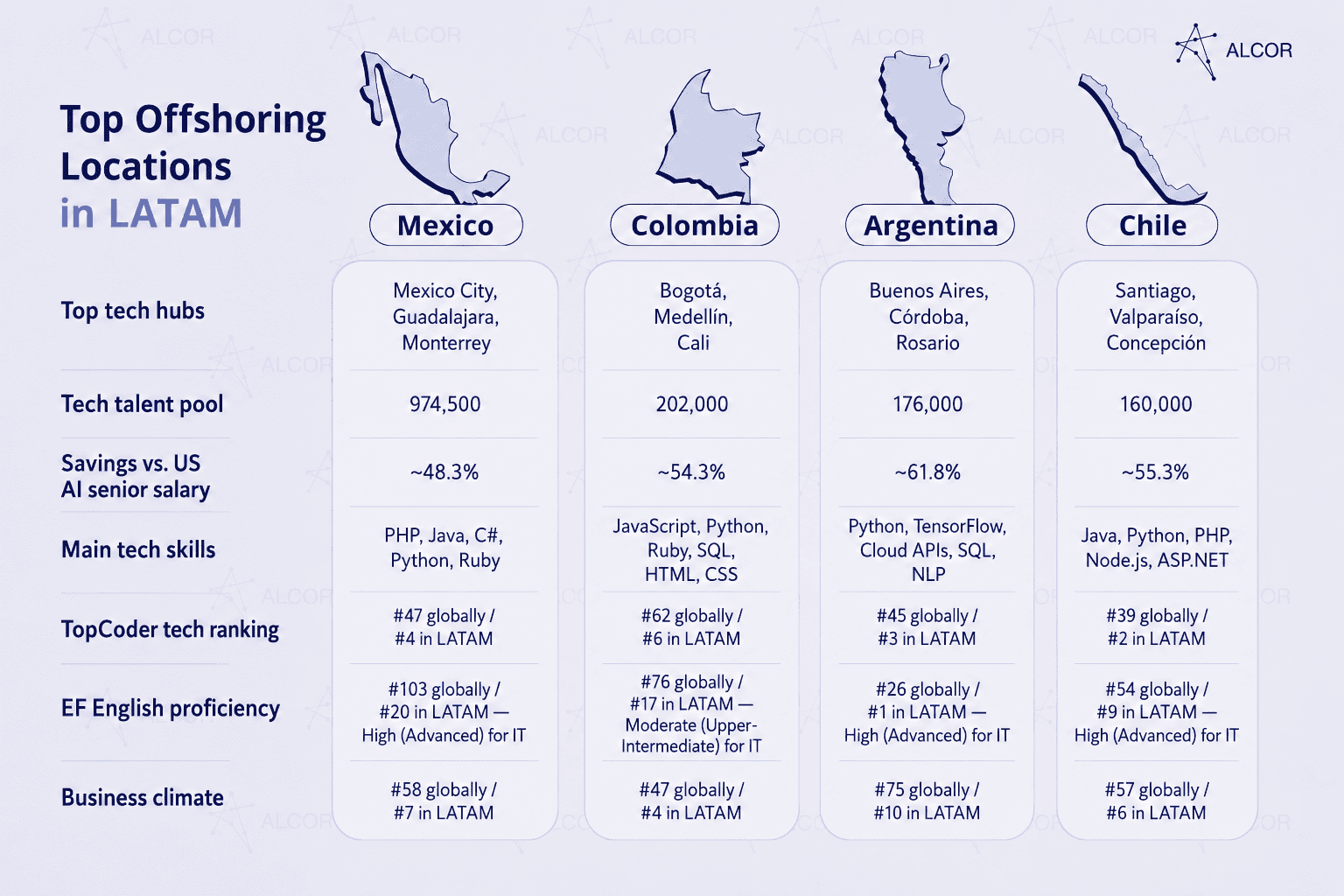
Mexico
The Mexican pool comprises 974,000 tech professionals skilled in data analytics and mobile application development, as well as JavaScript, Python, SQL, React.js, Angular, and C#. Their tech depth comes at LATAM pricing: according to Alcor’s 2026 engineer compensation research, senior AI engineers in Mexico earn 48.3% less than their US counterparts on average. A senior ML Engineer earns around $6,750/month, and a senior LLM Engineer around $8,000/month.
Mexico’s tech talent fuels the market’s steady growth: over 1,431 startups and 7 unicorns, according to the StartupBlink report, and its IT services are projected to grow to $20.04 billion by 2030. International giants support this development, with Amazon, Microsoft, and Google having committed $6.3 billion to AI and cloud infrastructure in its tech hubs.
Mexico City holds the largest tech workforce in LATAM, with over 300,000 experts, is home to roughly half of Mexico’s unicorns, and leads the region’s FinTech and AI scene. Guadalajara earns its “Silicon Valley of Mexico” nickname by producing systems-level engineers suited to MLOps and AI infrastructure work. While Monterrey ranks #1 among Mexican cities for English proficiency, making day-to-day collaboration with US product teams feel native from week one.
Mexico’s real edge, though, is time zone. Guadalajara and Mexico City run on GMT−6, delivering 3-4 hours of simultaneous real-time overlap with both US coasts – no overnight handoffs, no async lag. And the 2025 US tariff hike? Doesn’t touch digital services. Your software offshoring or nearshoring plans in Mexico stay just as efficient and tariff-free as before.
Colombia
Colombian tech hubs like Bogota, Medellin, and Cali have agglomerated 202,000 programmers who are experts in Python, JavaScript, C#, and Java, as well as increasingly in AI-assisted development. In fact, 91% of Colombian developers report daily use of AI coding tools, and 79% expect AI to significantly redefine their roles in the next few years, according to ColombiaOne. These tech experts obtain STEM degrees in highly esteemed institutions, as 12 Colombian universities are on the Best Global Universities in Latin America list.
According to Alcor’s 2026 engineer compensation research, senior AI engineers in Colombia cost 54.3% less than in the US on average: a senior AI Data Engineer runs around $7,750/month, and a senior ML Engineer around $6,500/month.
The ecosystem behind that talent is growing fast. Colombia drew $513 million across 104 deals in 2025, roughly 12% of all Latin American investment and third only to Brazil and Mexico. The country is home to over 2,124 top startups and 3 unicorns, with its IT services market on track to reach $2.87 billion by 2030, forecasted by Statista. Another staggering benefit of the Colombian business environment is its 100% tax deduction for R&D center services.
Argentina
Argentina’s tech talent pool comes in smaller than Mexico’s or Colombia’s at 176,000 tech professionals, but it leads in English proficiency – #1 in LATAM (#26 globally) on the EF English Proficiency Index. On top of English command, these software developers are skilled in Python, NLP, R, SQL, and Cloud APIs, ranking #3 in Topcoder across LATAM.
That capability comes at the steepest discount in LATAM, which makes Argentina a go-to LATAM location for offshore tech talent staffing. According to Alcor’s 2026 engineer compensation research, senior engineers in Argentina cost 61.8% less than in the US on average. The rates tend to run from around $5,250/month for a senior AI Prompt Engineer up to $9,250 for a senior AI Research Scientist.
The most prominent tech hubs include Buenos Aires, Cordoba, and Rosario. The country houses 1,031 top startups, including 2 unicorns, with an IT services market projected to reach $3.50 billion by 2030, and exports over $9.6 billion in knowledge-based services annually.
Chile
Chile’s tech talent pool is the smallest of the four LATAM markets at 160,000 tech professionals, but it’s the strongest in AI capability per engineer. Chile leads the region in AI development for the second consecutive year, scoring 70.5 on the Latin American Artificial Intelligence Index (ILIA) 2025 and ranks #1 in LATAM on the Global Innovation Index. On top of that, Chilean developers are talented in Java, Python, PHP, and ASP.NET, and excel in statistical and computer programming.
Still, they don’t charge premium rates. Senior AI engineers in Chile earn about 55.3% less than their US counterparts. For instance, a senior ML Data Scientist earns $8,000/month while an MLOps Engineer gets $7,750/month, according to Alcor’s 2026 AI salary research.
Home to 874 top startups, including 2 unicorns, Santiago is doing the heavy lifting, holding 85% of Chile’s startups and $7.3 billion in combined AWS and Microsoft cloud infrastructure investment. Valparaíso runs a smaller, focused mandate in generative AI, robotics, and biotech, while Concepción offers a lower-competition alternative for teams expanding past Santiago’s senior market.
Poland
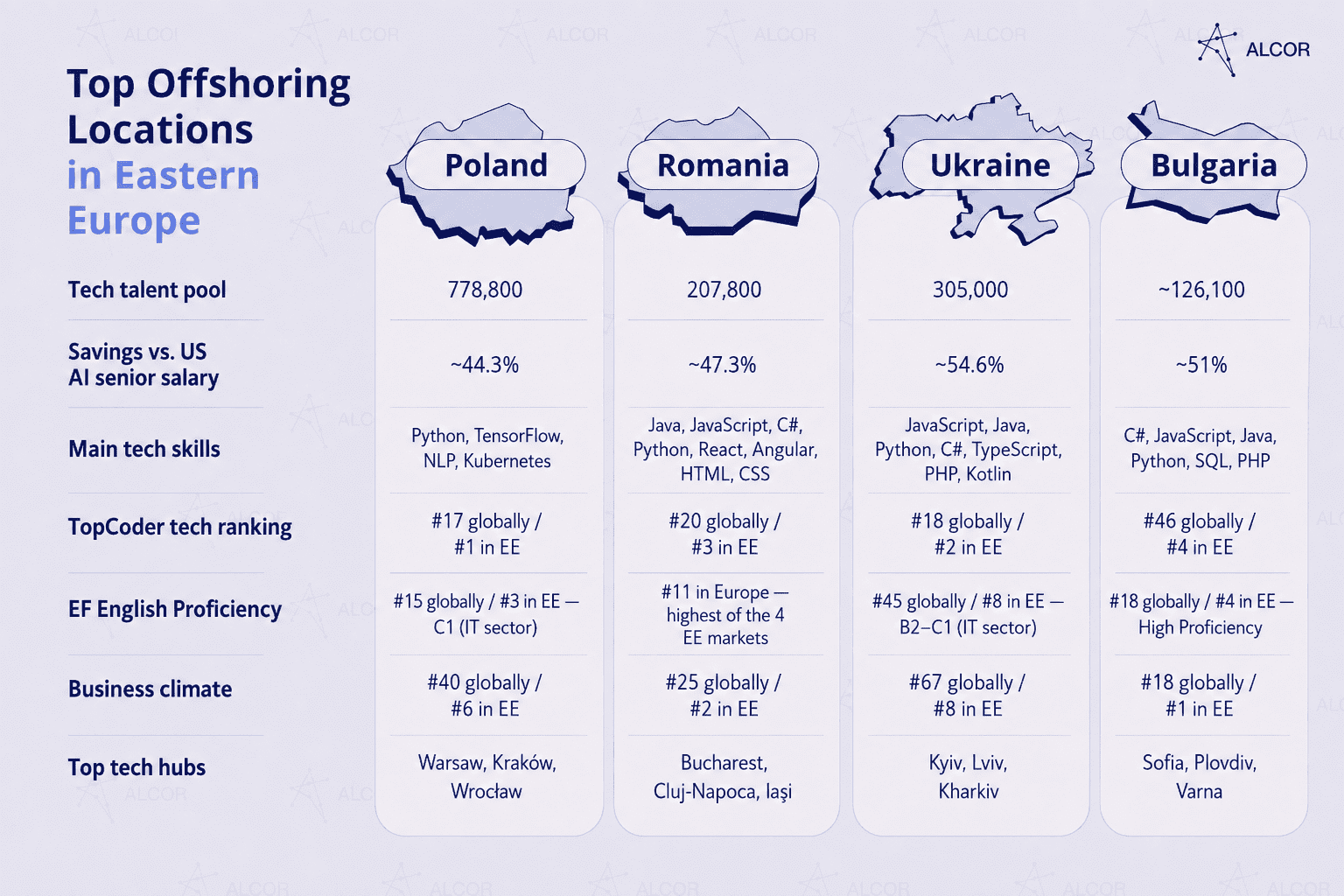
Poland has the biggest tech industry in Eastern Europe (EE). With over 778,000 ICT professionals, ranking #1 on Topcoder for tech skills, and the strongest business-climate rating (A2 on Coface’s scale), it’s a leading destination in EE for tech companies aiming to access mature talent and well-established infrastructure for their captive development center setup.
Local programmers are skilled in JavaScript, Java, Python, Ruby, Shell, PHP, and TypeScript, and rank #3 in the EF English Proficiency Index regionally. Each year, the country produces 74,000 STEM and ICT graduates every year, and 20 of its 500 higher education institutions rank in the QS World University Rankings 2026.
That caliber of talent comes at a real discount: senior AI engineers in Poland cost 44.3% less than their US counterparts. For example, a senior ML Engineer earns around $8,300/month, and an AI Agent Developer – $12,250/month.
Expanding tech companies can find senior and AI-skilled specialists across established tech hubs – Warsaw, Kraków, Wrocław, the Tri-City area (Gdańsk, Gdynia, and Sopot), Katowice, and Poznań.
Romania
With ICT service exports reaching $11 billion in 2024 and ranking #4 by the number of software developers in Eastern Europe, Romania is another go-to choice for business offshoring functions for Western companies.
This Eastern European country has a talent pool of over 207,800 software developers who are well-versed in PHP, Java, C#, JavaScript, React, and C++, and are #1 in English proficiency in EE. Senior AI engineers’ base salary in Romania is 47.3% lower than in the US, with MLOps Engineers receiving $8,300/month.
Bucharest holds more than half the country’s IT workforce alongside its EuroHPC AI infrastructure. Cluj-Napoca, often called the Silicon Valley of Romania, runs salaries roughly 10% below the capital around its own university-built GPU facility. And Iași, the most cost-efficient of the three hubs at roughly 20% below Bucharest, produces some of the country’s highest per-capita IT graduate output. The country houses 743 top startups, 3 of which are unicorns.
Bulgaria
Bulgaria has over 141,500 software developers, according to Eurostat, with strong command of JavaScript, Python, PHP, Java, and C#. These ICT specialists charge 51% less than their US counterparts. A senior LLM Engineer receives $7,500/month, while an AI Product Engineer of the same level gets $7,300/month. Regarding taxes in Europe vs the US, Bulgaria has one of the lowest corporate tax rates, at 10%. This combination of modest developer salaries and taxes makes it one of the most cost-effective offshoring locations in Eastern Europe.
Most Bulgarian developers reside in Sofia, which also holds 83% of the country’s startups, alongside offshore R&D centers for HP, SAP, Microsoft, and VMware. Plovdiv runs 10-25% below Sofia’s salaries. And Varna offers the lowest cost of living of the three, with rent running roughly 28% below Sofia. Bulgaria’s IT services sector is comparatively smaller, with the projection to reach $583.76 million by 2030.
Get armed with more info! Check out our article on outsourcing software development to Bulgaria!
Ukraine
Ukraine is resilient and highly digitalized: software development now contributes 6% of Ukraine’s GDP, up from 4.2% in 2021, and IT exports reached $6.66 billion in 2025 – the country’s largest services export and second-largest export category overall.
These impressive results are supported by Ukraine’s 305,000 ICT specialists – the second-largest pool in Eastern Europe. Skilled in JavaScript, Java, C#, Python, and PHP, they rank #2 on Topcoder in the region. The tech proficiency of Ukrainian developers doesn’t come with a high price tag, but quite the opposite. A senior AI Data Engineer gets $7,750/month. An MLOps Engineer receives $7,500/month. This is 54.6% savings on AI engineer salaries compared with the US.
As for its IT services market, it prospers with tech hubs in Kyiv, Lviv, Dnipro, Kharkiv, and Odesa, and will reach $4.95 billion by 2030. Kyiv holds 42% of the country’s tech workforce and hosts R&D operations for Google, Microsoft, Boeing, and Samsung; Lviv runs a close second with strong energy-resilience infrastructure and costs roughly 7% below Kyiv; and Kharkiv has rebuilt an IT cluster from 6 members to 650+ over a decade, concentrated in defense tech and systems engineering.
But how can you hire offshore programmers in Latin America or Eastern Europe to maximize the benefits for your tech product company?
Choose a Smart Offshore Outsourcing Strategy with Alcor’s EOR for Tech Model
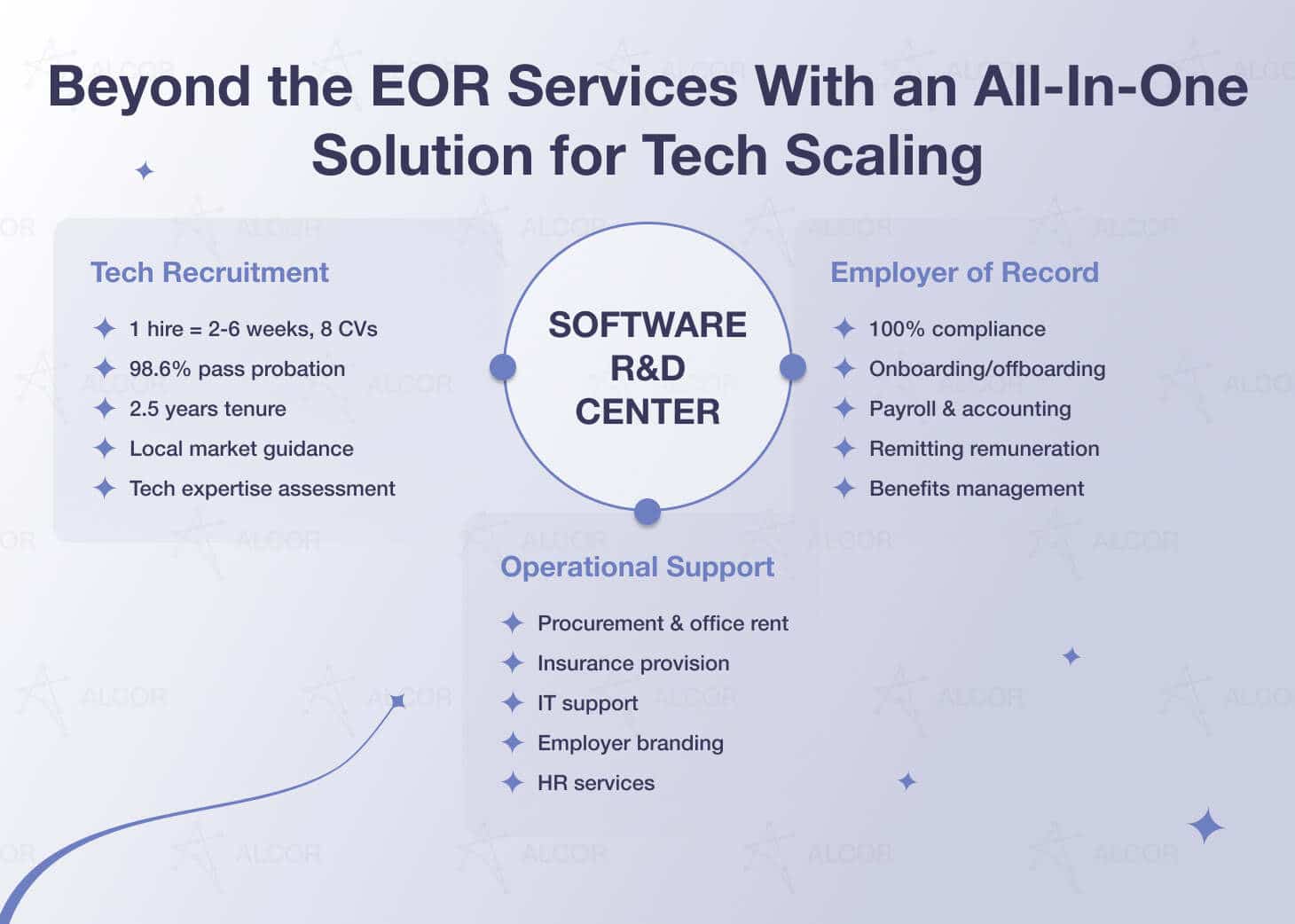
Alcor’s EOR for tech services, as part of the tech R&D center model, helps tech companies build in-house engineering teams in Latin America and Eastern Europe without opening a local legal entity. Alcor handles compliant employment, payroll, benefits, tech recruitment, and operational support, while the client retains control over hiring decisions, product development, and day-to-day team management. This approach reduces administrative and compliance risks while making offshore team scaling faster and easier.
Offshoring isn’t about handing off responsibility. It’s about making smarter decisions. That starts with choosing the right country, building a solid strategy, and partnering with someone who knows the local tech market.
With Alcor’s tech-focused Employer of Record services, you can build an in-house engineering team in LATAM or Eastern Europe fast without setting up a legal entity, worrying about compliance, or dealing with payroll headaches.
Why will you benefit from working with us?
- We employ your engineering team legally through our EOR model, so you’re not setting up your own entity, tracking local labor law changes, or carrying compliance risk yourself. You stay fully compliant under our Legal Shield while your team focuses on building the product.
- Our team of 40 tech recruiters draws from a vetted database of 325,000+ candidates, which is how we scale engineering teams from 0 to 30 senior engineers in 90 days.
- Once your team is in place and fully integrated, the engineers stay: our clients see a 98.6% probation pass rate and an average tenure of 2.5 years, built around long-term fit, not just fast placements.
- You get full operational support from day one. We handle office setup, hardware, and other essentials, so your team starts in a functional workspace that supports engagement and helps build team culture.
- With our all-in-one solution, you also get a dedicated Customer Ops Manager who supports your business operations end-to-end: from offshore payroll services to employer branding.
FAQ
1. How is offshoring helping tech companies?
With business offshoring technology businesses can deal with labor shortages on the local market, lack of in-house expertise, inability to manage non-core/administrative processes, necessity in business expansion, and attraction of new investment.
2. How can I offshore successfully?
If you want your company to be among triumphant offshoring business examples, you need to think of those business operations that you’d like to delegate, choose a destination with a good price-to-quality ratio, and find a reliable service provider.
3. Is it worth offshoring to Eastern Europe?
Eastern Europe and Latin America are both ideal destinations for offshoring since they have a mutual 3.8+ million talent pool, 2-3 times lower wages than in Western countries, more affordable taxes, convenient locations, and cultural similarities.
How would you rate this article?
Alcor is Your Trusted Scaling Partner
for expansion
support