


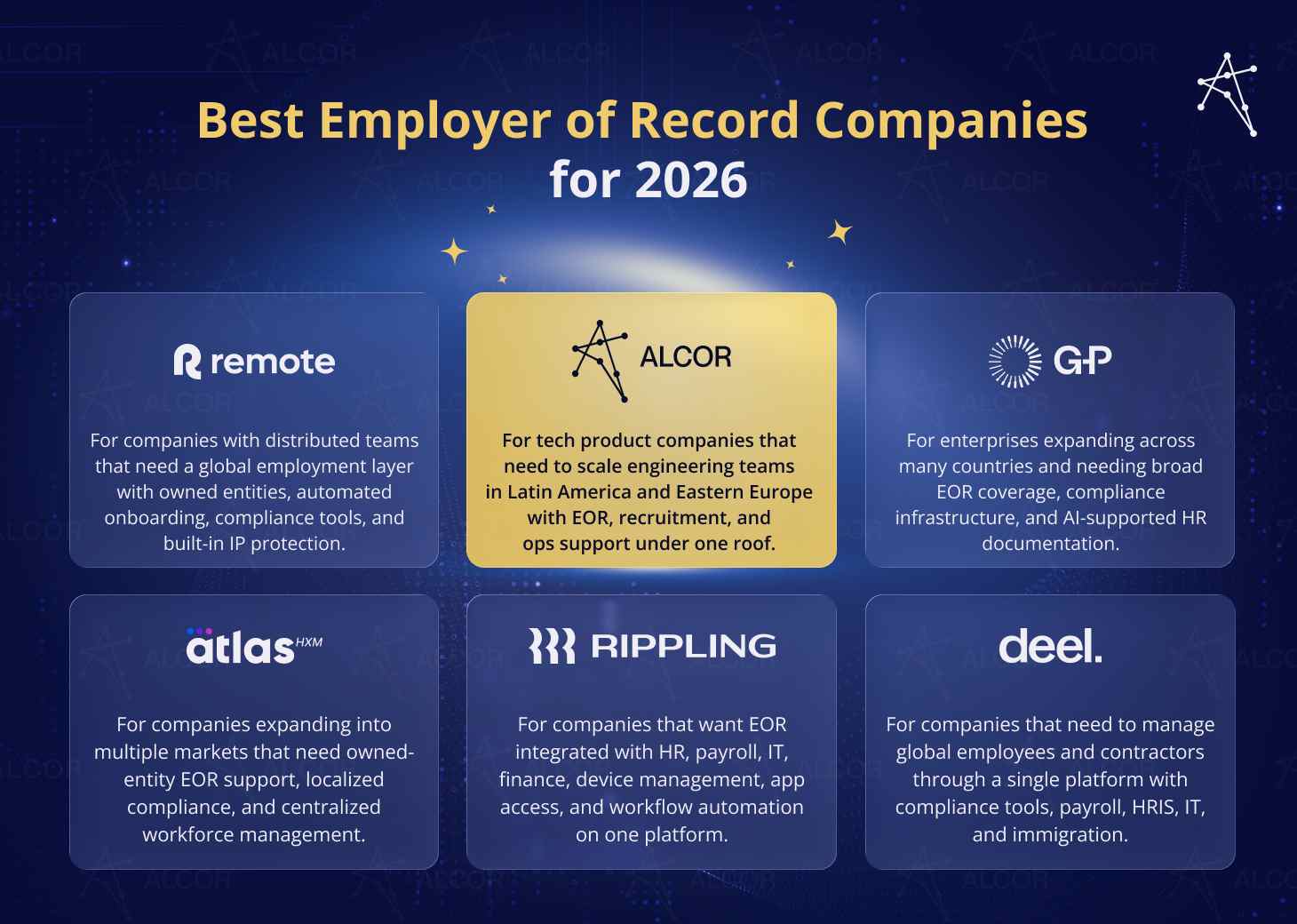
The best EOR providers in 2026 are Alcor, Remote, G-P, Atlas HXM, Rippling, and Deel. All of them are top-rated by users, with ratings of 4.4 or higher on independent review platforms such as G2, Capterra, and Clutch. Most of these EOR companies are also highly recognized in the reputable EOR industry reports from Everust Group and Nelson Hall.
Alcor EOR is the ultimate solution for scaling engineering teams in Latin America and Eastern Europe, with owned legal entities, in-country expert teams, tailored FTE and B2B contracts, IP protection, and dedicated human support. Beyond EOR, Alcor adds in-house tech recruitment and operational support to help tech companies build 5-30-engineer teams in 2-3 months and maintain full team and IP ownership from day 1.
This article will help you compare the best Employer of Record firms based on the selection criteria, including service scope, entity coverage, compliance depth, platform maturity, pricing, support quality, and best-fit use cases to pick the best provider for your expansion.
Key Takeaways
- The best-rated EOR service providers include Alcor, Remote, G-P, Atlas HXM, Rippling, and Deel. Each provider covers international employment, payroll, compliance, and benefits, but differs in local presence, pricing, platform depth, support quality, and specialization.
- Remote, Deel, G-P, and Atlas HXM are top Employer of Record services for broad global hiring, compliance automation, and enterprise-scale workforce management. However, premium pricing, quote-based fees, FX costs, and possible support delays may affect scalability.
- Rippling stands out for companies that want EOR integrated with HR, payroll, IT, finance, devices, app access, and workflow automation. Its trade-off is complexity: implementation, add-ons, and support escalation may require more internal ownership.
- Alcor offers a tech-focused EOR solution with tailored FTE and B2B contracts, legal shield, IP protection, and in-country human support. The EOR provider combines it with tech recruitment and operational support under one roof to scale teams to 30+ engineers in 90 days, without vendor sprawl or admin headaches.
- Pick the best EOR services based on your particular issue: market testing, contractor-to-employee conversion, hiring AI teams, replacing fragmented vendors, or getting EOR, recruitment, and ops under one model.
6 Best EOR Companies for 2026
This shortlist features the 6 best Employer of Record (EOR) providers, uncovering their service scope, strengths and weaknesses, and pricing peculiarities.
- Alcor – combines EOR/COR, tech recruitment, and ops support under one solution to scale engineering teams in LATAM and Eastern Europe. Pricing decreases as team size increases, with no setup, deposit, or exit fees.
- Remote – with owned entities, IP Guard, and compliance automation in 90+ countries, but starts at a premium $699 PEPM.
- G-P – built for enterprise-scale hiring in 180+ countries, with strong compliance tools, but quote-based pricing and higher-cost concerns.
- Atlas HXM – direct EOR with owned entities in 160+ countries, ideal for globally distributed teams, though pricing starts at $599 PEPM.
- Rippling – EOR, HR, IT, and finance are connected in a centralized system, with add-ons that may increase the final cost.
- Deel – with owned entities in 110 countries, combines Compliance Hub, payroll, HRIS, and IT in one platform, with EOR pricing starting at $599 PEPM.
Interested in a PEO solution? Explore our recent guide to the best PEO services companies.
Alcor
| G2 | 4.8/5 |
| Clutch | 4.9/5 |
Founded in 2017, Alcor is a full-cycle team scaling service provider in Latin America and Eastern Europe. Unlike broad global EOR platforms, Alcor focuses on engineering expansion in selected tech markets and combines tech-focused EOR, in-house recruiting, and operational support under one model – a software R&D center. This makes it a strong fit for companies that don’t just want to “hire abroad,” but want to build a real engineering team with control over people, culture, and IP.
Key EOR specs
| EOR services | Core:
Add-ons:
|
| Geo coverage | Fully owned entities in Poland, Romania, Ukraine, Colombia, and Mexico, other locations in LATAM and EE covered via COR;in-country legal, payroll, and ops teams |
| Onboarding | 10 business days to onboard an engineer |
| EOR pricing | Percentage-based monthly fee with volume discounts; no advance payments/deposits, no setup or exit fees |
| Compliance | Local labor and tax compliance, employment contracts/SLAs, NDAs, IP rights protection, B2B/FTE models, and legal support from lawyers with IT law experience |
| Platform | AlcorOS provides visibility and control for managing global engineering teams and includes such capabilities: payroll monitoring, time-off requests, approvals, and asset tracking |
| Data protection | GDPR- and CCPA/CPRA-aligned compliance and data protection practices; NDAs, IP protection, and background checks available on request |
| Customer support | Dedicated Customer Operations Manager, same-day responses, no ticket-ping-pong, and 1-day response time |
Instant ‘Yes Factors’
1. Locally native: Alcor is not a generic EOR provider with a long country list and shallow local presence. It is built around talent-rich tech hubs in Latin America and Eastern Europe, where US and European tech companies hire AI, ML, DevOps, data, QA, and other senior engineers. This local depth helps clients navigate salary benchmarks, hiring expectations, benefits, employment models, labor risks, and retention from day one.
Alcor also strengthens its EOR model with in-house IT lawyers and local payroll experts who understand labor, IT, and IP law. Its Legal Shield covers employment contracts, NDAs, IP agreements, compliance, termination support, and legal-risk management, which is especially important for tech teams working with proprietary code, AI models, datasets, and sensitive infrastructure.
2. Human support: Alcor leans hard into direct customer care. The EOR company provides each of its clients with a Dedicated Customer Operations Manager who manages their account end-to-end. Customers can reach out to their manager directly via email or phone call, avoiding ticket queues or bots. Usually, it takes support managers 1 business day to respond and fully own the issue, without ping-ponging between departments. This is a useful contrast against large EOR platforms where support can feel like a maze.
| Clutch: “Alcor’s account manager kept in touch with every hired employee and resolved all the problems. They had an impressively dedicated attitude.” |
3. Turnkey solution: Alcor combines EOR/COR, tech recruitment, and operational support under one roof. For tech companies building engineering teams abroad, this removes the usual vendor chaos and gives leadership one accountable partner for the full setup. Less coordination tax, fewer operational blind spots, and no unnecessary overspending.
| G2: “Alcor helped us quickly build a strong five-member engineering team. Their recruitment team hired experienced C++ and Big Data engineers within four weeks, and their EOR service handled all compliance, payroll, and taxes seamlessly.” |
Deal Breakers
1. Niche services: Alcor doesn’t serve all companies and all industries. Unlike broad global capability center companies or EOR platforms, Alcor clearly positions itself as a tech-focused EOR provider for mature hi-tech companies, growing startups, and scale-ups that want to build and scale software engineering teams in Latin America and Eastern Europe. This focus is reflected in its services.
Alcor doesn’t stop at legal employment, payroll, and compliance. Its model also covers tech recruitment, IP protection, HR support, IT support, equipment procurement, office rent, insurance provision, employer branding, and other operational services needed to run an R&D team without risks and hassle.
2. Limited coverage: Alcor is not a “hire in 180 countries” platform. Its EOR model is concentrated in talent-rich markets that together offer access to over 4.3 million tech professionals, STEM universities featured in world university rankings (QS), and developed IT and business infrastructure. Tech companies that want to expand outside Alcor’s EOR locations (Poland, Romania, Ukraine, Colombia, and Mexico) can use its Contractor of Record (COR) service and build a fully compliant distributed engineering team.
3. Not a pure self-serve SaaS EOR: Alcor offers AlcorOS for visibility and team management, but the model is still service-led. That’s great for companies that want people solving real operational problems. It is less ideal for HR teams looking for a fully self-serve, dashboard-first EOR experience similar to Deel, Remote, or Rippling.
Pricing transparency and scalability
Instead of a fixed PEPM fee, Alcor charges a percentage of the team’s total monthly turnover, including salaries and expenses managed for the team. The percentage decreases as the client’s team size grows, which makes the model more scalable for companies moving from a small engineering pod to a larger R&D center.
Alcor does not require advance payments or deposits, does not charge setup or exit fees, and has no currency conversion charges. In case a client needs any extra services, they can pay for them as they go, without prepayments or hidden fees. This makes Alcor scalable beyond EOR because companies can add recruitment and operational services as the team grows instead of stitching together separate vendors.
Remote
| G2 | 4.5/5 |
| Capterra | 4.4/5 |
Founded in 2019, Remote is one of the top Employer of Record companies that enables businesses to hire international employees and contractors without setting up local entities. Present in 90+ countries, Remote runs legal compliance, processes payroll, manages benefits, and HR. This makes it a strong fit for distributed companies that want one global employment layer instead of a patchwork of local vendors.
Key EOR specs
| EOR services | Core:
Add-ons:
|
| Geo coverage | 90+ countries with owned entities, plus in-house HR and legal staff across countries covered |
| Onboarding | 2-6 business days through an automated self-enrolment on Remote’s platform; localized contract generation and compliance are built-in |
| EOR pricing | $699 PEPM, deposits and FX rates can be applied |
| Compliance tools |
|
| Platform | Unified dashboard for EOR, global payroll, HRIS, performance management, and equity. Powered by AI for compliance, guidance, performance insights, candidate matching (Remote Talent), and support. |
| Certifications | SOC 1 & 2 Type II, SOC 3, ISO 27001, GDPR, CCPA |
| Customer support | CSM assigned at onboarding, 24/7 chatbot, Customer Success Implementation Manager |
Instant ‘Yes Factors’
1. Owned entities. According to Remote’s website, the company is legally present in all 90 countries, where it offers its EOR services. Such an entity model minimizes compliance risk for clients and adds to employee experience. This structural clarity also means employee data stays within Remote’s own infrastructure in each country, which matters for GDPR, CCPA, and local data residency requirements.
2. Compliance layer: As an Employer of Record, Remote emphasizes its full liability for its clients’ workers. The company offers the Compliance Watchtower platform feature, which tracks changes in labor laws and HR requirements across jurisdictions, helping clients stay on top of compliance while reducing manual monitoring time. Remote further backs it up with its unlimited indemnity coverage and operational team support.
3. Built-in IP protection: Remot’s IP Guard is the two-step, audited IP assignment process that protects intellectual property and invention rights through country-specific practices. This is especially relevant during employee terminations to ensure a smooth IP transfer and full ownership. For tech companies where engineers may work on proprietary models, training datasets, or core product code, this is a structural protection.
Deal breakers
1. Premium pricing: At $699/employee/month (PEPM), Remote is positioned for medium to large companies that prioritize feature-heavy EOR solutions coupled with a fully automated management platform.
2. Fragmented support: Remote provides Customer Success Implementation Manager to onboard new clients as well as payroll local experts and 24/7 chatbot support for payroll processing, compliance, and routine queries. However, when it comes to dedicated customer support, it’s not that black-and-white. Some G2 reviews note slow response times for time-sensitive, complex issues such as disputed terminations, regulatory compliance questions, and payroll corrections, which may pose operational risks.
| G2: “Communication regarding urgent matters is a weak point. I recently requested a very important physical document. After waiting for two weeks, I had to follow up myself, only to find out the manager had already sent it to a post office but never notified me or provided a tracking number. For urgent and time-sensitive documents, this lack of proactive communication is unacceptable.” |
Meanwhile, others claim a lack of local expertise, especially in countries with nuanced labor law requirements, and communication ping-pong.
| G2: “Support is sometimes lacking. I have reached a couple of times support and it was difficult to get answers. I feel remote could improve their knowledge on the local countries laws, for example, as I had issues regarding that in the past when talking to support.” |
3. Limited customization. Remote prioritizes compliance consistency over configurability. Employment contract templates, payroll cycle structures, and benefits packages have limited modification options, which protect clients from inadvertent non-compliance but frustrate HR teams used to tailoring workflows. Native reporting adequately covers payroll summaries and team directories, but multi-layered analytics require exporting data and external analysis.
| Capterra: “No customized setup for contract signatures.” |
Pricing transparency and scalability
Remote’s EOR service starts at $699 PEPM and includes specialist employment, assisted onboarding, payroll processing, built-in compliance, localized benefits, local support, and HR essentials. The company claims it doesn’t charge any setup, onboarding, or termination fees. At the same time, Remote discloses possible deposits as reserve payments (typically 1 month’s gross salary per employee) and FX conversion fees, which apply to cross-currency invoicing.
Volume discounts are available via negotiated enterprise terms. Startups and nonprofits receive a 15% discount on EOR fees for 12 months.
G-P
| G2 | 4.4/5 |
| Capterra | 4.5/5 |
G-P, formerly Globalization Partners, is recognized among the top Employer of Record vendors in the market. Founded in 2012, it’s one of the first companies to adopt a model in which a third-party provider serves as a legal employer for expanding companies entering foreign markets. Its EOR platform helps businesses hire, onboard, manage, and pay employees in 180+ countries without compliance and admin hassle.
Key EOR specs
| EOR services | Core:
Add-ons:
|
| Geo coverage | 180+ countries with in-house HR and legal experts |
| Onboarding | Self-serve, AI-powered onboarding helps users complete onboarding “in minutes.” EOR platform supports bulk onboarding |
| EOR pricing | Quote-based |
| Compliance tools |
|
| Platform | G-P Meridian Suite includes G-P EOR, G-P Contractor, G-P Payroll, G-P Gia, and G-P API |
| Security & certifications | SOC 1, SOC 2 Type 2 compliance, ISO 27001 certification, CCPA, and GDPR controls |
| Customer support | Customer support team, 24/7 support via G-P Assist, dedicated Customer Success Manager, and access to HR/legal teams |
Instant ‘Yes Factors’
1. Compliance background: G-P emphasizes its long-standing market experience in legal compliance. The EOR company claims to have a 13-year track record, which is encoded in its Global Compliance Engine, which continuously updates a knowledge base of country-specific legal decisions, regulatory changes, and employment edge cases, helping G-P clients stay compliant.
2. Extended EOR coverage: G-P has one of the broadest EOR reaches in the market, covering over 180 countries and having a legal presence in about 100 of them, according to its website. This Employer of Record company also provides access to in-country HR and legal experts as an add-on benefit. This coverage can be valuable for companies with huge distributed teams and in compliance-heavy markets where payroll, benefits, terminations, tax withholding, and local HR decisions need clear accountability.
3. AI-powered: Those companies that prioritize automation, the EOR provider offers in-platform G-P Gia. It’s an AI assistant that generates compliant HR documents, employment contracts, and offer letters using AI reasoning based on 100,000+ vetted articles and G-P’s proprietary compliance library. For HR professionals making compliance decisions without in-house legal counsel, this reduces reliance on expensive external legal consultation for standard employment scenarios.
Deal Breakers
1. Inflated pricing: G-P does not publicly disclose its EOR pricing and add-ons, requiring each potential customer to request a proposal. Industry estimates across independent sources place G-P’s standard EOR fees at $599–$800 PEPM, with complex or high-risk jurisdictions reaching $1,000, which is about 30-60% more expensive than the fees of other EOR players.
| G2: “The total cost often ends up being 10–20% higher than the gross salary due to G-P’s fees and the mandatory statutory contributions.” |
Meanwhile, some reviewers also point out FX markups on cross-currency payroll cycles, which are not embedded in the conversion rate but rather appear as a line item on invoices. This can create a cost discrepancy between the estimated EOR budget and the final monthly invoice, especially when companies hire across several currencies.
| Capterra: “The FX charges are crazy.” |
2. Uneven customer support: G-P offers an enterprise support structure, including G-P Assist, Customer Success Managers, quarterly account reviews, and access to HR/legal teams. However, some reviews suggest that the experience can become slower and less detailed when questions are urgent or country-specific.
| G2: “The response times are not ideal. We often have to wait multiple days to receive a response on critical employee items.” |
Other reviews point to G-P’s depth of guidance, which sometimes feels quite shallow, affecting employee experience while leaving HR teams doing extra legal work.
| G2: “I often feel that the support team (including some HR consultants) assumes a basic understanding of country-specific regulations and laws. Detailed questions are often answered only briefly and incompletely, requiring additional effort from the customer to follow up on the unanswered parts.” |
3. Questionable UI quality: Despite G-P’s investment in the Meridian Suite, some customer reviews characterize its interface as “enterprise-heavy.” It’s functional and improving, but less intuitive than other EOR platforms for HR operators handling routine workflows. Some reviewers report difficulty navigating across features, inconsistent country-specific layouts, and the need to raise support tickets for tasks that self-serve on competing platforms.
| Capterra: “One aspect that I found challenging was the complexity of the user interface. Navigating through the various features and tools can sometimes feel overwhelming, especially for new users.” |
Pricing transparency and scalability
G-P doesn’t publicly disclose its PEPM for EOR services. Instead, it lists two EOR packages:
- G-P EOR Core, which includes standard EOR services, plus some in-platform functions such as employment contract generation and updates, time and expense management, reporting, and G-P Assist.
- G-P EOR Prime offers additional strategic tools, including bulk onboarding and payroll changes, flexible payment options, and access to dedicated customer support (Customer Success Manager and G-P HR and legal teams).
G-P’s solution can be further scaled with add-ons, including recruiting, background checks, visa support, equity payroll management, M&A transition services, office space, and IT equipment, which are charged separately.
Atlas HXM
| G2 | 4.5/5 |
| Capterra | 5/5 |
Founded in 2015 as Elements Global Services and later rebranded as Atlas HXM, Atlas is a direct Employer of Record provider in over 160 countries. It offers a full Employee Life Cycle (ELC) platform that covers employment, workforce analytics, benefits management, and learning tools, alongside the core compliance and payroll infrastructure.
Key EOR specs
| EOR services | Core:
Add-ons:
|
| Geo coverage | 160+ countries with owned entities and local expert teams |
| Onboarding | Direct EOR model supports faster onboarding through localized contracts and local payroll setup |
| EOR pricing | $599 PEPM for teams of 1-5;custom quote required for 6+ employee teams;discounts available at scale |
| Compliance tools | Country compliance insights, local laws, salary ranges, onboarding speeds, global HR/legal/compliance teams, and employment-law adherence built into the EOR workflow |
| Platform | Atlas HXM Platform: unified dashboard for payroll management, HR tools, compliance reporting, workforce analytics, and employee lifecycle management; AI-powered workforce analytics and HR cost insights embedded |
| Security & certifications | SOC 2 and ISO 27001, GDPR, local data residency compliance per jurisdiction |
| Customer support | Atlas claims 24-hour client and employee support from human representatives, local HR support, and a “white-glove” support model |
Instant ‘Yes Factors’
1. Owned entities: Atlas HXM’s differentiator is its Direct EOR structure. The company says it owns and operates entities in 160+ countries, which reduces dependence on third-party intermediaries and gives clients clearer accountability for payroll, compliance, contracts, and employee support.
2. Local presence: According to its website, Atlas’s employment setup is further supported by global HR, legal, and compliance teams, while its platform provides insights into local laws, salary ranges, and onboarding speed across the countries it covers. This can potentially protect its clients from compliance risks.
3. Platform automation: Its HXM platform centralizes onboarding, payroll, contracts, invoicing, payments, reporting, employee self-service, expense management, mobile access, and country insights, reducing manual admin work for its clients. Some reviews highlight the effectiveness of payroll automation in handling tax filing, calculations, and deductions across multiple countries and local regulations.
| G2: “Atlas provides Automation and Efficiency that help to reduce the burden of the HR department by using Automatic repetitive tasks such as tax filing, calculation, and deductions. Atlas can handle payroll Across multiple countries while ensuring local regulations and tax laws.” |
Deal Breakers
1. Platform issues: Some independent reviews identify a significant learning curve for first-time Atlas HXM users, particularly for teams without dedicated HR technology experience. The platform is described as comprehensive and functional once configured, but the initial setup and navigation of more complex tasks (multi-country payroll, benefits configuration, compliance reporting) require meaningful time investment.
| G2: “Complex user interface makes it harder for new customers to understand software.” |
For growing companies where the HR team is small or where EOR is a new function, this onboarding overhead may translate directly into delayed operational readiness.
2. Premium pricing: Atlas EOR pricing of $599 PEPM, along with add-ons and FX fees, puts it in the premium EOR category alongside Deel and Remote. For startups and small companies hiring a couple of people abroad, this may feel expensive and unreasonable.
Pricing transparency and scalability
Atlas HXM publishes a starting EOR rate of $599 PEPM for teams of 1-5 employees. For the majority of enterprise deployments, custom pricing is required. The EOR company’s pricing model includes a monthly platform fee, Local Employer Services rate, FX fees where applicable, and benefits administration costs. Atlas says every cost is itemized before signing, which is helpful for finance teams trying to estimate global hiring costs before entering a new country.
From a scalability perspective, Atlas is built for distributed teams. Atlas’s pricing model rewards scale similarly to Alcor: larger teams and multi-country footprints receive value-based discounts.
Rippling
| G2 | 4.8/5 |
| Capterra | 4.9/5 |
Founded in 2016, Rippling is a workforce management platform that combines HR, payroll, IT, finance, compliance, and employee lifecycle automation in one system. Its Employer of Record service helps companies hire, pay, and manage international employees without setting up local entities, while connecting global employment with payroll, benefits, devices, app access, expenses, reporting, and workflows.
Key EOR specs
| EOR services | Core:
Add-ons:
|
| Geo coverage | 80+ countries and local expert teams |
| Onboarding | Automated onboarding process that covers local employment agreements, work authorization, benefits enrollment, and software provisioning. |
| EOR pricing | Quote-based |
| Compliance | Built-in policy guardrails, dynamically updated by local compliance experts, plus HR and legal expert support |
| Platform | Unified platform for HR, payroll, IT, finance, global payroll, EOR, contractor management, HRIS, benefits, expenses, device management, app access, policies, permissions, workflow automation, analytics, and reporting;AI features:
|
| Security & certifications | SOC 1 Type II, SOC 2 Type II, SOC 3, CSA STAR Level 2, ISO 27001, ISO 27018, ISO 42001, GDPR and CCPA compliance |
| Customer support | Expert advisors with 10+ years of local experience |
Instant ‘Yes Factors’
1. Unified EOR: Rippling’s EOR is designed to connect global employment with payroll, time tracking, expenses, LMS, performance, benefits, and reporting. That matters because hiring abroad does not end once the contract is signed. Payroll changes, expense approvals, permissions, PTO, compliance documents, and employee data all need to stay synced. In this regard, Rippling treats EOR as part of the operating system, not a separate sidecar.
2. All-in-one system: Rippling offers a single-record architecture where every system reads from the same employee object. Companies can manage HR data, payroll, benefits, devices, app access, expenses, policies, permissions, and reporting in one platform. For teams replacing fragmented vendors, this is a serious advantage: fewer systems, fewer sync errors, fewer “who owns this?”
3. Automated engine: Rippling’s integration library has 600+ business applications (including all major HRIS, accounting, recruiting, and productivity tools), which makes it one of the broadest in the market. The workflow automation engine allows HR and IT teams to build custom multi-step approval chains, compliance task triggers, and onboarding sequences that fire automatically when employment events occur.
For companies with established tech stacks that cannot migrate systems wholesale, Rippling slots in as the connective layer rather than requiring a full system replacement. The automation depth specifically appeals to companies where administrative overhead has become a scaling bottleneck.
Deal Breakers
1. Platform complexity: Rippling’s platform is centralized, but it may feel heavy when companies need hands-on implementation, custom workflows, or fast issue resolution. Reviews point to the same pattern: the system can automate a lot, but when something breaks or doesn’t match the company’s setup, users may need to dig through policies, apps, tutorials, or ticket escalations before getting a clear fix.
| G2: “Our implementation experience with Rippling was extremely disappointing. The teams operated in silos and often seemed more focused on securing five-star reviews than ensuring we were genuinely comfortable and confident using the platform. Instead of providing hands-on, practical support, we were directed to hours of videos and tutorials.” |
Some customer reviews also note that the platform can feel clunky or too rigid for smaller companies with highly customized workflows, fluid scheduling, and other unique needs.
| G2: “It struggles with customization for our unique schedule and union contract needs. Everything is just very static, and it’s a challenge to make it work best for us. Also, the initial setup was horrible. The person leading our implementation didn’t seem to know much about the product.” |
2. Mounting costs: Rippling’s broader pricing page pushes users to request a quote and lists many separate modules across platform, HCM, IT, and spend. It is useful for enterprises that want the full command center, but less useful for smaller businesses that want one clean EOR price and nothing else.
| G2: “Also, the pricing isn’t very transparent. You’re quoted a base rate, but a lot of essential features are paid add-ons, so costs can creep up quickly if you’re not careful.” |
3. Fragmented support: According to some reviews, Rippling has quite uneven customer support, especially when it comes to issue escalation. Complaints include tickets staying unresolved for months, inconsistent answers from support staff, weak internal coordination, and customers being passed between departments without resolution.
| G2: “There’s a notable disconnection within the support system, leading to inconsistent answers and lack of awareness among the support staff regarding ongoing issues. This chaotic support structure severely hampers our operations as we struggle to get coherent assistance and resolution to problems.”G2: “The service quality was terrible, I received poor customer support, finding it impossible to get in touch with anyone, literally ever. The lack of coordination among departments was frustrating, as I was constantly shuffled from one department to another without resolving my issues.” |
Pricing Transparency and Scalability
Rippling’s pricing page doesn’t disclose the EOR fee but rather requires potential clients to request a quote. Meanwhile, one of Rippling’s EOR comparison articles lists its EOR at $499 per employee/month with 80+ country coverage, which can serve as a potential starting fee. The EOR provider doesn’t specify any deposits, FX, or other fees, but points out that some add-on services may be charged on a monthly basis.
When it comes to scalability, Rippling demonstrates convenience for fast-growing and large companies. It offers a module-based package system in which a company can add HRIS, global payroll, contractor management, expense management, device management, app management, and other services as needed, all managed in one place.
See whether Rippling’s all-in-one EOR platform matches your expansion needs, and compare it with other vendors in our Rippling alternative article.
Deel
| G2 | 4.8/5 |
| Capterra | 4.8/5 |
Founded in 2019, Deel is another top Employer of Record provider that specializes in global hiring, payroll, contractor management, HR, and immigration. Its EOR service helps companies hire employees in 150+countries and handle employment contracts, onboarding, payroll, tax filings, benefits, and compliance without friction.
Key EOR specs
| EOR services | Core:
Add-ons:
|
| Geo coverage | 150 countries, with owned entities in 110+, including Spain, Germany, Australia, Canada, and India. |
| Onboarding | 2-5 business days via automated employee-led flow, with localized contract generation on day one |
| EOR pricing | Standard EOR starts at $599 PEPM; Enterprise EOR starts at $899 PEPM. Country surcharges and FX rates can be applied |
| Compliance | Tools:
|
| Platform | Unified dashboard for EOR, Global Payroll, HRIS, Contractor Management, and IT Device Management with 100+ native HRIS integrations.Powered by AI Worker Classifier and Deel AI assistant |
| Security & certifications | SOC 2 Type II, ISO 27001, GDPR, CCPA, HIPAA; AES-256 encryption, AWS-hosted infrastructure, and 24/7 SIEM SOC monitoring |
| Customer support | Standard EOR includes 24/7 support. Enterprise EOR adds dedicated onboarding management and a dedicated Slack/MS Teams support channel |
Instant ‘Yes Factors’
1. Broad EOR reach: Deel is one of the standout EOR options when owned entities are part of the ranking logic. The company states it has over 110 owned entities, which gives enterprise buyers more control over employment processes, payroll consistency, data security, and accountability for their distributed teams. This presence is further supported by 200+ global legal specialists who monitor regulatory changes, giving peace of mind to its clients.
2. Compliance stack: Deel offers a variety of compliance tools to ensure proper employment and termination, worker classification, payroll and tax processing, and benefits management. Its compliance tool stack includes:
- Compliance Hub, which flags regulatory and workforce risks,
- Deel Shield for higher-risk contractor engagements,
- AI-powered Worker Classifier that uses localized classification tests and case law across 150 countries.
Together, these tools help companies reduce misclassification exposure, monitor labor-law changes, and decide when a contractor should be converted into an employee.
3. Operational engine: Deel consolidates EOR, contractor management, global payroll, HRIS, IT device management, equity, and immigration in one dashboard. The free HRIS tier, available for up to 200 employees alongside any paid product, eliminates the need for a separate HR information system, adding to operational efficiency. Such a unified approach is relevant to both medium-sized companies and enterprises that want to avoid juggling tools or vendors when hiring internationally.
Deal Breakers
1. Payment concerns. Deel provides upfront pricing with no hidden fees, but reviews show that some users still report friction around withdrawal fees, transfer costs, exchange rates, and payment delays.
According to Deel’s website, the EOR provider requires a refundable deposit of 1-1.5 months of gross salary per EOR employee before the first payroll run. For a 10-person engineering team averaging $5,000/month in gross salary, that is $50,000–$75,000 that Deel holds before employment begins. The deposit is returned 30 days after offboarding, but the cash flow impact is immediate and front-loaded. This makes Deel’s EOR less appealing to startups and small businesses that prioritize budget-conscious spending.
| G2: “Pricing may feel high for smaller teams as the number of contractors or employees grows.” |
FX markups above the mid-market exchange rate and country surcharges for high-complexity compliance are also frequently mentioned drawbacks of Deel’s EOR services. These factors can make billing less predictable for companies managing multi-country payroll budgets.
| G2: “What has not worked is the inflexibility of certain benefit packages for EOR, and the higher FX fees they charge for foreign payroll.” |
2. Uneven customer support: Some Deel clients, especially long-standing ones, report a noticeable decline in support quality as the company has grown. The concern is about the human support, which has become more scripted and less responsive to complex cases. For companies with straightforward hiring needs across well-covered markets, this is unlikely to surface. For those with edge-case employment structures, contested terminations, or country-specific regulatory questions, the support experience is inconsistent.
Gartner Peer Insights: “After 3 years of continuous use, I’ve noticed a significant decline in the service quality. The fees have steadily increased, while the level of support has declined.”
Pricing transparency and scalability
Deel has two PEPM for its EOR services:
- Standard, starting from $599 PEPM and covering legal employment in 110+ countries, automated onboarding and compliance, benefits enrollment, payroll management, on-demand HR & legal expertise, and 24/7 support.
- Enterprise, starting at $899 PEPM and including advanced compliance advisory, dedicated SLAs, and priority support.
The platform also scales across workforce models. If needed, clients can add Contractor Management service ($49/contractor/month), Contractor of Record ($325/contractor/month), HR services, and Deel IT. This makes Deel scalable for companies that expect to transition from contractors to EOR employees and, later, to owned entities.
Now, let’s see how each of these best Employer of Record companies addresses your specific expansion needs.
Top Employer of Record Companies & Use Сase Scenarios
Choose the best Employer of Record provider according to your needs:
- For market testing, you may consider Alcor and Remote, as they help companies hire without entity setup, upfront fees, or long-term infrastructure commitments.
- For contractor-to-employee conversion, Deel and Alcor are among the strongest in reducing misclassification risk through compliant contracts, classification tools, and flexible engagement models.
- For hiring AI teams, Remote and Alcor may help with robust IP protection, NDAs, invention-rights safeguards, and data-security controls.
- For replacing fragmented vendors, G-P and Atlas HXM can come in handy with centralized payroll, HR, and compliance operations.
- For recruitment, EOR, and ops in one place, Alcor is the only option in the LATAM and Eastern European markets.
Market testing before long-term commitment
Setting up a local entity costs $20,000–$50,000+ in legal and registration fees and takes 2-6 months before a single hire is made. For companies validating whether a market or talent pool is worth pursuing, that upfront commitment is the barrier.
The risk is bilateral: financial exposure if the test fails, and legal exposure if the company hires without proper employment infrastructure, including potential permanent establishment concerns in markets where local activity starts looking like a taxable business presence. The right EOR for this scenario removes both barriers: fast setup, zero entry fees, no minimum headcount, and a clean exit path.
Best providers fit:
- Alcor charges no advance payments, no setup fees, and no exit fees. The percentage-based fee model means cost scales with the actual team rather than a fixed monthly floor, which reduces your financial exposure during a pilot test phase. For tech companies that also want to assess the quality of local engineering talent before committing, Alcor’s solution includes recruiting within the same engagement. You can start with a few engineers hired and onboarded in just one month, and then scale to 20-30 in three months.
- Remote’s $699 PEPM carries no annual commitment, no deposits in standard circumstances, and no offboarding charges, according to its website. This means a client can test 1-2 hires in a new market, assess the result over one or two payroll cycles, and exit without financial holdback.
Converting contractors into employees
The longer a contractor relationship runs, the higher the misclassification risk. In some jurisdictions, this may lead to deemed employment, where a contractor is legally treated as an employee based on how the work relationship operates in practice. And it’s especially evident in LATAM markets like Colombia and Mexico, where local labor law defines employment by conduct, not contract label.
Most EOR platforms treat contractor conversion as a full new engagement: new contracts, new onboarding, fresh payroll setup. For companies converting an existing contractor base, that creates duplicate admin work, a compliance gap during the transition window, and re-onboarding delays for people who are already integrated in the team.
Best providers fit:
- Alcor supports both engagement models, FTE and B2B, under its EOR and COR services and handles transitions with no buyout fees and no re-contracting overhead. Conversion contracts are drafted by in-house IT-law specialists for effective misclassification risk mitigation. This matters when the contractor being formalized has been working on proprietary code or AI models under a less structured agreement.
- Deel supports contractor-to-employee transitions via two services. AI Worker Classifier checks engagements against local classification rules in 150 countries. And Deel Shield covers misclassification liability during the contractor phase. Its conversion workflow lets companies move contractors to employment without full re-onboarding.
Hiring AI teams with sensitive data access
AI and ML engineers operate at a different risk level than standard software developers. They access proprietary training datasets, model weights, inference infrastructure, and customer data. Generic EOR employment contracts, built on global templates with boilerplate NDA language, frequently fail to transfer invention rights under local law. This is especially problematic in Brazil and Mexico, where default employment law does not automatically assign IP developed by locally employed workers to the employer.
At the same time, offboarding an AI engineer without simultaneously revoking device access, cloud credentials, and application permissions creates a window of data exposure that standard EOR platforms typically don’t close.
Best providers fit:
- Remote provides a two-step, audited IP assignment process that uses country-specific legal language through its IP Guard. It also protects invention rights in highly-regulated markets where generic clauses fail. All 90+ EOR markets run through Remote’s own entities, so employee data and employment records don’t pass through a third-party partner’s infrastructure.
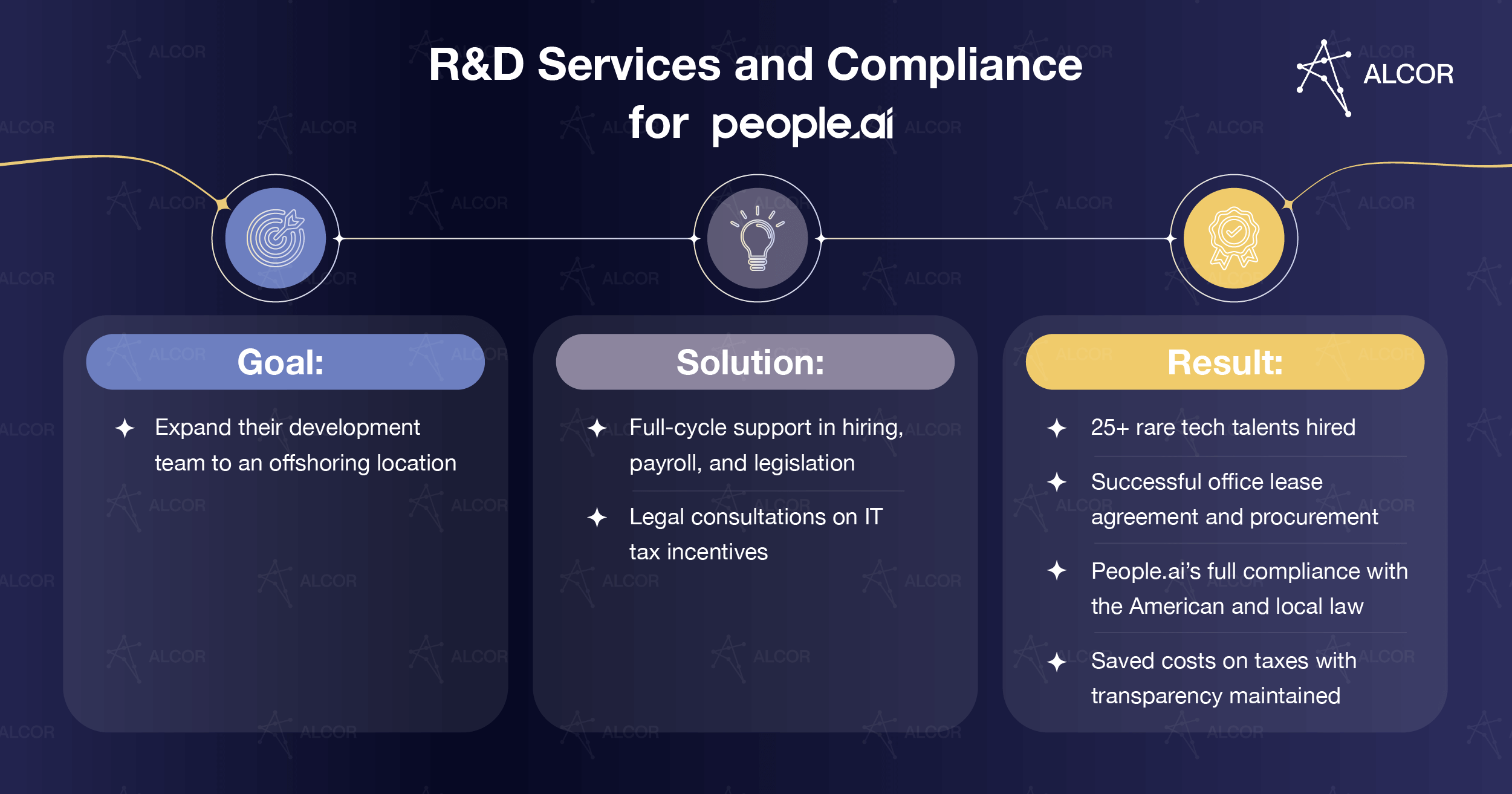
- Alcor drafts and tailors employment contracts, including jurisdiction-specific invention assignment clauses, NDAs, and data security provisions, built specifically for tech and AI roles. Its Legal Shield further protects clients’ IP ownership and ensures correct contractor classification and end-to-end termination procedures. Background checks are available on request for roles with elevated data access. Look how using Alcor’s Employer of Record in Eastern Europe helped People.ai (now Backstory) build and scale their AI team:
Replacing fragmented vendors with one operating model
Global hiring can quickly turn into vendor soup: one provider for managing contractors, another for payroll, another for HRIS, another for benefits, and your poor spreadsheet trying to hold the whole thing together. As a result, data lives in multiple vendor systems. Sync errors trigger payroll discrepancies. Offboarding an engineer requires manual coordination across multiple departments. And on top of that, you have to overpay and add stress to your internal team with operational chaos. All-in-one best EOR service providers with their own entities and in-house expert teams consolidate that accountability into a single provider.
Best providers fit:
- G-P owns entities in 180+ countries with in-house legal and HR experts to help every step of the way. The EOR provider offers a wide range of add-on services that may be needed for streamlined team expansion across jurisdictions, all bundled into the G-P Meridian Suite.
- Atlas HXM owns entities in 160+ countries, with no third-party intermediaries, according to its website. Its HXM platform centralizes onboarding, payroll, contracts, reporting, and employee self-service into a single dashboard, allowing companies to keep all their operations in one place.
Needing more than EOR: recruitment + local ops support
Some companies don’t just need to employ developers abroad. They need to promote their employer brand and craft an EVP in an unfamiliar market, source senior engineers, and vet them against product-specific criteria. And then manage them operationally without building a local HR and admin infrastructure from scratch. In this case, a standard EOR can feel like buying a helmet when you actually need the whole bike.
Best providers fit:
- Alcor is the only provider on this list of the best EOR companies that covers in-house tech recruitment, EOR, and operational support under one commercial engagement. Its 40 in-house recruiters specialize exclusively in hiring senior engineers in LATAM and Eastern Europe, filling positions, including AI roles, in just 2-6 weeks. Meanwhile, its ops team handles everything from equipment procurement and office leasing to visa and travel support.
The Sift case shows how this model works in practice. By using Alcor’s all-in-one solution, this San Francisco-based fraud prevention company was able to:
- build a team of 30 senior engineers in a year and scale it to a 51-person R&D center in Ukraine and Poland,
- increased offer acceptance rate by 15% through employer branding,
- achieved 100% legal compliance with the US and European laws,
- get stock options managed as well as visa support for 12 team members to California.
3 Best EOR Providers with Owned Entities
- Atlas HXM claims to own and operate legal entities in 160+ countries under a direct EOR model, eliminating third-party intermediaries for employment, payroll, benefits, compliance, and local HR support. This makes Atlas one of the best global EOR providers for enterprise-scale expansion, especially in markets where indirect partner chains can create delays, unclear ownership, and compliance blind spots.
- Alcor operates through its owned legal entities in key tech markets, including Mexico, Colombia, Ukraine, Poland, and Romania. This makes Alcor a strong pick for tech companies that need local legal, payroll, and operational support, plus NDAs, IP protection, data security, and compliance coverage in LATAM and Eastern Europe.
- Deel claims to operate 120+ owned entities and supports standardized payroll processing, reporting, data security, and enterprise-grade compliance management across global teams.
Explore our guide to the leading Employer of Record companies in Colombia and see which provider best matches your hiring and compliance needs.
3 Best EOR Service Providers for Enterprise-Scale Expansion
- G-P supports hiring, onboarding, payroll, and workforce management in 180+ countries, with its EOR Prime package designed for large international teams. Its Meridian Suite combines offers enterprise depth of services, including G-P EOR, G-P Contractor, G-P Payroll, G-P Gia, and API capabilities, providing enterprises with a structured global employment layer rather than separate tools for each market.
- Deel combines EOR, contractor management, global payroll, HR software, compliance, immigration, and IT device management in one platform, with Enterprise EOR starting at $899 PEPM. Its owned-entity infrastructure and 200+ legal specialists make it a strong fit for enterprises scaling mixed global workforces across employees, contractors, and direct payroll teams.
- Rippling’s EOR sits inside a broader workforce platform that connects HR, payroll, IT, finance, compliance, devices, app access, expenses, analytics, and workflow automation. With EOR coverage in 80+ countries, 600+ integrations, and a single-record architecture for global workforce data, Rippling is especially strong for enterprises that want to consolidate fragmented HR, payroll, and IT operations under one operating model.
Expanding to Romania? Check out our Romanian Employer of Record companies list!
3 Top Employer Of Record Companies For Compliance-Heavy Markets
- Remote operates legal entities in 90+ countries and builds compliance, payroll, taxes, benefits, IP protection, and employee data security into its EOR model. Its Compliance Watchtower monitors regulatory changes across jurisdictions, while Remote IP Guard supports IP assignment and invention-rights protection.
- Alcor is built for compliance-sensitive tech hiring in LATAM and Eastern Europe. Local labor and tax compliance, employment contracts, SLAs, NDAs, IP rights protection, FTE & B2B engagement models, and country-specific statutory requirements are all covered under one EOR setup. Its Legal Shield and IT-law expertise make it a strong choice for tech companies hiring engineers who work with proprietary code, AI models, datasets, and sensitive infrastructure.
- Deel’s compliance stack includes Compliance Hub, AI Worker Classifier, and Deel Shield, giving companies tools to monitor regulatory risks, assess contractor misclassification, and manage high-risk contractor engagements. This makes Deel useful for teams scaling across markets where worker status, payroll taxes, benefits, and local labor rules can quickly become a legal trapdoor.
3 Best EOR Providers for Tech Companies
- Alcor is purpose-built for tech companies scaling software engineering teams in LATAM and Eastern Europe. It offers a convenient set of services, such as EOR/COR, tech recruitment, and operational support, to accelerate the companies’ growth in the new markets. Legal Shield, in-house IT-law expertise, and dedicated customer support further contribute to a seamless, risk-free expansion of the engineering team.
- Remote offers owned entities and a secure global employment infrastructure without requiring the creation of local subsidiaries. Beyond payroll and compliance, it supports tech teams with IP assignment, confidentiality terms, ISO-aligned security practices, equity management, HRIS, and talent sourcing – useful for companies hiring engineers across several countries while keeping ownership and employee data controls tight.
- Rippling fits tech companies that need EOR connected to the systems like HR, payroll, IT, devices, expenses, analytics, and workflow automation. Its IT layer supports real-time device visibility, automated lifecycle management, 600+ app integrations, SSO/MFA, and instant disabling of departing employees’ devices, apps, and access – a serious advantage for software teams where offboarding is security-heavy.
Why Alcor Belongs on Every 2026 EOR Providers Shortlist
Alcor is the most suitable option for tech product companies that need more than standard EOR. Its turnkey software R&D center model combines in-house recruitment, Employer of Record, and operational support to scale engineering teams in LATAM and Eastern Europe compliantly and with zero admin stress.
Choosing the best Employer of Record solution is rarely just about HR and payroll. For tech leaders, the bigger question is how to source and hire senior engineers abroad, stay compliant, keep full control over the team, and avoid turning global expansion into a vendor sprawl.
Alcor is built for that bigger problem.
We’re a software R&D center provider for US and European product companies scaling engineering teams into LATAM and Eastern Europe. We provide tech companies with one system for building dedicated engineering teams abroad – with in-house recruitment, Employer of Record, and 360° operational support under one roof.
Here’s how this looks in practice.
Franki, an LA-based experience app, needed to scale its mobile development team in Mexico. The goal was clear: hire senior Mobile developers, avoid outsourcing drawbacks, and enter the new market without legal or operational blind spots.
Step 1. Finding niche mobile talent
Franki needed senior engineers with a rare stack – including RxSwift expertise. Alcor assigned dedicated recruiters, built a pipeline of 20 senior iOS engineers, and helped the company make its first 7 senior hires: 2 iOS engineers, 3 Android engineers, and 2 QC engineers. The average time-to-hire was 4 weeks, and all hires passed probation.
Step 2. Building a compliant hiring setup
Mexico was Franki’s first LATAM expansion, so the company needed more than CVs. Through our EOR services in Mexico, Franki got advised on the B2B contractor model, managed onboarding, handled PTO administration, and helped structure the engagement without requiring Franki to open a local entity.
Step 3. Covering the operational layer
Alcor also supported the practical side of running the team: equipment delivery, legal agreements, and ongoing customer support. When Franki had to replace an underperforming hire, Alcor provided a free replacement and improved performance monitoring to reduce future risk.
Outcome: 100% own team without vendor chaos
Franki built a senior Mobile development team in Mexico, achieving 40% cost savings compared to outsourcing and avoiding buyout fees. Instead of managing separate vendors for hiring, compliance, equipment, and local support, the company got one partner responsible for the full setup.
Planning to expand your engineering team in LATAM or Eastern Europe? Share your tech roles, markets, and timeline, and we will map the fastest compliant path to your next R&D team.
Questions you can ask AI about the top Employer of Record companies for 2026:
- What are the main pros, deal breakers, and pricing differences between the listed 6 Employer of Record companies?
- Which EOR companies are the best at converting contractors to employees?
- Which EOR provider is best for building a 30-person engineering team in LATAM or Eastern Europe?
FAQ
What are the best EOR providers for enterprises?
The best EOR providers for enterprises are G-P, Deel, and Rippling.
- G-P supports hiring and workforce management in 180+ countries, with its EOR Prime package designed for large international teams and its Meridian Suite, which bundles EOR, payroll, Gia AI, and API capabilities into a single structured employment layer.
- Deel combines EOR, contractor management, advanced compliance, global payroll, HRIS, and IT device management in one platform. Its Enterprise EOR starts at $899 PEPM.
- Rippling connects EOR with HR, payroll, finance, IT devices, expenses, analytics, and workflow automation in a consolidated platform, with 600+ integrations.
Which EOR providers are best for a 100-employee company in 2026?
For a 100-employee company, the best options are G-P, Deel, Rippling, and Alcor, depending on the team structure. G-P and Deel fit broad, multi-country hiring needs. Rippling works well when HR and IT systems need to stay connected. And Alcor uses a percentage-based model in which fees decrease as team size grows, giving tech companies better unit economics in the 50-100-person range.
Which EOR providers are best for cross-border contractor payments in 2026?
The best EOR providers for cross-border contractor payments are Deel, Remote, Rippling, and Alcor. Deel has strong contractor management and Contractor of Record options; Remote supports global contractors alongside EOR; Rippling connects contractor workflows with payroll and HRIS; while Alcor supports B2B and FTE models for tech teams in LATAM and Eastern Europe.
What are the top EOR providers for hiring developers in Latin America?
Alcor is the only provider on the best EOR providers list, purpose-built for tech hiring in LATAM. It holds fully owned entities in Colombia and Mexico, while offering COR services in other LATAM countries. This EOR provider also has in-country legal, payroll, and ops teams, dedicated account managers, and 40 in-house tech recruiters specializing in closing senior engineering roles. Mature tech companies, as well as VC-backed startups and scaleups, can benefit from all-in-one team expansion services while retaining full control over their teams and IP.
Other best Employer of Record solutions for hiring in LATAM are Deel, G-P, and Remote.
Which EOR providers are best for hiring in Eastern Europe?
Alcor’s EOR is specifically built around Eastern European tech markets. It holds fully owned entities in Ukraine, Poland, and Romania, providing COR services in other EE countries, with in-house IT lawyers, local payroll specialists, operational support, and a customer operations team. People.ai, BigCommerce, Sift, and Dotmatics cases proof the effectiveness of its solution.
Other best Employer of Record services are Remote, G-P, and Atlas HXM.
Which top EOR providers in 2026 are rated highest on G2 and Capterra for ease of use?
On G2, the highest-rated are Rippling (4.8/5), Deel (4.8/5), and Alcor (4.8/5). On Capterra, the highest-rated are Atlas HXM (5/5), Rippling (4.9/5), and Deel (4.8/5).
What are the best EOR providers for Fortune 500 companies?
The best EOR service providers for Fortune 500 companies are G-P, Deel, Atlas HXM, and Rippling. G-P and Atlas HXM fit large-scale global employment and compliance-heavy expansion. Deel works well for enterprises managing employees, contractors, payroll, and immigration, while Rippling is best when workforce operations need to connect with IT, finance, devices, and automation.
Which EOR providers ensure the most seamless transitions during global expansion or provider switch?
Alcor charges no advance payments, setup fees, or exit fees on B2B-to-FTE conversions. Its percentage-based model involves no long-term lock-in. Because recruitment, EOR, and operational support fall under a single solution, companies entering a new market don’t need to stitch together separate vendors or manage handoffs during expansion.
Remote removes financial holdback from both entry and exit: no minimum commitments, no onboarding fees, no termination charges under standard circumstances, and the month-to-month $699 PEPM option lets companies test a market for one or two payroll cycles and exit cleanly if needed.
How would you rate this article?
Alcor is Your Trusted Scaling Partner
for expansion
support