


Software development facts span nearly two centuries – from Ada Lovelace’s first program in 1842 to the AI-assisted engineering of 2026. In between, computer programming careers turned into a genuinely global phenomenon: SlashData’s Developer Population research puts the world’s active developer count at 48.4 million as of its late 2025 – up from just 26.9 million five years earlier. That’s too large and too varied a group to hire well without understanding what actually makes them tick.
I’m Yuliia Baranovska, IT Recruiting Manager at Alcor. We hire Silicon Valley-caliber developers for tech product companies entering Latin America and Eastern Europe, through one R&D center solution that combines IT recruitment, Employer of Record, and full operational support. We help you scale your team from 10 to 30 in just 3 months, up to 100 engineers within a year, with zero vendor juggling on your end.
In this guide, you’ll get data-backed facts about programmers: how they think, what they actually value at work, and what makes them stay, covering everything from the oldest coding trivia in history to the newest AI-era shifts. Get a practical toolkit for smarter tech hiring in 2026 and beyond, and… have fun reading!
Key Takeaways
- AI isn’t taking software development jobs in 2026 – or is it? (Spoiler: no, just the boring part)
- Interesting statistics: 52% of coders are under 35, yet the average COBOL developer is 55 – and paid the same and even more
- One tweet birthed “vibe coding.” One programming language was built to be impossible to write. Tech history may be weird
- 52.7% of engineers secretly think they’re frauds. If you’ve felt this, congratulations – you’re statistically normal.
- Hiring a developer now averages 42-44 days, and over half of companies admit their own process runs too long.
- If you’re thinking of business expansion, Alcor will help your tech company build a fully compliant R&D team in LATAM or Eastern Europe, with senior-level tech recruitment, legal support, payroll management, ops, and zero headaches.
Why is Software Engineering So Popular?
Software engineering remains one of the fastest-growing, highest-paying careers because it combines strong job growth, high demand, and real flexibility. The US Bureau of Labor Statistics projects 15% job growth for software developers from 2024 to 2034, far above the average profession. The global software market reached $779 billion in 2026, growing over 5% year-over-year. Developers can specialize in web, mobile, game, systems, or AI development, and 82% work remotely, hybrid, or with flexible arrangements. Talent hubs have also expanded beyond Silicon Valley: Latin America and Eastern Europe together host over 4.3 million skilled tech specialists, making global hiring both faster and more cost-effective than domestic-only recruitment.
1. A career built for the tech revolution era
Software engineering is one of the few careers actually built for where the world is headed. The US Bureau of Labor Statistics projects 15% job growth for software developers between 2024 and 2034 – still miles ahead of the average profession. And the industry backing it up isn’t small either: according to Statista, the global software technology market hit $779.07 billion in 2026, growing another 5.5% this year alone. Turns out “learn to code” was solid advice after all.
2. Flexible career paths & specializations
Here’s one of the more underrated computer engineering facts: this career barely locks you into anything. A web developer can pivot into DevOps, freelance on the side, join a startup, or vanish into an open-source project purely for fun. Popular paths today include:
- Application developers, who build desktop, web, or mobile solutions
- Web developers, crafting websites and interactive UIs
- Game developers, working on immersive entertainment experiences
- Systems software coders, developing operating systems and infrastructure
- Specialists in security, DevOps, AI, databases, or niche cloud stacks.
And remote work? Especially very much alive. Per the 2025 Stack Overflow Developer Survey, only 17.9% of developers work fully in-person – the rest have some flavor of remote, hybrid, or “whenever I feel like it” flexibility. Return-to-office headlines aside, this industry, in my view, isn’t giving that up anytime soon.
3. Tech hubs expanding beyond Silicon Valley
As the market grows, companies are looking past the usual tech capitals to find great engineers, which is exactly why Latin America and Eastern Europe have become talent powerhouses in their own right. Together, LATAM and Eastern Europe now account for over 4.3 million skilled, versatile tech specialists.
Find more facts about development in our articles on IT outsourcing in Latin America and outsourcing to Eastern Europe.
Alcor’s tech recruitment service puts Silicon Valley-caliber talent right at your global doorstep. We can hire your first 5 developers in a month and scale your team to 30+ across Eastern Europe or LATAM within 3 months.
Take Sift, for example. Alcor built the entire hiring engine from day one: 10 researchers and 3 dedicated tech recruiters, an employer branding push that lifted the offer acceptance rate by 15%, and full legal compliance across two countries. As a result, 51 engineers were hired across Ukraine and Poland, a demanding 3-stage interview process cleared every single week without a gap, and zero legal exposure for Sift’s leadership.
4. Best. Job. Ever? Actual rankings agree
If “is this a good career” keeps you up at night – relax. According to U.S. News’ 2026 Best Jobs rankings, software development sits in the top 10, with more than 267,600 new roles expected by 2034 – the highest projected job count of any profession on the list.
Hot AI Fact: AI Can’t Take Over Software Developers’ Jobs in 2026
AI is not replacing software developers in 2026, though it is changing how they work. In the 2025 Stack Overflow Developer Survey, 63.6% of developers said AI is not a threat to their job. Independent research from METR found mixed evidence on whether AI tools actually speed up experienced developers, with one 2025 study showing a slowdown. Alcor’s recruitment experience shows that interviewed coders see AI as a valuable companion, not a threat to their job.
Every year, someone predicts developers are finished. Every year, developers are still very much employed – mostly busy fixing whatever the AI wrote the night before.
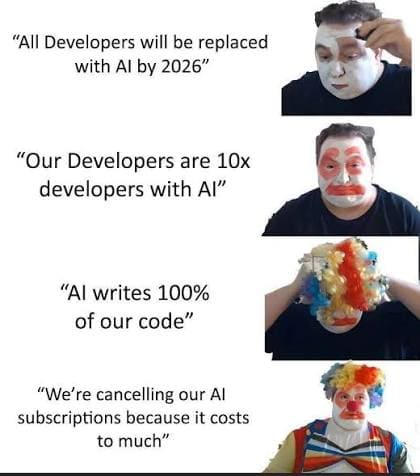
Ask developers directly and the panic doesn’t hold up: according to the same 2025 Stack Overflow Developer Survey, 63.6% say AI is not a threat to their job – down slightly from 68% the year before, but still a clear majority.
Here’s where it gets interesting, though. METR, an independent AI research nonprofit, ran a rigorous trial in 2025 and found experienced developers were 19% slower with AI tools, despite predicting they’d be 24% faster. Cue every “AI writes 100% of our code” claim looking a little embarrassing. But in a February 2026 follow-up, METR reran the experiment with the same developers using newer, more agentic tools – and this time got the opposite signal: a very rough 18% speedup. Here’s the fun part: even METR admits it’s tricky to pin down. Developers who’d gotten used to AI increasingly didn’t want to do tasks without it. METR was upfront about this and flagged it themselves rather than publish a clean-looking number they didn’t trust. Which says something on its own: when one of the most careful research teams in this space says “we’re not confident enough to give you a tidy stat,” that’s a pretty good sign the “AI makes everyone 10x” claim was never as settled as the hype suggested.
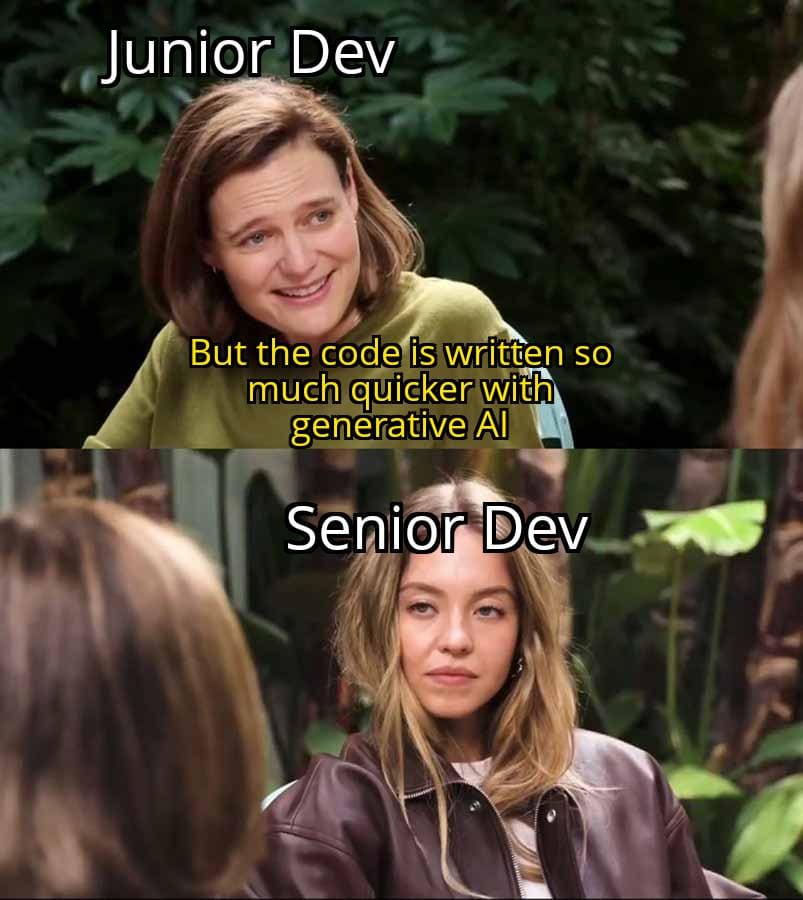
None of this means AI is useless – quite the opposite. Stack Overflow’s 2025 survey I keep returning to, found 84% of developers now use or plan to use AI tools (up from 76% the year before), and 51% use them daily. Developers aren’t rejecting AI. They’re just done pretending it works unsupervised: 46% say they don’t fully trust its output, and 66% describe AI answers as “almost right, but not quite.”
Our own recruiters hear this same story directly from candidates, every day. In interviews, the dominant tone isn’t fear, but a mix of genuine enthusiasm and pragmatic skepticism. Most developers describe AI as a real productivity boost for repetitive tasks, and say they’re actively working it into their workflow, while also noting they still need to review its output and stay sharper than the tool itself. Across every seniority level, candidates consistently frame AI as something that makes them more valuable, not something threatening their job – even skeptical senior engineers land on “useful tool with real limits,” not “existential threat.” Interestingly, AI/ML certifications rarely show up as hard requirements in the roles we fill; what actually moves the needle is hands-on experience, with cloud certifications (AWS, Azure, GCP) carrying more weight than generic AI courses. The real shift is elsewhere: AI-tool fluency is quietly becoming a baseline expectation across nearly every role, AI-specific or not.
In other words, AI has become a genuinely useful coworker, just not one you’d hand the keys to.
So no, AI isn’t taking over software development jobs in 2026. It’s taking over the boring 20% of the job, while developers keep the 80% that actually requires a brain.
10 Fun Facts About Software Engineering
Software engineering has a rich, often surprising history, from its origins to its modern culture. Ada Lovelace wrote the first computer program in 1842, over a century before computers existed. The first working computer, ENIAC, was programmed entirely by a team of women. The first recorded computer “bug” was a real moth found in a 1947 mainframe. Popular programming languages carry unexpected origin stories: Java was almost named “Oak,” Python is named after Monty Python, and Ruby beat out “Coral” by one character.
1. The first program dates back to the 19th century
Yes, you read that right! It was written by Ada Lovelace in 1842 – over a century before the first computer existed. Passionate about math, she used her visionary thinking to write the algorithm for Babbage’s calculating machine, “The Difference Engine.” While translating a paper by Italian engineer Luigi Manabrea, Ada added many pages of her notes, reimagining the idea of mere calculation in that machine. Even though Babble’s computer was never built, Ada’s contribution to computer programming was monumental.
2. “Computer” was a woman’s only occupation
Considering 2026’s gender gap in tech (where only 27.6% are women), this is a fun fact about application software that tends to surprise people: programming (once literally called “computing”) started out as an almost entirely female occupation. The first modern computer, ENIAC, was run by six women – Betty Holberton, Marlyn Wescoff, Ruth Lichterman, Kay McNulty, Betty Jean Jennings, and Fran Bilas. Through extensive planning, learning ENIAC’s logical diagrams, and endless configuration of wires, they set the first programming principles and developed a new field of computer programming – debugging.
3. The first computer bug was a moth – or was it?
The famous fact about engineering says the “first actual case of a bug being found” dates to 1947, when engineers on Harvard’s Mark II computer found a moth jammed in the machinery. Since then, “debug” and “bug” have become part of computer slang and have been widely adopted. Fun twist: Thomas Edison used the word “bug” for mechanical faults back in 1878. It just took Grace Hopper’s moth story to make the name stick.
4. Rubber duck debugging is a real, actual engineering technique
Ask a developer to explain their code line-by-line to a small rubber duck sitting on their desk, and most won’t even blink. The technique traces back to the 1999 book The Pragmatic Programmer by Andrew Hunt and David Thomas – and it works because saying your logic out loud, even to an inanimate object, forces your brain to catch the mistake your eyes kept skipping over. No AI required. Just a duck.

5. The logic behind the names of coding languages
- Java was created by James Gosling in 1991. Inspired by the oak tree outside his office, he initially called it “Oak.” However, potential copyright issues forced the team to come up with an alternative name – “Java.” It was a popular slang term for coffee at the time, and since programmers drink coffee by the gallon, “Java” seemed fitting. Plus, it was easy to spell and remember. Gosling himself later admitted the whole naming process was “continuous wild craziness” – Java beat out contenders like “Silk” and “DNA” in a team vote.
- Ruby was devised by Japanese software programmer Yukihiro Matsumoto in 1993. Inspired by Perl, he wanted his programming language to have an elegant yet simple name. Together with his colleague Keiju Ishitsuka, they developed “Ruby” and “Coral.” The latter was longer by one character, making it a mouthful to write multiple times – so they went with the shorter Ruby. By happy coincidence, pearl is the birthstone of June while ruby is the birthstone of July, making it a strangely perfect fit as Perl’s spiritual successor.
- Python was not named after a snake – surprise, surprise! Python is an object-oriented programming language created by Guido van Rossum, who happened to be a big fan of the BBC comedy sketch series Monty Python’s Flying Circus. So when he went looking for a name that was short, unique, and a little mysterious, he borrowed straight from the show. The Monty Python DNA runs deep in the language’s culture, too – Python’s own documentation famously uses “spam” and “eggs” instead of the usual “foo” and “bar.

6. Big tech and their names
- So, why Apple? Several theories are swirling around this fruity name. One suggests it’s a nod to Isaac Newton, who discovered gravity after an apple fell on his head. Actually, the first logo even showed this scene, but it got a makeover to a simpler design. Another theory credits Steve Jobs’ love for the Beatles’ Apple Corps label. And let’s not forget the famous bite out of the logo, rumored to honor Alan Turing’s tragic apple incident. But the truth? According to Steve Jobs, it was because he was on a fruitarian diet and had recently visited an apple farm. Maybe somewhere, a marketing team is still recovering from that answer.
- Google got its name due to a typo – shocking! The name was actually supposed to be “googol,” a mathematical term for a 1 followed by 100 zeros, fitting for a company obsessed with organizing unfathomable amounts of information. But when co-founder Sean Anderson checked whether the domain was free, he typed “google.com” instead – and it was available. Stanford’s own account of the story, recorded directly from Anderson, confirms Larry Page liked the misspelling enough to register it within hours. Nothing happens by chance, as they say – except, apparently, the name of the world’s biggest search engine.
- Meta or Facebook, that’s the question. The mystery behind the name change is refreshingly simple. In 2021, Facebook rebranded itself as Meta to signal its ambition to go beyond social media and build the “metaverse” – a 3D space for working and playing. At the announcement, CEO Mark Zuckerberg said the metaverse would be “the next frontier, just like social networking was when we got started.” Whether that frontier has actually arrived yet is a debate for another article entirely.
7. Every programmer’s first-ever line of code says the same thing
Type “Hello, World!” into almost any language, and you’re taking part in a tradition that goes back to 1972, when Brian Kernighan wrote it into a Bell Labs tutorial for the B language. According to HackerRank’s history of the phrase, Kernighan’s inspiration was a cartoon he’d seen of a chick hatching from an egg and saying “Hello, World.” More than 50 years later, it’s still the first thing nearly every developer ever types.

8. The first webcam was invented to babysit a coffee pot
In 1991, computer scientists at the University of Cambridge got tired of walking to the office coffee pot only to find it empty. So they pointed a spare video camera at it and wired the feed to their desktop screens. Co-creator Quentin Stafford-Fraser called it a project born from being “poor, impoverished academics” who “got through a lot of coffee.” Once the feed hit the early web in 1993, millions of strangers tuned in to watch a pot of coffee slowly disappear – arguably the internet’s first viral livestream, decades before Twitch existed.
9. Adding more developers to a late project makes it later – it’s an actual named law
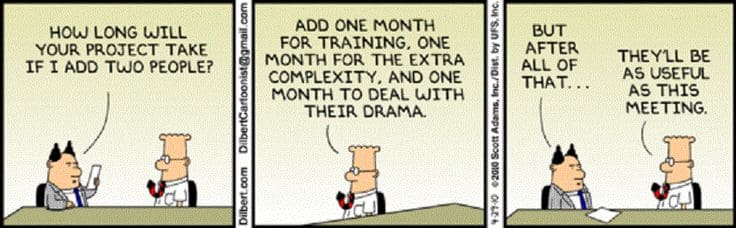
It sounds counterintuitive, but it’s one of the most quoted rules in software engineering: “Adding manpower to a late software project makes it later.” Known as Brooks’s Law, it comes from Fred Brooks’s 1975 book The Mythical Man-Month, based on his own experience managing IBM’s infamously delayed OS/360 project. New team members need ramp-up time and create more communication overhead – so throwing bodies at a deadline often backfires. Fifty years later, it’s still the reason “just hire more people” isn’t a real fix for a slipping deadline.
10. AI was supposed to be created by the end of one summer – in 1956
Fun facts about application software today wouldn’t be complete without AI. The term “artificial intelligence” wasn’t coined by a tech company or a sci-fi writer. It came from a research funding request.
In 1955, John McCarthy and three colleagues asked the Rockefeller Foundation to bankroll a summer workshop at Dartmouth College, where they planned to crack machine intelligence in about two months. According to the Dartmouth Alumni Magazine’s own retelling, McCarthy wrote he expected to have a working model “fairly close to the stage of programming in a computer” by that same summer. The Rockefeller Foundation, apparently sensing this was optimistic, only funded half the requested budget. Seventy years, several “AI winters,” and one very talkative chatbot boom later – we’re still not done. Some hype cycles just have really, really long summers.
15 Fact-Checked Facts about Software Developers
This section covers verified, source-backed facts about software developers’ pay, demographics, and work realities. Monthly salaries vary sharply by seniority, specialization, and region, with US senior engineers earning roughly triple their Eastern European or Latin American counterparts for comparable skill levels. Most coders are under 35, though COBOL specialists (averaging age 55) command high salaries due to a shrinking talent pool. Formal degrees are increasingly optional, as job postings requiring one dropped from 51% to 44% since 2017. Equity compensation remains common, as shown in Alcor’s client case study with Dotmatics, acquired by Siemens for $5.1 billion.
1. This job pays big bucks
According to Alcor’s internal data, the average base monthly wage for a middle-level software developer in the US sits at $11,302, climbing to $15,675 at senior level and $18,419 for leads. That’s not a typo – this is one of the rare professions where “middle” already outpaces most people’s three months’ income.
Pay varies depending on:
- Specialization: senior Mobile Developers (iOS/Android) average $14,500/month in the US. Specialists in emerging fields earn even more – Senior AI Research Scientists average $21,500/month, and Senior Blockchain Engineers sit at $14,250/month. The rarer the skill, the steeper the premium.
- Location: per Alcor’s data, a senior engineer in the US averages $15,675/month. The same seniority level in Eastern Europe averages $6,407/month (about 55% lower), and in LATAM $5,525/month (about 61% lower) – comparable output, a fraction of the cost.
While exact figures shift by role and region, the takeaway holds: software development pays well everywhere, and the pay gap between hiring locally and hiring smart is enormous.
However, employers face a real tension here – sky-high domestic salaries and brutal competition for the same shrinking pool of senior computer programmers. That’s exactly why companies expanding into global markets get two wins at once: lower information-backed labor costs and access to specialists who simply aren’t available (or affordable) at home.
2. Coders are younger than everyone else… mostly
The very same Stack Overflow Survey I keep referring to says that around 52% of coders are under 35, with the median age sitting at 43 – a fact about being a software developer that fuels the industry’s youthful reputation. But there’s a strange exception hiding in the data: COBOL.
According to reporting on the COBOL job market, the average COBOL developer today is 55 years old, and COBOL still quietly processes an estimated $3 trillion in transactions a day, including roughly 95% of ATM swipes. Universities largely stopped teaching it decades ago, so as this graying cohort retires, banks are paying six-figure salaries just to keep 60-year-old code alive. So yes – coding skews young. Except in the one corner of it that’s quietly running the global banking system, where being old enough to remember rotary phones is a hiring advantage.
3. Who said a university degree? Not obligatory!
Here’s one of the most empowering facts about programmers: you don’t need a formal engineering degree to become a successful software engineer. And this trend already started accelerating a few years ago. According to the Burning Glass Institute, the share of US job postings requiring a bachelor’s degree dropped from 51% in 2017 to roughly 44% by 2024, and 2026 data suggests the trend is picking up speed. A May 2025 survey of 1,000 hiring managers found 54% had already removed degree requirements for mid-level roles, and 23% had done the same even for senior ones. Google, IBM, Tesla, Apple, and Bank of America have all dropped the requirement for at least some technical positions.
In today’s IT sector, practical experience and hands-on problem-solving from computer programmers increasingly outweigh formal education. The abundance of free, structured coding resources has made tech education more accessible than ever – platforms like GitHub, Coursera, and freeCodeCamp offer real-world training in the technologies companies actually use. The takeaway for computer science grads and self-taught devs alike: the diploma opens doors it used to guard.
Expanding to LATAM? Discover the tech qualification of software developers in Colombia!
4. JavaScript – the king of the coding kingdom
JavaScript is still, technically, the most-used language on Earth – 66% of developers reported working extensively with it in 2025, a title it’s held every year since 2011 except two. But there’s a plot twist happening right under its nose: as of August 2025, TypeScript overtook both JavaScript and Python to become the single most-used language on GitHub by monthly contributors – over 2.6 million of them, up 66.6% year over year.
Our internal hiring data confirms the same pattern from the client side: across Alcor’s active job briefs, JavaScript/TypeScript (including its React, Node, Angular, and Vue ecosystem) leads as the single most-requested stack at 53%, ahead of Python (38%), Java (22%), Go (16%), and C#/.NET (12%). It’s not a fluke, either – pulling the full decade of jobs we’ve filled, JavaScript/TypeScript still ranks #1 at 39%, just ahead of a tight cluster of Python, C#/.NET, and Java. Whatever’s happening on GitHub with TypeScript’s rise, on the client-request side, JavaScript’s ecosystem is still the one everyone’s asking for.

5. C++, who doesn’t love a good brain teaser?
C++ remains genuinely hard to love at first – advanced syntax, less English-like structure than Python, and a reputation that makes new developers wince. And yet in TIOBE’s July 2026 index, C++ still sits in the global top 3.
Our internal recruiting data adds a wrinkle here: C++ specialists are significantly rarer in Eastern Europe and LATAM than JavaScript or Python developers – a typical C++ search surfaces a fraction of the candidate volume a JS or Python search would. Availability depends heavily on the domain more than the language itself. Eastern Europe has the stronger established pool, thanks to its history in embedded systems, gaming, and hardware-adjacent engineering — Poland, Ukraine, and Romania stand out. LATAM’s C++ talent is real but more concentrated, mainly in Mexico, Brazil, and Argentina.
Here’s the brain teaser part: everyone assumes AI runs on Python. Technically, true, but only at the surface. The actual engines underneath frameworks like PyTorch and TensorFlow, the parts doing the heavy lifting on GPUs, are written in C++. Python is the friendly face; C++ is running the machine room. So the language most developers associate with “old” and “hard” is quietly one of the languages powering the AI boom everyone thinks belongs entirely to Python. As the joke goes: “I’ve been learning C++ for 30 years” – and apparently, so has the AI industry, whether it admits it or not.
6. There’s a programming language literally designed to be impossible
If C++ is a brain teaser, Malbolge is a brain crime. Created in 1998 by Ben Olmstead specifically to be as difficult to program in as it’s possible to be, Malbolge is named after the eighth circle of hell in Dante’s Inferno – reserved, fittingly, for fraud. Its logic is so hostile that the very first working “Hello, World!” program wasn’t written by a human at all – it took two years to appear, and was ultimately generated by a search algorithm, because writing it by hand was effectively impossible even for its own creator. To this day, only a handful of working Malbolge programs exist. Somewhere out there, a developer is proud of that.

7. Programmers are real job-hoppers
Another fact about software development: tech talent changes jobs frequently, and the numbers back it up hard. According to Zippia’s analysis of roughly 103,000 software developers, 45% have a tenure of just 1 to 2 years at any given company, and a striking 69% stay under two years total.
Our own internal data backs this up almost exactly: across Alcor’s candidate pool, the median tenure per employer sits at 2.6 years – squarely in that same window. It’s a wide spread rather than a hard rule, though: a quarter of candidates move on in under 2 years, and a quarter stay past 3.7. Worth noting, these are active job-seekers already in our pipeline, so the number likely skews a touch shorter than the developer population as a whole.
From a coder’s view, this pattern often stems from stagnant salaries, outdated tech stacks, burnout, and a lack of autonomy. And culture matters more than people admit: internally, “cultural fit” shows up as a specific, tracked reason candidates or clients walk away – accounting for roughly 1 in 20 meaningful drop-offs in our process, mostly resolved early-to-mid funnel rather than at the finish line. A strong company’s culture that genuinely aligns with developers’ values remains one of the few proven ways to buck the trend and retain top talent.
8. Remote work is a lifestyle
I already mentioned, back when we talked about why software engineering is so popular, that only 17.9% of developers work fully in-person these days. Worth expanding not only on the fact about computer engineers here: this isn’t just a developer quirk – it’s one of the strongest holdouts against the broader return-to-office wave sweeping the rest of the corporate world. According to Gallup, among remote-capable tech workers specifically, roughly 47% are fully remote and 45% hybrid, leaving just 9% fully on-site.
Our recruiters hear the same story directly from candidates in Eastern Europe and LATAM: remote-only is the strongest preference in both regions, with around a third of candidates working fully remote and over 60% ranking flexibility as a top priority when weighing an offer. Hybrid is generally acceptable when in-office time is limited and clearly defined upfront. Fully office-based roles, though, consistently shrink the available pool (especially for senior and specialized profiles) with only about 18% of developers in our funnel working fully in-person, a number that lines up almost exactly with the global 17.9% figure above.
Tech is, in other words, the industry quietly refusing to get the memo. There’s even a term for the workaround some employees use under stricter mandates: “coffee badging” – badging into the office just long enough to be seen, then working from home anyway. For many software coders, this setup shapes their typical day: focused sprints, async collaboration, and zero commute. For employers, going remote remains about more than saved office costs – it’s autonomy, trust, and access to a genuinely global talent pool.
Discover the pros and cons of cooperating with IT outsourcing providers in Romania!
9. Moving up the career ladder like a flash
A developer’s career is often described as linear: junior, then middle, then senior after 5-7 years, then a fork toward either deep technical tracks or people management. Here’s the twist nobody puts on the recruiting brochure: a growing number of computer engineers never actually want that senior title. One widely discussed analysis of the mid-level plateau argues most developers who stay mid-level aren’t failing to grow – they’re simply not making the specific mental shift senior roles demand: from “implementer” to “problem-owner,” from executing tickets to deciding what shouldn’t be built at all. And in a genuinely surprising twist, back in 2024 Stack Overflow Developer Survey found senior developers reporting lower job satisfaction than juniors – the first time that’s happened in the survey’s history. Sometimes climbing the ladder just means reaching a floor with a worse view.

10. The word “vibe coding” is barely a year old – and it’s already a dictionary entry
On February 2, 2025, AI researcher Andrej Karpathy (an OpenAI co-founder and former Tesla AI director) posted a tweet describing a way of building software where you “fully give in to the vibes, embrace exponentials, and forget that the code even exists.” He called it “vibe coding,” meant it as a throwaway joke about weekend hobby projects, and later described the post itself as “a shower of thoughts throwaway tweet.”
It did not stay a joke. Within months, “vibe coding” spread across the entire industry, spawned counter-terms like “vibe debugging,” and by the end of 2025 was named Collins Dictionary’s Word of the Year, beating out “aura farming” and “taskmasking.” One tweet. One year. One dictionary entry. Some of the biggest innovations in how we talk about AI-assisted development started as a joke nobody expected to catch on, which is arguably one of the more honest facts about software engineers in this entire list: half of tech culture is just a bit that got too popular to retract.

11. When your first “compile error” took 24 hours to find out about
Here’s a computer engineering fact that makes today’s instant AI autocomplete look like pure science fiction: before the 1970s, most programmers didn’t type code into a screen – they punched it, one line at a time, into stacks of physical cards using a typewriter-like keypunch machine. Get a single character wrong, and you didn’t just retype a line – you re-punched an entire card from scratch.
Then came the real punishment. According to documented accounts of the punch-card era, programmers submitted their card deck to an operator and waited (often overnight, sometimes a full 24 hours) just to find out if the program had a typo in it. No red squiggly underline. No instant error message. Just a full day of your life, gone, to discover you’d mistyped a semicolon. Dedicated programmers would show up at 2 a.m. specifically because the queue was shorter then, and a single dropped or out-of-order card in the deck could ruin the entire run.

12. Sometimes the job is solving nothing, on purpose
You wanted a coconut simulator. It exists, almost exactly as described. Released November 22, 2024 by Dynamic Games, Coconut Simulator puts you on a sun-drenched beach as, well, a coconut. You lie there. Other coconuts lie nearby. That’s it – no goals, no combat, just contemplating the ocean as a piece of tropical fruit. It costs $0.99, sits at a 94-96% positive rating across hundreds of reviews, and was popular enough to spawn a sequel, Coconut Simulator 2.
It’s not even the first of its kind. Back in 2014, artist David OReilly released Mountain for the same price – you play a floating mountain, and the entire game is watching weather happen to you while time passes. The Atlantic called it a game that “breaks the mold.” Ten years later, Coconut Simulator proved the concept still works: give someone a inanimate object, a beach, and absolutely nothing to do, and they’ll pay for the privilege – twice, apparently, given the sequel. Software development doesn’t always mean solving hard problems. Sometimes it means solving none at all, on purpose, and shipping it anyway (and doing it again when people ask for more).
13. Devs sometimes own shares, not just code
That’s true! Equity compensation isn’t just for founders. Many software engineers receive shares or equity as part of their total compensation package. In the US, when total pay exceeds $250K, an increasing portion comes from equity-based rewards like RSUs or stock options. This structure incentivizes long-term commitment and aligns developers’ success with company performance.
Some public cases underscore the potential upside:
- Google, Meta, and Stripe regularly grant equity to engineers, making early employees eligible for substantial financial gain.
- At early-stage startups, it’s common for developers to receive 0.01% to 0.5% of the option pool, depending on the seniority of the role and the stage, which can become a life-changing amount after a successful exit.
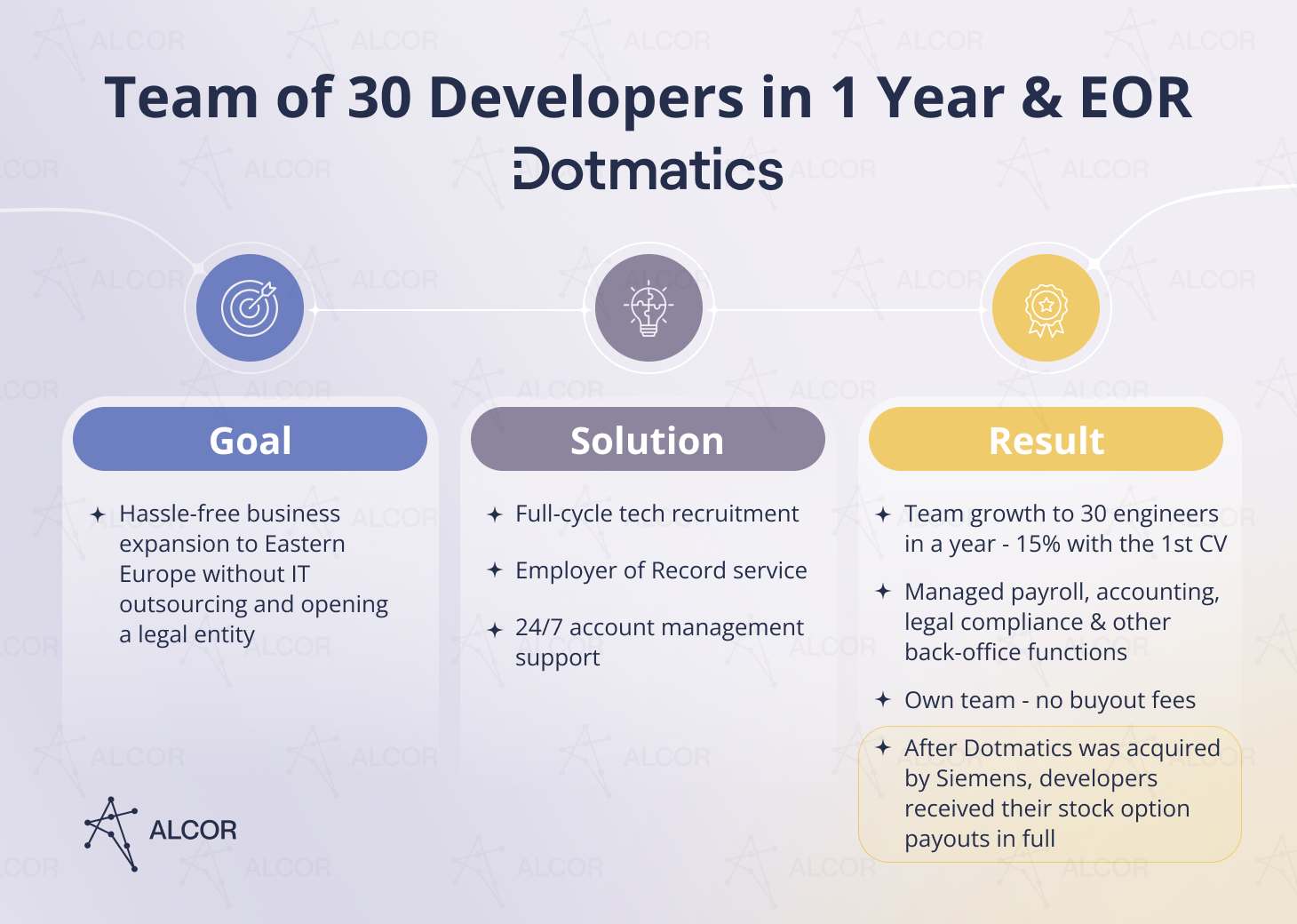
- This is a popular benefit among tech companies expanding to new markets like LATAM and Eastern Europe, as it helps to attract and retain top talent. When Alcor built Dotmatics’ 30-person Eastern European engineering team, stock options were part of the package from day one. In 2025, Dotmatics was acquired by Siemens for $5.1 billion, and Alcor made sure every developer’s stock options were paid out in full, with no delays.
14. Methodologies that shape developers’ work
One of the lesser-known computer engineering facts is how deeply a team’s workflow model influences a developer’s daily routine.
Agile methodologies have become the norm in most tech teams, offering flexibility, quick iterations, and constant feedback loops – ideal for developers working in dynamic, fast-scaling environments. Meanwhile, some industries still rely on Waterfall for its structured, linear process, especially in high-compliance sectors.
Each model affects how software coders prioritize tasks, handle communication, and implement automation tools – from CI/CD to documentation. That’s why understanding the development framework is key to evaluating a developer’s productivity, satisfaction, and alignment with your company’s goals.
15. Employment status of software developers
The world of software engineering offers far more than a typical 9-to-5 – one of the most overlooked facts about application software development is the sheer variety in how developers actually work. And AI is accelerating that variety, not shrinking it: in Upwork’s October 2025 survey of business leaders, 77% said AI is increasing their need for specialized, fractional talent rather than traditional full-time hires. Fittingly, Web, Mobile & Software Development is already the single largest freelance category on Upwork, making up 34% of all freelance work on the platform.
Here’s how companies are engaging developers in 2026:
- Full-time roles in tech product companies remain the gold standard for long-term engagement and growth.
- Freelance and contract gigs attract coders seeking flexibility, niche projects, or side hustles.
- IT outsourcing and outstaffing models allow companies to scale fast, but often with limited control and hidden fees.
- R&D centers strike a balance: direct hiring, Employer of Record compliance, and full operational support, providing tech leaders with full ownership without the headache of setting up a local entity.
Alcor’s EOR for tech: With Alcor, tech companies benefit from 100% compliance with local labor and tax laws, streamlined payroll and benefits handling, plus dedicated Customer Success Managers for seamless onboarding, fast issue resolution, and long-term success.
5 Untold Truths About Being A Software Engineer
According to Developer Nation’s 2024 survey, 84% of developers work overtime at least occasionally, and sedentary work leads to common health issues like back pain and eye strain, an area where operational support (like Alcor’s work with Pindrop) makes a measurable difference. Learning never stops. A peer-reviewed 2024 study found 52.7% of software engineers experience frequent impostor syndrome, regardless of actual skill or experience level.
1. Working overtime is likely
Now, discouraging facts about being a software engineer include working overtime. According to Developer Nation’s State of Developer Wellness Report, which surveyed nearly 1,000 developers across 86 countries, 84% of developers work overtime at least occasionally. More than half (53%) call it acceptable, but 39% say it leaves them dissatisfied, and 8% describe it as flat-out overwhelming. Highly stressful deadlines are typical for products in the development stage, especially during testing and debugging right before launch. Aside from being mentally exhausting, this pattern can snowball straight into burnout – the kind no amount of energy drinks or “just one more sprint” pep talks can fix.
For employers, the fix isn’t complicated: protect your team’s productivity by protecting their hours. A healthy work environment and real work-life balance are what keeps your best engineers from quietly updating their LinkedIn at midnight.
2. Sedentary lifestyle takes a toll on programmers’ health
While interviews and long hours can somehow be managed, the most shocking facts about software developers are related to their health. Bad backs and wrists, eye strain, brain fog, and mental exhaustion from staring at the same problem too long are the most frequent complaints. The essential tip here: make sure your engineers have the right equipment for their needs, and try to broaden their tasks so nobody’s stuck in the same posture, on the same problem, for months on end.
This is exactly the kind of thing that gets overlooked when a company is scaling fast – which is why Alcor built it into the process for Pindrop, a US voice-security company building a 30-engineer team in Ukraine. New hires used to lose real hours just getting their laptops set up. Alcor took that off Pindrop’s plate entirely – equipment procurement, WFH setup, and travel support, all backed by a dedicated Ops Manager, so new engineers arrived ready to work on day one, properly equipped, instead of hunched over a borrowed laptop for their first week. Pindrop called it an unexpected bonus. For developers, it’s the difference between a job that wrecks your back and one that doesn’t.
Planning a similar expansion? See how to hire developers in Ukraine without building local infrastructure from scratch.
3. There’s no end to learning
There’s no limit to the challenges that may arise for those who have chosen computer programming! Even though hard skills are common in this way, software engineering facts prove that this requirement is innumerable. For instance, our tech recruiters revealed in practice that most Full Stack job specs technically require just one core frontend technology and one primary backend language or framework – two to three core technologies is the realistic bar for what a role formally demands. But “required” and “valuable” are two different things. A developer who only knows the two required technologies is qualified. A developer who’s also picked up the adjacent framework, the cloud platform, or the tool nobody asked for on paper is the one clients actually fight over. The learning never stops, in other words, not because the job demands it on a checklist, but because every extra layer you add on top of the core is what turns “meets requirements” into “clearly worth hiring.”

4. Software developers complain about countless interviews
This one hasn’t improved — if anything, it’s gotten worse. 2026 hiring data shows 39% of companies admit candidates face too many interview rounds, and 52% admit their own process is too long, with roughly 1 in 7 employers now running five-plus rounds as standard practice.
Our own tech recruiters confirm this from the inside, but with a twist: it’s not actually the number of rounds candidates complain about most. It’s the waiting. The two most common complaints they hear are long gaps between stages (waiting a week or more for feedback after a technical interview) and lengthy live-coding assessments (over an hour), which some senior engineers withdraw from the moment they hear it’s required, feeling it doesn’t reflect their actual day-to-day skill. This hits senior and niche candidates hardest, since they’re usually running multiple processes in parallel and have far less patience for delay. There’s no single universal drop-off point – some candidates decide in the very first recruiter call whether they’re willing to commit to a long process at all, while others bail specifically at the technical-assessment stage. As for feeling like “just another applicant” in a generic process: Alcor’s recruiters actively guard against this through consistent, transparent communication and expectation-setting at every stage, which is exactly the kind of scorecard-driven approach we used building Firstup’s team.
For companies, being aware of these programmers’ facts and streamlining the hiring process is essential to avoid losing candidates halfway through. The best way to prevent it: working with a professional tech recruitment and EOR provider who already knows exactly where the process is bloated – and where it isn’t.
5. Most developers secretly think they’re not good enough
Here’s the truth almost nobody says out loud at standup: over half of software engineers privately believe they’re not actually as good as everyone thinks. A 2024 study using the validated Clance Impostor Phenomenon Scale (the same clinical tool used to study impostor syndrome in medicine) surveyed hundreds of software engineers and found 52.7% scored in the “frequent to intense” range for impostor feelings. It hits women harder (60.6%) than men (48.8%), and it’s directly correlated with lower job satisfaction, reduced productivity, and higher intent to quit.
The irony is almost poetic: this is an industry where the tech genuinely does change out from under you every few years – yesterday’s expert in jQuery is today’s beginner in server components – so feeling perpetually behind isn’t a personal failing, but a structural feature of the job. The engineers who seem the most confident are, statistically, just as likely to be quietly Googling “how does X actually work” as the ones who admit it.
Build a Team of Elite Software Developers
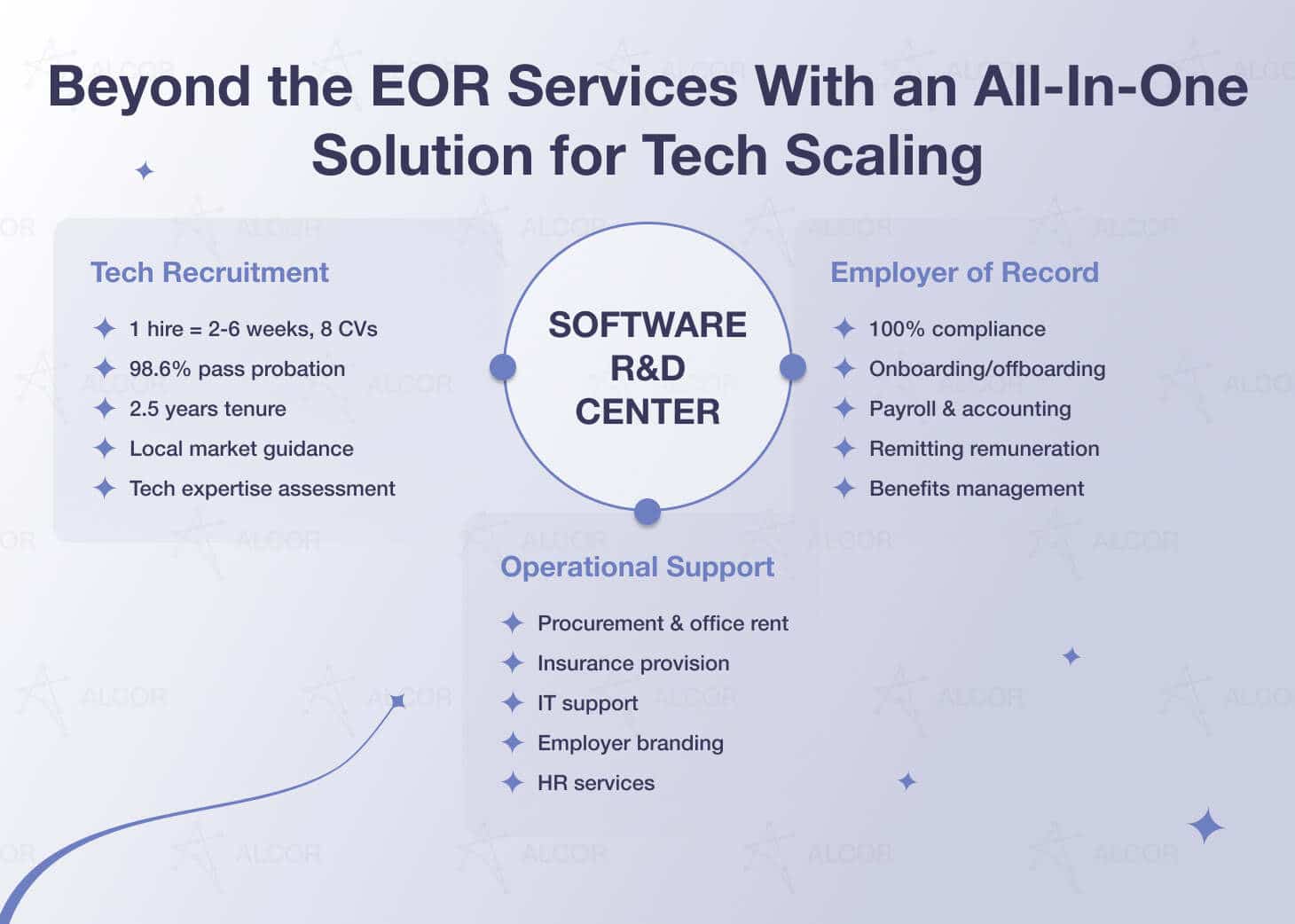
We do our best to keep tech talent from slipping through your fingers. Unlike other providers, Alcor covers every minor aspect of the expansion journey:
- In-house hiring: with our top-notch IT recruitment services in Romania, other Eastern European and LATAM countries, we deliver unicorn-grade senior engineers that match your needs and culture.
- Comprehensive Employer of Record/Contractor of Record: we hire developers on FTE and B2B models, plus handle specifically tailored contracts for tech realities, onboarding, payroll, compliance, and benefits – all under our legal entities.
- Full operational support: we cover office leasing and hardware procurement for your dev team to function with ease and comfort.
All of that is wrapped in our tech R&D center solution to bring you peace of mind in the new market.
With Alcor, you’ll enjoy:
- Silicon Valley-caliber developers in top tech locations across LATAM and EE
- Up to 50% savings compared to offshore development outsourcing models
- Pricing transparency without any prepayment, hidden fees
- Your own branded team with full IP rights and zero buyouts
Tech companies such as Backstory (ex-People.ai), Franki, Ledger, UFORCE, and other tech product companies are already reaping the benefits of our comprehensive solution.
Fill out the form below and try it out yourself!
FAQ
How popular is software development?
Software engineering is seen in top 10 best jobs in 2026, and its popularity is expected to grow further. More and more businesses are aiming for automation, and with data science, machine learning and AI gaining more popularity, software developers are at the top of all world trends.
What facts should I know about being a software developer?
Software developers are relatively young and well paid, enjoy the opportunity to travel and grow careerwise, and need salary raises and work challenges to stay at one company for more than 3 years. And no, AI won’t replace them.
What are the negative aspects of being a developer?
As with any computer-related job, health is in peril. Other disadvantages include a lengthy hiring process, plus the constant need for keeping up with learning trends and most likely a lot of overtime.
How would you rate this article?
Alcor is Your Trusted Scaling Partner
for expansion
support