


We build and operate top-tier tech teams in LATAM and Eastern Europe.
Up to 40% savings. 100 people a year. No entity. No buy-out fees.
Poland, Ukraine, Romania, and Bulgaria are the four countries leading in AI engineering across a region with more than 2 million tech professionals combined, according to Alcor’s 2026 Guide to Building Your AI & Product Engineering Team in Latin America & Eastern Europe. Each market supports scaling an AI tech team from 1–5 engineers to 30+ within 90 days with Alcor’s help – the question is which one fits your priorities best.
In this article, you’ll see how Poland, Ukraine, Romania, and Bulgaria compare on AI talent depth, salaries, and infrastructure. Also, you’ll discover what hiring a compliant AI engineer actually costs once labor law and statutory benefits are factored in. As well as how to protect full IP ownership of your AI product while building a team in any of these four markets.
Key Takeaways
- The top 4 AI development countries in Eastern Europe are Poland, Ukraine, Romania, and Bulgaria.
- Eastern Europe hires AI engineers 2-3x faster than the US, at roughly half the cost: 0.5-1.5 months to fill a senior role versus 2-4 months domestically, and $9,875/month versus $18,500, per Alcor’s 2026 research.
- Poland wins on talent depth (778,800 professionals, #1 in Europe for Tier 2 AI talent), Ukraine on cost savings, Romania on infrastructure momentum (a €500M EuroHPC AI Factory site), and Bulgaria on EU integration.
- Eastern European AI engineers’ salaries run 32.7-59.3% below US rates at every seniority level, with the widest savings at mid-level and the narrowest at lead-level, according to Alcor’s 2026 engineer compensation research.
- Alcor makes hiring in Eastern Europe simple – full-cycle recruitment, tech-focused EOR/COR, and 360° operational support under one roof. You get a fully owned, in-house AI engineering team of up to 100 tech specialists in a year with protected IP, no vendor layer, and no local entity required.
Why Tech Companies Are Hiring AI Engineers Beyond Domestic Markets
Companies look beyond domestic hiring because it’s too slow, talent is too scarce, and senior AI specialists cost too much. The US takes 2–4 months to fill a senior AI role; Eastern Europe does it in 0.5-1.5 months, at roughly half the salary ($9,875/month vs $18,500), per Alcor’s 2026 research, as regional AI/ML hiring capacity keeps expanding.
US and Western European companies are looking past domestic hiring because the AI talent pipeline at home can’t keep pace with product roadmaps, on three fronts at once: hiring takes too long, talent is too scarce, and senior AI specialists cost too much to hire at scale domestically.
- Speed. US AI, ML, and data science job postings rose 163% year-over-year to 49,200 in 2025, as the AI industry leans harder into automation and analytics, while filling a specialized AI engineering role domestically still takes months, not weeks, according to Robert Half.
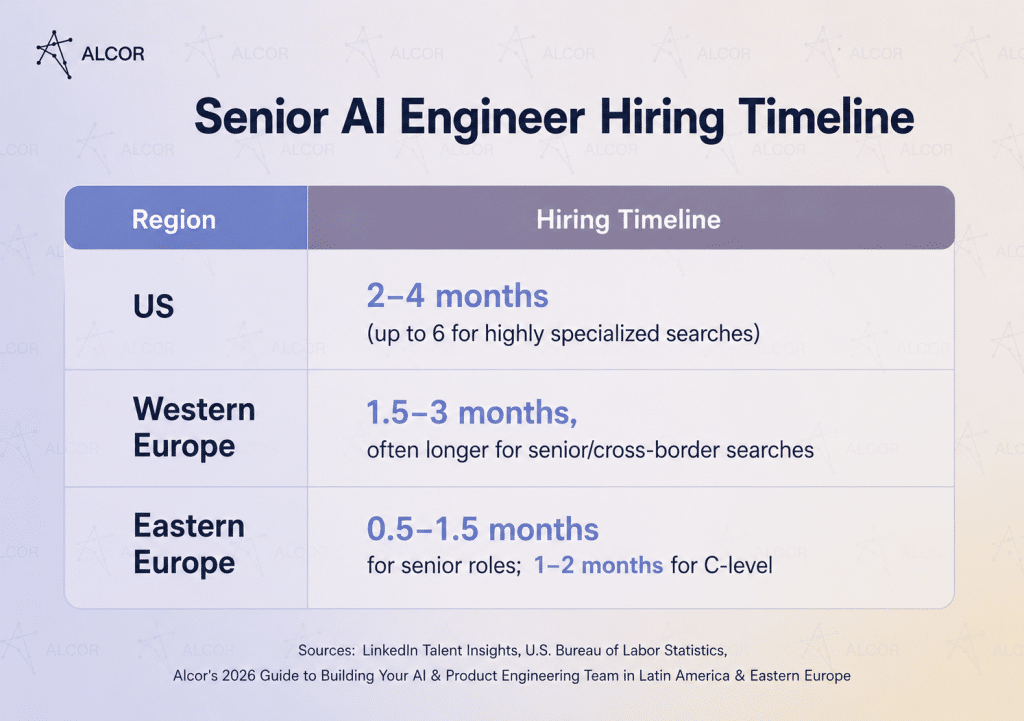
- Talent shortage. Robert Half found that 65% of technology leaders say finding skilled professionals is harder than it was a year ago. Only 7% believe their teams currently have the people and expertise needed to execute their priorities. PwC separately recorded roughly 483,000 job postings requiring AI skills across the UK, France, and Germany in 2025 alone. It’s a clear signal of accelerating AI adoption that’s pushing more companies to look at nearshore AI developers as domestic pipelines dry up.
- Cost. Senior AI Engineers in the US average $18,500/month in base salary, according to Alcor’s 2026 compensation research – nearly double the Eastern European average of $9,875/month.
- Eastern European STEM strength. Poland ranks #1 in Eastern Europe on the Topcoder Programming Competitiveness Index, with 74,000 STEM/ICT graduates a year and 20 universities in the QS World University Rankings 2026. Ukraine (#2), Romania (#3), and Bulgaria (#5) follow, backed by 40,000, 35,600, and 6,000 annual STEM graduates respectively. That combination of scale and specialization sets Eastern Europe apart from developing countries competing mainly on price rather than technical depth.
- Business fit. Working with US and Western European product companies isn’t new territory for these markets – the cultural and communication friction that trips up other regions has largely worn off already. Romania (#2 in Eastern Europe) and Poland (#3) top the region’s English proficiency rankings, with Bulgaria (#4) and Ukraine (#8) not far behind, according to the EF English Proficiency Index 2025 – so code reviews, architecture calls, and stakeholder updates run without a language gap getting in the way. Poland, Romania, and Bulgaria layer EU membership on top, which means GDPR compliance, IP protections, and shared EU AI safety regulation are already baked into how business gets done.
- Always-on coverage. For US teams, Poland, Ukraine, Romania, and Bulgaria sit 6-9 hours ahead, delivering round-the-clock progress while the US sleeps. For Western European teams, all four markets sit within 1-2 hours – full real-time overlap instead.
Turn your AI hiring pressure into a clear plan
Explore 8 tech markets across LATAM and Eastern Europe and get practical insights for building your AI engineering team.
Which Eastern European Countries Support AI Development Best?
Poland, Ukraine, Romania, and Bulgaria each lead Eastern Europe’s AI development on a different axis.
- Poland offers the deepest talent pool (778,800) and top Tier 2 AI research concentration.
- Ukraine has the fastest-growing AI/ML specialist base.
- Romania hosts a €500M EuroHPC AI Factory site.
- Bulgaria anchors AI research through INSAIT, built with ETH Zurich and EPFL.
Poland, Ukraine, Romania, and Bulgaria each lead on a different axis – talent depth, cost, infrastructure momentum, EU integration, or startup ecosystem maturity – so the right market depends on team size and priority, not a single “best” answer on any one AI index.
|
Market |
Tech talent pool |
AI development support |
|
Poland |
778,800 |
|
|
Ukraine |
305,000 |
|
|
Romania |
207,800+ |
|
|
Bulgaria |
126,100 |
|
AI Product Engineering Salaries in Eastern Europe
AI engineers’ salaries are 32.7-59.3% less across Poland, Ukraine, Romania, and Bulgaria than in the US, at every seniority level, according to Alcor’s 2026 compensation research. Savings are widest at mid-level and narrow at lead-level, where technical leadership commands a premium in every market.
The savings gap between AI product engineers’ salaries in Eastern Europe and the US shifts by seniority – here’s the breakdown market by market:
| Poland | Ukraine | Romania | Bulgaria | |
| Mid-level | -47.9% | -59.3% | -51.3% | -55.7% |
| Senior | -44.3% | -54.6% | -47.3% | -51% |
| Lead | -32.7% | -47.9% | -37% | -42.9% |
All figures are estimated monthly base salaries in USD for 2026, sourced from Alcor’s salary dataset. Savings percentages are calculated from the average salaries across the 15 roles chosen for Alcor’s 2026 Guide to Building Your AI & Product Engineering Team in Latin America & Eastern Europe.
At the senior level specifically, here’s how some AI roles compare across all four markets:
| Senior Monthly Base Salary, USD | |||||
| Poland | Ukraine | Romania | Bulgaria | USA | |
| AI Engineer | $10,750 | $8,750 | $10,250 | $9,750 | $18,500 |
| ML Engineer | $8,300 | $7,000 | $8,100 | $5,300 | $18,500 |
| MLOps Engineer | $8,500 | $7,500 | $8,300 | $7,150 | $15,750 |
| LLM Engineer | $8,500 | $7,200 | $8,150 | $7,500 | $19,500 |
| AI Product Engineer | $8,650 | $7,000 | $8,100 | $7,300 | $19,000 |
| According to Alcor’s 2026 engineer compensation research | |||||
Want the full picture? Download Alcor’s 2026 Guide to Building Your AI & Product Engineering Team in Latin America & Eastern Europe to access the breakdown of mid-level, senior, and lead salaries across all 15 AI and ML roles, in all four Eastern European markets + LATAM.
Labor Law and Compliance across Eastern Europe
Eastern Europe’s labor law splits into employment agreements or B2B contracts, with different rules by country. Each is governed by different legal codes, with its own rules on probation, notice periods, severance, and overtime pay.
Poland and Romania split employment law and B2B contracts between a Labour Code and a Civil Code, while Ukraine adds a third option, the Diia.City gig contract, built specifically for the IT workforce and supporting compliant hiring. Notice periods range from none required (Ukraine, in most cases) to three months (Poland, Bulgaria), and severance is far from universal: Romania requires none outside medical unfitness, while Poland, Ukraine, and Bulgaria mandate it only under specific conditions.
Every Eastern European market resolves to an employment agreement or a B2B contract, and each is governed by different local codes with materially different notice periods, severance formulas, and probation rules. So “cheapest salary” and “cheapest hire” are rarely the same market.
Poland
An employment agreement falls under the Labour Code, while a B2B contract runs on the Civil Code – the same framework that lets many senior engineers register as sole traders and negotiate rates directly in USD.
- Standard workweek: 40 hours (as of 2026);
- Overtime: 8 hours/week;
- Overtime pay: 150% in regular hours; 200% at night, on Sundays, or public holidays (alternatively compensated with time off);
- Probation: 1 month (fixed-term contracts under 6 months); 2 months (contracts between 6–12 months); 3 months (all other cases);
- Notice period: 2 weeks (under 6 months of employment); 1 month (6 months to under 3 years); 3 months (3+ years). For probation, 3 working days (probation up to 2 weeks); 1 week (probation over 2 weeks but under 3 months); 2 weeks (probation of 3 months);
- Termination payments: Compensation for all unused paid vacation days. Plus, any outstanding payments when probation is already passed;
- Severance payments: apply only at companies with 20+ employees dismissing for non-employee-related reasons – 1 to 3 months’ salary, capped at PLN 72,090 or ~ $18,900. Not presupposed during probation.
Ukraine
An employment agreement is governed by the Labor Code plus tax and social insurance law; a B2B contract by Civil/Commercial Law; and a third path, the Diia.City gig contract, was built specifically to keep IT talent and tax revenue onshore.
- Standard workweek: 40 hours (as of 2026);
- Overtime: 4 hours for 2 consecutive days; 120 hours/year (not applicable during martial law);
- Overtime pay: 200% of the regular rate in regular hours and on public holidays;
- Probation: 1 month for workmen; 3 months for other roles; 6 months with trade union consent;
- Notice period: Not required in most cases (a 2-month notice applies in some). For probation, 3 days;
- Termination payments: Compensation for unused vacation days plus outstanding payments; any pending compensation for days worked but not yet paid;
- Severance payments: Depending on certain causes, ranging from 1 to 6 months of average salary. Not presupposed during probation.
Romania
An employment agreement sits under the Labour Code, a B2B contract under the Civil Code – the same split as Poland.
- Standard workweek: 40 hours (as of 2026);
- Overtime: 8 hours/week;
- Overtime pay: 175% in regular hours; 200% on bank holidays;
- Probation: 90 days for standard roles; 120 days for managerial roles;
- Notice period: 20 working days; no prior notice required for disciplinary terminations or if the employee is under arrest for over 30 days. Not required during probation;
- Termination payments: Compensation for all unused paid vacation days. Plus, any outstanding payments when probation is already passed;
- Severance payments: Not mandatory, except in cases of medical unfitness, paid as agreed in the employment contract. Not presupposed during probation, except in special cases.
Bulgaria
An employment agreement runs under the Labour Code, while a B2B contract is governed by Civil/Commercial Law. Euro adoption in January 2026 made Bulgaria the most EU-integrated market in the region, removing FX exposure on payroll.
- Standard workweek: 40 hours (as of 2026);
- Overtime: 150 hours/year, 30 hours/month, 6 hours/week, and 3 hours/day (max 2 consecutive working days);
- Overtime pay: 150% for work on business days or under summarized working time; 175% on weekends; 200% on holidays;
- Probation: 1 month for fixed-term contracts under 1 year; 6 months in all other cases;
- Notice period: 30 days for indefinite contracts; 3 months for fixed-term contracts. Not required during probation;
- Termination payments: Compensation for all unused paid vacation days. Plus any outstanding payments when probation is already passed;
- Severance payments: Required in certain cases, ranging from 1 to 6 months’ gross salary of the last full calendar month worked. Not presupposed during probation.
The Cost of a Compliant AI Hire in Eastern Europe
Hiring a compliant AI hire in Eastern Europe costs more than base salary once statutory benefits and social security contributions are included. Employer SSC rates range from roughly 2.25% in Romania to 20% in Poland, with Ukraine (17.4%, or 0.8% under Diia.City) and Bulgaria (9.5%) in between. Optional benefits packages add $1,800–$5,700 per engineer annually. Under B2B engagement, the contractor covers their own taxes, so the employer pays zero SSC.
Salary in a job offer is rarely the full budget figure. Statutory benefits are the legal baseline for every hire – leaving them out isn’t just underestimating cost, it’s miscalculating compliance. Under an employment agreement, social security contributions add an often-overlooked percentage on top of salary, and optional benefits packages, while not required, still influence retention in competitive markets.
Poland
| Employment agreement (FTE) | |
|
Statutory employee benefits | Vacation: 20 working days (under 10 years’ service); 26 days (10+ years); many IT employers add 2–5 extra days in practice Sick leave: paid at 80% of salary; first 33 days (14 for employees 50+) covered by employer, up to 182 days thereafter covered by ZUS Maternity leave: 140 calendar days (at least 98 after childbirth) Paternity leave: 14 days at 100% of salary, paid by ZUS; must be taken within 24 months of birth, in up to two one-week installments Parental leave: 287 calendar days (1 child) / 301 days (2+); ZUS pays either 70% of salary for the period after maternity leave ends, or, if applied for within 21 days of birth, a flat 81.5% for the entire maternity and parental period combined Disability leave: +10 working days of annual leave for employees with a moderate or severe disability Childcare leave: 2 paid days/year for parents of children under 14 Special event leave: up to 2 working days for family life events Force majeure leave: up to 2 working days for urgent family matters Holidays: 14 paid public holidays (2026) |
|
Social Security Contributions (Employer) | Retirement pension: 9.76% Disability pension: 6.5% Accident insurance: 0.67%–3.33% Employment Fund: 2.45% Fund of Guaranteed Employee Benefits: 0.1% |
|
Benefits package (optional) | ~$5,000/year per engineer |
Ukraine
| Employment agreement (FTE) | Diia.City Gig Contract | |
|
Statutory employee benefits | Vacation: 24 calendar days Sick leave: employer covers 50–100% of salary for the first 5 calendar days; the Pension Fund covers the remainder Many IT employers may voluntarily grant 2–5 additional days off for well-being. Maternity leave: 126 calendar days (70 before birth + 56 after, or 70 after for complications/multiple births); paid by the Social Insurance Fund Paternity leave: 14 days Additional parental leave: 10–17 days for parents of 2+ children under 15 Adoption leave: 56 days Holidays: 11 paid public holidays (2026) | Governed separately under the Diia.City framework – broadly comparable protections, with specifics set out in the gig contract itself |
Social Security Contributions (Employer) | 22%, capped at UAH 172,940 (~$3,955) monthly base; max monthly contribution UAH 38,046.80 (~$870) |
SSC charged at the statutory minimum salary only – not gross salary – at the same 22% rate. |
|
Benefits package (optional) | ~$1,800–$2,000/year per engineer |
Same optional package as FTE |
Romania
| Employment agreement (FTE) | |
|
Statutory employee benefits | Vacation: 20 business days statutory minimum; most IT employers offer 22–26 days in practice Sick leave: day 1 unpaid; days 2–6 covered by employer; day 7 through day 183 (extendable by 90 days) covered by health insurance at 55% (≤7 days), 65% (8–14 days), 75% (15+ days), up to 100% for oncological illness or work accidents Maternity leave: 126 days (63 before + 63 after) Paternity leave: 10 working days (+5 extra with a completed childcare course) Mourning leave: 3 days Holidays: 17 paid public holidays (2026) |
|
Social Security Contributions (Employer) | Pension insurance: 0%–8% (0% normal conditions; 4% hard conditions; 8% special conditions) Labor insurance: 2.25% Additional obligations: Mandatory pre-hire medical checks (fully employer-covered); Mandatory Health & Safety training with documentation |
|
Benefits package (optional) | ~$4,450–$5,550/year per engineer |
Bulgaria
| Employment agreement (FTE) | |
|
Statutory employee benefits | Vacation: 20 working days statutory minimum; most IT employers offer 22–25 days in practice Sick leave: first 2 days covered by employer at 70% of salary; thereafter social security pays 80–90%, capped at 30 days post-termination for fixed-term or management contracts Maternity leave: 410 calendar days per child (45 before birth) Paternity leave: 15 days Parental leave: for one parent, until the child turns 2 Adoption leave: 1 year Additional parental leave: 2–4 working days depending on number of children under 18 Holidays: 12 paid public holidays (2026) |
Social Security Contributions (Employer) | Mandatory state pension fund: 8.22% Additional mandatory pension insurance: 2.8% General illness and maternity fund: 2.1% Unemployment fund: 0.6% Accident at work and occupational disease fund: 0.4%–1.1% (0.5% for administration & services) Health insurance fund: 4.8% |
|
Benefits package (optional) | ~$5,700/year per engineer |
In all mentioned markets under B2B engagement, the engineer covers their own taxes, so the company pays zero SSC – a fast, cost-effective option for early hires.
Full Ownership and Control of an AI Product
A fully owned AI product needs locally enforceable IP clauses covering models, pipelines, and datasets, secured before engineers touch the codebase. Alcor’s software R&D center bakes this in from the start, keeping the client in charge of the roadmap while engineers report directly to them. Pindrop proved it out: they got a 30-engineer in-house team with full IP ownership.
Full ownership of an AI product requires locally enforceable IP-assignment clauses signed before engineers get product access – covering not just source code, but fine-tuned models, training pipelines, proprietary datasets, and prompt and agent logic. Generic “software IP” contract language leaves the most valuable part of an AI product – the model and data layer – legally exposed.
Alcor builds this protection in from day one, before any engineer receives confidential product information, so full IP ownership is never something you have to chase down later. The client keeps full control of the roadmap, repositories, and day-to-day work throughout – engineers report directly to you, not to a vendor – and there’s no buyout cost or IP reconstruction if the team is insourced later.
This is what we call a software R&D center: one system covering full-cycle recruitment, tech-focused EOR/COR, and 360° operational support – built so you own the team in practice, not just in the contract. It’s not staff augmentation, and it’s not outsourcing: it’s your true in-house engineering team, built in Eastern Europe, with the operational infrastructure running underneath it.
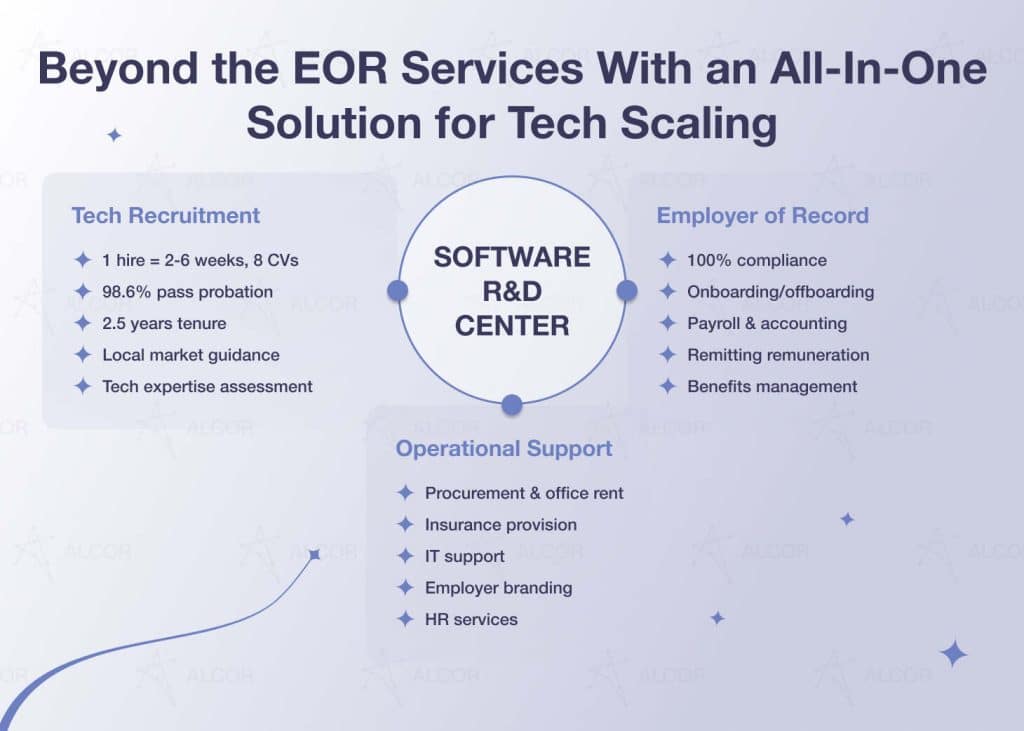
Pindrop needed exactly that. The company was running a fragmented outsourcing setup and wanted it gone – without losing engineers, sprints, or IP in the transition. Alcor rebuilt the model from the ground up in Eastern Europe, and the results spoke for themselves:
- 30 engineers hired into a fully owned, in-house team reporting directly to Pindrop – with zero sprints or deadlines lost.
- Full team, product knowledge, and IP ownership, replacing a vendor-dependent structure entirely.
- The first senior role filled with the first CV submitted, and just 6 CVs required per hire on average.
- 100% probation pass rate across every engineer hired.
- Full compliance, zero burden for Pindrop, since Alcor took ownership of every admin layer.
The payoff: Pindrop didn’t just replace a broken outsourcing setup – it walked away with a scalable, in-house engineering foundation of an offshore AI developers team it fully owns.
5-Step Checklist to Launch an AI Team in Eastern Europe
Launching an AI team in Eastern Europe takes 5 steps: research markets, estimate the real budget, validate labor law, choose a hiring model, and protect the product with IP-assignment clauses.
- Research the markets – compare technical depth, seniority mix, and AI development readiness across chosen countries to shape your hiring strategy.
- Estimate the real budget – base salary plus payroll taxes, statutory benefits, and optional benefits packages.
- Validate labor law requirements – confirm whether FTE, B2B, or both structures fit the roles you’re hiring for.
- Choose the hiring model – a software R&D center for a fully owned team, EOR/COR to test a market, or an own entity for permanent, high-headcount operations.
- Protect the product – lock in NDAs, confidentiality terms, and IP-assignment clauses before any engineer touches the codebase.
Companies weighing this decision alongside the plan to hire AI engineers more broadly, or comparing an AI developers staffing agency against building an in-house AI/ML development team, typically run this checklist market by market.
FAQ
Which countries in Eastern Europe lead in AI development?
Poland, Ukraine, Romania, and Bulgaria lead Eastern Europe’s AI engineering market. Poland leads on scale and Tier 2 AI talent depth, Ukraine on cost savings, Romania on infrastructure momentum, and Bulgaria on EU integration.
Who has the most advanced AI in Eastern Europe?
Poland ranks #1 in Europe and #4 globally for Tier 2 AI talent concentration – advanced researchers and engineers building deep learning models and production AI systems, according to Interface EU’s 2026 research.
Should I hire AI engineers as employees or B2B contractors in Eastern Europe?
Both structures are viable across Poland, Ukraine, Romania, and Bulgaria, but each carries different social security costs and IP-transfer requirements. B2B shifts tax and social security to the contractor; FTE gives more direct control over IP-assignment terms.
What’s the biggest compliance risk when hiring AI engineers abroad?
Generic “software IP” contract language that doesn’t extend to models, training pipelines, and datasets. Without locally enforceable IP-assignment clauses signed before product access, the most valuable part of an AI product can remain legally unprotected. Alcor builds these clauses into every contract before engineers get product access, so the gap never opens in the first place.