


The countries leading in AI across Latin America are becoming a serious hiring map for US tech companies, as National Law Review reports software engineer hiring in the region grew 250% year over year. One reason behind the shift: Robert Half found 65% of tech leaders struggle more to find skilled talent, and only 7% feel fully equipped to execute priorities. So, what makes LATAM countries a real AI hiring gem?
This article shows how to turn that LATAM hiring momentum into a real AI engineering team. I compare Mexico, Colombia, Argentina, and Chile by talent depth, AI maturity, salary benchmarks, total employment cost, labor law, IP protection, and hiring models – so you can choose the right market, avoid compliance gaps, and build an owned AI engineering team with less guesswork.
Key Takeaways
- LATAM solves the AI hiring squeeze that makes domestic recruiting slow, expensive, and overstretched. The region offers 2.3M+ tech specialists, 0.5–1.5-month hiring cycles, strong STEM talent, senior depth, and smart time-zone overlap.
- Mexico is the strongest LATAM market for high-volume AI hiring, with 974,500 IT specialists, major cloud investment, and 356% GenAI enrollment growth. Colombia stands out for 91% developer AI adoption and structured AI policy, Argentina for export-ready senior talent, and Chile for #1 regional AI maturity.
- LATAM offers major salary savings on core AI roles, including AI Engineer and Machine Learning Engineer. According to Alcor’s 2026 research, senior AI salaries are 41.8%–68.4% below US rates, freeing budget for additional hires.
- Hiring AI engineers in LATAM requires total cost planning, not salary-only budgeting. FTE hiring adds employer contributions, payroll taxes, statutory bonuses, severance obligations, paid leave, benefits, and country-specific labor rules.
- Launching a LATAM AI engineering team works best when companies make five decisions in order. Choose the market, calculate total employment cost, validate compliance, select the hiring model, and secure IP before product access.
- Alcor’s software R&D center model helps tech companies build owned LATAM AI engineering teams without opening a local entity by combining top-10% recruitment, EOR/COR, and 360-degree operational support – with full IP protection, zero buyouts, transparent pricing, up to 60% salary savings, and direct team ownership from day one.
Why Tech Companies are Hiring AI Engineers Beyond Domestic Markets
Tech companies are expanding AI hiring beyond domestic markets because local talent pools are too slow, expensive, and stretched to meet product roadmap demands. LATAM offers faster hiring cycles, access to 2.3M+ tech specialists, strong STEM and programming talent, and senior AI engineers at 55% below US salary benchmarks. With close time-zone overlap, cultural affinity, and experience in fintech, SaaS, AI infrastructure, and enterprise software, the region helps teams scale AI capability without slowing delivery.
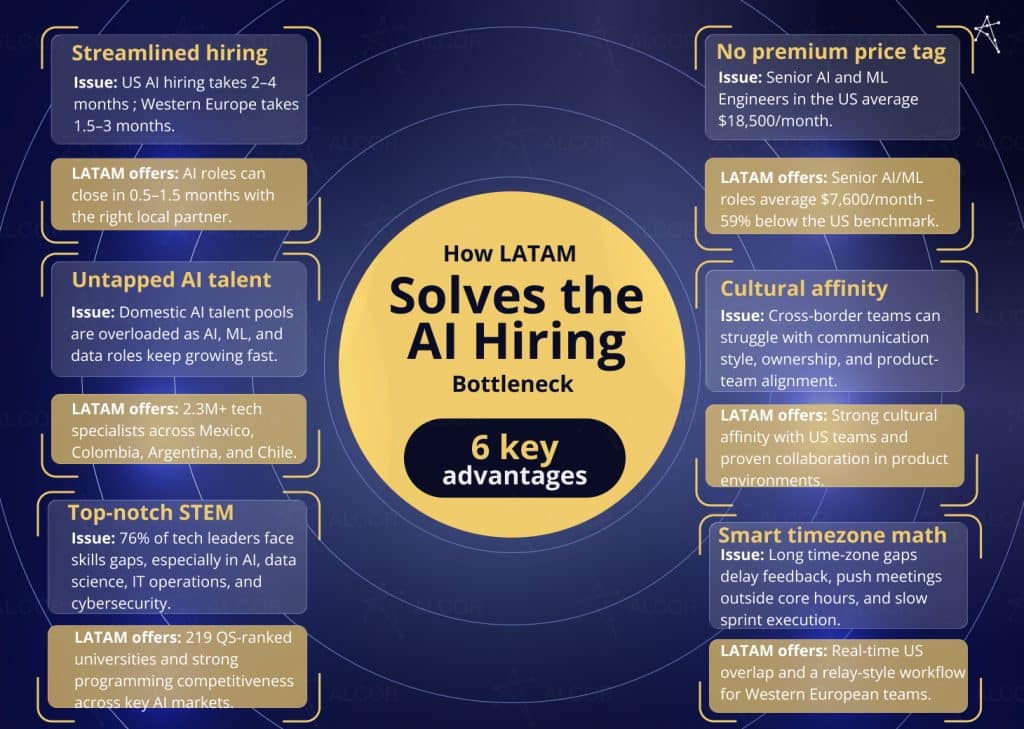
Streamlined hiring
The challenge: Domestic AI hiring moves too slowly for the pace most product roadmaps demand. According to Alcor’s recruitment department research, filling a specialized AI or machine learning role in the US typically takes 2-4 months, and highly specialized searches can stretch to 6 months– timelines that come from cold-sourcing a talent pool that’s already stretched thin. Western Europe fares only slightly better, with AI and machine learning hiring generally landing at 1.5-3 months, longer for senior or cross-border searches.
How LATAM solves the issue: In Latin America, that same role closes in 0.5–1.5 months with the right local hiring partner – a quarter of the US timeline, without lowering the seniority bar.
Access to a vast pool of Valley-grade talent
The challenge: The demand for specialized AI talent keeps intensifying faster than domestic markets can supply it. US job postings for AI, machine learning, and data science roles reached 49,200 in 2025, up 163% year-over-year, according to Robert Half’s Building Future-Forward Tech Teams report, while the UK, France, and Germany combined saw roughly 483,000 job postings requiring AI skills that same year, according to PwC.
How LATAM solves the issue: IT services market in Latin America offers a pool that hasn’t been tapped at the same rate: more than 2.3 million IT specialists across Mexico, Colombia, Argentina, Chile, and other markets, giving companies a wider path to hire AI developers with experience in fintech, SaaS, AI infrastructure, enterprise software, and data-heavy product environments.
Real STEM gems
The challenge: According to Robert Half’s Building Future-Forward Tech Teams report, 76% of tech leaders faced skills gaps in their department, with the largest concentration in AI, data science, IT operations, and cybersecurity. This gap in finding highly specialized tech talent doesn’t close by lowering the bar – it closes by widening the search.
How LATAM solves the issue: Latin America’s academic and skills data shows the depth is there, as 219 universities across the region appear in the QS World University Rankings 2026, while Mexico, Colombia, Argentina, and Chile all rank in the top six in LATAM on the Topсoder programming competitiveness index.
That depth shows up in the stacks engineers actually work in, not just rankings on a page:
- Mexico: JavaScript, Java, Python, C#, TypeScript
- Colombia: JavaScript, Python, Ruby, SQL, HTML/CSS
- Argentina: Python, TensorFlow, Cloud APIs, SQL, NLP
- Chile: Java, Python, PHP, Node.js, ASP.NET
A senior talent without the premium price tag
The challenge: Senior AI talent commands a premium wherever domestic hiring stays the only option. In the United States, Senior Machine Learning Engineers and Senior AI Engineers each average $18,500 a month in base salary. The UK isn’t far behind – Senior Machine Learning Engineers average £8,179 ($10,942), and Senior AI Engineers average £7,579 ($10,138), according to Alcor’s 2026 engineer compensation research.
How LATAM solves the issue: Latin America closes that gap without asking companies to compromise on seniority. Senior AI Engineers average $8,688 a month across the region, and Senior Machine Learning Engineers average $6,588 – a combined average of $7,638, roughly 59% below the US benchmark and still about 19% more affordable than the Western European average of $9,433, according to Alcor’s 2026 engineer compensation research.
Cultural and business affinity
The challenge: Expanding a team abroad raises a quieter worry alongside cost and talent – will the new engineers actually mesh with how a US product team works, or will differences in communication style and work culture slow the collaboration down?
How LATAM solves the issue: Decades of cooperation between Latin American engineers and US tech companies means those cultural and communication gaps mostly disappear. English proficiency backs that up directly – Argentina ranks #1 in the region, with the other three markets following, according to the EF English Proficiency Index 2025 – so standups, sprint planning, and stakeholder conversations happen without a language gap slowing anyone down. Software engineers in the region also work comfortably in both collaborative and independent settings, the kind of alignment that shows up as engineers taking ownership beyond their assigned task, not just executing tickets on schedule.
Smart timezone math
The challenge: Hiring across an ocean is a common workaround – US companies look to Western Europe for engineers, and Western European companies look right back at the US, or further out to Eastern Europe – but the time difference between them turns daily collaboration into a scheduling problem. Standups get pushed to whoever’s willing to log in early or late, sprint planning becomes asynchronous by default, and real-time problem-solving waits until the next overlap window opens.
How LATAM solves the issue: Hiring engineering teams in Latin America keeps the workday aligned with the US business day. Mexico sits just 1–2 hours behind the US East Coast, while Colombia runs on the same time as New York – zero gap, year-round, with no DST shifts to track. Chile is 1 hour ahead of the East Coast, and Argentina is 3 hours ahead. For Western European teams working with offshore artificial intelligence developers in Latin America, the relationship works almost in relay: by the time the European workday winds down, the LATAM team is just getting started – ready to pick up feedback and keep tasks moving instead of losing a full day to the time difference.
Ready to hire remote developers in Latin America? Alcor helps you build an AI-ready team with recruitment, EOR/COR, and operations covered.
Turn your AI hiring pressure into a clear planExplore 8 tech markets across LATAM and Eastern Europe and get practical insights for building your AI engineering team. |
Which LATAM Countries Support AI Development Best?
Mexico, Colombia, Argentina, and Chile rank among the top AI countries in Latin America, each supporting the region’s AI industry in a different way: Mexico offers the largest tech pool, strong cloud investment, and fast GenAI upskilling (Coursera). Colombia stands out for developer adoption, AI-native startups, and structured national policy. Argentina brings export-ready senior engineers, strong research, and LATAM’s best English proficiency (EF EPI 2025). Chile leads on AI maturity (ILIA 2025), cloud infrastructure, and senior, quality-first AI talent, making it ideal for focused AI engineering squads rather than large-volume hiring.
Mexico
Mexico’s AI readiness
Heading into 2027, Mexico is becoming one of Latin America’s strongest markets for building AI engineering teams. According to Novum, Mexico’s government-backed Public Center for AI initiative aims to train 25,000 people a year in AI, cloud computing, cybersecurity, data analysis, and Java. Local demand for AI skills is growing just as fast: Coursera’s 2025 Global Skills Report also shows that GenAI course enrollment in Mexico increased 356% year over year, signaling fast growth in applied AI skills.
Mexico’s AI market is also getting stronger infrastructure support: According to the Mexico Daily News, AWS plans to invest more than $5B in Mexico over 15 years, while Mexico Business News reports that Microsoft announced a $1.3B investment in cloud and AI infrastructure, and that Google Cloud launched a new cloud region in Querétaro. That push reaches chips and compute directly: $4.9 billion in annual semiconductor exports, as reported by Mexico Business News; $4.8 billion from CloudHQ for new datacenter capacity in Querétaro, also covered by Mexico Business News; and a government supercomputer running 15,000 GPUs for national AI development, as noted by LatinAmerican Post.
Mexico’s AI talent engine
Mexico’s AI growth is backed by real engineering depth: 974,500 IT specialists, #3 in LATAM on the Global Innovation Index, and #4 in LATAM on TopCoder. This gives companies room to hire senior AI/ML, data, cloud, and infrastructure talent without relying on one narrow candidate pool.
That talent is concentrated in startup-heavy hubs: according to the StartupBlink Global Startup Ecosystem Index 2025, Mexico has 11 unicorns and 933 startups across Mexico City, Guadalajara, and Monterrey, where AI, fintech, cloud, and software companies keep expanding the pool of engineers with real product experience.
Colombia
Colombia’s AI adoption momentum
Colombia’s AI ecosystem is interesting because developers, startups, and government policy are moving in the same direction. ColombiaOne reports that 91% of Colombian developers already use AI-assisted coding and 79% expect AI to redefine their roles by 2026. Colombia’s CONPES 4144 national AI policy also adds structure to that momentum, with 100+ actions planned through 2030 and COP 479 billion in projected investment, as stated by Access Partnership.
Colombia’s startup layer is moving just as fast: El Tiempo reports that 98% of Colombian startups use AI in some capacity, while 38% place AI at the center of their product. That means Colombia is no longer just “experimenting with AI” – its startups are already building AI into product workflows, automation, analytics, and customer experience.
Colombia’s AI talent engine
Colombia’s AI growth is supported by a tech pool of 202,000 professionals, strong developer competitiveness, and a startup market already building AI into real products. The country ranks #5 in LATAM and #71 globally in the Global Innovation Index, and #6 in the region on TopCoder, making it a strong market for AI/ML, data, backend, SaaS, fintech, and logistics technology roles.
Colombia’s AI talent is concentrated across three AI hubs: According to the KPMG and BBVA Spark Colombia Tech Report 2026, Bogotá attracts around 82% of the country’s startup investment, making it the main tech center. Medellín brings startup velocity, with 21 startups per 100,000 inhabitants, according to Startupblink – ahead of São Paulo, Buenos Aires, and Bogotá. Cali adds a cost-efficient option with growing strength in EdTech, software, and data engineering.
Argentina
Argentina’s AI delivery edge
Argentina’s AI readiness comes from three hard signals: export maturity, developer adoption, and academic research. According to the Consulate General of Argentina, knowledge-based service exports reached $9.6B in 2025, making the sector Argentina’s third-largest export category. OpenAI also names Argentina among the top Latin American countries for developers building on its tools, showing that local engineers already work inside AI-enabled development environments.
Argentina’s academic research base also strengthens its AI talent pipeline: Rest of World reports that the University of Buenos Aires hosts one of the country’s main data science centers. At the same time, the National University of Córdoba is home to one of Argentina’s leading AI labs, giving companies access to engineers shaped by both academic AI research and export-oriented software delivery.
Argentina’s global-ready AI talent
Argentina’s AI talent base combines 176,000 tech professionals with the strongest English proficiency in Latin America. Argentina ranks #1 in LATAM for English proficiency, as ranked by EF English Proficiency Index 2025, #3 for programming competitiveness, and #7 in the Global Innovation Index, making it a strong market for senior AI/ML, data engineering, NLP, cloud, and product engineering roles.
The talent is anchored in three hubs: Buenos Aires leads startup and investor activity, with 565+ startups tracked by StartupBlink. Córdoba adds academic and AI research depth, while Rosario brings niche strength in agritech, software, and data-driven products.
Chile
Chile’s AI leadership signals
Chile leads LATAM in AI maturity, with policy, research, and infrastructure moving in the same direction. As stated by UNESCO, CENIA and UNESCO’s Regional Office in Santiago signed a cooperation agreement in early 2026 to advance AI literacy, digital skills, and ethical AI development across Chile and Latin America. The scoring backs it up: the Latin American AI Index 2025 ranks Chile #1 in the region.
Cloud infrastructure is scaling to match, backed by real funding: According to Businesswire, AWS plans to invest more than $4B in Chile and launch its South America (Chile) Region by the end of 2026, while Microsoft’s Chile Central cloud region is already operating, with IDC estimating more than $3.3B supporting it over four years, as stated by Gob.cl. Together, this gives Chile one of the strongest AI and cloud infrastructure foundations in LATAM’s tech economy.
Chile’s AI talent advantage
Chile’s AI talent market is smaller than Mexico’s, Colombia’s, or Argentina’s, but strong on quality signals: 160,000 tech professionals, #1 in LATAM on the Global Innovation Index, and #2 in LATAM on TopCoder. This makes Chile a strong fit for focused senior AI/ML, data, cloud, and platform engineering squads rather than large-volume hiring.
Chile’s top tech hubs reflect this senior, quality-first AI specialization: Santiago anchors the country’s startup and cloud infrastructure activity. Valparaíso is developing Chile’s second Deep Tech hub, with a focus on generative AI, robotics, and biotechnology, according to Gov.cl. Concepción adds a secondary AI and engineering pipeline through the University of Concepción’s Center for Data and Artificial Intelligence, according to EduRank.
AI Product Engineering Salaries in Latin America
Hiring senior AI product engineers in Latin America gives Western tech companies a major salary advantage without lowering the technical bar. According to Alcor’s 2026 engineer compensation research, senior AI salaries across Mexico, Colombia, Argentina, and Chile are 41.8%–68.4% below US rates, depending on role and market. For example, a senior AI Engineer costs $18,500/month in the US, but $7,250/month in Argentina – enough savings to fund additional AI hires.
Hiring a senior AI engineer in Latin America can save Western tech product companies up to 68.4% compared to domestic rates, according to Alcor’s 2026 engineer compensation research. Across Mexico, Colombia, Argentina, and Chile, senior monthly base salaries run 41.8%–61.8% below US equivalents – a gap wide enough to fund an entire additional hire for the price of one US-based developer.
Take the AI Engineer role, the backbone of most production AI teams. A senior AI Engineer costs $18,500 a month in the US. Through nearshore AI development in Argentina, that same seniority and scope costs $7,250 – a 61% saving without changing the job description, the ownership level, or the technical bar.
We’ve put together the numbers our own recruiters use to benchmark every AI role we place – so you can see exactly what a senior hire’s base salary looks like across every market. If you’re also scoping mid-level or lead positions, explore our “Lead the AI Talent Race in 2026–2027” white paper, where we break down compensation benchmarks across all three seniority levels for every key LATAM location.
| Senior Monthly Base Salary, USD | |||||
| Role | Mexico | Colombia | Argentina | Chile | USA |
| AI Engineer | $10,250 | $8,750 | $7,250 | $8,500 | $18,500 |
| ML Engineer | $6,750 | $6,500 | $6,250 | $6,850 | $18,500 |
| AI/ML Engineer | $10,250 | $8,750 | $7,250 | $8,500 | $18,500 |
| MLOps Engineer | $7,750 | $7,750 | $5,400 | $7,750 | $15,750 |
| AI Data Engineer | $9,250 | $7,750 | $6,500 | $7,750 | $17,500 |
| LLM Engineer | $8,000 | $8,000 | $6,250 | $7,750 | $19,500 |
| AI Agent Developer | $11,500 | $10,000 | $8,500 | $9,750 | $19,750 |
| AI Infrastructure Engineer | $11,750 | $10,250 | $8,750 | $10,000 | $20,250 |
| ML Data Scientist | $9,750 | $8,250 | $6,750 | $8,000 | $18,000 |
| AI Platform Engineer | $11,000 | $9,250 | $8,000 | $9,250 | $19,000 |
| AI Product Engineer | $7,400 | $7,250 | $6,000 | $6,850 | $19,000 |
| AI-Native Engineer | $10,750 | $9,250 | $7,750 | $9,000 | $19,000 |
| AI Quality Engineer / SDET | $8,000 | $6,500 | $5,500 | $6,250 | $15,500 |
| AI Research Scientist | $12,250 | $10,750 | $9,250 | $10,500 | $21,500 |
| AI Prompt Engineer | $7,250 | $6,250 | $5,250 | $6,000 | $14,000 |
| According to Alcor’s 2026 engineer compensation research | |||||
Considering Mexico for your AI team? Check our latest guide to the senior software engineer salary in Mexico for role-specific benchmarks and hiring insights.
Labor Law and Compliance Across Latin America
Labor and employment law in Latin America varies by country, especially around probation, notice periods, termination grounds, overtime, and severance. For companies building an AI workforce across Mexico, Colombia, Argentina, or Chile, local regulation shapes everything from contract structure to termination risk: Mexico gives employers up to 6 months of probation for specialized roles but requires strict documentation for justified dismissal; Colombia adds Cesantía severance funds and formal notice rules; Argentina is heavily influenced by Collective Bargaining Agreements, which can extend probation and shape employment terms; Chile has no formal probation period and limits no-cause termination mostly to managerial roles, making compliant contract structure critical.
Compliance in Latin America isn’t one framework applied four times – each country sets its own rules on probation, termination, severance, and employment policy, and getting one wrong can turn a routine hire into a legal liability. Alcor’s legal team broke down the requirements for all 4 key LATAM locations – Mexico, Colombia, Argentina, and Chile – so you know exactly what you’re signing up for before you do. For the full country-by-country breakdown, including notice periods, statutory bonuses, and severance formulas for every market, check our “Lead the AI Talent Race in 2026–2027” white paper.
Mexico
Mexico allows the longest technical-role probation period of any market on this list – up to 6 months, compared to 30 days for standard roles. That extended window gives employers real room to validate seniority-level hires before committing long-term, but it also means Mexico’s Federal Labor Law, one of the most protective codes in Latin America, applies in full unless the engagement is structured as a B2B contract under Civil/Commercial Law instead.
- Standard workweek: 48 hours, with overtime capped at 3 hours/day and 9 hours/week – paid at 200% of the regular rate, rising to 300% past the weekly cap, plus applicable Sunday or holiday pay.
- Probation: 6 months for specialized technical, professional, or managerial roles; 30 days for everything else.
- Notice period: Not required – but the employer must notify in writing of the cause within 5 days if the dismissal is for cause.
- Termination payments: compensation for unused vacation days, a pro-rated 13th-month salary, and any pending compensation for days already worked.
- Severance: 90 days’ salary for unjustified dismissal, plus a 20-day-per-year additional indemnity for the same cause, plus a 12-day-per-year seniority premium owed independently of why the employment ended.
- The quirk to watch: justified dismissals require witnesses and proper documentation – undocumented terminations default to being treated as without cause.
Colombia
Colombia layers a dedicated severance fund, the Cesantía, on top of standard termination pay – a feature that doesn’t exist in the other three markets. Employment agreements fall under the Labor Code, while B2B contracts sit under Civil/Commercial Law, the standard split across most of the region.
- Standard workweek: 42 hours, with overtime capped at 2 hours/day and 12 hours/week – paid at 125% of the regular rate, rising to 190% on holidays or Sundays.
- Probation: Up to 2 months for indefinite-term contracts; for fixed-term contracts under a year, one-fifth of the contract term, capped at 2 months.
- Notice period: At least 15 days – waived only for severe cause dismissals, such as violence or disclosure of trade secrets.
- Termination payments: compensation for unused vacation days, a pro-rated 13th-month salary, any pending compensation for days already worked, and 30 days’ salary per year worked into the Cesantía fund.
- Severance: for employees earning under 10× the monthly minimum wage, 30 days’ salary for the first year plus 20 days per subsequent year. For employees earning 10× the minimum wage or more, 20 days’ salary for the first year plus 15 days per subsequent year.
Argentina
Argentina ties much of its employment framework to Collective Bargaining Agreements – sector-specific obligations that layer on top of the national Labor Code, which governs employment agreements directly. B2B contracts fall under Civil/Commercial Law instead, though CBAs can still shape what that B2B relationship is allowed to look like in practice.
- Standard workweek: 48 hours, with overtime generally capped at 3 hours/day, 30 hours/month, or 200 hours/year – paid at 150% of the regular rate, rising to 200% on Sundays or holidays. Written, voluntary bank-of-hours or compensatory-rest arrangements are also permitted.
- Probation: 6 months for standard roles, extendable via CBA to 8 months (companies with 6–100 employees) or 12 months (companies with up to 5 employees).
- Notice period: Not required during probation. Once probation ends, 30 days’ notice applies for employees with under 5 years of service, rising to 60 days for those with more than 5 years. Justified dismissals must also be notified in writing.
- Termination payments: compensation for unused vacation days, a pro-rated 13th-month salary, and any pending compensation for days already worked.
- Severance: 30 days’ salary per year of service.
- The quirk to watch: if the employment relationship isn’t properly registered with local authorities, the employer is deemed to have waived the probation period entirely, and the relationship is treated as indefinite from day one.
Chile
Chile is the outlier of the LATAM group: it recognizes no formal probation period at all, and reserves no-cause termination for managerial roles only. Employment agreements fall under the Labor Code, while B2B contracts sit under Civil/Commercial Law – applied here with far fewer guardrails around probation than in the other three markets.
- Standard workweek: 42 hours (as of 2026), with overtime capped at 2 hours/day and 12 hours/week – paid at 150% of the regular rate.
- Probation: Not recognized by labor law. Some companies use a short-term agreement as an informal substitute – if the collaboration doesn’t work out, they simply don’t renew it.
- Notice period: 30 days.
- Termination payments: compensation for unused vacation days, a pro-rated legal bonus, and any pending compensation for days already worked.
- Severance: 30 days’ salary per year of service, capped at 11 months – increasing by 30% to 100% depending on the severity of the dismissal reason.
- The quirk to watch: no-cause termination is only permitted for managerial positions; every other role requires a justified reason to dismiss.
The Cost of a Compliant AI Hire in LATAM
A compliant AI hire in LATAM costs more than base salary. Under FTE employment, companies must budget for employer social security contributions, payroll taxes, statutory bonuses, severance-related obligations, paid leave, and optional benefits expected by senior engineers. Colombia has the highest employer contribution rate at around 30%, followed by Argentina and Mexico, while Chile remains the lowest. B2B engagement changes the cost structure, as contractors handle their own taxes and companies pay only the agreed monthly rate plus provider fees.
The cost of hiring AI specialists in Latin America doesn’t end with the salary line – it also includes statutory social security contributions, mandatory bonuses, payroll taxes, and often optional benefits that top engineers expect. Skip any of those cost components from your hiring budget, and you’re not just underestimating cost, you’re miscalculating compliance.
That full cost structure applies specifically to employment agreements (FTE hiring). Under a B2B engagement instead, the engineer registers as a private entrepreneur and covers their own taxes – meaning you pay only the agreed monthly rate, with zero employer social security contributions. If you hire through an EOR or recruitment partner, the only additional cost you need to factor in is their fee – and that applies regardless of whether the underlying contract is FTE or B2B.
Here’s what the FTE model adds up to across Mexico, Colombia, Argentina, and Chile:
Mexico
Mexico’s employer social security contribution adds roughly 26.3% on top of a $5,000 monthly salary – one of the higher rates in the region, driven mostly by the mandatory Housing Fund (INFONAVIT) contribution at 5% and a variable occupational risk premium.
- Statutory employee benefits: vacation starts at 12 days in year one, rising to 30 days at 26+ years of service; sick leave pays 60% of salary from day 4 (100% if job-related) for up to 52 weeks; maternity leave is 84 calendar days, fully covered by Social Security; paternity leave is 5 days at full pay, covered by the employer; plus 7 paid public holidays in 2026.
- Employer social security contributions: ~26.3% effective rate on a $5,000/month salary, covering:
- sickness and maternity (23.25% combined),
- disability and life (1.75%),
- retirement (2%),
- unemployment (up to 7.513%),
- occupational risk (0.54%–7.59%),
- housing fund contributions (5%).
- Additional statutory obligations: local payroll tax (4% in Mexico City or 3% in Guadalajara), Aguinaldo (15 days’ salary), a 25% vacation bonus, and profit-sharing (10% of annual taxable profits, subject to caps).
- Optional benefits: private health insurance, meal vouchers, a home office allowance (not optional for remote workers), a learning budget, and wellness perks — totaling roughly $5,500/year per engineer.
Colombia
Colombia’s employer social security contribution adds roughly 30% on top of a $5,000 monthly salary – the highest effective rate of the four markets, driven by a 12% pension contribution and three separate payroll taxes layered on top.
- Statutory employee benefits: vacation is 15 working days after one year of service, with at least 6 days required to be taken annually; sick leave pays fully for the first 2 days, then 66.7% through day 90 and 50% through day 180, covered by the Social Security Institute (EPS); maternity leave runs 126 calendar days, including a mandatory prenatal week; paternity leave is 14 days at full pay; plus mourning leave (up to 5 days), education leave (up to 10 days), and 19 paid public holidays in 2026.
- Employer social security contributions: ~30% effective rate on a $5,000/month salary, covering:
- pension (12%),
- health insurance (8.5%, only above 10× the minimum monthly wage),
- labor risks (from 0.522%),
- three payroll taxes – Family Welfare/ICBF (3%), National Apprenticeship Service/SENA (2%), and the Family Compensation Fund (4%).
- Additional statutory obligations: Prima de Servicios (one month’s salary, paid in two installments), Cesantía (one month’s salary per year worked, deposited into a third-party severance fund), and Cesantía interest (12% of the Cesantía payment).
- Optional benefits: transportation/connectivity allowance, health insurance, meal vouchers or food allowances, and a home office allowance – totaling roughly $3,300/year per engineer.
Argentina
Argentina’s employer social security contribution adds roughly 27.8% on top of a $5,000 monthly salary – with a pension fund contribution of 16% doing most of the heavy lifting, alongside five smaller mandatory contributions.
- Statutory employee benefits: vacation starts at 14 days for employees with 6 months to 5 years of service, rising to 35 days at 20+ years; sick leave is fully covered by the employer for 3 months (under 5 years’ service) or 6 months (5+ years); maternity leave is 90 calendar days, paid by social security as a family allowance; paternity leave is 2 calendar days; plus mourning leave (up to 3 days), new-marriage leave (up to 10 days), and 19 paid public holidays in 2026.
- Employer social security contributions: ~27.8% effective rate on a $5,000/month salary, covering:
- pension funds (16%),
- health insurance (2%),
- social services (6%),
- unemployment insurance (1.5%),
- life insurance (0.30%),
- employment risk (2%, higher for some activities).
- Additional statutory obligations: Aguinaldo (30 days’ salary, split into two payments every 6 months) and a 20% vacation bonus during vacation days.
- Optional benefits: work injury/health insurance, meal vouchers, transport allowances, performance bonuses, professional development support, and an internet/home office allowance – totaling roughly $5,100/year per engineer.
Chile
Chile’s employer social security contribution adds roughly 8% on top of a $5,000 monthly salary – by far the lowest rate of the four markets, though it’s set to rise: the Social Protection Savings (SSP) contribution jumps from 1% to 3.5% starting August 2026, already reflected in this figure.
- Statutory employee benefits: vacation is 15 working days after one year of service, with an extra day added for every 3 years of service after year 10; the first 3 days of sick leave are unpaid if the leave runs under 10 days, after which the Health Insurance System covers 100% of salary through day 180; maternity leave is 126 calendar days (42 before and 84 after birth); paternity leave is 5 days; plus mourning leave (up to 10 days) and 17 paid public holidays in 2026.
- Employer social security contributions: ~8% effective rate on a $5,000/month salary, covering Disability and Survivor’s Insurance (1.54%), SANNA (0.03%), the Mutual risks fund (0.9%), Social Services/AFC (2.4%), and the SSP contribution (3.5% from August 2026).
- Additional statutory obligations: a legal bonus of 25% of monthly salary – or, if the employer opts out, 30% of net company profits distributed proportionally among employees.
- Optional benefits: private health insurance, meal and transportation vouchers, wellness perks, a home office allowance, professional development support, English language courses, performance bonuses and profit-sharing, and private life and accident insurance – totaling roughly $6,750/year per engineer.
Full Ownership and Control of an AI Product
Building an AI engineering team in Latin America only creates real value when your company controls the product, IP, and engineering process. Clear FTE or B2B agreements/contracts must assign ownership of code, architecture, documentation, models, datasets, prompts, pipelines, and fine-tuned weights. The right partner should prevent vendor lock-in, protect the full AI IP stack, and let you manage the roadmap, standards, repositories, and daily work directly from day one across markets safely.
Building an AI engineering team in Latin America only pays off if your company ends up owning what that team builds – the codebase, the models, and the IP itself, not just the output of a vendor relationship. Check our “Lead the AI Talent Race in 2026–2027” white paper to get the full breakdown of what this looks like in practice – the specific guarantees behind full product control, locally enforceable IP assignment, and protection before product access.
Why IP ownership isn’t automatic
Outsourcing vendors, unclear contractor arrangements, or agreements copied from a generic template routinely leave IP ownership undefined until it matters most: fundraising due diligence, an enterprise sales cycle, or an acquisition, well after engineers have already contributed code, models, or data pipelines. At that stage, fixing a missing assignment is expensive, slow, and sometimes impossible to fully resolve.
What an ownership-first hiring partner guarantees
Two guarantees separate an ownership-first hiring partner from a standard outsourcing vendor. Full product control means you manage the engineering team directly – roadmap, architecture, repositories, standards, and day-to-day work stay under your control at every stage, regardless of which LATAM market the team sits in. No vendor lock-in means you can bring engineers in-house later without a team buyout or a dispute over reconstructing product ownership.
FTE vs B2B: how the contract structure affects IP rights
The contract structure matters more than most companies assume, and it depends on how engineers are engaged. Under an EOR arrangement, IP and invention-assignment terms sit inside the employment contract itself, giving you exclusive worldwide rights to what employees create. Under a B2B/COR arrangement, contractors can retain rights to the code, architecture, or documentation they produce unless those rights are expressly and locally transferred – a gap that’s easy to miss and expensive to fix later.
Protecting the full AI IP stack, not just the code
For tech companies building AI products in developing countries and emerging tech hubs, ownership needs to go beyond source code. Contracts should clearly cover model architecture, proprietary datasets, training and evaluation pipelines, prompts, orchestration logic, and AI safety documentation – especially when engineers contribute to systems that may later go through enterprise audits, fundraising due diligence, or acquisition review.
Defining ownership down to the model weights, pipelines, and datasets themselves – not just the code – is what closes the gap enterprise buyers and acquirers actually look for, and it’s the standard Alcor’s framework is built on. You run the AI engineering team and the product; Alcor runs the legal and operational infrastructure around the engagement, across all 4 key LATAM destinations.
5-Step Checklist to Launch an AI Team in Latin America
Launching an AI engineering team in Latin America requires five decisions in the right order: choose a market with sustainable talent depth, calculate total employment costs, validate labor and tax requirements, select the hiring model that matches your growth stage, and protect IP before work begins. This checklist helps companies compare markets, avoid compliance gaps, build a scalable setup, and prevent short-term hiring choices from becoming expensive operational problems later on.
1. Narrow your market shortlist
Not every LATAM market fits every AI hiring goal – narrow the field before you start sourcing. Start with talent depth, not headcount: Mexico wins on volume, Colombia on fast-growing developer adoption, and Argentina and Chile on seniority and English proficiency. Weigh ecosystem maturity and economic stability too – the market you choose should keep delivering talent for years, not just for this year’s hiring push.
2. Estimate the true hiring cost
A lower base salary doesn’t always mean a lower total cost – payroll taxes, statutory benefits, and employer contributions can shift the math significantly between markets. Start with monthly base salaries for the senior and lead roles you need, then layer in the full employment cost: taxes, mandatory benefits, and any optional perks. Only then can you shortlist the markets that actually save you money.
3. Validate labor law requirements
Every LATAM market has its own rules on working hours, leave, probation, termination, and severance – and those rules decide how much flexibility your hiring model actually has. Confirm early whether FTE, B2B, or a mix of both is viable for the roles you’re planning. Then map the payroll, tax, benefits, invoicing, and reporting obligations that come with it, so compliance is built in from day one, not patched in later.
4. Choose the hiring model
Define your expansion goal first, then match it to the model built for it. Each hiring model is designed for a different stage of growth, and choosing based on convenience instead of goal is the most common reason teams outgrow their setup within a year:
- IT outsourcing – fits a fixed-scope MVP, feature build, or non-core project, not a long-term team.
- EOR/COR – best when you’re testing a new market or hiring a handful of engineers without opening a legal entity.
- Own legal entity – makes sense once you’re committing to a large, predictable headcount and a permanent presence abroad.
- Software R&D center – the right call when you’re building a fully owned AI engineering team for the long run and don’t want to establish local infrastructure yourself, combining an AI engineers staffing agency with EOR/COR and full operational support under one roof.
What I recommend: choose the option that lets you scale stress-free, without switching vendors as you grow or managing three or more of them at once. Recruitment, EOR/COR, and operations shouldn’t be three separate relationships you’re stitching together – Alcor’s software R&D center model combines all three under one roof, built for Western tech product companies assembling an AI/ML software development team for fast, compliant expansion across Latin America and Eastern Europe.
Here’s how it works in practice: Briq, a Series B AI automation platform for the construction industry, needed to expand into Mexico without the legal exposure of contractor misclassification or the overhead of setting up a local entity. Alcor closed both gaps end-to-end, delivering a complete solution across 3 dimensions:
- Silicon Valley-grade recruitment: Alcor closed 5 Automation Java Developer roles in under 6 weeks each, plus 2 Middle Support Engineer roles – 39 days on average across all 7 hires – surfacing top-10% market engineers now building Otto, one of Briq’s core product initiatives.
- Tech-focused EOR/COR: Every hire was structured as a compliant B2B contractor engagement, reviewed to close off misclassification risk under Mexican labor law. Alcor ran payroll, tax, and onboarding for all 7 hires, with a dedicated Customer Operations Manager handling day-to-day support – letting Briq scale its Mexico team without registering a local entity.
- 360-degree operational support: Alcor sourced and procured laptops and absorbed the cost of a free backfill when one hire resigned four days in. For companies where equity is part of the compensation strategy, Alcor also helps structure and administer stock option plans and offers on-demand employer branding support.
5. Protect your product before the launch
IP ownership isn’t automatic just because you’re paying the bill – it has to be written into the agreement before engineers ever touch the product. Work with a partner who structures locally adapted FTE or B2B agreements that assign the engineers’ work to your company, not the intermediary. Before granting product access, lock down NDAs, confidentiality terms, and IP provisions, and define exactly what counts as a protected AI asset – code, models, datasets, pipelines, prompts, and technical documentation.
Then document what happens at the other end too: offboarding, access revocation, continuing confidentiality, and terms for transferring the team if your setup ever changes.
Bottom line: Launching an AI engineering team in Latin America isn’t one decision – it’s five, made in order. Get the market right, price the real cost (not just the base salary), confirm the legal framework can support your hiring model, choose the model that matches your growth stage, and lock down IP before a single engineer touches the product. Skip a step, and you’re not saving time – you’re deferring the cost to a harder problem later.
BigCommerce, Backstory (ex-People.ai), Ledger, and Briq have already built their engineering teams this way, with Alcor handling recruitment, compliance, and operations as one accountable partner instead of three.
The next AI engineering team built this way could be yours. Are you ready to start?
FAQ
Which countries in LATAM lead in AI development?
Heading into 2027, four LATAM destinations lead AI development, each with a distinct strength:
- Mexico leads on scale – 974,500 IT specialists, major cloud investment from AWS, Microsoft, and Google, and 356% year-over-year GenAI course enrollment growth.
- Colombia stands out for 91% developer AI adoption and a structured national AI policy.
- Argentina brings export-ready senior engineers, strong academic research, and LATAM’s #1 English proficiency.
- Chile leads on AI maturity and cloud infrastructure, ranking #1 in the region on the Latin American Artificial Intelligence Index.
Who has the most advanced AI in LATAM?
Chile ranks #1 in the region on the Latin American Artificial Intelligence Index 2025, backed by CENIA (Chile’s National Center for Artificial Intelligence) and a formal 2026 cooperation agreement with UNESCO to advance AI literacy and ethical AI development. Chile also ranks #1 in LATAM on the Global Innovation Index. Mexico, Colombia, and Argentina follow closely, each advancing through their own government-backed AI incentives and infrastructure investment.
What’s included in the true cost of hiring a compliant AI engineer in LATAM, beyond salary?
Beyond base salary, FTE hiring includes employer social security contributions (8%–30% depending on country), statutory bonuses, severance obligations, paid leave, and often optional benefits. Colombia has the highest employer contribution rate at ~30%, while Chile has the lowest at ~8%.
If hiring through an EOR/COR or recruitment provider, factor in their fee too – regardless of whether the underlying contract is FTE or B2B.
Do I need to set up a legal entity to hire AI engineers in Latin America?
No, you don’t. EOR/COR (Employer/Contractor of Record) and software R&D center models both let companies hire compliant engineers in Mexico, Colombia, Argentina, or Chile without opening a local legal entity.
That’s exactly the gap Alcor closes, helping startups, scale-ups, and mature tech product companies establish their operations across these markets without opening an entity, covering the full engineering infrastructure end-to-end.
How much can I save by hiring AI engineers in Latin America instead of the US?
Senior AI salaries across Mexico, Colombia, Argentina, and Chile run 41.8%–68.4% below US rates, depending on role and market, according to Alcor’s 2026 engineer compensation research. A Senior AI Engineer costing $18,500 a month in the US costs as little as $7,250 a month in Argentina – up to 2.5 times more cost-efficient, freeing that budget for product development or additional hires.
How long does it take to hire an AI engineer in Latin America?
With the right local hiring partner, companies can fill an AI engineering role in Latin America in 0.5–1.5 months – roughly a quarter of the 2–4 month (up to 6 for specialized searches) timeline typical in the US. Alcor closes individual positions in 2–6 weeks, scales teams up to 30 engineers within 90 days, and onboards new hires in as little as 10 days, backed by a bench of 325,000+ vetted candidates ready to interview.
How would you rate this article?
Alcor is Your Trusted Scaling Partner
for expansion
support