

AI and Machine Learning Recruitment Agency
AI recruitment agency for scaling companies. Human-led AI/ML recruitment, not just AI-powered hiring software.
- Custom sourcing based on your exact candidate portrait
- 98% CV acceptance rate
- AI/ML expertise across mainstream and niche stacks
- Reach to multiple global talent markets
- TC benchmarking for scarce AI roles, from base salary and equity to bonuses and compute perks
- Full compliance, payroll, and operational support



 Mexico
 Colombia
 Argentina
 Chile
Chile Poland
 Romania
 Ukraine
 Bulgaria
Recruiting AI Engineers At a Scale
















Top-rated Recruitment Agency for AI Companies

325,000+ Candidates
in Alcor’s global tech talent network
Market-First Hiring
talent availability and compensation data before you commit to a location
40+ Tech Recruiters
sourcing AI, ML, data and other scarce engineering profiles
2-6 Weeks
average time to close a AI position
No Local Entity
recruitment, compliant employment, payroll, and legal support under one roof
98.6%
of our hires pass probation periodAI Talent Pipeline
Behind Every Great AI Hire is a Dedicated Expert. Meet Yours









Alcor AI Recruitment Processs

AI Role Calibration
- Mapping the role’s production scope.
- Separating research, modeling, data, MLOps, and infrastructure needs.
- Benchmarking salaries and talent availability.
Scarce Talent Mapping
- Mapping niche talent pools across target regions.
- Targeting passive specialists with relevant production experience.
- Aligning the EVP with candidate expectations.

AI Expertise Validation
- Assessing shipped models, production systems, research, and open-source work.
- Evaluating English, collaboration, and ownership.
- Filtering out profiles without proven engineering expertise.

Interview and Offer Management
- Shortlisting candidates aligned with the technical profile.
- Coordinating interviews, feedback, offers, and counteroffers.
- Aligning salary, equity, and role expectations.

Employment and Team Scaling
- Managing onboarding, payroll, employment, and compliance.
- Providing a free replacement within the three-month warranty period.
- Scaling from individual specialists to 10+ AI hires per month.
Result
Global talent strategy for hard-to-fill AI roles
Contact Us













AI Recruitment: Everything About Agencies, Strategies, Tools, etc.
Market Size of Human-Led AI Recruitment
The World Economic Forum ranks AI and Machine Learning Specialists among the fastest-growing technology roles through 2030. AI and big data also rank first among the fastest-growing skills employers expect to need
For technology companies, these statistics define the real AI recruitment market. The challenge is less about finding applicants and more about reaching scarce ML, LLM, MLOps, AI infrastructure, and AI product engineers before competitors do.
This imbalance increases the value of a specialized AI recruitment agency with access to passive candidates and technical niches across several hiring markets. For companies planning to add 10, 20, or 30+ specialists, AI talent recruitment increasingly becomes a capacity question: where is qualified talent concentrated, how quickly can they be reached, and what compensation will secure the hire?
AI Recruitment Industry Growth Statistics
AI specialists are becoming harder to recruit
An agency recruiting AI engineers now works in a market where demand rises faster than the supply of proven specialists. PwC found jobs requiring specific AI skills grew by 69%, compared with 9% across the total job market. The number of AI job postings was also almost twice as high as in 2024.
Competition is affecting pay as well. Workers with AI skills earned a 62% average wage premium in 2026, up from 57% a year earlier. Companies with the highest exposure to AI also recorded 24% wage growth since 2018, compared with 17% among less AI-exposed businesses.
This fragmentation of roles and responsibilities also makes AI talent recruitment harder than standard developer hiring. Two candidates with the same “AI Engineer” title may differ significantly in model training, inference optimization, GPU infrastructure, production deployment, research depth, or software engineering experience.
Competition extends beyond AI companies
The AI sector no longer competes only with AI startups. Finance, healthcare, cybersecurity, SaaS, e-commerce, and Fortune 500 companies in general are building internal AI capabilities and targeting the same talent pool.
For employers scaling several roles at once, AI talent recruitment becomes a sourcing capacity issue. A specialized AI-focused recruitment agency needs ways to access to elite engineers and handle negotiation in conditions, where demand still exceeds propostion.
Top 8 AI engineering roles by Demand
Core AI engineering roles
- Machine Learning (ML) engineers
ML engineers take models from concept to customer value. They turn raw datasets into intelligent systems and transition academic-grade models into robust, highly scalable production pipelines. ML engineers take accountability for deployment, ongoing monitoring, and long-term model maintenance. They’re essential for any company relying on AI to differentiate its product.
- Data engineer / Data Science Hybrid
This cross-functional role blends pipeline architecture, data hygiene, and modeling support. They prepare data for modeling and maintain ML-ready infrastructure, using Python, SQL, Spark, and Hadoop to deliver the insights your team depends on.
In many companies, ML Engineers and Data Scientists share overlapping responsibilities, which makes clear role definitions essential.
- MLOps engineers
MLOps engineers ensure AI survives real-world conditions. Their work spans DevOps, machine learning, data engineering, model monitoring, and governance, enabling companies to deploy and retrain models reliably as data changes. They automate maintenance, shorten release cycles, and transform prototypes into sustainable, production-grade systems. For companies scaling AI products, this is the role that makes “AI at scale” possible.
Specialized AI engineering roles
- Vision & Multimodal AI engineer (formerly Computer Vision engineer)
Formerly Computer Vision engineers, today’s Vision & Multimodal specialists design models that interpret images, video, and blended visual–language inputs. They build detection, classification, and understanding systems that power autonomous driving, smart retail, healthcare diagnostics, and more.
- Language / Conversational / LLM engineer
NLP roles are shifting toward Conversational AI engineers, Language AI engineers, LLM engineers, and even Prompt or Language & Communication engineers – all overlapping domains. These specialists enable systems to understand, generate, and reason about language using frameworks such as Hugging Face, spaCy, and TensorFlow. Their work fuels chatbots, search experiences, voice assistants, and enterprise knowledge tools.
- Generative AI (GenAI) engineers
GenAI specialists focus on creation rather than prediction. This is a fast-growing, emerging role that shapes how companies use foundation models, fine-tuning, synthetic data generation, and domain-specific model adaptation. These engineers build text, code, image, and video generators and often work across NLP and Vision, given how many models are multimodal. They are redefining software development through rapid prototyping, automated content creation, and the creation of entirely new product categories.
Product, strategy, and executive roles
- Chief AI Officer (CAIO)
The CAIO role is still emerging, and in many mid-size organizations, its responsibilities fall under the CTO, CDO, or Head of AI. When formalized, CAIOs lead enterprise-wide AI strategy, ethics, compliance, and long-term vision. They steer innovation while ensuring responsible, impactful deployment across teams.
- AI Product Managers
AI PMs turn complex machine learning capabilities into real business value. They define vision, KPIs, and user outcomes; balance engineering constraints; and ensure that AI features remain ethical, accurate, and useful. AI PMs help companies invest in the right use cases and extract measurable ROI from their AI strategy.
Modern AI/ML Talent Sourcing Strategies
Passive talent poaching
Many strong AI engineers are already employed and do not actively apply for jobs. Passive talent poaching focuses on identifying and contacting those candidates directly across professional networks, GitHub, research communities, and internal talent databases.
Pin estimates that nearlu 75% of talent pool is considered to be passive and sourced that way candidates are hired at a much higher rate than inbound applicants, which makes proactive outreach relevant for scarce AI roles.
Paper-to-code tracking
Paper-to-code tracking means identifying engineers or researchers who contributed to relevant publications, then checking whether they converted this work into repositories, models, APIs, or production systems.
This sourcing method fits roles such as:
- Research Engineer
- Applied Scientist
- LLM Engineer
- Computer Vision Engineer
- NLP Engineer
It helps an AI engineer recruitment agency distinguish candidates with theoretical knowledge from specialists who have shipped working AI systems.
Talent density mapping
Hiring by country or city alone gives a weak view of the AI talent pool. Talent density mapping looks for concentrations of engineers with a specific technical niche.
For example, agencies focused on recruiting AI developers might separately map clusters of:
- MLOps engineers
- inference and optimization specialists
- computer vision engineers
- LLM infrastructure developers
- AI platform engineers
This approach is useful when a company needs 10+ hires rather than one specialist. Recruiters see where enough relevant engineers exist before opening several vacancies in the same market.
Acqui-hiring for concentrated AI expertise
For companies that need an established AI team rather than individual hires, acqui-hiring is another option. Instead of engaging in long (on average 3 to 6 months) AI recruitment process, a company acquires a smaller business mainly to gain access to its technical team.
The model fits cases where talent density matters more than acquiring the target company’s product or revenue. It also requires more legal, financial, and retention work than standard AI staffing, so companies usually reserve it for strategic hiring gaps.
Components of AI/ML Total Compensation (TC)
Salary is only one part of an offer for scarce AI talent. Companies competing for senior AI engineers often structure total compensation around cash, equity, benefits, and role-specific incentives. An AI recruitment agency should benchmark the whole package before sourcing starts, since compensation gaps affect offer acceptance and candidate retention.
Base salary (Geographic location considered)
Base pay varies substantially by AI specialization and hiring location. According to Alcor’s 2026 salary research, a Senior AI Engineer earns around $222,000 annually in the US versus $123,000 in Mexico. For Senior ML Engineers, the respective benchmarks are $222,000 and $81,000.
Specialization matters too. Senior AI Infrastructure Engineers reach $243,000 annually in the US, while Senior AI Prompt Engineers average $168,000.
For an AI engineer recruitment agency, these differences make location and technical niche two important inputs for compensation benchmarking.
Equity, signing bonuses, and phased vesting
For senior engineers and AI developers total compensation package may include:
- Equity or stock options, especially for startup and scale-up hires
- Signing bonuses to offset compensation a candidate leaves behind
- Performance bonuses tied to company or individual targets
- Phased vesting, which distributes equity ownership over an agreed period
- Clawback clauses that require employees to repay signing bonuses or other upfront incentives if they leave before an agreed retention period ends
The right mix depends on seniority, company stage, location, and how competitive the target talent pool is.
Compute allocation perks
Compute allocation perks are employer-provided access to the hardware and cloud resources AI specialists need to train, test, and deploy models. Depending on the role, this may include dedicated GPU capacity, cloud credits, access to high-performance computing clusters, larger experimentation budgets, or priority access to internal AI infrastructure.
For these candidates, compute allocation perks influence the type and scale of work they will be able to perform. An AI and ML recruitment agency should therefore discuss technical resources during candidate qualification, rather than treating compensation as a salary-only conversation.
Benefits and recruitment costs
Companies hiring internationally also need to account for employment expenses outside direct compensation.
For example, Alcor’s data puts a standard tech benefits package in Eastern Europe at around $6,350 per employee annually, compared with $15,400 in the US. Top-tier recruitment fees typically equal around 20% of annual developer’s salary in Eastern Europe, versus 25% to 35% in the US.
For AI staffing at scale, these expenses compound quickly. Before sourcing, the hiring company should define the complete budget: base salary, bonuses, equity, benefits, recruitment costs, and any AI-specific compute perks.
AI Industry Focused Recruitment vs. AI-driven Recruitment
AI industry focused recruitment and AI-driven recruitment describe two different services. The first finds engineers who build AI products. The second applies artificial intelligence to automate parts of the hiring process.
Alcor operates as a recruitment agency with a focus on the AI sector. The service centers on sourcing, screening, and hiring AI/ML specialists for product companies, rather than selling AI-powered hiring software.
For a company building an AI engineering team, the distinction affects hiring results. Software helps process candidates already inside a recruitment funnel. An AI developer recruitment agency builds the funnel, reaches passive engineers, qualifies technical fit, and helps move selected specialists toward an accepted offer.
For companies hiring AI engineers, the problem often starts before a candidate enters an applicant tracking system. A CTO or VP Engineering first needs to answer:
- Where are enough qualified AI/ML specialists available?
• Which engineers have production experience rather than experimental AI exposure?
• What compensation will attract them?
• How quickly can 10, 20, or 30 specialists be hired?
• How will an international team be employed and supported after recruitment?
This is When We Step In
Our team source and support both common and hard-to-find profiles, including AI Engineers, Machine Learning Engineers, LLM Engineers, MLOps Engineers, AI Infrastructure Engineers, Data Scientists, and specialists in other technical niches.
For companies scaling beyond several isolated vacancies, the model is built around hiring capacity
• 2–6 weeks to close a vacancy
• 98.6% probation pass rate
• 2.5-year average tenure of Alcor hires
Ready to Build Your AI Engineering Team?
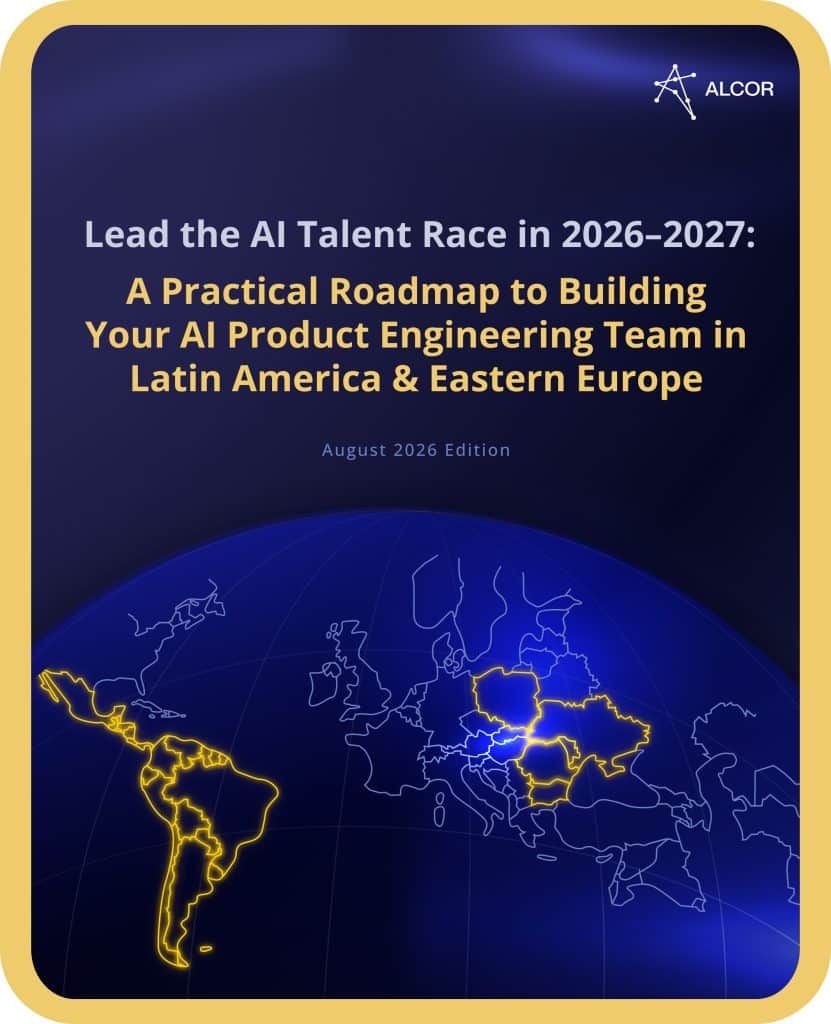
While your competitors are stuck fighting over the same domestic AI talent for months, this guide shows you where to build your AI engineering team twice as fast and save up to 66% on base salaries alone.
Service-Oriented Questions About Recruiting AI Talent
What does an AI recruitment agency do?
An AI recruitment agency sources, screens, and hires specialists who build artificial intelligence and machine learning products. Services usually cover AI talent acquisition, market mapping, passive candidate outreach, technical screening, interview coordination, and offer management. For companies building larger teams, the agency also advises on talent density, compensation expectations, hiring locations, and sourcing strategies.
What is the difference between an AI-focused recruitment agency and AI hiring software?
An AI-focused recruitment agency handles full-cycle hiring process of an AI engineers. From sourcing, vetting, interviewing, offer managment. Some cases include post-offer support and onboarding. AI hiring software uses artificial intelligence to automate recruiting tasks such as CV parsing, candidate matching, outreach, scheduling, or ranking. In a recruitment agency vs AI hiring software comparison, the main difference is responsibility. Software processes candidate data. An AI and ML recruitment agency build candidate-client relationship, takes responsibility for hiring KPIs and ROI.
How do you choose a top-rated recruitment agency for AI companies?
Evaluate an AI-focused recruitment agency by its experience in specific technical niches, screening process, hiring speed, candidate retention, geographic reach, and commercial terms. Ask for evidence from previous AI and machine learning recruitment cases. Relevant metrics include CV-to-interview rates, probation pass rates, time to hire, and repeat hiring. The agency should also explain how recruiters assess AI engineering experience instead of relying on job titles and keyword matching.
How is recruiting an AI engineer different from recruiting a software developer?
AI engineer recruitment often requires a narrower combination of software engineering, mathematics, data, infrastructure, and model expertise. A strong software developer does not automatically match an ML or AI engineering position. Recruiters need to verify experience with model development, evaluation, deployment, inference, data pipelines, or GPU infrastructure depending on the role.
How many AI engineers should we hire first?
The number depends on the product and existing engineering capabilities. A company adding AI features to an established product might start with several specialized engineers, while an AI-native company may need an entire cross-functional team. Before AI recruitment process begins, define which capabilities already exist internally and which gaps block delivery. This prevents overhiring overlapping profiles or expecting one AI engineer to cover research, data engineering, MLOps, infrastructure, and production development.
What are the main AI/ML engineer recruitment trends for 2027?
AI and machine learning recruitment in 2027 will focus on narrower technical niches, passive talent poaching, skills-first screening, and stronger total compensation packages. Demand for specialists in LLMs, MLOps, AI infrastructure, computer vision, and applied AI will keep pressure on the competitive talent market. An AI recruitment agency will need modern sourcing strategie, and accurate compensation benchmarks to reach scarce engineers before competing employers. AI-powered tools will support sourcing workflows, but human recruiters will remain important for qualification, candidate engagement, and closing senior hires.