


Building a software development team looks different heading into 2026–2027 than it did even two years ago. Today, key roles in a software development team typically include:
- Product Manager,
- Product Owner,
- Tech Project Manager,
- Business Analyst,
- Engineering Manager,
- Tech Lead,
- Team Lead,
- Software Architect,
- Software Developer,
- UX/UI Designer,
- QA Engineer.
And that lineup is already shifting: per Alcor’s recruitment department, interest in AI-focused positions went 3x in two years.
This guide breaks down what each of these software development roles actually does, how they fit together on a real product team, and which emerging positions – DevOps, AI, and Platform Engineers among them – are worth adding to your engineering team as products lean harder on automation, data, and cloud infrastructure.
Key Takeaways
- A great software development team combines technical discipline, cross-functional collaboration, direct user access, shared quality standards, and active knowledge-sharing – not just strong individual engineers.
- A software development team needs two connected tracks: engineering (Engineering Manager, Tech/Team Leads, Software Developers, Software Architects, QA) and product (Product Manager, Tech Project Manager, Product Owner, Business Analyst, UX/UI Designer).
- Critical roles in a software development team include Product Manager, Product Owner, Tech Project Manager, Business Analyst, Engineering Manager, Tech Lead, Team Lead, Software Architect, Software Developer, UX/UI Designer, and QA Engineer.
- Emerging roles that gain value in 2027 are DevOps, AI, and platform engineers, plus MLOps/AI Infrastructure and LLM Engineers – adding them early protects release velocity and reliability as cloud complexity and AI adoption accelerate.
- Building a high-performing software development team comes down to seven practices: create a clear scaling vision, prioritize T-shaped programmers, tap into a foreign talent pool for rare expertise, set ambitious yet realistic goals, establish clear communication, create a pleasant work environment, and offer a competitive employee value proposition.
- Alcor’s software R&D center model helps tech companies build fully owned engineering teams without opening a local entity by combining top-10% recruitment, EOR/COR, and 360-degree operational support – with full IP protection, zero buyouts, and transparent pricing from day one.
What Makes a Great Software Development Team
A great software development team needs more than strong individual engineers. High-performing teams combine technical discipline, cross-functional collaboration, direct user access, shared quality standards, and active knowledge-sharing. Practices such as code refactoring, pair programming, continuous integration, slack time, and meaningful retrospectives help teams solve problems faster and avoid silos. The result is a team that builds better software, adapts quickly, and keeps product quality consistent without constant oversight.
A great software development team combines individual technical skill with strong collaboration habits – neither one alone is enough. Regardless of company size or tech stack, the strongest teams tend to share these traits:
- Technical discipline: consistent use of practices like code refactoring, pair programming, and continuous integration, not just individual coding skill
- Genuine cross-functionality: team members work across roles toward one shared outcome instead of staying siloed in individual specialties
- Direct access to real users: firsthand contact with the people the product is built for, rather than requirements passed down secondhand
- Built-in slack time: room in the schedule for problem-solving, creativity, and handling the unexpected – not every hour booked to capacity
- A shared definition of “done”: everyone on the team applies the same quality bar without needing to be told
- Active knowledge-sharing: lessons learned get passed across the team and the organization, not kept with whoever solved the problem
- Meetings that function as real conversations: planning, alignment, and retrospectives that drive real decisions, not habitual time slots.
Key Software Development Team Roles and Responsibilities
A product software development team needs two connected tracks: engineering and product. The engineering side includes an Engineering Manager, Tech/Team Leads, Software Developers, Software Architects, and QA specialists. The product side includes a Product Manager, Tech Project Manager, Product Owner, Business Analyst, and UX/UI Designer. Together, these roles define strategy, manage delivery, build architecture, write code, test releases, and turn user needs into a scalable Agile product.
To drive your product to success, you need a tech team made up of these key roles:
- on the engineering side, an Engineering Manager overseeing Tech/Team Leads, Software Developers, Software Architects, and QA (Automation and Manual);
- on the product side, a Product Manager overseeing Tech Project Managers, Product Owners, Business Analysts, and UX/UI Designers.

Every tech team structure has different software development roles. A product team’s roles and responsibilities differ from a project team’s. This article covers the product team structure aligned with Agile development methodologies, since Alcor specializes in building R&D engineering teams for product tech companies.
11 Roles in a Software Development Team
An effective software development team combines product, delivery, engineering, design, and quality roles. Product Managers define strategy, Product Owners maximize user value, Tech Project Managers coordinate delivery, and Business Analysts translate needs into requirements. Engineering Managers, Team Leads, Tech Leads, Architects, Developers, UX/UI Designers, and QA Engineers keep architecture, execution, usability, and release quality aligned.
1. Product Manager
A Product Manager (PM) owns the product’s strategy, roadmap, and KPIs on a software development team, translating company goals into a plan the team can execute. It’s a role in a software project that touches nearly every function – PMs research the market, track competitors, generate feature ideas, set pricing, but also serve as the glue that binds the team players together, deciding what this team builds and why.
PM responsibilities typically include:
- Setting and monitoring product KPIs against company targets
- Researching the market and tracking competitor moves
- Managing pricing policy and go-to-market decisions
- Planning and prioritizing the product roadmap and backlog
- Interacting closely with developers, the product owner, marketing, sales, and stakeholders
- Running and facilitating cross-team meetings
- Approving or rejecting feature ideas and overseeing technical implementation
- Maintaining product documentation
In larger organizations, some of these responsibilities – pricing strategy or KPI ownership, for example – often shift to product marketing managers or engineering leadership instead.
2. Product Owner
A Product Owner is an expert who holds an important role in a software development team, accountable for maximizing the value of a product. They translate a client’s specific needs into clear goals and a shared vision that guides every member of a software development team.
Core responsibilities of a Product Owner include:
- Crafting a compelling product roadmap
- Managing the product backlog
- Defining and communicating the product vision
- Acting as a liaison between the development team and stakeholders
- Evaluating user and stakeholder feedback
- Ensuring maximum value delivery to end-users
Product Owners are often confused with Product Managers and Business Analysts, but the scope differs: PMs typically own broader business strategy and product P&L, Business Analysts focus on documenting technical requirements and process detail, while Product Owners concentrate specifically on end-user value and the team’s day-to-day product vision.
The role of a Product Owner requires a combination of strategic thinking, practical communication skills, and a deep understanding of both business objectives and end-user needs to guide the team in successfully creating a high-quality, market-aligned product.
3. Tech Project Manager
A Tech Project Manager (TPM) connects technical execution to business goals, turning a product roadmap into a scheduled delivery plan and keeping every milestone visible to the tech team. TPM is one of the most in-demand roles in a software engineering team, and depending on the company, the same role may be titled Delivery Manager or Program Manager.
TPM responsibilities typically include:
- Breaking work into sprints and tracking velocity
- Flagging risks to management before they turn into delays
- Working directly with the coding team on build-and-deploy issues – across stacks like Java, Python, C# – thanks to hands-on knowledge of DevOps pipelines and test automation
- Aligning cross-team dependencies with OKRs
- Keeping distributed teams synced across locations and time zones
- Keeping reporting focused on outcomes rather than status updates
- Managing stakeholder communication across all phases of a project, from planning through risk management
Beyond delivery metrics, an effective TPM safeguards cultural fit – keeping distributed team players aligned on goals so engineers can stay focused on quality rather than firefighting.
4. Business Analyst
A Business Analyst (BA) studies the product, maps the target audience’s needs, and translates market and user research into requirements engineers can build from. In agile environments where product owners or product managers absorb part of this scope, BAs typically focus more narrowly on requirements elaboration and process modeling.
BA responsibilities typically include:
- Gathering and documenting product requirements
- Analyzing user behavior and pain points
- Compiling product enhancement and development recommendations
- Modeling business processes and workflows
- Defining acceptance criteria with QA teams
- Supporting backlog grooming sessions
As soon as the product is ready, BAs analyze whether it resolves market problems and how important it is to end users, while also frequently collaborating with QA teams to define acceptance criteria and support grooming sessions.
5-7. Engineering Manager vs Team Lead vs Tech Lead
Engineering Manager, Tech Lead, and Team Lead are three of the most frequently confused roles of team members in software development within a software development team structure – each owns a different slice of delivery, and mixing them up leads to unclear ownership.
|
Criteria |
Engineering manager |
Tech Lead |
Team Lead |
|
Core objective |
End-to-end delivery & team scalability |
Code quality & architecture |
Workflow & coordination |
|
Typical background |
Senior engineering role with deep tech expertise |
Senior developer with deep stack expertise |
Experienced engineer with proven organizational skills |
|
Reporting line |
Director / VP Engineering |
Engineering Manager / Architect |
Engineering / Project Manager |
|
People management |
Hires, gives performance reviews, and provides coaching |
Mentors developers on tech skills |
Allocates work, approves leaves, and gives feedback |
|
Span of control |
Multiple teams and cross-team initiatives |
Technical depth across a single team’s stack |
Day-to-day operations within a single team |
In practice, these three roles – Engineering Manager, Tech Lead, and Team Lead – work in tandem, each focused on what they do best to keep product quality high and team motivation strong under delivery pressure.
8. Software Architect
A Software Architect designs the internal structure of a system, aligning it with product requirements and available resources. They translate business needs into the technical and functional building blocks a development team needs to build the product.
Software Architect responsibilities typically include:
- Designing the system’s architecture and technical structure
- Planning for future enhancements, extensions, and new features
- Staying hands-on in development rather than working only at the planning level
- Setting and enforcing coding standards
- Influencing long-term technical direction through governance practices like tech radars
- Finding the technical solutions that best fit the product’s constraints and goals
9. Software Developers
Software Developers write, test, and maintain the code that turns a product roadmap into working software, using languages, frameworks, and libraries suited to the product’s stack. It’s one of the most in-demand roles in a software development team, and the responsibilities of a software developer shift with experience level – from Middle to Senior to Lead.
Developers collaborate closely with designers, testers, product managers, and other team members throughout the build. Beyond writing code, software engineers typically own unit testing and participate in code reviews to keep quality consistent across the codebase. They also specialize as full-stack, front-end, or back-end developers: Stack Overflow’s 2025 survey shows that JavaScript leads at 66% of professional developers, followed by HTML/CSS at 61.9%, SQL at 58.6%, Python at 57.9%, Java at 29.4%, and C# at 27.8%.
That specialization comes at very different price points depending on where you hire. Here’s how average base monthly developer salaries compare across the US, Eastern Europe, and LATAM, according to Alcor’s 2026 engineer compensation research:
| Level | Years of experience | USA | Eastern Europe | LATAM |
| Middle | 1-3 years | $9,383 | $4,283 | $3,615 |
| Senior | 3-5 years | $13,222 | $6,192 | $5,056 |
| Lead | 5-10+ years | $16,056 | $7,481 | $6,476 |
| Alcor’s 2026 engineer compensation research | ||||
Even at the senior tier, hiring in Eastern Europe cuts payroll by roughly 50%, while LATAM delivers closer to 56% in savings compared to the US – without compromising the quality or scope of the role.
10. UX/UI Designers
UX/UI Designers shape how users experience and interact with a product – UX focuses on the underlying structure and flow, UI on the visual layer that expresses it. They’re two of the key roles in the software development team, and the two often sit with a single person rather than two separate hires.
UX Designer responsibilities typically include:
- Researching target audience behavior and needs
- Structuring navigation and information flow so users can complete tasks with minimal friction
- Running discovery workshops with product managers and product owners to align on user needs and product direction
- Testing and iterating on wireframes and prototypes
UI Designer responsibilities typically include:
- Choosing typography, color, and visual style consistent with the brand
- Designing micro-interactions and motion
- Building and maintaining a consistent design system
- Handing off polished, developer-ready designs
Both are among the team roles in a software development process that shape how a product feels to use, not just how it’s built.
11. QA Engineers
QA Engineers are central to the application development team’s roles and responsibilities, testing every release before it reaches users. In a high-velocity software engineering team, QA Engineers work alongside developers, DevOps, and product management to keep defect rates low and rework in check.
QA Engineer is a common role in the software development team, typically split into two specializations: Manual and Automation QA.
Manual QA Engineer responsibilities typically include:
- Testing real-life user scenarios and verifying functionality
- Identifying usability gaps automation may miss
- Validating new features against requirements
- Documenting bugs in detail to help developers fix issues faster
Automation QA Engineer responsibilities typically include:
- Building automation scripts and frameworks to scale testing efforts
- Automating regression checks
- Running performance tests and monitoring system behavior under load
- Analyzing automated test results and compiling reports
Together, Manual and Automation QA cover both the edge cases only a human eye catches and the scale that only automation makes possible.
Curious how to build a tech team through a Build-Operate-Transfer model? Read our article!
5 Emerging Roles in A Software Development Team
Emerging software development team roles are growing because products now depend on cloud infrastructure, automation, real-time data, and AI. According to Alcor’s recruitment department research, AI/ML role requests nearly tripled between 2024 and 2026, reaching almost 13% of all requests. DevOps Engineers, AI Engineers, MLOps/AI Infrastructure Engineers, LLM Engineers, and Platform Engineers help teams ship faster, scale models reliably, reduce deployment risks, and turn AI into production-ready product features.
According to Alcor’s recruitment department research, demand for AI-savvy talent is climbing fast: AI/ML role requests nearly tripled between 2024 and 2026, now making up almost 13% of all requests, up from roughly 4% two years ago. Platform and DevOps roles saw a similar surge earlier this decade – Alcor’s recruitment data shows requests for these specialists roughly doubling during the cloud-migration wave of 2020–2022 – and demand has picked back up again more recently after a quieter stretch.
Cloud systems are bigger, release cycles are shorter, and products now hinge on real-time data and machine learning. To keep pace, a software engineering team needs fresh expertise in automation, reliability, and AI – roles born from the pressure to ship faster without sacrificing trust.
1. DevOps Engineer
A DevOps Engineer connects development and operations within an application development team, keeping code moving from commit to production without stalling along the way.
DevOps Engineer responsibilities typically include:
- Designing and maintaining CI/CD pipelines that integrate every commit into production with fewer failures and faster recovery
- Automating processes like database migrations and container orchestration
- Applying Infrastructure-as-Code practices
- Owning observability and incident response
- Collaborating closely with Site Reliability Engineers (SREs)
The work is deeply technical, but its impact reaches other IT team roles: fewer deployment issues mean the responsibilities of software developer colleagues shift more toward building and less toward debugging releases.
DevOps Engineers are especially critical in SaaS, e-commerce, fintech, and health-tech products, according to the Mordor Intelligence data, where uptime and fast, secure delivery aren’t optional. Teams moving from a monolith to microservices typically see release cycles shrink significantly once a skilled DevOps hire is in place.
2. AI Engineer
An AI Engineer builds and deploys systems that apply artificial intelligence and machine learning to real business problems – working with algorithms, models, and data to turn theoretical AI concepts into production features. It’s the broadest title in this space, and a core part of any AI-ready software engineering team. According to Alcor’s recruitment department data, AI Engineer is the most popular role in this category, making up more than a quarter of all AI/ML vacancies Alcor has filled – with the majority of that demand landing in the past two years alone.
AI Engineer responsibilities typically include:
- Framing the business question before touching a model
- Building features and fine-tuning large language models
- Running A/B tests until the model hits target accuracy
- Auditing fairness and monitoring for model drift after release
They rarely work in isolation. In production, AI Engineers typically:
- Partner with data engineers on pipelines
- Work with MLOps specialists to deploy and monitor models
- Collaborate with designers on rapid prototypes
- Translate lift metrics into roadmap priorities with product management
This role fits companies with strong data foundations – SaaS platforms, fraud-detection tools, marketplaces, and productivity apps – where personalization, automation, or predictive insight can become a real product edge.
Want to know what it costs to hire for the most in-demand role in AI/ML? Check our latest AI engineering salary breakdown.
3. MLOps / AI Infrastructure Engineer
MLOps / AI Infrastructure Engineers take machine learning models from a working prototype to a reliable production system – building the pipelines, monitoring, and cloud infrastructure that keep models running at scale. It’s one of the hardest roles to fill in Eastern Europe and LATAM, since it demands both machine learning fluency and deep DevOps skills (cloud, Kubernetes, CI/CD, production reliability) in one hire.
MLOps / AI Infrastructure Engineer responsibilities typically include:
- Building and maintaining ML pipelines for training and deployment
- Managing model versioning and rollback
- Monitoring model performance in production and flagging degradation
- Scaling infrastructure to handle training and inference workloads
- Automating retraining workflows as data and usage patterns shift
Companies running models in production at real scale – rather than just prototyping them – are the ones that need this role most, since it’s the difference between an ML model that works in a notebook and one that holds up reliably for real users.
4. LLM Engineer
An LLM Engineer builds and deploys systems on top of large language models – designing the pipelines, prompts, and safeguards that turn a general-purpose model into a reliable product feature. It’s a narrower, more specialized role than AI Engineer, focused specifically on working with LLMs rather than machine learning broadly.
LLM Engineer responsibilities typically include:
- Designing retrieval-augmented generation (RAG) pipelines to ground model outputs in real data
- Fine-tuning and prompt-engineering models for specific use cases
- Evaluating output quality and building guardrails against hallucination
- Managing context windows, latency, and cost tradeoffs across different models
- Monitoring model behavior in production as usage patterns shift
According to Alcor’s recruitment data, LLM Engineering is one of the fastest-growing specializations in this space right now, alongside Agentic AI – but genuinely mature production experience is still rare, since most teams working with LLMs at scale have only been doing so for a year or two. That combination of fast-rising demand and a thin experienced talent pool makes it one of the more competitive roles to hire for currently.
Find the right market for your next AI hireCompare 8 LATAM and Eastern European tech markets to see where AI talent, costs, and hiring conditions best match your scaling plans. |
5. Platform Engineer
Gartner projects that 80% of large engineering organizations will have dedicated platform engineering teams by 2026, up from 45% in 2022 – a direct response to the complexity of microservices, cloud sprawl, and growing security requirements. Platform Engineers design and run the internal developer platforms that make delivering software easier, safer, and more consistent across an organization.
Platform Engineer responsibilities typically include:
- Building reusable modules and wrapping them in clear APIs and dashboards
- Embedding compliance through policy-as-code, covering everything from secrets management to cost controls
- Creating standardized, audit-ready “golden paths” that cut duplication and setup time
- Tracking metrics like lead time, change failure rate, MTTR, and developer satisfaction
- Coordinating with FinOps to align delivery speed, safety, and spend
A Platform Engineer essentially thinks like a Product Owner and codes like an SRE: once a new service is ready, developers push code, and the platform handles the rest.
This role is most valuable in organizations running dozens of microservices or multiple application teams that need a common path to production – and equally useful for scale-ups moving from ad-hoc scripts to regulated, audit-ready pipelines, helping the wider software engineering team ship faster without sacrificing reliability.
Tips for Building a Perfect Software Development Team
Building a strong software development team starts with a clear scaling vision, defined roles, and realistic goals for every engineer. T-shaped developers add flexibility, while foreign talent pools in Eastern Europe and LATAM help companies access rare expertise at 30–50% lower employment costs. Strong communication, work-life balance, and a competitive EVP improve retention and performance. Alcor’s experience shows that culture fit, structured onboarding, and clear expectations support a 98.6% probation pass rate.
Have a clear scaling vision
A clear scaling vision starts with the team structure you’ll need – size, tech stack, hiring location – defined before recruiting begins. Recruiting against a defined structure is faster and more accurate than recruiting against a goal.
How it works in practice: Backstory (ex-People.ai) came to us in 2017 with a bold product idea and a lean roadmap. We helped them define the software development and implementation team roles they needed, then built a 25+ person IT team in Ukraine – office, payroll, and support included – with the R&D center live in 4 weeks. Working across Python, Scala, Java, React, BigData, Kafka, and AWS, those engineers became Backstory’s core product team and carried it to unicorn status.
Prioritize hiring T-shaped programmers
Filling different roles in your software development team works best when you prioritize T-shaped developers – specialists who pair deep expertise in one area with broad, working knowledge across the rest of the stack. They bring the collaboration, emotional intelligence, and problem-solving skills that narrow specialists often lack, giving the team more flexibility without sacrificing depth.
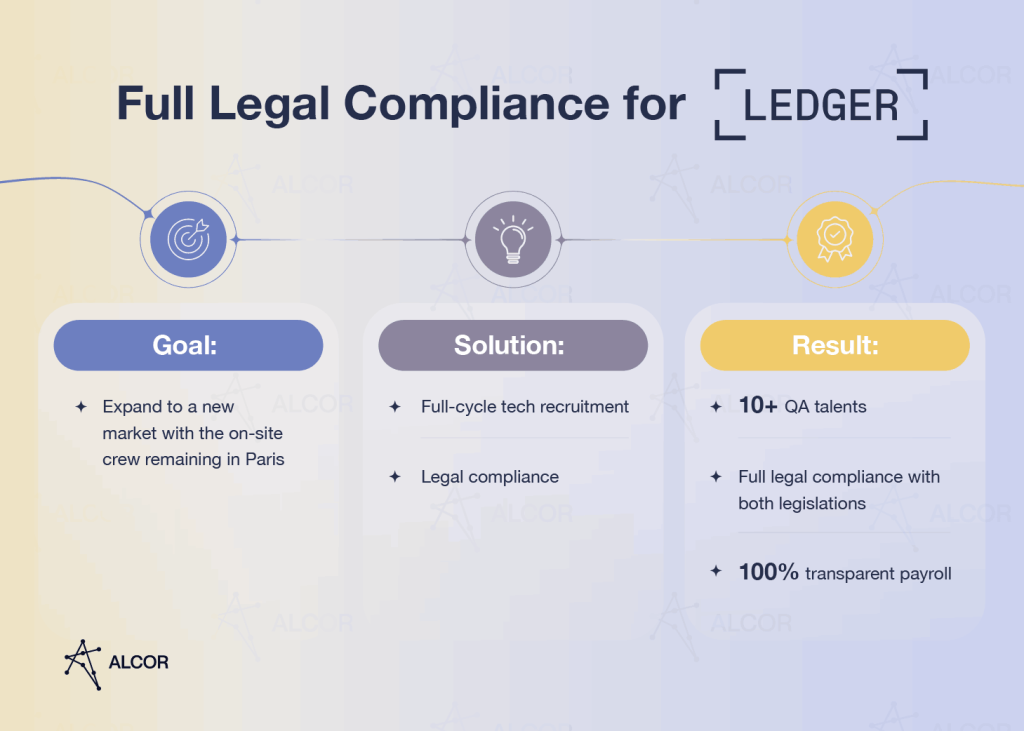
How it works in practice: Ledger needed QA specialists who could own both testing depth and cross-team coordination as it scaled abroad. With our support, they built a high-performing unit of 10+ QA talents – vetted for exactly that mix – and secured full legal and compliance coverage along the way.
Tap into a foreign talent pool for rare expertise
Tapping into a foreign talent pool means recruiting for rare expertise – in AI, DevOps, fintech security, and other hard-to-find domains – whether that means to hire software developers from Latin America in hubs like São Paulo and Bogotá, or sourcing talent in Eastern European hubs like Kyiv. This expands both the size and the skill diversity of a software engineering team, often at 30–50% lower employment costs than hiring the same roles in the US.
According to Alcor’s 2026 recruitment team research, Eastern Europe and Latin America together are home to over 4.3 million tech professionals – 2 million+ across Poland, Romania, Bulgaria, and Ukraine, and 2.3 million+ across Mexico, Colombia, Argentina, and Chile. Both regions also rank among the world’s most active startup ecosystems, with 38 unicorns founded across Alcor’s LATAM markets alone, according to the StartupBlink 2026 Startup Ecosystem Report.
Reaching beyond home turf means stepping outside one country’s supply-and-demand curve for a given skill set – which is exactly why sourcing rare expertise abroad has become standard practice for fast-scaling engineering teams.
Are you interested in expanding your team in Mexico specifically? Check our software development in Mexico breakdown for 2026.
Set ambitious yet realistic goals for your developers
Business goals matter, but they only get delivered through your software engineers – which makes individual goal-setting just as important as tracking overall team growth. The SMART framework works well for setting goals for software engineers, since it forces specificity instead of vague aspirations.
Goals for developers typically fall into five categories, each split into short-term and long-term versions:
- Career goals
- Technical goals
- Interpersonal goals
- Leadership goals
- Community goals
Establish clear communication
Clear, consistent communication keeps a development team aligned – and it matters even more for remote teams, who don’t have hallway conversations to fall back on. Tools like Slack, Notion, and Jira help, but the rituals around them make the real difference.
The rituals that matter most:
- Weekly team check-ins to keep everyone aligned
- Monthly one-on-ones to surface what’s working and what isn’t
- Honest, regular feedback – sugarcoating undermines productivity faster than direct feedback ever does
In short: be clear, be kind, be consistent.
Create a pleasant work environment
Overtime and unsustainable workloads are a real burnout risk in software development, and burnout shows up fast as lower performance, lost motivation, and quiet quitting. Prioritizing work-life balance for developers is a direct way to prevent it.
That typically means:
- Flexible working hours
- Fair, regular compensation reviews
- Strong benefits packages
- Real opportunities for growth
Culture matters just as much. According to Alcor’s recruitment team, culture fit is a consistent contributor to Alcor’s 98.6% probation pass rate – not as the sole driver, but working alongside a rigorous hiring process: clear expectations set early, structured onboarding, and close collaboration between recruiters, hiring managers, and the client team. Technical skill gets someone hired; how well they fit the team is often what determines whether they integrate and succeed.
Team cohesion reinforces all of this. A development team performs best when trust, mutual support, and shared responsibility are part of daily practice – built through consistent communication, team rituals, and shared ownership of outcomes.
Competitive employee value proposition
A first-rate Employee Value Proposition (EVP) is no longer optional when you’re competing for senior developers who can pick from a dozen offers. Salary still matters, but the edge often comes from benefits that speak to long-term upside and daily quality of life.
Why developers say yes:
- Market-matched basics: remote-first policies, learning budgets, and private health cover keep you level with top competitors
- True ownership: stock-option plans turn engineers into partners, not renters. The promise feels real when backed by clear vesting schedules and fair exercise windows
- PTO and professional development: according to Alcor’s recruitment team, work-life balance and professional development support – learning budgets, certifications, conferences – are the benefits candidates ask about most consistently, at both mid-level and senior levels
- Autonomy and influence for senior roles: as observed by Alcor’s recruitment department, for Engineering Managers, Architects, and Tech Leads specifically, remote flexibility, autonomy without micromanagement, technically challenging work, and the ability to shape product or technical direction often outweigh raw compensation as deciding factors – while mid-level developers are swayed more by learning and career-growth opportunities.
Opt for software development in Ukraine and save up to 56% on expenses while offering a generous benefit package. Contact us for details!
Scale Up Your Software Development Team with Alcor
Alcor offers a software R&D center solution for tech companies that want to scale engineering teams in Latin America and Eastern Europe without opening a local entity or slipping into outsourcing mode. The model runs on three engines: tech recruitment to hire the right specialists, EOR/COR to employ or engage them compliantly, and operational support to keep the team running smoothly – from equipment and HR to benefits, payroll, and day-to-day coordination.
Whether you’re an early-stage startup, a scaling product company, or a mature enterprise, building software engineering teams abroad brings the same core challenges: filtering through unqualified candidates, poor cultural fit, language mismatches, and unclear hiring processes in an unfamiliar market.
Alcor removes each of those obstacles for teams building software development in Latin America – including hiring developers in Argentina, Mexico, Colombia, and Chile – and across Eastern Europe, including Poland, Bulgaria, Ukraine, and Romania, by handling sourcing, compliance, and operations end-to-end through a single software R&D center solution.
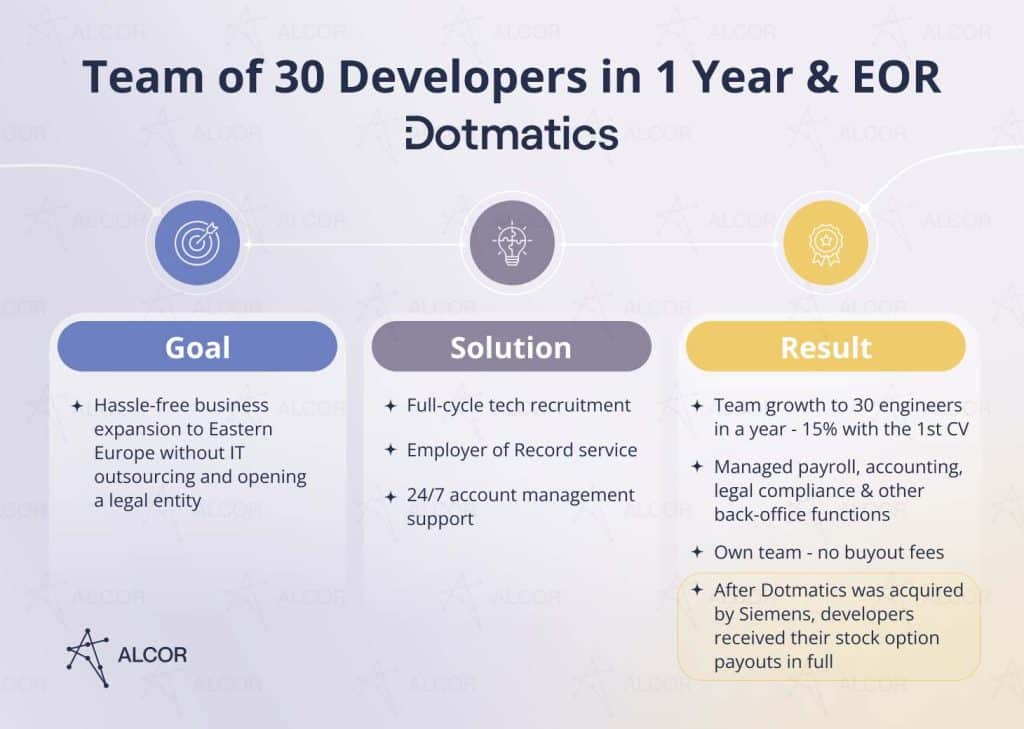
Here’s how it works in practice: Dotmatics, a Boston-based scientific R&D software company, needed to build an engineering team in Eastern Europe with full IP control and no intermediary layer – outsourcing wasn’t an option given the technical depth of their platform. Alcor delivered across three dimensions:
- Silicon Valley-grade recruitment: Alcor’s team of top researchers and headhunters ran full-cycle recruitment across Alcor’s 325,000+ candidate network, filling roles across Director of Engineering, Full Stack, React, QA Automation, DevOps, and Node.js. First CVs landed within 3–5 days, with 80% approved – building a 30-engineer team in 12 months.
- EOR/COR: With no legal entity in Eastern Europe, Alcor built Dotmatics a dedicated development center, with an Employer of Record package covering payroll, accounting, legal compliance, onboarding and offboarding, and benefits management – backed by a dedicated Customer Operations Manager available as a single point of contact within one business day.
- Ongoing operational support: Alcor also procured laptops for the team, while also offering employer branding support on demand for clients who need it. When Siemens acquired Dotmatics in 2025 for $5.1 billion, Alcor made sure every developer’s stock options paid out in full, with no delays.
Ready to build a team like this? Let’s get in touch, and we’ll map out what it takes to scale your engineering team in Latin America or Eastern Europe.
FAQ
What are the key roles in a software development team?
Key roles in a software development team include Product Manager, Product Owner, Tech Project Manager, Business Analyst, Engineering Manager, Tech Lead, Team Lead, Software Architect, Software Developer, UX/UI Designer, and QA Engineer. Together, these roles cover two connected tracks: product (strategy, requirements, user needs) and engineering (architecture, coding, delivery, and testing). Each role owns a distinct slice of the work, and unclear ownership between similar roles – like Tech Lead and Team Lead – is a common source of delivery problems.
What makes a great software development team?
A great software development team combines technical discipline, genuine cross-functionality, and direct access to real users, rather than relying on individual talent alone. High-performing teams build in slack time for problem-solving, share a common definition of “done,” actively share knowledge across the organization, and treat meetings as real conversations that drive decisions. These habits help teams solve problems faster, avoid silos, and keep product quality consistent without constant oversight.
What are the best tips for building a strong software development team?
Building a strong software development team starts with a clear scaling vision and defined roles before recruiting begins. Prioritize T-shaped developers, tap into foreign talent pools in Eastern Europe and LATAM for rare expertise at lower cost, and set ambitious yet realistic goals for engineers. Establish clear communication rituals, create a healthy work environment to prevent burnout, and offer a competitive employee value proposition that goes beyond salary.
How much does it cost to hire software developers in the US, LATAM, and Eastern Europe?
According to Alcor’s 2026 engineer compensation research, average monthly developer salaries range from $9,383 (Middle) to $16,056 (Lead) in the US, $4,283 to $7,481 in Eastern Europe, and $3,615 to $6,476 in LATAM. Even at the senior tier, hiring in Eastern Europe cuts payroll by roughly 50%, while LATAM delivers closer to 56% in savings compared to the US, without compromising quality.
What are the most in-demand emerging roles in software development teams?
The most in-demand emerging roles are DevOps Engineer, AI Engineer, MLOps/AI Infrastructure Engineer, LLM Engineer, and Platform Engineer. According to Alcor’s recruitment department research, AI/ML role requests nearly tripled between 2024 and 2026, now making up almost 13% of all requests. These roles emerged to help teams ship faster, scale AI models reliably, reduce deployment risk, and keep pace with cloud infrastructure and real-time data demands.
How would you rate this article?
Alcor is Your Trusted Scaling Partner
for expansion
support