

Hire AI Developers
Your AI tech team hired from scratch
- 30+ elite engineers in 3 months, 100+ in a year
- Up to 40% cost savings
- No need to set up a legal entity
- Fully managed back-office
- No buyout costs or hidden fees
- Your direct management and corporate culture


 Mexico
 Colombia
 Argentina
 Chile
Chile Poland
 Romania
 Ukraine
 Bulgaria
High-Speed Recruiting to Build a Senior AI Engineering Team
developers in 1 month
developers in 3 months
Trusted by VC-Backed Visionaries
















How Our Clients Transform by Partnering With Us?



Hire Top-1% AI Developers that Stay For Good

2-6 weeks
to close a vacancy
80% of candidates
are approved by clients
98.6%
probation pass rate
2.5 years
average tenure
8 CVs
to get 1 accepted offer
5 business days
to send you first CVsClients Love Us. Teams Do Too.
“The Alcor team has always been supportive and approachable whenever assistance was needed. Rather than feeling like an external resource, engineers working through Alcor are able to integrate closely with the client’s teams. This creates a more collaborative environment and allows engineers to have a greater impact.”

“My overall experience has been outstanding. Alcor’s model offered the right balance — strong operational support combined with genuine ownership and long-term collaboration. In this model, I am a core member of the team. Rather than rotating between projects, I can invest meaningfully in improving the product and establishing processes that deliver lasting value.”

“Whenever I’ve had tricky bank requests or needed extra documentation, Alcor has resolved everything rapidly. I also love their support with business trips and expense tracking—it’s incredibly convenient. Their team is always available via messenger and ready to help. Highly recommended for anyone who wants a hassle-free professional life!”

“Alcor has been a reliable partner throughout, especially in complex situations. Issues are resolved quickly — often within minutes or hours. Their ability to adapt and support us in complex situations has made a real difference for our team.”

How the Engine Works

Targeted sourcing (not mass outreach)
We build curated, role-specific pipelines instead of high-volume outreach.
Supported by internal domain experts, candidates are pre-screened for real-world technical capability before entering your interview process.

In-house recruiting infrastructure
Built on a team of 40+ in-house technical recruiters, specialized by region and role.

AI-supported qualification
Our recruiters focus on evaluating technical fit, while market mapping, candidate identification, and signal filtering are handled by internal AI tools.
Every CV is approved by a senior tech recruiter before it reaches your inbox.
Why Hire AI Engineers in Latin America and Eastern Europe
Why companies hire AI engineers in 2026
AI adoption is now a business priority
Artificial Intelligence has moved from roadmap experiment to production requirement. US private AI investment reached $285.9 billion in 2025 – according to Stanford’s 2026 AI Index Report, that’s more than 23 times China’s investment in the same year. Companies across fintech, healthtech, SaaS, and e-commerce are shipping generative AI features, NLP-driven interfaces, predictive analytics engines, and automation workflows for platforms at scale. Engineering teams are being asked to ship AI-native features on timelines that weren’t realistic two years ago.
The bottleneck is supply – for the first time, AI skills have surpassed all others to become the #1 hardest role category for employers to fill globally, according to ManpowerGroup’s 2026 Talent Shortage Survey. AI developers who can take a model from prototype to production are scarce, and the companies that move fastest on hiring are the ones building the most defensible products and platforms right now.
Common business cases for hiring AI developers
Companies hire AI developers to build systems that create measurable leverage across the product. The most common use cases:
- AI copilots – internal tools that accelerate developer, support, or sales workflows
- Intelligent chatbots and virtual agents – customer-facing automation for support, onboarding, and lead qualification
- Recommendation engines – personalization layers for content, product, and UX
- Fraud detection and risk scoring – real-time inference in payments, insurance, and lending
- Predictive analytics – demand forecasting, churn modeling, anomaly detection
- Document processing and extraction – contracts, invoices, medical records, legal filings
- AI-powered search – semantic and vector search across large knowledge bases and product catalogs
- Voice assistants and speech interfaces – for consumer apps and enterprise tooling
- Computer vision systems – identity verification, quality control, object detection
If any of these use cases are on your roadmap, the hiring decision is usually already made. The question is how fast you can get the right remote AI developers in place.
Types of AI developers you can hire
Machine Learning engineers
Machine Learning engineers design, train, and deploy predictive models at production scale. ML engineers build end-to-end data pipelines, select and tune algorithms, and maintain model performance in live environments, using a core stack that includes Python, TensorFlow, PyTorch, Scikit-learn, SQL, cloud platforms, and data science fundamentals. If your product depends on predictions, ranking, recommendations, or anomaly detection, ML engineers are who you need.
Generative AI developers
Generative AI developers specialize in building and fine-tuning large language models, diffusion models, and multimodal systems, and their work spans LLM fine-tuning, RAG pipelines, agentic AI frameworks, and prompt engineering at scale. Deep knowledge of transformer architectures and Hugging Face ecosystems sets Generative AI developers apart. High demand for AI copilots, code assistants, intelligent chatbots, and content generation workflows.
NLP engineers
NLP engineers build systems that process, understand, and generate human language – from semantic search and entity extraction to sentiment analysis and machine translation. NLP developers work with transformer-based models, tokenization pipelines, and domain-specific language fine-tuning. If your product involves text, voice, or language data at scale, NLP is a dedicated specialty – the depth required for production-grade language systems goes beyond what most generalist Machine Learning engineers cover.
Computer Vision engineers
Computer Vision engineers build systems that interpret visual data: images, video feeds, and real-time camera input. Computer Vision developers’ work spans CNNs, object detection models (e.g., YOLO), OCR, video analytics, and OpenCV-based pipelines. Typical use cases: identity verification, medical imaging, quality control, and autonomous systems. Core stack: Python, PyTorch, TensorFlow, and OpenCV with hardware-aware deployment tooling.
AI Integration specialists
Artificial Intelligence integration specialists connect AI technologies to your existing product and infrastructure. AI integration specialists don’t always build models from scratch – their value is in making Artificial Intelligence capabilities work reliably inside your software stack: APIs, microservices, MLOps pipelines, and data workflows. If you’re embedding third-party LLMs or deploying in-house models into production systems, the AI integration role bridges the gap between model development and real-world delivery.
Key skills to look for in AI developers
Technical titles in Artificial Intelligence often hide large differences in actual capability. Two remote developers can both list PyTorch on a resume and operate at completely different levels.
Machine Learning and Deep Learning expertise
The foundation. A strong Machine Learning engineer understands model architecture selection, not just implementation – they can explain why a given approach fits the problem, not just how to run it. Look for hands-on experience with Python, TensorFlow, and PyTorch, plus a solid grounding in deep learning concepts: CNNs, RNNs, and Transformer architectures. Proficiency with scikit-learn matters for classical Machine Learning tasks. The real signal: can they debug a model that’s degrading in production, or only one that fails during training?
Data Processing and Model Training
Artificial intelligence models are only as good as the data pipelines behind them. Strong candidates understand end-to-end data workflows – ingestion, cleaning, feature engineering, and validation – not just model training. Look for experience with experiment tracking tools (MLflow, Weights & Biases), data versioning (DVC), and distributed training at scale. Critical red flag: engineers who can train a model on clean benchmark data but have never dealt with messy, real-world datasets. SQL proficiency and data engineering fundamentals are non-negotiable.
LLM, RAG, and Agentic AI experience
The highest-demand skill cluster in 2026. Experienced candidates know the difference between fine-tuning an LLM, engineering prompts at scale, and building a RAG pipeline – and they know which approach fits which problem. Strong RAG experience means working with vector databases (Pinecone, Weaviate, Qdrant), embedding models, and retrieval optimization, not just wiring together LangChain tutorials. Agentic Artificial Intelligence adds another layer: multi-agent orchestration, tool use, and the management of non-deterministic behavior in production. If your roadmap includes AI copilots, intelligent search, or workflow automation, this is the skill set that determines whether those features ship or stall.
Cloud, MLOps, and Production Deployment skills
The gap between a working model and a production-grade Artificial Intelligence system is where most teams lose time. Look for hands-on experience with cloud Machine Learning platforms – AWS SageMaker, GCP Vertex AI, or Azure Machine Learning – and solid MLOps fundamentals: CI/CD pipelines for model deployment, containerization with Docker and Kubernetes, and automated retraining workflows. Equally important: experience monitoring model performance post-deployment, tracking data drift, and managing inference latency and cost at scale. Engineers who can only train models but can’t operationalize them create bottlenecks that the rest of the team pays for.
Security, Compliance, and Responsible AI knowledge
Often the last skill evaluated – and increasingly the one that matters most, especially for fintech, healthtech, and any product serving EU or US-regulated markets. Strong candidates understand data privacy frameworks (GDPR, HIPAA, and where applicable, CCPA for California-facing products), model-level security risks – prompt injection, adversarial attacks, model inversion – and explainability frameworks like SHAP and LIME. With the EU AI Act moving through phased implementation – prohibitions in force since August 2024, GPAI obligations since February 2025, and high-risk system requirements coming into effect August 2026 – companies building AI-powered products for European users increasingly need engineers who can assess regulatory risk, not just ship features.
Best countries to hire AI developers
Latin America
Mexico:
- 974,500+ tech talent pool
- ~58% more affordable salaries than in the US. For example, senior AI developers earn about $7,400 per month in Mexico vs $19,000 in the US
- Co-leads Latin America in Artificial Intelligence research – Brazil and Mexico together account for 68% of the region’s active Artificial Intelligence researchers
- Tec de Monterrey and UNAM rank among the strongest Machine Learning universities in the region
Colombia:
- 202,000+ tech talent pool
- ~60% more affordable salaries than in the US. For example, senior AI developers earn about $7,250 per month in Colombia vs $19,000 in the US
- Government AI Roadmap, led by MINCIENCIAS, targets 50% Artificial Intelligence adoption across private and public sectors in Colombia by 2031 – backed by up to €20M in annual funding
- Universidad de los Andes (Bogotá) and EAFIT (Medellín) are the region’s strongest feeders of AI and Machine Learning engineering talent
Argentina:
- 176,000+ tech talent pool
- ~66% more affordable salaries than in the US. For example, senior AI developers earn about $6,000 per month in Argentina vs $19,000 in the US
- 23,200+ tech graduates annually, with AI/ML as the fastest-growing specialization
- One of 5 countries generating 90% of Latin America’s Artificial Intelligence scientific publications
Eastern Europe
Poland:
- 778,800+ ICT specialists
- ~51% more affordable salaries than in the US. For example, senior AI developers earn about $8,650 per month in Poland vs $19,000 in the US
- Polish ranked #1 globally for Artificial Intelligence models prompting effectiveness across 26 languages
- National AI development policy runs through 2030 targeting CEE leadership
Romania:
- 207,800+ ICT professionals
- ~53% more affordable salaries than in the US. For example, senior AI developers earn about $7,025 per month in Romania vs $19,000 in the US
- UiPath – the world’s leading RPA and AI automation platform – was founded in Bucharest, making Romania a proven Artificial Intelligence product market
- Ranked 3rd globally for developer quality, and #1 in Europe and 6th globally for certified IT specialists per 1,000 residents
Ukraine:
- 305,000+ tech talent pool
- ~59% more affordable salaries than in the US. For example, senior AI developers earn about $7,000 per month in Ukraine vs $19,000 in the US
- 6,100 AI developers, growing 17% in two years – deepest expertise in NLP, computer vision, and tabular Machine Learning – majority at middle-to-lead seniority
- Scored a perfect 100 in AI Vision on the 2026 AI Readiness Index – ranking among the top globally in Artificial Intelligence policy and planning
How much does it cost to hire AI developers
Factors that influence AI developer rates
- Specialization and technical stack
The broader “AI developer” label covers a wide range of compensation. Machine Learning engineers and data scientists sit at the base of the range. LLM engineers, Generative AI specialists, and MLOps engineers with production-scale deployment experience command a premium. Domain-specific expertise – fintech fraud systems, medical imaging, agentic AI pipelines – adds another layer on top. The more difficult the stack is to hire for, the more the market charges.
- Experience level
The gap between mid-level and lead roles is substantial across all regions. In the US, mid-level AI product engineers earn around $13,750 per month, while leads earn approximately $22,500. In Eastern Europe, the same range runs from $5,188 to $10,025.
- Location
US salaries for senior AI developers are 2-3x higher than Eastern Europe and LATAM – without a comparable gap in output quality for most product engineering contexts. Hiring AI engineers in Ukraine, Poland, Romania, Argentina, Colombia, or Mexico saves approximately $130,000-$180,000 per engineer annually – capital that goes back into product, infrastructure, or your next hire.
Hidden costs to consider before hiring
Base salary is the starting point, not the full picture. The actual annual cost per AI developer includes:
- Taxes and statutory contributions – employer-side labor costs vary by country but typically add 15-30% on top of gross salary in Eastern Europe and LATAM.
- Benefits package – health insurance, hardware, professional development, and perks. The standard package in Eastern Europe and LATAM runs approximately $6,350-$6,500 per engineer per year. The US equivalent: ~$15,400.
- Recruitment fee – specialist AI recruiting for seniors typically costs 20% of annual gross in Eastern Europe or LATAM, and 30% in the US.
- EOR service fee – if you’re hiring without a local legal entity, an Employer of Record handles payroll, tax filings, compliance, and employment contracts. The industry standard in 2026 is approximately $400-700 per employee per month on a flat model, or 10-25% of gross salary on a percentage-based model.
Alcor’s pricing is structured differently. Instead of a flat per-head fee, costs scale down as your headcount grows – the larger the team, the lower the per-engineer rate. For companies building AI teams of 10, 20, or 30+ engineers, this creates material savings that standard EOR providers don’t offer.
Salary comparison: EE, LATAM, US
Senior remote AI developers in Eastern Europe cost 50-61% less than their US counterparts. In LATAM, the gap is 54-64%. On a 10-person AI team, that difference in base salary alone exceeds $1 million per year. See the difference for yourself:
|
Senior Developers’ Average Gross Monthly Salaries |
|||
|
Eastern Europe |
LATAM |
US |
|
| AI Product Engineer |
$7,763 |
$6,875 |
$19,000 |
| ML Engineer |
$7,175 |
$6,588 |
$18,500 |
| MLOps Engineer |
$7,863 |
$7,163 |
$15,750 |
| Data Engineer |
$6,250 |
$6,188 |
$14,750 |
Hiring models for AI development teams
Staff Augmentation
Staff augmentation solution means adding individual AI developers to your existing team on a contract basis. The engineers work under your direction, integrate into your sprint cycles, and report to your leads – but they remain employed by the staffing provider.
It’s a practical solution when you need to fill a specific skill gap quickly and temporarily without committing to a full headcount expansion. A team that needs one senior MLOps engineer or a specialist in computer vision for a defined project phase is a natural fit.
The tradeoff: staff augmentation solution is optimized for flexibility, not stability. Contract engineers have less skin in the product, and churn risk is higher than with fully employed team members. For companies building long-term Artificial Intelligence capabilities – not plugging short-term gaps – it’s rarely the most efficient path.
Employer of Record (EOR)
An Employer of Record solution lets you hire dedicated AI developers in Eastern Europe or Latin America without setting up a local legal entity. The EOR becomes the legal employer of your remote full-time developers in your chosen country, handling employment contracts (FTE or B2B), payroll processing, tax filings, and statutory compliance, while your remote engineers work entirely under your direction.
The EOR solution is purpose-built for companies that want to hire internationally but can’t justify the 3-6 months typically required to incorporate abroad.
The key distinction when evaluating EOR providers: most are general-purpose platforms built for any industry, any role. Alcor’s EOR solution is built exclusively for tech – every compliance setup, benefits structure, and support model is designed around engineering teams, not generic global workforce management. Onboarding through Alcor’s EOR solution takes only 10 business days – your remote engineers are legally compliant from day one, with full IP assigned to your company.
Dedicated Development Center
A dedicated development center – also referred to as an offshore development center – is the most complete solution for companies building a serious, scalable AI engineering capability abroad. If you want to hire dedicated AI engineers through a dedicated center solution, you will get a fully built, fully operated remote team: recruited to your spec, employed compliantly, and supported operationally from day one.
Remote engineers in a dedicated center are sourced, employed, and supported by a vendor like Alcor that covers everything from tech recruitment and onboarding to payroll and legal compliance. Day-to-day, developers report directly to your engineering leads, work inside your roadmap, and align fully with your team’s culture and velocity. The distinction from outsourcing is fundamental: this is your team, located abroad, not a third party delivering outputs on a statement of work.
How Alcor helps companies hire AI developers
Alcor’s software R&D center solution combines full-cycle tech recruitment, Employer of Record, and operational support under a single engagement.
Access to AI talent in Eastern Europe and LATAM
Alcor helps US tech product companies find the right AI developers for hire across Eastern Europe and LATAM. Our tech recruitment is built entirely in-house – 40 tech recruiters and a 325,000+ candidate database. Every search is run by people who interview AI developers daily and know the difference between a candidate who can demo a model and one who can own it in production.
- First CVs in 3–5 business days (pre-vetted, calibrated to your job description, ready to interview);
- Roles closed in 2–6 weeks (across Machine Learning engineers, LLM specialists, MLOps, computer vision, and generative AI roles);
- 8 CVs to 1 guaranteed offer;
- 98.6% probation success rate;
- 2.5+ year average engineer tenure;
- Optional tech assessment.
Full operational support
Once your AI team is hired, Alcor handles everything that sits between your developers and their ability to do their best work. Everything a senior AI engineer expects from a well-run employer, delivered without you having to manage it: procurement & office rent, insurance provision, full sysadmin support, EVP consultation, employer branding, HR services, and hardware. And if you decide to hire remote AI developers, Alcor also supports WFH setup and co-working space arrangements.
AI hiring success stories
Tech product unicorns like Backstory (ex-People.ai), Sift, and Ledger used this model to build their high-performing engineering teams in Eastern Europe faster and spend less than hiring equivalent talent in the US, without the overhead of managing multiple vendors or setting up foreign entities.
The outcomes speak for themselves:
- Backstory (ex-People.ai) – backed by Andreessen Horowitz and Y Combinator, this $1.1 billion AI unicorn got a full R&D office in Ukraine in one month, with 25+ AI specialists hired and a 98.6% probation success rate.
- Sift – backed by Insight Partners, this ML-powered fraud detection unicorn had 30 top-10% engineers hired in 12 months and scaled its R&D center to 51 engineers across Ukraine and Poland with Alcor.
- Ledger – backed by 10T Holdings with $577M raised, this crypto security unicorn placed 10+ QA engineers at 4.5 weeks per role average, with full Eastern European legal compliance from Alcor.
Ready to Build Your AI Engineering Team?
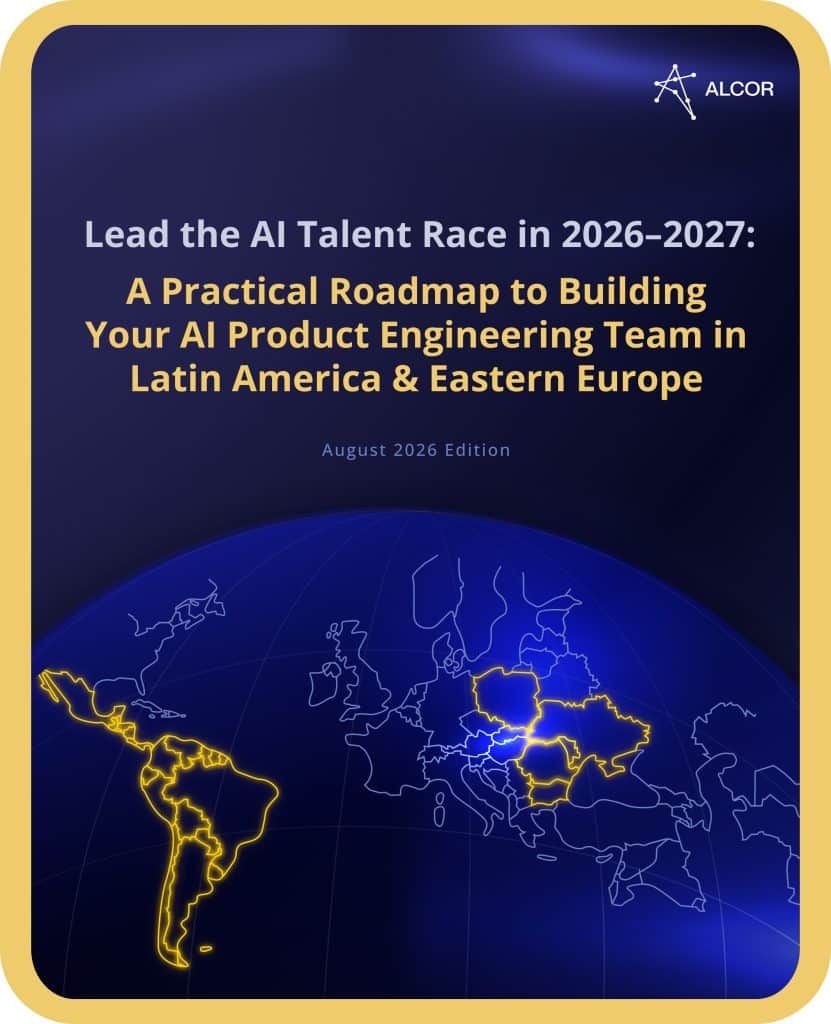
While your competitors are stuck fighting over the same domestic AI talent for months, this guide shows you where to build your AI engineering team twice as fast and save up to 66% on base salaries alone.
Industries we hire for
Your Dedicated Hiring Squad









Choose Your Hiring Mode
Direct Hiring
Recruiting-only service based on a success fee
Recruitment + EOR
Compliant solution for setting up a team of engineers abroad
If You’re Ready for Something Bigger
Software AI R&D Center
Contact usOperational Support
- Procurement & office rent
- Insurance provision
- IT support
- Employer branding
- HR services
Employer of Record
- 100% compliance
- Onboarding/offboarding
- Payroll & accounting
- Remitting remuneration
- Benefits management
Optional Add-ons
-

Premium legal support
Unlimited liability coverage, IP & data security guarantees, immediate IP transfer, legal consultations -
Benefits management
PTO, health insurance, parental leave, mental health, gym memberships, and remote work options -
Procurement
Procurement, setup, maintenance, and repair of all hardware types for your tech team -
Office rent
Support with office or coworking rentals, lease signing, and local payment management -
Employer branding
Boost your brand visibility in local IT markets to attract and retain top tech talent -
HR services
HR policies, HRIS setup, well-being programs, surveys, and internal team events



Hiring AI Developers Have Never Been So Easy
When you have a trusted partner that accelerates your growth hassle- and risk-free
- From 0 to 100+ AI engineers a year
- End-to-end recruitment and guidance
- Employment, payroll, benefits
- Hardware procurement and office lease
- No buyout or other hidden fees
- Your team from day one. Your management. Your culture.
FAQ about Hiring AI Engineers in Latin America and Eastern Europe
Are there hidden red flags to look out for in AI developers?
The most common red flag in AI developers is strong benchmark performance with no production experience – candidates who can train models in controlled environments but have never deployed, monitored, or debugged them at scale. Other signals to watch: inability to explain architectural decisions beyond tool names, no experience with data drift or model degradation in live systems, and shallow familiarity with MLOps practices.
Alcor’s 40 in-house tech recruiters screen AI engineers specifically for production readiness – not just stack depth. Every candidate goes through a technical evaluation calibrated to your role before the first CV reaches you, which is why Alcor maintains an 80% CV acceptance rate and 98.6% probation success rate across all AI and engineering hires.
How fast can Alcor hire and onboard AI developers?
Alcor keeps a live pipeline of AI engineers for hire – first pre-vetted CVs delivered in 3-5 business days of kick-off. Most roles are closed within 2-6 weeks. For companies needing to scale fast, Alcor can build an AI team from 10 to 30 engineers within 90 days.
Once hired, Alcor onboards developers through its Employer of Record solution in 10 business days – covering employment contracts, payroll setup, and full legal compliance in Eastern Europe or LATAM, with no entity setup required on the client’s side.
Is Alcor an outsourcing software development partner?
Alcor is not an outsourcing company. Alcor is a tech recruitment, Employer of Record, and operational support partner – the model is the opposite of outsourcing. AI developers hired through Alcor’s solution are your direct employees in all but legal form: they report to you, work on your roadmap, and operate as a fully integrated part of your engineering organization.
There is no vendor layer, no managed delivery team, and no statement-of-work structure. Alcor handles hiring, compliance, payroll, and operations – your team handles the product. Companies that hire remote AI engineers through Alcor’s EOR solution retain full IP ownership and direct management control, with no markups or buyout fees that outsourcing models typically carry – saving up to 40% compared to outsourcing costs. And if you ever want to bring the team fully in-house, Alcor makes it straightforward: take your team with you – fully transferable after 6 months.
What are retention rates of AI engineers at Alcor?
AI developers hired through Alcor’s solution stay with client teams for an average of 2.5+ years – significantly above the industry norm for offshore and nearshore engineering talent. Alcor’s EOR solution carries a 9.1 NPS, which also means developers who join through Alcor’s process are calibrated matches – not high-volume placements.
Does Alcor deliver culturally aligned AI talent?
Alcor sources AI developers from Eastern Europe and Latin America – regions with decades of deep integration into US and European product engineering culture. Remote developers hired through Alcor’s solution are accustomed to working directly with US-based CTOs and product leads, participating in sprint cycles, and communicating in English at a professional level.
Cultural alignment is evaluated before a candidate moves further in the process – not at the offer stage. Alcor’s recruiters assess English communication level, collaboration style, experience working within US or European product teams, and overall cultural fit with the client’s engineering culture. Candidates who don’t meet the bar on these dimensions are filtered out early, so the CVs that reach you represent engineers who are as aligned on culture as they are on technical skill.